How to drive SEO success with headless CMS

Since its rising popularity around 2015, headless CMS has been a buzzword for many organizations.

This web management concept was meant to reduce friction between content managers and dev teams and empower digital marketers to improve their access to tackling SEO initiatives.

So what is this new(ish) concept that has digital marketing teams hassling web developers about? Can it really improve the way we do SEO?

What is a headless CMS?

Simply put, a headless CMS is a content management system that separates the process of creating and managing content from how it is presented on websites or applications. 

It gives marketers more flexibility in delivering content to different devices and platforms, resulting in faster loading times and the ability to create personalized experiences.

How headless CMS works in practice

Imagine having a React JS site where your content changes must go through your dev team. Then you have to wait for their sprint to push to production. How long does that usually take you?

Headless CMS platforms help solve this problem for organizations by removing that dev barrier. 

With a headless CMS setup, content marketers can publish new content and edit existing content from a normal CMS like WordPress or even a custom-built CMS. 

Any content added into the headless CMS sends that content to the main website through API integration. The dev team creates sections for the content to populate.

How a headless CMS works in practice

How a headless CMS benefits organizations and SEO

Headless CMS platforms have been providing significant efficiency solutions since their adoption. Some of the most common benefits for organizations and SEOs include:

Ability to scale content production

With a fully decoupled CMS, SEOs can focus on optimizing the content without worrying about traditional CMS constraints.

They can easily collaborate with content creators, streamline workflows, and rapidly scale content production across various platforms and channels. 

Improves dev/SEO relationships

The separation of the headless CMS and core web platform fosters a more harmonious working environment.

SEOs can efficiently optimize content for search engine visibility without disrupting the development process. 

Additionally, headless CMS platforms often provide SEO-friendly features and integrations, such as structured data support and customizable URLs, enabling SEOs to implement their strategies seamlessly. 

By streamlining the content creation and optimization workflow, headless CMS empowers both SEOs and developers to work together more effectively, leading to improved search rankings, enhanced user experiences and, ultimately, a stronger online presence.

Improved web security

Headless CMS significantly enhances web security by decoupling the presentation layer from the backend infrastructure. 

A headless CMS does not rely on built-in templates or themes unlike traditional CMS solutions. Instead, it provides content through an API, allowing developers to build front-end applications using any technology stack. 

This separation of concerns ensures that sensitive backend systems, such as databases and server infrastructure, are shielded from direct exposure to the web. 

Faster load speeds

Since the front end is no longer tightly coupled to the CMS, developers can build lightweight and efficient web applications. 

Headless CMS platforms can deliver content directly to the user interface by leveraging APIs, reducing the complexity and overhead associated with traditional CMS architectures. 


Get the daily newsletter search marketers rely on.


How Google feels about headless CMS

Google is agnostic to which CMS you decide to use, according to John Mueller, Google’s Senior Search Analyst. In a 2022 video on YouTube, Mueller stated that Google doesn’t look for specific CMS signals to use in its algorithm. 

In theory, this principle could also be applied to headless CMS, meaning it will have neither a positive nor a negative direct impact on your SEO efforts. Headless CMS is just one more tool to create web content. 

Best practices for SEO with headless CMS

Ensure schema, metadata, and URL structure carries over

If your headless CMS uses a plugin to manage schema, titles and meta descriptions, and URL structure, make sure this information carries over to the compiled site.

Your dev team can pull those data points via the API to ensure it compiles correctly. 

Validate that the content is mobile-friendly

Even though the main site might be mobile-friendly, sometimes adding certain imagery may not translate well once the site is compiled.

Always make sure to spot-check your content before publishing. 

Compile content to webpage prior to fetch

Using fetch and render tests, ensure your page content is included in the fetch and has minimal changes between the fetch and render.

While Google uses the rendered content in its algorithm, it’s always best practice to ensure your website provides server-side rendering.

Have new content update XML sitemap

While most CMS platforms have systems to create dynamic sitemaps, they may not inherently translate to headless CMS systems.

Work with your dev team to ensure that any new or updated content dynamically reflects in the XML sitemap.

Improve your SEO performance with a headless CMS

Adopting a headless CMS can benefit organizations, including improved SEO performance.

By understanding what a headless CMS is and how it works in practice, organizations can harness its power to scale content production, foster better collaboration between developers and SEO professionals, enhance web security, and achieve faster load speeds. 


Opinions expressed in this article are those of the guest author and not necessarily Search Engine Land. Staff authors are listed here.


Related stories

New on Search Engine Land

@media screen and (min-width: 800px) { #div-gpt-ad-3191538-7 { display: flex !important; justify-content: center !important; align-items: center !important; min-width:770px; min-height:260px; } } @media screen and (min-width: 1279px) { #div-gpt-ad-3191538-7 { display: flex !important; justify-content: center !important; align-items: center !important; min-width:800px!important; min-height:440px!important; } }

About the author

John McAlpin

John McAlpin has nearly a decade providing advanced SEO consultations to health organizations across the United States. John is deeply engaged in both the local and national SEO community and has a strong background in technical SEO, web development, and digital marketing strategy. McAlpin also provides freelance web development services for WordPress hosted sites.

https://searchengineland.com/headless-cms-seo-success-428202


How to write a meta description that gets clicks

Like all beautiful yet hard-to-perfect things in life, writing effective meta descriptions is hard work.

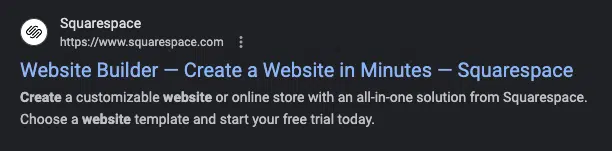
A critical HTML element of every webpage, a meta description is a summary of a page’s content that helps inform users and search engines about what’s on a page.

It appears in search as a snippet beneath the blue, clickable link to indicate what is on the page.

Your meta description is one of the first things people see when using organic search.

While it may be tough to construct the perfect meta description, you should not ignore it. 

Each significant page of your website should be effectively summarized in its meta description – indicating what’s behind that blue link on the SERP and what a user will get when they click through to that page of your site organically.

Other than the website name, URL/domain name, and title tag, the meta description is the only other real element users can assess to determine whether a search result is relevant to their query or not.

Squarespace meta description

Below are nine tips to ensure you’re giving each webpage the best possible meta description and that users needing your content will click on your result, thanks to the summary you provided.

1. Make sure every page has a unique meta description (and title tag and URL)

Just like no website should have multiple pages of duplicate content, no website should have duplicate metadata either. 

That includes meta descriptions, title tags, and a page’s main target keyword.

All of these important page elements have an impact on SEO and user behavior and should be weaponized as such. 

Customize them to describe the page and the content that lives on it. Make sure they entice a user to click on it because they are sure that whatever is on the page will be useful to them.

It should be a complete sentence (or two) with keywords relevant to the page and its contents.

There is no one, single correct way to write a meta description.

There are multiple ways to get the job done effectively.

And people have different styles for how they craft them and what works best for them and their brand. Surely, differing styles are not “wrong.” 

We need to ensure we are coming up with and using the best one possible to accurately and effectively describe what a page contains.

2. Start it off with action words (and always include a CTA)

We only have about 160 characters to get our point across. Ensure there is a CTA to guide the user for what’s on the page.

Many use multiple sentences to compose their meta descriptions to include keywords and details in the front half of the description, then a custom CTA toward the end of the description.

Action words – regardless of where they are placed – help people and search engines better understand the type of page they are about to click on (informational, transactional, etc.) and if it’s what they actually want.

We can’t be everything to everyone. But people looking for a specific page should be able to find it and get an idea if it contains what they are looking for.

3. Use keywords and front-load them whenever possible

Keywords are still important. And they’re a leading indicator for people (and search engines) when determining whether a page is useful and relevant to any specific query.

The best meta descriptions use keywords early in the snippet in a natural way. Those keywords support the page’s content and goals.

4. Ensure you include vital information about the page’s content

Include pertinent information that is vital to the page’s theme while being mindful of character length (or pixel width).

You can cover critical information that helps explain the page’s function and/or goal.

Is it an informational page about a product? 

Is it an ecommerce page where you can buy a product directly from? 

Such details can differentiate this page from others while enticing users to click.


Get the daily newsletter search marketers rely on.


5. Be specific

Put yourself in the shoes of the user.

What does that user need to continue to the website listed in search? 

Are there specific things being searched for in the user’s query that translate to your company helping them solve a problem?

Specify what users can expect when they open the page.

6. Maintain brand voice, tone and identity

This one may not translate directly to better search ranking or click-through, but brands benefit from a consistent voice and tone.

This includes specific terminology, general voice and tone, and style.

7. Keep character length (or pixel width) in mind 

Once again, remember: we only have about 160 characters to get the job done.

That’s not a lot of real estate to make a strong impression, but it’s definitely enough.

Use your space wisely and ensure your entire meta description is published (and not truncated).

Having the brand name in the meta description is often unnecessary and should be avoided whenever possible.

But if it’s needed for context – or if you need to satisfy some characters to ensure you’re hitting minimum length requirements – have at it.

People, and search engines, know what brand is behind most domains (and it’s usually in the domain). Thus, adding the brand name to the meta description wastes valuable real estate.

9. Keep it short and sweet

It’s not just about character length. 

People want quick, easy, and digestible meta descriptions that tell them if your content contains the information they’re looking for.

Satisfy that need with a great meta description and title tag, and your click-through rate will reflect that.

The best meta descriptions are accurate, keyword-rich and on-point. 

They give users an indication of what’s behind the link they are clicking while still satisfying the pixel limit and being easy to read.

Since search engines enable to customize and dictate what snippets are served to users in search, it’s vital to take full advantage of that opportunity.


Opinions expressed in this article are those of the guest author and not necessarily Search Engine Land. Staff authors are listed here.


Related stories

New on Search Engine Land

@media screen and (min-width: 800px) { #div-gpt-ad-3191538-7 { display: flex !important; justify-content: center !important; align-items: center !important; min-width:770px; min-height:260px; } } @media screen and (min-width: 1279px) { #div-gpt-ad-3191538-7 { display: flex !important; justify-content: center !important; align-items: center !important; min-width:800px!important; min-height:440px!important; } }

About the author

Sam Hollingsworth

Sam Hollingsworth is a native (Upstate) New Yorker currently residing in Saratoga Springs, New York, and helping lead SEO efforts for Moving Traffic Media as its Director of SEO. With a background in general SEO — specializing in local SEO, e-commerce SEO, and international SEO — as well as content strategy, social media, and client services, when Sam is not putting in time at the digital agency, he is likely enjoying one of America’s many historical thoroughbred race tracks, taking in the great outdoors (Adirondack Mountains, Great Sacandaga Lake, and more), and hanging with his family on whatever adventures they can find.

https://searchengineland.com/write-meta-description-clicks-428217


Google Search Console may show more breadcrumb warnings

Google has updated its breadcrumbs rich results report within Google Search Console to potentially show more warnings and notices around structured data issues with your breadcrumb markup. This update started on June 8, 2023 and may result in an increase in the number of warnings that show in that report.

What Google wrote. Google posted the update and said:

“Search Console started to show a warning when sites use the HTML id attribute to specify an ID for Breadcrumb structured data. As a result, you may see an increase in warnings in your Breadcrumb report. See the Breadcrumb documentation for more information on how to specify IDs.”

Google Search breadcrumb. A breadcrumb in Google search is when Google shows the path of where the page is located within the site directly in the search results snippets. “A breadcrumb trail on a page indicates the page’s position in the site hierarchy, and it may help users understand and explore a site effectively,” Google wrote.

Why we care. You may want to check out the breadcrumbs report in Search Console to see if there are any new warnings or errors showing up. You can then decide if you want to address those warnings and resolve any issues that Google may have reported on.


Related stories

New on Search Engine Land

@media screen and (min-width: 800px) { #div-gpt-ad-3191538-7 { display: flex !important; justify-content: center !important; align-items: center !important; min-width:770px; min-height:260px; } } @media screen and (min-width: 1279px) { #div-gpt-ad-3191538-7 { display: flex !important; justify-content: center !important; align-items: center !important; min-width:800px!important; min-height:440px!important; } }

About the author

Barry Schwartz

Barry Schwartz a Contributing Editor to Search Engine Land and a member of the programming team for SMX events. He owns RustyBrick, a NY based web consulting firm. He also runs Search Engine Roundtable, a popular search blog on very advanced SEM topics. Barry can be followed on Twitter here.

https://searchengineland.com/google-search-console-may-show-more-breadcrumb-warnings-428249


TikTok Shop tests visual search feature

TikTok is testing visual search in Shop, its ecommerce solution. Users can take a photo or upload an image to find and buy similar products.

Why we care. TikTok has been moving more into ecommerce lately, with a goal of generating $20 billion in sales. While this feature seems promising, it remains to be seen whether it will prove to have enough ROI for ecommerce brands to care.

What is TikTok Shop. TikTok Shop, which launched in beta in April, is an ecommerce solution designed to boost sales and brand growth. It allows users to discover and purchase products from their favorite creators and brands in a single, smooth experience.

How it works. A user clicks on the camera icon in the search bar. On the camera, TikTok instructs users: “Take a photo or upload an image to find similar products.”

The test. It is limited and only being tested in non-U.S. markets.

But. TikTok Shop is performing “worse than other TikTok channels and elsewhere,” AdWeek reported. Instagram moved into ecommerce but ultimately cut back on its shopping features last year. It will be worth watching to see whether TikTok figures this out or follows a similar fate.


Related stories

New on Search Engine Land

@media screen and (min-width: 800px) { #div-gpt-ad-3191538-7 { display: flex !important; justify-content: center !important; align-items: center !important; min-width:770px; min-height:260px; } } @media screen and (min-width: 1279px) { #div-gpt-ad-3191538-7 { display: flex !important; justify-content: center !important; align-items: center !important; min-width:800px!important; min-height:440px!important; } }

About the author

Danny Goodwin

Danny Goodwin has been Managing Editor of Search Engine Land & Search Marketing Expo – SMX since 2022. He joined Search Engine Land in 2022 as Senior Editor. In addition to reporting on the latest search marketing news, he manages Search Engine Land’s SME (Subject Matter Expert) program. He also helps program U.S. SMX events. Goodwin has been editing and writing about the latest developments and trends in search and digital marketing since 2007. He previously was Executive Editor of Search Engine Journal (from 2017 to 2022), managing editor of Momentology (from 2014-2016) and editor of Search Engine Watch (from 2007 to 2014). He has spoken at many major search conferences and virtual events, and has been sourced for his expertise by a wide range of publications and podcasts.

https://searchengineland.com/tiktok-shop-visual-search-428235


The power of customer reviews: a comprehensive guide for agencies by Digital Marketing Depot

Customer reviews

In today’s competitive landscape, marketing agencies must constantly seek innovative ways to deliver exceptional value to their clients. Smart agencies understand the crucial role that online reputation and customer feedback play in achieving success.

Whether your clients are grappling with negative reviews, a scarcity of reviews, or already boast a strong online presence, this guide is your blueprint for effectively tackling, generating, managing, and harnessing customer reviews in the long run.

Before you can offer review management — and charge for this service — you may have to get clients to see why customer reviews matter. This guide will show you:

  • 3 reasons why customer reviews matter
  • How to get more reviews – and make them count
  • How to respond to a negative review

Don’t miss out on this essential resource! Visit Digital Marketing Depot to download the Marketing Agency’s Guide to Review Management from GatherUp.


Related stories

New on Search Engine Land

@media screen and (min-width: 800px) { #div-gpt-ad-3191538-7 { display: flex !important; justify-content: center !important; align-items: center !important; min-width:770px; min-height:260px; } } @media screen and (min-width: 1279px) { #div-gpt-ad-3191538-7 { display: flex !important; justify-content: center !important; align-items: center !important; min-width:800px!important; min-height:440px!important; } }

About the author

Digital Marketing Depot

Digital Marketing Depot is the resource center for digital marketing strategies and tactics. Created by Third Door Media, Digital Marketing Depot features a robust library of hosted white papers, eBooks, original research, and webinars on a wide range of digital marketing topics- from advertising, analytics, data and content management, to email marketing, SEO and PPC campaign management, and much more. Visit us at http://digitalmarketingdepot.com.

https://searchengineland.com/the-power-of-customer-reviews-a-comprehensive-guide-for-agencies-428220


Amazon is testing AI-generated summaries of product reviews

Amazon has confirmed it is testing a new feature in its Shopping app – summaries of product reviews, generated by AI.

The summary provides a summary of both positive and negative feedback about products. Beneath that is a note: “AI-generated from the text of customer reviews.”

Why we care. Reviews are a key factor when people are deciding whether to buy a product. This feature could potentially be helpful for users – condensing hundreds or thousands of reviews into a useful summary. The big thing to watch is whether this could possibly negatively or positively impact sales.

What it looks like. Here’s one example of an AI-generated summary of customer reviews for a toy:

What Amazon is saying. Amazon confirmed the test but declined to reveal any details about how it is generating these product summaries. An Amazon spokesperson said:

  • “We are significantly investing in generative AI across all of our businesses.”

More generative AI at Amazon. The company is also reportedly preparing to add generative AI to its search experience. Amazon is also building tools for advertisers that generate videos and images.


Related stories

New on Search Engine Land

@media screen and (min-width: 800px) { #div-gpt-ad-3191538-7 { display: flex !important; justify-content: center !important; align-items: center !important; min-width:770px; min-height:260px; } } @media screen and (min-width: 1279px) { #div-gpt-ad-3191538-7 { display: flex !important; justify-content: center !important; align-items: center !important; min-width:800px!important; min-height:440px!important; } }

About the author

Danny Goodwin

Danny Goodwin has been Managing Editor of Search Engine Land & Search Marketing Expo – SMX since 2022. He joined Search Engine Land in 2022 as Senior Editor. In addition to reporting on the latest search marketing news, he manages Search Engine Land’s SME (Subject Matter Expert) program. He also helps program U.S. SMX events. Goodwin has been editing and writing about the latest developments and trends in search and digital marketing since 2007. He previously was Executive Editor of Search Engine Journal (from 2017 to 2022), managing editor of Momentology (from 2014-2016) and editor of Search Engine Watch (from 2007 to 2014). He has spoken at many major search conferences and virtual events, and has been sourced for his expertise by a wide range of publications and podcasts.

https://searchengineland.com/amazon-generative-ai-product-reviews-428207


Why creator-led content marketing is the future of search

Search is in the midst of a content revolution. We’re at a time where content creators reign supreme and the search universe is no longer confined to the traditional boundaries of Google’s search engine results pages (SERPs). 

As SEOs, we’d be foolish to ignore the potentially seismic shifts we are seeing implemented, seemingly on a weekly basis. 

From Google’s introduction of the Perspectives feed to the emergence of platforms like TikTok as trusted sources of information, search is evolving at speed. 

And at the heart of it all? Content creators.

This article will delve into the implications of these trends and explore why the era of creator-led search is upon us. We’ll look at: 

  • How content creators are changing the game with their unique ability to inspire, educate, and entertain their audiences. 
  • Why their impact is beyond influencing visibility on SERPs – but also breathing new life into the digital PR space and making “search everywhere” not just a concept but a reality.

Understanding creator-led content marketing

Creator culture, influencers and content creators are terms that are probably not new to anyone reading this article. 

The emergence of YouTube, Twitch, TikTok and other socially driven platforms has facilitated the emergence of content creators – individuals or groups that are leading conversations, entertainment, and more across the internet and beyond.

The easiest example to draw upon would be that of James Donaldson, a university drop-out turned content creator who has successfully developed an enormous community of followers on YouTube. 

From humble beginnings, sharing “Let’s Play” content, to be specific, to owning a themed burger business and range of “feastable” sweets. 

MrBeast (You instantly know who I mean now, huh?) has conquered the YouTube algorithm and is far and away the world’s most famous content creator.

MrBeast epitomizes what it means to be a content creator. He excels at creating inspiring, educational and, most importantly, entertaining content. 

And here is where the parallels between content creators and our SEO efforts begin to align.

As SEOs, our job is to create inspiring, educational and entertaining content for a SERP. 

Content creators? They’re doing the exact same thing, just for a different SERP. So, the lines between traditional SEO and creator-led content are becoming increasingly blurred. 

Evolving user behaviors, emerging technologies, and Google algorithm changes make creator-led content a viable SEO opportunity for brands, especially those who can leverage strong and engaged communities, just as creators do.

‘Perspectives’ will change the game

Google’s “Perspectives” feed is a new search filter that will be added to users’ SERP feeds. It offers users the opportunity to explore results from videos, blogs, forums and other social platforms. 

Liz Reid, VP of Search at Google, explained how the perspectives feed will exist to show users a more “lived experience,” as previously explored on Search Engine Land. 

Overall, its introduction is a clear signal of support for Google’s recent shift toward E-E-A-T.

These shifts by Google are a defense for the search engine giant, following its own admission that users are turning to platforms like TikTok and Instagram for certain queries. 

Up to 40% of Gen Z users prefer to search on these platforms vs. Google (for certain queries) and experience is seen as integral to that user behavior evolution.

Simply put, users seek content that provides answers effectively and comes from a place that shares a user’s values, thoughts and feelings, providing an authentic experience on a topic, product or service. 

And who can do this more effectively than anyone on the web? You guessed it, content creators.

Content creators are already leveraging their skills to inspire, educate and entertain their audiences, creating strong communities as they do so. 

Now, brands can work with like-minded, aligned creators, all to the benefit of visibility on a SERP through the perspectives feed.


Get the daily newsletter search marketers rely on.


If content is king, experience is queen

Integral to the perspectives feed, “experience” is a theme that is quickly emerging to be a vital aspect of SEO strategy today and beyond. 

I consider Google’s addition of experience to its E-A-T standards a combative response to the emergence of AI in content. 

More importantly, it has provided this huge opportunity for brands who want to deliver exciting content.

Let’s get specific. Experience refers to the knowledge, understanding or skills one can effectively demonstrate through their exposure to a product, topic or service. 

Users are looking for that “lived experience” within the content they engage with.

Content is often referred to as king when discussing marketing and brand awareness, a sentiment I tend to agree with. 

But, where content is king, experience is most certainly queen. 

Users are looking for content that is focused on them, speaking directly to them authentically and genuinely. One way in which brands can achieve this is by demonstrating experience within their content.

Content creators are uniquely positioned to demonstrate this “lived experience” while allowing brands to connect with a wider community in this favorable authentic, and genuine way. 

Not only can creator-led content marketing be effectively deployed to gain visibility upon the emerging perspectives feed, but significantly, that content contributes to brands achieving their SEO goals upon the normal SERP.

Users are already migrating searches and putting their trust and faith in their favorite content creators. 

By embracing creator-led SEO, brands can ensure they are at the heart of those conversations, reaping the benefits across the entire search universe.

Brands should be looking to repurpose and recycle creator-led content within their SEO content, ensuring they send clear “experience” signals to Google.

Supercharged digital PR

Digital PR may also leverage content from creator-led campaigns. 

The communities behind content creators are what make creator-led content marketing efforts excel. A further “win” for this point is the shareability of content. 

When a content creator is considered a key voice or thought leaderwithin a space, publications are likely willing to share their thoughts, opinions or content due to having a similarly aligned audience who will find value in such content. 

So, when a certain influencer is leading a trend on TikTok or when a creator is discussing their recent experiences with a product or service, it makes sense that publications will shout about this content as they look to engage with their own audience effectively.

For example, when Charli D’Amelio launched her signature coffee drink in partnership with Dunkin’, publications in the coffee niche, including Coffee at Three, happily shared the content, exploring the partnership, trying the drink and sharing thoughts with their community. 

If we leverage this strategically, we can develop full digital PR arms of our SEO strategies supported with a foundational effort within creator-led content efforts, further aligning the “search” universe.

At a time when journalists are becoming tired of our usual digital PR campaign ideas, creator-led content marketing really could supercharge and revitalize the space.

The expanding of the search universe and search everywhere

All this brings us nicely to the idea of “search everywhere” and the expanding search universe.

One thing I have noticed within my time in SEO is that brands’ efforts with content marketing are often very disjointed. 

However, creator-led content really does offer a capability to diversify our search efforts whilst aligning our strategic forces.

This alignment is what I refer to as “search everywhere.”

Such an approach is the commitment to delivering a comprehensive, integrated approach to content marketing, which involves:

  • Optimizing a brand’s presence across the entire search universe.
  • Encapsulating all the platforms and channels leveraged by a brand’s target audience as they progress through their search journey. 

The goal? 

To increase visibility, improve engagement and drive conversions by building a relationship with a target audience where they are consuming media, searching for information and eventually, purchasing products/services.

And once again, creator-led content marketing is a tool that can be utilized perfectly within such an approach, especially following the announcement of the Perspectives feed.

Users invested in TikTok content? 

Leverage a TikTok content creator to engage and build relations with their ideal audience on that platform, guiding them through the various stages of the user journey via strategically created content designed for the specific focus of a certain stage of the journey.

Work with certain influencers to develop initial awareness content before moving to different creators who are perhaps more suited to the latter stages of the journey. 

This will vary from brand to brand, and likely include developing content across platforms, but the benefits are clear.

Look at these statistics that have emerged as conversations about TikTok being a search platform have grown.

And TikTok isn’t the only platform seeing this development. 

We see multiple searches migrate to other platforms with typically less associated friction than a traditional SERP. Pinterest, Instagram and Reddit are some examples.

Tip: If you want to see this migration at a topic level, install the Glimpse Chrome extension and head to Google Trends.

Here, you can input a topic and see which platform is experiencing the largest trend for that topic. This is a great way to see where to invest your content marketing efforts.

Driving better engagement with creator-led content efforts

The era of creator-led search is not merely on the horizon. It’s here.

It promises to reshape how we approach SEO, content marketing, and digital PR. 

The influence of content creators is becoming increasingly pivotal. It will enrich the SERPs through Google’s Perspectives and offer opportunities to revitalize the digital PR space with compelling narratives and authentic experiences.

The advent of “search everywhere” is the epitome of the democratization of the search universe. Platforms like TikTok, Pinterest, Instagram, and Reddit are becoming trusted sources of information. 

The statistics speak for themselves, reflecting users’ high levels of trust and engagement with content and therefore brands they discover on these platforms.

In this new era, brands have an unparalleled opportunity to leverage the power of creator-led content marketing. 

By partnering with creators who resonate with their target audiences, they can deliver content that truly speaks to users’ values, thoughts, and feelings.

In doing so, brands can send clear “experience” signals to Google, build meaningful relationships with their audiences across various platforms, and ultimately achieve their SEO goals.

As we move forward, the shift toward creator-led search will undoubtedly continue to shape the future of SEO and digital PR. 

By embracing this shift, brands can position themselves at the forefront of their industry, harness the potential of the expanding search universe, and truly make their mark in this new era of search.

And that’s why creator-led content marketing is the future of search.


Opinions expressed in this article are those of the guest author and not necessarily Search Engine Land. Staff authors are listed here.


Related stories

New on Search Engine Land

@media screen and (min-width: 800px) { #div-gpt-ad-3191538-7 { display: flex !important; justify-content: center !important; align-items: center !important; min-width:770px; min-height:260px; } } @media screen and (min-width: 1279px) { #div-gpt-ad-3191538-7 { display: flex !important; justify-content: center !important; align-items: center !important; min-width:800px!important; min-height:440px!important; } }

About the author

Ashley Liddell

Ashley is an aspiring content and brand marketer with a focus on putting ‘search’ at the heart of marketing efforts by brands across varying industries. Working as an SEO Content Strategist, Ashley is responsible for assisting global brands in developing and better leveraging strategic efforts around on-site content as part of wider marketing strategies – all designed to deliver the best marketing approach possible.

https://searchengineland.com/creator-led-content-marketing-future-of-search-428185


How to run your digital agency from anywhere in the world

Imagine if you could merge work and pleasure, spending your afternoons basking in the sunshine or exploring a new city. You feel happy that business is taken care of and that you can relax and enjoy your surroundings stress-free. 

Well, imagine no longer.

In this article, I’ll share tips from 10+ years of experience in doing just that. My mission is to illustrate that such a lifestyle isn’t merely a far-fetched dream but an attainable reality, one that can be tailored to suit you. 

Whether that means sneaking in an extra holiday each year, spending a few months traveling Asia, or even relocating to a different country, it’s all possible.

For the last 16 years, I have owned and run a small digital marketing agency. During that time, I have traveled extensively, rarely took time off from work completely (don’t judge – I love it that way!), made the permanent move to Spain and managed a pretty successful business worldwide. 

Learn how to run your business from anywhere in the world. The secret is how you manage your workspace, time, boundaries, team and technology.

1. Plan your workspace

To make your travel and work arrangements smoother, start by researching the availability of internet services and power reliability in the country you’re visiting. Knowing the circumstances upfront will help you plan better.

If you intend to work from your accommodation, designate a specific space as your dedicated desk. Avoid makeshift setups on furniture or using the kitchen counter, as these can become problematic. Packing and unpacking your desk each time you need to use the dining table is also inconvenient.

Consider a co-working space, but check their operating hours to ensure they align with your work schedule. Conduct thorough research before your trip to make informed decisions.

2. Manage your time 

Optimize your productivity by leveraging different time zones. If you can work while your clients sleep, you’ll accomplish more. Consider adopting the “5 a.m. club” mindset. 

Create a schedule that combines overlapping working hours with dedicated uninterrupted time for deep work or batched tasks. This allows for focused work without distractions while still having time for meetings, calls, and team communication.

Maintain discipline to step away from work and enjoy your surroundings. The goal is to work fewer hours overall, so maximizing your efficiency is crucial. 

Utilize techniques like task batching and time blocking to stay focused and avoid task-switching. 

Pre-complete and schedule tasks like social media posting, blogging, and email newsletters if your travels are short-term.


Get the daily newsletter search marketers rely on.


3. Set your boundaries

When traveling with family or in a distracting environment, noise-canceling headphones are essential. Playing music while you work can help block distractions and signal that you shouldn’t be interrupted. 

Communicate clearly with your travel companions that during work hours, you’re focused and interruptions should be limited to emergencies. Likewise, when you’re not working, dedicate your time fully to them. Strict adherence to these boundaries is vital.

Establish boundaries with your clients as well. As long as you can communicate and deliver work, most clients won’t mind your physical location.

Consider adding a note to your email signature before traveling, informing recipients that your working hours may vary and you may not respond immediately. 

Alternatively, specify specific times for email responses. Stick to the schedule consistently. This allows clients and colleagues to adapt to your communication patterns in advance, allowing you to address any issues before your trip.

4. Empower your team to take the reins

You’ll be pleasantly surprised by how much your team can handle without your constant input. It may be challenging for business owners to let go completely, but you and your team will adapt to your absence during an extended period away. 

This allows you to focus on essential tasks that require your attention while empowering your team to take on more responsibility without constant approval-seeking.

Maintaining open communication channels is crucial for remote work. Schedule regular team meetings – at least twice a week – to discuss work-related matters concisely and bond with your team. 

Despite not having informal chats, showing genuine interest in your team members fosters honest and open relationships.

Encourage the team to have discussions without your involvement for minor day-to-day issues. If you don’t have a team, consider hiring a freelancer to handle basic administrative tasks and manage client communications while traveling. 

Clearly define their responsibilities, create standard operating procedures (SOPs) in advance, and bring them in at least two weeks before your departure. 

Even if they work only a few hours daily, having someone there can greatly ease your mental load. You might even find it difficult to let them go once you return.

5. Choose the right tech

For most travel situations, pack essentials like your laptop, noise-canceling headphones (highly recommended!), adapters, mobile phones, and chargers.

If you anticipate limited WiFi access, consider bringing a universal WiFi dongle. In case you can’t connect online, don’t panic. Things will likely run smoothly without you, and you’ll regain connectivity soon.

Ensure your files are stored in the cloud rather than solely on your laptop to avoid potential stress from loss, damage, or theft.

Keep a paper copy of important phone numbers, your passport, visas, ID cards, and travel insurance. Use a waterproof folder and separate them from your laptop and phone whenever possible.

Additionally, store copies of important documents on your phone, password-protected for security.

Don’t forget to pack spare chargers and adapters for your tech, as they can break unexpectedly during travel.

Make the most out of your experience

The main goal is to enjoy the country you’re visiting, as that’s the reason for your travel. Immerse yourself in the culture, try local cuisine, and explore and interact with locals. Working abroad for three months but seeing little beyond a hotel room would be unfortunate.

Consider starting work early and finishing at lunchtime to have the rest of the day for leisure. This provides an uninterrupted time when clients and team members are typically unavailable. Feeling confident that everything can wait until the next day contributes to a more relaxed mindset.

Designate a team member to contact you only for important matters, such as a significant drop in a client’s website traffic. Knowing they will reach out only for urgent issues allows you to leave your temporary office.

To stay present in the moment, consider using a cheaper phone while out exploring and leaving your work phone at your accommodation. It may take some adjustment, but it helps prevent constant email refreshing and allows you to engage in your activities fully. Choose the approach that suits your personality best.

If taking an extended trip makes you nervous, start with shorter school holidays and gradually extend them until you feel comfortable being away for longer periods.

Lastly, try not to worry about your clients’ perceptions. As someone who lives abroad, most of my client interactions occur remotely. Clients have become accustomed to it and sometimes even envy the lifestyle.


Opinions expressed in this article are those of the guest author and not necessarily Search Engine Land. Staff authors are listed here.


Related stories

New on Search Engine Land

@media screen and (min-width: 800px) { #div-gpt-ad-3191538-7 { display: flex !important; justify-content: center !important; align-items: center !important; min-width:770px; min-height:260px; } } @media screen and (min-width: 1279px) { #div-gpt-ad-3191538-7 { display: flex !important; justify-content: center !important; align-items: center !important; min-width:800px!important; min-height:440px!important; } }

About the author

Claire Taylor

Claire Taylor co-founded her Digital Marketing Agency, TU Marketing, in 2007. What sets Claire apart is her holistic and flexible approach and she has helped countless clients achieve online growth and success in what is often a crowded and competitive space. Claire loves business but also love to spend time travelling and challenging herself physically and mentally. From running ultra-marathons, racing against horses in Wales, through to trekking across Peru. You’ll often find her out in the countryside running or hiking with her dog Darcy and day dreaming about her next adventure.

https://searchengineland.com/run-digital-agency-from-anywhere-428155


How to use SEO education for stakeholder management

A lot of what impacts SEO success is ultimately out of the hands of search professionals.

We can have elaborate and robust SEO strategies in place. We can demonstrate substantial traffic growth. Our organic conversions can be higher than ever.

All it takes is an errant noindex tag to decimate our success overnight.

There are a few ways to protect against this happening – including building processes, checks and balances and QA systems.

But ultimately, the most important method is training those teams on how their actions can improve or destroy SEO progress.  

1. Invest in company-wide education 

SEO seems like a mystical dark art to many people. Either that, or they reckon it’s just keywords and meta. As search professionals, we know that there are many facets to SEO.

Depending on the industry and website, SEO strategies might have a wide focus. You may have international sites with local SEO and language handling considerations.

Perhaps yours is a marketplace and you need to deal with out-of-stock items frequently. Perhaps you manage a network of sites and have to consider syndication and links more than most. 

Why it’s advantageous to upskill colleagues

One of the biggest advantages you can give yourself in SEO is educating your company or departments who deal with the website/s.

This doesn’t mean in-depth training for every single person who has an impact on SEO. It can be as little as a general introduction to SEO carried out in your all-hands meeting or a guide you write and share internally. 

Educating your colleagues means creating SEO-aware champions in each key department.

It’s always better to have someone ask, “Does this matter to SEO?” than not. Without raising their awareness of what SEO involves, they may not know to ask. 

If your colleagues outside of the marketing department consider SEO to just be keywords and backlinks, they may not know to involve you in site architecture or branding decisions.

They may not consult you at the beginning of a site redesign or when considering re-platforming. You might not be looped in on the international expansion plans or the campaigns to create microsites for new products.

Opening the wider company’s eyes to the complexities of SEO can aid them in realizing when they need to involve you in their decision-making or quality assurance. 

2. Keep SEO in the public eye

Once you have given your company an overview of what SEO entails, keeping them aware of what you are working on and how it’s performing is a great idea.

Keeping SEO in front of them will remind your key stakeholders that they need to be consulting with you. Showing the impact of your work demonstrates the benefits of SEO to them. 

Training your colleagues or agency clients on the latest changes with search engines or approaches to SEO can remind stakeholders of the complexity and nuances involved in Search. 

Share the experiments you run and what you’ve learned from them company-wide. You can demonstrate that SEO doesn’t always have a straightforward answer.

The classic “it depends” answer can wear pretty thin with stakeholders. Demonstrating how much SEO is experimental and iterative can help reinforce that there isn’t a one-size-fits-all strategy.  

3. Identify who needs more bespoke training

There will be colleagues who need more than the basic overview of SEO for their work to complement and not hinder yours. 

The key to identifying who could do with a deeper education in SEO is looking at who you communicate with daily.

Brand-side

Chances are that the teams you interact with each day are the ones who will be able to impact SEO success. Audit your meetings and emails over the course of a week.

  • Who are you messaging the most?
  • Who are you in meetings with? 

Alongside people who can help or hinder SEO through their work, consider key stakeholders.

  • Who holds the keys to your budget?
  • Who is involved in prioritizing developer time?

These people are the ones who can help your SEO strategy get implemented. It is prudent to help them to understand the importance of SEO.

Clients

If you are working as a consultant or for an agency, the process of identifying training needs will differ. After all, you may only have one key contact at your client’s organization. Consider asking your contact for an overview of their organizational structure. 

An organizational chart or department overview will help you know who might need SEO upskilling. Look for the teams that have an impact on the website. For example, this might be developers, project managers, or marketing teams. 

Alternatively, speak with your contact and ask them to identify who might benefit from SEO education. Explain that your training will ultimately help gain buy-in for SEO activity. They will likely have a list of who would benefit from that. 

4. Determine the SEO skills needed for each stakeholder

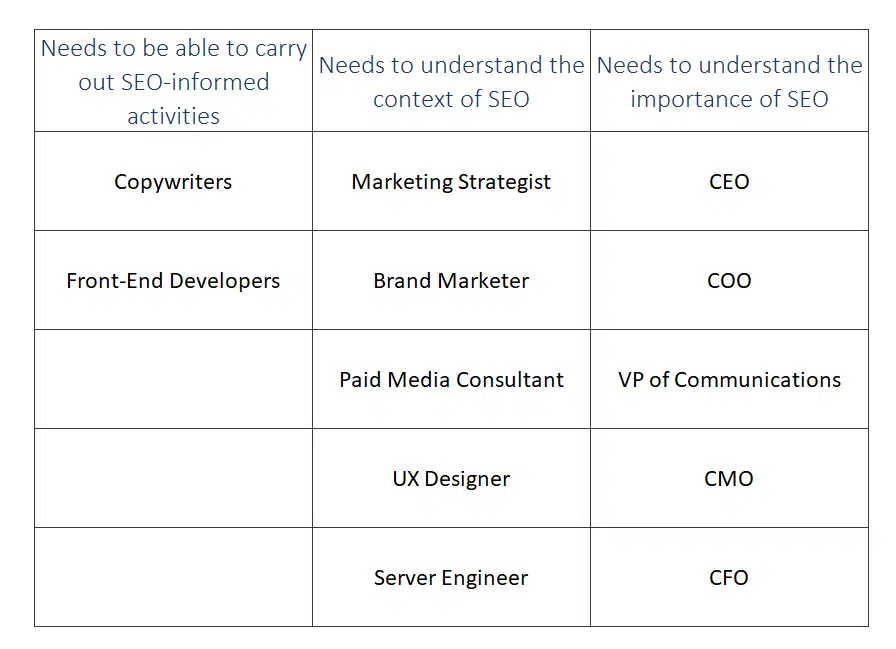
Once you have a list of people who may benefit from training, split them into three groups:

Needs to be able to carry out SEO-informed activities 

These people could use SEO skills in their work to help improve search performance.

For example, copywriters benefit from keyword research training and front-end developers from understanding how hreflang tags work. 

They will likely need an overview of SEO and how their work impacts it. They will need training on specific activities and the tools needed to accomplish them. 

Don’t get caught up in trying to teach them the entirety of SEO. It will probably make it harder to remember what they actually need to know. 

Give them sufficient SEO context to understand why the activity is important. This enables them to figure out better processes because you have equipped them with the knowledge to do so themselves rather than just training them by rote. 

Needs to understand the context of SEO 

These people will benefit from understanding where their work, or the work of the people they manage, can impact SEO. They might be your UX designers, project managers, or PPC managers. 

For this group, consider what they need to know to understand their impact on your work. Consider training stakeholders on when to involve SEO professionals in their decision-making.

This can be very important for team members who make changes to the website.

For example, your UX team might advise including pop-up boxes to encourage email sign-up. They will need to understand the implications of using interstitials and that it would likely need an SEO’s input to ensure it is implemented in a search-engine-friendly manner. 

They may not need in-depth training on rectifying the issues you are highlighting or which decisions they make could cause them.

Needs to understand the importance of SEO

These are your colleagues or client stakeholders who don’t directly impact SEO but indirectly do through prioritization and budget-holding.

These are your marketing directors, chief operating officers and finance managers. The people who need to understand the remit of SEO to sign off on the resources needed for your strategy. 

Your focus for training for this group is to show SEO’s impact on their bottom line. This might be operational efficiency, revenue or other KPIs important to your senior leadership team.

Work with them to find out what metrics they really care about and show them how SEO can impact them.

Stakeholder categories

Get the daily newsletter search marketers rely on.


5. Choose the best methods of training them

Workshops

As identified above, some of your colleagues or client stakeholders will need in-depth training. They may benefit from workshops to help them understand the processes they must follow.

Give them the full context of why the SEO skills you are teaching them are important. Walk them through examples and allow them to practice with you assisting. This will allow them to ask you questions as they learn new skills.

You may also consider follow-up sessions or refreshers when relevant new people join the company. This can act as a refresher for those you have previously trained.

Written updates

Sometimes the best course of action is to write up training guides and notes. This way, a permanent resource will be available for colleagues and clients to refer to.

If it is a document that allows tracked changes, you can also request that they ask any questions about it within it. This creates an FAQ within the guide to clarify anything where you accidentally omitted important foundational concepts or specific actions. 

Videos

Sometimes showing people will be the best way to teach them.

Creating a quick video of you carrying out a specific SEO activity, such as a crawl or keyword research, could be the key to helping instruct many people quickly.

You are not requiring them to be present in a workshop but giving them a resource they can use when they are carrying out the task.

6. Consider what needs to be provided externally

You might decide that you would feel more confident in an external trainer helping educate your stakeholders, especially on specific aspects like technical SEO training for your development team or E-E-A-T guidance for your content creation team. 

No SEO is an expert in every aspect of the discipline, so if you want to provide training but feel uncomfortable carrying it out yourself, employ an external consultant to help.

You may have been banging the same drum about an issue for a long time. Sometimes, having an external consultant provide the training on that issue can reinforce what you’ve been saying.

As frustrating as it might be, sometimes stakeholders respond better to hearing recommendations from external sources they have brought in for that specific project. 

7. Assess outdated knowledge

One of the biggest struggles SEOs face is correcting wrong or obsolete SEO knowledge. Many of the stakeholders you identified as needing some SEO education have probably worked with SEOs in the past.

Some may even have been responsible for SEO despite not being specialists. As such, they will possibly have a level of understanding of SEO already.

This can be a great head-start for getting buy-in for your recommendations. However, it can also mean starting right at the beginning and helping to unpick wrong thinking.

A quick way to see if any pre-existing SEO knowledge needs to be corrected is by creating a survey or quiz.

You can intentionally choose fairly common SEO myths like duplicate content penalties and PPC budgets to help organic search performance. It should give you an understanding of where to pitch your training.

Some stakeholders might already be very well informed and you don’t need to spend much more of their or your time training them. You can keep them updated on changes in the industry relevant to what they are working on.

Others may have had SEO training a decade ago and need to be updated on how modern SEO differs. 

8. Teach to encourage processes

Through the SEO upskilling of your stakeholders, you can encourage the adoption of SEO-beneficial processes.

For example, if you train copywriters to conduct keyword research, use those keywords in their copy, and write engaging page titles, they may add their current sign-off process.

The key to ensuring SEO considerations are adopted into relevant processes is educating the process owners. These are typically the senior members of teams.

They are the ones who decide if changes will impact efficiency and to whom you’ll need to highlight the benefits of considering SEO. 

Allowing the SEO team to sign off on changes to the website can save a lot of headaches down the line. Unfortunately, it’s not often something that gets built into the QA process for many teams.  

By training your colleagues and stakeholders, you will likely highlight the risks of not considering SEO impact in their work. This training can help to encourage them to build SEO into their sign-off processes.

9. Develop a self-serve curriculum

Creating a self-serve curriculum is the most efficient way of encouraging SEO upskilling.

Create a page on your intranet that houses all of the guides, videos and workshop presentations the SEO team has made. Tag them by department, project involvement or skill set to help your colleagues find training they might be interested in.

You can keep adding to the training over time and ask them to request their own resource from within that platform.

You can set out a roadmap based on training pathways, for example, “Training for Engineers” or “SEO training for Project [X].”

10. Get buy-in for your training

If you are asking entire teams to give up their time to attend an SEO workshop or asking for a half-hour slot in your next town hall meeting, you’ll probably need to demonstrate the benefits. 

As it is likely senior stakeholders, you must consider what metrics they use to define success. Work backward to identify how SEO-related mistakes may have impacted those metrics. 

For example, if a code deployment caused a crawling issue on the site, leading to rankings drops, demonstrate the link to the recent drop in organic leads and revenue.

Give examples of how training relevant people could prevent similar issues in the future. 

Using SEO education for stakeholder management

Whatever level of training you can give your stakeholders, the more buy-in to your ideas and processes you’ll get.

The time you invest now will save future time, stress and discouragement when pitching ideas. 


Opinions expressed in this article are those of the guest author and not necessarily Search Engine Land. Staff authors are listed here.


Related stories

New on Search Engine Land

@media screen and (min-width: 800px) { #div-gpt-ad-3191538-7 { display: flex !important; justify-content: center !important; align-items: center !important; min-width:770px; min-height:260px; } } @media screen and (min-width: 1279px) { #div-gpt-ad-3191538-7 { display: flex !important; justify-content: center !important; align-items: center !important; min-width:800px!important; min-height:440px!important; } }

About the author

Helen Pollitt

Helen is a senior SEO with over a decade’s experience in the industry. She has a passion for equipping teams and training individuals in SEO strategy and tactics. Helen is often seen on stage at conferences delivering talks about digital marketing.

https://searchengineland.com/seo-education-stakeholder-management-428068


Google Search Console video indexing report gets three new issue details

Google has expanded the video indexing report within Google Search Console to provide more detailed actions and reasons on what the issue may be with your videos not showing up in the Google search results. “We are breaking down the “Google could not determine the prominent video on the page” reason into three more specific reasons,” Google wrote.

New reasons. Google added these three new reasons:

  • Video outside the viewport: Reposition the video on the page so that the entire video is inside the renderable area of the page and seen when the page loads.
  • Video too small: Increase the height of the video so that it’s larger than 140px or the width of the video so that it’s larger than 140px and at least a third of the page’s width.
  • Video too tall: Decrease the height of the video so that it’s smaller than 1080px.

What they look like. Here is a screenshot of what these reasons look like within the video indexing report:

Video Indexing Specific Issues

Don’t see it yet? If you don’t see these new reasons yet or you see the old “Google could not determine the prominent video on the page” issue being reported, that is normal. Google said it can take up to three months for the historical data to flush out before it shows all these new error reasons.

“Since the Search Console video indexing report shows 3 months of historical data, you may still see the “Google could not determine the prominent video on the page” in the list of reason in the Video Indexing report, but it has no effect on your pages,” Google explained.

Why we care. If you have video on your site and you have seen those pesky “Google could not determine the prominent video on the page” errors, now you have a bit more detail on what the specific issues are. Google is providing you with three new reasons that can give you more actionable advice on what you need to change to help show your videos in Google Search.


Related stories

New on Search Engine Land

@media screen and (min-width: 800px) { #div-gpt-ad-3191538-7 { display: flex !important; justify-content: center !important; align-items: center !important; min-width:770px; min-height:260px; } } @media screen and (min-width: 1279px) { #div-gpt-ad-3191538-7 { display: flex !important; justify-content: center !important; align-items: center !important; min-width:800px!important; min-height:440px!important; } }

About the author

Barry Schwartz

Barry Schwartz a Contributing Editor to Search Engine Land and a member of the programming team for SMX events. He owns RustyBrick, a NY based web consulting firm. He also runs Search Engine Roundtable, a popular search blog on very advanced SEM topics. Barry can be followed on Twitter here.

https://searchengineland.com/google-search-console-video-indexing-report-gets-three-new-issue-details-428119