Google Bard now can show Search and knowledge panels, maps and more while removing the waitlist
Google has removed the waitlist for Google Bard today at Google I/O, opening Bard to over 180 countries in US English, Japanese and Korean languages. Plus, Google Bard added support to show a more visual interface, Google Lens support, dark mode, and additional integrations and features, the search company announced.
Waitlist gone. You no longer will be presented with a waitlist to sign up for Google Bard at bard.google.com. Instead, you will have access to Google Bard immediately, assuming your language and country is supported. Google Bard now supports over 180 countries in US English, Japanese and Korean.
Google said it will “gradually expand access to more languages, countries, and regions over time.”
Search and knowledge graph. Google has also showcased how Google Search and knowledge graph data can make Bard more visual and useful. Google said Bard can now provide a “helpful response along with rich visuals to give you a much better sense of what you’re exploring.”
Here is how that looks:
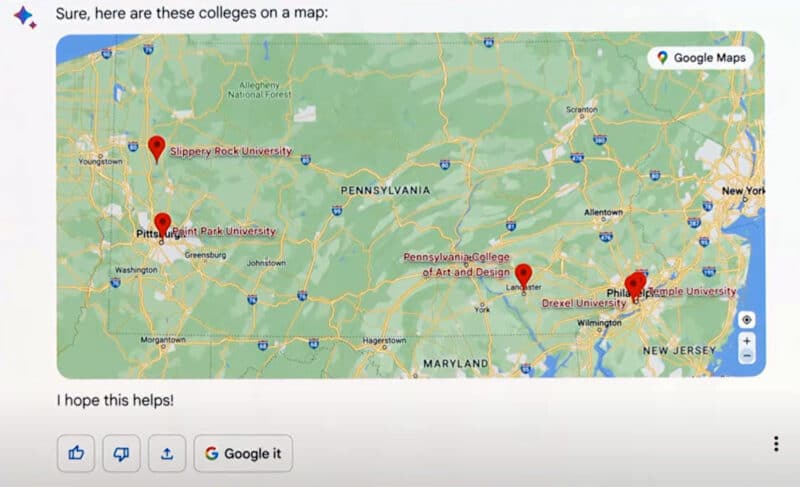
Google Maps. Google also has integrated Google Maps into Google Bard. It can show you a map directly inside the Google Bard answer box:
Google Lens. Google has also integrated Google Lens features directly into Bard. Google said you can upload a photo and prompt Bard to “write a funny caption about these two.” Using Google Lens, Bard will analyze the photo, and draft a few creative captions — all within seconds,” Google wrote.
Here is how that works :
Coding improvements. Google also demonstrated how Bard has improved its coding help with:
Source citations: Starting next week, Google will make citations even more precise. If Bard brings in a block of code or cites other content, just click the annotation and Bard will underline those parts of the response and link to the source.
“Export” Button: Google added the ability to export and run code with our partner Replit, starting with Python.
Dark mode. Google also added Dark theme on Bard, giving you the ability to easily switch Bard’s appearance between a light background with dark text to a dark background with light text. You can switch manually or it can detect your operating system’s default setting.
Google Docs & Gmail. Also with Google Docs & Gmail, Google added one-click options to export content generated by Bard, including formatting, directly into Google Docs and Gmail.
Adobe Firefly. Bard with Adobe Firefly can now help you make images. Google said Adobe Firefly, Adobe’s family of creative generative AI models, now is integrated into Google Bard to allow you to “easily and quickly turn your own creative ideas into high-quality images, which you can then edit further or add to your designs.”
Here is how that looks:
Why we care. It is amazing to see how fast these AI models and tools from both Google, Microsoft, Open AI and others are progressing.
There are practical use cases for these tools that you can use in your daily life right now and now it is open to more people to use.
@media screen and (min-width: 800px) { #div-gpt-ad-3191538-7 { display: flex !important; justify-content: center !important; align-items: center !important; min-width:770px; min-height:260px; }
}
@media screen and (min-width: 1279px) { #div-gpt-ad-3191538-7 { display: flex !important; justify-content: center !important; align-items: center !important; min-width:800px!important; min-height:440px!important; }
}
About the author
Barry Schwartz a Contributing Editor to Search Engine Land and a member of the programming team for SMX events. He owns RustyBrick, a NY based web consulting firm. He also runs Search Engine Roundtable, a popular search blog on very advanced SEM topics. Barry can be followed on Twitter here.
New Google perspectives, about this image and AI-generated image labels
Google announced a few new features to the existing Google Search at I/O, in addition to the new Google Search generative experience. These new features include perspectives, about this image and AI-generated image labels.
Perspectives
Google added a new perspectives filter that lets searchers filter their search results to show results from videos, blogs and forums. These results aim to show people a more “lived experience” to their search queries, Liz Reid, VP of Search at Google, told Search Engine Land.
Searchers want to see answers from people who are sharing their own personal perspectives and these answers are provided in a user interface that is more friendly and consumable to the younger searcher.
What perspectives looks like. Here is a screenshot of perspectives in action:
When you tap on the perspectives filter, you will see more long and short-form videos, images, and written posts that people have shared on discussion boards, Q&A sites, and social media platforms, Google explained.
Google will also display more details about the creators of this content, such as their name, profile photo, or information about the popularity of their content.
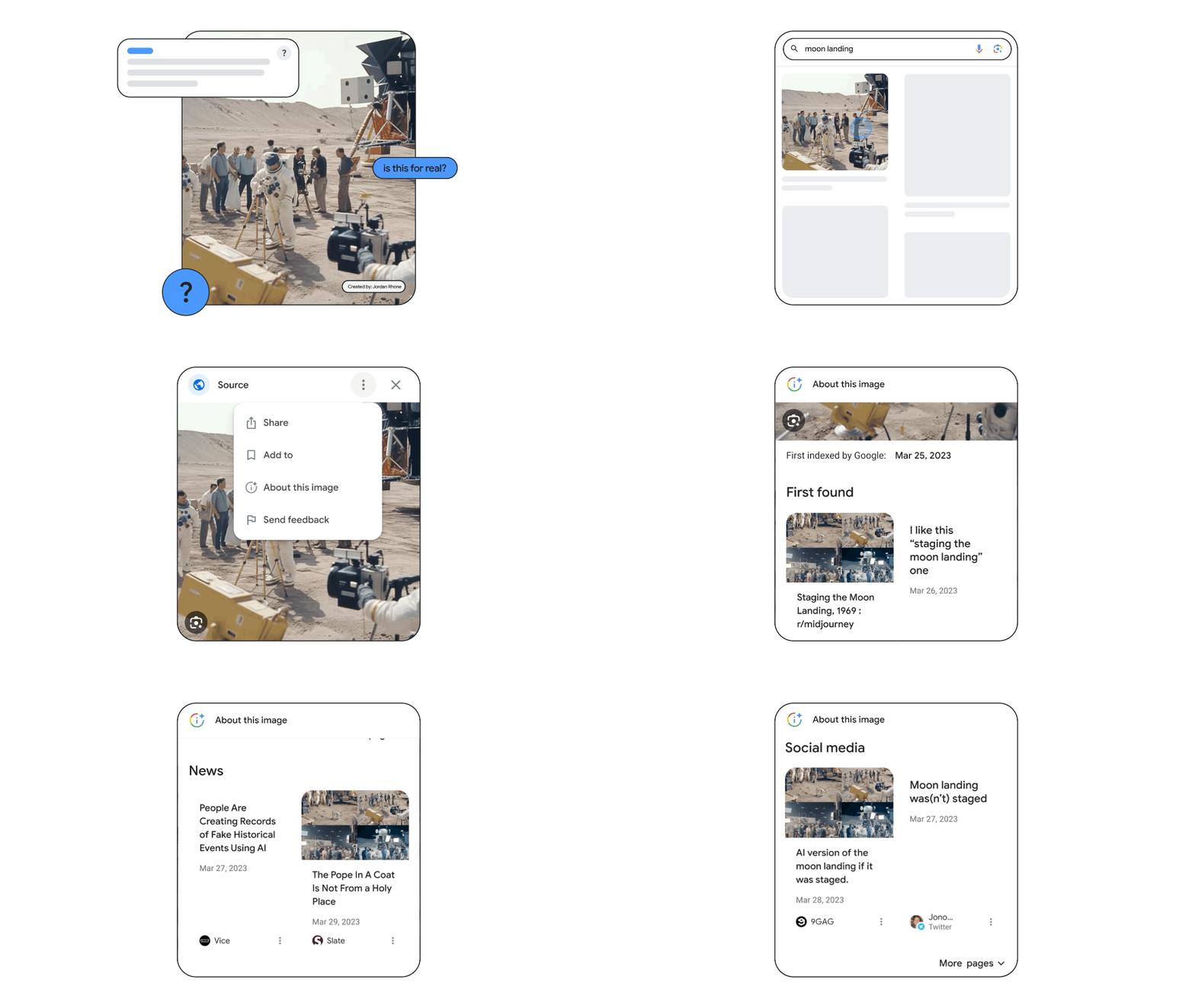
Just like Google has About this result for normal text-based search results, Google is launching “About this image.” The about this image will show you when the image and similar images were first indexed by Google, where the image may have appeared first and where else you can see the image, such as on news, social or other sites.
What About this image looks like. Here’s a screenshot of this feature in action:
AI-generated image labels
Google is also releasing new markup for site owners to label their images as AI-generated.
This will be a new meta data label, and will have to be added manually by site owners and publishers. In image search results, Google will show whether an image was AI generated.
Google is not labeling images as being AI-generated algorithmically, as Google is “not there yet” to detect if an image was generated by a machine versus a human. So Google is trusting image creators to use this meta data label.
Also, this markup will only work for images, not for AI-generated text.
What it looks like. Here’s a screenshot of what this looks like for an image created by Midjourney. It says “Image self-labeled as AI generated.”
Technicals. Google told us that the markup for the AI-generated self-label will be based upon technical standards from IPTC. It will be similar to how Google Images already shows certain information based on image metadata.
Why we care
These new user interface changes may impact your site’s traffic and visibility. So keep an eye out to see if your site shows up for some or all of these results or not.
More coverage. For more on what Google announced today at I/O on Search, see our companion shorter stories:
@media screen and (min-width: 800px) { #div-gpt-ad-3191538-7 { display: flex !important; justify-content: center !important; align-items: center !important; min-width:770px; min-height:260px; }
}
@media screen and (min-width: 1279px) { #div-gpt-ad-3191538-7 { display: flex !important; justify-content: center !important; align-items: center !important; min-width:800px!important; min-height:440px!important; }
}
About the author
Barry Schwartz a Contributing Editor to Search Engine Land and a member of the programming team for SMX events. He owns RustyBrick, a NY based web consulting firm. He also runs Search Engine Roundtable, a popular search blog on very advanced SEM topics. Barry can be followed on Twitter here.
How to sign up for the new Google Search generative experience
Want to be one of the first to play with the new Google Search generative experience, which was previewed today at Google I/O? Google has opened a waitlist where you can sign up.
Where to sign up. You can sign up in the Google Search Labs at labs.google.com/search by joining the “Experiment with Search Labs.”
Here is a GIF of the Experiment with Search Labs interface, where you can sign up for the new Google Search generative experience, as well as the new Code Tips and Add To Sheets” features.
Who can sign up. This is only available to U.S.-based searchers and is currently only supported in the English language, Google said.
This also does not work for Google Workspace users, as of yet. So sign up using your personal Gmail account.
When will waitlists be approved. Google will do a slow release of the new Google Search generative experience, inviting waves of users in batches, starting in the coming weeks.
Right now, Google has not invited the public to try out this new Google Search, but Google will start inviting users who sign up for the waitlist in the coming weeks.
Google hopes those that join the early release will provide valuable feedback Google can use to improve this new Google Search experience.
Why we care. Search is on the verge of changing. This is your opportunity to start learning how this may impact your business and websites.
@media screen and (min-width: 800px) { #div-gpt-ad-3191538-7 { display: flex !important; justify-content: center !important; align-items: center !important; min-width:770px; min-height:260px; }
}
@media screen and (min-width: 1279px) { #div-gpt-ad-3191538-7 { display: flex !important; justify-content: center !important; align-items: center !important; min-width:800px!important; min-height:440px!important; }
}
About the author
Barry Schwartz a Contributing Editor to Search Engine Land and a member of the programming team for SMX events. He owns RustyBrick, a NY based web consulting firm. He also runs Search Engine Roundtable, a popular search blog on very advanced SEM topics. Barry can be followed on Twitter here.
Durante l’ultima RSA Conference, che si è tenuta a San Francisco, gli esperto del SANS Institute hanno individuato e illustrato quelle che ritengono essere le cinque forme più pericolose di attacchi informatici per il 2023.
L’incontro ha fatto emergere diversi temi chiave, tra cui l’intersezione dell’Intelligenza Artificiale (AI) con i modelli di attacco e i modi in cui gli aggressori stanno sfruttando gli ambienti di sviluppo altamente flessibili.
Attacchi SEO
I criminali informatici stanno usando l’ottimizzazione dei motori di ricerca (SEO) per migliorare la posizione dei loro siti web dannosi nei motori di ricerca e indirizzare il traffico verso di essi.
Katie Nickels, Director of Intelligence di Red Canary
Katie Nickels, Director of Intelligence di Red Canary e istruttore SANS, ha spiegato che mentre i difensori stanno bloccando i clic in uscita verso siti dannosi, gli aggressori stanno utilizzando attacchi watering hole per attirare le loro vittime.
La SEO sta giocando un ruolo importante in queste tattiche, poiché gli aggressori utilizzano parole chiave e altre tecniche SEO per assicurarsi che i loro siti web dannosi siano in cima ai risultati dei motori di ricerca.
Ad esempio, Nickels ha citato un attacco GootLoader che ha utilizzato l’ottimizzazione dei motori di ricerca per aumentare la posizione in una ricerca per “accordi legali” e colpire gli utenti ignari alla ricerca di un modello di documento legale.
Malvertising
Come gli esperti di marketing, anche i criminali informatici utilizzano sia le tecniche di ricerca organica tramite SEO che quelle a pagamento, come la pubblicità, per aumentare la visibilità dei loro siti.
In particolare, gli attacchi drive-by sono spesso alimentati da campagne pubblicitarie dannose, note come malvertising, che aumentano artificialmente il posizionamento dei siti per determinate parole chiave.
Ciò è stato evidenziato da Nickels, che ha notato che il malvertising è stato appena aggiunto a MITRE ATT&CK come nuova tecnica.
Un esempio di questo è stato visto in una campagna per il software di grafica 3D gratuito Blender. I primi tre risultati per quella parola chiave erano dannosi, mentre solo il quarto risultato era il sito Web legittimo del software.
Inoltre, i siti dannosi sono diventati sempre più abili nell’imitare siti legittimi, come appunto quello di Blender.
Gli sviluppatori sono bersagli
Johannes Ullrich, Dean of Research del SANS Technology Institute e capo dell’Internet Storm Center, ha evidenziato la sua preoccupazione per gli attacchi informatici che colpiscono gli sviluppatori di software e applicazioni.
Johannes Ullrich, Dean of Research del SANS Technology Institute
Secondo Ullrich, gli attacchi stanno diventando sempre più mirati e specifici, prendendo di mira gli sviluppatori come primo punto di ingresso. Questo perché gli sviluppatori spesso hanno privilegi elevati nei sistemi IT e aziendali e lavorano su macchine meno bloccate rispetto all’utente medio, il che consente loro di sperimentare con il codice e spedire software ogni giorno.
Inoltre, gran parte del software di protezione degli endpoint è orientato verso la normale postazione di lavoro aziendale, non verso i sistemi in cui sono installati strumenti di sviluppo.
Questo rende gli sviluppatori un obiettivo estremamente allettante, in quanto qualsiasi attacco a loro può avvelenare la catena di fornitura del software. Ullrich prevede che gli attacchi mirati agli sviluppatori diventeranno sempre più diffusi e pericolosi nel prossimo futuro.
Attacchi con l’IA
Con l’aumento dell’utilizzo di grandi modelli linguistici (LLM), come ChatGPT, gli aggressori – anche quelli meno esperti – potrebbero utilizzare tali strumenti di intelligenza artificiale per sviluppare exploit e scoprire vulnerabilità zero-day.
Questa tendenza è stata evidenziata da Steven Sims, responsabile del curriculum delle operazioni offensive per SANS e ricercatore di vulnerabilità di lunga data e sviluppatore di exploit.
Sims ha dimostrato come ChatGPT possa essere utilizzato per scoprire una vulnerabilità zero-day e per aiutare a scrivere un semplice ransomware. Il problema è che, dal punto di vista difensivo, c’è poco che si possa fare per prevenire questo tipo di attacco.
Sims ha sottolineato l’importanza di avere una difesa profonda e di comprendere come funzionano gli LLM. Inoltre, ha suggerito di sviluppare intelligenza artificiale e apprendimento automatico per comprendere meglio questi strumenti.
Heather Mahalik, Senior Director of Digital Intelligence di Cellebrite
Heather Mahalik, Senior Director of Digital Intelligence di Cellebrite e Responsabile della Digital Forensics e della Risposta agli Incidenti per SANS, ha sottolineato che gli aggressori aumenteranno notevolmente l’uso dell’Intelligenza Artificiale (IA) per rendere i loro tentativi di ingegneria sociale più credibili.
Secondo Mahalik, l’IA può essere utilizzata per colpire le persone all’interno delle organizzazioni, rendendole più vulnerabili agli attacchi di ingegneria sociale.
Inoltre, ha sottolineato come sia importante rendersi conto che tutti sono attaccabili. Pertanto, le organizzazioni devono implementare misure di sicurezza adeguate per proteggere se stessi e i propri dipendenti da tali attacchi di ingegneria sociale altamente sofisticati basati sull’IA.
Meta is threatening to remove news content from Facebook and Instagram in Canada if proposed legislation meant to establish a “fair revenue sharing” system becomes law.
Why we care. Any publishers that rely on traffic, engagement or brand awareness from Meta properties could see a significant loss if news content is blocked from being shared.
What Meta said. “We will have to end the availability of news content on Facebook and Instagram in Canada,” according to Nick Clegg, president of global affairs at Meta. Calling it “flawed legislation,” he added that this would make Canada the “first democracy to put a price on free links to web pages, which flies in the face of global norms,” Bloomberg reported.
Meta threatened to remove news from its platform last year due to U.S. legislation that would have let news companies collectively negotiate with social platforms over the terms on which their material appears on their sites. Facebook also had a separate standoff with Australia in 2021.
Online News Act. Known as Bill C-18, it “proposes a regime to regulate digital platforms that act as intermediaries in Canada’s news media ecosystem in order to enhance fairness in the Canadian digital news market,” according to the Government of Canada site.
Google already limited access to news in Canada. Earlier this year, Google tested blocking news across all Canadian publisher websites, in Google Search, Google Discover and other Google surfaces. This test was limited to less than 4% of Canadians. A Google spokesperson told Search Engine Land in Februrary that this was a “potential product response to Bill C-18.”
@media screen and (min-width: 800px) { #div-gpt-ad-3191538-7 { display: flex !important; justify-content: center !important; align-items: center !important; min-width:770px; min-height:260px; }
}
@media screen and (min-width: 1279px) { #div-gpt-ad-3191538-7 { display: flex !important; justify-content: center !important; align-items: center !important; min-width:800px!important; min-height:440px!important; }
}
About the author
Danny Goodwin has been Managing Editor of Search Engine Land & Search Marketing Expo – SMX since 2022. He joined Search Engine Land in 2022 as Senior Editor. In addition to reporting on the latest search marketing news, he manages Search Engine Land’s SME (Subject Matter Expert) program. He also helps program U.S. SMX events. Goodwin has been editing and writing about the latest developments and trends in search and digital marketing since 2007. He previously was Executive Editor of Search Engine Journal (from 2017 to 2022), managing editor of Momentology (from 2014-2016) and editor of Search Engine Watch (from 2007 to 2014). He has spoken at many major search conferences and virtual events, and has been sourced for his expertise by a wide range of publications and podcasts.
6 strategies to maximize your marketing budget by Digital Marketing Depot
In today’s uncertain economic times, it’s important to be strategic about where you spend your marketing dollars to generate the highest returns and position your business for a strong rebound.
This guide from Conductor explains why SEO is the best marketing strategy during a recession, how to play the long game with SEO, and how SEO fuels all marketing efforts. Additionally, you will learn you how to meet your customers where they already are and identify new opportunities through your search data.
By being strategic about your marketing budget and focusing on your highest-performing channels, you can thrive during both booms and busts.
@media screen and (min-width: 800px) { #div-gpt-ad-3191538-7 { display: flex !important; justify-content: center !important; align-items: center !important; min-width:770px; min-height:260px; }
}
@media screen and (min-width: 1279px) { #div-gpt-ad-3191538-7 { display: flex !important; justify-content: center !important; align-items: center !important; min-width:800px!important; min-height:440px!important; }
}
About the author
Digital Marketing Depot is the resource center for digital marketing strategies and tactics. Created by Third Door Media, Digital Marketing Depot features a robust library of hosted white papers, eBooks, original research, and webinars on a wide range of digital marketing topics- from advertising, analytics, data and content management, to email marketing, SEO and PPC campaign management, and much more. Visit us at http://digitalmarketingdepot.com.
Internal and external links are essential topics every SEO must learn.
Links send users to external sites or can be used internally to keep people on your site and help search engines find more of your pages.
Over time, you’ll find links that you want to “explain” to search engines, such as:
Sponsored links.
User-generated content (UGC) links.
Nofollow links.
Using these attributes properly gives you greater control over how search engines identify and categorize certain links. Learn how to master all three of these values to “qualify” the links on your site.
Regular links are created using simple HTML, such as:
If you have this “regular” link on your site, you can expect Google to follow the link and parse the page without qualifiers. It’s a standard link that Google will make its own judgment on.
Let’s assume you have user-generated links but can’t handle moderation.
If you allow these links to be crawled without the right “rel” value, it’s possible for someone to spam your site leading to rankings drop.
When you add the rel="ugc", you’re telling search engines that this is user-generated content.
Over time, as you begin to trust a certain user and realize that their contributions provide immense value to your community, you can remove the UGC value.
If your site is doing well and an advertiser offers to pay for a link or ad on your site, you can add the following:
Using rel="sponsored" allows you to tell search engines that the link isn’t spam but is sponsored. Review Google’s Spam Policy to make sure that your site isn’t seen as spamming its users.
Finally, if you have a link you don’t want search engines to crawl, you can use rel="nofollow" just like we did in the previous examples.
When you use this parameter, you’re telling search engines not to pass “ranking credit” to the page.
Get the daily newsletter search marketers rely on.
As a site owner or manager, you have control over your domain but not others.
For example, let’s say you run a website about cats, and someone offers you $500 to advertise their cat beds on your site.
When you check the advertiser’s site, you see fantastic cat beds that your audience will love and approve the sponsored link.
A month or two goes by, and when you return, it has been redirected to a torrent website you do not want to be associated with.
It’s easy for the site owner to create a redirect from their page to another, and they can even do something manipulative, such as:
Redirect your IP address to the cat site.
Send anything not flagged as your IP address to a spam site.
If you’re in a scenario where this could happen, a rel="sponsored" tag will identify the link as a paid agreement.
In the case above, you may also want to consider the rel="nofollow" tag, meaning that you don’t want to pass credit to the site.
I recommend identifying sponsored links as rel="sponsored" because search engines prefer you to do this.
For example, if you write a sponsored product review on your site, would you add rel="sponsored" to the link?
Google’s John Mueller, who I’ll be referring to a lot in the coming sections, says:
“Nah, within the site is not really an issue, since you’re just linking from one part of your site to the other part.”
You can see the question and all of the responses in the tweet below:
If you have pages on your site that offer a sponsored review of a brand/product w/ affiliate links (and that’s the entire purpose of the page), should internal links to those pages contain any attributes (rel=sponsored, etc.)?
But there’s a reason you see so many blogs removing their comment sections: spam is out of control.
Others can use any user-generated content to spam your site.
It is an unfortunate consequence of offering user-generated content on your site.
You’ll want to use the rel="ugc" tag for:
Forum posts.
Comments.
Anywhere users can add content.
Instead of taking my word for it, listen to Mueller’s insights on the topic:
[embedded content]
He states the following:
Google doesn’t differentiate between what you write and what your users write on your site.
If the content is published on your site, it will be used for ranking purposes.
Web admins that publish user-generated content should moderate it before allowing it to be published.
Webmasters can noindex the content before moderation using <meta name="robots" content="noindex">.
You can’t vouch for the links before the post is moderated, so use the rel="ugc" attribute.
If you follow these guidelines, you’ll protect your site from potential user-generated content spam.
Using nofollow on links
If the link you’re linking to is external, you may want to use the rel="nofollow" attribute to tell search bots not to follow the link.
A general rule of thumb is that if you’re adding an attribute that doesn’t fall into the UGC or sponsored category, use nofollow.
Over the years, I’ve learned a lot of best practices for using the nofollowattribute, such as:
Avoid using this attribute when you link to your social media profiles.
Consider using rel=”me” for your social pages because they’re a representation of you
Don’t use nofollow to try and stop indexing. Instead, use noindex like in the previous section.
It’s also important to note that “nofollow” is not a dampening factor. Even if you add this attribute to a link, it doesn’t lower the link’s value. Instead, the link has novalue.
Many people tend to debate this, but Mueller clarified this in a 2022 tweet.
Still, many industry experts claim they notice a boost in rankings even if the link is a nofollow.
You’ll need to make the judgment for yourself and implement link attributes accordingly.
If you have a large enterprise site, like many clients I work with, it’s essential to have policies and procedures for developers and anyone posting content.
You can create rules and instances when the stakeholders add link attributes.
You don’t need to use these link attributes if you don’t see the need for them on your site. Many of my blog posts don’t include these attributes because I link out to high-quality sites.
However, when the content is sponsored or user-generated, these attributes serve as helpful tools for controlling how search engines qualify links.
Opinions expressed in this article are those of the guest author and not necessarily Search Engine Land. Staff authors are listed here.
@media screen and (min-width: 800px) { #div-gpt-ad-3191538-7 { display: flex !important; justify-content: center !important; align-items: center !important; min-width:770px; min-height:260px; }
}
@media screen and (min-width: 1279px) { #div-gpt-ad-3191538-7 { display: flex !important; justify-content: center !important; align-items: center !important; min-width:800px!important; min-height:440px!important; }
}
About the author
Ludwig Makhyan is a contributor for Search Engine Land, covering organic and technical SEO. His background is in web development and digital marketing. Ludwig has over 20 years of experience in website design, coding and promotion. He is the co-founder at MAZELESS, an enterprise SEO agency.
An SEO’s guide to understanding large language models (LLMs)
Should I use large language models for keyword research? Can these models think? Is ChatGPT my friend?
If you’ve been asking yourself these questions, this guide is for you.
This guide covers what SEOs need to know about large language models, natural language processing and everything in between.
Large language models, natural language processing and more in simple terms
There are two ways to get a person to do something – tell them to do it or hope they do it themselves.
When it comes to computer science, programming is telling the robot to do it, while machine learning is hoping the robot does it itself. The former is supervised machine learning, and the latter is unsupervised machine learning.
Natural language processing (NLP) is a way to break down the text into numbers and then analyze it using computers.
Computers analyze patterns in words and, as they get more advanced, in the relationships between the words.
An unsupervised natural language machine learning model can be trained on many different kinds of datasets.
For example, if you trained a language model on average reviews of the movie Waterworld, you would have a result that is good at writing (or understanding) reviews of the movie Waterworld.
If you trained it on the two positive reviews that I did of the movie Waterworld, it would only understand those positive reviews.
Large language models (LLMs) are neural networks with over a billion parameters. They are so big that they’re more generalized. They are not only trained on positive and negative reviews for Waterworld but also on comments, Wikipedia articles, news sites, and more.
Machine learning projects work with context a lot – things within context and out of context.
If you have a machine learning project that works to identify bugs and show it a cat, it won’t be good at that project.
This is why stuff like self-driving cars is so difficult: there are so many out-of-context problems that it’s very difficult to generalize that knowledge.
LLMs seem and can bea lot more generalized than other machine learning projects. This is because of the sheer size of the data and the ability to crunch billions of different relationships.
Let’s talk about one of the breakthrough technologies that allow for this – transformers.
Explaining transformers from scratch
A type of neural networking architecture, transformers have revolutionized the NLP field.
Before transformers, most NLP models relied on a technique called recurrent neural networks (RNNs), which processed text sequentially, one word at a time. This approach had its limitations, such as being slow and struggling to handle long-range dependencies in text.
Transformers changed this.
In the 2017 landmark paper, “Attention is All You Need,” Vaswani et al. introduced the transformer architecture.
Instead of processing text sequentially, transformers use a mechanism called “self-attention” to process words in parallel, allowing them to capture long-range dependencies more efficiently.
Previous architecture included RNNs and long short-term memory algorithms.
Recurrent models like these were (and still are) commonly used for tasks involving data sequences, such as text or speech.
However, these models have a problem. They can only process the data one piece at a time, which slows them down and limits how much data they can work with. This sequential processing really limits the ability of these models.
Attention mechanisms were introduced as a different way of processing sequence data. They allow a model to look at all the pieces of data at once and decide which pieces are most important.
This can be really helpful in many tasks. However, most models that used attention also use recurrent processing.
Basically, they had this way of processing data all at once but still needed to look at it in order. Vaswani et al.’s paper floated, “What if we only used the attention mechanism?”
Attention is a way for the model to focus on certain parts of the input sequence when processing it. For instance, when we read a sentence, we naturally pay more attention to some words than others, depending on the context and what we want to understand.
If you look at a transformer, the model computes a score for each word in the input sequence based on how important it is for understanding the overall meaning of the sequence.
The model then uses these scores to weigh the importance of each word in the sequence, allowing it to focus more on the important words and less on the unimportant ones.
This attention mechanism helps the model capture long-range dependencies and relationships between words that might be far apart in the input sequence without having to process the entire sequence sequentially.
This makes the transformer so powerful for natural language processing tasks, as it can quickly and accurately understand the meaning of a sentence or a longer sequence of text.
Let’s take the example of a transformer model processing the sentence “The cat sat on the mat.”
Each word in the sentence is represented as a vector, a series of numbers, using an embedding matrix. Let’s say the embeddings for each word are:
The: [0.2, 0.1, 0.3, 0.5]
cat: [0.6, 0.3, 0.1, 0.2]
sat: [0.1, 0.8, 0.2, 0.3]
on: [0.3, 0.1, 0.6, 0.4]
the: [0.5, 0.2, 0.1, 0.4]
mat: [0.2, 0.4, 0.7, 0.5]
Then, the transformer computes a score for each word in the sentence based on its relationship with all the other words in the sentence.
This is done using the dot product of each word’s embedding with the embeddings of all the other words in the sentence.
For example, to compute the score for the word “cat,” we would take the dot product of its embedding with the embeddings of all the other words:
These scores indicate the relevance of each word to the word “cat.” The transformer then uses these scores to compute a weighted sum of the word embeddings, where the weights are the scores.
This creates a context vector for the word “cat” that considers the relationships between all the words in the sentence. This process is repeated for each word in the sentence.
Think of it as the transformer drawing a line between each word in the sentence based on the result of each calculation. Some lines are more tenuous, and others are less so.
The transformer is a new kind of model that only uses attention without any recurrent processing. This makes it much faster and able to handle more data.
How GPT uses transformers
You may remember that in Google’s BERT announcement, they bragged that it allowed search to understand the full context of an input. This is similar to how GPT can use transformers.
Let’s use an analogy.
Imagine you have a million monkeys, each sitting in front of a keyboard.
Each monkey is randomly hitting keys on their keyboard, generating strings of letters and symbols.
Some strings are complete nonsense, while others might resemble real words or even coherent sentences.
One day, one of the circus trainers sees that a monkey has written out “To be, or not to be,” so the trainer gives the monkey a treat.
The other monkeys see this and start trying to imitate the successful monkey, hoping for their own treat.
As time passes, some monkeys start to consistently produce better and more coherent text strings, while others continue to produce gibberish.
Eventually, the monkeys can recognize and even emulate coherent patterns in text.
LLMs have a leg up on the monkeys because LLMs are first trained on billions of pieces of text. They can already see the patterns. They also understand the vectors and relationships between these pieces of text.
This means they can use those patterns and relationships to generate new text that resembles natural language.
GPT, which stands for Generative Pre-trained Transformer, is a language model that uses transformers to generate natural language text.
It was trained on a massive amount of text from the internet, which allowed it to learn the patterns and relationships between words and phrases in natural language.
The model works by taking in a prompt or a few words of text and using the transformers to predict what words should come next based on the patterns it has learned from its training data.
The model continues to generate text word by word, using the context of the previous words to inform the next ones.
GPT in action
One of the benefits of GPT is that it can generate natural language text that is highly coherent and contextually relevant.
This has many practical applications, such as generating product descriptions or answering customer service queries. It can also be used creatively, such as generating poetry or short stories.
However, it is only a language model. It’s trained on data, and that data can be out of date or incorrect.
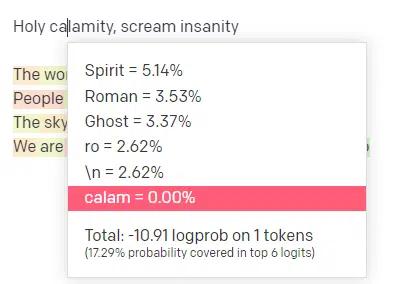
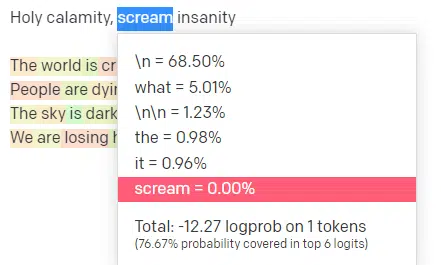
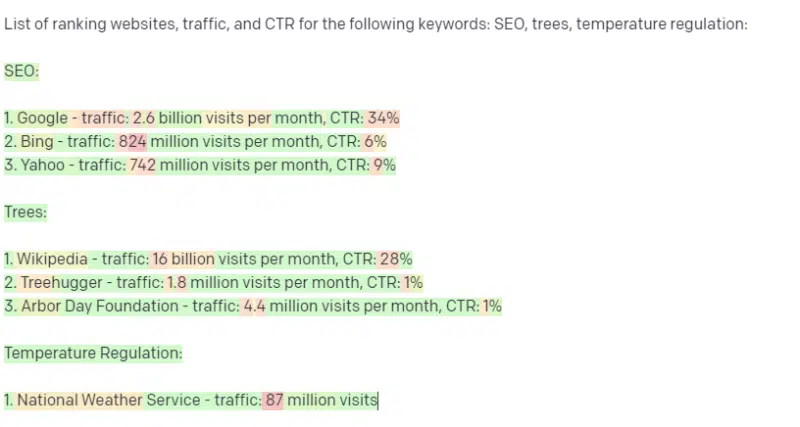
I submitted the response so we can see the likelihood of both of my input and the output lines. So let’s go through each part of what this tells us.
For the first word/token, I input “Holy.” We can see that the most expected next input is Spirit, Roman, and Ghost.
We can also see that the top six results cover only 17.29% of the probabilities of what comes next: which means that there are ~82% other possibilities we can’t see in this visualization.
Let’s briefly discuss the different inputs you can use in this and how they affect your output.
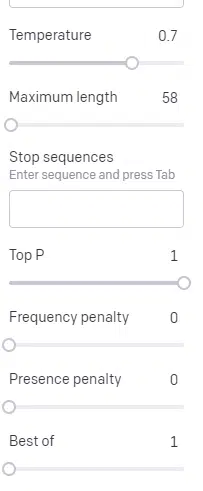
Temperature is how likely the model is to grab words other than those with the highest probability, top P is how it selects those words.
So for the input “Holy Calamity,” top P is how we select the cluster of next tokens [Ghost, Roman, Spirit], and temperature is how likely it is to go for the most likely token vs. more variety.
If the temperature is higher, it is more likely to choose a less likely token.
So a high temperature and a high top P will likely be wilder. It’s choosing from a wide variety (high top P) and is more likely to choose surprising tokens.
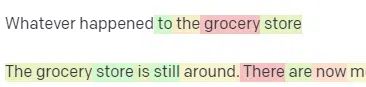
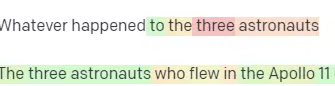
A selection of high temp, high P responses
While a high temp but lower top P will pick surprising options from a smaller sample of possibilities:
And lowering the temperature just chooses the most likely next tokens:
Playing with these probabilities can, in my opinion, give you a good insight into how these kinds of models work.
It is looking at a collection of probable next selections based on what is already completed
What does this mean actually?
Simply put, LLMs take in a collection of inputs, shake them up, and turn them into outputs.
I’ve heard people joke about whether that’s so different from people.
But it’s not like people – LLMs have no knowledge base. They aren’t extracting information about a thing. They’re guessing a sequence of words based on the last one.
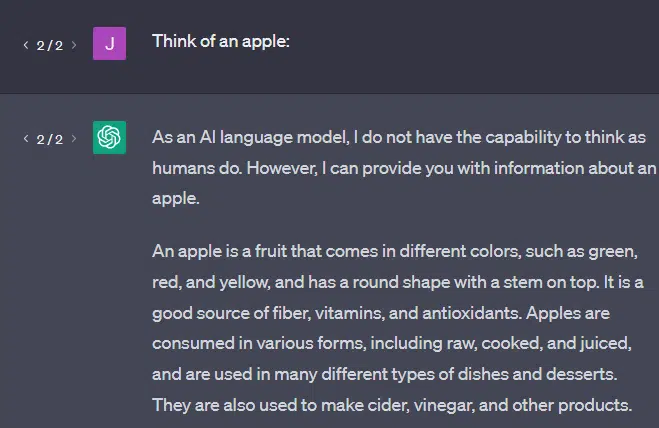
Another example: think of an apple. What comes to mind?
Maybe you can rotate one in your mind.
Perhaps you remember the smell of an apple orchard, the sweetness of a pink lady, etc.
Maybe you think of Steve Jobs.
Now let’s see what a prompt “think of an apple” returns.
You’ve probably heard the words “Stochastic Parrots” floating around by this point.
Stochastic Parrots is a term used to describe LLMs like GPT. A parrot is a bird that mimics what it hears.
So, LLMs are like parrots in that they take in information (words) and output something that resembles what they’ve heard. But they’re also stochastic, which means they use probability to guess what comes next.
LLMs are good at recognizing patterns and relationships between words, but they don’t have any deeper understanding of what they’re seeing. That’s why they’re so good at generating natural language text but not understanding it.
Good uses for an LLM
LLMs are good at more generalist tasks.
You can show it text, and without training, it can do a task with that text.
You can throw it some text and ask for sentiment analysis, ask it to transfer that text to structured markup, and even do some creative work, like writing outlines.
It’s OK at stuff like code. For many tasks, it can almost get you there.
But again, it’s based on probability and patterns. So there will be times when it picks up on patterns in your input that you don’t know are there.
This can be positive (seeing patterns that humans can’t), but it can also be negative (why did it respond like this?).
It also doesn’t have access to any sort of data sources. SEOs who use it to look up ranking keywords will have a bad time.
It can’t look up traffic for a keyword. It doesn’t have the information for keyword data beyond that words exist.
The exciting thing about ChatGPT is that it is an easily available language model you can use out of the box on various tasks. But it isn’t without caveats.
Good uses for other ML models
I hear people say they’re using LLMs for certain tasks, which other NLP algorithms and techniques can do better.
Let’s take an example, keyword extraction.
If I use TF-IDF, or another keyword technique, to extract keywords from a corpus, I know what calculations are going into that technique.
This means that the results will be standard, reproducible, and I know they will be related specifically to that corpus.
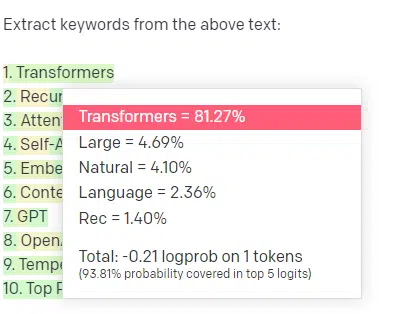
With LLMs like ChatGPT, if you are asking for keyword extraction, you aren’t necessarily getting the keywords extracted from the corpus. You’re getting what GPT thinks a response to corpus + extract keywords would be.
This is similar to tasks like clustering or sentiment analysis. You aren’t necessarily getting the fine-tuned result with the parameters you set. You’re getting what there is some probability of based on other similar tasks.
Again, LLMs have no knowledge base and no current information. They often cannot search the web, and they parse what they get from information as statistical tokens. The restrictions on how long an LLM’s memory lasts are because of these factors.
Another thing is that these models can’t think. I only use the word “think” a few times throughout this piece because it’s really difficult not to use it when talking about these processes.
The tendency is toward anthropomorphism, even when discussing fancy statistics.
But this means that if you entrust an LLM to any task needing “thought,” you are not trusting a thinking creature.
You’re trusting a statistical analysis of what hundreds of internet weirdos respond to similar tokens with.
If you would trust internet denizens with a task, then you can use an LLM. Otherwise…
Things that should never be ML models
A chatbot run through a GPT model (GPT-J) reportedly encouraged a man to kill himself. The combination of factors can cause real harm, including:
People anthropomorphizing these responses.
Believing them to be infallible.
Using them in places where humans need to be in the machine.
And more.
While you may think, “I’m an SEO. I don’t have a hand in systems that could kill someone!”
Think about YMYL pages and how Google promotes concepts like E-A-T.
Does Google do this because they want to annoy SEOs, or is it because they don’t want the culpability of that harm?
Even in systems with strong knowledge bases, harm can be done.
The above is a Google knowledge carousel for “flowers safe for cats and dogs.” Daffodils are on that list despite being toxic to cats.
Let’s say you are generating content for a veterinary website at scale using GPT. You plug in a bunch of keywords and ping the ChatGPT API.
You have a freelancer read all the results, and they are not a subject expert. They don’t pick up on a problem.
You publish the result, which encourages buying daffodils for cat owners.
You kill someone’s cat.
Not directly. Maybe they don’t even know it was that site particularly.
Maybe the other vet sites start doing the same thing and feeding off each other.
The top Google search result for “are daffodils toxic to cats” is a site saying they are not.
Other freelancers reading through other AI content – pages upon pages of AI content – actually fact-check. But the systems now have incorrect information.
When discussing this current AI boom, I mention the Therac-25 a lot. It is a famous case study of computer malfeasance.
Basically, it was a radiation therapy machine, the first to use only computer locking mechanisms. A glitch in the software meant people got tens of thousands of times the radiation dose they should have.
Something that always sticks out to me is that the company voluntarily recalled and inspected these models.
But they assumed that since the technology was advanced and software is “infallible,” the problem had to do with the machine’s mechanical parts.
Thus, they repaired the mechanisms but didn’t check the software – and the Therac-25 stayed on the market.
FAQs and misconceptions
Why does ChatGPT lie to me?
One thing I’ve seen from some of the greatest minds of our generation and also influencers on Twitter is a complaint that ChatGPT “lies” to them. This is due to a couple of misconceptions in tandem:
That ChatGPT has “wants.”
That it has a knowledge base
That the technologists behind the technology have some sort of agenda beyond “make money” or “make a cool thing.”
Biases are baked into every part of your day-to-day life. So are exceptions to these biases.
Most software developers currently are men: I am a software developer and a woman.
Training an AI based on this reality would lead to it always assuming software developers are men, which is not true.
A famous example is Amazon’s recruiting AI, trained on resumes from successful Amazon employees.
This led to it discarding resumes from majority black colleges, even though many of those employees could’ve been extremely successful.
To counter these biases, tools like ChatGPT use layers of fine-tuning. This is why you get the “As an AI language model, I cannot…” response.
Some workers in Kenya had to go through hundreds of prompts, looking for slurs, hate speech, and just downright terrible responses and prompts.
Then a fine-tuning layer was created.
Why can’t you make up insults about Joe Biden? Why can you make sexist jokes about men and not women?
It’s not due to liberal bias but because of thousands of layers of fine-tuning telling ChatGPT not to say the N-word.
Ideally, ChatGPT would be entirely neutral about the world, but they also need it to reflect the world.
It’s a similar problem to the one that Google has…
What is true, what makes people happy, and what makes a correct response to a prompt are often all very different things.
Why does ChatGPT come up with fake citations?
Another question I see come up frequently is about fake citations. Why are some of them fake and some real? Why are some websites real, but the pages fake?
Hopefully, by reading how the statistical models work, you can parse this out.
But in case you skipped the extremely long expectation, let’s make a shorter one here.
You’re an AI language model. You have been trained on a ton of the web.
Someone tells you to write about a technological thing – let’s say Cumulative Layout Shift.
You don’t have a ton of examples of CLS papers, but you know what it is, and you know the general shape of an article about technologies. You know the pattern of what this kind of article looks like.
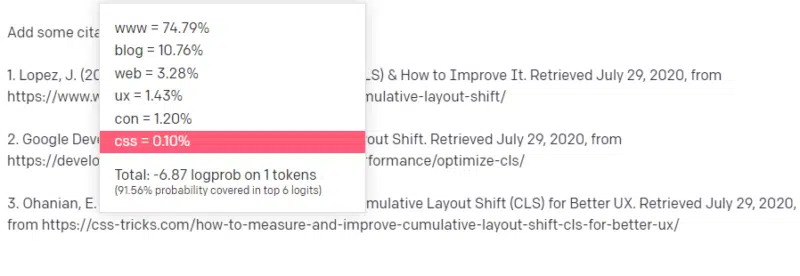
So you get started with your response and run into a kind of problem. In the way you understand technical writing, you know a URL should go next in your sentence.
Well, from other CLS articles, you know that Google and GTMetrix are often cited about CLS, so those are easy.
But you also know that CSS-tricks is often linked to in web articles: you know that usually CSS-tricks URLs look a certain way: so you can construct a CSS-tricks URL like this:
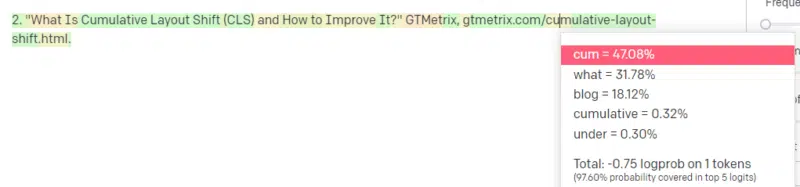
The trick is: this is how all the URLs are constructed, not just the fake ones:
This GTMetrix article does exist: but it exists because it was a likely string of values to come at the end of this sentence.
GPT and similar models cannot distinguish between a real citation and a fake one.
The only way to do that modeling is to use other sources (knowledge bases, Python, etc.) to parse that difference and check the results.
What is a ‘Stochastic Parrot’?
I know I went over this already, but it bears repeating. Stochastic Parrots are a way of describing what happens when large language models seem generalist in nature.
To the LLM, nonsense and reality is the same thing. They see the world the same way an economist does, as a bunch of statistics and numbers describing reality.
You know the quote, “There are three kinds of lies: lies, damned lies, and statistics.”
LLMs are a big bunch of statistics.
LLMs seem coherent, but that is because we fundamentally see things that appear human as human.
Similarly, the chatbot model obfuscates much of the prompting and information you need for GPT responses to be fully coherent.
I’m a developer: trying to use LLMs to debug my code has extremely variable results. If it is an issue similar to one people have often had online, then LLMs can pick up on and fix that result.
If it is an issue that it hasn’t come across before, or is a small part of the corpus, then it will not fix anything.
Why is GPT better than a search engine?
I worded this in a spicy way. I don’t think GPT is better than a search engine. It worries me that people have replaced searching with ChatGPT.
One underrecognized part of ChatGPT is how much it exists to follow instructions. You can ask it to basically do anything.
But remember, it’s all based on the statistical next word in a sentence, not the truth.
So if you ask it a question that has no good answer but ask it in a way that it is obligated to answer, you will get an answer: a poor one.
Having a response designed for you and around you is more comforting, but the world is a mass of experiences.
All of the inputs into an LLM are treated the same: but some people have experience, and their response will be better than a melange of other people’s responses.
One expert is worth more than a thousand think pieces.
Is this the dawning of AI? Is Skynet here?
Koko the Gorilla was an ape who was taught sign language. Researchers in linguistic studies did tons of research showing that apes could be taught language.
Herbert Terrace then discovered the apes weren’t putting together sentences or words but simply aping their human handlers.
People saw her as a person: a therapist they trusted and cared for. They asked researchers to be alone with her.
Language does something very specific to people’s brains. People hear something communicate and expect thought behind it.
LLMs are impressive but in a way that shows a breadth of human achievement.
LLMs don’t have wills. They can’t escape. They can’t try and take over the world.
They’re a mirror: a reflection of people and the user specifically.
The only thought there is a statistical representation of the collective unconscious.
Did GPT learn a whole language by itself?
Sundar Pichai, CEO of Google, went on 60 Minutes and claimed that Google’s language model learned Bengali.
The model was trained on those texts. It is incorrect that it “spoke a foreign language it was never trained to know.”
There are times when AI does unexpected things, but that in itself is expected.
When you’re looking at patterns and statistics on a grand scale, there will necessarily be times when those patterns reveal something surprising.
What this truly reveals is that many of the C-suite and marketing folks who are peddling AI and ML don’t actually understand how the systems work.
I’ve heard some people who are very smart talk about emergent properties, AGI, and other futuristic things.
I may just be a simple country ML ops engineer, but it shows how much hype, promises, science fiction, and reality get thrown together when talking about these systems.
Elizabeth Holmes, the infamous founder of Theranos, was crucified for making promises that could not be kept.
But the cycle of making impossible promises is part of startup culture and making money. The difference between Theranos and AI hype is that Theranos couldn’t fake it for long.
Is GPT a black box? What happens to my data in GPT?
GPT is, as a model, not a black box. You can see the source code for GPT-J and GPT-Neo.
OpenAI’s GPT is, however, a black box. OpenAI has not and will likely try not to release its model, as Google doesn’t release the algorithm.
But it isn’t because the algorithm is too dangerous. If that were true, they wouldn’t sell API subscriptions to any silly guy with a computer. It’s because of the value of that proprietary codebase.
When you use OpenAI’s tools, you are training and feeding their API on your inputs. This means everything you put into the OpenAI feeds it.
This means people who have used OpenAI’s GPT model on patient data to help write notes and other things have violated HIPAA. That information is now in the model, and it will be extremely difficult to extract it.
Because so many people have difficulties understanding this, it’s very likely the model contains tons of private data, just waiting for the right prompt to release it.
There is no easy way to avoid this. How can you have something recognize or understand hatred, biases, and violence without having it as a part of your training set?
How do you avoid biases and understand implicit and explicit biases when you’re a machine agent statistically selecting the next token in a sentence?
TL;DR
Hype and misinformation are currently major elements of the AI boom. That doesn’t mean there aren’t legitimate uses: this technology is amazing and useful.
But how the technology is marketed and how people use it can foster misinformation, plagiarism, and even cause direct harm.
Do not use LLMs when life is on the line. Do not use LLMs when a different algorithm would do better. Do not get tricked by the hype.
Understanding what LLMs are – and are not – is necessary
Google Search to become more “visual, snackable, personal, and human”
Google I/O is this Wednesday, and while I/O often does not have much core search news, this year, we expect that to change with Google demonstrating and hopefully launching new AI-powered features within Google Search. “Google plans to make its search engine more “visual, snackable, personal, and human,” with a focus on serving young people globally, according to the documents,” reported the Wall Street Journal.
Moving away from ten blue links. Google is supposedly going to make shifts away from listing the classic “ten blue links,” the listings of websites in its search results and instead will provide a more “visual, snackable, personal, and human” layout and interface designed to appeal more to younger searchers.
Converse with search. Google will also have a place its search results to allow you to have conversations with its search engine. Will it be an embed of Google Bard? Will it be named Magi? It is unclear but we should know on Wednesday when Sundar Pichai of Google will take the stage to provide the keynote.
Project Magi. As we reported earlier, Google is working on an all-new search engine, a team of more than 160 Googlers are working full-time on adding new features to the existing Google Search. This project is being code-named Magi, according to these reports and may be released as early as next month to a subset of users. According to the report, Magi would allow searchers to complete transactions, such as buying shoes or booking flights. This would allow searchers to complete financial transactions, all while still incorporating the existing – and lucrative – Google search ads. These changes can allow searchers to answer questions about “software coding and write code based on a user’s request.” “Google may place an ad under the computer code answers, according to a document,” the report added.
These reports came earlier from New York Times which reported, “the new search engine would offer users a far more personalized experience than the company’s current service, attempting to anticipate users’ needs.” The new Google search engine is still in its early stages, with no timeline for its release. But this new effort ” demonstrates Google’s ambitions to reimagine the search experience.”
The Wall Street Journal says we should see some of this demonstrated at the Google I/O event.
What may be announced. “Google plans to place greater emphasis on responding to queries that traditional web results can’t easily answer,” the Wall Street Journal wrote. Searchers might be asked to follow-up questions or swipe through visuals such as TikTok videos in response to their queries. We have seen this already with short videos that Google has been testing since 2020 and launched shortly after.
Google may also show online forum posts, maybe based on Q&A structured data, to make it easier for people to consume content in bit-sized chunks.
The shift will present Google “with the need to refine our definition of ‘trusted’ content, especially when there is no single right answer,” according to the documents outlining the company’s search strategy. Google will “give attribution and literacy tools to enable confidence in making use of the content,” according to the documents, the WSJ added.
Glenn Gabe noted on Twitter the focus on “younger users” with these changes.
Why we care. Changes to Google Search can be significant regarding the traffic site owners, publishers, content creators, and others get to their websites. Google sends a considerable amount of traffic to the web. If Google steps away from the traditional ten blue links, which it has been doing slowly over the years, that traffic might change.
Google I/O is just a few days away, so hang tight and wait to hear what Google has planned directly from the bot’s mouth. We will have much to report on in the coming days, so stay tuned.
@media screen and (min-width: 800px) { #div-gpt-ad-3191538-7 { display: flex !important; justify-content: center !important; align-items: center !important; min-width:770px; min-height:260px; }
}
@media screen and (min-width: 1279px) { #div-gpt-ad-3191538-7 { display: flex !important; justify-content: center !important; align-items: center !important; min-width:800px!important; min-height:440px!important; }
}
About the author
Barry Schwartz a Contributing Editor to Search Engine Land and a member of the programming team for SMX events. He owns RustyBrick, a NY based web consulting firm. He also runs Search Engine Roundtable, a popular search blog on very advanced SEM topics. Barry can be followed on Twitter here.
SEO Companies Are Embracing the Idea of PR Work for Nonprofits
Opinions expressed by Entrepreneur contributors are their own.
Search Engine Optimization (SEO) companies are no longer just focused on helping businesses increase their online visibility and traffic.
Many SEO companies are now embracing the idea of public relations work for nonprofits. This is a significant shift in the industry. Now, SEO companies are using their skills and expertise to support causes that they believe in. Why are SEO companies embracing the idea of public relations work for nonprofit organizations? What are the benefits?
One of the main reasons why SEO companies are embracing the idea of public relations work for nonprofit organizations is because it aligns with their corporate social responsibility (CSR) goals. Many SEO companies recognize that they have a social responsibility to give back to the community. By providing public relations work for non-profit organizations, they can use their skills and resources to support causes that they believe in. This is an effective way for SEO companies to demonstrate their commitment to social responsibility and build a positive brand image.
Community relations
Another reason why SEO companies are embracing the idea of public relations work for nonprofit organizations is because it helps to build strong relationships with the community. By supporting nonprofit organizations, SEO companies can establish themselves as a trusted partner and supporter of the community. This can help to build brand loyalty and increase customer retention rates. Additionally, it can help SEO companies to attract new customers who share their values and beliefs.
One example of an SEO company that has embraced the idea of public relations work for nonprofit organizations is Search Manipulator.
Other benefits
The benefits of public relations work for nonprofit organizations are not just limited to the organizations themselves. SEO companies that provide these services also benefit from the experience. So, by working with nonprofit organizations, SEO companies can gain valuable experience in public relations, media outreach and content creation. This experience can help SEO companies to become more effective at providing digital marketing services to businesses of all sizes.
SEO companies also benefit from the positive publicity that comes with this type of work. This can help to build their brand and establish them as a leader in the industry. Additionally, it can help SEO companies to attract new clients. Those looking for a digital marketing partner that shares their values and beliefs.
Final Thoughts
The trend of SEO companies embracing the idea of public relations work for non-profit organizations is not limited to a few companies. Many SEO companies have recognized the importance of giving back to the community. This trend is likely to continue in 2023 and beyond.