A Twitter Hashtag Won’t Cost Much, But It’s Worth Its Weight in Goal. 3 Keys to an Effective Social Media Presence

Your startup might be lurching along without much capital, but that doesn’t mean you can drop off the grid. Your business needs social media, and, fortunately, you don’t have to drain your account to get a big boost from today’s hottest platforms. You just have to be strategic without becoming too stingy.

A joint study by Smart Insights and Clutch echoed this reality,quantifying the value of various social media platforms across organizations: 58 percent of B2C companies and 46 percent of B2B companies surveyed considered social media a worthwhile investment in time and money. But, with the number of people active on social media predicted to grow from 2 billion to 2.5 billion in 2018, those percentages are also likely to rise.

Related: Where Is Social Media Headed in 2018 and Beyond?

From edging out competitors to building loyalists to wooing investors, social media is an increasingly essential component of doing business today. And for an entrepreneur with a shoestring budget, all it takes to navigate this social realm is wholehearted dedication, a strong company culture and a desire to connect to your audience in a genuine way. Here’s how:

Mapping out a cheap — but killer — social media campaign

Social media is meant to be a more cost-effective way to gain publicity for any new product or service. This benefit is especially potent for startups because of how often they operate with a very limited or nonexistent marketing budget.

Moreover, a social media presence doesn’t require outside help (though outside help certainly doesn’t hurt if you can afford it!). Even founders who are busy can add a social media plan to their “to-do” lists by understanding how and why they’re using it. Or, they can designate other team members as their “social guru team” to manage their channels and their communications, so long as there’s a social media policy guideline to follow. Having at least two people on this team with the requisite credentials can help ensure that your company’s efforts are coordinated and outreach is backed up by collaboration.

Related: 9 Low-Budget Marketing Strategies Every Startup Can Afford

That said, building a social media presence is no different than integrating any new program or system into your business. The effort takes proper planning, particularly with regard to figuring out which social channels are likely to give your company the most bang for its buck.

Entrepreneurs who are initially unsure where to focus their efforts can look to their competitors for guidance. Those businesses and leaders have already done their research, so follow their lead, understanding that their audience is your audience; and hone your strategies by utilizing the best plaforms for your bottom line.

Next? It’s your time to go live, but keep in mind these three strategies as you do:

1. Always keep your end goal in mind — regardless of platform or situation. Be sure to coordinate internally to create a voice and content style that accurately represents your organization and aligns with your other marketing materials. Will you communicate through a formal tone or informal one? Will you create videos to showcase employees or customers? Use unique photos or purchase stock images to drive links?

Spending time outlining your preferred social media interactions and how you envision your company on your chosen platforms can help you maintain your overall goals, even if the objectives shift across the various social platforms. While Facebook is the most-used social site — 79 percent of U.S. internet users log on, according to Pew Research Center — it may not be your preferred platform if your company is more B2B-oriented. At the same time, you should be certain that you have the manpower to achieve your vision.

For instance, if you want your Twitter account to serve as a customer service arm, you’ll need an employee to monitor that account and react to concerns humanely and in real time. You can use United Airline’s 2017 passenger-dragging fiasco as a guide on “What not to do in a crisis situation.” Specifically, appearing to be (or being) tone-deaf to a public-relations disaster is the quickest way to lose in the social media game.

2. Engage in actual conversations with your audience. How many nameless, faceless corporations can social media take? If you’re simply posting, knock it off and start engaging. Reply and comment to build a community. Otherwise, you’ll be viewed as senseless chatter or too robotic.

Take Cisco’s creative @WeAreCisco drives, for example. Cisco uses its own employees and their journeys to connect with up-and-coming talent from colleges and even high schools. The company went as far as to pilot a #WeAreCisco hashtag program on Snapchat that’s run by Kitten Rainbow Unicorns, a special team devoted to evangelizing Cisco’s messages.

Still, keep in mind that the more often you plan to post, the more it will cost, even if you cover everything in-house. After all, time is money, and while consistency is essential to ensure you retain followers’ interests, it’s much more important to predetermine and then stick to a degree and manner of posting that you can teach your audience to expect. Are you going to be the company offering daily informational updates, weekly announcements or just those occasional quirky tidbits?

3. Never stop evolving, which also means acknowledging when you mess up. Eventually, you may find that your social presence has become a bit rote and complacent. But, as your organization evolves, your social media presence must, too.

Merrill Lynch is a great example of this evolution. The company added GIFs, infographics, real-time newsworthy remarks, polls, and more to its Twitter account, making @MerrillLynch a coveted handle and a company that isn’t afraid to push boundaries in an industry tnot known for its quickness to change.

Related: 4 Ways to Boost Your Social Media Creativity Game

Being willing to evolve, though, inevitably means embracing proactivity and social spontaneity. While this spontaneity may sometimes be right on the money, sometimes it won’t be. Thus, if and when you take a wrong step, admit your mistakes and rectify that wrong (however impactful it is) by being human. When McDonald’s messed up a Black Friday tweet by not having any content, for instance, the brand roasted itself quickly, even though it knew it would be mocked by competitors, especially Wendy’s, with its own snarky Twitter persona.

Overall, entrepreneurs have a lot to balance and often little to work with. But negating social media simply because you don’t have the marketing budget that can support a full-fledged program isn’t a good strategy. Social media is, by its nature, cost-effective, and entrepreneurs who prioritize their organizations’ end goals, act socially and evolve their companies’ presence while remaining human, can capitalize on these platforms without breaking their budgets. So, get started posting, because #IfNotNowThenWhen?

https://www.entrepreneur.com/article/307937


2018 State of Social Report – Success with Live Video by @martinibuster

Buffer has just released its State of Social 2018 report. It is based on interviews with over 1,700 social media marketers.  The use of live video is growing year over year. The report features insights into why some social media managers reported success with live videos while others did not.

Live Video is a Growing Trend

Publishing live video on social media platforms is not mainstream. However the practice is growing. This is what Buffer says about it:

Live video hasn’t yet caught on (only 31 percent of marketers have broadcast live video)

In our last State of Social report, 26 percent of marketers said they had created live video content. In 2017, 31 percent of marketers said they had broadcast live content—just a 5 percent increase…

While a 5% increase may not sound like much of an increase, that’s still an upward trend. This is a new way of communicating with customers and potential customers, but the evidence is that it is becoming more and more mainstream.

How Effective is Live Video?

According to Facebook, live video is six times more effective at generating interactions than non-live videos. Buffer’s 2018 State of Social Report indicates that of those who used live videos 60% reported they found them effective, while only 10% found live videos ineffective. That’s a remarkable statistic.

That feedback doesn’t tell the whole story, however. If you dig down into the data and count up how effective live video was, you get a different picture.

As you can see, of those 60% that found live video effective, the majority, 36%, found it to be somewhat effective, while only 24% found it to be very effective. This may be a normal distribution of success as in any marketing activity. It could also be a reflection that live videos are more appropriate for certain industries than others.

Why is Live Video Ineffective for Some?

Of the 10% who reported who reported that live video was ineffective, fully 92% of them indicated that they only rarely used live video as part of their social media strategy. Social media managers who reported a lack of success were using live videos only once every few months. That might indicate that those who found it ineffective weren’t putting much effort into live videos.

How Often Should Live Videos be Published?

While 55% of those who found success published live videos on a regular basis, 45% of those who found success published live videos every few months. However, if we break down those numbers by daily, weekly, etc. we get a different picture entirely. It turns out that only 1% of successful live video creators published videos on a daily basis. Below is a graph showing that the biggest group of successful publishers are actually those who published live videos every few months.  Below is a graph showing the breakdown of how often live videos were published by those who reported that live videos were effective.

Quality not Quantity of Live Videos?

What separates those who found success posting live videos every few months versus those who posted at a similar frequency but found them ineffective? The survey doesn’t tell us. One can guess however that the relevance to users and effective promotion may have something to do with the success of those who posted live videos every few months.

The takeaway is that how often live videos are posted isn’t a guarantee of success.  Like anything else, the quality and relevance to the audience may play a role. It may be that success with live videos may be similar to pay per click advertising, where context, relevance and answering the question of “What’s in it for me?” works best.

The full State of Social 2018 report can be downloaded here as a Google Sheet.

Images by Shutterstock, modified by Author

Graphs and bar charts by Author

https://www.searchenginejournal.com/live-video-social-marketing/233515/?utm_medium=feed&utm_source=feedpress.me&utm_campaign=Feed%3A+searchenginejournal


Thinking About Using a Third-Party Social Media Tool for Your Content? Read This First.

This story originally appeared on Buffer

Putting your trust as a marketer or brand in third-party social media tools to manage all of your posts can be a bit scary. 

You might be wondering:

  • Are my posts getting optimal reach and engagement?
  • Do social media platforms penalize third-party tools?
  • Are third-party tools really worth the cost?

These are some of the most common questions our customer advocates receive on a daily basis. And up until this research, we haven’t had any concrete data to say “yes” or “no” to whether or not third-party tools affect the reach and engagement of posts.

Related: What Marketers Need to Know About LinkedIn

We’re hoping to change that. For an entire month, with the help of several awesome marketers and brands, we tested more than 200 posts across 35 profiles to see exactly how third-party social media tools stack up against native posting.

We’re excited to share the experiment setup and results in their entirety. 

Brief summary of results: third-party tools do not seem to negatively affect the reach of posts

We’d love to share a quick summary of what we found (you can find the full results and more on how we ran the experiment below).

Facebook:

  • Third-party tools: 9 posts / 81,639 total reach / 9,071 per post
  • Native posting: 9 posts / 79,380 total reach / 8,820 per post

Twitter:

  • Third-party tools: 45 posts / 949,890 total impressions / 21,108 per post
  • Native posting: 45 posts / 975,223 total impressions / 21,671 per post

LinkedIn:

  • Third-party tools: 9 posts / 63,221 total reach / 7,024 per post
  • Native posting: 9 posts / 54,646 total reach / 6,071 per post

Read on to check out all of the details.

Third-party social media tools vs. native posting: the setup

In order to make the research as statistically sound as possible, we focused on three important factors:

  • Account variation: Ensuring that we tested multiple third-party social media tools and social accounts
  • Content quality: Ensuring that we tested similar content across platforms
  • Posting consistency: Ensuring that we posted at similar times and frequencies

Our tests ran from November 27, 2017 to December 19, 2017.

Account variation

Our biggest concern with an experiment like this is that our results would be biased if we only tested Buffer content with the Buffer tool.

We knew it would take multiple marketers and tools to make the data meaningful.

First, we signed up for test accounts with Hootsuite and CoSchedule. This would allow us to test three different third-party social media tools to reduce the chance of a particular tool playing a factor in reach and engagement.

Then, we turned to the Social Media Masterminds Facebook Group and asked if any marketers would be up for helping us run a few tests. The response was incredible.

Judging by the number of comments and overall enthusiasm for this experiment, we knew we were onto something.

In the end, we received data from 11 different brands, totaling more than 98 posts across Facebook, LinkedIn and Twitter. Factoring in these results to the overall findings greatly helped to reduce any biased data.

Now we just had to figure out how we would approach content.

Content quality

Content presented a unique challenge in that we had to be strategic about what we posted and when we posted it.

As many marketers know, posting the same content multiple times in a short period of time might result in a decrease of reach and engagement with each post.

We ultimately decided that we would not post the same content multiple times. Rather, we would post three different types of content (links, images, videos) and do our very best to ensure that each piece of content was super high-quality.

But what we realized is that, at the end of the day, it’s nearly impossible to create truly equal content — some posts will inevitably perform better than others based on a hundreds of different algorithm factors.

In short, content is the number one factor that determines success on social media. (More on the implications of social media content later in this post.) 

Posting consistency

The final factor that we focused on for this experiment was to ensure that we were posting consistently. Both timing and frequency impact social media results and so we did our best to post at roughly the same time and frequency each day.

  • Facebook: Posted once per day between 6:00 a.m. & 12:00 p.m. PST.
  • Twitter: Posted 3-5 times per day between 5:00 a.m. & 10:00 p.m. PST.
  • LinkedIn: Posted once per day between 6:00 a.m. & 12:00 p.m. PST.

Posting natively proved to be the most difficult part of this experiment. We found that without third-party social media tools we were having to set reminders in our calendar in order to post at the correct times.

Multiplying that by eight posts per day and three social media accounts, we did end up missing a few posts here and there which prolonged the study.

Last, but not least, it might be helpful to provide the Buffer audience sizes on each network.

Current Buffer audience sizes:

  • Facebook: 106,000
  • Twitter: 927,000
  • LinkedIn: 16,500

Third-party social media tools vs. native posting: the results 

Now for the fun part! Do third-party tools negatively affect reach and engagement on social media?

Data-backed answer: No.

We did not find a significant difference in social media reach and engagement whether we posted through third-party tools or natively to each network. As you might expect, some pieces of content performed better than others no matter how they were posted.

Related: A Simple 3-Step Approach to Successful Social Media Advertising

If you’re interested in seeing all of the raw data from our experiment, feel free to check out the original spreadsheet where we kept track of every single post. And if you’d like to run your own third-party tools vs. native posting experiment, we’re happy to share the blank spreadsheet template: Third-Party Tools vs. Native Posting Results (Blank .XLS)

Total reach

First, let’s take a look at the main component of our experiment — how third-party tools performed vs. native posting in regards to reach/impressions on each social media network.

Facebook:

  • Third-party tools: 9 posts / 81,639 total reach / 8,515 per post
  • Native posting: 9 posts / 79,380 total reach / 8,820 per post

Slight advantage: third-party tools

Twitter:

  • Third-party tools: 45 posts / 949,890 total impressions / 21,108 per post
  • Native posting: 45 posts / 975,223 total impressions / 21,671 per post

Slight advantage: native posting

LinkedIn:

  • Third-party tools: 9 posts / 63,221 total reach / 7,024 per post
  • Native posting: 9 posts / 54,646 total reach / 6,071 per post

Slight advantage: third-party tools

Average reach per post type

Next, we thought it would be useful to break down how each post type (links, images/GIFS, videos) performed with both third-party social media tools and native posting.

Link posts:

  • Average link post reach (Facebook, third-party): 7,333
  • Average link post reach (Facebook, native): 7,332
  • Average link post impressions (Twitter, third-party): 20,326
  • Average link post impressions (Twitter, native): 18,931
  • Average link post reach (LinkedIn, third-party): 6,125
  • Average link post reach (LinkedIn, native): 5,852

Images/GIFs posts:

  • Average image/GIF post reach (Facebook, third-party): 5,733
  • Average image/GIF post reach (Facebook, native): 8,237
  • Average image/GIF post impressions (Twitter, third-party): 19,522
  • Average image/GIF post impressions (Twitter, native): 22,914
  • Average image/GIF post reach (LinkedIn, third-party): 8,148
  • Average image/GIF post reach (LinkedIn, native): 6,247

Video posts:

  • Average video post reach (Facebook, third-party): 14,146
  • Average video post reach (Facebook, native): 17,100
  • Average video post impressions (Twitter, third-party): 26,495
  • Average video post impressions (Twitter, native): 24,214
  • Average video post reach (LinkedIn, third-party): N/A
  • Average video post reach (LinkedIn, native): N/A

It’s interesting to note that in all cases there was no clear winner between third-party social media tools and native posting. Each performed better seemingly at random — making their performance more or less even across the board.

Which leads us to the three major takeaways that we got from this experiment.

Third-party social media tools vs. native posting: takeaways

This experiment was an eye-opening one, to say the least. It gave us a great perspective on the current state of social media reach and engagement while also reminding us how much time and effort goes into creating great content.

We’re excited to share the three biggest takeaways we learned in the process.

1. The importance of content

The number one takeaway that we got out of this experiment is that content is the most important factor that determines social media posting success.

It matters more than timing and frequency. And it matters more than whether or not we posted natively to each network or through a third-party social media tool.

In examining the data, there were times when a piece of content “went viral” when posted natively and there were times when content “went viral” when posted through a third-party tool.

We’ve had the pleasure of running multiple experiments over the past year and it always comes down to the same thing: content.

For example, simply reducing our posting frequency and focusing on only creating content that we knew our audience would love, we were able to increase our Facebook organic reach by more than 330 percent in 2017.

Sometimes all it takes is a fresh perspective on the types of content we create:

2. The power of video

We’ve talked about the importance of video marketing lots here on the blog in the past – we even mentioned the video trend in a recent episode of the Buffer Podcast.

Related: 12 Fantastic Places to Find Background Music for Your Video Content

Now we’re excited to say that we have our very own data to back it up!

Here’s how videos stacked up in terms of reach and engagement on Facebook and Twitter in comparison to links and images/GIFs:

LinkedIn doesn’t currently offer native video posting for brands and so we weren’t able to test the data from that network. But rumor has it that they’ll be opening up native video posting for brands sometime in 2018 (yes!).

Whether networks are prioritizing videos in their algorithms or people truly do enjoy interacting with video over other types of posts, we can expect to see a lot more of them in the coming year.

3. Time and productivity

Folks that work and are successful in the social media industry know that it can take lots of time and effort to create amazing content and grow accounts.

That’s why we’re huge fans of anything that can make our jobs that much easier — extensions, hacks, tools, you name it!

Planning, uploading and posting to social media natively turned out to be a major challenge for us. We often found ourselves forgetting to upload a Tweet or Facebook post at a certain time.

And quite ironically, when posting natively, we ended up using Buffer to “store” all of our content so that we could quickly copy and paste the image and caption to each social network. We’re not sure what we would have done without that over the course of the three weeks.

For us, utilizing a social media tool like Buffer, Hootsuite, CoSchedule (or any of the other great tools out there) is how we’re able to ship great content consistently and on time.

https://www.entrepreneur.com/article/307388


How Backlinks Can Boost Traffic to Your Website

How do you build links to your website?

Every online business wants to reach the top and be the best on the market. That’s why the online market is so overcrowded in the first place. Nevertheless, the competition is ongoing and businesses implement different strategies that will help them reach the top regardless. One such strategy is SEO (Search Engine Optimization) which helps businesses rank high on search engines and appear on the first page of search results. That way, businesses can improve their online visibility and allow their potential customers to easily find them online.

Link building is one of the most important SEO activities. Even though search engines change their algorithms often, thus changing the rules for SEO, it’s estimated that backlinks still account for around 80% of ranking factors for websites. The main reason backlinks are so important is that they build credibility and reputation of a website they link to; this is why it’s important that they come from reputable sources. Here are a few ways backlinks can boost your website traffic.

Build authority with backlinks
Backlinks are hyperlinks on a specific web page that point back to your website. Simply put, your website will appear on various web pages as a reference for further exploration or as a source of additional information. The more reputable and relevant backlink sources – i.e. websites that point back to you – will provide higher quality backlinks. Many business owners believe they’ll improve their SEO ranking by creating as many backlinks as they can, wherever they can.

However, that’s not the case. In fact, search engines, such as Google, penalize this activity. Instead of spamming backlinks, you should focus on building authority by creating high-quality backlinks. That means you should find websites and blogs that already have good reputation and authority, and are relevant to your niche to create backlinks on. This will undoubtedly build your own authority as you’ll be recommended by reputable sources. Not just that, but the audience on those sources will deem you worthy of attention and will want to check out what you have to offer.

Engage in guest posting
Guest posting on other websites or blogs is a great way to build relationships with popular people in your industry and for creating top-quality backlinks. Basically, guest posting is an opportunity to write and publish articles on someone else’s blog or website. However, you’ll have to find the right blogger or a webmaster and convince them to allow you to share your content.

You could use a reliable link building tool to help you identify prospects that are the most valuable to you and design a compelling outreach message. Furthermore, the content you want to publish has to be high-quality if you want your backlinks to have any real value. That means that the content has to be relevant, creative, informative and entertaining. That way, the audience from the blog or website you’re currently guest posting at, will find your content interesting enough to explore further and even check out your links.

Fix broken links
Broken link building is a great method for creating quality backlinks for your website and for boosting your web traffic. So what exactly is broken link building? Basically, you search for links that are no longer live on websites and blogs that are relevant to your industry and ask bloggers or webmaster to allow you to replace those broken links with links of your own. However, the content you provide has to be relevant to the content that was hosted on the broken link.

That way, you’ll help the webmasters fix their broken links, while you’ll also have an opportunity to create backlinks. Not only will you have backlinks on multiple sources, which will boost your web traffic, but you’ll also find out that it’s easier to fix a broken link than it is to create a new one. For instance, alerting a webmaster about a broken link may take a lot less time to generate a response than waiting for a response to an outreach mail.

Post content on social media
Social media is essential for every online business today. Various businesses build their presence on social networks and publish their content in order to drive engagement in their target audience. However, social links do not account for search ranking factors, but they can indeed boost your website traffic. Creating backlinks on social media can generate a lot of referral traffic to your website, especially if your content goes viral on social networks.

On the other hand, your social profiles do in fact rank in the search engines, so if someone searches for you by name or brand, chances are your social accounts may appear in the search results. Therefore, it’s important to maintain your social activity and publish content that will generate backlinks for your website on social media. Your social links may not influence your search rank, but they’ll definitely get people to visit your website.

Backlinks are one of the most important aspects of every SEO strategy. Not only do they improve online credibility, but they also boost website traffic by increasing the reach and exposure of online businesses. Having high-quality backlinks can greatly improve your business success, not to mention that search engines favor businesses that have quality backlinks as well.

How Backlinks Can Boost Traffic to Your Website


Is Facebook’s New Direction Advertiser Friendly? by @martinibuster

Facebook recently announced a change to their news feed that distanced itself from news. The announcement inspired questioning about what kinds of content will Facebook show? That question may have just been answered. Facebook announced a music industry partnership, which may offer clues to a part of Facebook’s new strategy: entertainment content.  This makes sense in context of Facebook’s official statement that:

“Many creators who post videos on Facebook prompt discussion among their followers, as do posts from celebrities.”

Bringing Facebook Members Together with Music

In an announcement titled, Building Community Together With Music, Facebook announced a wide ranging deal with companies that represent music publishers, songwriters and performers, worldwide. Here is a partial list of organizations:

  1. Universal Music Group,
  2. Sony/ATV (largest music publisher in the world)
  3. Global Music Rights (represents many popular music artists),
  4. HFA/Rumblefish which will allow independent music publishers to find an audience on Facebook.
  5. Kobalt Music Publishing (represents 25,000 music creators like Paul McCartney and Dave Grohl)

Facebook’s official announcement positioned this strategy as a way to enrich Facebook user’s experience:

“Facebook’s mission and music share something special — at their core, they both bring people together, enable stories and emotions to be shared, and forge bonds. Together, Facebook and the music industry are bringing the songs you love into the way you express yourself on Facebook… This means more ways to share, connect, find your fans and be your favorite artist’s biggest and best groupie.”

Facebook Compensating Music Artists

That statement prompts the question of how will the “creators of music” be compensated? The answer may be that Facebook is paying the music industry for the right to stream the videos.  A statment by Kobalt Music Publishing, which represents 25,000 music artists, was equally cryptic about who was paying the musicians and music publishers:

“In the spirit of a true partnership, Facebook will ensure songwriters are paid fairly and new revenue streams are created for user uploaded video.”

Last year the NMPA issued a statement announcing that talks were underway for Facebook to create a copyright infringement system and licensing music from publishers and artists in a manner similar to how Spotify and YouTube do.  So it’s likely that licensing music is how Facebook will acquire the rights for users to stream entertainment.

Will Music Sound Like Money to Advertisers?

It may be possible that Facebook is trying to engineer the kinds of discussions users have. Do advertisers necessarily want to post ads on heated political discussions? Does that even monetize? Even more important is will a Facebook community that is less political and angry be easier to advertise to?

https://www.searchenginejournal.com/facebooks-new-direction/232289/?utm_medium=feed&utm_source=feedpress.me&utm_campaign=Feed%3A+searchenginejournal


Where & How to Get the Right Reviews for Your Business by @DholakiyaPratik

Online reviews play a huge part in the modern customer’s journey.

Earning reviews is a necessary part of any modern marketing strategy.

But where should you get started if you want to take control and make the most of the consumer voice?

Let’s talk about the top review platforms, and the best way to leverage them.

1. Google My Business

Google My Business (GMB), the most recent incarnation of what was previously called Google Places and Google Local, is the starting point for any online review marketing strategy.

Ratings here determine your star rating in Google Maps results, as well as in the Google “Local Pack,” the list of Map results that show up when users perform a local search.

Reviews are the most important factor in determining where local businesses show up in Google search results, and Google My Business is the source the company trusts the most for these reviews.

And if you think this doesn’t affect you because your business is online instead of local, you’re wrong.

In one study that involved 30,000 sites, investing in reviews increased organic traffic from 5,500 to 8,000 in nine months.

But knowing that your Google profile needs reviews and actually earning them are two different things.

It should go without saying that an excellent product and superb customer service are a must here.

A strong emphasis on customer service should be reiterated, since bad customer service is more likely to lead to a review than positive customer service is.

In addition to thoroughly vetting your customer service and developing the best product you can, there are additional steps you can take to get the most out of Google My Business.

Let’s start with the obvious: you should set up a Google My Business profile, rather than let it sit unclaimed:

  • Go to https://www.google.com/business/.
  • Select or create the Google account you want to be associated with your business.
  • Enter your name and address to search for your business.
  • Click on the appropriate location.
  • Click “Mail me my Code.” Google needs to verify your ownership of the physical location of your business. This is the simplest way to do it.
  • Add high quality photos to your profile, with an emphasis on what aspects of your business and your products can be communicated most effectively through visual media.
  • Update all fields and descriptions and deck out your profile with the same care you would apply to your own website.

Now you will need to encourage your customers to leave you a review, and the most effective way to do that is to provide them with a direct link to the place where they can review your business. Here’s how:

  • Go to the PlaceID Lookup Tool.
  • Put your business name in the “Enter a location” field.
  • Click your business name. If you have trouble, enter your location.
  • On the map, beneath your business name and above your location, is your Place ID.
  • Copy your Place ID and paste it over “<place_id>” in this URL: https://search.google.com/local/writereview?placeid=<place_id>.
  • Visit the link and it should take you to a page where a Google review form will pop up.

This is the link you will need to share with customers at common interaction points to encourage them to leave a review, especially during interactions where you have reason to believe you have a satisfied customer on your hands.

A Few More Tips for Getting GMB Reviews

  • Integrate your Google My Business review link into your email marketing campaigns. Use your email signature to ask your customers to leave reviews.
  • Segment your audience and look for correlations between quantifiable interactions and customer lifetime value, and request reviews from those in your audience who are the most likely to be long-term customers.
  • Make it a part of your training to teach all customer-facing staff to ask for reviews from customers, especially where customers seem to be satisfied.
  • Where providing a direct link isn’t possible, have ready-made materials to teach customers how to leave reviews.
  • Write personal emails that request reviews. The context of the personal email should make it clear that the email is not mass produced.

2. Industry-Specific Review Sites

While industry-specific review sites don’t directly impact your star ratings in Google Maps and Google’s local search results, they do impact your rankings in search results, and star ratings in non-local search results are often visible before clicking through.

On top of that, 97 percent of customers say they’re influenced by customer reviews.

On every measure, the more reviews available, the better, which is why you want to earn as many reviews in as many places as possible, provided your products and customer service are meeting the expectations of customers.

Irate or irritated customers are the most likely reviewers – and they can do serious damage to your brand reputation.

So it’s important to make an effort to encourage reviews from a more representative sample of your customer base.

Industry-specific review sites are sites built for or usually used within specific industries, such as Yelp for restaurants and TripAdvisor for hotels.

You can use the tips discussed above for earning Google My Business reviews and simply apply them to these other platforms.

You can find a list of industry-specific review sites here and here, but you can and should also find industry-specific review sites by performing Google searches for:

  • [your industry name] reviews/ratings
  • [your competitor name] reviews/ratings

The list of industry-specific review sites you will come across will be far larger than any list of review sites you should point customers to in a single email or interaction.

It’s important to be focused in deciding which review sites to send customers to.

If you feel it’s important to send customers to a wide range of review sites to avoid low numbers or poorly representative scores on some sites, this is best accomplished by rotating your review links rather than by overloading customers with too many options.

3. Product Review Sites

Product review sites are third-party sites designed to help companies earn reviews while vetting them for accuracy.

Because customers are more likely to leave a review when they know it will be vetted and published by a third party, and since customers are more likely to trust these reviews than those selected and perhaps manipulated by the company itself, reviews on these sites are more likely to lead to conversions and positive brand sentiment than reviews on your own site using your own native system.

Of these, Trustpilot is arguably the go-to starting point – sort of the Yelp of product review sites – in large part because Google trusts them enough to include their product ratings in the Google Shopping ads.

Since the platform is “open,” meaning that the reviews aren’t modified or moderated to give brands a biased positive score, they are likely to positively influence both brand perception and search engine rankings in the long term.

One of the most helpful features a third-party review platform can bring to the table is the ability to incorporate reviews directly on your site (here’s how to do that with TrustPilot specifically).

A good product review site will also include the Schema markup necessary to get your star ratings listed in the Google search results, and have enough trust built with the search engine to increase the likelihood that those star ratings will be visible.

Taking advantage of product review sites allows you to take ownership of the story surrounding your brand and be a part of the conversation.

If you’re concerned about the fact that authentic reviews will inevitably point an imperfect picture, consider the following stats from Bazaarvoice:

  • Product page visitors who read and interact with online reviews have a 58 percent higher conversion rate.
  • When a site goes from having zero reviews to having 30, it can result in a 25 percent increase in orders. 100 reviews can result in a 37 percent increase.
  • As we discussed above, review volume has a stronger positive impact on sales than review score, with scores in the 4.2 to 4.5 range typically performing better than higher scores (which generally have fewer overall reviews)
  • Adding user reviews typically leads to a 15 to 25 percent increase in organic search traffic.

4. Social Media

The introduction of Facebook Local has solidified that brands need to consider social media not only as a marketing outlet but as a place where customers review businesses.

Everything we discussed above applies to social media as much as it does to Google My Business, industry-specific review sites, and product review sites, but there are a few additional things to take into consideration:

Share Customer Reviews

Social media isn’t just a place where reviews are earned; it’s a place where reviews can be shared. The key is to do so tactfully.

When you share, retweet, post, and pin reviews your customers have left, it’s important to do so in a way that is more about that individual customer and less about the brand.

Social media is a place where people go to keep up with their friends and loved ones, so it’s important to respect the platform for its proper use.

Respond to Online Reviews on All of Your Platforms

This plays an important part in how your customers feel they will be treated, but this is doubly true of social media.

The word “social” is there for a reason. Customers expect you to be part of the conversation.

It’s important to be proactive but not defensive in responding to negative press.

Also, it’s important to recognize that social media responds better to actions, stories, and events than it does to words.

Resolve Customer Issues Publicly on Social Media

If you’re asking a customer to please contact customer support and take the conversation offline, onlookers will wonder what you’re trying to hide.

There are obvious lines that shouldn’t be crossed, such as revealing personal information, but publicly acknowledging a customer’s needs and treating them respectfully are important actions.

Although you should never give into unreasonable demands, you should demonstrate how customers can expect to be treated by you.

Conclusion

User reviews play a crucial role in modern brand perception, and no marketing strategy can be considered successful without successfully addressing them.

While brands cannot control the content and sentiment of reviews, they can encourage a more representative and beneficial dialog by working with their customers to increase the number of reviews and the diversity of opinions.

These actions have been shown time and again to increase sales.

Do not neglect what you have learned here if you hope to master the art of branding in the years ahead.

More Online Reviews Resources Here:


Image Credits
Featured Image: aradaphotography / Shutterstock.com
Screenshots by Pratik Dholakiya (via Google My Business, Yelp & Facebook). Taken January 2018.

http://tracking.feedpress.it/link/13962/8009161


PPC for Travel: 3 New Tactics to Try This Year by @cchaitanya

It’s a new year, and for those of us who work in PPC for travel, a significant opportunity.

Statista predicts that digital travel sales will grow to $693 billion this year, up 30 percent from 2017.

So how can you take a bigger slice of this seemingly bigger pie?

With some new tactics, as well as revised versions of existing strategies you may already be familiar with.

Here are some tactics to try out for your PPC programs tied to travel destinations.

1. Brand Bidding

Bidding on branded terms may not be the first travel PPC tactic that comes to your mind.

But it should – brand awareness matters!

Fifty-two percent of site traffic to the top 10 travel websites in the world is direct.

So, longer-term, establishing your brand identity is important.

Your company is (or will eventually be) a huge name in travel that will drive significant traffic on name recognition alone.

Not buying that? OK, fine.

The same study I referenced also points out that 37 percent of all traffic for the top travel sites is search-based (that includes organic and paid).

Remember, your competitors are also bidding against you.

That means they’re bidding on your own brand keywords.

Why?

So their ads show up in search queries for your company’s name.

To ensure you box out the competition, you need to make sure you control the top SERP real estate for branded queries.

If you do, people who do search for your company by name will be more likely end up visiting your company’s website; not that of your competitors.

In addition, studies show that bidding on brand + non-branded terms provides significant lift in clicks.

On Bing, brand + non-brand bidding lifts clicks by as much as 27 percent.

Remember, branded ads will tend to come up in queries for more-knowledgeable searchers who are bidding beyond generic terms (“tropical cruise,” “5-star hotel England,” etc.).

So, it’s important to provide additional extensions to drive in-a-hurry travelers to proper website destinations.

These include sitelinks that point directly to your reservations pages or promotional pages.

It’s also a good idea to make use of additional extensions such as review extensions and callout extensions for travelers who are further up the funnel and still in research mode.

2. Proximity Targeting

Paid search for travel isn’t just about finding travelers who are planning months ahead for a vacation.

It’s also about grabbing travelers on the ground to invite them to your shopping centers, restaurants, or other attractions.

For this purpose, you can make use of the variety of location-based targeting tools available through AdWords and elsewhere.

Fortunately, these tools offer surprisingly tight coverage near your physical location – in some cases, a mile or less:

AdWords Radius Targeting

Even a generic keyword campaign set in a tight proximity to your business can potentially pay dividends using AdWords radius targeting.

You can set AdWords ads to cover an area as small as 1 kilometer (or about 0.6 miles) around your business.

Are there spontaneous travelers who might be interested in your business’s scuba diving experience, Michelin-star rated eatery, or a similar local business? Absolutely.

Aggressively targeting popular, generic keywords in a tight proximity can potentially drive significant traffic at a reasonable prices.

Facebook Location Targeting

Facebook location targeting offers a slightly larger range within which you can target prospects: 1 mile (or 1.6 kilometers).

Unfortunately, Facebook can’t exactly offer the deep-funnel intent of search as a channel.

However, it offers a significantly richer experience that lets you use all those beautiful, high-resolution photos and logos you’ve been collecting for just this occasion.

Again, this is potentially an economical way to drive interest in your local business.

You can also use Facebook’s interest targeting to more-precisely segment and target audiences here.

Google Display Network

Like Facebook, GDN is also more of a top-funnel channel.

Therefore, you likely won’t see quite as many conversions as deep-funnel search queries.

However, like Facebook, GDN offers the ability to add rich media experiences in the form of high-resolution photos and logos.

GDN also includes options for segmentation via interest, though they may not be as robust as those of Facebook.

On the other hand, this option is potentially the most economical of the three.

3. Facebook Lookalikes & Page Post Engagement Ads

Facebook lookalike targeting has a relatively lenient threshold to get started (100 confirmed emails you’ve collected from your customers).

So launching a campaign of this sort (assuming you don’t already have any in flight) should have relatively low barriers to entry.

To start creating lookalike audiences, you must upload of your email list.

You can then choose which country to target and vary the lookalike percentage.

One percent is the most highly relevant (but also the smallest and potentially most constrained).

Small businesses may find 1 percent to be a good start, but larger businesses will likely want to expand their list.

You can also augment this list using other social sources, such as travelers that have already Liked your business’s Facebook page.

To target travelers before they even begin booking their next trip, consider Page Post Engagement Ads.

These are potentially more economical than other engagement-focused ads.

You can get one of these campaigns started by including a Facebook post along with your regularly-scheduled social update cadence.

This post should focus on a specific audience, such as out-of-towners who are interested in visiting your location.

You can then use this post as a basis for your Page Post Engagement Ad to specifically target travelers who are a certain distance away from your business’s physical presence.

Takeaways

Paid search for travel is an exciting place to be in 2018.

Since the market will likely grow in size this year, consider using these advanced tactics to capture and convert travelers in different funnel stages.

More Paid Search Resources:

http://tracking.feedpress.it/link/13962/8008752


What You Can Learn From These 3 Celebrity Women on Using Social Media for Social Good

Disney channel actor and producer Zendaya recently said “If people know your name, they should know it for a reason,” meaning, if you have a platform, you should use it for social good.

Zendaya is using her social media platform (she has nearly 47 million followers on Instagram alone) to speak up on political issues she cares about, including the right to protest by taking a knee, ending gun violence and eradicating the pay gap for women of color.

If you don’t have 46 million followers (how many of us do!?) you might be wondering how you could possibly make an impact, let alone use your social media platform for social good. Finding success on social media is never easy, but it is attainable, particularly if you follow in the footsteps of some social media success stories. 

Here are three tips on how business owners and entrepreneurs can use social media for social good, inspired by some powerhouse women and businesses.

Related: This Designer’s Instagram Savvy Led to Partnerships With Microsoft and Target

1. Create a strong brand identity

Over the past decade or so, Chelsea Handler has built a solid brand identity as a bold, fearless force. Often controversial — and never giving a f*ck — she is known for unabashedly speaking her mind. 

The woman who built her platform by writing about her dalliances with vodka and her “horizontal life” has traded her Kardashian punchlines for political activism. Her brand has evolved but her no-holds-barred identity remains the same.

Handler recently left her Netflix talk show in order to focus on fighting for women’s rights and getting more women elected to public office. She’s using social media to accomplish both these goals — and succeeding.

Handler has continously been in the top 10 social media personalities — even hitting no. 1 a few times — in part due to her posts endorsing female political candidates and urging women to support each other.

You don’t get distinctions like that without having a strong brand identity.

Handler’s uncensored brand identity seeps through in every social media interaction, including those with her critics. When a Twitter user wrote to her to say “One thing America does NOT need is more women being elected,” Handler retweeted his words with some of her own: “This is exactly why we need more women. So, that comments like these are no longer made.”

If you’re an introverted entrepreneur who shies away from conflict or adamantly opposes combining politics with business, you might be wondering what you can learn from Handler. It’s not about copying her personality; it’s about showcasing yours. When creating your own powerful brand, don’t stray from who you really are. 

Handler’s personal branding works because it is unequivocally her. Don’t pretend to be a social butterfly if you’d rather spend your weekend at home in pajamas with a good book. Ask yourself who you are and how can you best showcase your traits to align with your business goals. 

2. Be a good resource

A good social media marketing campaign involves providing helpful, interesting content to your audience. If all you do is link to your own content or automate “buy it now” sales pitches, your audience will likely tune out. Provide valuable, story-driven information, and you’ll have a happy, rapt audience.

The Geena Davis Institute on Gender in Media, founded by Academy Award winning actor Geena Davis, uses social media to highlight the gender disparity both in front of and behind the camera in film and TV. In doing so, it’s established itself as the go-to resource for all content related to gender in media.

Related: This Health-Conscious Chef Reveals How She Used Instagram to Channel Her Personal Wellness Goals Into a Thriving Brand

For instance, if you head to any of GDIGM’s social networks, you will find thoughtfully curated content related to women in media — from articles about Patty Jenkins’ Wonder Woman, to articles about Eva Longoria developing a new family drama about immigrant mothers and statistics showing that women are slowly starting to get more directing gigs in television.

By thoughtfully curating content, GDIGM is able to get its message across — that women take up half the space on the planet and deserve to take up half the space in movie and TV credits — without shouting. By sharing reputable news stories about women in media, GDIGM allows its audience to see the lack of gender parity in film and TV as a legitimate problem without simply sharing statistics from its own website. Curating content allows GDIGM to be seen as an authority on gender in media rather than a company promoting its own research.

That said, GDIGM has shown itself to be an invaluable resource by spearheading its own research studies and presenting its findings to studio heads and entertainment executives in order to reduce the gender imbalance in film and TV. Which is a good lesson for entrepreneurs: If you don’t simply peddle your own content but instead combine it with useful curated content, your audience is much more likely to savor your material.

3. Make your audience part of your brand story

Actor and activist Ashley Judd uses her social media platform to speak out against misogyny and abuse of women. She is successful at both because she includes her audience in her brand story.

When Judd spoke out about being sexually harassed by Harvey Weinstein in the original New York Times exposé, she said, “Women have been talking about Harvey amongst ourselves for a long time, and it’s simply beyond time to have the conversation publicly.” She turned to social media to bring the conversation about sexual harassment out in the open with the hope that “women across all spaces and sectors and industries” would join together “and say basta — enough is enough.”  

When Judd received rape and death threats on Twitter back in 2015 and wanted to write an article highlighting the abuse, her chief advisor told her not to, fearing the situation would be escalated and her life would be in added danger. She wrote the article anyway, believing that women needed her to use her platform to speak out against online harassment — and that women would in turn amplify her own voice, diluting the cacophonous chorus of abusive men. And she was right. Her article went viral and inspired a TED Talk in which she fiercely stated, “Online misogyny is a global gender rights tragedy and it is imperative that it ends.”

By being an ally for women — and by engaging with her audience — Judd has inspired an army of women to assist in her mission to make the world a safer, less misogynistic place.

If you’re an entrepreneur wondering how you can improve your social media strategy by following Judd’s lead, start by engaging with your audience. Judd regularly replies to people on Twitter, including adding them in her brand story.

For instance, when a man on Twitter wrote to her lamenting about the abuse women go though on a daily basis, she asked him if he’s checked out A Call To Men, an initiative working to “create a world where all men and boys are loving and respectful and all women and girls are valued and safe.” In doing so, Judd not only included him in her brand story, but gave him a call to action on point with her mission.

When another man on Twitter sent her “hypersexual, nasty stuff,” she wrote him back and asked if the girl in his profile picture is his daughter. If it is, she said,“I feel a lot of fear that you may think about and talk to women this way.” As Judd recounted in her TED Talk, “he surprised me by saying, “You know what? You’re right. I apologize.”

Related: This Entrepreneur Helps Celebrities Harness Their Fame to Build Their Brands

By engaging with your audience, you won’t always change people’s minds, but you’ll consistently make them feel included in your brand story. The more you engage with others, the more likely they’ll return the favor by commenting on, liking and sharing your posts. This is a fantastic way to expand your audience.

https://www.entrepreneur.com/article/307006


17+ Social Media Marketing Predictions for 2018 From the Pros

Shares 708

social media reviewsAre you wondering how social media marketing will change this year?

The social platforms are constantly changing, and that means marketers need to change as well.

To find out how marketing on Facebook, Instagram, Twitter, LinkedIn, and Pinterest will change in the coming year, we reached out to expert social media professionals to get their thoughts.

17+ Social Media Marketing Predictions for 2018 From the Pros on Social Media Examiner.

17+ Social Media Marketing Predictions for 2018 From the Pros on Social Media Examiner.

#1: Pinterest Hones Ad Targeting

kate ahl bio imageI anticipate that Pinterest will get smarter and more efficient at keyword and visual search.

In their continual quest to serve their user base, I believe Pinterest will focus on creating better ad targeting based on those searches and fill the user’s smart feed with top pins that are relevant to the search term.

Additionally, video will gain broader acceptance on Pinterest. Marketers will have to learn what types of video pins will best engage Pinterest users.

Kate Ahl, owner of Pinterest management company Simple Pin Media, has a passion for helping bloggers and business owners grow their business using Pinterest.

#2: Brands Head to YouTube for Lead Generation

sunny lenarduzzi bio imageWith the rising cost of Facebook ads, I’m working with more entrepreneurs looking to diversify their content platforms and generate leads for free.

YouTube is an untapped resource and an insurance policy for so many businesses.
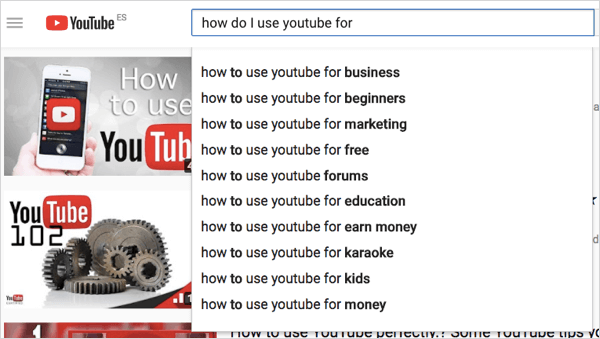
youtube search termsWhile it’s often viewed as a video hosting site, it’s so much more! Imagine being discovered by your ideal customers every single day, at the exact moment they’re searching for a solution to their problem. You show up to solve it, creating a warm lead immediately – and a long-term know, like, and trust bond.

Sunny Lenarduzzi is an award-winning video, social media, and online business strategist.

#3: LinkedIn Ads Performance Flourishes

azriel ratz bio imageOver the last few months, LinkedIn has been making some serious moves. They’ve added video for all personal accounts, they’re testing geofilters for videos, they’ve made a ton of extreme updates to their messaging platform, and at this point they have over 500 million monthly users.

In short, going into 2018, LinkedIn’s growth is about as big as Snapchat’s growth in 2016 and Instagram’s in 2017.

Additionally, as opposed to most platforms, LinkedIn is a business platform, which means that the value of the users is higher for those companies looking to connect and engage with users who are over 35 and working for larger businesses.

What’s truly exciting going into 2018 is that LinkedIn plans to roll out video ads. Currently, there’s no way for a business page to post videos, but this update would make it possible to run high-quality ads on LinkedIn.

Today, Facebook advertising is hands-down the best bang for your buck, but with these changes and others on the way, it’s possible that LinkedIn’s ad platform and the platform as a whole may be one of the best performing for many companies in the coming year.

Azriel Ratz, the CEO of Ratz Pack Media, has years of experience in online marketing and has perfected his strategy for companies to find their ideal audiences and create the most relevant ads for their businesses.

#4: Facebook Becomes Major Player in Video

michael stelzner bio imageIn 2017, Facebook rolled out Facebook Watch for select creators (their TV-like option) In 2018, we’ll see that program expand to all people and pages on Facebook.

We’ll also likely see Facebook roll out new features for video creators that’ll make it far easier to get exposure and be discovered.

facebook videoThis could include preferential Facebook news feed exposure for original native video, generous revenue-sharing deals, and the eventual rollout of a dedicated video app. We also might see Facebook negotiate traditional television deals or even start its own cable television network.

If you’re a video creator, watch this space closely!

Michael Stelzner is the founder and CEO of Social Media Examiner, founder of the Social Media Marketing Society, and author of the books Launch and Writing White Papers.

#5: Rising Ad Costs Are Here to Stay

loren bartley bio imageI predict that the costs of Facebook and Instagram advertising are going to rise considerably over the next 12 months, and this will be an ongoing trend. Investing in social media ads now to generate awareness about your business and build your audiences (particularly via email subscribers), will give you a competitive advantage for years to come.

This competitive advantage will be similar to that some businesses received by building their social audiences early on when organic reach was high and algorithms worked in favor of audience development for businesses.

So invest now before you’re priced out of the market and social media no longer is a viable marketing channel for your business.

Loren Bartley, a social media strategist, Facebook ads specialist, speaker,  and consultant, is co-host and producer of the top-rated podcast, #BusinessAddicts.

#6: Facebook Reviews Become Key Assets

logan young bio imageReviews drive search traffic for Amazon and they also get the sale. Likewise, reviews are increasingly critical on Facebook, as the platform expands ways consumers can leave reviews.

You can think of a like on a post, page, or profile as a mini-review. Everything is a positive or negative review; a check-in, a comment, someone sharing their experience with your company, a new employee updating their profile to show they work at your company, partners tagging you in a post, customers mentioning you in their live video, and so forth.

This word of mouth has always been there, so what’s really changed? This: Everything is boostable.
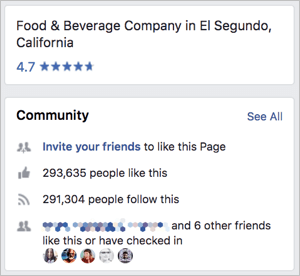
facebook network connections on a brand pageYou now have the power to collect these “reviews” and make sure they’re seen by potential customers. Boost a positive review, share and boost a favorable media mention, and let older posts continue to get exposure. Manage these assets like they’re your bank account. Then when prospective customers first come in contact with your brand, you control exactly what they see.

You know Facebook automatically shows prospects which of their friends are fans of yours, have left a review or checked in, and so forth. If your competitors have abundant “reviews” in the form of positive feedback, especially video, how will you fare when customers are shopping in the news feed?

Logan Young is the vice president of strategy at BlitzMetrics, where he implements ad campaigns and helps structure companies’ marketing funnels.

#7: Snapchat Stories Move Outside the Mobile App

carlos gil bio imageHeading into 2017, I thought without a doubt that we would see Snapchat mix in live video functionality. Well, it didn’t happen. Instead, we saw Instagram continuously innovate while Snapchat remained stagnant. However, I stand firm in my prediction from last year that we’ll finally see Snapchat integrate live video into its redesigned interface.

livestream abstractFurthermore, as Snapchat looks to keep advertisers and brands happy, Stories will be viewable outside of its mobile app, similar to Facebook and Instagram Stories, to boost organic views.

Now, for a bold prediction: By the end of 2018, we’ll see Snapchat acquired by a major media company such as Disney or NBC Universal as these media conglomerates battle to reach the prized attention of Millennials and Gen Z’ers.

Carlos Gil is a first-generation Latino marketing executive and award-winning Snapchat storyteller with over a decade of experience leading social media strategy for global brands.

#8: Twitter Sees Renewed Relevance

mark schaefer bio imageI think this is a little unexpected, but I believe we’ll see a renaissance in marketing through Twitter.

There’s a massive and highly engaged audience there (330 million) that has been largely ignored by brands. Meanwhile, advertising costs are going up on Facebook and AdWords, making Twitter an attractive alternative.

Twitter has shown positive signs in user and revenue growth and is beginning a fun new ad campaign to insert some energy into the brand.

Mark Schaefer is a marketing consultant, keynote speaker, and author of The Content Code.

#9: Instagram Gains Ground as Top Choice for Brands

brooke b sellas bio imageThis isn’t just a gut feeling; the stats back it up. First of all, Instagram is growing fast among businesses; 70.7% of businesses were using Instagram in 2017 (nearly double the number of businesses that used Instagram in 2016), and 80% of Instagram accounts follow at least one business.

Additionally, businesses can now use Stories Highlights to showcase stories on their account pages.

instagram abstractAdvertising is another biggie for Instagram and brands. In 2015, a study by eMarketer said that Instagram’s mobile ad sales could reach $2.81 billion in 2017. But it seems Instagram blew past that, as they’re expected to come in at $4 billion in global advertising.

While Facebook is dealing with ad saturation issues, Instagram is flexing its muscles as the choice platform for users, businesses, and advertisers. Sure, Instagram isn’t going to replace Facebook anytime soon. But it’s positioning itself as a platform ripe for businesses to garner more of that ever-elusive brand engagement.

Brooke B. Sellas is an in-the-trenches digital marketer and CEO at B Squared Media, a boutique “done-for-you” social media marketing and advertising agency.

#10: CEOs Embrace a Social Presence

samantha kelly bio imageCEOs will no longer be able to avoid social media. They’ll become the company’s biggest marketer by engaging with customers and allies more regularly and showing more behind the scenes and the human side, which will increase sales and brand advocates.

Additionally, I still believe Twitter will remain the best way to build relationships with customers and allies, especially in the B2B space. People on Twitter want everything fast, so clicks to sale are easily attained by proper engagement and being human once the correct link (Buy Now) is there.

Samantha Kelly, a leading social media strategist, speaker, and trainer, owns and operates Tweeting Goddess.

#11: Social Media Video Is Essential

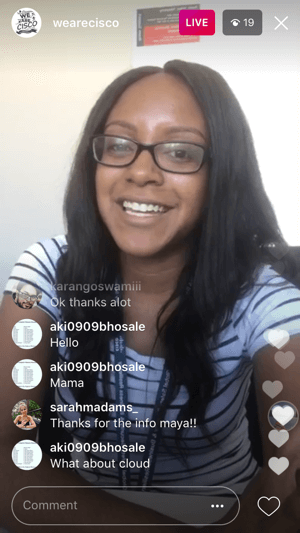
carmen collins bio imageI don’t need 300 words to describe how social media will change in 2018. The answer is live video, produced video, Snapchat video, Instagram video, and YouTube video. If you don’t have video in your content mix for almost every social media channel, you’re going to lose out on those “thumb-stopping” moments as people scroll through their feeds.
facebook live from cisco

And it won’t be enough just to create the video. You’ll need to figure out how to repurpose and repost that video across many channels for maximum exposure.

Carmen Collins is the social media lead for Cisco’s award-winning talent brand, and manages the team and strategy behind the @WeAreCisco accounts.

#12: Story Highlights Improve Instagram Content Quality

melanie deziel bio imageEvery time a platform rolls out a new feature, I get excited to see the creative ways that brands use it and stretch the boundaries of what it can do.

The Story Highlights feature on Instagram, which allows pages to host static collections of previously disappearing story posts on their profiles, could change the way brands approach Stories.

I think we’ll see higher production values in stories now that they can have a longer life, as well as the creation of more evergreen content worthy of being highlighted on the main profile.

Melanie Deziel is an award-winning branded content strategist and consultant, and the founder of The Overlap League native ad newsletter.

#13: Successful Platforms Focus on Users vs. Advertisers

cassie roma bio imageI truly believe that brands might be great generators of content and advertising spend, but the actual strength of social channels lies in community and authentic sharing.

users over advertising dollarsIn a time of algorithmic curation and a melding of friends and brands in timelines, we’re already seeing shifts back to a delineation between the two.

At the same time, users are progressively becoming less open to marketing, and are looking for deeper conversations and stories.

In 2018, the social channels that shift the balance from advertisers back to loved ones and interesting topics will come out winners.

Cassie Roma, GM of content marketing at New Zealand Media & Entertainment, is passionate about storytelling across media both emerging and traditional.

#14: Retargeting Essential to the Customer Journey

jason van orden bio imageBecause the cost to gain the attention of targeted prospects and acquire new customers will continue to climb, companies need to be more efficient with how they use social media and content marketing to drive the customer journey.

Each piece of content or social media post will need to play a deliberate role in guiding prospects along the customer awareness spectrum. This means using retargeting and other similar techniques to ensure a prospect sees the most relevant and resonant messaging in the right order based on previous actions they’ve taken (e.g., visiting a page, requesting a download, clicking, playing a video, viewing a broadcast, viewing an ad, etc.).

Marketing and sales based on using social media and content marketing solely to generate email leads and then relying on automated email sequences to drive the sales process will be at a disadvantage in the coming year. Marketing and sales that create a customer journey that starts much earlier, even before acquiring an email address or other information from a lead, will be much more successful.

Jason Van Orden is a consultant, trainer, and strategist who helps thought leaders reach a larger audience with their ideas and create new income streams from their expertise.

#15: Hashtag Competition Hits Full Swing on Instagram

dustin stout bio imageIn 2018, I see Instagram building more momentum with product updates, user growth, and business tools. They’ve already begun releasing more tools for marketers to allow things like “swipe up” calls to action and giving users the ability to follow hashtags.

I don’t think many people realize, though, how big a deal hashtag following really is.

hashtagThe algorithm for hashtags isn’t great at the moment, but as more people start following them and interacting with hashtagged posts, they’ll feed Instagram data about how users interact with hashtags and the algorithm will improve.

The competition for these hashtags is going to be fierce, but I think the first-movers (as always) will have a great advantage.

Dustin W. Stout is co-founder of Warfare Plugins, a WordPress plugin company, where he oversees social media and content marketing initiatives, branding, and product development.

#16: Savvy Consumers Force Brands to Humanize

jenna kutcher bio imageWe’re learning more each day about the power of human connection. People are far more likely to trust a business that has a personality behind it.

While businesses may have been able to get away with only sharing their products in the past, I think consumers are getting better at spotting and blocking promotions, paid ads, and sales pitches. It simply isn’t enough to only share your work anymore!

One of the biggest things I’ve seen this year is a shift toward more authenticity and vulnerability online and through that, more depth of the connections we’re making with our clients, customers, and followers.

If you really want to take people from simply followers to true fans, it’s time to focus on creating a brand that shares more than what you have to sell.

Jenna Kutcher spends her days in her small town in Wisconsin inspiring entrepreneurs online through her resources, courses, and The Goal Digger Podcast.

#17: AI Magnifies Social Customer Service Quality

viveka von rosen bio imageThere seems to be a dichotomy brewing between needing a more human experience and the onslaught of AI. But are they really on opposite ends of the spectrum?

On one hand – it’s getting increasingly noisy online, making it difficult for those active in social selling and social media marketing to stand out. It’s no surprise there’s an even greater push for customer success, customer happiness, and a better customer experience.

ai information filteringAnd this is where AI comes in. Because of the overload of Big Data and amount of noise on multiple channels, successful marketers are going to need some way to sort through the chaos to get their message out to the right audience. The perception is that AI will dehumanize sales and marketing efforts; however, if used to augment these activities, it could allow professionals to spend more time creating real relationships with the right people.

As Max Altschuler, CEO of Sales Hacker, says, “AI makes good reps great, great reps exceptional, and crappy reps even worse. It’s a magnifying glass. But it’s still going to be very hard to fix bad reps, or use AI to replace reps altogether. That’s the reality that will set in for 2018.”

When you look at some of the AI technologies out there (even LinkedIn is playing in this field), one thing becomes clear. You can’t be afraid of technology. It might be #CreepyCool, but it’s here to stay, and it can help you become a better marketing professional if you know how to use it.

Viveka von Rosen, @LinkedInExpert and co-founder of Vengreso, the world’s largest full-spectrum social selling provider, is author of the best-selling LinkedIn Marketing: An Hour a Day and LinkedIn: 101 Ways to Rock.

#18: LinkedIn Organic Reach Booms

dennis yu bio imageThere’s so little competition on LinkedIn, so much traffic, and such a weak algorithm that people who use the “hero story” formula will get loads of traffic. It’s a perfect storm of a social network that’s transitioning from a job search site to a true professional community.

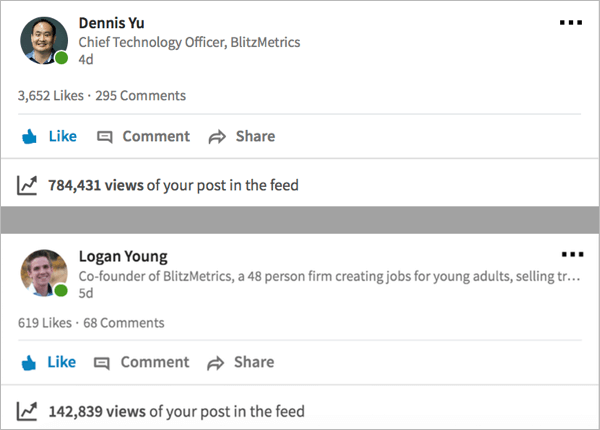
A few days ago, one of my hero story posts generated almost 800,000 views and 4,000 interactions. Instead of receiving the usual 20 connection requests, I received 200 that day. Plus, this post drove dozens of quality leads.

We’ve repeatedly demonstrated using this type of post works. My business partner, Logan Young, who has fewer than 1,500 connections, tried it with similar results. Because the algorithm isn’t smart yet, expect wild variations; posts will get anywhere from a couple of hundred to 200,000 impressions.
hashtag

Here’s how to produce a high-performing hero story post of your own:

  • Present a personal struggle and end with a positive lesson, but be careful not to complain. Because the algorithm counts post expansions (clicking More) as engagement, it’s a good idea to open your story with curiosity or drama to attract the attention of readers.
  • Use one-sentence paragraphs with no links or images; you have up to 1,300 characters. Write quickly and without judgment; the best-performing posts are spontaneous, not overly polished.
  • Be sure to change your post settings to LinkedIn + Twitter. You can post at any time because unlike Twitter or Facebook, your engagement will grow over the next 7-10 days.
  • After publication, click Like and comment on the post whenever possible; LinkedIn doesn’t weigh your own shares, likes, and comments differently than those from others.

Dennis Yu is the chief technology officer of BlitzMetrics, a digital marketing company that offers clients top-notch analytics on all major social networks.

#19: Instagram Further Adapts to Business Needs

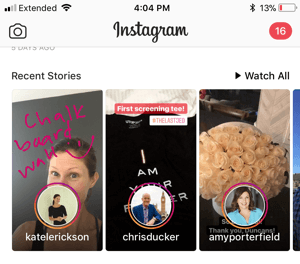
john lee dumas bio imageInstagram has proven they’re quick to adapt with their rollout of InstaStories, and I love that they continue to promote Stories to users within the actual “news feed.”
instagram instastories example

InstaStories gives you, the creator, such a unique opportunity to create an intimate connection with your followers – one where they truly feel like they know you. This type of transparency and behind-the-scenes access will continue to be a powerful way to grow your following and the know, like, trust factor.

Instagram has also made some pretty awesome upgrades to the business side of things. They’re now offering business profiles and tools for business owners, and the ads side of things continues to improve with promoted posts. You can even set up posts where people can click straight through to your online store.

instagram buy tag

There are a lot of growth possibilities with Instagram, and the fact they continue to adapt in an ever-changing social media world says a lot.

John Lee Dumas is the host of Entrepreneurs On FIRE, awarded Best of iTunes, where he interviews the world’s most successful entrepreneurs 7 days a week.

#20: Video Views Become a Vanity Metric

nick cicero bio imageWith each platform counting their video views differently (Snapchat at 1 second, Twitter at 2 seconds, Facebook/Instagram at 3 seconds, and YouTube at 30 seconds), it’s not about the number of views anymore. We only get the same 86,400 seconds in a day.

In 2018, we’ll see more marketers focus on authenticated data, measuring the time spent, and the attention held across all screens on all platforms as they create more and more content.

Nick Cicero, CEO and founder of Delmondo, a social media and digital video analytics measurement company, created the first analytics for Snapchat and Facebook Live.

#21: Paid Facebook Acquisition Is Here to Stay

rebekah radice bio imageLet’s admit it, Facebook organic reach is decreasing at a rapid pace to the point of nonexistence. For those who’ve been solely dependent on an organic strategy, those days are done. They’ll now be replaced by a paid model.

But rather than panicking or tossing out your Facebook marketing strategy altogether, treat this as a challenge.

paid facebook acquisitionYou have to be far more strategic in the placement of your content, the context around it, the tools you use, how you position your ads, manage your spend, and so much more.

And consider this: ads are quantifiable. That means that whether it’s Facebook, Instagram, LinkedIn, or Twitter, you can track the metrics of each ad or promoted post. No more guessing or struggling to put together a month-end report.

When you pair a paid acquisition model with historical data, personalized content, and a deep understanding of customer behavior, everybody wins. And more than that, I guarantee that it’ll be the defining difference between those who limp along and those who drive real revenue results in 2018.

Rebekah Radice is the founder of RadiantLA, the author of Social Media Mastery: A Comprehensive Guide to Strategic Growth, and creator of the best-selling course, The Smart Guide to Marketing Your Business on Social Media.

#22: LinkedIn Sees User Resurgence

aj wilcox bio imageLinkedIn is currently enjoying a mindset shift with professionals. Whereas it used to be the old, boring, stodgy network with no personality, now many professionals are realizing it’s an ideal place to create real relationships that turn into real business.

I predict that professionals’ usage of LinkedIn will skyrocket, resulting in more conversation and interaction, putting LinkedIn into the mainstream where users will make spending time there a priority.

linkedinIncreased attention on the platform will result in more conversation, which means more competition for the eyeballs of your connections/followers. Currently, LinkedIn employs an algorithm that rebroadcasts all social actions (like, comment, and share) to the user’s networks, which makes it much easier to achieve virality with your LinkedIn posts than with posts on other networks.

On the advertising platform, that increased usage will result in additional ad inventory, which has a dampening effect on costs. Of course, the more attention on LinkedIn, the more advertisers will enter, driving up competition, so costs likely won’t go down, but I predict they will increase only slightly, compared to Facebook ad costs which will continue to grow double-digit percentages quarter over quarter.

Additionally, the rising cost of Facebook Ads will start to drive some advertisers away. As soon as B2B clicks on Facebook start to cost over the $3 mark, advertisers will start to move over in droves to test LinkedIn Ads for the better B2B targeting, scale, and the higher-quality leads.

AJ Wilcox is a LinkedIn Ads pro who founded B2Linked.com, a LinkedIn Ads-specific agency, in 2014.

#23: Collaborative Storytelling Is a Must

kathy klotz-guest bio imageThe future of video, live streaming, and social media is exciting. Brands are going to get more personal and collaborative by bringing fans, customers, and employees into more of the stories they tell and co-create.

Breaking the fourth wall (a performance term) between customers and companies isn’t an option for video storytelling and content anymore; it’s a must. When we break walls, we create powerful shared “we” experiences.

collaborative marketingWe’re going to see this happening more with other social media channels, too. Far more interactive story creation with audiences is critical to breaking the fourth wall that traditional marketing has erected. It’s the year of collaboration (a key principle of improv) that puts employees and customers at the center of the most amazing stories.

Kathy Klotz-Guest, founder of Keeping it Human, is a speaker, author, strategist, and comic.

#24: Facebook Page Growth Stops

andrea vahl bio imagePeople ask me if Facebook still makes sense for their business. And for the first time, I’m recommending putting less effort in your Facebook Pages for many businesses.

Some businesses still have engaged communities on their Pages and for those businesses, it makes sense to continue posting as they have in the past. But I’ve seen many Pages growth slow to a crawl.

For the record, I’m definitely nott telling you to shut down your Facebook Page. Just don’t expect the Page to drive organic growth. Businesses do still need a Facebook Page in order to advertise on Facebook.

Here are my recommendations:

  • Use your Facebook Page to post your best content and reach your core audience.
  • Post less and Boost more. But only Boost your important posts to your core audience to save money.
  • Use Facebook Ads as your growth engine by running Conversion ads to get people onto your email list or showcase special offers.
  • Use Facebook Groups for growth as well if it makes sense for your business. Groups are being seen much more in the News Feed but also require a lot more moderation.
  • Use Facebook Video on your Page as your growth engine and to get more organic reach and to drive traffic to your website.

The Marble Jar HQ Tour

The Marble Jar has been my dream for years, and it’s so exciting to see it come to life. Watch as I walk you through our HQ and show you where the dream is coming true!

We are an online store, but this Sunday, Nov 5th, we’re hosting our first pop-up from 12pm – 5pm CST. I can’t be at the pop-up that day, but I’ll be sending all of my good vibes. And, I’ve signed a big stack of books that will be available at the pop-up! RSVP here: https://www.facebook.com/events/312548919151662/

Posted by Brené Brown on Friday, November 3, 2017

Facebook is making a major play for YouTube and Netflix as the source for video content. Video is getting more organic reach and Facebook Watch is becoming more visible. So if you are going to use Facebook for business in 2018 focus on Video, Groups, and Ads.

Andrea Vahl, a social media coach, speaker and strategist, is co-author of Facebook Marketing All-in-One for Dummies and co-founder of Social Media Manager School.

#25: Credible Content Reigns Supreme

becky roth bio imageAfter a year that popularized the phrase “fake news,” 2018’s audiences will be ready to connect with something real. So while storytelling will remain an important tool, we’ll see the focus of those stories shift toward universal themes like humanity and diversity. At the same time, we’ll also see new demands placed on social platforms and content creators, designed to surface more credible content.

So how can you stay ahead of these shifting demands? Here are a few ideas:

  • Photos are key. Photography is seen as more authentic than illustration, and the more candid the better. Use lifestyle photography whenever possible, and reserve illustrations for product explanations.
  • Prioritize video. Likewise, video conveys a sense of authenticity and immediacy that text just can’t match, and it’s popularity is increasing. Need proof? Just look at Instagram’s new emphasis on video, or the new iOS 11 App Store guidelines that consider video content “expected,” no longer a “nice to have.”
  • Commit to a format. Storytelling content will become either long-form (e.g., podcasts) or short-form (e.g., Snapchat), with no middle ground. Time is precious, so either give your audiences the whole story, or limit yourself to a quick bite and let them get on with their day.
  • Make it sound good. According to eMarketer, 18.5% of Americans own a smart speaker like Amazon Echo or Google Home, while Comscore reports that they’ve hit the “critical adoption threshold.” With nearly a fifth of your audience turning to Alexa, Google, and Siri for information, audio-optimized content will be essential in 2018. But not only will marketers need to optimize content for voice search, it’ll be especially important to stay authentic and human. For the first time, we’ll be able to actually talk to people at the exact moment they need us. It’s a great opportunity for content creators, but also a medium that must be addressed carefully. We expect that 2018 will be the year we figure that out.

Becky Roth is a creative and forever-curious product marketing manager for the Expedia Mobile App.

#26: LinkedIn Integral to Influence

josh elledge bio imageI embarrassed myself in 2017 by suggesting that LinkedIn was a great place to update your resume but held little value for connecting with influencers, particularly those within the media. I now believe that one can’t over-invest in their LinkedIn presence in 2018, particularly if you’re a company principal, sales rep, or marketing pro.

influence authorityWhile I believe that concentrating on growing audiences and engagement on social media platforms is key to boosting sales and conversion rates and gaining greater opportunities for collaboration, it’s also excellent for attracting amazing opportunities to be seen as the go-to authority for your industry.

In short, beyond simply using social media to connect with more people, your measurable authority on social media is a currency that will be more vital than ever for your business to grow in any way.

Josh Elledge, founder of upendPR.com and a weekly syndicated newspaper columnist reaching more than 1.1 million readers, also regularly appears on radio and more than 75 TV stations across the country.

#27: Video Is Crucial to Social Sales

billy gene shaw bio imageI guarantee you that a significant percentage of companies that don’t make a serious commitment to selling their product or service with VIDEO will go out of business.

Now more than ever, consumers want to watch videos. Not taking advantage of this opportunity is actually hurting businesses and they don’t even realize it. Over 500 million people are watching video on Facebook every single day.

When these people watch videos, they begin to trust the business more (unless the videos completely don’t resonate with their audience). And as a result, the more someone trusts the business, the more likely they are to purchase something from them.

So, if your competitor begins putting out a bunch of video content (which more and more businesses are already starting to do), then they are going to win the customer over the businesses that aren’t using videos.

Even simple selfie videos filmed on cell phones are propelling businesses higher than video-less businesses. People need to stop being afraid of be on camera, take imperfect action, and just put out as much video content as possible.

Don’t get me wrong though, creating videos alone isn’t going to be enough. You also need to run paid ads to get eyes on them. Because if no one sees your videos, then it’s like they don’t exist.

Billy Gene Shaw is one of the world’s top online marketing influencers, educators, and practitioners.

#28: Facebook Groups Key to Success

jessika phillips bio imageAs we move into 2018, the number-one trend on social media will be relationship marketing. People will begin to focus on building more meaningful connections, especially with current audiences, that will grow repeat and referral business. One way to do this is on Facebook.

I predict it’s going to become easier for great brands to shine on Facebook while increasingly harder for brands that rely on automated means to gain traction.

relationships on facebookBrands will need to invest in creating a separate Facebook group that’s tailor-made for their niche. These pages will be managed by their business page, which will give them the ability to build relationships with their core audience. This lets them use Facebook for two purposes. Business pages will serve as an introduction to the brand, while groups will encourage a deeper, more meaningful connection.

For example, we manage a holistic doctor’s office that focuses on wellness, but their Facebook group is directed at runners within their specific city. This allows them to gather their target audience of like-minded individuals so they can show their expertise and then build meaningful connections based on serving their audience.

Using Facebook groups will require a community manager to ensure they’re managed properly. Constantly providing quality content mixed with oversight of group members and conversations will be key components.

Jessika Phillips is a social media strategist and founder of NOW Marketing Group.

#29: Brands That Co-Create With Consumers Will Thrive

duncan wardle bio imageBrands that continue to use social channels as a push messaging strategy to deliver boring content that solely aligns with their strategic goals, rather than engaging their consumers in co-content creative development will continue to diminish in relevance.

Brands that embrace the trends of crowdsourcing, crowdfunding, accelerator programs, and the sharing economy, developing both content and ideas for products and services in conjunction with their consumers/influencers, will ultimately prevail.

Duncan Wardle is an independent innovation, design thinking consultant.

#30: Video Messaging Drives Social Selling

karin aviles bio imageFor 2018, I predict that video goes mainstream and furthers one-to-one communication, especially in B2B. I know we’ve been saying that video is the social trend for the last 3 years or so. And believe it or not, some brands still aren’t leveraging video content to their fullest potential. I’m not suggesting that having video content in your brand handle’s feed is a new trend.
video message example stillWhat I am suggesting is that video messages will take social selling to the next level by enabling any employee at a company to communicate professionally through video. Just look at recording platforms like OneMob or Loom, which allow brands to make a more human connection in 2018.

B2B customers and prospects would much rather receive a recorded video from their partner, supplier, or vendor than a traditional email. Think of the power when your sales rep follows up with a prospect via LinkedIn and references specific discussion points from the sales meeting. The rep is instantly able to customize everything about the message, making them a standout among the rest of the follow-up emails prospects typically receive.

Alternatively, video messages can be public, like using them for customer onboarding or partner training. While that typically requires videos to be generic, they can scale quickly and make the process repeatable. Not to mention that it’s more engaging than handing someone a 10-page PDF to read.

In 2018, it’s all about cutting through the noise, increasing engagement, and deepening personal relationships. That means finding new and exciting ways to drive engagement through video. Using a personalized video message allows brands to do just that!

Karin Aviles leads North America demand generation and field marketing for Direct Energy Business and most recently oversaw MarCom and content operations for Verizon Business Markets.

#31: Social Content Evolves Past 2D

cathy hackl bio imageSocial media companies like Facebook and Snapchat will continue to focus on augmented reality as the next social platform.

We will also see more interest in VR and social VR (i.e. Facebook Spaces) and how it can be used by brands to connect with audiences in virtual environments, as we move from storytelling to storyliving.

[embedded content]

The content paradigm will continue to shift from 2D/flat content to content that’s 3D, 360, and sometimes holographic.

Cathy Hackl is an Emmy-nominated broadcaster turned social media marketer and nationally recognized live video and VR/AR influencer and speaker.

#32: Facebook Advertising Loses Market Share

heidi cohen bio imageWhile expanding its focus on video that proved to be its most shared and viral content according to BuzzSumo [http://buzzsumo.com/blog/the-most-shared-facebook-content-posts-videos/], Facebook will remain blind to its lack of competitive search functionality that its peers have, namely Google’s YouTube (the second largest search engine after Google) as well as voice search on Amazon’s Echo and Google’s Home.

From an advertising perspective, Amazon (which can be considered a social media network via its customer reviews) will become a greater threat to Facebook and Google. Through Prime that eliminates shipping charges in the US, Amazon has increased its dominance for first stop shopping entryway.

Heidi Cohen, an Entrepreneur Magazine Top 10 Online Marketing Influencer of 2016, is the chief content officer of the award-winning Actionable Marketing Guide.

#33: LinkedIn Lightens Up

andy crestodina bio imageIn 2018, LinkedIn will do everything Facebook did in 2017. LinkedIn really really wants to keep up with it’s cooler, younger brother. Adding video helped, but it’s not enough. As Facebook smashes records for engagement and ad revenue, look for other “me too” features in LinkedIn.

Keep an eye out for exciting new LinkedIn emojis, stickers, polls and animated GIFs. A year from now, sharing on LinkedIn will have these fun options!
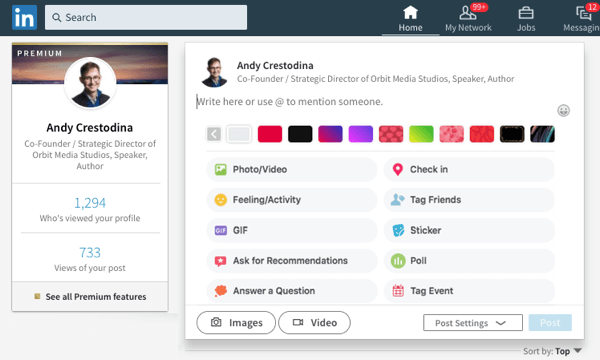
linkedin facebook-like post backgrounds

Also, look for cool new filters for profile pictures that will let you look like a cat on LinkedIn! Here’s what my profile will look like this time next year:
linkedin facebook-like profile photo filter

Do these ideas make sense for LinkedIn? Not really. But they have to try something to get more engagement. So the business social network will become a bit more business casual. It’ll be like the company holiday party year round.

In all seriousness, I won’t be surprised to see one change to LinkedIn in 2018. Currently, this is the only social network that lets you export all of your connections and their contact info. This is extraordinary and not something that we should count on forever. Consider exporting yours before this feature is quietly removed.

Andy Crestodina is a co-founder of Orbit Media, an award-winning, 38-person web design company in Chicago.

What do you think? Do these predictions match up with what you’re expecting in 2018? Are you predicting something different? Share your thoughts in the comments below.
Wondering how marketing on Facebook, Instagram, Twitter, LinkedIn, & Pinterest will change in 2018? Social media pros offer their thoughts.

Shares 708

https://www.socialmediaexaminer.com/social-media-predictions-2018/



OkCupid begins enforcing real-name rules, insists it’s a good idea

Enlarge / OKCupid would rather you use real names for its dating service than use anonymous handles. But its open letter announcing the change didn’t address possible privacy ramifications.

Over the past year, online dating service OkCupid has shaken up a few of its core features, and the changes have all pushed the service far closer to resembling rival dating app Tinder. Thursday’s big change, however, sees the site borrowing a subtler Tinder “feature” that has long enraged users of other online platforms: a real-name policy, coming before year’s end.

“We all have real names,” the company’s open letter states while listing a variety of goofy-sounding handles that the unnamed author insists are taken from real dating accounts. “We know, this is tough to hear. It’s because, like the recent goodbye we said to AIM screen names, it’s time to keep up with the times. We want you, BigDaddyFlash916, to go by who you are, and not be hidden beneath another layer of mystique.”

The feature will only display first names, and OkCupid says no outside-service verification will be used to confirm that the name matches your actual identity. An OkCupid spokesperson tells Ars Technica that the only requirements are a two-letter minimum without numbers, symbols, or emojis and that it will operate a “banned word” list, whose contents it did not disclose.

Real name, real headache?

OkCupid’s decision follows a tumultuous period earlier in the decade when a number of companies began preventing customers from publicly identifying themselves with pseudonyms, and instead began mandating they use real names, even when communicating with other users. Facebook’s policy, in particular, has faced serious scrutiny thanks to privacy and LGBTQ advocates pointing out the inherent problems and dangers that users can face by attaching “legal” names to their online accounts. Google’s efforts to attach real-name information to Google+ accounts eventually crashed and burned due to user outcry—particularly in terms of those real names getting attached to YouTube accounts. Blizzard toyed with a real-name policy for roughly one week in 2010 before changing course due to negative fan responses.

Facebook ultimately won out in European courts in disputes over its real-name policies, but that hasn’t stopped critics, including Ars’ own Timothy B. Lee, from speaking out about just why Internet anonymity is valuable, especially in the face of governments trying to legislate their own real-name rules. From Lee’s 2011 op-ed:

Not everyone seeks anonymity to behave boorishly. Some online speakers want anonymity because they fear their legitimate online speech could trigger real-life retaliation. That could mean a citizen of a repressive regime wanting to criticize the government. It could mean a whistleblower wanting to expose the wrongdoing of her employer. It could be a woman trying to avoid discovery by her abusive ex-husband. The list of reasons people want to speak anonymously is almost endless.

Lee also points out that companies in free-speech countries like the United States are welcome to enforce their own real-name rules, and users can adopt or reject them as they see fit, so OkCupid’s plans (probably) don’t run afoul of American law. But they do raise questions about the sensitive data proposition of online dating and how any attachment to real identities can prove troubling. One European Tinder user found this out earlier this year when she requested, and finally received, an 800-page print-out of personally identifying data that the company had collected about her use of the service. And whether you’re using the site in an above-board fashion or behind a partner’s back, the ramifications of real dating data in hackers’ hands still echo loudly following the explosive Ashley Madison leak in 2015.

When asked about issues with identifying factors that can result in harassment and abuse, whether due to stalkers and exes or due to users being members of the LGBTQ community, an OkCupid spokesperson responded with a statement:

“We know this is a change that has worried the trans community. We have always been about inclusivity and making OkCupid a place where everyone feels welcome which is why we were one of the first dating apps to offer non-binary gender options and today have 22 gender options and 13 orientations available. It’s important to note that it doesn’t necessarily have to be your legal first name, it can be whatever nickname you would like your dates to call you.” The statement also pointed out that the company stopped indexing its profiles on Google “months ago.”

OkCupid’s rapid Tinder-ization

In OkCupid’s case, the move follows some other major changes that bring the service far closer to resembling Tinder. This one, for example, mirrors Tinder’s use of Facebook profile data, which thus assigns a “real” first name to a user’s account.

Last month, OkCupid rolled out a change to its messaging system that prevents any user from seeing if they’ve received an unsolicited message unless they stumble upon the message-sender’s dating profile and indicate a “like.” Doing this unlocks that suitor’s ability to directly contact the other person. This is similar to Tinder, which only allows messages to be shared when both users indicate a “like.” For some users (read: the popular ones, as per activity on the site), this feature change can reduce mailbox clutter. For others (read: the less popular ones), this makes receiving messages much more difficult and all but requires constant flipping and swiping through profiles just to raise your chances of unlocking a sender’s ability to contact you.

In July, OkCupid also removed an opt-in feature that showed users who had stumbled upon their dating profile and at what time they did so. This allowed daters, particularly the less popular ones, to passively peruse potential matches of interest. By removing this opt-in feature, OkCupid essentially nudged users to do more browsing and swiping through the entire site’s meat market of available daters.

https://arstechnica.com/?p=1236977