This PR Guru Says When It Comes to Social Media, Stop Doing These 5 Things Right Now

Mimi Banks decided to open her own boutique, full-service social media agency after spending years working in the beauty industry. Today, she focuses on helping global beauty, luxury and lifestyle brands with social media management, influencer outreach, content creation and training. She sat down with Jessica Abo to talk about how she started MB Social and shared what you should stop doing to help your brand break through the noise online.

Related: How 2 Sisters Created a Business Around Wearable Art

Watch more videos from Jessica Abo on her YouTube channel here.

Entrepreneur Network is a premium video network providing entertainment, education and inspiration from successful entrepreneurs and thought leaders. We provide expertise and opportunities to accelerate brand growth and effectively monetize video and audio content distributed across all digital platforms for the business genre.

EN is partnered with hundreds of top YouTube channels in the business vertical. Watch video from our network partners on demand on Amazon Fire, Roku, Apple TV and the Entrepreneur App available on iOS and Android devices.


Influencer Disclosure Guidelines: What Marketers and Creators Need to Know

Shares 793

social media how toDo you work with influencers?

Wondering how best to comply with disclosure guidelines?

In this article, you’ll discover how to properly protect your business when participating in influencer campaigns.

Influencer Disclosure Guidelines: What Marketers and Creators Need to Know by Laura Danforth on Social Media Examiner.

Influencer Disclosure Guidelines: What Marketers and Creators Need to Know by Laura Danforth on Social Media Examiner.

#1: Use Built-In Disclosure Tools for Top Social Platforms

One positive result from the efforts of the Federal Trade Commission (FTC) to increase transparency is that the world’s best-known (and most-used) social platforms (Facebook, Instagram, and YouTube) now provide tools to help marketers comply with existing disclosure rules. Using these tools can dramatically simplify compliance efforts while also giving you peace of mind.

Instagram

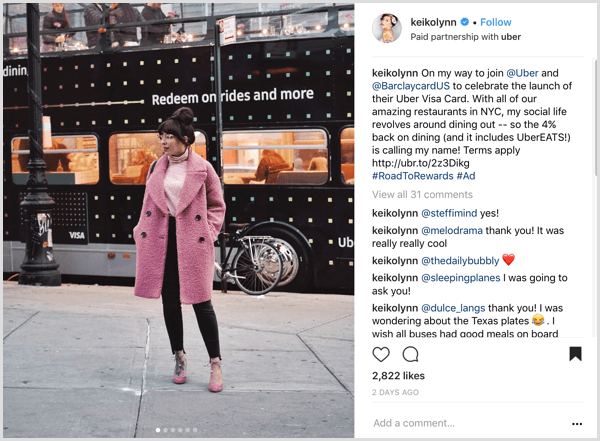
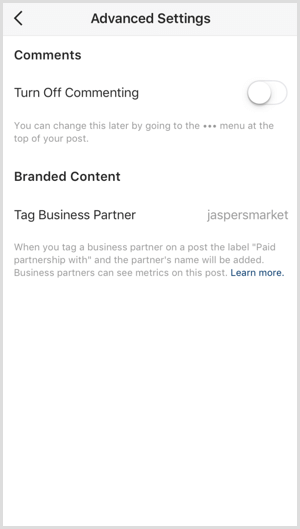
In March 2017, Instagram launched a “Paid Partnership with [business partner]” tag that makes it easier for creators to highlight sponsored posts in their feeds. While the feature hasn’t rolled out to all Instagram users, creators and brands with access can find the tool in the Advanced Settings section when creating a post.

Instagram paid partnership tag

Facebook

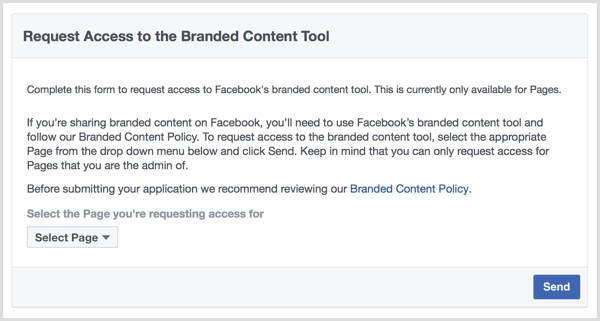
Facebook has similar branded content policies and tools to help simplify the disclosure process for marketers and creators. The first step for marketers is to ask creator partners to request access to Facebook’s Branded Content Tool. They can go to this link to initiate the process.

Facebook branded content tool request access

From there, Facebook lets businesses, creators, and partners tag branded content a number of ways, depending on the post type and business goal. Review the full branded content tagging guidelines in this comprehensive Facebook FAQ.

YouTube

YouTube has improved transparency by allowing you to add an optional text disclosure statement to any video campaign.

YouTube video disclosure

If you’re working with a YouTube influencer, ask the influencer to go to their video manager in Creator Studio to complete the process. Here are the steps they need to follow:

First, click the Edit button for the video asset that requires a sponsored content disclosure. On the Info and Settings tab, click Advanced Settings below the video.

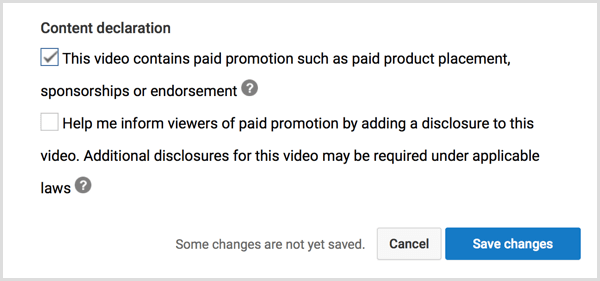
Look for the Content Declaration section at the bottom right and check the box if the video contains paid promotion.

YouTube content declaration

While the YouTube process isn’t very elegant or simple, it’s a worthwhile process that can help you avoid any future FTC disclosure issues.

#2: Follow Disclosure Best Practices if No Formal Tool Exists

What should marketers do when there are neither formal disclosure tools nor clear guidelines? The good news is the advertising industry has some disclosure best practices that apply to influencer campaigns regardless of platform. Based on this informal list and suggestions from the FTC, marketers should follow these guidelines.

Use the Right Hashtags

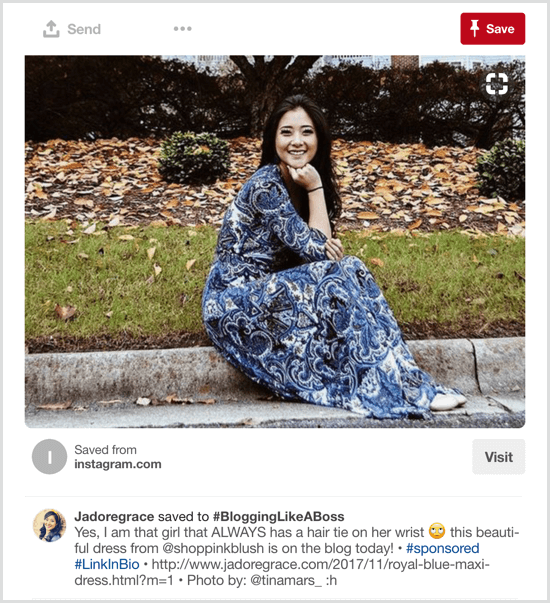
According to the FTC, #ad or #sponsored are the preferred hashtags for sponsored content campaigns. While other hashtags like #sp and #partner are popular, the FTC notes that it’s too easy for these terms to be misunderstood or simply ignored by followers.

sponsored content Facebook

Tag the Sponsor in Branded Posts

Creators should always tag the brand account if the social channel allows it. On platforms like Instagram or Facebook, the tagging features for sponsored content are much more robust. However, nearly every social platform enables some method for linking to the sponsoring brand’s account, typically using the “@[brand name]” signifier.

sponsored content Pinterest

Use Umbrella Kickoff Posts

If possible, marketers and creators should plan separate posts at the start of sponsored campaigns to explain the program and preview what kind of content will be posted.

Disclose Early

Don’t force a user to scroll down or click through to view a sponsored post disclosure. It should be the first thing followers see.

For further disclosure tips, check out the FTC’s blog.

paid partnership Instagram

#3: Follow Industry Trade Groups to Stay Up to Date on the Latest Guidelines

In the fast-moving influencer marketing space, rules and best practices are constantly evolving. As a result, some of today’s more forward-thinking ad agencies, brands, talent agencies, and creators are joining industry trade groups to share tips, create community, and establish measurement standards for sponsored content campaigns.

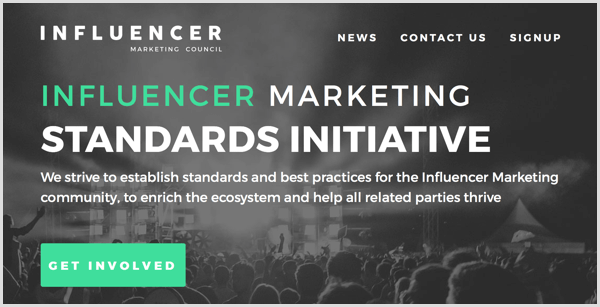
While a number of groups are working on this transparency issue, one of the newest is the Influencer Marketing Council (IMC). It’s a constellation of agencies that hopes to negotiate directly with social media platforms and the FTC as they continue to formalize future rules for sponsored social campaigns.

Influencer Marketing Council standards initiative

In addition to the IMC, several other ad industry trade organizations are launching working groups and resources to inform marketers and creators. In the UK, the Committees of Advertising Practice publishes guidelines and educational information about influencer disclosure on their website.

In the U.S., the Internet Advertising Bureau (IAB) is involved with disclosure rules for sponsored campaigns. Last summer, it convened a working group to develop recommendations related to the practice.

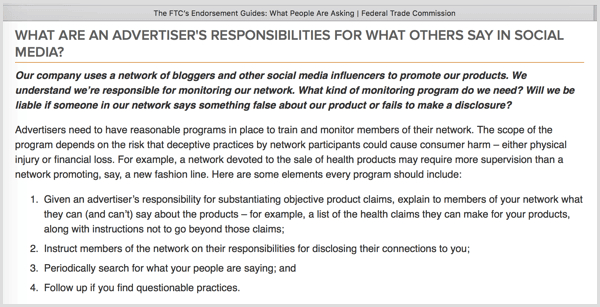
The FTC’s What People Are Asking page is another great resource for marketers looking for answers. In addition to reiterating the best practices outlined above, you can find guidance on more complicated influencer situations like social media contests, online review programs, and more.

FTC what people are asking

Conclusion

There’s no doubt about it: Influencer campaigns are becoming a critical marketing tool for many of the world’s biggest brands. But because the discipline is still relatively new, it’s too easy for creators and marketers partnering with them to run into problems, causing headaches that result in legal and financial penalties.

The FTC continues to ramp up enforcement of new rules surrounding branded content. Not only has the FTC settled its first legal case against influencers Trevor Martin and Thomas Cassell, but the organization has also been sending a growing number of warning letters to prominent social users like Naomi Campbell and Lindsay Lohan who aren’t adhering to proper disclosure rules.

If you take the time to study the emerging disclosure best practices for sponsored content, you can put your mind at ease. Using the built-in branded content tools on Instagram, Facebook, and YouTube is a great start. But even in situations where no formal tools exist, you should still follow the disclosure guidelines established above.

*Nothing in this article is intended to be legal advice and is for educational purposes only.

What do you think? Do you follow these best practices for branded content? Please share your thoughts in the comments below.

Discover how best to comply with disclosure guidelines and properly protect your business when participating in influencer campaigns.

Shares 793


13 Social Media Stories You May Have Missed in November by @thebigdebowski

Miss the latest social media news? Here’s a recap of the latest updates on Facebook, Instagram, Snapchat, Twitter, and YouTube.

Facebook

Facebook’s standalone Events app has received a significant update, which comes with a full rebranding and more opportunities to discover local highlights. No longer being focused exclusively on events, the app has been renamed “Local.”

In addition to being able to find local events, the new app allows for the discovery of restaurants, bars, and other local businesses.

ADVERTISEMENT

Learn More: Facebook Updates Events App With Restaurants, Bars, and More

Facebook revealed details about version 2.2 of its Messenger platform, which comes with a highly requested customer chat plugin.

This plugin allows businesses to carry on conversations with customers between their website and Facebook Messenger. That means a conversation can begin on a business’ website and then seamlessly transition to Messenger, or vice versa, without losing any of the chat history.

Learn More: Facebook Introduces Messenger Chat Plugin for Business Websites

Facebook rolled out a new feature to pages and profiles that will allow users to post simple polls, and even add GIFs to them as well. Polls include one question and two choices of answers, similar to the new Instagram polls that were introduced recently.

Learn More: Facebook Introduces a Simple Polling Feature With Support for GIFs

Instagram

In a bid to encourage more users to privately message one another, Instagram announced a new feature it’s calling “remixing.” The process involves editing a friend’s photo sent to you via direct message with stickers and custom text and doodles, and then sending it back to them within another photo of yourself.

Learn More: Instagram now lets you vandalize your friends’ photos with custom text and doodles

Instagram tweaked a couple of its direct messaging features to make them a bit more flexible and interactive. You can now automatically capture and remix photos sent to you in replies back to friends, and allow photo and video replays to be replayed more than once.

Learn More: Instagram now allows optional photo and video message replays

Instagram is testing a number of new features including the ability to search for GIFs to upload in your stories, according to screenshots obtained by The Next Web. TNW also detailed a number of other new features Instagram appears to be testing:

  • A close friends list to share with only a small group of people.
  • An automatic archiving option for all your stories.
  • Hashtag and emoji search options.
  • The ability to follow hashtags to get top posts and stories on a particular trend.

Learn More: Instagram testing GIF search for Stories

LinkedIn

LinkedIn is telling people’s bosses about what they’re posting online. The networking site is analyzing users’ sharing habits and offering to send its findings to their employers.

This includes the amount of content people are posting, and the impact these updates are having on “content engagement.”

Learn More: LinkedIn lets your boss keep tabs on what you’re posting online with new feature

Snapchat

Snapchat is now using object recognition to identify what’s in users’ photos and serve them relevant filters. So, if you take a picture of some food, Snapchat will suggest filters with slogans like “get in my belly” and “what diet?”

Learn More: Snapchat now recognizes food, pets, and more when suggesting filters

Snapchat is rolling out a new ad format just in time for the holiday season: Promoted Stories, which will let advertisers pay to push their story to more users. Anyone on Snapchat can create a Story, including brands or businesses, but they are only visible to the account’s followers.

Promoted Stories, though, are country-wide, which means a brand could push their ad to all Snapchat users in the U.S., for example.

Learn More: Snapchat is selling a new type of ad just in time for the holidays: Promoted Stories

By putting best friends first and dividing them from professional publishers, Snapchat hopes to conquer Instagram and revive its own growth with a big redesign that begins rolling out Friday. And it looks great. Snapchat is finally personalizing, highlighting the most relevant content so it’s easier to consume.

Learn More: Snapchat starts algorithm-personalized redesign splitting social and media

Twitter

Twitter officially doubled its character limit from 140 to 280, following a short test which showed longer tweets receive more engagement. More specifically, Twitter is doubling the character limit in countries where “cramming was an issue.”

Learn More: Twitter Doubles Character Limit to 280, Says Longer Tweets Drive More Engagement

Twitter’s data-saving application has landed on the local Google Play stores of 24 new locations.

After a successful test run in the Philippines, the social network has released its Lite app in Algeria, Bangladesh, Bolivia, Brazil, Chile, Colombia, Costa Rica, Ecuador, Egypt, Israel, Kazakhstan, Mexico, Malaysia, Nigeria, Nepal, Panama, Peru, Serbia, El Salvador, South Africa, Thailand, Tunisia, Tanzania, and Venezuela.

Learn More: Twitter’s Lite app reaches 24 more countries

YouTube

Even YouTube is adding Stories. The popular is now making its way to YouTube as a new feature the company is calling “Reels.”

The idea with Reels is to introduce a new video format on YouTube that lets creators express themselves and engage fans without having to post a full video. Instead, creators make new Reels by shooting a few quick mobile videos of up to 30 seconds each, then adding filters, music, text and more, including new “YouTube-y” stickers.

Learn More: YouTube is launching its own take on Stories with a new video format called ‘Reels’


Win Free Tickets to Social Media Marketing World 2018

Shares 314

social media reviewsWant to win a free ticket to the industry’s largest social media marketing conference of the year?

Social Media Examiner has been working hard to bring you our sixth annual physical conference.

And we’ve come up with a fun way for you to get involved.

First, what is this event?

Social Media Marketing World 2018 is the world’s largest social media conference dedicated to helping marketers and creators master social media marketing.

More than 200 of the world’s most respected social media marketing experts will share their strategies with you–and you can meet them face to face. Imagine chatting with Guy Kawasaki, Mari Smith, Jay Baer, Ann Handley, Amy Porterfield, Chris Brogan, Mark Schaefer, Michael Stelzner, Kim Garst, Tim Schmoyer, Darren Rowse, Zach King, Pat Flynn, Joel Comm, and Shaun McBride–and many, many more.

With an all-access ticket, you’ll choose from 140+ pitch-free sessions and workshops at Social Media Marketing World 2018. We’ll cover all of the newest techniques to help you excel on Facebook, Instagram, YouTube, LinkedIn, Twitter, Pinterest, Snapchat, and beyond.

We’ve also got creator tracks for bloggers, podcasters, and video creators. You’ll discover how to grow your audience, monetize your following, and refine your craft from the experts at Social Media Marketing World.

One of the best parts of Social Media Marketing World is the opportunity to network with 5,000 fellow marketers. We’ve built networking right into the schedule, with dedicated networking times after lunches and keynote sessions, an enormous Networking Plaza where you can connect with experts and peers between sessions, networking walks and runs, and two networking parties, including the Opening Night Networking Party aboard the USS Midway aircraft carrier.

How can you win a ticket?

Win Free Tickets to Social Media Marketing World 2018.

Win Free Tickets to Social Media Marketing World 2018.

We’re giving away one free all-access ticket to the conference (retail value $1,597) and one free virtual ticket (retail value $697).

Here’s how you can enter to win: In the comments box below, write about your biggest social media marketing challenge and why you should win a free ticket.

Our judges will select two winners. The grand prize winner will be awarded a free all-access ticket to Social Media Marketing World 2018.

The second-place winner will be awarded a free virtual ticket to Social Media Marketing World 2018 (remote access to the content).

The judges–Jasmine Star (photographer and Instagram expert at JasmineStar.com), Viveka von Rosen (LinkedIn expert and author, LinkedIn Marketing: An Hour a Day), and Ian Anderson Gray (founder, Seriously Social, and social media tools expert)–will select the winning entries. Their decisions are subjective and final.

We look forward to seeing your comments. Good luck!


5 Ways to Use Social Profiles to Get Quality Links by @_kevinrowe

Using company or personnel online profiles to generate links is a tricky subject.

Some people think it is spammy or misleading, especially when someone creates profiles for the sole purpose of getting links.

However, even though there are shady marketers out there that intend to twist the purpose of profiles, it doesn’t mean you can’t do it in a genuine way.

ADVERTISEMENT

It is possible to have real profiles that share your information, background, and accomplishments, while also using it for more than just a way for people to find you online.

Having online profiles on the main social networks and websites your core audience visit is not only important to online visibility, but it can help you grow your network, which can organically lead to more inbound links for your content.

Below are some of the best ways we’ve found to use profiles to help get quality links.

1. Outreach with an Executive’s Profile for Better Response Rates

Connections made with a real person get higher engagement and provide better trust than the same activities done with a company profile.

Many online users have learned to ignore messages and requests from brands on social networking sites, simply because there are just too many companies on there trying to get users to buy their products or share their content.

Personal connections continue to matter. It is possible to use network building as a way to share content on an individualized basis, but it does take some work to grow the relationship first.

Some digital marketing teams log into executive’s personal profiles to add friends or connections, or to follow-up with existing contacts to help build relationships.  This helps executives get to know others in the industry, which can lead to a reciprocal relationship of sharing and promoting each other’s content.

However, while this seems like a good way to offload some of the social networking, it can have a lot of potential drawbacks.

If the executive doesn’t know what was said and then happens to talk to the connection in person or on the phone (or even in email), it can make them seem disingenuous and untrustworthy.  If a team is helping an executive with their social media, make sure they are still involved in the process.

2. Forum Profiles Can Be Used to Build Relationships with Highly Technical People

Most people are on the basic social networks, like LinkedIn and Facebook. But there are many more niche networks and forums that are commonly used daily by those that are deeply involved in a certain industry.

Try to find these online communities and get more involved. You’ll find that there is often more depth to the questions and discussions, leading to a lot of good opportunities to build trust and get others interested in your content (provided it’s useful to the discussion at hand).

Some sites to check include Reddit, which has thousands of “subreddits” or threaded discussion boards based on a specific topic, and Github, which is a portfolio hosting and online community for programmers and developers.

Because these are highly technical forums, it doesn’t make sense to go in and start spamming discussions with your links.

Try to integrate with the community by answering questions, getting involved, completing your profile, and staying active before even attempting to share your own content.

When you share your content, make sure it’s actually useful to other users. Otherwise, you may find yourself being ostracized for trying to commercialize the discussion.

3. Use LinkedIn to Share Your Content with the Right People

When possible, ask your executives to get involved with your online activity or set up a sharing schedule (with their permission) to regularly share content on their personal social media profiles.

LinkedIn is the perfect platform for this, as executives can have their own profiles and can share content as needed.

Because executives have more personal credibility, their link suggestions are much more like to be taken seriously by users than a company profile simply sharing links to their blog.

The executive’s profile is “vouching” for the content, making it more trustworthy.

When possible, ask executives for their insight or commentary on an article that can then be shared with the link.

Users like hearing the opinions of influential or high profile people, so adding this personal touch can help increase interest.

4. Reach out to the Social Profiles of People Who Are Authorities

LinkedIn is great for building personal credibility and sharing content, but you can also use Twitter, forums, and Facebook to do outreach and get others interested in your content.

On Twitter (and Instagram), it’s a common practice to follow people in your industry you hope will follow you back. Taking the “first step” toward building a relationship can help get you noticed organically and hopefully start a relationship.

After following someone, send them a tweet mentioning something they did recently, such as podcast they were on or an article they wrote. This can show that you admire their work, and people are much more likely to take an interest in someone that they know already appreciates what they do (because it doesn’t feel like they have to win them over – it’s already done!).

Building genuine relationships with influencers or authorities in your field can be a fulfilling way to not only grow your online visibility, but to also learn from some of the best minds in the business.

As these influencers and authorities begin to trust you, you can ask them about sharing your links or if there is a way you can continue to help one another promote new ventures and projects.

5. Promote Your Content with Facebook Ads to Drive Traffic, Shares & Links

WordStream founder Larry Kim is a master at getting tons of traffic to his content, and he has shared in presentations and in blog posts how this strategy has lead to big gains. He even did a webinar about this topic for SEJ.

Essentially, with the right targeting and even as little as $50, you can get your content in front of the right people on Facebook.

When you have clear and concise targeting, the ad spend is lower, and the user interest is usually a lot higher.

Try to target exact interests or industries (e.g., manufacturing VPs in the U.S. instead of simply users who have an interest in “business”) and make sure your content title and description shares exactly how it is useful to the people you’re trying to target.

As the ad garners more visibility, you’ll see a trend in natural links as well, as users who see the ad share the content with their own networks. This helps it grow organically, making your ad budgets stretch much further.

Conclusion

Getting shares and links for your content using online profiles and personal outreach certainly isn’t the fastest way to build links, but it is one of the most genuine and usually has the greatest long-term impact.

As you grow your network, you’ll find that people are more likely to share content from people they know, like, and trust. By focusing on building your online profiles by staying active, sharing interesting and relevant information, and promoting the work of others, you’ll find that it often comes back to you in a big way.


More Link Building Resources:


The Art of the Marketing Makeover: Grooming Legacy Companies for Today’s More Dynamic Marketplace

You don’t have to be hip, trendy, or in an arrantly dynamic new market to pique our interest here at Go Media. We love the challenge of working with clients who have a long history in business but are in need of what I like to call a Marketing Makeover. This could amount to any number of things: from re-imagining a logo, to a complete brand refresh, to freshening up your communications with copy that sheds new light on your business while adding a singular twist to the ongoing dialogue you enjoy with your customers.

Fact is, there are many seasoned and vibrant company’s out there looking for a little TLC, commercially speaking. From re-introducing you to the world with a beautiful, new, fully responsive website, to employing a comprehensive inbound marketing strategy [complete with SEO and social media marketing], the potential for engagement with your audience is staggering nowadays.

And from our perspective here at Go Media, there are few things more rewarding than taking the scattered brand assets and outdated communications of what we like to call a legacy company with a notable history and updating them for today’s marketplace. The process is kind of like treating you to a long weekend at the spa while we rummage through the attic of your house for old family photos, heirlooms, and clues to your family history.

As a copywriter, I particularly enjoy the challenge of updating a company’s overall communication strategy. The task of casting a company’s vision in a new light with a fresh new narrative is one that I relish. And no matter how conventional, or seemingly mundane the subject matter, the prospect of making a company’s communication strategy comprehensible and appealing across new and different platforms (website, blog, social media, etc.) is exciting and should be handled with gusto.

Case in point, Allied Tool & Die [a 70+ year old, Cleveland-based manufacturer of metal stampings for Automotive, Medical, electronic, and commercial industries worldwide] approached Go Media in early 2017 requesting a marketing makeover themselves: new Web Design, Inbound Marketing services (SEO), Upgraded Logo Design, and comprehensive Copywriting Services. Fortunately, the good people at Allied gave us the keys to their “attic” and free reign to rummage.

The Go Media team went for a more acute, contemporary approach to an otherwise fixed industry traditionally accustomed to staying in their own lane. And like a duck to water, we dove in and delivered punchier communications for the pages on their website (Capabilities, Services, Equipment, etc.). Then we launched it all on an intelligently designed, fully responsive Go Media Designer Site complete with artful photos and video presented on a cinematic scale. Phew! Now that’s one stunning Marketing Makeover!

If you know of a company that you’d like to recommend for a Marketing Makeover, or you suspect the company you work for could benefit from one too, give us a nudge!


Social Advocacy: Why Your Business Needs It & How to Get Started by @Jasmine_Sandler

In my work for the last 15+ years in utilizing social media to develop brands and communities, one thing has always remained true for brand strength – a sense of social advocacy both internally and externally is necessary for companies who want to develop a strong online reputation.

What Is a Social Advocacy Program?

A social advocacy program is a strategic way for a company to grow and talk to the marketplace by making top executives and other future leaders at your company into social media spokespeople.

For companies that do it well, through excellent social customer care, their customers and clients become their best social advocates – the dream of any company social media marketer.

ADVERTISEMENT

For B2B companies who have always relied upon sales relationships to capture market share, such programs help to drive word of mouth social leads and social brand visibility.

B2C brands and specifically individual celebrity brands like political ones – think how President Trump and Obama built their popular social brands and advocacy.

Why You Need a Social Advocacy Program

Why is it so critical that you start to deploy proper social advocacy programs inside of your organization?

Let’s just consider the fact that enterprise organizations now are utilizing gamification tactics to encourage social advocacy amongst employees and it is paying off in many forms – from more positive reviews on Glassdoor to massive increase in online exposure from shared company content across employee engaged social media programs.

There are several social marketing SaaS companies as well as AI software firms, those of which I have been analyzing in the last several years, that have been leading the way to provide online platforms for engaging employee social advocacy for corporations that invest in social branding. One of those is Sociabble.

One of Sociabble’s clients, PWC in France, has confirmed that because of the proper internal implementation of a social employee advocacy program the company has made their “Employees day-to-day superheroes for the brand.”

How Can It Be Done?

When we talk about the need for social advocacy, we point to the need to curate and share original, authentic content more and more.

How can we do this?

Managed social platforms, use and predictive conversations in AI and related tools. Converging marketing and communication teams and buy in from executives in social customer care.

I witnessed this first-hand a few weeks back when I was brought into Thomson Reuters as part of their Global #SocialMedia Day to Keynote on Social Advocacy via Social Branding. Large and small B2B companies are aware that by engaging their own employees in the practice of Social Selling that they can grow rapidly and maintain positive employee retention.

What’s in It for You?

Companies and organizations of all kinds can benefit in multiple both internally and externally.

Let me share some of these benefits to your organization.

Internal Benefit: Your Employees Become Vocal Company Advocates

Coached correctly and guided by your marketing department, your own employees can promote your brand in an authentic, lively, and unexpected way. They can lend expertise, personality, and human faces to your business, carrying the brand goals forward in a fan-welcomed and measurable format.

Social advocacy programs will enhance the company’s reputation while providing personal and professional benefits to your staff, elevating them within as well as outside of the organization and further increasing their loyalty. Staff will be more onboard with the company’s market stance and vision, perhaps helping in the implementation.

Additionally, with the increasing number of millennials who are now reaching upper management, social advocacy is a great engagement device. Social marketing is a fundamental mode of communicating for people under 35, and it’s important for them to know that they’re working for a future-minded company.

You can encourage employees to act. This could with a points related or gamification system or it could be rewarding employees with incentives like additional remote working days or money rewards, vacation days, etc.

External Benefit: Target Engagement Online

Microsoft Europe, a Sociabble customer stated that “If 10,000 MS employees did their share of content they estimated an increase of 300-500 million impressions per year online.”

But it isn’t just stale, boring content. The content that drives target engagement through employee involvement can and should be personalized in some way.

The best content uses storytelling, is filled with examples, and is developed to support the customer buying cycle.

Think like a Netflix series so that each “episode” you or your employee tells teases and leads to the next piece. This can be any type of content, from a blog post, to an infographic, white paper, audio, or video file.

It may not so much be a company spokesperson and associated executive personal brand that makes that happen, although important, it may just be a comment support a content post and that comment engaging the audience of an ordinary employee.

Your best opportunity to truly engage is to identify your spokesperson social brand. This can be more than one person. At a recent accounting firm client, we identified social brand leaders by industry vertical type and empowered those internal leaders with content, events and social commentary guidelines to guarantee their social brand success.

It has been confirmed in a recent marketing report on social branding of thought leaders that 92 percent of B2B buyers use social media to engage with sales industry thought leaders.

The Essential Components of a Social Advocacy Program

Companies need to put certain building blocks in place, regardless of the business sector. These will establish the base for your program.

Here are the essential components of a solid social advocacy program:

1. Social Media Strategy

Without a solid strategy and plan complete with benchmarks and KPIs, a social advocacy program will fail.

A proper social media strategy needs to define original, authentic content for sharing both internally and externally, channel use and frequency, social customer care and related resources as well as important social media monitoring, management and engagement tools – everything from live chat to predetermined AI responses and more.

2. Social Advocacy Onboarding

Creating the rules of engagement for employees is critical. Employees who post must follow an internal handbook which clearly defines corporate values, external-facing policies, branding musts, and importantly, “no-go” areas.

This is an ongoing process of education. Think of your social advocacy program as part of your employee onboarding and exiting, a part of all company recruiting efforts.

3. Blueprint for Social Advocacy Implementation

Plan for how social advocacy will work. This means who will manage the program, how it will be monitored and how employees and key stakeholder advocates will continually be engaged.

Don’t forget integrated efforts. Employees and key advocates don’t just communicate online.

Provide tools, resources, and guidelines to produce and distribute offline, event-based content to help to continue to drive online impact.

4. Approval & Monitoring of the Program

Who has veto and editing power over the content? In practice, this is almost always the social media director or someone in corporate communications.

Quality control is critical. Through social, you are talking to employees, management, potential customers and current clients, as well as to the world at large. Make sure they have the tools and guidelines to properly monitor and manage.

Other features can help to make your program effective. Individual communication platforms should be created for each staff included based on their position, interests, area of expertise, and your business philosophy.

Consider letting these representatives make posts about their own outside interests if these align with company values (e.g., mountain climbing, sailing, motorcycles, and travel).

Supplement the social media training programs with real-world leadership training to develop staff members into leaders of tomorrow.

Conclusion

The time to set up a program is now. The benefits are likely to show up as solid sales figures as your company increases visibility in communications. This can’t be ignored.

Where are you in strategizing or implementing your own social advocacy program? I am always collecting data. Love to hear it in 280 characters on Twitter.

More Social Media Marketing Resources Here:


Extreme digital vetting of visitors to the US moves forward under a new name

Enlarge / Automobiles entering the USA from Canada at the Customs and Border Protection Sweetgrass border crossing on Interstate 15 in Sweetgrass, Montana.
This article originally appeared on ProPublica on November 22, 2017. It has been lightly edited.

The Department of Immigration & Customs Enforcement is taking new steps in its plans for monitoring the social media accounts of applicants and holders of US visas. At a tech industry conference last Thursday in Arlington, Virginia, ICE officials explained to software providers what they are seeking: algorithms that would assess potential threats posed by visa holders in the United States and conduct ongoing social media surveillance of those deemed high risk.

The comments provide the first clear blueprint for ICE’s proposed augmentation of its visa-vetting program. The initial announcement of the plans this summer, viewed as part of President Donald Trump’s calls for the “extreme vetting” of visitors from Muslim countries, stoked a public outcry from immigrants and civil liberties advocates. They argued that such a plan would discriminate against Muslim visitors and potentially place a huge number of individuals under watch.

ICE officials subsequently changed the program’s name to “Visa Lifecycle Vetting.” But, according to the ICE presentation, the goal of the initiative—enhanced monitoring of visa holders using social media—remains the same.

Speaking to a room of information-technology contractors, hosted by the Government Technology & Services Coalition, Louis Rodi, deputy assistant director of ICE Homeland Security Investigations’ National Security Program, said the agency needs a tool equipped with “risk-based matrices” to predict dangers posed by visa holders, with the social media of those considered a threat under continuous surveillance throughout their stay in the US.

“We have millions and millions and millions of people coming every year and subsequently departing, so we have to be smart about it,” said Rodi to a room of representatives from companies like Microsoft, Accenture, Deloitte, and Motorola Solutions. “And I’m sure there are tools out there that can help.”

For this targeted group of visa holders, ICE’s online monitoring of public social media posts would be large-scale and non-stop. “Everything we’re dealing with is in bulk, so we need batch-vetting capabilities for any of the processes that we have,” said Rodi. Alysa Erichs, ICE Homeland Security Investigations’ acting deputy association director for information management, told attendees that ICE hopes to get automated notifications about any visa holders’ social media activity that could “ping us as a potential alert.”

ICE spokeswoman Carissa Cutrell stressed to ProPublica that the Department of Homeland Security has not actually begun building any such program. “The request for information on this initiative was simply that—an opportunity to gather information from industry professionals and other government agencies on current technological capabilities to determine the best way forward,” Cutrell wrote in an email. The program would require clearance from numerous DHS units, including the Privacy Office and the Principal Legal Advisor, before it could be implemented, according to a federal official who spoke on the condition of anonymity.

In his speech, Rodi referred to meetings ICE has had with companies but did not mention any frontrunners. The major tech companies present at the conference, including Microsoft, Accenture, and Deloitte, either declined to comment or didn’t respond to ProPublica’s request to comment about their level of interest in providing technology for the vetting program. Microsoft has opposed Trump’s immigration policies, and several Microsoft researchers have publicly called for ICE to stop spying on visitors’ social media.

What ICE already monitors

ICE is already monitoring some social media at eight Homeland Security Investigation posts internationally, Rodi said, and the plan is to expand to more sites. In response to a question posed by ProPublica from the audience, he stated that the department was open to other social media monitoring techniques, such as link analysis (which helps authorities map out applicants’ online connections), so long as they solely rely on public posts.

The ICE officials emphasized the Trump administration’s strict stance. “This administration is big on immigration enforcement, so we’re not going to look the other way like we have in the past when we have overstays,” said Rodi. “Maybe it’s an administrative violation—it’s still a crime. These people need to pay. They can’t get away with it.”

Some analysts argue that gathering social media data is necessary. ICE already has a tool that searches for connections to terrorists, according to Claude Arnold, a former ICE Homeland Security Investigations special agent, now with the security firm Frontier Solutions. But, he said, potential terrorist threats often come from countries, such as Iraq or Syria, that provide little intelligence to US authorities. As a result, in Arnold’s view, social media information is all the more important.

Privacy advocates take a darker view. “ICE is building a dangerously broad tool that could be used to justify excluding, or deporting, almost anyone,” said Alvaro Bedoya, executive director of Georgetown Law’s Center on Privacy & Technology. “They are talking about this as a targeted tool, but the numbers tell a different story.”

Bedoya noted that the program outline originally anticipated that the monitoring would identify 10,000 high-risk visa holders a year. That suggests the pool of people under social media surveillance would be many orders of magnitude larger. (ICE officials did not address this point at the conference.)

Last week, a coalition of academics and technologists warned in a public letter that ICE’s interest in using big-data algorithms to assess risk is misguided, given how rare it is for foreign visitors to be involved in terrorist attacks in the US. That means there’s little historical data to mine in hopes of using it to design a new algorithm. The letter cited a Cato Institute analysis that found that the likelihood of an American dying in a terrorist attack on US soil in any given year was 1 in 3.6 million in the period between 1975 and 2015.

Cathy O’Neil, one of the signatories to that letter and author of “Weapons of Math Destruction,” told this reporter in August that any algorithm a company proposes would come built-in with some very human calculations. “At the end of the day, someone has to choose a ratio,” she said. “How many innocent false positives are you going to keep out of the country for each false negative?”

Does it work?

Thus far, social media monitoring of visa applicants has not identified any potential threats that wouldn’t have turned up in existing government databases, Rodi acknowledged. “We haven’t found anything that would preclude someone from getting a visa through social media alone,” he said. “But, you never know, the day may come when social media will actually find someone that wasn’t in the government systems we check.”

That argument doesn’t placate those who believe ICE’s vetting is already exhaustive. Social media surveillance would be difficult to carry out without collecting collateral data on thousands of American citizens in the process, said Rachel Levinson-Waldman, senior counsel to the Brennan Center’s Liberty and National Security Program.

“Generally, with surveillance technologies, they are adopted for national security purposes overseas, but are then brought stateside pretty quickly,” she said, citing practices first honed overseas, such as intercepting cellphone calls. “So once there’s some kind of dragnet surveillance tool or information collection tool in place for one purpose, slippage can happen, and it will expand and expand.”

George Joseph is a reporter focusing on immigration, law enforcement, and the use of “big data” in criminal justice systems. Beyond ProPublica, his work has appeared in outlets such as The Guardian, The Atlantic, The Intercept, and CityLab.

This piece original ran on ProPublica.


7 Ways to Improve Your Retargeting Ad Campaigns

social media how toWondering how efficient your ad spend is?

Looking for tips to help you monitor and manage your retargeting campaigns more effectively?

In this article, you’ll discover seven ways to organize, analyze, and optimize your retargeting campaigns.

7 Ways to Improve Your Retargeting Ad Campaigns by David Christopher on Social Media Examiner.

7 Ways to Improve Your Retargeting Ad Campaigns by David Christopher on Social Media Examiner.

#1: Run Separate Campaigns to New and Retargeting Audiences

When you target both retargeting and new audiences at the same time, it’s almost impossible to gauge the real impact of your ad. If you generate a sale, did it come from a brand-new prospect or someone deep in your funnel? There’s no way to know.

Suppose your goal is to pay no more than $10 for each new customer acquired. You have an ad group that targets both a retargeting audience and an audience of new prospects. You receive nine conversions from your retargeting audience at $1 each and one conversion from a new prospect at $71, making your average conversion $8. But that’s obviously not an accurate picture.

To see what’s really going on, you need to separate these audiences into their own campaigns (or ad groups). If you do that in this example, you’re left with one campaign that can turn your retargeting audience into customers for just $1, and another campaign that can turn a new prospect into a customer for $71, which is well over your $10 target cost per acquisition (CPA).

In this case, you’d want to leave your retargeting campaign untouched and try to aggressively optimize your campaign for new prospects. Or you could start over with a fresh campaign targeting new prospects.

#2: Use Descriptive Naming Conventions to Better Sort Campaign Results

Adopting a standard naming convention for your ad groups will help you know at a glance what you’re looking at. You can then use filters to sort the data to easily see aggregated results for different campaign or audience types.

facebook ads manager filters

Set Up a Naming Convention

Put some thought into your naming convention ahead of time and try to think of the important comparisons you might want to make. For instance, if you have two products, include the names of those products in your naming convention so you can see your CPA for different products:

[content promoted] – [product promoted] – [campaign goal]

The image below shows what this naming scheme might look like in practice. The products promoted in these campaigns are Pinterest and Instagram scheduling tools.

facebook ads campaign naming convention

At the ad set level, use a naming convention that specifies the type of audience you’re targeting. For example, suppose you want to be able to quickly compare retargeting audiences and audiences of strangers. The following ad set convention would make it easy to see your CPA for each of those two core groups:

[retargeting/stranger] – [audience name] – [additional targeting]

Here’s an example of ad set names using this naming convention:

facebook ads ad set naming convention

At the ad level, call out variants of the visual and the copy in your naming scheme, as in this example:

facebook ads naming convention

Use Filters to Sort Campaign Results

Once you’ve settled on a naming convention that works for you, use filters in Facebook Ads Manager (or the search bar in Twitter and Pinterest ads managers) to quickly see your aggregated results for different campaign or audience types.

To create a new filter in Facebook Ads Manager, select Create New Filter from the Filters drop-down menu.

facebook ads manager create new filter

To determine the average CPA (or average of any other metric) for just your retargeting audiences in the Ads Manager, visit the Ad Sets tab with the retargeting filter enabled. This filter shows only ad sets with the word “retargeting” in their name.

facebook ads manager retargeting filter

Twitter and Pinterest currently allow you to filter campaigns only by campaign name, not by the names of ad groups. If you want to do this kind of quick comparison on those networks, you need to include the pertinent information in your campaign names and structure them accordingly.

Jon Loomer’s in-depth guide to Facebook ad naming conventions is well worth a look. My advice is to make your naming convention as simple as you can, considering what you’re going to need to filter by in the future.

#3: Create Separate Ad Groups for Each Retargeting Audience

The naming convention described above identifies the specific type of retargeting audience. These audiences range from near the top of the funnel (website) down to the bottom (customer).

Once your naming convention is in place, you can use filters in Facebook Ads Manager to track your CPA for different retargeting audiences. For instance, if you want to calculate the average CPA when retargeting to your website traffic, go to the Ad Sets tab, use the website filter, and look at the total across all of the ad sets.

facebook ads manager website filter

You can then use the email filter to compare that cost with the average CPA when retargeting to your email list. Over time, you should see that you’re paying less for purchases when targeting people further down your funnel.

facebook ads manager email filter

#4: Cease Delivery to Underperforming Audiences

Once you’ve separated your audiences into different ad groups and let some time pass, you can determine a benchmark CPA for each of your retargeting audiences (or stages in your funnel).

Returning to the earlier example of a $10 CPA target, suppose it costs you an average of $1 to move website traffic to purchase via retargeting, $3 to move blog traffic to purchase, and $9 to move your email list to purchase.

You’ll probably want to make some adjustments to your email retargeting. For example, you might stop retargeting your email audience altogether, optimize that ad group by trying new creative, or tweak ad placement or targeting until the CPA seems more reasonable.

Email lists are a good example of an audience that seems perfect for retargeting but may not prove to be so. Perhaps the email addresses in your list are old, the leads are cold, or the subscribers are mostly customers already.

#5: Optimize for Click-Through Conversions Instead of View-Through Conversions

For a conservative estimate of the value of the conversions from your ads, you need to be able to see not only your CPA for all conversions, but also your CPA for click-through conversions only.

Click-through conversions are those that were triggered after someone clicked your ad and later converted. View-through conversions are those that were triggered after someone saw your ad, didn’t click on it, but then came to your site and converted.

This doesn’t mean that clicks are inherently better than impressions, but when retargeting, view-through conversions can be misleading. By showing your ads to a large number of people in your funnel, you’ll inevitably generate a lot of view-through conversions. In fact, you might expect to generate conversions at whatever your typical conversion rate is at that stage in the funnel, whether you paid to show your audience an ad or not.

These are called slightly different things on different social networks. On Pinterest, they’re “click conversions.” On Twitter, the closest you can get is “post engagement” by checking that box under Customize Metrics.

On Facebook, they’re determined by your attribution window. Your options are “view” and “click.” If you want to edit them, select Customize Columns from the Columns drop-down menu to open the Customize Columns window.

facebook ads manager customize columns

The default conversion attribution window on Facebook is 1 day for view-through conversions and 28 days for click-through conversions, as shown below. For most businesses, that’s reasonable.

facebook ads manager customize columns click and view conversions

It’s worth checking how many of your conversions are “click” and how many are “view” to get a clearer picture of the likelihood your retargeting ads were actually effective at driving purchases.

To see your view and click conversions in the Ads Manager, click Edit under Attribution Window.

facebook ads manager attribution window comparison

You want to see more click conversions than view conversions, depending on how likely it is that someone might convert having only seen, and not clicked on, your ad.

#6: Monitor and Adjust Your Retargeting Spend Over Time

When you know your current CPA for different audiences on one ad platform, you can start optimizing your campaigns and creating new campaigns to try to drive that cost down. You’ve established a baseline and now you can work to beat it!

Charting your progress in the aggregate over time can help you stay focused on increasing the number of conversions you’re driving, while maintaining (or even better, lowering) your CPA.

To track the success of your social ad campaigns, create a chart that shows the volume of conversions and the CPA over time. Ideally, you’ll maintain a chart like this for both your retargeting and new prospect ad spend, for each of your core products, and possibly for different market segments.

create chart to track conversions vs cost per acquisition over time

Lowering the CPA of your retargeting ads doesn’t guarantee that they’re worth the investment, but it makes it substantially more likely they will be over time.

Check out these articles for more on how to optimize your Facebook ads and Twitter ads and improve your Pinterest ad results.

#7: Adjust New Prospect Acquisition and Retargeting Spend to Find the Optimal Ad Budget

One overlooked aspect of optimizing your retargeting ad spend is not to overspend. When you’re trying to drive more conversions at a lower cost, there’s a huge temptation to put money into the activity with the highest likelihood of registering conversions and the lowest CPA. Doing so feels like optimization, but is it?

At a marketing conference recently, I asked a Facebook ads expert how he allocates his ad budget between acquiring new customers and retargeting. His answer was telling. He insists clients allow him to spend 10% of their Facebook ad budget on acquiring new customers, leaving 90% for retargeting. To him, 10% seemed to be a generous amount to put toward non-retargeting activities.

This ad budget distribution is common among Facebook advertisers, especially in the agency world (where the incentive to attach an impression to every impending conversion in the funnel is at its highest).

budget stock

In my experience, it’s more challenging to generate conversions from new prospects than it is from a retargeting audience. It’s harder to come up with the right targeting and generate the creative to initially attract them. It also takes longer to woo them, so your efforts appear more wasteful in the short-term. But that doesn’t let businesses off the hook for finding new customers, which is a big part of what you’re after.

If you’re spending too much of your money in retargeting, your CPA will be higher than it should be. If you move money from retargeting into new customer acquisition, you may be able to lower the frequency at which you’re serving retargeting ads to the same tired audiences, and at the same time, increase the pool of new prospects in your funnel to whom you can then retarget.

In short, one way to optimize your retargeting ad spend may be to move money out of retargeting campaigns and into new prospect campaigns. You’ll know it’s time to put more money back into your retargeting campaigns when additional money spent there generates appropriately priced conversions.

Test Your Retargeting Spend Across Multiple Social Networks

You may find that it’s more effective to retarget people on one social network than another.

Many businesses find that Facebook and Instagram offer cheap retargeting, and they can reach a good chunk of the world’s population there. However, don’t overlook other networks. Your customers may be more active or responsive to your ads on another network. For example, ads aimed at job-seekers may be more relevant and perform better on LinkedIn.

Spreading your retargeting and new prospect budgets across different social networks can help you determine which work best for you when targeting people at different stages in your funnel.

Conclusion

Retargeting ads are delivered to people who already have some relationship with your business. Perhaps they visited your website in the past, are on your email list, or have previously bought something from you. These ads let you keep the conversation going, educate them on your product, and stay top of mind.

Retargeting ads appear to be a bargain because they almost always cost less per click and per conversion than other types of ads. Cheap clicks and conversions sound great until you consider that many of the people you’re retargeting would likely have bought from you whether they saw your retargeting ad or not.

The fact is that you should be paying substantially less per conversion when retargeting. The real question is, how much less?

By following these tips, you can turn retargeting from a potential financial liability into a proven driver of purchases and revenue. You can clear away the misleading data that may be pushing more of your budget than is optimal into retargeting, and free up money and attention for new customer acquisition.

In short, you can see your retargeting ad campaigns with more clarity and optimize them more effectively.

What do you think? Which tactics will you try to improve your retargeting campaigns? What tips can you offer? Please share your thoughts in the comments below.

Discover seven ways to organize, analyze, and optimize your retargeting campaigns.


What are the SEO benefits of social media?

How does using social media benefit your efforts with SEO?

Back in 2008, Search Engine Watch published the article ‘Social Media and SEO – Friends with Benefits‘, and I’d highly recommend reading it back now for a stark reminder of how far the digital world has progressed in the last nine years.

Some of the key statistics and points featured in the article (although contemporary at the time) may seem somewhat archaic in 2017:

  • Facebook having 140 million active users (when they are now over 2 billion)
  • LinkedIn having 30 million users (less than 10% of their current user base)
  • Popularity of now defunct social platforms like Digg (which sold for just $500,000 back in 2012)
  • MySpace being mentioned in the same breath as Facebook, LinkedIn, Reddit and Twitter (ha!)
  • Use of ‘SEO friendly’ anchor text when linking from social profiles (ahem… ‘money keywords’)

Nobody could have guessed what social media would become in such a short amount of time. Nearly a decade later and Facebook is nothing short of a social media superpower, Instagram has grown from zero to over 700 million users in the space of just seven years, MySpace has fallen out of popularity into the depths of dated pop-culture references, and using ‘SEO friendly’ anchor text is a very dangerous game to play in light of Google’s almighty Penguin updates.

It’s safe to say that everything is very different now, and as the social media landscape changes so too does its relationship with search engines and SEO practices. But what exactly is this relationship in 2017?

Social media and SEO: It’s complicated

In the past, Google have made contradictory statements regarding the role of social media in their ranking algorithm. On the one hand, they have stated that social media pages are indexed in the same manner as other web pages, and that social links therefore count as links.

But on the other, they have stated that social metrics do not constitute direct ranking factors. Over at Microsoft, the guys behind Bing have said that they too consider the authority of social media profiles (e.g. Twitter profile metrics) and mentions across numerous social platforms in their search engine.

[embedded content]

[embedded content]

As per usual, Google keeps their cards close to their chest. Research from the likes of Neil Patel show what Matt Cutts referred to in 2014 as a correlation but not necessarily a causation.

All very confusing indeed.

Can we 100% say that social metrics have a direct impact on search engine rankings? Probably not. However, if we look at the potential of social media’s influence on search engine rankings the story is different.

My personal opinion is that we should not be worried about whether links from social media platforms are valued in the same way as a link from a high quality and highly relevant website. Instead we should look at the benefits of utilizing social media to help boost ranking signals that we know search engines care about.

We should also bear in mind the impact of social media on the landscape of the search engine results pages (SERPs).

Focusing on any one particular ‘SEO metric’ is as old school as MySpace. SEO has evolved into far more than just keywords and links. Great SEO acts as a core function to any holistic, integrated digital marketing campaign.

We should consign the days of marketing departments operating independently to the history books and focus on the often significant benefits of integrated campaigns. Having said that, there are a few SEO metric-specific boosters that social media can provide.

Link earning

The holy grail of any link-building campaign. Link earning has the power to gain multiple links from a single piece of content compared with the individual links gained from more one at a time traditional guest posting tactics.

It is link-building on steroids, but unless your website’s content has a large amount of visitors or subscribers your link earning potential is significantly reduced.

Enter stage left: social media.

The great thing about social media in 2017? Almost everyone you know will have a profile, most likely with hundreds of connections. This provides a platform through which promotion of content can not only be distributed instantly to hundreds of people, but the more people engage and interact with your content, the more people outside of your direct network see your content.

Viral. How I hate that word. It sets often unrealistic expectations. Viral to me means millions of views, akin to the hard to grasp concept of Gangnam Style’s frankly insane popularity and near 3 billion views on Youtube.

It’s great if your content does go viral, but you don’t need millions of views and tens of thousands of shares on social for social media to have an impact on search rankings. Quality over quantity, my dear.

If you have even tens or hundreds of people engage with your post and content via a platform such as LinkedIn you can bet that the quality of those engagements is pretty high. If done correctly, those views of your content on social media will result in other content creators citing your content in their articles. Your content has just earned links, which has a direct impact on search rankings.

Front of mind: Co-citation and co-occurrence

As a brief follow-on to link earning, your dissemination of content via social will provide touch points with your brand across multiple platforms. To use another word that falls into my dislike category, your brand remains ‘front of mind’.

In turn, this can lead to mentions across the web in what is likely to be highly relevant content, therefore increasing your co-citation and co-occurrence metrics.

Brand authority and CTR

Social can be utilised to build not only awareness but also brand authority. Sure people are more wary about fake information and news on social media compared with a few years ago but that does not mean that engaging in a well thought out, high quality social media campaign will not develop your brand in the eyes of the public.

Guess what? When they go to search for a product they may even search directly for your brand name or associated search terms which are directly related to your brand. Failing that, if your brand name is the one result that they know within the search results, it can increase your click-through rates from search.

Social media in search results

Social media profiles are delivered within the SERPs, along with tweets due to Twitter’s provision for Google to access their “firehose” of real-time tweets. As a result, your social media presence does have an impact on your SERP presence.

Admittedly, the majority of social links within the SERPs appear for branded search terms, but this should not be discounted. If we are in fact looking at marketing as a more holistic practice in the digital age, then we have to ensure that your branded search terms result in high click-through rates from search.

Ever been freaked out by a company or individual’s lack of social presence? This can be especially poignant for newer businesses or non-household names. In today’s society where follower numbers, likes and shares have a real impact on authority, the fact that social media results appear in branded searches should not be underestimated, not only in click-through rates from SERPs but also future conversions.

Will social metrics ever be a direct ranking factor?

From our research, it is clear that there are some pretty large problems associated with search engines using social metrics as a direct ranking factor. These include limited access for robots to crawl the platforms and therefore understand social authority, and the prevalence of fake profiles or ‘bought likes’ which are likely to be viewed in the same light as paid links.

In short, there is currently too much provision for manipulation of these metrics for search engines to bank on them. Will this change in the future?

Considering that Google and Facebook are two of the largest companies in the world, vying for the attention of us all, we don’t see them joining hands, opening their doors and singing Kumbaya around a campfire together any time soon.

Social media has its own benefits

Whether or not Google or Bing count social metrics as direct ranking factors is somewhat of a moot point. Social media and SEO should be working together, sharing content or utilizing engagement metrics as data for future content creation.

Lest we forget, businesses can benefit from revenue generated directly from social media regardless of its influence on search rankings. Social media campaigns should be focused primarily on generating their own success, with SEO considerations as a secondary (but still important) consideration.

Related reading

Image of a person typing on a laptop with paper and pens by the side, and a variety of different analytics icons sketched above it, such as graphs, charts and a clipboard.