Using Virtual Assistants to Scale Your Social Media

April 13, 2021 8 min read

Opinions expressed by Entrepreneur contributors are their own.

has evolved a lot over the years, and today with more than 700 million users, it is the top social media platform for professionals.

But most people aren’t using it anywhere near as effectively or efficiently as they could be. That’s a shame, too, because I know firsthand the positive impact it can create when used properly. I’ve used LinkedIn to hire employees, discover partnerships and land deals. And I want to help you get more out of your efforts on the platform. 

I’m putting the finishing touches on my book dedicated to mastering LinkedIn and wanted to share some insight on how to leverage virtual assistants so you can focus on the high-level activities that only you can do and take the lower-level tasks completely off of your plate.

This is critical because it allows you to make the most of your valuable time while still getting phenomenal results on LinkedIn.

Related: Hiring Virtual Assistants is the ‘New Normal’

Start with your strategy

Your strategy includes branding and positioning, messaging style, your  and how you develop and nurture relationships. 

The most important question you need to answer at this point is this, why are you doing this? What’s the point of even being on LinkedIn?

Once you know that, you’ll be able to craft a plan and map out the details. From there, you can decide what parts of your LinkedIn efforts you want to handle yourself and which you want to hand off to a to make the most of your time.

Process is critical

A lot of people like to wing it with social media. That can work when you’re handling every aspect of it yourself, but that’s not a good use of your time. On the flip side, you can’t simply hand it off to an assistant and say, “take care of LinkedIn for me.” 

Without a documented process, a checklist of tasks and an explanation of your strategy, handing even just certain parts of your LinkedIn marketing off to a virtual assistant is bound to fail. 

But it doesn’t have to. 

I’ve taken both approaches — from handling every aspect of LinkedIn myself to turning a majority of it over to virtual assistants. What I’ve found was that while virtual assistants saved me a lot of time, I had to lay out a detailed roadmap for them first. 

Robert Nickell, the founder of the 800+ person virtual assistant agency Rocket Station, explains why that’s essential. “You can’t give a task to someone who doesn’t have your experience and expect them to do it the same way you would unless you lay out the exact process for them to follow,” Nickell says.

It’s too easy to assume anyone you assign to take care of your social media will just get it, but that’s unrealistic. Nickell continues, “There are so many pieces of knowledge in your head that you take for granted, so you often won’t even realize how much the average person doesn’t know about how to do what you do.”

Nickell’s company takes the same approach I do. They document the process for their clients. In my case, I record my screen as I work through a task and I explain what I’m doing and why. Nickell’s company hops on a screen share and watches the client perform every single step. “We’ll even have them explain their thinking out loud throughout the process so we can understand exactly how and why they do the things they do,” he says.

When you document your process to this level, you’re enabling your virtual assistants to consistently perform the tasks you give them at the standards you expect.

Related: Why Most Entrepreneurs Aren’t Delegating Effectively

Optimize your profile

A lot of people overlook this critical aspect of their LinkedIn marketing efforts because it’s more exciting to focus on creating content and engaging with people. This hurts them more than they realize.

Think of your profile like you would your first meeting with a prospect. That first impression is critical, so you need to get it right. Your profile needs to be complete and engaging, but it also needs to be updated regularly.

The initial optimization should probably be handled by you or someone who specializes in LinkedIn profile optimization, but the ongoing updates are a perfect task to hand off to a virtual assistant — provided you have a process for that.

Some of these updates include:

  • Updating your contact info
  • Updating your bio
  • Updating your profile photo and banner
  • Adding new skills
  • Updating/adding featured items (LinkedIn allows you to feature posts, articles, links, and media)
  • Adding accomplishments (LinkedIn allows you to publish publications, patents, awards, and other things in a special section of your profile)

Nickell explains that a good way to hand this lower-level work off to a virtual assistant is to outline the exact steps they’re to follow, and then assign the tasks through a project system like Teamwork, Monday or Basecamp to ensure nothing falls through the cracks.

Posting your content

You may want to maintain control of creating your content, but you don’t need to actually post it — anyone can do that.

Because it’s significantly more effective to write your posts in batches, you can get ahead by creating up to a month’s worth of posts at a time and then have your virtual assistant post them on LinkedIn for you.

There are some good scheduling tools out there, but I prefer to have a human do the posting. If your virtual assistant manually logs into LinkedIn and posts your content natively, you won’t run afoul of any detection mechanisms LinkedIn puts in place to devalue content posted through a tool, and if there happens to be an error of some kind, your assistant will see it immediately and can fix it before it makes a bad impression.

Related: Ignoring These 4 Marketing Trends Could Cost You in the Long Run

Engagement has risks

You may opt to have your virtual assistant handle some or even all of your engagement, like responding to comments and DMs. This can work, but you need to approach it with caution because anything they say as you will be perceived as being directly from you. If they mess up and say the wrong thing, or worse yet, say something offensive, the results could be disastrous. 

I like to be heavily involved in my own engagement, but I do let my virtual assistants handle some of it. For example, if someone sends me a DM asking about a free guide I offered on a podcast, I might have my assistant reply and send it to them. I don’t need to be personally involved in that conversation. But if someone sends a DM asking about a joint venture opportunity, that’s something I’d prefer to handle myself. One of the most valuable things your virtual assistant can do for you is delete those annoying spam messages from people you don’t know offering you irrelevant services.

Nickell says, “The key in cases like this is to start small with very specific rules on what kind of comments and DMs your virtual assistants should reply to. As they prove that they can handle that, move on to more complex situations.”

He says it’s also important to have a list of people you specifically don’t want your virtual assistants to engage with, which could include close friends or people you regularly do business with. This is important because there will be nuances to these relationships and how you communicate with them that an outsider will probably never be able to replicate.

These are just a few small ways you can improve your LinkedIn results by using a virtual assistant to take care of easier tasks. Have you had any experience, good or bad, using a virtual assistant to manage your LinkedIn profile? I’d love to hear about it. Connect with me through LinkedIn.

https://www.entrepreneur.com/article/365100



The Twitter Boycott Isn’t Effective. We Need More Than ‘Intent’ to Support Women


On April 9, there is a boycott of Twitter.

The Business of Marketing

Don’t miss The Business of Marketing, a new series featuring leading c-suite executives sharing insights on the importance of leveraging the intersectionality of marketing, finance, technology, HR and the boardroom to drive business growth. Tune in.

@g_Mirabelli Gabriella Mirabelli is an insights and brand strategy executive whose primary focus is analyzing and forecasting human behavior and cultural trends. She is the host of the Up Next podcast. Gabriella was formerly the evp consumer insights and brand strategy at Valence Media.

https://www.adweek.com/agencies/the-twitter-boycott-isnt-effective-we-need-more-than-intent-to-support-women/


8 Simple Ways to Make Social Media Work for Your Business

June 6, 2019 5 min read

Opinions expressed by Entrepreneur contributors are their own.

The following excerpt is from ’s book Breakthrough. Buy it now from Amazon | Barnes & Noble | Apple Books | IndieBound or click here to buy it directly from us and SAVE 60% on this book when you use code LEAD2021 through 4/10/21.

In social media, you must not only engage but also engage consistently. The key to building meaningful relationships is to join the conversation. By reaching out to people in your community and responding to their comments, you can set the agenda.

Pick one platform to start with, whether it’s , , ,  or another from the growing list of choices. Learn a little about the channels before you decide. They do have different characteristics and are therefore somewhat different in how you can best present yourself. For example, LinkedIn is more popular in the world and has a very large international following. Meanwhile, Instagram is more visually oriented. Twitter is very newsworthy, with quick comments and responses, and Facebook has many businesses, but the approach is more social. Each also has slightly different user demographics. Most important, find out which social media platform is the one your customers spend their time on — because that’s where you need to be. Go find them and engage.

Related: 5 Ways to Inspire Creativity and Innovation in Your Employees

These tips will help:

Be authentic.

Be yourself. Share and tweet and post the things that interest you. Don’t try to be what you think others want you to be. And don’t work too hard to make everything perfect; if you do, you’ll either never put anything up, or worse, break trust with your customers. Whether it’s Twitter, Facebook, or , what matters are your thoughts. Post things that genuinely interest you and your community.

Engage, engage, engage!

The primary goal on social media is to build relationships and add value. This is where most people fall down. They work so hard to create content and push it out, but then they fail to step in and engage with their audience.

That means don’t talk at people but post what you think is cool. Talk with people and really engage. Respond to comments. Jump into communities. Share your perspective and point of view.

Document — don’t produce.

Overproduced content tends to turn people off on social media. Plus, you need so much content (video, audio, , quote boards, pictures, etc.) that most people don’t have the time and resources to put it into production and make it look fancy. People don’t care. And they don’t care about what you created last week. They want to get to know you, experience your day with you and relate to you. As a result, it’s much more powerful to document your life in real time than it is to take a bunch of time honing and polishing one piece of content to a high sheen.

Don’t oversell.

You know that guy at a party who always wants to sell you insurance? Don’t be that guy. Get to know people, engage honestly, and join in the conversation … don’t dominate it. Giving advice and offering suggestions will make you seem helpful, knowledgeable, and trustworthy. Get people to ask you about yourself, rather than telling them about yourself, and they’ll be more receptive.

Related: 7 Ways to Make Outsourcing a Success Time After Time

Commit yourself to a daily “hour of power.”

Getting started with these technologies is quick and easy. Opening an account costs nothing, and posting is free. In a few minutes, you can be up and running. Within an hour, you can reach out and connect with friends, co-workers, and customers.

Spend one hour per day during your launch engaging with the community. That’s it. In one hour a day, at zero cost, you can build an army. The cost in time and money is negligible, but the potential payback in exposure and attention is incalculable.

Monitor and protect your brand.

Make sure to regularly frequent the sites, feeds, and pages that discuss your industry, product, or service. Look for posts that mention your company. Respond to comments and complaints, using them as opportunities to engage, build trust, grow your brand, and collect market research. If you pay attention, you can get ahead of potential problems.

Invest in sound.

If you’re posting video or audio content, keep a couple of things in mind. Even though your color, background, and production values may not be perfect, good sound is very important. Buy a lavalier microphone for quality sound and, whatever the source of your video, be sure there’s enough light for people to see you clearly. You don’t need to spend a lot of money, but this is one detail you should invest in.

Related: The 13 Factors That Make a Strong Partnership

Tell them how to reach you.

Make sure your fans know how to get hold of you. If possible, give them your web address, email address, phone number, and social media handle. If possible, use the same handle on all social media platforms.

Social media offers you the chance to build a massive sales force that will be more effective than anyone you can put on staff. Your crowdsourced sales force will be out there telling other people who are interested in your product or service all about you. People are much more likely to trust your brand and make a purchase based on a friend’s referral than by listening to anything you have to say.

Did you enjoy your book preview? Click here to grab a copy today—now 60% off when you use code LEAD2021 through 4/10/21.

https://www.entrepreneur.com/article/330344


How to Pinpoint the Best Social Media Platform for Your Business

Stop chasing shiny new social media platforms, and be consistent on a few.

March 30, 2021 6 min read

Opinions expressed by Entrepreneur contributors are their own.

Snapchat, , Twitch, Instagram and now Clubhouse — it’s all a little overwhelming, isn’t it? So many entrepreneurs get into an anxiety-induced frenzy over which platform is right for their business. They start to have a “Fear of Missing Out” and jump onto the newest, shiniest social platform — only to crash and burn with a zombie account that is rarely updated because the password has gone missing and they’ve moved onto the next platform just to do it all again.

In a world where your voice is amplified to millions of potential followers who can take your business to the next level, how do you do it all without burning out?

Answer: you don’t.

I’m a firm believer in reducing friction to make a business run smoothly, so I advocate we all take a step back and stop trying to be everywhere. Using every platform available doesn’t amplify your message. If anything, it dilutes it. To keep your platforms running, you’ve got to constantly run back and forth, adjust the speed, maintain the balance and be sure you don’t stumble and ruin the whole show.

What’s the key to being successful on social media?

Consistency. That’s it. It’s a stupidly simple concept but incredibly hard to implement. It’s like a marathon: In the beginning, you’re with this huge group of people, all vying for the gold. As you move further along the route, the group starts to thin out. Then as you keep going, you find yourself against maybe two or three other runners who are super-focused. Now you’re no longer up against hundreds of other runners.

It’s the same way with social media. How many of your competitors post consistently enough to end up being a threat to your platform? Probably not as many as you think. I’ve seen so many businesses get into that “shiny object” phase of posting. They post a bunch of content in a quick burst, and then crickets.

Related: 10 Social-Media Marketing Strategies for Companies

Consistency beats the algorithms

Consider the behind-the-curtain world of social media platform algorithms. While we don’t know the actual coding behind it, it’s safe to make some assumptions that can help us win favor.

Social media platforms make money by showing ads, so their goal is to show as many ads as possible. To do this, they have to keep their users on the platform for as long as they can. Based on some terrifyingly accurate data scraping, they’re able to find out what content is appealing to you, so they’ll show more of that with the goal of keeping you scrolling.

But the is lazy. It doesn’t want to work hard to find content that keeps you interested, so it looks for low-hanging fruit that it recognizes you’re interested in seeing. What’s that low-hanging fruit? An account that is seen as a reliable source of content because it regularly publishes new posts. It’s safer for the algorithm to source content from an active account than it is to keep scouring for new sources, so it decides to use that content stream to its advantage.

Understanding the algorithm of social media platforms gives you an edge. If you can create a plan that makes it easy for you to consistently push content, then the algorithm will take notice and start trusting your account as a reliable source. 

Related: 10 Laws of Social Media Marketing

Figure out where you can be consistent

It’s so much easier said than done when it comes to this part. So let’s break down how you can figure out which social media platform is the best fit for your business and where you can confidently say you’ll be able to consistently publish content:

  1. Who is your audience? Knowing this is the first step in figuring out where to put your energy. Don’t look at competitors here, as too often your competitors are just following everyone else and haven’t taken the time to figure out if the customers are actually there. Consider the demographics of each platform ahead of time and see if it matches up to your profile. Luckily, as many platforms are now , this information is easily accessible by Googling “[platform] demographics.”
  2. How do they use the platform? When I was a director of marketing, I got in close-to-screaming matches because the people outside of the marketing departments wanted to be on Instagram purely because they felt like we should. I pushed back against this every time because we weren’t a visual company and Instagram users were not on that platform to look for the services we offered. Think about how people actually use each platform and be honest about if your business fits those use cases. and have very different uses, so your posts will have a vastly different outcome on each. Don’t waste your effort trying to scream into a mic when no one is listening.
  3. Do you have a plan for how you can source and post content consistently? Are you able to source content consistently to post? If you don’t have a lot of products or aren’t a visual company, image-heavy platforms like TikTok and Instagram might not be the best use of your efforts. Conversely, if you’re a very visual and consumer-driven brand, platforms like LinkedIn and Clubhouse might not be the right fit.

There aren’t hard and fast rules for every business, as some companies who rebel against the strategy succeed while others don’t. If you’re struggling and feel overwhelmed by social media, keep it simple by following these rules. Know who your people are, find the platforms they use for the type of thing you provide and post consistently to have the algorithms trust you and push your content further.

Related: How Algorithms Can Predict Our Intentions Faster Than We Can

https://www.entrepreneur.com/article/367233


This Brand’s ‘Modern-Day Beauty Pageant’ Uses TikTok to Go Beyond Gender Stereotypes

Makeup can be a means of revolutionizing your own appearance. Now London cosmetics brand Revolution Beauty is working with TikTok to lead a resistance against traditional beauty standards with #CreatorRevolution, a “modern-day beauty pageant for the digital age.”

Taylor Dua is a freelance writer for Adweek.

https://www.adweek.com/brand-marketing/this-brands-modern-day-beauty-pageant-uses-tiktok-to-go-beyond-gender-stereotypes/


How to refute fake news (without the need to insult)

March 25, 2021 9 min read

This article was translated from our Spanish edition using AI technologies. Errors may exist due to this process.

Opinions expressed by Entrepreneur contributors are their own.

  • Interest groups have always existed that take advantage of the ignorance of others to inject wrong thoughts.
  • Mental frames, metaphors and narratives are designed, manufactured and disseminated so that many people believe in (or doubt) certain things.
  • You may be outraged to read biased and tortious information. Maybe you wanted to send an evangelist to error.

Today social networks allow us to express ourselves on any subject in the terms that we want. It does not matter if we know a lot or a little, we can give our opinion thinking that our criteria are equal to that of an expert person.

The democratization of content has given us an explosion of knowledge. But, also, the (false) perception that we can all be instant experts in cooking, trading , Bitcoins, atomic physics, politics, soccer, vaccines and a thousand other things.

Thus, obtuse and uncertain arguments proliferate on YouTube and social networks, such as, for example, fake news , flat Earth , conspiracy theories or various forms of denial (evolutionary, against climate change, anti-vaccination, 5G …).

Errors and ignorances have been a constant throughout history. The difference between the present and, say, the Classic Era is that there was no Twitter or TikTok then, and that what was criticized in agoras and forums was nothing more than temporary heat. But today citizens are connected with other citizenships and, like COVID, stupid things can go viral.

The problem

I see no malice in being wrong and defending the mistake. Even the wisest people admit that any theory can be refuted and exchanged for another. The bottom line is that there have always been interest groups that take advantage of the ignorance of others to inject wrong thoughts into society, knowing that they are wrong.

These groups design, manufacture and spread false mental frames, metaphors and narratives so that many other people believe in (or doubt about) certain things, depending on their interest at the time.

Nowadays, manipulators have it very easy thanks to social networks and the infodemic , which is that kind of avalanche of data that we receive at all hours. Furthermore, although they spend most of their time in hiding, they tend to manifest themselves more vigorously when, as now, discontent grows in the streets.

In your day-to-day life as an Internet surfer, surely you have come across one of these evangelists of error, with their biased and torturous comments. Maybe you wanted to send him to the club. But, before you get to that extreme, take good care of it.

The solution

When I meet someone who criticizes without having the slightest idea what he is saying, but who boasts an authority that he does not possess, I try not to lose my composure or disrespect him. The insult is rude and, furthermore, it is only practiced by those who lack real arguments to defend their position.

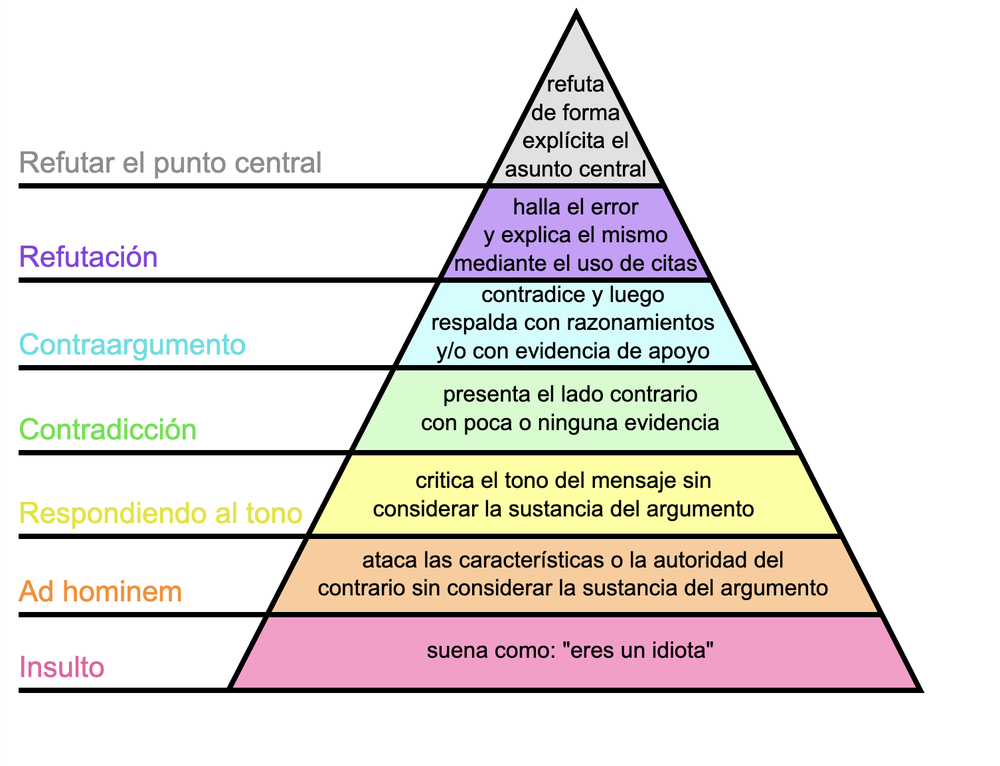
Rather, I use a system to decide whether the debate is worth entering and, if so, to ensure the quality of my arguments. It was invented in 2008 by entrepreneur and visionary Paul Graham .

In his article ” How to Disagree, ” Graham defined seven ways of arguing that range from gross to sophisticated. And, since stupidity seems more common than intelligence, the author imagined it in the shape of a pyramid.

Graham’s Hierarchy of Disagreement (2008)

Source: Wikimedia Commons

The good thing about the scheme is that it helps you see what level you are on and move on to the higher level. From now on you can fight the obtuse stories without behaving like a madman.

Seven levels of discussion

Graham’s hierarchy of disagreement ranges from the most primitive to the most elaborate. And it is defined in the following steps:

1. The insult. Is the most brutal way of arguing of all. It appears when one disagrees with the opinion of another saying that he is a cretin or a fool (or something more serious). But disrespect does not change the course of any discussion and forever portrays whoever offends. And although some say that gossip is therapeutic , the truth is that when you have a business, the day could come when you regret having insulted someone .

2. The ad hominem criticism . It is the argument of those who want to attack an opinion by attacking the authority of the person who defends it. For example, in a discussion about whether the Earth is flat or round, a flat-earther tells an astronaut that he is wrong because he works for NASA and, of course, “ NASA is an agency of the American government designed to deceive people. ”. The problem with this argument is that it does not get to the heart of the matter and is therefore insubstantial.

3. The attack on tone . This shape is subtle. Imagine that a very wise person says something that is true, but because he speaks from an apparent arrogance, his opinion is criticized and he is belittled. It is like when we see a politician who doesn’t like us saying something in a speech, or like when the star of the rival soccer team pronounces on a result. We simply do not accept your opinion, not because of what you say, but because of how bad it is for us. It is a bad argument: it is based on prejudice, rather than analysis. I do not recommend it to refute opinions.

4. The contradiction. It consists of denying the opinion of the other in a systematic way, idea after idea. To each thing that the other says, the opposite option is presented just for the sake of it, without further argument. If one says that the Earth is round, the other will say that it is flat. If one says they can prove it, the other will say that too. If one says they have maps and math, the other will say they have them on the contrary. It is a form of endless discussion in which both parties want to have legitimacy on their own, but show no evidence. It is an exhausting way that I do not recommend either.

5. The counterargument. It is a more civilized position than the previous ones. It consists of taking a contradiction (link 4) and elaborating it with proofs (or pseudo proofs) that try to support it. The point, according to Graham, is that the counterargument provides inaccurate or adequate evidence to the case. For example: one discusses an idea to the other based on evidence that, in the past, he tried to lie to the other on a different matter. It is about invalidating the opponent with tests that have nothing to do with the ongoing discussion.

6. The rebuttal. This is a more sophisticated and efficient system. But, as it requires work, it is also less frequent. It is about identifying those arguments in which we disagree, analyze them and expose the reason for the error. Many times, if you find yourself at this level of the pyramid and expose the other, their counterattack will turn into insult or ad hominem criticism. This will try to disqualify you. But his derision will prove you right and you will know that you are right.

7. The refutation of the central point. Is the most evolved form of all. It involves expanding the previous link with greater richness and systematic forms. Again, it requires so much work that only people who are experts in a subject usually have the knowledge and ability to develop this rebuttal. For people like you and me, who are not, that depth of argument can help us detect who is right in a discussion we are not part of. So it’s a good idea to pay attention to elaborate arguments.

Conclution

It is known that there are people who live convinced of wrong things, even knowing that the rest of the world warns them of their error. Psychologists say that this is a self-defense mechanism against the world, and that frees them from guilt.

But it is also known that there are political currents that seek to take advantage of these weaknesses. That is why idiocy abounds on the Internet and television debates. A poet from my land sang – more or less – that if assholes had wings, we would no longer see the sun.

It is up to you to inform yourself. It is up to you to build a criterion. No longer to avoid error, which will always be present in our lives. But to know when and how to buy a story and when and how to refute it in a civilized way.

And to avoid insults, although sometimes we believe that they are deserved.

https://www.entrepreneur.com/article/367909


Why This Social Media App Will Be the Next Big Craze

Here are three ways the new social audio media app is impacting you, your business and society as a whole through transparency and education.

February 18, 2021 4 min read

Opinions expressed by Entrepreneur contributors are their own.

As entrepreneurs, we’re knowledge-seekers and networkers by nature. When launched, we jumped at the opportunity to hear thoughts from mentors and start forming real-time conversations. When podcasts started gaining traction, we had a chance to hear advice and learn about the backgrounds of inspiring entrepreneurs.

Now, has entered the scene. For those who are unfamiliar, Clubhouse is an audio-based social network that’s invite-only for iPhone users (as of now). This new social network has combined the best parts of old-school talk radio and podcasts, bringing peer-to-peer, transparent conversations to the entrepreneurial world. And it couldn’t have come at a better time.

Related: How to Get Invited to Clubhouse

After a year of public demands for more transparent media, Clubhouse has found its niche as the solution to ultimately help democratize the mainstream media. Conversations taking place are transparent, conversational, knowledgeable and inspiring – making it the perfect platform for us knowledge-seekers to actively participate.

So, what does this mean for you personally, as a owner, and your conversations in society as a whole? Let’s break it down.

Personal impact

I’ve always said that the most successful entrepreneurs naturally look for ways to grow personally to be our best selves for our teams, clients and customers. Clubhouse has given us a chance to peek behind the curtain and drop in on these growth-driven discussions in a much more organic, less demanding way than we ever could with written content, radio or even podcasts.

Now, we can listen in on real-time conversations happening with people who inspire us, while taking a break from the draining news cycle via traditional media. We can get back to discussing ideas and learning from each other. We have an insider’s look at thousands of experts’ thought processes – something we’ve never been able to hear live in the past aside from a short talk radio interview. Not only can we pull from their advice and thoughts personally, but these conversations can help us formulate ideas on how we can be better business owners as well.

Related: 10 Worthwhile Books Written by Self-Made Billionaires

Business impact

While the conversations happening on Clubhouse are helpful for our personal growth, it’s also a great place to do business. At any given moment, there are like-minded individuals on the platform. The app now gives us a chance to network, share expertise, combine knowledge, bounce ideas off one another, and so much more. Some of the best business ideas come from spit-balling thoughts or hearing someone else’s discussion – Clubhouse now gives us a way to do this in real-time.

Related: How Clubhouse Is Creating Unprecedented Opportunities and Access

In addition to giving us a way to brainstorm ideas, it also provides a way to learn more on a topic that’s essential to a business that isn’t a current area of expertise. For example, if you have a technical background, accounting or marketing may not be skillsets you’re particularly knowledgeable in. By listening in on a room specialized in a specific field (like Accounting.Club), it’ll be easier to pick up on the essentials and have a basic knowledge moving forward. It’s almost like learning a new language – Clubhouse provides a genuine, uncontrived space for immersing yourself in the industry in which you’d like to assimilate.

Societal impact

As a society, we’re craving a feeling of unity, and privacy. We’ve seen the disenchantment with come about as privacy concerns and content from unverified sources continue to run rampant across the platform. Clubhouse is providing a way for us all to connect with like-minded individuals with expertise across a broad range of interests. Though we’re all still feeling the effects of isolation, communities now have more ways to connect in a safe manner.

Clubhouse also provides people another way to multitask. The key benefit to podcasts and audiobooks being read by our favorite entrepreneurs is that we’re able to soak in the while still being able to multitask around the house or in the office.

The platform currently has two million users and is valued at around $1 billion. We can see from Clubhouse’s fast growth that this social audio platform is serving a critical need that business owners needed to fill. At our core, we want to build community, educate ourselves, and create a product or service from our knowledge and experiences. Clubhouse is now a key player that we all need to keep our eyes (and ears) on.

loading…

https://www.entrepreneur.com/article/365588


Trump lancerà il proprio social nellßrco di alcuni mesi

L’ex presidente Donald Trump creerà la sua piattaforma di social media e tornerà a pubblicare online in due o tre mesi, ha detto il suo consigliere e portavoce, Jason Miller, in una nuova intervista.

Per anni, Trump ha preferito Twitter e aveva accumulato quasi 90 milioni di follower prima che la piattaforma dei social media lo sospendesse a gennaio. Anche Facebook, YouTube, Twitch, Snapchat e altri si sono mossi per sospendere l’ex presidente e, allo stesso tempo, Trump non ha indicato che avrebbe utilizzato altri siti di social media preferiti dai conservatori come Gab, MeWe o Parler.

Miller ha detto domenica a Fox News che si aspetta che Trump “[tornerà] sui social media tra due o tre mesi” con “la sua piattaforma” che “ridefinirà completamente il gioco” e attirerà “decine di milioni” di utenti.

Miller, che è il portavoce più importante di Trump, non ha elaborato dettagli o un possibile nome per l’impresa sui social media.

Da quando Twitter ha sospeso il suo account, l’ex presidente ha invece scelto di rilasciare dichiarazioni stampa tramite i propri consiglieri e via  ed e-mail, concentrandosi soprattutto sul sostegno ai candidati pi# vicine in vista delle elezioni di mid-term del 2022.

Sempre nell’intervista, Miller ha affermato che Trump detiene ancora una notevole influenza nel Partito Repubblicano.

“Già più di 20 senatori, oltre 50 membri del Congresso …  hanno fatto il pellegrinaggio a Mar-a-Lago”, ha detto. “Prestate attenzione alla Georgia lunedì”, poiché è in arrivo un “grande sostegno”.

In un’intervista il mese scorso, Trump ha detto che sta “negoziando con un certo numero di persone, e c’è anche l’altra opzione di costruire il proprio sito [social media]”. Ha aggiunto: “Perché abbiamo più seguaci  di chiunque altro. Voglio dire che posso letteralmente costruire il mio sito. ”

“Volevo davvero tacere. Mi volevano moltissimo su Parler nonostanteà i falsi rapporti che dicevano il contrario – intendo esattamente il contrario, mi volevano davvero su Parler “, ha continuato Trump.

L’ex presidente ha ipotizzato che Parler non sarebbe stato in grado di gestire la quantità di traffico che avrebbe portato al sito web. “Meccanicamente, non possono gestire” il numero di utenti”, ha osservato Trump nell’intervista.

Dal nostro punto di vista più me un  mezzo proprio gli converrebbe creare una piattaforma che ripostasse immediatamente i suoi messaggi su tutte quelle indipendenti esistenti, non solo conservatrici, come Parler o Gab, ma anche indipendenti, come  Minds. Questo per evitare che il suo concentrarsi su una sola piattaforma la trasformi nell’obiettivo dei suoi avversari, oltre che di hacker e creando meno problemi tecnici ai social più tecnicamente “Deboli”.

L’ex presidente ha rilasciato una lunga intervista la scorsa settimana, affermando di non essere  sicuro di candidarsi di nuovo alla presidenza nel 2024. I suoi obiettivi sono a molto più breve termine

“La prima cosa importante  per noi, è vedere cosa potremo fare con la Camera dei Rappresentanti”, ha detto Trump. “Penso che abbiamo ottime possibilità di riprenderci l’Assemblea. “


Telegram
Grazie al nostro canale Telegram potete rimanere aggiornati sulla pubblicazione di nuovi articoli di Scenari Economici.

⇒ Iscrivetevi subito ⇐


Minds

.sostieni {padding: 12px; display: block; margin: 32px 0; border-top: 10px solid #E64946; position: relative; background-color: #f8f8f8;text-align:center;} .sostieni p {font-size: 16px; line-height: 22px; color: #000; margin-bottom: 4px; margin-top: 0;} .sostieni form{margin:21px auto;text-align:center;} .sostieni .sostieni_pulsante {background-color: #E64946;color:#fff;padding:7px 16px;text-transform:uppercase;border-radius:3px;font-weight:700;font-size: 17px;line-height: 24px;} .sostieni .vendor{margin:16px auto 0;text-align:center;}

Sostieni ScenariEconomici.it

Fra Mass Media ormai completamente uniformati ai bollettini di informazione del Potere, Scenari Economici rimane una voce che presenta opinioni libere ed indipendenti. Aiutaci a crescere ed a farci conoscere, sia condividendo i nostri contenuti, sia, se vuoi, con una donazione. Grazie!

PayPal

https://scenarieconomici.it/trump-lancera-il-proprio-social-nellsrco-di-alcuni-mesi/


Whatsapp, Instagram ed altri servizi FB down. Problema mondiale

Gravi disagi in corso per Whatsapp, Instagram e , per alcuni, anche per la Chat di facebook. Sitratta di problemi piuttosto complessi che durano ormai da quasi un’ora.

I casi sono segnalati in tutta Europa e, secondo Skynews sono estesi a livello mondiale, per cui si tratterebbe di una qualche dorsale che ha ceduto.

Al contrario Telegram, Twitter e Minds sembrano perfettamente attivi. Ricordiamo che Telegram si avvale di una configurazione decentralizzata, così come Minds, quindi  è più difficile che vada offline. Altri servizi sembrano però essere stati colpiti, e abbiamo notizie di videoconferenze cadute improvvisamente.

Inutile ripeterlo: la centralizzazione è fragile.


Telegram
Grazie al nostro canale Telegram potete rimanere aggiornati sulla pubblicazione di nuovi articoli di Scenari Economici.

⇒ Iscrivetevi subito ⇐


Minds

.sostieni {padding: 12px; display: block; margin: 32px 0; border-top: 10px solid #E64946; position: relative; background-color: #f8f8f8;text-align:center;} .sostieni p {font-size: 16px; line-height: 22px; color: #000; margin-bottom: 4px; margin-top: 0;} .sostieni form{margin:21px auto;text-align:center;} .sostieni .sostieni_pulsante {background-color: #E64946;color:#fff;padding:7px 16px;text-transform:uppercase;border-radius:3px;font-weight:700;font-size: 17px;line-height: 24px;} .sostieni .vendor{margin:16px auto 0;text-align:center;}

Sostieni ScenariEconomici.it

Fra Mass Media ormai completamente uniformati ai bollettini di informazione del Potere, Scenari Economici rimane una voce che presenta opinioni libere ed indipendenti. Aiutaci a crescere ed a farci conoscere, sia condividendo i nostri contenuti, sia, se vuoi, con una donazione. Grazie!

PayPal

https://scenarieconomici.it/hatsapp-instagram-ed-altri-servizi-fb-down-problema-mondiale/


Twitch’s Head of Global Social Media Urges Teams to Crack the Hiring Code

For Jotham Ndugga-Kabuye, Director and Head of Global Social Media at Twitch, innovation stems from the inside. From finding and developing talent outside of traditional methods and channels, Jotham urges more companies to realize how a more diverse team can give businesses serious competitive advantages.

https://www.adweek.com/inside-the-brand/twitchs-head-of-global-social-media-urges-teams-to-crack-the-hiring-code/