How to plan your social media strategy for any business

30-second summary:

  • The best social media strategy should not focus on lead generation but on building brand loyalty. How can you utilize social media platforms to make your brand talk of the town?
  • A good social media strategy should have a measurable end goal in mind. Find out how SMART goals eliminate the influence of vanity social media metrics.
  • Strive to understand who your target audience is. Are your social media followers a mirror image of your potential customer?
  • Should your social media strategy stick by the rules of the trade and only use tried and proven platforms? Should you innovate and use unconventional platforms?
  • This article broaches all these questions and presents you with examples of real-life brands that have excelled at their social media approach, by playing by the rules and at times, going into uncharted social media waters.

Amazon’s founder Jeff Bezos once said that a major determinant of your brand’s potency is what people say about it when you are out of the room. Unfortunately, many business owners only equate their brand to its visual identity, its tagline, and its logo. The only reason, however, why you should go to great lengths to create a cool logo or place promotional advertisements is to strengthen or grow a loyal customer base.

You need your clients to be so fascinated with your brand that they should not just buy your goods or services but identify with your business’s ethos. Social media is a formidable channel for building brand loyalty. A humor laden 140 characters or less tweet can lead to massive exposure on Twitter, an achievement that would take other forms of advertising, very large budgets to achieve.

Data shows that product information on social media platforms influences the shopping habits of at least 75% of American consumers. These platforms are also very critical to the discovery of new services, goods, or brands because 33% of all buyers unearth novel items from social media. This is the reason why, over 72% of all savvy marketers, use these internet mediums to access and build the most loyal of fan bases.

92% of businesses that have robust social forums following can attest that these online podiums have increased their brand’s online visibility. Consequently, every business should not only have a social media presence but a strategy as well. Your social media strategy is a blueprint that takes into consideration, all the details, and processes that govern brand social media activity.

A good social platform game plan should answer questions regarding the when, who, what, and why your brand should interact with the internet community. A well thought out social media strategy can:

  • Build brand awareness
  • Improve brand authority and loyalty
  • Revamp customer service
  • Increase your customer engagement rates
  • Enhance your conversion rates
  • Grow your web traffic rates via content distribution

How to design a brilliant social media strategy

1. Get SMART and precise with your goals
Setting SMART goals for your social media strategy

Source

Like many businesses, you might have a social media presence but have no defined goals that help measure your strategy’s success. The first key element of a successful social media strategy is a realistic and relevant marketing goal. Why do you want to market on these forums? What is the end-product of your efforts? Do you plan to increase website traffic, promote a product, or contact customers? 

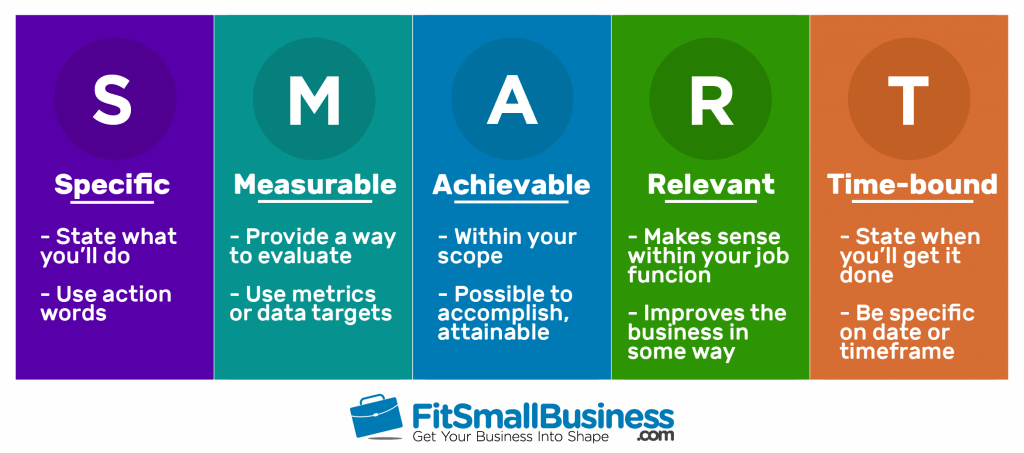
Choose social media goals that enhance your business’ strategic goals. Make these goals SMART meaning they should not just be distinct, but measurable, within reach, relevant, and time-bound. SMART goals ensure that your marketers look beyond vanity metrics such as the number of likes or followers. They for instance will use useful statistics such as post reach to measure a brand awareness objective. 

As an illustration, most luggage brands’ marketing content is chock-full of product features. AwayTravel.com has chosen to sell their suitcases differently. On Instagram, they have a following that talks more about the experiences that Away luggage can enable.

On the brand’s page, you will find exquisite user-generated travel images from all parts of the world, inspiring its potential and loyal customers. The brand’s strategy is to portray itself not as a suitcase seller but as a travel brand. Their strategy has paid off so well that in less than three years of activity on social media, they have over 547K followers on Instagram. They have also amassed a useful, massive celebrity following.

Because Away’s goal is to attract and engage with travelers, they will not waste money buying fake Instagram followers. They need active travelers that will engage with the brand, which in the end creates revenue. Since engagement is one of the most critical goals for this brand, its marketers will actively monitor metrics such as brand awareness, applause, average engagement, amplification, and virality rates.

2. Choose a target audience that reflects your customer persona

Once you have your “why” in the bag, you need to figure out who your target audience is. When you have a well-defined target audience in mind, you will find it easier to create appropriate content. Creating content on the platforms that are more inundated by your audience of choice will also be less of a challenge.

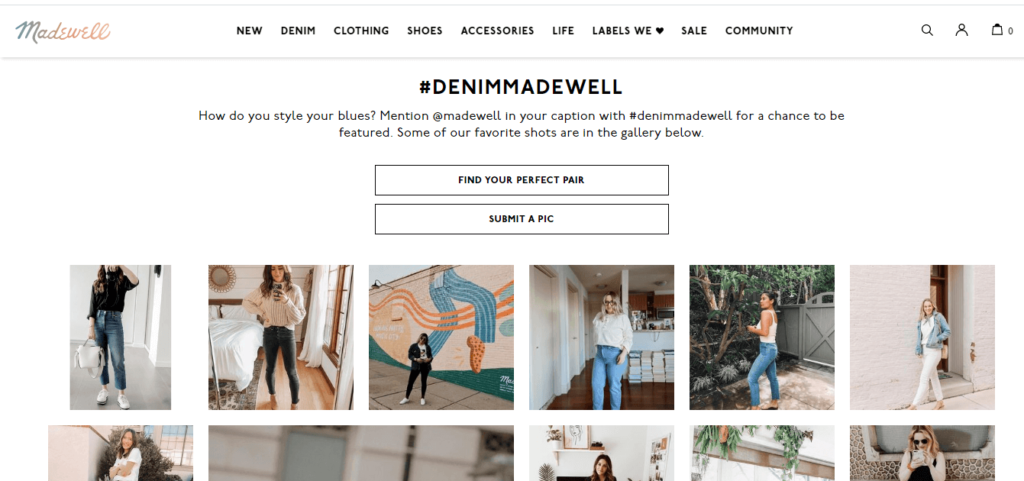
As an illustration, on a typical day, Lauren Dix’s 73.6k Instagram followers will be actively listening to her hushed tones as she dons outfits inside one of Madewell’s dressing room. Lauren’s massive fans will giggle at her attempts to communicate with them without spooking her neighbor in the next dressing room. She will try on the brand’s tasteful denim collection and decide whether her jeans ensemble is worth its $30 tag or not, then move on to her next story. The fashion influencer only displays clothing items from affordable brands like Madewell.
Madewell - Example for social media strategy

Source: Madewell.com

J.Crew, a clothing retailer and Madewell’s parent company is over seven decades old. J.Crew has been reporting losses for the last few years, but Madewell has seen its revenue increase in the same period. The brand’s chic universal basic and denim lines have a small brick and mortar footprint than its mother brand making 40% of its sales online. 

Madewell’s social media strategy is so successful that it has over 1.4 million Instagram followers and is one of the best examples out there of a master plan that precisely answers the “who” element of internet community marketing. Madewell’s focus is on increasing its social media engagement amongst millennials.

Data shows that over 59% of the millennial women between the ages of 18 to 29 spend most of their time on Instagram. The brand has a consistent free-spirited, artsy, and non-maximalist brand identity that appeals to this segment. Consequently, while Madewell is active on other platforms it is so particular about its Instagram presence, that it has a website page dedicated to Instagram customer posts. In 2018, Madewell won an overall best brand presence Webby Award.

Cisco social media strategy example

Source

Most B2B brands often avoid snazzy social media platforms like Snapchat or Instagram. You will find them on platforms for professionals like LinkedIn because 80% of B2B leads come from this network of professionals. This is the reason why 94% of B2B marketers turn to LinkedIn for content distribution.

The platform’s acquisition by Microsoft has expanded its business features and functionality, making it a stand up and authoritative tool for business sales teams. Cisco’s social media strategists have however put a new spin on the B2B Snapchat social media experience. After identifying a need to engage Gen Z, a large portion of the business’s young technophile hires, Cisco turned to Snapchat and has enjoyed a lot of success at it.

Snapchat has 46 million active users each month in the US. Over 53% of US Gen Z between the ages of 15 and 25 years use Snapchat and are the largest demographic on the platform. The technology firm’s need to create a robust talent pipeline has actualized via their massive Snapchat success, connecting them to new graduates and university students from all parts of the globe.

Your social media followers should be similar to your potential customer persona. Some of the metrics that you should use when determining your target audience includes;

  • The income, age, location, education, or title of your audience
  • Your potential audience’s interests such as educative, informational, or entertainment
  • Time when your brand’s following is online, weekends, lunch hour, evening and morning commutes
  • Knowing what their motivations are, could range in anything between fitness and travel to high-level skills 
  • The type of content that they prefer; is it video, blog posts or infographics

3. Use the right platform
Stats Graph

Source

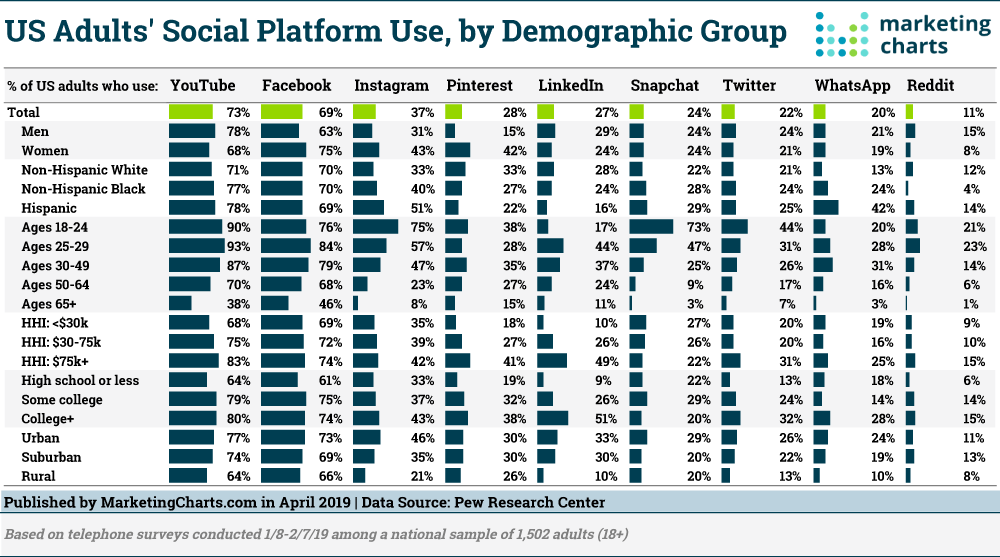
You need to gauge different social media forums and choose which particular one(s) you should focus more on. The metric that Facebook attracts 2.3 billion active users each month is very attractive. Nevertheless, if your brand needs younger people, you will not find this demographic well-represented on Facebook. This target audience frequents Instagram and Snapchat.

Nevertheless, do not put your strategy at the mercy of popular social media data. As an illustration, data shows that 63% of all B2B marketers rate LinkedIn as the most effective social media-marketing forum. This metric tends to keep B2B brands captive on this professional platform for its lead generation opportunities. Your social media strategy’s purpose however is not a lead generation but a brand enhancement strategy.

B2B brands that want to generate leads should go to social media not to sell, but to tell stories that spark conversations and that appeal to human emotions. A brand that has its strategy down pat will have multiple possibilities open to it. Novartis for instance has a 2.2 million following on LinkedIn and 268 thousand followers on Twitter.

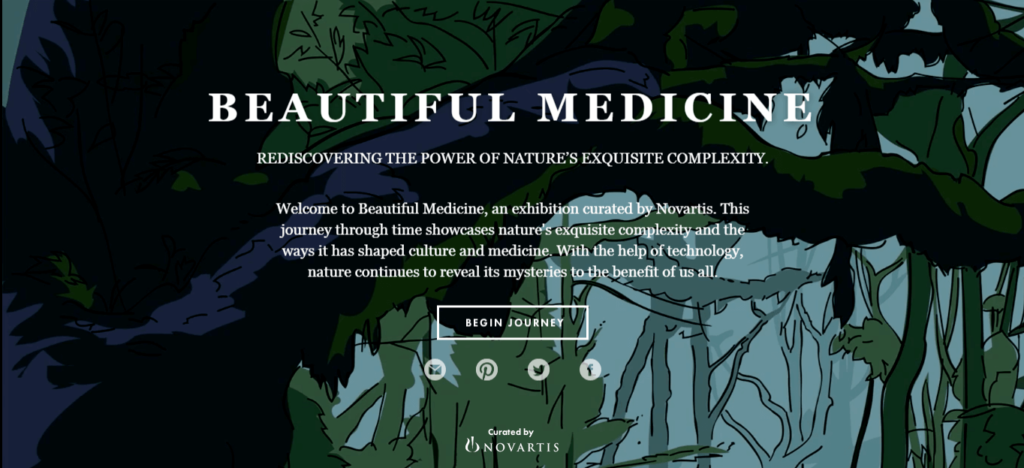
You will also find the pharmaceutical company on Facebook, Instagram, and YouTube. On Instagram, the brand tells stories of nature and medicine, pushing traffic to its site Beautiful Medicine. On YouTube, you will find financial, scientific, and patient views videos.
Source: Beautifulmedicine.com

GoPro is one of those rare B2C brands that seem to utilize all the major platforms to its advantage. The versatile camera brand has a close to 11 million Facebook followers and 17 million Instagram fans. It also has 2.3 million Twitter followers. So how does GoPro create value, promote products, and interact with a wide customer demographic on various platforms?GoPro exampleSource
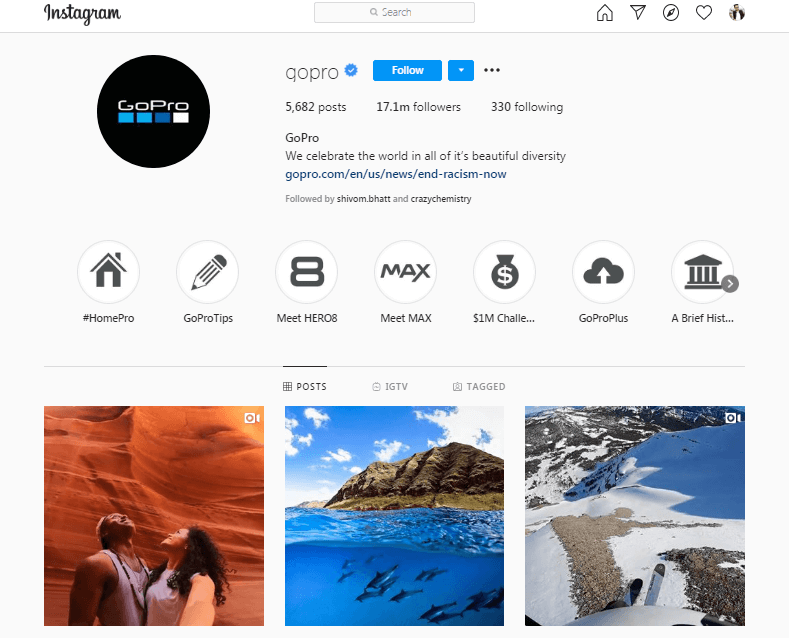
The genius social media strategists at GoPro use each network distinctly. They use Facebook to stimulate brand awareness, engage with their existing customers, and access new clients. They will also create Instagram stories to foster user-generated content and display the quality of their merchandise. On Twitter, you will find GoPro product announcements while their YouTube channel has video tutorials and tips.

If you are going to use different platforms, then you need to optimize content and post them strategically. So, first, perform thorough research to determine where it is that your target audience is. It is beneficial not to waste time and resources on internet communities that do not have any interest in your brand on products.

4. Audit your brand’s and your competitor’s social media approach

Businesses do not function in isolation. You do have competitors that keep you on your toes with their social media game plan. To optimize your social media blueprint, you need to be aware of what their tactics are. Whom do they target? What are their goals? Where do they meet most potential clients? Which platforms and keywords have they dominated?

Conduct competitor research via tools like BuzzSumo to bring to the light what your rival’s weakness and strengths are. Such information will help you to construct better policies for social media audiences. Exploit the gaps where possible.

Audit your performance too to improve on your tactics. Your appraisal will help direct you on the best times to post the most engaging content type and form and what your limitations are.

Conclusion

An optimized social media strategy will infuse your marketing efforts with purpose and help you to meet your business’s objectives. Use the steps above to create a robust social media presence then audit and tweak it to perfection.

Sumeet Anand is a Digital Marketing Expert, who specializes in SEO, social media marketing, and content marketing. You can find him on Twitter @Sumeetanand143 or connect with him on LinkedIn.
How to plan your social media strategy for any business


3 Ways to Use Social Commerce Today via @katylucey

Social media platforms continue to be a leader in driving product discovery for brands.

30% of online shoppers say they would be likely to make a purchase from a social media network like Facebook, Pinterest, Instagram, Twitter, or Snapchat – either through organic or paid efforts.

With the introduction of Facebook and Instagram Shops, social commerce has been a hot topic as of late.

But what exactly is it?

What Is Social Commerce?

By definition, social commerce is the use of social networks like Facebook, Snapchat, Pinterest, and others in the context of facilitating ecommerce transactions.

Social commerce can include the ability to checkout directly within each platform or be a collection of products hosted within the social network.

Most social commerce support is currently available through organic means.

But paid opportunities, such as product-focused ads available across most platforms, and additional support for paid social commerce are on the horizon.

Current Trends in Social Commerce

Social commerce is still in relative infancy, but the early numbers from existing products are promising.

ADVERTISEMENT

CONTINUE READING BELOW

eMarketer reports:

“According to Civic Science’s trend adoption tracker, the percentage of internet users who had bought a product directly through social media channels grew each quarter between Q4 2018 and Q3 2019, rising from 13% to 21%. The biggest jump came in Q2, shortly after the launch of Instagram Checkout.”

As platforms continue to expand their offerings to support commerce interactions, the adoption rates will most likely increase and we will see social commerce adoption climb.

Right now, the average buyer spends more than $300 annually via social commerce and that number is expected to almost double in the next few years.

Benefits of Social Commerce

There are a few key benefits for the implementation of social commerce for both the brand and shoppers.

For buyers, browsing and purchasing via a commerce product within a social media platform cuts down on the amount of friction associated with the shopping process.

These microsites are much more mobile-friendly which will generally lead to increased conversion rates.

ADVERTISEMENT

CONTINUE READING BELOW

Having all shopping actions hosted in one place helps to consolidate the funnel and increase efficiency in the customer journey.

With consumers doing all their shopping within the social platform, brands will be able to track each touchpoint via the native pixels and thus have better insight into attribution across the board.

These learnings will provide greater awareness of the role that social plays within the purchase journey.

Another plus to social commerce is the first-party targeting information that is housed within the individual social channels.

Being able to tap into these segments in a place where you know consumers are already spending time allows brands to capitalize on the connections that already exist on these platforms.

These segments provide the ability for brands to scale their commerce efforts across these channels.

How to Start Using Social Commerce Now

One of the first – and most important – steps in starting with any of these social commerce options is to make sure that your product feed is properly optimized for social as opposed to other feed-based platforms.

A few things to remember:

  • Ensure the images that are being pulled in are the right size for use across social channels, typically a ratio of 1.91:1 and 500 x 500 pixels.
  • Use custom labels to clearly delineate product groups you want to feature often, like new arrivals or best sellers.
  • Make sure to have inventory markers uploaded to account for in and out of stock products.

It is also important to remember the individual nuances of each channel when customizing your feed, as well as considering how the media will be consumed on both desktop and mobile.

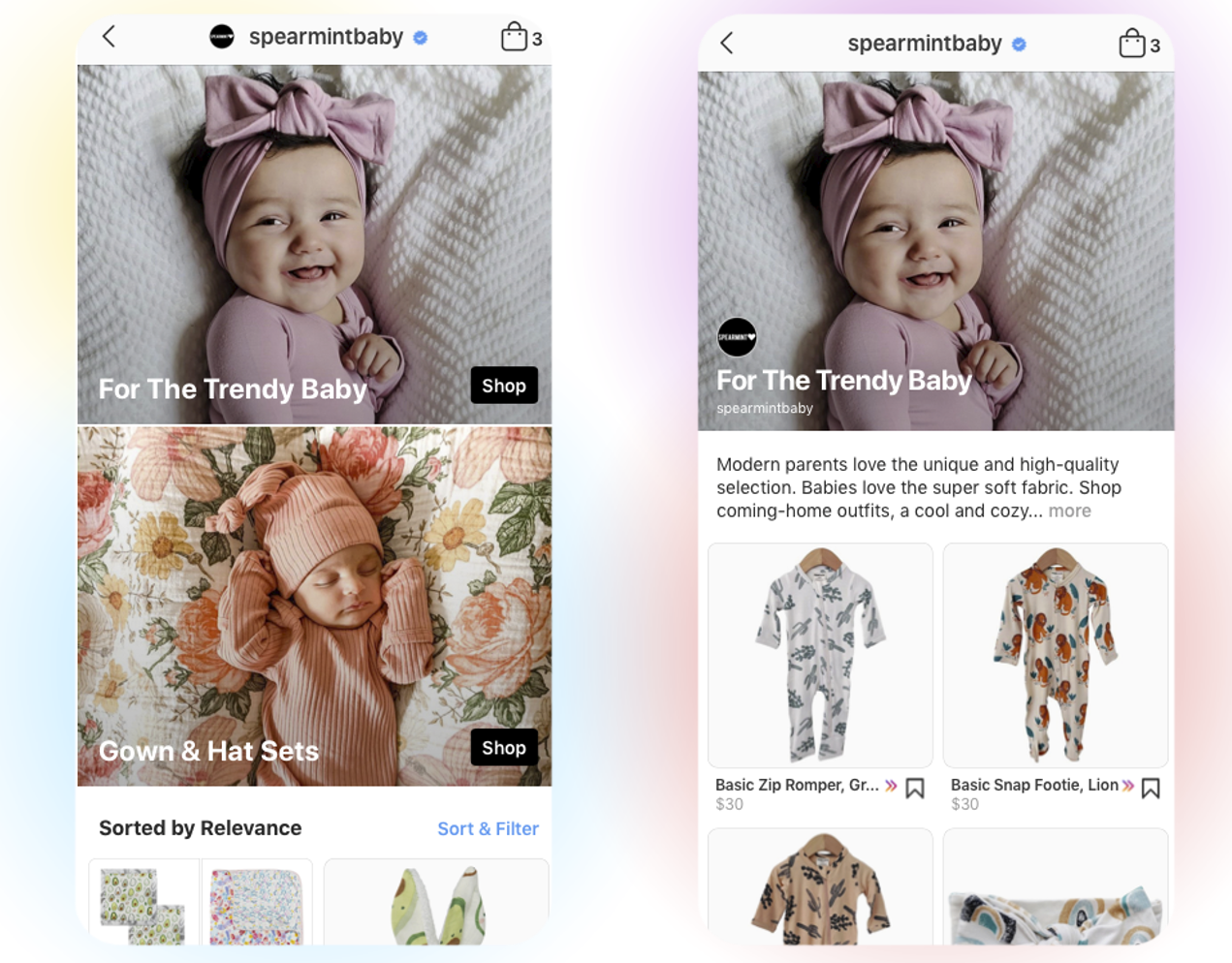
1. Facebook & Instagram Checkout & Shops

3 Ways to Use Social Commerce Today

3 Ways to Use Social Commerce Today

The leader in the social commerce space to date, unsurprisingly, is Facebook.

Instagram Shopping and Checkout were their first steps into the space more than a year ago and now Facebook and Instagram Shops are rolling out to build upon that success.

ADVERTISEMENT

CONTINUE READING BELOW

While Checkout is still in closed beta, Instagram Shopping and Facebook Shops are open to almost everyone – and it’s relatively easy to set up.

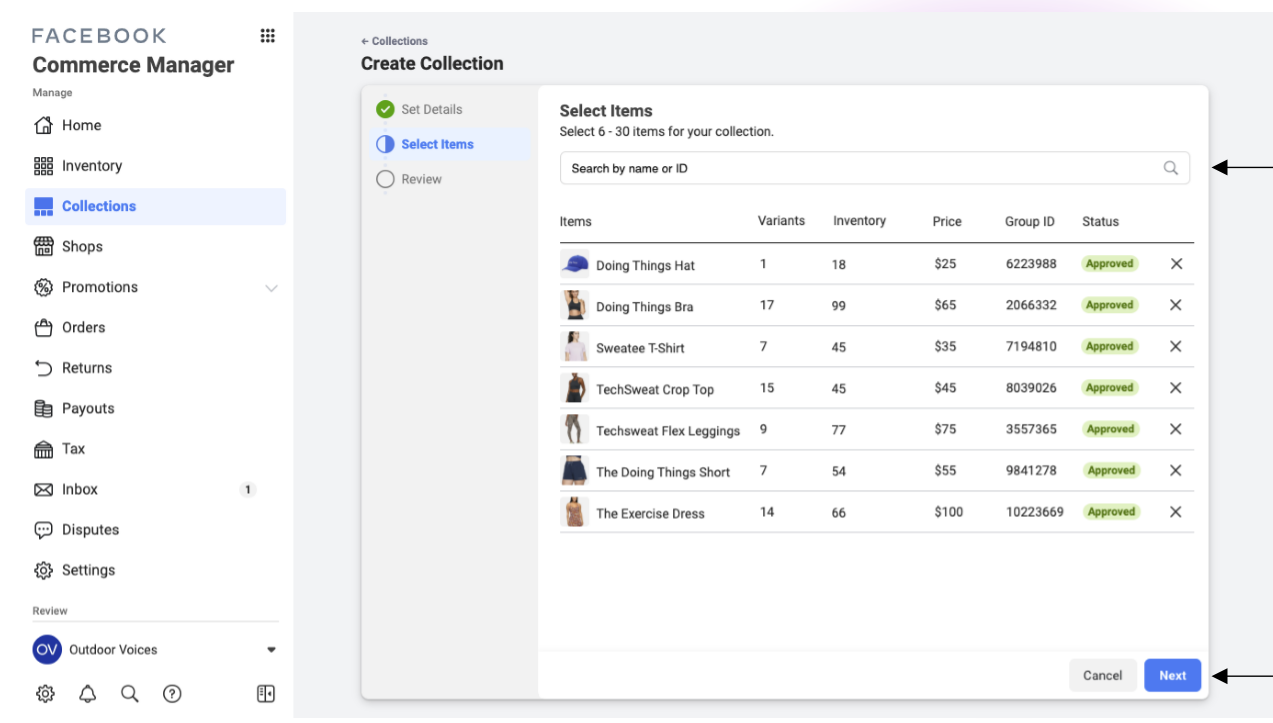
The first step is uploading your product catalog to Business Manager.

Once the feed is loaded, check to see if you’re eligible for Commerce Manager.

This is where you will create and edit your collections and shop layout in addition to managing inventory and checking on fulfillment.

One key thing to remember here – if you work with an agency partner, it’s important that the Commerce Manager lives within the brand’s Business Manager and not the agency’s.

3 Ways to Use Social Commerce Today

3 Ways to Use Social Commerce Today

Once Commerce Manager has been set up, you can now begin to build out collections to be featured without your shop.

3 Ways to Use Social Commerce Today

3 Ways to Use Social Commerce Today

Once the collections are created and published to your page, you will be able to track performance metrics like content views and clicks to the website within the Commerce Manager.

ADVERTISEMENT

CONTINUE READING BELOW

For now, there are no paid amplification options available for Facebook and Instagram Shops and other commerce products.

2. Pinterest Product Pins & Shopping Ads

3 Ways to Use Social Commerce Today

3 Ways to Use Social Commerce Today

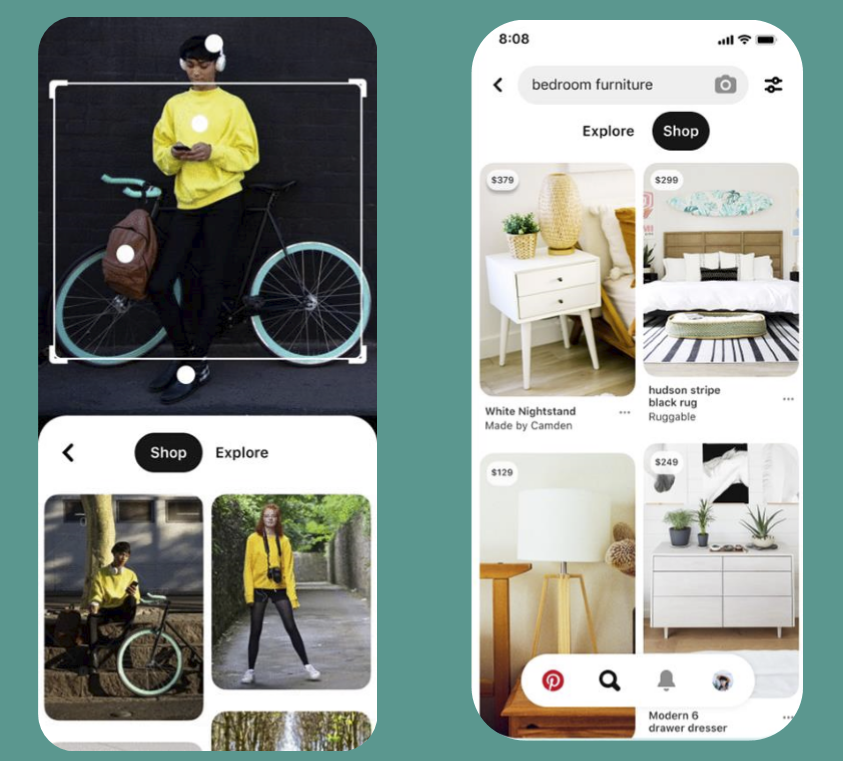
Pinterest is where shoppers come to be inspired and to discover new brands like yours.

According to Pinterest, 83% of Pinners have made a purchase based on the content they saw from brands on the platform.

Product Pins and Shopping Ads boost your distribution and help your products stand out.

Pinterest will automatically show your ads to relevant shoppers, matching your products with the people they think are likely to love them.

Pinterest catalogs are the fastest way to get your products onto Pinterest.

After your data source is approved, product Pins are automatically created for every item in the upload.

3 Ways to Use Social Commerce Today

3 Ways to Use Social Commerce Today

Product Pins contain data to let browsers know that they’re shoppable, including pricing info, availability, product title, and description.

ADVERTISEMENT

CONTINUE READING BELOW

Once Product Pins are set up, it is simple to transition to paid promotion of these pins.

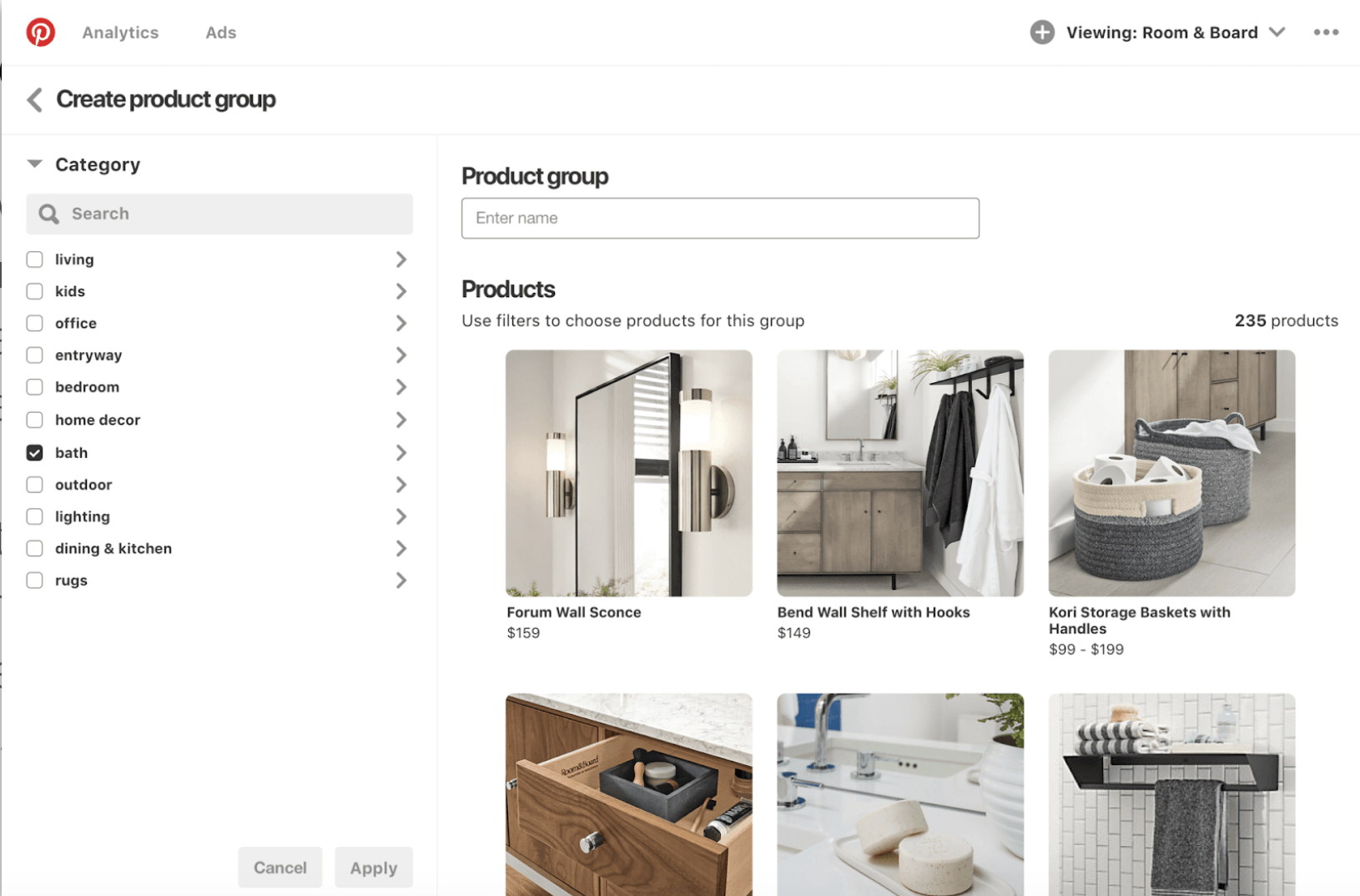
Lumping products together into groups, such as best sellers or new arrivals, will allow for easier creation of collection-based ads which can then be amplified with media spend.

3 Ways to Use Social Commerce Today

3 Ways to Use Social Commerce Today

If Pinterest Shopping is on your radar, it is recommended to join the Verified Merchant Program.

The program gets you a dedicated Shop tab on your page, similar to what is available on Facebook and Instagram, as well as a badge showing your status.

The program also gives early access to new products, including updated insights capabilities.

3. Snapchat Collections

Snapchat has been testing in-app stores with a handful of influencers but has yet to roll it out for wider adoption.

However, there are a few options available for brands to tap into social commerce through paid options.

ADVERTISEMENT

CONTINUE READING BELOW

collect-snap

collect-snap

Snapchat Collection ads are their commerce-based ad type that allow you to feature a series of products within the ad unit where users can tap to get more information.

Unlike on Facebook and Instagram Shops, brands can put spend behind these units for a more targeted social commerce approach.

Similarly to Facebook, Snap Collections require the use of a product feed, which is housed within the Snap Ads Manager.

3 Ways to Use Social Commerce Today

3 Ways to Use Social Commerce Today

Once the products are loaded, the ad can be created within the Creative Library section of the platform.

ADVERTISEMENT

CONTINUE READING BELOW

There you can upload your hero image or video and select which products you want to feature and publish to use within ads.

You can also use the product feed for Snapchat dynamic ads.

Snapchat is testing a native checkout option as well, but right now it’s still in closed beta.

Social Commerce – What’s Coming Next?

As some of these newer social commerce offerings see adoption from brands, new data and trends will emerge on their impact within the ecommerce space.

Expect to see increased social click-through and conversion rates as consumer begin experimenting with these products.

In terms of the next wave of social commerce offerings, expect TikTok to join the fray as they continue to build out their ecommerce support and advertising offerings.

The platform offers a unique value proposition to brands as it historically has been used mostly for content viewing as opposed to brand discovery, which could have unique implications for audience reach.

As the platform continues to age up, expect the potential buying power on the app to grow as well.

ADVERTISEMENT

CONTINUE READING BELOW

One thing is for sure – social commerce will continue to be a major player in the digital commerce space for years to come.

And the brands that will be the most successful are the ones who adopt early and iterate often.

More Resources:


Image Credits

In-Post Images: Instagram, Pinterest
Screenshots taken by author, June 2020

http://tracking.feedpress.it/link/13962/13634267


Instagram Reviews How Its Policies and Algorithms Negatively Affect Black Users

CEO Adam Mosseri says the social network needs to ‘better support’ underrepresented groups.

Grow Your Business, Not Your Inbox

Stay informed and join our daily newsletter now!

June 16, 2020 2 min read

This story originally appeared on PC Mag

Instagram has become a popular platform for the Black Live Matter movement, with supporters using the social network to demand justice, express solidarity, support businesses, amplify voices, and raise awareness. But while a revolution rages on the surface, Instagram is reconciling how it treats equality at the core.

“In the last few weeks, we’ve seen an incredible movement happening around the world. As these important conversations have come to our platform, we’ve seen communities on Instagram mobilizing,” CEO Adam Mosseri wrote in a blog post.

“At the same time, we’re also hearing concern about whether we suppress Black voices and whether our products and policies treat everyone equally,” he continued, highlighting the irony that “we’re a platform that stands for elevating Black voices, but at the same time Black people are often harassed, afraid of being ‘shadowbanned’ and disagree with many content takedowns.”

For years, users have complained of stealth banning—the act of blocking someone and/or their content in such a way that they don’t realize it’s happening. Instagram promised more information “soon” about the types of posts it avoids recommending. The company, which has previously taken steps to curb online bullying and bolster mental health, is turning its focus toward underrepresented groups at and on Instagram.

“We need to better support the Black community within our own organization, as well as on our platform,” according to Mosseri, who outlined four key elements for change:

  1. Harassment: Address safety inequalities on and off the site and fill gaps in products and policies

  2. Account verification: Adjust current criteria to ensure inclusivity

  3. Distribution: Review how content is filtered on Explore and Hashtag pages

  4. Algorithmic bias: Investigate how internal technology enforces inequality

“This work is going to take some time, but we’re going to provide updates over the next few months—both about what we learn and what we address,” Mosseri said. “These efforts won’t stop with the disparities people may experience solely on the basis of race; we’re also going to look at how we can better serve other underrepresented groups that use our product,” including the LGBTQ+ community and body positivity activists.

https://www.entrepreneur.com/article/351956


How to Get Results on Social Media Without a Million-Dollar Budget via @GaryLHenderson

Our consumers have learned what inadequate social media efforts look like, and they’re tired of direct response advertising.

People are tired of businesses marketing to them on social media only to sell them new products and services that they don’t want or need.

This direct type of social media advertising is burning people out.

It’s turning people away from our businesses and brands because we are not taking the time to meet our consumers where they are.

Businesses are trying hard to speed up the selling process that they forget about the customer and what the customer wants and needs.

Here’s an example to explain what I mean.

If you are at an in-person networking event, you wouldn’t walk up to someone you’ve never met and say,

“Hi, my name is John, could you give me your email address so I can send you my lead magnet?”

or…..

“Hi, my name is John, do you want to learn how to run better Facebook ads for your business? Give me your email address, and I”ll give you my lead magnet.”

ADVERTISEMENT

CONTINUE READING BELOW

This is a conversation most people would not be comfortable having.

But, this is exactly what we are doing to people online.

We are having premature conversations online with strangers who don’t even know who we are.

That’s why our ads aren’t working, and that’s why marketers and business owners are burning through audiences so quickly.

That’s why our businesses get a bad reputation because we aren’t putting our consumers first online.

When we take what we usually do, and we put our consumers first, we build their product awareness.

We go through the buyer journey through pieces of content rather than give me your email, then we can finally build good relationships with our customers.

It’s time to give people a new and better approach that speaks to them exactly where they are in their buyer journey.

So, check out this four-step social media strategy to engage and get results with an audience on social media without a million-dollar budget.

ADVERTISEMENT

CONTINUE READING BELOW

Step 1: Map & Plan Where You Want People to Go

The first step in getting results on social media is to map and envision where you want your ideal consumer to go.

Make sure to personalize this for your social media advertising so the consumer will flow through the buying process smoothly.

If you are unsure how to determine your next conversion point you could ask yourself the following questions:

  • What journey or path are you trying to take your ideal consumer on?
  • How do you want them to think or feel about your business?
  • What action do you want them to take?
  • Do you want them to sign up for your email list?
  • Do you want them to buy your product?
  • What exactly do you want them to do?

These are all questions to help you better understand how to be clear on your expectations and know exactly what steps you want your audience to take.

And then, once you understand what path you want people to take, you will learn how to properly serve your ideal consumer through their actions and buying patterns.

Now that you understand where your audience is going, it’s time to move to the next step and create content for your people on social media.

Step 2: Create a Piece of Content

Create a Piece of Content

Create a Piece of Content

For the second step, it’s time to create a piece of content that you can show to your ideal audience on Facebook or Instagram.

The content you create could be a video, blog post, or any form of content that will get them to take the first desired step in your process that we talked about before.

When creating content for your audience on social media, it’s important to remember to create content that intrigues your audience enough to make them want to learn more about you.

Another critical thing to remember is to make sure the content you create is for where your consumer is at today and for what they are thinking about today.

The goal is to create social media content that showcases your business, product, or service in the way you want your ideal consumer to see it, but it has to be super relevant to where they are at that moment.

ADVERTISEMENT

CONTINUE READING BELOW

Here’s an example to better explain what I mean.

If I want someone to dine inside my restaurant after the quarantine, I may want to create a Facebook video on what the safest precautions are for restaurants since businesses are starting to open back up.

The purpose of this first video is to ultimately meet your ideal consumer where they are in their journey and in their process.

This is to warm them up to you and to make them aware that you exist and could be an option for them.

Then, you would create another video or a different piece of content to move those people along further into the buying process, which leads to the next step.

Step 3: Build a Custom Audience

For this step, build a custom audience on Facebook of the people who engaged with your first video or the first piece of content.

This is where you want to take the people who just engaged with your video or piece of content and move them forward in the buyers’ journey or to the next conversion point.

ADVERTISEMENT

CONTINUE READING BELOW

These are now hot leads who are closer to purchasing with you.

Here is an example to better explain.

If the first piece of content you created was a video, take that audience who watched 50-75% of the video and push them to take the next desired action.

If they are ready, this could even be a purchase.

The goal is to serve the audience with a new piece of relevant content until they feel comfortable enough to purchase with you.

This could be as easy as creating another video; it’s whatever they need.

And by meeting people where they are at and serving them in the way they need on social media, it will drastically drive your advertising costs down, among many other benefits – especially when using social media ads to target your ideal target audience on Facebook or Instagram.

Facebook and Instagram want to keep people on their social media platforms so that they can continue to get their ad revenue and continue to get the user’s time.

ADVERTISEMENT

CONTINUE READING BELOW

You also drastically increase your ROI because you are only going to serve your direct response ad to the people already engaged in the product, program, or service.

Step 4: Get Those People to Take the Next Step

Studies say it typically takes a person around seven touches with a business before they make a purchase.

So, the goal for the final step is to get the people from the custom audience you created to take the next step in your social media strategy or to make a purchase.

This is where you can create specific content for each step in their buyer journey that caters to their wants and needs.

Once you do this, you will start to see a pattern in how many pieces of content your target audience will need before they make a purchase with you.

Wrapping Up

#R3MAT Method

#R3MAT Method
These are all steps we can take to avoid direct response advertising on social media.

We have to stop flooding people with our new offers, deals, and products when they don’t even know who we are.

ADVERTISEMENT

CONTINUE READING BELOW

We have to learn the patterns of our ideal people and serve them in the way they need and at the time they need it.

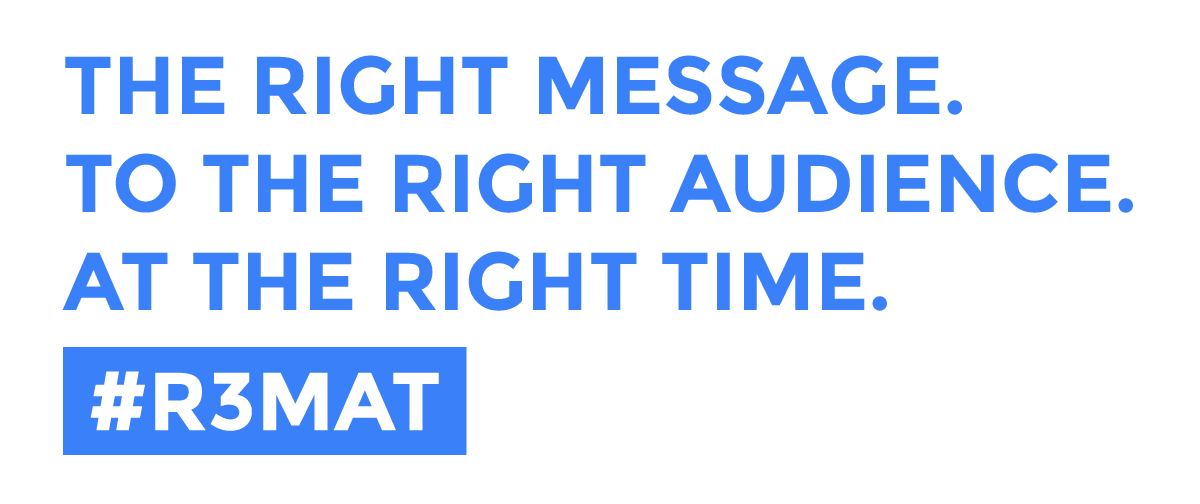
You have to show the right message to the right person at the right time with the right expectations or as we like to call it the #R3MAT Method.

Once you do this you will begin to build better relationships with your ideal consumer and ultimately create a better consumer at the end of the day that will have a higher lifetime value.

More Resources:

https://tracking.feedpress.com/link/13962/13625992/371025


10 Ways to Avoid Bad Press via @JuliaEMcCoy

Your online presence can be the reason your brand rises to amazing success.

Or it can be your ultimate downfall.

It all depends on whether you get good or bad press.

Take Wendy’s, for example.

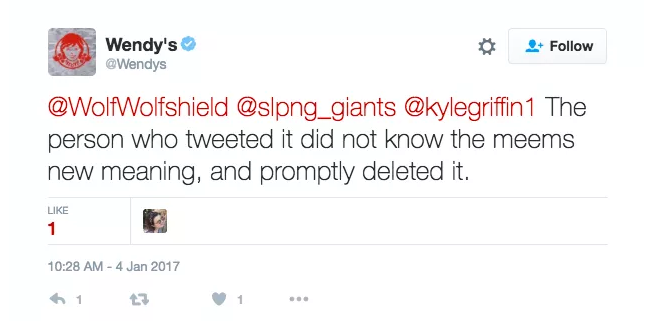
Back in 2016, Wendy’s social media manager innocently posted a meme of Pepe the Frog on the company’s Twitter account.

What he didn’t know was that Pepe the Frog had since transformed from a cute cartoon frog into a symbol of white supremacy and racism.

Imagine the response it got.

Now, you don’t want bad press like that for your brand!

But is it possible to eliminate it entirely in a world where users are entitled to express their opinions freely online?

Well, no.

But there are ways to avoid or even tone down bad press when it hits you.

ADVERTISEMENT

CONTINUE READING BELOW

Let’s look at some of them.

10 Tips for Avoiding and Dealing with Bad Press

These 10 proven tips will help you keep away from the vulgar and ugly side of online publicity.

1. Do Your Research

It’s OK for your brand to have a fun, witty, even snarky voice.

You can even express strong opinions to get attention.

But always remember to do enough research before posting anything online.

As with the example above, Wendy’s social media manager posted the anti-semantic meme of Pepe the Frog because he didn’t know it had taken on a new meaning.

Wendy's response to bad press

Wendy's response to bad press

Remember, you don’t need to spend hours on your research.

A quick Google search will tell you whether something is safe to post.

2. Stay Away from Controversy

While there are ways to use controversy to spark up interest for your brand, stay away from sensitive subjects like:

ADVERTISEMENT

CONTINUE READING BELOW

  • Politics
  • Religion
  • Sexuality
  • Abuse
  • Racism

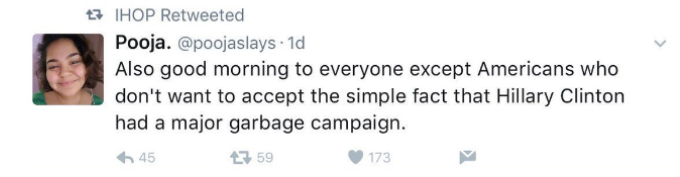
For example, when IHOP retweeted a controversial post about Hilary Clinton’s campaign, it provoked a ton of reactions.

The pancake house was forced to take the post down and claim its account had been hacked.

IHOP controversial tweet

IHOP controversial tweet

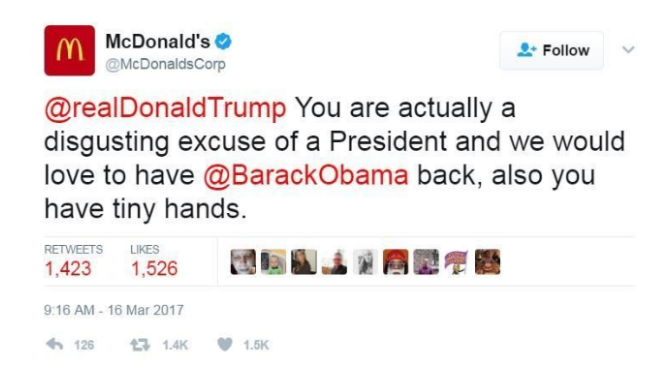
Here’s another example from McDonald’s.

McDonald's controversial tweet

McDonald's controversial tweet

This political post garnered the hashtag #BoycottMcDonald’s from angry Trump supporters.

3. Avoid Stoking the Flames

It’s bad enough to get hit by bad press.

It gets even worse if you retaliate with angry comments of your own.

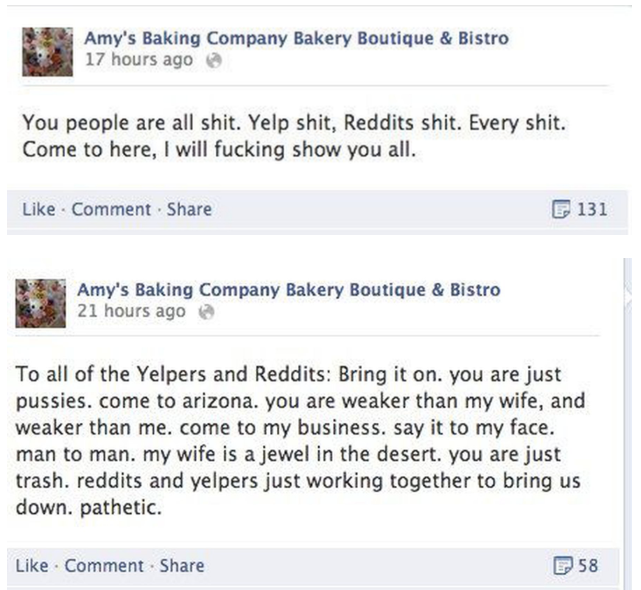
Take, for instance, Amy’s Baking Company.

Back in 2013, the restaurant was featured on FOX’s “Kitchen Nightmares“.

Not long after the feature, the restaurant’s Facebook page was slammed by Redditors.

Angered by their comments, owners Amy and Samy Bouzaglo retaliated with their own vulgar statuses.

adding to controversy

adding to controversy

While it’s OK to post statuses like these on your personal account (well, not really), never do it on your brand’s account.

4. Respond to Criticism Quickly and Professionally

When your brand gets negative comments, respond calmly and professionally.

Find out what the problem is and do your best to address it.

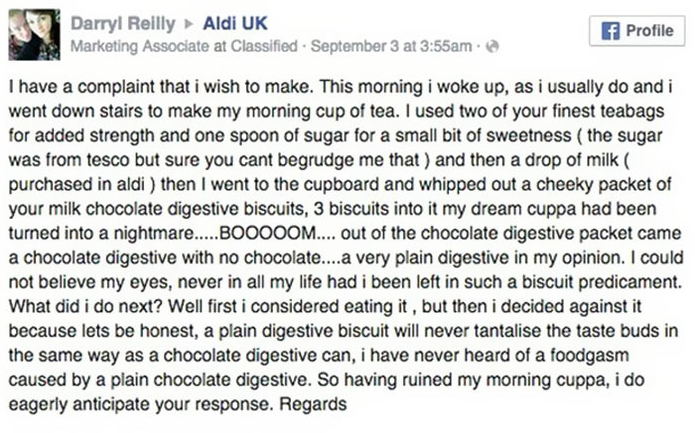
Here’s a great example from an Aldi UK buyer.

negative comment from Aldi customer

negative comment from Aldi customer

Aldi UK’s response?

ADVERTISEMENT

CONTINUE READING BELOW

Aldi's response to customer

Aldi's response to customer

Taking a customer’s complaint to heart and trying your best to solve it will both appease your customer and give you valuable input you can use to improve your brand.

Add a dash of wit and humor to your genuine concern for your customer, and you’ll have a magic formula for addressing complaints and bad press.

As you can see, Aldi UK’s response got 32,316 likes on Facebook.

5. Make Them Forget by Outstanding Performance

The human memory is fragile at best.

This is good news for you as a brand owner.

It means that no matter how much bad press you get, there’s always a way to make people forget what happened.

One excellent way to do this is to outperform your competitors.

Be silent and let your performance do the talking.

ADVERTISEMENT

CONTINUE READING BELOW

For instance, what comes to your mind when you think of Airbnb?

That’s right.

You think of a highly successful multi-billion dollar company.

You’ve probably forgotten (or never even knew) that Airbnb was once a tiny startup struggling to make ends meet by creating custom cereal boxes.

Outstanding performance makes people forget failures and bad press.

6. Don’t Make Promises You Can’t Keep

To promote their Baywatch-themed swimsuit The Pamela, Sunny Clothing Co. posted an interesting challenge.

Whoever tagged and re-posted their promotional photo would get a free swimsuit worth $65.

sunny-clothing-co

sunny-clothing-co

The problem was over 3,000 people joined the challenge and Sunny Clothing Co. couldn’t keep up with the demand.

The result?

A ton of furious, sarcastic, and disappointed customers.

7. Stay Away from Sensitive Issues

It’s simply impossible to please everyone today.

ADVERTISEMENT

CONTINUE READING BELOW

But as a rule-of-thumb, stay away from campaigns that can be called:

  • Sexist
  • Out of touch
  • Body shaming

For instance, remember the massive amount of criticism Peloton got for its 2019 Christmas ad?

Peloton ad response

Peloton ad response

8. Don’t Be Afraid to Take the Blame

When you receive criticism, avoid pointing fingers and blame-shifting.

If you receive bad feedback from customers, look into the issue, and be 100% honest and transparent.

Also, don’t be afraid to apologize to disgruntled customers.

ADVERTISEMENT

CONTINUE READING BELOW

For example, take a look at Toblerone’s response to an unhappy buyer.

Toblerone response to unhappy buyer

Toblerone response to unhappy buyer

9. Be Prepared with a Contingency Plan

No matter how well you protect your brand, bad press will hit you sooner or later.

The best thing you can do is to be prepared.

Come up with a detailed plan on how to respond to criticism and how to handle worst-case scenarios.

10. Hire a Community Manager

As your brand grows, you’ll have less and less time to deal with feedback from consumers.

What you can do to address this is to hire a professional who can manage all your blogs and social media accounts.

A community manager will know how to cool things down when negative comments start coming in.

How to Avoid Bad Press That’ll Hurt Your Brand

You want your online presence to give you a boost up instead of bringing you down.

ADVERTISEMENT

CONTINUE READING BELOW

To do this, follow the tips for avoiding or dealing with bad press:

  • Show genuine concern when customers express their problems.
  • Avoid touchy subjects and controversy.
  • Stay calm and professional.
  • Outperform your competitors.
  • Hire a professional to nurture your online presence.

Following these tips carefully will allow you to sleep sounder at night.

More Resources:


Image Credits

All screenshots taken by author, May 2020

http://tracking.feedpress.it/link/13962/13624565


Chaotic communication: COVID-19 is rewriting our cultural rules of connection

30-second summary:

  • Quarantine and the COVID-19 crisis have totally rewritten our cultural rules of communication. But the frantic ways we’re corresponding now will likely shift the way we connect long beyond the end of lockdown. 
  • Open Mind Strategy’s Megan Routh shares four crucial shifts in online behaviors with examples of how brands like Skittles, Frito Lay’s, and many other popular faces have quickly adapted their communication to these shifts.
  • Read on for some refreshing insights and lessons that will help your brand pivot successfully in the “new normal”.

Talk to any Millennial or Gen Z’er two months ago, or… text them, they would say there are fewer things more anxiety-provoking than actual, in-real-time phone calls. The abruptness, the awkward pauses, and the very fact that they’re beyond control.  

But that was the old world.  

In the solitude of quarantine, a craving for intimacy and personal connection means consumers, once notoriously adverse to spontaneous, face-to-face communications, are now clamoring to hear each other’s voices and see each other’s face.  

Verizon fielded over 800 million phone calls per day within the first two weeks the country was locked down. The word “Zoom” has become a stand-in to mean any “video chat” and apps like Houseparty have seen downloads increase 70 fold.  

Not only are face-to-face chats more frequent, but they’re also increasingly unannounced, unplanned, and unavoidable. A jarring juxtaposition to our pre-pandemic habits. It’s communication chaos.  

Quarantine and the COVID-19 crisis have totally rewritten our cultural rules of communication. But the frantic ways we’re corresponding now will likely shift the way we connect long beyond the end of lockdown. 

Shift one: A quest for intimacy in digital communities

Your bestie going live. Your boss going live. Your bank going live. When we were ordered to stay home, it only took a matter of days for everyone to start broadcasting themselves, most times to seemingly chaotic and confusing ends.  

Recently on IG live, comedian Whitney Cummings agreed to talk to anyone in attendance: She wound up chatting with baby squirrels.

The official, verified account of Skittles has, on more than one occasion, stirred up drama in the comments section of Bowen Yang and Julio Torres’ Instagram Live chats.  

Club Quarantine, a daily digital Queer dance party that happens every night via Zoom allows virtual clubgoers to join in with their cams, or just watch from behind a black tile, eliciting exhibitionism that can be traced back to the random recklessness of the bygone Chat Roulette era.  

But while it seems haphazard, each call, chat, and interaction is an expansion of community that chips away at our cultural fear of real-life intimacy and democratizes digital communities. 

As more white-collar workers are beginning to wonder not when they’re going to return to the office, but why they would ever return to an office at all, major coastal cities are staring at an exodus of their creative class and a bit of their cultural capital. 

What the migration offers brands

This migration gives brands a mandate to expand their offerings to bigger, more diverse groups of consumers as they use live-streaming and digital tools to build new communities all over the country.  

Take The Wing, a women’s co–working space founded in New York City with offices in chic urban hubs like San Francisco and London. When forced to close, they quickly pivoted from millennial-pink meeting rooms to Zooms, making the interconnectedness of their community and celebrity-speckled programming accessible online for people all over. 

Shift two: Consumers are rejecting content that screams aspiration

The foundational cracks in the influencer veneer have been growing over the past few years, but the COVID-19 crisis provides a magnifying glass that’s amplifying influencer’s social media shortcomings. 

The highly-filtered, everything-is-perfect image that is the hallmark of influencer and celebrity marketing has never been less appropriate than it is now. 

In a global crisis, consumers are rejecting content that screams aspiration and are instead looking for ways to share in and mitigate our collective exasperation. So what’s to fill this anti-influencer void? More unpolished, even unhinged, content.  

64-year-old character actor Leslie Jordan has seen his following balloon from 80k to 4.2 million thanks to a stream of monologues showcasing the absurd mundanity of lockdown – ironing for fun, baton twirling for exercise, watching porn while eating cereal.  

But we’re the stars, too. From live baking and hair-coloring tutorials to yoga flows in cluttered bedrooms, to organized weekly Zoom sessions, we’re all content creators and each other’s influencers, now more than ever. “Coming to you live” from the physical and emotional messiness of quarantine is recalibrating our relationship with reality, causing us to consciously avoid unreasonable expectations and embrace “doing the best we can do” as the new form of “living our best life”.

Heineken’s recent spot montages the relatable pain points of our endless digital gatherings and nods to the fact that quarantine life isn’t great, but we’re all trying to make it through. 

Shift three: Optimistic content has become a balm to cure anxiety

Optimism was already growing as a countertrend to the vitriol on the internet, but today, it’s flourishing.  During the pandemic, against a backdrop of endless doomsday news, we’re clamoring for more optimism. The sarcasm and troll-like tone that was once the hallmark of the internet is being replaced by content that uplifts.  

For a moment this week, “Duck Pool Party,” a stream of ducks playing in a pool, was the most viewed Reddit live stream. Even notoriously snarky brands like Wendy’s have shifted their Twitter strategy, at least temporarily, to encourage camaraderie through games, activities, and shared stories.  

Wholesome, positive –if not strange and mindless– content has become a balm to cure our anxiety, making it a great way of communication, a form of self-care that fills a void and provides a sense of calm that sheet masks and sourdough cannot.  

Shift dour: Fascination with facts

In March, consumers were letting out a collective sigh of exhaustion as their inboxes filled with branded emails detailing how we were all “in this together”. But against the background of a pandemic, these vague platitudes have a counter-effect, reminding us all just how much these companies haven’t been there for us in the past, what little cooperation and communication we received from airlines and car companies before, and what little practical application they have in this stripped back version of reality.  

Instead, we want to hear the straightforward truth. Unlikely figures like Dr. Fauci and New York’s Governor Andrew Cuomo have emerged as the leading men of the pandemic, and Cuomo’s curt, distinctively Dad-toned Powerpoint slides have found a cult following of their own. Frito Lay’s COVID-spot “It’s About People” has won praise for saying what they were doing to help employees, instead of selling chips. 

[embedded content]

But the most trustworthy brand voice comes from a most unlikely player: Steak Umms. The frozen meat company has emerged as a “voice of truth” thanks to their straight-forward, no-nonsense tweets that are at times, radical, at least for a corporate brand. Their willingness to tweet bold opinions– and not mild platitudes–earned them double their pre-COVID audience and the admiration of the internet.  

When we emerge post-crisis, shell-shocked, knowing that catastrophe can hit again at any moment, we’ll still want straightforward communication from brands. Brands need to learn this lesson quickly if they hope to pivot successfully in the “new normal”.

Megan Routh is a cultural anthropologist, writer, and strategist at Open Mind Strategy whose expertise lies in translating cultural insights and trends into actionable strategies for Fortune 100 companies including PepsiCo, Calvin Klein, JP Morgan Chase, Mondelez, Target, and the United States Postal Service.

https://www.searchenginewatch.com/2020/06/11/chaotic-communication-covid-19-is-rewriting-our-cultural-rules-of-connection/


How to Make Your Facebook Avatar

Having a personalized sticker is becoming a trend in the social network. It’s time to create yours.

Grow Your Business, Not Your Inbox

Stay informed and join our daily newsletter now!

June 10, 2020 2 min read

Brought to you by Cine Premiere

Facebook has implemented a new feature where you can create a custom avatar inspired by yourself. Like any new function, having a personalized avatar is becoming a trend, since this avatar has different ways of using it, including highlighting using it as a profile photo, making posts with the avatar by making some fun gesture, sending it as a message through Messenger, and even as stickers in the comments of publications. If you still do not have your custom avatar, here we explain how to create it.

Once in the application, you should go to the settings page distinguished by the icon with three horizontal lines located in the upper right corner for Android and lower right for iOS.

Then, sliding the screen downwards you will find an option from the «See more» menu, distinguished by colored geometric figures. When you click on this option, you will first see the “Avatars” option.

Related: How to Delete Your Facebook Account

When entering, there is only the simplest thing left, which is to create your own avatar. You can choose between different physical features such as face shape, eyes, eyebrows, nose and mouth, as well as customize your avatar with different colors and haircuts, hairstyles and head accessories. You can also modify the avatar’s complexion and choose between the different outfits that are available.

Once your Facebook avatar is finished, you must click on the popcorn that appears at the top of the screen. Even when saving your custom avatar, Facebook will show the option to make it a profile picture if you want to use it.

Similarly, in the comments of the publications when selecting the happy face that takes you to the stickers, you will find a tab with all the ones you can use with your personalized avatar.

Now that you know how to create your avatar and how to use it, you can now share it with your friends. Do you like this new Facebook feature?

https://www.entrepreneur.com/article/351702


How to create social media content that builds your brand

30-second summary:

  • Now is the time to connect your audience to show who your brand is and why you’re valuable to them, through the power of social media content.
  • Gone are the days of posting “just to post”. Have a purpose – be a human.
  • Social media is where your brand can spread its wings as real people and share data-driven advice, what you see in the industry, and how you’re overcoming challenges, and how your audience can too.
  • Make quality imagery a non-negotiable in your social media marketing strategy to catch your audience’s attention and encourage them to share your content.
  • The main point of social media is to connect with other people. Right now, connecting with people virtually has never been more critical.

According to a Statista survey on in-home media consumption as of March 2020, 44% of people worldwide are spending more time on social media (Facebook, Instagram, Twitter, and others). 

This is higher than 36% of people spending more time on computer/video games and also 35% spending more time reading/listening to books and music. 

Why does this matter for your company? 

Well, social media is no longer just a fun way to pass the time or a boring place where you share your latest blog link with no reason why it’s valuable. 

Now is the time to connect with that heightened audience that is filling their days with social media content. Hello, screen time. 

I’ll break down four ways that you can create the most impact for your audience using your social channels, focusing on building your brand in times of unforeseen crisis. 

1. Create images with a purpose

As silly as it is, when we think of the companies that we know and trust, they typically have impeccable branding and design – and usually an Instagram aesthetic to boot. 

Laugh if you want, but when their social media profiles look more professional overall, this can seem more credible. 

For example, Aveeno is one of the most trusted brands of 2019, according to BrandSpark. 

Social media content example 1

Notice

  1. Their beautiful imagery that is displayed so nicely next to the other images. 
  2. How they use similar colors, so they don’t clash.
  3. They SHOW their followers that their products are natural by bringing fruit, plants, etc. into the photos. 

Why does this matter?

Aveeno’s audience is women who want to feel and natural look their best. It makes sense to have beautiful images with pleasing colors, with a mix of a real photo of a real woman as well. 

This woman also happens to be a healthcare worker, which shows that Aveeno has a supportive voice during the challenging time of COVID-19. 

They also include “natural items” next to their products letting their customers know they can be trusted to only offer the best ingredients for their clients’ skin. 

Additionally, Hubspot is one of the most trusted SaaS brands, according to research conducted on Nextiva Blog. 

Social media content - Hubspot exampls

Notice

  1. Hubspot’s quality of minimalistic brand design with their images and stories. 
  2. The breathable space around their text so it’s easy to read and the variety of post designs without it being distracting.
  3. Their empathetic copy, which is critical during a time of crisis.   

Why does this matter?

Gone are the days of posting “just to post”. For HubSpot, their audience is businesses looking to grow. Their goal is to provide valuable social media content while showing they are a team of humans as well. 

Notice how they give actionable advice through their copy, while still incorporating branded imagery and design. They also show data-driven infographics that provide their audience insight they can use right away to move forward during these uncertain times. 

They also do a favorable job of being human and using mindful copy. We’re in a global pandemic. People don’t want “just” stats. 

Additionally, add a powerful call-to-action in your caption that works with design to tie it all together. 

2. Tell a story you’d want to read

It’s a repeated phrase you might hear often, “Social media is so over-saturated; my company doesn’t need to be on there.”

However, social media is where your brand can spread its wings as real human employees share data-driven advice, what they see in the industry, how they’re overcoming challenges, and how their audience can too. 

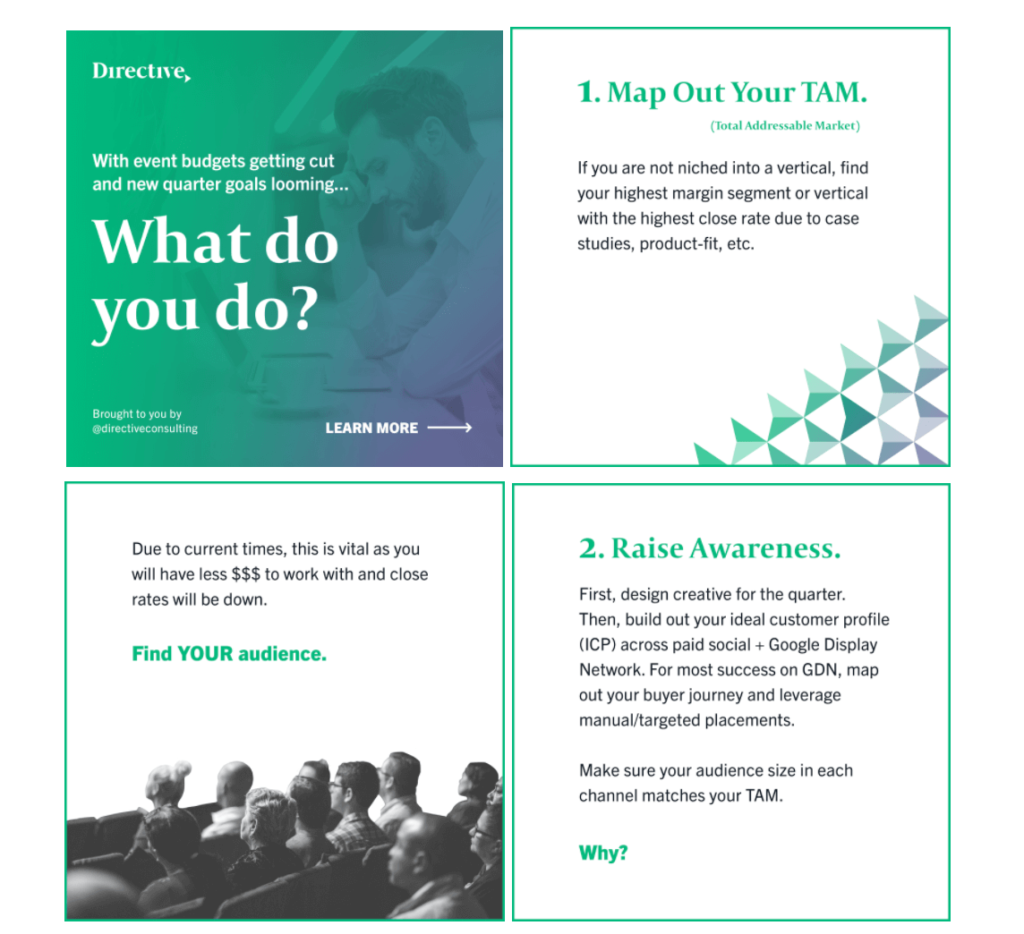
For example, for my company, Directive, a performance marketing agency for software brands, we have been focusing on providing data-backed insight to help software marketers keep pushing forward. You can see an example of a LinkedIn post we shared below:

Copy:

Directive copy example

10-Image Carousel below to tell the story through copy and design. Here are 4/10:  

You can check out all 10 slides for the complete story here: 

Why does this matter?

This shows how it’s important to us that SaaS marketers feel encouraged to keep moving forward and find new ways to meet their quarterly growth goals. We want to offer them support in the best way we know how to. 

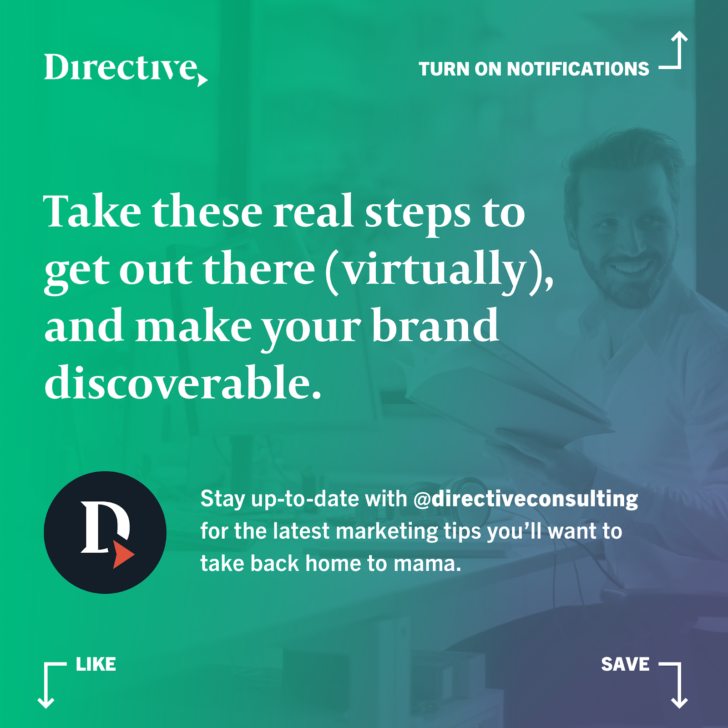
We also show in our last slide how we can help educate them further, when the time is right, rather than making a pushy sales pitch. 

See below: 

social media content example - Directive

3. Bringing your designs to life

So you know what you want to say and have great design ideas you think will connect with your audience – but then you remember that you’re not a graphic designer. 

What do you do?

Do you have a graphic designer on your team?

If yes, read here. If not, move to the next question. 

For me, I have a graphic designer on my team who is busy with clients but has room to help me create two pieces of design content a week. (We tested and two posts a week was the sweet spot.)

This way, I use Asana to assign her a task that shows exactly what I am looking for, what my inspiration is, who the audience is, any specific colors, I’d like to use, and the thoroughly edited copy for the design. 

I assign the due date, which is the day before I aim to post, so I have time to edit the design and leave any comments. I make sure she has three days to make this happen in case her client-work gets busier. 

This strategy has been incredibly beneficial, and we make what we have work every week.  

Are you the only “designer” available?

Don’t stress. When you don’t have access to expensive graphic design tools, you can still produce quality posts. 

DIY design

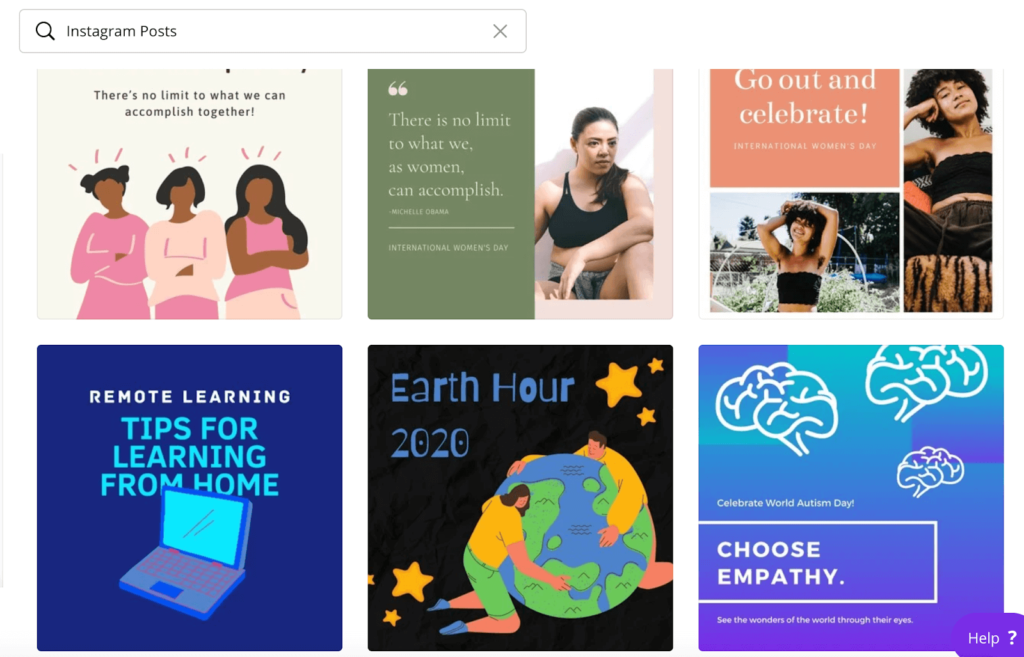
Canva has been around for a while, but often, their free version is underrated. Here, you can build off already existing templates or bring your own vision to life. They also have templates with the exact sizing for each social media platform.

 Canva social media templatesYou can upload your own logo, photos, and more into impressive graphics and make sure that the colors and branding match what will meet your audience’s needs. 

Turns out, you can do it all!

4. Communicate with humans

It’s critical to remember that sometimes, your words are enough. Check out engagement on one of Dave Gerhardt’s (the CMO from Privy.com) latest LinkedIn posts below:

LinkedIn post on Dave Gerhardt’s profile

Notice

  1. There’s no image at all. 
  2. He doesn’t use fancy “corporate” language. 
  3. He received over 1,000 engagements by telling his audience what he could not help them with. 

Why does this matter?

There is a way to build your brand without having a design on every single social media post (besides Instagram, of course). The main point of social media is to connect with other people. Right now, connecting with people virtually has never been more critical.

Remember:

  • Social copy that doesn’t resonate with your audience won’t work right now.
  • Social copy that doesn’t provide empathy won’t work right now. 
  • Over-“salesy” social media content or any form of salesy-content won’t work right now. 
  • Communicating with humans in a real way and showing how your brand can help them will work right now. 

Let’s help each other

Moving forward, while your current social strategy may have worked impeccably for the past five years, the next year might look slightly different. You may need to make some changes. 

Challenge yourself to work your creative muscles. What new designs might meet your audience’s needs right now? 

Is there a message your audience needs to hear? Do you have an already existing piece of content that is perfect to benefit your followers during this time? 

This is your time to grow. This is your brand’s time to flourish.

Ashton Newell is the lead digital PR strategist at Directive, a performance marketing agency specialized in the software space. When Ashton is away from her day job, she spends her time teaching yoga, cheering on the ASU Sun Devils, and drinking numerous cups of coffee. She can be found on Twitter @ashtonmeisner.

https://www.searchenginewatch.com/2020/06/09/how-to-create-social-media-content-that-builds-your-brand/


Online reputation management: Seven steps to success

30-second summary:

  • Apparently, it’s crucial to track your reputation in order to prevent PR crises. Moreover, monitoring your reputation enables you to discover valuable customer insights.
  • Founder and CMO at SEO PowerSuite and Awario, Aleh Barysevich, shares a strategy to tackle the challenges of online reputation management. 
  • Right from setting up your online reputation management (ORM) protocol to becoming proactive about getting reviews, there’s more to discover. 

There’s no need to explain the importance of reputation for businesses. The good word of your customers, potential or existing, is the best promotion tool you have. Meanwhile, scandals and criticism can ruin companies. Reputation becomes even more important during the times of crisis when emotions are heightened and any mistake can lead to a full-blown scandal. 

The internet really just amplified the importance of reputation: news and rumours travel fast, but on social media, they travel even faster (and reach more people). Who among us hasn’t checked the reviews before purchasing a product or hasn’t checked out a brand after seeing a friend praising it on social media?  No matter the size of your business, people are talking about you online, sharing their opinion on social media or leaving a review on Yelp and the likes of it.  

It would be wrong to think about online reputation as something separate from your “real-world” or offline reputation: with three billion social media users and counting your online reputation is simply your reputation, it affects purchasing decisions both online and offline.  

For example, Gillette’s polarizing campaign “The Best Men Can Be” gathered a lot of negative feedback (as well as some positive). Social media users publicly denounced the company and promised to stop buying Gillette razors. That wasn’t the first time a social media scandal led to calls for a boycott of the company, Nike and Uber being other notable examples.  

Besides the obvious need to track your reputation in order to prevent PR crises, monitoring your reputation enables you to discover valuable customer insights. Once you start paying close attention to your reviews and mentions online, you’ll learn what people love about your product, what they think you could improve, and what influences their decisions the most.  

All this makes reputation management more relevant than ever. You simply can’t ignore online conversations around your brand if you want to have a successful business. Luckily, the digital world gives us a lot more tactics and tools to monitor and actively improve our reputation than the offline world ever could. This article covers online reputation management step by step, giving you specific guidelines to follow.  

How to manage your reputation online 

Most businesses already conduct some type of online reputation management (ORM), for example, answering customers’ comments and posts where they were tagged. But to make your reputation crisis-proof, you need a robust workflow, and that’s what this article is all about. You can use these steps to revise your existing ORM workflow or build a new one from scratch. 

Step one: Set up your ORM protocol

Before you even start going through your online reviews, you need to establish some guidelines. These will help you and your team to know when to respond to reviews, do it appropriately and quickly, and know the best way to act if there’s a threat of a reputation crisis. This protocol can be as thorough as you like depending on how much you are synced with your team, but here are some questions to answer to figure out the guidelines: 

  • How fast should you answer? Obviously, the quicker your response, the better, but it’s a good practice to establish the minimum response time required for your team members. 
  • How transparent are you willing to be? This will help you determine if you want to go into all the nuances when responding to a customer or simply reassure them that you’re working on the issue. The recent trends prove that transparency is very much appreciated by customers.  
  • What tone of voice should you use? This, of course, will depend on your brand. Should you be cordial or professional and straight-to-the-point? Can you make jokes? Oftentimes a funny response to a complaint can go viral. For example, Oatly is one of the brands that heavily uses negative reviews in its marketing putting an ironic spin on them. But would it fit your brand’s image? 
  • Who will be the spokesperson(s) in case of a crisis? If the need arises, who will be giving the official statements on behalf of your brand? Is it the CEO, or the PR manager? Again, you can decide on the answer based on your company’s image — if you’re trying to build authentic relationships with customers and/or have a charismatic leader, it’s only logical that your CEO will do the talking.  
  • Should you automate your responses? Automation cuts your response time to seconds and allows you to save on staff, but can you be sure it won’t anger your customers? In the example below, the customer grew frustrated after trying to solve their problem on Twitter and getting the same scripted message from Amazon. 
  • Should you always respond? Some brands take their pride in the “always respond rule”, and for smaller brands, it’s actually a must — the more engagement you get, the higher your brand awareness, especially on social media. But once you start getting a ton of mentions at once, you might need to start prioritizing. Besides, sometimes negative reviews can just become trolling — and if there’s one rule you need to learn on the Internet, it’s “Don’t feed the trolls”.  

By answering the questions, you should have a clear outline of dos and don’ts for your social media, community, and PR managers. 

Step two: Choose and set up a monitoring tool

You could try tracking your online reviews and mentions manually, but without a specialized tool, it’s practically impossible. Online reputation management tools enable you to find mentions of your company on social media, in the news, and on review aggregator websites. There is an array of monitoring tools for different needs and budgets, such as Awario, Brandwatch, Reputology, and others. How do you choose the right one? 

As with the previous step, there are some questions you could ask yourself and your team to decide which tool to settle on: 

  • Platforms it covers. Of course, when we are doing online reputation management, the more feedback we find, the better. But for some businesses specific websites or social media platforms are crucial: for example, TripAdvisor for tourist guide companies or Instagram for clothing brands.  
  • Sentiment analysis. Sentiment analysis is one of the core features in ORM. It helps you focus on dealing with negative reviews first and see the overall share of negative and positive mentions of your brand.  
  • Special features. Are there any particular requirements that your team might have? Do you need influencer analytics to quickly prioritize reviews with the biggest reach first? Or do you maybe need a tool that could easily be integrated with your CRM/task manager?  
  • Pricing. Reputation management tools vary greatly in pricing going from Enterprise-level analytical powerhouses that cost thousands of dollars, to much more affordable options for mid- and small-sized businesses. Make sure the core features you’re looking for are available in the plan you’re ready to pay for! 

Most tools offer either free trials or demos to get you acquainted with them, so you can investigate before you are ready to invest. 

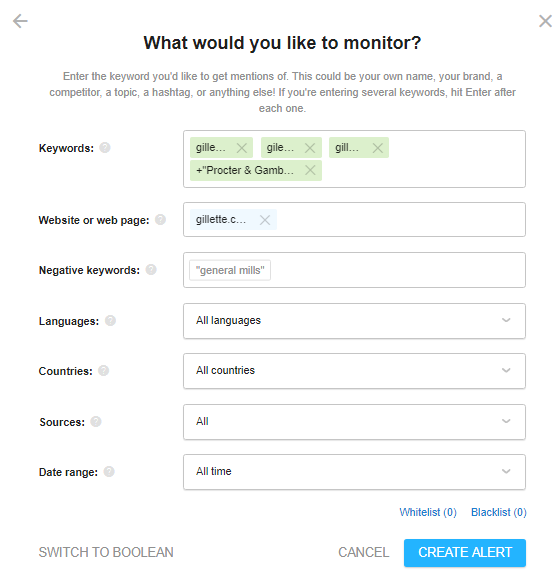
Once you settle on a tool, you need to set it up to start monitoring. You can monitor your brand name, the name of your products, the names of key public figures in your company. Don’t forget to include common misspellings of these words and phrases – it’s a common mistake that brands make when monitoring their reputation which results in missing a lot of feedback. 

setting online reputation management tool

Most tools allow you to choose some filters for your monitoring efforts: to find reviews only in a certain language, from certain countries or platforms.  

If there’s a topic that causes particular concern for your reputation (for example, Shell and oil spillage), you can create a separate monitoring alert for it using a Boolean search mode.  

Most reputation management tools have a notification settings tab where you can choose when and how you want to receive notifications. 

Now that you’re finished with your setup, it’s time to check your online reputation! 

Step three: Check sentiment analytics and mention spikes

The first thing to do every time you go to your online reputation management tool is to look at the dashboard. This is typically where all your analytics are visualized so you can notice if something is out of the ordinary right away.  

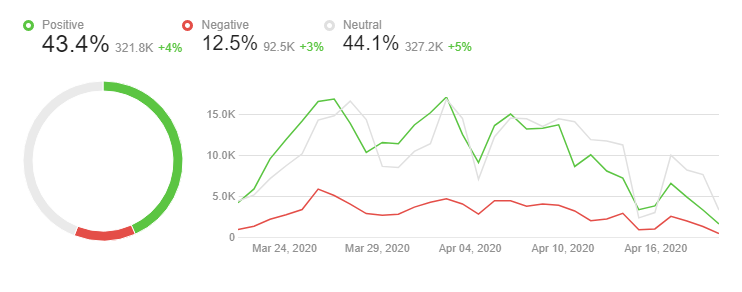
sentiment graph - online reputation management (ORM) tool

First, look at your overall sentiment and see the shares of positive and negative mentions. This will give you an understanding of your overall reputation. You can select different time frames to get a closer look at a certain moment in your company’s history, or vice versa choose as big of a time frame as you want to get a historical perspective.  

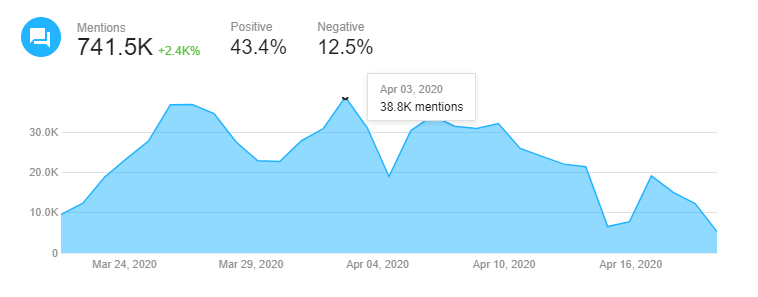
mentions graph

Other important graphs here are the number and reach of mentions, specifically, sudden spikes in it. A sudden spike in the number of mentions means that a lot of people are talking about you (hopefully, for a good reason) and a sudden spike in reach can also indicate that some influential account or website mentioned your brand. A lot of stories nowadays emerge on social media and paying attention to spikes allows you to get on top of the story right away.  

Step four: Deal with the social media mentions

Now that you’re sure that there are no reputation crises unfurling at the moment, it’s time to deal with individual mentions. I suggest focusing on social media first since it’s the media with the biggest “sense of urgency”, that is, the medium where people expect you to answer the quickest. According to the study by The Social Habit, 42% of social media users expect a brand to respond in 60 minutes or less.  

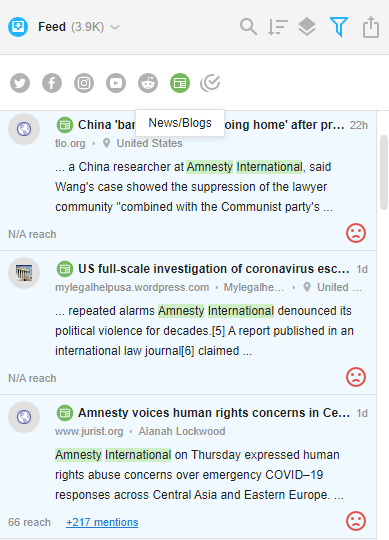
Most tools have some kind of a feed that gives you access to individual mentions. For now, filter out everything but the mentions from social media platforms: we will deal with the rest a bit later.  

Usually, social media mentions are sorted by date with the newest mentions displayed first. You can filter them to see negative mentions only to make sure you respond to the unhappy customers first, and then take a look at the neutral and positive mentions, thanking users and sharing favorable posts. Testimonials are an extremely powerful way to promote your brand, so don’t neglect the positive reviews you get, use them. 

The mentions, both positive and negative, can be a great source of customer insights as well. Pay attention to constructive feedback, you can even tag them to come back to them later or share them with your colleagues. 

Step five: Check review sites

Now that social media are dealt with, let’s move on to other types of review platforms: Google My Business, Yelp, TripAdvisor, Amazon, and any industry-specific platforms you might come across.  

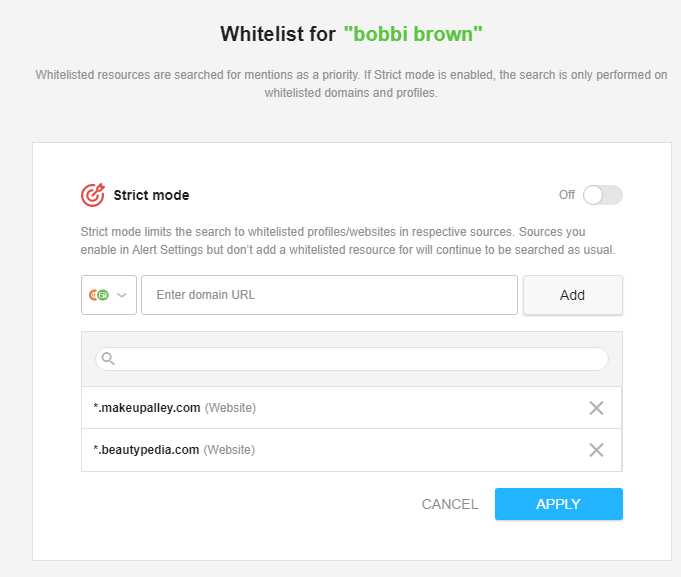
To find these reviews, do the opposite of what we did in the previous step: filter out all the social media mentions as well as the news. Some tools like Awario even offer a whitelist feature which is used to prioritize certain domains — this could come in handy if you want to make sure you’re getting mentions from specific websites popular in your industry. 

Most websites allow you to respond to reviews once you verify your brand’s account — as with social media, start with the negative ones. You can also share the positive reviews on your website and social media through plugins or screenshots. 

If you allow reviews on your own website (if you’re running an eCommerce business, for example), now is a good time to go through them as well. 

Step six: Check mentions from the media 

Granted you haven’t noticed a sudden change in the sentiment or number of mentions at the third step, media outlets and blogs can wait until you’ve dealt with social reviews. Of course, if you’re in the midst of a PR scandal, the news becomes a much more important source. Also, these steps could be tackled by different teams – social and reviews sites can be taken care of by community managers and news and blogs can be handled by the PR professionals. Nevertheless, they will still be using the same online reputation management tool. 

Filter out everything but mentions from news and blogs. Then the workflow is pretty much the same: check the negative articles first, then the rest. You can reach out to bloggers and journalists to try to swing their opinion in case of negative coverage or thank them and possibly build lasting relationships.  

Step seven: Become proactive about getting reviews

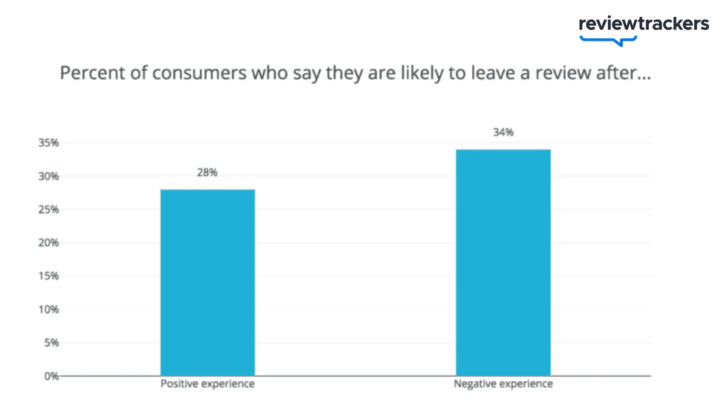
Some communication specialists may treat reviews as a headache: the truth is people are much more likely to leave negative reviews than positive ones. This discrepancy can create a feeling of despair when it comes to online reputation management, but this only means that you need to become more proactive about getting reviews from your customers. 

The secret to getting more reviews is asking for them! You need to set up a consistent system of encouraging your customers to leave reviews on social media and review platforms. You can do it manually or use automation tools (Buffer, Mailchimp, Delighted) to schedule social media posts and emails encouraging users to leave reviews and add review-requests plugins to your website. Resharing positive reviews on social may also encourage other users to post praises to your business. You can even run a social media contest focusing on positive reviews as the main challenge for your followers. Get creative! 

To sum up

With proper preparations, online reputation management becomes a piece of cake. Once you have clear guidelines in place (which can be perfected over time) and set up a reputation management tool, there should be no trouble for you to make your reputation crisis-proof. 

Aleh Barysevich is Founder and CMO at SEO PowerSuite and Awario.

https://www.searchenginewatch.com/2020/06/03/online-reputation-management-seven-steps-to-success/


New To Instagram Live? Here’s How To Show Up Like A Pro

June 1, 2020 5 min read

Opinions expressed by Entrepreneur contributors are their own.

From the entertainment sector to the health and fitness industry, stay-at-home orders have forced many entrepreneurs to improvise and share their skills virtually. Live has emerged as an outlet of choice for enterprising business owners. Hop on Instagram right now, and you’ll likely see dozens of users and brands either going live or advertising an upcoming live stream.

Though it’s becoming more popular in recent months, live-streaming has largely been underestimated. But it won’t stay that way for long: Instagram’s algorithm rewards live-streaming with additional push notifications and a position at the front of the line in users’ Stories feed, so it’s only a matter of time before brands and businesses catch on. Streamers can also see and respond to comments in , which opens up the potential to directly communicate with and engage your audience.

Related: 5 Ways to Get More Followers and Brand Exposure With Instagram Live Videos

If you’re looking to use Instagram Live to create content or even sell virtual services at this time, here are four tips to help give you a running start.

Free up your Wi-Fi

In 2015, the average American household had around 10 ; the advent of -connected appliances is rapidly driving this number up. Studies project this number has since doubled and will eventually reach 50 devices per home.

Smart speakers, smart doorbells and smart security cameras all tug at your Wi-Fi connection throughout the day. When it’s time to go live, you want the maximum available bandwidth possible. Consider closing down or temporarily disconnecting devices tethered to your Wi-Fi connection. This minimizes the chances that you’ll experience interference, a pixelated feed or a blip in internet connection that short-circuits your stream entirely.

If you see yourself live-streaming regularly for the foreseeable future, hardwire your setup and connect your phone directly to your internet router via Ethernet cable. A lightning-to-Ethernet adapter is here, a Micro USB-to-Ethernet adapter (for Android devices) is here, and a USB-C-to-Ethernet adapter is here.

Related: Everything You Need to Know About Instagram Takeovers

Consider the split-screen live feature 

Since late 2017, Instagram has made it possible for two accounts to live stream at the same time. During a time when most people are home and many are spending more time than usual on social media platforms, a two-screen offering can create freshness and variety.

Here’s how to create a two-person Instagram Live:

  • Coordinate beforehand with your guest or live stream co-host; they will need to be viewing your live video already before you can invite them to join.

  • Go live on Instagram, then locate the two faces icon at the bottom of the screen.

  • Viewers who are watching your live stream will appear as co-host options; select your guest and invite them to join. Once they accept, the split-screen will appear.

It can sometimes take 15 seconds or more for users to be notified that you’ve gone live; consider preparing an introduction of some kind to fill the dead air time before your guest arrives and is able to join you on your feed.

Concerned about going live, having your stream look presentable and pressing the right buttons? Make a dummy Instagram account and practice as often as needed to boost your confidence before you broadcast to an actual audience.

Related: Interact With Customers Through Instagram Stories and Live Videos

Leverage Story highlights

Instagram launched Stories in 2016 as a response to , but any content created would disappear after 24 hours. In December 2017, though, Story highlights were added, and users can feature past Story content or live-streamed content below their profile description.

Consider creating a Story highlight to show off your live streams. The majority of viewers watch your replay, not your actual live stream, and your content will reach a larger total audience when replays are available. Don’t let a low number of live viewers discourage you.

You can also grab a hyperlink from any Stories post. Simply go to the icon at the bottom right of the screen, tap, then tap “Copy Highlight Link.” Your Instagram live replay can now become source content for email campaigns or other initiatives and help you cross-pollinate your audience to Instagram.

Related: How to Use Facebook Live and Instagram Live to Boost Your Business

Put your phone in “Do Not Disturb” mode

If you do all this work, but then receive a phone call during a live stream, the call will take priority and your stream will pause or end altogether. Don’t let this happen to you, especially when you’ve hustled to gather your followers in one place. 

Toggle on the “Do Not Disturb” function in your smartphone’s settings section. If you plan to live stream regularly, you may want to create a pre-broadcast checklist; include this settings tweak in your preparation.

can be scary at times — don’t let fear or gear stop you from sharing your expertise with your community, especially when they’re stuck at home and unable to consume your services in person. Use this time to learn the ropes, and you’ll have a new strategy for your future marketing toolbox. 

Related: The Ultimate Guide to Instagram Analytics: Metrics, Insights, Tools and Tips

https://www.entrepreneur.com/article/348009