Creative Ideas to Work with Influencers this Holiday via @ashleymadhatter
[unable to retrieve full-text content]http://tracking.feedpress.it/link/13962/12915823
[unable to retrieve full-text content]http://tracking.feedpress.it/link/13962/12915823
[unable to retrieve full-text content]http://tracking.feedpress.it/link/13962/12912949
[unable to retrieve full-text content]http://tracking.feedpress.it/link/13962/12911136

Every business wants as much customer feedback as possible. That’s why we obsessively measure NPS (which barely has any statistical validity) and run surveys (which, in addition to being biased by definition, can negatively impact customer experience) like it’s the end of the world.
But the feedback we really want is different. It’s genuine, quick and easy to get, and structured enough so we can analyze it effectively. That’s where social listening, or social media monitoring, comes in.
Social listening is the process of monitoring mentions of keywords (for example, a brand name) or key phrases across social media and the Internet at large. Think of it as a way to measure people’s awareness of any subject – and their opinion on it – without having to ask questions.

More and more companies are adopting social media monitoring every year, and social listening tools are also evolving quickly. Even though they’re called social media monitoring tools, many apps go beyond social media and monitor the web at large. Finally, they analyze the data in order to provide you with insights you can learn from and act on.
In this post, we’ll look at the best social media monitoring tools you can use in 2020.

Awario is one of the best options in terms of bang for the buck. With pricing starting at $29/month, it comes equipped with many features of Enterprise-geared tools: sentiment analysis, topic clouds, Boolean search, and more.
In terms of coverage, Awario monitors Twitter, Facebook, Instagram, YouTube, Reddit, news and blogs, and the rest of the web. Let’s look at what makes Awario stand out.
Awario lets users measure dozens of social listening metrics, such as sentiment, reach, share of voice, key themes, top countries, and more. On top of that, you can use the tool to identify your biggest influencers and compare several brands side-by-side against crucial metrics for benchmarking and competitor analysis.
Boolean search isn’t for every brand. If your company name isn’t a common or ambiguous word (think Apple or Tesla), you’ll be just fine by simply feeding your brand name to the tool.
However, social listening has plenty of benefits beyond brand monitoring: from lead generation and PR, to doing research for your content strategy, this is where Boolean search comes in handy. It’s an advanced search mode that uses Boolean logic, letting you create flexible queries of any complexity to make sure you only get relevant results, whatever your use case may be.

Awario offers a free 7-day trial. Pricing starts at $29/mo for the Starter plan (with 3 topics to monitor and 30,000 mentions/mo) and goes up to $299/mo for Enterprise.

Although TweetDeck isn’t a specialized social media monitoring tool, it definitely deserves a place on this list.
First of all, TweetDeck is free. Second, it lets you run Twitter searches using its powerful filters. And third, it combines the search functionality with everything else you’ll need to manage your Twitter presence.
TweetDeck lets you schedule tweets, manage your DMs, and track mentions of your company on the network. You can set up as many searches as you need and reply to tweets right from the dashboard by connecting your Twitter account to the app.
Another great thing about TweetDeck is its column layout where you get to choose what each column shows. For instance, you could have your Twitter feed in one column, your DMs in another, and your social listening search in yet another one.
TweetDeck is free.

Talkwalker is an excellent social listening tool for digital agencies. The software collects the latest mentions of your brand and offers detailed analytics on your social media presence.
The tool’s social media coverage is pretty impressive, on top of Twitter, Facebook, Instagram, and YouTube, the platform also monitors Flickr and Pinterest.
In addition to monitoring mentions, Talkwalker will give you insights on people who mention you, including your audience’s gender, age, interests, and geography.
Talkwalker’s Enterprise plan offers an ability to monitor images and videos, this way you’ll be notified whenever your logo appears in an Instagram photo or YouTube video.
Pricing starts at $9,600/year for 10,000 mentions/mo.

Mention is a social media tool that’s primarily geared towards agencies and big brands, although they do offer plans for smaller businesses. Mention’s focus is on real-time monitoring – if you sign up and create an alert, you’ll only see mentions from the last 24 hours. Historical data is available under custom plans.
For businesses that like to have their analytics in one place, Mention offers API access, letting you integrate it into your own tools. If you’re not into coding, Mention offers an integration with Zapier, letting you automatically send mentions to a Google Spreadsheet, set up Slack notifications, and more.
In addition to social media monitoring, Mention lets you search for industry influencers across Twitter and Instagram; on top of that, it finds influential websites that you can partner with or guest post on.
Mention’s pricing starts at $29/mo for its basic Solo plan, which lets you monitor one topic. For bigger brands, the app offers custom plans which start at $600/mo.
That’s our list of the best social media monitoring tools for the coming year. Each of them has its own unique pros, so I do hope you’ve found one that’s a perfect fit for your use case and budget.
This is a sponsored post from Awario. Awario is a social listening and analytics platform trusted by over 5,000 companies worldwide. The tool gives brands access to meaningful insights on their customers, industry, and competitors through real-time social media and web monitoring. Awario monitors social media networks, news websites, blogs, and the rest of the web in real time, crawling over 13 billion pages daily to ensure you never miss important conversations that spark out online.

What you need to know about the recent changes in the LinkedIn algorithm, how to create engaging content, and examples of brands using the platform well.

Traffic forecasting is one of a CMO’s best resources to allocate marketing spend across the most useful tactics. Here’s how traffic forecasting could mean smarter ad spend.

Marketers are choking under a data avalanche. Is there a tool that cuts through the data noise, ignores vanity metrics, and focuses on numbers that matter?

Shopping on social media channels is spreading quickly as the next big thing. The rise of visual search is powered by people’s desire to discover brands.
https://www.searchenginewatch.com/2019/10/15/top-social-listening-tools-for-2020/
On social media, as in life, first impressions mean everything. Your social media bio can make or break your ability to grow your following.
October 10, 2019 5 min read
Opinions expressed by Entrepreneur contributors are their own.
Social media marketing is an important strategy for businesses today. However, many business owners and marketers focus solely on creating content to share on social media and forget about one little (but very vital) thing—the social media bio.
Related: 10 Laws of Social Media Marketing
Your business’s social media bio might not seem like that big of a deal, but it is. Your bio is one of the first things that users see when they discover your business on social media. So, it needs to grab the attention of users, explain your business and make them want to find out more about you. Accomplishing all of this can be difficult when you’re working with such a small space, but it’s not impossible.
Here’s how to sell your brand with a better social media bio:
Your social media bios shouldn’t be exactly the same on all platforms. Your audience will differ across social networks, so you need to create bios that are relevant to each. For example, your audience on LinkedIn will typically want to know about your professional accomplishments, including how many years your company has been in business. On the other hand, users on Instagram will expect your business to be a bit more personable and fun. So, be sure to study your audience on each platform and create a social media bio accordingly.
While each bio should cater to the specific platform and audience, remember that you need to keep your brand consistent throughout. Create a style guide that your team can follow. Include guidelines for images, colors and tone of voice to ensure brand consistency across multiple channels.
Social media bios should be kept short. You need to grab the attention of users and give them the information they need about your business, without boring them with a lengthy, wordy bio. But how do you tell the story of your business in just a few sentences? A good tip is to write what you do and who you do it for.
Related: Follow the 3 Ps to Grow Your Social Media Influence
For example, the Instagram bio of The Wing lets users know it offers work and community spaces designed for women. It also includes the company’s mission. This type of information is important for the target audience to know.

Telling your story will help you connect with your target audience, especially if you can evoke emotions. According to Harvard Business Review, on a lifetime value basis, emotionally connected customers are more than twice as valuable as highly satisfied customers.
You may not associate emojis with professionalism, but if you want to stand out on social media, you need to use emojis in your bios. Not only will emojis help your brand stand out online, but they can also help you convey your message more effectively.
Related: 5 Smart Ways to Use Social Media to Grow Your Business
According to Vyvyan Evans, the author of The Emoji Code, emojis replicate characteristics of human conversation. He adds that “70 percent of the meaning of an oral conversation comes from nonverbal cues. Emojis add personality to the text and generate empathy among users.”
Take a look at the use of emojis from Outdoor Voices. It uses several athletic and recreational-type emojis to connect with its sporty audience.

But don’t just add an emoji for the sake of adding an emoji. Be sure to use emojis that are relevant to your business and your message.
Adding a call-to-action in your social media bio is important. After all, when a user finds your business on social media, you’ll want them to take the next step and visit your website, sign up for your email list or register for a free trial. Instead of adding a link to your website and hoping users will click on it, create a better call-to-action (CTA).
In this Twitter bio example from Honey, the company informs users how to install Honey and use its new iOS app with a link for each.

Rather than adding a link without explanation, effective CTAs let Twitter users know exactly what steps to take next. You can also use an arrow emoji to draw more attention to your CTA.
The phrase “You had me at hello” isn’t just for romantic movies anymore. By creating better social media bios, your target audience will be saying that famous phrase about your business. So, say “hello” and make a good first impression online.
https://www.entrepreneur.com/article/339553
[unable to retrieve full-text content]http://tracking.feedpress.it/link/13962/12845649
[unable to retrieve full-text content]http://tracking.feedpress.it/link/13962/12832533
[unable to retrieve full-text content]http://tracking.feedpress.it/link/13962/12825255

Faith in Facebook and other platforms has been shaken, which could alter their money-making models.
September 10, 2019 3 min read
Opinions expressed by Entrepreneur contributors are their own.
When the concept of “influencer marketing” emerged, it was the first time in decades that advertising seemed authentic. This was particularly timely, given how most people had been avoiding paid promotion by any means necessary (ad blockers on the internet, time-skipping DVRs on television, etc.). But in the wake of revelations like Facebook’s Cambridge Analytics privacy scandal, social media — the primary vector by which influencers plied their trade — became less trustworthy than ever, leading many to wonder about the impact on ad revenue and how social media on the whole would respond.
The 2018 Edelman Trust Barometer presents a stark picture of just how much trust was lost. In the United States alone, user confidence in social-media platforms declined 11 points over 2017’s figures. Worldwide, merely 41 percent claimed they trusted social media. Worse, 40 percent of respondents subsequently deleted a social media account, and government watchdogs have increasingly targeted social-media firms with antitrust actions.
Related: How Much Should You Spend on Social Media Marketing?
Sometimes, potential solutions emerge that can help shore up the losses. Facebook, for example, reported a 28 percent increase in ad revenue year-over-year for their most recent quarter; amounting to over $16.6 billion. The customer targeting-capabilities on Facebook are so robust that brands continue to use the advertising platform. In addition, Instagram Stories added significantly to the company’s bottom line.
Still, trust will need to be regained, and improvements have to be made in the protection and use of information. “We can’t assume that our privacy is being respected, even with laws like GDPR,” says Jon Gillham, CEO of Blade, a pair of browser extensions that block ads and replace them with adbank-powered ads offering crypto rewards. “Current technology is built to benefit companies and shareholders, not end users. We will continue to see tech giants use sneaky tactics that exploit user data and outwit regulations until advertisers, publishers and end users actually choose to use privacy-respecting platforms.”
Related: 4 Tips for Launching Winning Snapchat Ads
Lost viewers will eventually lead to lost ad revenue, and the only way to get that revenue back is with improved protection for users. That’s going to require new technology, and already, some are looking to blockchain to address the shortfall. Facebook’s own controversial Libra program happens to feature cryptocurrency at its base.
Social-media providers may have started to see the handwriting on the wall for revenues related to advertising and are working to branch out. Again, Facebook’s cryptocurrency plan could deliver a new source of revenue, but social media platforms like Pinterest and Instagram have been working to serve as channels for selling goods. On the surface, it makes
sense; people are already on the site to look at goods, so why not integrate buying options to turn the window shopping equivalent into a regular shopping opportunity?
https://www.entrepreneur.com/article/338133

A picture is worth a thousand words. If we talk about digital marketing, a strategically used picture could be worth a thousand links. Links play a pivotal role in the success of your digital marketing and eventually, your brand’s growth strategy and that’s why image-based link building is a key factor for your search engine ranking.
Put simply, link building is getting your website including your blog, articles, and resources linked by other websites. Your images, infographics, and memes, too, can be used for link building and turn your page into a link magnet.
Readers pay close attention to information-carrying images. According to research by Brain, three days after reading or hearing a piece of information, people can remember only 10% of it. However, if the information is presented in an easy to grasp graphic, that percentage goes up to 65%.
And for that reason, 32% of marketers insist that images are the most important type of content in their digital marketing strategy.
Images can increase your website traffic by 12%. Social media updates with images get 150% more shares than those without any image.
Want to see your images generating backlinks and generating traffic? Check out the following:
If you are a digital marketer, you cannot avoid using images. But, creating images that encourage people to take some kind of action – such as to share or to fill up the contact form – requires strategic efforts.
The best way to do that is to create something that your users might be interested in. Share something that revolves around and resolves their pain points.
Keep your images simple and the information in it easy to digest. Some of the most engaged-with images are those that have facts, how-to guides, tips, and quotes.
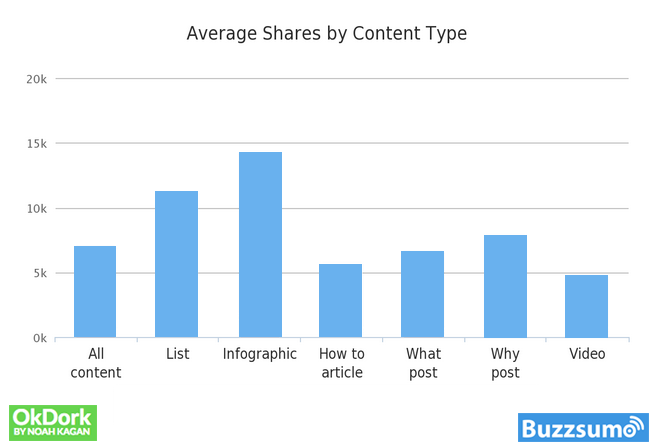
Source: Buzzsumo
Be regular with your posting and keep monitoring the behavior of your audience on each of your updates. The ones that get most shares, likes, comments, and downloads are the ones your audience likes to see and the ones you should center on.
First, you need images to support your articles, blogs, web content, and social media updates. Then, you will need to fine-tune those images to fit into your requirements.
ShutterStock, iStockPhoto, and AdobeStock are some of the top platforms to get high-quality graphics for your updates and articles. If you are looking for high-quality images without stressing your marketing budget, Pexels, Pixabay, StockSnap, and Unsplash are a few places to visit.
For editing and creation, you could use Canva, the best online platform for creating compelling graphics for your texts and social media updates. With their sea of pre-loaded templates, this task becomes a cakewalk. Some other image editing tools are AdobeSpark, Fotor, and Pixlr.
Although there is a mention of infographic in the article earlier, the point is vast and important that it gets a separate cover.
In modern digital marketing, the use of infographics allows marketers to increase their text’s readability and drive engagement. Infographics grab more attention. In fact, an infographic is 30 times more likely to be read than a purely textual article.
About 65% of B2B marketers use infographics for their marketing emails, presentations, and blogs. And 30% of them create infographics on their own.
Creating engaging infographics requires hours and days of research, along with a creative mindset to come up with an interactive, interesting, and unique layout.
You could use tools like Piktochart, Venngage, Visme, and Easel.ly to create infographics like a pro. You can also create infographics with Microsoft PowerPoint.
So, now you know how to create graphics for your website and social media. What if people can’t find your image?
No matter how impressive your images are, if no one can find them when they need it most or if no one seeing it, it is of no worth.
To be found on search engines, your images will need to be crawled by crawlers or robots sent by search engines to your website. Since these robots cannot decipher images, you will need to make some alternative arrangements so search engine robots can understand and index your images.
On social media, you will need to follow a completely different strategy in order to make your graphics easy to find by users. On Twitter and LinkedIn, there is an option to add a short description for your images. Pinterest too asks you to add a description to each of your posts.
On Facebook, Instagram, and other platforms including Twitter and LinkedIn, you can increase the visibility of your posts by using the right and trending hashtags.
The easier it is to find your images, the higher is its visibility and engagement.
As a marketer, you should know how many websites link to your images and how many are using them without your permission. It is an important metric for your business and digital marketing strategy building.
If you have uploaded an image on the Internet, you cannot actually control it or stop people from using it. But, there are ways to find out who all are using your graphics.
There is no harm if you are given credit or backlink. But if someone unauthorized or without allowance is using your image, it could have an impact on your search engine ranking.
Open Google Image Search, and upload or paste the link of your picture. You shall see a list of similar images being used by others.
A couple of similar tools to locate your images on the World Wide Web are TinEye and ImageRaider. Using both these tools, you can also figure out if your images have been cropped, reversed or flipped.
Once you have found unauthorized use of your images, ask the webmaster or admin of the page to give you credit or remove it from their database.
Social media is an unavoidable practice for a digital marketer. It is an immense boost to your SEO efforts.
To make the most of your high-quality images, you could turn to Instagram and Pinterest – the most happening image sharing platforms – that are also in the list of top 10 most used social networks.
That makes Instagram a very popular and super-active marketing platform. With Instagram marketing, you can connect with your audience across multiple channels. You can also create eye-attracting ads that have high engagement rate and improved ROI.
86% of brands use Instagram and at an average 72% of these brands post at least 1 picture every week. Engagement on Instagram graphics is growing with every passing year and Pinterest is 80% more viral and 3x more effective at generating leads than Twitter. In fact, Pinterest Marketing converts more and faster than any other social media platform. Another plus side about Pinterest is that it has fewer steps from discovery to conversion and it saves marketers a lot of time.
Posting and tracking Instagram and Pinterest activities on a day-to-day basis could be is challenging. So, you could consider using social media management tools. which can ease your day by allowing you to check analytics and schedule your updates.
Checking out the activities of competitors has always been a part of traditional marketing strategies. Even in the era of digital and social, you should always be aware of what your competitors are doing.
Follow their feeds anonymously and check out their social media updates and website more often.
Doing so, you can keep yourself updated with the latest marketing trends. This also helps find out the type of content they are leveraging to draw traffic and engagement.
With that, you can take inspiration for your content strategy and gain customer attention through your marketing campaigns. You can even engage with your competitors, sometimes, to draw engagement and attention.
Take an exchange of Tweets between Audi and BMW from last year. BMW tweeted a marketing material using the logo of Audi.
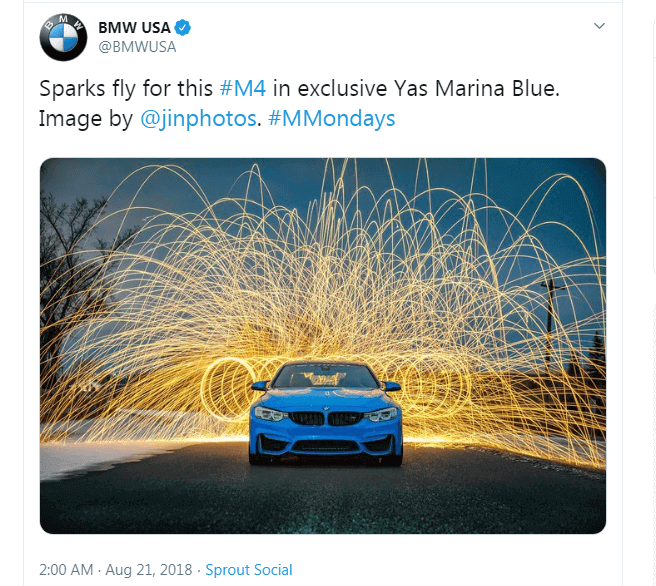
Taking a note of it, Audi commented with the following:
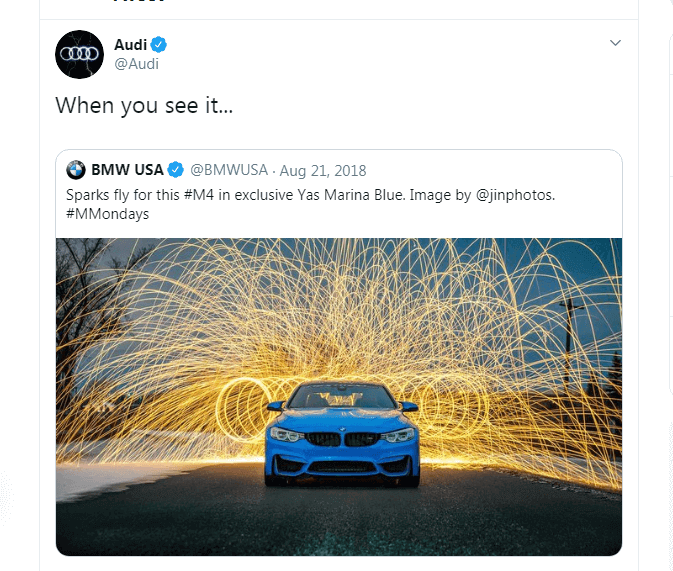
That simply shows that Audi not only follows BMW but doesn’t hesitate in engaging with their update. BMW, too, didn’t ignore their mention. They came quickly with a hilariously mouth-shutting reply.
It is both an example of keeping an eye on competitor’s activities as well as never letting a chance of engagement slip. Both BMW and Audi are competitors both follow each other on all social networks.
PostPlanner has compiled a list of top brands to follow to take inspiration from for your social media graphics. This list compilation includes brands from different industries. So, no matter what industry you belong to, this list is going to be a great help for you.
There is another way, you can perform competitor analysis. Find free and paid productivity tools based on your budget and requirement. One such tool is a must-have resource for your SEO and SMO teams these days.
I hope these tips help you create outstanding visual graphics for your brand, boost your social and on-site engagement, and generate more traffic to your website. The focus should be on creating pictures that offer users some information they can use. And that is the most important point here.
Moving forward, prepare a list of your on-site images that Google and other search engines have indexed. Make another list pointing out the images that have been used legally by others. They are an authentic backlink for your image and site. Make efforts for the ones used illegally and turn them into an official backlink.

A marketing feedback loop is when a business uses responses they get from a campaign or product on the social web. Ways to identify and use it to improve SEO.

In a world of highly customized SERPs and a host of ranking signals for local search that Google uses, relevant ranking data is as challenging.

Keyword research can be stressful. This guide explains the process of researching keywords to help you begin and improve your content marketing strategy.

Around five billion videos are watched on YouTube each day. Tried and tested optimization tips on how to optimize your video marketing strategy on YouTube.
https://www.searchenginewatch.com/2019/09/10/image-link-building-tips/