Boolean search for social media monitoring: What to track, how to track, and why

Boolean search for social media monitoring What to track, how to track, and why

If you have any experience with social media monitoring platforms, you know that getting precise results may be tricky at times: Apps can show a lot of noise for brands with common names or, quite the contrary, miss some valuable data behind due to the restrictive filters.

That’s when Boolean search fits in perfectly.

Boolean search definition

In a broad sense, a Boolean search is a type of search that combines terms with operators. It’s used in social listening tools, search engines, and other apps. It lets you find precisely what you’re searching for, and exclude what you’re not. I have to mention that not all social listening tools provide Boolean capabilities, but some platforms such as Awario, SproutSocial, or Google Alerts do let you test it before starting your subscription.

Dealing with those Boolean queries may look intimidating at first if you aren’t familiar with programming. But the good news is that first of all, not everyone needs Boolean: If you’re monitoring unique keywords, you’ll be alright with a regular search mode. And secondly, mastering the basics of creating Boolean queries doesn’t require any technical background at all.

Boolean terms explained

Before creating your first query, you should get comfortable with major Boolean operators, such as “AND”, “OR”, “AND NOT” (which is sometimes used as “NOT” or just “-”).

AND

This one narrows your search to find results of both keywords or groups of keywords within one post, so the query like “Prince William” AND “Duchess Kate” will show us results where both names are mentioned:
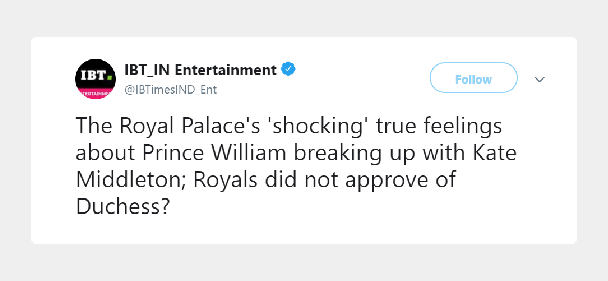
example of using the AND boolean to find keywords or groups of keywords

OR

OR broadens the search to find results where any term is mentioned. This can be good for misspellings, typos, and alternatives of the same term. For example “Catherine, Duchess of Cambridge” OR “Duchess Kate” will show mentions with any version of her name:
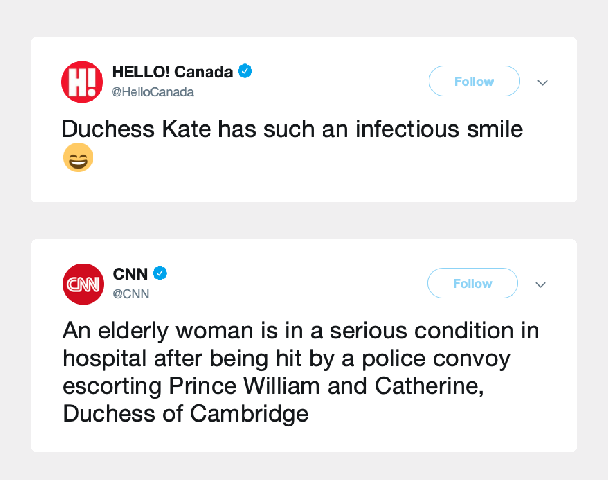
example of using OR boolean to search misspellings, typos, and alternatives of the same term

AND NOT

AND NOT lets you exclude terms you don’t want to appear in your search results. If you don’t want to get mentions about Prince William’s 37th birthday, (“Prince William” AND NOT birthday) will help you get relevant mentions:
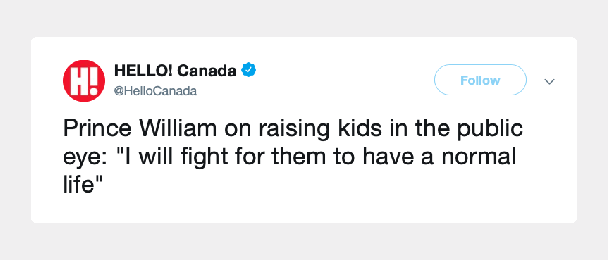
The list of Boolean operators and their logic varies on different tools: some of them, such as Google Alerts, has a pretty basic set (which is enough in most cases though) which includes “OR”, “-”, “site”, quotation marks, and an asterisk. Others, like Brandwatch, offer advanced operators, such as “NEAR/n”, “raw”, “country”, and more.

Where and how to use Boolean?

Boolean search is applicable in multiple scenarios, but I’d love to focus more on the cases where this mode is indispensable. So below you can find the cases when a few lines of code can save you tons of time on cutting through the noise.

Save time on inputting all brand name alternatives

This is a time-saving tactic that lets you create a query using just a few lines of code instead of entering all possible brand name alternatives. Works best for three-word names or more.

Let’s say there’s a brand that’s called C.S. Johnson & Sons. This brand name can be spelled in a number of ways:
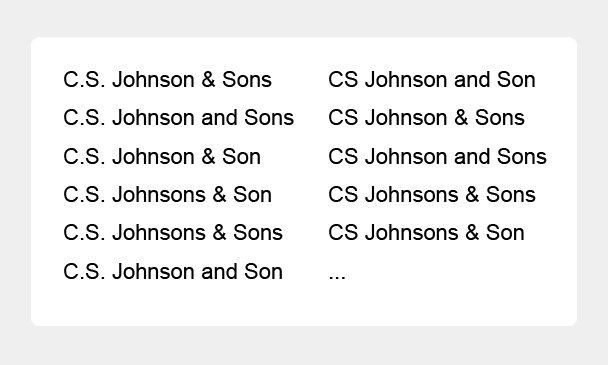
using Boolean to create a query using just a few lines of code

But if you have access to Boolean search, you can create the following query:
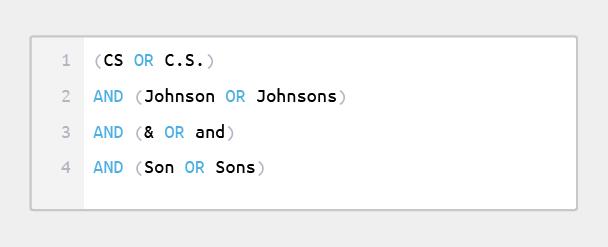
example of creating a Boolean search query

Gain control over acronyms or brands with common names

As in the previous case, you can apply the power of grouping words for searching brands with common or ambiguous names. And there are two ways of treating those cases.

First of all, you can exclude irrelevant results by adding a group of negative keywords, which are terms you don’t want to be used in your results:
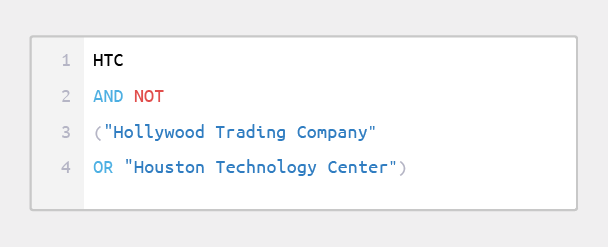
example of gaining control over acronyms and brand names by adding a group of negative keywords

Secondly, you can add some terms to be used with the brand name to ensure you find results that matter to your business.
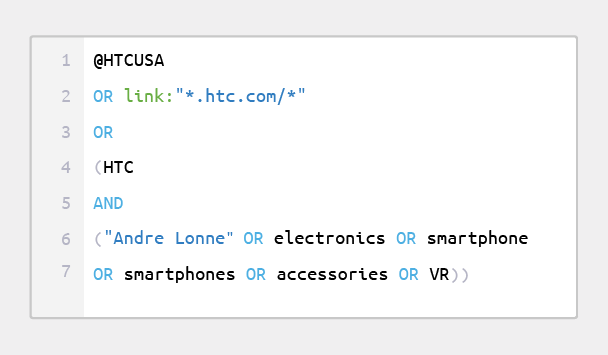
example of adding common terms to brand names for boolean search

On the screenshot above, at the top, you can find a social media handle and a website that will bring relevant results per se. They’re followed by the brand name that can be used in multiple cases, but we narrow it down to the relevant case only.

And finally, sometimes it makes perfect sense to use both “AND” and “AND NOT” operators:
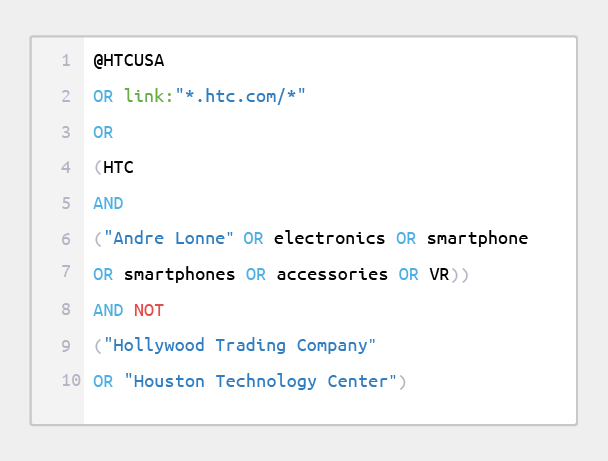
example of using AND” and “AND NOT” operators for boolean search

This query shows only relevant results since the whole query is supported by negative terms.

Find linkless pages for link-building purposes

Boolean search lets you easily create queries that contain only mentions of a particular brand or industry and don’t have links to this brand. It works best for news articles and other web pages, so note that you’ll need a tool that monitors those sources as well:
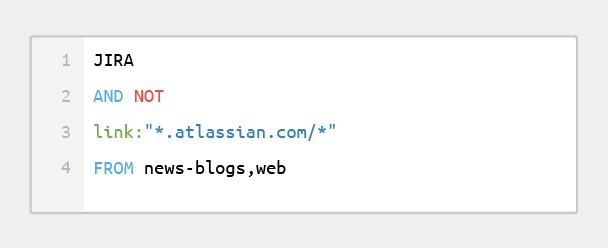
This query will deliver all webpages that mention JIRA on the web and don’t have links to their website. So our job here is to reach out to website owners to turn those pages into backlinks.

Monitor mentions from specific regions

This technique is useful for international companies. You can set up an alert that will deliver relevant mentions to a person in charge of the company unit from a particular geographical area.

You can use the country operator to limit the search to a specific location that’s provided by social networks. And in addition to that, you can create another group of keywords that will provide search results for your keywords with location names. This way, the tool will cover mentions where people use the names of relevant locations in the text of a post.
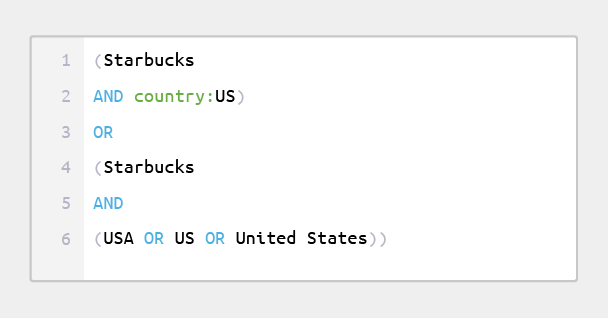
The example above searches for mentions posted in the US as well as all the mentions where location keywords are used within a post.

Uncover dissatisfied customers

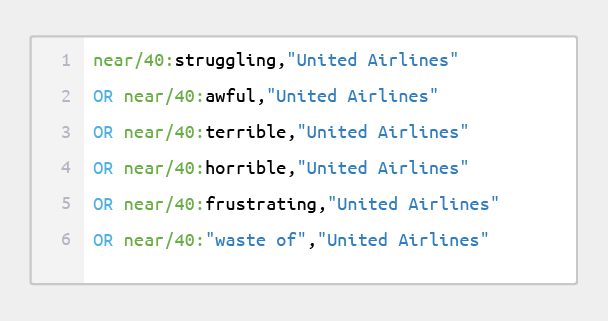
This one is great for crisis managers in a company. Boolean search lets you create queries that search for posts containing problematic terms.

To use this, you’ll need the proximity operator near/n that will let you specify the maximum distance between the name of a company and a word or phrase typically used to complain about something online:
Generate new leads

The other case where Boolean search comes in handy is lead generation. To set up a search, you’ll need to come up with a few phrases that people typically use to ask about services online, such as “I’m looking for”, “I need”, “recommend me”, and similar search queries.

By using the near/n proximity operator, you can define the distance of those phrases from your target keywords:
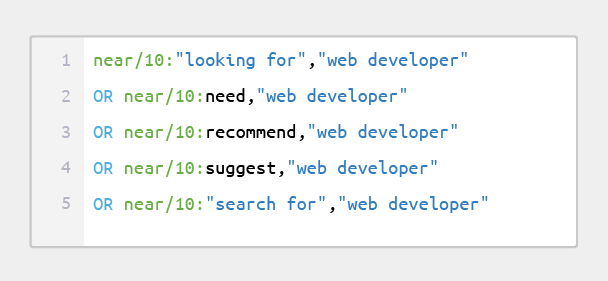
This query will monitor social platforms for all new posts where people search for web designers. All you need to do is interact with those posts internally from the tool (if it has the capability to do so) or externally from a social media platform.

Check texts for plagiarism

And the last one I’d like to tell you about is checking texts for copyright infringement. All you need to do is add a few pieces of content to the alert (don’t forget to quote it to search for the exact match).
example of using Boolean search to check for plagiarized content

The app will search for matches of those pieces on social media platforms and the web and notify you each time someone’s taking advantage of your work without permission.

Final words

Using Boolean for social media monitoring is a great way to cut through countless mentions to find those gems that let you understand your audience better and reach your social media marketing goals.

So when you shop for a social media monitoring tool, make sure it’s equipped with a Boolean search mode.

Aleh is the Founder and CMO at SEO PowerSuite and Awario. He can be found on Twitter at .

Whitepapers

Related reading

Eight tips to get the most from your Facebook page in 2019

social media_does it affect seo

Social listening 101 Six crucial keywords to track

eight social media trends 2019

Boolean search for social media monitoring: What to track, how to track, and why


YouTube should stop recommending garbage videos to users

YouTube headquarters in San Bruno, California.
Enlarge / YouTube headquarters in San Bruno, California.

In The New York Times, reporters Max Fisher and Amanda Taub explain how YouTube propelled the career of controversial Brazilian politician Jair Bolsonaro. Before his election as Brazil’s president, they write, Bolsonaro “had long used the platform to post hoaxes and conspiracies.”

Ostensibly, YouTube’s recommendation algorithms are politically neutral. However, they’re optimized to boost “engagement,” and in practice that means promoting videos with extremist and conspiratorial points of view. In Brazil, that has meant bringing a cadre of far-right social media stars to prominence, ultimately helping them gain power in national politics.

According to the Times, Brazilians are also increasingly turning to “Dr. YouTube”—relying on YouTube videos rather than conventional professionals for medical advice.

“Harvard researchers found that YouTube’s systems frequently directed users who searched for information on Zika, or even those who watched a reputable video on health issues, toward conspiracy channels,” the reporters write.

We’ve seen similar developments here in the United States, where social media has boosted the profile of anti-vaccine activists.

YouTube’s auto-play recommendations aren’t great for kids, either. Two years ago, writer James Bridle penned a widely read essay about the increasingly bizarre and disturbing children’s videos that have been appearing on YouTube as publishers generate automated videos to game YouTube’s recommendation algorithm.

YouTube’s recommendation engine “isn’t built to help you get what you want—it’s built to get you addicted to YouTube,” argued Guillaume Chaslot, an engineer who used to work on YouTube’s recommendation algorithm, in a June interview with TNW.

There’s a simple way to solve these problems: YouTube should stop making algorithmic video recommendations. When a video finishes playing, YouTube should show the next video in the same channel. Or maybe it could show users a video selected from a list of high-quality videos curated by human YouTube employees. But the current approach—in which an algorithm tries to recommend the most engaging videos without worrying about whether they’re any good—has got to go.

YouTube isn’t using its vast power responsibly

In recent years, YouTube, Facebook, and other major platforms have been embroiled in debates about whether to ban extreme and controversial content. It’s a bit of a no-win situation for them. If they leave a video up, many people see it as endorsing the video’s odious views. If they take videos down, they get attacked for political bias and censorship.

But the situation isn’t so complicated when a platform makes recommendations. It’s not censorship if YouTube decides not to recommend your video to other users. And it should be uncontroversial that, if YouTube is going to recommend a video, the site should first verify that the video is worth watching.

What if YouTube staffers thought more like journalists? Journalists understand that they have a responsibility to do more than just run whatever story will get them the most readers, viewers, or clicks. They try to verify claims before reporting them as true, and they will spike a story if it’s not newsworthy.

Of course, journalists aren’t perfect. News organizations do still publish clickbait and inaccurate information from time to time. But most journalists at least try to use their power responsibly, even if we don’t always succeed.

YouTube has vastly more influence over people’s information diets than any contemporary media organization. Yet YouTube seems far less concerned about using its power responsibly. Far from steering people away from inaccurate and conspiratorial information, YouTube’s automated algorithms seem to steer people toward this kind of misinformation because (as a former Facebook employee once put it) “bullshit is highly engaging.”

Defenders of online platforms argue that it’s not feasible to do human content curation at the scale of a platform like YouTube. That might be true if the goal is to take down the worst content. But the argument doesn’t make sense if you’re talking about YouTube’s recommendations.

There’s no reason YouTube’s recommendations need to be personalized. YouTube could recommend the same set of videos to every YouTube visitor in a particular country—just as Ars Technica recommends the same articles to everyone who visits our home page. Or it could apply limited personalization algorithms to choose among a subset of videos that have been pre-screened by human reviewers for accuracy and quality.

Instead, YouTube recommends a lot of toxic videos to its users because YouTube has made a business decision to prioritize “engagement” over all competing values. That decision is having negative consequences in Brazil, the United States, and around the world. It’s time for YouTube to rethink its approach.

YouTube says it’s working to improve its system

The Times story on Brazil was based on research done at Harvard and the University of Minas Gerais in Brazil. In a Monday tweet, YouTube disputed the team’s findings.

“We had a team across product and engineering try to reproduce the recommendation results found by the University of Minas Gerais and Harvard’s researchers, and it was unable to do so,” YouTube wrote.

YouTube also says that since January, it has been “reducing recommendations of borderline content and videos that could misinform users in harmful ways. We’re bringing this to Brazil by the end of this year.”

But whether or not this will be enough remains to be seen. It may not be easy to predict in advance which types of content will prove harmful to users. A better approach would be to first drastically scale back automated recommendations—then only resume using them if and when the company is confident it can do so responsibly.

https://arstechnica.com/?p=1550009


Trump admin reportedly drafting order to counter social media “bias”

Trump admin reportedly drafting order to counter social media “bias”

The Trump administration seems determined to take action concerning its irritation with social media networks’ supposed bias against right-wing speech, as the White House is reportedly drafting an executive order directing agencies to do something about it.

Politico reported earlier this week that the White House was circulating drafts of a proposed order, but the site couldn’t get anyone to describe what was in this document. Today, however, CNN says it has seen a summary of the draft executive order.

The current draft, called “Protecting Americans from Online Censorship,” would put the burden of Internet content management on the Federal Communications Commission, calling on the agency—which has never before dealt with regulation of online content—to develop regulations clarifying under what circumstances social media platforms are protected by the law when moderating content. It also says the Federal Trade Commission should consider whatever policies the FCC comes up with when it investigates companies for not adhering to their stated policies.

The summary says the administration received 15,000 anecdotal complaints about online censorship from the online form it launched in May asking for user reports, and the White House offers to share those complaints with the FTC for a public complaint docket. The most recent high-profile right-wing censorship complaint was resolved earlier today, when Twitter, under significant pressure, reversed course on allowing the campaign account for Sen. Majority Leader Mitch McConnell to share a video showing “abusive behavior” on the part of protestors.

Trump last month held a social media event at the White House, and he railed against the “tremendous dishonesty, bias, discrimination, and suppression practiced by” platforms such as Twitter, Facebook, and YouTube. “We will not let them get away with it much longer,” he said at the time.

The platforms’ supposed silencing of conservative voices is “disgraceful,” added the president, whose personal Twitter account has about 63 million followers.

The White House, the FTC, and the FCC all declined to comment to CNN on the draft summary, which is a long way yet from being any kind of official order. FCC commissioner Jessica Rosenworcel, however, tweeted out a link to the CNN story with the one-word commentary: “What.”

https://arstechnica.com/?p=1549243


How to Reach More People on Facebook via @martinibuster

[unable to retrieve full-text content]http://tracking.feedpress.it/link/13962/12730575


Video marketing tips and tools to boost your traffic

The world of content seems to have shifted from classic blog articles into video marketing, evident in the rise of YouTube as the second largest search engine in the world (behind Google). In this article, we’ll go over video marketing tips and some tools to get started.

YouTube started in 2005 with only a few dozen uploads and has since grown into the largest video platform with over 30 million visitors and five billion videos watched every day. On top of that, the emergence of live streaming platforms like Instagram Story, Instagram TV, Facebook Live, Periscope, and Snapchat further prove the case.

A survey conducted by HubSpot in 2017 suggested that consumers prefer videos over any other form of content marketing. As a result of this, more and more brands are shifting their attention to video marketing. In 2019, the number of companies that use video as a marketing tool reached 87%, a significant increase from 63% in 2017, and 81% in 2018.

what kind of content do consumers want to see from brands

Source: HubSpot

What makes video marketing effective?

So, what triggers this change? For starters, we’re visual creatures. We naturally understand and connect faster while watching videos rather than reading posts. Our brains remember 95% of the information that we see in a video, while we only remember 10% of the information that we read.

How do consumers most prefer to learn about a new product or service

Source: Wyzowl

The second reason is the popularity of smartphones. Over the last decade, people have become inseparable from this electronic device. The thing is, 75% of all video viewers on the internet are on mobile devices. More importantly, 92% of those mobile video watchers are willing to share the video with their friends. That means, if you create the right content for the right audience, your videos have a chance to go viral!

Video marketing tips to increase traffic

1.   Create an engaging thumbnail

A video’s title and thumbnail are the first things the viewers see when browsing on Google, YouTube and other websites across the internet. It represents what your video is about and the content inside it. The more interested the viewers are in your title and thumbnail, the more likely they’ll click the video.

Tips:

  • Make sure that the thumbnail is a shot from your own video, don’t try to fool the audience with fake images.
  • Use interesting images from later on your video as a teaser to keep the audience watching.
  • Having human interaction or close up faces as thumbnails will more likely affect the viewers’ emotions.

2.   Create buzz on social media

When you’re doing a video marketing campaign, your focus should be on video sharing platforms like YouTube, as well as social media like Instagram, Twitter, Facebook, and Snapchat. On average, people spend almost two hours of their time on those platforms every single day. Sounds like a good goldmine to promote your brand, doesn’t it?

Tips:

  • Post high-quality videos regularly and engage with your audience to build your brand presence.
  • Optimize the use of tags on YouTube and hashtags on social media, so that your content becomes searchable.
  • Reach out to influencers and other more popular brands to promote your content, in exchange for something in return.

3.   Optimize it to be SEO friendly

Social media are platforms to build your brand awareness and presence. The end goal remains to bring the audience to your website, so you can convert them into loyal paying customers. Thus, it’s important that the videos on your website are search engine friendly.

Tips:

  • Provide transcription to your video, so it will appear on general Google searches.
  • Optimize your video file metadata with related and user intent keywords on the video’s title and description.
  • Create a video sitemap and submit it to Google Search Console.

4.   Make sure it’s mobile-friendly

As we mentioned before, most videos are watched on mobile devices. A survey conducted by Facebook found that people are 1.5x more likely to watch videos on a smartphone than on a computer.

Tips:

  • Use responsive video players like YouTube, Vimeo, or Brightcove. Those platforms will automatically increase or reduce video quality according to the viewers’ bandwidth.
  • Watch out for the text size, because a text that appears big on a TV screen will look small on a smartphone screen.
  • Adjust the video playing time according to your purpose. An hour-long behind-the-scenes video is suited for YouTube, while a 60 seconds teaser is best for Instagram.

5.   Create a clear call-to-action

Make sure to include a clear call-to-action in every video that you post. Without a clear CTA, viewers will be confused and not sure of what to do next. If you want more traffic to your site, it’s your duty to make it easier for the audience to find your site.

Tips:

  • Use YouTube End Screens (the last 5-20 seconds of a video) to include up to four clickable elements, you can send people to your website, your other videos, channels, or particular landing page.
  • When posting on social media, include a CTA and a link that leads to your website or landing pages.

Based on the audience’s demand for more video-based content and the emergence of YouTube as the second largest website in the world, video marketing seems to be the future of content marketing.

If you want to get started with more video marketing, we made a list of 100+ video making and marketing tools, including:

  • DIY Animation Tools
  • Video Marketing Platforms
  • Live Streaming Platforms
  • Video Editing Tools
  • Interactive Videos
  • Sound Effects Library
  • Stock Video Library
  • Sound Recording Tools
  • Scriptwriting Utilities

Nat McNeely is Digital Marketing Manager of Breadnbeyond, an award winning explainer video company. 

The post Video marketing tips and tools to boost your traffic appeared first on Search Engine Watch.

https://searchenginewatch.com/2019/08/08/video-marketing-tips/


How a Dentist Used Social Media to Reach 7 Figures in Revenue

Her social media strategies also helped patients overcome their fears.

August 5, 2019 2 min read

Opinions expressed by Entrepreneur contributors are their own.

In this interview at ClickFunnels’ annual Funnel Hacking Live conference, Entrepreneur Network partner Emily Richett sits down with Dr. Anissa Holmes, a dentist and entrepreneur, to learn how she used social media marketing in her business and helped other dentists boost their practices.

Dr. Holmes uses her social media marketing experience to help other dentists bring in more patients and make a greater impact in their communities. Through funnels, Facebook ads and coaching services, she’s helped dentists scale their practices by 30 to 50 percent per year.

Holmes says it all started with her own dentistry practice. Her new patients would tell her about how her social media helped them overcome their fears of going to the dentist because it highlighted other patients’ great experiences.

Holmes says that social media marketing was the key to getting her practice in front of people, which helps them fight their fears. She says, “If we can unpeel and show them that we are impacting lives in the community, that our patients are having really good experiences, we can connect with them and change their life as well. And that’s the power of marketing.”

Holmes also said that the main motivation in her business, Delivering Wow, is serving her colleagues. She adds, “In order to serve people, you have to have ways to serve them. And so that’s what I’ve been able to create, again using this amazing software with click funnels.”

Related: How This Entrepreneur Achieved His Greatest Success After His Worst Failure

https://www.entrepreneur.com/video/337627


How to master LinkedIn’s algorithm to boost engagement

LinkedIn can be a very engaging channel, especially for B2B brands. Here’s everything you need to know about the recent changes in the algorithm and how to create engaging content.

LinkedIn has turned into the number one platform for professionals and B2B brands. It’s been a social media platform with a consistent mission and it is attracting millions of people and brands who want to focus on professional relationship building.

Just a few months ago, Microsoft announced that there has been ‘record levels of engagement’ on LinkedIn seeing a Q1 growth of 24% for on-platform sessions. It’s not surprising then that more brands are investing time in updating their LinkedIn strategy over the last few years.

A good way to understand how LinkedIn works and how to improve your engagement is to look at their algorithm and their recent updates.

Understanding LinkedIn’s algorithm

LinkedIn has recently updated their algorithm that decides what shows up on our feeds. We might be talking more about Facebook’s algorithm when it comes to social media changes, but it’s still useful to understand how other platforms behave. When it comes to LinkedIn, what comes up on our feeds is based on their framework of ‘People You Know, Talking About Things You Care About.’

The most obvious posts that show up in your feed have to do with the people that you’re connected to or follow. There are also posts that your connections have liked, commented, shared that show up on your feed. Moreover, you can also see posts from groups, hashtags and topics that you follow.

understanding linkedin's algorithm

The idea is to discover content that you care about. It’s not enough though to focus on relevance without the necessary value. The bigger the value, the higher the chances of seeing a post in your feed.

LinkedIn is relying on a machine learning algorithm that identifies the best conversations from all members that should show up to your feed. There is a two-pass architecture that ranks in the fraction of second thousands of posts to pick the most relevant ones for each member. The first pass rankers (FRP) are handling the preliminary selection that is based on predictive relevance (what they assume that you find relevant). For example, this selection can include updates from your connections, job ads and sponsored updates. The second pass ranker (SRP) combine all the preliminary scores to build a single list of ranking.

The FollowFeed is the main first pass ranker that brings tougher all the feed updates from your network and it includes more than 80% of your feed updates. In fact, these updates actually lead to more than 95% of the members’ conversations.

After an extensive series of tests and advanced machine learning features, LinkedIn is now focusing even more on the probability of contribution for the posts that show up on your feed. Thus, LinkedIn members see the content that they have more chances to share, comment, or react to.

To find out more technical details on LinkedIn’s algorithm, read their blog on their latest updates.

Focusing on engagement

LinkedIn is aiming to encourage participation and the rise of engagement in the platform comes from a series of changes to their algorithm. As with Facebook, ‘meaningful interactions’ are important to ensure that users are exposed to the most engaging content.

From a brand perspective, it’s very important to keep up with these changes to ensure that you’re creating engaging content.

It’s crucial to encourage conversations to increase the chances of having your content show up in more feeds.

You can start building the engagement through a series of steps

  • Create posts that lead to conversations: don’t just share a link that you find interesting, ask a question and try to make it more engaging
  • Encourage people to mention others: be creative with your content and encourage people to mention others who would find your posts interesting.
  • Be part of existing conversations: use your personal profiles to join existing conversations and monitor your brand’s mentions to respond to them
  • Use employee advocacy to reach a broader network: ask for help from your employees and their personal networks when sharing important content
  • Create content that people want to share: tap into the psychology of a social media user and create content that is interesting enough for your audience to instantly share it

Improving your LinkedIn strategy

Pete Davies, Consumer Product at LinkedIn, has written an article sharing his own tips on how to improve your LinkedIn content strategy to get your posts to show up on users’ feeds.

Some of his tips include:

  • Encourage conversations: the recent changes in LinkedIn’s algorithm make it imperative to create content that people will want to contribute to it. Aim for engagement that feels genuine.
  • Pick niche over broad: think of your target audience and focus on your niche. You don’t need to share posts that are general as LinkedIn members seem to prefer niche topics they are interested in.
  • Be authentic: authenticity can help you stand out with your content. Except for relevance and value, you also want to master your own tone of voice that will help you build a stronger community.

Moreover, we also see more brands adding to their LinkedIn strategy:

Videos

More brands are sharing videos and they tend to show up more frequently on our feeds over the last few months. Not all videos should be around campaigns, you can also share videos from your team, interesting interviews or even UGC that might be relevant.

example of mashable sharing a video on their linkedin

Creative posts

There is a new trend on LinkedIn with posts that stand out with their creativity. How about sharing link posts that people won’t be able to ignore?

example of adobe sharing a video on their linkedin

Hashtags

Hashtags have also had increased importance on LinkedIn especially when you want to improve your niche relevance.

example of google sharing a post on their social good work on linkedin

When it comes to LinkedIn, what we need to remember when creating content is the reason why people are visiting the platform. People are visiting LinkedIn to connect with like-minded professionals. The content should be both interesting but also engaging to ensure that your brand stays relevant

Whitepapers

Related reading

Five ways to target ads on Google that don’t involve keywords

Two simple behavioral levers to improve your link building efforts

Five extensions to help you boost on-page SEO

small budget guide to testing ad copy, landing pages, and more

https://searchenginewatch.com/2019/08/05/how-to-master-linkedins-algorithm-to-boost-engagement/


Camilla Ferrari – behind the lens

In a world where people are connected 24/7 to social media and where people take more and more photos, it is difficult to find a marked division between photographers and social media users.

Photography, especially photojournalism, has changed over the years thanks to all the new technological devices, like smartphones, but the purpose behind the work of a photographer has never changed. While people take pictures to showcase their lifestyle and all the “cool” things they do, photographers have been working on meaningful pictures that represent the reality we live in.

I talked with Camilla Ferrari, an Italian visual storyteller and photographer who has been nominated by Artsy as one of the 20 Rising Female Photojournalists, she has been nominated for the Joop Swart Masterclass and selected as one of 2019 PDN’s 30: New and Emerging Photographers to Watch, for the Nikon-NOOR Academy Masterclass in Turin, Italy, and for the Eddie Adams Workshop XXXI.

Her profile on Instagram show a mixture of still and moving images, taking advantage of the multiple tools of this social media.

When did you start getting close to photography?

When I started taking photos at 13, I didn’t know what my path would’ve been. What was certain was that the variety of creative possibilities, through which you can approach photography, is endless. I knew I wanted it to be my full-time job even though I didn’t know what form it would have had.

At the beginning I spent entire days in my room with a small light taking self portraits and modifying them digitally by copying and pasting me in far, surreal sceneries. I think that in the beginning photography has been to me an unconscious act of confirming my presence on Earth. At that time I wasn’t a sociable, extrovert person, even though I tried to be one. So photography was a way of telling the world “I’m here!” and creating a sort of visual legacy of my passage.

Sanlitun at night, Beijing, August 2017 – Camilla Ferrari
The streets around the area of Sanlitun are really fascinating. The Main Street is full of lights and people and noise everywhere but as soon as you turn the corner, the little roads become pitch black and the only things you can see are fleeting lights in the distance… little gems waiting to be discovered

What is photography to you? What do you want to express with your work?

I have always been attracted and curious about stories that in some way are close to my personal experience, either because they were directly connected or because they created the same feelings and emotions.

My approach to visual storytelling has instead changed completely in time, from being based only on photography to moving towards a multimedia approach, where images are combined to videos.

I think that the combination of still images and videos can really help the viewer to have a richer and deeper understanding of a story, thanks to not only the still images, but also sounds and moving images.

I have also realized in time, working on my practice and studying other photographers’ and artists’ work, that to me it’s very important to have an element of kindness and delicacy in my work. In a world where pictures yell at the viewer, I believe that there is a dignified power in silence. That is what I want to express through my work.

Seller in Panjiayuan market, Beijing, August 2017 – Camilla Ferrari
Panjiayuan market is easily one of the most crowded and chaotic places I’ve ever experienced. People are selling the most different kinds of things and clients spend hours and hours observing the stones, admiring their shape, feeling their texture in their hands. I saw a woman trying each and every single stone laying on the stand to find the perfect one. And sellers wait for the bargain to start

You are considered one of the female photojournalists to keep an eye on. How do you approach street photography and photojournalism?

We live in a period of great changes in the way we intend photography and the creation of images in general. The role of a photographer has evolved very quickly during the last years, especially in photojournalism, where the idea of photography changed from “absolute truth bringer” to “one of the million truths possible”.

I agree with what Max Pinckers said in an interview for American Suburb X last year: he said that he is “tormented by a crisis of faith in his authenticity. The documentary genre tries to reposition itself in relation to the excess of a post-truth ideology and confused idea on realism.

How can we rethink the documentary genre conceptually, formally and methodologically in the eye of uncertainty, contamination and perpetual and constant criticism? How can we be inspired by the paradox of trying to get close to the reality with a documentary behaviour while it transforms and it dissolves continually?”

How can we face the fact that there is no absolute truth and the inevitable acceptance of our role and influence of human beings in the act of creating images?

I really hope that the debate on these subjects can be easily helped by the world of photojournalism. Doubting our role of photographers is the first step to free the practice of photography, to create new ways of telling stories and to raise deeper awareness on critical and contemporary issues and phenomena.

Guomao, Beijing, August 2017 – Camilla Ferrari
Guomao, it’s lunch time. People get out of the buildings in a continuous flow, a river where the human beings are the drops of water. Looks almost like a mechanical behavior, like their bodies need air so they rush to get out and finally breathe.

Photographers often use Instagram as a window on their work or just as a personal profile. How do you use this social?

I am very fascinated by how social media have the power to enrich the act of storytelling and to influence the way we create and consume visual content.

When Instagram launched the Instagram Stories in 2016, the whole sharing panorama has changed deeply: from the speed, to the immediacy and intimacy. To me it has been very interesting trying to understand how to use this new tool in my photography practice, so I learned how to use IG Stories to represent and meditate on everyday life and afterwards as a new element to the stories I wanted to tell.

The evolution of the medium influences the vision and practice of those who produce images. In my case, the thought behind the presence of IG Stories as a fundamental part of my work couldn’t have been possible without a smartphone.

Personally, the immediacy of a smartphone makes me feel free and lighter, both on a physical and psychological level.

Civita di Bagnoregio lies in the middle of the Calanchi Valley, in the centre of the Italian peninsula. Surrounded by a sea of mist, the village is crumbling 7 cm per year due to the erosion and is currently populated by six people.
Tony is the only inhabitant of Civita who can go through the footbridge, (which connects the village to the mainland) with an Ape – he struggles walking up and down that steep climb everyday.
On Tuesdays, at 9 am, he takes his small car and leaves the village to go grocery shopping.

On one side we have technological progress in photography, on the other we have people who use old film cameras. What do you think of this trend opposed to the use of social media?

I think that the choice of the photographic medium to use shall be thought of based on what you want to express with your work. Shall be film or digital, it has to have a reason, a purpose, not just a trend.

Rossana warms up by the fire while preparing lunch for Antonio, before restaurant service starts. The couple owns one of the most famous restaurants of the village.

At the end of the story, in your opinion, how shall the perfect photograph be?

I don’t think there is a precise and final answer to this question. To me it’s important that a photograph expresses the right balance between power, delicacy and silence. The image has to become the access point of the beginning of a reflection.

Follow @positive_mag on twitter for the last updateshttps://www.positive-magazine.com/camilla-ferrari-behind-the-lens/


The Top 25 Movies About Social Media to Add to Your Watch List via @KristiKellogg

[unable to retrieve full-text content]http://tracking.feedpress.it/link/13962/12694037


3 Social Strategies Every B2B Marketer Should Memorize ASAP via @bsmarketer

[unable to retrieve full-text content]http://tracking.feedpress.it/link/13962/12685615