How Much Should You Spend on Social Media Marketing?

It’s a valuable tool, but don’t forget about these other (sometimes free!) ways to reach your clients.

July 18, 2019 4 min read

This story appears in the July 2019 issue of Entrepreneur. Subscribe »

Q: When it comes to customer acquisition, how important is paid social media compared with other digital channels? — John L., Houston

Social media has created a beautiful opportunity for entrepreneurs: It’s never been easier to get your message in front of hundreds, thousands, or even millions of people. But if you want to reach all those people, it’s going to cost a lot.

It’s a simple case of supply and demand, and social media platforms are limiting the supply. Organic reach — that is, your ability to speak directly to the audience that chooses to follow and interact with your business — has dwindled to almost nothing. On Facebook, for example, organic reach touches less than 5 percent of your audience on average. Facebook simply doesn’t show your posts to most of your followers … unless you pay for the privilege. That’s one of the reasons why advertising inside social media has become increasingly expensive, as brands outbid each other in a competition for users’ attention.

Related: The 5 Things Entrepreneurs Should Never Post on Social Media

Suddenly, social media isn’t such a great deal. If you’re on a budget, all of this can brutally limit your growth and acquisition opportunities. 

That’s not to say you should stop using digital platforms altogether. Paid social is a hotbed of marketing insight. With just a small amount of cash, you can easily test headlines, imagery, and offers on different audiences. That’s valuable research. However, if your entire acquisition strategy depends on paid media, you could pay your way right out of business. 

But there is another way! You just need to diversify. In the digital world, there are many ways to acquire customers: paid social, paid search, email acquisition, organic social, organic search (earning traffic through content), public relations, influencer marketing, and earned media. Start by identifying a few channels where you want to focus most of your efforts. (Ideally, at least some of those channels will not require the spend of ad dollars.) This way, you can test what’s working while building an omnichannel approach that will pay off down the road. 

Related: How to Get More From Your Influencer Marketing Investment

At my marketing agency, we start with data and consumer insights, then use that to support tactics that allow clients to win at SEO through organic content. (Social media may be the ultimate toy for idle hands, but Google is still a business’s best friend.) Then we tie that to a strategy that makes it easy to acquire email addresses. Then we focus on paid social to amplify direct selling.

For example, we have one CPG client for whom we created 40 original articles, designed to drive traffic to its website. On the surface, this might not seem like a way to grow revenue. But within two years, those 40 articles allowed the brand to rank for more than 12,000 keywords (up from 2,000), landing in the top three Google results for nearly 400 different topics and searches.

Related: Is Your Marketing Working? You Won’t Know Till You Test It

This influx of traffic made it easier than ever to directly sell on the article pages and add thousands of email addresses to the company’s database, which they used for email marketing. This was a combination of smart SEO planning (knowing what keywords to target), strategy lead generation (creating pop-ups or other opt-ins to the site visitor), and positioning product offerings on specific article pages (like native ads that sold products related to the topic of a specific article). This way, the traffic was technically “free” — and so were the added emails, which we could now upload to social media platforms and directly sell to consumers with ads based on their known interests. 

If you put all your eggs in the paid basket, you underestimate and undercut the long-term growth of your brand. And when you push on all levers at the same time, you make it increasingly hard to know which acquisition channels have the highest ROI. But when you diversify and segment your strategy, the opportunity for growth can feel limitless. 

https://www.entrepreneur.com/article/335401


7 Reasons Marketers & SEO Pros Should Use Social Media at Work via @coreydmorris

[unable to retrieve full-text content]http://tracking.feedpress.it/link/13962/12669585


5 Key Considerations When Launching Influencer Marketing Campaigns via @brentcsutoras

[unable to retrieve full-text content]http://tracking.feedpress.it/link/13962/12666072


10 Lessons from the Micro-Stage of Social Media for the Main Stage of Life via @stoneyd

[unable to retrieve full-text content]http://tracking.feedpress.it/link/13962/12662420


Right-wingers say Twitter’s “bias” against them should be illegal

President Donald Trump speaking at the White House on July 11, 2019.
Enlarge / President Donald Trump speaking at the White House on July 11, 2019.

A large collection of right-wing opinionators, meme-makers, and pundits joined President Trump and a handful of lawmakers at the White House yesterday for a social media summit to discuss the supposed “bias” that platforms such as Twitter, Google, and Facebook have against conservative voices.

In a series of tweets prior to the meeting, Trump said the summit would be “very big and very important.”

The president, who regularly posts messages covered by most media outlets to his 61.9 million Twitter followers, 13.7 million Instagram followers, and 25.6 million Facebook followers, added that a “big subject … will be the tremendous dishonesty, bias, discrimination, and suppression practiced by certain companies.”

“We will not let them get away with it much longer,” he added.

In prepared remarks capping off Thursday’s summit, Trump called the event “historic,” saying the influencers present, many of whom are best known for spreading conspiracy theories, were “fulfilling a vital role in our nation, challenging the media gatekeepers” to talk directly to the American people.

“The crap you think of is unbelievable,” he added, calling the social media firms “disgraceful” and saying, “We’re not going to be silenced.”

Rep. David Cicilline (D-R.I.), chair of the antitrust subcommittee in the House, said in a statement about the summit that he had no evidence of tech firm bias against conservatives. “If someone wants to show me some empirical data instead of some alt-right member’s paranoid claims, I’d appreciate it,” Cicilline said. “In the meantime, it would be great if President Trump would get serious about antitrust.”

Sen. Mark Warner (D-V.A.) also lambasted the event, asking, “Instead of complaining that Internet trolls and conspiracy peddlers aren’t getting as many retweets these days, what if the President of the United States used his platform to lead and address the real challenges we face regarding social media?” Warner discussed several bills he sponsored or cosponsored that would deal with Russian interference, disinformation, and the use of consumers’ private data by tech firms.

The list of more than 150 attendees included Internet and media personalities as well as Republican lawmakers, but representatives from Facebook, Twitter, and Google were not invited.

Among those present was Charlie Kirk, founder of right-wing student group Turning Point USA. The day before the summit, Kirk ran an op-ed in the Washington Post calling for changes to the law that he claimed would prevent conservative voices from “being shadow-banned, throttled, muted, and outright censored online.”

One of the key culprits, Kirk said, is section 230 of the Communications Decency Act. “Social media companies have leveraged Section 230 to great effect, and astounding profits, by claiming they are platforms—not publishers—thereby avoiding under the law billions of dollars in potential copyright infringement and libel lawsuits,” Kirk wrote.

Section 230

“Section 230” has recently become a rallying cry du jour among the far right. Sen. Josh Hawley (R-Mo.), who was among the lawmakers present at the summit, recently introduced legislation seeking to amend the law, revoking “the immunity big tech companies receive under Section 230 unless they submit to an external audit that proves by clear and convincing evidence that their algorithms and content-removal practices are politically neutral.”

The idea of Section 230 reform has also drawn support from Sens. Lindsey Graham (R-S.C.) and Ted Cruz (R-Texas), as well as support in the house from Rep. Matt Gaetz (R-Fla.).

Nor are the Republicans alone. House Speaker Nancy Pelosi (D-Calif.) said in an April interview that section 230 is “a gift” to the tech firms, “and I don’t think they are treating it with the respect that they should, and so I think that could be a question mark and in jeopardy.”

However, the actual law has nothing to do with neutrality, and the current campaign to reform it is drawing opposition from both conservative and progressive sources.

The key part of § 230 of the Communications Decency Act of 1996 says:

No provider or user of an interactive computer service shall be treated as the publisher or speaker of any information provided by another information content provider.

In 23 years of practice, this has been interpreted and recognized as something of a safe harbor provision. You, the platform that hosts content generated by other sources and users, are not considered the originator of that content.

That idea is what has made the rise of social media—including Facebook, Twitter, Instagram, Tumblr, Yelp, YouTube, and basically any other platform you can think of that hosts user-generated content—possible.

A coalition of conservative groups on Wednesday sent a letter to House and Senate leadership asking Congress to leave the law alone.

“Social media has empowered an explosion of opinionated speech online,” they wrote. “These new venues for conservative speech are made possible by section 230.”

“Weakening or removing section 230 would strengthen the hand of government to silence speech it dislikes,” the letter continues. “Congress must defend section 230. Without these protections, free speech and American entrepreneurialism would be irreparably harmed.”

Sen. Ron Wyden (D-Ore.), a liberal who helped author the 1996 law, agrees. “Without protections, all online media would face an onslaught of bad-faith lawsuits and pressure campaigns from the powerful in an effort to silence their critics,” he said in a May statement. “Calls for government regulation of online speech and the business practices of private corporations run counter to everything conservatives claim to believe.”

Section 230 was revised in 2018 when Congress approved the Fight Online Sex Trafficking Act (FOSTA), which President Trump later signed into law. The Electronic Frontier Foundation filed a lawsuit shortly after, saying the law constitutes “the most comprehensive censorship of Internet speech in America in the last 20 years.”

(The suit was dismissed when a judge found the EFF and other plaintiffs in the case did not have standing; the organization has appealed.)

The EFF also opposes Hawley’s bill, calling it “clearly unconstitutional.”

https://arstechnica.com/?p=1535145


The White House’s Social Media Summit May Not Include Facebook and Twitter

It’s not much of a summit without the two biggest players.

July 8, 2019 2 min read

This story originally appeared on Engadget

The White House’s upcoming social media summit might be missing some key players when it goes ahead this week. Facebook and Twitter have not been invited to attend, according to sources who spoke with CNN.

The sources said the summit would not be a serious attempt to discuss issues like privacy or security, but rather “would amount to a right-wing grievance session.” Supporting this assertion is the fact that right-wing commentators who have complained of anti-conservative bias and censorship on social media have been invited, as reported in the Washington Post, while Facebook and Twitter, two of the biggest players in social media, have not.

Both companies have had clashes with Trump and his administration. In April, Trump met with Twitter CEO Jack Dorsey and reportedly complained about the site removing a number of his followers. There have also been issues over the shadow banning and actual banning of far-right organizations and individuals on the site. And despite Facebook providing support for Trump during his campaign, it pulled campaign ads which it deemed too sensationalist and banned far-right users like Alex Jones.

Facebook and Twitter were also among a group of 50 global brands who denounced Trump’s anti-trans position at the start of the year. There is an ongoing perception among Republicans that Silicon Valley companies have an anti-conservative bias, but it’s not clear how hosting a summit without inviting the key players will help address this issue.

https://www.entrepreneur.com/article/336442


5 Things to Consider When Launching Influencer Marketing Campaigns [Webinar] via @lorenbaker

[unable to retrieve full-text content]http://tracking.feedpress.it/link/13962/12426711


Google Sandbox: Is it still affecting new sites in 2019?

Google Sandbox Is it still affecting new sites in 2019

Google Sandbox is a commonly believed filter that’s used by Google to prevent new websites from ranking high in Google’s Search Engine Results Pages (SERPs). It’s believed that Google uses this filter to put some restrictions on rankings for new websites.

The main idea behind it is that new websites may not be as relevant as the old ones. Moreover, some of them may even be spam.

While Google has never confirmed the existence of such a system, many SEOs believe that it exists. They claim so because they have seen such effects on websites that they are trying to rank. This is why it is extremely difficult to avoid being placed in the Google Sandbox when your domain is new.

So, does Google Sandbox still exist in 2019? If it still does, how do you avoid getting affected by it? Let’s take a deeper look into it.

The history of Google Sandbox

In 2004, a lot of SEOs found that their new websites weren’t ranking well on Google during their first few months. And this happened in spite of the best of their efforts. While their websites were easily indexed by Google, they weren’t able to rank well for even low-competition keywords. On the flip side, they were ranking well on other search engines such as Yahoo and Bing.

This effect of Google Sandbox lasted for several weeks and months and it varied for each website. The idea of such a system made sense because Google aimed to provide only the most authoritative and quality content to its users. Rand Fishkin from Moz believed that SEOmoz was in Google Sandbox for about nine months. This happened in spite of having a good backlink profile.

“SEOmoz is finally Sandbox free for the first time since our move to this domain nine months ago. We aren’t alone, either. Many folks had sites escape, and I’m happy for all of them. It looks like our 12,000+ all‐natural links (never link built for this site, just link‐baited) finally paid off.”

Rand Fishkin, Co‐founder Moz

In 2014, yet again, Google Sandbox caught the interest of SEOs and marketers when they saw that their new websites weren’t able to rank easily. Now that we know a brief history of Google Sandbox and what it can do, let’s look at how it is working in 2019.

What does Google say about Google Sandbox?

Google pretty much denies the existence of this Sandbox. In fact, you can see it through many tweets by Google’s employees.
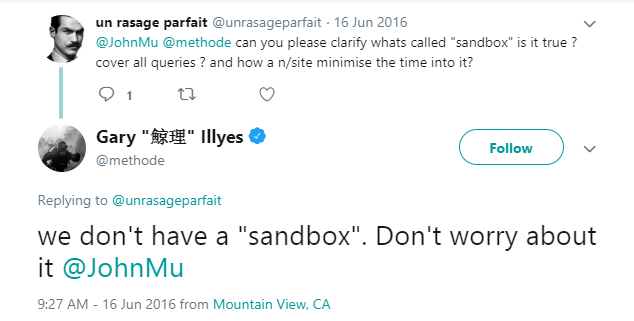
Tweet exchange on the existence of the "sandbox" between a user and Gary Illyes

Source: Twitter

Even a Webmaster Trends Analyst at Google said the same thing –

“With regards to sandbox, we don’t really have this traditional sandbox that a lot of SEOs used to be talking about in the years past. We have a number of algorithms that might look similar, but these are essentially just algorithms trying to understand how the website fits in with the rest of the websites trying to rank for those queries. […] It’s always kind of tricky in the beginning when we have a new website and we don’t quite know where we should put it.”

– John Mueller

However, the former head of webspam at Google did end up giving a few hints about it.

“My answer is not to worry that much. The difference between a domain that’s six months old versus one-year-old is really not that big at all. So as long as you’ve been around for a least a couple months, a few months, you should be able to make sure that you’re able to show up in the search results.”

– Matt Cutts

Why does a new website not rank high on Google?

Google’s experts have mentioned that they need enough data to rank a site. A new website must show its expertise, authoritativeness, and trustworthiness to Google. Additionally, it should have a good backlink profile. However, it is very unlikely that a new website can win Google’s trust within a very short period of time.

Here are a few reasons why a new website may not rank high on Google.

1. Less content

To understand your website’s relevance to a certain topic, Google needs to go through your website’s pages. If your website doesn’t have enough content on it, Google may not be able to fully understand what your website is meant for.

2. Low on backlinks

Backlinks are one of the most important factors for ranking a website on Google. If your website has a weak backlink profile, Google may not rank it higher up in searches. Moreover, your website should have internal links that can allow link juice to pass through them. You might succeed in building loads of backlinks in a very short period of time but if they are not of high quality, Google may just ignore them.

You must also be very careful as rapidly grown backlink profiles may even give you penalties from Google.

3. Lesser user signals

Google may take time to analyze the behavioral data of your website visitors. For this reason, it may postpone ranking your website higher up in search results for popular keywords. It’ll observe things like click-through rate, dwell time, and bounce rate to see if your website is worthy of ranking higher up.

Now that you know why your website could be in the Google Sandbox, let’s figure out how you can get out of it quickly.

Is Google Sandbox still affecting sites in 2019?

There are many SEOs out there who claim that their website ranks high up in the search results within just a month of launching. On the other hand, there are other SEOs who believe that there is definitely some force that is stopping their websites from ranking in the search results during their first few months.

However, through our study, we found that even a new website can rank higher up in searches within a short time period. We launched our blog website in June 2018 and within just four months we managed to reach the first page of search results. As you can see in the screenshot, there is a huge fluctuation in the average position graph. This was the time when Google started collecting data about our website. You can notice from the chart that after two months, there was a consistent increase in the rankings. We got the 9.5 average position for the whole site in Google Search Console.
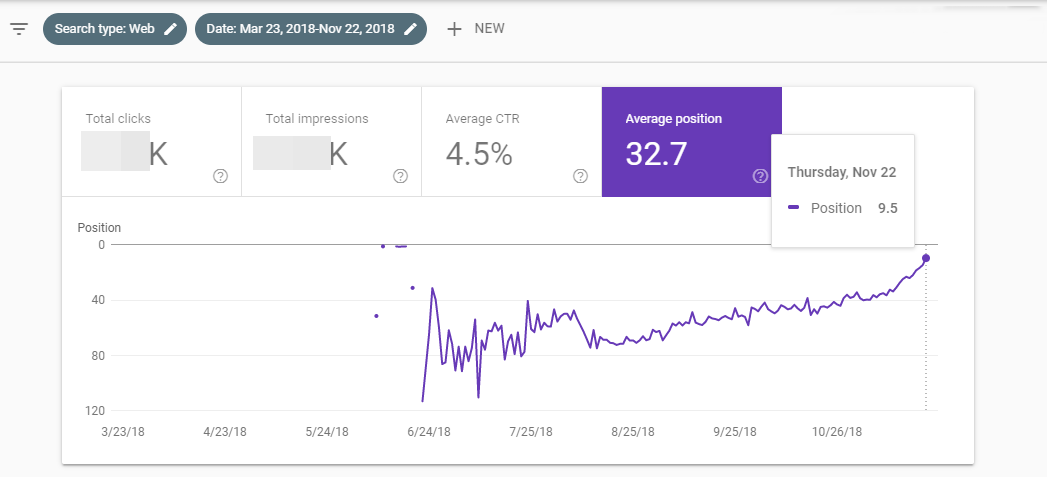
Google Search Console graph showing SERP position rankings

We also ranked a few other sites with higher volume keywords in less than six months. So, according to our research, Google Sandbox is a myth. With consistent efforts, you can rank high up in SERPs in a short duration.

What did we find during our study?

My own theory is almost the same as Google says. Google Sandbox doesn’t exist according to me. It could be possible that Google doesn’t prefer to rank new sites but it doesn’t mean that a new site can’t rank higher. Google wants to rank trusted and useful content. But for a new site, Google doesn’t have the required information to rank it. As soon as you are able to show to Google that you are genuine and trustworthy, you will start ranking higher.

I found that the ranking of a new site depends on its niche, competition, and your SEO strategy. These are the most important factors, according to me. For example, one of our sites started ranking with only social signals. It was a modeling niche site. We didn’t focus on link building for that site. We were just sharing its content on social media. In just a few weeks, keywords started ranking on the first page. Some higher competitive keywords were not ranking.

Rest of it depends upon your SEO strategy. Are you focusing on branding or rankings?

Let me explain, if you’re focusing on acquiring more links, it means you want rankings. But if you want links from top-tier high authority sites, means you are trying to build a brand. And Google loves brands. These days, Google is working for the future. SEO-friendly content and more backlinks are not enough to rank your website. You should focus on branding if you want to rank in a short time and for the long term. Try to get exposure, create online buzz, brand searches, and user satisfaction.

How to rank higher quickly?

While Google Sandbox can be annoying for new websites, there are methods you can use to get out of it quickly.

Here are a few things you can do:

1. Get your website indexed quickly

Your website may have already gone live, however, it doesn’t start aging in the eyes of Google unless it is actually indexed by it. To check if your website has been indexed by Google, you simply need to do a Google search. Just type “site:yourdomain.com” to check how many pages of your website have been indexed by Google.

If it has not been indexed yet, you need to get it done as soon as possible. To speed up the process, you can register the domain on Google Search Console and submit your XML sitemap.

2. Traffic

Getting traffic to your website is very important, especially in its early days. It is one factor that can help your website rank higher up and get out of Google Sandbox quickly. To get more visitors to your website, you should consider posting regularly in forums and groups on Facebook.

You can even try guest posting on other popular websites to drive traffic to your website and at the same time build a stronger backlink profile. You may also run ads on Facebook and other social media platforms to drive traffic.

3. Social signals

Social signals are important to gain the trust of Google because they indicate that your website is gaining popularity on social media platforms. A great way of using social signals to your advantage is that of running Facebook ads. You can publish an article on your blog and then run Facebook ads to drive traffic to it.

4. Choose long tail keywords

Google may not give you much traction for popular keywords earlier on when you are in the perceived Sandbox. However, you may be able to rank well for long tail keywords. To do this, you will first need to do keyword research and check the competition for every long tail keyword that you intend to target. You can use tools such as Ubersuggest and SEMrush to do this.

It is also a good idea to conduct competitor research and go after the keywords that they are ranking for. Using tools such as SEMrush, you can conduct competitor research by simply entering the URL of your competitor.

5. Build authority

“Google Shows Popular, Google doesn’t make you popular” – Google

Google wants authoritative, trustworthy, and user-friendly content to rank on top. As a new site, Google doesn’t know much about you because they don’t have enough data about your website.

So you should build authority and trust in the eyes of Google and users. Google will trust you if your site has good user-metrics, links, mentions from high-authority and relevant sites, and brand queries for your site. You should build more authority for your site.

6. Don’t be too aggressive

Focus on quality than quantity.

You may want to see your website high up in the SERPs. However, if you become too aggressive in promoting your website and link building, Google may see it as spam. You should try to acquire premium links for your new site. Only a few but premium links can change the picture.

Ideally, you shouldn’t build a huge number of links in a short period of time. Moreover, you should drip-feed the foundational links that you’ve built. Don’t optimize your anchor text too much, it’s preferable to keep it under-optimized. Lastly, make sure that you get good enough social signals.

It’s a good idea to give your website a slow and steady start. This will help it grow and prosper in the long run and will help in building more trust with Google. Once Google trusts you more, you can become slightly more aggressive in your link building methods.

7. Purchase an active website

One of the easiest ways of avoiding Google Sandbox is that of purchasing a website that is already active. You can do so by spending a decent sum of money on a website that has decent traffic and has been online for quite some time but has hardly any income.

Using tools such as Flippa, you can find websites which are already active and then can purchase and repurpose them to fit your requirements. Moreover, purchasing an already active website can help you figure out the power that the domain has by checking which keywords the website already ranks for.

Final thoughts

Maybe Google has some specific algorithms for new sites but it is still possible to rank a new site on Google. Don’t be aggressive from day one. Start slowly and then increase your SEO efforts over time. You should try to get links and mentions from high-authority sites, increase your brand searches, and user-satisfaction. I’m sure you will see that your newly launched website is ranking on Google.

What do you think about Google Sandbox and what is the best way of getting out of the Google Sandbox? Let us know in the comments.

Harpreet Munjal is the founder of the digital marketing company, LoudGrowth. He can be found on Twitter .

Related reading

Nine Google Ads hacks to improve your CTR and conversion rate

traffic forecasting customer journey

Five tips to create an SEO-friendly FAQ page

Five easy SEO strategies Increase search engine rankings and gain qualified customers

Google Sandbox: Is it still affecting new sites in 2019?


How Entrepreneurs Can Start Benefiting From Social Media Batching

Batching solves the problem of social media distractions without giving up social media

June 28, 2019 10 min read

Opinions expressed by Entrepreneur contributors are their own.

Social media, no matter how you feel about it, has become embedded in our daily lives. That’s not always a bad thing. After all, having a presence on social media does have numerous benefits for entrepreneurs. Social media gets the word out about you and your business and helps establish you as a thought leader. It gives you a chance to connect with other influencers and lets you engage with your audience, providing real-time feedback on your products and services. Social can assist you in monitoring leads, and it’s ideal for finding supportive entrepreneurial communities.

On the flip side, social media distractions can throw a monkey-wrench into your productivity. However, as you get started batching your social creations, you’ll become more effective and efficient with your efforts.

Related: 5 Smart Ways to Use Social Media to Grow Your Business in 2019

What is social media batching?

Social media batching is just a variation of the time management technique with the same name, batching. For those unfamiliar with this productivity hack, it’s where you simply arrange tasks in set groups. For example, instead of checking your email every time you receive a notification, you set aside specific times in your schedule to go through your inbox. Otherwise — hands off — turn off that “ding” and ignore the banners. Soon you won’t even see them except when you are on your scheduled timeframe.

The same concept applies to your social media output. Spend two hours Monday morning (or whatever time is the best for you), creating and curating social content for the week. This time may be spent brainstorming your content calendar with your team for the entire year. Or, your goals may require and include engaging with influencers or customers twice a day.

By grouping similar tasks together, you’ll avoid multitasking and frequent distractions — and you’ll likely find that batching makes you feel less stressed. Most importantly, the times that are set aside give you structure and boosts your productivity.

The benefits of social media batching.

Batching sounds good but even the most self-disciplined entrepreneur can benefit from following this practice more closely. The most apparent gain you’ll have is in how much time it will save you. Let’s say that you don’t reach for your phone every time you receive a notification. First off, good for you. Secondly, you’re probably not just on one social channel. You’re likely still devoting a lot of time on Facebook, Twitter, Instagram or LinkedIn. It’s been found that, on average, people globally spend over two hours per day on social media — these facts will vary slightly depending on age and location.

Additionally, small business owners spend around six to 10 hours per week on social media. Moreover, they may also devote 20 hours or more on marketing their business — which includes platforms like the Web, social, and email. These stats may not sound like much, but, they definitely add up over time. If there is any way to speed up this process, then you need to latch onto it. Batching can help you accomplish your goals in the following ways.

Reducing start-up and slow-down time.

Whenever we jump into another task, our brains are essentially shifting gears. This brain-shift is because various activities use different parts of the brain. Instead of jumping from one activity to another — when you’re batching — you’re staying in the same zone in your brain as well.

Breaking up your social media campaign.

Thinking about what your social media calendar is going to look like can be overwhelming. First, you need to come up with ideas and then make those concepts into reality. After that, you have to publish and monitor the content, making the process a lot to absorb. Breaking your objectives into blocks and zones by batching together the tasks that are alike will make this system more manageable.

For instance, you could schedule an afternoon with your team to generate ideas. You could then plan another day to develop those ideas and schedule them in advance. Then, every Friday afternoon, you could check the analytics to see how the content is performing. Your analytics will reveal to you where you need to spend more time.

Improving your focus.

Whenever you work on something for a while, you enter a “flow state.” Another way to define this is that you “get in the zone,” as you dive deeper into a task. In regards to social media, this means that if you blocked out an hour to brainstorm content, once you get started, you’ll start cranking out ideas in a shorter amount of time.

On top of the benefits listed, batching also ensures that you won’t forget to post an update — you are reminded because it’s scheduled in your calendar. Early in my career, there were days when I was so swamped that my social accounts were completely neglected. Using the batching technique, I can practically “set and forget” my social posts — and I have a separate time of day scheduled to respond to comments.

Batching tends to make you feel more productive, positive and in control. This fact is also borne out according to research conducted at Duke University’s Center for Advanced Hindsight. The study found that people feel anxious and feel like they’re missing out on something important. However, instead of checking your smartphone every hour to see your notifications, they found three to be the magic number.

The researchers found that three batches of notifications are perfect. They recommend that your first batching timeframe should be during your morning commute or right when you get to work. The second batch takes place at the end of lunch. And, the final batch, block or timeframe — you’ll schedule — will be when you’re heading home for the day.

Related: 40 Entrepreneurs Share Their Secrets to Staying Focused

Getting started with social media batching.

Hopefully, you’re ready to get started with social media batching. While it’s not a complicated process — you will need to experiment with what works best for you. Here’s a couple of pointers to get the ball rolling.

Brainstorm and draft.

Whether you’re flying solo or working with your team consider when are the best times to batch —  and block out those times. Your team will probably be inclined to have a different time for a separate work-batching process. With the team, you’ll want to develop as many ideas in one shot as you can. Think about what type of content your audience engages with the most. Ideally, the best ideas address a pain point and how you can help. Your audience likely enjoys the content that humanizes your brand — like behind the scenes footage.

If you’re stuck, you can always scope your competitors and create similar, yet different content for a while. Obviously, you don’t want to plagiarize or rip them off, but you can take a look at great channels. Use ideas that inspire and make you want to be a better person to generate your own unique perspectives.

After you’ve brainstormed, set aside the time to start drafting the content, gather quality content from others to share — and pick a variety of information and thought. Not everyone will think or feel the way you think. I use Feedly sometimes and subscribe to a variety of blog posts that are relevant to my business. I check my feed every morning and schedule exciting or valuable content for the next week at this time.

Create a content calendar.

If you’re producing or sharing any content, then a content calendar is a must. Knowing the direction you’re headed prevents you from scrambling around every day trying to create or find material to publish. Before I added my social media activities to my calendar, I would waste precious time every day frantically searching for information to post.

Having a calendar, however, eliminates this frenzied search. Now I know what I’m going to publish and when — every day. Of course, there are exceptions like breaking news, but this action has been a real time-saver.

Determine the best way to batch.

Here’s the thing with social media batching — there’s no right or wrong action for its creation. You can take several different approaches, and you may like to mix it up here and there anyway. Here is an idea I spotted on Social Media & Coffee. The idea and design are straightforward and makes a lot of sense. I suggest you give a try as I have.

The first way to batch is by the social media platform. You dedicate a couple of hours on Monday morning to schedule your Facebook posts for the next week or month. Additionally, while you’re focused on this specific platform, you could dive deeper into your analytics. Maybe you’ll use this time to take care of some other housekeeping — like changing your cover photo or creating new events.

Another approach to your social media work would be to arrange it — or batch it — by topic. For example, if you just released a new product or service, then all of your social activity would be revolved around that topic. This focused approach is practical because you’re getting that one idea that’s on the top of your mind out of your head.

The third tactic would be by calendar days. In this case, you would sit down and schedule all of your social media updates day by day. The duration for your batching is up to you, but scheduling all of your social media work on Mondays helps you to be able to focus on other activities for the rest of the week.

Related: Top Calendar Apps to Increase Productivity

Schedule your content using an SMMS tool.

If you’re dealing with multiple social channels that need your social media management — use a system like Hootsuite, Buffer, or Sprout Social. Instead of jumping across multiple platforms, you can batch schedule and monitor all of your accounts from one dashboard.

Block out specific times to work on social media.

Finally, reserve specific times in your calendar exclusively for social media, just as you would for any other important task. In my calendar, every Monday from nine a.m. to ten a.m. — I block an hour and schedule my posts for the week. I also block out 15-minutes every morning, midday, and late afternoon to check-in. Batching my check-ins regularly takes the pressure off of my mind and ensures that I address any questions or comments in a timely manner. If there is any breaking news in my industry — it allows me to discuss it with my audience.

https://www.entrepreneur.com/article/335894


3 Ways to Use Instagram Stories to Boost Your Brand

With Stories disappearing after 24 hours, they become your chance to experiment with different creative content.

June 25, 2019 2 min read

Opinions expressed by Entrepreneur contributors are their own.

More than 500 million people use Instagram Stories every day. As a brand, this gives you an opportunity to reach and regularly engage with a mass audience. In fact, over a third of the most viewed stories come directly from brands. With Stories disappearing after 24 hours, they become your chance to experiment with different creative content. Here are a few things to keep in mind:

1. Get discovered.

Hashtags and geotags tags can help you become discoverable to your target audience. Adding these to appropriate stories on your account can help increase your number of followers while focusing on earning quality customers.

2. Create engaging content.

Instagram Stories are viewed vertically and use your entire screen. There are many features specific to Stories that are not available for Feed Posts. Learning the various features available and experimenting with them across your content can be a creative way to differentiate your brand from your competition. Try using the Poll feature to get feedback on business decisions such as what new product you may want to create since your customers can provide you with direct feedback.

3. Monitor your performance.

By understanding the analytics provided in Instagram, you can track the success of your Stories. Paying close attention to your view completion rate (what percentage of viewers watched the next Story in a sequence of multiple stories) is a key metric in understanding your performance. This will help you understand what type of content works best for you and improve it going forward.

Need some help with this, or have other social media or digital marketing questions? Book a consulting session with me on Entrepreneur’s Ask an Expert platform. My schedule is always up to date, and you can even record the meeting if you’d like. Hope to speak with you soon, and have fun with your Instagram Stories!

https://www.entrepreneur.com/article/335824