Need to Establish Trust With Your Audience? Leverage Social Proof.

You can’t be the only one talking about how great your brand is — leverage testimonials and reviews to increase audience buy-in.

June 4, 2019 2 min read

Opinions expressed by Entrepreneur contributors are their own.

Entrepreneur Insider’s Tip of the Day provides concise input on how you can improve aspects of your business or professional routines.

Social proof is a psychological phenomenon where people look to the actions of others in an attempt to behave correctly in a given situation.

Robert Cialdini discussed this principle in his book, Influence: The Psychology of Persuasion: “We view a behavior as more correct in a given situation to the degree that we see others performing it.”

What does this mean for your brand? Leveraging user generated content, testimonials or reviews can increase the chances of you connecting with a new audience.

Next time you get a great “thank you” email or see a positive social post from a customer, ask if you can share it with your larger audience. Highlight this content in your social media, emails and on your website. 

Need some help with this, or have other digital marketing questions? Book a consulting session with me on Entrepreneur’s Ask an Expert platform. My schedule is always up to date, and you can even record the meeting if you’d like. Hope to speak with you soon, and good luck with your next campaign!

https://www.entrepreneur.com/article/334759


How to Make Your Social Media Channels More Accessible to Everyone

People with visual and hearing impairment may have accessibility problems in finding out about your business. Here are some simple solutions.

June 3, 2019 4 min read

Opinions expressed by Entrepreneur contributors are their own.

Social media is powerful; these platforms have the ability to connect people from all over the world and have changed the way people interact with one another. It has also changed the way businesses build relationships with their customers.

Related: 5 Things You Need to Know About Web Accessibility

Unfortunately though, most social media platforms aren’t yet fully accessible. For people who are blind, visually impaired, deaf or hearing-impaired, interacting with your content on social media is difficult and sometimes completely impossible.

Luckily, there are some steps you can take on your own social media accounts that will allow you to improve the usability of your content as well as enable you to reach the widest audience possible.

Here’s how to make your social media channels more accessible to everyone.

Write hashtags in camelcase.

Hashtags are an important part of social media; they have the ability to link content together as well as widen your reach in order to get discovered by more users. But, if your hashtag looks like this, #CHECKOUTMYHASHTAG, it’s difficult for all users to read.

Hashtags in all capital letters are especially difficult to understand for those with visual or reading disabilities. Screen-readers are unable to differentiate the words, which means the hashtag comes out sounding like a jumbled up mess.

Solution: Instead, make sure to write your hashtags in camelcase, like this: #CheckOutMyHashtag. This simple fix will make your hashtags more readable for everyone.

Include open or closed captioning for videos.

Next, with videos taking up so much of social media, it’s incredibly important to include open or closed captioning for people who are deaf and hard-of-hearing. Google has even recently announced a new project called Live Captions, a new feature for Android Q. This feature automatically surfaces captions to any video or audio content on a viewer’s phone in real time, regardless of whether he or she has an internet connection or not.

Related: Even Internet Entrepreneurs Need to Make Their Businesses Handicap Accessible

Until a feature like this is readily available to everyone, it’s important to do your part by adding open or closed captioning to your social media videos as in the example below.


Image Source: YouTube

Open and closed captioning has actually become more popular on social media for everyone because it allows people to watch videos without headphones and not worry about the sound  bothering the people next to them. As a result, open or closed captioning will not only make your social media more accessible but can actually increase your views. According to Facebook, videos with closed captions increase viewing time by about 12 percent.

Add image descriptions.

To make your social media channels more accessible to people who are visually impaired, you need to add image descriptions. An image description or alt text allows a screen-reader to describe what’s going on in the image so that blind users can have a full understanding of your social media posts.

Last year, Instagram introduced new accessibility improvements that make it incredibly easy for you to add image descriptions on that platform. Instagram introduced automatic alternative text as well as custom alternative text so your business can add a richer description of its photos. When posting a photo on Instagram, simply go to the Advanced Settings and write a brief description of the photo in the alt text section.

Post various types of content.

Posting the same type of content on social media all the time is not only boring, but it makes your social media profiles less accessible. Posting a variety of content types is especially important when you’re using Instagram and Snapchat Stories.

For instance, when sharing an Instagram Story like the one below, a screen-reader isn’t able to read the text on the image, making this content inaccessible to people with visual or reading disabilities.


Image Source: AdEspresso

So, it’s important to mix it up by providing different types of content. Instead of posting Instagram Stories with text on images all the time, use live video and speak to your audience once in a while — it’s a great way to form stronger connections with your audience. Plus, with video, you can add transcription so that the hearing-impaired won’t be excluded either.

Related: 5 Steps to Make Sure Your Website Is ADA-Compliant

Over to you

Now that you know how to make your social media channels more accessible to everyone, start taking these simple steps to make it happen. Putting these tips into action will allow you to improve the user experience for your followers of all ability levels. Once your messages become widely accessible, they’ll be able to reach everyone.

https://www.entrepreneur.com/article/334628


Podcast SEO 101: How to optimize your podcast for search engines

Podcasts have turned into a very popular option for content consumption. They are not new as a form of content type but there is an increasing number of people re-discovering them. They can actually make an interesting medium to explore when trying to grow your audience.

“Podcast SEO” is expected to be a growing term among SEO professionals, marketers, and podcast hosts over the next few years.

What do we mean by “podcast SEO” and how can you really optimize your podcast for search engines?

Here is everything you need to know.

Podcasts show up in Google searches

Google has announced earlier this year that podcasts will start showing up in search results.

You will be able to search for a podcast and find some of the episodes straight through the search results. The indexing of the podcast will return the audio content that you can consume directly.

There is also the potential for Google and its services to analyze the audio and automatically transcribe it to highlight a podcast in relevant search results.

What’s interesting is that Google Podcasts has recently started automatically transcribing the podcasts to use the content as metadata. Thus, people are able to find specific information as part of an episode without even knowing about the podcast before.

This is a big moment for anyone interested in SEO to understand that podcasts are becoming more important. With Google’s support, there is a clear indication that podcasts cannot be ignored as a source of content.

“Podcast SEO” is now a growing term and there is a great opportunity for successful podcasts to build their audience through search traffic.

Thinking of SEO when structuring an episode

How do these changes from Google affect your podcast? A good starting point is to think of your content structure.

A podcast can sometimes feel like a casual conversation but it still has a structure and a theme. Whether you’re producing formal or casual content, you want to be able to have a clear theme.

Think of what you want to talk about and how the questions can maintain a good flow.

It will be easier for Google to understand the content of your podcast and how to index it if you start thinking of your audience, and what they expect from you.

Moreover, a clear theme also helps your listeners understand your main focus without getting lost in the conversation.

Creating a site for your podcast

You don’t necessarily need a site to start your own podcast. All you need is a hosting provider. However, if you want to start thinking of SEO more seriously, you want to be certain that you own the data and the relationship with your subscribers.

You can also build an email list to grow your most loyal listeners.

A site can also help you improve your podcast’s SEO. It’s easier for search engines to discover your episodes when you provide additional context to them.

Many podcasts publish a new blog post for every new episode to describe their new topic. It’s a great way to build up the content for your podcast and make it easier for search engines to pick up the main theme and the focus keywords.

You can also treat your blog content as any other regular blog post to link from one episode to the other, add related posts, and keep your audience engaged.

Adding keywords to your podcast episodes

Your podcast’s title is your number one keyword. However, you won’t just rank for it once you create more episodes so you want to make sure that you increase your chances of building your audience.

When creating content for your podcast you want to pick one main keyword that will describe it. Think of your theme, the episode’s structure, and find the best keyword to describe it.

Make sure that you don’t pick the same keyword on every episode as you risk cannibalizing your own success. Even if there is a similarity from one keyword to another, it is still important to aim for one keyword per episode.

Your keyword should have a high search volume and ideally a low competition. You can aim for long tail keywords and you can find inspiration by searching in Google or through the use of tools like Ubersuggest.

Decide on the episode titles

Your podcast titles will determine whether your potential audience will spend the time to listen to your episodes.

Even when someone discovers your podcast, they won’t necessarily listen to every single episode if the titles aren’t appealing enough.

Your titles should be clear and descriptive while taking into consideration the limitation of characters.

A keyword can also be helpful in the episode’s title but you still want to make sure that you add it in context with the rest of the content.

Should you include the episode’s transcript?

Google may have just started automatically transcribing the podcasts but they are not yet perfect.

A transcription of your episode can help search engines understand your podcast in more detail.

It can improve the discoverability of the episode through the right focus on keywords, content structure, and key topics.

A transcription also makes your podcast more accessible to people and you can even split the topics that you’re talking about in time brackets to help everyone find them easily in your podcast.

Podcast transcriptions can be time-consuming though and not every podcast host might be ready for this step. If you’re serious about building your audience and improving your SEO, even in the longer term, it might be worth the effort.

Metadata

As with every other practice of SEO, metadata can provide additional details about your content.

A podcast’s description can explain what the episode is about. It should provide further information right after the title. The description is also helpful for search optimization to allow search engines to understand the topic of your episode. You can also add your main keyword to ensure that you are consistent with it.

Tags are also useful for your podcast. They allow people to discover them by looking at specific categories or genres. You can add several tags but you want to make sure that they are still somehow relevant to your podcast.

Think of your potential audience and what they should search to discover your podcast.

Link to your podcast on social media

Sharing is caring. A good indication of a podcast’s success is the number of shares and comments it gets on social media. You don’t need to have an extremely popular show to see a few positive comments or shares on social media.

As with every form of content, content marketing is an important factor in improving your success. Pick your social media channels and other forms of promotion based on your topic and target audience. This can be a consistent effort with the promotion.

Encourage people to share the link if they’ve enjoyed your show and create tracking links to find your best-performing channels.

This can be a great way to improve your SEO through “online word of mouth” as it can improve your levels of popularity and eventually your ranking.

Ask for reviews for social proof

Podcast reviews can also help your podcast’s success. It’s not just an indication of the quality of your podcast but they can also help improve the social proof.

Ask your listeners to leave a review if they enjoyed your podcast. Start with your most loyal fans and make it as effortless as possible.

Social proof can be very useful for SEO as it “notifies” search engines of the most successful pieces of content.

Add your podcast to Google Podcasts

As Google becomes serious about podcasts, Google Podcasts is now more important than ever.

If you’re not uploading your episodes to Google Podcasts yet, you can quickly do it by adding your podcast’s RSS feed.

It’s the easiest way to start improving your SEO presence while monitoring your rankings, and you’ll show up as an audio snippet in search results.

Quality first, SEO next

I assume that we’ll start spending more time with “podcast SEO” as podcasts keep growing as a content type. The fact that Google is paying more attention to them and the way that they can show up in SERPs is a good indication that the podcast market will only grow stronger.

What you need to remember though is that quality should still be a priority for your podcast.

Audio and content quality will be the key factors to your podcast’s success. Promotion and SEO will only work if you have a solid starting point for your podcast.

Find a creative title, a unique topic, and pay attention to your sound’s quality. These things will help your future audience connect with you and your podcast making success easier through marketing and SEO.

Got any queries or thoughts on “podcast SEO” that you’d like to share? Leave a comment.

Related reading

Seven reasons why your rankings dropped and how to fix them

A summary of Google Data Studio Updates from April 2019

local SEO for enterprises

Study: How to use domain authority for digital PR and content marketing

https://searchenginewatch.com/2019/06/03/podcast-seo-tips-101/


Rankin against selfies – the art of self-portraiture

The British photographer and director Rankin is lobbying against selfies and has made a call to the creative industries to go against them. The counterattack consists in giving the opportunity to anyone to collaborate with Rankin on creating a self-portrait. In the not too distant past portraiture had the potential to give insight. Not long ago portaiture photography had the potential to give insight. Not only photographers, but also artists would explore different ideas of “self”: through the creation of an image of oneself the artist created an imagery that exposed intimacies or ideas of themselves, using self-portrait as a personal and introspective artistic expression.

Self(ie) Control images courtesy of Rankin Photography

In my mind selfies are the worst form of self expression, they are just 2 dimensional branding exercises. They are the opposite of what it means to truly look at yourself”. In the not too distant past, portraiture had the potential to give insight. Artists would explore the idea of self, through the creation of imagery that exposed intimacies or ideas off self, through the creation of imagery that exposed intimacies or ideas of themselves. But as self culture has pervaded our screens and lives, it has also suffocated a unique form of artistic expression, the self portrait.

Self(ie) Control images courtesy of Rankin Photography

But as the selfie culture has pervaded our lives through social media, it has also given a distorted image of a unique form of artistic expression, the self-portrait. With the aim of giving dignity back to this artistic expression, Rankin is opening up his lens and giving creatives out there the chance to create portraits with him. He is giving a shoutout to all the creative thinkers so they can send him self-portrait ideas. The best ideas will be selected and brought to life.

Self(ie) Control images courtesy of Rankin Photography

He wants the industry to take back control with concepts that are fresh, original and show a part of oneself that is never shown in selfies on social media.

Follow @positive_mag on twitter for the last updateshttps://www.positive-magazine.com/rankin-against-selfies/


5 of the Best Social Media Lead Gen Techniques via @afhammer

[unable to retrieve full-text content]http://tracking.feedpress.it/link/13962/11490528


People Are Using Instagram More, Facebook and Snapchat Less via @MattGSouthern

[unable to retrieve full-text content]http://tracking.feedpress.it/link/13962/11404663


Can Social Media Have Negative Effects on the Brain?

May 24, 2019 2 min read

Opinions expressed by Entrepreneur contributors are their own.

Have you ever wondered about the negative effects of social media use on your brain and how you can use biohacking to decrease them? In this episode of Becoming Unstoppable, brain and memory expert Jim Kwik explains what it was like growing up being known as the kid with the “broken brain,” how one of his students read over 30 books in 30 days, how social media can affect mental health and more.

Want to become unstoppable in business and in life? Take this 60-second quiz now to find out what’s really holding you back, and be sure to grab a copy of Angel’s new book, Unstoppable, today.

Related: What Exactly Is the Biohacking Movement?

Entrepreneur Network is a premium video network providing entertainment, ewitducation and inspiration from successful entrepreneurs and thought leaders. We provide expertise and opportunities to accelerate brand growth and effectively monetize video and audio content distributed across all digital platforms for the business genre.

EN is partnered with hundreds of top YouTube channels in the business vertical. Watch video from our network partners on demand on Roku, Apple TV and the Entrepreneur App available on iOS and Android devices.

Click here to become a part of this growing video network.

https://www.entrepreneur.com/video/334151


New visual search innovations tap human emotions and biological buying triggers

New visual search innovations tap human emotions and biological buying triggers

There’s a science behind what engages shoppers and gets them to purchase and new visual search tech implementations promise to exploit that and reinvent ecommerce as we know it.

A shopper’s decision to buy products is more influenced by the primal brain areas and less from the analytical side. Us humans are hard-wired to our emotions which spring from the same areas of the brain, the right side, that processes and reacts to visual stimulation. In the early days of mankind, it’s largely how our ancient ancestors survived in the wild.

Similar to Facebook’s emoticons it rolled out as “reactions” in 2016, our modern emotions emerge from four core feelings, happy, sad, afraid/surprised (“wow”), and angry/disgusted, based on research conducted by the Institute of Neuroscience and Psychology at the University of Glasgow.

Smart marketers can appeal to our right brains that communicate in feelings and respond to images that increase conversions and sales because people tend to act based on emotions. Most of the purchase decisions people make are emotional, not practical. Retail shopping therapy is, perhaps, an offshoot of this science-based truth.

When it comes to shopping, decision-making, and conversions, another experiment conducted by the George Washington University and UCLA, found that playing to the emotional side of our brains is a far better strategy than using too many facts and figures that appeal to the decision-making areas of the brain.

The researchers found that ads that use logical persuasion (for example, “this car gets 42 miles to the gallon”) scored lower for conversions than those that “seduced” people by circumventing “consumers’ conscious awareness by depicting a fun, vague or sexy scene”.

Visual search will revolutionize ecommerce and SEO

The rise of visual search is powered, in part, by people’s desire to discover products and brands, and it’s playing out now in the new trend of shopping on social media channels such as Instagram and Pinterest that’s spreading most quickly amongst millennials as the next big thing.

Yet, “creating technology that can understand images as quickly and effectively as the human mind is a huge undertaking”, wrote Adam Stetzer in a trend piece on visual search last year. “Visual identification is a natural ability made possible through a wonder of nerves, neurons and synapses. We can look at a picture, and in 13 milliseconds or less, know exactly what we’re seeing”.

Google is making rapid advancements tied to the increasingly visual nature of the search for ecommerce. For example, in early March it rolled out a new pilot program to digitally connect retailers and consumers, who can now make purchases from results of Google Image searches.

For the pilot’s launch, Google cited a figure that 50 percent of online shoppers said images of the product inspired them to purchase. Google is currently testing its “Showcase Shopping” ads on what it calls “a small percentage” of traffic with select retailers, surfacing on broad queries such as “home office ideas”, “shower tile designs”, and “abstract art”.

Certainly, the visual search trend will impact the programmatic ad industry’s innovations for future offerings. Advanced AI and computer imaging will be two core technologies that power dynamic personalization and highly customized ads that boost campaign performance tied to consumer’s visual search behaviors. For instance, it enables offering up winter jackets in the shopper’s favorite colors as fall approaches, or quickly serves up visually or stylistically complementary dining sets to match a new dining table or tablecloth search or purchase.

Adtech leaders’ R&D programs have already begun to focus on new AI-powered marketing innovations, including research and development from Facebook, Google, and Pinterest, and new strategic partnerships such as the one announced by Amazon and Snap last year.

Shoppable visual ads take off on social media platforms

The powerful combination of influencer marketing, using emotional buying triggers we’re hard-wired to respond to, and the highly visual nature of popular social channels such as Instagram and Pinterest have sparked the fast growth of shoppable ads on social media platforms.

Many industry watchers are betting that Instagram and Facebook will lead the pack here. Late last year, Salesforce predicted that Instagram will grow 3X faster than overall social-traffic boosts, citing data from Cowen & Company that 30 percent of internet users reported purchasing a product they discovered on Facebook or Instagram.

The overall trend of social media’s impact on purchase behavior is well-documented. As many as 76 percents of consumers have purchased a product they’ve seen in a brand’s social media post, per data from Curalate.

Influencer marketing and consumers’ purchase of products, as a result, is nothing new. For example, many kids who grew up in the 1970s and their parents bought Wheaties back then based on the cereal’s “Breakfast of Champions” campaign because they were inspired to be like Bruce Jenner after his decathlon triumph at the 1976 Montreal Olympics.

While the mediums have changed, and we can now click on ads and have products delivered within the same day, and be much more granular in terms of micro-influencers’ campaigns that pinpoint targets and conserve campaign budgets, the psychology of why it works is the same.

New platforms such as Shopify make it easy for brands and merchants of all kinds to create engaging, highly connected sites that are helping to energize the social aspects of the web.

Large companies such as Amazon, Pinterest, and Instagram have done an excellent job of figuring out consumer sentiment, emotions, and online behaviors. We’re getting much closer to narrowing down to a “segment of one“, a trend that many retailers today are focused on in order to increase the personalization of advertising and improve the experience for consumers so that promotional offers to purchase products become more like a personal shopper catering to them instead of a pushy salesperson who annoys them to the point of departing the store.

And if Pinterest is any indication with more than 600 million visual searches each month, and fact that image-based Pinterest ads have an 8.5 percent conversion rate, the role of visual search in helping to capture our attention, personalize the advertising experience, and seduce us to buy is here to stay as ecommerce and SEO evolve around it.

Gary Burtka is Vice President of U.S. operations at RTB House, a global company that provides retargeting technology for global brands worldwide. He can be found on Twitter .

Related reading

SEO case study - How Venngage turned search into their primary lead source

https://searchenginewatch.com/2019/05/16/new-visual-search-innovations-tap-human-emotions-and-biological-buying-triggers/


Use This Simple Technique for a 25% Conversion Rate Boost for Your Facebook and Instagram Campaigns

Discover how delivering a better mobile experience can lead to better campaign performance.

May 10, 2019 3 min read

Opinions expressed by Entrepreneur contributors are their own.

Facebook campaign optimization is an ongoing process, and you’re never done. But there may be a quick win you’re not aware of: targeting mobile users only when they’re on Wi-Fi.

I’ve done this with several of my clients and seen conversion rates increase by up to 25%. Here’s why:

  • People on Wi-Fi are more likely to be stationary. Someone laying on their couch is much more likely to convert than someone killing time while standing in line at Whole Foods.
  • Your videos will load faster. We all know how important video is for social; let’s make sure people can view it without any lag.
  • Downloading apps on a mobile network can take a long time. Increase your click-to-conversion rate by targeting people on Wi-Fi. They’ll also have a better experience when they first open it.
  • If you have a slow mobile site, it’s going to be even slower on a mobile network. This is an issue you’ll need to address, but at least you’ll be able to provide a faster experience on Wi-Fi.

Related: The Most Influential Companies on Social Media Listen to Their Followers

Here’s how you run Wi-Fi Only Facebook campaigns to increase your conversion rate

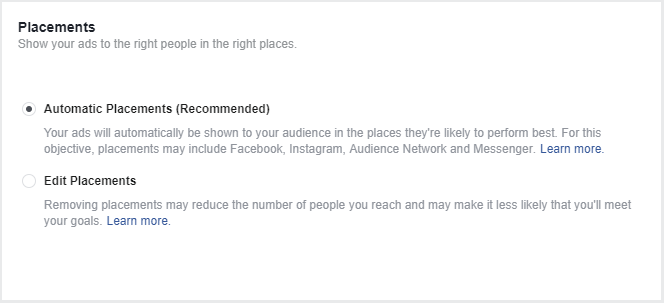
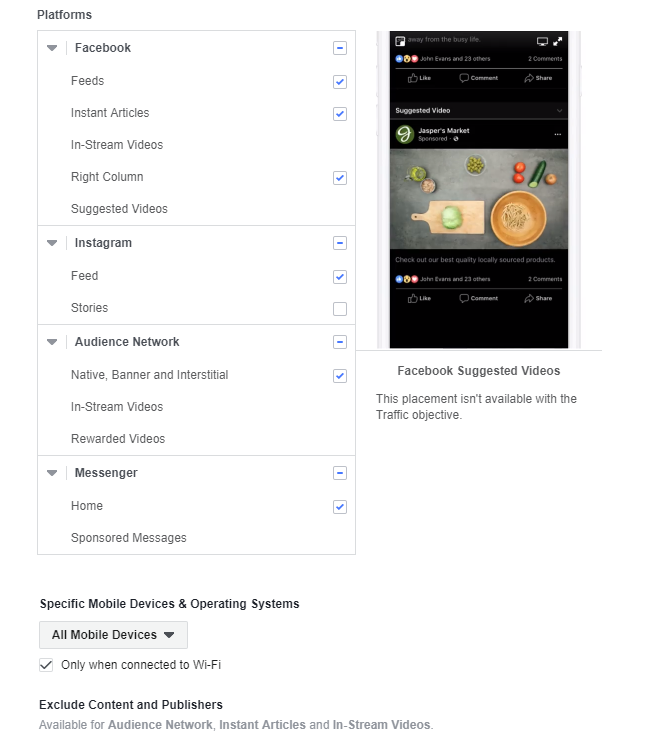
You need to opt in to this targeting at the ‘Placements’ setting within your Ad Set.

1. Select “Edit Placements”.

2. Next, scroll down and select the “Only when connected to Wi-Fi” option.

3. That’s it! Wow, that was easy. You’re good to go from here.

Since we’re limiting the size of our audience, we should expect our Cost per Impression (CPM) to increase. However, if we’re getting more efficiency from these impressions, we can easily get a lower Cost per Acquisition (CPA).

Related: 5 Ways Your Business May Not (But Should) Be Taking Advantage of Facebook Marketing

Here’s a scenario that provides more context:

Notice, Ad Set B had a higher CPM. However, the Click Through Rate (CTR) and Conversion Rate (CVR) was also higher. As a result, this Ad Set got more conversions, at a lower price.

There you go, try it out for yourself and let me know how it goes.

Related: Use These 5 Facebook Ad Hacks to Send Your Ecommerce Sales Soaring

Need some help with this, or have other Digital Marketing questions? Book a consulting session with me on Entrepreneur’s Ask an Expert platform. My schedule is always up to date, you can even record the meeting if you’d like. Hope to speak with you soon, and good luck with your next campaign!

https://www.entrepreneur.com/article/333561


Study: How to use domain authority for digital PR and content marketing

Study: How to use domain authority for digital PR and content marketing

For the SEO community, Domain Authority is a contentious metric.

Domain Authority (DA) is defined by Moz as

“A search engine ranking score developed by Moz that predicts how well a website will rank on search engine result pages (SERPs). A Domain Authority score ranges from one to 100, with higher scores corresponding to a greater ability to rank.”

Some people say that this score does more harm than good because it distracts digital marketers from what matters. Improving your DA doesn’t mean you’re improving your rankings. Others tend to find it useful on its own as a quick way to determine the quality or trustworthiness of a site.

Here’s what I say, from a digital PR perspective, domain authority is valuable when you’re using it to compare sites relative to one another. In fact, DA provides value for us PRs and is incredibly useful to our work.

Think of it this way. There are more websites than ever before, about 1.5 billion to be exact and so in some ways, this means there is more opportunity for marketers to get their content out in the world and in front of new audiences. While most people think that journalism is dying out, an enlightening post on Recode by Rani Molla explains that “while job postings for journalists are off more than 10 percent since 2004, jobs broadly related to content have almost quadrupled.” 

In other words, if outreach is executed well, there are more places than ever to get your content featured and lead to driving traffic, broadening your audience, and improving your search ranking.

But even the most skilled PR teams can’t reach out to 1.5 billion sites. The knowledgeable ones know that you really only need one successful placement to get your content to spread like wildfire all over the Internet, earning links and gaining exposure for your brand in the process. With so many options out there, how do PR professionals know which sites to spend time targeting?

That’s where DA comes into play. When it comes to link building, content marketers know that not all backlinks and brand mentions are created equally. The value of a link or mention varies depending on the referring website. Moz’s DA score is a way for us PRs to quickly and easily assess the quality of the websites we target for our client’s content marketing campaigns.

Our team tends to bucket online publishers, blogs, and websites into three categories:

  • Top-tier
  • Mid-tier
  • Low-tier

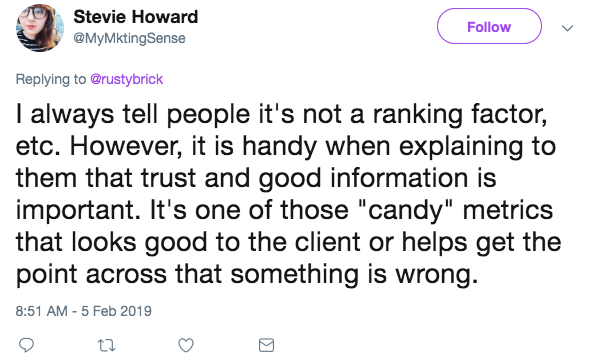
Keep in mind, particularly with the new Moz update, when deciding who to pitch, you must take a holistic approach. While domain authority is an excellent way to quickly assess the quality of a website, a site’s DA can change at any minute due to a multitude of factors, so make sure you are also taking into account your goals, the site’s audience, social following, and reputation as well as Moz DA score. In response to a Marketing Land tweet about the new DA, Stevie Howard says it perfectly.

Screenshot of Stevie Howard's tweet in response to a Marketing Land tweet about the new DA

Top-tier sites

What constitutes a top-tier website? Can a top-tier site have a low DA? Potentially, but it’s uncommon.

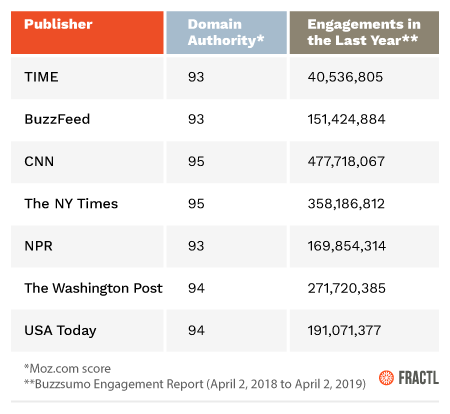
When you look at the holy grail of media coverage, DA tends to align perfectly. Take, for example, the following seven major publishers that any brand or business would love to earn coverage on. The DA scores for all of these sites fall above 90. These sites all have an extremely large audience, both on-site and on social media.

List of top tier sites having a DA score of 90 and above

Our team at Fractl has an innate sense of the online publisher landscape, and the largest and most well-known content publishers out there all tend to have a domain authority above 90. This is what we consider to be the “top-tier”.

These publishers are difficult to place with because of their large audience, social following, and reputation, so for the best chance at earning organic press mentions on these sites, offer them authoritative, unique, exclusive, and newsworthy content.

Mid-tier sites

Mid-tier sites may not be the holy grail of news publishers, but they’re our bread and butter. This is where the majority of placements tend to happen. These publishers hit a sweet spot for digital PR pros—they’re not as sought-after as Buzzfeed and don’t deeply scrutinize pitches the way The New York Times does, but they have large audiences and tend to be much more responsive to content pitches.

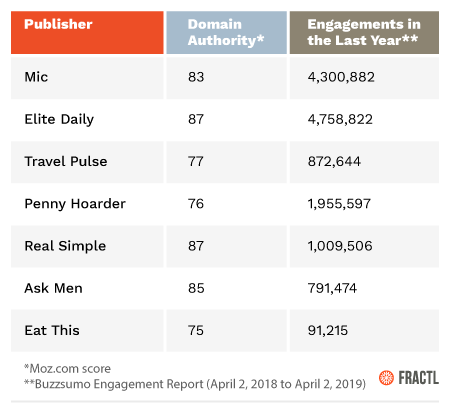
I tend to categorize the mid-tier as publishers that fall within a DA of 66 to 89. Here are some examples of publishers that may be considered mid-tier.

List of mid-tier publishers that have a DA of 66 to 89

Low-tier sites

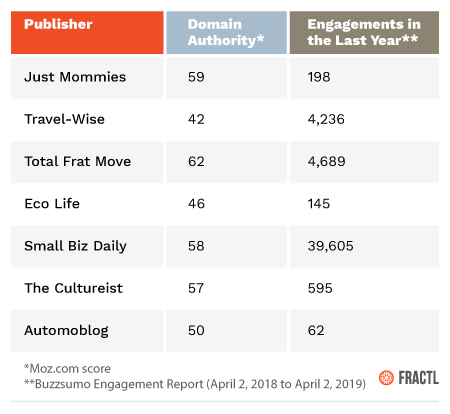
Don’t underestimate a low-tier site simply because of its domain authority. For example, it wasn’t long ago that personal finance website, Money-ish, had a DA of 1. Launched in 2017, it was first its own website before being absorbed as part of the larger MarketWatch domain. MarketWatch has a DA of 93, with social engagement as high as 12,294,777 in the last year. If you ignored Money-ish because of its DA when they first started, you would have missed out on a chance to get your content featured on MarketWatch as well as build relationships with writers that are now under the MarketWatch umbrella. There are all types of content, and most marketers can figure out which projects have “legs” and which have less appeal. These lower-tier sites are often very niche and the perfect home for content that is aimed towards smaller, more precise audiences. These lower-tier sites also tend to have a high engagement where it matters, your target audience. Consider the site’s community. Does this site have a ton of email subscribers or high comment engagement? Are they killing it on Instagram or on another social network? You never know which site will become the next Money-ish, either!

List of low-tier sites with DA below 60 or 65

Pitching differences for each tier

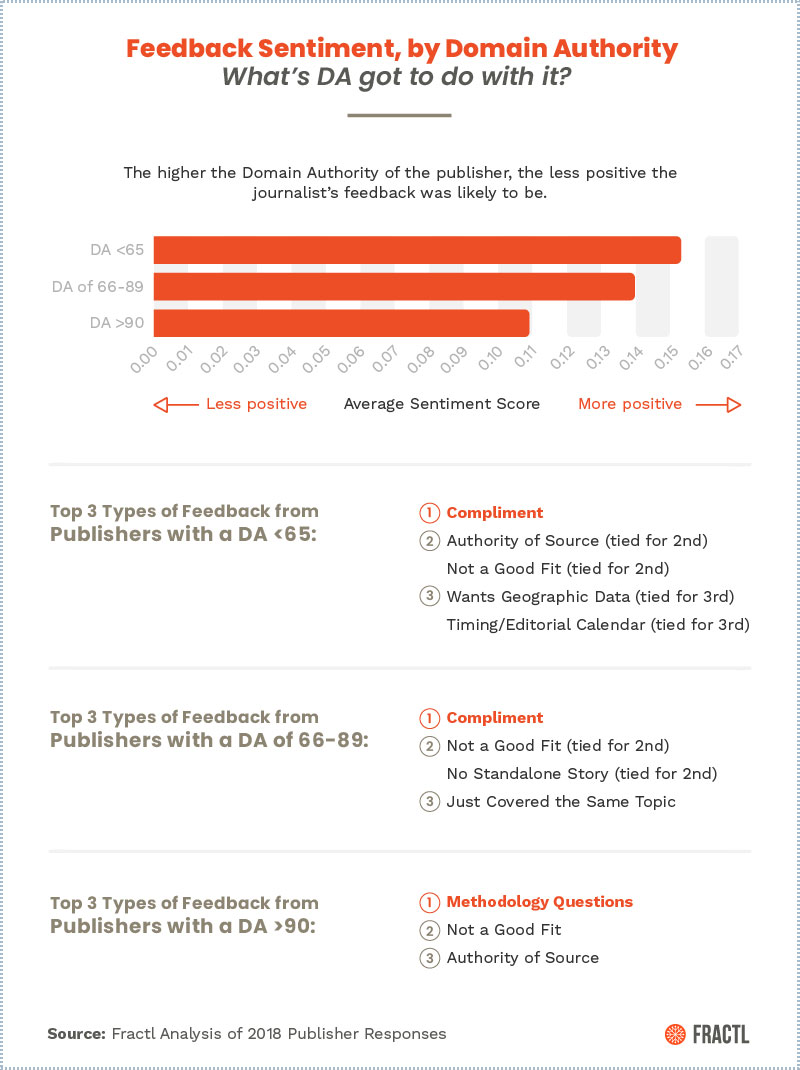
There are plenty of sites that fall within different ranges of domain authority that would be an excellent fit for your content. It all just depends on your goals. In Fractl’s latest internal study, we were able to identify trends in the way journalists respond to PR professionals, based on the DA of the site they write for.

Graph on how journalists respond to PRs based on their sites DA score

Observations

  • Feedback from writers working for sites with a DA lower than 89 was most likely to be complimentary of the content campaigns we pitched them.
  • The verbiage of their responses was also more positive on average than those from journalists working for publishers with a DA of 90 or above.

An example of the feedback we received that would be labeled as complimentary is,

“Thanks for sending this over, it fits perfectly with our audience. I scheduled a post on this study to go up tomorrow.”- Contributor, Matador Network (DA: 82)

Those of us that have been pitching mainstream publishers for a while know from experience that it’s often easier to place with websites that tend to fall in the mid to low-tier buckets. Writers at these publishers are usually open to email pitches and open to writing about outside content because such websites have less stringent editorial guidelines.

Conversely, publishers that fall into our definition of “high-tier” were less positive on average than writers working for publishers with a DA less than 90. On average, the higher the DA, the less positive the language becomes.

Why might that be? It makes perfect sense that publishers like The New York Times, CNN, TIME, and The Washington Post would be less positive. They’re likely receiving hundreds of PR pitches a day because of their popularity. If they do respond to a pitch, they want to ensure that they’re inquiring about content that would eventually meet their editorial guidelines, should they decide to cover it.

According to our study, when journalists at publishers with a DA of 90 or above do respond, they’re more likely to be asking about the methodology or source of the content.

An example of this feedback is from a staff writer at CNN.

“Thanks for sending along. I’m interested to know more about the methodology of the study.”

A response like this isn’t necessarily bad, in fact, it’s quite good. If a journalist is taking time to ask you more about the details of the content you pitched, it’s a good indication that the writer is hoping to cover it, they just need more information to ensure that any data-driven content is methodologically-sound.

Conclusion

Domain authority will continue to remain a controversial metric for SEOs, but for those of us working in digital PR, the metric provides a lot of value. Our study found a link between the DA of a site and the type of responses we received from writers at these publishers. High DA sites were less positive on average and requested research back methodologies more than lower-tier sites. Knowing the DA of a site allows you to:

  • Improve your list building process and increase outreach efficacy
  • Customize each outreach email you send to publishers of varying DAs
  • Anticipate the level of editorial scrutiny you’re up against in terms of content types and research methodologies
  • Optimize content you create to fit the needs of your target publisher
  • Predict the outcome of a content campaign depending on where you placed the “exclusive”

Remember, just because a site has a high DA, it doesn’t mean it’s necessarily a good fit for your content. Always be sure to take a holistic approach to your list building process. Keep in mind the social engagement of the site, the topics they cover, who their audience is, their editorial guidelines, and most importantly, the goals of you or your client before reaching out to any publisher solely based on domain authority.

Domenica is a Brand Relationship Manager at Fractl. She can be found on Twitter .

Related reading

On-site analytics tactics to adopt now Heatmaps, intent analysis, and more

How AI is powering real-time SEO research Insights and optimization

The SEO metrics that really matter for your business

How progressive web apps positively impact your SEO

https://searchenginewatch.com/2019/05/10/domain-authority-for-digital-pr/