Twitter to Let Users Hide Replies to Their Tweets by @MattGSouthern

ADVERTISEMENT

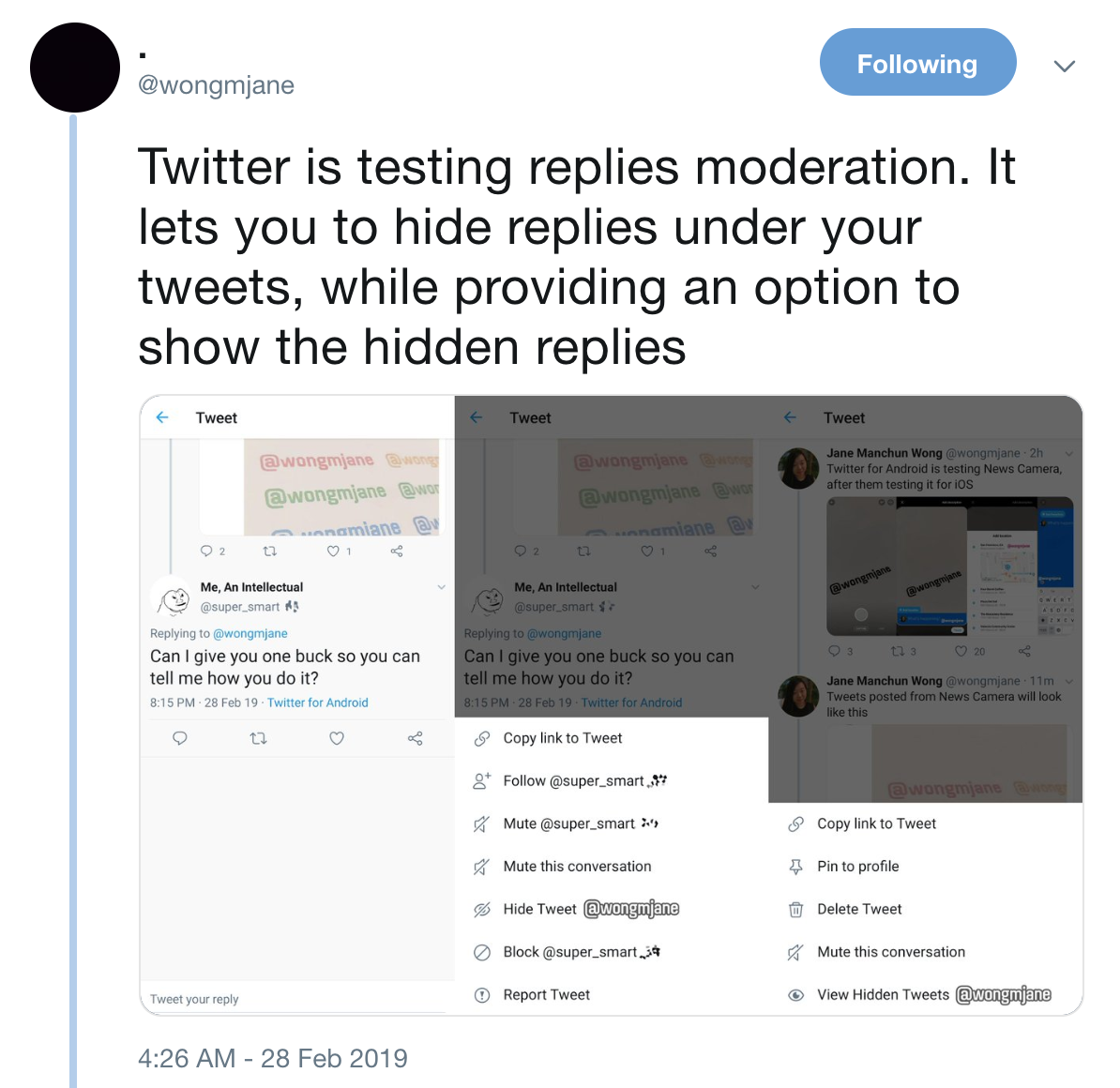
Twitter is working on a tweet moderation feature that would let users hide replies to their tweets.

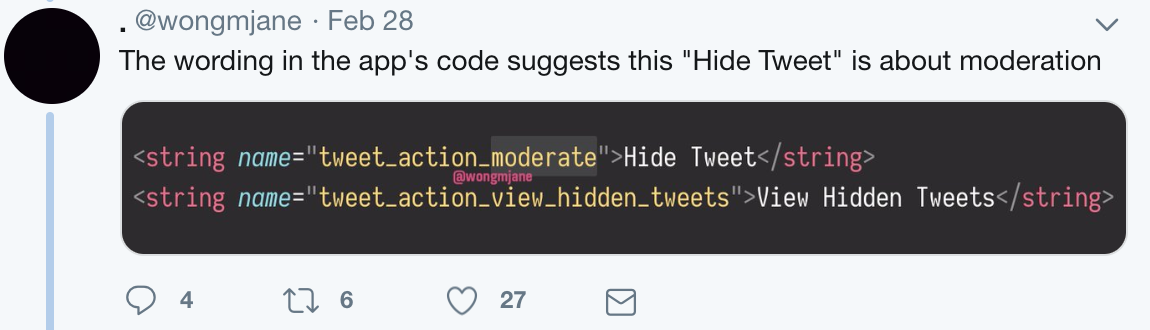
Jane M. Wong, an expert on reverse engineering apps, discovered the feature and shared some screenshots.

Twitter to Let Users Hide Replies to Their Tweets

Twitter to Let Users Hide Replies to Their Tweets

Twitter to Let Users Hide Replies to Their Tweets

Twitter to Let Users Hide Replies to Their Tweets

A senior product manager at Twitter confirmed the company is indeed working on this feature while also adding more context.

The feature is being designed to give users more control over the conversations around their tweets:

“We often hear from heavy Tweeters that they want to be able to protect their conversations…

People who start interesting conversations on Twitter are really important to us, and we want to empower them to make the conversations they start as healthy as possible by giving them some control.”

Twitter already has features such as block, mute, and report. However, they don’t address issues the way the new moderation feature is intended to.

“Block and mute only change the experience of the blocker, and report only works for the content that violates our policies.

With this feature, the person who started a conversation could choose to hide replies to their tweets. The hidden replies would be viewable by others through a menu option.”

So, while tweets would be hidden, they would not completely disappear.

It sounds similar to a downvoted reply on Reddit, though arguably less democratic.

When the Reddit community collectively downvotes a reply to a thread it gets hidden, but it can still be viewed manually.

With this tweet moderation feature, the original poster has full control over hiding replies to their tweets.

Twitter’s product manager somewhat acknowledges this, while adding that users can always call out situations where they disagree with tweets being hidden.

“We think the transparency of the hidden replies would allow the community to notice and call out situations where people use the feature to hide content they disagree with. We think this can balance the product experience between the original Tweeter and the audience.”

This feature is already generating a fair amount of controversy, with Twitter users arguing for and against it.

On one hand, it could be useful for reducing the visibility of trolls and others tweeting abusive comments.

On the other hand, the feature could be easily misused by users who simply wish to hide comments from people with conflicting viewpoints.

Twitter plans to test the feature publicly in the coming months, so it will be interesting to see how people choose to make use of it.

More Resources

Subscribe to SEJ

Get our daily newsletter from SEJ’s Founder Loren Baker about the latest news in the industry!

Ebook

http://tracking.feedpress.it/link/13962/11117765


Facebook Cracks Down on Companies Selling Fake Likes, Followers, and Accounts by @MattGSouthern

ADVERTISEMENT

Facebook is going after companies that promote the sale of fake accounts, likes, and followers.

On Friday, a lawsuit was filed in US federal court against four companies and three people based in the People’s Republic of China.

The companies were selling fake accounts, likes, and followers on Facebook, Instagram, and other platforms like Amazon, Apple, Google, LinkedIn, and Twitter.

In a statement, the company explains what it aims to achieve through the lawsuit:

“By filing the lawsuit, we hope to reinforce that this kind of fraudulent activity is not tolerated – and that we’ll act forcefully to protect the integrity of our platform.”

The lawsuit asks the court to prevent these people and entities from:

  • Creating and promoting the sale of fake accounts, likes, and followers on Facebook and Instagram
  • Infringing on Facebook’s trademarks on their websites
  • Using Facebook-branded domain names to operate their websites

Facebook says it devotes significant resources to detecting and stopping this type of behavior.

This past November, Instagram announced it was purging fake followers, comments, and likes generated by third-party apps.

Apparently, that was not just a one-and-done occurrence, as Facebook says in its latest announcement that it disables millions of fake accounts every day.

Now the company is taking its efforts a step further by filing multiple lawsuits.

If Facebook wins the lawsuits it will certainly set a legal precedent with respect to the selling of fake like, followers, and accounts.

Subscribe to SEJ

Get our daily newsletter from SEJ’s Founder Loren Baker about the latest news in the industry!

Ebook

http://tracking.feedpress.it/link/13962/11117580


Link building with PR: Relevant links at scale

Link building with substance - Why scaling PR is the best strategy

It is no secret that Google and other search engines like quality links and consider them as one of the top ranking factors. Search engines are getting smarter and better at identifying unnatural link building. Updated algorithms can assess the brand’s strength and content’s usefulness at a glance.

This results in higher requirements for the quality of links and content you use for your SEO. Fortunately, there is a way to create engaging content and build quality links from authority sites simultaneously. The solution is to align SEO efforts with PR. Public Relations puts a business in the spotlight, creating brand awareness and reputation through press coverage. Mentions about the company boost the quality of SEO as well.

I came up with this strategy based on a video Rand Fishkin had created on ‘The Marketing Flywheel.’  It’s an old Whiteboard Friday that still resonates today.

Rand’s video explains strategies that can impact and scale your link building. I had to find a solution as many of us are in our assigned positions, we are a team of one. So I had to make friends, and fast!

In this article, we will take a look at how scaling PR is one of the best link building strategies that can scale your efforts and brand your business fast.

What is an online PR strategy?

A highly cost-effective marketing technique, online PR is a way to spread a word about your brand on the web. A good PR strategy is really important in this modern age. It does not just help you start influencing people but also gains trust and reputation quickly.

I started reading books from Ryan Holiday, a successful marketer and American Eagle executive that has pulled a lot of crazy stunts to scale earned media.

He does not focus on SEO as he is more on branding and growth hacking, but his strategies are unconventional and allow you to think out of the box.

Connecting with quality influencers and journalists

You already do it with guest posting, why not do this by finding journalists and other influencers with blogs?

The payoff for building these relationships is organic backlinks. Connecting with high authority journalists and influencers in the industry or general media can work wonders for your SEO.

The key is to come up with something that can attract their attention, we used a scholarship mixed with a need and based on current priorities that the manufacturing industry had, this is how we recently landed a sweet article on IndustryWeek.

It is important to understand that there is no one-size-fits-all solution to using an online PR strategy for link building. You should develop a PR scaling plan that suits your company needs.

Here are some useful tips to do link building with PR for your business

1. Media relations

Public relations is different from guest blogging and is about developing healthy relations resulting in high-quality opportunities for the placement of content. Building relations with journalists, bloggers, publishers, and influencers is important.

Focus on quality rather than quantity and take time to build these relations. Begin by targeting a few people and nurture a relationship with them. Do some research and find writers, journalists, and influencers in your niche and start engaging with them. Know them and listen to what they say before asking them for links.

Like and comment on what they post on social media. Send some useful information to them, even if it is not about you. This will create a positive impression about you in their minds. This way, they will be ready to work with you when the time comes.

2. Priority of online reputation management (ORM)

Your online business reputation has to be on point. One suggestion to create fast, positive feedback is to email potential influencers in your industry with some free products and ask for feedback. Seven out of ten times, they will write about you on their blog or create a video endorsing your product. Bloggers love free stuff and this is a quick way to gain positive feedback and reviews on your brand and products.

Don’t make your own products? That’s okay! Gift cards work as well with a focus on asking for feedback on your user experience or app. It works both ways.

3. Use of press releases

Press releases have evolved over the years and a good press release which catches the attention of journalists gives a great opportunity for social media coverage and organic links.

Consider our example in introducing a scholarship program to bridge the skills gap in the manufacturing industry. This initiative helped us get some great PR and we built trust and reputation within the industry in a matter of a few months.

4. .EDU links help

It also helped us fuel our acquisition of .EDU Links. We targeted media and industry sites first and then with the trust in place, we contacted schools and universities offering manufacturing courses.

We pitched our scholarships and included these articles with links of the stories about the scholarship. The result we got from these efforts were awesome. In less than four months, we went from DA 17 to DA 30 and still growing with over 15 .EDUs and 1200 backlinks which we acquired in just a few weeks.

Rather than distributing the press release through syndicated websites with no-follow links, consider distributing it on social media and use some keywords that help influencers and journalists find it easily. You can make it appealing by sending it to influencers before releasing it.

5. Timely content

Try to tie your content to a current event to make it appealing to high-quality sites. Most SEO pros write a story around something timely and pitch it before their competitors do. This is also referred to as newsjacking, it works with the right pitch and data but may backfire if you get too controversial.

Doing this right requires that you stay updated on the local and national news and events, and always be ready to give the expert opinion. Such commentary comes with a mention and possibly a link. You can set up Google Alerts for topics and people in your niche to know whenever a big story is up.

6. Use of social media

Social media is one of the most powerful tools for public relations. Social media platforms such as Instagram and Facebook make it easy for brands to get introduced to influencers and build relations. By using social media to boost your SEO, you get more people to read your content. Always ensure you are visible where you should be and you don’t miss out on anything. Don’t share your content on social media just to get clicks.

Encourage the audience to share your content, comment on it, mention to their contacts and use other ways to spread it across the internet. This is how social media can help you generate new, organic links.

7. Buy your PR team some doughnuts

PR has a valuable place in SEO and vice versa. When the two industries work together, the results are amazing. As you can see here, there are numerous benefits of scaling PR with link building.

Links do matter but where you get them from is more important. Building relations and connections are imperative to success. With the bar of link quality going up at a constant rate, make sure you use PR strategies in your SEO campaigns to generate organic links from high-authority sites.

How would you use PR to boost your link building? Let us know in the comments section below.

Jonathan Alonso is Director of Digital Marketing at CNCMachines.Net. He can be found on Twitter at @jongeek.

Related reading

mobile search and video in 2019: how visible are you?

facebook is a local search engine. Are you treating it like one?

17 best extensions and plugins that experienced SEOs use

cybersecurity in SEO, how website security affects your SEO performance

https://searchenginewatch.com/2019/03/01/link-building-with-pr-relevant-links-at-scale/


TikTok Was Downloaded More Times Than Instagram Last Year by @MattGSouthern

ADVERTISEMENT

Short-form video app TikTok has reached the 1 billion download mark across Android and iOS.

What’s perhaps even more impressive is that it was downloaded more times than Instagram in 2018.

App analytics site SensorTower released the data this week, adding that the billion figure does not include Android installs from China.

So it’s likely that the total number of downloads is even higher than what was reported.

Over half of TikTok’s total downloads, roughly 663 million, came in 2018.

By comparison, Instagram was downloaded 444 million times.

TikTok was the fourth most-downloaded non-game app for 2018, behind WhatsApp, Facebook Messenger, and Facebook.

SensorTower reports that TikTok’s momentum has carried into 2019. In January it was the #3 app worldwide in terms of new installs across Android and iOS.

Further, TikTok was the #1 non-game app in the United States in January 2019.

Despite being the top non-game app, TikTok is not especially popular in the US compared to other markets.

SensorTower notes that 25% percent of TikTok’s downloads to date have come from India. In January 2019, 43% of the app’s new users were from India.

The share of new users from the US is growing year-over-year, just less significantly than other markets.

Subscribe to SEJ

Get our daily newsletter from SEJ’s Founder Loren Baker about the latest news in the industry!

Ebook

http://tracking.feedpress.it/link/13962/11111842


All the Free PR Secrets You Need to Know to Scale Your Business by @lisabuyer

ADVERTISEMENT

Can PR make your brand famous?

Just ask Cameron Herold and Adrian Salamunovic, two entrepreneurs who hacked their way to getting publicity without spending a dime on a fancy public relations firm or advertising.

The Wall Street Journal, Wired, and Fortune, to name a few, all ran stories on their startups, thanks to being just plain real and authentic.

Their just-released book “Free PR” walks through how to get the attention of journalists, bloggers, reporters and get in front of the masses without a mega-budget or a PR background.

History of PR

Public relations dates back to the early 1900s when publicity boards were formed to influence public opinion and eventually journalists.

Press releases were used to communicate to journalists in crisis situations which helped repair reputations and resulted in positive press in the mid-1900s.

As radio and TV evolved as media outlets, PR became a more critical communication part of a company. Journalists were the gatekeepers of what made the headline news and who was used as a source.

Why PR?

Public relations is considered a third-party endorsement versus an ad or sponsored content, which is obviously paid.

Unlike ads, which stop when the paid campaign ends, public relations keeps on giving. This can be in the form of referring traffic, inbound authority links, branding, and more.

It’s been shown that media breeds media. When your brand gets mentioned once in the media, more media tend to flock and it can be a domino effect.

In an era when consumer trust is at a low, positive public relations results build credibility and credibility builds trust.

Salesforce reports that 95 percent of customers are more likely to be loyal to a company they trust while 92 percent are more likely to purchase additional products and services from trusted businesses.

All the Free PR Secrets You Need to Know to Scale Your Business

All the Free PR Secrets You Need to Know to Scale Your Business

Old School Meets New School Opportunities

Today’s news cycles are 24/7. Journalists, media outlets, search engines, and social media channels are hungry for good content.

We’ve come a long way from two to three TV networks and a few radio and print outlets in each market.

Free PR book

Free PR bookYou don’t need to pay Madison Avenue prices for Wall Street Journal results.

The number of media outlets is massive and growing while the number of journalists and staffing is decreasing due to budget cuts. In the last decade, newsrooms have shed over 20,000 jobs, representing a 39 percent decline.

For example, BuzzFeed publishes more than 200 stories and videos a day while The Washington Post outputs more than 500 videos and posts a day. There are more than 600,000 podcasts and 505 million blogs. More than 7,000 magazines in the US and 1400 plus newspapers. More than 1,700 TV stations exist in the US.

Journalists are expected to do more for less. This includes finding artwork and multimedia.

This leaves a huge opportunity for potential media coverage with the right PR savviness and tactics.

So whether you are a digital marketer, startup, solopreneur, nonprofit, or any size organization – check out these PR tips to scale your public relations results on any budget.

The Right Audience & Angles

You must know your audience and angle before you can skip to pitching your story to the media.

If you have your audience personas in place you should know what publications they are mostly reading. Once you know the publications then you can research who covers the types of story that fit your brand’s story.

Discover what your prospect is interested in, then provide it. It’s business 101.

“If you can’t tell the journalist why their audience will care then you are not ready to pitch,” Herold and Salamunovic said.

A story angle is the spin you put on your product or service that makes it interesting or compelling.

Bad Pitch: “I want you to write a story about an app I’m launching next week.”

Good Pitch: “We are launching a new app for entrepreneurs that saves an hour a day in productivity, increases happiness in the workplace, and decreases stress.”

The best story angles come from knowing your unique value proposition, or what makes your brand unique or innovative to your industry. This will help frame your story idea into categories, which could include:

  • Announcements: These include new products or new hires.
  • Evergreen: These are timeless ideas such as “how to write a book in 30 days.”
  • Seasonal: Tied to specific holidays or events such as the Super Bowl or elections.
  • Events: Such as if your brand is part of SXSW or industry conference such as Pubcon.

Perfect Pitches & Press Releases for Free PR

There is an old saying, “the press release is dead, long live the press release.”

Contrary to popular belief, the press release is not dead, it’s actually very much alive and well. A press release answers the critical questions about your brand’s news: the who, what, when, where, and why.

Since the revolution of the digital age, many have come to believe that the only message that matters is the one that you put out online. Yet, they still want coverage in Forbes, The New York Times, NBC, and local media.

If those are the goals that align with your business needs, then a well-written, attention-grabbing press release is your golden ticket to getting found in search and social.

Pitching

Pitching a story to the media does not require a PR degree, but it does help to be a good writer, researcher, and connector

You need to be able to sell what the journalists and media are buying in a way that’s helpful, relevant, and timely.

  • Make sure it is personalized and tailored to the journalist.
  • Keep it short and to the point without fluff.
  • Before you start to pitch, follow the reporter on Twitter and start interacting and building that relationship.

#SocialPRSecret to Pitching Peeves

I caught up with Destiny Lane, a freelance writer for publications including Elite Daily, Thought Catalog, PaleoHacks, Jopwell, and Glassdoor.

“My two biggest pet peeves when it comes to receiving pitches from brands are the lack of relevance and the sheer unwillingness to build a relationship. Along with many other journalists, I have a digital footprint. A quick Google search paired with 10 minutes of your time and you’ll find something about me that is relatable to your client.

This can help segue a trustworthy hello into an introduction to your client. Building relationships is so important in general, but especially when it comes to press.

Follow relevant journalists on social media even if they only have a few hundred followers on Instagram, share their stories, like their tweets/photos even if they didn’t mention your client this month or this quarter. It’s an easy way to stay on top of their mind, especially as you prepare for another round of outreach.”

Anatomy of a Press Release

The press release is not a marketing document and should not be written like one. If you write like a journalist you will get noticed by a journalist.

Get the who, what, where, when and how covered and keep it to 400 words with more details on your website. Below are key parts of a press release from start to finish.

  • Headline (make sure you have keywords front-loaded).
  • Sub-Headline (optional).
  • Visual: Include a logo, an image at a minimum and a video if possible.
  • Location and Release Date.
  • Summary (have a link with full URL to the company).
  • Problem.
  • Solution.
  • Data and Market Facts.
  • Your Quote (can also include influencer, customer, or partner quote).
  • Closing and call to action.
  • Boilerplate.
  • Media contact info: According to a study done by TEK Group, the media contact info is the most wanted piece of info when visiting a brand’s website. Do you have a media contact listed on your website?

Visuals

Journalists said they “always” or “often” use multimedia elements 70.5 percent of the time.

In addition, studies show that press release distributed with images and video gain more visibility in search and referring traffic.

  • Photography: Invest in a variety of photography and get creative beyond headshots. The better the photography the easier you make the life of a journalist. Take action shots in both horizontal and vertical.
  • Infographics: Turning data into a visual also wine the hearts and attention of the media including social media, search, and traditional media.
  • Videos: Your iPhone camera is today’s videographer and your apps hold the key to some of the easiest and best editing – no skills required. Don’t be afraid to get creative with video, no budget required.

Optimization

Optimizing your press release doesn’t mean making it all spammy with an overdose of keywords. If you are doing versions on social media make sure you have relevant tags including:

  • Keywords: Make sure you keep in mind how your audience is searching and write with those keyword phrases in mind.
  • Image file names: Keep in mind the power and influence of Google image search.
  • Links for referring traffic: Make sure you follow Google best practices, things change.
  • Shareable: How will your news share on social media? Is the visual shareworthy and does it tell a story?

Distribution

  • Paid: Ereleases, PR Newswire or Business wire.
  • Email: Let your email subscribers know what’s happening in a simple version that links to the full story on your website
  • Google My Business: Dedicate your GMB posts to reporting news and get controlled visibility on page one of Google. You can even add a video or image – make it pop and stand out.
  • Custom versions for your website’s online newsroom, Linkedin, Medium.
  • Multiple lengths: 160 characters, 1 paragraph.
  • Social media versions: Create unique versions of your press release for each network. If your audience is on Instagram, make sure you break news first on the channel that matter most to your audience. Instagram is catching up to Twitter for breaking news.
  • Media list: Make sure your media list is personalized and groomed for each pitch. You don’t have to be BFF with a journalist to get a story, you just need to make their lives easier.

Ready for It?

Ready to start or relaunch your brand’s journey to getting free publicity, good links and build credibility?

Grab your shades and watch the fame grow, just remember this process is one built with momentum. There is no such thing as the “pause campaign” button.

Public relations is an “always on” process.

More Resources:


Image Credits

Featured Image: Unsplash
Screenshot and in-post image taken by author, February 2019

Subscribe to SEJ

Get our daily newsletter from SEJ’s Founder Loren Baker about the latest news in the industry!

Ebook

http://tracking.feedpress.it/link/13962/11107080


Instagram Video Posts Receive Twice the Engagement of Other Post Types [STUDY] by @MattGSouthern

ADVERTISEMENT

A study on Instagram engagement discovered that video posts receive 2x engagement of other post types.

The study also reveals how many followers most Instagram users have, and how many likes the average posts receive.

Data was compiled by HubSpot after analyzing 48,065,694 Instagram
posts from 306,278 top users.

More than 80% of businesses consider engagement the most important metric, which makes this study particularly relevant to marketers.

Here are some key highlights from the study.

Engagement on Instagram

Likes and Comments

The average Instagram post receives 5,963 likes, which is admittedly skewed by the number of likes received by highly influential users.

The median number of likes is closer to 100, which suggests 50% of users receive less than 100 likes for the average post.

Video posts received on average
the highest number of likes and have increased in overall engagement year-over-year.

The average Instagram post receives 100.34 comments.

Video posts, in particular, receive an average of 150 comments, although that’s skewed by the average number of comments on viral videos.

The median number of comments per video is 4, which means more than 50% of total users receive less than 4 comments per video post.

Hashtags

The average Instagram post contains at least 1 hashtag. Using more hashtags actually decreases the average engagement rate.

It’s likely better to use fewer hashtags (no more than 5) than to use too many.

Ultimately, when it comes to hashtags, it’s not about quantity. It’s about relevance.

Followers

According to HubSpot’s data, 46.6% of Instagram users have fewer than 1,000 followers.

Around 33.5% of users have between 1,000-10,000 followers.

Only 9.8% have 10,000-50,000, and 2.7% have 50,000-100,000 followers.

For more data on Instagram engagement, download the full PDF here.

Subscribe to SEJ

Get our daily newsletter from SEJ’s Founder Loren Baker about the latest news in the industry!

Ebook

http://tracking.feedpress.it/link/13962/11105599


LinkedIn Job Listings Now Inform Users Where They Could Make More Money by @MattGSouthern

ADVERTISEMENT

LinkedIn is rolling out a salary comparison tool to help professionals discover where they could make more money.

“Now, when you’re searching for jobs on LinkedIn in the U.S., UK and Canada, we’ll show you personalized insights about jobs where you could make more money on the job card and within the job listing.”

This enhancement to job listings will not indicate specifically how much more could be made. It will simply notify users of a “pay raise opportunity.”

Here’s an example of what it looks like:

LinkedIn Job Listings Now Inform Users Where They Could Make More Money

LinkedIn Job Listings Now Inform Users Where They Could Make More Money

In addition to this update, LinkedIn Salary is being expanded to more than 10 countries.

LinkedIn Salary provides users with a reliable source of up-to-date information about the factors that impact the way they’re paid.

The company offers the following tips when using LinkedIn Salary to navigate one’s:

  • Do Your Research: Before initiating a conversation about salary, spend some time researching what professionals in your industry and role are being paid by talking to people in your network and using LinkedIn Salary to compare with others who have similar skills and years of experience.
  • Be Transparent: Go into the conversation with a solid number in your head and don’t be afraid to lay it on the table. Use LinkedIn Salary to help you understand how factors like your education and past experience could impact your salary.
  • Don’t Be Afraid to Counter: If your employer or potential employer comes back with less than you were asking, work together to find a common ground – and make sure you’re prepared to explain why you deserve it.

With these personalized insights, LinkedIn aims to provide users with the tools needed to make informed decisions one’s earning potential.

Subscribe to SEJ

Get our daily newsletter from SEJ’s Founder Loren Baker about the latest news in the industry!

Ebook

http://tracking.feedpress.it/link/13962/11105442


Facebook Introduces a Premium Ad Offering for Video Advertisers by @MattGSouthern

ADVERTISEMENT

Facebook is rolling out a premium ad program called Showcase, which lets advertisers target the highest-quality videos.

Ads bought through Showcase show up in Facebook Watch, which houses the platform’s top tier of original and publisher content.

Showcase ads can also appear within certain video content in the newsfeed and Facebook pages.

On average, Facebook says nearly 100 million people in the US watch Showcase eligible content each month.

Showcase is now available for campaigns targeting US audiences and includes the following products:

  • In-Stream Reserve: In-stream ads can appear either mid-roll or pre-roll. These placements are bought in advance at a fixed cost and delivered to in-target audiences verified by Nielsen.
  • In-Stream Reserve Categories: Includes all the features of In-Stream Reserve, and allows advertisers to reach people within contextually relevant content. Categories include sports, fashion/beauty, entertainment, food, and news.
  • Sponsorships: Allow advertisers to be the exclusive sponsor of a program for US viewers, giving advertisers the opportunity to place their ads in specific shows.

Facebook emphasizes that Showcase can help advertisers reach younger audiences that are difficult to reach on traditional TV.

“Showcase can help advertisers reach younger-skewing audiences that are increasingly difficult to reach on TV. Over the past three months, 43% of people in the US who watched In-Stream Reserve-eligible content on Facebook were 18-34 years old, compared to 28% of TV viewers.”

Ultimately, Showcase is designed to let advertisers buy and measure video ad campaigns using the same processes that premium video and TV ad buyers are familiar with.

Ads are bought upfront at a fixed price and guaranteed to be shown to a specific demographic.

For more information about Showcase, visit the new launch page.

More Resources

Subscribe to SEJ

Get our daily newsletter from SEJ’s Founder Loren Baker about the latest news in the industry!

Ebook

http://tracking.feedpress.it/link/13962/11105374


3 Ways Social Proof Boosts Customer Acquisition & ROI by @rajnijjer

There is more for digital native marketers to like about social proof than just “likes.”

For ecommerce brands seeking to draw clear lines and capture consumer touchpoints between social media engagement and sales, the science of “social proof” is often overlooked.

By not incorporating social proof into their attribution metrics, ecommerce brands are committing several unforced errors.

Generally speaking, ignoring social proof typically results in higher customer acquisition costs (CAC) and a higher rate of returns for online merchandise.

What Is Social Proof? Substance, Not Smoke

The rise of mobile and social media apps have severely diminished the importance of measuring pageviews, unique website visitors, and clickthroughs. It’s the action a person takes on an interactive platform that matters most.

That brings us to social proof: the validation of a site’s content, messaging, and branding through the demonstration of some action taken by a user.

The basic examples of social proof can be found in users leaving reviews, comments, recommendations, or social sharing. This form of user-generated content (UGC) and its demonstrated ability to create social proof can lead to higher conversion rates (CVR) and thus, sales.

How UGC increases CVR

How UGC increases CVR

Compared to the vague and passive act of viewing a web page, social proof is a committed act of engagement. It’s solid substance versus vaporous smoke.

Prove It – Socially

Aside from that obvious value of being able to point to direct user activity, the currency of social proof also speaks to the psychology of online consumers. Consider the reasons behind a consumer’s decision of what, when, and where to make an online purchase.

The foundation of any decision to transact online begins and ends with whether the consumer trusts the online retailer to provide an experience that is secure, easy to navigate, and offers access to desired items.

A brick-and-mortar store offers the immediate, tactile quality of examining a product. How busy the store is also tends to influence shopper choices.

Naturally, an ecommerce outlet doesn’t have those in-store elements that have traditionally comforted and inspired consumers.

Social proof is the virtual version of those brick-and-mortar features. And it has clear advantages over the traditional shopping model that digital brands can smartly exploit.

The creative possibilities associated with social proof allow brands to breathe new life into existing ads and content.

Lingerie retailer Yandy was able to repurpose its Facebook Dynamic Product Ad campaign by mixing customers’ images and reviews as part of the content it posted elsewhere.

Before making the switch, their cost-per-click was skyrocketing, making their return on ad spend unsustainable.

Yandy - Facebook Dynamic Product Ad campaign

Yandy - Facebook Dynamic Product Ad campaign

“The ads that featured customer content eclipsed our old ads both in value and efficiency, generating 70 percent more sales,” says Eric Polatty, Yandy’s digital marketing manager.

1. Social Proof Helps Boost Sales While Lowering Costs

Consumers take their online shopping cues from social proof in the form of reviews and social sharing. Credible reviews and testimonials inspire trust in a shopper.

That influence can come in the form the reviews on a company page or images and comments on a social media site. That validation gives the consumer comfort and encouragement to check out an otherwise unfamiliar online shop.

That is how social proof drives discovery and customer acquisition – and at a much lower cost than other forms that involve moving consumers through the marketing funnel.

Social proofs for an online business include its social media followers, product reviews, and blog posts or news articles that mention the company. These are all forms of validation that legitimize a business in the eyes of consumers.

Beyond spurring greater brand affinity, from an expense and efficiency perspective, ads that feature customers’ Instagram photos have a 50 percent lower acquisition cost than ads with branded photos.

3 Ways Social Proof Boosts Customer Acquisition & ROI

3 Ways Social Proof Boosts Customer Acquisition & ROI

On top of all that, social proof gives old school word-of-mouth marketing methods a crucial update by letting brands see the conversations and actions of consumers in real-time. This is one of the most powerful forces for growing a brand.

A Yotpo survey (disclosure: I work for the company) found that 79 percent of shoppers refer friends to brands they love. Like with most things, people are also more likely to feel better about buying from a recommended brand.

Making it easy for your customers to share their reviews and recommendations, and incentivizing them to do so, will allow you to reach new, relevant audiences that already believe in your brand.

With CAC doubling for both B2B and B2C over the last few years, social proof not only tells brands whether their discovery mechanisms are producing desired results, but it also spurs more trust.

2. Social Proof Can Improve Email Marketing

Email marketing often doesn’t get the credit it deserves. It’s one of the oldest types of digital marketing and therefore, it tends to fall into that “set it and forget it” mindset from brand strategists.

But as the original form of social media, email marketing is the key one-to-one communication extension of the image sharing, reviews, and testimonials that brands count on in a developing a lasting customer relationship.

With all that in mind, social proof represents the connective tissue between other marketing tools, with email being the ultimate validation of continued trust between a brand and a consumer.

In a word, it’s all about satisfying consumers’ demand for greater personalization and relevance.

The social proof that consumers leave across an ecommerce site and social media extensions can better inform a content and email marketing program.

For example, finding the highest rated products can serve as the basis for a range of messages. By curating the conversation that is being steered and driven by active customers, brands have a fuller sense of what is worth sharing more widely and consistently.

The ability to listen more clearly to customers also helps brand messaging avoid being placed in the spam folder of consumers’ emails as well as their minds.

In its push to lift its repurchase rates from customers who receive its email offers, Uniqlo highlighted top products with customer testimonials in its newsletter. Showcasing 5-star ratings linked to user photos let shoppers simply click through and purchase products that they might’ve not otherwise considered.

With 15 percent of U.S. retail email subscribers making multiple purchases, emphasizing a social proof strategy is essential to promoting shopper engagement and refreshed content.

In general, 27 percent of previous shoppers who click on promoted products in a review request email make another purchase.

3. Social Proof Offers a Better Customer Experience

There has been tremendous progress made in the amount of granular knowledge of customers’ buying habits and the instantaneous targeting of that behavior.

But the significant level of depth that social proof presents to brands from consumers’ own thoughts and actions makes these so continuously valuable as opposed to more episodic campaign metrics.

Social proof’s directional insights into the most minute customer trends and offers the chance to predict how and when to update and alter an ecommerce platform’s customer experience.

Where there is mostly uncertainty about moving a transactional site to the next steps, the reviews, comments, and image sharing activity let brands set customer expectations and meet shoppers’ stated needs.

To understand the connection between social proof, content marketing, and the resulting purchase process, companies like Glossier have nailed the experience considering that roughly 40 percent of customers share photos when they identify great product packaging.

Glossier Social Proof

Glossier Social Proof

Consider how popular unboxing videos are. As such, packaging has become as much a part of the customer experience as the actual product.

One way a brand can encourage customers to send in photos is to hold a contest and feature winners right on your packaging. It’s a perfect way of demonstrating the relationship between a brand and its customers.

Conclusion

As the worlds of “professional” media and user-generated content meet, social proof shows how to deliver on-brand promises at a time when consumers’ attention for immediate satisfaction is constantly tested.

In defining and refining the customer experience when they shop on a site, social proof is about ensuring a marketer’s voice and presence remain perfectly in sync with their most important customers.

More Resources:


Image Credits

All screenshots taken by author, February 2019

Subscribe to SEJ

Get our daily newsletter from SEJ’s Founder Loren Baker about the latest news in the industry!

Ebook

http://tracking.feedpress.it/link/13962/11104935


Facebook Messenger Tests a Separate Folder for Business Messages by @MattGSouthern

ADVERTISEMENT

Facebook is testing a new way of organizing messages from business pages in Messenger.

Social Media Examiner discovered this update and shared an example on their page:

Several other Facebook users are reporting seeing this as well.

It was later stated in a developer community that this is currently a test with a minimal number of Messenger users, with no plans to expand at this time.

For those unable to read the text in the image above, it says:

“Hi All,
There have been some discussions about a Messenger test that is currently running, and we want to provide you all with some clarity.

Earlier this month, we started testing a dedicated destination for business messages within Messenger. As with any testing, we want to ensure that we are delivering a delightful experience for the Messenger community while delivering business results for advertisers. We are testing this with a minimal number of Messenger users and do not have plans to expand the test at this time.

We appreciate your feedback.”

So if you’re not yet seeing this folder, you’re not alone.

Clearly, this can assist users with separating business messages from personal messages.

It can also assist Facebook page admins with keeping their personal messages separated from customer messages.

This change, if it ends up rolling out more widely, may even make users more inclined to opt-in to Messenger bots and stay engaged with them.

At first glance, it would seem this change has numerous benefits to both users and businesses. Time will tell if it ends up becoming a permanent feature.

Subscribe to SEJ

Get our daily newsletter from SEJ’s Founder Loren Baker about the latest news in the industry!

Ebook

http://tracking.feedpress.it/link/13962/11099140