10 Social Media Trends That Will Matter Most in 2019 by @MrDannyGoodwin

ADVERTISEMENT

A new year is a great time to reassess everything you’ve been doing and find ways to improve your social media marketing strategy.

Like most digital marketing channels, social media is always evolving.

People’s behaviors are changing, as are the technologies and capabilities of social media platforms.

So what will be the key social media trends you need to know in 2019?

If I were to sum it up – well, I wouldn’t.

Rather, I’ll let Trish Carey, Marketing Director, SellerEngine Software, do it for me as she put it so perfectly in this one sentence:

“While we’ll see a lot of changes in 2019, to me it really still comes back to understanding your audience, crafting different, targeted and appropriate messages for those audiences, and creating engaging content.”

But there’s a lot to unpack in that one statement. Which is exactly what we’ll start doing right now.

Read on for 10 important trends that will matter most to marketers, brands, and businesses in 2019, according to 30 of today’s top experts on social media.

1. Love & Care About Your Audience

If you don’t show any love to your audience, why would you expect them to show any love or loyalty to you?

In 2019, the top focus for marketers should be on being responsive to the people who follow you.

After all, social media is all about relationships and engagement.

Being authentic and timely is a good start, according to Jasmine Sandler, CEO, Owner & Operator of JS Media.

“This means responding quickly to customer complaints, issues, and questions,” Sandler said. “Doing this in a real way that nurtures and supports the customer or audience first is also important for overall social brand loyalty.”

Companies need to remember that the “newness” of social media is over, said Brent Csutoras, co-owner and adviser of Search Engine Journal.

“Smart businesses are starting to understand that connecting and marketing with users through social media sites and applications is about being present and interacting within the site and application, instead of just using them to get visibility and traffic back to your website,” Csutoras said. “In 2019, businesses need to really take the time to understand their customers and how they interact with the brand on each social media site, and then engage with them in the right tone, with the right medium, and in their communities.”

In 2019, social media will shift even more toward 1:1 interactions, rather than 1:many broadcasting that many brands and businesses have been doing, said Kevan Lee, VP of Marketing at Buffer.

“One of the absolute best things that brands can do on social media is to be responsive to their customers and engaged with their audience,” Lee said. ” Your biggest competitive advantage will be doing the things that don’t scale: replying to every request, jumping into the comments of all your posts, etc.”

Rebecca Murtagh, an author, speaker, and business advisor, agreed.

“No matter how big (or small) a brand is, every customer type (including employees, investors, etc.) will expect more personal interaction, Murtagh said. “Brands that can approach social engagement with a true desire to build relationships will be the winners in 2019 and beyond!”

As Erin Jones, Founder of RepBright, puts it: let your audience know that they matter to your brand, and they’ll help you grow your brand.

“If you want to increase your reach, become an invaluable resource for your audience, and interact with them accordingly,” Jones said. “They’ll promote your brand for you, and your reach will grow considerably.”

How can you manage all these social conversations and provide real-time customer service?

By making sure you have the right monitoring and tracking tools in place, according to Debbie Miller, President of Social Hospitality.

“Businesses that monitor and participate in conversations with their customers (and potential customers) will be able to cultivate more authentic relationships with those folks, and, again, stand out among the high number of brands that don’t,” Miller said.

2. Tell Authentic Stories & Share Moments That Matter

Will 2019 be the year of authenticity on social media? Anna Crowe, Assistant Editor of Search Engine Journal, believes so.

“That means less of static updates and more behind-the-scenes, raw, and intimate Stories,” Crowe said. “Stories create a more transparent and meaningful relationship between the user and the brand.”

That means more work for marketers and brands because it requires better storytelling.

“In order to cut through the clutter, we need to tell stories that matter to people, not your brand,” said Mae Chong, Digital Strategist at Brew Interactive. “We need to share moments that matter to people, not your brand. Lastly, we need to share secrets that matter to people, not your brand.”

How do you find content that will matter to people? Dennis Yu may have the best answer: “amplify the signal” by crossing search and social.

“Take your very best evergreen web content and create one-minute videos on those same topics, posting these videos to Facebook, LinkedIn, and other channels,” Yu said. “You’ll find that one-minute videos get 400 to 500 percent more reach on LinkedIn compared to Facebook.”

“Take your best-performing posts from social and convert them to an article – thereby using social power to fuel search rankings and traffic,” he added. “You can repurpose Facebook live videos and podcasts into listicles, tweets, articles, and other derivative content.”

This can be a great strategy because content that worked for your audience on one channel or platform is also likely to work on other platforms – and those audiences aren’t the same.

3. Work with Influencers & Micro-Influencers

Facebook marketing authority Mari Smith said influencer marketing will be a dominant trend in 2019.

“We’ll see a big growth spurt in seasoned influencers creating successful campaigns, along with a rise in nano influencers (ordinary digital citizens with 1,000 to 5,000 followers),” Smith said. “Brands and businesses will seek proven influencer marketing strategies and especially look for proven influencer agencies.”

Adam Proehl, Partner & Co-founder of NordicClick Interactive, also expects micro-influencer marketing to be a key trend in 2019.

“Tools like Mavrck, Neoreach, and Traackr help big brands find and develop relationships with key micro-influencers at a scale and efficiency which no human could match,” Proehl said.

When it comes to social, everyone is someone, said Barrie Moran, Director & Founder of Purple Imp.

“Engaging with those ‘influencers,’ remains key,” Moran said. “Knowing who to speak to when, how to speak to them, and knowing when to shut up and listen are all core skills for social marketers.”

Meanwhile, Mark Traphagen, Content Strategy Director at Perficient Digital, said he will be shifting more of his social media efforts into finding and nurturing strategic partnerships via relationship building, and he’ll be advising his clients to do the same.”

“While I continue to use social as a promotional channel, particularly for our content, I am finding the highest return on time spent in using social to be social with non-competitive influencers, business owners, thought leaders, etc.” he said. “This has led to many opportunities for joint projects, client referrals, shared content ventures, sharing of data for studies, and more.”

4. Video, Video, Video!

Video? A trend again? Oh yes.

For most marketers, video (both live and uploaded) is nothing new.

But marketers, brands, and businesses must have a video strategy in 2019.

What to watch:

  • Live Video: Victoria Edwards, Senior Manager of Social Media for GuideWell Connect, expects to “see more brands potentially partnering with influencers or developing content that has more of a real human touch, than highly produced content.”
  • Vertical video: “2019 will be a breakout year for IGTV with Instagram pushing the app front and center. Plus, we’ll see continued growth in vertical video consumption on Facebook,” according to Mari Smith.
  • Interactive video: “Just posting native video won’t quite be enough in 2019. Now you will need to craft short videos that can run as ads without seeming out of tune with interactive shows on Facebook Watch and IGTV,” said Michelle Stinson Ross, Marketing Operations Director at Apogee Results.
  • More smartphone-quality videos: “Marketers are going to be able to get away with videos made on a smartphone to keep up with the pace of content consumers are looking for. The ephemeral content trend really makes these smartphone-quality videos an acceptable form of content that doesn’t decrease your brand equity. If anything, it makes your brand more approachable and trustworthy,” said Nancy Rothman, Director of Marketing at MeetEdgar.
  • Video remarketing: “You also have so many remarketing capabilities when someone watches your video and I expect our video capabilities and analytic data to continue to improve and provide us with even more granular targeting based off video advertisements,” said Adam Heitzman, Managing Partner at HigherVisibility.

Akvile DeFazio, President of AKvertise, also offers these video tips:

  • Set goals for your video.
  • Storyboard with your team.
  • Create a 30-60 second video that you can use on Facebook, Instagram, and LinkedIn News Feeds.
  • For Stories, create 15-second micro-segment videos of your longer ones to utilize, here.
  • Repurpose your content where and when you can.
  • Put your best foot forward in the first 10 seconds because no matter how interesting, useful, entertaining, or informative your video is, viewers will begin to drop off after the 10-15 mark.

5. Facebook Messenger & Chatbots

Chatbots are a super hot trend right now.

As Lisa Buyer, CEO of The Buyer Group, pointed out, Facebook Messenger and chatbots have awesome open rates and are one of the most effective ways to reach and build audience engagement.

In fact, according to Kristi Kellogg, Founder & CEO of Dazzling Digital, businesses that market via Messenger earn 60-80 percent open rates within the first 60 minutes.

In 2019, it’s time to start chat blasting.

“It’s email blasting, except it’s done via Messenger, and you’ll earn much, much more engagement,” Kellogg said. “Facebook Messenger marketing is the new and improved email marketing.”

Kellogg’s best advice for 2019 is to:

  • Build a Facebook Messenger chatbot.
  • Grow your Facebook Messenger contacts.
  • Start strategically delivering content via Messenger.

That said, expect the chatbot hype to die down a bit and for marketers to shift from “we need a chatbot” to “how do we use this strategically as a communications tool,” according to Krista Neher, an author, speaker, and social media trainer.

“Many chatbots are not providing great consumer experiences, which means that they aren’t providing business results,” Neher said. “In 2019 businesses with poor-performing chatbots will get rid of their chatbots and those who want to use the tool will invest more in understanding the consumer experience to create something that works for both consumers and the business.”

6. Put Community & Socialization Back in Social Media

The point of social media is to be social? What a crazy idea.

But yes, somewhere along the way people forgot this and used it as a broadcast medium – a promotion channel to drive traffic and brand awareness.

Or, as Mark Schaefer, author of “The Content Code” puts it: businesses have systematically been taking the “social” out of social media for more than a decade now.

“The smart companies are beginning to realize that people want more than artificial attempts at engagement,” Schaefer said. “To cut through the clutter of our world, businesses will have to offer authentic communications that help people connect and create meaningful relationships.”

As Geoffrey Colon, Head of Microsoft Advertising Brand Studio, points out, true communities were centered on interests in the early days of social media.

“That’s coming back with blazing glory because it never really went away in the first place,” Colon said. “The platforms took it away, but people want it. I mean, what good is social media if it isn’t centered around community socialization in the first place?”

So how can companies build these niche or subculture communities?

Facebook is promoting Groups hard, because that’s where the future of the platform lies, said Virginia Nussey, Director of Content Marketing for MobileMonkey.

“Our individual social media preferences are moving from public broadcasting to engaging in more intimate communities,” Nussey said. “On that note, Facebook Groups are a hot spot for engagement and a place to focus social media efforts in 2019.”

Adds Mari Smith:

“People crave a sense of belonging with their respective tribes and want to participate in meaningful groups. Brands and businesses should invest in creating and managing niche groups to foster deeper relationships with their communities.”

7. Earn, Rebuild, or Keep the Trust of Your Followers

Brands will need to work harder to capture and retain the trust of their target audience in 2019, according to Mel Carson, Founder, CEO & Principal Strategist of Delightful Communications.

With online trust waning with all the fake news talk and privacy disasters that happened in 2018, we think people will be heavily relied on to carry brand messages on social media throughout 2019,” Carson said. “By putting people at the heart of each of their social media tactics, they have a very real possibility of making emotional connections that people care about and might keep them loyal.”

If 2018 was all about scandals, security breaches, manipulation, and an overall sense of uncertainty, then 2019 will be all about regaining the trust of users, according to Mary Davies, President of Beanstalk Internet Marketing.

That means abandoning old tactics that got engagement but were misused and abused. Davies shared three ways you can regain the trust of your followers:

  • Up your paid promotion budget: You will need this to counteract some of the losses you may experience from not putting out spammy content like that mentioned above.
  • Stop asking your followers for something all the time: Create content that naturally creates engagement rather than begging for it.
  • Stop selling, start communicating: Don’t be that friend that invites you to coffee and then spends the entire time selling to you. Invite your followers to a conversation, not a sales pitch.

Trish Carey also believes we’ll see greater concern about privacy in 2019 – and states in the U.S. continue to adopt GDPR-like regulations around personal privacy

“Hopefully, something will happen at a higher level, otherwise, it will become very difficult to be compliant if we have to have different rules for each state,” Carey said. “I also wouldn’t be surprised to see some kind of education for everyone to help understand how to control options for personal online privacy.”

8. The Year of LinkedIn?

LinkedIn is often not fully leveraged by marketers. But if you look at what LinkedIn has done over the last year with video, the rise of LinkedIn influencers and connecting their products to Bing – this is the platform to watch and get serious about next year, according to Krista Neher.

“Many business professionals already report 10X the number of video views on LinkedIn vs. Facebook – even with a bigger audience on Facebook,” she said. “LinkedIn also recently relaunched Groups in an aim to drive more community on the platform. 2019 will see the revival of LinkedIn and the rise of LinkedIn Influencers who are able to build and leverage large audiences.”

Virginia Nussey also believes LinkedIn gives a great opportunity for creators a better chance to have their posts seen, especially after their October 2018 algorithm update.

“Even if you have a small LinkedIn following, your posts and engagements on LinkedIn are making a big difference,” she said. “LinkedIn reports that likes, comments, and shares on the network increased more than 50 percent YoY! That’s an engaged community for you!”

Akvile DeFazio also recommends testing out LinkedIn 2019 if it’s applicable to your audience, whether it’s younger demographic or executives.

“LinkedIn is evolving and making a huge push toward becoming an informative business content sharing and connection nurturing network. They are creating alluring features for younger demographics to begin using the network as they begin entering the workforce or heading into higher education,” she said. “If executives are your target audience, 59 percent of them would rather watch video than read text.”

9. More Strategic Employee Advocacy Programs

Is your company getting your employees engaged in content creation? If not, the time is now.

Ted Rubin, social marketing strategist and keynote speaker, said 2019 should be the year of empowering employees to power your brand.

Why?

Employee-created content receives eight times more engagement than content shared from the company itself.

In addition, employee content extends brand messaging by over 500 percent, according to Rubin.

“Your employees are the best way to humanize and personalize your brand… and truly the best way to scale relevant, contextual content creation,” he said. “It’s well known that companies with engaged employees outperform their peers; involving employees in content creation can help to create a sense of common purpose.”

10. Create Content for Your Mobile Fans

In 2019, it’s critical to craft a social experience that is fluid, beautiful, and easily interactive for mobile fans on every aspect of digital marketing, including social media – from social media post to end engagement.

That’s according to Ashley Ward, CEO & Director of Marketing at Madhouse Matters.

“Everything that you share on your social media profiles needs to accommodate a mobile user,” Ward said. “This means that if you want them to click on a link in order to engage with your post, that link needs to go to a page that is designed specifically for the mobile user.”

Get More 2019 Social Media Trends & Insights

We’ve only just started.

Ready for more useful, helpful, and actionable insights and tips on how you can be more successful at social media marketing in 2019?

Click here to download 30 Experts on the 2019 SEO Trends That Really Matter.

You’ll get insights from these social media experts:

Lisa Buyer

Lisa Buyer

Lisa Buyer
The Buyer Group

Trish Carey

Trish Carey

Trish Carey
SellerEngine Software


Mel Carson

Mel Carson

Mel Carson
Delightful Communications

Mae Chong

Mae Chong

Mae Chong
Brew Interactive

Geoffrey Colon

Geoffrey Colon

Geoffrey Colon
Microsoft

Anna Crowe

Anna Crowe

Anna Crowe
Search Engine Journal

Brent Csutoras

Brent Csutoras

Brent Csutoras
Search Engine Journal

Mary Davies

Mary Davies

Mary Davies
Beanstalk Internet Marketing

Akvile DeFazio

Akvile DeFazio

Akvile DeFazio
AKvertise

Victoria Edwards

Victoria Edwards

Victoria Edwards
GuideWell Connect

Adam Heitzman

Adam Heitzman

Adam Heitzman
HigherVisibility

Erin Jones

Erin Jones

Erin Jones
RepBright

Kristi Kellogg

Kristi Kellogg

Kristi Kellogg
Dazzling Digital

Kevan Lee

Kevan Lee

Kevan Lee
Buffer

Debbie Miller

Debbie Miller

Debbie Miller
Social Hospitality

Barrie Moran

Barrie Moran

Barrie Moran
Purple Imp

Rebecca Murtagh

Rebecca Murtagh

Rebecca Murtagh
Author, Speaker & Adviser

Krista Neher

Krista Neher

Krista Neher
Author, Speaker & Trainer

Virginia Nussey

Virginia Nussey

Virginia Nussey
MobileMonkey

Matthew Pacheco

Matthew Pacheco

Matthew Pacheco
EliteSEM

Adam Proehl

Adam Proehl

Adam Proehl
NordicClick Interactive

Nancy Rothman

Nancy Rothman

Nancy Rothman
MeetEdgar

Ted Rubin

Ted Rubin

Ted Rubin
Social Media Strategist & Speaker

Jasmine Sandler

Jasmine Sandler

Jasmine Sandler
JS Media

Mark Schaefer

Mark Schaefer

Mark Schaefer
Author & Consultant

Mari Smith

Mari Smith

Mari Smith
Social Media Speaker & Consultant

Michelle Stinson Ross

Michelle Stinson Ross

Michelle Stinson Ross
Apogee Results

Mark Traphagen

Mark Traphagen

Mark Traphagen
Perficient Digital

Ashley Ward

Ashley Ward

Ashley Ward
Madhouse Matters

Dennis Yu

Dennis Yu

Dennis Yu
BlitzMetrics

Past Editions of Social Media Trends:


Image Credits

Featured Image: Paulo Bobita

Subscribe to SEJ

Get our daily newsletter from SEJ’s Founder Loren Baker about the latest news in the industry!

Ebook

http://tracking.feedpress.it/link/13962/10990036


10 Reasons Why Social Media Is Important to Your Company by @coreydmorris

ADVERTISEMENT

For companies not already on – or forced by prospects and customers to be on – the leading edge of social media, there’s often a prevalent question about what value social media has.

From the range of being seen as an untapped opportunity to one of frustration with it being seen as something of a burden, it can be tough to find the right justification for why it is important.

Regardless of industry and organization size, a consistent question I have been asked over the years is what level of social media effort a brand should be investing in. This investment is thought of in terms of internal resources and dedication to content, posting, roles, and volume.

It also includes hard costs like outsourcing the strategy and implementation to a consultant or agency and what the ROI looks like on that investment.

Additionally, the layer of paid social on top of organic complicates the question and consideration to be given.

There are 10 reasons why social media is important to your company regardless of any preconceived answers to the potential questions or to previous commitments and efforts.

1. Reputation Management

Many social media sites – especially for B2C businesses – also serve as review and rating websites.

If you’re unaware which social sites your audience is using and reviewing on in your industry, you can miss out on the opportunity to leverage reviews for your benefit.

Plus, you can miss the negative reviews that you have the opportunity to respond to and address professionally to gain the reputation your company deserves.

2. PR

Social media is a great vehicle for disseminating important company news and messages.

LinkedIn allows for more professional and press release-like communications, but beyond the corporate feeling content, you can leverage many social networks to get positive news out to customers, prospects, and stakeholders about what the company is doing beyond making a profit.

Spreading cheer and gaining goodwill on social often gains the most engagement from audiences which in turn increases audience sizes over time and impacts visibility in timelines and feeds.

Don’t ignore or underestimate the impact of social on amplifying PR.

In light of Facebook’s changes in filtering promotional content from the organic news feed, we find that PR content does better at getting through in many cases due to higher engagement rates.

3. SEO

There’s a lot of information (and misinformation) about the impact of social media on SEO.

Regardless of the debates over causation, correlation, and whether there are signals built directly into search engine algorithms that relate to social media, there’s consensus within digital marketing that if you’re doing SEO, you should be thinking about social as well.

Creating a clear link between websites and owned social profiles is a must. Beyond that, creating feeds to bring social content into websites and having links back to social profile pages is important.

Beyond that, I strongly recommend putting together a plan to create as much content and gain as much engagement on social sites as industry-leading competitors in the traditional marketplace, search rankings, and social media realms.

4. Local Search

Much like reputation management, local search intersects with social media websites as well.

Many social platforms factor into the local search ecosystem. This ranges from ensuring that you have claimed profiles, consistent NAP (name, address, phone) data, and some level of data refresh or timely verifications over time.

By focusing on the right social media sites that intersect with importance for local search in your industry, you can maintain the importance of both and craft the right strategy for data accuracy and ongoing posting and engagement.

5. Funnel Development

One thing I have to admit in my career as a digital marketer is that in the early days of social when I was heavily focused on search marketing, I had a hard time with dedicating time and resources to social. It was hard to measure (if not impossible) and I knew the ROI metrics in search.

Times have changed.

We have attribution reporting and assisted conversions in Google Analytics among other reporting sources. Writing off the impact of social media without trying and without looking at these metrics is short-sighted.

While I don’t expect the number of last-click conversions to be higher in social than other sources, I do have to consider how social media fits into the funnel and customer journey.

When we are willing to give a social strategy a try and objectively look at assisted conversions, user journey paths, and different attribution models we’ll see how social media has an impact in the conversion funnel.

6. Agile Marketing

While big content investments are still made in gated content, books, ebooks, and research studies, agile marketing has emerged as a necessary approach. It includes small content investments and quick testing to make adjustments.

Rather than investing six months and six figures in a big content project, try out smaller pieces, learn how the audience responds, and use that information to guide the continuing investment in content.

Social media is the perfect place to try pieces of content, ideas, and judge interest and engagement as it is cheap, quick, and easy to deploy within.

7. Prospecting

Compared to some other digital marketing channels, social can have a different type of reach.

Search relies on people looking for what we have to offer when they plug in a specific query.

Email marketing is limited to our existing audience unless we’re buying lists.

Social media offers the opportunity to get in front of a larger referral audience organically when followers engage with content making it show up in their networks’ feeds.

Additionally, we have many options for sponsoring content and advertising that allow us to proactively target the extended networks of followers as well as choose demographic and interest-based campaigns.

Through the sponsored and advertising options on sites like LinkedIn and Facebook/Instagram, we can expand our prospect audiences proactively in ways that we can’t in other channels.

8. Thought Leadership

If one of your goals is to build and establish thought leadership over time, then social media platforms can help you do so.

While most of the content we’re creating likely is posted and housed on our own websites that positions us as an industry leader, if we’re just posting it on our sites, we’re kind of just talking about ourselves.

When we use social media to gain reach, tie into influencer audiences, and find ways to amplify the content, then we allow our audiences to determine the quality of the content and authority status we deserve in the industry.

9. Gaining Industry Insight

Beyond the focus of our own posting and efforts to gain more attention, engagement, and ROI, we can also listen and learn a lot in social media.

By monitoring your competitors, using social listening tools to keep tabs on shifts in your audience, and staying engaged ourselves and through our companies, we can gain insights.

These insights can advise strategy, inspire content, help with product decisions, and fan out into bigger marketing intelligence initiatives.

10. Recruitment

Your content matters to job seekers.

LinkedIn is one of the best recruiting tools out there. Facebook, Twitter, Instagram, and other sources are also important for showing what the company culture is like and help sell candidates on their decision to join your organization.

Yes, recruiter seats are popular and most of the time worth the investment on LinkedIn in addition to job postings.

However, if all you’re doing is recruiting and missing the boat on marketing your company through social to your ideal candidates, you could be losing out on who you want to hire.

Conclusion

The decision on how much time, dollars, and focus to invest in social media comes down to the question of “why?” and “is it worth it?”

These 10 reasons shed some light on why social is important even in industries that are very traditional or that lack a clear last-click conversion showing immediate ROI.

More Resources:

Subscribe to SEJ

Get our daily newsletter from SEJ’s Founder Loren Baker about the latest news in the industry!

Ebook

http://tracking.feedpress.it/link/13962/10989910


How to scale your social media marketing to build traffic and leads

Scaling is all about making repetitive tasks more productive to be able to focus on more creative things and experiments.

I know a lot of people will cringe at the idea of scaling social media marketing because it is supposed to be all about human connections.

There are also many people who don’t believe you can attract any substantial amount of clicks from social media.

Well, both may be true but only if you do that wrong:

That’s not possible to build good traffic from social media without at least some sort of automating / scaling.

  • Social media audiences are fragmented: You cannot catch all of your social media followers with one single update.
  • Social media is multi-platform (has been for quite a while) and it’s impossible to be everywhere at the same time.
  • Social media won’t send you any traffic unless you are constantly there both engaging and broadcasting.

And while truly effective engagement cannot be efficiently scaled, you can scale all other parts of the puzzle, at least to some extent:

  • Social media posting
  • Social media tracking and analysis

Let’s see:

Cross-post with calendar publishing tools

Even if you have a dedicated full time social media team at your disposal, constantly publishing on social media is difficult to achieve. Big corporations have rotating shifts that handle it but for most of us we have to operate on a smaller scale, especially budget wise.

We can get around that by publishing scheduled posts, which includes cross-posting from one platform to another. That will cut the time spent on social media in half.

That doesn’t mean that all of your posts should be pre-made and scheduled, or that they should go to every single platform. It still takes intelligent planning.

My personal method is to sit down every month and plan a month’s worth of social media posts based around content that is going to be circulated and is already scheduled to post. Using ContentCal, I get all of those posts ready to go on all platforms.

ContentCal is an affordable social media editorial calendar with some cool productivity features:

  • It makes things easy to delegate (Your team members may add posts to a “Pinboard” for you to drag and drop them throughout your calendar)
  • It makes it easy to review your monthly calendar and make sure you have something to go live daily
  • It make it a breeze to update multiple platforms with one click

ContentCal month

From there, my team will dedicate time every day to manage regular social media interactivity. They will respond to posts, find brand mentions using listening tools and searches and do the more thorough work involved in the process.

Supported platforms: Twitter, Facebook, LinkedIn, Instagram

Put your content in front of influencers where they expect it

The power of influencer marketing cannot be overstated. Twitter has become a particular powerhouse for the tactics, but Instagram, YouTube and even Snapchat are gaining a lead. Cultivating a relationship with influential social media users is mutually beneficial and can have lasting effects on your brand.

I have done the long term version of this, which takes a lot of time and effort for both you and the influencer. Viral Content Bee (Disclaimer: This is the project I co-founded) strives to make it easier by connecting you and the influencers straight away.

viralcontentbee

You share their content, they share yours. Both get some much needed exposure and without shady pay deals. It is easy and effective.

The main thing it eliminates any possible frustration of the “being used” feeling when influencers receive pitches to share something daily. Instead, they join that platform to find your content: All you need to do is to put it there.

Supported platforms: Twitter, Linkedin, Mix, Pinterest, and Tumblr.

Track your growth and learn from that growth

Growth for its own sake is important enough and that doesn’t even get into the importance to a brand, organic traffic and profitability. But one thing we sometimes forget is what we can learn from exponential growth and how it applies to future campaigns.

Some things work. Some things don’t. We need to be able to clearly see which is which and change it up accordingly. This is where watching every one of your social channels is critical, so you can respond to every tick up or down you may see.

Over time you will also begin to notice trends that can have a huge influence on your branding. Business can change their entire social direction based on the findings of these types of analytics.

There are endless tools for this purpose. My personal favorite is Cyfe because it is an all in one business dashboard that is fully customizable. You create your own widgets, monitoring whatever you want to and all for $19 per month (they have a free version but if you are going with a higher number of channels you will want to pay the money for the full features).

Cyfe

Cyfe can manage both social media monitoring and growth for you, from one single dashboard.

Furthermore, the best widget I ever created was a Google Analytics dashboard that monitored the traffic that came from each one of my social media accounts. It really showed where my team and I needed to focus our energies.

Supported platforms: Twitter, Facebook, LinkedIn, Instagram, YouTube, Google Analytics…

What NOT to scale

Some things you just cannot scale or automate well, so it’s better to stop trying.

  • Always participate in discussions. Interactions boost your social media “rank” making your updates more visible. This is true for all networks but especially Twitter where you can join any discussion out there, without being invited. Here’s a nice article on how to find comments on Twitter and engage with them.
  • Always engage with your social media mentions: Until we have a social media bot smart enough to talk to your customers online in public without sounding like a bot, do it manually. It will also give you a better feeling of your audience and customer base which is very useful in the wrong run.

Truth be told, marketing is going to be more and more automated going forward. Technology is making authentic and effective personalization possible, so marketing automation (including social media automation) discussion should mature. If you want to see your social media marketing bring any kind of ROI, automate.

And how do you scale social media for it to bring more traffic and leads? Share your tips!

Related reading

https://searchenginewatch.com/2019/01/14/scale-social-media-marketing/


How to Get Started with Remarketing on Google Ads & Facebook by @joshuacmccoy

For those of us who work in digital advertising, any chance we have to make our online strategic approach more successful is much appreciated.

Using remarketing (a.k.a., retargeting) is that chance.

It is a second chance to advertise, an opportunity to cross-sell or an opportunity to nurture your audience with your content marketing efforts.

Inversely, if needed, it is a way to exclude audience targeting and hold advertising dollars for new eyes only.

This Is Old News, Right?

Technically, yes.

Google began remarketing offering for display advertising as far back as 2010. Then remarketing showed up in search advertising in 2013.

So, yes, it has been around for quite a while.

Surprisingly, though, I only see a few new clients who are taking advantage of remarketing – or who even know what it is.

The beauty of remarketing is that our audience targets are what I like to call a “considerate” audience. They know who you are.

Remarketing targets:

  • Email addresses of your current customers.
  • Email addresses you’ve acquired through lead generation.
  • People who have visited your website, or a specific webpage, and may have exhibited a specific behavior (e.g., not converting into a site conversion goal).

It’s More Than Just Search

Why should you love using remarketing?

Because it allows you to craft a digital strategy where your brand is always in front of these specific web users when they:

  • Visit a website where display advertising is available.
  • Perform a keyword search on a search engine.
  • Watch a YouTube video.
  • Use a social media site (e.g., Facebook, Instagram, LinkedIn, Twitter, Pinterest).

From personal experience, remarketing has always performed better than generic targeting.

Getting Started

The aforementioned platforms have made it quite easy to deploy your remarketing efforts.

Let’s take a look at how you can get started in a few popular platforms.

While we will not look at setting up across all available remarketing and retargeting platforms, a few example processes below will give you a general understanding of the ease of enabling these audiences.

Search & Display Example: Google Ads

Website Visitor Remarketing

Keep in mind that you are generating the audience in Google Analytics but deploying in Google Ads.

With this understanding, first ensure that you have linked your Google Ads account with your Google Analytics account.

From within your Google Analytics admin, in property settings, create an audience to target.

How to Get Started with Remarketing on Google Ads & Facebook

How to Get Started with Remarketing on Google Ads & Facebook

You can elect to create a predefined audience, a custom list based on specific behaviors, or a Smart List.

Smart Lists are ideal for those websites with 10,000 pageviews a day or more than 500 monthly transactions. This is Google’s machine learning assistance which generates an audience based on who they feel is likely to convert in the future.

If you do not apply to the figures above you can still enable Smart Lists but it will be determined by behaviors of similar sites.

For most digital advertisers, a custom audience on targeted behaviors is the way to go. The below example is for All users except those that reached the transaction thank you page.

How to Get Started with Remarketing on Google Ads & Facebook

How to Get Started with Remarketing on Google Ads & Facebook

You will then be able to choose the membership duration, how long of a window to hold someone in this audience based on when they visited the site. You may choose up to 540 days but you likely want to keep this window closer to the 30-90 day range.

Next, name your audience and click the box to connect Google Ads and you are halfway there.

In Google Ads, in the Tools main navigation tab, visit the Audience Manager section.

In the list on the following page you will identify your previously created audience. Click the box next to your audience and know you will be able to add this audience to desired campaigns or ad groups.

How to Get Started with Remarketing on Google Ads & Facebook

How to Get Started with Remarketing on Google Ads & Facebook

Audience Remarketing

In Google Ads, remarketing is better known as Customer Match. Thankfully, this is also an easier process compared to setting up audience remarketing.

From the same Audience Manager area we visited in Google Ads, click on the plus and then choose Customer List.

How to Get Started with Remarketing on Google Ads & Facebook

How to Get Started with Remarketing on Google Ads & Facebook

Next, you have the opportunity to upload your CSV of customer/lead data based on email, phone, name, country, ZIP, and choose whether to upload hashed or unhashed data.

How to Get Started with Remarketing on Google Ads & Facebook

How to Get Started with Remarketing on Google Ads & Facebook

Now you can apply your customer match list to campaigns or ad groups.

Hooray! You are all set in Google Ads.

After you have set up and managed successful campaigns, you can take it up a notch with advanced offerings such as dynamic remarketing, if it is applicable to your business or advertising intent.

Social Media Example: Facebook

Website Visitor Remarketing

Similar to how we enabled remarketing for Google Ads Search and Display, we will be establishing our initiative from two points, the website as well as the Facebook Ads platform.

First, create a Facebook pixel for your website. Do this by visiting the Events Manager section in Facebook Business Manager. Choose to create a/another data source.

How to Get Started with Remarketing on Google Ads & Facebook

How to Get Started with Remarketing on Google Ads & Facebook

From here, you will be prompted to either manually place the code or to do so through Google Tag Manager. I highly recommend doing the latter.

Once you have deployed your pixel you should begin to see activity.

How to Get Started with Remarketing on Google Ads & Facebook

How to Get Started with Remarketing on Google Ads & Facebook

Now that Facebook can see the users of your site, we have to create specific audiences to target in our Facebook advertising.

From the Asset Library, we can choose to create a new audience based on website traffic.

How to Get Started with Remarketing on Google Ads & Facebook

How to Get Started with Remarketing on Google Ads & Facebook

Now, you can create audiences based on those who visited your site, or who visited or didn’t visit certain site sections.

You will also need to select the window of time up to 180 days in gathering the audience group.

How to Get Started with Remarketing on Google Ads & Facebook

How to Get Started with Remarketing on Google Ads & Facebook

The above example shows the gathering of all site traffic but only those who did not reach the conversion thank you page. Now, you are ready to apply this audience to your targeting ad campaigns.

If you find that remarketing is working well for you, you can enlist lookalike audiences. These are chosen by 1 percent to 10 percent of your targeted country’s population that are considered similar to your audience.

Additionally, you can also further your audience targeted and analysis through custom conversions.

In my opinion, Facebook has long since been a leader in the breadth of available social advertising targeting capabilities.

Once you have set up general remarketing, you can explore opportunities available in offline audience tracking (e.g., store visits, phone calls, etc.).

It is also worth noting, that the above example setup will be similar for remarketing in other popular networks (e.g., LinkedIn, Twitter).

Audience Remarketing

This process will require that we once again go back to the Asset Library, specifically within the Audiences tab.

You will choose to create an audience just as we did previously but this time you will choose Customer File. From here, you can upload your .txt or CSV file just as we did in our search and display setup.

How to Get Started with Remarketing on Google Ads & Facebook

How to Get Started with Remarketing on Google Ads & Facebook

In general, the more data you can provide, the better the matching ability will be within your audiences.

Again, this process will be similar across other social media platforms.

Strategic Uses

You’ve done the setup, now the real fun begins. How you utilize your remarketing strategies depend on your business needs.

Example Cases

Content Awareness & Promotion

  • Remarketing social audiences that have viewed blog/resource content in the past.
  • Remarketing to current customers to provide added value with resource materials.
  • Create an audience which has viewed your previous video content for future YouTube InStream advertising.

Sales

  • Remarketing all site users that entered the site but did not complete a purchase.
  • Remarketing to all current customers to inform upon new products or cross-sell opportunities.

Omni-Channel Reinforcement

  • Search and display remarketing specifically to those that used popular social channels that historically have had an omni-channel relationship leading to conversion goals.

Omni-channel/Device Focus

  • Focused remarketing efforts on specific previous traffic channels and advertising toward specific social media networks or search/display to understand potentially strong omni-channel relationships.
  • Targeting advertising to those who have used your app in the past.

Drip Theory

  • Remarketing to those that have arrived at the site from previous marketing messages/campaigns from both search engines and social media.

Exclusion

  • Exclude previous site visitors advertising audiences to help ensure that you are only reaching fresh eyes if a new search or social awareness campaign is underway.

Conclusion

While I have only covered a few opportunistic networks for setup as well as a few usage examples, hopefully you can find a myriad of variations branching from these examples to help drive more qualified traffic back to your site.

Call me an “ad geek,” but I love this stuff! It is extremely simple to deploy and can lead to much better ROI vs. standard digital advertising tactics.

I feel that it is quite under-utilized and no one should opt-out of second chance marketing.

More Resources:


Image Credits

Featured Image: Istockphoto.com, modified by author
Screenshots taken by author, January 2019

Subscribe to SEJ

Get our daily newsletter from SEJ’s Founder Loren Baker about the latest news in the industry!

Ebook

http://tracking.feedpress.it/link/13962/10983663


How (and Where) to Add Social Media Buttons to Your Site for More Engagement by @bsmarketer

ADVERTISEMENT

With social shares on content down 50 percent since 2015, it’s feeling like a lost cause to even consider social media in your content plan.

And we’ve all heard the age-old “social sharing buttons are dead” statements.

Just like we’ve heard for SEO, content marketing, PPC, and just about every other marketing tactic that still works.

The biggest gripes that tag along with social sharing buttons are often from marketers who use them wrong.

Or on sites that don’t get enough traffic.

Most of the time, it’s the case of awful placements and poor usability.

Here is how and where to add social buttons to your site for maximum social engagement.

Where to Avoid Social Buttons on Your Site

Most marketers go wrong in two main areas with social sharing buttons:

  • Putting them on the wrong pages: nobody is going to share it.
  • Using poor social buttons with horrible usability: it’s too much of a hassle to use.

Where do social sharing buttons definitively not work?

On product, pricing, and features pages:

social sharing buttons product page

social sharing buttons product page

According to a study done by VWO, removing social sharing buttons on ecommerce sites product pages increased conversions by 11.9 percent.

This study has produced some controversy as to whether social sharing buttons actually work or if they negatively impact your success.

But it’s hard to tell for a few reasons:

  • It was on a product page. Who is going to social share a product directly from the product page before they buy it? Probably 1 in 1,000,000.
  • Low amounts of shares on a product page are similar to negative or zero reviews on Amazon. People don’t trust it. It works as “negative” social proof.
  • It is distracting people from the main CTA, which is to buy the product.

If you can add user-friendly social sharing buttons to the right pages, you can bet that social sharing is going to rise.

So, where do you add them?

Add Social Sharing Buttons Within Your Content

Possibly one of the best examples of social sharing button use is from HubSpot:

social sharing buttons within content

social sharing buttons within content

When consuming content on HubSpot and highlighting specific sections, a social sharing bar pops up, displaying options for Twitter, Facebook, email, LinkedIn, Messenger, and copy and pasting.

This is stellar usability.

It allows users to not only just share the entire article but share specific sections of the content they find interesting.

Plus when you copy and paste a section from the post, here is what it looks like:

“When you segment the above results by company size, the results get even more interesting.” https://blog.hubspot.com/marketing/blogging-frequency-benchmarks

It automatically places the copied content into quotation marks and cites the source with HubSpot’s link.

Boom! Now that’s proper attribution.

When you select the social buttons like Twitter or Facebook, it does the same thing, automatically importing the quoted text and citing the article link.

Want more social shares with buttons? Follow HubSpot’s lead and incorporate it into the usability of the page, rather than just having static buttons on the side-bar.

Add Social Sharing Buttons Halfway Through Content

A white paper by Chartbeat found that 55 percent of site visitors read an article for 15 seconds or less.

Brutal.

Getting people to click in search engine results is hard enough as is, let alone getting them to stay around for content consumption.

So you can bet that those social sharing buttons displayed at the top of your blog post aren’t doing the heavy lifting.

If people aren’t even reading for 15+ seconds, they aren’t going to share your content.

With that being said, you should add them further down the page on your content, targeting more interested readers and high intent traffic.

If people are reaching the bottom of your content consistently, they probably loved the post.

And if they loved the post, your odds of generating a social share are far higher.

Sharing buttons at the top of your content can just be a distraction from the big picture:

Getting people to actively read your content.

So, try adding social sharing buttons towards the lower half of your content.

Or even at the end with a call to action:

social sharing buttons with call to action

social sharing buttons with call to action

Switch it up and see what generates more social shares for your content.

Display Social Sharing as Social Proof When Shares Accumulate

As you begin to accumulate social shares, you can flip the script and display social buttons at the top of your content.

Low shares on content can work against you if you don’t have years of built up brand awareness.

Imagine this:

Someone who has never heard of your brand decides to give you a shot in the SERPs against big brands.

They click on your content and see this:

social sharing social proof

social sharing social proof

Chances are, they are going to think:

That’s weird, why does this post have just a single social share? Is this content accurate? Is it bad? Should I find something else?

If you haven’t had time to generate tons of social shares yet, or a post simply didn’t get that many, avoid using static buttons at the beginning of your post.

It might negatively impact your ability to get more shares.

Conversely, if you have tons of shares, directly display them at the top of your post for massive social proof benefits:

social proof accumulating

social proof accumulating

The Best Social Sharing Button Apps and Plugins

Not all social sharing buttons and plugins are created equal.

Some are clunky, outdated, have bad usability, and simply look awful.

When it comes to sharing buttons, you want the opposite of that.

Here are some of the best on the market, both free and paid to experiment with.

1. Highlight and Share for WordPress – Free!

This plugin for WordPress works just like HubSpot’s, allowing users on your site to share your content when highlighting text.

highlight and share social sharing

highlight and share social sharing

This plugin is completely free for WordPress users and works with:

  • Twitter
  • Facebook
  • WhatsApp
  • LinkedIn
  • Email

With it, you can enable themes, disable specific socials and customize the sharing options.

2. Social Warfare – Free to Paid

Social Warfare packs a bunch of different options for sharing buttons from static to fading in at specific points on your post.

It’s great for adding sharing buttons halfway through content to target interested readers.

3. Monarch – Paid

Monarch is the social sharing plugin under the ElegantThemes brand. It costs money to have access to the site and plugin, but it’s one of the best on the market.

It allows the most branding customization of any plugin out there and the most diverse animation sequences.

Want a superior plugin? You are going to have to pay a bit more.

But if customization is key for you, this is worth it.

Conclusion

Social sharing buttons can be highly effective when placed on the right pages at the right time.

But more often than not, most marketers just put social sharing buttons everywhere.

More buttons! You get a button, you get a button!

Sadly, this approach fails.

Want more social shares from your social buttons?

Place them within content when people highlight sections.

Add social sharing buttons halfway through content to target interested readers.

Only display social buttons at the top of posts when you have accumulated tons of shares.

Avoid cheap, clunks social buttons and opt for ones with greater usability.

Social sharing buttons are far from dead. It’s just time to start using them with intent.

More Resources:


Image Credits

Screenshots taken by author, January 2019

Subscribe to SEJ

Get our daily newsletter from SEJ’s Founder Loren Baker about the latest news in the industry!

Ebook

http://tracking.feedpress.it/link/13962/10975067


Snapchat Study Finds it Has the Happiest Social Media Users by @MattGSouthern

ADVERTISEMENT

A study on why and how people use social networks finds Snapchat makes people happy – Facebook and Twitter not so much.

Snapchat commissioned a study with Murphy Research to better understand how people spend their time on social networks, and how they feel as a result.

Results of the study are broken down into three key findings.

How Social Networks Affect Users’ Moods

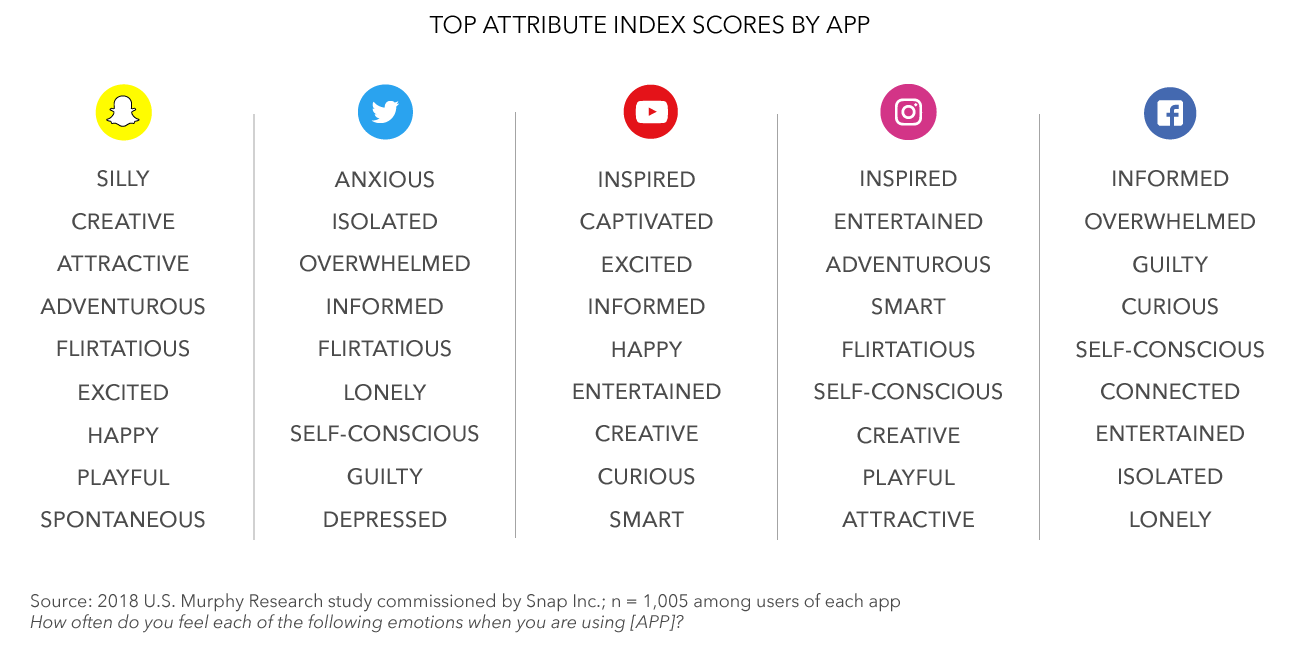
According to the study, 95% of Snapchat users say the app makes them feel happy, more than any other app tested.

Facebook and Twitter make users feel anxious, isolated, overwhelmed, lonely, and even depressed.

Instagram primarily creates positive feelings, although it can also make users feel self-conscious.

YouTube is mostly associated with positive feelings, making users feel creative and entertained.

Here is a breakdown of how people reported the way they feel using different apps.

Snapchat Study Finds it Has the Happiest Social Media Users

Snapchat Study Finds it Has the Happiest Social Media Users

How Users Spend Time on Social Networks

The study finds that people use each social network for different reasons:

  • Snapchat is for conversations between close friends, as well as for playing with Filters and Lenses.
  • Twitter is for keeping up with current events or following discussions.
  • YouTube is for learning about new products or topics of interest.
  • Facebook is for keeping up with family and events.
    Instagram is for influencer and celebrity content.

Snapchat Study Finds it Has the Happiest Social Media Users

Snapchat Study Finds it Has the Happiest Social Media Users

When Are People Using Different Social Networks

People use different social networks depending on what they’re doing at the time.

Here is what the study found:

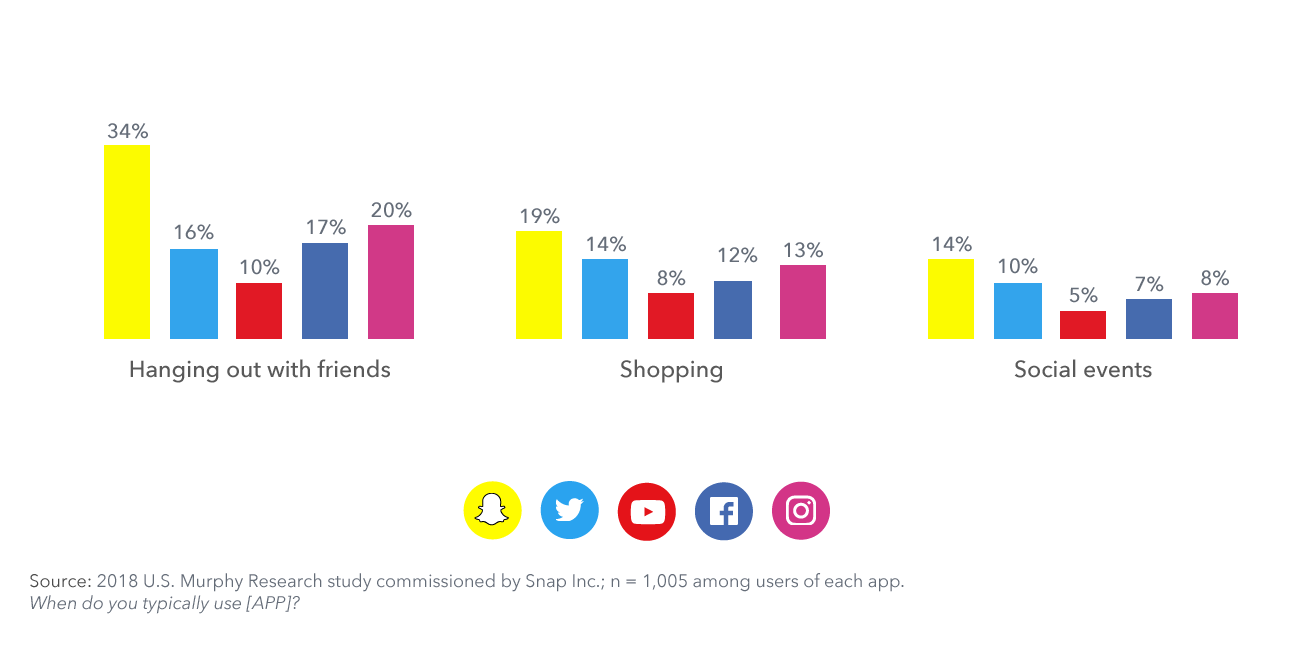
  • Snapchat is most used when on-the-go, with friends, out shopping, and at social events.
  • Facebook is most used at home, while waiting for something, and when unable to sleep.
  • Twitter is most used while commuting.
  • Instagram is most used when hanging out with friends.
  • YouTube is most used at home and when unable to sleep.

Snapchat Study Finds it Has the Happiest Social Media Users

Snapchat Study Finds it Has the Happiest Social Media Users

Snapchat Study Finds it Has the Happiest Social Media Users

Snapchat Study Finds it Has the Happiest Social Media Users

Snapchat Study Finds it Has the Happiest Social Media Users

Snapchat Study Finds it Has the Happiest Social Media Users

Results of the study are based on the responses of 1,005 app users aged 13-44.

Subscribe to SEJ

Get our daily newsletter from SEJ’s Founder Loren Baker about the latest news in the industry!

Ebook

http://tracking.feedpress.it/link/13962/10973387


LinkedIn Reveals the Most In-Demand Skills in 2019 by @MattGSouthern

ADVERTISEMENT

LinkedIn has released a list of professional skills that companies need most in 2019.

There are 50,000 professional skills in the world, according to LinkedIn data.

The company has combed through its data to determine the hard skills and soft skills that are most valuable this year.

“These are the skills your boss and your boss’s boss find most valuable, but have a hard time finding – and the skills that’ll most help you better serve your clients and customers.”

Those who are looking to improve their skill set this year could consider this data a starting point.

Most In-Demand Soft Skills

According to LinkedIn data, 57% of senior leaders today say soft skills are more important than hard skills.

Here’s what they need most and why:

  1. Creativity: Organizations most need creative employees who can conceive the solutions of tomorrow.
  2. Persuasion: The key to having a great product is persuading people to buy into it.
  3. Collaboration: As projects grow increasingly more complex, effective collaboration is becoming more important.
  4. Adaptability: An adaptable mind is an essential tool for navigating today’s ever-changing world.
  5. Time Management: Mastering time management today will serve you the rest of your career.

Most In-Demand Hard Skills

To no surprise, many of the most valuable hard skills are those that can be utilized in today’s increasingly digital world.

Here’s are the top 5 skills companies need most and why:

  1. Cloud Computing: Companies are desperately searching for engineers who have the skills to accommodate a shift toward the cloud.
  2. Artificial Intelligence: Data suggest that the age of AI has arrived.
  3. Analytical Reasoning: Companies are hungry for professionals who can make smart decisions based on vast arrays of data.
  4. People Management: Companies are shifting toward having leaders who can coach and empower powers.
  5. UX Design: This is is the key to making a digital world work for humans.

Here are the rest of the most in-demand hard skills in order:

  • Mobile Application Development
  • Video Production
  • Sales Leadership
  • Translation
  • Audio Production
  • Natural Language Processing
  • Scientific Computing
  • Game Development
  • Social Media Marketing
  • Animation
  • Business Analysis
  • Journalism
  • Digital Marketing
  • Industrial Design
  • Competitive Strategies
  • Customer Service Systems
  • Software Testing
  • Data Science
  • Computer Graphics
  • Corporate Communications

LinkedIn measured demand by identifying the skills listed on the LinkedIn profiles of people who are getting hired at the highest rates. Only cities with 100,000 LinkedIn members were included.

More Resources

Subscribe to SEJ

Get our daily newsletter from SEJ’s Founder Loren Baker about the latest news in the industry!

Ebook

http://tracking.feedpress.it/link/13962/10972009


Facebook Cannot be Deleted from Certain Android Phones by @MattGSouthern

ADVERTISEMENT

Facebook is causing an uproar amongst Android phone owners after discovering the app cannot be permanently deleted.

Specifically, owners of Samsung phones cannot permanently delete Facebook as a result of a pre-install deal made between the two companies.

Facebook can only be “disabled” on Samsung phones, which means the app will forever remain on the phone in some form.

This information caused quite a stir yesterday after an article from Bloomberg started making the rounds on Twitter.

Is there really anything for users to be concerned about? This article will look at it from both sides.

What’s the Deal with Pre-Installs?

Pre-install deals with Android phone manufacturers are not exclusively a Facebook thing, but they are rarely communicated to consumers.

Samsung claims that such arrangements are made in order to provide “the best” experience to users.

There are also financial incentives for phone manufacturers to sign pre-install deals.

According to a Facebook spokesperson, when the app is disabled it acts as though it has been deleted. So it no longer collects data or sends information back to the company.

However, many users are still not satisfied and would prefer the option to delete the app altogether.

Should Users Really be Concerned?

Reputable tech tipster and reverse-engineering expert, Jane Manchun Wong, dissected this issue in a series of tweets published yesterday.

“Samsung only ship the stub version of Facebook on their phones. It’s basically a non-functional empty shell, acts as the placeholder for when the phone receives the “real” Facebook app as app updates”

When a pre-installed app is disabled on an Android phone it will be reverted back to the “non-functional stub,” Wong continues to explain.

Wong assures users that there is nothing to worry about when an app is disabled, as it’s not capable of doing anything.

As far as I can tell, Wong has nothing to gain from clearing up these misconceptions, so it’s the most unbiased take on the situation that I can find at the moment.

Those who are still put off by pre-installs could always consider iPhones. Apple doesn’t pre-install any third-party apps on its devices.

Subscribe to SEJ

Get our daily newsletter from SEJ’s Founder Loren Baker about the latest news in the industry!

Ebook

http://tracking.feedpress.it/link/13962/10971709


Why Social Media Marketing Is Crucial for Your Local Business by @alextachalova

How many people do you think use Facebook actively every month?

Your estimate might actually be low.

Let’s talk about the numbers:

Statista reports that the number of Facebook users in the U.S. (as of October 2018) had reached a whopping 204 million users.

Combine this with the fact that the overall U.S. population is around 327 million, and you can derive that 2 in 3 U.S. citizens are actively using Facebook.

At this point of this guide, now that you know the value of the organic search, you may be looking for other ways to promote your local business.

Facebook (and other relevant social media platforms) can substantially help your local business grow.

If you do it right.

This begs a natural question:

How exactly can your business benefit from being present on social media channels?

We did some homework, so you can get an idea of how exactly local businesses are taking advantage of social media marketing.

Before you decide whether you’re ready to dive into the world of social media marketing, let’s dive a bit deeper into why you should.

Why Local Businesses Should Invest Time & Money in Social Media Marketing

You’re probably already crazy busy promoting your business.

Adding even more marketing tasks might seem a bit like overkill.

Nowadays though, neglecting to incorporate social media into your marketing plan can cost you – not just in terms of new potential customers who don’t know you (and who your competitor is happy to collect!) but also in terms of retaining your existing customers.

By building a relationship with your clients, your chances of retaining them increase, and so does their potential lifetime value.

Now let these other compelling arguments convince you even more:

‘Hey, Guys… Does Anyone Know a Good…’

Folks on social are constantly asking their friends for recommendations for almost everything, ranging from local restaurants to car repairing services.

Social media platforms (as the marketing machines that they are) hone in on these conversations.

Facebook Recommendations

For example, Facebook offers users a dedicated feature that allows them to ask for recommendations in an area where they live.

Once a user seems to be asking for local tips in a status update, a special algorithm is fired that recognizes recommendation requests.

Based on the answers of Facebook friends in the comments, the feature then pulls up the exact locations of businesses mentioned.

This means the local business will be tagged automatically, visible for the user who asked the question, and anyone else who sees the post.

Similar features have been rolled out on other social media platforms.

So what happens if you aren’t there? Crickets…

‘Worst Service Ever!’

Even if you aren’t active on social media, people will talk about your business.

Customers share their feedback, good and bad, and you need to be aware of it.

  • If it’s good, GREAT! You can capitalize on that satisfied customer, by leveraging their praise to get more customers or have your happy ones come back for more.
  • If it’s bad, GREAT! You can control the conversation by showing your excellent customer service skills. Turn the grumpy complainer into a blazing fan by really listening to their issue and solving it.

It usually isn’t about making a mistake – mistakes are inevitable for any business.

Really, it’s about how you correct it.

And a bonus? You get to learn more about what your customers really think, and improve your business accordingly.

Know what happens when you aren’t there?

Complaints go viral, and your competitor offers to help out your customer. Because they were listening.

Cut Your Ad Costs by Local Advertising

Social media platforms were not built for their users, but for advertisers.

Location is one of the many specific demographic aspects you can target your ads on.

If you laser target your ads on the people who are based in your area, their interests, and some other demographic details, you will achieve the highest customer potential with the lowest costs.

Furthermore, by tweaking the targeting and the content of your ads, you learn more about ideal leads than any survey can tell you, for a fraction of the cost!

And what if you don’t use these ads features? You keep firing aimlessly, while your competition targets the golden nuggets.

Let the Fans Speak for You

Social media marketing lends itself perfectly for building a passionate community around your brand.

There’s no better way to encourage people to promote you than helping them to connect with like-minded people.

This is more than just owning the conversations around your products or services.

You’re also creating long-term relationships with, and between, customers.

Happy customers will take care of word-of-mouth marketing for you – and even part of your customer service.

Also, they will come back to you for more business. Again and again.

Some Ideas to Illustrate Community Building

Suppose you own a shop in craft supplies and want to become more visible to potential buyers.

You could showcase finished projects from your customers on Pinterest and Facebook, and invite people to ask questions and tips from the makers.

This will get the ball rolling in people sharing their crafty accomplishments, struggles, and dreams, all around your products!

Another great example is building a community around detoxing and weight loss, for a local juice bar.

People can inspire and support each other in their health goals, while you can share the latest juice recipes and congratulate everyone on their progress.

You might organize meetups in your bar, before or after workouts. All done quite easily with the functionality social media provides you.

If you don’t have a community, you are definitely missing out on establishing yourself as a strong brand, with fairly low-cost effort. A community is an asset that will pay itself back multiple times.

Easy Promotion of New Products & Services

While spreading the news about new products and services through traditional local channels still has its merits, getting the word out through social media can give your campaign a huge boost.

Through social advertising, your community and your own page, you have several options to “show what you’ve got”. And you can do this with images, text, and video.

It’s amazing when you can actually show your product in action from all angles!

Moreover, you can let your fans spread the news for you. If you have shareable content, they will pass it on.

If you have followers that are raving about your new thing, let their positive reviews shine!

The more their love for you gets the spotlight, the more attractive you will be for others.

Not using social media marketing for your new products? Then you’re giving your customers a very limited experience in getting a taste of what’s to come.

Free Mass Publicity

Throughout this chapter, you might have been rolling your eyes, thinking: “Does this mean I have to spend all my time reacting to everyone on social?”

I hear you. And no, you don’t.

Though you should pay attention to what your customers tell you about their experience, you don’t have to bend over backwards for every voice out there.

Some social influencers have become so accustomed to companies quivering in their boots for any negative tweet or post, they assume they are all powerful.

However, if you remain authentic, open in your communication, and use a bit of clever banter, you will often find yourself on the winning side of things.

People are getting quite fed up with spoiled insta celebs and will gather behind you. And if you get lucky (or is it luck if you play it smart?) – you can end up being featured in the mass media.

The White Moose vs. Elle Darby

A great example of this is the online feud between Irish restaurant The White Moose Cafe, and YouTube blogger Elle Darby.

Darby asked (through cold email) for a free room in exchange for a review. To which The White Moose reacted by sharing her email (with personal details hidden) in a post criticizing the current favor demanding an attitude of bloggers.

Reactions from both sides went back and forth for a while, while many others chimed in, sharing and commenting on their posts.

Meanwhile, The White Moose were selling feud-related merch and producing one popular social media post after another.

Oh, and they got featured in 114 articles, in 20 countries, reaching about 450 million people. For free.

Though getting this kind of publicity depends on a lot of factors, I believe that being alert and ready for these events creates opportunities.

Or, as Louis Pasteur says: “Fortune favors the prepared mind.”

If you aren’t ready, someone else might be!

Now that I’ve hopefully convinced you into accepting the necessity of SMM for your local business, here’s how to start.

Which Social Media Platforms Are Best for Your Business?

Face it, you can’t do everything at once.

Well, some companies can (thanks to amazing tools and teams).

To start, however, you should focus on one or two channels first.

Need help selecting the right social media platforms for you?

Here are some tips to decide which networks to focus on.

Type of Content

This can vary, from images and videos to written content.

Let’s imagine you’re providing plumber or dental services, in which case it’s hard to post a few photos per day (compared to restaurants and shops that prefer to focus on visual content).

This means that Instagram won’t work for each and every local business, as opposed to Facebook.

I believe that a local business should have a company page on Facebook (see image below) where a potential customer can find all necessary info (i.e., working hours, location, site, and services you provide).

Cleaning Company - Facebook Page Details

Cleaning Company - Facebook Page Details

Where & When Is Your Audience Most Active?

Having a page on a channel doesn’t mean that you need to produce posts on a daily basis.

For instance, if your audience isn’t really actively engaging on Facebook, then posting a few times per month should be enough.

However, if you’ve found out that your current and potential customers are actively engaging with your competitors and industry niche pages, then it’s a green light for you, too.

Another thing that’s worth checking is Facebook groups. With the help of Facebook closed groups, you can find:

  • The most urgent and viral topics.
  • What sort of content resonates best with your audience.
  • What influences their buying decisions.

The same goes for other social media channels. So research other local businesses on Instagram, YouTube, Twitter, Reddit, and Pinterest.

Here you can find an overview of the most popular social media channels by the number of users.

What Is Your Budget?

Take into consideration the number of hours you can invest in this and/or the budget you have.

Nowadays, successful social media managers spend a good amount of time on creating social media posts – but even more hours engaging with their audience.

Conversations and engagement are the main keys to social media success.

Likes and shares won’t help your community grow as much as comments and interactions.

This is why you need to understand whether you have enough resources to be present (e.g., cover just the social media basics, post something from time to time) or active (all the basics, posting daily, plus interacting with and quickly responding to people) on social media.

Connecting Your Offline Customers with Your Social Media Platforms

Once you’ve selected the right social media platforms, you’re going to face another painful issue: your audience is still split between the online and offline world.

This is where all brands are struggling more or less, with clients who are constantly consuming their products but are not a part of their social media community.

You need to connect users who are consuming your products/services offline with your online activity. They can help you grow your presence, leave positive reviews, and connect your business to a location because they are connected to the area around it.

So how does that work?

Here are a few ideas on how you can do it:

  • Ask them to check out your business on social media by giving them a printed card with all your details.
  • Make a photo corner where they can make a photo/selfie and showcase of other clients that have already participated in. Remember, social media marketing is 1,000x more effective when it’s about your happy customers (not YOU). So put them in the spotlight!
  • Create a giveaway.
  • Give people a discount on their current purchase/bill if they join your online community.
  • Invite them to a special sale that will be running exclusively for your community.

Takeaway

Being online for businesses has become very, very local.

Everyone on social media is being located, by the things that they like and the things that they do.

Social media marketing can be an effective, fairly low-cost way to create greater visibility for your local business.

So be one of the things that a lot of locals like on their news feed, and more of them will follow.


Image Credits

Featured Image: Paulo Bobita
Screenshot: Taken by author

A Guide to Local SEO

Ebook

http://tracking.feedpress.it/link/13962/10949254


How to Get Your Sales Team to Use Social Media: A 6-Step Plan

Social Media Marketing

Industry Report

In our 10th annual social media study (44 pages, 70+ charts) of 5700+ marketers, you’ll discover which social networks marketers most plan on using, organic social activities, paid social media plans, and much more! Get this free report and never miss another great article from Social Media Examiner.

https://www.socialmediaexaminer.com/how-to-get-your-sales-team-use-social-media-6-step-plan/