Facebook to Pack More Details Into Descriptions of Images for Blind, Visually Impaired People


Facebook revamped its automatic alt text experience, which provides detailed descriptions of images for people who are blind or visually impaired.

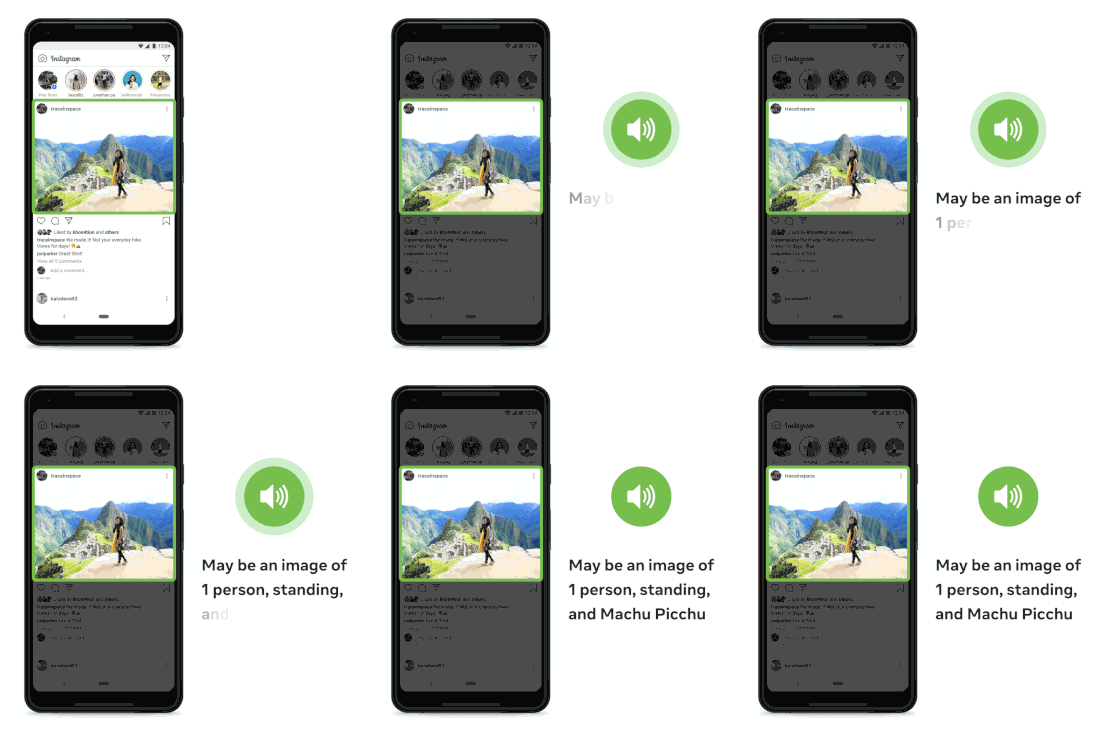
The social network introduced AAT in April 2016, using artificial intelligence and object recognition to automatically generate descriptions of photos on-demand.

Instagram added AAT in November 2018.
Instagram

AAT is available to people using screen readers, an assistive technology that converts text and other on-screen elements to speech.

Facebook wrote in a Newsroom post Tuesday, “When Facebook users scroll through their News Feed, they find all kinds of content—articles, friends’ comments, event invitations and. of course, photos. Most people are able to instantly see what’s in these images, whether it’s their new grandchild, a boat on a river or a grainy picture of a band onstage. But many users who are blind or visually impaired can also experience that imagery, provided it’s tagged properly with alternative text. A screen reader can describe the contents of these images using a synthetic voice and enable people who are BVI to understand images in their Facebook feed.”

The company’s AAT technology can now recognize more than 1,200 objects and concepts, over 10 times the number when the tool was introduced in 2016, meaning that more photos will now have descriptions.

Those descriptions are also more detailed, as the updated technology can identify activities, animals, landmarks and other details, with Facebook offering as an example: “May be a selfie of two people, outdoors, the Leaning Tower of Pisa.”

The social network also made it possible to include information about the positional location and relative size of elements in a photo, providing these examples:

Instead of providing a photo description of “may be an image of five people,” it can now specify that there are two people at the center of the photo and three others scattered toward the fringes, implying that the two in the center are the focus.

Instead of describing a landscape as, “may be a house and a mountain,” Facebook can now highlight that the mountain in the primary object, based on how large it appears in comparison with the house at its base.

The social network said AAT is available for photos in groups, News Feed and profiles, as well as when images are open in the detail view, where the image appears full-screen and the background is black.

Alt text descriptions are phrased simply, enabling them to be translated into 45 different languages.

Facebook

Facebook

Facebook

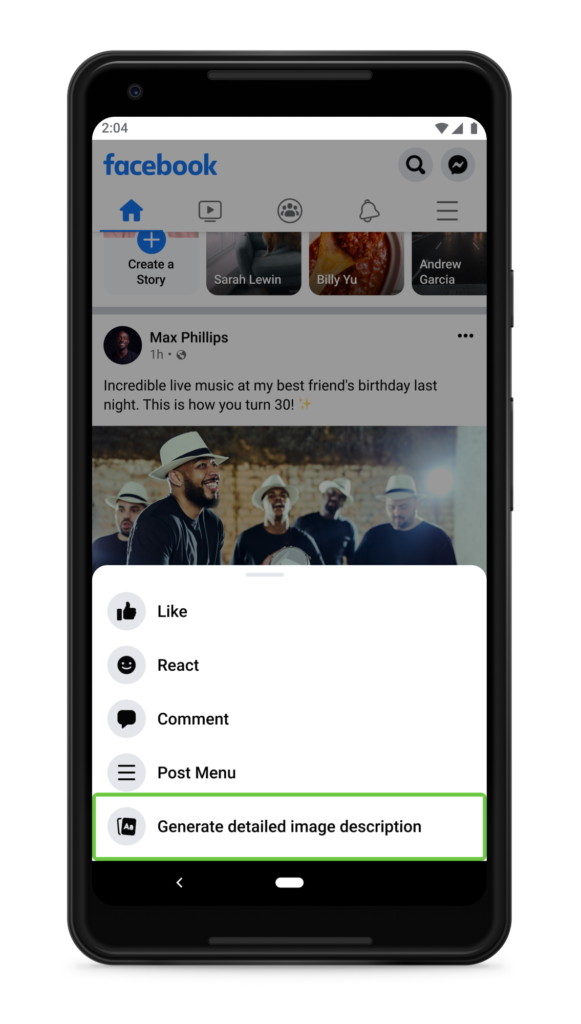
Facebook said it asked users who depend on screen readers for feedback on the types of information they wanted to hear and when they wanted to hear it, finding that they wanted more information when images were from friends and family and less when they were not.

The social network explained what happens when users opt for more detailed descriptions: “A panel is presented that provides a more comprehensive description of a photo’s contents, including a count of the elements in the photo, some of which may not have been mentioned in the default description. Detailed descriptions also include simple positional information—top/middle/bottom or left/center/right—and a comparison of the relative prominence of objects, described as ‘primary,’ ‘secondary’ or ‘minor.’ These words were specifically chosen to minimize ambiguity. Feedback on this feature during development showed that using a word like ‘big’ to describe an object could be confusing because it’s unclear whether the reference is to its actual size or its size relative to other objects in an image. Even a chihuahua looks large if it’s photographed up close.”

https://www.adweek.com/media/facebook-to-pack-more-details-into-descriptions-of-images-for-blind-visually-impaired-people/


WhatsApp Pushes Back Feb. 8 Deadline to Accept Its New Terms

WhatsApp responded to pushback over the new terms of its recent update, postponing the Feb. 8 deadline it had initially imposed for users to review and accept the terms.

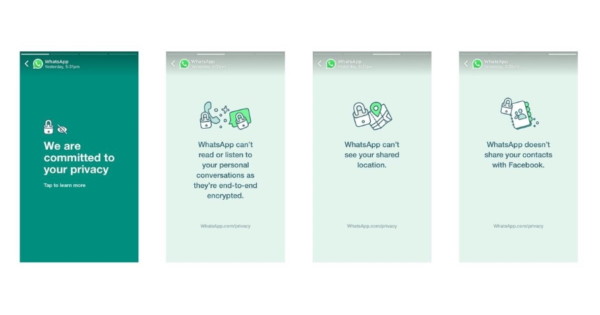
Despite attempts earlier this week to clarify details of its new terms and reassure users that neither WhatsApp nor parent company Facebook can see their messages, hear their calls or see their shared locations, and that the update mainly applies to messaging businesses via the platform, privacy advocates—and even longtime Facebook critic Elon Musk—urged WhatsApp users to opt for alternatives such as Signal and Telegram.

Telegram said earlier this week that it topped the 500 million active user mark, gaining over 25 million new users worldwide in 72 hours.

WhatsApp said in a blog post Friday, “We’re now moving back the date on which people will be asked to review and accept the terms. No one will have their account suspended or deleted Feb. 8. We’re also going to do a lot more to clear up the misinformation around how privacy and security works on WhatsApp. We’ll then go to people gradually to review the policy at their own pace before new business options are available on May 15.”

https://www.adweek.com/media/whatsapp-pushes-back-feb-8-deadline-to-accept-its-new-terms/


Facebook, NYU Langone Health Use AI to Predict Health of Covid-19 Patients

Facebook’s use of machine learning to predict the types of content users are most interested in seeing in their News Feeds has been chronicled often through the years, but the social network is also working on potential ways to predict the treatment and resource needs of Covid-19 patients as part of its ongoing collaboration with NYU Langone Health’s Predictive Analytics Unit and Department of Radiology.

The two parties developed three machine learning models that may be able to help doctors predict how their patients’ conditions will develop and ensure that they have sufficient resources on hand to care for those patients:

  • A model for predicting patient deterioration based on a single X-ray.
  • A model for predicting patient deterioration based on a sequence of X-rays.
  • A model for predicting how much supplemental oxygen (if any) a patient might need based on a single X-ray.

Research engineer Matthew Muckley, research assistant Koustuv Sinha, research engineer Anuroop Sriram and program manager Nafissa Yakubova wrote in a blog post, “Our model using sequential chest X-rays can predict up to four days (96 hours) in advance if a patient may need more intensive care solutions, generally outperforming predictions by human experts. These predictions could help doctors avoid sending at-risk patients home too soon and help hospitals better predict demand for supplemental oxygen and other limited resources.”

NYU Langone Health professor of radiology William Moore added, “We have been able to show that with the use of this artificial intelligence algorithm, serial chest radiographs can predict the need for escalation of care in patients with Covid-19. As Covid-19 continues to be a major public health issue, the ability to predict a patient’s need for elevation of care—for example, intensive care unit admission—will be essential for hospitals.”

Facebook and NYU Langone Health are open-sourcing their pretrained models and publishing their research so that the broader community can benefit from it and build upon it.

https://www.adweek.com/media/facebook-nyu-langone-health-use-ai-to-predict-health-of-covid-19-patients/


Why Fox Sports Put a Billboard Saluting North Carolina Fans in Duke Territory

Just over 11 miles separate Chapel Hill and Durham, N.C., homes to fierce basketball rivals the University of North Carolina and Duke University, respectively. While the flames of that rivalry hardly require any further stoking, a new billboard in Durham may do just that.

Fox Sports encouraged college basketball fans to vote via Twitter last spring on which team had the best fan base in the sport, with the winner receiving a billboard in their rival’s territory.

Tar Heel Nation came through in a big way, as North Carolina topped the vote, leading to the billboard in Durham, which was unveiled this week and will remain through the Tarheels’ visit to Duke Feb. 6.

The idea came from Mark Titus, a former walk-on to the basketball team at Ohio State University, who currently co-hosts podcasts The People’s Sports Podcast and Titus & Tate.

“The idea came when March Madness was canceled,” Titus told Adweek. “All of us looked at each other and said, ‘Now what?’ We had been building toward March and never had the climatic excitement of competition.”

Titus said college hoops fans were initially lukewarm to the idea, but interest began to grow, adding, “The same people who said, ‘This is stupid,’ were saying, ‘We have to win this.’”

When North Carolina emerged victorious, Titus & Tate co-host Tate Frazier’s mother suggested a location for the billboard near the residence of Duke head coach Mike Krzyzewski, but it ended up in a different spot.

The billboard was “symbolic of staking a flag in your opponent’s territory,” Titus told Adweek. “The gesture is as old as time. The biggest ‘FU’ to your rival was conquering their territory and sticking your flag in their territory. The modern version was a billboard. We wanted it to slowly chip away at the loser.”

This marks the second billboard execution for Fox Sports, following last December’s salute to the National Football League’s Buffalo Bills in Foxborough, Mass., home of the bitter division rival New England Patriots.

ESPN also turned to social networks to engage with college sports fans, focusing on the gridiron instead of the hardwood.

ESPN crowdsourced social media to identify 140 of this past season’s biggest college football fans, including top engagers on its social properties and virtual fans of College GameDay.

Fans who were selected received premium gift boxes with swag including baseball caps, cameras and headphones, and a select group received special social shoutouts from the network’s college football talent, including Rece Davis, Chris Fowler, Kirk Herbstreit, Desmond Howard, David Pollack, Laura Rutledge and Maria Taylor.

ESPN shared this tweet featuring some of the winning fans’ reactions and unboxing moments.

The network also aired the spot below prior to the College Football Playoff National Championship game Monday night to thank the college football community for coming together despite all of the challenges this season due to Covid-19.

ESPN vice president of sports marketing Emeka Ofodile said in a statement, “We always knew that the passion of college football fans was strong, but this season really showed how deep it runs. No matter the circumstance, the fans showed up to support their team and to support college football. It is something worth celebrating and showing appreciation for how much fans bring to this game.”

https://www.adweek.com/media/why-fox-sports-put-a-billboard-saluting-north-carolina-fans-in-duke-territory/


Facebook Files Lawsuit Over Data Scraping in Portugal

Facebook and Facebook Ireland filed a lawsuit in Portugal against two individuals for scraping user profiles and other data from its website, calling their actions a violation of the social network’s terms of service, as well as Portugal’s Database Protection Law.

Director of platform enforcement and litigation Jessica Romero said in a Newsroom post Thursday that the two individuals developed browser extensions under the name Oink and Stuff and made them available on the Google Chrome store, misleading users by stating in its privacy policy that personal information was not being collected.

Romero added that four extensions—Blue Messenger, Emoji Keyboard, Green Messenger and Web for Instagram Plus DM—contained hidden code that caused them to function like spyware.

She explained, “When people installed these extensions on their browsers, they were installing concealed code designed to scrape their information from the Facebook website, but also information from the users’ browsers unrelated to Facebook—all without their knowledge. If the user visited the Facebook website, the browser extensions were programmed to scrape their name, user ID, gender, relationship status, age group and other information related to their account. The defendants did not compromise Facebook’s security systems. Instead, they used the extensions on the users’ devices to collect information.”

Facebook is seeking a permanent injunction against the two defendants and demanding that they delete all Facebook data in their possession.

https://www.adweek.com/media/facebook-files-lawsuit-over-data-scraping-in-portugal/


Media Rating Council Accredits Google’s Ads Data Hub

Google said Thursday that its Ads Data Hub was accredited by the Media Rating Council for SIVT-filtered (sophisticated invalid traffic), rendered and viewable video ad impressions and TrueView views generated via the Ads Data Hub user interface and application-programming interface.

The company added that as of Thursday, Comscore, DoubleVerify, Dynata, Kantar, Integral Ad Science, Moat by Oracle Data Cloud and Nielsen completely switched to Ads Data Hub-based reporting, joining partners that had already been doing so.

Ads Data Hub is the Google-owned video site’s cloud-based, privacy-centric measurement and analytics solution.

It enables marketers to ensure end-user privacy by enforcing privacy checks and aggregating Google data before it leaves the company’s Cloud project

Ads Data Hub does not rely on pixels, so advertisers can access measurement and insights across desktop and mobile purchased via YouTube and Google ad platforms including Google Ads and Display & Video 360.

And it enables cross-publisher reporting by third parties that are privacy-centric.

Google group product manager for analytics, insights and measurement Prema Sampath wrote in a blog post, “We are committed to fostering a healthy measurement partner ecosystem, with privacy at its core. With the MRC accreditation of Ads Data Hub and the full migration of global third-party brand-measurement partners, advertisers will gain more comprehensive reporting and measurement, using technology that’s built to enhance user privacy. We are thrilled to mark a big step toward durable, privacy-centric, trustworthy measurement and remain committed to innovation for more capabilities in the future.”

https://www.adweek.com/programmatic/media-rating-council-accredits-youtubes-ads-data-hub/


CES 2021: What Happened in Vegas Stays on Pinterest

As has been the case for most major events since last March, screens are replacing the Las Vegas Convention Center for CES 2021, and Pinterest is helping brands on its platform re-create the CES experience on those screens.

Pinterest said its top customers are using its platform to share the full-in person experience of CES virtually and fulfill their goals of sharing the latest product news and audience insights via decks, talks and videos built out by Pinterest, which are accessible throughout organizations, giving viewers access to more executives than they would otherwise encounter on the show floor and during sessions.

One of those tech brands is Motorola, which began using automatic bidding from Pinterest in the fourth quarter of 2020 and saw it become the most efficient driver of qualified site traffic among its social efforts.

Searches for electronics on Pinterest were up 70% year-over-year from January through November 2020, and the platform said it has identified 75 million technology and telecommunications early adopters that can be reached via its Ads Manager.

Global head of strategy and marketing, travel and technology Ashish Arya and insights lead Eric Alessi wrote in a blog post, “There weren’t many choices to make when we bought our first cell phones: Make, model, storage size—and that was pretty much it. Everyone’s phones more or less looked the same. And in some ways, that was part of the appeal. Having the same device as your friends was like a status symbol, or a way to fit in.”

That is no longer the case, as the desire to personalize has taken over. A Pinterest study found that 50% of technology shoppers choose devices that match their style or personality, with that number jumping to 60% among Pinners.

Arya and Alessi pointed out that while price and functionality are still the primary drivers behind purchase decisions, shoppers are also factoring in color palettes, form factor and aesthetics, as well as accessories such as cases and charms, and how well the devices can support their hobbies via add-ons or applications.

As mentioned in the Pinterest Predicts report that was released last December, digital décor was tabbed as a top trend for 2021, with Pinners searching for things like custom icons, lock screens and playlist covers. The debut of Apple’s iOS 14 last September was also a factor.

Pinterest

With people confined to their homes by the pandemic, searches for computer and gaming setups rose by nearly three times from November 2019 through November 2020, with people transitioning from stopgap solutions to more permanent setups.

Arya and Alessi wrote, “Work-from-homers need flexibility and comfort—whether they’re in a sprawling home office or working out of a closet. That makes ergonomics, device compatibility and space efficiency more important than ever. For gaming, people want equal parts specs and aesthetics. First, they have to get the equipment right: mics, monitors and so on. But they’re also looking up more stylish elements, trying to create just the right mood. That means queries like ‘custom gaming desks,’ ‘RGB lights’ and ‘vibey lights.’”

Pinterest

Pinterest shared three ways that device manufacturers and app marketers can incorporate the move toward personalization into their strategies:

  1. Offer a range of sizes, colors and configurations: Think about the different ways that people incorporate devices into their homes and routines. You can even include tools on your site to help people configure the perfect option.
  2. Show people how your devices can fit their style: As you develop campaigns and ad creative, think about showing devices in different kinds of décor, or supporting different kinds of hobbies.
  3. Make it easy to customize the user experience: Think about how people will interact with your app or your screens. You can even offer different presets for specific aesthetics or interests to help people out.

https://www.adweek.com/media/ces-2021-what-happened-in-vegas-stays-on-pinterest/


TikTok Tightens Up Privacy Settings for Users Under 18

TikTok Wednesday implemented several privacy and safety measures aimed at protecting its users under the age of 18.

The default privacy setting for all registered accounts for users between the ages of 13 and 15 was set to private, meaning that only people approved by those users can view their videos.

The comment setting for that age group enabling everyone to comment on their videos was removed, meaning that users 13 through 15 have the choices of friends or no one.

TikTok’s Duet and Stitch features are now limited to users 16 and older, and the default settings on those features for people aged 16 and 17 will be friends.

Videos can now only be downloaded from creators 16 and older. While all users can decide whether to allow downloads of their videos, the default for those 16 and 17 will be set to off.

The “suggest your account to others” setting will be set to off by default for users 13 through 15.

These moves follow previous updates from TikTok, including: restricting direct messaging and livestream hosting to users 16 and over; restricting the buying, sending and receiving of in-application virtual gifts) to those 18 and over; and enabling parents and caregivers to set guidelines via TikTok’s Family Pairing feature.

TikTok will also team up with Common Sense Networks to refine its TikTok for Younger Users limited app experience for kids under the age of 13.

Head of U.S. safety Eric Han wrote in a blog post Wednesday, “We know there is no finish line when it comes to protecting users and their privacy, and our investment in this important area won’t stop here. We’ll continue to evolve our policies, work closely with regulators and experts in minor safety and invest in our technology and teams so that TikTok remains a safe place for everyone to express their creativity.”

https://www.adweek.com/media/tiktok-tightens-up-privacy-settings-for-users-under-18/


Twitter Took Action Against 4,658 Accounts for Covid-19 Misinformation in the First Half of 2020

Twitter took enforcement action against 4,658 accounts for misleading information about Covid-19 during the time period between when it implemented its policies last March and June 30, 2020, and the social network’s automated systems challenged 4.5 million accounts that were targeting discussions around Covid-19 with spammy or manipulative behaviors, according to the 17th Twitter Transparency Report, which covers the first six months of 2020.

During that time period, Twitter took action on more than 52,000 accounts that it reliably attributed to state-backed information operations originating in China, Egypt, Ghana, Honduras, Indonesia, Nigeria, Russia, Saudi Arabia, Serbia and Turkey.

Twitter saw a 54% increase in anti-spam challenges from January through June 2020 compared with the previous six months, attributing much of the gain to proactive measures it put in place to protect the conversation around Covid-19, and spam reports were up 16%.

The number of accounts removed for violations of Twitter’s terrorism and violent extremism policies was up 5% in the first six months of 2020 versus the second half of 2019, with 94% of those accounts proactively identified, including by leveraging data from the shared industry hash database supported by the Global Internet Forum to Counter Terrorism.

Twitter also saw a 68% jump in child sexual exploitation content removed from its platform and reported to the National Center for Missing and Exploited Children from January through June 2020 compared with July through December 2019.

The social network said it received 19% more Digital Millennium Copyright Act takedown notices during the first six months of 2020 than in the second half of 2019, affecting 87% more accounts, but its trademark notice compliance fell by 30% during the period.

Twitter detailed other changes in its rules enforcement in the first half of 2020 versus July through December 2019:

  • Abuse/harassment: Actions were taken against 34% more accounts.
  • Civic integrity: Actions were taken against 37% more accounts, driven by elections taking place across the globe.
  • Hateful conduct: 35% fewer accounts were acted upon, and Twitter noted that its hateful conduct policy was expanded in March 2020 to cover new facets of dehumanization, including the prohibition of language that dehumanizes people on the basis of age, disability and disease.
  • Non-consensual nudity: Enforcement actions were down 58%.
  • Private information: Enforcement of this policy climbed 68%.
  • Promoting suicide and self-harm: Action was taken against 49% fewer accounts.

Twitter received 12,657 legal requests for account information from January through June 2020, specifying 25,560 accounts, from 68 different countries.

The social network also received 42,220 legal demands to remove content, specifying 85,375 accounts, from 53 different countries. Twitter said 96% of the total global volume came from five countries—Japan, Russia, South Korea, Turkey and India—and they impacted roughly 13% fewer accounts than in the second half of 2019.

Twitter received 19% more reports based on local laws from trusted reporters and non-governmental organizations in the first six months of 2020 than from July through December 2019, impacting about 7% more accounts.

Twitter wrote, “As noted throughout the report, the Covid-19 pandemic did significantly disrupt our content moderation work during this time—a disruption that is reflected in much of the data presented today. Our enforcement teams have adjusted their approach in the context of a pandemic and are continuing to increase their capacity to get back to the strong pre-Covid levels of enforcement that is expected.

The social network concluded, “There will always be more work to do in this space, and we’ll continue to provide biannual Twitter Transparency Reports that offer more clarity into our operations and work to protect the public conversation. We also recognize the importance of measuring prevalence of certain content on Twitter, and we have begun a multiyear initiative to enable us to provide more consistent transparency on these issues. We look forward to sharing more details in due course.”

https://www.adweek.com/media/twitter-took-action-against-4658-accounts-for-covid-19-misinformation-in-the-first-half-of-2020/


Workplace From Facebook Adds Safety Center

Enterprise platform Workplace From Facebook added a Safety Center and made some improvements to its live video experience.

https://www.adweek.com/media/workplace-from-facebook-adds-safety-center/