TikTok: How to Add Text-to-Speech to Posts


TikTok began rolling out a new text-to-speech feature this week that will automatically convert text to a voiceover as users watch videos that have the feature enabled. Our guide will show you how to activate text-to-speech on your videos before posting them.

Note: These screenshots were captured in the TikTok application on iOS.

Step 1: Once you’ve recorded or uploaded a video in TikTok, tap the “Text” button at the bottom of the screen.

Step 2: Type your desired text, and then tap “Done” in the top-right corner of the screen.

Step 3: Tap the text you typed.

Step 4: Tap “Text-to-speech.” This will cause the application to convert this text to speech that becomes part of the video’s audio.

From there, you can continue editing your post as normal.

https://www.adweek.com/digital/tiktok-how-to-add-text-to-speech-to-posts/


Republicans Express Displeasure With Social Platforms’ Handling of Political Content


Decisions made by social platforms regarding election content drew the ire of people on both sides of the political spectrum, but a new report from Pew Research Center found that Republicans were far more likely to be critical.

Pew surveyed 12,648 U.S. adults between Nov. 18 and 29, with respondents from its American Trends Panel weighted to be representative of the U.S. adult population by gender, race, ethnicity, partisan affiliation, education and other categories.

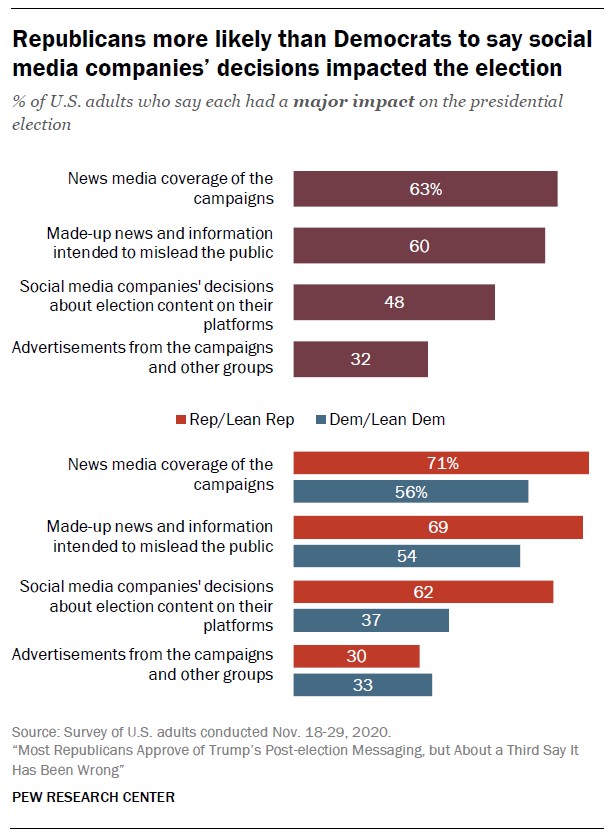
Overall, 60% of respondents believe made-up news and information had a major impact on the 2020 presidential election, while 63% believe new media coverage had a major impact.

Turing to social networks, 48% of respondents believe the decisions made by those platforms on election content had a great effect on the results, with 32% feeling the same way about campaign ads.

Republicans were far more likely than Democrats to say that decisions by social media companies had a major impact on the election, at 62%, compared with 37%.

The same partisan divide surfaced when asked whether news media coverage (71% of Republicans, 56% of Democrats) and made-up news (69% and 54%, respectively) impacted the vote.

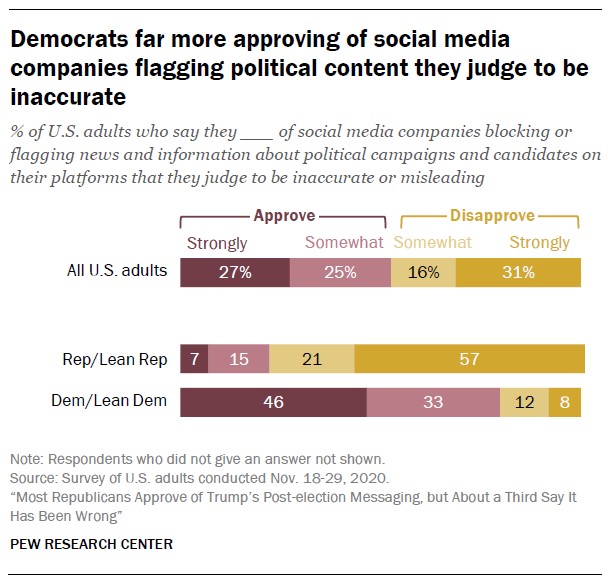
Respondents were largely divided on social platforms’ decisions to block or flag election news and information that they believed to be inaccurate or misleading, with 51% approving and 47% disapproving.

However, along party lines, 78% of Republicans disapproved of decisions by social networks.

A total of 60% of respondents believe made-up news and information had a major impact on the election, with Democrats and Republicans both overwhelmingly seeing it as affecting their own party.

Pew Research Center

Pew Research Center

Other findings from Pew’s new report included:

  • 91% of Democratic respondents believe President-elect Joe Biden has been delivering the right message since the election ended, while outgoing President Donald Trump has been delivering the wrong message.
  • Republicans who disagree with Trump’s post-election messaging are more likely to be young adults, have college degrees and be Hispanic. Republicans who describe their political ideology as moderate or liberal are far more likely to disapprove of Trump’s messaging than conservative Republicans, at 51% versus 20%.
  • One-half of respondents know that in modern history, there has never been a case of a losing presidential candidate refusing to publicly concede prior to Inauguration Day, but this, too, was split along party lines, with 64% of Democrats correctly answering this question, compared with 36% of Republicans.
  • 42% of respondents believe allegations of voter fraud have received too much attention, while 31% said they have received too little attention and 25% saw it as about the right amount. This, too, was split on party lines, with 58% of Republicans believing these allegations received too little attention (compared with just 8% of Democrats), 22% saying they received the right amount (versus 28% of Democrats) and just 18% saying they received too much attention (compared with 63% of Democrats).
  • Asked about the news media overall, 69% of Democrat respondents said it provided largely accurate coverage after the polls closed, compared with just 18% of Republicans.
  • One-half of Democrats believe the news sources they turned to did very well at explaining the process of counting votes after the polls closed, versus just 16% of Republicans.
  • The share of respondents paying close attention to Covid-19 remained largely unchanged from mid-October through late November, with 37% following it very closely—47% of Democrats, versus 28% of Republicans.
  • Far more Democrats (45%) than Republicans (21%) changed their Thanksgiving plans due to the pandemic, as Republicans (56%) were fare more likely than Democrats (13%) to say that the pandemic has been exaggerated (although that Republican number has slipped by roughly five percentage points in recent weeks).

https://www.adweek.com/digital/republicans-express-displeasure-with-social-platforms-handling-of-political-content/


LinkedIn Product Pages Roll Out for Company Pages

LinkedIn officially debuted LinkedIn Product Pages Tuesday, providing a dedicated tab on company pages for companies to nurture conversations about and build brand affinity for their products. The professional network said it already has more than 10,000 LinkedIn Product Pages across the business-to-business software category, with plans to add more industries in 2021. LinkedIn pointed… https://www.adweek.com/digital/linkedin-product-pages-roll-out-for-company-pages/


LinkedIn: How to Stop LinkedIn From Showing You Personalized Ads Outside the Platform


Did you know that LinkedIn has the ability to show you personalized ads on other applications and websites outside of the LinkedIn platform? This can happen even if you aren’t currently logged into the professional network’s services. If you want to stop LinkedIn from showing you personalized ads outside of the LinkedIn platform, our guide will show you how to turn this setting off.

Note: These screenshots were captured in the LinkedIn app on iOS. Also note, even if you turn this setting off, you may still see LinkedIn’s ads on other platforms, but they will not be personalized based on your LinkedIn data.

Step 1: Tap your profile picture in the top-left corner of the screen.

Step 2: Tap “Settings.”

Step 3: Tap “Advertising data.”

Step 4: Scroll down to the “Third-party data” section and tap “Ads beyond LinkedIn.”

Step 5: Tap the toggle to stop LinkedIn from showing you personalized advertisements outside of the LinkedIn platform.

https://www.adweek.com/digital/linkedin-how-to-stop-linkedin-from-showing-you-personalized-ads-outside-the-platform/


Beekman 1802’s Iconic Goats Star in New Snapchat AR Lens


Skincare brand Beekman 1802 wants to get Snapchatters’ goat.

The company started on the historic Beekman farm 12 years ago, with 100 goats, and goat milk is the base for its products.

The company recently rolled out its new probiotic skincare products at 400 Ulta Beauty stores nationwide, and it turned to its goats to help battle the challenges of doing this during a pandemic.

Beekman 1802 teamed up with Fishermen Labs on a Snapchat augmented reality lens that turns shoppers into goats, giving them floppy ears and adorable noses, while showing them what their skin will look like after using its new probiotic skincare products.

Beekman 1802/Snap Inc.

When the camera on the Snapchat application is flipped into world view, a goat appears out of thin air and struts up and down the aisles of the store, or wherever the user is.

Beekman 1802/Snap Inc.

Beekman 1802/Snap Inc.

The lens has tallied some 2.6 million impressions to date.

Beekman 1802 CEO Tomei Thomas said in a statement, “There’s no handbook on how to launch a new skincare range at a major retailer during a pandemic. Our goal was to find a fun and interactive way to introduce Ulta Beauty shoppers to Beekman 1802, our farm and 100 goats. So, we used AR to turn Snapchatters into goats with glowing skin and gave them a goat of their very own to play with around the store. With the Lens, which garnered 2.6 million impressions, and the truly engaged Ulta guest, we doubled sales projections at launch and sold out product, making our clean, probiotic skincare launch one of Ulta Beauty’s most successful of 2020.”

Beekman 1802/Snap Inc.

Beekman 1802/Snap Inc.

Beekman 1802/Snap Inc.

https://www.adweek.com/digital/beekman-1802s-iconic-goats-star-in-new-snapchat-ar-lens/


Netflix Unveils Trailer for Bridgerton Exclusively on Twitter

Netflix debuted the trailer for upcoming series Bridgerton exclusively on @TwitterTV.

Bridgerton is set to debut in the U.S. on Christmas Day, Dec. 25, at 3 a.m. ET. The series comes from Shonda Rhimes’ Shondaland and creator Chris Van Dusen, and it was inspired by Julia Quinn’s bestselling novels.

Netflix’s description of Bridgerton follows: “Bridgerton follows Daphne Bridgerton (Phoebe Dynevor), the eldest daughter of the powerful Bridgerton family, as she makes her debut onto Regency London’s competitive marriage market. Hoping to follow in her parents’ footsteps and find a match sparked by true love, Daphne’s prospects initially seem to be unrivaled. But as her older brother begins to rule out her potential suitors, the high society scandal sheet written by the mysterious Lady Whistledown casts aspersions on Daphne. Enter the highly desirable and rebellious Duke of Hastings (Regé-Jean Page), committed bachelor and the catch of the season for the debutantes’ mamas. Despite proclaiming that they want nothing the other has to offer, their attraction is undeniable and sparks fly as they find themselves engaged in an increasing battle of wits while navigating society’s expectations for their future.”

Hashtag-triggered emojis also rolled out Monday for tweets containing #Bridgerton, #BridgertonisComing, #BridgertonNetflix, #BridgertononNetflix and #LadyWhistledown.

Twitter was also the platform where Warner Bros. Pictures revealed the trailer for highly anticipated theatrical Dune in September.

https://www.adweek.com/digital/netflix-unveils-trailer-for-bridgerton-exclusively-on-twitter/


Instagram: How to Use AR Effects on Instagram Profiles


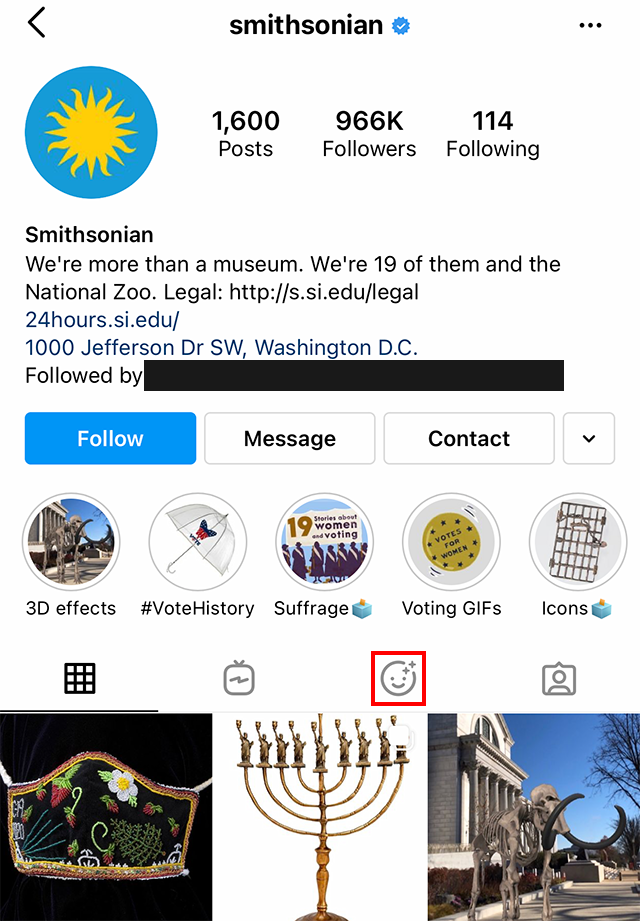
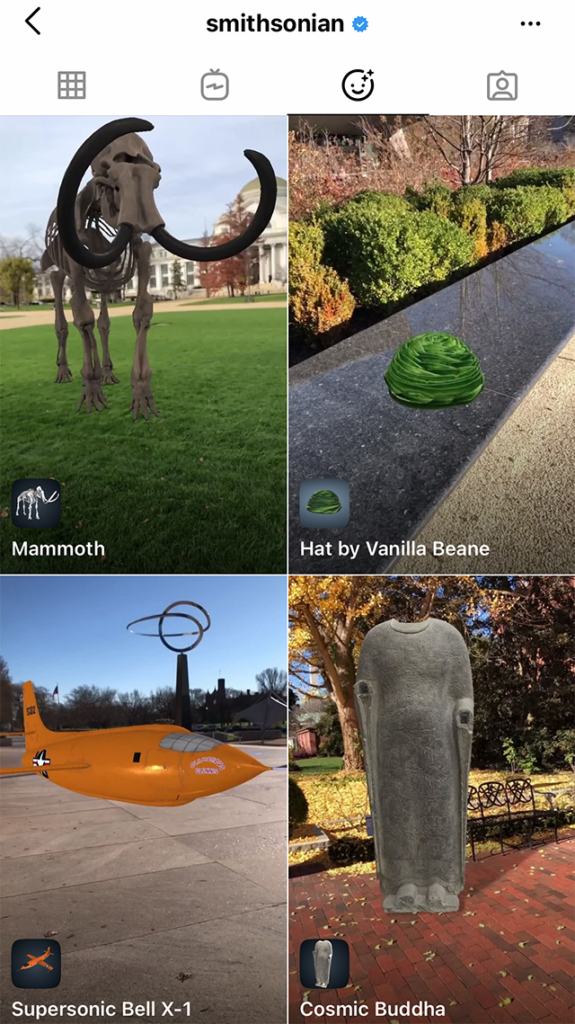
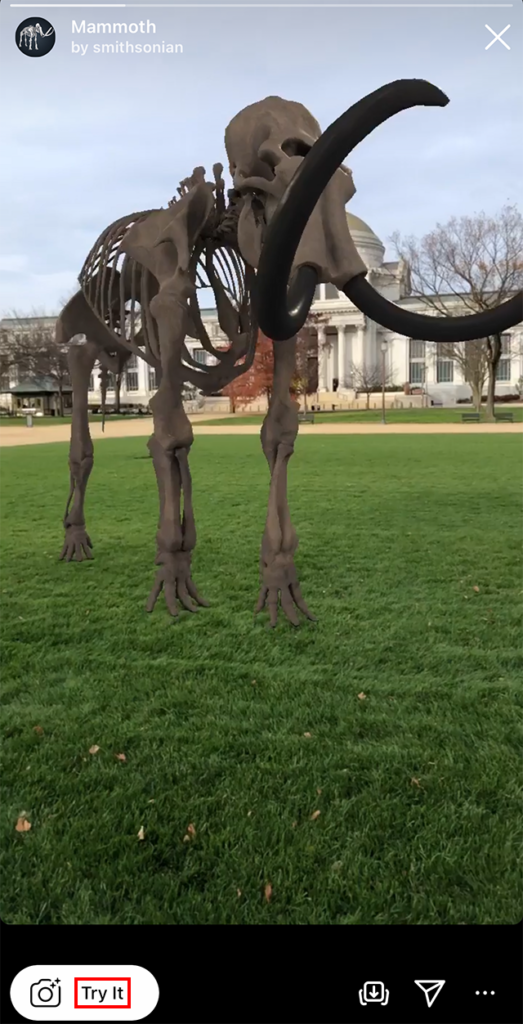
Facebook recently partnered with three cultural institutions (Le Grand Palais, the Palace of Versailles and The Smithsonian) to bring augmented reality effects to those organizations’ Instagram profiles. These effects allow users to view items from each institution’s collections in AR and, in some cases, to learn about them through on-screen text. This feature will be added to more profiles in the future.

Our guide will show you how to use these kinds of AR effects. We’ll use content from The Smithsonian as an example, but this feature works the same across any profile with this feature enabled.

Note: These screenshots were captured in the Instagram application on iOS.

Step 1: When viewing a profile that contains AR effects, tap the AR effects tab (the smiling face icon).

Step 2: Tap the AR effect you wish to view.

Step 3: Tap “Try It” in the bottom-left corner of the screen. Note: You can also tap the down arrow near the bottom-right corner of the screen to save this effect to your camera for future use.

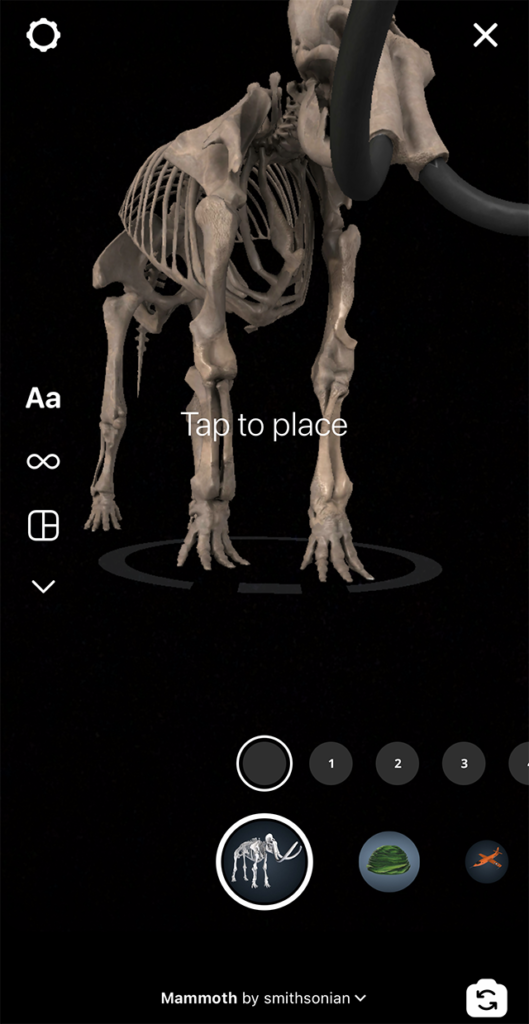
Step 4: Point your device’s camera in the desired direction and tap the screen to “place” the object down in front of you. Note: If you want to view the object from all sides, make sure to place the AR object so that you can physically “walk around it” in the real world. Also note, we’ve covered up our camera lens for the sake of our guide. When you use an AR effect, you’ll see your current surroundings behind the object you’re placing.

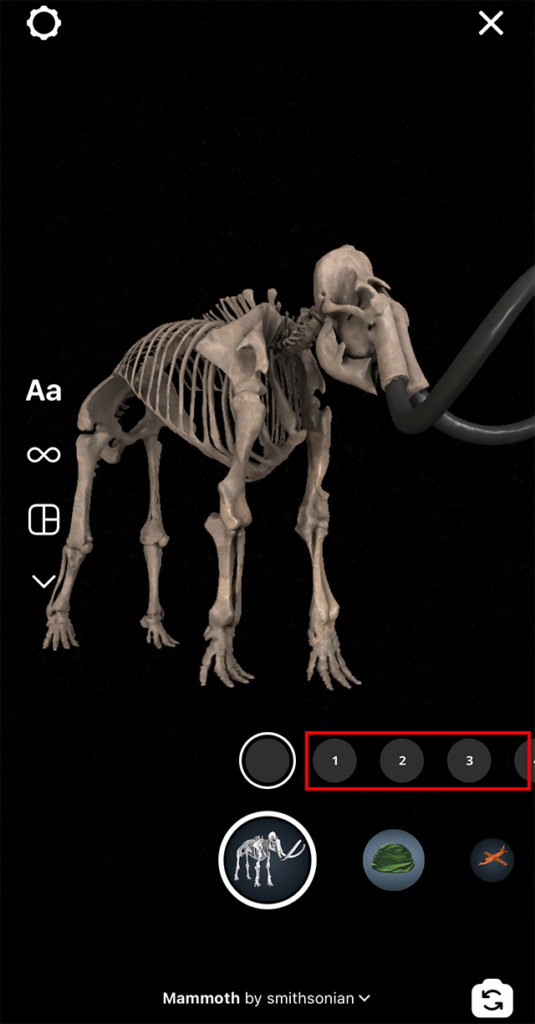
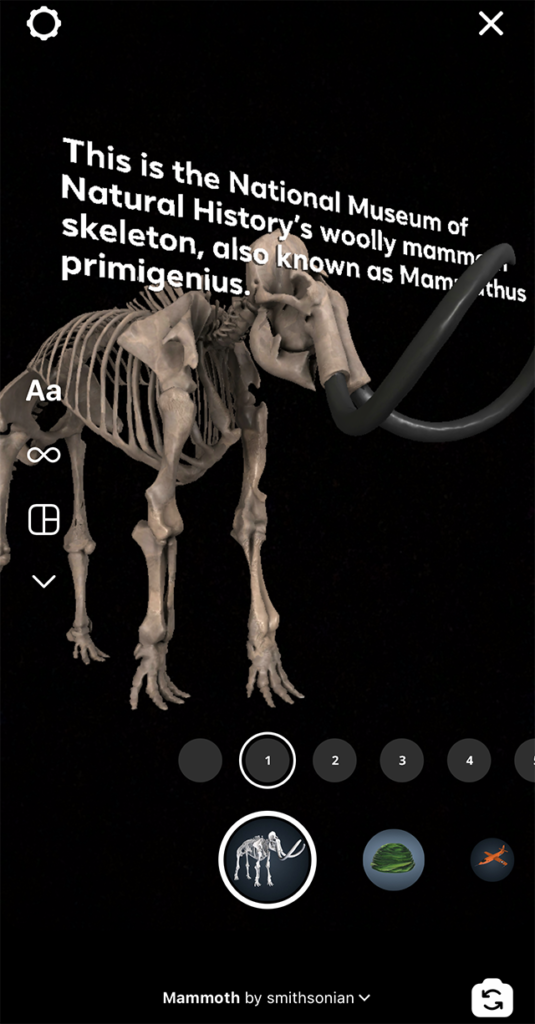
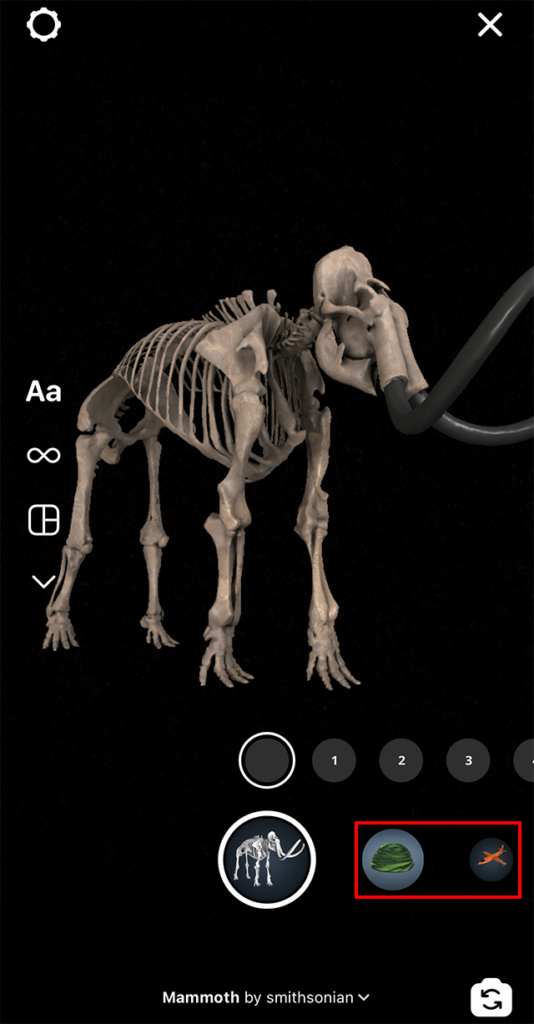
Some objects may come with additional information that you can read about the piece. When this is the case, you can tap the numbers near the bottom of the screen to read each piece of information.

If a profile has more than one AR effect, you can switch to another one by tapping the desired effect at the bottom of the screen.

Finally, you can tap the capture button at the bottom of the screen to take a picture of what you’re seeing, which you can then share on your profile.

https://www.adweek.com/digital/instagram-how-to-use-ar-effects-on-instagram-profiles/


Multiplayer Snap Game Bitmoji Paint Debuts on Snapchat

Snap Inc. Monday debuted Bitmoji Paint, a new multiplayer Snap Game that enables millions of Snapchatters to contribute to a single, massive collage.

Snapchat users can enter Bitmoji Paint through chat via the rocket icon or via search.

They will see a planet with multiple islands floating in space, and each island is a server that players can join, along with hundreds of other players. After doing so, they are placed on a live, editable canvas.

Players can paint, explore and hang out by switching between three modes: map, move and paint.

Snapchatters can encounter other Snapchatters organically in the game, but they can only communicate via a menu of emotes. Other players’ Snap IDs are not viewable.

Easy access to reporting tools is available within Bitmoji Paint if other players are not following Snapchat’s rules, and reports will be quickly reviewed.

Snap is also introducing Snap Tokens for Android users, enabling them to customize their experiences in Bitmoji Paint.

Snap Tokens can be purchased and stored in a virtual wallet tied to Snapchat accounts. The Token Shop is accessible via users’ profile pages or within Bitmoji Paint, where they can be used to purchase in-game items such as hoverboards, ink painters, paint rollers and roller skates.

Gaming creators Jeff Cyrus, Julia Kelley, Chris Melberger and Julien Solomita will livestream their Bitmoji Paint experiences on their respective Twitch channels Monday (Dec. 14) from 5 p.m. PT to 6 p.m. PT/8 p.m. ET to 9 p.m. ET, using Twitch’s Squad Stream tool.

https://www.adweek.com/digital/multiplayer-snap-game-bitmoji-paint-debuts-on-snapchat/


Facebook Extends Brand Collabs Manager to Public Groups


Facebook extended its Brand Collabs Manager to public groups this week, as it promised during its Facebook Communities Summit at the beginning of October.

Brand Collabs Manager—a marketplace that enables brands to link with the creators who are most relevant to promote their products and services—was previously available only to pages and Instagram.

Once group administrators apply for access here, they can collaborate with brands to create campaigns, tapping into brands’ relevant audiences in spaces that people trust and giving group admins the opportunity to earn money.

Facebook

Facebook

Facebook said in a blog post this week, “We’re rolling out Brand Collabs Manager to public groups first and will continue to evaluate other ways that we can help both public and private group admins serve and sustain their communities.”

https://www.adweek.com/media/facebook-extends-brand-collabs-manager-to-public-groups/


Facebook Sniffs Out Groups of Hackers Based in Bangladesh, Vietnam

Facebook took action against two separate groups of hackers, in Bangladesh and Vietnam, removing their accounts and pages from its platform and sharing information that it uncovered with its industry partners.

The group based in Bangladesh targeted local activists, journalists and religious minorities, including some living abroad, compromising their accounts in efforts to have them disabled by Facebook for violating its community standards.

Facebook’s investigation linked the activity to two nonprofits organizations in the country: the Crime Research and Analysis Foundation and Don’s Team (also known as Defense of Nation).

Head of security policy Nathaniel Gleicher and cyber threat intelligence manager Mike Dvilyanski explained in a Newsroom post, “Don’s Team and CRAF collaborated to report people on Facebook for fictitious violations of our community standards, including alleged impersonation, intellectual property infringements, nudity and terrorism. They also hacked people’s accounts and pages and used some of these compromised accounts for their own operational purposes, including to amplify their content. On at least one occasion, after a page administrator’s account was compromised, they removed the remaining admins to take over and disable the page. Our investigation suggests that these targeted hacking attempts were likely carried out through a number of off-platform tactics, including email and device compromise and abuse of our account recovery process.”

In Vietnam, Facebook found that APT32, an advanced persistent threat actor, used malware to target Vietnamese human rights activists (locally and abroad), foreign governments (including those of Cambodia and Laos), non-governmental organizations, news agencies and businesses across information technology, hospitality, agriculture/commodities, hospitals, retail, automotive and mobile services.

The group also lured targets to download Android applications via the Google Play Store, and those apps contained a wide range of permissions, enabling broad surveillance of peoples’ devices.

Gleicher and Dvilyanski explained, “APT32 created fictitious personas across the internet posing as activists and business entities, or used romantic lures when contacting people they targeted. These efforts often involved creating backstops for these fake personas and fake organizations on other internet services so they appear more legitimate and can withstand scrutiny, including by security researchers. Some of its pages were designed to lure particular followers for later phishing and malware targeting.”

https://www.adweek.com/media/facebook-sniffs-out-groups-of-hackers-based-in-bangladesh-vietnam/