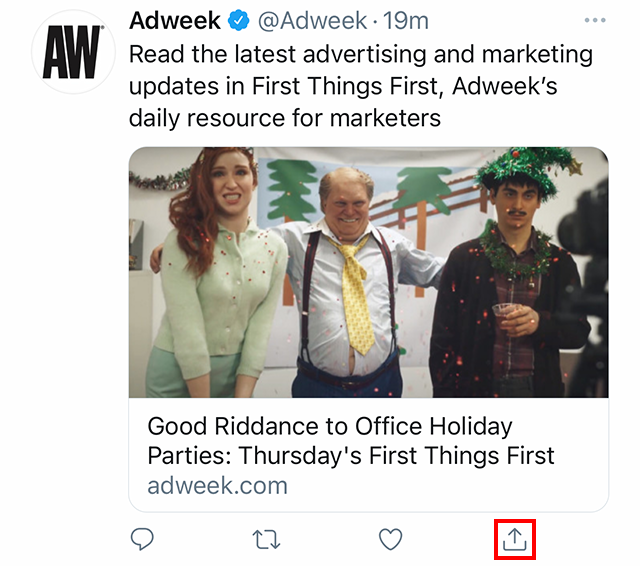
Twitter rolled out Fleets earlier this week, its disappearing tweets that resemble posts on Instagram or Facebook Stories. With the Fleets feature, users can create new Fleets from scratch, and they can also share users’ regular tweets (including their own) in Fleets. Our guide will show you how to share a normal tweet in a Fleet.
Note: These screenshots were captured in the Twitter application on iOS.
Step 1: Tap the share button under the tweet you wish to share in a Fleet.
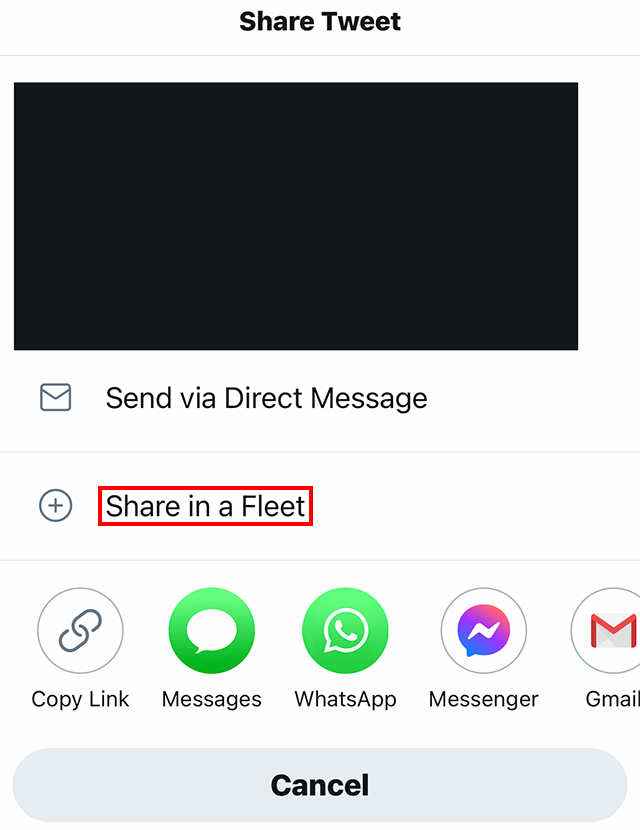
Step 2: Tap “Share in a Fleet.”
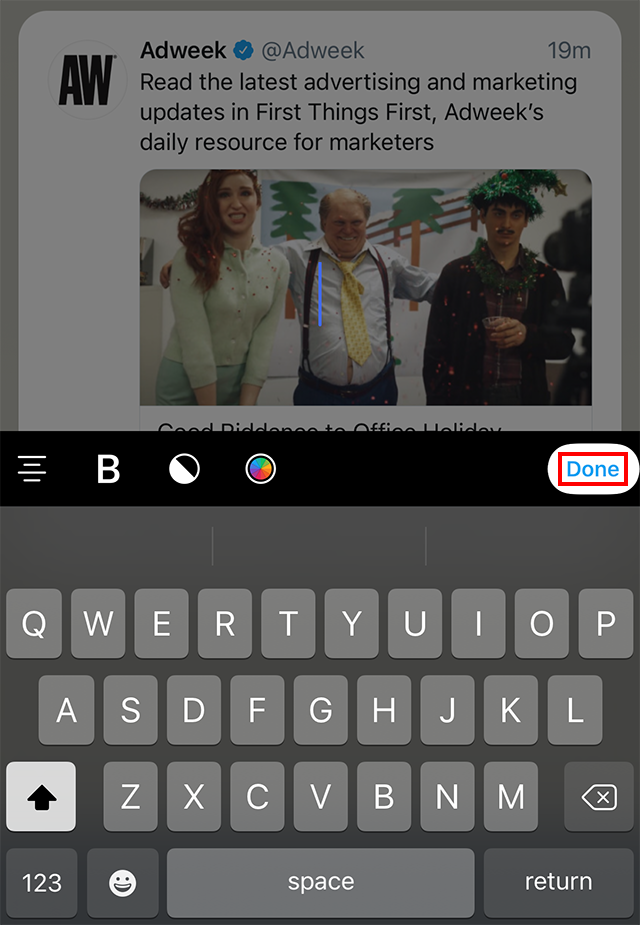
Step 3: Twitter will assume you want to type your own sentiment about the Fleet, so it will open your device’s keyboard and show you a text entry field. You can now type something about the Fleet, but you’re not required to. Tap “Done” when you’re ready to move on.
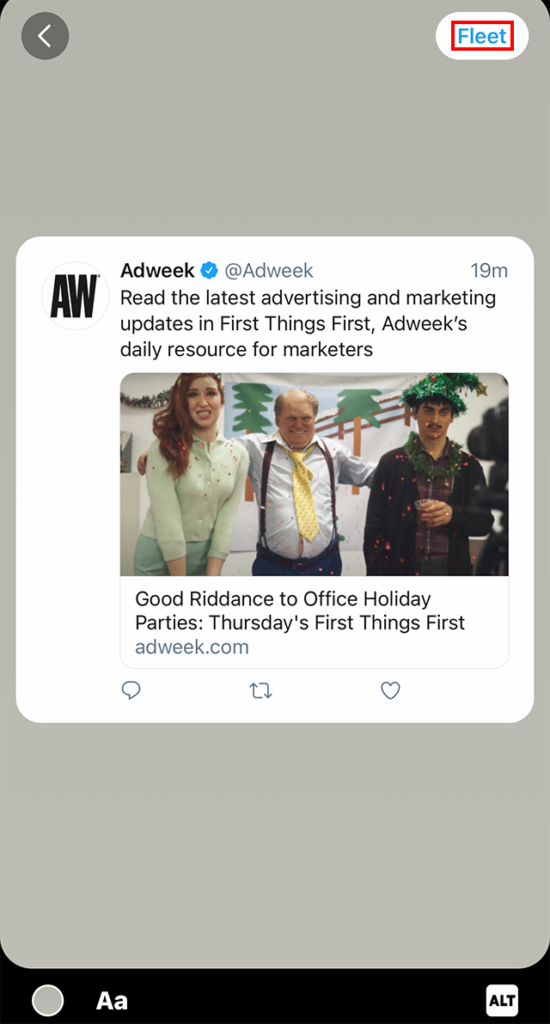
Step 4: From there, you can continue editing your Fleet as normal. When you’re done, tap “Fleet” in the top-right corner of the post to share your Fleet.
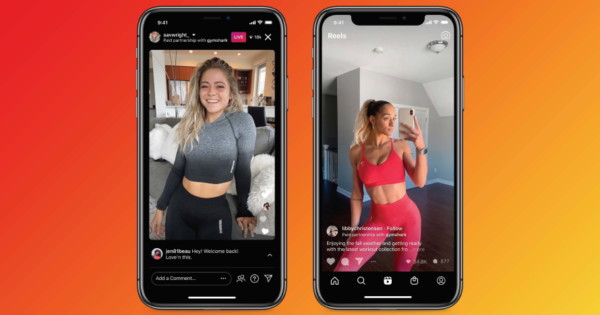
Instagram revealed several updates related to branded content on its platform Friday, highlighted by the rollout of the branded content tag on Reels and the start of testing of that tag on Instagram Live in the coming weeks.
The Facebook-owned photo- and video-sharing network said in a blog post Friday, referring to the branded content tag, “We want to ensure that creators can clearly disclose when they’re creating branded content, no matter what format they choose to use.”
The tag debuted Friday on Reels, and testing on Instagram Live will follow shortly.
Instagram added the ability for brands to run branded content posts as ads in June 2019,.but those ads could only be created by promoting existing posts from creators.
The platform rolled out a new workflow Friday that lets advertisers create branded content ads without having to post organically first, allowing for more flexibility.
Creators can approve or pause any ads published from their handles.
The new workflow is:
The advertiser sends a request for ad creation access.
The creator accepts ad creation access, with a notification sent to the advertiser upon acceptance.
The creator receives notification of the created ad for their approval.
Branded content ads in Stories can now include tappable elements, such as hashtags, location and @mentions, in order to give brands access to organic Stories creative that is native and authentic to the experience.
Businesses will soon be able to promote branded content posts with product tags, which is not currently possible.
Instagram said in its blog post, “More and more, people are shopping directly from the creators they love on Instagram. This new ad format is another way brands can provide a seamless shopping experience on Instagram. This new format will begin testing in the coming months.”
Account holders can choose to set a default minimum age, set a minimum age for specific countries, or create a combination of both options.
Instagram chief operating officer Justin Osofsky said in a statement, “Creators push culture forward and signal what’s next, which is why people are increasingly turning to them for inspiration. Branded content is a powerful tool for creators and businesses, and these updates will help them get more out of the content they’re creating together. This will continue to be an area of focus for us as we build out a suite of monetization tools that support creators’ various needs and ambitions.”
Co-founder Alexis Ohanian resigned from the company’s board in June and expressed his wishes that his seat be filled with a Black candidate, and the company complied with those wishes days later, tapping Y Combinator partner Michael Seibel.
Reddit co-founder and CEO Steve Huffman said in a statement, “Paula’s vast experience as a world-class financial leader and strategic advisor will be a tremendous asset to us in the years ahead. Best of all, she embodies the two qualities most important to us for this board seat: expertise leading companies through periods of transformative growth and real passion for Reddit’s mission.”
Price added, “I’m thrilled to be joining Reddit’s board at this time of rapid growth and opportunity. As both the company and community continue to scale, I’m looking forward to channeling my expertise to further Reddit’s mission.”
Vice president of integrity Guy Rosen said in a Newsroom post Thursday that Facebook’s investments in artificial intelligence have helped it to proactively detect hate speech content on its platform before it is reported by users.
Rosen said during a press call Thursday, “Think of prevalence like an air quality test to determine the percentage of pollutants.”
Facebook product manager for integrity Arcadiy Kantor went into further detail in a separate Newsroom post, explaining that the social network calculates prevalence by selecting a sample of content that was seen on Facebook and labeling how much of that content violates its hate speech policies.
In order to account for language and cultural context, these samples are sent to content reviewers across different languages and regions.
Kantor pointed out that the amount of times that content is seen is not evenly distributed, writing, “One piece of content could go viral and be seen by lots of people in a very short amount of time, whereas other content could be on the internet for a long time and only be seen by a handful of people.”
He also detailed the challenges of determining what constitutes hate speech, writing, “We define hate speech as anything that directly attacks people based on protected characteristics including race, ethnicity, national origin, religious affiliation, sexual orientation, sex, gender, gender identity or serious disability or disease,” but adding, “Language continues to evolve, and a word that was not a slur yesterday may become one tomorrow. This means content enforcement is a delicate balance between making sure we don’t miss hate speech while not removing other forms of permissible speech.”
Facebook continues to use a combination of user reports and AI to detect hate speech on Facebook and Instagram, and Kantor addressed the challenges the company faces with the human part of that equation, such as people from areas with lower digital literacy not being aware that they can report content, or people reporting content that they don’t like, but that doesn’t violate Facebook’s policies, such as TV show spoilers or posts about rival sports teams.
As for AI, he wrote, “When we first began reporting our metrics for hate speech, in the fourth quarter of 2017, our proactive detection rate was 23.6%. This means that of the hate speech we removed, 23.6% of it was found before a user reported it to us. The remaining majority of it was removed after a user reported it. Today, we proactively detect about 95% of hate speech content we remove. Whether content is proactively detected or reported by users, we often use AI to take action on the straightforward cases and prioritize the more nuanced cases, where context needs to be considered, for our reviewers.”
Facebook
Those content moderators may beg to differ, however, as an open letter sent Wednesday by over 200 of them blasted Facebook’s AI systems, saying, “Management told moderators that we should no longer see certain varieties of toxic content coming up in the review tool from which we work—such as graphic violence or child abuse, for example. The AI wasn’t up to the job. Important speech got swept into the maw of the Facebook filter—and risky content, like self-harm, stayed up. The lesson is clear. Facebook’s algorithms are years away from achieving the necessary level of sophistication to moderate content automatically. They may never get there.”
Snap Rolls Out Suite of Ad Products for App Marketers
Snap Inc. continued its focus on direct-response marketers with its rollout of an advertising product suite Thursday geared specifically toward application marketers.
The company said the move was made with two key ideas in mind: bringing what’s best for apps to Snapchat with ad products that drive retention, lifetime value and maximum return on ad spend; and bringing the best of Snapchat into apps through experiences that will help keep users engaged.
Marketers focused on user acquisition can now select app installs as the objective for augmented reality lens campaigns. They can set a desired cost-per-install bid, similar to Snap Ads, and the platform’s automated systems will attempt to achieve that outcome.
A new dedicated campaign flow gives marketers the option of an improved deep link ad format to drive more engagement and boost app conversions, and they can create custom audiences based on in-app actions, as well as use new goal-based bidding options.
Snap said the average smartphone user spend 84% of their time on just their top five apps, citing data from eMarketer, and 95% of app users churn within 30 days, according to AppsFlyer, adding that its new campaign flow helps boost retention and LTV.
The platform also introduced a minimum ROAS bid strategy that enables advertisers to reach the highest-spending Snapchatters by setting a specific ROAS.
Snap Audience Network, which is still in beta, allows advertisers to extend their Snapchat campaigns off-platform seamlessly.
The first mediation partners for the mobile ad network are MoPub and Applovin, and Snap said it will work directly with mobile in-app developers that leverage those two platforms to monetize their inventory.
Snap’s Creative Kit enables developers to integrate Snapchat into their apps and let users share AR experiences, filters, GIFs, lenses, videos and other content directly to the Snapchat camera or preview screen.
And Login Kit lets users sign into apps with their Snapchat credentials and bring along their Bitmoji.
Snap Inc.
Snap product marketing manager for apps Skye Featherstone said in a statement, “As consumers spend more time on mobile, brands of all types are reimagining how apps can drive business growth in response to rapid social and economic changes. Over the past year, Snap has doubled down on our ad tech to meet the needs of multichannel brands and app-only businesses alike. In a few short years, we’ve become a top-performing app advertising channel because of our dual focus on developer tools and ad experiences.”
DraftKings manager of growth marketing Vito Batista added, “To reach new users and drive engagement throughout the customer journey, we utilize both acquisition and re-engagement tactics on Snapchat. DraftKings was an early tester of app re-engagement via goal-based bidding, which has become a key part of our strategy helping us to maximize our results.”
Twitter debuted Fleets earlier this week, allowing users to share disappearing tweets to their tops of their feeds, similar to how one shares disappearing posts to Instagram or Facebook Stories. Our guide will show you how to send a Fleet in the Twitter mobile application.
Note: These screenshots were captured in the Twitter app on iOS.
Step 1: Tap “Add” in the top-left corner of your Twitter home feed.
Step 2: Swipe right or left on the modes at the bottom of the screen to choose which type of Fleet to send. “Text” allows you to share a text post, “Camera Roll” allows you to choose a photo or video from your device’s library, “Capture” allows you to take a new photo (or video) and “Video” allows you to record a new video.
Each of these options allows you to customize your Fleet in different ways before sharing it. For instance, in the “Text” mode, you can change your post’s background color, as well as tap icons that allow you to change your text’s alignment (left, right or center), make the font bold, change the text’s color, add a background to the text and change the color of this background. You can also add text to photo and video posts and customize that text using the same options.
Step 3: When you’re done editing your post, tap the “Fleet” button in the top-right corner of the screen to post it.
ServiceNow Virtual Agent Integrates With Workplace From Facebook
Workplace From Facebook and ServiceNow extended their existing relationship Wednesday with the integration of the cloud computing company’s Virtual Agent with the social network’s enterprise offering.
Virtual Agent will enable employees of Workplace From Facebook clients to request support, receive updates on in-progress requests and connect with live agents, all without leaving the platform.
Companies on Workplace From Facebook can use ServiceNow Employee Campaigns to distribute relevant content to employees directly through the platform.
And Spoke, which is available as an IntegrationHub, enables Workplace From Facebook clients to create their own integrations to meet their employee experience needs.
ServiceNow/Workplace From Facebook
Workplace from Facebook vice president Julien Codorniou said in a statement, “ServiceNow is a formidable brand that we are honored to deepen our partnership with. Together, we are uniquely positioned to bring best-in-class technology to every single employee within an organization, regardless of where or how they work. As global companies navigate a new normal and become increasingly decentralized, digital tools that bridge the communication gap beyond just the HQ will be imperative to their success. This is especially important for deskless, or frontline, employees, who make up 80% of the world’s working population. I’m excited that our combined efforts will serve this crucial group of employees more seamlessly and will enable Workplace to enter the automation and productivity space—something we believe is a game changer for all of our customers.”
ServiceNow vp and general manager of human resources service delivery Gretchen Alarcon added, “The workplace of the future will be distributed, which means organizations must create new workflows that keep their employees informed, engaged and connected. We’re thrilled to partner with Workplace From Facebook to help our mutual customers break down silos, boost productivity and ultimately deliver great employee experiences.”
BTS Invades Messenger From Facebook, Instagram via TinyTAN
K-pop superstars BTS are set to release new album BE Nov. 20, and Messenger From Facebook, Instagram and TinyTAN teamed up on a custom chat experience for fans worldwide.
LinkedIn B2B Institute, GWI Examine Pandemic’s Impact on Knowledge Workers 21 Through 40
LinkedIn’s B2B Institute teamed up with target audience company GlobalWebIndex on “Work in BETA: The Rising B2B Decision Maker,” a new study of 17,000 knowledge workers between the ages of 21 and 40, in 10 markets, and their changing behaviors and attitudes in a world altered by Covid-19.
The two parties named the study group the BETAs, saying they are the first cohort of digital natives to assume positions of seniority and become purchasers and decision-makers in the global workforce, with roughly two-thirds of them serving as the ultimate decision maker for their company or the final decision maker for their department or team when making purchases.
They wrote, “The group has been named the BETAs; as the line between their life and work is ’Blurred’; they have ‘Evolving’ expectations that formal structures will be supplanted by development opportunities for the individual; their dexterity with ‘Technology’ will give them an advantage as work styles involve; and they will take their ‘Activism’ to work and use it as a filter to judge employers, colleagues, customers and suppliers.”
Key findings included:
The loss of dedicated workspaces due to the pandemic is most intense on this group, who are most likely to live in shared households or with their parents, and not out of a home office. Nearly one out of five do not have a dedicated space to work, compared with just over one out of 10 for other business professionals.
Eight out of 10 business professionals worldwide are regularly working late or putting in overtime, while one out of 10 said they always work late and 15% said they always work overtime. The BETAs group is eight points ahead of other professionals in terms of regularly working late and 13 points in regularly working overtime.
More than one-half of BETAs use personal smartphones for work, versus 40% of those aged 41 through 50 and roughly one-third of those between 51 and 64.
BETAs worldwide spent 3.5 hours per day on their smartphones, while other professionals globally spend just under two hours daily, dropping to one hour and 20 minutes for the 51-through-64 group. The two parties wrote, “Smartphones are the device they mostly work on, unlike other age groups who prioritize laptop or desktop.”
BETAs place importance on professional development through self-improvement and self-evolution, with 80% worldwide participating in online learning to learn or improve skills, increase knowledge or gain qualifications. LinkedIn B2B Institute and GWI wrote, “In turn, they are most likely to expect promotions, and globally. they place a higher-than-average premium on job satisfaction—despite the impact of the pandemic on businesses and job losses.”
On a typical workday, BETAs will receive 32 emails and be asked to attend at least three meetings. Throughout 2020, they will handle an average of nearly 8,500 emails and almost 800 meetings.
Three out of four BETAs say they are constantly connected online, while six out of 10 believe it is critical to be contactable at all times and one-third worry about spending too much time on their phones.
83% of BETAs want to see companies take at least one action related to the Black Lives Matter movement, such as reviewing hiring policies, ensuring diversity in leadership, supporting local initiatives and making charitable donations. LinkedIn B2B Institute and GWI wrote, “In the U.S. and U.K., using social media to support diversity is one of the lowest-scoring options among BETAs. This reflects a concern among some that only using this channel to demonstrate support could be superficial or too performative. Instead, BETAs in these markets prioritize internal reflection and change—they expect brands and employers to reflect their values, through action.”