Twitter Taps Peiter Zatko for Newly Created Role of Head of Security

If you want to stop a hacker, you’ve got to think like a hacker, or, in the case of Twitter, hire one.

Peiter Zatko—better known by his hacker handle, Mudge—joined the social network in the newly created role of head of security, reporting to CEO Jack Dorsey.

Zatko most recently oversaw security at electronic payments platform Stripe, following stints at Google and the Defense Advanced Research and Projects Agency.

He said in a tweet Monday, “Looks like the cat is out of the bag. I’m very excited to be joining the executive team at Twitter. I truly believe in the mission of (equitably) serving the public conversation. I will do my best.”

Zatko said in an interview with Reuters that he will examine “information security, site integrity, physical security, platform integrity—which starts to touch on abuse and manipulation of the platform—and engineering.”

He added, “They are willing to take some risks. With the challenges of algorithms and algorithmic bias, they are not standing by and waiting until someone else solves the problem.”

https://www.adweek.com/digital/twitter-taps-peiter-zatko-for-newly-created-role-of-head-of-security/



Post Malone’s Celebrity World Pong League Comes Exclusively to Facebook’s Watch Together

Facebook teamed up with hip-hop superstar Post Malone on Post Malone’s Celebrity World Pong League, a new, exclusive series available to Messenger From Facebook and Instagram users through the social network’s Watch Together feature.

Post Malone will take on some famous friends in pong, including The Chainsmokers, Doja Cat, Machine Gun Kelly, Quavo and Saweetie.

“The winning team will get ultimate bragging rights and the losing team will be forced to participate in some hilarious acts,” Facebook said.

Post Malone’s Celebrity World Pong League will debut Nov. 18, with new episodes on Wednesdays and Fridays.

To start watching the show, users can start a video call in Messenger or Instagram or create a Messenger Room.

In an Instagram video call, tthey can tap the media button in the bottom right and select the TV & Movies tab.

In a Messenger video call, they can swipe up to access the menu, select Watch Together and select the TV & Movies tab.

https://www.adweek.com/digital/post-malones-celebrity-world-pong-league-comes-exclusively-to-facebooks-watch-together/


Nextdoor Neighborhood Sponsorships Enable Businesses to Advertise on a ZIP Code Level

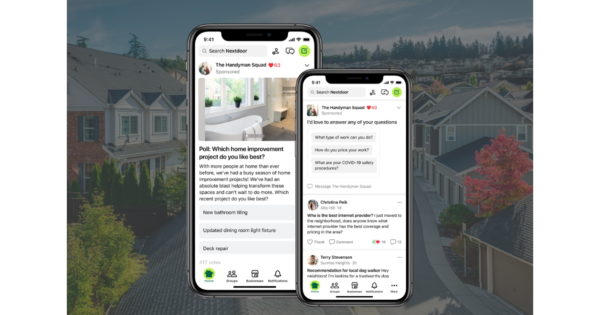
Neighborhood social network Nextdoor rolled out its Neighborhood Sponsorships tool nationwide Thursday, giving local businesses on its platform a way to advertise to potential customers on a ZIP code level.

Businesses must create their free business page to use Neighborhood Sponsorships, at which point they provide information including the business name, location and contact information, as well as up to 10 categories that describe the business or the services it provides.

ZIP codes can be selected through the Sponsorships/Manage Plan tab, where businesses can check availability and pricing. The people behind the business account are not required to live in a ZIP code in order to sponsor it.

Two ad formats are available via Neighborhood Sponsorships:

  • Tips & Advice Ads: Businesses can demonstrate their expertise and how it can help nearby neighbors. When this type of ad is selected, businesses can choose from a list of conversation options, select the prompts they wish to run and add their responses. Custom prompts can be included, as well. Nextdoor recommended responses of 30 to 100 characters and the enabling of four to five prompts so that neighbors see a variety of ads.
  • Conversation Starters Ads: This ad unit also involves choosing from a variety of prompts to answer questions that neighbors might have about the business, and businesses can create their own prompts, as well. Neighbors will see up to three prompts at a time when campaigns are running and, once they select a prompt, Nextdoor’s chat window will open and the conversation can begin. Nextdoor suggested customizing these prompts so that they are relevant to the business, and it reminded businesses to ensure that the information in their profiles is complete.

Nextdoor said in an email, “Whether a business is in the process of reopening due to Covid or just looking to get more exposure in specific neighborhoods, Neighborhood Sponsorships can help small businesses build big brand awareness and rapport with local customers. Additionally, as more people pack up and move neighborhoods during the pandemic (we found that mentions of movers on Nextdoor are up 84% since March), it’s crucial that business owners have the tools they need to directly reach these new customers in order to offer their services. For example, when looking at Nextdoor data, we found that top topics for new movers include: lawn service, house cleaning service, mover, handyman and landscape contractor.”

https://www.adweek.com/programmatic/nextdoor-neighborhood-sponsorships-enable-businesses-to-advertise-on-a-zip-code-level/


LinkedIn Details 2 Measurement Issues It Discovered and Corrected

LinkedIn shared details on two measurement issues it discovered in August and corrected this month that may have led to overreporting of some campaign metrics for impressions and video views on sponsored content.

Vice president of product management Gyanda Sachdeva said in a blog post that the two issues potentially impacted more than 418,000 customers over a period of just over two years, adding that more than 90% of those customers saw impacts of less than $25.

The professional network is working with all of those customers to fully credit their accounts.

Sachdeva outlined steps LinkedIn is taking to prevent a similar incident, including an audit of its metrics by the Media Rating Council, collaborating with Moat by Oracle Data Cloud to measure video viewability and investing in improvements to our processes and systems.

She wrote, “We are committed to delivering consistent advertising products and analytics that you can rely on and that align with industry and third-party standards. We’ll plan to share updates on the ongoing work that we’re doing to keep our advertising platform safe and trusted.”

https://www.adweek.com/programmatic/linkedin-details-2-measurement-issues-it-discovered-corrected-in-august/


Instagram Begins the Process of Bringing its Suicide, Self-Harm Detection Tech to the EU

Instagram will extend initiatives it has used outside of the European Union to proactively detect content related to suicide or self-harm to the EU, head of Instagram Adam Mosseri said in a blog post.

Mosseri said Instagram is in discussions with regulators and governments in the EU on ways to bring this technology to the region while recognizing each market’s privacy regulations.

From April through June, more than 90% of the suicide and self-harm content that Instagram took action on—including removing the content, connecting the person who posted it with local organizations that may be able to help or, in extreme cases, contacting emergency services—was detected by its own technology before being reported by other users, Mosseri said.

He added that not being able to deploy this technology in the EU has hampered its efforts in that region, but some of it is now beginning to roll out on both Instagram and Facebook.

Mosseri wrote, “We can now look for posts that likely break our rules around suicide and self-harm and make them less visible by automatically removing them from places like Explore. And when our technology is really confident that a post breaks our rules, we can now automatically remove it altogether. This is an important step that will protect more people in the EU. But we want to do a lot more. The next step is using our technology not just to find the content and make it less visible, but to send it to our human reviewers and get people help, like we do everywhere else in the world.”

https://www.adweek.com/media/instagram-begins-the-process-of-bringing-its-suicide-self-harm-detection-tech-to-the-eu/


LinkedIn Foils Attempt to Create 33M+ Fake Accounts

LinkedIn said this week that it thwarted a large-scale effort to create over 33 million fake accounts on its platform.

The professional network shared its Transparency Report for the first half of 2020, saying that during that time period, its automated defenses blocked 98.4% of all fake accounts that it prevented or took down.

Vice president of legal for product and privacy Rob Hallman said in a blog post that over 98% of spam and cam content is removed from LinkedIn before members encounter it.

The professional network also removed more hate speech, harassment, adult content and violent content in the first six months of 2020 than it did in the second half of 2019, which Hallman partially attributed to an overall increase in the volume of conversations on the platform.

LinkedIn received 599 government requests for data during the time period covered by the report, with the bulk (377) coming from the U.S., along with 21 government requests for content removal, 18 of those from China.

Finally, LinkedIn added a new community report category to its Transparency Report covering misinformation, saying that from January through June, it removed 22,846 instances of misinformation, including some related to Covid-19.

https://www.adweek.com/media/linkedin-foils-attempt-to-create-33m-fake-accounts/


WhatsApp Rolls Out Shopping Button Globally


WhatsApp said last month that it would increase investment in three areas for businesses on its platform—shopping, Facebook hosting services and business sales—and it took the first step on the shopping front with Tuesday’s introduction of a shopping button.

The shopping button eases the process for users of the Facebook-owned messaging application who want to browse businesses’ catalogs of goods and services, eliminating the need to click through to the business profile.

The new button, which resembles a storefront icon, will immediately indicate that the business has a catalog and enable users to access it with one tap.

WhatsApp said the shopping button is available globally, replacing the voice call button on the app’s interface. Users can still start voice calls via the call button, which enables them to choose between video and voice.

Over 175 million people message WhatsApp business accounts each day, the company said, with over 40 million viewing catalogs every month.

WhatsApp also cited a recent survey, which found that 68% of international respondents were more likely to do business with or purchase from a company that it can contact via messaging than with one that doesn’t offer that option.


Join Adweek for Commerce Week, a live virtual summit on Nov. 9-12, to explore the rapid transformation of the commerce landscape, and what’s next. Register now.

https://www.adweek.com/media/whatsapp-rolls-out-shopping-button-globally/


Instagram: How to Send Selfie Stickers in Direct


Did you know that Instagram allows you to send selfie stickers to other users through Direct messages? Our guide will show you how this is done.

Note: These screenshots were captured in the Instagram application on iOS.

Step 1: In a Direct conversation, tap the sticker icon to the right of the “Message…” text field.

Step 2: Tap the Selfie sticker.

Step 3: If you’ve already created and saved a selfie sticker (for instance, if you created one to use in Instagram Stories), you can tap it under the “Saved Stickers” section to instantly send it. If you need to create a new sticker, tap the capture button under the camera window. Note: You have multiple options that allow you to create multiple kinds of selfie stickers. For instance, if you tap the heart eyes emoji under the camera window, you can add heart eyes to your selfie before creating a sticker. You can also tap the camera window itself to change the background for your sticker.

Step 4: If you created a new sticker, tap the black and white arrow icon to send the sticker in the conversation. Note: You can also tap “Save Sticker” to save the selfie sticker so you can use it again later on.


https://www.adweek.com/media/instagram-how-to-send-selfie-stickers-in-direct/


Facebook Removes Public Group Stop the Steal 2020 for ‘Delegitimization of the Election Process’

The fight against election-related misinformation continued for Facebook Thursday, as the social network took down a public group, Stop the Steal 2020, that had attracted over 300,000 members in just two days.

A Facebook spokesperson confirmed the action, saying, “In line with the exceptional measures that we are taking during this period of heightened tension, we have removed the Group ‘Stop the Steal,’ which was creating real-world events. The group was organized around the delegitimization of the election process, and we saw worrying calls for violence from some members of the group.”

The group was being used to organize protests in states where ballots were still being counted, and it was also littered with calls for violence and inaccurate claims about the ballot counting process.

Aaron Mak of Slate reported that the group topped 360,000 members, while Ali Breland of Mother Jones reported that it was tied to Republican operatives including Liberty Lab, which provides digital services to conservative clients, and Women for America First, a nonprofit co-founded and led by former Tea Party activist Amy Kremer.

The Center for Countering Digital Hate shared screenshots from the group on Twitter, with calls for violence such as, “Time to clean the guns, time to hit the streets,” and, “It’s time. We must resort to violence if we have to.”

The social network had not yet responded to a request for comment at the time of this post, but it appears to also have blocked the #StopTheSteal hashtag, as well as #SharpieGate, which refers to a since-debunked conspiracy theory claiming that the Board of Supervisors in Maricopa County, Ga.—one of the states where a winner has not yet been declared—said the use of Sharpies would make ballots invalid.

Clicking on either of those hashtags brings up a message from Facebook saying that posts with those hashtags are temporarily hidden due to violating its community standards.

However, Taylor Hatmaker and Sarah Perez of TechCrunch pointed out that hashtags with similar intentions were still functional on the platform, including #ElectionFraud, #ElectionMeddling, #Rigged and #RiggedElection.

https://www.adweek.com/media/facebook-removes-public-group-stop-the-steal-2020-for-delegitimization-of-the-election-process/


Snap Audience Network Becomes a MoPub Mediation Partner

Snap Audience Network, Snap Inc.’s mobile ad network, is now a supported mediation partner of Twitter-owned mobile monetization platform MoPub.

The partnership means advertising demand on Snapchat is now available to application publishers and developers using the MoPub platform.

MoPub’s goal is to give publishers and developers control over their mobile ad inventory and access to multiple ad networks, as well as its own MoPub Marketplace.

MoPub wrote in a blog post Thursday, “Thanks to the Snap Audience Network, publishers get access to Snapchat’s industry leading ad formats, such as Snap Ads. These are full-screen video ads in interstitials or rewarded format that are optimized toward installs or conversions. Snapchat reaches more than 90% of the highly coveted 13- to 24-year-old demographic, and more than 75% of the 13- to 34-year-old demographic in the U.S., both of which its marketing partners frequently target with high-quality, customized campaigns. With our newly announced partnership, MoPub publishers now have the ability to access these high-quality creatives and advertising demand.”

Snap director of revenue and product partnerships Ali Rana added in the blog post, “We are thrilled to partner with MoPub, a longtime mediation leader. This milestone for the Snap Audience Network introduces a new opportunity for MoPub publishers to better monetize their Generation Z and millennial audience with our full-screen video ads and rewarded units. We’re excited to bring the Snap Audience Network to more publishers who are looking for a true alternative in the space.”

https://www.adweek.com/programmatic/snap-audience-network-becomes-a-mopub-mediation-partner/