Barack Obama Stars in Snapchat PSA Aimed at Younger and First-Time Voters
Former President Barack Obama is being featured in public-service announcements from Snapchat aimed at encouraging first-time and younger voters to register to vote via a new in-application tool that enables them to do so.
Snap Inc. said it is a nonpartisan, multi-week public awareness effort that will also focus on helping younger voters learn about the issues and candidates and ensure that they cast their votes, either in-person or by mail.
Upcoming PSAs will feature former Ohio Gov. and Republican presidential nominee John Kasich and former California Gov. Arnold Schwarzenegger.
They will be joined by athletes, celebrities, influencers and musicians, and Snap said those who have already begun encouraging Snapchatters to use the new tool through their Snapchat Stories include Quincy Brown, Catherine McBroom and Snoop Dogg.
Snap said it released the Obama PSA in anticipation of National Voter Registration Day Sept. 22, noting that Snapchat reaches more people between the ages of 13 and 24 in the U.S. than Facebook, Instagram and Messenger From Facebook combined, and that 80% of the 100 million Snapchatters in the U.S. are of voting age, 18 or older.
Other election-related initiatives from Snap include a voter guide featuring content from the ACLU, APIAVote, I Am a Voter, the NAACP and Voto Latino, as well as a feature that enables users to craft their plan to vote, including the ability to request mail-in ballots directly through the app.
For the 2018 midterm elections in the U.S., Snapchat helped over 450,000 users register to vote, with 57% of them actually following through and going to the polls.
Facebook to Use Its Platform to Recruit Poll Workers for US Election
[unable to retrieve full-text content] https://www.adweek.com/digital/facebook-to-use-its-platform-to-recruit-poll-workers-for-us-election/
TikTok Looks to Clear Up Questions About Its $1B Creator Fund
[unable to retrieve full-text content] https://www.adweek.com/digital/tiktok-looks-to-clear-up-questions-about-its-1b-creator-fund/
YouTube Plans Rollout of Engaged-View Conversions by Year-End
[unable to retrieve full-text content] https://www.adweek.com/programmatic/youtube-plans-rollout-of-engaged-view-conversions-by-year-end/
What’s Inside the TikTok Virtual Transparency and Accountability Center?
Physical visits to the Transparency and Accountability Centers TikTok opened in Los Angeles and Washington, D.C., have been put on hold by the coronavirus, so the video-creation platform has done the next best thing by taking them virtual.
Vice president and head of U.S. public policy Michael Beckerman said in a blog post Thursday that nearly two-dozen experts and Congressional offices have visited TikTok’s virtual Transparency and Accountability Center to learn about its safety and security practices.
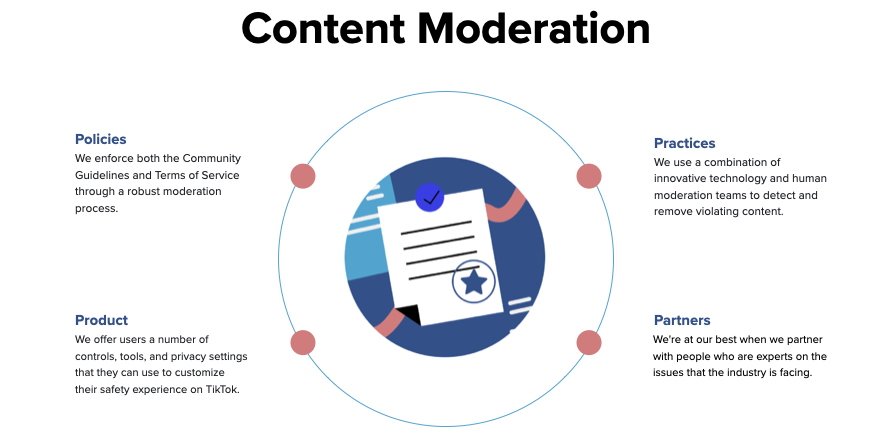
Part of the virtual Transparency and Accountability Center is dedicated to explaining how TikTok’s moderators review content and accounts that are escalated via user reports and machine learning, giving visitors a detailed look at its safety classifiers and the deep learning models that proactively identify harmful content, as well as the decision engine that ranks the content to aid moderation teams with their reviews.
Beckerman said that once the physical centers can be visited, guests will be able to sit in the seat of a content moderator, use TikTok’s moderation platform, review and label sample content and experiment with detection models.
TikTok will also share details on how its recommendation engine works and how user experience and safety are built into those recommendations. Beckerman wrote, “This includes sharing how our systems work to diversify content in the For You feed and additional insights into how content is tailored to the preferences of each user.”
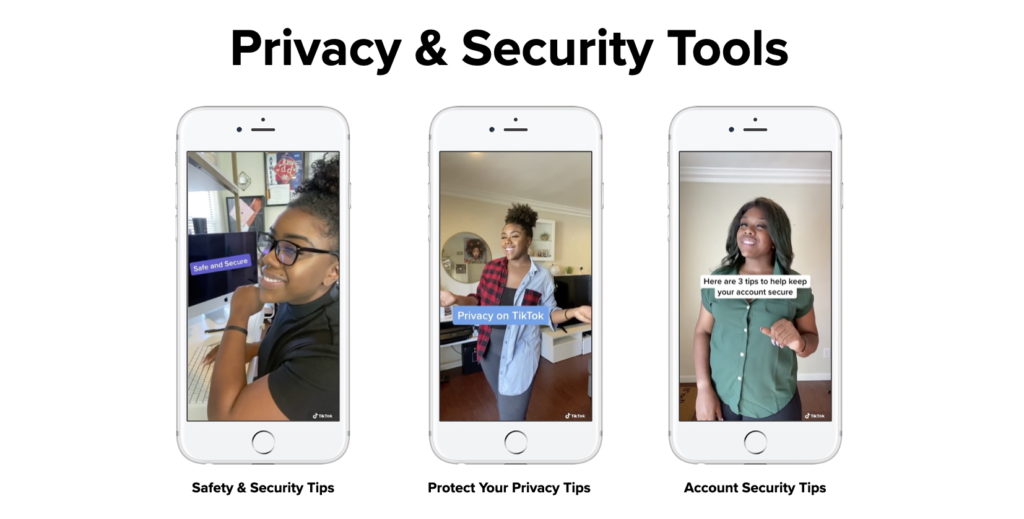
Finally, on privacy and security, he wrote, “Under the leadership of our chief security officer, Roland Cloutier—who has decades of experience in law enforcement and the financial services industry—our teams work to protect our community’s information and stay ahead of evolving security challenges. Our virtual experience shows visitors how we store TikTok user data in the U.S. and safeguard that data from hackers and other threats with encryption and the latest technology. We also detail how we work with industry-leading third-party experts—the same ones used by the federal government—to test and validate our security processes. In our physical centers, we’ll also give experts a first-hand look at how we keep our platform safe 24 hours a day, seven days a week through a cutting-edge fusion center.”
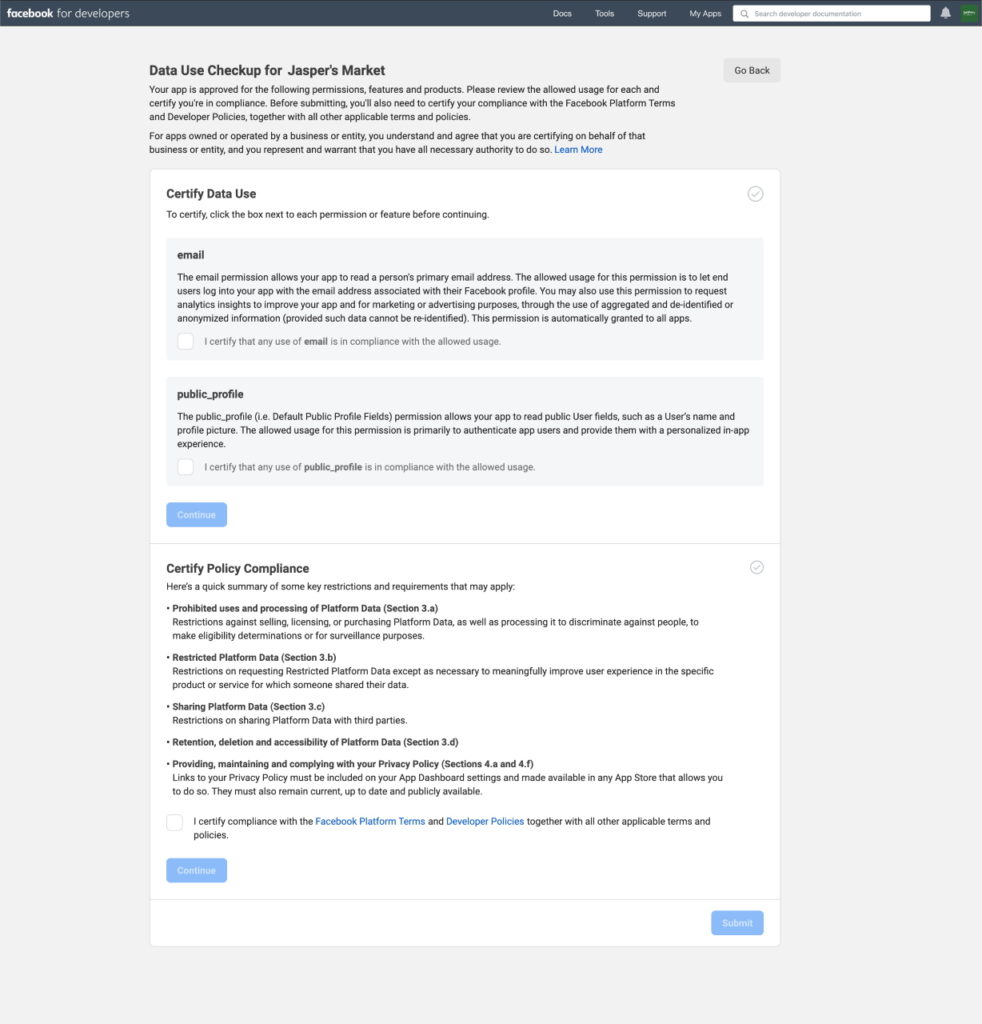
Facebook will begin broadly rolling out the Data Use Checkup workflow for developers and their applications that it began testing in April.
The social network onboarded “a small set of apps” in April, and director of platform partnerships Konstantinos Papamiltiadis said in a blog post Thursday that it will gradually roll out in waves over the coming months.
Data Use Checkup will prompt developers to review the permissions that their apps have access to and commit that their application-programming interface and data use comply with Facebook’s platform terms and developer policies.
When developers are enrolled in Data Use Checkup, they will be notified via developer alert, email to the registered contact and in the task list of App Dashboard. They will then have 60 days to comply or risk losing their API access.
Developers managing multiple apps will have the option of completing the process simultaneously for all of their apps via the My Apps page in App Dashboard, although they must still review each app they manage and the permissions they have access to in order to ensure compliance.
Papamiltiadis shared the following steps that developers not yet enrolled in Data Use Checkup should take in order to be prepared:
Ensure that you can access your app or apps via App Dashboard. Developers that need to regain administrator status can click here.
Update contact details and app admin designations for each app. App admins can complete the Data Use Checkup process, so they should have proper authority to act on behalf of the developer or organization.
Audit apps and remove those that are no longer needed.
Review permissions and features and remove those that are no longer needed.
Snap, Kantar Examine Gen Z’s Attention Span, Affinity for Brands
Snapchat prides itself on its Generation Z-heavy user base, and parent Snap Inc. commissioned two separate studies from Kantar, on that demographic’s ad recall and its brand preferences.
For the first study, more than 2,000 participants 18 and older from Australia, Canada, the U.K. and the U.S. were instructed to use simulated social media environments as they would normally do on their phones for 75 seconds, which each participant seeing the same skippable video ad during those sessions.
Kantar found that Gen Z participants spent less time on content, both advertising and non-advertising, than their millennial, Generation X and baby boomer counterparts, yet they still recalled the content they saw, including the video ad, at high rates.
Specifically, 59% of Gen Z participants correctly recalled the advertiser, compared with 57% of millennials and 47% of Gen X.
When examining results for those who watched the skippable video ad for two seconds or less and comparing them with those who watched for more than two seconds, Kantar found that 55% of Gen Z participants who watched for less than two seconds still recalled the ad, more than double the 26% rate for those 40 and older.
Snap head of international measurement and insights Andy Pang said in an email, “Gen Zers represent a meaningful opportunity for brands, and we have all seen the speed at which this group rapidly tap, swipe and scroll through mobile content, raising the question as to whether what was viewed was actually read and absorbed. This study proves that Gen Z audiences are far faster at processing information than we might have given them credit for. This faster speed of cognitive processing means that brands that want to engage Gen Z need to tailor their video creative and focus on communicating brand and product messages as early as possible.”
Snap wrote in a blog post, “Advertisers may want to consider different creative strategies for digital video targeted at Gen Z, placing greater emphasis on communicating brand and product messages as early as possible. Advertisers may also want to take into account the age distribution of the viewing audience when using video view duration metrics as proxies for an ad’s effectiveness, especially skippable video. Younger people may require less time with a skippable video ad than older people in order to recall seeing it.”
For the second study, Kantar surveyed more than 12,000 people from Australia, Canada, France, Saudi Arabia, the U.K. and the U.S., and it found that Gen Z respondents indicated a high rate of brand preference, as measured by their likelihood to prefer one to three brands above others in specific categories.
Participants were asked to assign attributes to brands they use and, while all age groups leaned toward having the best product features or enjoyment, Gen Z had more of a focus on the environment, caring about customers and product exclusivity.
In the U.S., 60% of Gen Z respondents said their favorite brand was recommended by friends and family, versus 52% of millennials and 39% of those in Gen X or older. “This suggests that there is an opportunity for brands to grow with Gen Z by making advocates of their friends and family,” Snap wrote.
When comparing Snapchatters and non-users, Snapchat users had higher affinity toward brands and were more likely to look at them as modes of self-expression. Kantar found that 60% of Gen Z respondents in the U.S. believe brands allow them to express themselves at higher rates than older generations, compared with 40% for Gen X and baby boomers.
The social network said in a blog post that its existing policy covers the most directly harmful types of content: information or false claims on how to participate in civic processes; content with the potential to intimidate or suppress participation; and false affiliation.
Twitter Safety wrote in its blog post, “In recognition of the changing circumstances of how people will vote in 2020, and in line with our commitment to protecting the integrity of the election conversation, we’re expanding this existing framework. The goal is to further protect against content that could suppress the vote and help stop the spread of harmful misinformation that could compromise the integrity of an election or other civic process.”
Starting Thursday, Sept. 17, Twitter will label or remove false or misleading information intended to undermine public confidence in an election or other civic process, including (but not limited to):
Causing confusion about the laws and regulation of a civic process or officials and institutions executing those processes.
Disputed claims that could undermine faith in the process, such as unverified information about election rigging, ballot tampering, vote tallying or certification of election results.
Misleading claims about the results or outcome of a civic process, which calls for or could lead to interference with their implementation, such as claiming victory before results have been certified or inciting unlawful conduct to prevent a peaceful transfer of power or orderly succession.
The social network said that in line with its existing policies, tweets labeled under the expanded policy will have reduced visibility across its platform and will not be amplified on Twitter’s surfaces, although people following the account that sent the tweet will still be able to view and retweet it.
Jesse Lehrich, co-founder of Accountable Tech and former foreign affairs spokesperson for Hillary Clinton’s presidential campaign in 2016, expressed support for the updates in an email.
“Twitter’s new policies clearly acknowledge the harm done to our democracy when false attacks on the integrity of our elections go unchecked,” he said. “It outlines strong treatments to limit the reach and impact of such posts, to provide factual context to inoculate users and to penalize repeat offenders.”
Twitter Safety wrote, “The conversation happening on Twitter is never more important than during elections. Twitter is where people come to hear directly from elected officials and candidates for office, it’s where they come to find breaking news and, increasingly, it’s an integral source for information on when and how to vote in elections. As more people seek ways to vote and express their fundamental civil rights safely during the Covid-19 pandemic, the need for this type of information has only grown.”
However, Lehrich cautioned, “There is always a question as to whether Twitter can consistently enforce these at scale in real-time, so I don’t want to heap too much praise until we see it in action, but these appear to be significant steps forward. I hope Facebook and others follow suit.”
#ChipotleSponsorUs TikTok Challenge Will Give 5 Groups Free Burritos for a Year
Chipotle marked the addition of a group ordering feature to its application with family TikTok challenge #ChipotleSponsorUs.
The fast-casual restaurant chain and creator collective The House Nobody Asked For will choose five families or small groups of friends (up to five people) who best showcase why Chipotle should sponsor them, and each person in those groups will win free burritos for one year.
To enter, TikTok users can post videos of their family or group using the hashtag #ChipotleSponsorUs through Sept. 14 at 11 a.m. PT/2 p.m. ET. The House Nobody Asked For will then comment on the winners’ posts at 3 p.m. PT/6 p.m. ET that day.
Chipotle ran a similar challenge, #ChipotleSponsorMe, in late April and early May, in which digital star and Chipotle “superfan” David Dobrik chose five individuals who best expressed why the restaurant chain should sponsor them.
Chipotle chief marketing officer Chris Brandt said in a statement, “With people spending more time with their loved ones, we’re quickly seeing TikTok become a family affair. Our #ChipotleSponsorUs TikTok challenge will inspire creativity on the platform and highlight our new group ordering feature, which eliminates the stress of collecting everyone’s Chipotle order.”
Instagram Updates Its Efforts to Bring Equity to Its Products and Platform
Head of Instagram Adam Mosseri shared a progress update on the steps he promised in June to ensure that Black voices are not suppressed on the platform.
A dedicated product group, the Instagram Equity team, was created to focus on better understanding and addressing bias in product development on the platform, as well as users’ experiences.
\Mosseri said the team will focus on creating fair and equitable products, working with parent company Facebook’s responsible artificial intelligence team, and it will create new features to respond to the needs of underserved communities.
Instagram is also seeking to hire a director for diversity and inclusion to advance its goals of finding, keeping and growing more diverse talent among its ranks.
Enforcement against people who make serious rape threats on the platform has been stepped up, and Mosseri said accounts that engage in such activity will be disabled as soon as they are discovered, rather than just removing the content.
Instagram will also take steps to protect involuntary public figures, or people who find themselves in the public eye due to events out of their control, many of whom are members of marginalized communities.
Mosseri said Instagram spent the past two months reviewing its verification practices and, while it will not make its specific criteria public in order to avoid bad actors trying to game the system, accounts must have “a degree of notability” to be considered, measured via press articles about the applicant.
He added that more Black, Latinx and LGBTQ+ media outlets have been added to its list of press sources.
Mosseri wrote, “While follower count was never a requirement to get verified through the in-app form (which anyone can apply for), we did have certain systems in place that prioritized accounts with high followings to help get through the tens of thousands of requests received every day. We’ve since removed this from the automated part of the process.”
Finally, Instagram sought to provide transparency on how it determines the types of content that can appear in places such as its Explore tab by publishing those guidelines, which Mosseri said were formulated after consultation with over 50 experts in recommendation systems, social computing, freedom of expression, safety and civil and digital rights.
Mosseri concluded by sharing links to open roles on Instagram’s policy and product teams and writing, “As I said in my first post, this work will take time, but it’s important to do and to take the time to get right.”