Outcome Health Organizes One-Day Social Initiative to Spotlight Issues Facing Black Community

Healthcare innovation company Outcome Health is spearheading #ShareTheScope, a one-day social media initiative Wednesday (July 22) aimed at spotlighting health issues and disparities facing the Black community.

On that day, eight pairs of organizations, each boasting reaches of over 1 million followers, will engage in “sharing the stethoscope” by using their social media spaces to share new voices and perspectives from Black voices working to uproot racism from the healthcare system in the U.S.

Outcome Heath cited data compiled over a century by the National Medical Association—the country’s oldest Black healthcare association, which represents over 50,000 Black physicians—showing that asthma, Covid-19, diabetes, heart disease and pregnancy-related deaths are just a few of the health issues that disproportionately affect Black Americans.

The pairings are:

  • Ad Council will share its platform with Black Mental Wellness, which provides access to evidence-based information and resources about mental health and behavioral health to decrease mental health stigma in the Black community.
  • HealthiNation will turn over its platform to Sean Peters, founder of My Body, My Kitchen, an online resource to help with the development of the physical and mental health of persons of color.
  • MM&M is partnering with BLKHLTH, which challenges racism and its impact on Black health via its platform that educates, engages and empowers the Black community.
  • Outcome Health will #ShareTheScope with Suzet McKinney, CEO and executive director of the Illinois Medical District, the second-largest urban medical district in the U.S. and home to four major hospitals.
  • PatientPoint will give its platform to GEN-H, developers of a regional health plan as a communitywide response to the critical and growing health challenges facing Greater Cincinnati and North Kentucky.
  • Real Talk With Dr. Offutt will open its mic to the Urban Health Media Project, which is teaching diverse high schools from underresourced communities how to report multimedia stories about the health and social issues affecting their communities.
  • Shatterproof will #ShareTheScope with the Texas Harm Reduction Alliance, which develops and promotes practices and programs to create positive change and reduce the harmful consequences of substance use and misuse in Texas.
  • VeryWell Health will provide its platform to the Black Women’s Health Imperative, the only national organization dedicated solely to improving the health and wellness of the country’s 21 million Black women and girls—physically, emotionally and financially.

Outcome Health CEO Matt McNally said in a statement, “#ShareTheScope is Outcome Health’s call to action to the industry to educate and advocate on the deeply embedded gaps in healthcare for Black families. Knowledge is power, so we decided to connect prominent Black organizations with our peers in healthcare who have a shared desire for justice to act together to collectively walk the walk, not just talk the talk: That’s who Outcome Health is. We intend to raise the bar on all aspects within the point-of-care space, which is a key piece of our mission as an organization.”

McKinney added, “Despite the fact that healthcare in America has been a topic of debate for decades, the needs of people of color have not been given equitable consideration. The opportunity to #ShareTheScope with Outcome Health for education and advocacy should be a catalyst to a growing recognition of the existing health disparities suffered by Black Americans, and we trust it will encourage more people to use their voices loudly to enact meaningful, lasting change.”

And Black Women’s Health Imperative president and CEO Linda Goler Blount said, “#ShareTheScope fits well with our mission to mobilize and engage women and organizations to pursue greater opportunities for gender and racial justice. This is a great opportunity to educate and shift public perception about the needs of Black women’s health.”

https://www.adweek.com/digital/outcome-health-organizes-one-day-social-initiative-to-spotlight-issues-facing-black-community/


Michelob Ultra and Joe Buck Want Fans to Share Their Great Backyard Sports Calls

Michelob Ultra teamed up with Fox Sports announcer Joe Buck on the #UltraBuckCalls contest.

The premise behind #UltraBuckCalls is that with sports largely confined to backyards due to the pandemic, “What’s a great sports moment without great sports commentary?”

Fans have until Aug. 1 to share videos of sports moments with their own calls on Facebook, Instagram or Twitter with the #UltraBuckCalls hashtag.

“Whether it’s a rec softball league home run, a miraculous golf shot or you hitting a game-winning shot in a game of H.O.R.S.E., all videos are eligible,” the beer brand said.

Buck will then choose his four favorite fan-submitted videos and provide his own commentary, and they will be shared on the social channels of Fox Sports, Michelob Ultra and People Are Awesome.

https://www.adweek.com/creativity/michelob-ultra-and-joe-buck-want-fans-to-share-their-great-backyard-sports-calls/


Twitter Users Can View Direct Messages Without Leaving Timeline

It’s been a busy week for Twitter

Somehow, in the midst of dealing with a major security breach and a complete overhaul of its application-programming interface, Twitter found the time to release a new feature.

The social network revealed in a tweet that on desktop, direct messages can be viewed without users having to leave their timelines.

https://www.adweek.com/digital/twitter-users-can-view-direct-messages-without-leaving-timeline/


Pinterest Cooks Up a New Chefs at Home Initiative for Its Today Tab

Pinterest kicked off its Chefs at Home initiative this week both to aid the restaurant industry, struggling with the effects of the coronavirus pandemic, and to provide inspiration for people quarantined at home and looking to sharpen their cooking skills.

Every Thursday through the end of August, Pinterest’s Today tab will feature new recipes from top chefs and culinary leaders including Giada de Laurentiis, Tanya Holland, Kwame Onwuachi and Andrew Zimmern.

The series kicked off Thursday with contributions from “game-changing” Black chefs including Adrienne Cheatham’s salmon skin chicharrones and Chef JJ’s shoulder pork noodles.

Pinterest will also donate $300,000 in ad budget to Relief Opportunities for All Restaurants and Restaurant Employees Relief Fund.

https://www.adweek.com/digital/pinterest-cooks-up-a-new-chefs-at-home-initiative-for-its-today-tab/


Facebook Releases 2020 Diversity Report

Facebook released its 2020 Diversity Report earlier this week, citing increased representation for women and Black and Hispanic people on its work force across every category tracked by the company.

The social network said in a Newsroom post that from 2014 through 2020, Black representation in non-technical roles in the U.S. grew to nearly 9% from 2%, while Hispanic representation went to 11% from 6%.

Meanwhile, over the same period, women in leadership roles rose to 34.2% from 23%.

Chief diversity officer Maxine Williams wrote in the Newsroom post, “Numbers for technical roles have remained more stubborn,” saying that will women have seen representation grow to 24.1% in 2020 from 15% in 2014, over the same time period, growth has been much slower for Black people (1.7% from 1%) and Hispanic people (4.3% from 3%).

She also addressed the 50 in 5 plan the company introduced last year, with the goal of having underrepresented people make up at least 50% of Facebook’s workforce by 2024.

Williams wrote, “In doing this, we aim to double the number of women employees globally and double the number of Black and Hispanic employees in the U.S. When we announced this goal last year, people from underrepresented groups accounted for 43% of our staff. Today, that number is up to 45.3%.”

She added that Facebook is making an additional commitment to boost the representation of people of color in leadership positions in the U.S. by 30%, including a 30% gain in the representation of Black people in leadership, by 2025.

Williams wrote, “These numbers, of course, are only one part of our story. We aim to create a workplace at Facebook where everyone has opportunity with dignity—an environment where people earn equal pay for equal work. For many years, we have conducted pay equity analyses, and we continue to be committed to pay equity. Our analyses confirm that we continue to have pay equity across gender globally and race in the U.S. for people in similar jobs, accounting for factors such as location, role and level.”

She also reiterated Facebook’s pledges last month to spend $1 billion with diverse suppliers in 2021, including $100 million with Black-owned businesses, as well as $100 million in grants and ad credits to Black-owned small and midsized businesses, creators and nonprofits in the U.S., writing, “Recovering from this pandemic will take years. Ending the centuries-old scourge of racial violence and xenophobia will take longer still. And we will continue to empower and give voice to marginalized people and communities, on and off our platform, in the years to come.”

Williams wrote in her introduction, “We’ve seen people of color—Black, Latinx, Indigenous peoples—as well as those with disabilities, veterans, the elderly and those who work on the front lines dying at higher rates from Covid-19. We’ve seen Black Americans killed flagrantly, as if their lives do not matter; women subject to increased domestic abuse in their homes; xenophobic epithets hurled at Asians and people of various religions; violence against LGBTQ people; and so much more. We know in our hearts that our common humanity has not bred a common reality.”

She continued, “At the same time, in every crisis, there are opportunities to help, to serve and to bring people together—to stand for community and, more important, to act for community. This has been our mission from day one at Facebook, and we want inclusion to be a leading factor—not a lagging one—in everything we do.”

https://www.adweek.com/digital/facebook-releases-2020-diversity-report/


Twitter: 14,900 Tweets Removed for Covid-19 Misinformation, 4.5M Accounts Challenged

Twitter provided an update on its efforts to prevent misinformation related to the coronavirus pandemic, saying that since updating its safety rules in March to account for content on Covid-19, 14,900 tweets have been removed and 4.5 million accounts have been challenged.

The social network added that more than 160 million people have visited its curated Covid-19 page over 2 billion times thus far.

Twitter also provided clarification on how it evaluates whether to remove potentially misleading Covid-19 information from its platform, breaking it up into three criteria:

  1. Is the content advancing a claim of fact regarding Covid-19? The social network said the claim must be presented as fact, not opinion, on topics including: the origin nature and characteristics of the coronavirus; preventative measures, treatments, cures and other precautions; viral spread or the current state of the crisis; official health advisories, restrictions, regulations and public-service announcements; and how vulnerable communities are affected by or responding to the pandemic.
  2. Is the claim demonstrably false or misleading? Tweets fall under this category if the information within has been confirmed as false by experts, such as public health authorities, or if that information is shared in a way that could confuse or deceive people. Factors considered include: whether the content of the tweet, including media, has been altered, manipulated, doctored or fabricated; if claims are presented improperly or out of context; and whether claims are widely accepted by experts to be inaccurate or false.
  3. Would belief in this information, as presented, lead to harm? Twitter said in its ongoing blog post about all things Covid-19, “We will not be able to take enforcement action on every tweet that contains incomplete or disputed information about Covid-19. Our focus in the Covid-19 policy is narrowed to address those claims that could adversely impact an individual, group or community.” Examples included misleading information that could increase the likelihood of exposure, have adverse effects on the public health system’s capacity to cope with the crisis or could lead to discrimination against or avoidance of communities or places of business based on their perceived affiliation with protected groups.

The social network reiterated that content meeting all three of the criteria above is not permitted on its platform, and accounts sharing that content may be permanently suspended.

Twitter also said it would continue using warning labels in cases where the risks of harm associated with the content are less severe, but it could still be confusing or misleading.

The social network wrote, “The world has changed since this pandemic was first declared, and public health experts, medical professionals, scientists and researchers now know more about how we can best stay safe and healthy. As the situation evolves and as global health advisories shift to cope with the pandemic, we are committed to ensuring that our rules and enforcement actions reflect that evolution.”

https://www.adweek.com/digital/twitter-14900-tweets-removed-for-covid-19-misinformation-4-5m-accounts-challenged/


Facebook: How to Stop Seeing Parenting Ads

Our guide will show you how to stop seeing ads related to parenting

Did you know that Facebook allows you to stop seeing advertisements related to certain topics, such as alcohol and politics? Our guide will show you how to stop seeing ads related to “parenting.”

Note: These screenshots were captured in the Facebook application on iOS.

Step 1: Tap the three horizontal lines in the bottom-right corner of the screen.

Step 2: Scroll down and tap “Settings & Privacy.”

Step 3: Tap “Settings.”

Step 4: Scroll down to the “Ads” section and tap “Ad Preferences.”

Step 5: Tap “Ad Topics.”

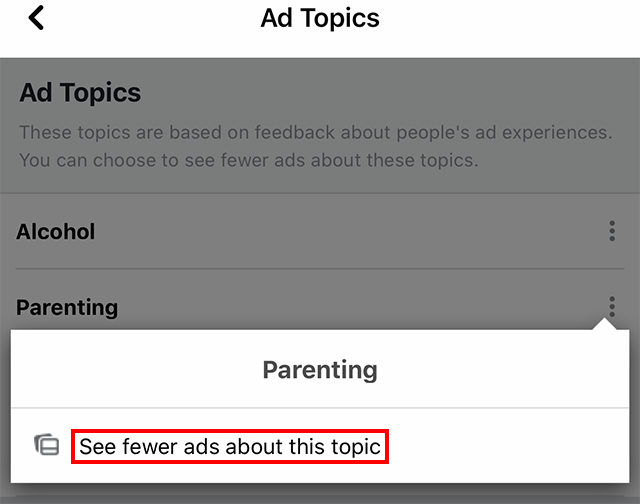
Step 6: Tap the three dots to the right of “Parenting.”

Step 7: Tap “See fewer ads about this topic.”

https://www.adweek.com/brand-marketing/facebook-how-to-stop-seeing-parenting-ads/


Music Videos in the U.S. May Look a Little Different on Facebook Starting Aug. 1

Facebook has reportedly begun notifying administrators of pages linked to musical artists in the U.S. that they must activate a new setting prior to Aug. 1 for officially licensed music videos to be added to those pages.

Sarah Perez of TechCrunch reviewed materials that were sent to admins, reporting that they will not be tasked with manually uploading videos or providing links, and that activating the new setting gives Facebook permission to add videos to their pages, which can be discovered via the Videos tab.

Artists’ official videos and videos that they are featured in will be included, Perez reported.

If page admins do not activate the feature by Aug. 1, the social network will create separate official music pages on behalf of the artists, and those pages will be controlled by Facebook and accessible via Facebook Watch, as well as via a new music video destination that will be added to the social network’s platform, according to Perez.

She reported that Facebook said in an email to page admins that when it receives a new video from an artist’s label, that artist’s page will automatically share the video on its Timeline, reaching fan’s News Feeds, adding that the automatic-sharing setting can be disabled at any time.

According to Perez, artists that enable the setting are granting the social network permission to share aggregate performance insights such as comments, likes, shares, views and other engagement data with rightsholders.

Elements of those auto-generated posts that can be edited include description, tags, thumbnails and title, she added.

Facebook would not confirm any of the details, but it did point out that it already has a music video experience available in India and Thailand, with plans to expand availability in the coming weeks.

The social network has been working with music-industry partners on ways to incorporate music into how people connect and share on its platforms, including the availability of music stickers for Stories on Facebook and Instagram, as well as letting users include music in the background of videos they create and share.

And video continues to be an area of focus for the company moving forward.

https://www.adweek.com/creativity/music-videos-in-the-u-s-may-look-a-little-different-on-facebook-starting-aug-1/


Chipotle Creates Stand-Alone @What_Chipotle_Are_You Instagram Account

Chipotle took the “What _____ are you” meme to a new level with its debut this week of the @What_Chipotle_Are_You Instagram account.

A spokesperson for the restaurant chain said the inspiration came from similar accounts such as @what_frog_you_are and @whatdogyouare, adding that names are being crowdsourced for addition to the list.

Chipotle introduced the account with this post Monday on its main Instagram account.

https://www.adweek.com/brand-marketing/chipotle-creates-stand-alone-what_chipotle_are_you-instagram-account/


Facebook: How to Stop Seeing Alcohol Ads

Did you know that you can stop Facebook from showing you advertisements related to certain topics? For instance, the social network recently rolled out the ability for users to stop seeing political, election and social issue ads. You also have the option to stop seeing ads related to alcohol. Our guide will show you how this works.

Note: These screenshots were captured in the Facebook application on iOS. Also note, when you tell Facebook to stop showing you ads related to a particular topic, you’ll still see the same number of ads on the social network. They just won’t be about the topics you’ve chosen to hide.

Step 1: Tap the three horizontal lines in the bottom-right corner of the screen.

Step 2: Scroll down and tap “Settings & Privacy.”

Step 3: Tap “Settings.”

Step 4: Scroll down to the “Ads” section and tap “Ad Preferences.”

Step 5: Tap “Ad Topics.”

Step 6: Tap the three dots to the right of “Alcohol.”

Step 7: Tap “See fewer ads about this topic.”

https://www.adweek.com/brand-marketing/facebook-how-to-stop-seeing-alcohol-ads/