Facebook Shares Its 2019 Year in Review for Open Source

Facebook said it released 170 new open-source projects in 2019, bringing its total portfolio to 579 active repositories.

Open-source developer advocate Dmitry Vinnik said in a blog post that the social network’s internal engineers contributed more than 82,000 commits in 2019, while some 2,500 external contributors committed over 32,000 changes.

He added that almost 93,000 new people starred Facebook’s open-source projects last year.

Vinnik shared highlights of Facebook’s collaboration efforts in support of open-source projects, including two initiatives in partnership with the Linux Foundation: the GraphQL Foundation and the Presto Foundation.

Facebook expanded on its open-source deep-learning platform, PyTorch, with the debut of PyTorch Mobile, as well as the additions of CrypTen, a framework for privacy-preserving machine learning, and Captum, a model interpretability and understanding library.

The social network also added support for free Jupyter notebook environment Google Colaboratory to its PyTorch tutorials.

On the topic of web and mobile open-source offerings, Vinnik said React and React Native remained very active, and he spotlighted the open-source releases of Hermes, a JavaScript engine optimized for mobile applications, and Magma, a platform that enables operators to deploy mobile networks in a timely fashion.

Late in the year, Facebook released Hydra, a framework that simplifies the development of Python apps by allowing developers to compose and override configurations.

Finally, Vinnik touched on the social network’s work on the blockchain front with the Libra Association via its Calibra subsidiary.

He wrote, “Overall, it has been an excellent year for open source, with many new projects being released and existing communities growing more rapidly than we expected. We want to end this post the same way we started it—by thanking all our internal and external contributors, those who use our open-source tools and frameworks and those who give back to the community. We appreciate you and look forward to working with everyone in the years to come.”

https://www.adweek.com/digital/facebook-shares-its-2019-year-in-review-for-open-source/


Facebook Aims to Show Users the Relationships Between Agencies, Marketers, Advertisers

Facebook director of product management for business integrity Rob Leathern turned to a different social network to share further details on a change introduced last week regarding custom audiences from lists.

Leathern shared a series of tweets about the change, which will begin rolling out later this month.

He said that when Facebook updated its “Why am I seeing this ad?” and Ad Preferences tools in July, he told Katie Notopoulos of BuzzFeed News in an interview that the tools were still “somewhat difficult to navigate and not as comprehensive as (people would) like.”

Leathern said this month’s update will make it easier for Facebook to show its users the relationships between agencies, marketing partners and advertisers, adding, “Many small and medium businesses do their own marketing, whereas some big companies have their own marketing affiliates and multiple agencies.”

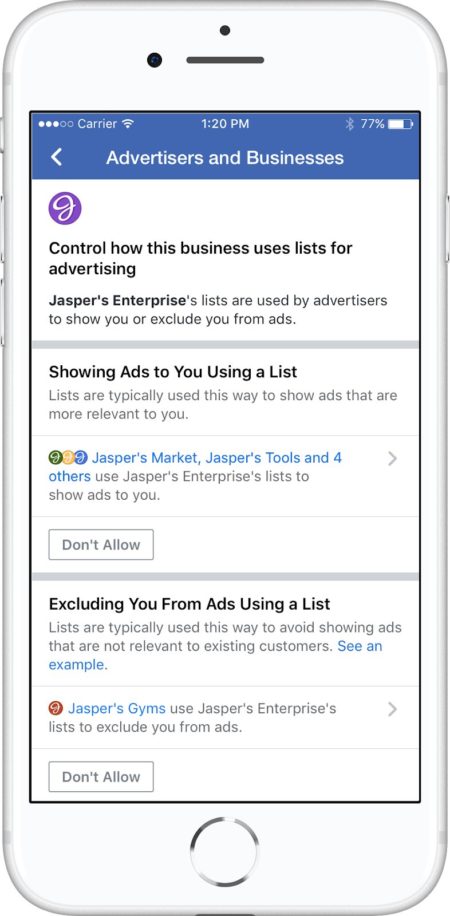
He previewed the new control screen for businesses that people will have access to, saying in his tweets, “You can control the use of lists at a business level. You could disallow the use of lists by multiple advertisers at one time, if they are using lists uploaded by the same business account. You can choose whether an advertiser can include or exclude you from their target audience at a business account level. That means any advertiser using any list from that business will also not be able to include, or exclude, you in an audience. Or you could make yourself eligible for seeing the ad, if they are using a list to exclude you. In this example, a gym might exclude you from ads to sign up because you’re already a member.”

Leathern elaborated on the include/exclude split, saying that advertisers use it for testing purposes, and offering as an example a streaming service that a person is already signed up for not showing them sign-up ads, but showing them ads for specific new shows.

People who are not sure why they were included on a list in the first place will still have to contact the business that created the list, as Leathern said Facebook has no visibility into the makeup of these lists, and all information is hashed before being sent to the social network.

When the update is rolled out, users will be able to access it via Advertisers & Businesses in their Ad Preferences.

Leathern concluded his tweetstorm with, “I’m excited about the new transparency that people will get about how marketers are trying to reach them and the granular ability to make changes to that picture. Once it rolls out later this month, I would love feedback on how we continue to improve it.”

https://www.adweek.com/digital/facebook-aims-to-show-users-the-relationships-between-agencies-marketers-advertisers/


Facebook Improves on Its Amber Alerts

Facebook debuted a revamped Amber Alert format Monday to mark Amber Alert Awareness Day and the fifth anniversary of the day the initiative to help locate missing children rolled out on the social network.

Since the feature debuted in January 2015, over 700 Amber Alerts have been issued via Facebook, and they are now available in 22 countries.

Facebook said its redesign added an updated look and new information making Amber Alerts more visible and easier to share, and important details about the missing child are included, such as photos, descriptions and location of abductions.

Prior to Facebook’s addition of the feature, in May 2014, the social network was a key part of the rescue of kidnapped baby Victoria in Canada.

The social network also shared two other instances of Amber Alerts on its platform helping to reunite parents and missing children.

In October 2016, an Amber Alert was issued for a four-year old girl abducted in Lakeland, Fla. Kaytlin Brown, an anesthesia technician at Baptist East hospital in Memphis, Tenn., was on her lunch break when she recognized the missing child after seeing an Amber Alert on Facebook. Her quick action helped rescue the missing girl.

On Jan. 3, 2018, a five-month-old child was abducted in Greene County, Mo. The Facebook Amber Alert had 46,000 shares and was viewed over 2 million times. A Facebook user, who received the Amber Alert through Facebook, spotted the vehicle of the abductor in Ozark, Mo., contacted 911 and, in just 43 minutes from the initial push of the Amber Alert, the child was found safe and returned home.

https://www.adweek.com/digital/facebook-improves-on-its-amber-alerts/


College Admissions Officers Are Paying More Attention to Applicants’ Social Profiles

The trend of college admissions officers visiting the social media profiles of applicants is back on the upswing, according to the latest survey from Kaplan Test Prep.

The educational and career-services provider polled nearly 300 college admissions officers and found that 36% of them turn to applicants’ profiles on social platforms including Facebook, Instagram, Twitter and YouTube to learn more about them, up from 25% last year.

Kaplan added that since reaching a high of 40% three years ago, the trend had been downward, caused in part by the emergence of newer platforms such as TikTok and Twitch and in part by prominent use of content that is not publicly accessible or disappears after a certain period of time, such as Stories on Snapchat and Instagram.

The company said 19% of respondents who view applicants’ social media profiles do so “often,” up from 11% in Kaplan’s 2015 survey.

Kaplan said 59% of admissions officers believe visiting applicants’ social media profiles is “fair game,” up slightly from 57% last year, while 41% called it “an invasion of privacy that shouldn’t be done.” A separate survey found that 70% of applicants were OK with their profiles being viewed by admissions officers.

Finally, the results of those profile viewings were mixed, as Kaplan said 38% of respondents were impacted positively by what they saw, while 32% were impacted negatively.

Kaplan Test Prep

Kaplan director of college prep programs Sam Pritchard said in a release, “In tracking the role of social media in the college admissions process over the past 11 years, what we’re seeing is that while admissions officers have become more ideologically comfortable with the idea of visiting applicants’ social media profiles as part of their decision-making process, in practice, the majority still don’t actually do it. They often tell us that while it shouldn’t be off-limits, they are much more focused on evaluating prospective students on the traditional admissions factors like an applicant’s GPA (grade point average), SAT (Scholastic Aptitude Test) and ACT scores, letters of recommendation, admissions essay and extracurriculars.”

He added, “We continue to believe that applicants’ social media content remains a wildcard in the admissions process, with what they post possibly being the tipping point of whether they or not they’re admitted to the college of their choice. Our consistent advice to teens is to remain careful and strategic about what they decide to share. In 25 years, you’ll definitely remember where you graduated college from, but you’ll unlikely remember how many people liked that photo of what you did over winter break.”

https://www.adweek.com/digital/college-admissions-officers-are-paying-more-attention-to-applicants-social-profiles/


Reddit Updates Its Policies on Impersonation, Deepfakes

Reddit released a policy update on impersonation and deepfakes, saying that while neither currently represents a huge issue on its platform, it wants to nip potential problems in the bud.

The company said in a Reddit Security post that impersonation is one of the rarest report classes it receives, so it does not expect its policy update to impact its users.

Reddit added that while it hasn’t seen many deepfakes on its platform to date, it wanted to guard against potential offenses such as malicious deepfakes of politicians or other forged or manipulated content, explaining that its policy doesn’t apply to all deepfake or manipulated content, only to content that was manipulated for malicious purposes.

The new policy reads, “Reddit does not allow content that impersonates individuals or entities in a misleading or deceptive manner. This not only includes using a Reddit account to impersonate someone, but also encompasses things such as domains that mimic others, as well as deepfakes or other manipulated content presented to mislead, or falsely attributed to an individual or entity. While we permit satire and parody, we will always take into account the context of any particular content.”

Reddit added that any potential violations can be reported here.

https://www.adweek.com/digital/reddit-updates-its-policies-on-impersonation-deepfakes/


Facebook Page Admins Can Now Access Their Page Management History

Facebook quietly added a new way for page administrators to police each other.

The social network added a Page Management History option to the left column of its page settings.

Page Management History displays actions taken by page admins including added and removed admins, changes to rolls, changes to page settings and admins who added, removed or left groups.

Facebook said in a Help Center post that information in Page Management History only goes back to last Nov. 1.

https://www.adweek.com/digital/facebook-page-admins-can-now-access-their-page-management-history/


TikTok Packs a Lot More Into Its Updated Terms of Service

Popular video creation application TikTok released its updated terms of service earlier this week, with significantly more meat than the previous version.

The prohibition on harmful or dangerous organizations or content was expanded, and in addition to terrorists and terrorist organizations, it covers hate groups, violent extremist organizations and groups engaged in arms trafficking, blackmailing, cybercrime, drug trafficking, extortion, fraud, homicide, human trafficking, kidnapping, money laundering and organ trafficking.

Flags, gestures, logos, names, portraits, slogans, symbols or other object representing those organizations are banned, as is content that glorifies, praises or supports dangerous individuals or organizations.

TikTok’s new terms of service also include lengthy details on illegal activities and regulated goods.

Users are forbidden to post:

  • Content that promotes acts of physical harm, such as assaulting or kidnapping.
  • Content that risks the safety of others, including pranks like swatting.
  • Content that promotes human exploitation or wildlife trafficking.
  • Content that offers the purchase, sale or trade of unlawfully acquired goods.
  • Content that provides instructions on how to conduct criminal activities.

The app also prohibits content portraying ammunition, explosive weapons, firearm accessories or firearms, as well as instructions on how to manufacture them.

On the topic of drugs and controlled substances, TikTok will not allow:

  • Content that displays drugs, drug consumption or encourages others to make, use or trade drugs or other controlled substances.
  • Content that sells, offers, trades or solicits drugs or other controlled substances.
  • Content that provides information on how to buy illegal or controlled substances.

TikTok added a long list of prohibited content related to minors, including child abuse, child nudity, sexual exploitation, underage delinquent behavior (such as use of drugs, alcohol or tobacco) and grooming behavior (an adult building an emotional relationship with a minor to gain their trust for the purposes of sexual abuse, sexual exploitation or sexual trafficking).

And the app adding a section on frauds and scams, covering examples such as phishing, Ponzi schemes, pyramid schemes, fixed betting, get-rich-quick schemes and other scams.

The section about hate speech in the new terms of service now includes these details about slurs: “Slurs are defined as derogatory terms that are intended to disparage an ethnicity, race or any other protected attributes listed above. They are not tolerated on our platform because we do not want to contribute to the spread of egregiously offensive terms. However, we are aware of the fact that slurs can be used self-referentially or have been reappropriated, and we may give exceptions when slurs are used in a song or in other instances of a self-referential satirical context and/or reappropriation.”

Finally, TikTok added a section to its terms of service on a hot-button topic for social platforms these days, misleading information.

The app wrote, “We do not permit misinformation that could cause harm to our community or the larger public. While we encourage our users to have respectful conversations about the subjects that matter to them, we remove misinformation that could cause harm to an individual’s health or wider public safety. We also remove content distributed by disinformation campaigns.”

TikTok provided as examples:

  • Misinformation meant to incite fear, hate or prejudice.
  • Misinformation that may cause harm to an individual’s health, such as misleading information about medical treatments.
  • Hoaxes, phishing attempts or manipulated content meant to cause harm.
  • Content that misleads community members about elections or other civic processes.

TikTok wrote in the introduction to its updated terms of service, “Our values form the foundation of our community guidelines. We remove content including video, audio, images and text that violates our community guidelines, and suspend or ban accounts involved in severe or repeated violations. Under certain circumstances, we will go one step further and report the accounts to relevant legal authorities to keep our community safe.”

https://www.adweek.com/digital/tiktok-packs-a-lot-more-into-its-updated-terms-of-service/


Twitter Will Test Enabling Accounts to Control Who Can Reply to Their Tweets

Twitter revealed the next steps in its ongoing effort to give people on its platform more control over their conversations in a session at CES 2020 Wednesday.

The social network said it will begin testing a new conversation participants menu on its compose screen that will give the tweet creator four options for who can reply to their tweets: Global, meaning anyone on Twitter; Group, limiting replies to people followed or mentioned by the tweeting account; Panel, whereby only people mentioned in the tweet can reply; and Statement, which prohibits all replies.

The conversation participants menu is being tested with the intention of making it available to all accounts on the platform, whether they belong to individual users or businesses.

A Twitter spokesperson said in an email, “As part of our work to help people feel safe participating in the conversation on Twitter, we want to give them more control over the conversations they start—for example, who can reply to their tweets. We will be experimenting with this in early 2020.”

Twitter director of product management Suzanne Xie said at the CES session that the social network will experiment with the new feature during the first quarter, with the aim of refining it and preparing it for a global rollout later this year.

Xie joined Twitter last August when the social network acquired the company she founded and led, Lightwell, a startup provider of mobile design tools for building interactive, narrative applications.

She said during the session, “We thought, well, what if we could actually put more control into the author’s hands before the fact and give them really a way to control the conversation space as they’re actually composing a tweet? … Right now, public conversation on Twitter is when you tweet something that everyone in the world will see and everyone can reply, or you can have a very private conversation in a direct message. So, there’s an entire spectrum of conversations that we don’t see on Twitter yet,” Ingrid Lunden and Sarah Perez of TechCrunch reported.

Vice president of product Kayvon Beykpour added, as reported by Lunden and Perez, “The primary motivation is control. We want to build on the theme of authors getting more control, and we’ve thought … that there are many analogs of how people have communications in life.”

Dieter Bohn of The Verge reported that Xie also cited as motivation for the test “getting ratio’d, getting dunked on, the dynamics that happen that we think aren’t as healthy are definitely part of … our thinking about this,” adding that in cases where misinformation cannot be rebutted due to inability to comment, users can turn to quote tweeting, and this is “something we’re going to be watching really closely as we experiment.”

Twitter also said during its CES session that it plans to bring the conversation threading that it has been testing in its twttr prototype application will come to its flagship app in the coming months.

https://www.adweek.com/digital/twitter-will-test-enabling-accounts-to-control-who-can-reply-to-their-tweets/


4 Million Advertisers Are Using Stories Across Instagram, Facebook, Messenger

Facebook said at CES 2020 Tuesday that 4 million advertisers are now using Stories ads across Instagram, Facebook and Messenger.

The company’s Stories advertiser total topped 3 million last May.

The social network also highlighted recent Stories campaigns by two brands.

Direct-to-consumer brand Grove Collaborative—which makes eco-friendly household products in areas including cleaning, personal care, babies, kids and pets—created full-screen vertical video ads for immersive mobile viewing.

Facebook said the style of the videos was “personal and casual,” making it seem like actual customers were sharing videos of Grove Collaborative products being used in their homes, adding that viewers were able to swipe up to access the company’s online store.

Grove Collaborative said 37% of its new customers came via Stories, and the campaign resulted in a 25% lower cost per acquisition compared with all of its placements and a click-through rate 2.1 times higher than all of its other placements.

Skin care product manufacturer Clinique used its global #FindMyiD campaign to leverage data from Facebook’s platform and identify the top three concerns around skin.

In what the social network called a “great demonstration of personalization at scale,” Clinique then delivered personalized ads based on consumer signals, driving conversions online and in-store.

The campaign delivered a 114% lift in offline conversions in Malaysia, a 13-point lift in brand awareness (compared with the luxury benchmark of four points) in France and ad recall in 14 out of 20 markets that was two times the norms.

https://www.adweek.com/digital/4-million-advertisers-are-using-stories-across-instagram-facebook-messenger/


Andrew Bosworth Urges Facebook Co-Workers to Avoid Temptations of Influencing Election

Facebook vice president of consumer hardware Andrew Bosworth found himself in the familiar position of defending something he wrote for internal consumption at the company that ended up being publicly leaked.

Kevin Roose, Sheera Frenkel and Mike Isaac of The New York Times obtained a copy of a memo Bosworth shared on his internal Facebook profile Dec. 30, in which he stated that while he does not want to see President Donald Trump win a second term, he also did not want to see Facebook do anything that could potentially manipulate the outcome of the 2020 presidential election.

Bosworth responded by publicly sharing his memo, Thoughts for 2020, and saying in his post introducing the memo: “It wasn’t written for public consumption, and I am worried about context collapse, so I wanted to share some important context for those who are curious.”

He added, “We have a culture at Facebook of sharing ideas and inviting discussion internally … Overall, I hoped this post would encourage my coworkers to continue to accept criticism with grace as we accept the responsibility we have overseeing our platform.”

Facebook had no further comment beyond Bosworth’s response. The Trump campaign had not responded to a request for comment at the time of this post.

Bosworth found himself in a similar situation in March 2018, when BuzzFeed News obtained and shared a memo he penned in June 2016, in which he stressed connecting people at all costs, writing in part, ““So we connect more people. That can be bad if they make it negative. Maybe it costs someone a life by exposing someone to bullies. Maybe someone dies in a terrorist attack coordinated on our tools.”

He led Facebook’s ads and business platform for five years, including the period during the 2016 U.S. presidential campaign, before shifting in August 2017 from vp of ads and business platform to vp of consumer hardware.

Bosworth referenced Lord of the Rings in the part of his memo drawing the most attention, writing, “As a committed liberal, I find myself desperately wanting to pull any lever at my disposal to avoid the same result. So, what stays my hand? I find myself thinking of the Lord of the Rings at this moment—specifically, when Frodo offers the ring to Galadriel and she imagines using the power righteously, at first, but knows it will eventually corrupt her. As tempting as it is to use the tools available to us to change the outcome, I am confident we must never do that or we will become that which we fear.”

Other noteworthy parts of Thoughts for 2020 follow:

Russian interference

“$100,000 in ads on Facebook can be a powerful tool, but it can’t buy you an American election.”

Bosworth stressed that while Russian interference in the 2016 presidential election was real, advertising was not the weapon of choice.

He pointed to tactics such as “hosting Black Lives Matter and Blue Lives Matter protest events in the same city on the same day.”

Bosworth said that while he does not expect foreign interference to play a major role in the upcoming election, “It is certainly true that we should have been more mindful of the role both paid and organic content played in democracy and been more protective of it.”

Cambridge Analytica

Bosworth dismissed Cambridge Analytica as “a total non-event,” and he even praised Brad Parscale, digital director of Trump’s 2016 campaign and campaign manager for his re-election effort, for debunking Cambridge Analytica’s claims that it helped influence the 2016 results.

“They were snake oil salespeople,” he wrote. “The tools they used didn’t work, and the scale they used them at wasn’t meaningful. Every claim they have made about themselves is garbage.”

https://www.adweek.com/digital/andrew-bosworth-urges-facebook-co-workers-to-avoid-temptations-of-influencing-election/