Instagram Adds Layout Feature for Stories

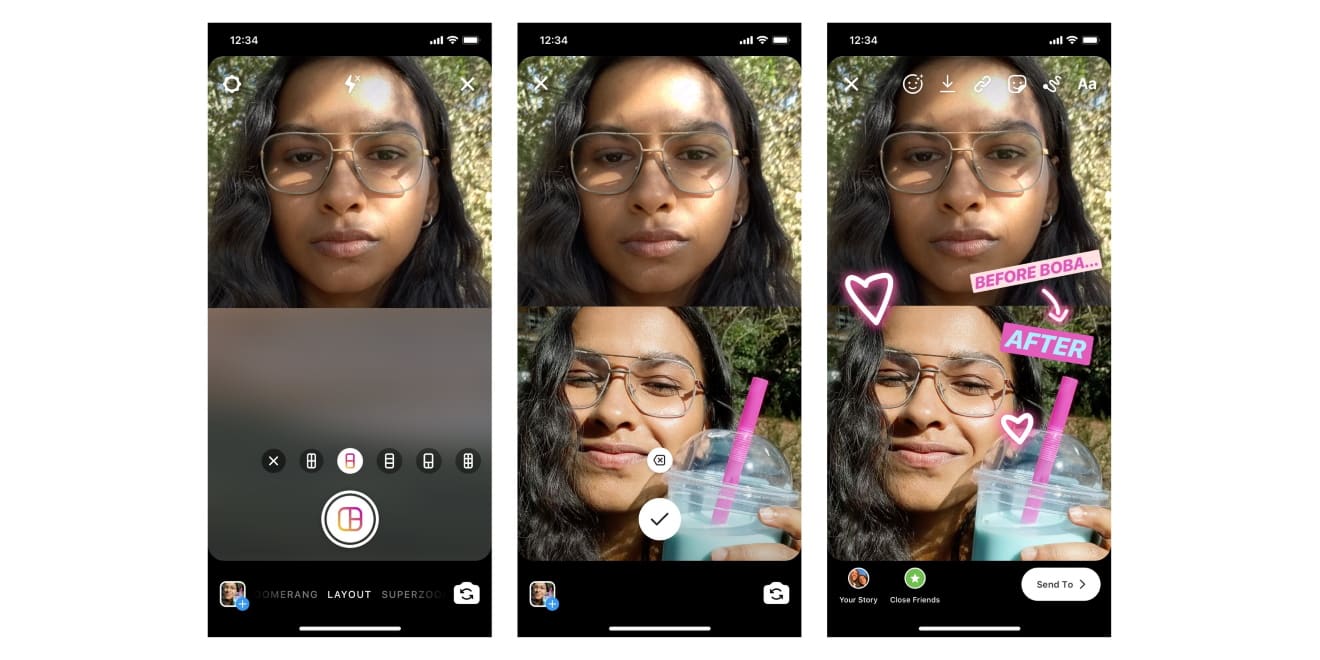
Instagram added a Layout feature to Stories that enables users to capture and share multiple photos.

The Facebook-owned photo- and video-sharing network introduced the update in a tweet.

Instagram introduced stand-alone application Layout in March 2015, and it enables users to combine multiple photos into a single image.

https://www.adweek.com/digital/instagram-adds-layout-feature-for-stories/


Twitter Chips Away at Its Inclusion and Diversity Goals

Twitter released the December 2019 edition of its Inclusion & Diversity Report Tuesday, revealing mixed results in its efforts to meet the two-year diversity targets it set in 2017.

Vice president, people experience and head of inclusion and diversity Dalana Brand said in a blog post that the social network was encouraged by its progress in recruiting diverse technical talent, but more focus was needed on bringing that diversity to senior roles.

Women made up 42% of the company’s total workforce as of the end of November, short of the December target of 43%.

Twitter exceeded its goal of 5% of its workforce being made up of blacks, reaching 5.7% at the end of November.

However, the reverse was true for Latinx, as its November figure of 4.7% fell short of its December goal of 5%.

Women made up 34.9% of Twitter’s global leadership, down from 35.8% at the end of 2018.

Meanwhile, in the U.S., blacks accounted for 5.3% of leadership, up from 4.7% at the end of last year, and Latinx leadership rose to 3.5% from 2.7%.

Women also made up 23.5% of the company’s technical workforce, up from 20.2% as of December 2018.

Blacks accounted for 4.1% of the social network’s technical workforce in the U.S., up from 2.9% at year-end 2018, while Latinx representation rose from 3.2% to 3.6% over the same time period.

Brand wrote, “Next year, we’re introducing a new vision for what we want our workforce to look like in five years, and a career pathways program that will help increase representation of women, black, and Latinx Tweeps across all levels, roles and office locations.”

From October 2018 through October 2019, 45.6% of new hires worldwide were women, while blacks accounted for 9% of U.S. hires and Latinx for 6.4%.

Over the same time period, Twitter saw attrition of 10.4% of women globally, as well as 9.1% of blacks and 6.8% of Latinx in the U.S.

Brand added, “While this is encouraging data, we are determined to lower attrition across these groups even further, and we will be investing heavily in 2020.”

The company also shared its U.S. race and ethnicity representation data as of November.

Overall, 40.9% of its U.S workforce is white, followed by: Asian/Pacific Islander (27.7%), no response/declined to disclose (17.3%), black (5.7%), Latinx (4.7%), multiracial (3.6%) and Native American/Alaskan (0.1%).

Whites made up 56.9% of U.S. leadership, followed by: Asian/Pacific Islander (16.7%), no response/declined to disclose (14.8%), black (5.3%), Latinx (3.5%), multiracial (2.8%) and Native American/Alaskan (0.0%).

Finally, Twitter’s U.S. technical workforce is 35.2% Asian/Pacific Islander, followed by: white (34.8%), no response/declined to disclose (19.3%), black (4.1%), Latinx (3.6%), multiracial (2.9%) and Native American/Alaskan (0.1%).

Brand wrote, “The true measure of diversity is more complex than what can be gathered from formal people systems. That’s why we’ve launched an anonymous internal global inclusion survey to collect more robust information about our Tweeps’ lived experiences. The survey explores important topics across gender, sexual orientation, race/ethnicity and immigration, socio-economic status, and religion—to name a few. This data will guide our future I&D investments, and we look forward to sharing the results in a future report.”

As for learning and development, Twitter rolled out an e-learning module in August to help employees better understand micro-aggressions, how to avoid them and what to do when they occur.

The company also began mandatory unconscious bias training for all employees in November, “equipping them to recognize and address the effects of unconscious bias by challenging assumptions; encouraging diversity of experience, opinion, and expression; and supporting a workplace culture that actively and intentionally strives to be more inclusive,” Brand wrote.

Finally, on the product and partnerships front, Twitter debuted cross-functional effort #TwitterTeamUp in October, led by its inclusion and diversity team and joined by its teams in business resources, user services, health and trust and safety. Brand wrote, “The collaboration has opened new lines of communication across leaders who play an important role in shaping how the company thinks about these issues.”

She concluded, “As the year winds down, we’ve got our sights set on 2025 and are asking ourselves, ‘What will it take to become the world’s most inclusive and diverse tech company?’ We’re excited to share our vision with you in our next report. In the meantime, we want to hear from you! What would you like to see from us?”
https://www.adweek.com/digital/twitter-chips-away-at-its-inclusion-and-diversity-goals/


Facebook Updates App Dashboard to Optimize App Review Process for Developers

Facebook updated its app dashboard to ease the application review process for developers by helping them request access to the appropriate permissions for their apps.

Software engineer Samuel Kitono said in a blog post that the social network’s app review process—during which developers request access to the permissions they believe are necessary to access information from the Facebook platform—also helps Facebook understand how developers are using and accessing its platform.

Facebook added a new tool to the app review process that enables developers to see past application-programming interface calls and commonly used endpoints so that they can better determine which permissions they need.

The social network sends messages to developers—via the dashboard inbox or personal email—related to the permissions they requested, which can become an onerous process if that number is too high.

Therefore, Facebook added a feature that lets developers remove permissions from the app dashboard and no longer receive messages related to those permissions.

Finally, Facebook added a new page to its app dashboard where developers can see past submissions for app review.

Kitono wrote, “This information gives teams insight into what permissions have been requested before and improves submissions moving forward.”

https://www.adweek.com/digital/facebook-updates-app-dashboard-to-optimize-app-review-process-for-developers/


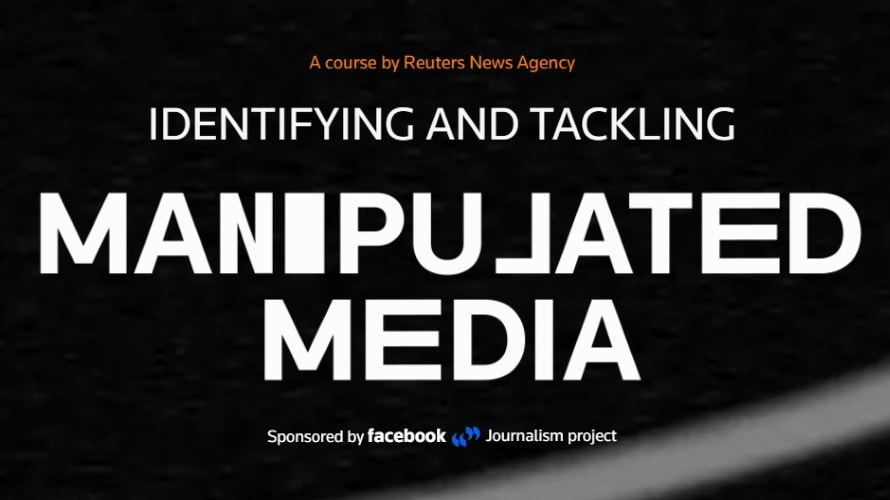
Reuters, Facebook Journalism Project Create E-Learning Course on Deepfakes

Multimedia news publisher Reuters teamed up with the Facebook Journalism Project on an e-learning course aimed at helping newsrooms more easily detect deepfakes and manipulated media.

Identifying and Tackling Manipulated Media contains tips on identifying and rejecting manipulated video, images and audio to help curb the spread of misinformation.

The course uses real-world examples, hypothetical cases and insights into the evolving technology that is used to create and detect manipulated media.

It debuted in Arabic, English, French and Spanish, and Reuters said more languages will be added in 2020.

Reuters said in a release, “The spread of inaccurate and misleading information is a significant and growing global problem. It is a major challenge for journalists and a source of alarm for governments, institutions and individuals all over the world, as it has had an increasing impact on elections. Some of the most powerful and effective forms of misinformation are video and images, as they are highly shared on social media and can be understood by all. Staged events, recycled video, deceptive editing, tampering and the recent rise of artificial-intelligence-driven deepfake videos all pose a fundamental threat to an informed democracy.”

Julia Bain, global strategic initiatives lead for news partnerships at Facebook, added, “We need to work across industries to better identify and address manipulated media. Partnering with Reuters to launch this free e-learning course is an important step to help journalists spot this type of content so that we can stop the spread of misinformation online,”

And Reuters director of strategic partnerships and program management Jess April said, “Organizations around the world are increasingly alarmed by the spread and impact of misinformation on society. It’s become a major challenge for media organizations as they’re bombarded with user-generated and other third-party content. It’s a threat we at Reuters encounter every day, and this new course puts that expertise into practice to educate journalists and newsrooms about identifying manipulated media to help stop the spread of misinformation. Providing trusted news and intelligence to the world is at the heart of what we do, and sharing our knowledge of this growing threat is critical to that mission.”

https://www.adweek.com/digital/reuters-facebook-journalism-project-create-e-learning-course-on-deepfakes/


Instagram’s Use of Third-Party Fact-Checkers Goes Global

Instagram began testing parent company Facebook’s third-party fact-checking initiative in the U.S. in May, and Monday, the program was expanded worldwide.

The social network’s 45 third-party fact-checkers will independently assess and rate false information on Instagram in order to help detect it and reduce its distribution.

Instagram said in a blog post that content rated as false or partly false by a third-party fact checker will be removed from its Explore tab and hashtag pages in order to reduce its distribution, and it will be labeled in order to enable people to better decide for themselves what to read, trust and share.

The labels link to the rating from the fact-checker and provide links to articles from credible sources that debunk the questionable content.

Those labels will appear worldwide in feed, profile, Stories and Instagram Direct messages.

Instagram is using image-matching technology to find duplicates of the content and label them, and content that is rated false or partly false on Facebook will automatically be labeled as such on Instagram, as well.

The company uses a combination of feedback from its community and artificial intelligence to determine which content should be passed along to third-party fact-checkers for review.

The Facebook-owned photo- and video-sharing network added a way for its users to report potential false information in August.

However, in line with the policies of its parent company, organic content and ads from politicians will not be subject to fact-checking.

Instagram said in its blog post, “We want you to trust what you see on Instagram. Photo- and video-based misinformation is increasingly a challenge across our industry and something our teams have been focused on addressing.”

https://www.adweek.com/digital/instagrams-use-of-third-party-fact-checkers-goes-global/


Instagram Uses AI to Warn Users Who Are About to Post Potentially Offensive Captions

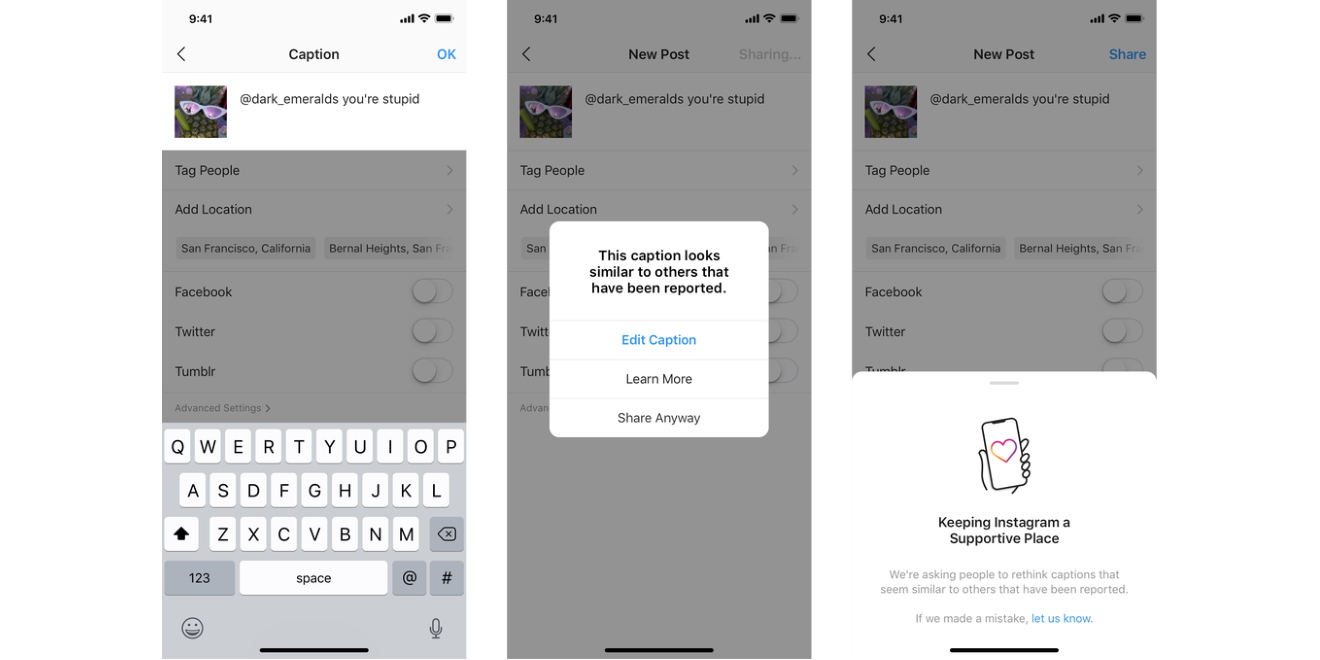
Instagram rolled out a feature in July in which it used artificial intelligence to detect comments that might be considered offensive, warning the people who are posting those comments and giving them a chance to reconsider. That feature was extended to captions Monday.

The Facebook-owned photo- and video-sharing network said in a blog post that when its AI detects a caption on a feed post to be potentially offensive, the user about to post that caption will see a prompt warning them that it is similar to others that were reported for bullying.

The user will then be given the opportunity to edit his or her caption before posting it.

The feature began rolling out in select countries Monday, with plans to expand it globally in the coming months.

Instagram wrote in its blog post, “In addition to limiting the reach of bullying, this warning helps educate people on what we don’t allow on Instagram, and when an account may be at risk of breaking our rules.

https://www.adweek.com/digital/instagram-uses-ai-to-warn-users-who-are-about-to-post-potentially-offensive-captions/


Snapchat’s First-Ever Trailer Reaction Lens Takes Flight for Top Gun: Maverick

Paramount Pictures is marking the release of its new trailer for upcoming feature film Top Gun: Maverick with the first-ever trailer reaction lens on Snapchat.

The lens provides an experience whereby Snapchatters see a horizontal split screen, with the trailer for Top Gun: Maverick playing on the top, while an augmented reality face lens experience on the bottom transforms them into jet-flying fighter pilots.

Users can react to the trailer in real-time and record their reactions.

The lens is already available in Canada and the U.S., and it will be rolled out in Brazil, France, Germany, Mexico and the U.K. in the coming days.

Paramount Pictures/Snapchat

Paramount Pictures/Snapchat

The original Top Gun was released in theaters in 1986.

Top Gun: Maverick, which is scheduled for a June 26 debut, picks up the story of Pete “Maverick” Mitchell (Tom Cruise), who is serving as a test pilot after over 30 years as one of the Navy’s top aviators.

He ends up training a detachment of Top Gun graduates for a specialized mission, including Lt. Bradley Bradshaw (Miles Teller), “Rooster,” the son of Maverick’s late friend and Radar Intercept Officer Lt. Nick Bradshaw, aka “Goose.”

https://www.adweek.com/digital/snapchats-first-ever-trailer-reaction-lens-takes-flight-for-top-gun-maverick/


Twitter Trust and Safety Council Eyes Expansion, Reorganization

Twitter provided an update Friday on the Twitter Trust and Safety Council, which the social network established in February 2016 to help advise it as it develops products, programs and the Twitter rules.

Director of public policy strategy Nick Pickles said in a blog post that after speaking with the current members and internal discussions, it was determined that membership needed to be broadened to include more diverse voices, and members needed to be organized so that their conversations could be more in-depth.

Going forward, the Twitter Trust and Safety Council will be made up of several groups, starting in 2020 with: safety and online harassment; human and digital rights; child sexual exploitation; and suicide prevention and mental health.

Pickles wrote, “These four groups cover topics that are critical to ensuring that people feel safe, and they will be a crucial part in helping us learn how we can move faster to address emerging trends and risks. Focusing on these issues will help us more quickly adapt and address new trends and risks to consider. By bringing together a wider and more diverse range of perspectives, we hope to engage in more substantial discussion of these issues.”

Temporary working groups will also be established to focus on topics better addressed with organizations that have related expertise, such as one group dedicated to Twitter’s interpretation of dehumanization.

Pickles said more details will be shared in January on how the Twitter Trust and Safety Council will be expanded, as well as more of the company’s thinking following ongoing meetings with nongovernmental organizations, activists and other organizations.

He concluded, “We’re grateful for the continued support and engagement from our partners around the world and look forward to collaborating with even more groups in the future.”

https://www.adweek.com/digital/twitter-trust-and-safety-council-eyes-expansion-reorganization/


WWE Creates Channel on TikTok

WWE climbed into the ring with TikTok, debuting an official channel on the video creation and sharing platform.

The channel debuted with the entrance themes for more than 30 WWE Superstars and Hall of Famers including “Stone Cold” Steve Austin, The Undertaker, Ultimate Warrior, Becky Lynch, John Cena and Sasha Banks.

TikTok users can incorporate those entrance themes into their own unique videos.

Mayan Scharf, who works on global partnerships for TikTok, said in a release, “By capturing the passion and thrill of wrestling, WWE is at the forefront of bringing together sports and entertainment in an unconventional and fun way. Through our partnership with WWE, we’re looking forward to bringing the excitement of the WWE experience to TikTok’s global community.”

WWE executive vice president of advanced media Jayar Donlan added, “We are thrilled to be launching this partnership, which offers a new level of engagement with WWE content by enabling the TikTok community to create their own shareable stories tied to WWE‘s world renowned Superstars.”

https://www.adweek.com/digital/wwe-creates-channel-on-tiktok/


Facebook’s Independent Oversight Board Won’t Name Members Until 2020

Facebook provided an update on its global independent oversight board for content, which was originally proposed by CEO Mark Zuckerberg last November.

Director of governance and global affairs Brent Harris said in a Newsroom post that it established an independent oversight board trust in order to ensure that the board retains the ability to make independent decisions and recommendations.

Its governance structure was created as a non-charitable purpose trust under Delaware law, and the company released its trust agreement and LLC operating agreement, which will be used to finalize contracts with board members and staff, separate from Facebook.

That staff will be independent from Facebook, and the company said it expects to start with a director, case managers and dedicated staff members for support in areas such as communications, legal, human resources and research.

Facebook said the trust will be responsible for matters such as overseeing the board’s funding and reviewing its annual budget, as well as formally appointing and removing members in accordance with its upcoming bylaws and code of conduct.

It will be made up of at least three individual trustees and one corporate trustee, Brown Brothers Harriman. Facebook is current working with executive search firm Spencer Stuart to select the individual trustees.

Facebook made an initial commitment of $130 million to cover operational costs—including office space, staff and travel expenses—for the board’s first two terms, spanning six years.

Harris wrote, “The board will submit a yearly budget to the trust for approval and disbursement of funds. Annual reports from the board and trust will help to document the health and effectiveness of the board, including its stewardship of these resources. Facebook intends to continue funding the board’s operations in the future, and these reports will be used to assess the need for additional, substantive and long-term funding.

On the topic of human rights, Facebook teamed up with independent nonprofit organization BSR to commission a review on how best to structure the board.

Harris wrote, “The recommendations in the assessment, including on the diversity of board members, remedies, user support, transparent communications and privacy-protective tools, have helped inform the board’s charter, as well as its bylaws.”

Facebook originally intended to reveal board members by year-end, but the company said it was taking additional time to consider candidates, with Harris adding, “This call for recommendations has resulted in submissions from people from a range of disciplines and backgrounds, which we are actively reviewing and taking under consideration as part of our membership selection process. We’ve seen strong global interest in serving on the board, and this is a sign that we are heading in the right direction. We are eager to see the oversight board take shape and start hearing cases next year.”

https://www.adweek.com/digital/facebooks-independent-oversight-board-wont-name-members-until-2020/