Facebook Dating Users Can Now Share Stories From Facebook, Instagram

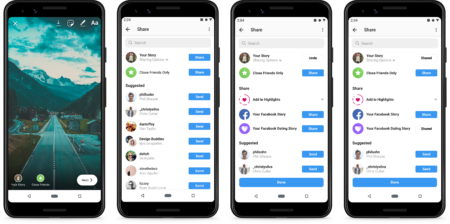
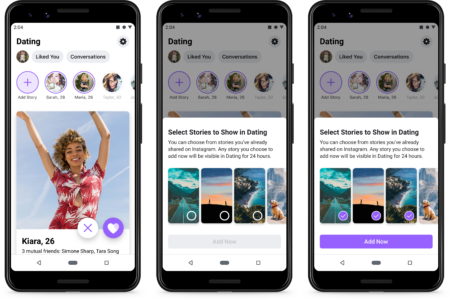
Facebook Stories and Instagram Stories can now be added to Facebook Dating.

The feature began rolling out Thursday and, by early 2020, it will be available in all 20 countries with access to Facebook Dating: Argentina, Bolivia, Brazil, Canada, Chile, Colombia, Ecuador, Guyana, Laos, Malaysia, Mexico, Paraguay, Peru, the Philippines, Singapore, Suriname, Thailand, the U.S., Uruguay and Vietnam.

Charmaine Hung, lead product manager on Stories for Facebook Dating, told Queenie Wong of CNET that adding Stories—which enable people to post photos and videos that disappear in 24 hours—can help people bring a more “authentic” version of themselves to Facebook Dating, potentially extending conversations with matches.

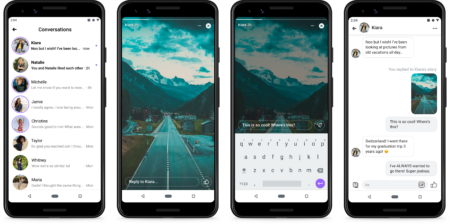
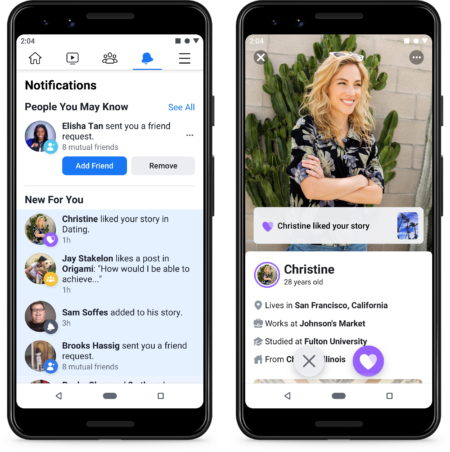
Stories cannot be created within Facebook Dating. Rather, once they are created on Facebook or Instagram, Facebook Dating users can share them. Potential matches’ Stories can be viewed and liked, and people who match can continue viewing each other’s Stories.
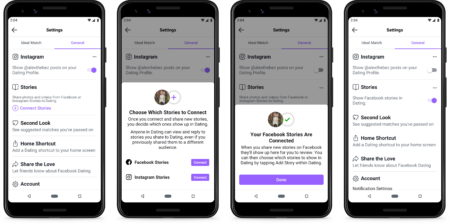
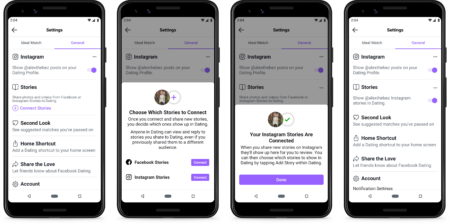
People on Facebook Dating have complete control over which Stories to share, and those Stories cannot be viewed by users they have blocked or passed on.

In instances of inappropriate content in Stories, users can be blocked and those Stories can be reported.

Facebook stressed that sharing Stories to Facebook Dating does not change users’ settings on Facebook or Instagram, but those Stories will be viewable by other people on Facebook Dating.

Hung told Wong the motivation behind allowing people to share existing Stories from Facebook and Instagram but not enabling them to create Stories within Facebook Dating was to avoid unsolicited nude photos, adding, “We can leverage all of our robust monitoring tools that Facebook and Instagram have to detect inappropriate content, and then they get taken down quite quickly.”

Facebook Dating was initially introduced at the social network’s F8 developers conference in May 2018.

Facebook Dating profiles are separate from users’ main profiles, with all Facebook Dating activity remaining within that feature and not being shared elsewhere on Facebook.

Facebook Dating is completely opt-in, and only people who choose to use the feature will have Facebook Dating profiles

People on Facebook will have no way of knowing that their friends are using Facebook Dating, and current friends will not be suggested as matches unless the Secret Crush feature is being used.

https://www.adweek.com/digital/facebook-dating-users-can-now-share-stories-from-facebook-instagram/


Facebook Reveals Steps to Keep Advertisers Better Informed

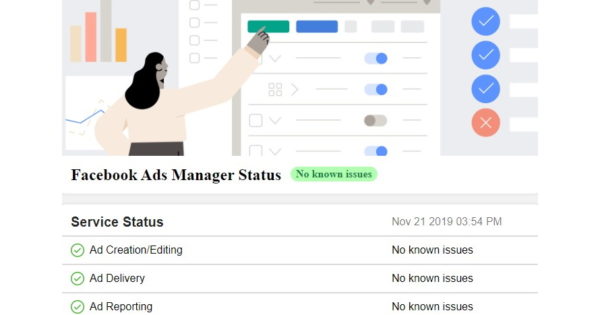
Facebook created an Ads Status Page to keep advertisers on its platform informed about disruptions to its services.

The page alerts advertisers if there are issues with the social network’s Ads Manager related to creation/editing, delivery or reporting.

The social network also pledged to increase support during the crucial period between Black Friday and Cyber Monday for businesses of all sizes—around-the-clock support for larger brands and more chat support for small and midsized businesses.

Other updates revealed by the social network Thursday included a Learning Phase section in the Account Overview tab in Ads Manager, helping details how machine learning determines who to show their ads to.

The Learning Phase section shows advertisers the percentage of ads, ad sets and spend in learning phases for that account to help them make more informed decisions or create budget efficiencies.

Some advertisers may begin seeing alerts in Ads Manager’s Account Overview tab and while creating ads, and those alerts will provide specific suggestions on how to improve performance, including auction overlap, ad set consolidation and conversions.

Finally, Facebook said it will begin notifying advertisers within Ads Manager if there are major changes across its five most common metrics—amount spent, cost per result, impressions, reach and results—that may require their attention.

Facebook vice president of ads and business platform Dan Levy said in an email, “We know that stability of our services is critically important for businesses, and we are committed to improving. We hope these notifications and the ads status page help advertisers better inform their marketing decisions, particularly during the busy holiday season.”

https://www.adweek.com/digital/facebook-reveals-steps-to-keep-advertisers-better-informed/


YouTube Masthead Ads on TV Screens Exit Beta-Test

All advertisers can now opt to purchase the YouTube Masthead for TV ad option on a CPM (cost per thousand impressions) basis.

The Google-owned video site began beta-testing the offering in September, saying at the time that daily watch time via television screens had surpassed 250 million hours.

YouTube product manager Anish Kattukaran said in a Google Support post that the YouTube Masthead can be purchased as part of a seamless cross-screen buy that runs on mobile, desktop and TV screens, or as part of a single-screen-only buy that runs just on TV screens.

Fox has been part of the beta-test of the ad unit, seeking to drive awareness for The Masked Singer.

Natalie Park, the broadcast network’s vice president of media, said in a statement, “This first-of-its-kind initiative reaches viewers where they live, right at their point of viewing, and with YouTube’s scale, it’s the perfect partnership and a fantastic way to promote our No. 1 show.”

YouTube began beta-testing the option of buying ads on its masthead on a CPM basis, as well as using its targeting solutions to determine which users see those ads, in February, and that beta-test ended in July, opening up the option to all advertisers as a reserved media placement, with advertisers paying based on CPM or cost per day, or at a fixed rate, and minimum spend requirements.

https://www.adweek.com/digital/youtube-masthead-ads-on-tv-screens-exit-beta-test/


Facebook Reveals Several Brand Safety Updates

Facebook detailed a host of updates Wednesday related to its three-pronged approach to brand safety: creating a safe and welcoming community; maintaining a high-quality ecosystem of content, publishers and ads; and proactively collaborating with the industry.

The social network created a one-stop place in Business Manager and Ads Manager where brands can create block lists, see delivery reports and set account-level inventory filters.

Those tasks previously had to be applied one campaign at a time.

Delivery reports were also enhanced to enable advertisers to search by account ID or publisher without being required to download the entire report, and Facebook said content-level information will soon be added to delivery reports, as well.

Existing brand safety partners DoubleVerify, Integral Ad Science and OpenSlate were joined by Zefr.

Brands working with IAS, OpenSlate or Zefr can now test dynamic content sets that will provide a content-level whitelisting tool, enabling them to update and adjust videos available to them for in-stream placements.

Finally, publisher whitelists are being tested for mobile ad network Facebook Audience Network and for in-stream ads on Facebook.

Facebook said in a blog post, “Brand safety is a challenge for the entire advertising industry, which is why we collaborate with industry partners to share knowledge, build consensus and work toward making all online platforms safer for businesses.”

On that note, the social network said it completed JICWEBS’ Digital Trading Standards Group’s Brand Safety audit, receiving the IAB UK Gold Standard, and it is an active part of the working group for the World Federation of Advertiser’s Global Alliance for Responsible Media, “which is leading the charge with global brands, media agencies, media owners and platforms and industry bodies to create a more sustainable and responsible digital ecosystem.”

Facebook concluded in its blog post: “While we have zero tolerance for harmful content on our platforms, we recognize that doesn’t mean zero occurrence. It’s why we are tackling this challenge across the company working with industry, enlisting expertise across subject matters, and continuing to invest in the technology, tools and advancements that advertisers are asking for. A safer Facebook and Instagram is better for everyone, including businesses, and it’s what we’ll keep working toward.”

https://www.adweek.com/digital/facebook-reveals-several-brand-safety-updates/


Facebook’s Sets Dates for F8 2020 Annual Developer Conference

F8 2020, Facebook’s annual developer conference, is set for May 5 and 6 at the McEnery Convention Center in San Jose, Calif.

Developers interested in attending the invite-only event can sign up at the F8 site to be notified when registration opens and to receive event updates.

Major announcements at F8 in the past included:

  • 2019: Facebook introduced an overhaul of its flagship mobile applications and desktop site, as well as the Project LightSpeeed revamp of Messenger and extended availability of Facebook Dating and the Facebook Portal video-calling device.
  • 2018: The social network revealed that it was testing a dating feature and began enabling third-party applications to share content to Stories on Facebook and Instagram.
  • 2017: Augmented reality was the headline-grabber at this conference, along with updates to Facebook Login.
  • 2016: Messenger bots were officially introduced.
  • 2015: Messenger Platform was rolled out and businesses were welcomed to the social network’s flagship messaging application.
  • 2014: Mobile advertising network Facebook Audience Network was unveiled after much speculation.

Director of platform partnerships Konstantinos Papamiltiadis wrote in a blog post, “This is such an important event for us. It’s one of our favorite ways to celebrate all of you—the developers, creators, entrepreneurs and innovators who build incredible experiences using our platform and tools and participate in our programs. F8 will feature product demos, deep-dive sessions that showcase how technology can enable you to come together and create your best work and opportunities for you to network with our global developer community and learn from each other.”

https://www.adweek.com/digital/facebooks-sets-dates-for-f8-2020-annual-developer-conference/


eMarketer Ups Its Estimates for Snapchat’s User Base, Ad Revenue

Research outfit eMarketer is bullish on Snapchat.

Citing new features introduced since the messaging application’s ill-fated redesign in early 2018 and a revamped Android experience, eMarketer revised its forecasts for user growth upward.

According to eMarketer, Snapchat will have 293.01 million users worldwide at the end of 2019, up from the forecast of 281.27 million it issued during the second quarter of the year.

The company sees Snapchat adding over 63 million users by the end of 2023, compared with its previous forecast of 52 million.

Snapchat’s largest market is the U.S., which makes up 27.4% of its 2019 users, according to eMarketer.

While the app was hit hard in the U.S. last year, with its user base slipping 1.4% due to the redesign, eMarketer sees positive growth in 2019, up 5.9%, which will push its user base in the country over the 80 million mark for the first time.

Users between the ages of 12 and 17 will provide the biggest turnaround, according to eMarketer, after 1.1 million of them left the platform in 2018.

Instagram remains Snapchat’s strongest competitor, eMarketer said, projecting the Facebook-owned photo- and video-sharing network for a 6.7% jump in its U.S. user base this year, to 107.2 million, and an 11.6% global climb to 788.43 million.

eMarketer principal analyst Debra Aho Williamson said in a release, “Snapchat has regained momentum, but Instagram never lost it. These apps will continue to compete for users as we head into 2020.”

Instagram also claims a larger share of digital ad revenue worldwide, with eMarketer pegging it for $15.01 billion at the end of 2019, or a 4.6% share, versus $1.53 billion and 0.5%, respectively, for Snapchat.

Williamson said, “Snapchat has reported gains in users every quarter so far in 2019, and we believe that the relaunched Android app has reinvigorated growth. In addition, features such as the successful baby face and gender swap filters earlier this year have driven increases in user engagement with the app.”

https://www.adweek.com/digital/emarketer-ups-its-estimates-for-snapchats-user-base-ad-revenue/


Campaign Backing Virtual Reality Headset Oculus Quest Takes Over an Actual Theater

Moviegoers at a screening of Rogue One: A Star Wars Story in Los Angeles Saturday night got much more than a film and some popcorn.

Facebook’s Oculus virtual reality division teamed up with cinematic theater experience provider Cinespia to debut a four-minute immersive experience that enabled attendees to experience all the bells and whistles of VR without a headset.

The Los Angeles event marked part of a national ad campaign this holiday season for the Oculus Quest—Facebook’s biggest effort backing VR to date—which also includes television, social and digital.

The TV spot debuted earlier this month, directed by Fredrik Bond and featuring actor Eric Wareheim (Tim and Eric Awesome Show, Great Job!, Master of None) portraying the character Reality.

[embedded content]

Wareheim’s Reality character also interacts online with people, via social and digital channels, commenting on his struggles with VR. And people can play with stickers and GIFs of the Reality character.

We are especially excited about where we’re going with VR right now,” Rebecca Van Dyck, chief marketing officer of augmented reality and VR at Facebook, said in an interview. “This is a super-exciting time for VR in general. VR has been a tethered headset since its inception, and Quest is the first time we’ve had a stand-alone experience—a fully immersive experience without being tethered to a computer.”

Oculus and Cinespia transformed the historic Los Angeles Theatre with lasers, projectors and practical effects, and Oculus said this event marks the first time these technologies were combined together to demonstrate the scale and impact of VR.

“What if you were in a room that was just taken over by the whole experience?” Van Dyck said.

The event began with a 2D video of VR rhythm game Beat Saber, followed by a transition to 3D movement and sound for a look at popular VR adventure game Moss, which climaxed with a battle between Quill, the game’s mouse hero, and a slithering snake.

Oculus/Cinespia

Beat Saber
Oculus/Cinespia

The next stop was zero-gravity sports game Echo Arena, for which the theater was transformed into an orbital space station, where 3D characters engaged in combat.

Echo Arena

Finally, tying in with the movie that they came to see, Darth Vader appeared and used the power of the Force to make the theater walls crumble and lava gush through the cracks.

Oculus/Cinespia

Vader Immortal

Following Rogue One: A Star Wars Story, guests were invited to try out Vader Immortal: A Star Wars VR Series on the Oculus Quest, as well as to explore the Los Angeles Theatre—which is rarely open to the public—complete with full bars and concessions, a DJ dance party in the ballroom and Cinespia’s custom photo booth.

“Vader Immortal was perfectly suited to the experience before watching Rogue One,” Van Dyck said.

Oculus said the process of creating the VR experience took eight weeks, and it worked with engineers, programmers and designers from VTProDesign.

AKQA San Francisco was the agency behind the event, and it was directed by Bradley G. Munkowitz (GMunk).

They took a 3D scan of the building and created a 16K by 8K resolution spherical map powered by 22 high-powered projectors, adding in 16 lasers to map out the venue space in greater detail and create volumetric beam and aerial effects, including a set of custom lasers that projected out into the crowd.

The engineers built a custom hologram mesh screen to provide the illusion of 3D objects floating around the stage, adding a jumbo LED video screen to enhance the holographic effects by producing a parallax effect.

Finally, the team added to the digital effects with actual effects, such as fog and confetti, to simulate in-game particle effects.

A custom audio solution was developed using 22 channels of audio and custom tracks.

Oculus’ campaign is “a really unique concept to help express what makes VR great, Defy Reality,” Van Dyck said, adding that the company is “taking it to next level for the holiday season.”

https://www.adweek.com/digital/campaign-backing-virtual-reality-headset-oculus-quest-takes-over-an-actual-theater/


Twitter Formalizes Its Policies on Political Advertising

Twitter CEO Jack Dorsey revealed in a late-October tweetstorm that the social network would no longer accept political ads, and Friday, Twitter released a more formal policy on the issue.

Promotion of political content is banned globally, and the company defined political content as “content that references a candidate, political party, elected or appointed government official, election, referendum, ballot measure, legislation, regulation, directive or judicial outcome.”

The policy also applies to ads that contain references to political content, such as appeals for votes, solicitation of financial support and advocacy for or against any of the examples listed above.

Candidates, political parties, elected government officials and appointed government officials are not allowed to run ads of any type on the platform.

News publishers that meet Twitter’s criteria for exemption can run ads that reference political content or prohibited advertisers, but those ads cannot include advocacy for or against the topics or advertisers.

In the U.S., political action committees and Super PACs are also prohibited from advertising on the social network.

Twitter said it restricts promotion of and requires advertiser certification for ads that educate, raise awareness of or call for people to take action on civic engagement, economic growth, environmental stewardship or social equity causes.

The company added, “We have made this decision based on the following two beliefs: Advertising should not be used to drive political, judicial, legislative or regulatory outcomes. However, cause-based advertising can facilitate public conversation around important topics.”

Twitter said micro-targeting “presents entirely new challenges to civic discourse that are not yet fully understood,” adding that in order to use this feature, advertisers must comply with all of the conditions mentioned above, complete its advertising certification process and honor the following restrictions.

Advertisers are limited to geo, keyword and interest targeting, and other types, including tailored audiences, are prohibited.

ZIP code-level targeting is not allowed: Geotargeting can only occur at the state, province or region level and above.

Finally, keyword and interest targeting cannot include terms associated with political content, prohibited advertisers or political leanings or affiliations, such as conservative and liberal.

Twitter said ads cannot be run on behalf of or specifically reference people or entities that are excluded under the policies detailed above, and landing pages must not be directly linked to those people or entities, either.

Finally, the social network addressed for-profit organizations wishing to run ads that educate, raise awareness of or call for people to take action in connection with the causes mentioned above.

The ads should not have the primary goal of driving political, judicial, legislative or regulatory outcomes, and they must be tied to the organization’s publicly stated values, principles and/or beliefs.

Government and supranational agencies and entities are not subject to geo-targeting restrictions as long as they comply with all other restrictions.

https://www.adweek.com/digital/twitter-formalizes-its-policies-on-political-advertising/


Here Are the Winners of the Fourth Annual Shorty Social Good Awards

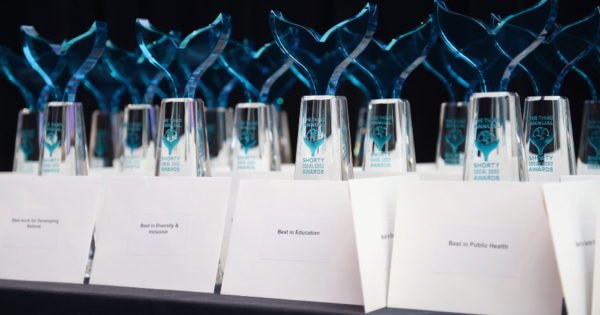
The Fourth Annual Shorty Social Good Awards were handed out at Current at Pier 50 in New York Thursday evening.

This year’s Impact Honoree recipient is Andrew Rea, who was recognized for his YouTube channel, Binging With Babish.

The Shorty Awards said in an email, “The Shorty Social Good Awards primarily focuses on brands, agencies, organizations and nonprofits using the social and digital media space to positively impact people all over the world in numerous ways. But we realize that there are also individuals, such as creators and influencers, who use their platforms for good.”

On the winner, it continued, “In these episodes, the self-taught chef connects with his impassioned fan base, helping them in a variety of ways including raising money, donating his time or encouraging his audience to live a healthier and happier lifestyle. It’s so special when a creator takes advantage of the connective powers of social media to positively and personally impact the lives of their fans.”

The complete list of winners appears below. JFK Moonshot, from the John F. Kennedy Presidential Library and Museum, tallied the most wins, with eight.

The winners were:

Best Global Campaign

Code & Response

Best Integrated Campaign

Changing the Game

Best Mobile Campaign

JFK Moonshot

Best Multiplatform Campaign

Dear Refugees

Best on a Shoestring Campaign

Waste of Film

Best Pro Bono Campaign

JFK Moonshot

Best Social Movement Campaign

ROMA Social Impact Campaign

Best in Accessibility

Deaf 911

Best in Animal and Wildlife

FAIR FRIDAY

Best in Arts and Culture

JFK Moonshot

Best in Civic Engagement

Generation Lockdown

Best Work for Developing Nations

End Violence Together

Best in Diversity and Inclusion

All American Family Portrait film by HP and Edelman

Best in Education

Roo High School, Where No [Sex Ed] Question Is Off-Limits

Best in Emergency Relief

Code & Response

Best in Environment and Sustainability

Look Good. Do Good.

Best in Gender Equality

ROMA Social Impact Campaign

Best in Human Rights

Speak Truth to Power

Best in Immigration and Refugees

Benny Blanco, Calvin Harris & Miguel – I Found You / Nilda’s Story

Best in LGBTQ+

Love Calls Back

Best in Medical Research

TURNING POINT – The Importance of Clinical Trials in the Quest for a Cure for Alzheimer’s

Best in Mental Health

Beauty Mark

Best in Poverty and Hunger

Sustainable Food Production With Farm From a Box

Best in Public Health

Generation Lockdown

Best in Racial Equality

NowThis Reports: School Inequality in the Deep South

Best in Social Justice

Robert Reich & W. Kamau Bell: A Tale of Two Tickets

Best in Veteran and Service Support

Pets for Patriots

Best in Youth and Family

Generation Lockdown

Best in Auto

The Magic Snow Globe

Best in Business to Business

Code & Response

Best Consumer Brand

Love Calls Back

Best Cultural Institution

JFK Moonshot

Best in Energy

The Ray – The Highway of the Future

Best in Entertainment

Say Yes to the Prom 2019

Best in Fashion, Beauty and Luxury

Project #ShowUs

Best in Financial Services

Citi’s Voices of Change

Best in Food and Beverage

Chipotle Mexican Grill: Transforming Trash – Giving Single Use Plastic Gloves a Second Life

Best in Government and Politics

HRC Mobilizes for House Passage of the Equality Act

Best in Health and Fitness

Planet Fitness Teen Summer Challenge

Best in Hospitality and Travel

Days Inn: Leveling the Playing Field.

Best in Live Events

JFK Moonshot

Best in News and Media

NowThis — the No. 1 News Brand on Mobile

Best Nonprofit Organization

JFK Moonshot

Best in Retail and Ecommerce

Beauty Mark

Best in Sports

WNBA: Take a Seat, Take a Stand

Best in STEM

National Geographic Documentary Films’ SCIENCE FAIR Inspires Students to Engage in STEM

https://www.adweek.com/digital/here-are-the-winners-of-the-fourth-annual-shorty-social-good-awards/


Facebook Will Match Up to $7M in Donations via Its Tools on GivingTuesday

Facebook said it will match up to $7 million in donations to U.S. nonprofits made via its fundraisers and donate button on GivingTuesday, which falls on Dec. 3 this year.

The social network said 100% of money raised via those tools on Facebook and Instagram goes directly to the organizations.

The company revealed in September that over $2 billion had been raised via its fundraising tools since their August 2015 debut.

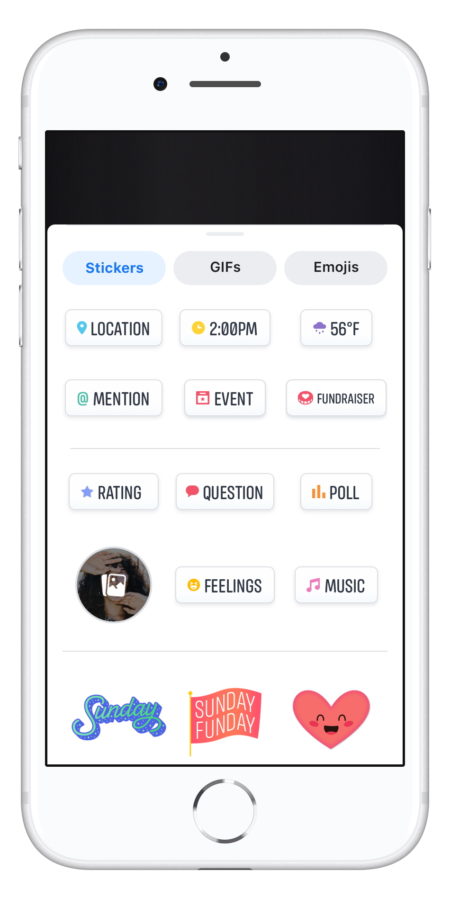
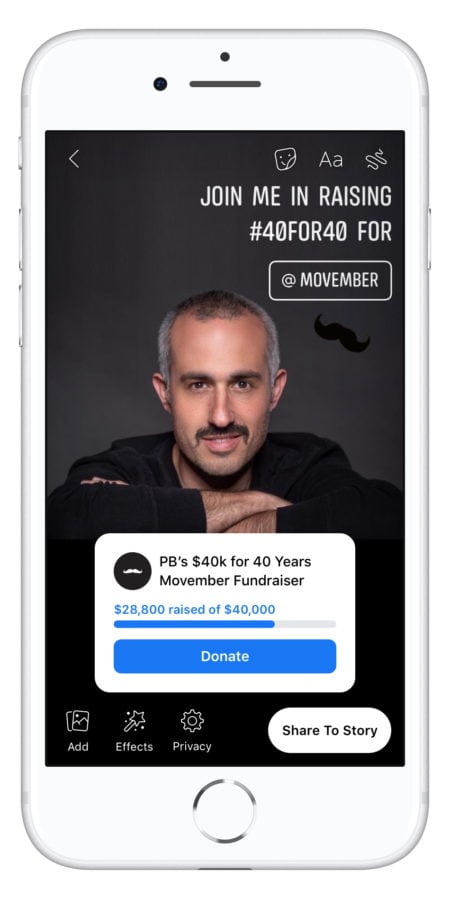
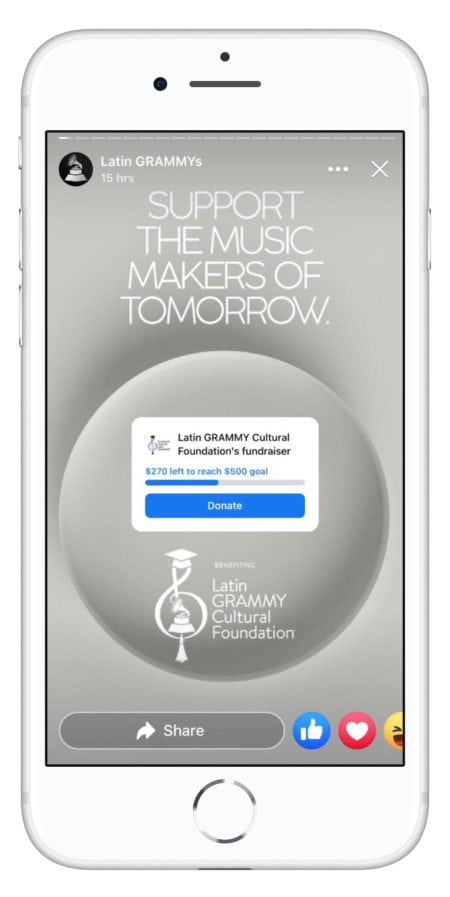
Facebook also introduced a fundraiser sticker for Facebook Stories, enabling people to promote specific nonprofits or personal fundraisers.

Business accounts on Instagram now have a donate button, which they can use to raise money directly via those profiles.

Gaming content creators on Facebook can now raise money for their favorite charities during their livestreams, and more details on this initiative are available here.

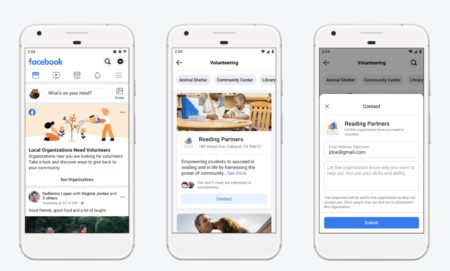
Finally, the social network is working with nonprofits organizations to develop a feature that would enable people to volunteer for causes they care about, with the aim of rolling it out in 2020.

https://www.adweek.com/digital/facebook-will-match-up-to-7m-in-donations-via-its-tools-on-givingtuesday/