Senior vice president and general counsel Blake Lawit wrote in a blog post, “As our impact on the world of work has grown, we recognize that our responsibility has grown, as well. We understand that in the critical areas of privacy, security, safety and fairness, we need to continue to deliver for our members and the world beyond. So, in addition to this foundational value of members first, we use a set of guiding principles to ensure our employees make the best possible decisions to protect our members and maintain their trust.”
The four principles outlined by Lawit follow:
Clarity, consistency and control over user data: Lawit said LinkedIn tells its members what it intends to do with their data and does not use that data for other purposes, adding that the professional network’s easy-to-use settings give them complete control.
Safety: LinkedIn uses systems, technology and reports from its members to detect and quickly remove content that violates its community policies. Lawit also reaffirmed the professional network’s commitment to preventing fake profiles, jobs and companies.
Equal opportunity: Lawit said LinkedIn is committed to building out its product with no unfair bias, providing opportunity to all members and seeking to close the network gap.
Obey the law: Lawit wrote, “We’re a global platform with an obligation to respect the laws that apply to us. We also contribute to the dialog that shapes these laws so that we can fulfill our vision of creating economic opportunity for every member of the global workforce.”
The Halloween costumes are off, but Pinterest kicked November off with a refreshed look for its iOS and Android applications.
Search is now in a main navigation bar, enabling Pinners to access personalized and trending searches with a swipe.
The following tab was moved to the top of the home feed, giving users new ideas from accounts they follow, in chronological order.
The top of the home feed will also feature ideas for boards that Pinners most recently engaged with, and those ideas can be saved with a single tap.
And saved Pins are now easier to locate thanks to refreshes to the design of profiles and boards.
Pinterest said in a blog post detailing the changes, “Before we head into a new year, we’ve been busy making subtle updates to refresh and improve the Pinterest you know and love with a more immersive design that’s streamlined for Pinners around the world. We hear from Pinners that they want an easy way to get inspired and browse ideas they love. Our updated look for iOS and Android makes Pinterest even more visual, with personalized recommendations front and center in your home feed and reduced space around Pins to celebrate the content.”
Pinterest Reports 322 Million Global Monthly Active Users at the End of Q3
|
20 hours ago
Pinterest reported revenue of $279.7 million in the third quarter of 2019, up 47% from $190.2 million in the year-earlier period, but its net loss soared 561% over the same time period, to $124.7 million from $18.9 million, using generally accepted accounting principles.
The company pointed out that it was profitable on a non-GAAP basis, with $5.96 million of net income, compared with a net loss of $14.9 million in the previous-year period.
Pinterest tallied 322 million global monthly active users at the end of the third quarter, up 28% year-over-year, citing double-digit growth in nearly all countries outside of the U.S.
The company now sells ads in 28 countries, up from 19 at the end of the second quarter. New markets added during the period were Cyprus, the Czech Republic, Greece, Hungary, Luxembourg, Malta, Poland, Romania and Slovakia.
Pinterest said it uploaded 75% more merchant catalogs than in the second quarter, along with expanding its shopping ads globally and working with ecommerce platforms including Shopify to onboard merchants and advertisers to its platform.
The company added that the percentage of U.S. MAUs that engaged with its shopping features more than doubled in the third quarter compared with the previous period, and clicks to retail sites from organic shoppable Pins tripled year-over-year.
On the measurement side, merchants’ adoption of the Pinterest tag via integrations into their ecommerce sites has skyrocketed by 10 times since May.
And on the user side, Pinterest touted upgraded to its ranking algorithm for lowering home feed hide rates 25% quarter-over-quarter. The company also said improvements to personalized search recommendations rolled out globally during the third quarter, driving a doubling of engagements with recommendations year-over-year.
Facebook Releases Graph API v5.0, Marketing API v5.0
Facebook’s Halloween treat for developers was the release of application-programming interfaces Graph API v5.0 and Marketing API v5.0.
Software engineer Evan Klein said in a blog post that the social network will limit the number of ads each page can run simultaneously in mid-2020, explaining that excessively high ad volume can hinder an advertiser’s performance and adding, “With too many ads running at the same time, fewer ads exit the learning phase and more budget is spent before the delivery system can optimize an ad’s performance.”
Klein said the change will impact just a small percentage of advertisers, adding that Facebook released an Ad Volume API to enable developers to track a page’s ad volume for an ad account.
He added that in the future, the Ad Volume API will also track ad volume across ad accounts and the number of ads each page will be permitted to use.
Marketing API v5.0 also includes a special ad category field to enable businesses to comply with the social network’s rules announced earlier this year regarding ads promoting housing, employment or credit opportunities.
Facebook also set two deadlines for businesses either running campaigns that do not fall under those special ad categories or that do fall under them and were created before Dec. 4, 2019:
Feb. 11, 2020: Businesses located in the U.S. or targeting people in the U.S. must identify any active campaigns that belong to special ad categories and update the targeting settings for those campaigns, or those ads will no longer be allowed to run. Klein said it applies to all campaigns created or edited before Dec. 4, 2019, across all buying surfaces, including the Marketing API.
March 31, 2020: All businesses using the Marketing API must identify whether or not new and edited campaigns belong to special ad categories and update their targeting settings to comply with restrictions for those categories, or the ads will be prevented from running. Businesses not running housing, employment or credit opportunity ads must indicate “none” in the special ad category field.
Filters were added to Facebook’s Ad Library to make it easier for advertisers to search for all ads stored and for active and inactive ads related to politics or issues and to find certain types of ads.
Finally, the Ad Keyword Stats API is being sunset as part of an effort to retire endpoints with low adoption and simplify reporting-based solutions.
Don’t Expect AI, Machine Learning to Replace Facebook’s 35,000 People Dedicated to Safety
|
14 hours ago
Machine or human? Human or machine? The debate resurfaced during Facebook’s third-quarter earnings call Wednesday.
Goldman Sachs analyst Heather Bellini referenced the 35,000 people Facebook has dedicated to safety and the company’s budget in this area during the call’s question-and-answer period.
Bellini asked, “How long does this have to be as resource-intensive from a people perspective? Or do you see the ability over time with technologies like artificial intelligence potentially helping you to get more leverage out of this existing budget? So maybe you don’t have to continue to ramp it as quickly as your user base and engagement continues to grow?”
Facebook CEO Mark Zuckerberg didn’t foresee dramatic changes on this front in the near future, saying, “In general, what we have to do is use computers and AI for what they’re good for, which is looking at a lot of content very quickly and making quick judgments. And we have teams of people doing what people are good for, which is making nuanced human judgments … And then there’s just so much content flowing through the system that we do need a lot of people looking at this. And I don’t think that that’s going to change anytime soon.”
Chief financial officer David Wehner chimed in, as well, saying, “When using AI and machine learning systems, it’s a real benefit to have actual people looking and tagging that content, classifying it, because it helps those machine learning algorithms be able to learn what they’re looking at.”
Mark Zuckerberg Spoke Extensively About Political Ads During Facebook’s Earnings Call
|
6 hours ago
“We’ve found ourselves in the middle of the debate about what political speech is acceptable in the upcoming campaigns,” Facebook CEO Mark Zuckerberg said in his opening remarks during the company’s third-quarter earnings call Wednesday. Talk about an understatement.
Roughly one hour before the call kicked off, Twitter CEO Jack Dorsey tweeted that his company would stop all political advertising on its platform globally, with the final policy on this matter to be shared Nov. 15.
Fast-growing video-creation application TikTok also said earlier this month that it would not accept political ads on its platform.
Zuckerberg repeatedly referenced a speech he gave at Georgetown University earlier this month, in which he reiterated his and his company’s commitment to free expression and giving everybody a voice.
He said in his opening remarks during Wednesday’s earnings call, “Right now, the content debate is about political ads. Should we block political ads with false statements? Should we block all political ads? Google, YouTube and most internet platforms run these same ads; most cable networks run these same ads; and, of course national broadcasters are required by law to run them by Federal Communications Commission regulations. I think there are good reasons for this. In a democracy, I don’t think it’s right for private companies to censor politicians or the news. And although I’ve considered whether we should not carry these ads in the past and I’ll continue to do so, on balance so far, I’ve thought we should continue.”
Zuckerberg also said political ads can be a way for candidates and advocacy groups that aren’t receiving as much media coverage to get their message out, and he discussed the challenges of where to draw the line, adding, “Would we really want to block ads for important political issues, like climate change or women’s empowerment?”
And he cited the transparency measures the social network has built into its platform, including its Ad Library, which enables people on or off Facebook to see every ad that was run by a page, who saw it and how much was spent, among other information.
Zuckerberg addressed the financial implications, saying, “Some people accuse us of allowing this speech because they think all we care about is making money. That’s wrong. I can assure you, from a business perspective, the controversy this creates far outweighs the very small percent of our business that these political ads make up. We estimate that these ads from politicians will be less than 0.5% of our revenue next year. That’s not why we’re doing this. To put this in perspective, the Federal Trade Commission fine that these same critics said wouldn’t be enough to change our incentives was more than 10 times bigger than this. The reality is that we believe deeply that political speech is important, and that’s what is driving us.”
He also discussed accusations that Facebook was using inflammatory content to drive engagement, saying, “I think we’ve done more than any of the other major internet platforms to try to build positive incentives into our systems. We don’t let any of our News Feed or Instagram feed teams set goals around increasing time spent on our services. We rank feeds to encourage meaningful social interactions—helping people connect with friends, family and their communities. We have real people come in and tell us what content they saw that was most meaningful to them and sparked valuable discussions, and then we build systems to try to surface that kind of content. We’ve taken many steps over the years to fight clickbait and polarization, and now, we’re even testing removing like counts in Instagram and Facebook. We do this because we know that if we help people have meaningful interactions, they’ll find our services more valuable, and that’s the key to building something sustainable and growing over time.”
Addressing recent allegations that Facebook is biased toward conservatives, Zuckerberg said, “Some people say this is just all a cynical political calculation and that we’re acting in a way we don’t believe because we’re trying to appease conservatives. That’s wrong, too. We face a lot of criticism from both progressives and conservatives. Frankly, if our goal were trying to make either side happy, then we’re not doing a very good job because I’m pretty sure everyone is frustrated with us. Our values on voice and free expression are not partisan. But unfortunately, in our current environment, a lot of people look at every decision through the lens of whether it’s going to help or hurt the candidate they want in winning their next election.
He concluded, “A lot of people have told us: You’ve got to pick a side, or else both sides are going to cause problems for you. Sadly, from a practical perspective, they may be right. But we can’t make decisions that way. So, over the next year of campaigns, we’re going to be at the center of the debate anytime there’s content or policies on any of our services that people believe could advantage or disadvantage their side. This may lead to more investigations, and the candidates are going to criticize us.”
2.2 Billion People Use Facebook, Instagram, WhatsApp or Messenger Every Day
|
16 hours ago
Facebook said during its third-quarter earnings call Wednesday that about 2.2 billion people currently use its family of applications—Facebook, Instagram, WhatsApp and Messenger— on a daily basis, up from 2.1 billion in the second quarter of 2019.
On a monthly basis, those totals are 2.8 billion and 2.7 billion, respectively.
Chief financial officer David Wehner said during his opening remarks that Facebook’s daily active users averaged 1.62 billion in September, up 9% year-over-year, led by growth in India, Indonesia and the Philippines.
Meanwhile, the social network averaged 2.45 billion monthly active users as of Sept. 30, up 8% versus the year-ago period, with Wehner saying, “We were pleased with the growth trends in all regions, including the U.S. and Canada.”
Facebook reported $17.652 billion in revenue for the third quarter of 2019, up 29% year-over-year, with advertising accounting for the bulk of that figure, at $17.383 billion.
Mobile advertising revenue made up approximately 94% of total advertising revenue during the period, compared with 92% in the third quarter of 2018.
Facebook reported net income of $6.091 billion for the quarter, up 19% versus the prior-year period.
Wehner said during his opening remarks that ad impressions served across Facebook’s services were up 37% year-over-year, and the average price per ad was down 6%, attributing impression growth primarily to ads on Facebook News Feed, Instagram Stories and Instagram feed.
He added, “The year-over-year decline in average price per ad was primarily driven by the ongoing mix shift toward geographies and Stories ads, which monetize at lower rates.”
Facebook’s total headcount was 43,030 as of Sept. 30, up 28% compared with the same date last year.
Facebook Details Updates to Messenger Platform From Graph API v5.0
|
7 hours ago
Facebook detailed some updates to Messenger Platform resulting from the release of the social network’s Graph API (application-programming interface) v5.0.
Software engineer Nitin Garg detailed all the updates to Facebook’s flagship messaging app in a blog post.
Brands with multiple apps connected to Messenger Platform can now easily select which one of their apps to use in their click-to-Messenger ads.
Brands can also set icebreakers in their Messenger profiles via the API, enabling them to reduce friction when starting conversations by surfacing common questions or topics of interest.
Finally, the update gives brands the ability to see people’s reactions to their messages, with Garg writing, “Message replies adds context to a conversation. Businesses can see which message the user is responding to. This adds more clarity to the conversations and helps businesses respond to inquiries better.”
Facebook Drops Appeal of U.K. Cambridge Analytica Fine
|
6 hours ago
Facebook’s slap on the wrist from the U.K. over the Cambridge Analytica scandal is in the record books, as the company agreed to pay a £500,000 ($644,731) fine, without being forced to admit any wrongdoing.
The Information Commissioner’s Office, the privacy regulator in the U.K., imposed its maximum financial penalty on Facebook, but that figure pales in comparison to the $16.886 billion in revenue reported by the company in the second quarter.
The ICO was limited to a £500,000 fine because the actions took place prior to the enactment of the European Union’s General Data Protection Regulation May 25, 2018.
The fine was originally imposed last October, but Facebook appealed, withdrawing its appeal this week.
Facebook associate general counsel Harry Kinmonth said in a statement, “We are pleased to have reached a settlement with the ICO. As we have said before, we wish we had done more to investigate claims about Cambridge Analytica in 2015. We made major changes to our platform back then, significantly restricting the information that application developers could access. Protecting people’s information and privacy is a top priority for Facebook, and we are continuing to build new controls to help people protect and manage their information. The ICO has stated that it has not discovered evidence that the data of Facebook users in the EU was transferred to Cambridge Analytica by (Cambridge University researcher) Aleksandr Kogan. However, we look forward to continuing to cooperate with the ICO’s wider and ongoing investigation into the use of data analytics for political purposes.”
And ICO deputy commissioner James Dipple-Johnstone said in a statement, ” The ICO welcomes the agreement reached with Facebook for the withdrawal of its appeal against our monetary penalty notice and agreement to pay the fine. The ICO’s main concern was that U.K. citizen data was exposed to a serious risk of harm. Protection of personal information and personal privacy is of fundamental importance not only for the rights of individuals, but also, as we now know, for the preservation of a strong democracy. We are pleased to hear that Facebook has taken, and will continue to take, significant steps to comply with the fundamental principles of data protection. With this strong commitment to protecting people’s personal information and privacy, we expect that Facebook will be able to move forward and learn from the events of this case.”
Head of cybersecurity policy Nathaniel Gleicher said in a Newsroom post that the three networks were connected to entities associated with Russian financier Yevgeniy Prigozhin, who was previously indicted by the U.S. Department of Justice.
The first of the three groups consisted of 35 accounts, 53 pages, seven groups and five Instagram accounts, with its activity focused on Madagascar, the Central African Republic, Mozambique, the Democratic Republic of the Congo, Côte d’Ivoire and Cameroon.
They used a combination of fake accounts and authentic accounts of local nationals in Madagascar and Mozambique to manage pages and groups and post content, typically regarding global and local political news on topics including Russian policies in Africa, elections in Madagascar and Mozambique, election monitoring by a local non-governmental organization and criticism of French and U.S. policies.
According to Gleicher, some 475,000 accounts followed one or more of the removed pages, about 450 people followed at least one of the groups and roughly 650 users followed one or more of the Instagram accounts.
This network spent about $77,000 on Facebook ads, paid for in U.S. dollars, with the first ad running in April 2018 and the most recent ad running this month.
He also shared sample content from some of the removed pages:
Page Name: “Sudan in the Eyes of Others.” Caption Translation: Yam Brands, the company that owns the KFC franchise, stated that it intends on opening three branches of its franchise in Sudan. The spokesman of the company based in the American state of Kentucky, Takalaty Similiny, issued a statement saying that the branches are currently under construction and will open in mid-November.
Translation: The Police of the Republic of Mozambique announced today that nine members of RENAMO were detained for their participation in the attempt to remove urns from one of the voting posts in the district of Machanga, Sofala, and for having vandalized the infrastructure. According to the spokesperson for PRM, that spoke in a press-conference in Maputo, the nine people are accused of having led around 300 RENAMO supporters that tried to remove the urns during counting at the Inharingue Primary School.
Translation: President of Central African Republic asked Vladimir Putin to organize the delivery of heavy weapons. Wednesday, in Sochi, President Faustin-Archange Touadera asked his counterpart Vladimir Putin to increase the military assistance to the Republic, asking specifically for the supply of heavier weapons. “Russia is giving a considerable help to our country. They already carried out two weapons deliveries, trained our national troops, trained police officers, but for more effectiveness, we need heavy weapons. We hope that Russia will be able to allocate us combat vehicles, artillery cannons and other killing weapons in order for us to bring our people to safety,” said Touadera. However, there is still an issue which is blocking us to implement this. The embargo on the Central African Republic was not fully lifted in order for Russia to implement the plans of Touadera. Until now, it is only possible to supply weapons with a caliber less than 14,5 mm. The embargo does not stop armed groups to get illegally heavy weapons for themselves, which is not helping the efforts of the government to establish peace. We ask the Security Council of United Nations to draw attention on what their (sometimes reckless) sanctions are bringing.
The second network was made up of 17 accounts, 18 pages, three groups and six Instagram accounts, focused primarily on Sudan and using authentic accounts of Sudanese nationals, as well as fake and compromised accounts, to comments, post and manage pages posing as news organizations, as well as to direct traffic to off-platform sites.
Stories from Sudanese state news agency SUNA were often shared, as well as content from Russian state-controlled media Sputnik and RT, posted primarily in Arabic but sometimes in English. Topics included local news and events in Sudan and other countries in Sub-Saharan Africa, such a Sudanese-Russian relations, U.S.-Russian relations, Russian foreign policy and Muslims in Russia.
About 457,000 accounts followed at least one of the pages, while some 1,300 joined at least one of the groups and around 2,900 followed at least one of the Instagram accounts.
About $160 was spent on Facebook ads, paid for in Russian rubles, with the first running in April 2018 and the most recent one this past September.
Gleicher shared sample content from some of the removed pages:
Translation (first two paragraphs): “American and British intelligence put together false information about Putin’s inner circle … a diplomatic military source said that American and British intelligence agencies are preparing to leak false information about people close to the president, Vladimir Putin, and the leadership of the Russian defense ministry.“
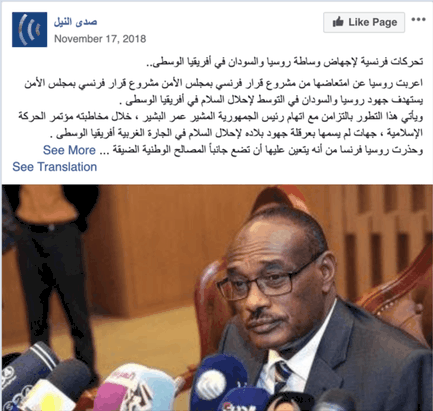
Page title: “Nile Echo.” Post translation (first paragraph only): French movements to abort Russian and Sudanese mediation in the Central African Republic …
Translation: #Article (I am completely sure that the person in the cell is not [ousted Sudanese leader Omar] al-Bashir, but I don’t have physical evidence proving this) Aml al-Kordofani wrote: The person resembling al-Bashir who is sitting behind the bars … who is he? The double game continues between the military and the sons of Gosh (referring to former Sudanese intelligence chief Salah Abdullah Mohamed Saleh) according to the American plan. The American plan employs psychological operations, as we mentioned earlier, and are undertaken by a huge office within the U.S. Department of Defense.
And the final group of 14 accounts, 12 pages, one group and one Instagram account focused on Libya, using a combination of authentic accounts of Egyptian nationals and fake and compromised accounts to manage pages and drive people to an off-platform domain.
Stories from Sputnik and RT were frequently shared, and posts in Arabic covered local news and geopolitical issues including Libyan politics, crimes, natural disasters, public health, Turkey’s alleged sponsoring of terrorism in Libya, illegal migration, militia violence, the detention of Russian citizens in Libya for alleged interference in elections and a meeting between Khalifa Haftar, head of the Libyan National Army, and Russian President Vladimir Putin.
Gleicher added that some of the pages posted content on multiple sides of political debate in Libya, including criticism of the Government of National Accord, U.S. foreign policy, and Haftar, as well as support of Muammar Gaddafi and his son, Saif al-Islam Gaddafi, Russian foreign policy and Khalifa Haftar.
Approximately 212,000 accounts followed at least one of the pages, while just one account joined the group and around 29,300 people followed the Instagram account.