El Paso airport closed after military used new anti-drone laser to zap party balloon
On Tuesday night, the Federal Aviation Administration closed airspace up to 18,000 feet above the El Paso International Airport in Texas, saying the restrictions would be in place for 10 days. Then, less than 10 hours later, the federal agency reopened the airspace, allowing planes to land and take off at the busy airport.

About an hour after lifting the restrictions, US Secretary of Transportation Sean Duffy, whose responsibilities include overseeing the FAA, explained the unexpected closure by saying, “The FAA and DOW acted swiftly to address a cartel drone incursion.” (The Trump Administration refers to the Department of Defense as the Department of War, or DOW, although its legal name remains the former.)

Not everyone agrees with Duffy’s account.

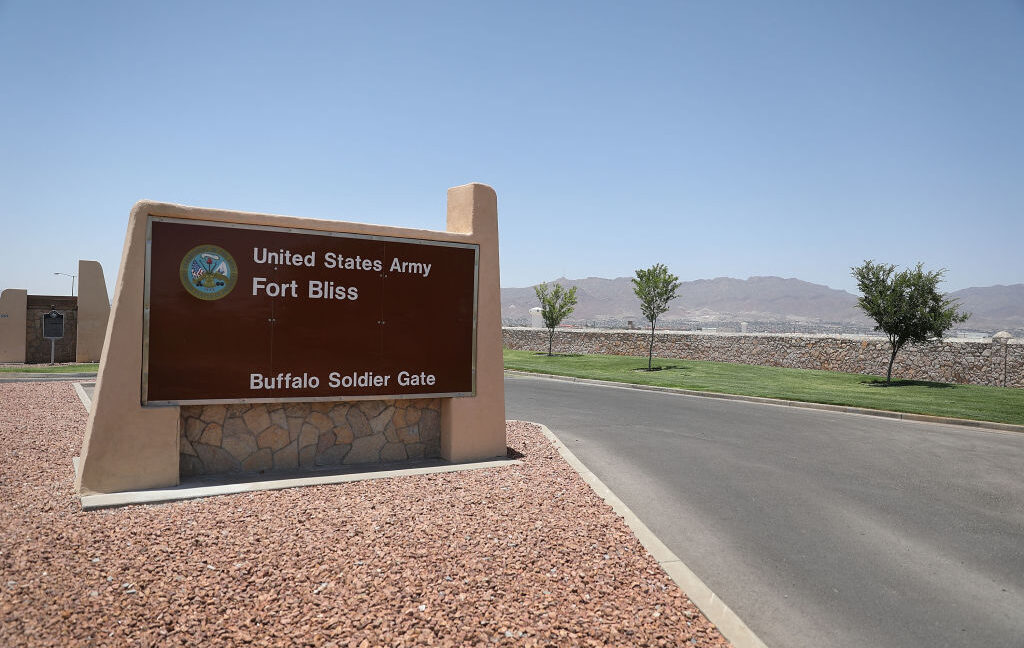
Based upon reporting from The New York Times and other publications, the military has been developing high-energy lasers to bring down drones. The FAA and US military officials had been discussing tests of the new weapon from the nearby Fort Bliss Army base. However, the FAA had not resolved all of its concerns about airplane safety from the tests.

Despite these apparently lingering concerns from the FAA, the military went ahead with a test earlier this week against what was thought to be a drone. The object was a party balloon.

https://arstechnica.com/space/2026/02/el-paso-airport-closed-after-military-used-new-anti-drone-laser-to-zap-party-balloon/


Yes, Rocket Lab is blowing up engines. No, it’s not a big deal, CEO says.

A little more than two months ago, a Rocket Lab employee called the Stennis Space Center Fire Department from the nearby A3 test stand. There was a grass fire where Archimedes engines undergo testing. Could they please send personnel over?

According to the fire station’s November 30 dispatcher log, the employee said, “The fire started during a test when an anomaly caused an electrical box to catch fire.”

Satellite imagery from before and after the anomaly appears to show that the roof had been blown off the left test cell, one of two at the test stand at the historic NASA facility in southern Mississippi. One person with knowledge of the anomaly said, “The characterization of this as an electrical fire doesn’t reflect what actually occurred. This was a catastrophic engine explosion that resulted in significant infrastructure damage.”

According to two sources, this is one of at least two Archimedes engine tests that have failed in the past three months.

The engine test anomalies come at a critical time for Rocket Lab, as it is attempting to finalize development of a flight version of the Archimedes engine, which burns liquid oxygen and methane and has a sea-level thrust of 165,000 pounds. Nine of these engines will power the company’s much-anticipated Neutron rocket, which is aiming for a debut launch later this year.

Making mountains out of molehills?

In response to a query from Ars about the engine test anomalies, Rocket Lab Chief Executive Officer Pete Beck downplayed concerns.

https://arstechnica.com/space/2026/02/yes-rocket-lab-is-blowing-up-engines-no-its-not-a-big-deal-ceo-says/


SpaceX’s next-gen Super Heavy booster aces four days of “cryoproof” testing

The upgraded Super Heavy booster slated to launch SpaceX’s next Starship flight has completed cryogenic proof testing, clearing a hurdle that resulted in the destruction of the company’s previous booster.

SpaceX announced the milestone in a social media post Tuesday: “Cryoproof operations complete for the first time with a Super Heavy V3 booster. This multi-day campaign tested the booster’s redesigned propellant systems and its structural strength.”

Ground teams at Starbase, Texas, rolled the 237-foot-tall (72.3-meter) stainless-steel booster out of its factory and transported it a few miles away to Massey’s Test Site last week. The test crew first performed a pressure test on the rocket at ambient temperatures, then loaded super-cold liquid nitrogen into the rocket four times over six days, putting the booster through repeated thermal and pressurization cycles. The nitrogen is a stand-in for the cryogenic methane and liquid oxygen that will fill the booster’s propellant tanks on launch day.

The proof test is notable because it moves engineers closer to launching the first test flight of an upgraded version of SpaceX’s mega-rocket named Starship V3 or Block 3. SpaceX launched the previous version, Starship V2, five times last year, but the first three test flights failed. The last two flights achieved SpaceX’s goals, and the company moved on to V3.

Better results this time

The Super Heavy booster originally assigned to the first Starship V3 test flight failed during a pressure test in November. The rocket’s liquid oxygen tank ruptured under pressure, and SpaceX scrapped the booster and moved on to the next in line—Booster 19. This Super Heavy vehicle appears have sailed through stress testing, and SpaceX returned the booster to the factory early Monday. There, technicians will mount 33 Raptor engines to the bottom of the rocket and install the booster’s grid fins.

These components are changed from Starship V2. The Raptor engines set to debut on Starship V3 produce more thrust and include changes to improve reliability, according to SpaceX. The Raptor 3s are lighter with plumbing and sensors integrated into the engine’s main structure, eliminating the requirement for self-contained heat shields between the engines at the base of the rocket.

https://arstechnica.com/space/2026/02/spacexs-starbase-is-coming-alive-again-after-a-lull-in-starship-testing/


Why would Elon Musk pivot from Mars to the Moon all of a sudden?

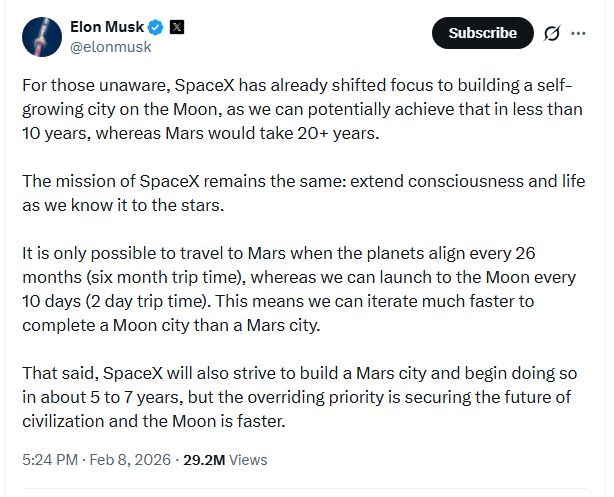
As more than 120 million people tuned in to the Super Bowl for kickoff on Sunday evening, SpaceX founder Elon Musk turned instead to his social network. There, he tapped out an extended message in which he revealed that SpaceX is pivoting from the settlement of Mars to building a “self-growing” city on the Moon.

“For those unaware, SpaceX has already shifted focus to building a self-growing city on the Moon, as we can potentially achieve that in less than 10 years, whereas Mars would take 20+ years,” Musk wrote, in part.

Elon Musk tweet at 6:24 pm ET on Sunday.

Credit: X/Elon Musk

Elon Musk tweet at 6:24 pm ET on Sunday. Credit: X/Elon Musk

This is simultaneously a jolting and practical decision coming from Musk.

Why it’s a jolting decision

A quarter of a century ago, Musk founded SpaceX with a single-minded goal: settling Mars. One of his longest-tenured employees, SpaceX President and Chief Operating Officer Gwynne Shotwell, described her very first interview with Musk in 2002 to me as borderline messianic.

“He was talking about Mars, his Mars Oasis project,” Shotwell said. “He wanted to do Mars Oasis, because he wanted people to see that life on Mars was doable, and we needed to go there.”

She was not alone in this description of her first interaction with Musk. The vision for SpaceX has not wavered. Even in the company’s newest, massive Starship rocket factory at the Starbase facility in South Texas—also known as the Gateway to Mars—there are reminders of the red planet everywhere. For example, the carpet inside Musk’s executive conference room is rust red, the same color as the surface of Mars.

In the last 25 years, Musk has gone from an obscure, modestly wealthy person to the richest human being ever, from a political moderate to chief supporter of Donald Trump; from a respected entrepreneur to, well, to a lot of things to a lot of people: world’s greatest industrialist/supervillain/savant/grifter-fraudster.

But one thing that has remained constant across the Muskverse is his commitment to “extending the light of human consciousness” and to the belief that the best place to begin humanity’s journey toward becoming a multi-planetary species was Mars.

https://arstechnica.com/space/2026/02/has-elon-musk-given-up-on-mars/


US House takes first step toward creating “commercial” deep space program

A US House committee with oversight of NASA unanimously passed a “reauthorization” act for the space agency on Wednesday. The legislation must still be approved by the full House before being sent to the Senate, which may take up consideration later this month.

Congress passes such reauthorization bills every couple of years, providing the space agency with a general sense of the direction legislators want to see NASA go. They are distinct from appropriations bills, which provide actual funding for specific programs, but nonetheless play an important role in establishing space policy.

There weren’t any huge surprises in the legislation, but there were some interesting amendments. Most notably among these was the Amendment No. 01, offered by the chair of the Committee on Science, Space, and Technology, Rep. Brian Babin (R-Texas), as well as its ranking member, Zoe Lofgren (D-Calif.), and three other legislators.

NASA can consider Artemis alternatives

The amendment concerns acquisition powers bestowed upon NASA by Congress, stating in part: “The Administrator may, subject to appropriations, procure from United States commercial providers operational services to carry cargo and crew safely, reliably, and affordably to and from deep space destinations, including the Moon and Mars.”

That language is fairly general in nature, but the intent seems clear. NASA’s initial missions to the Moon, through Artemis V, have a clearly defined architecture: They must use the Space Launch System rocket, Orion spacecraft, and a lander built by either SpaceX or Blue Origin to complete lunar landings.

But after that? With this amendment, Congress appears to be opening the aperture to commercial companies. That is to say, if SpaceX wanted to bid an end-to-end Starship lunar mission, it could; or if Blue Origin wanted to launch Orion on New Glenn, that is also an option. The language is generalized enough, not specifying “launch” but rather “transportation,” that in-space companies such as Impulse Space could also get creative. Essentially, Congress is telling the US industry that if it is ready to step up, NASA should allow it to bid on lunar cargo and crew missions.

https://arstechnica.com/space/2026/02/us-house-takes-first-step-toward-creating-commercial-deep-space-program/


Russian spy satellites have intercepted EU communications satellites

Those thrusters could also be used to knock satellites out of alignment or even cause them to crash back to Earth or drift into space.

Intelligence gathered by Luch 1 and 2 could also help Russia coordinate less overt attacks on Western interests. Monitoring other satellites can reveal who is using them and where—information that could later be exploited for targeted ground-based jamming or hacking operations.

The Luch vehicles were “maneuvring about and parking themselves close to geostationary satellites, often for many months at a time,” said Belinda Marchand, chief science officer at Slingshot Aerospace, a US-based company that tracks objects in space using ground-based sensors and artificial intelligence.

She added that Luch 2 was currently “in proximity” to Intelsat 39, a large geostationary satellite that services Europe and Africa.

Since its launch in 2023, Luch-2 has hovered near at least 17 other geostationary satellites above Europe serving both commercial and government purposes, Slingshot data shows.

“They have visited the same families, the same operators—so you can deduce that they have a specific purpose or interest,” said Norbert Pouzin, senior orbital analyst at Aldoria, a French satellite tracking company that has also shadowed the Luch satellites. “These are all Nato-based operators.”

“Even if they cannot decrypt messages, they can still extract a lot of information… they can map how a satellite is being used, work out the location of ground terminals, for example,” he added.

Pouzin also said that Russia now seemed to be ramping up its reconnaissance activity in space, launching two new satellites last year named Cosmos 2589 and Cosmos 2590. The vehicles appear to have similarly maneuvrable capabilities to Luch-1 and Luch-2.

Cosmos 2589 is now on its way to the same range as geostationary satellites, which orbit 35,000 km above Earth, Pouzin said.

But Luch-1 may no longer be functional. On January 30, Earth telescopes observed what appeared to be a plume of gas coming from the satellite. Shortly after, it appeared to at least partially fragment.

“It looks like it began with something to do with the propulsion,” said Marchand, adding that afterwards there “was certainly a fragmentation,” and the satellite was “still tumbling.”

© 2026 The Financial Times Ltd. All rights reserved. Not to be redistributed, copied, or modified in any way.

https://arstechnica.com/space/2026/02/russian-spy-satellites-have-intercepted-eu-communications-satellites/


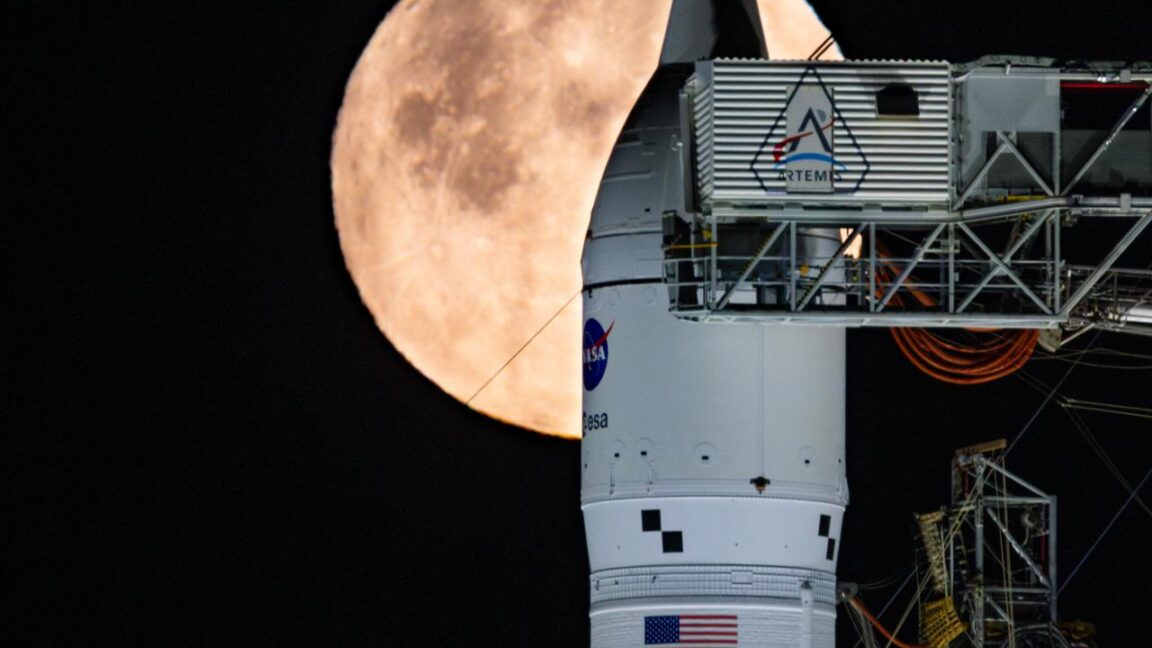
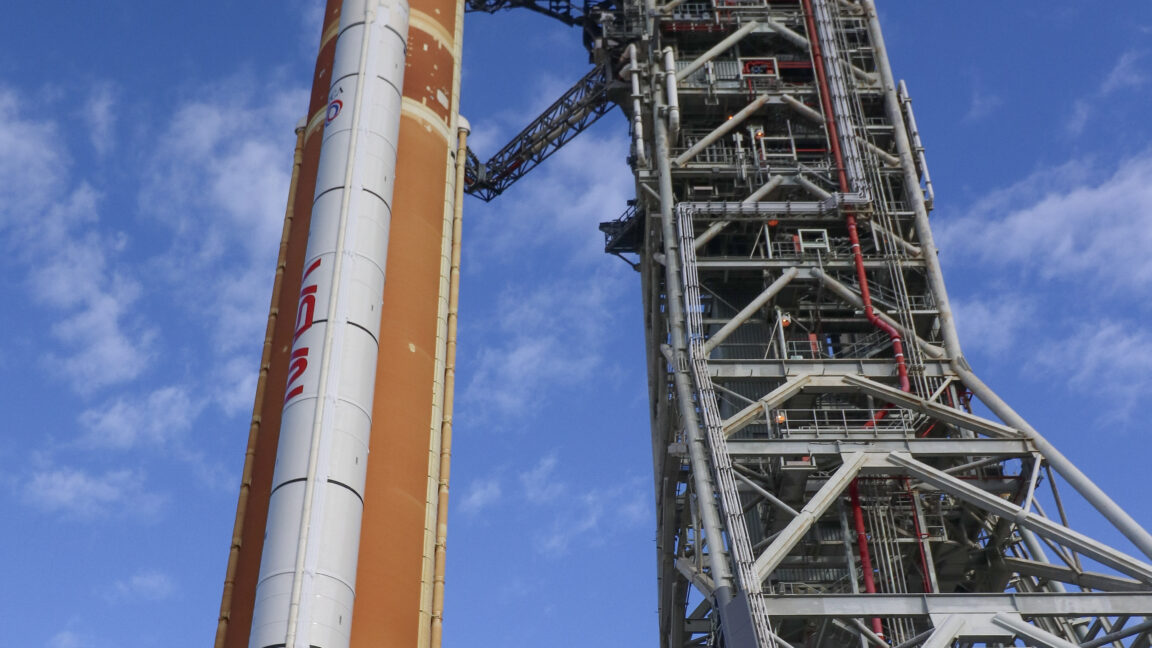
NASA finally acknowledges the elephant in the room with the SLS rocket

The Space Launch System rocket program is now a decade and a half old, and it continues to be dominated by two unfortunate traits: It is expensive, and it is slow.

The massive rocket and its convoluted ground systems, so necessary to baby and cajole the booster’s prickly hydrogen propellant on board, have cost US taxpayers in excess of $30 billion to date. And even as it reaches maturity, the rocket is going nowhere fast.

You remember the last time NASA tried to launch the world’s largest orange rocket, right? The space agency rolled the Space Launch System out of its hangar in March 2022. The first, second, and third attempts at a wet dress rehearsal—elaborate fueling tests—were scrubbed. The SLS rocket was slowly rolled back to its hangar for work in April before returning to the pad in June.

The fourth fueling test also ended early but this time reached to within 29 seconds of when the engines would ignite. This was not all the way to the planned T-9.3 seconds, a previously established gate to launch the vehicle. Nevertheless mission managers had evidently had enough of failed fueling tests. Accordingly, they proceeded into final launch preparations.

The first launch attempt (effectively the fifth wet-dress test), in late August, was scrubbed due to hydrogen leaks and other problems. A second attempt, a week later, also succumbed to hydrogen leaks. Finally, on the next attempt, and seventh overall try at fully fueling and nursing this vehicle through a countdown, the Space Launch System rocket actually took off. After doing so, it flew splendidly.

That was November 16, 2022. More than three years ago. You might think that over the course of the extended interval since then, and after the excruciating pain of spending nearly an entire year conducting fueling tests to try to lift the massive rocket off the pad, some of the smartest engineers in the world, the fine men and women at NASA, would have dug into and solved the leak issues.

https://arstechnica.com/space/2026/02/nasa-finally-acknowledges-the-elephant-in-the-room-with-the-sls-rocket/


Here’s why Blue Origin just ended its suborbital space tourism program

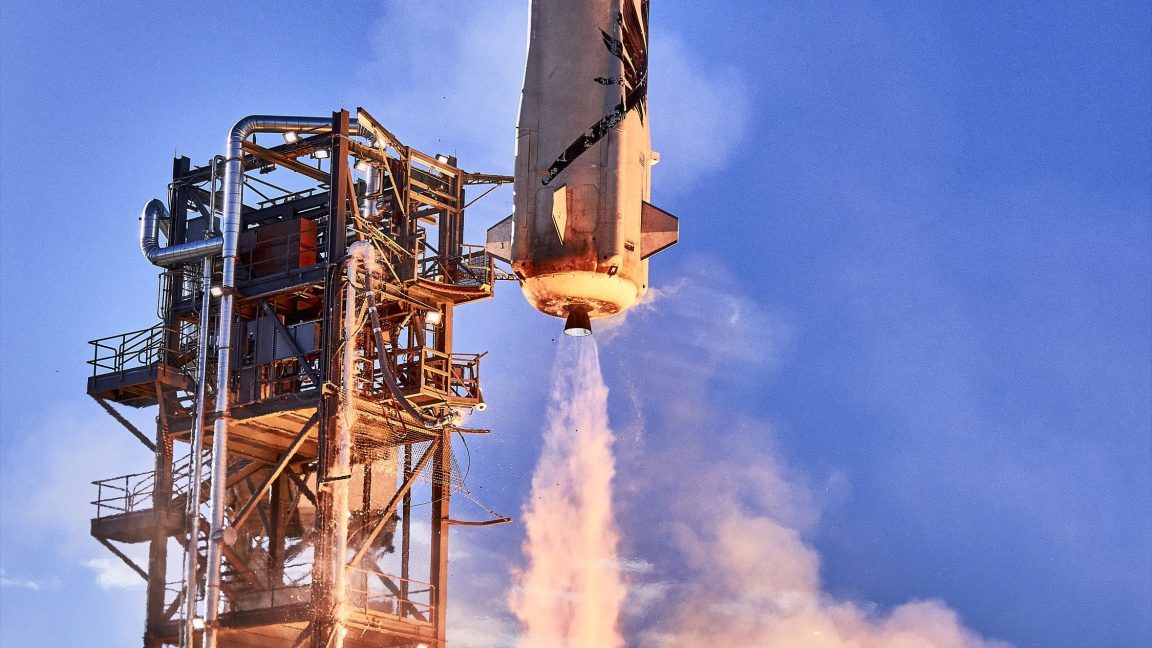
Blue Origin has “paused” its New Shepard program for the next two years, a move that likely signals a permanent end to the suborbital space tourism initiative.

The small rocket and capsule have been flying since April 2015 and have combined to make 38 launches, all but one of which were successful, and 36 landings. In its existence, the New Shepard program flew 98 people to space, however briefly, and launched more than 200 scientific and research payloads into the microgravity environment.

So why is Blue Origin, founded by Jeff Bezos more than a quarter of a century ago, ending the company’s longest-running program?

“We will redirect our people and resources toward further acceleration of our human lunar capabilities inclusive of New Glenn,” wrote the company’s chief executive, Dave Limp, in an internal email on Friday afternoon. “We have an extraordinary opportunity to be a part of our nation’s goal of returning to the Moon and establishing a permanent, sustained lunar presence.”

Move was a surprise

The cancellation came, generally, as a surprise to Blue Origin employees. The company flew its most recent mission eight days ago, launching six people into space. Moreover, the company has four new boosters in various stages of development as well as two new capsules under construction. Blue Origin has been selling human flights for more than a year  and is still commanding a per-seat price of approximately $1 million based on recent sales. It was talking about expansion to new spaceports in September.

Still, there have always been questions about the program’s viability. In November 2023, Ars published an article asking how long Bezos would continue to subsidize the New Shepard program, which at the time was “hemorrhaging” money. Sources indicate the program has gotten closer to breaking even, but it remains a drain on Blue Origin’s efforts.

More than 500 people spend part or all of their time working on New Shepard, but it also draws on other resources within the company. Although it is a small fraction of the company’s overall workforce, it is nonetheless a distraction from the company’s long-term ambitions to build settlements in space where millions of people will live, work, and help move industrial activity off Earth and into orbit.

https://arstechnica.com/space/2026/01/heres-why-blue-origin-just-ended-its-suborbital-space-tourism-program/


NASA faces a crucial choice on a Mars spacecraft—and it must decide soon

However, some leaders within NASA see the language in the Cruz legislation as spelling out a telecommunications orbiter only and believe it would be difficult, if not impossible, to run a procurement competition between now and September 30th for anything beyond a straightforward communications orbiter.

In a statement provided to Ars by a NASA spokesperson, the agency said that is what it intends to do.

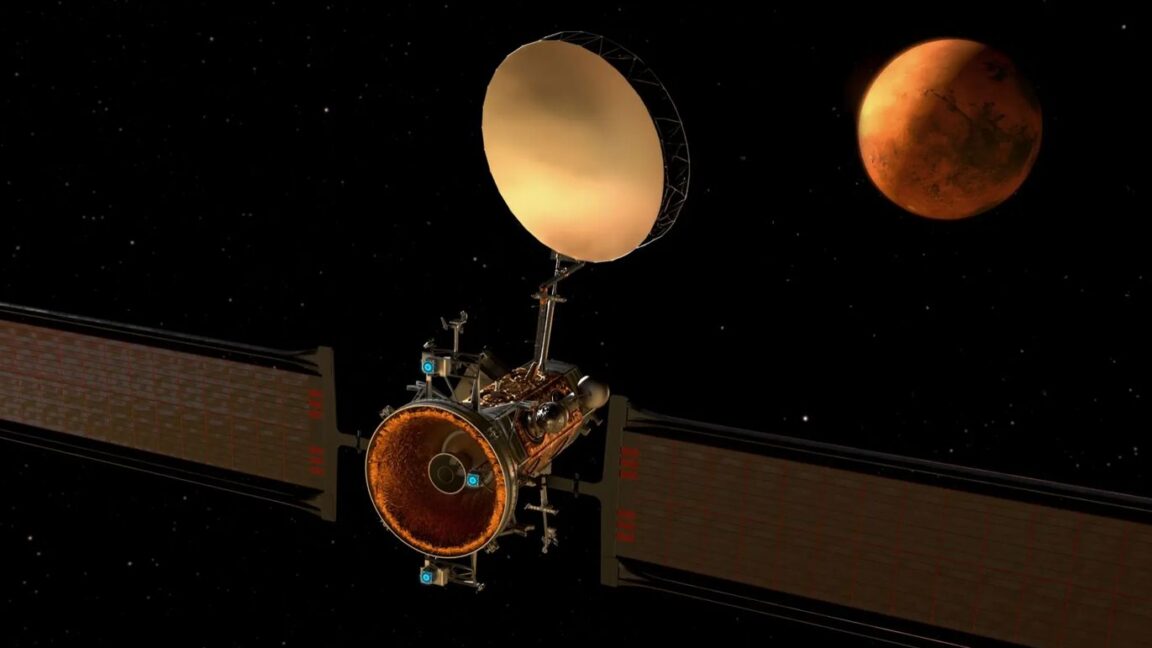
“NASA will procure a high-performance Mars telecommunications orbiter that will provide robust, continuous communications for Mars missions,” a spokesperson said. “NASA looks forward to collaborating with our commercial partners to advance deep space communications and navigation capabilities, strengthening US leadership in Mars infrastructure and the commercial space sector.”

Big decisions loom

Even so, sources said Isaacman has yet to decide whether the orbiter should include scientific instruments. NASA could also tap into other funding in its fiscal year 2026 budget, which included $110 million for unspecified “Mars Future Missions,” as well as a large wedge of funding that could potentially be used to support a Mars commercial payload delivery program.

The range of options before NASA, therefore, includes asking industry for a single telecom orbiter from one company, asking for a telecom orbiter with the capability to add a couple of instruments, or creating competition by asking for multiple orbiters and capabilities by tapping into the $700 million in the Cruz bill but then augmenting this with other Mars funding.

One indication that this process has been muddied within NASA came a week ago, when the space agency briefly posted a “Justification for Other Than Full and Open Competition, Extension” notice on a government website. It stated that the agency “will only conduct a competition among vendors that satisfy the statutory qualifications.” The notice also listed the companies eligible to bid based on the Cruz language: Blue Origin, L3Harris, Lockheed Martin, Northrop Grumman, Rocket Lab, SpaceX, Quantum Space, and Whittinghill Aerospace.

https://arstechnica.com/space/2026/01/nasa-faces-a-crucial-choice-on-a-mars-spacecraft-and-it-must-decide-soon/


Rocket Report: How a 5-ton satellite fell off a booster; will SpaceX and xAI merge?

ESA to study Falcon 9 breakup over Poland. The European Space Agency has published a call to tender for a study examining the reentry and breakup of a SpaceX Falcon 9 upper stage in February last year, European Spaceflight reports. In the early hours of February 19, 2025, a Falcon 9 second stage underwent an uncontrolled atmospheric re-entry over Poland. At least four fragments of the stage survived re-entry and landed in various locations across the country. While no one was injured and no property was damaged, at least one fragment landed in a populated area.

Not just an academic study … ESA hopes to use data collected during the reentry of the Falcon 9 upper stage over Poland to help predict the risks associated with the re-entry of elongated upper stages. There are currently considerable uncertainties surrounding the physics and dynamics of destructive reentry in the very low-Earth orbit regime, below 150km. It’s not an academic study, as in 2015 there were approximately 80 orbital rocket launches. A decade on, that figure has almost quadrupled, with 317 successful orbital rocket launches occurring in 2025. (submitted  by EllPeaTea)

SpaceX targets mid-March for next Starship launch. The company plans to launch Starship’s next test flight in six weeks, SpaceX founder Elon Musk said Sunday, January 25, Space.com reports. The flight will be the 12th overall for Starship but the first of the bigger, more powerful, and much-anticipated “Version 3” (V3) iteration of the vehicle.

A better engine … Starship V3 is slightly taller than V2—408.1 feet (124.4 meters) vs. 403.9 feet (123.1 m), but considerably more powerful. V3 can loft more than 100 tons of payload to low-Earth orbit, compared to about 35 tons for V2, according to Musk. The increased brawn comes courtesy of Raptor 3, a new variant of the engine that will fly for the first time on the upcoming test mission. SpaceX is hoping it proves more reliable than V2 as well.

Seeking information about Challenger artifacts. Back in 2010, Robert Pearlman of CollectSpace bought a batch of 18 space shuttle-era “Remove Before Flight” tags on eBay. It was only later that he pieced together that these tags were, in fact, removed from the external tank of STS 51-L, the ill-fated flight of space shuttle Challenger in 1986. He wrote about the experience on Ars.

How did they get to eBay? … “When the tags were first identified, contacts at NASA and Lockheed, among others, were unable to explain how they ended up on eBay and, ultimately, with me,” Pearlman said. He wants to gather more information about the provenance of the tags so that he can donate them to museums, with their full backstory.

Next three launches

January 30: Falcon 9 | Starlink 6-101 | Cape Canaveral Space Force Station, Florida | 05:51 UTC

February 2: Falcon 9 | Starlink 17-32 | Vandenberg Space Force Base, Calif. | 15:17 UTC

February 3: Falcon 9 | Starlink 6-103 | Cape Canaveral Space Force Station, Florida | 22:12 UTC

https://arstechnica.com/space/2026/01/rocket-report-how-a-5-ton-satellite-fell-off-a-booster-will-spacex-and-xai-merge/