US spy satellite agency declassifies high-flying Cold War listening post

The National Reconnaissance Office, the agency overseeing the US government’s fleet of spy satellites, has declassified a decades-old program used to eavesdrop on the Soviet Union’s military communication signals.

The program was codenamed Jumpseat, and its existence was already public knowledge through leaks and contemporary media reports. What’s new is the NRO’s description of the program’s purpose, development, and pictures of the satellites themselves.

In a statement, the NRO called Jumpseat “the United States’ first-generation, highly elliptical orbit (HEO) signals-collection satellite.”

Scooping up signals

Eight Jumpseat satellites launched from 1971 through 1987, when the US government considered the very existence of the National Reconnaissance Office a state secret. Jumpseat satellites operated until 2006. Their core mission was “monitoring adversarial offensive and defensive weapon system development,” the NRO said. “Jumpseat collected electronic emissions and signals, communication intelligence, as well as foreign instrumentation intelligence.”

Data intercepted by the Jumpseat satellites flowed to the Department of Defense, the National Security Agency, and “other national security elements,” the NRO said.

The Soviet Union was the primary target for Jumpseat intelligence collections. The satellites flew in highly elliptical orbits ranging from a few hundred miles up to 24,000 miles (39,000 kilometers) above the Earth. The satellites’ flight paths were angled such that they reached apogee, the highest point of their orbits, over the far northern hemisphere. Satellites travel slowest at apogee, so the Jumpseat spacecraft loitered high over the Arctic, Russia, Canada, and Greenland for most of the 12 hours it took them to complete a loop around the Earth.

This trajectory gave the Jumpseat satellites persistent coverage over the Arctic and the Soviet Union, which first realized the utility of such an orbit. The Soviet government began launching communication and early-warning satellites into the same type of orbit a few years before the first Jumpseat mission launched in 1971. The Soviets called the orbit Molniya, the Russian word for lightning.

A Jumpseat satellite before launch.

Credit: National Reconnaissance Office

A Jumpseat satellite before launch. Credit: National Reconnaissance Office

The name Jumpseat was first revealed in a 1986 book by the investigative journalist Seymour Hersh on the Soviet Union’s 1983 shoot-down of Korean Air Lines Flight 007. Hersh wrote that the Jumpseat satellites could “intercept all kinds of communications,” including voice messages between Soviet ground personnel and pilots.

https://arstechnica.com/space/2026/01/us-spy-satellite-agency-declassifies-high-flying-cold-war-listening-post/



Do you have ideas about how to improve America’s space program?

“Any time there’s dynamic change, there’s the opportunity for new ideas to insert themselves,” Autry said in an interview with Ars. So Autry and others want to give people a chance to voice those ideas by launching the “Space Ideation Challenge.”

A challenge for new ideas

A prize purse of $125,000 will be awarded to the best ideas, of which $25,000 will be devoted to the best undergraduate and graduate student submissions. Entrants will be required to write three- to five-page white papers that explain their idea and how they would shape markets and strengthen the space economy or national security. Papers are due by June 30, and judging will be complete by August 15.

As an additional incentive, the best ideas will be briefed to relevant policymakers, including key members of Congress, NASA Administrator Jared Isaacman, and Saltzman, of the Space Force.

So what constitutes a good idea? It is not, Autry said, a business plan. These ideas will be shared with others, so if you have a proprietary idea to make billions of dollars, go elsewhere. Beyond that, though, it could be anything, Autry said, and the goal is to really open the aperture widely.

As an example, he cited NASA’s Commercial Orbital Transportation Services program, initiated more than two decades ago. This program ultimately spawned private cargo and crew services to the International Space Station and provided key funding to help SpaceX survive its early, lean years and accelerate to what it has become today. Autry said forward-looking ideas today might help the space agency with the transition to private space stations from the ISS or in the competition with China to reach the Moon and develop its resources. There could also be other kinds of prize-based competitions to spur innovation.

Ideas could come from students; the various super-engaged space communities on Twitter, YouTube, Reddit, Discord, or elsewhere; or even employees at NASA or private companies who can’t get management to listen to them. Basically, if someone has thought about space and how something could be done better, this is an opportunity to speak up and be heard.

“I think we all know that we’re on the verge of some big things in space, but I think there’s some frustration with how to get there with traditional thinking,” Autry said. “So we’re looking for some non-traditional thinking.”

https://arstechnica.com/space/2026/01/do-you-have-ideas-about-how-to-improve-americas-space-program/


I bought “Remove Before Flight” tags on eBay in 2010—it turns out they’re from Challenger

Having a more complete history of these tags would help meet the accession requirements of some museums and, if approved, provide curators with the information they need to put the tags on display.

Reconnecting to flight

When the tags were first identified, contacts at NASA and Lockheed, among others, were unable to explain how they ended up on eBay and, ultimately, with me.

It was 2011, and the space shuttle program was coming to its end. I was politely told that this was not the time to ask about the tags, as documents were being moved into archives and, perhaps more importantly, people were more concerned about pending layoffs. One person suggested the tags be put back in a drawer and forgotten about for another decade.

In the years since, other “Remove Before Flight” tags from other space shuttle missions have come up for sale. Some have included evidence that the tags had passed through the surplus procedures; some did not and were offered as is.

Close-up detail of two of the 18 shuttle “Return Before Flight” tags purchased off eBay. All were marked “ET-26” with a serial number. Some included additional stamps and handwritten notations. Most of the latter, though, has bled into the fabric to the point that it can no longer be read.

Close-up detail of two of the 18 shuttle “Return Before Flight” tags purchased off eBay. All were marked “ET-26” with a serial number. Some included additional stamps and handwritten notations. Most of the latter, though, has bled into the fabric to the point that it can no longer be read. Credit: collectSPACE.com

There were anecdotes about outgoing employees taking home mementos. Maybe someone saw these tags heading out as scrap (or worse, being tossed in the garbage) and, recognizing what they were, saved them from being lost to history. An agent with the NASA Office of Inspector General once said that dumpster diving was not prohibited, so long as the item(s) being dived for were not metal (due to recycling).

More recent attempts to reach people who might know anything about the specific tags have been unsuccessful, other than the few details Cianilli was able to share. An attempt to recontact the eBay seller has so far gone unanswered.

If you or someone you know worked on the external tank at the time of the STS-51L tragedy, or if you’re familiar with NASA’s practices regarding installing, retrieving, and archiving or disposing of the Remove Before Flight tags, please get in contact.

https://arstechnica.com/space/2026/01/attached-to-tragedy-tracing-challenger-remove-before-flight-tags/


A WB-57 pilot just made a heroic landing in Houston after its landing gear failed

One of NASA’s three large WB-57 aircraft made an emergency landing at Ellington Field on Tuesday morning in southeastern Houston.

Video captured by KHOU 11 television showed the aircraft touching down on the runway without its landing gear extended. The pilot then maintains control of the vehicle as it slides down the runway, slowing the aircraft through friction. The crew was not harmed, NASA spokesperson Bethany Stevens said.

[embedded content]

WB-57 landing.

“Today, a mechanical issue with one of NASA’s WB-57s resulted in a gear-up landing at Ellington Field,” she said. “Response to the incident is ongoing, and all crew are safe at this time. As with any incident, a thorough investigation will be conducted by NASA into the cause. NASA will transparently update the public as we gather more information.”

The B-57 line of aircraft dates back to 1944, when the English Electric Company began developing the plane. After the Royal Air Force showcased the B-57 in 1951 by crossing the Atlantic in a record four hours and 40 minutes and becoming the first jet-powered aircraft to span the Atlantic without refueling, the United States Air Force began buying them to replace its aging Douglas B-26 Invader.

Now used for science

The aircraft performed bombing missions in Vietnam and other military campaigns, and a variant that later became the WB-57 was designed with longer wings that could fly even higher, up to 62,000 feet. This proved useful for weather reconnaissance and, around the world, to sample the upper atmosphere for evidence of nuclear debris where US officials suspected the atmospheric testing of nuclear weapons.

https://arstechnica.com/space/2026/01/one-of-nasas-three-wb-57-aircraft-just-did-a-belly-landing-in-houston/


Trade wars muzzle allied talks on Trump’s Golden Dome missile shield

These 18 awards are focused on boost-phase SBIs, weapons that can take out a missile soon after it leaves its silo. From a physics perspective, this is one of the most difficult things to ask an interceptor to do, because the weapon must account for atmospheric disturbances and reentry heating to reach its target. In December, the Space Force issued a follow-up request for prototype proposals looking at space-based midcourse interceptors capable of destroying a ballistic missile while it is coasting through space.

The Pentagon has not said how many SBIs it will need for Golden Dome, or what they will look like. Essentially, an orbiting interceptor will be a flying fuel tank with a rocket and a sensor package to home in on its target. But the Space Force and its prospective Golden Dome contractors, which include industry giants Northrop Grumman and Lockheed Martin, have not disclosed the interceptors’ design specs or how many the shield will need.

A Standard Missile 3 Block IIA launches from the Aegis Ashore Missile Defense Test Complex at the Pacific Missile Range Facility in Kauai, Hawaii, on December 10, 2018, during a test to intercept an intermediate-range ballistic missile target in space.

Credit: Mark Wright/DOD

A Standard Missile 3 Block IIA launches from the Aegis Ashore Missile Defense Test Complex at the Pacific Missile Range Facility in Kauai, Hawaii, on December 10, 2018, during a test to intercept an intermediate-range ballistic missile target in space. Credit: Mark Wright/DOD

“I can move money around at will”

Guetlein said Pentagon leaders have empowered him with “unprecedented authorities” on the Golden Dome program. He said Friday his office has full authority over the program’s technical aspects, along with Golden Dome’s procurement, contracting, hiring, security, and budget.

President Trump directed the military to start the Golden Dome program in an executive order last January and nominated Guetlein to head the effort. The Senate confirmed him for the job in a voice vote last July. After the initial pomp of Golden Dome’s announcement, including multiple Oval Office photo ops, military officials went quiet. Guetlein cited security concerns for the Pentagon’s silence on one of Trump’s marquee defense programs.

“I was confirmed on the 18th of July. On the 19th of July, I popped No. 1 on the intel collect list for our adversaries,” Guetlein said. “On the 20th of July, they started hacking our defense industrial base, and the Secretary (of Defense) asked us to go silent. So, we have been quiet. I have not been talking to industry consortiums. I have not been talking to the press. I have not been talking to the think tanks. And it wasn’t until September that I was allowed to even start talking to the Hill (Congress).”

https://arstechnica.com/space/2026/01/trade-wars-muzzle-allied-talks-on-trumps-golden-dome-missile-shield/


Former astronaut on lunar spacesuits: “I don’t think they’re great right now”

“The suits that we have are definitely much better than Apollo,” Rubins said in the interview. “They were just big bags of air. The joints aren’t in there, so it was harder to move. What they did have going for them was that they were much, much lighter than our current spacesuits. We have added a lot of the joints back, and that does get some mobility for us. But at the end of the day, the suits are still quite heavy.”

You can divide the weight of the suit by six to get an idea of how it might feel to carry it around on the lunar surface. While it won’t feel like 300 pounds, astronauts will still have to account for their mass and momentum.

Rubins explained:

Instead of kind of floating in microgravity and moving your mass around with your hands and your arms, now we’re ambulating. We’re walking with our legs. You’re going to have more strain on your knees and your hips. Your hamstrings, your calves, and your glutes are going to come more into play.

I think, overall, it may be a better fit for humans physically because if you ask somebody to do a task, I’m going to be much better at a task if I can use my legs and I’m ambulating. Then I have to pull myself along with my arms… We’re not really built to do that, but we are built to run and to go long distances. Our legs are just such a powerful force.

So I think there are a lot of things lining up that are going to make the physiology easier. Then there are things that are going to be different because we’re now in a partial gravity environment. We’re going to be bending, we’re going to be twisting, we’re going to be doing different things.

It’s an incredibly hard engineering challenge. You have to keep a human alive in absolute vacuum, warm at temperatures that you know in the polar regions could go as far down as 40 Kelvin (minus 388° Fahrenheit). We haven’t sent humans anywhere that cold before. They are also going to be very hot. They’re going to be baking in the sunshine. You’ve got radiation. If you put all that together, that’s a huge amount of suit material just to keep the human physiology and the human body intact.

Then our challenge is ‘how do you make that mobile?’ It’s very difficult to bend down and pick up a rock. You have to manage that center of gravity because you’re wearing that big life support system on your back, a big pack that has a lot of mass in it, so that brings your center of gravity higher than you’re used to on Earth and a little bit farther backward.

When you move around, it’s like wearing a really, really heavy backpack that has mass but no weight, so it’s going to kind of tip you back. You can do some things with putting weights on the front of the suit to try to move that center of gravity forward, but it’s still higher, and it’s not exactly at your center of mass that you’re used to on the Earth. On the Earth, we have a center of our mass related to gravity, and nobody ever thinks about it, and you don’t think about it until it moves somewhere else, and then it makes all of your natural motion seem very difficult.

Those are some of the challenges that we’re facing engineering-wise. I think the new suits, they’ve gone a long way toward addressing these, but it’s still a hard engineering challenge. And I’m not talking about any specific suit. I can’t talk about the details of the provider’s suits. This is the NASA xEMU and all the lunar suits I have tested over the years. That includes the Mark III suit, the Axiom suit. They have similar issues. So this isn’t really anything about a specific vendor. These are just the difficulties of designing a spacesuit for the lunar environment.

NASA trains astronauts for spacewalks in the Neutral Buoyancy Laboratory, an enormous pool in Houston used for simulating weightlessness. They also use a gravity-offloading device to rehearse the basics of spacewalking. The optimal test environment, short of the space environment itself, will be aboard parabolic flights, where suit developers and astronauts can get the best feel for the suit’s momentum, according to Rubins.

https://arstechnica.com/space/2026/01/former-astronaut-on-lunar-spacesuits-i-dont-think-theyre-great-right-now/


Rocket Report: Chinese rockets fail twice in 12 hours; Rocket Lab reports setback

Welcome to Edition 8.26 of the Rocket Report! The past week has been one of advancements and setbacks in the rocket business. NASA rolled the massive rocket for the Artemis II mission to its launch pad in Florida, while Chinese launchers suffered back-to-back failures within a span of approximately 12 hours. Rocket Lab’s march toward a debut of its new Neutron launch vehicle in the coming months may have stalled after a failure during a key qualification test. We cover all this and more in this week’s Rocket Report.

As always, we welcome reader submissions. If you don’t want to miss an issue, please subscribe using the box below (the form will not appear on AMP-enabled versions of the site). Each report will include information on small-, medium-, and heavy-lift rockets, as well as a quick look ahead at the next three launches on the calendar.

Australia invests in sovereign launch. Six months after its first orbital rocket cleared the launch tower for just 14 seconds before crashing back to Earth, Gilmour Space Technologies has secured 217 million Australian dollars ($148 million) in funding that CEO Adam Gilmour says finally gives Australia a fighting chance in the global space race, the Sydney Morning Herald reports. The funding round, led by the federal government’s National Reconstruction Fund Corporation and superannuation giant Hostplus with $75 million each, makes the Queensland company Australia’s newest unicorna fast-growth start-up valued at more than $1 billionand one of the country’s most heavily backed private technology ventures.

Homegrown rocket… “We’re a rocket company that has never had access to the capital that our American competitors have,” Gilmour told the newspaper. “This is the first raise where I’ve actually raised a decent amount of capital compared to the rest of the world.” The investment reflects growing concern about Australia’s reliance on foreign launch providerspredominantly Elon Musk’s SpaceXto put government, defense, and commercial satellites into orbit. With US launch queues stretching beyond two years and geopolitical tensions reshaping access to space infrastructure, Canberra has identified sovereign launch capability as a strategic priority. Gilmour’s first Eris rocket lifted off from the Bowen Orbital Spaceport in North Queensland on July 30 last year. It achieved 14 seconds of flight before falling back to the ground, a result Gilmour framed as a partial success in an industry where first launches routinely fail.

https://arstechnica.com/space/2026/01/rocket-report-rocket-lab-reports-neutron-setback-australia-backs-launch-startup/


Blue Origin makes impressive strides with reuse—next launch will refly booster

SpaceX successfully landed its second Falcon 9 booster in April 2016, on the 23rd overall flight of the Falcon 9 fleet. This booster was refurbished and, after a lengthy series of inspections, it was reflown successfully in March 2017, nearly 11 months later.

Reshuffling the manifest

With New Glenn, Blue Origin is seeking to refly a booster on just the third overall flight of the New Glenn fleet and turn the rocket around in less than four months. Even for a well-capitalized program with the benefit of learning from both Blue Origin’s own suborbital New Shepard rocket and the industry’s experience with the Falcon 9, this represents an impressive turnaround in first stage reuse.

Blue Origin originally planned to launch its MK1 lunar lander on the third flight of New Glenn, but it pivoted to a commercial launch as the lunar vehicle continues preparatory work.

On Wednesday, the company announced that it had completed the integration of the MK1 vehicle and put it on a barge bound for Johnson Space Center in Houston. There, it will undergo vacuum chamber testing before a launch later this spring—or, more likely, sometime this summer.

https://arstechnica.com/space/2026/01/blue-origin-makes-impressive-strides-with-reuse-next-launch-will-refly-booster/


All sorts of interesting flags and artifacts will fly to the Moon on Artemis II

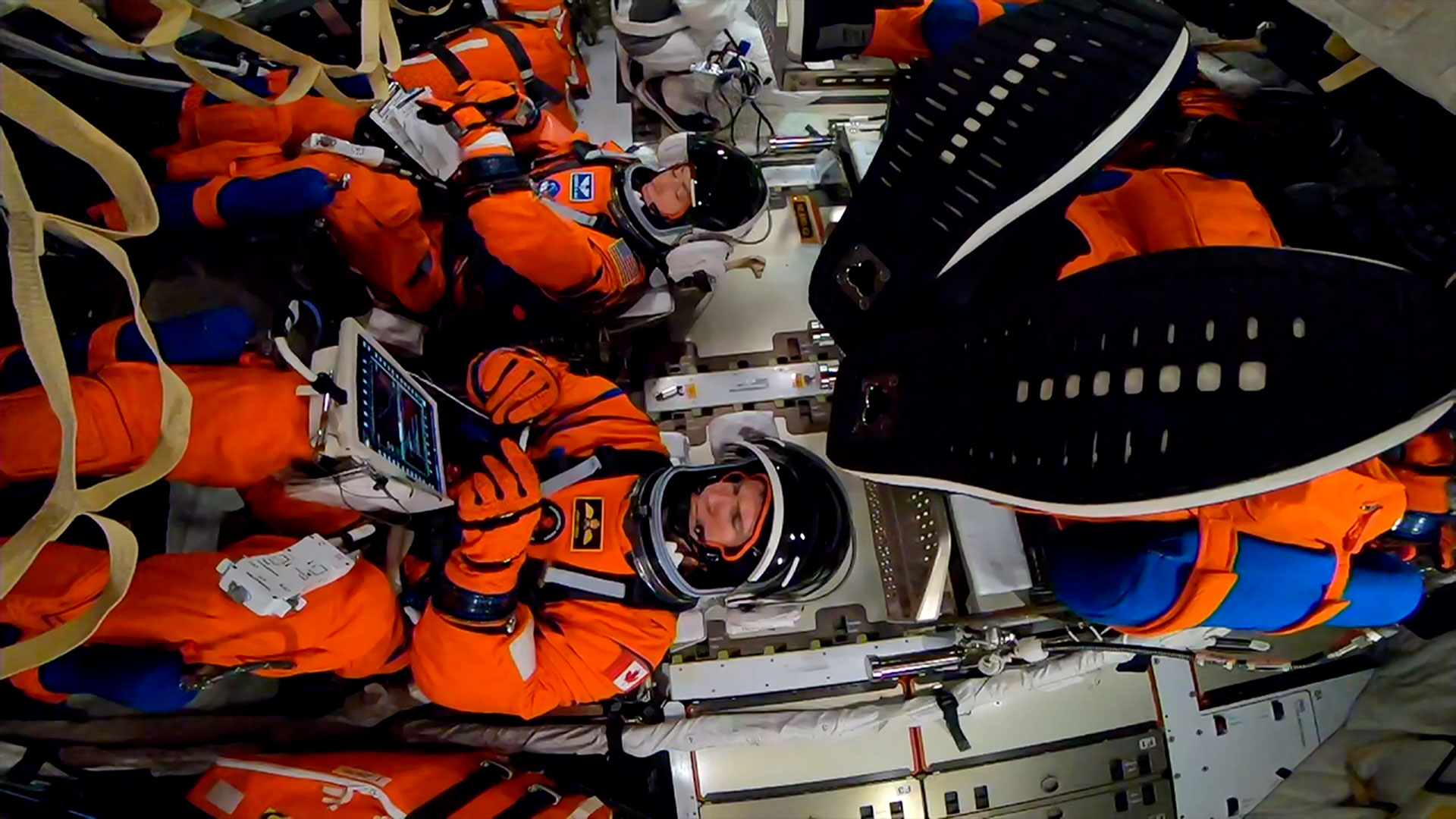
NASA’s first astronauts to fly to the Moon in more than 50 years will pay tribute to the lunar and space exploration missions that preceded them, as well as aviation and American history, by taking with them artifacts and mementos representing those past accomplishments.

NASA, on Wednesday, January 21, revealed the contents of the Artemis II mission’s Official Flight Kit (OFK), continuing a tradition dating back to the Apollo program of packing a duffel bag-sized pouch of symbolic and celebratory items to commemorate the flight and recognize the people behind it. The kit includes more than 2,300 items, including a handful of relics.

“This mission will bring together pieces of our earliest achievements in aviation, defining moments from human spaceflight and symbols of where we’re headed next,” Jared Isaacman, NASA’s administrator, said in a statement. “Historical artifacts flying aboard Artemis II reflect the long arc of American exploration and the generations of innovators who made this moment possible.”

The Artemis II Official Flight Kit will fly aboard the Orion spacecraft Integrity stowed in a locker for the duration of the 10-day mission so as to be out of the way for the mission’s four crew members.

Credit: NASA

The Artemis II Official Flight Kit will fly aboard the Orion spacecraft Integrity stowed in a locker for the duration of the 10-day mission so as to be out of the way for the mission’s four crew members. Credit: NASA

The Artemis II mission, which may launch as soon as early February, is set to take three NASA astronauts—commander Reid Wiseman, pilot Victor Glover, and mission specialist Christina Koch—and a representative of the Canadian Space Agency, mission specialist Jeremy Hansen, on a 10-day flight that takes them farther out into space than any humans have ever traveled before and then return them safely to Earth.

The mission includes a flyby of the Moon, affording the crew an opportunity to see parts of the far side never observed directly by human eyes.

Banners aboard

“During America’s 250th anniversary, Orion will carry astronauts around the Moon, while also carrying our history forward into the next chapter beyond Earth,” said Isaacman.

Inside the OFK are numerous flags of different types, including hundreds of US and “America 250” flags for post-flight presentation. The kit also holds two special examples of the stars and stripes, one that is returning to space for its third time, and another that is finally getting its chance to fly.

https://arstechnica.com/space/2026/01/nasa-to-fly-apollo-aviation-artifacts-on-artemis-ii/


Another Jeff Bezos company has announced plans to develop a megaconstellation

The announcement came out of the blue, from Blue, on Wednesday.

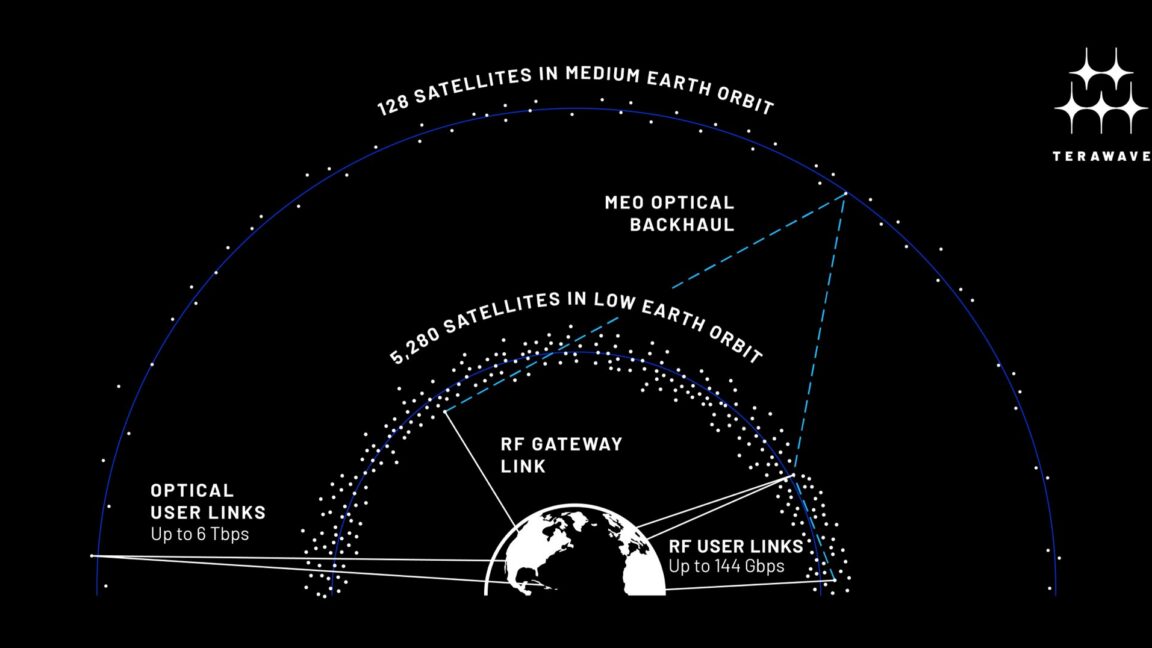
The space company founded by Jeff Bezos, Blue Origin, said it was developing a new megaconstellation named TeraWave to deliver data speeds of up to 6Tbps anywhere on Earth. The constellation will consist of 5,408 optically interconnected satellites, with a majority in low-Earth orbit and the remainder in medium-Earth orbit.

The satellites in low-Earth orbit will provide up to 144Gbps through radio spectrum, whereas those in medium-Earth orbit will provide higher data rates through optical links.

“This provides the reliability and resilience needed for real-time operations and massive data movement,” Blue Origin’s chief executive, Dave Limp, said on social media. “It also provides backup connectivity during outages, keeping critical operations running. Plus, the ability to scale on demand and rapidly deploy globally while maintaining performance.”

Going for the enterprise market

Unlike other megaconstellations, including SpaceX’s Starlink, Blue Origin’s new constellation will not serve consumers or try to provide direct-to-cell communications. Rather, TeraWave will seek to serve “tens of thousands” of enterprise, data center, and government users who require reliable connectivity for critical operations.

The announcement was surprising for several reasons, but it may also represent a shrewd business decision.

It was surprising because Bezos’ other company, Amazon, has already spent more than half a decade developing its own megaconstellation, now known as Amazon Leo, which is presently authorized to deploy 3,236 satellites into low-Earth orbit. This service is intended to compete with Starlink, both through customer terminals and by providing services such as in-flight Wi-Fi.

However, the emergence of increased data needs from AI data centers and other operations must have convinced Bezos that Blue Origin should enter the competition for lucrative enterprise customers—an area in which Amazon Leo is also expected to compete.

https://arstechnica.com/space/2026/01/blue-origin-we-want-to-have-a-megaconstellation-too/