Webb reveals a planetary nebula with phenomenal clarity, and it is spectacular
The Helix Nebula is one of the most well-known and commonly photographed planetary nebulae because it resembles the “Eye of Sauron.” It is also one of the closest bright nebulae to Earth, located approximately 655 light-years from our Solar System.
You may not know what this particular nebula looks like when reading its name, but the Hubble Space Telescope has taken some iconic images of it over the years. And almost certainly, you’ll recognize a photograph of the Helix Nebula, shown below.
Like many objects in astronomy, planetary nebulae have a confusing name, since they are formed not by planets but by stars like our own Sun, though a little larger. Near the end of their lives, these stars shed large amounts of gas in an expanding shell that, however briefly in cosmological time, put on a grand show.
This is one of the Hubble Space Telescope’s iconic images of the Helix Nebula.
Credit: NASA
This is one of the Hubble Space Telescope’s iconic images of the Helix Nebula. Credit: NASA
Now the James Webb Space Telescope has turned its sights on the Helix Nebula, and, oh my, does it have a story to tell. NASA released the new images of the nebula on Tuesday.
In this image, there are vibrant pillars of gas along the inner region of the nebula’s expanding shell of gas. According to the space agency, this is what we’re seeing:
The first commercial space station, Haven-1, is now undergoing assembly for launch
As Ars reported last week, NASA’s plan to replace the International Space Station with commercial space stations is running into a time crunch.
The sprawling International Space Station is due to be decommissioned less than five years from now, and the US space agency has yet to formally publish rules and requirements for the follow-on stations being designed and developed by several different private companies.
Although there are expected to be multiple bidders in “phase two” of NASA’s commercial space station program, there are at present four main contenders: Voyager Technologies, Axiom Space, Blue Origin, and Vast Space. At some point later this year, the space agency is expected to select one, or more likely two, of these companies for larger contracts that will support their efforts to build their stations.
To get a sense of the overall landscape as the competition heats up, Ars recently interviewed Voyager chief executive Dylan Taylor about his company’s plans for a private station, Starlab. Today we are publishing an interview with Max Haot, the chief executive of Vast. The company is furthest along in terms of development, choosing to build a smaller, interim space station, Haven-1, capable of short-duration stays. Eventually, NASA wants facilities capable of continuous habitation, but it is not clear whether that will be a requirement starting in 2030.
Until today, Haven-1 had a public launch date of mid-2026. However, as Haot explained in our interview, that launch date is no longer tenable.
Max Haot: This is obviously our first space station, and we’re moving as safely and as fast as we can. That’s the date right now that we are confident we will meet. We’ve been tracking that date, without slip, for quite a while. And that’s still a year, probably two years or even more, ahead of anyone else. It will be building the world’s first commercial space station from scratch, from an empty building and no team, in under four years.
The fastest human spaceflight mission in history crawls closer to liftoff
The launch team repaired a leaky hydrogen seal and introduced a gentler hydrogen loading procedure to overcome the problem. Hydrogen is an extremely efficient fuel for rockets, but its super-cold temperature and the tiny size of hydrogen molecules make it prone to leakage. The hydrogen feeds the SLS rocket’s four core-stage engines and single upper-stage engine.
“Artemis I was a test flight, and we learned a lot during that campaign getting to launch,” said Charlie Blackwell-Thompson, NASA’s Artemis II launch director. “The things that we’ve learned relative to how to go load this vehicle, how to load LOX (liquid oxygen), how to load hydrogen, have all been rolled into the way in which we intend to load the Artemis II vehicle.”
NASA is hesitant to publicly set a target launch date until the agency gets through the dress rehearsal, but agency officials say a February launch remains feasible.
“We’ve held schedule pretty well getting to rollout today,” Isaacman said. “We have zero intention of communicating an actual launch date until we get through wet dress. But look, that’s our first window, and if everything is tracking accordingly, I know the teams are prepared, I know this crew is prepared, we’ll take it.”
“Wet dress is the driver to launch,” Blackwell-Thompson said. “With a wet dress that is without significant issues, if everything goes to plan, then certainly there are opportunities within February that could be achievable.”
One constraint that threw a wrench into NASA’s Artemis I launch campaign is no longer a significant factor for Artemis II. On Artemis I, NASA had to roll the rocket back to the Vehicle Assembly Building (VAB) after the wet dress rehearsal to complete final installation and testing on its flight termination system, which consists of a series of pyrotechnic charges designed to destroy the rocket if it flies off course and threatens populated areas after liftoff.
The US Space Force’s Eastern Range, responsible for public safety for all launches from Florida’s Space Coast, requires the flight termination system to be retested after 28 to 35 days, a clock that started ticking last week before rollout. During Artemis I, technicians could not access the parts of the rocket they needed to in order to perform the retest at the launch pad. NASA now has structural arms to give ground teams the ability to reach parts higher up the rocket for the retest without returning to the hangar.
With this new capability, Artemis II could remain at the pad for launch opportunities in February and March before officials need to bring it back to the VAB to replace the flight termination system’s batteries, which still can’t be accessed at the pad.
Managers on alert for “launch fever” as pressure builds for NASA’s Moon mission
“Putting crew on the rocket and taking the crew around the Moon, this is going be our first step toward a sustained lunar presence,” Honeycutt said. “It’s 10 days [and] four astronauts going farther from Earth than any other human has ever traveled. We’ll be validating the Orion spacecraft’s life support, navigation and crew systems in the really harsh environments of deep space, and that’s going to pave the way for future landings.”
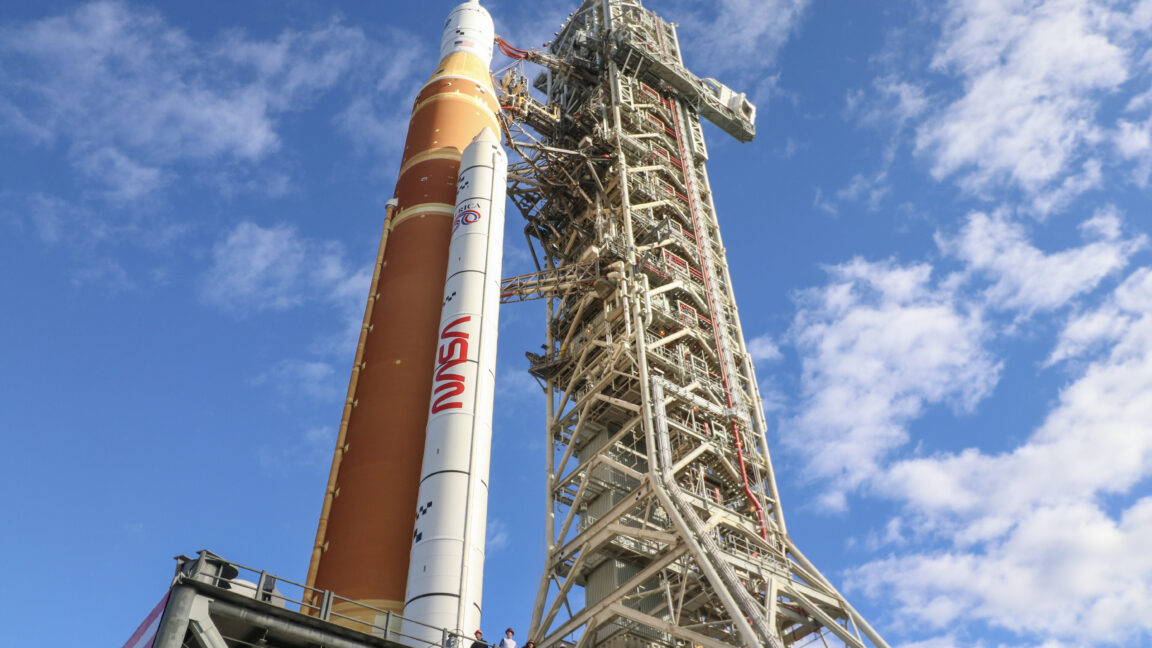
NASA’s 322-foot-tall (98-meter) SLS rocket inside the Vehicle Assembly Building on the eve of rollout to Launch Complex 39B.
Credit: NASA/Joel Kowsky
NASA’s 322-foot-tall (98-meter) SLS rocket inside the Vehicle Assembly Building on the eve of rollout to Launch Complex 39B. Credit: NASA/Joel Kowsky
There is still much work ahead before NASA can clear Artemis II for launch. At the launch pad, technicians will complete final checkouts and closeouts before NASA’s launch team gathers in early February for a critical practice countdown. During this countdown, called a Wet Dress Rehearsal (WDR), Blackwell-Thompson and her team will oversee the loading of the SLS rocket’s core stage and upper stage with super-cold liquid hydrogen and liquid oxygen propellants.
The cryogenic fluids, particularly liquid hydrogen, gave fits to the Artemis launch team as NASA prepared to launch the Artemis I mission—without astronauts—on the SLS rocket’s first test flight in 2022. Engineers resolved the issues and successfully launched the Artemis I mission in November 2022, and officials will apply the lessons for the Artemis II countdown.
“Artemis I was a test flight, and we learned a lot during that campaign getting to launch,” Blackwell-Thompson said. “And the things that we’ve learned relative to how to go load this vehicle, how to load LOX (liquid oxygen), how to load hydrogen, have all been rolled in to the way in which we intend to do for the Artemis II vehicle.”
Finding the right time to fly
Assuming the countdown rehearsal goes according to plan, NASA could be in a position to launch the Artemis II mission as soon as February 6. But the schedule for February 6 is tight, with no margin for error. Officials typically have about five days per month when they can launch Artemis II, when the Moon is in the right position relative to Earth, and the Orion spacecraft can follow the proper trajectory toward reentry and splashdown to limit stress on the capsule’s heat shield.
In February, the available launch dates are February 6, 7, 8, 10, and 11, with launch windows in the overnight hours in Florida. If the mission isn’t off the ground by February 11, NASA will have to stand down until a new series of launch opportunities beginning March 6. The space agency has posted a document showing all available launch dates and times through the end of April.
John Honeycutt, chair NASA’s Mission Management Team for the Artemis II mission, speaks during a news conference at Kennedy Space Center in Florida on January 16, 2026.
Credit: Jim Watson/AFP via Getty Images
John Honeycutt, chair NASA’s Mission Management Team for the Artemis II mission, speaks during a news conference at Kennedy Space Center in Florida on January 16, 2026. Credit: Jim Watson/AFP via Getty Images
NASA’s leaders are eager for Artemis II to fly. NASA is not only racing China, a reality the agency’s former administrator acknowledged during the Biden administration. Now, the Trump administration is pushing NASA to accomplish a human landing on the Moon by the end of his presidential term on January 20, 2029.
One of Honeycutt’s jobs as chair of the Mission Management Team (MMT) is ensuring all the Is are dotted and Ts are crossed amid the frenzy of final launch preparations. While the hardware for Artemis II is on the move in Florida, the astronauts and flight controllers are wrapping up their final training and simulations at Johnson Space Center in Houston.
“I think I’ve got a good eye for launch fever,” he said Friday.
“As chair of the MMT, I’ve got one job, and it’s the safe return of Reid, Victor, Christina, and Jeremy. I consider that a duty and a trust, and it’s one I intend to see through.”
Rocket Report: Ariane 64 to debut soon; India has a Falcon 9 clone too?
NASA topples historic Saturn and shuttle infrastructure. Two historic NASA test facilities used in the development of the Saturn V and space shuttle launch vehicles have been demolished after towering over the Marshall Space Flight Center in Alabama since the start of the Space Age, Ars reports. The Propulsion and Structural Test Facility, which was erected in 1957—the same year the first artificial satellite entered Earth orbit—and the Dynamic Test Facility, which has stood since 1964, were brought down by a coordinated series of implosions on Saturday, January 10.
Out with the old, in with the new … Located in Marshall’s East Test Area on the US Army’s Redstone Arsenal in Huntsville, the two structures were no longer in use and, according to NASA, had a backlog of $25 million in needed repairs. “This work reflects smart stewardship of taxpayer resources,” Jared Isaacman, NASA administrator, said in a statement. “Clearing outdated infrastructure allows NASA to safely modernize, streamline operations and fully leverage the infrastructure investments signed into law by President Trump to keep Marshall positioned at the forefront of aerospace innovation.”
Space Force swaps Vulcan for Falcon 9. The next Global Positioning System satellite is switching from a United Launch Alliance Vulcan rocket to a SpaceX Falcon 9, a spokesperson for the US Space Force Space Systems Command System Delta 80 said Tuesday, Spaceflight Now reports. SpaceX could launch the GPS III Space Vehicle 09 (SV09) within the next few weeks, as the satellite was entering the final stages of pre-flight preparations.
The trade is logical … SV09 was originally awarded to ULA as part of order-year five of the National Security Space Launch (NSSL) Phase 2 contract, which was announced on October 31, 2023. This isn’t the first time that the Space Force has shuffled timelines and switched launch providers for GPS missions. In May 2025, SpaceX launched the GPS III SV08 spacecraft, which was originally assigned to ULA in June 2023. In exchange, ULA was given the SV11 launch, which would have flown on a Falcon Heavy rocket. The changes have been driven largely by repeated delays in Vulcan readiness.
Next three launches
January 16: Long March 3B | Unknown payload | Xichang Satellite Launch Center, China | 16:55 UTC
January 17: Ceres 2 | Demo flight | Jiuquan Satellite Launch Center, China | 04:05 UTC
January 17: Falcon 9 | NROL-105 | Vandenberg Space Force Base, Calif. | 06:18 UTC
Key Senate staffer is “begging” NASA to get on with commercial space stations
In remarks this week to a Texas space organization, a key Senate staff member said an “extension” of the International Space Station is on the table and that NASA needs to accelerate a program to replace the aging station with commercial alternatives.
Maddy Davis, a space policy staff member for US Sen. Ted Cruz, R-Texas, made the comments to the Texas Space Coalition during a virtual event.
Cruz is chairman of the Senate Committee on Commerce, Science, and Transportation and has an outsized say in space policy. As a senator from Texas, he has a parochial interest in Johnson Space Center, where the International Space Station Program is led.
“No gap”
Davis said Cruz has repeatedly reaffirmed that one of his core priorities is establishing a continuous human presence in low-Earth orbit, with “no gap” in that capability. That means he wants commercial space stations operating before the International Space Station is de-orbited, which is currently scheduled for 2030.
“He’s very painfully clear,” Davis said. “It comes up almost every time that I see him. Continuous human presence and no gap.”
To that end, Davis said she has been pressing NASA to accelerate the program to develop private space stations, known as Commercial LEO Destinations, or CLDs. In this program, NASA has previously provided funding to four different companies to develop space station concepts. The CLD program will soon enter “Phase 2,” in which these and other companies will compete for larger amounts of funding—at least hundreds of millions of dollars. One or two companies are likely to win these larger contracts. They will then build their stations with a mix of public and privately raised funding.
To kick off this competition, NASA is due to issue a long-delayed “request for proposals,” or RFP.
“Begging” for release of proposals
“Earlier today, I was having a briefing with NASA and begging for—we really needed that RFP released for CLDs like nine months ago,” Davis said. “But here we are still begging for it.”
The program has largely been stuck in neutral over the last year as the space agency’s leadership has been in flux. Interim NASA Administrator Sean Duffy threw a grenade of sorts into the process last August by issuing a new directive that changed the rules for private space stations. This appeared to favor some of the companies over others. But this directive is now being reviewed by new NASA Administrator Jared Isaacman and his team, and the requirements for these stations may well shift again.
You can now reserve a hotel room on the Moon for $250,000
A company called GRU Space publicly announced its intent to construct a series of increasingly sophisticated habitats on the Moon, culminating in a hotel inspired by the Palace of the Fine Arts in San Francisco.
On Monday, the company invited those interested in a berth to plunk down a deposit between $250,000 and $1 million, qualifying them for a spot on one of its early lunar surface missions in as little as six years from now.
It sounds crazy, doesn’t it? After all, GRU Space had, as of late December when I spoke to founder Skyler Chan, a single full-time employee aside from himself. And Chan, in fact, only recently graduated from the University of California, Berkeley.
All of this could therefore be dismissed as a lark. But I must say that I am a sucker for these kinds of stories. Chan is perfectly earnest about all of this. And despite all of the talk about lunar resources, my belief is that the surest long-term commercial activity on the Moon will be lunar tourism—it would be an amazing destination.
So when I interviewed Chan, I did so with an open mind.
Who are the customers?
Like many younger people, Chan grew up wanting to become an astronaut. But along the way, in high school and later college, he came to believe that he could lead a more impactful life by enabling everyone to go to space, not just himself.
“I realized I was born in this time where we can actually become interplanetary, and that is probably the singular most impactful thing one person could do with their time,” Chan said. “So I charged towards building the systems necessary and technology to enable that future. That’s actually what led me to go to Berkeley to study electrical engineering and computer science.”
NASA topples towers used to test Saturn rockets, space shuttle
In recent years, NASA considered using the Propulsion and Structural Test Facility to support the Constellation program and its Ares family of rockets, but that program was canceled in 2010.
A Saturn I rocket’s first stage (S-1-10) is test-fired at the Propulsion and Structural Test Facility, or “T-tower,” at NASA’s Marshall Space Flight Center in Huntsville, Alabama, in 1964.
Credit: NASA
A Saturn I rocket’s first stage (S-1-10) is test-fired at the Propulsion and Structural Test Facility, or “T-tower,” at NASA’s Marshall Space Flight Center in Huntsville, Alabama, in 1964. Credit: NASA
“While it is hard to let them go, they’ve earned their retirement,” said Rae Ann Meyer, the acting director of the Marshall Space Flight Center. “Each one of these structures helped NASA make history.”
The Dynamic Test Stand (Building 4550) rises more than twice as high as the Propulsion and Structural Test Facility and for good reason—it was built to fit a fully assembled Saturn V (363 feet or 111 meters tall) for mechanical and vibrational trials. Described once as the tallest building in the state, the stand was later used to form the first complete space shuttle stack with a winged orbiter (the prototype “Enterprise”), external fuel tank, and solid rocket boosters.
The Dynamic Test Stand is so tall that, according to NASA, its last use in the early 2000s was as a drop tower in support of microgravity testing. It was added to the National Register of Historic Places and deemed a National Landmark in 1985.
“These structures are not safe,” said Meyer. “Strategic demolition is a necessary step in shaping the future of NASA’s mission to explore, innovate, and inspire. By removing these structures that we have not used in decades, we are saving money on upkeep of facilities we can’t use. We also are making these areas safe to use for future NASA exploration endeavors and investments.”
The Dynamic Test Stand at NASA’s Marshall Space Flight Center in Alabama supported the testing of the first fully assembled Saturn V rocket in 1966 and the first stacked space shuttle in 1978.
Credit: NASA
The Dynamic Test Stand at NASA’s Marshall Space Flight Center in Alabama supported the testing of the first fully assembled Saturn V rocket in 1966 and the first stacked space shuttle in 1978. Credit: NASA
Sites and citations
The Propulsion and Structural Test Facility and the Dynamic Test Facility were among 19 sites identified for removal at the Marshall Space Flight Center. The count also includes the Neutral Buoyancy Simulator (NBS), a facility that enabled NASA astronauts and researchers to practice for spacewalks and work in microgravity. It comprised a tank that was 75 feet in diameter, 40 feet deep, and designed to hold up to nearly 1.5 million gallons of water (23 by 12 meters by 5.7 million liters).
ESA considers righting the wrongs of Ariane 6 by turning it into a Franken-rocket
Bruno Le Maire, the former French finance minister, said in 2021 that the Ariane 6 was a “bad strategic choice.” More recently, in October of last year, the head of ESA said the continent’s space industry must “catch up” with international competitors like SpaceX and develop a reusable launcher “relatively fast.”
In its submission to ESA’s BEST! initiative, ArianeGroup proposes replacing the Ariane 6 rocket’s solid-fueled side boosters with new liquid-fueled boosters. The boosters would be developed by MaiaSpace, a French subsidiary of ArianeGroup working on its own partially reusable small satellite launcher. MaiaSpace and ArianeGroup would convert the Maia rocket’s methane-fueled booster for use on the Ariane 6.
Isar Aerospace’s concept for a reusable first stage booster (left) and ArianeGroup’s proposal for an Ariane 6 rocket with reusable strap-on boosters (right).
Credit: ESA/Isar Aerospace/ArianeGroup
Isar Aerospace’s concept for a reusable first stage booster (left) and ArianeGroup’s proposal for an Ariane 6 rocket with reusable strap-on boosters (right). Credit: ESA/Isar Aerospace/ArianeGroup
ArianeGroup’s proposal was first reported by European Spaceflight, which said the concept presented to ESA is similar to an ArianeGroup proposal from 2022, when the company described the liquid reusable boosters as a “plug-and-play” alternative to Ariane 6’s solid-fueled boosters, helping reduce operating costs and increase launch rates.
The details of ArianeGroup’s newest proposal have not been published, but the concept was summarized in a paper presented at the European Conference for Aeronautics and Space Sciences in 2025.
Isar Aerospace, a German rocket startup, won a separate BEST! contract from ESA to study a demonstrator for a reusable first stage based on the company’s light-class Spectrum rocket. The Spectrum rocket’s initial design is expendable. Its first test flight last year ended in failure, and Isar is readying the second Spectrum rocket for another launch attempt later this month.
ESA asked ArianeGroup and Isar Aerospace to assess the feasibility of their proposals, develop technology and system development plans, and define plans and costs for a “major flight demonstration.”
MaiaSpace’s rocket won’t launch until 2027, at the earliest, and it’s unlikely any decision to use it as the basis for new Ariane 6 boosters will bear fruit until long after Maia flies on its own. Even if ESA and ArianeGroup take this route, the Ariane 6 rocket would still be predominantly expendable.
NASA chief reviews Orion heat shield, expresses “full confidence” in it for Artemis II
Olivas is very credible on these issues. He was asked by the NASA leadership in late 2023, before the independent review team was formally named, to provide a second set of eyes on the space agency’s heat shield work. He saw all of the investigative data in real time. Although not formally a member, he sat in on the review team’s meetings through 2024 before that process ended. Afterward, he had some lingering questions he felt were unresolved by that process. A few weeks ago, he told Pearlman and me he would be reluctant to fly on Orion. It was a stunning admission.
Isaacman appeared to take these concerns seriously. In advance of Thursday’s meeting, he engaged with Olivas to hear him out and share information about what NASA’s engineers had done over the last 18 months to resolve some of the independent review team’s questions. These included char loss very early in Orion’s reentry.
After Thursday’s meeting, Olivas told me he had changed his mind, expressing appreciation and admiration for the in-depth engineering work done by the NASA team. He would now fly on Orion.
Camarda, another former shuttle astronaut, was less effusive. He has been very public with his criticism of NASA’s handling of the Orion heat shield. He told me in December 2024 that the space agency and its leadership team should be “ashamed.” Unlike Olivas, however, he has been on the outside the whole time. NASA had kept Camarda, 73, at arm’s length, and he felt disrespected. Given his credentials—the aerospace engineer spent two decades working on thermal protection for the space shuttle and hypersonic vehicles–Camarda could be a potent voice of skepticism leading up to the Artemis II launch.
After the meeting, I asked Camarda whether he felt any better about flying crew on the Artemis II heat shield.
“I would never be happy accepting a workaround and flying something that I know is the worst version of that heat shield we could possibly fly and hoping that the workaround is going to fix it,” Camarda said. “What I really hope he [Isaacman] gets is that if we don’t get back to doing research at NASA, we’re not going to be able to help Starship solve their problems. We’ve got to get back to doing research.”
But Camarda was no longer the firebrand he was at the outset of the meeting. Near its end, in fact, he even thanked the leadership team for being brought in, read in on the data, and allowed to have his say.