Here’s how orbital dynamics wizardry helped save NASA’s next Mars mission

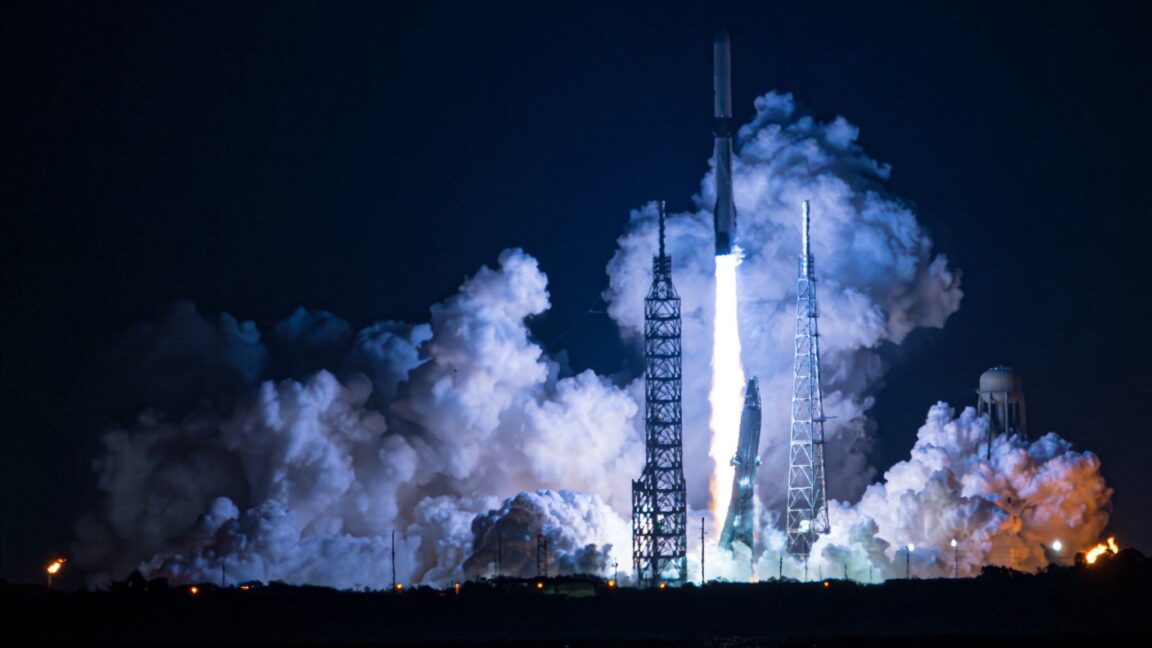
Heading east, the rocket will surpass the speed of sound in a little over a minute. After soaring through the stratosphere, New Glenn will shut down its seven booster engines and shed its first stage a little more than 3 minutes into the flight. Twin BE-3U engines, burning liquid hydrogen, will ignite to finish the job of sending the ESCAPADE satellites toward deep space. The rocket’s trajectory will send the satellites toward a gravitationally-stable location beyond the Moon, called the L2 Lagrange point, where it will swing into a loosely-bound loiter orbit to wait for the right time to head for Mars.

Meanwhile, the New Glenn booster, itself measuring nearly 20 stories tall, will begin maneuvers to head toward Blue Origin’s recovery ship floating a few hundred miles downrange in the Atlantic Ocean. The final part of the descent will include a landing burn using three of the BE-4 engines, then downshifting to a single engine to control the booster’s touchdown on the landing platform, dubbed “Jacklyn” in honor of Bezos’ late mother.
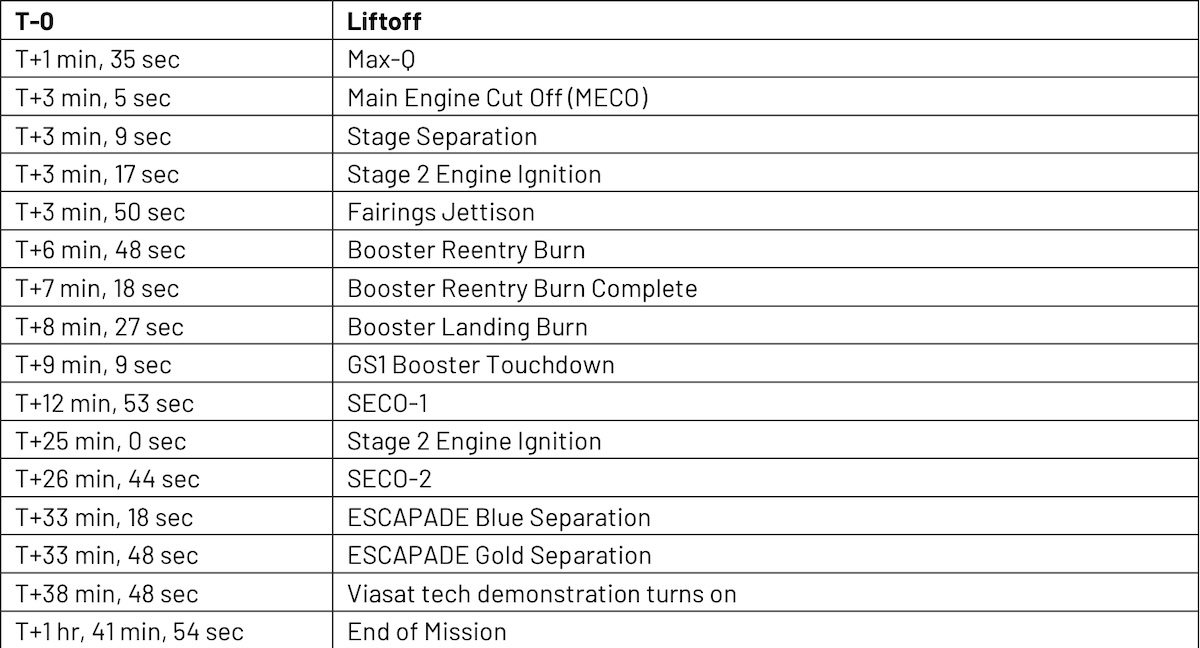
The launch timeline for New Glenn’s second mission. Credit: Blue Origin

New Glenn’s inaugural launch at the start of this year was a success, but the booster’s descent did not go well. The rocket was unable to restart its engines, and it crashed into the sea.

“We’ve incorporated a number of changes to our propellant management system, some minor hardware changes as well, to increase our likelihood of landing that booster on this mission,” said Laura Maginnis, Blue Origin’s vice president of New Glenn mission management. “That was the primary schedule driver that kind of took us from from January to where we are today.”

Blue Origin officials are hopeful they can land the booster this time. The company’s optimism is enough for officials to have penciled in a reflight of this particular booster on the very next New Glenn launch, slated for the early months of next year. That launch is due to send Blue Origin’s first Blue Moon cargo lander to the Moon.

“Our No. 1 objective is to deliver ESCAPADE safely and successfully on its way to L2, and then eventually on to Mars,” Maginnis said in a press conference Saturday. “We also are planning and wanting to land our booster. If we don’t land the booster, that’s OK. We have several more vehicles in production. We’re excited to see how the mission plays out tomorrow.”

Tracing a kidney bean

ESCAPADE’s path through space, relative to the Earth, has the peculiar shape of a kidney bean. In the world of astrodynamics, this is called a staging or libration orbit. It’s a way to keep the spacecraft on a stable trajectory to wait for the opportunity to go to Mars late next year.

https://arstechnica.com/space/2025/11/heres-how-orbital-dynamics-wizardry-helped-save-nasas-next-mars-mission/


Blue Origin will ‘move heaven and Earth’ to help NASA reach the Moon faster, CEO says

Blue Origin stands ready to help NASA achieve its goals with regard to landing humans on the Moon as soon as possible, the company’s chief executive said Saturday in an interview with Ars.

“We just want to help the US get to the Moon,” said Dave Limp, CEO of the space company founded by Jeff Bezos. “If NASA wants to go quicker, we would move heaven and Earth, pun intended, to try to get to the Moon sooner. And I think we have some good ideas.”

Limp spoke on Saturday, about 24 hours ahead of the company’s second launch of the large New Glenn rocket. Carrying the ESCAPADE spacecraft for NASA, the mission has a launch window that opens at 2:45 pm ET (19:45 UTC) at Cape Canaveral Space Force Station in Florida, and runs for a little more than two hours.

NASA seeks a faster return

This year it has become increasingly apparent that, should NASA stick to its present plans for the Artemis III lunar landing mission, China is on course to beat the United States back to the Moon with humans. In recognition of this, about three weeks ago, NASA acting administrator Sean Duffy said the space agency was reopening the competition for a human lander.

SpaceX and Blue Origin both have existing contracts for human landers, but the government has asked each providers for an option to accelerate their timeline. NASA currently has a target landing date of 2027, but that is unrealistic using the present approach of SpaceX’s Starship or Blue Origin’s large Mk. 2 lander.

Ars exclusively reported in early October that Blue Origin had begun work on a faster architecture, involving multiple versions of its Mk. 1 cargo lander as well as a modified version of this vehicle tentatively called Mk 1.5. Limp said that after Duffy asked for revised proposals, Blue Origin responded almost immediately.

“We’ve sent our initial summary of that over, and we have a full report of that due here shortly,” he said. “I’m not going to go into the details because I think that’s probably for NASA to talk about, not us, but we have some ideas that we think could accelerate the path to the Moon. And I hope NASA takes a close look.”

https://arstechnica.com/space/2025/11/blue-origin-will-move-heaven-and-earth-to-help-nasa-reach-the-moon-faster-ceo-says/


The government shutdown is starting to have cosmic consequences

The federal government shutdown, now in its 38th day, prompted the Federal Aviation Administration to issue a temporary emergency order Thursday prohibiting commercial rocket launches from occurring during “peak hours” of air traffic.

The FAA also directed commercial airlines to reduce domestic flights from 40 “high impact airports” across the country in a phased approach beginning Friday. The agency said the order from the FAA’s administrator, Bryan Bedford, is aimed at addressing “safety risks and delays presented by air traffic controller staffing constraints caused by the continued lapse in appropriations.”

The government considers air traffic controllers essential workers, so they remain on the job without pay until Congress passes a federal budget and President Donald Trump signs it into law. The shutdown’s effects, which affected federal workers most severely at first, are now rippling across the broader economy.

Sharing the airspace

Vehicles traveling to and from space share the skies with aircraft, requiring close coordination with air traffic controllers to clear airspace for rocket launches and reentries. The FAA said its order restricting commercial air traffic, launches, and reentries is intended to “ensure the safety of aircraft and the efficiency of the [National Airspace System].”

In a statement explaining the order, the FAA said the air traffic control system is “stressed” due to the shutdown.

“With continued delays and unpredictable staffing shortages, which are driving fatigue, risk is further increasing, and the FAA is concerned with the system’s ability to maintain the current volume of operations,” the regulator said. “Accordingly, the FAA has determined additional mitigation is necessary.”

Beginning Monday, the FAA said commercial space launches will only be permitted between 10 pm and 6 am local time, when the national airspace is most calm. The order restricts commercial reentries to the same overnight timeframe. The FAA licenses all commercial launches and reentries.

https://arstechnica.com/space/2025/11/faa-says-commercial-rockets-must-launch-at-night-citing-government-shutdown/


Rocket Report: Canada invests in sovereign launch; India flexes rocket muscles

Doubling cadence … This was the fourth flight of Europe’s new Ariane 6 rocket, and its third operational launch. Arianespace plans one more Ariane 62 launch to close out the year with a pair of Galileo navigation satellites. The company aims to double its Ariane 6 launch cadence in 2026, with between six and eight missions planned, according to David Cavaillès, Arianespace’s CEO. The European launch provider will open its 2026 manifest with the first flight of the more powerful four-booster variant of the rocket. If the company does manage eight Ariane 6 flights in 2026, it will already be close to reaching the stated maximum launch cadence of between nine and 10 flights per year.

India sets its own record for payload mass. The Indian Space Research Organization on Sunday successfully launched the Indian Navy’s advanced communication satellite GSAT-7R, or CMS-03, on an LVM3 rocket from the Satish Dhawan Space Center, The Hindu reports. The indigenously designed and developed satellite, weighing approximately 4.4 metric tons (9,700 pounds), is the heaviest satellite ever launched by an Indian rocket and marks a major milestone in strengthening the Navy’s space-based communications and maritime domain awareness.

Going heavy … The launch Sunday was India’s fourth of 2025, a decline from the country’s high-water mark of eight orbital launches in a year in 2023. The failure in May of India’s most-flown rocket, the PSLV, has contributed to this year’s slower launch cadence. India’s larger rockets, the GSLV and LVM3, have been more active while officials grounded the PSLV for an investigation into the launch failure. (submitted by EllPeaTea)

Blue Origin preps for second flight of New Glenn. The road to the second flight of Blue Origin’s heavy-lifting New Glenn rocket got a lot clearer this week. The company confirmed it is targeting Sunday, November 9, for the launch of New Glenn from Cape Canaveral Space Force Station, Florida. This follows a successful test-firing of the rocket’s seven BE-4 main engines last week, Ars reports. Blue Origin, the space company owned by billionaire Jeff Bezos, said the engines operated at full power for 22 seconds, generating nearly 3.9 million pounds of thrust on the launch pad.

https://arstechnica.com/space/2025/11/rocket-report-canada-invests-in-sovereign-launch-india-flexes-rocket-muscles/


If you want to satiate AI’s hunger for power, Google suggests going to space

It was probably always when, not if, Google would add its name to the list of companies intrigued by the potential of orbiting data centers.

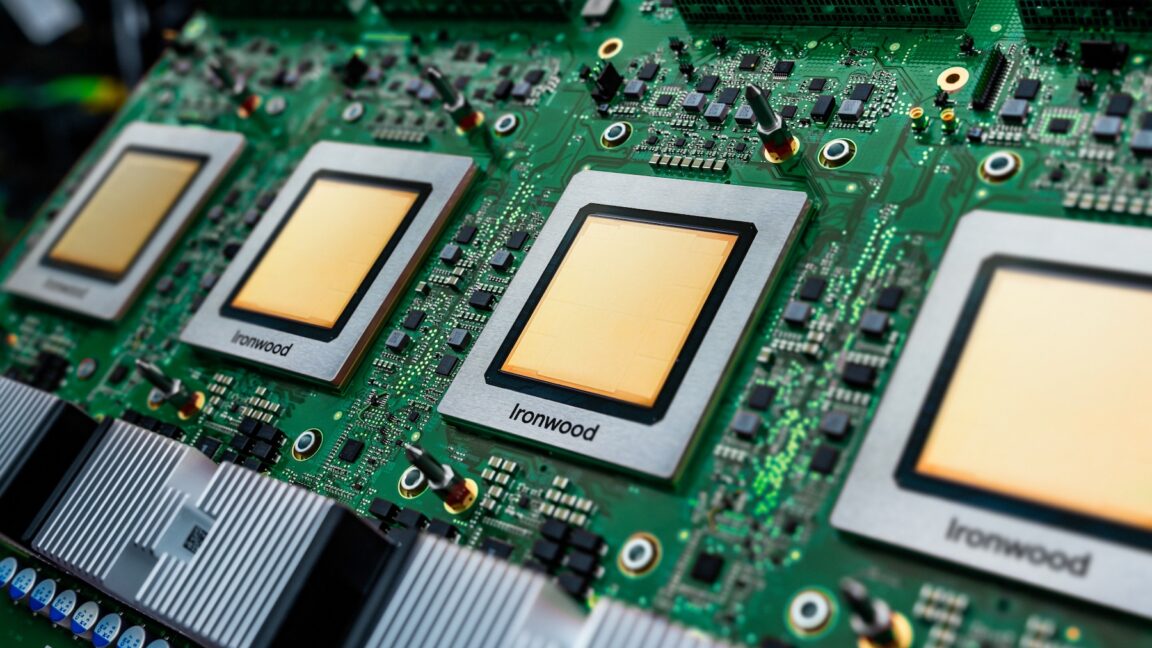
Google announced Tuesday a new initiative, named Project Suncatcher, to examine the feasibility of bringing artificial intelligence to space. The idea is to deploy swarms of satellites in low-Earth orbit, each carrying Google’s AI accelerator chips designed for training, content generation, synthetic speech and vision, and predictive modeling. Google calls these chips Tensor Processing Units, or TPUs.

“Project Suncatcher is a moonshot exploring a new frontier: equipping solar-powered satellite constellations with TPUs and free-space optical links to one day scale machine learning compute in space,” Google wrote in a blog post.

“Like any moonshot, it’s going to require us to solve a lot of complex engineering challenges,” Google’s CEO, Sundar Pichai, wrote on X. Pichai noted that Google’s early tests show the company’s TPUs can withstand the intense radiation they will encounter in space. “However, significant challenges still remain like thermal management and on-orbit system reliability.”

The why and how

Ars reported on Google’s announcement on Tuesday, and Google published a research paper outlining the motivation for such a moonshot project. One of the authors, Travis Beals, spoke with Ars about Project Suncatcher and offered his thoughts on why it just might work.

“We’re just seeing so much demand from people for AI,” said Beals, senior director of Paradigms of Intelligence, a research team within Google. “So, we wanted to figure out a solution for compute that could work no matter how large demand might grow.”

Higher demand will lead to bigger data centers consuming colossal amounts of electricity. According to the MIT Technology Review, AI alone could consume as much electricity annually as 22 percent of all US households by 2028. Cooling is also a problem, often requiring access to vast water resources, raising important questions about environmental sustainability.

https://arstechnica.com/space/2025/11/if-you-want-to-satiate-ais-hunger-for-power-google-suggests-going-to-space/


Meet Project Suncatcher, Google’s plan to put AI data centers in space

Google’s proposed free-fall (“no thrust”) constellation for linked satellites; arrow pointing toward Earth.

However, there is the problem of physics. Received power decreases with the square of distance, so Google notes the satellites would have to maintain proximity of a kilometer or less. That would require a tighter formation than any currently operational constellation, but it should be workable. Google has developed analytical models suggesting that satellites positioned several hundred meters apart would require only “modest station-keeping maneuvers.”

Hardware designed for space is expensive and often less capable compared to terrestrial systems because the former needs to be hardened against extreme temperatures and radiation. Google’s approach to Project Suncatcher is to reuse the components used on Earth, which might not be very robust when you stuff them in a satellite. However, innovations like the Snapdragon-powered Mars Ingenuity helicopter have shown that off-the-shelf hardware may survive longer in space than we thought.

Google says Suncatcher only works if TPUs can run for at least five years, which works out to 750 rad. The company is testing this by blasting its latest v6e Cloud TPU (Trillium) in a 67MeV proton beam. Google says that while the memory was most vulnerable to damage, the experiments showed that TPUs can handle about three times as much radiation (almost 2 krad) before data corruption was detected.

Google hopes to launch a pair of prototype satellites with TPUs by early 2027. It expects the launch cost of these first AI orbiters to be quite high. However, Google is planning for the mid-2030s when launch costs are projected to drop to as little as $200 per kilogram. At that level, space-based data centers could become as economical as the terrestrial versions.

The fact is, terrestrial data centers are dirty, noisy, and ravenous for power and water. This has led many communities to oppose plans to build them near the places where people live and work. Putting them in space could solve everyone’s problems (unless you’re an astronomer).

https://arstechnica.com/google/2025/11/meet-project-suncatcher-googles-plan-to-put-ai-data-centers-in-space/


A commercial space station startup now has a foothold in space

The integration tasks still include installing Haven-1’s environmental control and life support elements, power, data, and thermal control systems, and thrusters, fuel tanks, and internal crew accommodations. While that work continues on Earth, Vast’s demo mission will validate some of the company’s designs in space.

Flying at an altitude of 300 miles (500 kilometers), Haven Demo will test Vast’s computer, power, software, guidance and control, propulsion, and radio systems. The pathfinder will also provide Vast an opportunity to exercise its ground stations and mission control teams.

Meanwhile, Vast will ship Haven-1 from its California headquarters to NASA’s Neil Armstrong Test Facility in Ohio for a rigorous environmental test campaign. The Haven-1 module, roughly 33 feet (10.1 meters) long and 14 feet (4.4 meters) wide, will undergo acoustics, vibration, and electromagnetic interference testing. Engineers will also place the habitat into a test chamber to check its performance in the extreme temperatures and airless vacuum environment of low-Earth orbit.

Then, Haven-1 will ship to Cape Canaveral, Florida, for final launch preparations. Vast’s official schedule calls for a launch of Haven-1 no earlier than May 2026, but there’s still a lot to do before the spacecraft is ready to travel to the launch site.

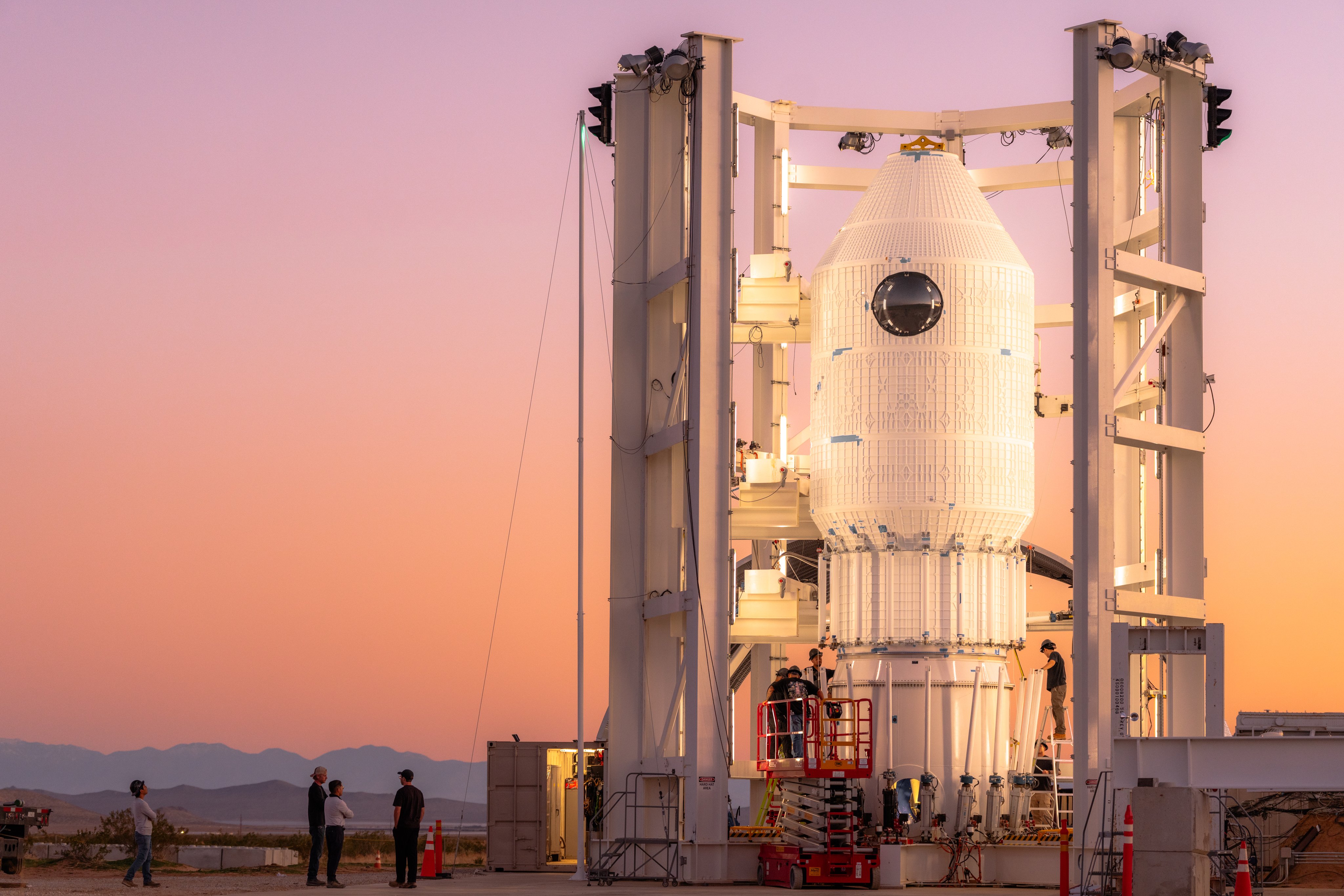
The primary structure of Vast’s Haven-1 habitat is seen undergoing structural testing in Mojave, California. Credit: Vast

Once in orbit, Haven-1 will host a series of crew visits flying on SpaceX’s Dragon spacecraft, each staying for two weeks before returning to Earth.

Haven-1 has a habitable volume of about 1,600 cubic feet (45 cubic meters), somewhat less than one of the primary modules on the International Space Station, but five times more than SpaceX’s Dragon capsule. Vast’s longer-term roadmap includes a larger multi-module space station called Haven-2 to support larger crews and longer expeditions in the 2030s.

Vast’s demo mission is an initial step toward these goals. The satellite now circling the planet carries several systems that are “architecturally similar” to Haven-1, according to Vast. For example, Haven-1 will have 12 solar arrays, each identical to the single array on Haven Demo. The pathfinder mission uses a subset of Haven-1’s propulsion system, but with identical thrusters, valves, and tanks.

https://arstechnica.com/space/2025/11/a-commercial-space-station-startup-now-has-a-foothold-in-space/


Capitol Hill is abuzz with talk of the “Athena” plan for NASA

In recent weeks, copies of an intriguing policy document have started to spread among space lobbyists on Capitol Hill in Washington, DC. The document bears the title “Athena,” and it purports to summarize the actions that private astronaut Jared Isaacman would have taken, were his nomination to become NASA administrator confirmed.

The 62-page plan is notable both for the ideas to remake NASA that it espouses as well as the manner in which it has been leaked to the space community.

After receiving a copy of this plan from an industry official, I spoke with multiple sources over the weekend to understand what is happening. Based upon this reporting there are clearly multiple layers to the story, which I want to unpack.

In the big picture, this leak appears to be part of a campaign by interim NASA Administrator Sean Duffy to either hold onto the high-profile job or, at the very least, prejudice the re-nomination of Isaacman to lead the space agency. Additionally, it is also being spread by legacy aerospace contractors who seek to protect their interests from the Trump administration’s goal of controlling spending and leaning into commercial space.

The Athena plan’s origin

The leaked document is 62 pages long and, according to sources, represents a pared-down version of a more comprehensive “Athena” plan devised by Isaacman and his advisors early in 2025, after President Trump nominated him to become NASA administrator.

The Athena plan lays out a blueprint for Isaacman’s tenure at NASA, seeking to return the space agency to “achieving the near impossible,” focusing on leading the world in human space exploration, igniting the space economy, and becoming a force multiplier for science.

Isaacman’s nomination was pulled in late May, largely for political reasons. Trump then appointed his Secretary of Transportation, Sean Duffy, to oversee NASA on an interim basis in early July. As a courtesy, in August, Isaacman’s team edited a shorter version of the plan down to 62 pages and gave a copy to Duffy and his chief of staff, Pete Meachum.

https://arstechnica.com/space/2025/11/capitol-hill-is-abuzz-with-talk-of-the-athena-plan-for-nasa/


New Glenn rocket has clear path to launch after test-firing at Cape Canaveral

The road to the second flight of Blue Origin’s heavy-lifting New Glenn rocket got a lot clearer Thursday night with a success test-firing of the launcher’s seven main engines on a launch pad at Cape Canaveral Space Force Station, Florida.

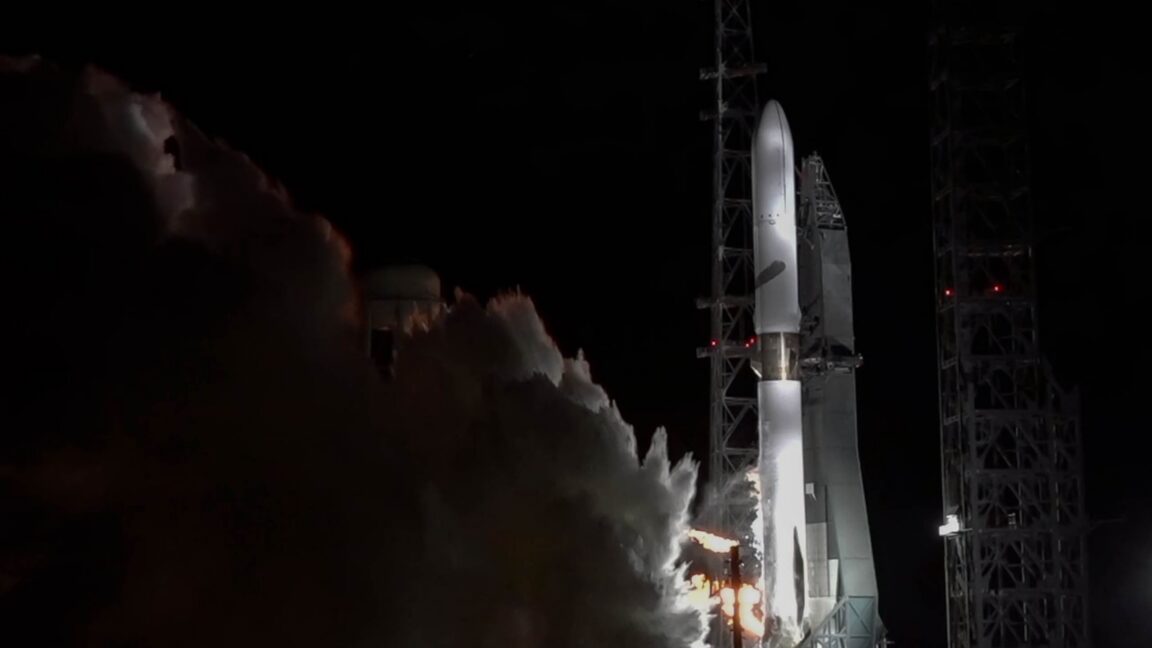
Standing on a seaside launch pad, the New Glenn rocket ignited its seven BE-4 main engines at 9:59 pm EDT Thursday (01:59 UTC Friday). The engines burned for 38 seconds while the rocket remained firmly on the ground, according to a social media post by Blue Origin.

The hold-down firing of the first stage engines was the final major test of the New Glenn rocket before launch day. Blue Origin previously test-fired the rocket’s second-stage engines. Officials have not announced a target launch date, but sources tell Ars the rocket could be ready for liftoff as soon as November 9.

“Love seeing New Glenn’s seven BE-4 engines come alive! Congratulations to Team Blue on today’s hotfire,” the company’s CEO, Dave Limp, posted on X.

Blue Origin, the space company owned by billionaire Jeff Bezos, said the engines operated at full power for 22 seconds, generating nearly 3.9 million pounds of thrust. Limp said engineers extended this test-firing and shut down some of the BE-4 engines to simulate the booster’s landing burn sequence, which Blue Origin hopes will culminate in a successful touchdown on a barge floating downrange in the Atlantic Ocean.

“This helps us understand fluid interactions between active and inactive engine feedlines during landing,” Limp wrote.

Blue Origin is counting on recovering the New Glenn first stage on the next flight after missing the landing on the rocket’s inaugural mission in January. Officials plan to reuse this booster on the third New Glenn launch early next year, slated to propel Blue Origin’s first unpiloted Blue Moon lander toward the Moon. If Blue Origin fails to land this rocket, it’s unlikely a new first stage booster will be ready to launch until sometime later in 2026.

A few more things to do

With the test-firing complete, Blue Origin’s ground crew will lower the more than 320-foot-tall (98-meter) rocket and roll it back to a nearby hangar. There, technicians will inspect the vehicle and swap its payload fairing for another clamshell containing two NASA-owned spacecraft set to begin their journey to Mars.

https://arstechnica.com/space/2025/10/blue-origin-test-fires-second-new-glenn-rocket-ahead-of-launch-next-month/


Elon Musk on data centers in orbit: “SpaceX will be doing this”

Interest is growing rapidly

“The amount of momentum from heavyweights in the tech industry is very much worth paying attention to,” said Caleb Henry, director of research at Quilty Space, in an interview. “If they start putting money behind it, we could see another transformation of what’s done in space.”

The essential function of a data center is to store, process, and transmit data. Historically, satellites have already done a lot of this, Henry said. Telecommunications satellites specialize in transmitting data. Imaging satellites store a lot of data and then dump it when they pass over ground stations. In recent years, onboard computers have gotten more sophisticated at processing data. Data centers in space could represent the next evolution of that.

Critics rightly note that it would require very large satellites with extensive solar panels to power data centers that rival ground-based infrastructure. However, SpaceX’s Starlink V3 satellites are unlike any previous space-based technology, Henry said.

A lot more capacity

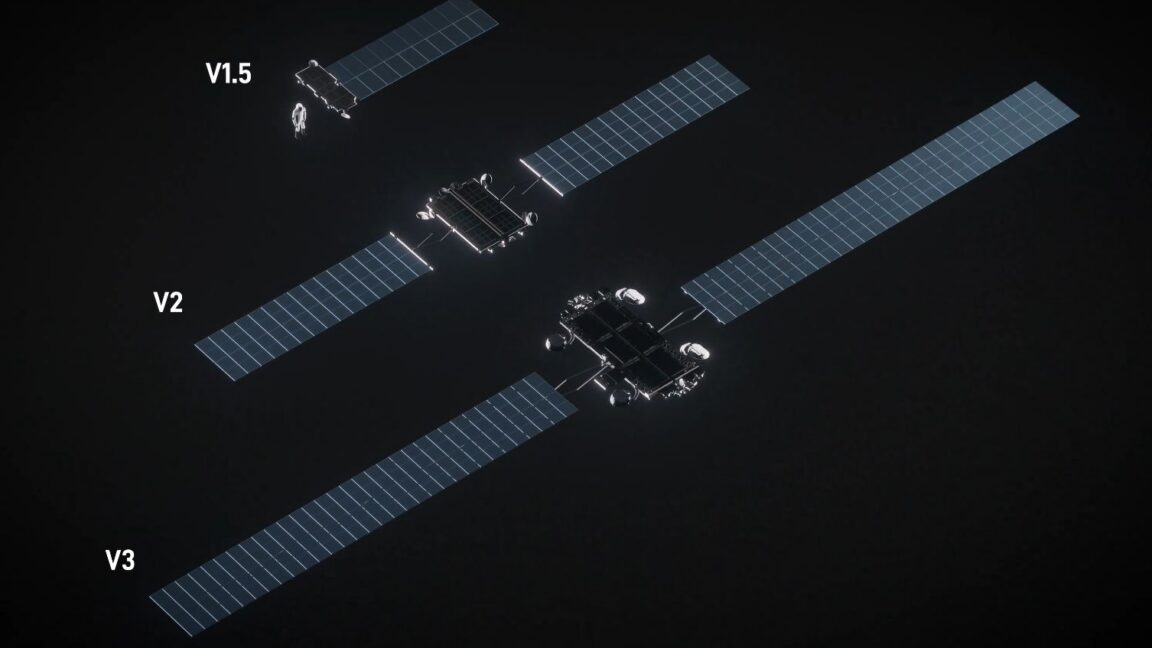
SpaceX’s current Starlink V2 mini satellites have a maximum downlink capacity of approximately 100 Gbps. The V3 satellite is expected to increase this capacity by a factor of 10, to 1 Tbps. This is not unprecedented in satellite capacity, but it certainly is at scale.

For example, Viasat contracted with Boeing for the better part of a decade, spending hundreds of millions of dollars, to build Viasat-3, a geostationary satellite with a capacity of 1 Tbps. This single satellite may launch next week on an Atlas V rocket.

SpaceX plans to launch dozens of Starlink V3 satellites—Henry estimates the number is about 60—on each Starship rocket launch. Those launches could occur as soon as the first half of 2026, as SpaceX has already tested a satellite dispenser on its Starship vehicle.

“Nothing else in the rest of the satellite industry that comes close to that amount of capacity,” Henry said.

Exactly what “scaling up” Starlink V3 satellites might look like is not clear, but it doesn’t seem silly to expect it could happen. The very first operational Starlink satellites launched a little more than half a decade ago with a mass of about 300 kg and a capacity of 15Gbps. Starlink V3 satellites will likely mass 1,500 kg.

https://arstechnica.com/space/2025/10/elon-musk-on-data-centers-in-orbit-spacex-will-be-doing-this/