NASA test flight seeks to help bring commercial supersonic travel back

About an hour after sunrise over the Mojave Desert of Southern California, NASA’s newest experimental supersonic jet took to the skies for the first time on Tuesday. The X-59 Quesst (Quiet SuperSonic Technology) is designed to decrease the noise of a sonic boom when an aircraft breaks the sound barrier, paving the way for future commercial jets to fly at supersonic speeds over land.

The jet, built by Lockheed Martin’s Skunk Works, took off from US Air Force Plant 42 in Palmdale, California. Flown by Nils Larson, NASA’s lead test pilot for the X-59, the inaugural flight validated the jet’s airworthiness and safety before landing about an hour after takeoff near NASA’s Armstrong Flight Research Center in Edwards, California.

“X-59 is a symbol of American ingenuity,” acting NASA Administrator Sean Duffy said in a statement. “It’s part of our DNA—the desire to go farther, faster, and even quieter than anyone has ever gone before.”

Commercial planes are prohibited from flying at supersonic speeds over land in the US due to the disruption that breaking the sound barrier causes on the ground, releasing a loud sonic boom that can rattle windows and trigger alarms. The Concorde, which was the only successful commercial supersonic jet, was limited to flying at supersonic speeds only over the oceans.

When a plane approaches the speed of sound, pressure waves build up on the surface of the aircraft. These areas of high pressure coalesce into large shock waves when the plane goes supersonic, producing the double thunderclap of a sonic boom.

The X-59 is capable of reaching supersonic speeds, without the supersonic boom.

Credit: Lockheed Martin/Gary Tice

The X-59 is capable of reaching supersonic speeds, without the supersonic boom. Credit: Lockheed Martin/Gary Tice

The X-59 will generate a lower “sonic thump” thanks to its unique design. It was given a long, slender nose that accounts for about a third of the total length and breaks up pressure waves that would otherwise merge on other parts of the airplane. The engine was mounted on top of the X-59’s fuselage, rather than underneath as on a fighter jet, to keep a smooth underside that limits shock waves and also to direct sound waves up into the sky rather than down toward the ground. NASA aims to provide key data to aircraft manufacturers so they can build less noisy supersonic planes.

https://arstechnica.com/space/2025/10/nasa-test-flight-seeks-to-help-bring-commercial-supersonic-travel-back/



SpaceX teases simplified Starship as alarms sound over Moon landing delays

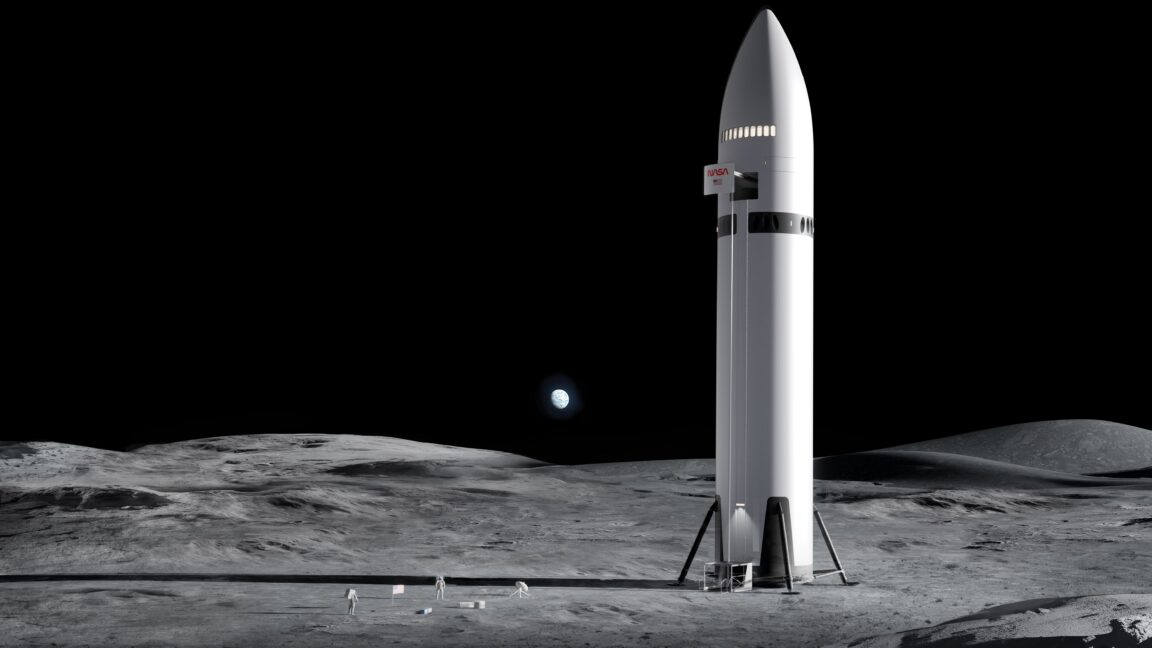
The recent Starship delays, coupled with the scope of work to go, have raised concerns that the Artemis program is falling behind China’s initiative to land its own astronauts on the Moon. China’s goal is to do it by 2030, a schedule reiterated in Chinese state media this week. The Chinese program relies on an architecture more closely resembling NASA’s old Apollo designs.

The official schedule for the first Artemis crew landing, on Artemis III, puts it in 2027, but that timeline is no longer achievable. Starship and new lunar spacesuits developed by Axiom Space won’t be ready, in part because NASA didn’t award the contracts to SpaceX and Axiom until 2021 and 2022.

All of this adds up to waning odds that the United States can beat China back to the Moon, according to a growing chorus of voices in the space community. Last month, former NASA chief Jim Bridenstine, who led the agency during the first Trump administration, told Congress the United States was likely to lose the second lunar space race.

At a space conference earlier this week, Bridenstine suggested the Trump administration use its powers to fast-track a lunar landing, even floating the idea of invoking the Defense Production Act, a law that grants the president authority to marshal industrial might to meet pressing national needs.

An executive order from President Donald Trump could authorize such an effort and declare a “national security imperative that we’re going to beat China to the Moon,” Bridenstine said at the American Astronautical Society’s von Braun Space Exploration Symposium in Huntsville, Alabama.

Charlie Bolden, NASA’s administrator under former President Barack Obama, also expressed doubts that NASA could land humans on the Moon before China, or by the end of Trump’s term in the White House. “Let’s be real, OK? Everybody in this room knows, to say we’re going to do it by the end of the term, or we’re going to do it before the Chinese, that doesn’t help industry.”

https://arstechnica.com/space/2025/10/as-pressure-mounts-spacex-insists-starship-is-fastest-path-to-moon-landing/


Rocket Report: SpaceX surpasses shuttle launch total; Skyroot has big ambitions

Amid shutdown, NASA trying to keep Artemis II on schedule. It has been nearly one month since many parts of the federal government shut down after lawmakers missed a budget deadline at the end of September, but so far, NASA’s most critical operations have been unaffected by the political impasse in Washington, DC. That may change soon, Ars reports. Federal civil servants and NASA contractors are not getting paid during the shutdown, even if agency leaders have deemed their tasks essential and directed them to continue working.

A significant impact soon … Many employees at NASA’s Kennedy Space Center in Florida remain at work, where their job is to keep the Artemis II mission on schedule for launch as soon as next February. Even while work continues, the government shutdown is creating inefficiencies that, if left unchecked, will inevitably impact the Artemis II schedule. And some officials are starting to sound the alarm. Kirk Shireman, vice president and program manager for Orion at Lockheed Martin, said this week, “I do think we’re rapidly approaching the point where it will be a significant impact.”

Variant of China’s Moon rocket to take flight. China aims to conduct the first launch of its Long March 10 rocket and a lunar-capable crew spacecraft next year, Space News reports. “The Long March 10 carrier rocket, the Mengzhou crew spacecraft, the Lanyue lunar lander, the Wangyu lunar suit, and the Exploration crew lunar rover have completed the main work of the prototype stage,” Zhang Jingbo, spokesperson for China’s human spaceflight program, said Thursday at a pre-launch press conference for the Shenzhou-21 mission at Jiuquan spaceport.

China appears on track for pre-2030 landing … Though not explicitly stated, Mengzhou will likely fly on a two-stage, single-stick variant of the Long March 10, which is used for low Earth orbit (LEO) missions. The full, three-stage, 92.5-meter-tall Long March 10 for lunar flights will use three 5-meter-diameter first stages bundled together, each powered by seven YF-100K variable thrust kerosene-liquid oxygen engines. Zhang did not state if the first flight would be crewed or uncrewed, nor if the mission would head to the Tiangong space station. (submitted by EllPeaTea)

Next three launches

October 31: Long March 2 | Shenzhou 21 crewed flight | Jiuquan Satellite Launch Center, China| 15:44 UTC

October 31: Falcon 9 | Starlink 11-23 | Vandenberg Space Force Base, Calif. | 20:06 UTC

Nov. 2: Falcon 9 | Bandwagon-4 | Cape Canaveral Space Force Station, Fla. | 05:09 UTC

https://arstechnica.com/space/2025/10/rocket-report-chinas-moon-rocket-to-debut-soon-arcaspace-is-back-sort-of/


25 years, one website: ISS in Real Time captures quarter-century on space station

With the milestone just days away, you are likely to hear this week that there has now been a continuous human presence on the International Space Station (ISS) for the past 25 years. But what does that quarter of a century actually encompass?

If only there was a way to see, hear, and experience each of those 9,131 days.

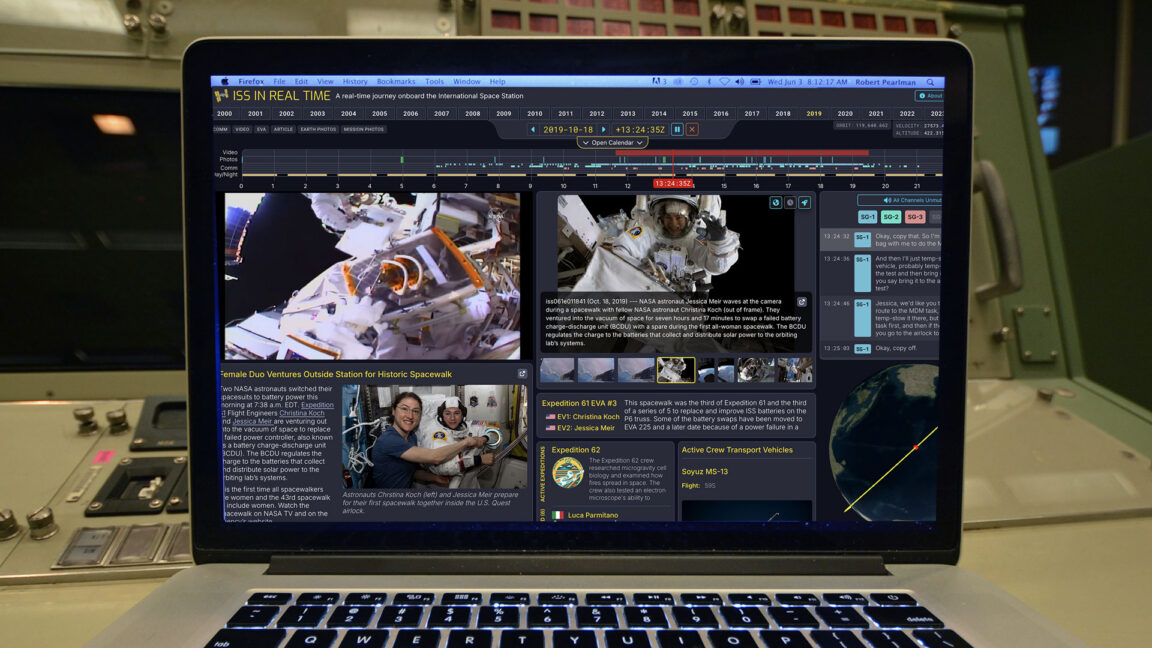
Fortunately, the astronauts and cosmonauts on the space station have devoted some of their work time and a lot of their free time to taking photos, filming videos, and calling down to Earth. Much of that data has been made available to the public, but in separate repositories, with no real way to correlate or connect it with the timeline on which it was all created.

That is, not until now. Two NASA contractors, working only during their off hours, have built a portal into all of those resources to uniquely represent the 25-year history of ISS occupancy.

ISS in Real Time, by Ben Feist and David Charney, went live on Monday (October 27), ahead of the November 2 anniversary. In its own way, the new website may be as impressive a software engineering accomplishment as the station is an aerospace engineering marvel.

[embedded content]

ISS in Real Time – Overview

Scraping space station data

“Everything that is on the website was already public. It’s already on another website somewhere, with some of it tucked away in some format or another. What we did was a lot of scraping of that data, to get it pulled into the context of every day on the space station,” said Feist in an interview with collectSPACE.com.

As an info box on the front page of ISS in Real Time tallies, at its debut the site contained mission data for 9,064 days out of the 9,131 (99.32 percent coverage); 4,739 days with full space-to-ground audio coverage; 4,561,987 space-to-ground comm calls in 69 languages; 6,931,369 photos taken in space over 8,525 days; 10,908 articles across 7,711 days; and 930 videos across 712 days.

https://arstechnica.com/space/2025/10/25-years-one-website-iss-in-real-time-captures-quarter-century-on-space-station/


Satellite shows what’s really happening at the East Wing of the White House

Karoline Leavitt, the White House press secretary, shared a different point of view in an interview with Fox News earlier this week.

“I believe there’s a lot of fake outrage right now because nearly every single president who has lived in this beautiful White House behind me has made modernizations and renovations of their own,” Leavitt said.

An official White House fact sheet published Tuesday used similar sensationalized language, accusing “unhinged leftists and their Fake News allies” of “clutching their pearls over President Donald J. Trump’s visionary addition of a grand, privately-funded ballroom to the White House.”

President Donald Trump displays a rendering of the White House ballroom as he meets with NATO Secretary General Mark Rutte (left) in the Oval Office of the White House on Wednesday. Credit: Alex Wong/Getty Images

It’s true that every president has put their own mark on the White House, but all of the updates cost at least an order of magnitude less than Trump’s ballroom. Most amounted to little more than redecorating, and none were as destructive as this week’s teardown. Former President Barack Obama repainted the lines of the White House tennis court and installed hoops to turn it into a basketball court. During the George W. Bush administration, the White House press briefing room got a significant makeover. Taxpayers and media companies shared the bill. It’s hard to imagine that happening today.

Former President Gerald Ford had an outdoor swimming pool built near the West Wing. Former First Lady Jacqueline Kennedy famously spearheaded the redesign of the White House Rose Garden and East Garden, which was later renamed in her honor. The grass in the Rose Garden was paved over with stone tiles earlier this year, and the Jacqueline Kennedy Garden was razed this week, the result of which was also visible from space.

In July, Leavitt said the East Wing would be “modernized.” Like Trump, she did not mention plans for demolition, only saying: “The necessary construction will take place.”

Thanks to satellites and commercial space, we now know what necessary construction really meant.

https://arstechnica.com/space/2025/10/satellite-shows-whats-really-happening-at-the-east-wing-of-the-white-house/


Rocket Report: China tests Falcon 9 lookalike; NASA’s Moon rocket fully stacked

Aiming for LEO … This will be the first flight of Innospace’s HANBIT-Nano launch vehicle, standing roughly 72 feet (22 meters) tall with a diameter of 4.6 feet (1.4 meters). The two-stage rocket is powered by hybrid propulsion, consuming a mixture of paraffin and liquid oxygen. For its debut flight, the rocket will target an orbit about 300 kilometers (186 miles) high with a batch of small satellites from customers in South Korea, Brazil, and India. According to Innospace, HANBIT-Nano can lift about 200 pounds (90 kilograms) of payload into orbit.

A new record for rocket reuse. SpaceX’s launch of a Falcon 9 rocket from Florida on October 19 set a new record for reusable rockets, Ars reports. It marked the 31st launch of the company’s most-flown Falcon 9 booster. The rocket landed on SpaceX’s recovery ship in the Atlantic Ocean to be returned to Florida for a 32nd flight. Several more rockets in SpaceX’s inventory are nearing their 30th launch. In all, SpaceX has more than 20 Falcon 9 boosters in its fleet on both the East and West Coasts. SpaceX engineers are now certifying the Falcon 9 boosters for up to 40 flights apiece.

10,000 and counting … SpaceX’s two launches last weekend weren’t just noteworthy for Falcon 9 lore. Hours after setting the new booster reuse record, SpaceX deployed a batch of 28 Starlink satellites from a different rocket after lifting off from California. This mission propelled SpaceX’s Starlink program past a notable milestone. With the satellites added to the constellation on Sunday, the company has delivered more than 10,000 mass-produced Starlink spacecraft to low-Earth orbit. The exact figure stands at 10,006 satellites, according to a tabulation by Jonathan McDowell, an astrophysicist who expertly tracks comings and goings between Earth and space. About 8,700 of these Starlink satellites are still in orbit, with SpaceX adding more every week.

China is on the cusp of something big. Launch startup LandSpace is in the final stages of preparations for the first flight of its Zhuque-3 rocket and a potentially landmark mission for China, Space News reports. LandSpace said it completed the first phase of the Zhuque-3 rocket’s inaugural launch campaign this week. The Zhuque-3 is the largest commercial rocket developed to date in China, nearly matching the size and performance of SpaceX’s Falcon 9, with nine first stage engines and a single upper stage engine. One key difference is that the Zhuque-3 burns methane fuel, while Falcon 9’s engines consume kerosene. Most notably, LandSpace will attempt to land the rocket’s first stage booster at a location downrange from the launch site, similar to the way SpaceX lands Falcon 9 boosters on drone ships at sea. Zhuque-3’s first stage will aim for a land-based site in an experiment that could pave the way for LandSpace to reuse rockets in the future.

https://arstechnica.com/space/2025/10/rocket-report-china-tests-falcon-9-lookalike-nasas-moon-rocket-fully-stacked/


Texas lawmakers double down on Discovery, call for DOJ investigation into Smithsonian

It is unknown what, if any, actions Roberts took in response to the letter. The Smithsonian issued a statement asserting it “does not engage in direct or grassroots lobbying” and that its staff has “acted in accordance with all governing rules and regulations.”

The Smithsonian has also stated that it is not a part of the federal government and holds clear title to Discovery, as transferred by NASA in 2012. As such, any attempt to remove Discovery from its collection would be unprecedented. The Congressional Research Service raised similar concerns about ownership in a briefing paper it prepared for lawmakers.

The crux of the concerns seems to be a letter the Smithsonian sent to the congressional authorizing and appropriating committees, as first shared by KeepTheShuttle, a grassroots organization founded to support Discovery staying at the National Air and Space Museum’s Steven F. Udvar-Hazy Center in Chantilly, Virginia. In that letter, the Smithsonian cited a cost of $35 million to $65 million more than the $85 million authorized by the Big Beautiful Bill Act (and that excluded the construction of a display facility, which was included in the legislation’s budget).

To chop or not to chop

[embedded content]

The Smithsonian, together with NASA, also expressed concern that “Discovery will have to undergo significant disassembly to be moved.”

That possibility, along with the logistics and costs of making the move, resulted in Sens. Mark Kelly (D-Ariz.), Dick Durbin (D-Ill.), Mark Warner (D-Va.), and Tim Kaine (D-Va.) sending their own letter to the Senate Committee on Appropriations to block funding for the move. Kelly, a former NASA astronaut who flew on Discovery twice, and Warner also released a video on social media contrasting chopping vegetables to chopping up the space shuttle.

“To get it down there [to Houston], you would have to rip off the wings. The head shield, all of those tiles on the bottom, would be stripped off. The white thermal blankets? Gone,” Kelly said in the video released on Tuesday. “If Ted Cruz and Cornyn think they are putting this thing back together, I want to see them get out there. They’ll be out there for the next 10 years trying to figure this out.

“This is the dumbest plan I’ve ever heard in nearly five years in the United States Senate,” said Kelly.

https://arstechnica.com/space/2025/10/texas-lawmakers-double-down-on-discovery-call-for-doj-investigation-into-smithsonian/


California startup to demonstrate space weapon on its own dime

“All of the pieces that are required to make it viable exist. They’re out there,” Cinnamon told Ars. “We have satellites, we have boosters, we have seekers, we have fire control, we have IFTUs (in-flight target updates), we have inter-satellite links. The key is, all those pieces need to talk to each other and actually come together, and that integration is really, really difficult. The second key is, in order for it to be viable, you need enough of them in space to actually have the impact that you need.”

This frame from an Apex animation shows a space-based interceptor deploying from an Orbital Magazine.

Apex says its Project Shadow demo is scheduled to launch in June 2026. Once in orbit, the Project Shadow spacecraft will deploy two interceptors, each firing a high-thrust solid rocket motor from a third-party supplier. “The Orbital Magazine will prove its ability to environmentally control the interceptors, issue a fire control command, and close an in-space cross-link to send real-time updates post-deployment,” Apex said in a statement.

The Orbital Magazine on Apex’s drawing board could eventually carry more than 11,000 pounds (5,000 kilograms) of interceptor payload, the company said. “Orbital Magazines host one or many interceptors, allowing thousands of SBIs to be staged in orbit.”‍

Apex is spending about $15 million of its own money on Project Shadow. Cinnamon said Apex is working with other companies on “key parts of the interceptor and mission analysis” for Project Shadow, but he wasn’t ready to identify them yet. One possible propulsion supplier is Anduril Industries, the weapons company started by Oculus founder Palmer Luckey in 2017. Apex and Anduril have worked together before.

“What we’re very good at is high-rate manufacturing and piecing it together,” Cinnamon said. “We have suppliers for everything else.”

Apex is the first company to publicly disclose any details for an SBI demonstration, but it won’t be the last. Cinnamon said Apex will provide further updates on Project Shadow as it nears launch.

“We’re talking about it publicly because I believe it’s really important to inspire both the US and our allies, and show the pace of innovation and show what’s possible in today’s world,” Cinnamon said. “We are very fortunate to have an amazing team, a very large war chest of capital, and the ability to go do a project like this, truly for the good of the US and the good of our allies.”

https://arstechnica.com/space/2025/10/california-startup-to-demonstrate-space-weapon-on-its-own-dime/


Meet the Arc spacecraft: it aims to deliver cargo anywhere in the world in an hour

The Arc spacecraft lands under parachutes in this rendering.

Credit: Inversion

The Arc spacecraft lands under parachutes in this rendering. Credit: Inversion

The test spacecraft, with a mass of about 200 pounds (90 kg) performed well, Fiaschetti said. It demonstrated the capability to raise and lower its orbit, and remains power positive to date, periodically checking in with Inversion flight controllers. However, the spacecraft will not make a controlled landing.

“Ray won’t be coming back,” Fiaschetti said. “We’re doing long-term testing of software on orbit.”

Although Ray did not land, Inversion now feels confident enough in its technology to move into the production of the larger Arc vehicle, which was unveiled on Wednesday evening. About the size of a large table top—Arc is four feet wide and eight feet tall—the company is aiming to launch the first Arc vehicle by the end of 2026. Fiaschetti said Inversion is “on a really good path” to make that timeline.

So what does the military want to ship?

Arc is a lifting body spacecraft, and it will do the majority of its maneuvering in the atmosphere, where it has 1,000 km of cross-range capability during reentry. It will land under parachutes and therefore not require a runway. Because the vehicle’s propulsion system uses non-toxic materials, a soldier can approach it immediately after landing without any protective gear.

So what would the US military want to pre-position in space for delivery at a moment’s notice to any location around the world?

“We like to describe this as mission-enabling cargo or effects,” Fiaschetti said. “This could be a wide variety of specific payloads, anything from medical supplies to drones to what have you. But the key discriminator is, does this make a difference in the moment it’s needed when it gets back down to the ground? You know, for the military and national security, if they need their cargo before the fight is over.”

The company says it has already built a “full-scale manufacturing development unit of the primary structure” for the first Arc vehicle. It would be an impressive capability if the small team at Inversion—now 60 people strong, and growing—can bring the Arc spacecraft to market. If, of course, is the operative word. “Space is hard” may be a cliché, but it also happens to be true.

https://arstechnica.com/space/2025/10/meet-the-arc-spacecraft-it-aims-to-deliver-cargo-anywhere-in-the-world-in-an-hour/


Rocket Report: Keeping up with Kuiper; New Glenn’s second flight slips

Welcome to Edition 8.12 of the Rocket Report! We often hear from satellite operators—from the military to venture-backed startups—about their appetite for more launch capacity. With so many rocket launches happening around the world, some might want to dismiss these statements as a corporate plea for more competition, and therefore lower prices. SpaceX is on pace to launch more than 150 times this year. China could end the year with more than 70 orbital launches. These are staggering numbers compared to global launch rates just a few years ago. But I’m convinced there’s room for more alternatives for reliable (and reusable) rockets. All of the world’s planned mega-constellations will need immense launch capacity just to get off the ground, and if successful, they’ll go into regular replacement and replenishment cycles. Throw in the still-undefined Golden Dome missile shield and many nations’ desire for a sovereign launch capability, and it’s easy to see the demand curve going up.

As always, we welcome reader submissions. If you don’t want to miss an issue, please subscribe using the box below (the form will not appear on AMP-enabled versions of the site). Each report will include information on small-, medium-, and heavy-lift rockets, as well as a quick look ahead at the next three launches on the calendar.

Sharp words from Astra’s Chris Kemp. Chris Kemp, the chief executive officer of Astra, apparently didn’t get the memo about playing nice with his competitors in the launch business. Kemp made some spicy remarks at the Berkeley Space Symposium 2025 earlier this month, billed as the largest undergraduate aerospace event at the university (see video of the talk). During the speech, Kemp periodically deviated from building up Astra to hurling insults at several of his competitors in the launch industry, Ars reports. To be fair to Kemp, some of his criticisms are not without a kernel of truth. But they are uncharacteristically rough all the same, especially given Astra’s uneven-at-best launch record and financial solvency to date.

Wait, what?! … Kemp is generally laudatory in his comments about SpaceX, but his most crass statement took aim at the quality of life of SpaceX employees at Starbase, Texas. He said life at Astra is “more fun than SpaceX because we’re not on the border of Mexico where they’ll chop your head off if you accidentally take a left turn.” For the record, no SpaceX employees have been beheaded. “And you don’t have to live in a trailer. And we don’t make you work six and a half days a week, 12 hours a day.” Kemp also accused Firefly Aerospace of sending Astra “garbage” rocket engines as part of the companies’ partnership on propulsion for Astra’s next-generation rocket.

https://arstechnica.com/space/2025/09/rocket-report-keeping-up-with-kuiper-new-glenns-second-flight-slips/