Rocket Report: European rocket reuse test delayed; NASA tweaks SLS for Artemis II

Welcome to Edition 8.11 of the Rocket Report! We have reached the time of year when it is possible the US government will shut down its operations at the end of this month, depending on congressional action. A shutdown would have significant implications for many NASA missions, but most notably a couple of dozen in the science directorate that the White House would like to shut down. At Ars, we will be watching this issue closely in the coming days. As for Artemis II, it seems to be far enough along that a launch next February seems possible as long as any government closure does not drag on for weeks and weeks.

As always, we welcome reader submissions, and if you don’t want to miss an issue, please subscribe using the box below (the form will not appear on AMP-enabled versions of the site). Each report will include information on small-, medium-, and heavy-lift rockets as well as a quick look ahead at the next three launches on the calendar.

Rocket Lab to sell common shares. The space company said Tuesday that it intends to raise up to $750 million by selling common shares, MSN reports. This new at-the-market program replaces a prior agreement that allowed Rocket Lab to sell up to $500 million of stock. Under that earlier arrangement, the company had sold roughly $396.6 million in shares before ending the program.

Seeking to scale up … The program’s structure enables Rocket Lab to sell shares periodically through the appointed agents, who may act as either principals or intermediaries. The larger offering indicates that Rocket Lab is aiming to bolster its cash reserves to support ongoing development of its launch services, including the medium-lift Neutron rocket and spacecraft manufacturing operations. The company’s stock dropped by about 10 percent after the announcement.

Astra targets mid-2026 for Rocket 4 debut. Astra is targeting next summer for the first flight of its Rocket 4 vehicle as the company prepares to reenter the launch market, Space News reports. At the World Space Business Week conference in Paris, Chris Kemp, chief executive of Astra, said the company was on track for a first launch of Rocket 4 in summer 2026 from Cape Canaveral, Florida. He highlighted progress Astra is making, such as tests of a new engine the company developed for the vehicle’s first stage that produces 42,000 pounds of thrust. Two of those engines will power the first stage, while the upper stage will use a single Hadley engine produced by Ursa Major.

https://arstechnica.com/space/2025/09/rocket-report-european-rocket-reuse-test-delayed-nasa-tweaks-sls-for-artemis-ii/



Pentagon begins deploying new satellite network to link sensors with shooters

The relay satellites, which the SDA calls the transport layer, are also equipped with Ka-band and laser communication terminals for higher bandwidth connectivity.

“What the transport layer does is it extends beyond the line of sight,” Sandhoo said. “Now, you’re able to talk not only to within couple of miles with your Link 16 radios, (but) we can use space to, let’s say, go from Hawaii out to Guam using those tactical radios, using a space layer.”

The Space Development Agency’s “Tranche 1” architecture includes 154 operational satellites, 126 for data relay and 28 for missile tracking. With this illustration, the SDA does its best to show how the complex architecture is supposed to work. Credit: Space Development Agency

Another batch of SDA relay satellites will launch next month, and more will head to space in November. In all, it will take 10 launches to fully deploy the SDA’s Tranche 1 constellation. Six of those missions will carry data relay satellites, and four will carry satellites with sensors to detect and track missile launches. The Pentagon selected several contractors to build the satellites, so the military is not reliant on a single company. The builders of the SDA’s operational satellites include York, Lockheed Martin, Northrop Grumman, and L3Harris.

“We will increase coverage as we get the rest of those launches on orbit,” said Michael Eppolito, the SDA’s acting deputy director.

The satellites will connect with one another using inter-satellite laser links, creating a mesh network with sufficient range to provide regional communications, missile warning, and targeting coverage over the Western Pacific beginning in 2027. US Indo-Pacific Command, which oversees military operations in this region, is slated to become the first combatant command to take up use of the SDA’s satellite constellation.

This is not incidental. US officials see China as the nation’s primary strategic threat, and Indo-Pacific Command would be on the front lines of any future conflict between Chinese and US forces. The SDA has contracts in place for more than 270 second-generation, or Tranche 2 satellites, to further expand the network’s reach. There’s also a third generation in the works, but the Pentagon has paused part of the SDA’s Tranche 3 program to evaluate other architectures, including one offered by SpaceX.

Teaching tactical operators to use the new capabilities offered by the SDA’s satellite fleet could be just as challenging as building the network itself. To do this, the Pentagon plans to put soldiers, sailors, airmen, and marines through “warfighter immersion” training beginning next year. This training will allow US forces to “get used to using space from this construct,” Sandhoo said.

https://arstechnica.com/space/2025/09/pentagon-begins-deploying-new-satellite-network-to-link-sensors-with-shooters/


GOP may finally succeed in unrelenting quest to kill two NASA climate satellites

Before satellite measurements, researchers relied on estimates and data from a smattering of air and ground-based sensors. An instrument on Mauna Loa, Hawaii, with the longest record of direct carbon dioxide measurements, is also slated for shutdown under Trump’s budget.

It requires a sustained, consistent dataset to recognize trends. That’s why, for example, the US government has funded a series of Landsat satellites since 1972 to create an uninterrupted data catalog illustrating changes in global land use.

But NASA is now poised to shut off OCO-2 and OCO-3 instead of thinking about how to replace them when they inevitably cease working. The missions are now operating beyond their original design lives, but scientists say both instruments are in good health.

Can anyone replace NASA?

Research institutes in Japan, China, and Europe have launched their own greenhouse gas-monitoring satellites. So far, all of them lack the spatial resolution of the OCO instruments, meaning they can’t identify emission sources with the same precision as the US missions. A new European mission called CO2M will come closest to replicating OCO-2 and OCO-3, but it won’t launch until 2027.

Several private groups have launched their own satellites to measure atmospheric chemicals, but these have primarily focused on detecting localized methane emissions for regulatory purposes, and not on global trends.

One of the newer groups in this sector, known as the Carbon Mapper Coalition, launched its first small satellite last year. This nonprofit consortium includes contributors from JPL, the same lab that spawned the OCO instruments, as well as Planet Labs, the California Air Resources Board, universities, and private investment funds.

Government leaders in Montgomery County, Maryland, have set a goal of reducing greenhouse gas emissions by 80 percent by 2027, and 100 percent by 2035. Mark Elrich, the Democratic county executive, said the pending termination of NASA’s carbon-monitoring missions “weakens our ability to hold polluters accountable.”

“This decision would … wipe out years of research that helps us understand greenhouse gas emissions, plant health, and the forces that are driving climate change,” Elrich said in a press conference last month.

https://arstechnica.com/space/2025/09/gop-may-finally-succeed-in-unrelenting-quest-to-kill-two-nasa-climate-satellites/


NASA’s acting chief “angry” about talk that China will beat US back to the Moon

NASA’s interim administrator, Sean Duffy, said Thursday he has heard the recent talk about how some people are starting to believe that China will land humans on the Moon before NASA can return there with the Artemis Program.

“We had testimony that said NASA will not beat China to the Moon,” Duffy remarked during an all-hands meeting with NASA employees. “That was shade thrown on all of NASA. I heard it, and I gotta tell you what, maybe I am competitive, I was angry about it. I can tell you what, I’ll be damned if that is the story that we write. We are going to beat the Chinese to the Moon.”

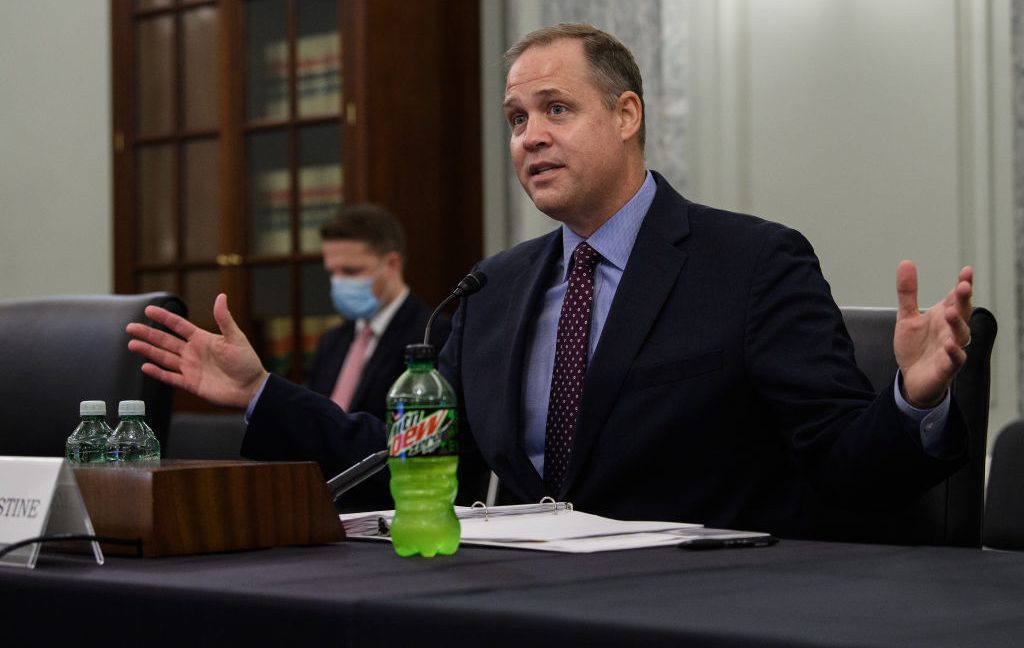
Duffy’s remarks followed a Congressional hearing on Wednesday during which former Congressman Jim Bridenstine, who served as NASA administrator during President Trump’s first term, said China had pulled ahead of NASA and the United States in the second space race.

“Unless something changes, it is highly unlikely the United States will beat China’s projected timeline to the Moon’s surface,” said Bridenstine, who led the creation of the Artemis Program in 2019. China has said multiple times that it intends to land taikonuats on the Moon before the year 2030.

A lot of TV appearances

Duffy’s remarks were characteristic of his tenure since his appointment two months ago by Trump to serve as interim administrator of the space agency. He has made frequent appearances on Fox News and offered generally upbeat views of NASA’s position in its competition with China for supremacy in space. And on Friday, in a slickly produced video, he said, “I’m committed to getting us back to the Moon before President Trump leaves office.”

Sources have said Duffy, already a cabinet member as the secretary of transportation, is also angling to remove the “interim” from his NASA administrator title. Like Bridenstine, he has a capable political background and politics that align with the Trump administration. He is an excellent public speaker and knows the value of speaking to the president through Fox News. To date, however, he has shown limited recognition of the reality of the current competition with China.

https://arstechnica.com/space/2025/09/nasas-acting-chief-angry-about-talk-that-china-will-beat-us-back-to-the-moon/


Rocket Report: Neutron’s pad opens for business; SpaceX gets Falcon 9 green light

Welcome to Edition 8.09 of the Rocket Report! The biggest news of the week happened inside the Beltway rather than on a launch pad somewhere. In Washington, DC, Congress has pushed back on the Trump administration’s plan to stop flying the Space Launch System rocket after Artemis III. Congress made it clear that it wants to keep the booster in business for a long time. The big question now is whether the Trump White House will blink.

As always, we welcome reader submissions, and if you don’t want to miss an issue, please subscribe using the box below (the form will not appear on AMP-enabled versions of the site). Each report will include information on small-, medium-, and heavy-lift rockets as well as a quick look ahead at the next three launches on the calendar.

Israel launches SAR satellite. The Israel Ministry of Defense, Israel Defense Forces, and Israel Aerospace Industries successfully launched the Ofek 19 satellite on Tuesday from the Palmachim Airbase. The launch was carried out by the country’s solid-propellant Shavit 2 rocket. Ofek 19 is a synthetic aperture radar observation satellite with enhanced capabilities, 7 Israel National News reports.

A unique launch posture … This was the seventh launch of the Shavit-2 vehicle, which made its debut in June 2007. The most recent launch prior to this week occurred in March 2023. Because of its geographic location and difficult relations with surrounding countries, Israel launches its rockets to the west, over the Mediterranean Sea. (submitted by MarkW98)

Canadian launch firm invests in launch site. Earlier this summer, Reaction Dynamics, an Ontario-based launch company, closed on a Series A funding round worth $10 million. This will support the next phase of development of the Canadian company’s hybrid propulsion system, of which an initial suborbital demonstration flight is planned for this winter. Now the company has taken some of this funding and invested in a launch site in Nova Scotia, SpaceQ reports.

Getting in on the ground floor … In a transaction worth $1.2 million, Reaction Dynamics is investing in Maritime Launch Services, which is developing the Spaceport Nova Scotia facility. Reaction Dynamics intends to launch its Aurora-8 rocket from the Canadian launch site. Bachar Elzein, the CEO of Reaction Dynamics, said the move made sense for two reasons. The first is that it secures “a spot to launch our very first orbital rocket,” with Elzein adding, “we believe in their vision,” and thus wanted to invest. That second factor had to do with all the work, the heavy lifting, MLS has done to date, to build a spaceport from the ground up. (submitted by JoeyS)

https://arstechnica.com/space/2025/09/rocket-report-neutrons-pad-opens-for-business-spacex-gets-falcon-9-green-light/


Lull in Falcon Heavy missions opens window for SpaceX to build new landing pads

SpaceX’s goal for this year is 170 Falcon 9 launches, and the company is on pace to come close to this target. Most Falcon 9 launches carry SpaceX’s own Starlink broadband satellites into orbit. The FAA’s environmental approval opens the door for more flights from SpaceX’s busiest launch pad.

But launch pad availability is not the only hurdle limiting how many Falcon 9 flights can take off in a year. There’s also the rate of production for Falcon 9 upper stages, which are new on each flight, and the time it takes for each vessel in SpaceX’s fleet of drone ships (one in California, two in Florida) to return to port with a recovered booster and redeploy back to sea again for the next mission. SpaceX lands Falcon 9 boosters on offshore drone ships after most of its launches and only brings the rocket back to an onshore landing on missions carrying lighter payloads to orbit.

When a Falcon 9 booster does return to landing on land, it targets one of SpaceX’s recovery zones at military-run spaceports in Florida and California. SpaceX’s landing zone at Vandenberg Space Force Base in California is close to the Falcon 9 launch pad there.

The Space Force wants SpaceX, and potentially other future reusable rocket companies, to replicate the side-by-side launch and landing pads at Cape Canaveral.

To do that, the FAA also gave the green light Wednesday for SpaceX to construct and operate a new rocket landing zone at SLC-40 and conduct up to 34 first-stage booster landings there each year. The landing zone will consist of a 280-foot diameter concrete pad surrounded by a 60-foot-wide gravel apron. The landing zone’s broadest diameter, including the apron, will measure 400 feet.

The location of SpaceX’s new rocket landing pad is shown with the red circle, approximately 1,000 feet northeast of the Falcon 9 rocket’s launch pad at Space Launch Complex-40. Credit: Google Maps/Ars Technica

SpaceX is in an earlier phase of planning for a Falcon landing pad at historic Launch Complex-39A at NASA’s Kennedy Space Center, just a few miles north of SLC-40. SpaceX uses LC-39A as a launch pad for most Falcon 9 crew launches, all Falcon Heavy missions, and, in the future, flights of the company’s gigantic next-generation rocket, Starship. SpaceX foresees Starship as a replacement for Falcon 9 and Falcon Heavy, but the company’s continuing investment in Falcon-related infrastructure shows the workhorse rocket will stick around for a while.

https://arstechnica.com/space/2025/09/lull-in-falcon-heavy-missions-opens-window-for-spacex-to-build-new-landing-pads/


Former NASA chief says United States likely to lose second lunar space race

The hearing, titled “There’s a Bad Moon on the Rise: Why Congress and NASA Must Thwart China in the Space Race,” had no witnesses who disagreed with this viewpoint. They included Allen Cutler, CEO of the Coalition for Deep Space Exploration, the chief lobbying organization for SLS, Orion, and Gateway; Jim Bridenstine, former NASA Administrator who now leads government operations for United Launch Alliance; Mike Gold of Redwire, a Gateway contractor; and Lt. General John Shaw, former Space Command official.

The hearing before the committee chaired by Cruz, Commerce, Science, and Transportation, included the usual mishmash of parochial politics, lobbying for traditional space, back slapping, and fawning—at one point, Gold, a Star Trek fan, went so far as to assert that Cruz is the “Captain Kirk” of the US Senate.

Beyond this, however, there was a fair amount of teeth gnashing about the fact that the United States faces a serious threat from China, which appears to be on course to put humans on the Moon before NASA can return there with the Artemis Program. China aims to land humans at the South Pole before the year 2030.

NASA likely to lose “race”

Bridenstine, who oversaw the creation of the Artemis Program half a decade ago, put it most bluntly: “Unless something changes, it is highly unlikely the United States will beat China’s projected timeline to the Moon’s surface,” he said.

Bridenstine and others on the panel criticized the complex nature of SpaceX’s Starship-based lunar lander, which NASA selected in April 2021 as a means to get astronauts down to the lunar surface and back. The proposal relies on Starship being refueled in low-Earth orbit by multiple Starship tanker launches.

https://arstechnica.com/space/2025/09/ted-cruz-criticizes-trump-plan-to-cancel-sls-and-lunar-gateway-as-folly/


Fuel supply is a bottleneck for Starship—here’s how SpaceX will get around it

If SpaceX is going to fly Starships as often as it wants to, it’s going to take more than rockets and launch pads.

First, there’s the sprawling factory that SpaceX has constructed at its Starbase location along the Gulf Coast in South Texas. The building, known as Starfactory, is designed to produce one Starship per day. A couple of miles to the east, SpaceX has built one Starship launch pad and is preparing to activate a second one.

With Starship, SpaceX seeks to buck the old way of doing things. Tanker trucks have traditionally delivered rocket propellant to launch pads at America’s busiest spaceports in Florida and California. SpaceX has used the same method of bringing propellant for the first several years of operations at Starbase.

But a reusable Starship’s scale dwarfs that of other rockets. It stands more than 400 feet tall, with a capacity for more than a million gallons of super-cold liquid methane and liquid oxygen propellants. SpaceX also uses large quantities of liquid nitrogen to chill and purge the propellant loading system for Starship.

It’s not just Starship’s size. SpaceX has the green light from the Federal Aviation Administration to launch Starships up to 25 times per year from South Texas, and is seeking regulatory approval to fly up to 120 times from new launch pads on Florida’s Space Coast. Eventually, SpaceX eyes daily launches of Starship, or even more, as the company deploys a fleet of ships traveling to low-Earth orbit, the Moon, and Mars.

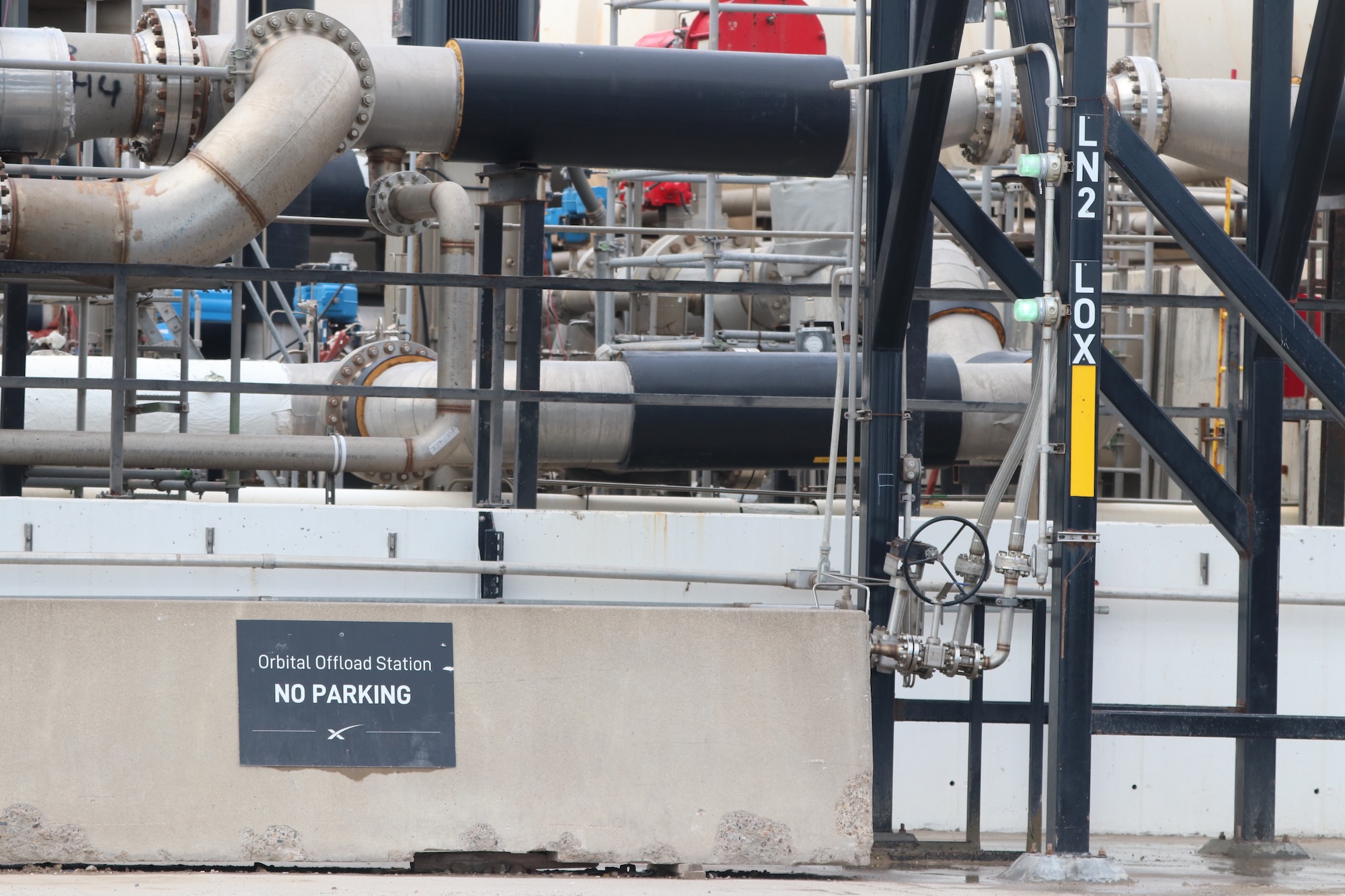
A closer look at SpaceX’s “orbital offload station,” where trucks deliver liquid propellants for Starship launches. Credit: Stephen Clark/Ars Technica

There are innumerable bottlenecks to achieving such a fast launch cadence. One of them is simply a matter of logistics. It takes more than 200 tanker trucks traveling from distant refineries to deliver all of the methane, liquid oxygen, and liquid nitrogen for a Starship launch. SpaceX officials recognize this is not an efficient means of conveying these commodities to the launch pad. It takes time, emits pollution, and clogs roadways. The sole two-lane highway leading to Starbase from nearby Brownsville, Texas, is riddled with potholes and cracks in the pavement from overuse by heavy trucks.

https://arstechnica.com/space/2025/09/spacex-moves-closer-to-making-its-own-rocket-fuel-at-starship-launch-site/


Ted Cruz reminds us why NASA’s rocket is called the “Senate Launch System”

All of the original US senators who created and sustained NASA’s Space Launch System rocket over the last 15 years—Bill Nelson, Kay Bailey Hutchison, and Richard Shelby—have either retired or failed to win reelection. However, a new champion has emerged to continue the fight: Texas Republican Ted Cruz.

He seems an unlikely hero for NASA’s large rocket, which costs the federal government more than $2 billion to launch. Cruz, after all, is a self-described pro-capitalist, fiscal conservative. SpaceX and Blue Origin, which are building large and significantly lower-cost alternatives to the SLS rocket, have large operations in Texas. In previous legislative sessions, Cruz has often carried legislation important to the commercial space industry, such as the American Space Commerce Act and the Space Frontier Act.

But now that he chairs the Senate Commerce, Science, and Transportation Committee, Cruz has made a significant shift toward supporting the SLS rocket and its chief contractor, Boeing.

Cruz seeks to save SLS

Earlier this year, Cruz crafted the NASA provision tacked onto President Trump’s “One Big, Beautiful Bill,” which included $10 billion in funding for key space programs, and in two notable areas directly undermined White House space policy goals.

As part of its fiscal year 2026 budget, the White House sought to end funding for the Space Launch System rocket after the Artemis III mission, and also cancel the Lunar Gateway, an orbital space station that provides a destination for the rocket. The Cruz addendum provided $6.7 billion in funding for two additional SLS missions, Artemis IV and Artemis V, and to continue Gateway construction.

In several hearings this year, Cruz has made it clear that his priorities for human spaceflight are to beat China back to the Moon and maintain a presence there. However, it is now increasingly clear that he views this as only being possible through continued use of NASA’s SLS rocket.

https://arstechnica.com/space/2025/09/ted-cruz-reminds-us-why-nasas-rocket-is-called-the-senate-launch-system/


Starship’s heat shield appears to have performed quite well in test

One of the more curious aspects of the 10th flight of SpaceX’s Starship rocket on Tuesday was the striking orange discoloration of the second stage. This could be observed on video taken from a buoy near the landing site as the vehicle made a soft landing in the Indian Ocean.

This color—so different from the silvery skin and black tiles that cover Starship’s upper stage—led to all sorts of speculation. Had heating damaged the stainless steel skin? Had the vehicle’s tiles been shucked off, leaving behind some sort of orange adhesive material? Was this actually NASA’s Space Launch System in disguise?

The answer to this question was rather important, as SpaceX founder Elon Musk had said before this flight that gathering data about the performance of this heat shield was the most important aspect of the mission.

We got some answers on Thursday. During the afternoon, the company posted some new high-resolution photos, taken by a drone in the vicinity of the landing location. They offered a clear view of the Starship vehicle with its heat shield intact, albeit with a rust-colored tint.

Musk provided some clarity on this discoloration on Thursday evening, writing on the social media site X, “Worth noting that the heat shield tiles almost entirely stayed attached, so the latest upgrades are looking good! The red color is from some metallic test tiles that oxidized and the white is from insulation of areas where we deliberately removed tiles.”

The new images and information from Musk suggest that SpaceX is making progress on developing a heat shield for Starship. This really is the key technology to make an upper stage rapidly reusable—NASA’s space shuttle orbiters were reusable but required a standing army to refurbish the vehicle between flights. To unlock Starship’s potential, SpaceX wants to be able to refly Starships within 24 hours.

https://arstechnica.com/space/2025/08/spacex-got-good-heat-shield-data-for-starship-so-what-comes-next/