Rocket Report: SpaceX achieved daily launch this week; ULA recovers booster

A rocket on a rocket … SpaceX engineers installed two small Draco rocket engines in the trunk of the Dragon spacecraft. The thrusters have their own dedicated propellant tanks and will operate independently of 16 other Draco thrusters used to maneuver Dragon on its journey to the ISS. When NASA says it’s the right time, SpaceX controllers will command the Draco thrusters to ignite and gently accelerate the massive 450-ton space station. All told, the reboost kit can add about 20 mph, or 9 meters per second, to the space station’s already-dizzying speed. Maintaining the space station’s orbit has previously been the responsibility of Russia.

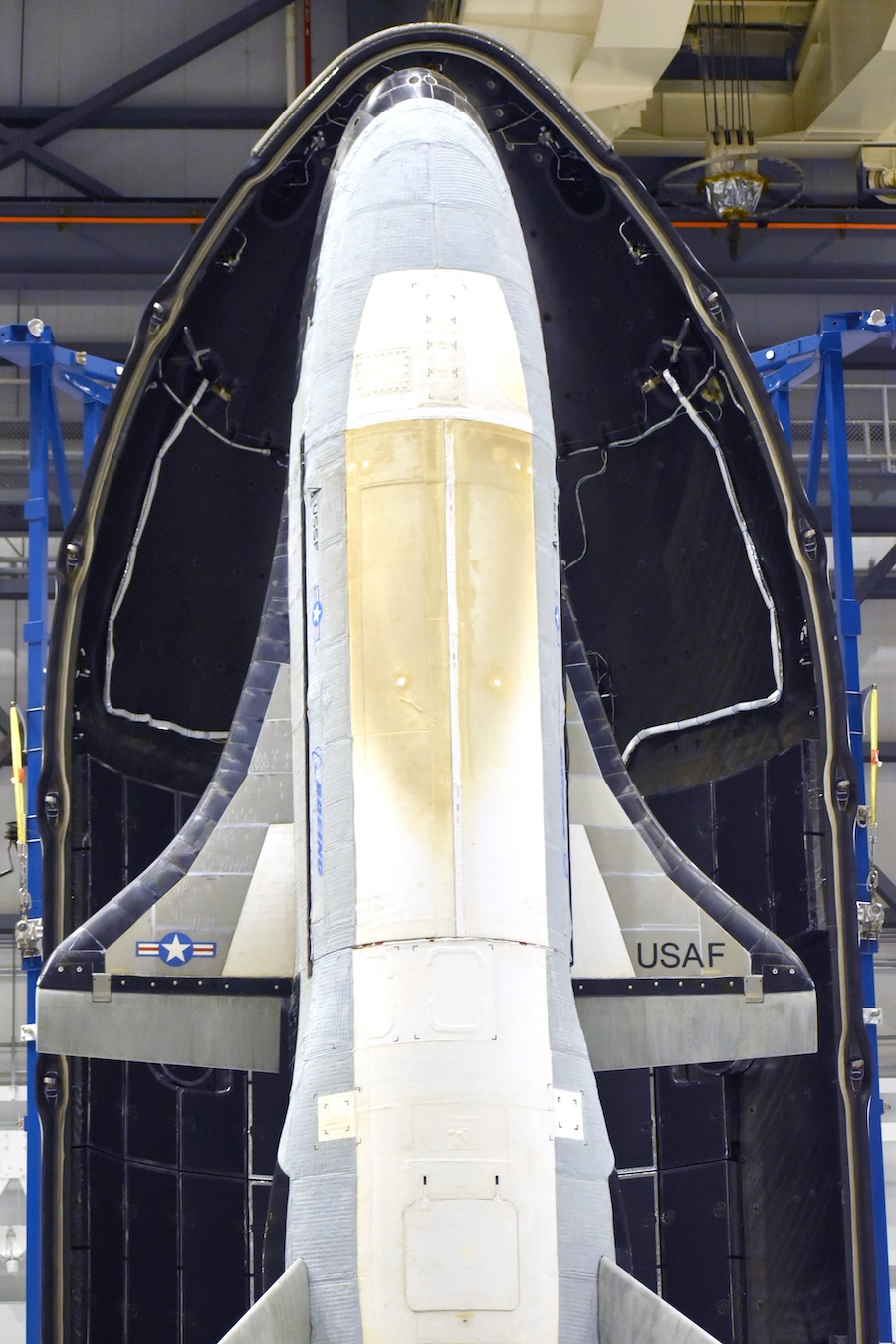
X-37B rides with SpaceX again. The US military’s reusable winged spaceship rocketed back into orbit from Florida on August 21 atop a SpaceX rocket, kicking off a mission that will, among other things, demonstrate how future spacecraft can navigate without relying on GPS signals, Ars reports. The core of the navigation experiment is what the Space Force calls the “world’s highest performing quantum inertial sensor ever used in space.” The spaceplane also hosts a laser inter-satellite communications demo. This is the eighth flight of the X-37B spaceplane, and the third to launch with SpaceX.

Back to LEO … This mission launched on a Falcon 9 rocket into low-Earth orbit (LEO) a few hundred miles above the Earth. This marks a return to LEO after the previous X-37B mission flew on a Falcon Heavy rocket into a much higher orbit. Many of the spaceplane’s payloads have been classified, but officials typically identify a handful of unclassified experiments flying on each X-37B mission. Past X-37B missions have also deployed small satellites into orbit before returning to Earth for a runway landing at Kennedy Space Center, Florida, or Vandenberg Space Force Base, California.

Rocket Lab cuts the ribbon on Neutron launch pad. Launch Complex 3, the Virginia Spaceport Authority’s Mid-Atlantic Regional Spaceport and home to Rocket Lab’s newest reusable rocket, Neutron, is now complete and celebrated its official opening Thursday, WAVY-TV reports. Officials said Launch Complex 3 is ready to bring the largest orbital launch capacity in the spaceport’s history with Neutron, Rocket Lab’s reusable launch vehicle, a medium-lift vehicle capable of launching 33,000 pounds (15 metric tons) to space for commercial constellations, national security, and interplanetary missions.

https://arstechnica.com/space/2025/08/rocket-report-spacex-achieved-daily-launch-this-week-ula-recovers-booster/


With recent Falcon 9 milestones, SpaceX vindicates its “dumb” approach to reuse

As SpaceX’s Starship vehicle gathered all of the attention this week, the company’s workhorse Falcon 9 rocket continued to hit some impressive milestones.

Both occurred during relatively anonymous launches of the company’s Starlink satellites but are nonetheless notable because they underscore the value of first-stage reuse, which SpaceX has pioneered over the last decade.

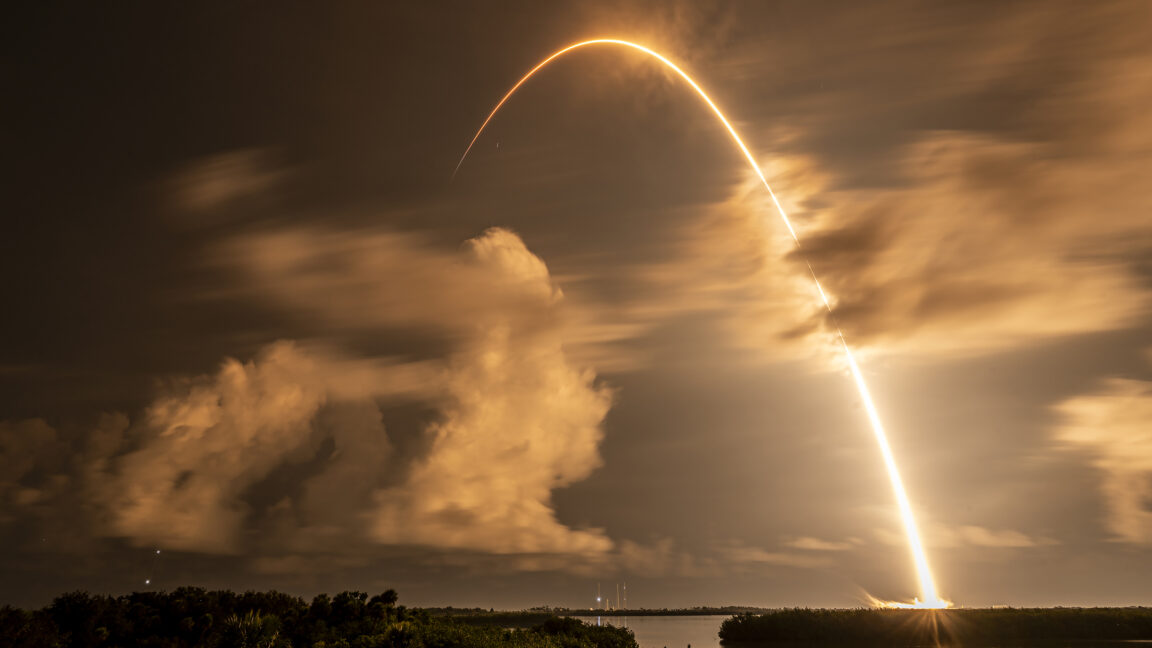
The first milestone occurred on Wednesday morning with the launch of the Starlink 10-56 mission from Cape Canaveral, Florida. The first stage that launched these satellites, Booster 1096, was making its second launch and successfully landed on the Just Read the Instructions drone ship. Strikingly, this was the 400th time SpaceX has executed a drone ship landing.

Then, less than 24 hours later, another Falcon 9 rocket launched the Starlink 10-11 mission from a nearby launch pad at Kennedy Space Center. This first stage, Booster 1067, subsequently returned and landed on another drone ship, A Shortfall of Gravitas.

This is a special booster, having made its debut in June 2021 and launching a wide variety of missions, including two Crew Dragon vehicles to the International Space Station and some Galileo satellites for the European Union. On Thursday, the rocket made its 30th flight, the first time a Falcon 9 booster has hit that level of experience.

A decade in the making

These milestones came about one decade after SpaceX began to have some success with first-stage reuse.

The company first made a controlled entry of the Falcon 9 rocket’s first stage in September 2013, during the first flight of version 1.1 of the vehicle. This proved the viability of the concept of supersonic retropropulsion, which was, until that time, just theoretical.

This involves igniting the rocket’s nine Merlin engines while the vehicle is traveling faster than the speed of sound through the upper atmosphere, with external temperatures exceeding 1,000 degrees Fahrenheit. Due to the blunt force of this reentry, the engines in the outer ring of the rocket wanted to get splayed out, the company’s chief of propulsion at the time, Tom Mueller, told me for the book Reentry. Success on the first try seemed improbable.

He recalled watching this launch from Vandenberg Space Force Base in California and observing reentry as a camera aboard SpaceX founder Elon Musk’s private jet tracked the rocket. The first stage made it all the way down, intact.

https://arstechnica.com/space/2025/08/with-recent-falcon-9-milestones-spacex-vindicates-its-dumb-approach-to-reuse/


Under pressure after setbacks, SpaceX’s huge rocket finally goes the distance

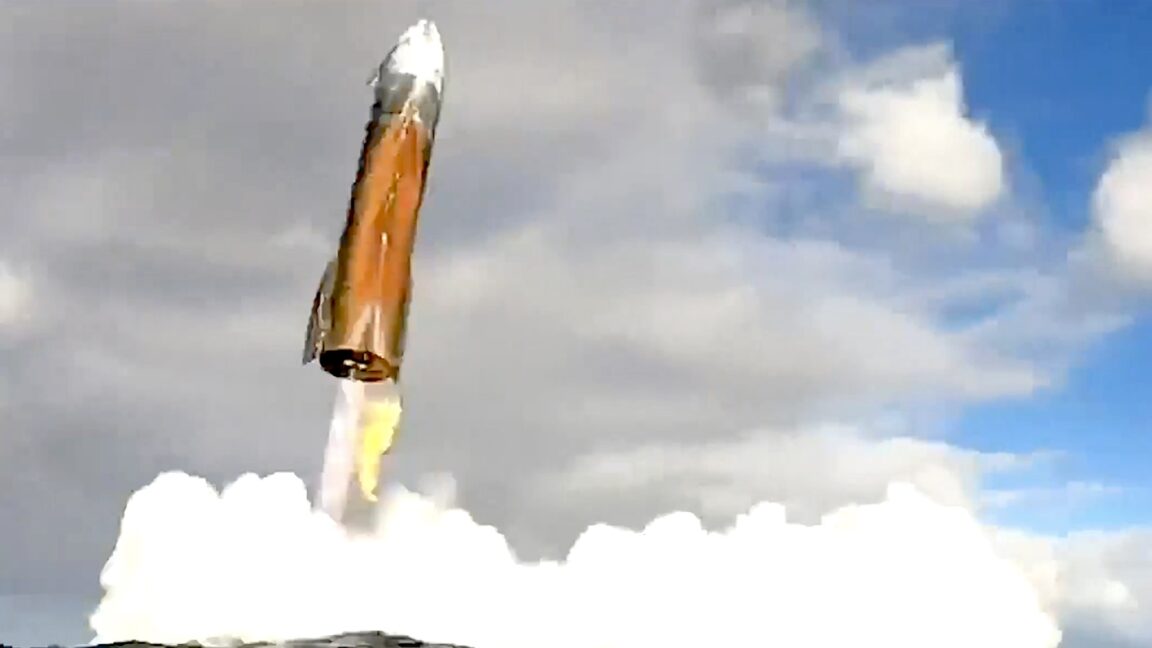
The ship made it all the way through reentry, turned to a horizontal position to descend through scattered clouds, then relit three of its engines to flip back to a vertical orientation for the final braking maneuver before splashdown.

Things to improve on

There are several takeaways from Tuesday’s flight that will require some improvements to Starship, but these are more akin to what officials might expect from a rocket test program and not the catastrophic failures of the ship that occurred earlier this year.

One of the Super Heavy booster’s 33 engines prematurely shut down during ascent. This has happened before, and while it didn’t affect the booster’s overall performance, engineers will investigate the failure to try to improve the reliability of SpaceX’s Raptor engines, each of which can generate more than a half-million pounds of thrust.

Later in the flight, cameras pointed at one of the ship’s rear flaps showed structural damage to the back of the wing. It wasn’t clear what caused the damage, but super-heated plasma burned through part of the flap as the ship fell deeper into the atmosphere. Still, the flap remained largely intact and was able to help control the vehicle through reentry and splashdown.

“We’re kind of being mean to this Starship a little bit,” Huot said on SpaceX’s live webcast. “We’re really trying to put it through the paces and kind of poke on what some of its weak points are.”

Small chunks of debris were also visible peeling off the ship during reentry. The origin of the glowing debris wasn’t immediately clear, but it may have been parts of the ship’s heat shield tiles. On this flight, SpaceX tested several different tile designs, including ceramic and metallic materials, and one tile design that uses “active cooling” to help dissipate heat during reentry.

A bright flash inside the ship’s engine bay during reentry also appeared to damage the vehicle’s aft skirt, the stainless steel structure that encircles the rocket’s six main engines.

“That’s not what we want to see,” Huot said. “We just saw some of the aft skirt just take a hit. So we’ve got some visible damage on the aft skirt. We’re continuing to reenter, though. We are intentionally stressing the ship as we go through this, so it is not guaranteed to be a smooth ride down to the Indian Ocean.

“We’ve removed a bunch of tiles in kind of critical places across the vehicle, so seeing stuff like that is still valuable to us,” he said. “We are trying to kind of push this vehicle to the limits to learn what its limits are as we design our next version of Starship.”

Shana Diez, a Starship engineer at SpaceX, perhaps summed up Tuesday’s results best on X: “It’s not been an easy year but we finally got the reentry data that’s so critical to Starship. It feels good to be back!”

https://arstechnica.com/space/2025/08/spacex-bounces-back-with-a-starship-test-flight-that-ended-on-a-buoyant-note/


With a new Soyuz rocket, Russia seeks to break its Ukrainian dependency

This partnership held together after the breakup of the Soviet Union, but all cooperation ended after Russia’s invasion of Ukraine in February 2022. (Russia even went so far as to strike the factory where Zenit rockets were once made with an intermediate-range ballistic missile last November.)

With the Soyuz-5 booster, Russia seeks to replace both the Zenit family of rockets and the aging Proton-M launch vehicle. The new Irtysh rocket will have slightly larger main propellant tanks than the Zenit-2 vehicle, giving it a lift capacity of about 17 metric tons to low-Earth orbit.

Not much new here

Probably the most interesting element of this rocket is its engine, the RD-171MV. This is based on technology that goes back decades to the Energia launch vehicle, which the Soviet Union used to launch the Buran space shuttle. A modified version, the RD-171, was used for Zenit rockets. Unlike the previous engines, this newest version does not use any Ukrainian components.

This line of rocket engines, powered by kerosene and liquid oxygen, produces more than three times the thrust of a NASA Space Shuttle main engine. They are the most powerful liquid-fueled rocket engines in the world.

One key question for the Russian space program is whether the Soyuz-5 rocket can become commercially successful and attract non-Russian launch business. The country will also continue to fly the Soyuz-2 launch vehicle, which is presently used for crewed missions and the newer line of Angara rockets.

It’s notable that the Russian space program—which has had its funding curtailed to help pay for the war against Ukraine—has managed to bring the Soyuz-5 to the launch pad. However, a far more significant achievement would be delivering another Soyuz rocket in development, the Soyuz-7, also known as Amur. This is because the Amur rocket marks a significant break from traditional Russian designs.

This rocket, with new liquid oxygen-methane engines, is intended to replace the Soyuz-2 vehicle. The rocket could also be more price competitive, as it is intended to have a reusable first stage. The vehicle’s debut has been repeatedly pushed back, however, with Russia now expected to debut the vehicle no earlier than 2030.

https://arstechnica.com/space/2025/08/with-a-new-soyuz-rocket-russia-seeks-to-break-its-ukrainian-dependency/


SpaceX’s latest Dragon mission will breathe more fire at the space station

“Our capsule’s engines are not pointed in the right direction for optimum boost,” said Sarah Walker, SpaceX’s director of Dragon mission management. “So, this trunk module has engines pointed in the right direction to maximize efficiency of propellant usage.”

When NASA says it’s the right time, SpaceX controllers will command the Draco thrusters to ignite and gently accelerate the massive 450-ton complex. All told, the reboost kit can add about 20 mph, or 9 meters per second, to the space station’s already-dizzying speed, according to Walker.

Spetch said that’s roughly equivalent to the total reboost impulse provided by one-and-a-half Russian Progress cargo vehicles. That’s about one-third to one-fourth of the total orbit maintenance the ISS needs in a year.

“The boost kit will help sustain the orbiting lab’s altitude, starting in September, with a series of burns planned periodically throughout the fall of 2025,” Spetch said.

After a few months docked at the ISS, the Dragon cargo capsule will depart and head for a parachute-assisted splashdown in the Pacific Ocean off the coast of California. SpaceX will recover the pressurized capsule to fly again, while the trunk containing the reboost kit will jettison and burn up in the atmosphere.

SpaceX’s Dragon spacecraft approaches the International Space Station for docking at 7:05 am EDT (11:05 UTC) on Monday. Credit: NASA TV/Ars Technica

While this mission is SpaceX’s 33rd cargo flight to the ISS under the auspices of NASA’s multibillion-dollar Commercial Resupply Services contract, it’s also SpaceX’s 50th overall Dragon mission to the outpost. This tally includes 17 flights of the human-rated Crew Dragon.

“With CRS-33, we’ll mark our 50th voyage to ISS,” Walker said. “Just incredible. Together, these missions have (carried) well over 300,000 pounds of cargo and supplies to the orbiting lab and well over 1,000 science and research projects that are not only helping us to understand how to live and work effectively in space… but also directly contributing to critical research that serves our lives here on Earth.”

Future Dragon trunks will be able to accommodate a reboost kit or unpressurized science payloads, depending on NASA’s needs at the space station.

The design of the Dragon reboost kit is a smaller-scale version of what SpaceX will build for a much larger Dragon trunk under a $843 million contract signed with NASA last year for the US Deorbit Vehicle. This souped-up Dragon will dock with the ISS and steer it back into the atmosphere after the lab’s decommissioning in the early 2030s. The deorbit vehicle will have 46 Draco thrusters—16 to control the craft’s orientation and 30 in the trunk to provide the impulse needed to drop the station out of orbit.

https://arstechnica.com/space/2025/08/spacexs-latest-dragon-mission-will-breathe-more-fire-at-the-space-station/


Time is running out for SpaceX to make a splash with second-gen Starship

STARBASE, Texas—A beehive of aerospace technicians, construction workers, and spaceflight fans descended on South Texas this weekend in advance of the next test flight of SpaceX’s gigantic Starship rocket, the largest vehicle of its kind ever built.

Towering 404 feet (123.1 meters) tall, the rocket will lift off during a one-hour launch window beginning at 6:30 pm CDT (7:30 pm EDT; 23:30 UTC) Sunday. The main concern for Sunday’s launch attempt will be weather conditions at Starbase, located a few miles north of the US-Mexico border. There’s just a 45 percent chance of favorable weather for liftoff Sunday, according to SpaceX.

It will take about 66 minutes for the rocket to travel from the launch pad in Texas to a splashdown zone in the Indian Ocean northwest of Australia. You can watch the test flight live on SpaceX’s official website. We’ve also embedded a live stream from Spaceflight Now and LabPadre below.

[embedded content]

This will be the 10th full-scale test flight of Starship and its Super Heavy booster stage. It’s the fourth flight of an upgraded version of Starship conceived as a stepping stone to a more reliable, heavier-duty version of the rocket designed to carry up to 150 metric tons, or some 330,000 pounds, of cargo to pretty much anywhere in the inner part of our Solar System.

But this iteration of Starship, known as Block 2 or Version 2, has been anything but reliable. After reeling off a series of increasingly successful flights last year with the first-generation Starship and Super Heavy booster, SpaceX has encountered repeated setbacks since debuting Starship Version 2 in January.

Now, there are just two Starship Version 2s left to fly, including the vehicle poised for launch Sunday. Then, SpaceX will move on to Version 3, the design intended to go all the way to low-Earth orbit, where it can be refueled for longer expeditions into deep space.

https://arstechnica.com/space/2025/08/whats-the-goal-of-spacexs-10th-starship-test-flight-right-the-ship/


US military’s X-37B spaceplane stays relevant with launch of another mission

“Quantum inertial sensors are not only scientifically intriguing, but they also have direct defense applications,” said Lt. Col. Nicholas Estep, an Air Force engineer who manages the DIU’s emerging technology portfolio. “If we can field devices that provide a leap in sensitivity and precision for observing platform motion over what is available today, then there’s an opportunity for strategic gains across the DoD.”

Teaching an old dog new tricks

The Pentagon’s twin X-37Bs have logged more than 4,200 days in orbit, equivalent to about 11-and-a-half years. The spaceplanes have flown in secrecy for nearly all of that time.

The most recent flight, Mission 7, ended in March with a runway landing at Vandenberg after a mission of more than 14 months that carried the spaceplane higher than ever before, all the way to an altitude approaching 25,000 miles (40,000 kilometers). The high-altitude elliptical orbit required a boost on a Falcon Heavy rocket.

In the final phase of the mission, ground controllers commanded the X-37B to gently dip into the atmosphere to demonstrate the spacecraft could use “aerobraking” maneuvers to bring its orbit closer to Earth in preparation for reentry.

An X-37B spaceplane is ready for encapsulation inside the Falcon 9 rocket’s payload fairing. Credit: US Space Force

Now, on Mission 8, the spaceplane heads back to low-Earth orbit hosting quantum navigation and laser communications experiments. Few people, if any, envisioned these kinds of missions flying on the X-37B when it first soared to space 15 years ago. At that time, quantum sensing was confined to the lab, and the first laser communication demonstrations in space were barely underway. SpaceX hadn’t revealed its plans for the Falcon Heavy rocket, which the X-37B needed to get to its higher orbit on the last mission.

The laser communications experiments on this flight will involve optical inter-satellite links with “proliferated commercial satellite networks in low-Earth orbit,” the Space Force said. This is likely a reference to SpaceX’s Starlink or Starshield broadband satellites. Laser links enable faster transmission of data, while offering more security against eavesdropping or intercepts.

Gen. Chance Saltzman, the Space Force’s chief of space operations, said in a statement that the laser communications experiment “will mark an important step in the US Space Force’s ability to leverage proliferated space networks as part of a diversified and redundant space architectures. In so doing, it will strengthen the resilience, reliability, adaptability and data transport speeds of our satellite communications architecture.”

https://arstechnica.com/space/2025/08/spacex-boeing-team-up-for-another-flight-of-the-militarys-x-37b-spaceplane/


Rocket Report: Pivotal Starship test on tap, Firefly wants to be big in Japan

There’s a lot on the line for Starship’s next launch. In a feature, Ars reviews the history of Starbase and its production site, culminating in the massive new Starfactory building that encompasses 1 million square feet. The opening of the sleek, large building earlier this year came as SpaceX continues to struggle with the technical development of the Starship vehicle. Essentially, the article says, SpaceX has built the machine to build the machine. But what about the machine?

Three failures in a row … SpaceX has not had a good run of things with the ambitious Starship vehicle this year. Three times, in January, March, and May, the vehicle took flight. And three times, the upper stage experienced significant problems during ascent, and the vehicle was lost on the ride up to space, or just after. Sources at SpaceX believe the upper stage issues can be resolved, especially with a new “Version 3” of Starship due to make its debut late this year or early in 2026. But the acid test will only come on upcoming flights, beginning Sunday with the vehicle’s tenth test flight.

China tests lunar rocket. In recent weeks, the secretive Chinese space program has reported some significant milestones in developing its program to land astronauts on the lunar surface by the year 2030, Ars reports. Among these efforts, last Friday, the space agency and its state-operated rocket developer, the China Academy of Launch Vehicle Technology, successfully conducted a 30-second test firing of the Long March 10 rocket’s center core with its seven YF-100K engines that burn kerosene and liquid oxygen.

A winner in the space race? … The primary variant of the rocket will combine three of these cores to lift about 70 metric tons to low-Earth orbit. As part of China’s plan to land astronauts on the Moon “before” 2030, this rocket will be used for a crewed mission and lunar lander. Recent setbacks with SpaceX’s Starship vehicle—one of two lunar landers under contract with NASA, alongside Blue Origin’s Mark 2 lander—indicate that it will still be several years until these newer technologies are ready to go. Ars concludes that it is now probable that China will “beat” NASA back to the Moon this decade and win at least the initial heat of this new space race.

https://arstechnica.com/space/2025/08/rocket-report-pivotal-starship-test-on-tap-firefly-wants-to-be-big-in-japan/


China’s Guowang megaconstellation is more than another version of Starlink

Chinese media reports suggest the Guowang satellites could accommodate a range of instrumentation, including broadband communications payloads, laser communications terminals, synthetic aperture radars, and optical remote sensing payloads. This sounds a lot like a mix of SpaceX and the NRO’s Starshield fleet, the Space Development Agency’s future constellation, and the proposed MILNET program.

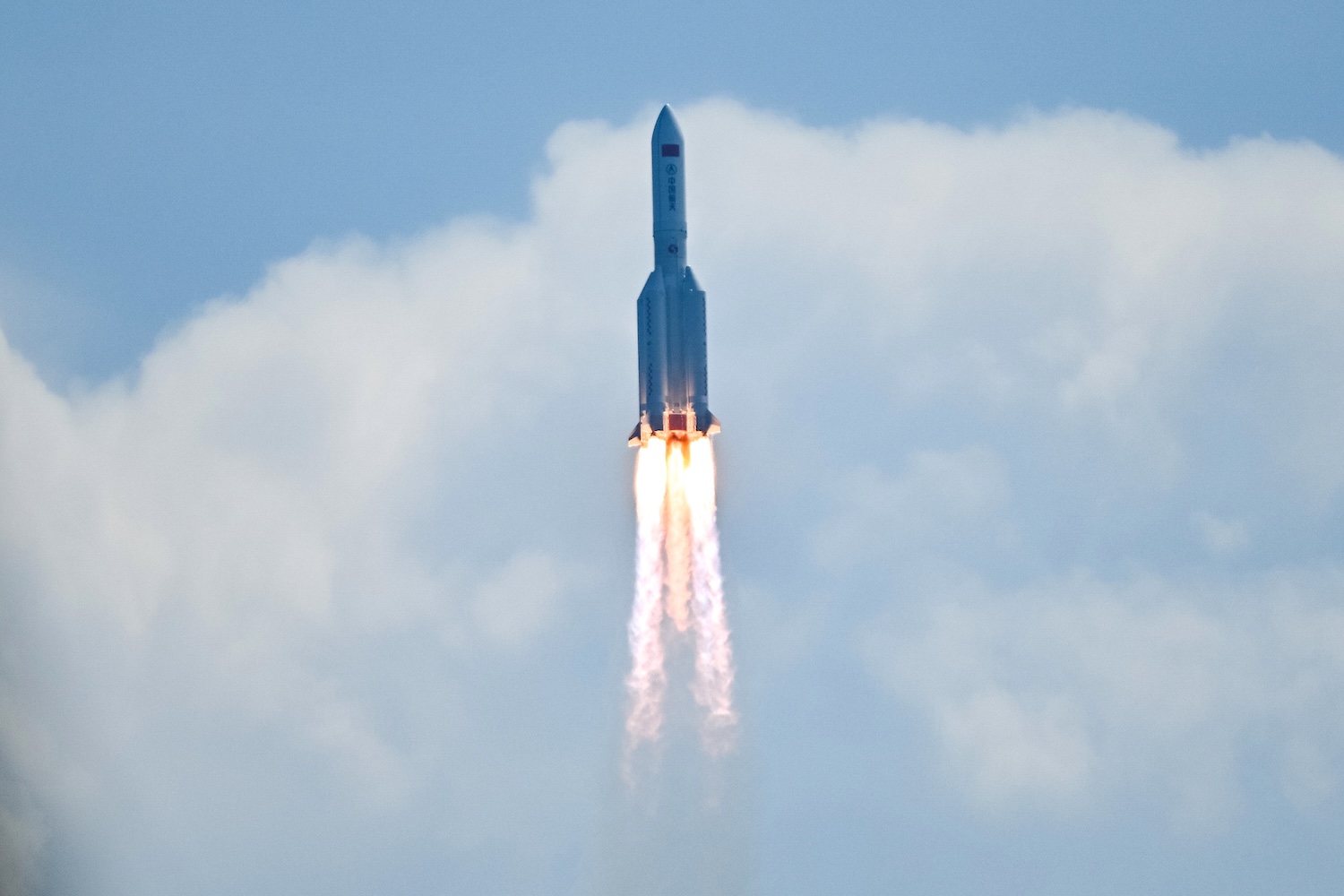
A Long March 5B rocket lifts off from the Wenchang Space Launch Site in China’s Hainan Province on August 13, 2025, with a group of Guowang satellites. (Photo by Luo Yunfei/China News Service/VCG via Getty Images.) Credit: Luo Yunfei/China News Service/VCG via Getty Images

In testimony before a Senate committee in June, the top general in the US Space Force said it is “worrisome” that China is moving in this direction. Gen. Chance Saltzman, the Chief of Space Operations, used China’s emergence as an argument for developing space weapons, euphemistically called “counter-space capabilities.”

“The space-enabled targeting that they’ve been able to achieve from space has increased the range and accuracy of their weapon systems to the point where getting anywhere close enough [to China] in the Western Pacific to be able to achieve military objectives is in jeopardy if we can’t deny, disrupt, degrade that… capability,” Saltzman said. “That’s the most pressing challenge, and that means the Space Force needs the space control counter-space capabilities in order to deny that kill web.”

The US military’s push to migrate many wartime responsibilities to space is not without controversy. The Trump administration wants to cancel purchases of new E-7 jets designed to serve as nerve centers in the sky, where Air Force operators receive signals about what’s happening in the air, on the ground, and in the water for hundreds of miles around. Instead, much of this responsibility would be transferred to satellites.

Some retired military officials, along with some lawmakers, argue against canceling the E-7. They say there’s too little confidence in when satellites will be ready to take over. If the Air Force goes ahead with the plan to cancel the E-7, the service intends to bridge the gap by extending the life of a fleet of Cold War-era E-3 Sentry airplanes, commonly known as AWACS (Airborne Warning and Control System).

But the high ground of space offers notable benefits. First, a proliferated network of satellites has global reach, and airplanes don’t. Second, satellites could do the job on their own, with some help from artificial intelligence and edge computing. This would remove humans from the line of fire. And finally, using a large number of satellites is inherently beneficial because it means an attack on one or several satellites won’t degrade US military capabilities.

https://arstechnica.com/space/2025/08/china-may-have-taken-an-early-lead-in-the-race-for-a-military-megaconstellation/


After recent tests, China appears likely to beat the United States back to the Moon

Ars: Taking the longer view, is the United States or China better positioned (i.e., US spending on defense, reusable in-space architecture vs Chinese plans) to dominate cislunar space between now and the middle of this century?

Cheng: On paper, the US has most of the advantages. We have a larger economy, more experience in space, extant space industrial capacity for reusable space launch, etc. But we have not had programmatic stability so that we are consistently pursuing the same goal over time. During Trump-1, the US said it would go to the Moon with people by 2024. Here we are, halfway through 2025. Trump-2 seems to once again be swinging wildly from going (back) to the Moon to going to Mars. Scientific and engineering advances don’t do well in the face of such wild swings and inconstancy.

By contrast, the Chinese are stable, systematic. They pursue a given goal (e.g., human spaceflight, a space station) over decades, with persistence and programmatic (both budgetarily and in terms of goals) stability. So I expect that the Chinese will put a Chinese person on the Moon by 2030 and follow that with additional crewed and unmanned facilities. This will be supported by a built-out infrastructure of lunar PNT/comms. The US will almost certainly put people on the Moon in a landing in the next several years, but then what? Is Lunar Gateway going to be real? How often will the US go to the Moon, as the Chinese go over and over?

Ars: Do you have any advice for the Trump administration in order to better compete with China in this effort to not only land on the Moon but have a dominant presence there?

Cheng: The Trump administration needs to make a programmatic commitment to some goal, whether the Moon or Mars. It needs to mobilize Congress and the public to support that goal. It needs to fund that goal, but as important, it also needs to have a high-level commitment and oversight, such as the VP and the National Space Council in the first Trump administration. There is little/no obvious direction at the moment for where space is going in this administration, and what its priorities are.

This lack of direction then affects the likelihood that industry, whether big business or entrepreneurs, can support whatever efforts do emerge. If POTUS wants to rely more on entrepreneurial business (a reasonable approach), he nonetheless needs to provide indications of this. It would help to also provide incentives, e.g., a follow-on to the Ansari and X-prizes, which did lead to a blossoming of innovation.

https://arstechnica.com/space/2025/08/after-recent-tests-china-appears-likely-to-beat-the-united-states-back-to-the-moon/