Space Force officials take secrecy to new heights ahead of key rocket launch

The Vulcan rocket checks off several important boxes for the Space Force. First, it relies entirely on US-made rocket engines. The Atlas V rocket it is replacing uses Russian-built main engines, and given the chilled relations between the two powers, US officials have long desired to stop using Russian engines to power the Pentagon’s satellites into orbit. Second, ULA says the Vulcan rocket will eventually provide a heavy-lift launch capability at a lower cost than the company’s now-retired Delta IV Heavy rocket.

Third, Vulcan provides the Space Force with an alternative to SpaceX’s Falcon 9 and Falcon Heavy, which have been the only rockets in their class available to the military since the last national security mission was launched on an Atlas V rocket one year ago.

Col. Jim Horne, mission director for the USSF-106 launch, said this flight marks a “pretty historic point in our program’s history. We officially end our reliance on Russian-made main engines with this launch, and we continue to maintain our assured access to space with at least two independent rocket service companies that we can leverage to get our capabilities on orbit.”

What’s onboard?

The Space Force has only acknowledged one of the satellites aboard the USSF-106 mission, but there are more payloads cocooned inside the Vulcan rocket’s fairing.

The $250 million mission that officials are willing to talk about is named Navigation Technology Satellite-3, or NTS-3. This experimental spacecraft will test new satellite navigation technologies that may eventually find their way on next-generation GPS satellites. A key focus for engineers who designed and will operate the NTS-3 satellite is to look at ways of overcoming GPS jamming and spoofing, which can degrade satellite navigation signals used by military forces, commercial airliners, and civilian drivers.

“We’re going to be doing, we anticipate, over 100 different experiments,” said Joanna Hinks, senior research aerospace engineer at the Air Force Research Laboratory’s space vehicles directorate, which manages the NTS-3 mission. “Some of the major areas we’re looking at—we have an electronically steerable phased array antenna so that we can deliver higher power to get through interference to the location that it’s needed.”

Arlen Biersgreen, then-program manager for the NTS-3 satellite mission at the Air Force Research Laboratory, presents a one-third scale model of the NTS-3 spacecraft to an audience in 2022. Credit: US Air Force/Andrea Rael

GPS jamming is especially a problem in and near war zones. Investigators probing the crash of Azerbaijan Airlines Flight 8243 last December determined GPS jamming, likely by Russian military forces attempting to counter a Ukrainian drone strike, interfered with the aircraft’s navigation as it approached its destination in the Russian republic of Chechnya. Azerbaijani government officials blamed a Russian surface-to-air missile for damaging the aircraft, ultimately leading to a crash in nearby Kazakhstan that killed 38 people.

“We have a number of different advanced signals that we’ve designed,” Hinks said. “One of those is the Chimera anti-spoofing signal… to protect civil users from spoofing that’s affecting so many aircraft worldwide today, as well as ships.”

The NTS-3 spacecraft, developed by L3Harris and Northrop Grumman, only takes up a fraction of the Vulcan rocket’s capacity. The satellite weighs less than 3,000 pounds (about 1,250 kilograms), about a quarter of what this version of the Vulcan rocket can deliver to geosynchronous orbit.

https://arstechnica.com/space/2025/08/space-force-officials-take-secrecy-to-new-heights-ahead-of-key-rocket-launch/


Why does Jeff Bezos keep buying launches from Elon Musk?

Early Monday morning, a Falcon 9 rocket lifted off from its original launch site in Florida. Remarkably, it was SpaceX’s 100th launch of the year.

Perhaps even more notable was the rocket’s payload: two-dozen Project Kuiper satellites, which were dispensed into low-Earth orbit on target. This was SpaceX’s second launch of satellites for Amazon, which is developing a constellation to deliver low-latency broadband Internet around the world. SpaceX, then, just launched a direct competitor to its Starlink network into orbit. And it was for the founder of Amazon, Jeff Bezos, who owns a rocket company of his own in Blue Origin.

So how did it come to this—Bezos and Elon Musk, competitors in so many ways, working together in space?

Most obvious answer: SpaceX is a launch business

First and foremost, one of SpaceX’s two core businesses is launching rockets. (The other is its Starlink Internet service). SpaceX sells launch services to all comers and typically offers the lowest price per kilogram to orbit.

By reusing the first stage of the Falcon 9, SpaceX has cracked the code on rapid, reliable launch service. Launch used to be expensive and rare, and it would take years to get manifested onto a rocket. Because the Falcon 9 now flies so frequently, it provides a relatively fast way to get a payload into space.

SpaceX also has proven that it is willing to launch competitors. Between December 2022 and October 2024, SpaceX launched four batches of satellites for OneWeb, another broadband Internet competitor. AST SpaceMobile has purchased multiple launches from SpaceX for its direct-to-device satellites. The Falcon 9 rocket has also launched two Cygnus spacecraft to the International Space Station for Northrop Grumman, a direct competitor to its Cargo Dragon vehicle.

https://arstechnica.com/space/2025/08/why-amazon-is-letting-its-rival-launch-its-satellites/


James Lovell, the steady astronaut who brought Apollo 13 home safely, has died

After the Apollo 13 mission, Lovell was named the deputy director of science and applications at NASA’s Manned Spacecraft Center (today, Johnson Space Center) before retiring from both the space agency and Navy on March 1, 1973. Lovell became chief executive officer of Bay-Houston Towing Company in 1975 and then president of Fisk Telephone Systems in 1977.

On January 1, 1981, Lovell joined Centel Corporation as group vice president for business communications systems and, 10 years later, retired as executive vice president and a member of the company’s board of directors.

For 11 years, from 1967 to 1978, Lovell served as a consultant and then chairman of the Physical Fitness Council (today, the President’s Council on Sports, Fitness and Nutrition). He was a member of the board for several organizations, including Federal Signal Corporation in Chicago from 1984 to 2003 and the Astronautics Corporation of America in Milwaukee from 1990 to 1999. He was also chairman of the Astronaut Scholarship Foundation from 1997 to 2005.

Appearances and awards

From 1999 to 2006, Lovell helped run “Lovell’s of Lake Forest,” a restaurant that he and his family opened in Illinois. (The restaurant was then sold to Jay, Lovell’s son, but ultimately closed in 2015.)

In 1994, Lovell worked with Jeffrey Kluger to publish Lost Moon: The Perilous Voyage of Apollo 13, which was later retitled Apollo 13 after serving as the basis for the Ron Howard movie.

In addition to being played by Hanks and having a cameo in Apollo 13, Lovell was also portrayed by Tim Daly in the 1998 HBO miniseries From the Earth to the Moon and Pablo Schreiber in the 2018 Neil Armstrong biopic First Man. Lovell also made a cameo appearance in the 1976 movie The Man Who Fell to Earth.

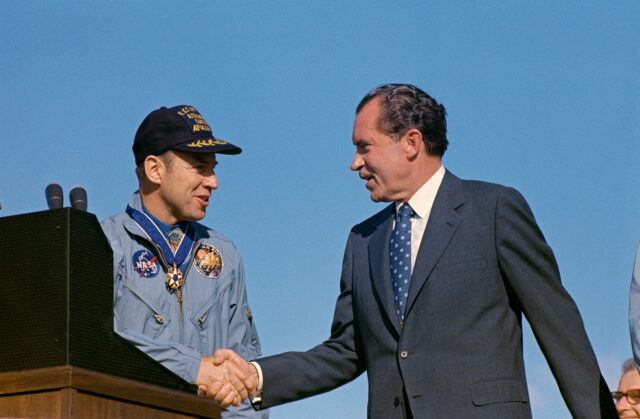
a man in a blue flight suit and ball cap shakes hands with a man in a business suit outside under a clear blue sky

Jim Lovell, Apollo 13 commander, shakes hands with President Richard Nixon after being presented with the Presidential Medal of Freedom at Hickham Air Force Base, Hawaii, in 1970. Credit: NASA

For his service to the US space program, Lovell was awarded the NASA Distinguished Service and Exceptional Service medals; the Congressional Space Medal of Honor, and Presidential Medal of Freedom. As a member of the Gemini 7, Gemini 12, and Apollo 8 crews, Lovell was bestowed the Harmon International Trophy three times and, with his Apollo 8 crewmates, the Robert J. Collier and Dr. Robert H. Goddard Memorial trophies and was named Time Magazine’s Man of the Year for 1968.

https://arstechnica.com/space/2025/08/astronaut-james-lovell-famed-apollo-13-commander-dies-at-97/


Rocket Report: Firefly lights the markets up; SpaceX starts selling trips to Mars

SpaceX begins offering Starship services to Mars. On Thursday, Gwynne Shotwell, the president and chief operating officer of SpaceX, announced that the company has begun selling rides to Mars. “Get on board! We are going to Mars! SpaceX is now offering Starship services to the red planet,” Shotwell said on X. As part of the announcement, Shotwell said SpaceX has signed a “first of its kind” agreement with the Italian Space Agency.

Racing the Giro d’Mars … The president of the Italian Space Agency, Teodoro Valente, confirmed the news, saying the first Starship flights to Mars (which will, of course, be uncrewed) will carry Italian experiments. “The payloads will gather scientific data during the missions. Italy continues to lead in space exploration!” Valente wrote on X. Left unsaid, of course, is when such flights will take place. It is difficult to see Starship now being ready for a late 2026 window, but early 2029 seems plausible.

ULA will eventually test reuse technology. On Thursday, ahead of the first Vulcan launch of a national security payload next week, United Launch Alliance chief executive Tory Bruno spoke with reporters about various topics, NASA Spaceflight reports. A highlight was ULA’s progress on SMART Reuse, a system aimed at recovering and reusing booster components to reduce costs. Bruno announced that the critical design review for key components is complete, paving the way for building flight-like hardware for certification.

Testing remains a ways away … As development progresses, ULA plans to relocate more components to the aft section of the booster for recovery. “By the time that path is finished, pretty much the only thing being discarded from the booster will be the fuel tanks,” he said. Experimental flights incorporating SMART Reuse could begin as early as 2026, or at least by 2027, but only when aligned with customer needs. One wonders when actual engine recovery and reuse might begin.

Next three launches

August 8: Falcon 9 | Project Kuiper KF-02 | Cape Canaveral Space Force Station, Florida | 13:40 UTC

August 8: Jielong 3 | Undeclared payload | Offshore site, Chinese coastal waters | 16:30 UTC

August 10: Falcon 9 | Starlink 17-4 | Vandenberg Space Force Base, Calif. | 03:43 UTC

https://arstechnica.com/space/2025/08/rocket-report-firefly-lights-the-markets-up-spacex-starts-selling-ships-to-mars/


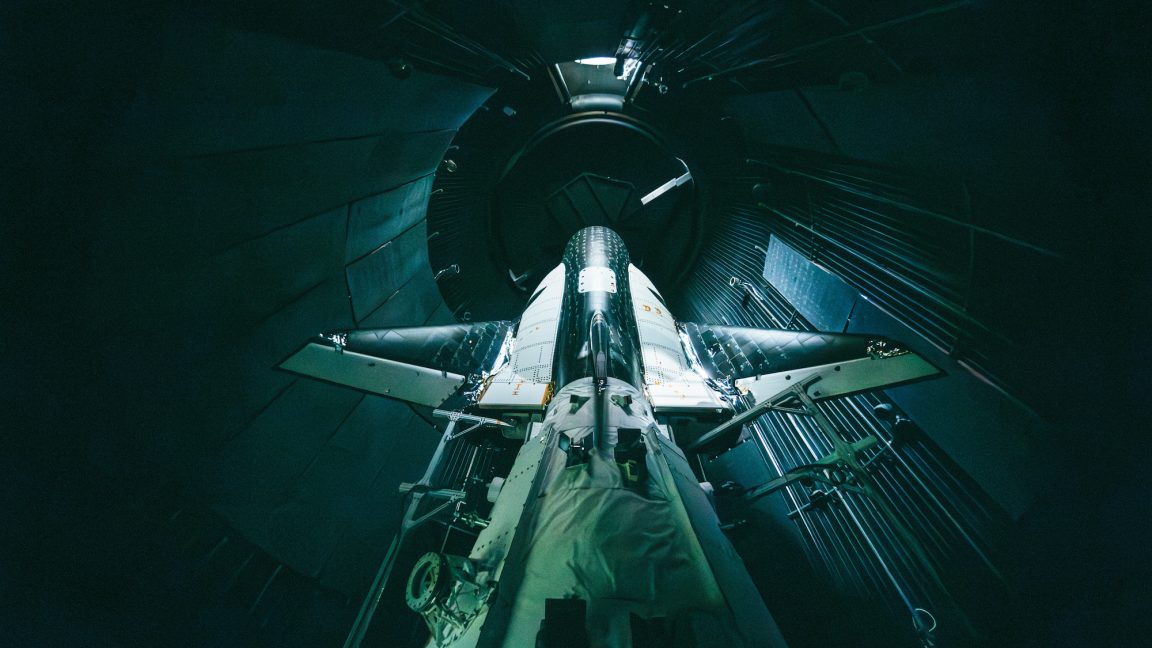
Is the Dream Chaser space plane ever going to launch into orbit?

“We wanted to have a fuel system that was green instead of using hypergolics, so we could land it on a runway and we could walk up to the vehicle without being in hazmat suits,” Tom Vice, then Sierra’s chief executive, told Ars in late 2023. “That was hard, I have to say.”

Apparently it still is because, according to Weigel, the process to finish testing of the propulsion system and certify it for an uncrewed spaceflight remains ongoing.

“We still have some of our integrated safety reviews to do, and we’re in the process with updating both of our schedules to try to understand where does that really put us,” she said. “And so Sierra’s working on that, and so I need to wait and just get information back from them to see where they think some of that work lines out.”

First mission may not berth with ISS

According to one source, Sierra is considering a modification to its first mission to shorten the certification period.

The company had planned to fly the vehicle close enough to the space station such that it could be captured and berthed to the orbiting laboratory. One option now under consideration is a mission that would bring Dream Chaser close enough to the station to test key elements of the vehicle in flight but not have it berth.

This would increase confidence in the spacecraft’s propulsion system and provide the data NASA and partner space agencies need to clear the vehicle to approach and berth with the station on its second flight. However, this would require a modification of the company’s contract with NASA, and a final decision has not yet been reached on whether to perform a flyby mission before an actual berthing.

It appears highly unlikely that Dream Chaser will be ready for its debut spaceflight this year for these technical reasons. Another challenge is the availability of its Vulcan launch vehicle. After years of delays, Vulcan is finally due to make its first national security launch as early as this coming Sunday. Assuming this launch is successful, Vulcan has a busy manifest in the coming months for the US Space Force.

Given this, it is uncertain when a Vulcan launch vehicle will become available for Dream Chaser, which was initially designated to fly on Vulcan’s second flight. However, because Dream Chaser was not ready last fall, that rocket flew with a mass simulator on this second launch, back in October 2024.

https://arstechnica.com/space/2025/08/is-the-dream-chaser-space-plane-ever-going-to-launch-into-orbit/


With Trump’s cutbacks, crew heads for ISS unsure of when they’ll come back

The next four-person team to live and work aboard the International Space Station departed from NASA’s Kennedy Space Center in Florida on Friday, taking aim at the massive orbiting research complex for a planned stay of six to eight months.

Spacecraft commander Zena Cardman leads the mission, designated Crew-11, that lifted off from Florida’s Space Coast at 11:43 am EDT (15:43 UTC) on Friday. Sitting to her right inside SpaceX’s Crew Dragon Endeavour capsule was veteran NASA astronaut Mike Fincke, serving as the vehicle pilot. Flanking the commander and pilot were two mission specialists: Kimiya Yui of Japan and Oleg Platonov of Russia.

Cardman and her crewmates rode a Falcon 9 rocket off the launch pad and headed northeast over the Atlantic Ocean, lining up with the space station’s orbit to set the stage for an automated docking at the complex early Saturday.


Goodbye LZ-1

The Falcon 9’s reusable first stage booster detached and returned to a propulsive touchdown at Landing Zone 1 (LZ-1) at Cape Canaveral Space Force Station, a few miles south of the launch site. This was the 53rd and final rocket landing at LZ-1 since SpaceX aced the first intact recovery of a Falcon 9 booster there on December 21, 2015.

On most of SpaceX’s missions, Falcon 9 boosters land on the company’s offshore drone ships hundreds of miles downrange from the launch site. For launches with enough fuel margin, the first stage can return to an onshore landing. But the Space Force, which leases out the landing zones to SpaceX, wants to convert the site of LZ-1 into a launch site for another rocket company.

SpaceX will move onshore rocket landings to new landing zones to be constructed next to the two Falcon 9 launch pads at the Florida spaceport. Landing Zone 2, located adjacent to Landing Zone 1, will also be decommissioned and handed back over to the Space Force once SpaceX activates the new landing sites.

“We’re working with the Cape and with the Kennedy Space Center folks to figure out the right time to make that transition from Landing Zone 2 in the future,” said Bill Gerstenmaier, SpaceX’s vice president of build and flight reliability. “But I think we’ll stay with Landing Zone 2 at least near-term, for a little while, and then look at the right time to move to the other areas.”

https://arstechnica.com/space/2025/08/with-trumps-cutbacks-crew-heads-for-iss-unsure-of-when-theyll-come-back/


The curious case of Russia’s charm offensive with NASA this week

Although NASA and its counterpart in Russia, Roscosmos, continue to work together on a daily basis, the leaders of the two organizations have not held face-to-face meetings since the middle of the first Trump administration, back in October 2018.

A lot has changed in the nearly eight years since then, including the Russian invasion of Ukraine, the rocky departure of Roscosmos leader Dmitry Rogozin in 2022 who was subsequently dispatched to the front lines of the war, several changes in NASA leadership, and more.

This drought in high-level meetings was finally broken this week when the relatively new leader of Roscosmos, Roscosmos Director General Dmitry Bakanov, visited the United States to view the launch of the Crew-11 mission from Florida, which included cosmonaut Oleg Platonov. Bakanov has also met with some of NASA’s human spaceflight leaders at Johnson Space Center in Houston.

Notably, NASA has provided almost no coverage of the visit. However, the state-operated Russian news service, TASS, has published multiple updates. For example, on Thursday at Kennedy Space Center, TASS reported that Bakanov and Acting NASA Administrator Sean Duffy discussed the future of the International Space Station.

Future of ISS partnership

“The conversation went quite well,” Bakanov is quoted as saying. “We agreed to continue using the ISS until 2028. It’s important that the new NASA chief confirmed this. We will work on the deorbiting process until 2030.”

A separate TASS report also quoted Duffy as saying NASA and Roscosmos should continue to work together despite high geopolitical tensions on Earth.

“What’s unique is we might find disagreement with conflict here, which we have,” Duffy said. “We have wild disagreement with the Russians on Ukraine, but what you see is we find points of agreement and points of partnership, which is what we have with the International Space Station and Russians, and so through hard times, we don’t throw those relationships away. We’re going to continue to work on the problems that we have here, but we’re going to continue to build alliances and partnerships and friendships as humanity continues to advance in space exploration.”

https://arstechnica.com/space/2025/08/the-curious-case-of-russias-charm-offensive-with-nasa-this-week/


Rocket Report: NASA finally working on depots, Air Force tests new ICBM

How to get to the Moon … The report estimates that canceling the SLS rocket, its ground systems, Orion, and the Lunar Gateway would save NASA $5.25 billion a year. The authors posit several different architectures for a lunar lander that would be ready sooner and be compatible with existing rockets. This includes a novel plan to use Crew Dragon, with legs, as a lander. It is not clear how much impact the report will have, as Congress seems to want to fly the SLS indefinitely, and the Trump administration seeks to cancel the rocket after two more flights.

NASA is finally interested in propellant depots. This week NASA’s Marshall Space Flight Center posted an update noting its recent work on developing and testing technology to manage cryogenic propellants in space. Teams at the field center in Huntsville, Alabama tested an innovative approach to achieve zero boiloff storage of liquid hydrogen using two stages of active cooling, which could prevent the loss of valuable propellant. “Technologies for reducing propellant loss must be implemented for successful long-duration missions to deep space like the Moon and Mars,” said Kathy Henkel, acting manager of NASA’s Cryogenic Fluid Management Portfolio Project, based at NASA Marshall.

If only this had been done earlier … This is great, obviously, as long-term storage of liquid propellants such as oxygen, hydrogen, and methane are critical to the strategies of SpaceX, Blue Origin, and other companies working to develop reusable and more cost-effective space transportation vehicles. However, it is somewhat ironic to see NASA and Marshall promoting this work after it was suppressed for a decade by US Sen. Richard Shelby, the Alabama Republican. As Ars has previously reported, in order to protect the Space Launch System rocket, Shelby directed NASA to end its work on storage and transfer of cryogenic propellants, going so far as to say he would fire anyone who used the word ‘depot.’ Well, we will say it: Depot.

<h2>Next three launches</h2>

August 1: Falcon 9 | Crew-11 | Kennedy Space Center, Florida | 15:43 UTC

August 2: Electron | JAKE 4 suborbital flight | Wallops Flight Facility, Virginia | 01:45 UTC

August 4: Falcon 9 | Starlink 10-30 | Cape Canaveral Space Force Station, Florida | 04:11 UTC

https://arstechnica.com/space/2025/08/rocket-report-nasa-finally-working-on-depots-air-force-tests-new-icbm/


The first company to complete a fully successful lunar landing is going public

The financial services firm Charles Schwab reported last month that IPOs are on the comeback across multiple sectors of the market. “After a long dry spell, there are signs of life in the initial public offerings space,” Charles Schwab said in June. “An increase in offerings can sometimes suggest an improvement in overall market sentiment.”

Firefly Aerospace started as a propulsion company. This image released by Firefly earlier this year shows the company’s family of engines. From left to right: Miranda for the Eclipse rocket; Lightning and Reaver for the Alpha rocket; and Spectre for the Blue Ghost and Elytra spacecraft.

Firefly is eschewing a SPAC merger in favor of a traditional IPO. Another space company, Voyager Technologies, closed an Initial Public Offering on June 11, raising nearly $383 million with a valuation peaking at $3.8 billion despite reporting a loss of $66 million in 2024. Voyager’s stock price has been in a precipitous decline since then.

Financial information disclosed by Firefly in a regulatory filing with the Securities and Exchange Commission reveals the company registered $60.8 million in revenue in 2024, a 10 percent increase from the prior year. But Firefly’s net loss widened from $135 million to $231 million, largely due to higher spending on research and development for the Eclipse rocket and Elytra spacecraft.

Rocket Lab, too, reported a net loss of $190 million in 2024 and another $60.6 million in the first quarter of this year. Despite this, Rocket Lab’s stock price has soared for most of 2025, further confirming that near-term profits aren’t everything for investors.

Chad Anderson, the founder and managing partner of Space Capital, offered a “gut check” to investors listening to his quarterly podcast last week.

“90 percent of IPOs that double on day one deliver negative returns over three years,” Anderson said. “And a few breakout companies become long-term winners… Rocket Lab being chief among them. But many fall short of expectations, even with some collapsing into bankruptcy, again, as we’ve seen over the last few years.

“There’s a lot of excitement about the space economy, and rightly so,” Anderson said. “This is a once-in-a-generation opportunity for investors, but unfortunately, I think this is going to be another example of why specialist expertise is required and the ability to read financial statements and understand the underlying business fundamentals, because that’s what’s really going to take companies through in the long term.”

https://arstechnica.com/space/2025/07/the-first-company-to-complete-a-fully-successful-lunar-landing-is-going-public/


Starlink kept me connected to the Internet without fail—until Thursday

A rare global interruption in the Starlink satellite Internet network knocked subscribers offline for more than two hours on Thursday, the longest widespread outage since SpaceX opened the service to consumers nearly five years ago.

The outage affected civilian and military users, creating an inconvenience for many but cutting off a critical lifeline for those who rely on Starlink for military operations, health care, and other applications.

Michael Nicolls, SpaceX’s vice president of Starlink engineering, wrote on X that the network outage lasted approximately 2.5 hours.

“The outage was due to failure of key internal software services that operate the core network,” Nicolls wrote. “We apologize for the temporary disruption in our service; we are deeply committed to providing a highly reliable network, and will fully root cause this issue and ensure it does not occur again.”

Elon Musk, SpaceX’s founder and CEO, apologized for the interruption in service on X: “Sorry for the outage. SpaceX will remedy root cause to ensure it doesn’t happen again.”

Effects big and small

The Ukrainian military has been at the leading edge of adopting Starlink services and adapting the system for use in war zones. Ukraine’s exploitation of Starlink connectivity has been instrumental in directing military operations, supporting battlefield communications, and controlling drones engaged in reconnaissance and offensive strikes.

The commander of Ukraine’s drone forces, Robert Brovdi, confirmed Thursday’s Starlink outage reached his country’s ongoing war with Russia.

“Starlink went down across the entire front,” Brovdi wrote on Telegram. “Combat operations were carried out without broadcasts; reconnaissance was carried out … using shock weapons.”

Brovdi added that the interruption in service illustrates the importance of having multiple paths of connectivity, especially for time-critical military operations. “This incident, which lasted 150 minutes in the war, points to bottlenecks,” he wrote, urging the military to diversify its means of communication and connectivity.

Oleksandr Dmitriev, the founder of a Ukrainian system that centralizes feeds from thousands of drone crews across the frontline, told Reuters the outage was an example of the shortcomings of relying on cloud services for military operations, particularly battlefield drone reconnaissance.

https://arstechnica.com/space/2025/07/starlink-kept-me-connected-to-the-internet-without-fail-until-thursday/