Rocket Report: Channeling the future at Wallops; SpaceX recovers rocket wreckage

The easiest way to keep up with Eric Berger’s and Stephen Clark’s reporting on all things space is to sign up for our newsletter. We’ll collect their stories and deliver them straight to your inbox.

Sign Me Up!

One big defense prime is posturing for Golden Dome. Northrop Grumman is conducting ground-based testing related to space-based interceptors as part of a competition for that segment of the Trump administration’s Golden Dome missile-defense initiative, The War Zone reports. Kathy Warden, Northrop Grumman’s CEO, highlighted the company’s work on space-based interceptors, as well as broader business opportunities stemming from Golden Dome, during a quarterly earnings call this week. Warden identified Northrop’s work in radars, drones, and command-and-control systems as potentially applicable to Golden Dome.

But here’s the real news … “It will also include new innovation, like space-based interceptors, which we’re testing now,” Warden continued. “These are ground-based tests today, and we are in competition, obviously, so not a lot of detail that I can provide here.” Warden declined to respond directly to a question about how the space-based interceptors Northrop Grumman is developing now will defeat their targets. (submitted by Biokleen)

Trump may slash environmental rules for rocket launches. The Trump administration is considering slashing rules meant to protect the environment and the public during commercial rocket launches, changes that companies like Elon Musk’s SpaceX have long sought, ProPublica reports. A draft executive order being circulated among federal agencies, and viewed by ProPublica, directs Secretary of Transportation Sean Duffy to “use all available authorities to eliminate or expedite” environmental reviews for launch licenses. It could also, in time, require states to allow more launches or even more launch sites along their coastlines.

Getting political at the FAA … The order is a step toward the rollback of federal oversight that Musk, who has fought bitterly with the Federal Aviation Administration over his space operations, and others have pushed for. Commercial rocket launches have grown exponentially more frequent in recent years. In addition to slashing environmental rules, the draft executive order would make the head of the FAA’s Office of Commercial Space Transportation a political appointee. This is currently a civil servant position, but the last head of the office took a voluntary separation offer earlier this year.

https://arstechnica.com/space/2025/07/rocket-report-channeling-the-future-at-wallops-spacex-recovers-rocket-wreckage/




Lawmakers writing NASA’s budget want a cheaper upper stage for the SLS rocket

Not surprisingly, Congress is pushing back against the Trump administration’s proposal to cancel the Space Launch System, the behemoth rocket NASA has developed to propel astronauts back to the Moon.

Spending bills making their way through both houses of Congress reject the White House’s plan to wind down the SLS rocket after two more launches, but the text of a draft budget recently released by the House Appropriations Committee suggests an openness to making some major changes to the program.

The next SLS flight, called Artemis II, is scheduled to lift off early next year to send a crew of four astronauts around the far side of the Moon. Artemis III will follow a few years later on a mission to attempt a crew lunar landing at the Moon’s south pole. These missions follow Artemis I, a successful unpiloted test flight in 2022.

After Artemis III, the official policy of the Trump administration is to terminate the SLS program, along with the Orion crew capsule designed to launch on top of the rocket. The White House also proposed canceling NASA’s Gateway, a mini-space station to be placed in orbit around the Moon. NASA would instead procure commercial launches and commercial spacecraft to ferry astronauts between the Earth and the Moon, while focusing the agency’s long-term gaze toward Mars.

CYA EUS?

House and Senate appropriations bills would preserve SLS, Orion, and the Gateway. However, the House version of NASA’s budget has an interesting paragraph directing NASA to explore cheaper, faster options for a new SLS upper stage.

NASA has tasked Boeing, which also builds SLS core stages, to develop an Exploration Upper Stage for debut on the Artemis IV mission, the fourth flight of the Space Launch System. This new upper stage would have large propellant tanks and carry four engines instead of the single engine used on the rocket’s interim upper stage, which NASA is using for the first three SLS flights.

https://arstechnica.com/space/2025/07/lawmakers-writing-nasas-budget-want-a-cheaper-upper-stage-for-the-sls-rocket/


Nearly 3,000 people are leaving NASA, and this director is one of them

You can add another name to the thousands of employees leaving NASA as the Trump administration primes the space agency for a 25 percent budget cut.

On Monday, NASA announced that Makenzie Lystrup will leave her post as director of the Goddard Space Flight Center on Friday, August 1. Lystrup has held the top job at Goddard since April 2023, overseeing a staff of more than 8,000 civil servants and contractor employees, and a budget last year of about $4.7 billion.

These figures make Goddard the largest of NASA’s 10 field centers primarily devoted to scientific research and development of robotic space missions, with a budget and workforce comparable to NASA’s human spaceflight centers in Texas, Florida, and Alabama. Officials at Goddard manage the James Webb and Hubble telescopes in space, and Goddard engineers are assembling the Nancy Grace Roman Space Telescope, another flagship observatory scheduled for launch late next year.

“We’re grateful to Makenzie for her leadership at NASA Goddard for more than two years, including her work to inspire a Golden Age of explorers, scientists, and engineers,” Vanessa Wyche, NASA’s acting associate administrator, said in a statement.

Cynthia Simmons, Goddard’s deputy director, will take over as acting chief at the space center. Simmons started work at Goddard as a contract engineer 25 years ago.

Lystrup came to NASA from Ball Aerospace, now part of BAE Systems, where she managed the company’s work on civilian space projects for NASA and other federal agencies. Before joining Ball Aerospace, Lystrup earned a doctorate in astrophysics from University College London and conducted research as a planetary astronomer.

Formal dissent

The announcement of Lystrup’s departure from Goddard came hours after the release of an open letter to NASA’s interim administrator, Transportation Secretary Sean Duffy, signed by hundreds of current and former agency employees. The letter, titled the “The Voyager Declaration,” identifies what the signatories call “recent policies that have or threaten to waste public resources, compromise human safety, weaken national security, and undermine the core NASA mission.”

https://arstechnica.com/space/2025/07/the-director-of-nasas-largest-science-center-is-leaving-government/


As White House talks about impounding NASA funding, Congress takes the threat seriously

This year, given the recent action on the budget measures, it is possible that Congress could pass Appropriations legislation for most of the federal government, including NASA before October 1.

Certainly there is motivation to do so, because the White House and its Office of Management and Budget, led by Russ Vought, has indicated that in absence of Appropriations legislation it is planning to take measures that would implement the Presidents Budget Request, which set significantly lower spending levels for NASA and other federal agencies.

For example, as Ars reported earlier this month, the principal investigators of NASA science missions that White House seeks to kill have been told to create termination plans that could be implemented within three months, beginning as soon as October 1.

Whether there is a continuing resolution, or shutdown, then, the White House appears likely to go to court to implement its spending priorities at federal agencies, including NASA.

Congress acknowledges the threat

This week the Ranking Members of House committee with oversight over NASA raised the alarm publicly about this in a letter to Sean Duffy, the Secretary of Transportation who was recently named interim administrator of NASA as well.

NASA appears to be acting in accordance with a fringe, extremist ideology emanating from the White House Office of Management and Budget that asserts a right to impound funds appropriated by Congress for the sake of executive branch priorities. Moreover, it now appears that the agency intends to implement funding cuts that were never enacted by Congress in order to “align” the agency’s present-day budget with the Trump Administration’s slash-and-burn proposed budget for the next fiscal year, with seemingly no concern for the devastation that will be caused by mass layoffs, widespread program terminations, and the possible closure of critical centers and facilities. These decisions are wrong, and they are not yours to make.

The letter reminds Duffy that Congress sets the budget, and federal agencies work toward those budget levels. However, the legislators say, NASA is moving ahead with funding freezes for various programs reducing employees across the agency. Approximately 2,700 employees have left the agency since the beginning of the Trump Administration.

https://arstechnica.com/space/2025/07/a-huge-fight-looms-over-the-nasa-budget-this-fall/


Amazon’s ride on the rocket merry-go-round continues with SpaceX launch

SpaceX’s patch for the KF-01 mission illustrates a Falcon 9 rocket with a batch of Kuiper broadband satellites inside its payload fairing. Credit: SpaceX

Vulcan, Ariane 6, and New Glenn have all now launched successfully, but none of them have yet demonstrated the ability to launch more than twice a year. Vulcan and Ariane 6 appear to be on track to fly multiple times before the end of 2025, while Blue Origin’s ability to quickly ramp up New Glenn’s launch cadence is more questionable.

Amazon’s only path to space for Kuiper satellites until the fall will be SpaceX’s Falcon 9.

A Federal Communications Commission deadline requires Amazon to launch half of its constellation by next July. The company will likely have to ask the FCC to extend the deadline due to Kuiper delays. For a long time, issues starting up Amazon’s Kuiper satellite production line were responsible for the delays. Now, it’s a lack of available rockets, so SpaceX is stepping in.

The Kuiper satellite factory in Kirkland, Washington, is churning out several satellites per week and shipping them to Cape Canaveral for launch preparations. At this rate, another batch of Kuiper spacecraft should be ready to fly within a few weeks. Amazon eventually wants to increase its factory throughput to five satellites per day.

Amazon’s Kuiper production plant is already the second-busiest satellite factory in the Western world, ranking behind only SpaceX’s Starlink factory a few miles away in another Seattle-area suburb.

For point of comparison, SpaceX launched a set of 26 Starlink satellites on a Falcon 9 rocket from California just four hours prior to Wednesday morning’s Kuiper launch from Florida. These additions to the Starlink network bring SpaceX’s megaconstellation to nearly 8,000 satellites in orbit. SpaceX has now launched more than 9,100 Starlink satellites to date, including spacecraft that have left the constellation for disposal in Earth’s atmosphere.

https://arstechnica.com/space/2025/07/amazons-ride-on-the-rocket-merry-go-round-continues-with-spacex-launch/


Rocket Report: SpaceX to make its own propellant; China’s largest launch pad

Trust the computer … It’s easy to be skeptical about this project, but it has attracted an interesting group of people. LEAP 71 has just two employees—its two German co-founders—but boasts lofty ambitions and calls itself a “pioneer in AI-driven engineering.” As part of the agreement with Aspire Space, LEAP 71 will use a proprietary software program called Noyron to design the entire propulsion stack for Aspire’s rockets. The company says its AI-enabled design approach for Aspire’s 450,000-pound-thrust engine will cut in half the time it took other rocket companies to begin test-firing a new engine of similar size. Rudenko forecasts Aspire’s entire project, including a launcher, reusable spacecraft, and ground infrastructure to support it all, will cost more than $1 billion. So far, the project is self-funded, Rudenko told Payload. (submitted by Lin Kayser)

Russia launches ISS resupply freighter. A Russian Progress supply ship launched July 3 from the Baikonur Cosmodrome in Kazakhstan atop a Soyuz-2.1a rocket, NASASpaceflight reports. Packed with 5,787 pounds (2,625 kilograms) of cargo and fuel, the Progress MS-31 spacecraft glided to an automated docking at the International Space Station two days later. The Russian cosmonauts living aboard the ISS will unpack the supplies carried inside the Progress craft’s pressurized compartment. This was the eighth orbital launch of the year by a Russian rocket, continuing a downward trend in launch activity for the Russian space program in recent years.

Celebrating a golden anniversary … The Soyuz rocket that launched Progress MS-31 was painted an unusual blue and white scheme, as it was originally intended for a commercial launch that was likely canceled after Russia’s invasion of Ukraine. It also sported a logo commemorating the 50th anniversary of the Apollo-Soyuz mission in July 1975.

Chinese rocket moves closer to first launch. Chinese commercial launch firm Orienspace is aiming for a late 2025 debut of its Gravity-2 rocket following a recent first-stage engine hot fire test, Space News reports. The “three-in-one” hot fire test verified the performance of the Gravity-2 rocket’s first stage engine, servo mechanisms, and valves that regulate the flow of propellants into the engine, according to a press release from Orienspace. The Gravity-2 rocket’s recoverable and reusable first stage will be powered by nine of these kerosene-fueled engines. The recent hot fire test “lays a solid foundation” for future tests leading up to the Gravity-2’s inaugural flight.

Extra medium … Orienspace’s first rocket, the solid-fueled Gravity-1, completed its first successful flight last year to place multiple small satellites into orbit. Gravity-2 is a much larger vehicle, standing 230 feet (70 meters) tall, the same height as SpaceX’s Falcon 9 rocket. Orienspace’s new rocket will fly in a core-only configuration or with the assistance of two solid rocket boosters. An infographic released by Orienspace in conjunction with the recent engine hot fire test indicates the Gravity-2 rocket will be capable of hauling up to 21.5 metric tons (47,400 pounds) of cargo into low-Earth orbit, placing its performance near the upper limit of medium-lift launchers.

https://arstechnica.com/space/2025/07/rocket-report-starbase-propellant-plant-wins-approval-vulcan-nears-key-launch/


It’s hunting season in orbit as Russia’s killer satellites mystify skywatchers

Jim Shell, a former NRO project manager and scientist at Air Force Space Command, suggested the two satellites seem positioned to cooperate with one another. “Many interesting scenarios here such as ‘spotter shooter’ among others. Certainly something to keep eyes on!” Shell posted Saturday on X.

COMSPOC, a commercial space situational awareness company, said the unusual orbit of Kosmos 2589 and its companion put the Russian satellites in a position to, at a minimum, spy on Western satellites in geosynchronous orbit.

“This unique orbit, which crosses two key satellite regions daily, may aid in monitoring objects in both GEO and graveyard orbits,” COMSPOC wrote on X. “Its slight 1° inclination could also reduce collision risks. While the satellite’s mission remains unclear, its orbit suggests interesting potential roles.”

Historically, Russia’s military has placed less emphasis on operating in geosynchronous orbit than in low-Earth orbit or other unique perches in space. Due to their positions near the equator, geosynchronous orbits are harder to reach from Russian spaceports because of the country’s high latitude. But Russia’s potential adversaries, like the United States and Europe, rely heavily on geosynchronous satellites.

Other Russian satellites have flown near Western communications satellites in geosynchronous orbit, likely in an attempt to eavesdrop on radio transmissions.

“So it is interesting that they may be doing a GEO inspector,” the retired US military space official told Ars. “I would be curious if that’s what it is. We’ve got to watch. We’ve got to wait and see.”

If you’re a fan of spy techno-thrillers, this all might remind you of the plot from The Hunt for Red October, where a new state-of-the-art Russian submarine leaves its frigid port in Murmansk with orders to test a fictional silent propulsion system that could shake up the balance of power between the Soviet and American navies.

Just replace the unforgiving waters of the North Atlantic Ocean with an environment even more inhospitable: the vacuum of space.

A few minutes into the film, the submarine’s commander, Marko Ramius, played by Sean Connery, announces his orders to the crew. “Once more, we play our dangerous game, a game of chess, against our old adversary—the American Navy.”

Today, nearly 40 years removed from the Cold War, the old adversaries are now scheming against one another in space.

https://arstechnica.com/space/2025/07/its-hunting-season-in-orbit-as-russias-killer-satellites-mystify-skywatchers/


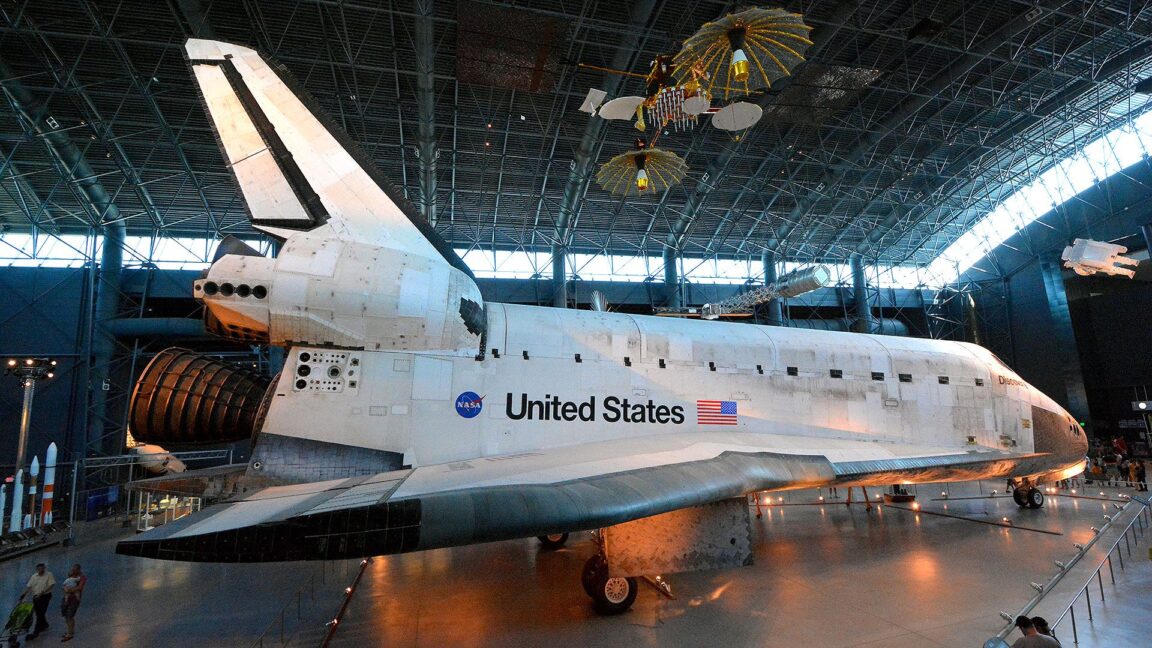
“It’s a heist”: Senator calls out Texas for trying to steal shuttle from Smithsonian

Citing research by NASA and the Smithsonian, Durbin said that the total was closer to $305 million and that did not include the estimated $178 million needed to build a facility to house and display Discovery once in Houston.

Furthermore, it was unclear if Congress even has the right to remove an artifact, let alone a space shuttle, from the Smithsonian’s collection. The Washington, DC, institution, which serves as a trust instrumentality of the US, maintains that it owns Discovery. The paperwork signed by NASA in 2012 transferred “all rights, interest, title, and ownership” for the spacecraft to the Smithsonian.

“This will be the first time ever in the history of the Smithsonian someone has taken one of their displays and forcibly taken possession of it. What are we doing here? They don’t have the right in Texas to claim this,” said Durbin.

Houston was not the only city to miss out on displaying a retired space shuttle. In 2011, Durbin and fellow Illinois Senator Mark Kirk appealed to NASA to exhibit one of the winged spacecraft at the Adler Planetarium in Chicago. The agency ultimately decided to award the shuttles to the National Air and Space Museum, the Kennedy Space Center Visitor Complex in Florida, and the California Science Center in Los Angeles.

Houston, we have a problem

A prototype orbiter that was exhibited where Discovery is now was transferred to the Intrepid Museum in New York City.

To be able to bring up his points at Thursday’s hearing, Durbin introduced the “Houston, We Have a Problem” amendment to “prohibit the use of funds to transfer a decommissioned space shuttle from one location to another location.”

He then withdrew the amendment after having voiced his objections.

“I think we’re dealing with something called waste. Eighty-five million dollars worth of waste. I know that this is a controversial issue, and I know that there are other agencies, Smithsonian, NASA, and others that are interested in this issue; I’m going to withdraw this amendment, but I’m going to ask my colleagues be honest about it,” said Durbin. “I hope that we think about this long and hard.”

https://arstechnica.com/space/2025/07/its-a-heist-senator-calls-out-texas-for-trying-to-steal-shuttle-from-smithsonian/


Nearly everyone opposes Trump’s plan to kill space traffic control program

The trade organizations count the largest Western commercial satellite operators among their members: SpaceX, Amazon, Eutelsat OneWeb, Planet Labs, Iridium, SES, Intelsat, and Spire. These are the companies with the most at stake in the debate over the future of space traffic coordination. Industry sources told Ars that some companies are concerned a catastrophic collision in low-Earth orbit might trigger a wave of burdensome regulations, an outcome they would like to avoid.

“Without funding for space traffic coordination, US commercial and government satellite operators would face greater risks—putting critical missions in harm’s way, raising the cost of doing business, and potentially driving US industry to relocate overseas,” the industry groups warned.

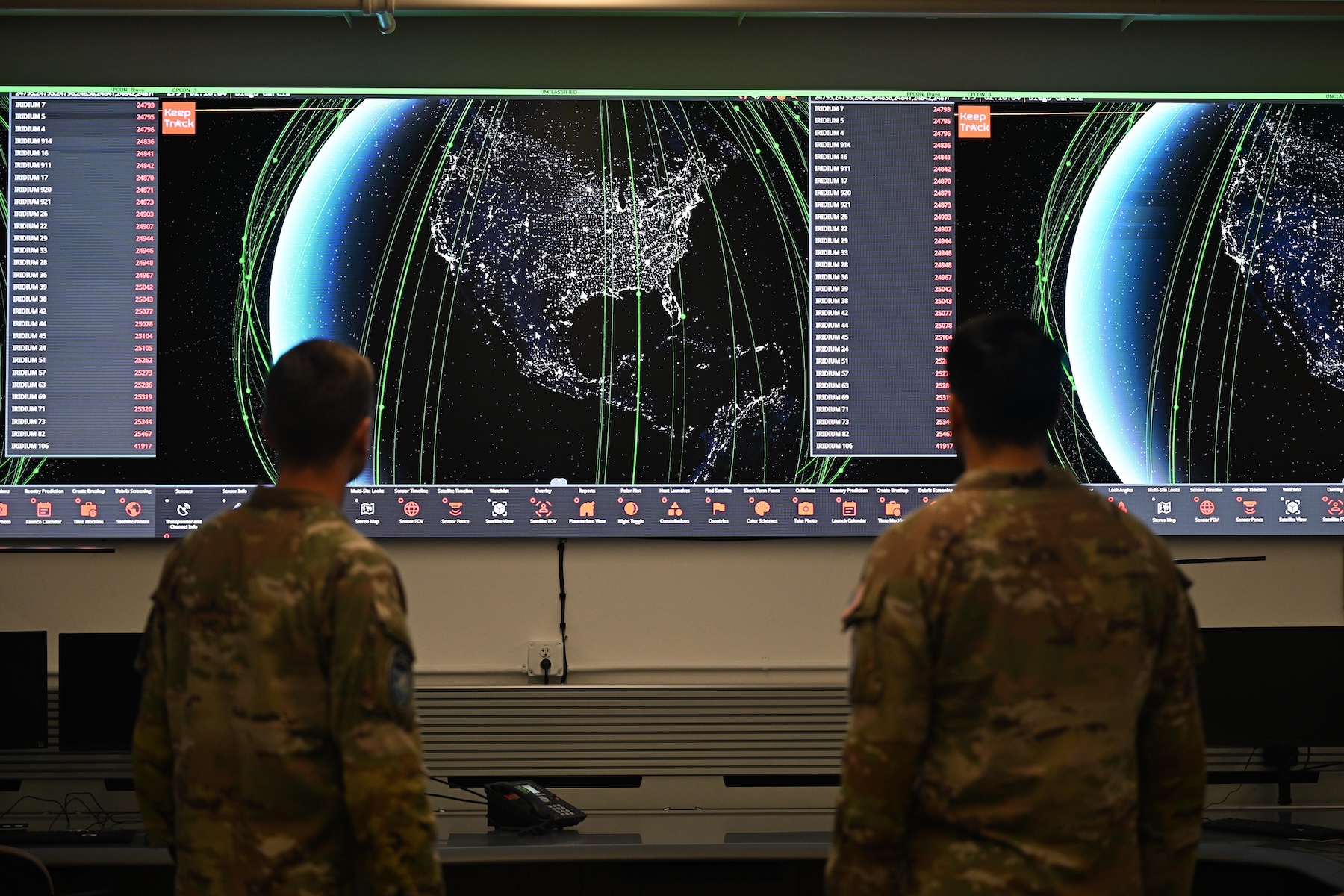
Members of the 18th Space Defense Combat Squadron observe orbital data at Vandenberg Space Force Base, California, on October 4, 2024. Credit: US Space Force/David Dozoretz

The military currently performs the spaceflight safety mission, providing up to a million collision warnings per day to give satellite operators a heads-up that their spacecraft will encounter another object as they speed around the Earth at nearly 5 miles per second. A collision at those velocities would endanger numerous other satellites, including the International Space Station. This happened in 2009 with the accidental collision of a functional commercial communications satellite and a defunct Russian spacecraft, adding more than 2,000 pieces of debris to busy orbital traffic lanes.

Ideally, the Space Force issues its warnings in time for a satellite operator to maneuver their spacecraft out of the path of a potential collision. Satellite operators might also have more precise information on the location of their spacecraft, and determine that they don’t need to perform any collision avoidance maneuver.

The military’s Space Surveillance Network (SSN) tracks more than 47,000 objects in orbit. Most of these objects are orbital debris, but there’s a growing number of active spacecraft as many operators—mainly SpaceX, Amazon, the Space Force, and China—deploy megaconstellations with hundreds to thousands of satellites.

The Satellite Industry Association reports that nearly 2,700 satellites were launched into Earth orbit last year, bringing the total number of active satellites to 11,539, a threefold increase over the number of operating spacecraft in 2020.

Under strain

Space Force officials are eager to exit the business of warning third-party satellite operators, including rivals such as Russia and China, of possible collisions in orbit. The military would prefer to focus on managing ever-growing threats from satellites, an intensive effort that requires continual monitoring as other nations’ increasingly sophisticated spacecraft maneuver from one orbit to another.

https://arstechnica.com/space/2025/07/nearly-everyone-opposes-trumps-plan-to-kill-space-traffic-control-program/


Investors appear to like a company with big space manufacturing ambitions

The company has also positioned its W-series of spacecraft, which reenter at a maximum speed of Mach 25, as an ideal test bed for thermal protection materials, navigation, communications, and other sensors that could be flown operationally on hypersonic missiles.

Therefore, Varda’s three main lines of business are military applications, pharmaceutical research and manufacturing, and basic research in microgravity.

The latter is an interesting option at a time when NASA is rushing to manifest research experiments on board the International Space Station—which is due to retire in 2030—and commercial space stations have not yet come online (and may not for several years).

Humans in the loop?

For experiments that can be done without a human astronaut, Varda now offers a less expensive and faster way to get experiments done in space.

It is not difficult to envision an increasingly sophisticated, autonomous spacecraft potentially taking some commercial business away from private space stations (NASA’s program for this is called Commercial LEO Destinations, or CLDs) that are being developed to come online by 2030, or shortly thereafter. However, Varda officials say this is not their intent.

“We don’t view ourselves [as] competitive with those platforms. If anything, we’re a force multiplier,” said Eric Lasker, Varda’s chief revenue officer. “We view ourselves more as the bridge versus some kind of competition to all things CLD.”

Nevertheless, it’s worth noting that Varda is flying missions right now—and quite a lot of them for a small space company. The next five years could see some industries and commercial applications moving toward an autonomous model in space rather than having humans in the loop, simply because that’s the commercial option that exists today.

Despite its autonomous posture, Varda is not actually anti-human spaceflight. Asparouhov said the company would eventually like to build much larger platforms in space that can stay there permanently. Over time, these facilities will naturally need some maintenance.

“Consider an oil rig worker in Dallas where it’s two weeks on, two weeks off. You get to be with your family two weeks, and then you’re at this industrial outpost in the middle of nowhere that’s difficult to get to,” he said. “Ours just happens to be this low-Earth-orbit-based industrial outpost rather than somewhere in the ocean.”

https://arstechnica.com/space/2025/07/after-some-success-in-space-varda-raises-187-million-to-expand-ambitions/