Here’s why Trump appointed the Secretary of Transportation to lead NASA

Six weeks after he terminated the nomination of Jared Isaacman to become NASA Administrator, President Trump moved on Wednesday evening to install a new temporary leader for the space agency.

The newly named interim administrator, Sean Duffy, already has a full portfolio: He is serving as the Secretary of Transportation, a Cabinet-level position that oversees 55,000 employees at thirteen agencies, including the Federal Aviation Administration.

“Sean is doing a TREMENDOUS job in handling our Country’s Transportation Affairs, including creating a state-of-the-art Air Traffic Control systems, while at the same time rebuilding our roads and bridges, making them efficient, and beautiful, again,” Trump wrote on his social media network Wednesday evening. “He will be a fantastic leader of the ever more important Space Agency, even if only for a short period of time.”

In response to this post, Duffy wrote on X, “Honored to accept this mission. Time to take over space. Let’s launch.”

The idea of the Secretary of Transportation also running NASA may seem like an odd choice, but in some ways the appointment of Duffy makes sense for the President. Whether it is beneficial to the space agency remains to be seen, but two industry sources speaking confidentially said they would not immediately dismiss the prospect.

Who is Sean Duffy?

Duffy has a colorful background, starring on the Real World: Boston reality television show in 1997, and serving as a commentator on ESPN. A Republican, he served in the US House of Representatives from 2011 to 2019. He is married and has nine children.

Although he does not have a space background, Duffy has shown an interest in spaceflight since becoming FAA Administrator. He watched from NASA Headquarters the Crew 9 mission’s splashdown on March 18, which brought Butch Wilmore and Suni Williams back to Earth after a prolonged stay in space. He also had expressed an interest in attending the forthcoming Crew 11 launch at the end of this month.

https://arstechnica.com/space/2025/07/nasa-has-a-new-interim-administrator-the-secretary-of-transportation/


Rocket Report: Japan’s workhorse booster takes a bow; you can invest in SpaceX now

Seeking to scale … “Thanks to this location, we will be able to industrialize Zephyr production up to 50 units per year while maintaining control over our growth pace,” said Isabelle Valentin, chief operating officer of the company. Latitude aims to launch its Zephyr rocket in 2026 from the Guiana Space Centre, in French Guiana, for the first time. The company also said it has signed two major contracts, including a strategic mission for the European Defence Fund and a contract with the French space agency, CNES, for microgravity demonstrations.

Japan’s H2A rocket makes final flight. Japan’s flagship H2A rocket lifted off for the final time on Sunday from the Tanegashima Space Center in Kagoshima Prefecture, successfully concluding a 24-year run that has defined the nation’s space capabilities, The Japan Times reports. The rocket’s 50th and final mission carried the GOSAT-GW, a government-developed hybrid environmental observation satellite.

Out with the old, in with the new … Jointly developed by Mitsubishi Heavy Industries and the Japan Aerospace Exploration Agency, the 53-meter rocket debuted in 2001 and quickly became the workhorse of the country’s space program. It had an excellent record, with 49 successes out of 50 launch attempts. The decision to retire the H2A comes amid rising global competition in the space launch industry, where cost-efficiency has become a key differentiator. Japan hopes its new H3 rocket, although expendable, will be more cost competitive.

SpaceX to win DOD satellite contract. The Trump administration plans to cancel a fleet of orbiting data relay satellites managed by the Space Development Agency and replace it with a secretive network that, so far, relies primarily on SpaceX’s Starlink Internet constellation, Ars reports. While details of the Pentagon’s plan remain secret, the White House proposal would commit $277 million in funding to kick off a new program called “pLEO SATCOM” or “MILNET.” The funding line for a proliferated low-Earth orbit satellite communications network hasn’t appeared in a Pentagon budget before, but plans for MILNET already exist in a different form.

X marks the spot … Meanwhile, the budget proposal for fiscal year 2026 would eliminate funding for a new tranche of data relay satellites from the Space Development Agency. The pLEO SATCOM or MILNET program would replace them, providing crucial support for the Trump administration’s proposed Golden Dome missile defense shield. While SpaceX’s role isn’t mentioned explicitly in the Pentagon’s budget documents, the MILNET program is already on the books, and SpaceX is the lead contractor. It has been made public in recent months, after years of secrecy, although many details remain unclear.

https://arstechnica.com/space/2025/07/rocket-report-japans-workhorse-booster-takes-a-bow-you-can-invest-in-spacex-now/


Pentagon may put SpaceX at the center of a sensor-to-shooter targeting network

The possibilities include exploiting automation, artificial intelligence, and machine learning to sense, target, and strike an enemy vehicle—a truck, tank, airplane, ship, or missile—nearly instantaneously.

“If I’m on the edge doing 3D fusion, I’m less dependent on the ground and I can get around the globe with my mesh network,” Davis said. “There’s inherent resilience in the overall architecture—not just the space architecture, but the overall architecture—if the ground segment or link segment comes under attack.”

Questioning the plan

Military officials haven’t disclosed the cost of MILNET, either in its current form or in the future architecture envisioned by the Trump administration. For context, SDA has awarded fixed-price contracts worth more than $5.6 billion for approximately 340 data relay satellites in Tranches 1 and 2.

That comes out to roughly $16 million per spacecraft, at least an order of magnitude more expensive than a Starlink satellite coming off of SpaceX’s assembly line. Starshield satellites, with their secure communications capability, are presumably somewhat more expensive than an off-the-shelf Starlink.

Some former defense officials and lawmakers are uncomfortable with putting commercially operated satellites in the “kill chain,” the term military officials use for the process of identifying threats, making a targeting decision, and taking military action.

It isn’t clear yet whether SpaceX will operate the MILNET satellites in this new paradigm, but the company has a longstanding preference for doing so. SpaceX built a handful of tech demo satellites for the Space Development Agency a few years ago, but didn’t compete for subsequent SDA contracts. One reason for this, sources told Ars, is that the SDA operates its satellite constellation from government-run control centers.

Instead, the SDA chose L3Harris, Lockheed Martin, Northrop Grumman, Rocket Lab, Sierra Space, Terran Orbital, and York Space Systems to provide the next batches of missile tracking and data transport satellites. RTX, formerly known as Raytheon, withdrew from a contract after the company determined it couldn’t make money on the program.

https://arstechnica.com/space/2025/07/pentagon-may-put-spacex-at-the-center-of-a-sensor-to-shooter-targeting-network/


White House works to ground NASA science missions before Congress can act

NASA typically complies with guidance from Congress since it receives its budget from Congress. (Really, you do not want to bite the hand that feeds.) However, this year’s process is not expected to be normal, and there is no legal requirement for NASA (or other federal agencies) to consider congressional feedback on their operating plans.

This year, in fact, the Office of Management and Budget has even stopped NASA from submitting operational plans to Congress.

“This is yet another bad faith move by the administration, which seems hell-bent on attacking science and the future of American innovation,” said Rep. George Whitesides (D-Calif.), who previously served as NASA’s chief of staff. “To go around Congress, and the committee of jurisdiction that I sit on, to enact their radical agenda that will make us less safe, less competitive, and less able to respond to threats is not only dangerous, it will cede all ground to our adversaries like China.”

Will the last planetary scientist please turn out the lights?

How will this play out?

There are multiple strategies, and some of them are likely to end up in court fights. Philosophically, Vought believes strongly that the president should have more authority to direct federal spending. And he appears likely to try to force the issue this year. Using tactics such as recission—essentially ordering federal agencies to freeze spending—and impoundment, Vought will seek to implement the priorities in the president’s budget request, which his office wrote.

Beginning October 1, without a fiscal year 2026 budget in place, NASA may be directed to start following the closeout plans submitted this month by principal investigators and turning missions off. That means the lights go out at Jupiter, telescopes stop gathering data across the Solar System, and so on for dozens of missions.

And once those missions are gone, they’re almost impossible to bring back—even if Congress were inclined to restore funding months later with a new budget.

“If there’s not much hope to restart a mission, the people who are managing Juno, New Horizons, and other missions are going to be looking for their next job,” Green said. “They’re going to be gone. Within a few months, you won’t be able to get the expertise back. And without the expertise, you don’t have the ability to run the mission safely.”

https://arstechnica.com/space/2025/07/trump-administration-moves-to-tighten-the-noose-around-nasa-science-missions/


Texas politicians make headway in effort to wrench space shuttle from Smithsonian

In 2011, the NASA Office of the Inspector General investigated the process that NASA went through and found “no evidence that the White House, politics, or any other outside force improperly influenced the selection decision.” The OIG did find one “significant error,” but it would have benefited the National Museum of the US Air Force in Ohio, rather than Space Center Houston.

Don’t say Discovery

The language in the Senate bill avoids any mention of the Smithsonian, Space Center Houston, Discovery, or even the space shuttle. It only stipulates that a “space vehicle” (defined as a vessel that carried people into space) be transferred within 18 months of enactment to a NASA center “involved in the administration of the Commercial Crew program” and put on public display “within the Metropolitan Statistical Area” of that center.

The bill directs that the NASA administrator (or acting administrator) identify the vehicle within 30 days of the bill becoming law. Of the four retired orbiters, Enterprise in New York and Endeavour in California are owned by their display homes; Discovery and Atlantis, the latter on display in Florida, remain federal property.

The vagueness of the wording is an effort to avoid the provision being flagged by the Senate parliamentarian for violating the “Byrd rule,” which keeps “extraneous matter” out of Senate reconciliation bills, including earmarks directed at a specific recipient, according to Roll Call. The shuttle move, as originally phrased, was identified as being at risk.

Should the text remain and make it to a vote and the Senate passes the bill, then it still must return to the House of Representatives to be reconciled with its version passed in May. Rep. Randy Weber, serving Texas’ 14th District, said that he was prepared to enter Discovery’s move into the House bill.

“We’re working on it,” said Weber at Space Center Houston, standing with Cornyn. “They are working on the Big Beautiful Bill; we’ll get this done and, hopefully, we’ll get this headed our way.”

https://arstechnica.com/space/2025/06/relocation-of-space-shuttle-discovery-may-hinge-on-big-beautiful-bill/


Rocket Report: SpaceX’s dustup on the border; Northrop has a nozzle problem

Sovereign launch … HyPrSpace’s Baguette One will stand roughly 10 meters (30 feet) tall and will be capable of carrying payloads of up to 300 kilograms (660 pounds) to suborbital space. It is scheduled to launch next year from a French missile testing site in the south of France. “Gaining access to this dual-use launch pad in mainland France is a major achievement after many years of work on our hybrid propulsion technology,” said Sylvain Bataillard, director general of HyPrSpace. “It’s a unique opportunity for HyPrSpace and marks a decisive turning point. We’re eager to launch Baguette One and to play a key role in building a more sovereign, more sustainable, and boldly innovative European dual-use space industry.” (submitted by EllPeaTea)

Firefly moves closer to launching from Sweden. An agreement between the United States and Sweden brings Firefly Aerospace one step closer to launching its Alpha rocket from a Swedish spaceport, Space News reports. The two countries signed a technology safeguards agreement (TSA) at a June 20 ceremony at the Swedish embassy in Washington, DC. The TSA allows the export of American rockets to Sweden for launches there, putting in place measures to protect launch vehicle technology.

A special relationship … The US government has signed launch-related safeguard agreements with only a handful of countries, such as Australia, the United Kingdom, and now Sweden. Rocket exports are subject to strict controls because of the potential military applications of that technology. Firefly currently launches its Alpha rocket from Vandenberg Space Force Base, California, and is building a launch site at Wallops Island, Virginia. Firefly also has a lease for a launch pad at Cape Canaveral, Florida, although the company is prioritizing other sites. Then, last year, Firefly announced an agreement with the Swedish Space Corporation to launch Alpha from Esrange Space Center as soon as 2026. (submitted by EllPeaTea)

Amazon is running strong out of the gate. For the second time in two months, United Launch Alliance sent a batch of 27 broadband Internet satellites into orbit for Amazon on Monday morning, Ars reports. This was the second launch of a full load of operational satellites for Amazon’s Project Kuiper, a network envisioned to become a competitor to SpaceX’s Starlink. Just like the last flight on April 28, an Atlas V rocket lifted off from Cape Canaveral, Florida, and delivered Amazon’s satellites into an on-target orbit roughly 280 miles (450 kilometers) above Earth.

https://arstechnica.com/science/2025/06/rocket-report-spacexs-dustup-on-the-border-northrop-has-a-nozzle-problem/


NASA tested a new SLS booster that may never fly, and the end of it blew off

Unlike the RS-25 firing at Stennis, NASA chose to broadcast the booster test. Everything appeared to go well until 1 minute and 40 seconds into the burn, when a fiery plume of super-hot exhaust appeared to burn through part of the booster’s structure just above the nozzle. Moments later, the nozzle disintegrated.

Solid rocket boosters can’t be turned off after ignition, and for better or worse, the motor continued firing until it ran out of propellant about 30 seconds later. The rocket sparked a fire in the hills overlooking the test stand.

This was the first test-firing of the Booster Obsolescence and Life Extension (BOLE) program, which aims to develop a higher-performance solid rocket booster for SLS missions. NASA awarded Northrop Grumman a $3.2 billion contract in 2021 to produce boosters with existing shuttle parts for five SLS missions (Artemis IV-VIII), and design, develop, and test a new booster design for Artemis IX.

The boosters produce more than 75 percent of the thrust required to propel the SLS rocket off the launch pad with NASA’s crewed Orion spacecraft on top. Four RS-25 engines power the core stage, collectively generating more than 2 million pounds of thrust.

Northrop Grumman calls the new booster “the largest and most powerful segmented solid rocket motor ever built for human spaceflight.”

One of the most significant changes with the BOLE booster design is that it replaces shuttle-era steel cases with carbon-fiber composite cases. Northrop says the new cases are lighter and stronger. It also replaces the booster’s hydraulic thrust vector control steering system with an electronic system. The propellant packed inside the booster is also different, using a mix that Northrop packs inside its commercial rocket motors instead of the recipe used for the space shuttle.

Northrop Grumman has had a tough time with rocket nozzles in recent years. In 2019, a test motor for the company’s now-canceled Omega rocket lost its nozzle during a test-firing in Utah. Then, last year, a smaller Northrop-made booster flying on United Launch Alliance’s Vulcan rocket lost its nozzle in flight. Vulcan’s guidance system and main engines corrected for the problem, and the rocket still achieved its planned orbit.

https://arstechnica.com/space/2025/06/nasa-tested-a-new-sls-booster-that-may-never-fly-and-the-end-of-it-blew-off/


Psyche keeps its date with an asteroid, but now it’s running in backup mode

The spacecraft, built by Maxar Space Systems, will operate its electric thrusters for the equivalent of three months between now and November to keep the mission on track for arrival at asteroid Psyche in 2029.

“Through comprehensive testing and analysis, the team narrowed down the potential causes to a valve that may have malfunctioned in the primary line,” NASA said in a statement Friday. “The switch to the identical backup propellant line in late May restored full functionality to the propulsion system.”

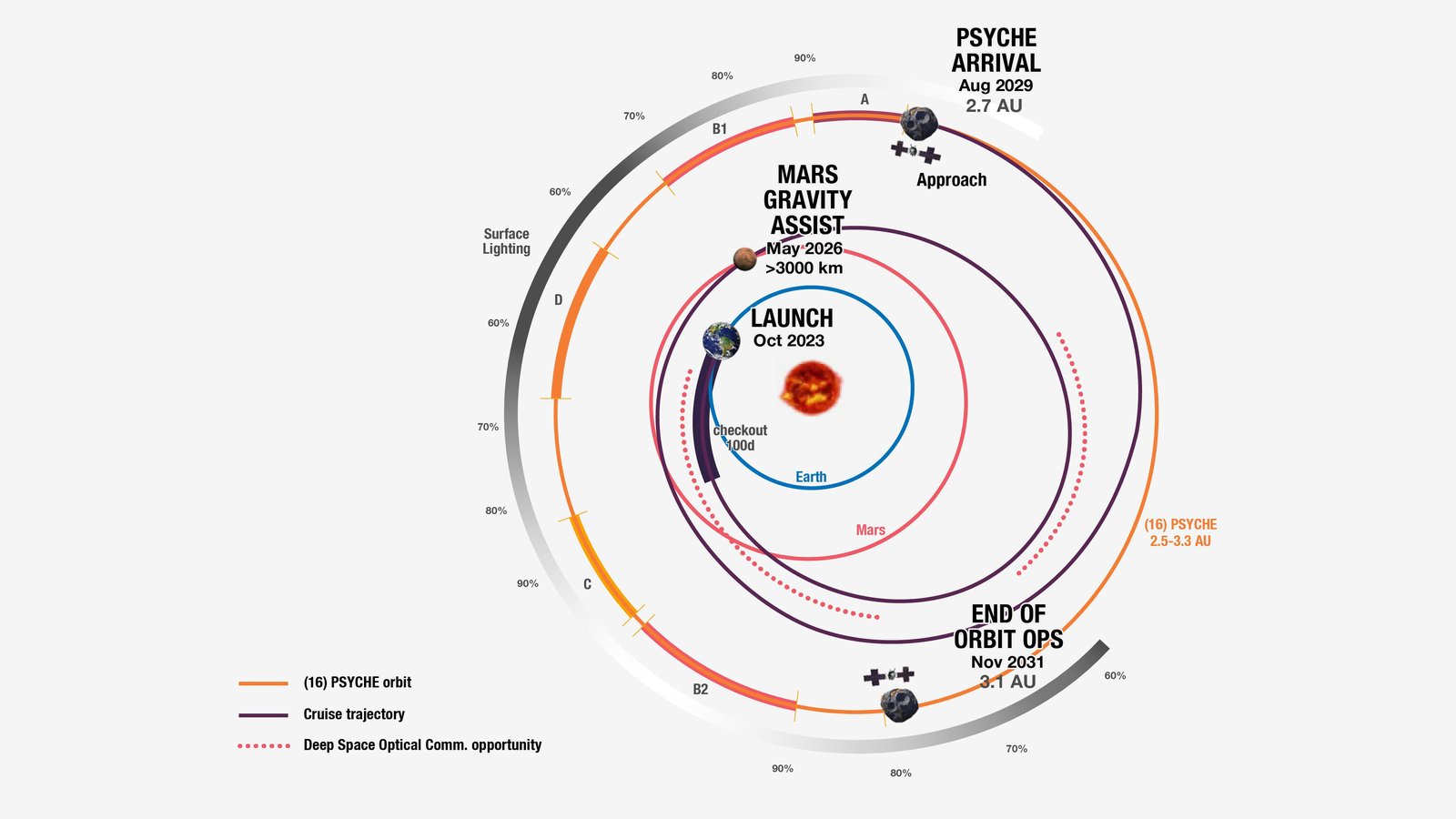
The next waypoint on Psyche’s voyage will be a flyby of Mars in May 2026. Officials expect Psyche to keep that date, which is critical for using Mars’ gravity to slingshot the spacecraft deeper into the Solar System, eventually reaching the asteroid belt about four years from now.

NASA’s Psyche spacecraft takes a spiral path to the asteroid Psyche, as depicted in this graphic that shows the path from above the plane of the planets, labeled with key milestones of the prime mission. Credit: NASA/JPL-Caltech

At Psyche, the spacecraft will enter orbit and progressively move closer to the asteroid, using a suite of sensors to map its surface, measure its shape, mass, and gravity field, and determine its elemental composition. Observations through telescopes suggest Psyche is roughly 140 miles (226 kilometers) in diameter, or about the width of Massachusetts. But it’s likely not spherical in shape. Scientists describe its shape as more akin to a potato.

Potatoes come in lots of shapes, and researchers won’t know exactly what Psyche looks like until NASA’s asteroid explorer arrives in 2029. Psyche will be the first metallic, or M-type, asteroid visited by any spacecraft, and scientists are eager to study an object that’s largely made of metals—probably iron, nickel, and perhaps some rarer elements— instead of rocky minerals.

With the Psyche spacecraft’s plasma thrusters back in action, these goals of NASA’s billion-dollar science mission remain achievable.

“The mission team’s dedication and systematic approach to this investigation exemplifies the best of NASA engineering,” said Bob Mase, Psyche project manager at  JPL, in a statement. “Their thorough diagnosis and recovery, using the backup system, demonstrates the value of robust spacecraft design and exceptional teamwork.”

But there’s still a lingering concern whatever problem caused the valve to malfunction in the primary fuel line might also eventually affect the same kind of valve in the backup line.

“We are doing a lot of good proactive work around that possible issue,” wrote Lindy Elkins-Tanton, Psyche’s principal investigator at Arizona State University, in a post on X.

https://arstechnica.com/space/2025/06/psyche-keeps-its-date-with-an-asteroid-but-now-its-running-in-backup-mode/


Sally celebrates complicated legacy of first US woman in space

“I understood that this was her basic nature, and she had a lot to lose, but I didn’t like it,” said O’Shaughnessy, although love ultimately triumphed. “I wish we could have been more open. I loved her. It would have been fun to share her more, even with some of her friends that she wouldn’t let in. She only let in certain people. And once we started the science education company, there was no way. We knew we were dependent on corporate sponsorships. We just decided, ‘We’ve got to hide it.'”

A private life

Sally Ride as a teenager playing tennis in the 1960s.

Sally Ride as a teenager playing tennis in the 1960s.

Courtesy of Tam O’Shaughnessy

Astronaut Sally Ride poses in her classic leather bomber jacket in this undated photo.

Astronaut Sally Ride poses in her classic leather bomber jacket in this undated photo.

courtesy of Bear Ride

Juggling between these two very different aspects of Ride’s life posed a challenge for Sally‘s director. “I really think there are two different films here,” said Costantini. “One is that Sally that we all knew, who was almost too well documented. We had to bring in 5,000 reels from the NASA archives and sort through them to find some gems. It was a mountain of footage and a lot of it was labeled as just ‘shuttle era’ or something very nonspecific. We also had to sound sync it all, since it didn’t have sound.”

On the private side, she decided to rely on several re-enactments. “There were not very many pictures and not any footage of the two of them together,” said Costantini. “So we decided to create our own visual language around that love story that would help illustrate Tam’s storytelling in these private moments. It’s a careful weave of stepping away from the very public and going into the very private. I love that the story has these big, epic space moments and also these very quiet, intimate moments, the microscopic and the celestial.”

“We really made this film for anyone who’s ever had to hide part of themselves to get where they want to be, which is, in 2025, a more common experience than ever,” said Costantini. “I’m very inspired personally by Tam and Sally’s bravery: Sally’s bravery to launch on a rocket up into space, Tam’s bravery to live as a queer woman during a time when that was not celebrated by mainstream culture. I often think there’s a real lack of brave people nowadays. I open the newspaper and think, ‘Where did all the brave people go?’ Looking into Sally’s past, you can see echoes of some of the same struggles that we’re facing today.

https://arstechnica.com/science/2025/06/natgeos-sally-explores-public-and-private-faces-of-sally-ride/


Companies may soon pay a fee for their rockets to share the skies with airplanes

Assuming Falcon 9s continue to launch Starlink satellites in 2033, the fees would rise to approximately $56,000 per launch. SpaceX may have switched over all Starlink missions to its giant new Starship rocket by then, in which case the company will likely reach the FAA’s proposed fee cap of $200,000 per launch. SpaceX hopes to launch Starships at lower cost than it currently launches the Falcon 9 rocket, so this proposal would see SpaceX pay a significantly larger fraction of its per-mission costs in the form of FAA fees.

Industry reaction

A senior transportation official in the Biden administration voiced tentative support in 2023 for a fee scheme similar to the one under consideration by the Senate. Michael Huerta, a former FAA administrator during the Obama administration and the first Trump administration, told NPR last year that he supports the idea.

“You have this group of new users that are paying nothing into the system that are an increasing share of the operations,” Huerta said. “I truly believe the current structure isn’t sustainable.”

The Commercial Spaceflight Federation, an industry advocacy group that includes SpaceX and Blue Origin among its membership, signaled last year it was against the idea of creating launch and reentry fees, or taxes, as some industry officials call them. Commercial launch and reentry companies have been excluded from FAA fees to remove regulatory burdens and help the industry grow. The federation told NPR last year that because the commercial space industry requires access to US airspace much less often than the aviation industry, it would not yet be appropriate to have space companies pay into an FAA trust fund.

SpaceX did not respond to questions from Ars on the matter. United Launch Alliance would likely be on the hook to become the second-largest payer of FAA fees, at least over the next couple of years, with numerous missions in its backlog to launch massive stacks of Internet satellites for Amazon’s Project Kuiper network from Cape Canaveral Space Force Station in Florida.

A ULA spokesperson told Ars the company is still reviewing and assessing the Senate Commerce Committee’s proposal. “In general, we are supportive of fees that are affordable, do not disadvantage US companies against their foreign counterparts, are fair, equitable, and are used to directly improve the shared infrastructure at the Cape and other spaceports,” the spokesperson said.

https://arstechnica.com/space/2025/06/companies-may-soon-pay-a-fee-for-their-rockets-to-share-the-skies-with-airplanes/