What’s it like to be 70 years old in space? “All those little aches and pains heal up.”
Not many people celebrate their birthday by burning a fiery arc through the atmosphere, pulling 4.4gs in freefall back to planet Earth, thudding into the ground, and emptying their stomach on the steppes of Kazakhstan.
No one has ever done it on their 70th birthday.
Perhaps this is appropriate because NASA astronaut Don Pettit is a singular individual. His birthday is April 20, and when the Soyuz spacecraft carrying him landed at dawn in Kazakhstan, the calendar had turned over to that date. John Glenn, then 77, was older when he went to space. But no one as old as Pettit had spent as long as he had in orbit, 220 days, on a mission.
On Monday, a little more than a week after returning from orbit, Pettit met with reporters at Johnson Space Center. “It’s good to be back on planet Earth,” he said. “As much as I love exploring space, going into the frontier, and making observations, you do reach a time when it’s time to come home.”
Flying in space at 70 years old
Pettit first went into space at the age of 47 for his first of three long-duration missions to the International Space Station. Since then, he has flown a shorter shuttle mission and two more space station increments. All told, he has lived in space for 590 days, the third-most all-time among NASA astronauts.
“I’ve got a few creaks and groans in my body, but basically I feel the same as I did 20 years ago, and coming back to gravity is provocative,” he said.
After every one of his missions, Pettit said the readjustment to gravity for him has been a challenge. He added that the surprising thing about spaceflight is that it’s not so much your large muscles that ache, but the smaller ones.
Weapons of war are launching from Cape Canaveral for the first time since 1988
The Pentagon has a long-standing policy of not publicizing hypersonic missile tests before they happen, except for safety notices for civilian airplanes and ships downrange. But the Defense Department declared the previous Dark Eagle test flight a success within a few hours of the launch, and did not do so this time.
Hypersonic missiles offer several advantages over conventional ballistic missiles. These new kinds of weapons are more maneuverable and dimmer than other missiles, so they are more difficult for an aerial defense system to detect, track, and destroy. They are designed to evade an adversary’s missile warning sensors. These sensors were originally activated to detect larger, brighter incoming ballistic missiles, which have a predictable trajectory toward their targets after boosting themselves out of the atmosphere and into space.
A hypersonic weapon is different. It can skim through the upper atmosphere at blistering speeds, producing a much dimmer heat signature that is difficult to see with an infrared sensor on a conventional missile warning satellite. At these altitudes, the glide vehicle can take advantage of aerodynamic forces for maneuvers. This is why the Pentagon’s Space Development Agency is spending billions of dollars to deploy a network of missile tracking satellites in low-Earth orbit, putting hundreds of sophisticated sensors closer to the flight path of hypersonic weapons.
Dark Eagle is designed to fly at speeds exceeding Mach 5, or 3,800 mph, with a reported range of 1,725 miles (2,775 kilometers), sufficient to reach Taiwan from Guam, or NATO’s borders with Russia from Western Europe. The US military says it has no plans to outfit its hypersonic weapons with nuclear warheads.
In a statement on Thursday, the Department of Defense said the weapon’s official name pays tribute to the eagle, known for its speed, stealth, and agility. Dark Eagle offers a similar mix of attributes: velocity, accuracy, maneuverability, survivability, and versatility, the Pentagon said.
Rocket Report: The pitfalls of rideshare; China launches next Tiangong crew
Back from the brink… The Alameda, California-based company, which was delisted from Nasdaq in June 2024 after its shares collapsed, is now targeting the first test flight of Rocket 4 in 2026. Astra’s arrangement with the Defense Innovation Unit includes two milestones: one suborbital (point-to-point) and the other orbital, with the option to launch from a location outside the United States, as Astra is developing a mobile launcher. Chris Kemp, Astra’s co-founder and CEO, told Space News the orbital launch will likely originate from Australia. Astra’s first launches with the new-retired Rocket 3 vehicle were based in Alaska and Florida.
The easiest way to keep up with Eric Berger’s and Stephen Clark’s reporting on all things space is to sign up for our newsletter. We’ll collect their stories and deliver them straight to your inbox.
The Army has a catchy name for its newest weapon. The Long Range Hypersonic Weapon has a new name: Dark Eagle. The US Army announced the popular name for the service’s quick strike missile this week. “Part of the name pays tribute to the eagle—a master hunter known for its speed, stealth, and agility—due to the LRHW’s combination of velocity, accuracy, maneuverability, survivability, and versatility,” the Army said in a press release. “In addition, the bald eagle—our national bird—represents independence, strength, and freedom.” The Dark Eagle is designed to strike targets with little or no warning via a hypersonic glide vehicle capable of maneuvering in the upper atmosphere after an initial launch with a conventional missile. The hypersonic weapon’s ability to overcome an adversary’s air and missile defenses is embodied in the word “dark” in Dark Eagle, the Army said.
Flying again soon… The Army tested the hypersonic weapon’s “all-up round” during a missile launch from Cape Canaveral, Florida, in December. The test was delayed more than a year due to unspecified issues. The Army appears to be preparing for another Dark Eagle test from Florida’s Space Coast as soon as Friday, according to airspace and maritime warning notices in the Atlantic Ocean. (submitted by EllPeaTea)
Northrop’s niche with Minotaur. Ars mentioned in last week’s Rocket Report that Northrop Grumman’s Minotaur IV rocket launched April 16 with a classified payload for the National Reconnaissance Office. This was the first Minotaur IV launch in nearly five years and the first orbital Minotaur launch from Vandenberg Space Force Base, California, in 14 years. The low-volume Minotaur IV uses solid rocket motors from the Air Force’s stockpile of retired Peacekeeper ballistic missiles, turning part of a weapon of mass destruction into, in this case, a tool to support the US government’s spy satellite agency. The Minotaur IV’s lift capability fits neatly between the capacity of smaller commercial rockets, like Firefly’s Alpha or Rocket Lab’s Electron, and larger rockets like SpaceX’s Falcon 9. The most recent Minotaur IV launch contract cost the Space Force roughly $30 million, more than a mission with Firefly but less than a dedicated ride on a Falcon 9.
Reusable rockets are here, so why is NASA paying more to launch stuff to space?
• 1998: Deep Space 1 — Delta II rocket — $86 million
• 1999: Mars Polar Lander — Delta II rocket — $88 million
• 2001: Mars Odyssey — Delta II rocket — $96 million
• 2003: Spirit and Opportunity Mars rovers — two Delta II rockets — $87 million per launch
• 2004: Swift — Delta II rocket — $90 million
• 2005: Mars Reconnaissance Orbiter — Atlas V rocket — $147 million
• 2007: Phoenix Mars lander — Delta II rocket — $132 million
Launch prices for NASA missions soared after the late 2000s, following the creation of United Launch Alliance through a merger of the Atlas and Delta rocket programs developed by Lockheed Martin and Boeing. The merger eliminated competition for most of NASA’s launch contracts until SpaceX’s Falcon 9 became available for NASA science missions in the mid-2010s. Here’s a sample of missions as examples of the rising costs, with contract values adjusted for inflation from the time of their award to reflect 2025 dollars:
• 2009: Lunar Reconnaissance Orbiter — Atlas V rocket — $220 million
• 2012: Radiation Belt Storm Probes — Atlas V rocket — $226 million (averaged from a bulk buy)
• 2014: Orbiting Carbon Observatory-2 — Delta II rocket — $191 million (averaged from a bulk buy)
• 2016: OSIRIS-REx asteroid mission — Atlas V rocket — $252 million
• 2017: TDRS-M data relay satellite — Atlas V rocket — $179 million
• 2017: JPSS-2 weather satellite — Atlas V rocket — $224 million
• 2018: InSight Mars lander — Atlas V rocket — $220 million
• 2018: ICESAT-2 — Delta II rocket — $134 million
Again, the missions listed above would likely launch on SpaceX’s Falcon 9 rockets if NASA awarded these contracts today. So, how do SpaceX’s more recent Falcon 9 prices compare? Let’s take a look. These contract values are adjusted for inflation from the time of their award to reflect 2025 dollars:
• 2016: Jason 3 oceanography satellite — Falcon 9 rocket — $114 million
And here are a few future launches NASA has booked to fly on SpaceX’s Falcon 9 rocket. Some of these contracts were awarded in the last 12 months, and those have not been adjusted for inflation. The others reflect 2025 dollars:
• 2025: Interstellar Mapping and Acceleration Probe — Falcon 9 rocket — $134 million
• 2025: Sentinel-6B — Falcon 9 rocket — $101 million
• 2027: Compton Spectrometer and Imager — Falcon 9 rocket — $69 million
There are a few other things worth noting when we chart NASA’s launch prices. One is that SpaceX’s Falcon Heavy, used for NASA’s heaviest missions, costs more than a Falcon 9 rocket. For example, two identical weather satellites launched in 2022 and 2024 on ULA’s Atlas V and SpaceX’s Falcon Heavy rocket for $207 million and $178 million, respectively, again adjusted for inflation.
Trump official to Katy Perry and Bezos’ fiancée: “You cannot identify as an astronaut”
Secretary of Transportation weighs in
That was pretty much how things stood until Thursday evening, when the Secretary of the US Department of Transportation, Sean Duffy, shared some thoughts on the social media site X.
“The last FAA guidelines under the Commercial Space Astronaut Wings Program were clear: Crewmembers who travel into space must have ‘demonstrated activities during flight that were essential to public safety, or contributed to human space flight safety,'” Duffy wrote. “The crew who flew to space this week on an automated flight by Blue Origin were brave and glam, but you cannot identify as an astronaut. They do not meet the FAA astronaut criteria.”
So there it was: The leading US official on transportation declaring that Perry et. al. were not astronauts. This is a pretty striking statement.
For starters the Federal Aviation Administration, an agency within the US Department of Transportation Duffy leads, has previously said it will take no part in determining whether people who fly on suborbital flights are astronauts. The agency makes this clear on its human spaceflight page, stating: “The FAA no longer designates anyone as an ‘astronaut.’ In addition, the FAA does not define where space begins.”
To step back just a little bit, the FAA created a commercial “Astronaut Wings” program back in 2004 to recognize the two pilots of SpaceShipOne, Mike Melvill and Brian Binnie, who flew the vehicle above 50 statute miles (80 km). After that time, the program recognized private citizens who flew on Virgin Galactic’s Unity spacecraft, Blue Origin’s New Shepard, and SpaceX’s orbital Crew Dragon vehicle. You flew, and you got astronaut wings.
Then, in December 2021, the agency stopped issuing wings. “With the advent of the commercial space tourism era, starting in 2022, the Federal Aviation Administration will now recognize individuals who reach space on its website instead of issuing Commercial Space Astronaut Wings,” the agency said. “Any individual who is on an FAA-licensed or permitted launch and reaches 50 statute miles above the surface of the Earth will be listed on the site.”
Why are two Texas senators trying to wrest a Space Shuttle from the Smithsonian?
Should the city of Houston, which proudly bills itself as “Space City,” have a prized Space Shuttle orbiter on public display?
More than a decade ago, arguably, the answer was yes. After all, the Space Shuttle program was managed from Johnson Space Center, in southeastern Houston. All the astronauts who flew on the shuttle trained there. And the vehicle was operated out of Mission Control at the Houston-based facility.
But when the final decisions were being made to distribute the shuttles 15 years ago, the Houston community dragged its feet on putting together a competitive proposal. There were also questions about the ability of Space Center Houston to raise funding to house the shuttle within a new display area, which magnified concerns that the historical vehicle, like a Saturn V rocket before it, would be left outside in the region’s humid environment. Finally, other cities offered better proposals for displaying the shuttles to the public.
In the end, the four shuttles were sent to museums in Washington, DC, New York, Florida, and California.
Bring it back home
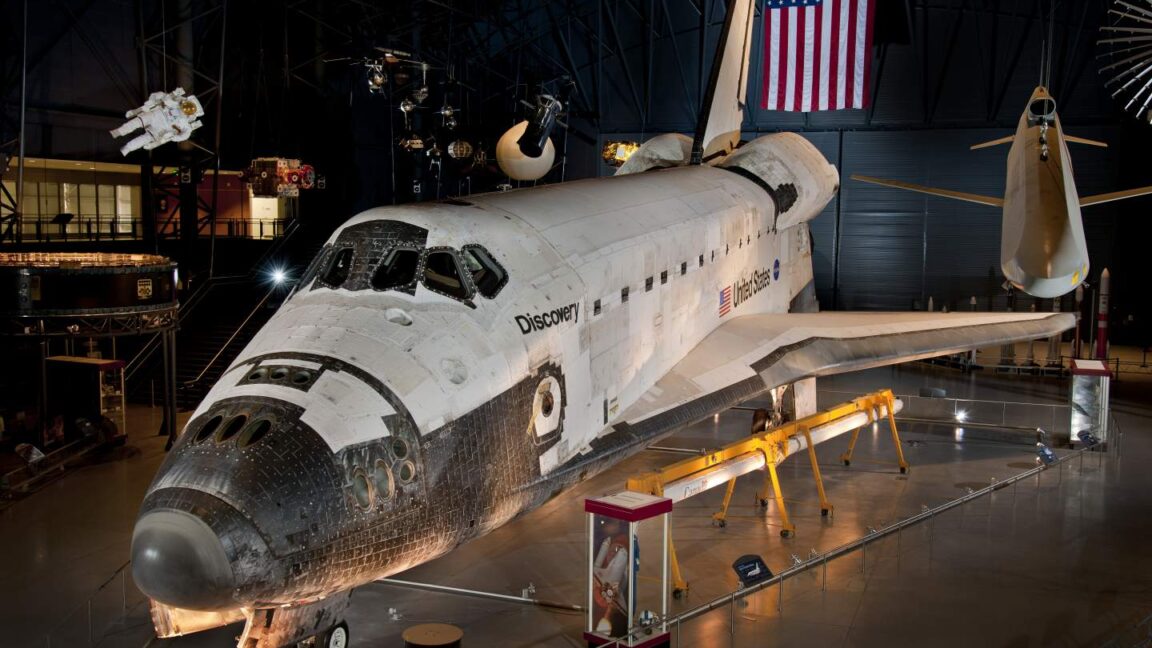
And that was all more or less settled until last week when the two US senators from Texas, John Cornyn and Ted Cruz, filed the “Bring the Space Shuttle Home Act” to move Space Shuttle Discovery from its current location the Smithsonian’s National Air and Space Museum’s Steven F. Udvar-Hazy Center in Virginia to Houston.
The space collectibles news site, CollectSpace, has a good overview of why this move is stupidly impractical. Essentially, it would easily cost $1 billion to get one of the two shuttle aircraft carriers back into service and move Discovery, it is unclear where the shuttle could survive such a journey in its current state, and the Smithsonian is the nation’s premier museum. There’s a reason that Discovery, the most historical of the three remaining shuttles that have gone to space, was placed there.
After the senators announced their bill, the collective response from the space community was initially shock. This was soon followed by: why? And so I’ve spoken with several people on background, both from the political and space spheres, to get a sense of what is really happening here. The short answer is that it is all political, and the timing is due to the reelection campaign for Cornyn, who faces a stiff runoff against Ken Paxton.
Lunar Gateway’s skeleton is complete—its next stop may be Trump’s chopping block
Officials blame changing requirements for much of the delays and rising costs. NASA managers dramatically changed their plans for the Gateway program in 2020, when they decided to launch the PPE and HALO on the same rocket, prompting major changes to their designs.
Jared Isaacman, Trump’s nominee for NASA administrator, declined to commit to the Gateway program during a confirmation hearing before the Senate Commerce Committee on April 9. Sen. Ted Cruz (R-Texas), the committee’s chairman, pressed Isaacman on the Lunar Gateway. Cruz is one of the Gateway program’s biggest backers in Congress since it is managed by Johnson Space Center in Texas. If it goes ahead, Gateway would guarantee numerous jobs at NASA’s mission control in Houston throughout its 15-year lifetime.
“That’s an area that if I’m confirmed, I would love to roll up my sleeves and further understand what’s working right?” Isaacman replied to Cruz. “What are the opportunities the Gateway presents to us? And where are some of the challenges, because I think the Gateway is a component of many programs that are over budget and behind schedule.”
The pressure shell for the Habitation and Logistics Outpost (HALO) module arrived in Gilbert, Arizona, last week for internal outfitting. Credit: NASA/Josh Valcarcel
Checking in with Gateway
Nevertheless, the Gateway program achieved a milestone one week before Isaacman’s confirmation hearing. The metallic pressure shell for the HALO module was shipped from its factory in Italy to Arizona. The HALO module is only partially complete, and it lacks life support systems and other hardware it needs to operate in space.
Over the next couple of years, Northrop Grumman will outfit the habitat with those components and connect it with the Power and Propulsion Element under construction at Maxar Technologies in Silicon Valley. This stage of spacecraft assembly, along with prelaunch testing, often uncovers problems that can drive up costs and trigger more delays.
Ars recently spoke with Jon Olansen, a bio-mechanical engineer and veteran space shuttle flight controller who now manages the Gateway program at Johnson Space Center. A transcript of our conversation with Olansen is below. It is lightly edited for clarity and brevity.
Ars: The HALO module has arrived in Arizona from Italy. What’s next?
Olansen: This HALO module went through significant effort from the primary and secondary structure perspective out at Thales Alenia Space in Italy. That was most of their focus in getting the vehicle ready to ship to Arizona. Now that it’s in Arizona, Northrop is setting it up in their facility there in Gilbert to be able to do all of the outfitting of the systems we need to actually execute the missions we want to do, keep the crew safe, and enable the science that we’re looking to do. So, if you consider your standard spacecraft, you’re going to have all of your command-and-control capabilities, your avionics systems, your computers, your network management, all of the things you need to control the vehicle. You’re going to have your power distribution capabilities. HALO attaches to the Power and Propulsion Element, and it provides the primary power distribution capability for the entire station. So that’ll all be part of HALO. You’ll have your standard thermal systems for active cooling. You’ll have the vehicle environmental control systems that will need to be installed, [along with] some of the other crew systems that you can think of, from lighting, restraint, mobility aids, all the different types of crew systems. Then, of course, all of our science aspects. So we have payload lockers, both internally, as well as payload sites external that we’ll have available, so pretty much all the different systems that you would need for a human-rated spacecraft.
Ars: What’s the latest status of the Power and Propulsion Element?
Olansen: PPE is fairly well along in their assembly and integration activities. The central cylinder has been integrated with the propulsion tanks… Their propulsion module is in good shape. They’re working on the avionics shelves associated with that spacecraft. So, with both vehicles, we’re really trying to get the assembly done in the next year or so, so we can get into integrated spacecraft testing at that point in time.
Ars: What’s in the critical path in getting to the launch pad?
Olansen: The assembly and integration activity is really the key for us. It’s to get to the full vehicle level test. All the different activities that we’re working on across the vehicles are making substantive progress. So, it’s a matter of bringing them all in and doing the assembly and integration in the appropriate sequences, so that we get the vehicles put together the way we need them and get to the point where we can actually power up the vehicles and do all the testing we need to do. Obviously, software is a key part of that development activity, once we power on the vehicles, making sure we can do all the control work that we need to do for those vehicles.
[There are] a couple of key pieces I will mention along those lines. On the PPE side, we have the electrical propulsion system. The thrusters associated with that system are being delivered. Those will go through acceptance testing at the Glenn Research Center [in Ohio] and then be integrated on the spacecraft out at Maxar; so that work is ongoing as we speak. Out at ESA, ESA is providing the HALO lunar communication system. That’ll be delivered later this year. That’ll be installed on HALO as part of its integrated test and checkout and then launch on HALO. That provides the full communication capability down to the lunar surface for us, where PPE provides the communication capability back to Earth. So, those are key components that we’re looking to get delivered later this year.
Jon Olansen, manager of NASA’s Gateway program at Johnson Space Center in Houston. Credit: NASA/Andrew Carlsen
Ars: What’s the status of the electric propulsion thrusters for the PPE?
Olansen: The first one has actually been delivered already, so we’ll have the opportunity to go through, like I said, the acceptance testing for those. The other flight units are right on the heels of the first one that was delivered. They’ll make it through their acceptance testing, then get delivered to Maxar, like I said, for integration into PPE. So, that work is already in progress. [The Power and Propulsion Element will have three xenon-fueled 12-kilowatt Hall thrusters produced by Aerojet Rocketdyne, and four smaller 6-kilowatt thrusters.]
Ars: The Government Accountability Office (GAO) outlined concerns last year about keeping the mass of Gateway within the capability of its rocket. Has there been any progress on that issue? Will you need to remove components from the HALO module and launch them on a future mission? Will you narrow your launch windows to only launch on the most fuel-efficient trajectories?
Olansen: We’re working the plan. Now that we’re launching the two vehicles together, we’re working mass management. Mass management is always an issue with spacecraft development, so it’s no different for us. All of the things you described are all knobs that are in the trade space as we proceed, but fundamentally, we’re working to design the optimal spacecraft that we can, first. So, that’s the key part. As we get all the components delivered, we can measure mass across all of those components, understand what our integrated mass looks like, and we have several different options to make sure that we’re able to execute the mission we need to execute. All of those will be balanced over time based on the impacts that are there. There’s not a need for a lot of those decisions to happen today. Those that are needed from a design perspective, we’ve already made. Those that are needed from enabling future decisions, we’ve already made all of those. So, really, what we’re working through is being able to, at the appropriate time, make decisions necessary to fly the vehicle the way we need to, to get out to NRHO [Near Rectilinear Halo Orbit, an elliptical orbit around the Moon], and then be able to execute the Artemis missions in the future.
Ars: The GAO also discussed a problem with Gateway’s controllability with something as massive as Starship docked to it. What’s the latest status of that problem?
Olansen: There are a number of different risks that we work through as a program, as you’d expect. We continue to look at all possibilities and work through them with due diligence. That’s our job, to be able to do that on a daily basis. With the stack controllability [issue], where that came from for GAO, we were early in the assessments of what the potential impacts could be from visiting vehicles, not just any one [vehicle] but any visiting vehicle. We’re a smaller space station than ISS, so making sure we understand the implications of thruster firings as vehicles approach the station, and the implications associated with those, is where that stack controllability conversation came from.
The bus that Maxar typically designs doesn’t have to generally deal with docking. Part of what we’ve been doing is working through ways that we can use the capabilities that are already built into that spacecraft differently to provide us the control authority we need when we have visiting vehicles, as well as working with the visiting vehicles and their design to make sure that they’re minimizing the impact on the station. So, the combination of those two has largely, over the past year since that report came out, improved where we are from a stack controllability perspective. We still have forward work to close out all of the different potential cases that are there. We’ll continue to work through those. That’s standard forward work, but we’ve been able to make some updates, some software updates, some management updates and logic updates, that really allow us to control the stack effectively and have the right amount of control authority for the dockings and undockings that we will need to execute for the missions.
Trump White House budget proposal eviscerates science funding at NASA
This week, as part of the process to develop a budget for fiscal-year 2026, the Trump White House shared the draft version of its budget request for NASA with the space agency.
This initial version of the administration’s budget request calls for an approximately 20 percent overall cut to the agency’s budget across the board, effectively $5 billion from an overall topline of about $25 billion. However, the majority of the cuts are concentrated within the agency’s Science Mission Directorate, which oversees all planetary science, Earth science, astrophysics research, and more.
According to the “passback” documents given to NASA officials on Thursday, the space agency’s science programs would receive nearly a 50 percent cut in funding. After the agency received $7.5 billion for science in fiscal-year 2025, the Trump administration has proposed a science topline budget of just $3.9 billion for the coming fiscal year.
Detailing the cuts
Among the proposals were: A two-thirds cut to astrophysics, down to $487 million; a greater than two-thirds cut to heliophysics, down to $455 million; a greater than 50 percent cut to Earth science, down to $1.033 billion; and a 30 percent cut to Planetary science, down to $1.929 billion.
Although the budget would continue support for ongoing missions such as the Hubble Space Telescope and the James Webb Space Telescope, it would kill the much-anticipated Nancy Grace Roman Space Telescope, an observatory seen as on par with those two world-class instruments that is already fully assembled and on budget for a launch in two years.
“Passback supports continued operation of the Hubble and James Webb Space Telescopes and assumes no funding is provided for other telescopes,” the document states.
Tuesday Telescope: Does this Milky Way image remind you of Powers of 10?
Welcome to the Tuesday Telescope. There is a little too much darkness in this world and not enough light—a little too much pseudoscience and not enough science. We’ll let other publications offer you a daily horoscope. At Ars Technica, we’ll take a different route, finding inspiration from very real images of a universe that is filled with stars and wonder.
When I was a kid, I was fascinated by the Powers of 10 video, which came out in the 1970s. Perhaps you remember it, with the narrator taking us both outward toward the fathomless end of the Universe and then, reversing course, guiding us back to Earth and inside a proton. The film gave a younger me a good sense of just how large the Universe around us really is.
What I did not know until much later is that the short film was made by the Eames Office, which was founded by the noted designers Charles Eames and Ray Kaiser. It’s the same organization that produced the Eames Lounge Chair. It goes to show you the value of good design across genres (shoutout to Ars’ resident designer, Aurich Lawson).
Anyway, I say all that because the Power of 10 film continues to live in my head, rent-free, decades later. It was the first thing I thought of when looking at today’s image of the Milky Way Galaxy’s center. The main image showcases huge vertical filaments, with the supermassive black hole at the galaxy’s core clearly visible. This image, captured by a South African radio telescope named MeerKAT, also shows the ghostly, bubble-like remnants of supernovas that exploded over millennia.
On the right of the image, there is a zoomed-in box taken in infrared light by the James Webb Space Telescope, and showing the star-forming Sagittarius C region. An estimated 500,000 stars are visible in this image of the Sagittarius C region. There is also a large region of ionized hydrogen, shown in cyan, that contains intriguing needle-like structures.
With new contracts, SpaceX will become the US military’s top launch provider
SpaceX will get 28 missions worth approximately $5.9 billion
ULA will get 19 missions worth approximately $5.4 billion
Blue Origin will get seven missions worth approximately
That equates to a 60-40 split between SpaceX and ULA for the bulk of the missions. Going into the competition, military officials set aside seven additional missions to launch with a third provider, allowing a new player to gain a foothold in the market. The Space Force reserves the right to reapportion missions between the three providers if one of them runs into trouble.
The Pentagon confirmed an unnamed fourth company also submitted a proposal, but wasn’t selected for Phase 3.
Rounded to the nearest million, the contract with SpaceX averages out to $212 million per launch. For ULA, it’s $282 million, and Blue Origin’s price is $341 million per launch. But take these numbers with caution. The contracts include a lot of bells and whistles, pricing them higher than what a commercial customer might pay.
According to the Pentagon, the contracts provide “launch services, mission unique services, mission acceleration, quick reaction/anomaly resolution, special studies, launch service support, fleet surveillance, and early integration studies/mission analysis.”
Essentially, the Space Force is paying a premium to all three launch providers for schedule priority, tailored solutions, and access to data from every flight of each company’s rocket, among other things.
New Glenn lifts off on its debut flight. Credit: Blue Origin
“Winning 60% percent of the missions may sound generous, but the reality is that all SpaceX competitors combined cannot currently deliver the other 40%!,” Elon Musk, SpaceX’s founder and CEO, posted on X. “I hope they succeed, but they aren’t there yet.”
This is true if you look at each company’s flight rate. SpaceX has launched Falcon 9 and Falcon Heavy rockets 140 times over the last 365 days. These are the flight-proven rockets SpaceX will use for its share of Space Force missions.