A NASA astronaut may have just taken the best photo from space—ever
People who appreciate good astrophotography will no doubt be familiar with the work of Don Pettit, a veteran NASA astronaut who is closing in on having lived 500 days of his life in space.

Pettit is now in the midst of his third stint on the International Space Station, and the decade he had to prepare for his current stay in orbit was put to good use. Accordingly, he is well stocked on cameras, lenses, and plans to make the most of six months in space to observe the planets and heavens from an incredible vantage point.

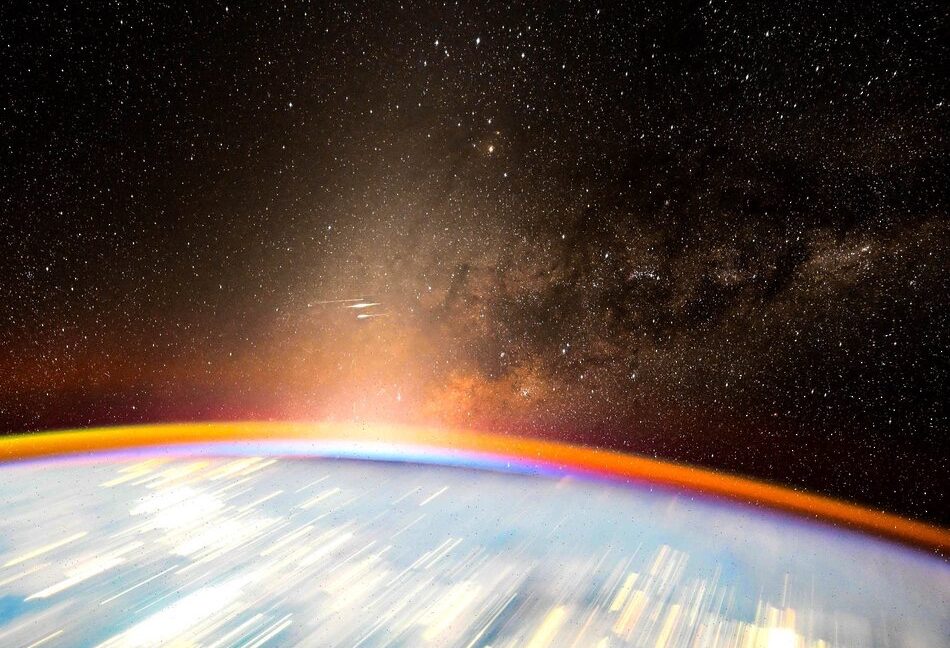
Ars has previously written admiringly of Pettit’s work, but his latest image deserves additional mention. When I first saw it, I was dazzled by its beauty. But when I looked further into the image, there were just so many amazing details to be found.

In this image, one can see the core of the Milky Way galaxy, zodiacal light (sunlight diffused by interplanetary dust), streaks of SpaceX Starlink satellites, individual stars, an edge-on view of the atmosphere that appears in burnt umber due to hydroxide emissions, a near-sunrise just over the horizon, and nighttime cities appearing as streaks.

Pettit said he took the image from the port-side window of Crew Dragon Freedom, which brought two astronauts to the International Space Station last year and will bring Butch Wilmore and Suni Williams back to Earth next spring.

Putting all of this together, I think Pettit’s streaky image may be the best picture ever taken from the International Space Station. Disagree?

https://arstechnica.com/space/2025/01/a-nasa-astronaut-may-have-just-taken-the-best-photo-from-space-ever/




An icy vent line may have caused Blue Origin to scrub debut launch of New Glenn

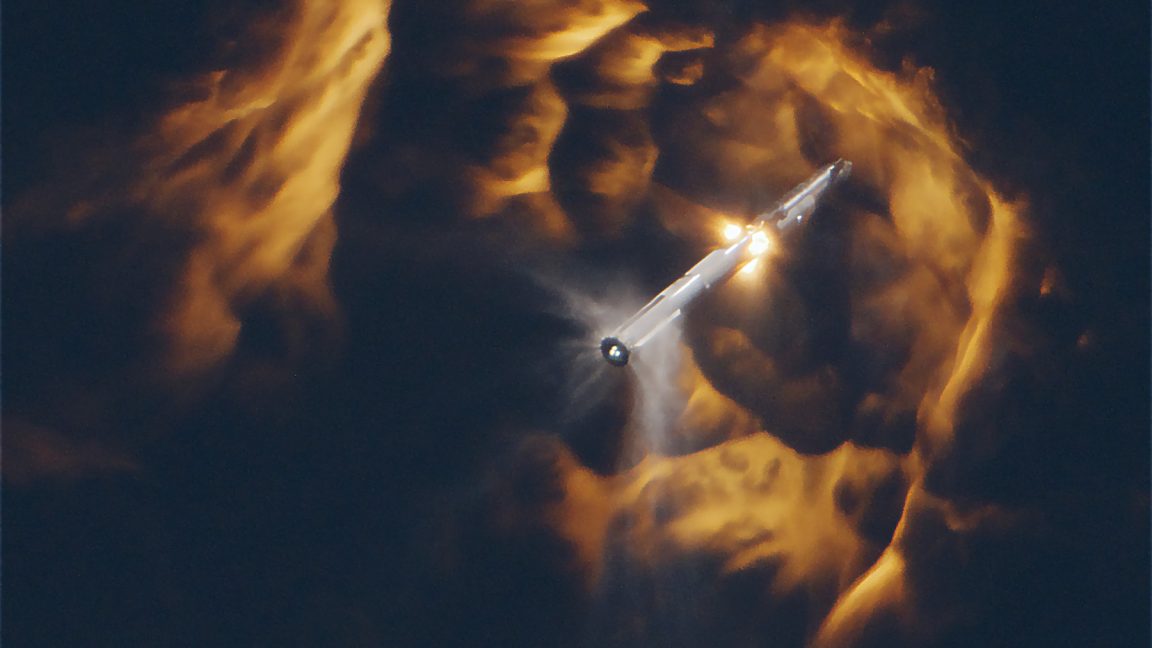
COCOA BEACH, Fla.—With 45 minutes left in a three-hour launch window, Blue Origin scrubbed its first attempt to launch the massive New Glenn rocket early on Monday morning.

Throughout the window, which opened at 1 am ET (06:00 UTC), the company continued to reset the countdown clock as launch engineers worked out technical issues with the rocket.

Officially, both on its live webcast as well as on social media following the scrub, Blue Origin was vague about the cause of the delayed launch attempt.

“We’re standing down on today’s launch attempt to troubleshoot a vehicle subsystem issue that will take us beyond our launch window,” the company said. “We’re reviewing opportunities for our next launch attempt.”

According to sources, the primary problem was likely ice clogging one of the vent lines that carry pressurized gas away from the vehicle. Several attempts were made to melt the ice, but these efforts were not successful, necessitating the scrub. Hopefully Blue Origin will provide more information about the cause of the scrub in the coming days.

To land, or not to land?

Additionally there appears to have been a problem with at least one of the auxiliary power units that provide power to the rocket after the engines shut off. One of the primary purposes of these APUs is to power the deployment of landing legs needed to make a soft touchdown on the company’s droneship, Jacklyn. It was not immediately clear early Monday whether Blue Origin would have pressed ahead with the launch should it have had to land the first stage in the ocean rather than attempting a barge landing.

https://arstechnica.com/space/2025/01/an-icy-vent-line-may-have-caused-blue-origin-to-scrub-debut-launch-of-new-glenn/


Rocket Report: China launches refueling demo; DoD’s big appetite for hypersonics

Relativity’s value seems to be plummeting. For several years, an innovative, California-based launch company named Relativity Space has been the darling of investors and media. But the honeymoon appears to be over, Ars reports. A little more than a year ago, Relativity reached a valuation of $4.5 billion following its latest Series F fundraising round. This was despite only launching one rocket and then abandoning that program and pivoting to the development of a significantly larger reusable launch vehicle. The decision meant Relativity would not realize any significant revenue for several years, and Ars reported in September on some of the challenges the company has encountered developing the much larger Terran R rocket.

Gravity always wins … Relativity is a privately held company, so its financial statements aren’t public. However, we can glean some clues from the published quarterly report from Fidelity Investments, which owns Relativity shares. As of March 2024, Fidelity valued its 1.67 million shares at an estimated $31.8 million. However, in a report ending November 29 of last year, which was only recently published, Fidelity’s valuation of Relativity plummeted. Its stake in Relativity was then thought to be worth just $866,735—a per-share value of 52 cents. Shares in the other fundraising rounds are also valued at less than $1 each.

SpaceX has already launched four times this year. The space company is off to a fast start in 2025, with four missions in the first nine days of the year. Two of these missions launched Starlink internet satellites, and the other two deployed an Emirati-owned geostationary communications satellite and a batch of Starshield surveillance satellites for the National Reconnaissance Office. In its new year projections, SpaceX estimates it will launch more than 170 Falcon rockets, between Falcon 9 and Falcon Heavy, Spaceflight Now reports. This is in addition to SpaceX’s plans for up to 25 flights of the Starship rocket from Texas.

What’s in store this year?… Highlights of SpaceX’s launch manifest this year will likely include an attempt to catch and recover Starship after returning from orbit, a first in-orbit cryogenic propellant transfer demonstration with Starship, and perhaps the debut of a second launch pad at Starbase in South Texas. For the Falcon rocket fleet, notable missions this year will include launches of commercial robotic lunar landers for NASA’s CLPS program and several crew flights, including the first human spaceflight mission to fly in polar orbit. According to public schedules, a Falcon 9 rocket could launch a commercial mini-space station for Vast, a privately held startup, before the end of the year. That would be a significant accomplishment, but we won’t be surprised if this schedule moves to the right.

https://arstechnica.com/space/2025/01/rocket-report-china-launches-refueling-demo-dods-big-appetite-for-hypersonics/


A glowing ring of metal fell to Earth, and no one has any idea what it is

It has been more than a week since reports first emerged about a “glowing ring of metal” that fell from the sky and crashed near a remote village in Kenya.

According to the Kenya Space Agency, the object weighed 1,100 pounds (500 kg) and had a diameter of more than 8 feet (2.4 meters) when measured after it landed on December 30. A couple of days later, the space agency confidently reported that the object was a piece of space debris, saying it was a ring that separated from a rocket. “Such objects are usually designed to burn up as they re-enter the Earth’s atmosphere or to fall over unoccupied areas, such as the oceans,” the space agency told The New York Times.

Since those initial reports were published in Western media, a small band of dedicated space trackers have been using open source data to try to identify precisely which space object fell into Kenya. So far, they have not been able to identify the rocket launch to which the large ring can be attributed.

Now, some space trackers believe the object may not have come from space at all.

Did it really come from space?

Space is increasingly crowded, but large chunks of metal from rockets are generally not flying around in Earth orbit undetected and untracked.

“It was suggested that the ring is space debris, but the evidence is marginal,” wrote Jonathan McDowell, an astrophysicist working at the Harvard-Smithsonian Center for Astrophysics. McDowell is highly regarded for his analysis of space objects. “The most likely space-related possibility is the reentry of the SYLDA adapter from the Ariane V184 flight, object 33155. Nevertheless, I am not fully convinced that the ring is space debris at all,” he wrote.

Another prominent space tracker, Marco Langbroek, believes it’s plausible that the ring came from space, so he investigated further into objects that may have returned around the time of the object’s discovery in Kenya. In a blog post written Wednesday he noted that apart from the metal ring, other fragments looking consistent with space debris—including material that looks like carbon wrap and isolation foil—were found several kilometers away from the ring.

https://arstechnica.com/space/2025/01/a-glowing-ring-of-metal-fell-to-earth-and-no-one-has-any-idea-what-it-is/


Intuitive Machines set for second landing, looking to build a lunar economy

Five years ago, a small company in Houston named Intuitive Machines had just 30 employees, a couple of 3D printers, and a few soldering irons.

Oh, and it had some big dreams. The company’s founders wanted to open a business on the Moon.

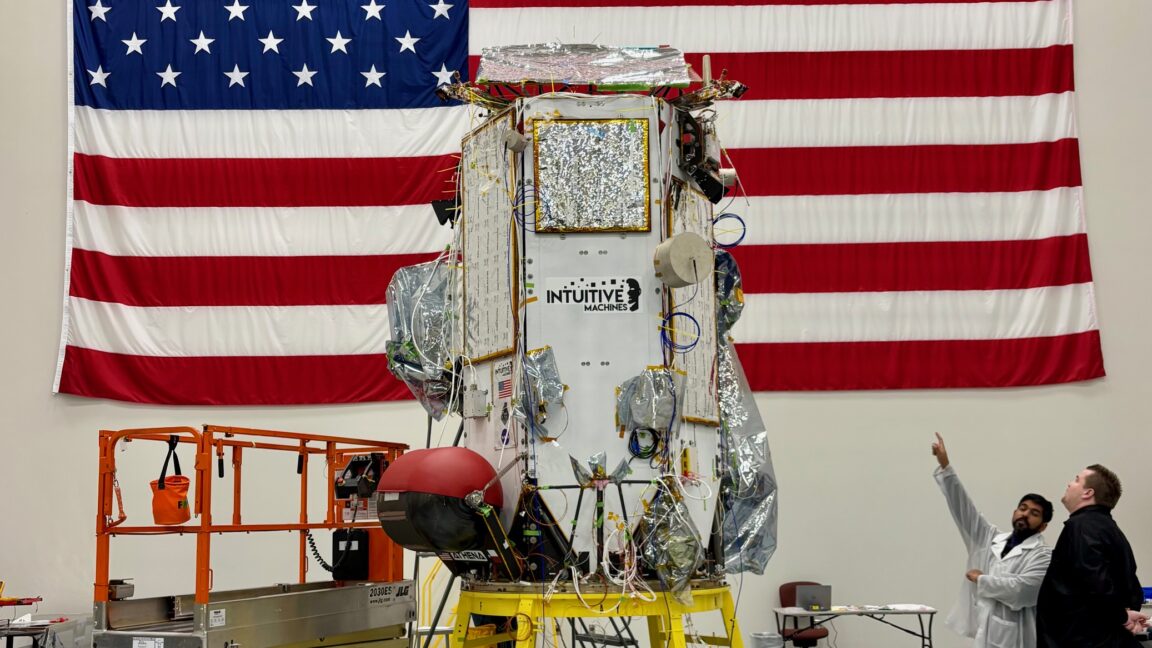
On Wednesday morning, when I drove into the company’s new headquarters at Spaceport Houston, there were no spaces to park in a lot filled with hundreds of cars. Inside, the offices were buzzing. And a large integration hangar was packed with hardware: two lunar landers, two lunar rover mock-ups, a hopper, and other spaceflight vehicles.

This is what can happen when NASA strikes the right balance with the commercial space industry.

In May 2019, NASA issued the first three awards as part of its Commercial Lunar Payload Services Program to pay private companies—in this case, Astrobotic, Orbit Beyond, and Intuitive Machines—to deliver scientific payloads to the lunar surface. It’s been a long road since then. Astrobotic’s first mission a year ago failed on the way to the Moon. Orbit Beyond dropped out. But Intuitive Machines largely succeeded, putting its Odysseus lander on the Moon, albeit sideways, after its altimeter failed. For the first time ever, a private company successfully made a soft landing on the Moon.

Now, it’s going to try again.

To the Moon in a week

“For us, it’s been a real journey,” said the chief executive of Intuitive Machines, Steve Altemus, as we stood a few feet away from the company’s second lunar lander, which will soon be shipped to a launch site in Florida. “In February of 2023, we went public, and that was a huge milestone for us in terms of growing up. In February 2024, we landed on the Moon, and everything has changed since then. And here we are again, ready to launch our second mission in February 2025.”

The company’s lander, named Athena, is presently scheduled to lift off on a dedicated Falcon 9 rocket at the end of February, Altemus said. The current launch date supports a lunar landing about a week later, on March 6 or 7, near the south pole of the Moon. The goal is to have about 10 days in sunlight before the lunar night sets in.

https://arstechnica.com/space/2025/01/intuitive-machines-set-for-second-landing-looking-to-build-a-lunar-economy/


Italy’s plan to buy Starlink data deals a serious blow to European space network

Developed by the European Union and European Space Agency, with Italian participation, this constellation of 290 satellites is planned to come online by 2030 at a development cost of $10.5 billion. During the lengthy negotiations, Italy even managed to secure one of the three primary ground stations in the Abruzzo region of the country.

The response from some Italian and European officials to the potential agreement between Italy and SpaceX has been ferocious.

Antonio Misiani, former deputy finance minister for Italy and senator for the opposition Democratic Party, told Politico that a completed agreement would represent an “unacceptable sell-out of national sovereignty.”

An Atlantic Council senior fellow and former policy advisor to the Italian government, Beniamino Irdi, told the Financial Times, “It sends a political signal to the EU,” Irdi said. “Iris² is a symbol of Europe’s strategic autonomy, and a key EU member shifting to a different solution can be interpreted as a sign of divestment from that.”

There are multiple layers of frustration here beyond Iris². One concerns Musk, who, since the election of Trump, has turned his attention toward advancing far-right political causes in Europe, particularly in Germany and the United Kingdom. Meloni, a conservative leader of Italy, considers Musk a friend and ally. Andrea Stroppa, one of Musk’s advisers in Italy, explained in September that “Elon recognizes Giorgia Meloni’s leadership. And he sees in her the same thing he sees in Donald Trump, someone who can defend Western values ​​in danger.”

Battling with Breton

Musk has also had a long-running feud with French businessman Thierry Breton, who was Commissioner for the Internal Market of the European Union for five years until last September. Breton spearheaded the Iris² initiative to provide secure communications from low-Earth orbit. He also championed the Digital Services Act, which aims to curb misinformation published online in Europe. The European Commission has been energetically investigating Musk’s social media site X under the law.

https://arstechnica.com/space/2025/01/italian-interest-in-starlink-strikes-at-the-heart-of-european-space-solidarity/


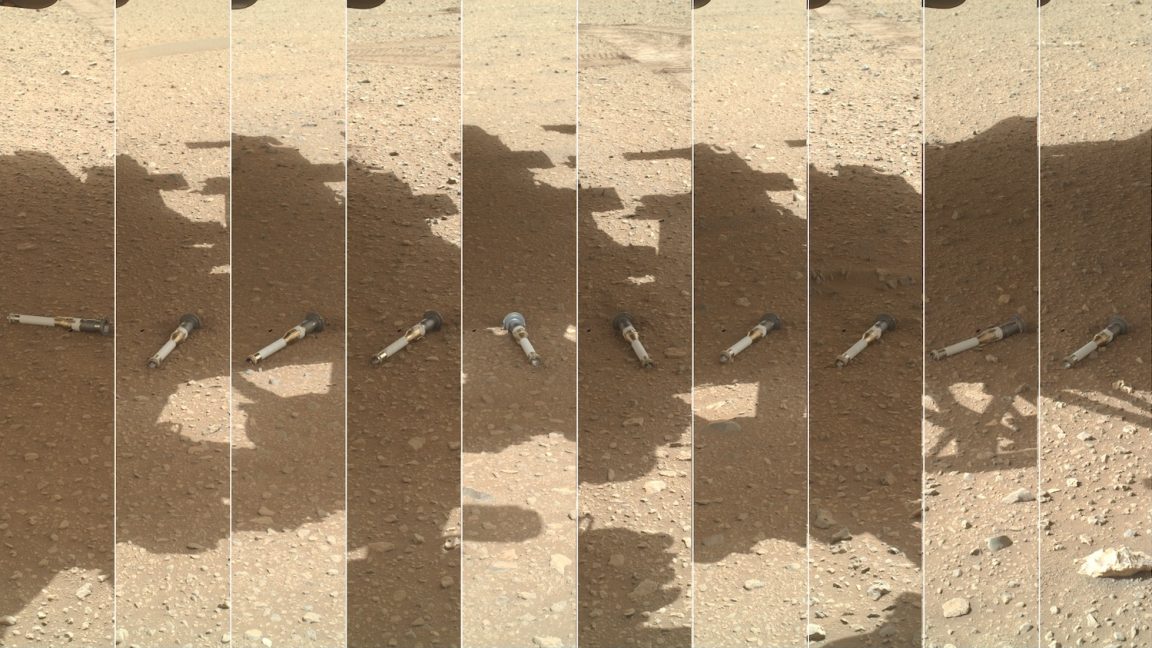
NASA defers decision on Mars Sample Return to the Trump administration

“The samples that we have taken by Perseverance actually predate—they are older than any of the samples or rocks that we could take here on Earth,” Fox said. “So it allows us to kind of investigate what the early solar system was like before life began here on Earth, which is amazing.”

Fox said returning Mars samples before a human expedition would help NASA prioritize where astronauts should land on the red planet.

In a statement, the Planetary Society said it is “concerned that NASA is again delaying a decision on the program, committing only to additional concept studies.”

“It has been more than two years since NASA paused work on MSR,” the Planetary Society said. “It is time to commit to a path forward to ensure the return of the samples already being collected by the Perseverance rover.

“We urge the incoming Trump administration to expedite a decision on a path forward for this ambitious project, and for Congress to provide the funding necessary to ensure the return of these priceless samples from the Martian surface.”

China says it is developing its own mission to bring Mars rocks back to Earth. Named Tianwen-3, the mission could launch as soon as 2028 and return samples to Earth by 2031. While NASA’s plan would bring back carefully curated samples from an expansive environment that may have once harbored life, China’s mission will scoop up rocks and soil near its landing site.

“They’re just going to have a mission to grab and go—go to a landing site of their choosing, grab a sample and go,” Nelson said. “That does not give you a comprehensive look for the scientific community. So you cannot compare the two missions. Now, will people say that there’s a race? Of course, people will say that, but it’s two totally different missions.”

Still, Nelson said he wants NASA to be first. He said he has not had detailed conversations with Trump’s NASA transition team.

“I think it was a responsible thing to do, not to hand the new administration just one alternative if they want to have a Mars Sample Return,” Nelson said. “I can’t imagine that they don’t. I don’t think we want the only sample return coming back on a Chinese spacecraft.”

https://arstechnica.com/science/2025/01/fund-or-cancel-robots-or-humans-nasa-punts-on-mars-sample-return-decision/


Nearly two years after its radical pivot, Fidelity slashes Relativity’s valuation

For several years, an innovative, California-based launch company named Relativity Space has been the darling of investors and media.

Relativity promised to disrupt launch by taking a somewhat niche technology in the space industry at the time, 3D printing, and using it as the foundation for manufacturing rockets. The pitch worked. Relativity’s chief executive Tim Ellis liked to brag that his first investor call was to Dallas Mavericks owner Mark Cuban, who cut the company’s first check. Cuban invested half a million dollars.

That was just the beginning of the torrent of fundraising by Ellis, who, by November 2023, turned the privately held Relativity into a $4.5 billion company following its latest, Series F funding. This was an impressive start for the company founded by Ellis and Jordan Noone, both engineers, in 2016.

A big bet

The Series F round occurred as Relativity was amid a bold gamble that, in hindsight, may have been a poor bet. In March 2023, the company launched its Terran 1 rocket for the first—and only—time. After this flight, Ellis announced that the company was pivoting immediately to developing the much larger and more capable Terran R rocket.

“It’s a big, bold bet,” Ellis said in an interview. “But it’s actually a really obvious decision.”

With an advertised capacity of more than 1 metric ton to low-Earth orbit and a “backlog” of launch contracts valued in the hundreds of millions of dollars, according to Ellis, Terran 1 had the potential to draw significant revenue. It could also have nabbed a share of launch contracts that have since been snared by competitors such as Rocket Lab, with its smaller Electron vehicle, and Firefly, with its comparably sized Alpha rocket.

https://arstechnica.com/space/2025/01/nearly-two-years-after-its-radical-pivot-fidelity-slashes-relativitys-valuation/


Annual power ranking of US launch companies finds a shake-up at the bottom

Once again, we’re back with our annual power ranking of US launch companies. 2024 was the third year Ars compiled a list of the most accomplished rocket companies in the United States with the goal of sparking debate, discussion, and appreciation for the challenge of operating a successful launch company.

This is a difficult business, both technically and financially. We salute all the engineers, technicians, and business development people out there giving this industry a go.

Please note that this is a subjective list, although hard metrics such as total launches, tonnage to orbit, success rate, and more were all important factors in our decisions. And our focus remains on what each company accomplished in 2024, not on what they might do in the future.

1. SpaceX (no change from last year)

There can be no doubt about the number one slot for 2024.

SpaceX flew nearly as many Falcon rockets as times NASA flew the Space Shuttle over the course of three decades. In addition to flying 134 Falcon 9 and Falcon Heavy missions in 2024, SpaceX also launched its massive experimental Starship rocket four times, even catching the first stage on one of those occasions.

SpaceX has become much more than a launch company in the last five years, both in terms of human spaceflight with the Dragon spacecraft and broadband connectivity and its Starlink Internet constellation. This summer, Dragon was called upon to fly Butch Wilmore and Suni Williams back from the International Space Station after NASA was uncertain of the Starliner spacecraft’s safety. With Starlink, SpaceX operates a profitable network composed of more satellites than the rest of the world operates combined.

2. United Launch Alliance (+1)

ULA returns to the second spot for 2024 after finally delivering its new Vulcan rocket to orbit in January. In addition to two Vulcan launches, the company also flew its final Delta IV Heavy rocket in April and flew two Atlas V missions. The launches were successful, although the second Vulcan launch in October required an investigation after a solid rocket motor nozzle broke apart during flight.

https://arstechnica.com/space/2025/01/annual-power-ranking-of-us-launch-companies-finds-a-shake-up-at-the-bottom/


Outgoing NASA administrator urges incoming leaders to stick with Artemis plan

Ars: What’s going on with the Mars Sample Return mission? You made an important decision about a year ago by shutting the current program down for a re-think.

Bill Nelson: On Tuesday, we’re going to announce the Mars sample return decisions, and it will not put the new administration in a box. We’re going to work it up with options for them to consider, and then, in large part, it’s going to be their decisions because of the funding. But sooner or later, the samples will be returned from Mars, and therefore, we will have an idea that millions of years ago, was there life on Mars? And what happened? And what can we learn if there was life that we could become better stewards of ours?

Ars: Do you think you have some options that are affordable for the mission? From a schedule and cost standpoint, it was looking pretty untenable.

Bill Nelson: Well, that’s why I pulled the plug on it, because it was too costly, and it was going to take all the way to 2040, and that’s unacceptable. So I think you will see in the options that we’re going to present on Tuesday that our desire to bring it in quicker and cheaper is certainly doable.

Ars: What do you think of the Trump administration’s plan to nominate private astronaut and entrepreneur Jared Isaacman as your successor?

Bill Nelson: I don’t really know him. I’ve met him. I called him on the day it was announced and congratulated him and told him that I was happy to help in any way. But I really do not know him. Obviously, a lot of people think very highly of him, and so I wish him well, and if he is confirmed as the administrator of NASA, he will certainly have my support.

Ars: Do you think it’s appropriate for the next administration to review the Artemis Program?

Bill Nelson: Are you implying that Artemis should be canceled?

Ars: No. I don’t think Artemis will be canceled in the main. But I do think they’re going to take a look at the way the missions are done at the architecture. I know NASA just went through that process with Orion’s heat shield.

Bill Nelson: Well, I think questioning what you’re doing clearly is always an issue that ought to be on the table.  But do I think that they are going to cancel, as some of the chatter out there suggests, and replace SLS with Starship? The answer is no.

https://arstechnica.com/space/2025/01/outgoing-nasa-administrator-urges-incoming-leaders-to-stick-with-artemis-plan/