Is Goldman Sachs (GS) Q1 Performance a Green Light for Investors?

The Goldman Sachs Group (GS) comfortably topped analysts’ earnings and revenue estimates in the first quarter. After its solid first-quarter performance, should investors consider adding the stock to their portfolio now? Keep reading.

The Goldman Sachs Group, Inc. (GS) reported its first-quarter results on April 15. The company comprehensively surpassed Wall Street’s EPS and revenue estimates. In this piece, I have discussed why it could be prudent to wait for a better entry point in the stock now despite the earnings and revenue beat.

For the first quarter, GS’s EPS was 34.1% above the consensus estimate, and its revenue was 9.9% higher than the analysts’ estimates. GS’ first-quarter profit and revenue topped analysts’ expectations, driven by solid gains in trading and investment banking revenue. GS’ strong earnings marked two consecutive quarters of double-digit earnings gains. However, revenue growth decelerated over the past four quarters.

GS’ investment banking fees rose 32% year-over-year to $2.08 billion, driven by higher equity and debt underwriting. Meanwhile, the bank’s global banking and markets revenue jumped 15% over the prior-year quarter to $9.73 billion. Its fixed-income trading revenue rose 10% year-over-year to $4.32 billion, driven by the rise in mortgage, foreign exchange, and credit trading and financing.

Moreover, its Asset & Wealth Management and Platform Solutions segments’ revenues increased 18% and 24% year-over-year to $3.79 billion and $698 million, respectively. Also, in Asset & Wealth Management, its assets under supervision rose to a record of $2.8 trillion in the first quarter.

The bank allocated $318 million in provisions for credit loss in the first quarter, compared to a benefit of $171 million in the year-ago quarter, due to potential defaults in wholesale loans and credit cards. The bank expects M&A (Mergers and Acquisitions) and debt underwriting to continue this year. GS’ stock has gained 33.5% over the past six months and 20.7% over the past year to close the last trading session at $403.11.

Here’s what could influence GS’ performance in the upcoming months:

Mixed Financials

GS’ total net revenues for the fiscal first quarter ended March 31, 2024, rose 16.3% year-over-year to $14.21 billion. Its net earnings applicable to common shareholders increased 27.3% over the prior-year quarter to $3.93 billion. The company’s standardized CET1 ratio came in at 14.7%, compared to 14.4% in the year-ago quarter. Also, its EPS came in at $11.58, representing an increase of 31.7% year-over-year.

In addition, its annualized return on average common shareholders’ equity (ROE) was 14.8%, up 3.2 percentage points year-over-year. Its annualized return on average tangible common shareholders’ equity (ROTE) was 15.9%, up 3.3 percentage points over the prior-year quarter.

On the other hand, its net interest income declined 9.7% year-over-year to $1.61 billion.

Commenting on GS’ first-quarter performance, Chairman and CEO David Solomon said, “Our first quarter results reflect the strength of our world-class and interconnected franchises and the earnings power of Goldman Sachs. We continue to execute on our strategy, focusing on our core strengths to serve our clients and deliver for our shareholders.”

Favorable Analyst Estimates

Analysts expect GS’ fiscal 2024 EPS and revenue to increase 56.8% and 9.7% year-over-year to $35.87 and $51.06 billion, respectively. Its fiscal 2025 EPS and revenue are expected to grow 11% and 3.3% year-over-year to $39.80 and $52.76 billion, respectively.

Similarly, analysts expect GS’ EPS and revenue for the quarter ending June 30, 2024, to increase 180.5% and 15.2% year-over-year to $8.64 and $12.55 billion, respectively.

Mixed Profitability

In terms of the trailing-12-month gross profit margin, GS’ 83.49% is 39.4% higher than the 59.91% industry average. Likewise, its 4.96% trailing-12-month Capex / Sales is 146.4% higher than the industry average of 2.01%.

On the other hand, its 20.15% trailing-12-month net income margin is 14.9% lower than the 23.66% industry average. Likewise, its 0.03x trailing-12-month asset turnover ratio is 86.4% lower than the 0.21x.

Mixed Valuation

In terms of forward Price/Sales, GS’ 2.71x is 13% higher than the 2.40x industry average. Its 11.24x forward non-GAAP P/E is 12.9% higher than the 9.96x industry average. Likewise, its 1.21x forward Price/Book is 21% higher than the 1x industry average.

On the other hand, in terms of forward non-GAAP PEG, GS’ 1.06x is 13% lower than the 1.22x industry average.

POWR Ratings Reflect Uncertainty

GS has an overall rating of C, equating to a Neutral in our POWR Ratings system. The POWR Ratings are calculated by considering 118 different factors, each weighted to an optimal degree.

Our proprietary rating system also evaluates each stock based on eight distinct categories. GS has a C grade for Value, which is consistent with its mixed valuation. It has a C grade for Stability, in sync with its 1.42 beta.

GS’s mixed profitability justifies its C grade for Quality.

GS is ranked #7 out of 20 stocks in the Investment Brokerage industry. Click here to access GS’s Growth, Momentum, and Sentiment ratings.

Bottom Line

GS started the year strong, with sharp increases in profits and revenue in the first quarter, driven by a resurgence in debt underwriting and deal-making activities. The bank said it was operating in a complex operating environment, but it believes that it is in the early stages of a reopening of the capital markets, which bodes well for the company, as its fortunes depend on the stock and bond markets’ performances.

However, a strong U.S. jobs market and rising inflation could mean that interest rates remain higher for longer. The Federal Reserve looks highly unlikely to cut interest rates at its upcoming policy meeting due to a lack of further progress on inflation.

Many economists are considering the possibility of no rate cuts at all this year. This, along with escalating geopolitical tensions, could negatively impact the capital markets as deals and M&As could take a pause.

On the other hand, if inflation starts easing again, the Fed could proceed with rate cuts, thereby boosting corporate confidence in striking deals and raising money.

Given its mixed financials, stability, profitability, and valuation, it could be wise to wait for a better entry point in the stock.

How Does The Goldman Sachs Group, Inc. (GS) Stack Up Against Its Peers?

GS has an overall POWR Rating of C, equating to a Neutral rating. You may check out these B-rated stocks within the Investment Brokerage industry: Oppenheimer Holdings Inc. (OPY), Piper Sandler Companies (PIPR), and Stifel Financial Corp. (SF). For exploring more Buy-rated Investment Brokerage stocks, click here.

What To Do Next?

Get your hands on this special report with 3 low priced companies with tremendous upside potential even in today’s volatile markets:

3 Stocks to DOUBLE This Year


GS shares were unchanged in premarket trading Friday. Year-to-date, GS has gained 5.24%, versus a 5.42% rise in the benchmark S&P 500 index during the same period.


About the Author: Dipanjan Banchur

Since he was in grade school, Dipanjan was interested in the stock market. This led to him obtaining a master’s degree in Finance and Accounting. Currently, as an investment analyst and financial journalist, Dipanjan has a strong interest in reading and analyzing emerging trends in financial markets.

More…

The post Is Goldman Sachs (GS) Q1 Performance a Green Light for Investors? appeared first on StockNews.com

https://www.entrepreneur.com/finance/is-goldman-sachs-gs-q1-performance-a-green-light-for/472967





American Express (AXP) Earnings Announcement – Will Credit Card Giant Surpass Expectations?

American Express Company (AXP) will publish its first-quarter earnings on April 19. After missing the earnings and revenue expectations in the previous quarter, will the credit card giant be able to surpass the first quarter expectations? Read on to learn my view.

American Express Company (AXP) will unveil its first-quarter results on April 19. Wall Street anticipates the credit card giant to post higher revenue and earnings in the first quarter. With AXP’s earnings expected shortly, I have discussed why waiting for an opportune entry point in the stock could be wise.

For the first quarter, AXP’s EPS and revenue are expected to increase 24.2% and 10.5% year-over-year to $2.98 and $15.79 billion, respectively. The company achieved record revenues and profits in 2023 and added 12.2 million new proprietary cards last year, bringing the total number of cards-in-force issued on its global network to over 140 million.

For fiscal 2024, AXP has guided revenue growth of 9% to 11% and expects EPS of between $12.65 and $13.15. The company aims to continue achieving revenue growth of 10% plus and mid-teens EPS growth in the future. AXP’s stock has gained 41% over the past six months and 33% over the past year, closing the last trading session at $217.67.

Here’s what you might want to consider ahead of its upcoming earnings release:

Robust Financials

AXP’s total revenues net of interest expense for the fiscal fourth quarter ended December 31, 2023, rose 11.4% year-over-year to $15.80 billion. Its net interest income rose 30.7% over the prior-year quarter to $3.60 billion. The company’s net income attributable to common shareholders increased 23.2% year-over-year to $1.90 billion. Also, its EPS came in at $2.62, representing an increase of 26.6% year-over-year.

For the fiscal year ended December 31, 2023, AXP’s total revenues net of interest expense increased 14.5% year-over-year to $60.52 billion. Its net interest income rose 32.7% over the prior-year period to $13.13 billion. The company’s net income attributable to common shareholders increased 11.5% year-over-year to $8.25 billion. Also, its EPS came in at $11.21, representing an increase of 13.8% year-over-year.

Favorable Analyst Estimates

Analysts expect AXP’s fiscal 2024 EPS and revenue to increase 14.2% and 9.4% year-over-year to $12.81 and $66.22 billion, respectively. Its fiscal 2025 EPS and revenue are expected to increase 15% and 8.6% year-over-year to $14.73 and $71.92 billion, respectively.

Similarly, analysts expect AXP’s EPS and revenue for the quarter ending June 30, 2024, to increase 12% and 9.8% year-over-year to $3.24 and $16.53 billion, respectively.

Mixed Profitability

AXP’s 15.06% trailing-12-month net income margin is 36% lower than the 23.52% industry average. Its 55.04% trailing-12-month gross profit margin is 7.7% lower than the 59.66% industry average.

On the other hand, AXP’s 31.28% trailing-12-month Return on Common Equity is 187.7% higher than the 10.87% industry average. Furthermore, the stock’s 3.21% trailing-12-month Return on Total Assets is 195.3% higher than the industry average of 1.09%. Also, its 0.23x trailing-12-month asset turnover ratio is 7.5% higher than the industry average of 0.21x.

Mixed Valuation

In terms of forward non-GAAP PEG, AXP’s 1.29x is 6.1% higher than the 1.21x industry average. Its 17x forward non-GAAP P/E is 72.1% higher than the 9.88x industry average. Likewise, its 5.04x forward Price/Book is 406.8% higher than the 0.99x industry average.

On the other hand, in terms of forward Price/Sales, AXP’s 2.37x is 0.8% lower than the 2.39x industry average.

POWR Ratings Reflect Uncertainty

AXP has an overall rating of C, equating to a Neutral in our POWR Ratings system. The POWR Ratings are calculated by considering 118 different factors, each weighted to an optimal degree.

Our proprietary rating system also evaluates each stock based on eight distinct categories. AXP has a C grade for Value, which is consistent with its mixed valuation. It has a C grade for Stability, in sync with its 1.23 beta.

AXP’s mixed profitability justifies its C grade for Quality.

AXP is ranked #19 out of 45 stocks in the Consumer Financial Services industry. Click here to access AXP’s Growth, Momentum, and Sentiment ratings.

Bottom Line

After ending fiscal 2023 on a solid note, AXP remains firmly positioned to achieve its long-term annual revenue growth of more than 10% and mid-teens EPS growth. As consumer spending continues to remain robust, the company is expected to see strong growth in billings, new account acquisitions, and processed volumes in the first quarter.

However, loans and cardmember receivables are expected to moderate through the rest of the year. Net interest income growth is also expected to moderate in fiscal 2024. Moreover, as credit card delinquencies continue to rise, write-offs are expected to increase along with higher reserve build-ups.

Given its mixed profitability, valuation, and stability, it could be wise to wait for a better entry point in the stock.

How Does American Express Company (AXP) Stack Up Against Its Peers?

AXP has an overall POWR Rating of C, equating to a Neutral rating. You may check out these A and B-rated stocks within the Consumer Financial Services industry: Qifu Technology, Inc. (QFIN), Atlanticus Holdings Corporation (ATLC), and EZCORP, Inc. (EZPW). For exploring more Buy-rated Comsumer Financial Services stocks, click here.

What To Do Next?

Discover 10 widely held stocks that our proprietary model shows have tremendous downside potential. Please make sure none of these “death trap” stocks are lurking in your portfolio:

10 Stocks to SELL NOW! >


AXP shares were unchanged in premarket trading Thursday. Year-to-date, AXP has gained 16.93%, versus a 5.64% rise in the benchmark S&P 500 index during the same period.


About the Author: Dipanjan Banchur

Since he was in grade school, Dipanjan was interested in the stock market. This led to him obtaining a master’s degree in Finance and Accounting. Currently, as an investment analyst and financial journalist, Dipanjan has a strong interest in reading and analyzing emerging trends in financial markets.

More…

The post American Express (AXP) Earnings Announcement – Will Credit Card Giant Surpass Expectations? appeared first on StockNews.com

https://www.entrepreneur.com/finance/american-express-axp-earnings-announcement-will-credit/472902


How Low Could Stocks Go?

The S&P 500 (SPY) is starting to test key support levels for the first time since November 2023 given continuing signs that Fed rate cuts are getting pushed further and further into the future. This begs the question of “how low could stocks go?” 44 year investment veteran Steve Reitmeister does his level best to answer that question including a trading plan and top picks to stay one step ahead of the market. Read on below for the full story.

Anyone who knows me personally would question my choice of professions. That is because I highly value rationality and fairness. And yet the stock market that is at the epicenter of my daily activities is highly irrational and unfair.

Over the past 44 years I have come to expect the unexpected which makes it easier to deal with the bouts of volatility and insanity.

That sets us up for an interesting discussion today to talk about what is the reasonable path for the stock market from here. And then what is possible (which might deviate greatly from the reasonable path). And yes, along with that I will share a trading plan to stay on the right side of the action.

Market Commentary

Plain and simple, stock prices got ahead of the fundamentals. High inflation is not yet fully tamed and thus the economic catalyst of lower rates is pushed out further and further into the future.

Now the debate is about whether the first cut is coming in July or September (and maybe even later). Given that rates would still be quite high and restrictive to the economy at that level, then the economic benefit of all this is looking more like a 2025 affair.

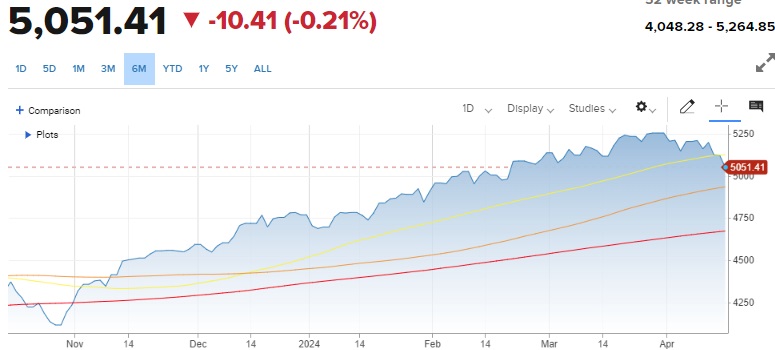
That says that stock prices are a bit too richly valued here in 2024 leading to an appropriate round of profit taking. Meaning that the reasonable response is for stocks to retrace some of the recent steps which brings us to the S&P 500 (SPY) chart below.

Moving Averages: 50 Day (yellow), 100 Day (orange), 200 Day (red)

We just broke below the 50 day moving average for the first time since early November. This puts the 100 day moving average in sight at 4,921.

However, that level is coming up quite a bit. Soon it would conjoin with the psychologically important 5,000 mark to provide ample support for the market.

Meaning the reasonable and rational move for this market is to give back about 5% from the recent highs of 5,265 to find a low around 5,000.

Unfortunately, as shared in the intro…the market is quite often not rational at all. This means that we do have to consider the possibility of a test of 200 day moving average.

I see virtually no chance we make it all the way down to its current locale at 4,666. However, given that its current slope gets it to around 4,800 by end of May. Then that test is a possibility down the road. Especially with any more bad news on the inflation front which further delays the first rate cut.

Also, on the spectrum of the market not being rationale, this down spell could soon be over with a move back towards the recent highs. That could happen because investors work on the premise of what lies ahead…not what is happening now.

Thus, knowing that rates will be cut at some point, then investors may continue to rev their engines at this red light knowing it will soon turn green.

Meaning that after this modest, and long overdue pullback, some excesses will have been removed allowing investors to patiently play in a trading range between 5,000 and 5,265 awaiting the rate cut signal to press higher.

Trading Plan

This is still very much a bull market. Just one that was a bit overextended and ripe for the pullback that is taking place now.

I see downside risk for the S&P 500 as about 250 points (5%) to 4,800 versus upside to my target of 5,500 by years end (10% upside). The better reward than risk has me continuing to be fully invested at this time. Just a slightly more conservative mix of stocks to weather any coming storm (and yes those moves have already been quite beneficial in April in the midst of this pullback).

Investors should continue to have a greater eye towards value than growth. The 18% loss this year for the growth posterchild, ARK Innovation Fund (ARKK), is a perfect example of what I am talking about avoiding now.

Gladly the 31 factors of value calculated in our exclusive POWR Ratings system will help to insure you have a value bias at this time.

On top of that investors will be very focused on the quality of earnings reports that starting rolling in earnest over the next several weeks.

Companies that beat will be rewarded.

Companies that miss will be crushed.

Gladly the additional 13 factors of Growth and 31 factors of fundamental Quality also in the POWR Ratings is a proven statistical advantage to find companies more likely to beat earnings and enjoy share price outperformance.

Long story short, now is a vital time to be focused on the best POWR Ratings stocks. To see my favorite picks, then read on below…

What To Do Next?

Discover my current portfolio of 12 stocks packed to the brim with the outperforming benefits found in our exclusive POWR Ratings model. (Nearly 4X better than the S&P 500 going back to 1999)

This includes 5 under the radar small caps recently added with tremendous upside potential.

Plus I have 1 special ETF that is incredibly well positioned to outpace the market in the weeks and months ahead.

This is all based on my 44 years of investing experience seeing bull markets…bear markets…and everything between.

If you are curious to learn more, and want to see these lucky 13 hand selected trades, then please click the link below to get started now.

Steve Reitmeister’s Trading Plan & Top Picks >

Wishing you a world of investment success!


Steve Reitmeister…but everyone calls me Reity (pronounced “Righty”)
CEO, StockNews.com and Editor, Reitmeister Total Return


SPY shares were trading at $503.53 per share on Tuesday afternoon, down $0.92 (-0.18%). Year-to-date, SPY has gained 6.27%, versus a % rise in the benchmark S&P 500 index during the same period.


About the Author: Steve Reitmeister

Steve is better known to the StockNews audience as “Reity”. Not only is he the CEO of the firm, but he also shares his 40 years of investment experience in the Reitmeister Total Return portfolio. Learn more about Reity’s background, along with links to his most recent articles and stock picks.

More…

The post How Low Could Stocks Go? appeared first on StockNews.com

https://www.entrepreneur.com/finance/how-low-could-stocks-go/472824


Schlumberger (SLB) Earnings Loom – Is It Time to Invest?

Schlumberger (SLB), the world’s biggest oilfield services company, will publish its first-quarter earnings on April 19. The company is expected to report revenue and earnings growth over the prior-year quarter. Therefore, is it time to invest in the stock ahead of its earnings? Read on to learn my view.

Schlumberger Limited (SLB) will report its first-quarter results on April 19. Wall Street expects the company to post higher revenue and earnings in the first quarter. With SLB’s earnings expected shortly, I have discussed why waiting for an opportune entry point in the stock could be wise.

For the first quarter, SLB’s EPS and revenue are expected to increase 18.9% and 12.5% year-over-year to $0.75 and $8.70 billion, respectively. The company has a solid earnings history, beating the consensus estimate in each of the trailing four quarters. For the first quarter, SLB expects revenue growth in the low teens and EBITDA growth in the mid-teens. SLB announced it will return $7 billion to shareholders over the next two years.

SLB intends to increase its 2024 shareholder returns to $3 billion and set a target of $4 billion for 2025. It forecasts over $100 billion in global offshore FIDs (final investment decisions) in 2024 and 2025. In the International markets, the company expects full-year revenue growth to be in the mid-teens, led by the Middle East and Asia, Europe, and Africa.

It expects to deliver more than $4 billion in additional subsea bookings this year, an increase of 25% year-over-year. Meanwhile, in North America, the company expects full-year revenue growth in the mid-single digits. Beyond 2025, SLB foresees record investment levels in the Middle East, as well as heightened offshore activity in Brazil, Guyana, Angola, and Norway.

SLB’s stock has gained 6.4% over the past three months and declined 13.5% over the past six months to close the last trading session at $51.41.

Here’s what you might want to consider ahead of its upcoming earnings release:

Strategic Acquisitions

On April 2, 2024, SLB announced a definitive agreement to acquire Champion X in an all-stock transaction. The acquisition strengthens SLB’s position as a leader in the production space, with world-class production chemicals and artificial lift technologies. It will also help expand its presence in the less cyclical and growing production and recovery space, which aligns well with its returns-focused, capital-light strategy.

On March 27, 2024, SLB announced its agreement to combine its carbon capture business with Aker Carbon Capture (ACC) to support industrial decarbonization at scale. SLB CEO Olivier Le Peuch said, “For CCUS (carbon capture, utilization, and sequestration) to have the expected impact on supporting global net-zero ambitions, it will need to scale up 100-200 times in less than three decades.”

“Crucial to this scale-up is the ability to lower capture costs, which often represent as much as 50-70% of the total spend of a CCUS project. We are excited to create this business with ACC to accelerate the deployment of carbon capture technologies that will shift the economics of carbon capture across high-emitting industrial sectors,” he added.

Mixed Financials

SLB’s revenue for the fourth quarter ended December 31, 2023, increased 14.1% year-over-year to $8.99 billion. Its adjusted EBITDA rose 18.5% over the prior-year quarter to $2.28 billion. The company’s net income attributable to SLB increased 4.5% year-over-year to $1.11 billion. Also, its EPS came in at $0.77, representing an increase of 4% year-over-year.

On the other hand, its income before taxes margin came in at 15.9%, compared to 17.1% in the prior-year quarter.

For the fiscal year ended December 31, 2023, SLB’s revenue increased 18% year-over-year to $33.14 billion. Its adjusted EBITDA rose 25.5% year-over-year to $8.11 billion. The company’s net income attributable to SLB increased 22.1% over the prior-year period to $4.20 billion. Also, its EPS came in at $2.91, representing an increase of 21.8% year-over-year. In addition, its cash flow from operations rose 78.4% year-over-year to $6.64 billion.

On the other hand, its long-term debt increased 2.3% year-over-year to $10.84 billion.

Favorable Analyst Estimates

Analysts expect SLB’s fiscal 2024 EPS and revenue to increase 18.5% and 12.7% year-over-year to $3.53 and $37.33 billion, respectively. Its fiscal 2025 EPS and revenue are expected to increase 18.5% and 11.3% year-over-year to $4.19 and $41.54 billion, respectively.

Similarly, analysts expect SLB’s EPS and revenue for the quarter ending June 30, 2024, to increase 17.5% and 12.8% year-over-year to $0.85 and $9.13 billion, respectively.

Mixed Profitability

SLB’s 16.56% trailing-12-month EBIT margin is 26.5% lower than the 22.52% industry average. Its 19.81% trailing-12-month gross profit margin is 57.3% lower than the 46.37% industry average. Additionally, its 7.38% trailing-12-month CAPEX / Sales is 49.6% lower than the 14.65% industry average.

On the other hand, SLB’s 8.38% trailing-12-month levered FCF margin is 32.4% higher than the 6.33% industry average. Furthermore, the stock’s 22.19% trailing-12-month Return on Common Equity is 24.7% higher than the industry average of 17.80%. Also, its 0.73x trailing-12-month asset turnover ratio is 40.3% higher than the industry average of 0.52x.

Stretched Valuation

In terms of forward non-GAAP P/E, SLB’s 14.55x is 30.7% higher than the 11.13x industry average. Its 2.24x forward EV/Sales is 10.7% higher than the 2.02x industry average. Likewise, its 9x forward EV/EBITDA is 56.6% higher than the 5.75x industry average.

POWR Ratings Reflect Uncertainty

SLB has an overall rating of C, equating to a Neutral in our POWR Ratings system. The POWR Ratings are calculated by considering 118 different factors, each weighted to an optimal degree.

Our proprietary rating system also evaluates each stock based on eight distinct categories. SLB has a D grade for Value, consistent with its stretched valuation. Its 1.62 beta justifies its C grade for Stability.

It has a C grade for Quality, which is in sync with its mixed profitability.

SLB is ranked #17 out of 49 stocks in the Energy – Services industry. Click here to access SLB’s Growth, Momentum, and Sentiment ratings.

Bottom Line

After a solid end to fiscal 2023, SLB expects further growth this year, driven by international investment and offshore growth. The company sees more than two-thirds of total investment taking place in the Middle East, offshore, and gas resources. SLB expects seasonal activity to bounce in the second quarter with further traction in the second half of the year.

The company’s digital solutions are expected to be in demand as the industry goes through digitization. Moreover, its acquisition of ChampionX and investment in Aker Carbon Capture will drive future revenue growth.

Despite the favorable growth trends, the challenges of a slowdown in oil demand due to a sluggish global economy and a further escalation of tensions in the Middle East could hamper new investments and contract wins.

Given its mixed profitability and stability, it could be wise to wait for a better entry point in the stock.

How Does Schlumberger Limited (SLB) Stack Up Against Its Peers?

SLB has an overall POWR Rating of C, equating to a Neutral rating. You may check out these A and B-rated stocks within the Energy – Services industry: Vibra Energia S.A. (PETRY), Trican Well Service Ltd. (TOLWF), and Geospace Technologies Corporation (GEOS). For exploring more Buy-rated Energy – Services stocks, click here.

What To Do Next?

43 year investment veteran, Steve Reitmeister, has just released his 2024 market outlook along with trading plan and top 11 picks for the year ahead.

2024 Stock Market Outlook >


SLB shares fell $0.04 (-0.08%) in premarket trading Wednesday. Year-to-date, SLB has declined -1.21%, versus a 6.27% rise in the benchmark S&P 500 index during the same period.


About the Author: Dipanjan Banchur

Since he was in grade school, Dipanjan was interested in the stock market. This led to him obtaining a master’s degree in Finance and Accounting. Currently, as an investment analyst and financial journalist, Dipanjan has a strong interest in reading and analyzing emerging trends in financial markets.

More…

The post Schlumberger (SLB) Earnings Loom – Is It Time to Invest? appeared first on StockNews.com

https://www.entrepreneur.com/finance/schlumberger-slb-earnings-loom-is-it-time-to-invest/472839


Top 3 Airline Stocks Positioned for Potential Gains – Buy or Hold?

The airline market has emerged resilient over the years and is poised for significant growth owing to increasing air travel demand and the incorporation of new innovative ideas to bolster the market. Given this backdrop, let’s assess the prospects of airline stocks Copa Holdings, S.A. (CPA), Corporación América Airports S.A. (CAAP), and Cathay Pacific Airways (CPCAY) to determine the best investment opportunity in this space for now. Read on….

With more people and cargo taking to the skies, coupled with technological advancements, the airline industry’s prospects are promising. Given the industry tailwinds, investors could consider buying airline stocks Corporación América Airports S.A. (CAAP) and Cathay Pacific Airways Limited (CPCAY), positioned for potential gains, while it would be wise to watch Copa Holdings, S.A. (CPA) now.

According to the International Air Transport Association (IATA), global passenger demand for February 2024, calculated in revenue passenger kilometers (RPKs), grew by 21.5% year-over-year, while the total capacity measured in available seat kilometers (ASK) increased by 18.7% annually.

The air cargo total demand, measured in cargo tonne-kilometers (CTKs), increased by 11.9% compared to February 2023 levels, marking the third consecutive month of double-digit year-on-year demand growth.

The airline industry is expected to showcase extraordinary growth this year and expect further growth in 2025. The IATA forecasts total revenues to grow by 7.6% year over year to $964 billion in 2024.

The industry is coming up with new innovative technologies, like the usage of global weather data, historical flight operations data, and more, with the help of artificial intelligence (AI) algorithms to avoid flight delays and cancellations, enhance customer experience, employee efficiency, and help in cutting costs. 

The U.S. Aviation Market is estimated to grow at a CAGR of 4.5%, reaching $105 billion by 2030.

In light of these encouraging trends, let’s look at the fundamentals of the three Airlines stocks, starting with the weakest from the investment point of view.

Stock #3: Copa Holdings, S.A. (CPA)

Headquartered in Panama City, Panama, CPA provides airline passenger and cargo services. The Company operates through air transportation segment. It offers approximately 327 daily scheduled flights to 78 destinations in 32 countries in North, Central, and South America, as well as the Caribbean from its Panama City hub.

On April 11, CPA announced its March 2024 figures in which CPA’s capacity (ASMs) increased by 12.3%, while system-wide passenger traffic (RPMs) also increased by 11.5% year-over-year. 

On March 15, CPA paid its shareholders the first quarterly dividend of $1.61 per share. Its annualized dividend rate of $6.44 per share translates to a dividend yield of 6.69% on the current share price. Its four-year average yield is 1.32%. Over the past five years, CPA’s dividend payments have grown at an 8.5% CAGR.

CPA’s trailing-12-month EBITDA and levered FCF margins of 32.29% and 21.53% are 135.8% and 225.7% higher than the industry averages of 13.69% and 6.61%, respectively. However, the stock’s asset turnover ratio of 0.70x is 11.4% lower than the industry average of 0.79x.

Over the past three and five years, its revenue grew at CAGRs of 62.9% and 5.3%, respectively, while its total assets grew at 10.5% and 3.2% CAGRs over the same periods.

During the fiscal fourth quarter that ended December 31, 2023, CPA’s total operating revenue and total operating expense increased 3% and 4% year-over-year to $916.93 million and $698.06 million, respectively.

For the same quarter, the company’s adjusted net profit increased 6% from the year-ago quarter, while adjusted basic earnings per share declined marginally from the prior-year quarter to $4.47.

Street expects CPA’s revenue for the fiscal year ending December 2024 to increase 7.6% year-over-year to $3.72 billion. The company’s EPS is expected to decline 1.6% year-over-year to $16.52 for the same period. The company surpassed consensus EPS estimates in each of the trailing four quarters, which is impressive.

The stock has declined 14.8% over the past nine months but gained 14.2% over the past six months to close the last trading session at $96.25.

CPA’s mixed fundamentals are reflected in its POWR Ratings. The stock has an overall C rating, equating to Neutral in our proprietary rating system. The POWR Ratings are calculated by considering 118 distinct factors, with each factor weighted to an optimal degree.

The stock has a C grade for Growth, Value, Momentum, and Stability. Within the Airlines industry, it is ranked #10 out of 26 stocks.

To see additional POWR Ratings for Sentiment and Quality for CPA, click here.

Stock #2: Corporación América Airports S.A. (CAAP)

Headquartered in Luxembourg City, Luxembourg, CAAP acquires, develops, and operates airport concessions. It operates 52 airports in Latin America, Europe, and Eurasia.

On March 19, CAAP reported a 5.4% year-over-year increase in passenger traffic in February 2024, reaching 92.80% of February 2019 levels. Additionally, it reported its international passenger traffic to be 4.2% above pre-pandemic levels.

CAAP’s trailing-12-month cash from operations of $356.42 million is 18.4% higher than the industry average of $300.97 million. Its trailing-12-month EBITDA and levered FCF margins of 40.33% and 16.67% are 194.6% and 152.3% higher than the industry averages of 13.69% and 6.61%, respectively.

Over the past three and five years, its EBITDA grew at CAGRs of 123.8% and 3.4%, respectively, while its net income grew at a 102% CAGR over the past five years.

For the fiscal fourth quarter that ended December 31, 2023, CAAP’s revenue stood at $365.04 million, while gross profit increased 6.4% year-over-year to $115.38 million. Moreover, its adjusted EBITDA stood at 303.40 million, up 146.6% from the year-ago quarter.

For the same quarter, its income for the period attributable to owners of the parent and EPS stood at $130.75 million and $0.81, up 977.2% and 976.7% from the prior-year quarter, respectively.

Street expects CAAP’s revenue for the fiscal year ending December 2024 to increase 13.5% year-over-year to $1.59 billion. Its EPS is expected to be $1.18 for the same period. The company surpassed consensus EPS estimates in three of the trailing four quarters.

The stock has gained 59.6% over the past year to close the last trading session at $16.45. Over the past six months, it has gained 36%.

CAAP’s POWR Ratings reflect this promising outlook. It has an overall rating of B, which translates to a Buy in our proprietary rating system.

CAAP has an A grade for Sentiment and a B for Momentum and Quality. Within the same industry, it is ranked #2.

For CAAP’s other ratings (Growth, Value, and Stability), click here.

Stock #1: Cathay Pacific Airways Limited (CPCAY)

Headquartered in Lantau Island, Hong Kong, CPCAY offers international passenger and air cargo transportation services. The company operates business through its four operating segments: Cathay Pacific and Cathay Dragon; Air Hong Kong; HK Express; and Airline Services.

On March 21, CPCAY February 2024 figures showed strong travel demand throughout the month, in particular during the Chinese New Year holiday period. On February 18, CPCAY achieved a significant milestone by carrying over 70,000 passengers and operating 272 passenger flight sectors, the most on a single day since the start of the pandemic. CPCAY carried 1,801,174 passengers in February 2024, an increase of 61.6% year-over-year.

On March 13, CPCAY announced the distribution of an interim dividend for the year ended December 31, 2023, of HKD0.43 per share, payable to shareholders on May 2. Its annualized dividend rate of $0.55 per share translates to a dividend yield of 10.72% on the current share price. Its four-year average yield is 0.28%. Over the past five years, CPCAY’s dividend payments have grown at a 23.5% CAGR.

CPCAY’s trailing-12-month cash from operations of $3.38 billion is significantly higher than the industry average of $300.97 million. Its trailing-12-month EBITDA and levered FCF margins of 21.66% and 20.86% are 58.2% and 215.6% higher than the industry averages of 13.69% and 6.61%, respectively.

Over the past three years, its revenue grew at a 26.3% CAGR, while its net income grew at a 33.1% CAGR over the past five years.

For the fiscal year that ended December 31, 2023, CPCAY’s total revenue and operating profit stood at $12.11 billion and $1.94 billion, up 85.1% and 335.7% year-over-year, respectively.

For the same year, its underlying profit attributable to shareholders of CPCAY and earnings per ordinary share came to $982 million and 16.10 cents, compared to underlying loss attributable to shareholders of CPCAY and loss per ordinary share of $849 million and 14.40 cents in the previous year, respectively.

Street expects CPCAY’s revenue for the fiscal year ending December 2024 to increase 18.6% year-over-year to $14.32 billion.

The stock has gained 5.5% over the past six months to close the last trading session at $5.13. Over the past year, it has gained 4.2%.

CPCAY’s robust prospects are reflected in its POWR Ratings. The stock has an overall A rating, equating to a Strong Buy in our proprietary rating system.

CPCAY has an A grade for Quality and a B for Growth, Value, and Stability. It is ranked first within the same industry.

Click here for the additional POWR Ratings for CPCAY (Momentum and Sentiment).

What To Do Next?

Get your hands on this special report with 3 low priced companies with tremendous upside potential even in today’s volatile markets:

3 Stocks to DOUBLE This Year >


CPCAY shares were unchanged in premarket trading Tuesday. Year-to-date, CPCAY has gained 3.47%, versus a 6.46% rise in the benchmark S&P 500 index during the same period.


About the Author: Neha Panjwani

From her school days, Neha harbored a profound fascination for finance, a passion that steered her toward a career as an investment analyst following the completion of her bachelor’s degree in commerce. Currently enrolled in the CFA program, Neha is dedicated to further enriching her comprehension of investment fundamentals. Neha’s primary objective is to aid retail investors in discerning optimal investment opportunities by diligently evaluating crucial aspects of financial instruments, with a primary focus on stocks and ETFs. Her commitment lies in empowering individuals to make informed and strategic investment decisions in the dynamic world of finance.

More…

The post Top 3 Airline Stocks Positioned for Potential Gains – Buy or Hold? appeared first on StockNews.com

https://www.entrepreneur.com/finance/top-3-airline-stocks-positioned-for-potential-gains-buy/472765


NFLX Earnings Call Approaching – Is It a Buy or Sell?

Streaming giant Netflix (NFLX) will publish its first-quarter earnings on April 18. The company is expected to report revenue and earnings growth over the prior-year quarter. Therefore, is the stock a buy or sell ahead of its earnings? Read on to learn my view.

Netflix, Inc. (NFLX) is scheduled to report its first-quarter results on April 18. Wall Street expects the streaming giant to post higher revenue and earnings in the first quarter. With NFLX’s earnings expected shortly, I have discussed why it could be wise to buy the stock now.

For the first quarter, NFLX’s EPS and revenue are expected to increase 57.5% and 13.7% year-over-year to $4.54 and $9.28 billion, respectively. The company reported adding 13.1 million subscribers during the fourth quarter, which was much higher than Wall Street expectations. Moreover, NFLX’s global streaming paid memberships grew 12.8% year-over-year to 260.28 million.

For fiscal 2024, the company expects a solid double-digit revenue growth driven by continued membership growth and investments in its advertising business. NFLX increased its full-year 2024 operating margin forecast from between 22% and 23% to 24%. It expects its first-quarter revenue to grow 13.2% year-over-year to $9.24 billion, and its operating income and margin to come in at $2.42 billion and 26.2%, respectively.

In addition, the Los Gatos, California-based company expects its net income and EPS to be $1.98 billion and $4.49, respectively. However, the company expects paid net sub-additions to be down sequentially but rise by 1.8 million year-over-year. NFLX’s stock has gained 70.7% over the past six months and 79.3% over the past year to close the last trading session at $607.15.

Here’s what you might want to consider ahead of its upcoming earnings release:

Robust Financials

NFLX’s revenues for the fiscal fourth quarter that ended December 31, 2023, rose 12.5% from the year-ago value to $8.83 billion. Its operating income stood at $1.50 billion, up 172.1% year-over-year. The company’s net income and EPS increased significantly over the prior-year quarter to $937.84 million and $2.11, respectively. Also, its non-GAAP free cash flow increased 375.9% year-over-year to $1.58 billion.

For the fiscal year ended December 31, 2023, NFLX’s revenues increased 6.7% year-over-year to $33.72 billion. Its operating income rose 23.5% over the prior-year period to $6.95 billion. The company’s net income increased 20.4% year-over-year to $5.41 billion. Its EPS came in at $12.03, representing an increase of 20.9% year-over-year. In addition, its non-GAAP free cash flow increased 327.9% year-over-year to $6.93 billion.

Favorable Analyst Estimates

Analysts expect NFLX’s fiscal 2024 EPS and revenue to increase 43.2% and 14.4% year-over-year to $17.22 and $38.58 billion, respectively. Its fiscal 2025 EPS and revenue are expected to increase 23.2% and 12% year-over-year to $21.22 and $43.21 billion, respectively.

Similarly, analysts expect NFLX’s EPS and revenue for the quarter ending June 30, 2024, to increase 38.2% and 16.3% year-over-year to $4.55 and $9.52 billion, respectively.

Stretched Valuation

In terms of forward non-GAAP P/E, NFLX’s 35.25x is 176.6% higher than the 12.75x industry average. Its 7.07x forward EV/Sales is 293.2% higher than the 1.80x industry average. Likewise, its 27.35x forward EV/EBITDA is 262.7% higher than the 7.54x industry average.

High Profitability

In terms of the trailing-12-month EBITDA margin, NFLX’s 21.68% is 17.2% higher than the 18.50% industry average. Likewise, its 0.69x trailing-12-month asset turnover ratio is 43.7% higher than the industry average of 0.48x. Furthermore, its 26.15% trailing-12-month Return on Common Equity is 795.7% higher than the industry average of 2.92%.

POWR Ratings Show Promise

NFLX has an overall B rating, equating to a Buy in our proprietary POWR Ratings system. The POWR Ratings are calculated considering 118 distinct factors, with each factor weighted to an optimal degree.

Our proprietary rating system also evaluates each stock based on eight distinct categories. NLFX has a B grade for Quality, consistent with its high profitability.

It has a B grade for Sentiment, which is in sync with its favorable analyst estimates.

NFLX is ranked #18 out of 53 stocks in the Internet industry. Click here to access NFLX’s Growth, Value, Momentum, and Stability ratings.

Bottom Line

NFLX expects a strong start to the year, with its first-quarter revenue and earnings rising over the prior-year quarter. The company is seeing strong growth in its advertising-based plan, surpassing 23 million global monthly active users, up more than 50% from the 15 million reported in November last year. Given its strong portfolio of content, it is likely to be one of the key beneficiaries of the demise of cable TV services.

It also announced its foray into live entertainment, inking a deal with TKO Group Holdings to carry the WWE flagship wrestling program “Raw” beginning in January 2025. Moreover, its gaming business is slowly gaining steam and is expected to continue garnering higher user engagement and downloads throughout the year. Meanwhile, its ads business is expected to significantly boost its top-line growth in 2025 and beyond.

Given its robust financials, favorable analyst estimates, and high profitability, it could be wise to buy the stock now.

How Does Netflix, Inc. (NFLX) Stack Up Against Its Peers?

While NFLX has an overall grade of B, equating to a Buy rating, you may also check out these other A (Strong Buy) or B (Buy)-rated stocks within the Internet industry: Despegar.com, Corp. (DESP), Travelzoo (TZOO), and Amazon.com, Inc. (AMZN). To explore more Internet stocks, click here.

What To Do Next?

Get your hands on this special report with 3 low priced companies with tremendous upside potential even in today’s volatile markets:

3 Stocks to DOUBLE This Year >


NFLX shares fell $3.15 (-0.52%) in premarket trading Tuesday. Year-to-date, NFLX has gained 24.70%, versus a 6.46% rise in the benchmark S&P 500 index during the same period.


About the Author: Dipanjan Banchur

Since he was in grade school, Dipanjan was interested in the stock market. This led to him obtaining a master’s degree in Finance and Accounting. Currently, as an investment analyst and financial journalist, Dipanjan has a strong interest in reading and analyzing emerging trends in financial markets.

More…

The post NFLX Earnings Call Approaching – Is It a Buy or Sell? appeared first on StockNews.com

https://www.entrepreneur.com/finance/nflx-earnings-call-approaching-is-it-a-buy-or-sell/472761


Bank of America (BAC) Braces for Earnings – Strategies for Investors

Bank of America (BAC), the second-largest U.S. lender, will publish its first-quarter earnings on April 16. With the bank’s net interest income expected to decline in the first quarter, should investors consider investing in the stock ahead of its earnings? Read on to learn my view.

Bank of America Corporation (BAC) will unveil its first-quarter results on April 16. Wall Street anticipates a year-over-year decline in the bank’s earnings and revenue. In this piece, I have discussed why waiting for an opportune entry point in the stock could be wise.

For the first quarter, BAC’s EPS and revenue are expected to decline 17.6% and 3.3% year-over-year to $0.77 and $25.39 billion, respectively. The company has a solid earnings history, beating the consensus estimate in three of the trailing four quarters.

For fiscal 2024, BAC expects loans to grow at the low-to mid-single-digit percentage rate. Post its fourth quarter results, BAC’s CFO Alastair Borthwick said he expects net interest income to be $100 million to $200 million lower in the first quarter from the fourth quarter of 2023 and possibly weaken in the second quarter as consumers pay taxes, before improving in the second half of the year.

The Charlotte, North Carolina-based bank’s net interest income is expected to hit the upper range of the forecast of between $13.90 billion and $14 billion. It expects expenses to be between $700 million to $800 million higher than the fourth quarter of 2023. BAC’s stock has declined 0.5% over the past month and gained 33.1% over the past six months.

Here’s what you might want to consider ahead of its upcoming earnings release:

Mixed Financials

BAC’s total revenue, net of interest expense, for the fiscal fourth quarter, which ended December 31, 2023, decreased 10.5% year-over-year to $21.96 billion. Its net income applicable to common stockholders declined 58.9% year-over-year to $7.27 billion. The company’s net interest income fell 5% over the prior-year quarter to $13.95 billion. Its EPS came in at $0.35, representing a decline of 58.8% year-over-year.

In addition, its provision for credit losses rose 1.1% year-over-year to $1.10 billion. Also, its total net charge-offs increased 73% year-over-year. The net charge-offs as a percentage of average loans and leases outstanding stood at 0.45%, compared to 0.26% in the prior-year quarter.

On the other hand, its CET1 ratio came in at 11.8%, compared to 11.2% in the prior-year quarter. Also, its total loans and leases rose 0.8% year-over-year to $1.05 trillion.

For the fiscal year ended December 31, 2023, BAC’s total revenue, net of interest expense, increased 3.8% year-over-year to $98.58 billion. Its net interest income rose 8.5% over the prior-year period to $56.93 billion.

On the other hand, BAC’s provision for credit losses rose 72.8% year-over-year to $4.39 billion. Its net income applicable to common shareholders declined 4.4% year-over-year to $24.87 billion. The company’s EPS came in at $3.08, representing a decline of 3.4% year-over-year. In addition, its total net charge-offs rose 74.9% year-over-year to $3.80 billion.

Favorable Analyst Estimates

Analysts expect BAC’s fiscal 2024 EPS and revenue to increase 2% and 1.7% year-over-year to $3.14 and $100.25 billion, respectively. Its fiscal 2025 EPS and revenue are expected to grow 9% and 2.8% year-over-year to $3.42 and $103.09 billion, respectively.

Mixed Profitability

In terms of the trailing-12-month net income margin, BAC’s 28.15% is 18.3% higher than the 23.80% industry average.

On the other hand, BAC’s 0.83% trailing-12-month Return on Total Assets is 23.4% lower than the 1.09% industry average. Its 9.79% trailing-12-month Return on Common Equity is 10.4% lower than the 10.93% industry average.

Mixed Valuation

In terms of forward non-GAAP P/E, BAC’s 11.39x is 13.8% higher than the 10.01x industry average. Its 2.82x forward Price/Sales is 15.9% higher than the 2.43x industry average.

On the other hand, its 1.07x trailing-12-month Price/Book is 0.3% lower than the 1.08x industry average.

POWR Ratings Reflect Uncertainty

BAC has an overall rating of C, equating to a Neutral in our POWR Ratings system. The POWR Ratings are calculated by considering 118 different factors, each weighted to an optimal degree.

Our proprietary rating system also evaluates each stock based on eight distinct categories. BAC has a C grade for Quality, consistent with its mixed profitability. Its 1.39 beta justifies its C grade for Stability.

It has a C grade for Value, which is in sync with its mixed valuation.

BAC is ranked first out of 9 stocks in the Money Center Banks industry. Click here to access BAC’s Growth, Momentum, and Sentiment ratings.

Bottom Line

Wall Street expects BAC’s EPS and revenue in the first quarter to decline year-over-year. Despite the high-interest rates, the bank’s net interest income (NII) is expected to remain compressed in the first quarter, with the net interest margin likely to drop for the fourth time in five quarters. Moreover, an inverted yield curve means BAC is stuck with higher unrealized losses due to its low-yielding, long-dated securities.

Despite the weakness in NII, the bank is expected to have logged substantial gains in trading and investment banking due to improved capital markets activity. With sticky inflation, the Federal Reserve is unlikely to cut interest rates in June, meaning interest rates will remain higher-for-longer. While this means that banks can charge higher rates on loans, they will also have to pay more for deposits, which may impact their margins.

Given BAC’s mixed financials, valuation, and profitability, it could be wise to wait for a better entry point in the stock.

How Does Bank of America Corporation (BAC) Stack Up Against Its Peers?

BAC has an overall POWR Rating of C, equating to a Neutral rating. You may check out these A and B-rated stocks within the Foreign Banks industry: Banco Macro S.A. (BMA), Banco Santander, S.A. (SAN), and Banco Bilbao Vizcaya Argentaria, S.A. (BBVA). For exploring more Buy-rated Foreign Banks stocks, click here.

What To Do Next?

Discover 10 widely held stocks that our proprietary model shows have tremendous downside potential. Please make sure none of these “death trap” stocks are lurking in your portfolio:

10 Stocks to SELL NOW! >


BAC shares rose $0.17 (+0.47%) in premarket trading Monday. Year-to-date, BAC has gained 7.05%, versus a 7.81% rise in the benchmark S&P 500 index during the same period.


About the Author: Dipanjan Banchur

Since he was in grade school, Dipanjan was interested in the stock market. This led to him obtaining a master’s degree in Finance and Accounting. Currently, as an investment analyst and financial journalist, Dipanjan has a strong interest in reading and analyzing emerging trends in financial markets.

More…

The post Bank of America (BAC) Braces for Earnings – Strategies for Investors appeared first on StockNews.com

https://www.entrepreneur.com/finance/bank-of-america-bac-braces-for-earnings-strategies-for/472685


Are Interactive Brokers (IBKR) and Bank of New York Mellon (BK) Set for a Q1 Earnings Surprise?

The financial services industry is booming with the growing demand for wealth management and digital banking services coupled with the rising adoption of advanced technologies like AI and machine learning. Amid this, let’s find out if financial stocks Interactive Brokers (IBKR) and Bank of New York Mellon (BK) are poised for a first-quarter earnings surprise. Read more.

The financial services industry’s sustained growth and expansion can be attributed to the rising demand for fast and real-time fund transfers, surging use of digital banking services, growth in the wealth of high-net-worth individuals, increasing demand for alternative investments, and rapid urbanization.

Financial stocks Interactive Brokers Group, Inc. (IBKR) and The Bank of New York Mellon Corporation (BK) are scheduled to report their first-quarter earnings this Tuesday, April 16, 2024. Investors could wait for a better entry point in these stocks before their earnings release.

Before delving deeper into the fundamentals of these stocks, let’s discuss what’s shaping the financial services industry’s outlook.

Financial institutions, from banking and wealth management to insurance and brokerage firms, are poised to experience significant growth this year and beyond, driven by surging demand for financial services. The financial services market size is expected to reach $44.93 trillion in 2028, growing at a CAGR of 7.6% from 2024 to 2028.

In 2024, numerous technological changes, including the rise of generative AI, the transition to the cloud, heightened fraud and cyber risks, and the convergence of industries like the embedded finance trend, will require unprecedented agility from financial services leaders.

Moreover, the integration of AI and machine learning capabilities in digital asset management (DAM) solutions is one of the primary trends in the U.S. Also, the increased cloud adoption rate nationwide, which has accelerated due to the pandemic, is expected to drive companies’ digital assets, ultimately driving the adoption of DAM solutions.

The digital asset management market is estimated to total $11.41 billion by 2029, expanding at a CAGR of 14.2% during the forecast period (2024-2029). Meanwhile, the U.S. securities brokerage market is anticipated to grow at a CAGR of 4.2% to surpass $242.33 billion by 2029.

Now, let’s discuss the fundamentals of IBKR and BK in detail:

Interactive Brokers Group, Inc. (IBKR)

IBKR operates as a global automated electronic broker. It engages in the execution, clearance, and settlement of trades in stocks, options, futures, bonds, mutual funds, foreign exchange instruments, exchange-traded funds (ETFs), and cryptocurrencies. Additionally, the company provides custody, prime brokerage, securities, and margin lending services.

On April 11, IBKR unveiled High Touch Prime Brokerage and Global Outsourced Trading, exclusive new services to help select US hedge funds manage their businesses. High Touch Prime Brokerage equips Interactive Brokers to contend with large prime brokers while eliminating a potential barrier for hedge funds looking for a low-cost platform yet requiring a personalized service.

On February 28, IBKR introduced a next-generation trading platform: IBKR Desktop. It is a trading application for Windows and Mac that caters to today’s traders who seek simplicity but value Interactive Brokers’ robust trading tools. IBKR Desktop signifies a new chapter for innovation and a focus on an intuitive user experience at Interactive Brokers.

In terms of trailing-12-month Price/Cash Flow, IBKR is trading at 2.60x, 65.8% lower than the industry average of 7.62x. However, the stock’s forward Price/Book and non-GAAP P/E multiples of 2.92 and 16.99 are 190.4% and 69.7% higher than the respective industry averages of 1.01 and 10.01.

IBKR’s trailing-12-month gross profit margin and ROCE of 90.34% and 18.66% are higher than the industry averages of 59.73% and 10.99%, respectively. However, the stock’s trailing-12-month net income margin of 13.57% is 42.4% lower than the industry average of 23.57%.

For the fourth quarter that ended December 31, 2023, IBKR’s adjusted net revenues increased 19.9% year-over-year to $1.15 billion. Its adjusted income before income taxes rose 23.8% from the year-ago value to $831 million. Its adjusted net income available for common stockholders was $164 million, up 21.5% from the previous year’s quarter.

In addition, the company’s adjusted EPS grew 16.9% year-over-year to $1.52.

Interactive Brokers is scheduled to release its first-quarter financial results on Tuesday, April 16, 2024, at nearly 4:00 pm (ET). Street expects IBKR’s revenue and EPS for the quarter (ended March 2024) to increase 14% and 20.8% year-over-year to $1.20 billion and $1.63, respectively.

In addition, analysts expect the company’s revenue for the fiscal year 2025 to increase 1.9% year-over-year to $4.91 billion, but its EPS is estimated to decrease marginally from the previous year to $6.49.

IBKR’s stock has gained 29.2% over the past six months to close the last trading session at $110.39. However, the stock has plunged 2.8% over the past five days.

IBKR’s POWR Ratings reflect its mixed outlook. The stock has an overall rating of C, equating to a Neutral in our proprietary rating system. The POWR Ratings are calculated by considering 118 different factors, each weighted to an optimal degree.

IBKR has a C grade for Growth, Value, Stability, Momentum, Sentiment, and Quality. In the Investment Brokerage industry, it is ranked #12 out of 20 stocks.

Click here to access all the IBKR ratings.

The Bank of New York Mellon Corporation (BK)

BK offers a wide range of financial products and services internationally. The company operates through Securities Services, Market and Wealth Services, Investment and Wealth Management, and other segments. It offers custody, trust and depositary, accounting, exchange-traded funds, middle-office solutions, and lending services.

On April 12, 2024, BK collaborated with Accenture (ACN), a prominent professional services company, to modernize financial services offerings with an initial focus on data management and analytics product development and delivery.

Leveraging ACN’s data, AI and platform engineering expertise with BK’s Extensive financial data and analytics will help accelerate the rollout of new services in private markets and wealth management technology while facilitating the expansion into new markets. This strategic partnership will bode well for both companies.

On April 9, BK announced a partnership of its short-term investment platform, LiquidityDirect, with Kyriba, a world leader in cloud treasury and financial solutions. This collaboration combines Kyriba’s scalable SaaS solution with BNY Mellon’s LiquidityDirect platform to boost liquidity performance and unlock enhanced cash visibility.

In terms of forward non-GAAP PEG, BK is trading at 1.02x, 19.8% lower than the industry average of 1.27x. However, the stock’s forward Price/Book of 1.09x is 8% higher than the industry average of 1.01x.

BK’s trailing-12-month CAPEX/Sales of 7.02% is 250.7% higher than the industry average of 2%. However, the stock’s trailing-12-month ROCE and ROTA of 8.43% and 0.80% are lower than the industry averages of 10.99% and 1.09%, respectively.

For the fourth quarter that ended December 31, 2023, BK’s total revenue decreased 1.4% year-over-year to $4.31 billion. The company’s income before income taxes declined 72% from the prior year’s quarter to $359 million. Its net income and EPS came in at $300 million and $0.33, down 71.2% and 73% year-over-year, respectively.

BNY Mellon is set to report its financial results for the first quarter of 2024 on April 16, 2024. Analysts expect BK’s revenue for the quarter (ended March 2024) to grow marginally year-over-year to $4.40 billion. The consensus EPS estimate of $1.19 for the same period indicates an increase of 5.2% year-over-year.

For the fiscal year ending December 2024, Street expects the company’s revenue and EPS to grow 1.6% and 5.8% year-over-year to $17.78 billion and $5.34, respectively.

Shares of BK have surged 33.5% over the past six months to close the last trading session at $55.05. However, the stock declined 3.2% over the past five days.

BK’s mixed fundamentals are reflected in its POWR Ratings. The stock has an overall C rating, translating to a Neutral in our proprietary rating system.

The stock has a C grade for Quality, Value, Momentum, Sentiment, and Stability. BK is ranked #29 of 51 stocks in the Asset Management industry.

In addition to the POWR Ratings I’ve just highlighted, you can see BK’s ratings for Growth here.

What To Do Next?

Discover 10 widely held stocks that our proprietary model shows have tremendous downside potential. Please make sure none of these “death trap” stocks are lurking in your portfolio:

10 Stocks to SELL NOW! >


IBKR shares rose $2.06 (+1.87%) in premarket trading Monday. Year-to-date, IBKR has gained 33.28%, versus a 7.81% rise in the benchmark S&P 500 index during the same period.


About the Author: Mangeet Kaur Bouns

Mangeet’s keen interest in the stock market led her to become an investment researcher and financial journalist. Using her fundamental approach to analyzing stocks, Mangeet’s looks to help retail investors understand the underlying factors before making investment decisions.

More…

The post Are Interactive Brokers (IBKR) and Bank of New York Mellon (BK) Set for a Q1 Earnings Surprise? appeared first on StockNews.com

https://www.entrepreneur.com/finance/are-interactive-brokers-ibkr-and-bank-of-new-york-mellon/472684


How To Buy The Best Stocks At The Best Time

How to use the POWR Options approach of combining fundamental, technical and implied volatility analysis with a recent RIO trade as an example.

One of the screens we use in the POWR Options trade selection process involves comparing recent performance to help identify relative underperformance in Strong Buy (A – Rated) stocks.

The expectation is that this relative underperformance will be short-lived and these A – Rated stocks will be relative outperformers over the coming weeks. Bullish calls are purchased on these temporarily discounted Strong Buy stocks to profit from the anticipated outperformance.

Technical and implied volatility analysis is employed as well in the decision-making process.

A quick walk through a recent trade in Rio Tinto (RIO) initiated on April 1 may help shine some light on the process.

Rio Tinto was a Strong Buy rated stock in the POWR ratings. Ranked number 1 out of 33 in the Industrial-Metals Industry. As good as it gets.

Yet RIO, a leading worldwide steel producer, had been dramatically underperforming the Steel Index over the past few months.

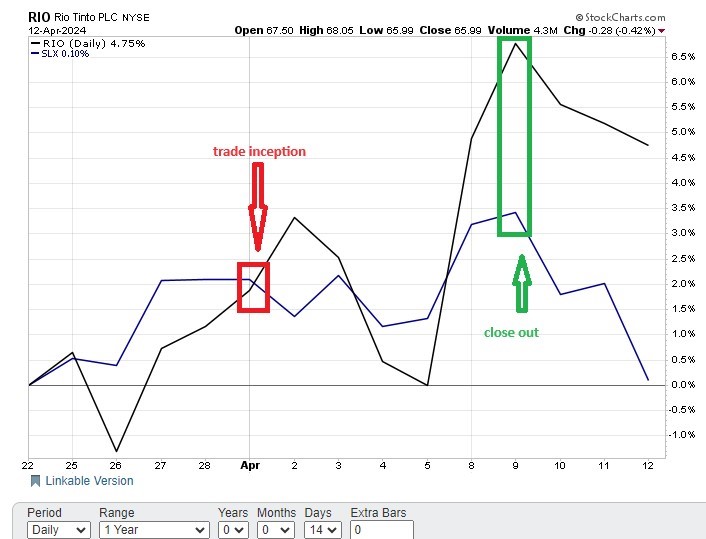
Indeed, this underperformance had reached an extreme, as seen in the six-month chart below. Rio Tinto was up just over 3% over the prior half year while SLX had gained almost 21% in that same time frame. The performance difference was now at 17.59%. This despite the fact that RIO is the largest component at just over 10% in the Steel Index.

RIO stock was finally showing some price action improvement on a technical basis on April 1. Shares had broken back above the 20-day moving average after hitting oversold readings.

Implied volatility (IV) was also very reasonable at just 13%. This means option prices were only cheaper than this 13% of the time in the past year.

POWR Options issued a trade recommendation on April1 to position for a pop in Rio Tinto. The actual trade was to buy the RIO 7/19/2024 $62.50 calls @ $5.00.

Fast forward to April 9 and the expected outperformance by RIO versus SLX had begun to transpire. Rio Tinto stock had risen about 3 points (5%). RIO stock had also closed the performance gap versus SLX from 17.59% to 12.20%.

POWR Options issued a close out on April 9 to sell the Rio calls at $6.70. The performance spread had converged, and RIO stock was getting overbought and running into overhead resistance on a technical basis.

9-day RSI neared the 70 level. Bollinger Percent B raced past 100. MACD hit a recent extreme. Shares were trading at a big premium to the 20-day moving average. RIO stock had trouble breaking past major resistance at $67 as we noted in the close out e-mail.

POWR Options bought the RIO calls on April 1 for $5.00. Closed out those calls on April 9 at $6.70 for a 34% gain. The holding period was 9 days. Not bad for a few weeks work.

RIO stock moved from $64 to $67 in that same 9-day period. A very respectable gain of just under 5%.

So, while the stock rose just under 5% the calls rose nearly 35%-or 7 times the amount of the stock. Highlights the powerful leverage that options can provide.

Not all trades work out this well-or this quickly. Trading is, after all, about probability and not certainty.

Those looking to increase the odds of success may want to take a closer look at POWR Options.

POWR Options

What To Do Next?

If you’re looking for the best options trades for today’s market, you should check out our latest presentation How to Trade Options with the POWR Ratings. Here we show you how to consistently find the top options trades, while minimizing risk.

If that appeals to you, and you want to learn more about this powerful new options strategy, then click below to get access to this timely investment presentation now:

How to Trade Options with the POWR Ratings

All the Best!

Tim Biggam

Editor, POWR Options Newsletter


RIO shares closed at $65.99 on Friday, down $-0.28 (-0.42%). Year-to-date, RIO has declined -7.71%, versus a 7.81% rise in the benchmark S&P 500 index during the same period.


About the Author: Tim Biggam

Tim spent 13 years as Chief Options Strategist at Man Securities in Chicago, 4 years as Lead Options Strategist at ThinkorSwim and 3 years as a Market Maker for First Options in Chicago. He makes regular appearances on Bloomberg TV and is a weekly contributor to the TD Ameritrade Network “Morning Trade Live”. His overriding passion is to make the complex world of options more understandable and therefore more useful to the everyday trader. Tim is the editor of the POWR Options newsletter. Learn more about Tim’s background, along with links to his most recent articles.

More…

The post How To Buy The Best Stocks At The Best Time appeared first on StockNews.com

https://www.entrepreneur.com/finance/how-to-buy-the-best-stocks-at-the-best-time/472664


Inflation Not Fading Fast Enough for Stock Investors

Investors may have celebrated the end of high inflation too soon. The CPI report shows inflation bouncing higher and thus pushing back the start date for Fed rate cuts. This has the S&P 500 (SPY) coming off recent highs. This begs questions like how much more downside could we see? And when will the bull market get back on track? 44 year investment veteran Steve Reitmeister shares his answers to these questions in this timely commentary including a preview of his top picks to stay ahead of the pack. Read on below for more.

High inflation refuses to “go quietly into the night“.

Instead, the most recent CPI report was too hot which greatly downgraded the odds of a rate cut coming in June or July. With that bond rates went higher on Wednesday and stock prices went lower.

Thursday’s PPI report was a bit tamer helping to ease the mood. But it does cloud the outlook for the market.

So, we will do our best to shine some light on our path forward from here in today’s commentary.

Market Commentary

April started with a very mild sell off which seems quite natural given then rapid pace of gains in Q1. Then just as stocks were bouncing back towards the highs we got served up a unwelcome CPI report on Wednesday that had investors hitting the sell button once again.

Unfortunately, year over year inflation increased from a 3.2% reading last month to 3.5% this time around. Yes, that is the wrong direction as we want to continue on our glide path towards the Fed’s target of 2%.

We all know that inflation rarely moves in a straight line. But this was not the first inflation report above expectations…but it certainly was the most resounding negative that investors could not dismiss.

The nerds out there (like myself) will note that the Sticky Inflation readings got even worse. That reading went up to 5% based upon the month to month change from the previous 4%. There is simply no way the Fed can look at this recent data and decide to lower rates in May…June…and probably not July.

The world of investors most certainly agreed with this notion given the seismic moves in the bond market. Most notable was the 10 year Treasury rate spiking to nearly 4.6% on Wednesday. That cooled down a notch on Thursday given the “slightly” better than expected reading for PPI.

This greatly changes expectations for the timing of the first Fed rate cut. A month ago there was 72% probability of that taking place in June. That is now down to 22%.

Moving out to July that was considered a near slam dunk at 90% odds of lower rates. That is now a coin toss at just 49% likelihood.

Finally, we see the September meeting coming in at 70% odds of lower rates. This all points to investors going over the May 1st Fed testimony with a microscope looking for even the smallest clues of what comes next.

Long story short, I think it is borderline insane for investors to expect new highs for stocks until inflation is better under wraps and certainty increases on the timing of the first rate cut. That points to the recent high of 5,265 for the S&P 500 (SPY) as being the top end of current trading range.

The bottom of that range is a bit less clear. Will investors do more of a consolidation slightly under recent levels? The hearty bounce on Thursday seems to point in that direction. But the longer things go on without a resolution to the matter, the more we could break below the 50 day moving average at 5,105 and perhaps give 5,000 a serious test.

If that scares you, then might I recommend you put your money in the bank rather than the stock market.

The only way you can enjoy the reward of a 27% gain for the S&P 500 since late October is by taking the risk that comes with mild pullbacks and tougher corrections from time to time. Meaning that testing 5,000 or even lower would be a yawn in the history of stock market movements which has improved our net worth considerably over the past few months…years…decades…generations…and so on.

My trading plan is to remain bullish. Just have a better eye towards the value of your positions. If you wouldn’t buy more shares of those stocks today…then perhaps time to sell and add new stocks that you feel have better upside potential.

That also calls for a “buy the dip” mentality as there likely will be more volatility and rough sessions ahead. Those are the times to step in and add shares of your favorite stocks.

All in all, we are moving back to a more normal bull market. Where 2 steps forward and 1 step back is just part of the dance. So, all the more reason to find the beat and dance right along.

What To Do Next?

Discover my current portfolio of 12 stocks packed to the brim with the outperforming benefits found in our exclusive POWR Ratings model. (Nearly 4X better than the S&P 500 going back to 1999)

This includes 5 under the radar small caps recently added with tremendous upside potential.

Plus I have 1 special ETF that is incredibly well positioned to outpace the market in the weeks and months ahead.

This is all based on my 43 years of investing experience seeing bull markets…bear markets…and everything between.

If you are curious to learn more, and want to see these lucky 13 hand selected trades, then please click the link below to get started now.

Steve Reitmeister’s Trading Plan & Top Picks >

Wishing you a world of investment success!


Steve Reitmeister…but everyone calls me Reity (pronounced “Righty”)
CEO, StockNews.com and Editor, Reitmeister Total Return


SPY shares were trading at $515.01 per share on Friday morning, down $2.99 (-0.58%). Year-to-date, SPY has gained 8.69%, versus a % rise in the benchmark S&P 500 index during the same period.


About the Author: Steve Reitmeister

Steve is better known to the StockNews audience as “Reity”. Not only is he the CEO of the firm, but he also shares his 40 years of investment experience in the Reitmeister Total Return portfolio. Learn more about Reity’s background, along with links to his most recent articles and stock picks.

More…

The post Inflation Not Fading Fast Enough for Stock Investors appeared first on StockNews.com

https://www.entrepreneur.com/finance/inflation-not-fading-fast-enough-for-stock-investors/472655