These 2 Restaurant Stocks Are a Bargain Under $10 For Investors

The increasing emphasis on technology and delivery services in the restaurant industry are some of the major factors driving the restaurant industry’s growth this year. Investors looking for a bargain could consider fundamentally strong restaurant stocks Domino’s Pizza Group (DPUKY) and El Pollo Loco (LOCO), currently trading under $10. Read on.

Despite the macroeconomic challenges, the restaurant industry’s long-term outlook remains promising. Therefore, I present quality restaurant stocks offering a potential bargain for investors: Domino’s Pizza Group plc (DPUKY) and El Pollo Loco Holdings, Inc. (LOCO), currently trading under $10.

The National Restaurant Association’s 2023 State of the Restaurant Industry report indicates that the food service industry is expected to reach $997 billion in sales in 2023, with a projected growth of 500,000 jobs, despite rising food costs and increasing competition.

The restaurant industry is embracing technology to automate operations, with AI-powered voice technology optimizing phone and drive-thru orders, and self-service kiosks providing customization and flexibility for customers.

Moreover, self-service technology is expected to evolve further and could soon be integrated into in-car digital assistants, offering advantages for restaurants in terms of efficiency and customer convenience. In addition, the use of GPS tracking systems is also creating a seamless and transparent customer experience.

Consumers are also increasingly opting for food delivery services, and there is a growing emphasis on healthy eating, with many delivery services offering healthy food options. Additionally, online food delivery services are expanding their networks, allowing consumers to order from a wide range of restaurants and cuisines.

As a result, according to IMARC Group, the online food delivery market is expected to grow at a CAGR of 10% until 2028.

Here are the stocks mentioned above:

Domino’s Pizza Group plc (DPUKY)

Based in Milton Keynes, the United Kingdom, DPUKY owns, operates, and franchises several Domino’s Pizza stores. It operates stores in the United Kingdom and the Republic of Ireland and also leases its stores.

In terms of forward EV/Sales, DPUKY is currently trading at 2.80x, which is 14.4% lower than its five-year average of 3.28x. Its forward EV/EBITDA of 13.74x is 8.7% lower than its five-year average of 15.05x. Moreover, its forward P/S multiple of 2.03 is 9.8% lower than its five-year average of 2.25.

The company pays an annual dividend of $0.33, which translates to a yield of 4.34% at the current price level, higher than its four-year average dividend yield of 3.38%.

During the year that ended December 25, 2022, DPUKY’s group revenue increased 7% year-over-year to £600.30 million ($751.64 million). Its gross profit rose 1.8% year-over-year to £273.50 million (342.45 million). Its profit for the period increased 4.2% year-over-year to £81.60 million ($102.17 million).

Also, the company’s earnings per share from continuing and discontinued operations stood at 18.7 pence.

DPUKY’s revenue is expected to rise 7.9% year-over-year to $771.65 million in the fiscal year 2023.

Over the past six months, the stock has gained 36.6%, closing the last trading session at $7.51. It has gained 5% over the past month.

DPUKY’s POWR Ratings reflect this promising outlook. The stock has an overall rating of B, which translates to a Buy in our proprietary rating system. The POWR Ratings are calculated by considering 118 different factors, with each factor weighted to an optimal degree.

DPUKY has a B grade for Momentum, Stability, and Quality. Within the A-rated Restaurants industry, it is ranked #6 out of 46 stocks.

Beyond the POWR Ratings stated above, we have also rated DPUKY for Growth, Value, and Sentiment. Get all DPUKY ratings here.

El Pollo Loco Holdings, Inc. (LOCO)

LOCO develops, franchises, licenses, and operates quick-service restaurants under the El Pollo Loco brand.

LOCO’s forward non-GAAP P/E of 15.03x is 23.7% lower than its five-year average of 19.70x. Its trailing-12-month P/B of 1.35x is 25.3% lower than its five-year average of 1.80x. Also, its forward P/S multiple of 0.79 is 30% lower than its five-year average of 1.13.

On April 18, 2023, LOCO announced that it had reintroduced its popular Shredded Beef Birria menu for the second year. The authentic Mexican flavor can be enjoyed in various entrees like crunchy tacos, grilled burritos, or overstuffed quesadillas, paired with a Consomé Dipping Sauce.

This menu item was a record-breaking limited-time offer for the brand across sales and social engagement last year, and the company is looking to replicate that success this year.

LOCO’s total revenue increased 22.5% year-over-year to $115.92 million in the fiscal fourth quarter that ended December 28, 2022. The company’s income from operations grew 12.9% from its prior-year quarter to $9.51 million. Its net income rose 5.8% from the prior-year quarter to $6.54 million.

Also, the company’s EPS increased 5.9% year-over-year to $0.18 and adjusted EBITDA grew 4.3% year-over-year to $13.25 million.

Analysts expect LOCO’s EPS to increase 54.3% year-over-year to $0.11 in the fiscal first quarter that ended March 2023. Its revenue is expected to rise 3.1% year-over-year to $113.42 million in the same quarter. The company has an impressive earnings surprise history; it beat the consensus EPS estimates in each of the trailing four quarters.

The stock has soared 14.7% over the past nine months and 6.8% over the past month, closing the last trading session at $9.99.

LOCO’s robust fundamentals are reflected POWR Ratings. The stock has an overall B rating, which equates to a Buy in our proprietary rating system.

Also, the stock has a B grade for Growth, Value, and Momentum. LOCO is ranked #11 in the same industry.

In addition to the POWR Rating grades I’ve just highlighted, one can see LOCO’s ratings for Stability, Quality, and Sentiment here.

What To Do Next?

Get your hands on this special report with 3 low priced companies with tremendous upside potential even in today’s volatile markets:

3 Stocks to DOUBLE This Year >


DPUKY shares were unchanged in premarket trading Thursday. Year-to-date, DPUKY has gained 1.75%, versus a 7.10% rise in the benchmark S&P 500 index during the same period.


About the Author: Kritika Sarmah

Her interest in risky instruments and passion for writing made Kritika an analyst and financial journalist. She earned her bachelor’s degree in commerce and is currently pursuing the CFA program. With her fundamental approach, she aims to help investors identify untapped investment opportunities.

More…

The post These 2 Restaurant Stocks Are a Bargain Under $10 For Investors appeared first on StockNews.com

https://www.entrepreneur.com/finance/these-2-restaurant-stocks-are-a-bargain-under-10-for/450998



Will the Next Fed Announcement Be Bullish or Bearish?

Investors have been in a state of limbo all year long trying to determine if still in a bear market or has the new bull already emerged? 4,200 on the S&P 500 (SPY) being the key level. Interestingly, the Fed announcement on Wednesday 5/3 could be the key catalyst to settle this dispute once and for all. Read on below for the trading plan to stay on the right side of the action. dated market outlook, trading plan and top picks in the commentary below.

Stocks have been rallying to their highest levels since the bear market began…but then took a BIG step back on Tuesday.

Why?

That is going to take a bit of explanation. Gladly we have the time to review it all in this week’s Reitmeister Total Return commentary below…

Market Commentary

Some have oversimplified the Tuesday decline by pointing out that questions have arisen once again in the banking sector. Especially true for the regional banks that fell as a group by 6% on the session.

Most of us suspected there would be more rumblings in this space as so much money has flowed out of smaller banks into the “too big to fail” group. This creates headline risk in the future for the next First Republic or Silicon Valley Bank to emerge. This explains why PacWest and Western Alliance declined -27% and -15% on the day (ouch indeed!).

Now layer on top how every time we turn around, we hit another debt ceiling. Most are easily dispensed with as congress hits the “Easy Button” to push the limit higher.

However, with an election season around the corner it would not be surprising if one of the parties makes a stand to point out the failings of the other. That political brinksmanship is never good for stock prices.

Now let’s put a cherry on top of this Risk Off sundae. No doubt a lot of investors took profits off the table Tuesday given some trepidation coming into Wednesday’s next Fed meeting at 2pm ET.

Right now, there is a 97% expectation of another quarter point rate hike on the way. The divergence in opinion occurs after that. Some expect more hikes and for the Fed to keep those high rates in place til early 2024 (which is the stated plan of the Fed).

Yet amazingly the street consensus is that this is the last rate hike and they will start lowering as early as September. Thus, if Powell sticks to his guns with higher rates for longer mantra, then we will likely see more sell off from the recent peak.

Also not helping the mood is the recent slate of economic reports that show continued weakness. That started Monday with ISM Manufacturing coming in at 47.1 (well below 50 showing that things are contracting). The forward-looking New Orders component was even worse at 45.7.

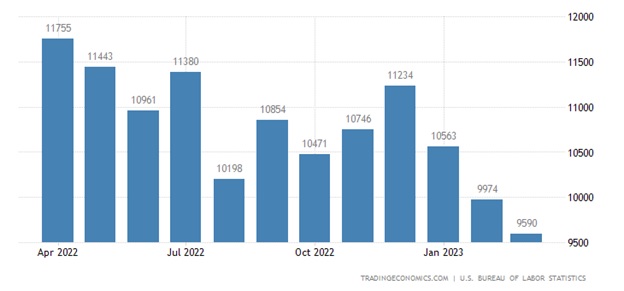
Next came the 3rd straight monthly drop in the JOLTs report (Job Openings and Labor Turnover).

Most investors are aware that employment is the current lynchpin for the economy. As long as that stays strong, then no recession coming putting an end to the bear market. BUT once employment finally weakens, then odds of recession soar with lower stock prices on the way.

Do consider that before companies start firing people, which increases the unemployment rate, they first stop hiring new people. Indeed, that is what the lower JOLTs report may be showing as there are 20% less job openings than a year ago.

Back to the Fed rate decision on Wednesday afternoon. What happens there could serve as the catalyst for the next big stock move.

If they are ready to stop raising rates and hint at the lowering them before the year ends, then stocks will immediately break higher. In fact, it could be enough to lift above 4,200 which would officially mark the start of a new bull market.

That’s because a bull market is designated by a 20% rally from the bear market lows. In that case, we are talking about 3,491 x 20% = 4,189 for the S&P 500 (SPY). Thus, most of us round that off to say a break above 4,200 = new bull market. And we should all get more aggressively long the stock market with Risk On stocks with that break out.

On the other hand, if the Fed sticks to the same hawkish song sheet as the past, then bulls will lose heart with more downside on the way. Remember that Powell has repeated time and time again that they will be keeping high rates in place through the end of 2023.

In fact, at the last press conference he was asked if investors are wrong with their view that rates will be lowered sooner. His reaction was so funny. Like he was the only adult in the room implying “there will be no ice cream before dinner“. Or simply, I could not be any clearer and don’t know why you dopes keep thinking that I am bluffing.

Given that backdrop, I do not believe there is any good reason for the Fed to change course at this time. Which means a hawkish reminder is likely on the way Wednesday afternoon with a sell off more plausible than a break above 4,200.

But anything is possible.

This means we should all stay vigilant for not just the rate hike decision at 2pm ET. But more importantly to get the full weight of their plans in Powells’ comments and press conference to follow at 2:30pm.

The content of these events are likely to provide the catalyst for the next big stock move.

Which direction will it be?

Stay tuned for the answer. But the above gives you a decoder ring of how to interpret these events so you can trade it appropriately.

What To Do Next?

Discover my balanced portfolio approach for uncertain times. The same approach that has vastly outperformed the market since being put into place the start of April.

This strategy was constructed based upon over 40 years of investing experience to appreciate the unique nature of the current market environment.

Right now, it is neither bullish or bearish. Rather it is confused…volatile…uncertain.

Yet, even in this unattractive setting we can still chart a course to outperformance. Just click the link below to start getting on the right side of the action:

Steve Reitmeister’s Trading Plan & Top Picks >

Wishing you a world of investment success!


Steve Reitmeister…but everyone calls me Reity (pronounced “Righty”)
CEO, StockNews.com and Editor, Reitmeister Total Return


SPY shares . Year-to-date, SPY has gained 7.84%, versus a % rise in the benchmark S&P 500 index during the same period.


About the Author: Steve Reitmeister

Steve is better known to the StockNews audience as “Reity”. Not only is he the CEO of the firm, but he also shares his 40 years of investment experience in the Reitmeister Total Return portfolio. Learn more about Reity’s background, along with links to his most recent articles and stock picks.

More…

The post Will the Next Fed Announcement Be Bullish or Bearish? appeared first on StockNews.com

https://www.entrepreneur.com/finance/will-the-next-fed-announcement-be-bullish-or-bearish/450887


2 Rotten Stocks to Sell Now Before They Spoil More

Given the uncertain macroeconomic climate and persistent inflation, fundamentally weak food stocks BRC (BRCC) and Save Foods (SVFD) are expected to remain under pressure. Therefore, it could be best to steer clear of these stocks. Keep reading.

Headwinds of persistently high inflation, tight monetary policy, and concerns of a looming recession have put industries under pressure. With food companies expected to face margin pressure from rising raw material costs, investors could look to sell fundamentally weak food stocks BRC Inc. (BRCC) and Save Foods, Inc. (SVFD) before they spoil further.

Although the latest CPI report signaled a cooling of inflation, it still remains well above the Federal Reserve’s target of 2%. A strong jobs growth in March and high inflation will likely bring further rate hikes by the Federal Reserve, increasing fears of the economy falling into a recession.

Moreover, Cleveland Fed President Loretta Mester has said that interest rates will need to rise above 5% given the high prices. With fears of a downturn weighing heavily on investors’ sentiments, it could be best to avoid BRCC and SVFD. Although food stocks tend to be recession-proof, the weak fundamentals of these stocks could lead to downward price pressure.

BRC Inc. (BRCC)

BRCC purchases, roasts, and sells coffee, coffee accessories, and branded apparel in the United States. The company also produces media content; podcasts; and digital and print journals, as well as sells coffee brewing equipment and outdoor and lifestyle gear.

In terms of trailing-12-month EBIT margin, BRCC’s negative 22.49% compares to the industry average of 7.64%. Its trailing-12-month Return on Total Capital of negative 41.11% million compares to the industry average of 6.42%. Likewise, its negative 40.52% trailing-12-month Levered FCF Margin compares to the 2.69% industry average.

For the fiscal fourth quarter ended December 31, 2022, BRCC’s loss from operations widened 378.3% year-over-year to $19.46 million. Its net loss widened 334.8% year-over-year to $20.03 million. Additionally, its adjusted EBITDA loss widened significantly year-over-year to $11.42 million, while its net loss per share came in at $0.09.

Over the past year, the stock has fallen 65.1% to close the last trading session at $5.21.

BRCC’s weak fundamentals are reflected in its POWR Ratings. The stock has an overall rating of F, which translates to a Strong Sell in our proprietary rating system. The POWR Ratings assess stocks by 118 different factors, each with its own weighting.

It is ranked #77 out of 79 stocks in the Food Makers industry. It has an F grade for Quality and a D for Stability and Sentiment.

We have also given BRCC grades for Growth, Value, and Momentum. Get all BRCC ratings here.

Save Foods, Inc. (SVFD)

Headquartered in Hod HaSharon, Israel, SVFD, an agri-food tech company, develops and sells eco-friendly green treatments for the food industry to enhance food safety and shelf life of fresh produce.

In terms of trailing-12-month Return on Common Equity, SVFD’s negative 93.10% compares to the industry average of 11.44%. Its trailing-12-month Return on Total Capital of negative 58.69% compares to the industry average of 6.81%. Likewise, its negative 88.41% trailing-12-month Return on Total Assets compares to the 5.21% industry average.

SVFD’s revenues from sales of products for the fiscal year ended December 31, 2022, declined 10.1% year-over-year to $394K. The company’s operating loss widened 23.7% year-over-year to $5.82 million. Its net loss attributable to the company’s shareholders widened 19.1% year-over-year to $5.74 million. Moreover, its loss per share narrowed by 20.4% year-over-year to $1.64.

Over the past year, the stock has fallen 85.6% to close the last trading session at $0.75.

SVFD’s POWR Ratings reflect its grim outlook. The stock has an overall rating of F, equating to a Strong Sell in our proprietary rating system.

It is ranked #78 in the same industry. Additionally, it has an F grade for Value and Stability and a D for Quality.

To see the additional ratings of SVFD for Growth, Momentum, and Sentiment, click here.

What To Do Next?

Get your hands on this special report with 3 low priced companies with tremendous upside potential even in today’s volatile markets:

3 Stocks to DOUBLE This Year >


BRCC shares . Year-to-date, BRCC has declined -14.73%, versus a 9.17% rise in the benchmark S&P 500 index during the same period.


About the Author: Malaika Alphonsus

Malaika’s passion for writing and interest in financial markets led her to pursue a career in investment research.With a degree in Economics and Psychology, she intends to assist investors in making informed investment decisions.

More…

The post 2 Rotten Stocks to Sell Now Before They Spoil More appeared first on StockNews.com

https://www.entrepreneur.com/finance/2-rotten-stocks-to-sell-now-before-they-spoil-more/450704


Are Stocks A Good Buy Now – Or A Good Bye ??

Three Things To Consider When Considering Whether To Be Bullish or Bearish on the SPY.

Stocks continue to climb higher on the back of earnings that have beaten expectations so far (albeit lowered expectations). The NASDAQ 100 just closed at the highest level since last August. The S&P 500 (SPY) is on the brink of a breakout above $4200.  The VIX just closed below 16 for the first time in well over a year.

Whether or not stock markets rip even higher remains to be seen. Momentum can certainly take prices beyond reasonable levels and to extremes.

To quote Keynes- “Markets can remain irrational longer than investors can remain solvent”. In the short run, markets can and will do almost anything.

Over a little longer-term horizon, however, three things are worth considering before you consider getting long stocks at these levels. Let’s look back to about a year ago (11 months) when the S&P 500 was at a similar price to see what has changed in that time frame.

Implied Volatility

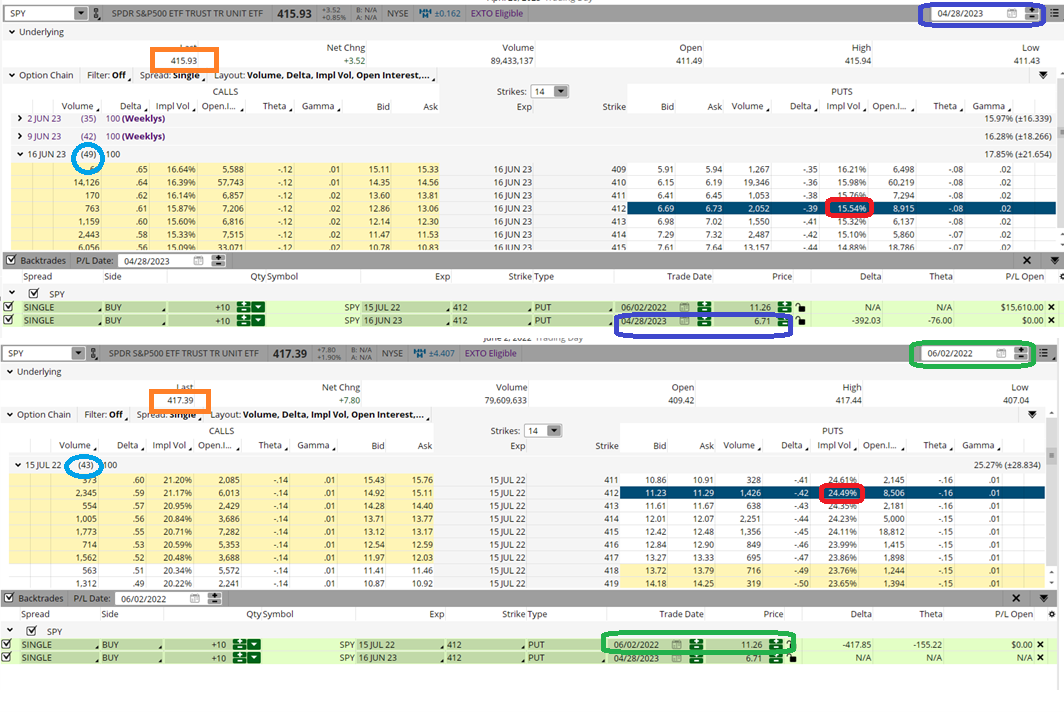
The two option montages below show option prices from Friday’s close and from the close on June 2, 2022.

Back on June 2, 2002, the SPY closed at $417.39. Friday it finished at $415.93, so pretty much the same price as Friday, just a touch lower (0.35%) now.

The June 16, 2023, options have 49 days to expiration (DTE). The July 15, 2022, options have 43 DTE. So, a little longer (6 days) for the 2023 options now.

Normally, puts that are closer to the money with more time to expiration are more expensive. But because the VIX -or implied volatility (IV) – is at lows, the puts now are actually much less expensive ($6.71 now versus $11.26 then).

All because of the big drop in IV from 24.49 to 15.54. The table below puts the comparison together, along with a % of strike (option price /$412 strike price) and downside breakeven ($412 strike price -option price).

So, a much lower cost for much better protection. Kind of like paying less insurance premium for a lower deductible with the exact same coverage.

Interest Rates

10-year Treasury yield was 2.913% on June 2, 2022. Friday it closed at 3.452%.

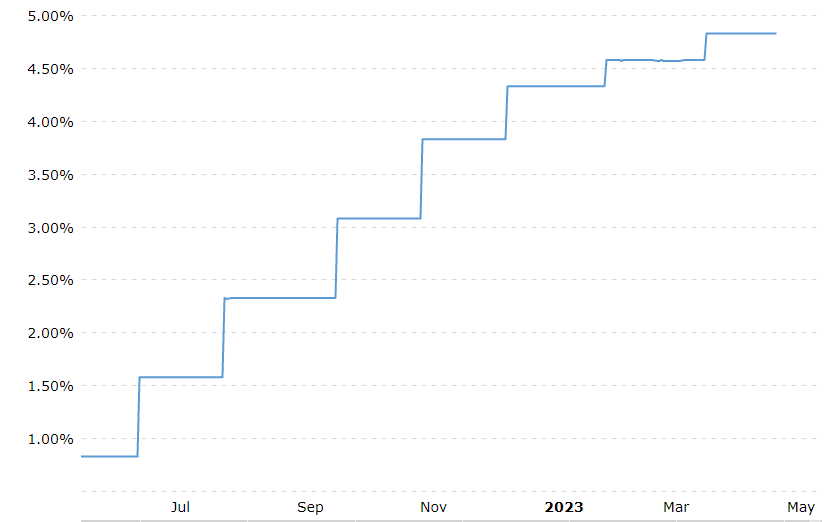
Fed Funds rate was under 1% back then, approaching 5% now.

No doubt interest rates have risen sharply over the past 11 months.

Valuations

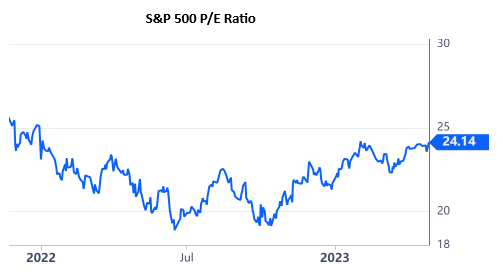
P/E was 21.51 June 2, 2022. P/E today is 24.14.-and nearing the richest multiple since December 2021. The last time it was above 24 was February 2 of this year which coincided with a significant top in the S&P 500.


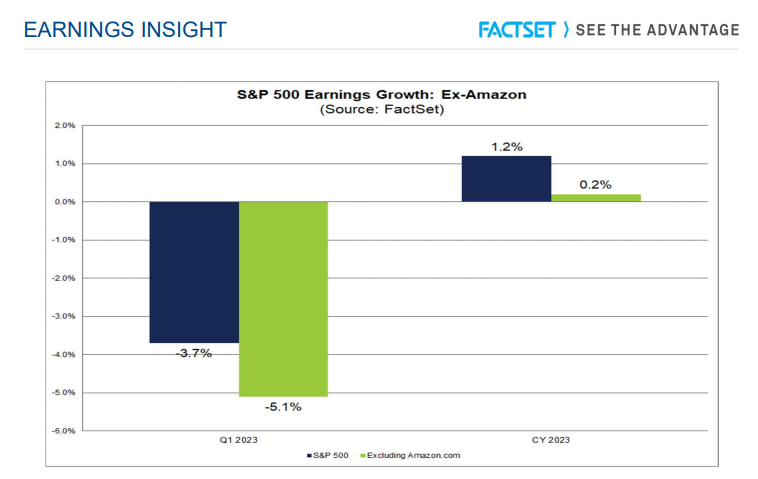
FactSet mentioned that it is interesting to note that Amazon.com is also the largest contributor to earnings growth for the entire S&P 500 for Q1 and 2023. If this company were excluded, the (blended) earnings decline for the S&P 500 for Q1 2023 would increase to -5.1% from -3.7%, while the estimated earnings growth rate for the S&P 500 for CY 2023 would fall to 0.2% from 1.2%. Either way, earnings are still receding and don’t look to see much growth over the next few quarters.

Increased interest rates and lower earnings should lead to lower valuation multiples-and lower stock prices. Instead, stock markets are back approaching fresh new multi-year highs on valuation and all-time highs on price.

The belief in the Fed to start lowering rates sooner than projected and earnings to start improving more quickly than expected requires a pretty good leap of faith.

Traders and investors alike may want to hedge that faith a little. Buying some downside protection with puts that are the cheapest they have been in a long time makes a lot of sense – everything considered.

POWR Options

What To Do Next?

If you’re looking for the best options trades for today’s market, you should check out our latest presentation How to Trade Options with the POWR Ratings. Here we show you how to consistently find the top options trades, while minimizing risk.

If that appeals to you, and you want to learn more about this powerful new options strategy, then click below to get access to this timely investment presentation now:

How to Trade Options with the POWR Ratings

All the Best!

Tim Biggam

Editor, POWR Options Newsletter


SPY shares closed at $415.93 on Friday, up $3.52 (+0.85%). Year-to-date, SPY has gained 9.17%, versus a % rise in the benchmark S&P 500 index during the same period.


About the Author: Tim Biggam

Tim spent 13 years as Chief Options Strategist at Man Securities in Chicago, 4 years as Lead Options Strategist at ThinkorSwim and 3 years as a Market Maker for First Options in Chicago. He makes regular appearances on Bloomberg TV and is a weekly contributor to the TD Ameritrade Network “Morning Trade Live”. His overriding passion is to make the complex world of options more understandable and therefore more useful to the everyday trader. Tim is the editor of the POWR Options newsletter. Learn more about Tim’s background, along with links to his most recent articles.

More…

The post Are Stocks A Good Buy Now – Or A Good Bye ?? appeared first on StockNews.com

https://www.entrepreneur.com/finance/are-stocks-a-good-buy-now-or-a-good-bye/450702


Is the New Bull Market at Hand?

There are signs that the S&P 500 (SPY) may finally be ready to break out above 4,200 and claim the start of the new bull market. Unfortunately, the bears have reason to believe that the worst is not yet behind us with early May economic reports looming large in investor decision making. Get Steve Reitmeister’s take with trading plan and top picks in the commentary below.

4,200 for the S&P 500 (SPY) is a vital level for the market. Above it lies a new bull market. Below it the bears can still claim victory.

Indeed, stocks were running up to that battle line once again this week.

Why? And what does that mean for the final bull/bear outcome for the market?

That will be the focus of this week’s commentary.

Market Commentary

On Thursday we found out that Q1 GDP was much lower than expected at only +1.1% growth when 2.3% was expected. The primary reason was that things slowed down considerably in March.

On top of that the Fed’s preferred inflation measure, Personal Consumption Expenditures (PCE), was higher than feared at +4.2% versus the previous reading of +3.7%. This should obviously have investors worried about the Fed’s “higher rates for longer” stance as we roll into their next announcement on Wednesday 5/3.

In fact, the combination of slower growth and higher inflation on Thursday had more commentators talking about Stagflation. That was an economic disease in the 1970’s that was part of a long secular bear market that did not really take off until 1982 when inflation started to come down and the economy got healthy once again.

Sounds like this would all equate to another Risk Off day. NOPE…think again!

The result was a shocking +2% rally on Thursday with tech leading the way thanks to the recent earnings success for Microsoft and Meta (Facebook). And then nearly another 1% was tacked on Friday to close at the highest level since early February.

Gladly it is not just tech showing promise this earnings season.  As the graphic below shows that just a week back on 4/20 Wall Street expected Q1 earnings to be down -9.75% year over year. And yet now with half of the companies in S&P 500 reporting that has been more than halved to only -4.28%.

Before you start getting too bullish on this positive earnings trend, unfortunately the bad news shows up in the next 2 columns. That being where estimates are getting slightly worse for the next 2 quarters. This coincides with the GDP report which shows that softness started end of Q1 and may be accelerating.

That is why estimates are still poor and why it may not necessarily be time to celebrate the end of the bear market. So at this stage the impetus from earnings season may have a touch more upside up to the line at 4,200.

To get a decided bullish break above 4,200 or to retreat back into bearish territory is awaiting the next round of catalysts. Like some of the key economic reports on the docket for next week:

5/1 ISM Manufacturing

5/3 ISM Services, Fed Rate Decision

5/5 Government Employment Situation

Note that the Chicago PMI report from Friday is considered the best leading indicator of where ISM Manufacturing will land. In that case it was still in contraction territory at 48.6. However, on the bright side that is the highest reading since September 2022.

So directionally it could be read that things are improving. We’ll know if that is also the case for ISM Manufacturing on Monday.

The point is that we are coming up to a moment of truth. Do bulls have the necessary fuel to break above 4,200 and claim victory? Or does the threat of recession still loom large enough to stay under that key level?

It is possible that we have our answer by the end of next week given the 3 key reports noted above.

Unfortunately, we may just have enough information to stay confused and in a limbo under 4,200 a while longer.

The trading plan remains balanced near 50% invested. If break bullish, then keeping adding attractive Risk On positions to get up closer to 100% invested.

If break bearish, then reduce amount invested with a very conservative mix of Risk Off stocks.

So let the chips fall where they may and we will trade accordingly.

What To Do Next?

Discover my balanced portfolio approach for uncertain times. The same approach that has beaten the S&P 500 by a wide margin so far in April.

This strategy was constructed based upon over 40 years of investing experience to appreciate the unique nature of the current market environment.

Right now, it is neither bullish or bearish. Rather it is confused…volatile…uncertain.

Yet, even in this unattractive setting we can still chart a course to outperformance. Just click the link below to start getting on the right side of the action:

Steve Reitmeister’s Trading Plan & Top Picks >

Wishing you a world of investment success!


Steve Reitmeister…but everyone calls me Reity (pronounced “Righty”)
CEO, StockNews.com and Editor, Reitmeister Total Return


SPY shares fell $0.20 (-0.05%) in after-hours trading Friday. Year-to-date, SPY has gained 9.17%, versus a % rise in the benchmark S&P 500 index during the same period.


About the Author: Steve Reitmeister

Steve is better known to the StockNews audience as “Reity”. Not only is he the CEO of the firm, but he also shares his 40 years of investment experience in the Reitmeister Total Return portfolio. Learn more about Reity’s background, along with links to his most recent articles and stock picks.

More…

The post Is the New Bull Market at Hand? appeared first on StockNews.com

https://www.entrepreneur.com/finance/is-the-new-bull-market-at-hand/450677


50% Bullish vs. 50% Bearish

40 year investment pro Steve Reitmeister has a more balanced view of whether the future is bullish or bearish. This doesn’t mean to sit on your hands waiting for an outcome as there are indeed ways to actively invest at this time to top the S&P 500 (SPY). Get Steve’s most recent market outlook, trading plan and top picks in the commentary below.

The S&P 500 (SPY) is near dead even week over week. And yet there is an interesting theme playing out as we look back the past month.

On one hand it is quite bullish. And on the other hand actually bearish.

Meaning that altogether it is quite confusing. So we will do our best to make sense of it all in the fresh market commentary that follows…

Market Commentary

OK…what is so bullish about action the past month?

Easy to say it’s because the S&P 500 is up +3.3% in that span. Plus, we are flirting with the recent highs found in early February just under 4,200.

Cool…so what is bearish about that?

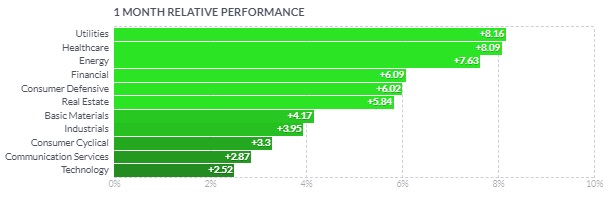
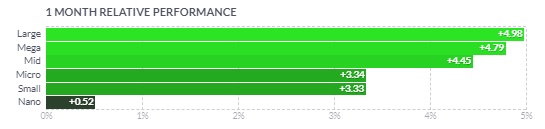
The Risk Off nature of the groups that are leading the way. The next 2 performance charts for the past month points out the issue in spades:

Bullish times are generally marked by investors taking on a bit more risk to enjoy more upside. So that is when smaller stocks outperform. Plus investors will bid up the more growth oriented industries like Consumer Cyclical and Technology.

CLEARLY NOT THE CASE NOW

As you can see the larger the stocks the higher the returns. And Risk Off sectors like Utilities, Healthcare and Consumer Defensive are leading the charge.

Again…kind of bullish when you see green arrows across the board. But kinda bearish with investors in Flight to Safety mode.

Meredith Margrave of our POWR Stocks Under $10 service had some other interesting ideas on this front:

“That brings me back to my earlier point that “the stock market” is doing well, and not “stocks.” You see, “stocks” aren’t really doing that great.

A number of analysts are concerned that this rally is much more vulnerable than it appears to be. Part of that is because market breadth has been weak. As of last Friday, less than half (45%) of Russell 3000 stocks were trading above their 200-day moving averages. That matches up with news that this rally has largely been carried by a handful of mega-cap stocks like Microsoft and Apple.

We’re also seeing low volatility – VIX is at its lowest since the beginning of the year – which could mean investors are possibly too complacent and stocks could be heading for a selloff.”

Until there is something blatantly bearish happening stocks will likely continue to float higher up to resistance at the February high of 4,200. Helping matters in the short run is that earnings season is better than low expectations…but not super impressive either.

What clearly showed up early in the results was that the big banks benefited from the banking crisis as deposits rushed out of smaller regional and community banks to the “too big to fail” institutions.

All in all, earnings season is just like everything else…not bearish, but not really bullish either. This keeps limbo in place until a new catalyst comes along to have people recalibrate the odds of recession making them either more bearish or more bullish.

Looking at the economic calendar there are not many catalysts that matter until ISM Manufacturing on 5/1 and the next would be the ISM Services and Fed rate hike decision on 5/3 and then winding up the week with Government Employment on 5/5.

The catalysts to become bearish will be obvious. That being clear cut proof of a recession unfolding with stocks tumbling to the October low of 3,491 and likely lower.

The funny thing is that the catalysts to the upside may be quite subtle. Simply the ABSENCE of bad news = good news = stocks move higher.

This is what Goldman Sachs was kind of saying in their write up that this stock market seems “bullet proof“. And the main reason why is the robustness of the employment market which refuses to buckle. With that being the case then income is in place which begets spending and economic growth. This is why we keep avoiding recession.

This has me shifting down odds for a future recession and extension of the bear market once again. I would say its about 50/50 at this time. As such I have been increasing my exposure to the stock market with emphasis on the best stocks thanks to the advantage in our POWR Ratings model.

I know some would prefer that I had greater certainty…like there is something wrong with me.

No friends. I have an Economics background and can say with full confidence it is an inexact science. That is why the average recession forms when less than 50% of economists predicting that outcome.

I say 50/50 NOT because I am flakey or afraid to make a call. It is because at one time I was 80% sure of recession and with it not happening again and again…I have to appreciate that odds are lower. BUT those recessionary odds still very much exist.

Thus, I will continue to sleep with 1 eye open for its potential return. Until that truly comes on the scene, then I will continue to increase my allocation to attractive stocks.

What To Do Next?

Discover my balanced portfolio approach for uncertain times. The same approach that has beaten the S&P 500 by a wide margin so far in April.

This strategy was constructed based upon over 40 years of investing experience to appreciate the unique nature of the current market environment.

Right now, it is neither bullish or bearish. Rather it is confused…volatile…uncertain.

Yet, even in this unattractive setting we can still chart a course to outperformance. Just click the link below to start getting on the right side of the action:

Steve Reitmeister’s Trading Plan & Top Picks >

Wishing you a world of investment success!


Steve Reitmeister…but everyone calls me Reity (pronounced “Righty”)
CEO, StockNews.com and Editor, Reitmeister Total Return


SPY shares fell $0.17 (-0.04%) in after-hours trading Friday. Year-to-date, SPY has gained 8.20%, versus a % rise in the benchmark S&P 500 index during the same period.


About the Author: Steve Reitmeister

Steve is better known to the StockNews audience as “Reity”. Not only is he the CEO of the firm, but he also shares his 40 years of investment experience in the Reitmeister Total Return portfolio. Learn more about Reity’s background, along with links to his most recent articles and stock picks.

More…

The post 50% Bullish vs. 50% Bearish appeared first on StockNews.com

https://www.entrepreneur.com/finance/50-bullish-vs-50-bearish/450210


Bears Have a Front Row Seat to the “Pain Trade”

Confused by what’s going on with the stock market? You wouldn’t be the only one. Despite so much bad news, the S&P 500 (SPY) is currently up about 7.5% year to date. So what exactly is going on here? Read my latest market commentary below to find out….

(Please enjoy this updated version of my weekly commentary originally published April 20th, 2023 in the POWR Stocks Under $10 newsletter).

Yes, the stock market really has been a bit confusing lately, hasn’t it?

In spite of all the bad news – the mini banking crisis, rising geopolitical tensions, predictions of a recession – the stock market has been doing surprisingly well in 2023.

(Please note I said “the stock market” has been doing well… not “stocks.” There’s a reason for that. More later…)

The market’s resilience is an example of a concept called the “pain trade,” which is a phrase I’d heard before but never really saw so perfectly in action until now.

The best way I’ve seen it described was like this: “The goal of the market is to extract the most amount of pain from the greatest number of people.”

Essentially, when everyone is bearish, the pain trade is for stocks to go up. When everyone is bullish, the pain trade is for stocks to go down.

And as we’ve discussed for months in this letter, there was perfectly good reason for everyone to be bearish.

A month ago, everyone was freaking out after the failures of Silicon Valley Bank and other regional lenders, and the CNN Fear and Greed Index was deep in the “fear” category.

It makes sense that everyone was waiting on the sidelines. (Remember, most people were ultra bearish at the end of 2022, which is when we saw people flee the market in droves.

Since they’ve already sold, they can’t sell again… which is why we’re not seeing another major selloff accompanying March’s negative sentiment.)

But now sentiment is improving, with more and more people starting to feel optimistic about the market.

Or a least that they’re missing out on all the gains and are willing to risk dipping their toes back in the water, recession be damned.

These hesitant “bulls” are the ones buoying the market at a moment where we’d likely see the weakness we’re all talking about show up on the charts.

That brings me back to my earlier point that “the stock market” is doing well, and not “stocks.” You see, “stocks” aren’t really doing that great.

A number of analysts are concerned that this rally is much more vulnerable than it appears to be.

Part of that is because market breadth has been weak. As of last Friday, less than half (45%) of Russell 3000 stocks were trading above their 200-day moving averages.

That matches up with news that this rally has largely been carried by a handful of mega-cap stocks like Microsoft and Apple.

We’re also seeing low volatility – VIX is at its lowest since the beginning of the year – which could mean investors are possibly too complacent and stocks could be heading for a selloff.

For volatility to revert back to the mean, we’d have to see some kind of selloff in the S&P 500 (SPY).

That lines up with the many analyst notes we’re seeing warning investors that even a mild recession would result in a substantial market selloff. Many believe that we’d retest the October 2022 lows – or a drop of more than 15% from current prices.

Those experts are recommending that clients stay underweighted on stocks and overweighted on cash, which is exactly where we are now.

Personally, I’m still more bearish than bullish, which I know seems to be the popular choice. But I’m still a believer that we can make money owning certain high-quality stocks.

Looking forward, the next three weeks of Q1 2023 corporate earnings reports and forward guidance for the rest of the year should hopefully help bridge the gap between the resilience of markets and the reticence of investors.

Conclusion

Despite my bearish leanings, I’m always on the lookout for new portfolio additions that fit our portfolio mandate.

We’ll see what we can scare up in the next few weeks as companies continue to report earnings. Keep an eye on your inbox…

What To Do Next?

If you’d like to see more top stocks under $10, then you should check out our free special report:

3 Stocks to DOUBLE This Year

What gives these stocks the right stuff to become big winners, even in this challeging stock market?

First, because they are all low priced companies with the most upside potential in today’s volatile markets.

But even more important, is that they are all top Buy rated stocks according to our coveted POWR Ratings system and they excel in key areas of growth, sentiment and momentum.

Click below now to see these 3 exciting stocks which could double or more in the year ahead.

3 Stocks to DOUBLE This Year

All the Best!

Meredith Margrave
Chief Growth Strategist, StockNews
Editor, POWR Stocks Under $10 Newsletter


SPY shares closed at $412.20 on Friday, up $0.32 (+0.08%). Year-to-date, SPY has gained 8.20%, versus a % rise in the benchmark S&P 500 index during the same period.


About the Author: Meredith Margrave

Meredith Margrave has been a noted financial expert and market commentator for the past two decades. She is currently the Editor of the POWR Growth and POWR Stocks Under $10 newsletters. Learn more about Meredith’s background, along with links to her most recent articles.

More…

The post Bears Have a Front Row Seat to the “Pain Trade” appeared first on StockNews.com

https://www.entrepreneur.com/finance/bears-have-a-front-row-seat-to-the-pain-trade/450209


Learn to Invest Wisely With This $120 App

Disclosure: Our goal is to feature products and services that we think you’ll find interesting and useful. If you purchase them, Entrepreneur may get a small share of the revenue from the sale from our commerce partners.

Recent estimates from LinkedIn say it can take up to four years for a new business to become profitable. In that time, you as the business owner may be putting everything you have into your work, but that does not leave much room for growth.

Instead, you could start investing in the stock market to generate passive income for yourself and to fund new growth for your company. Aim to invest wisely by checking stock risk summaries on Tykr, a stock screener app with a lifetime subscription on sale for $119.99 (reg. $900).

Assess the risk factor for thousands of stocks.

Tykr cannot guarantee an investment will earn you money, but it can provide risk assessments based on open-source calculations that you can factor into your investment plans. Tykr supports more than 30,000 U.S. and international stocks and provides multiple levels of analysis for each one.

[embedded content]

This easy-to-use stock screener generates a stock summary, score, and margin of safety for each supported stock. The summary is an overview which shows if a stock is on sale, should be watched for price changes, or if it’s overpriced. Before investing, make sure to also check the safety score to determine the financial strength of a stock.

The Margin of Safety shows the difference between share price and sticker price and shows your potential returns. All of this is based on open-source calculations that you can check. Tykr is an educational tool that could save you time in your investment research, but what shares you purchase is always up to your judgment. Based on your investments, your business might have a bright future.

Save on a lifetime of Tykr Stock Screener.

Automatically get a detailed breakdown on the investment potential for tens of thousands of US and international stocks.

For a limited time, get a lifetime subscription to Tykr Stock Screener on sale for $119.99 (reg. $900).

Prices subject to change.

https://www.entrepreneur.com/finance/learn-to-invest-wisely-with-this-120-app/449930


Don’t Hold On: 3 Stocks With Disappointing Sentiment to Sell in April

The Fed’s monetary tightening to bring inflation down to its target level is raising the odds of a recession this year. So, it could be best to avoid fundamentally weak stocks Desktop Metal (DM), Customers Bancorp (CUBI), and Conn’s (CONN) with disappointing analysts’ sentiment. Read on.

Amid the increasing concerns about a recession this year and a sluggish economy, I think it is best to steer clear of fundamentally weak stocks Desktop Metal, Inc. (DM), Customers Bancorp, Inc. (CUBI), and Conn’s, Inc. (CONN) with bearish analysts sentiment.

Atlanta Federal Reserve President Raphael Bostic stated on Tuesday that the central bank would approve one more interest rate rise before pausing to assess the impact of policy tightening on the economy.

According to a survey of investors by JPMorgan, almost 90% of respondents see a recession materializing by the first quarter of 2024.

“We do not see inflation providing the Fed an option for easing before a recession takes hold, and we maintain a risk bias toward a recession that starts later, with higher terminal rates across [developed markets] and a more synchronized global downturn,” said the note, which published takeaways from JPMorgan’s Investor Seminar.

This month, consumer sentiment remained largely constant, rising by less than two index points from March. Sentiment is now around 3% lower than a year ago but 27% higher from the all-time low set in June of last year. In April, consumers perceived no significant changes in the economic climate.

Let’s discuss the stocks mentioned above in detail.

Desktop Metal, Inc. (DM)

DM manufactures and sells additive manufacturing solutions for engineers, designers, and manufacturers in the Americas, Europe, the Middle East, Africa, and Asia-Pacific.

Its forward EV/Sales multiple of 2.77 is 70.8% higher than the 1.62 industry average. In terms of its forward Price/Sales, DM is trading at 2.97x, which is 124.6% higher than the industry average of 1.32x.

DM’s trailing-12-month ROTC of negative 13.74% is lower than the 7.05% industry average. Its trailing-12-month EBIT margin of negative 101.61% is lower than the 9.69% industry average.

DM’s total operating expenses for the year that ended December 31, 2022, increased 239.9% year-over-year to $746.83 million. Its loss from operations increased 263.2% from the year-ago value to $731.76 million.

The company’s net loss amounted to $740.34 million and $2.35 loss per share, up 208% and 155.4% year-over-year, respectively.

Analysts expect DM’s revenue to decrease 2.9% year-over-year to $55.99 million for the second quarter ending June 2023. Its EPS is expected to remain negative to $0.05 for the same quarter. It has missed EPS estimates in three of four trailing quarter. DM’s shares have lost 47.8% over the past year to close the last trading session at $2.09.

DM’s POWR Ratings reflect this bleak outlook. The stock has an overall rating of F, equating to a Strong Sell in our proprietary rating system. The POWR Ratings assess stocks by 118 different factors, each with its own weighting.

DM has an F grade for Stability, Sentiment, and Quality and a D grade for Value. Within the F- rated Technology – 3D Printing industry, it is ranked last among six stocks. Click here for the additional POWR Ratings for Growth and Momentum for DM.

Customers Bancorp, Inc. (CUBI)

CUBI functions as the bank holding company for Customers Bank that offers financial products and services to individual consumers and small and middle-market businesses. The Wyomissing, Pa., company offers deposit products, including checking, savings, MMDA, and other deposit accounts.

CUBI’s trailing-12-month ROTA of 1.09% is 5.1% lower than the 1.15% industry average.

CUBI’s net income decreased 74% year-over-year to $25.62 million in the fiscal fourth quarter that ended December 31, 2022. Also, its EPS came in at $0.77, down 73.9% year-over-year. Also, its total liabilities came in at $19.49 billion for the period that ended December 31, 2022, compared to $18.21 billion for the period ended December 31, 2021.

Street expects CUBI’s revenue to decrease 5.1% year-over-year to $593.13 million in 2023. Its EPS is expected to decrease 33.4% year-over-year to $5.08 in 2024. It has missed the EPS estimates in three of the trailing four quarters. Over the past year, the stock has lost 59.3% to close the last trading session at $19.25.

CUBI’s poor prospects are reflected in its POWR Ratings. The stock has an overall D rating, which translates to a Sell in our proprietary rating system.

CUBI has an F grade for Sentiment and a D for Growth and Stability. It is ranked #45 out of 67 stocks in the F-rated Northeast Regional Banks industry. For additional POWR Rating for Value, Momentum, and Quality for CUBI, click here.

Conn’s, Inc. (CONN)

CONN operates as a specialty retailer of durable consumer goods and related services in the United States. It operates through two segments, Retail and Credit.

CONN’s forward EV/EBITDA multiple of 111.75 is significantly higher than the industry average of 9.42.

CONN’s trailing-12-month gross profit margin of 25.35% is 28% lower than the industry average of 35.23%. Its trailing-12-month ROTA of negative 10.61% is lower than the industry average of 11.79%.

For the fiscal fourth quarter ended December 31, 2022, CONN’s total revenues decreased 16.8% year-over-year to $334.88 million. Its net loss came in at $42.81 million, compared to a net income of $7.56 million in the prior year. Also, its net loss per share amounted to $1.79, compared to EPS of $0.26 in the same quarter.

CONN’s revenue is expected to decrease 12.1% year-over-year to $298.77 million for the first quarter ending April 2023. Its EPS to remain negative $1.33 for the same period. It has missed EPS estimates in three of trailing quarters. Over the past year, the stock has lost 70% to close the last trading session at $4.97.

It’s no surprise that CONN has an overall D rating, equating to a Sell in our POWR Ratings system. It has an F grade for Growth and Sentiment and a D for Momentum and Stability. It is ranked #38 out of 44 stocks in the Specialty Retailers  industry.

Beyond what is stated above, we’ve also rated CONN for Value and Quality. Get all CONN ratings here.

What To Do Next?

Get your hands on this special report with 3 low priced companies with tremendous upside potential even in today’s volatile markets:

3 Stocks to DOUBLE This Year >


DM shares fell $0.07 (-3.35%) in premarket trading Friday. Year-to-date, DM has gained 53.68%, versus a 8.11% rise in the benchmark S&P 500 index during the same period.


About the Author: Rashmi Kumari

Rashmi is passionate about capital markets, wealth management, and financial regulatory issues, which led her to pursue a career as an investment analyst. With a master’s degree in commerce, she aspires to make complex financial matters understandable for individual investors and help them make appropriate investment decisions.

More…

The post Don’t Hold On: 3 Stocks With Disappointing Sentiment to Sell in April appeared first on StockNews.com

https://www.entrepreneur.com/finance/dont-hold-on-3-stocks-with-disappointing-sentiment-to/450135


2 Healthcare Stocks Showing Stability With A and B POWR Ratings

The healthcare industry should thrive with accelerated breakthrough developments and a growing market for telemedicine and personalized medicines. Moreover, given the lingering macroeconomic headwinds, fundamentally strong healthcare stocks, Amgen (AMGN), and Otsuka Holdings (OTSKY) showing Stability with A and B POWR Ratings could be ideal buys. Read more.

The US healthcare industry is massive and is evolving with breakthrough developments and technological advancements. Moreover, the industry remains resilient in the face of macroeconomic headwinds, thanks to inelastic demand for products and services.

Given this backdrop, buying stable healthcare stocks Amgen Inc. (AMGN) and Otsuka Holdings Co., Ltd. (OTSKY) could be wise. These stocks are A or B rated in our POWR Ratings system.

While sales of COVID-19 tests are waning, manufacturers and providers are rolling out other types of at-home tests, including those for sexually transmitted diseases which are now considered an “out-of-control” situation in the US.

According to Precedence Research, the global home diagnostics market is expected to reach $8.15 billion by 2030. The do-it-yourself healthcare market is booming.

On the other hand, the pandemic has accelerated the shift towards digitalization, telemedicine, and personalized medicine, all of which are expected to drive growth in the industry. The global personalized medicine market is projected to grow at a CAGR of 10.9% to reach $540.12 billion by 2028. The global healthcare market is expected to reach $665.37 billion by 2028.

Also, demand is on the rise for services from the small business healthcare segment, which includes physician offices, dental labs, vision clinics, and other providers that serve local communities. Despite a continuing industry trend toward consolidation into large groups and hospitals, small healthcare practices are expected to increase this year.

According to IBISWorld, the number of companies specializing in primary care is expected to rise steadily at a yearly rate of 1.6%, reaching 152,496 businesses by 2027.

Let’s discuss the stocks mentioned above in detail:

Amgen Inc. (AMGN)

AMGN discovers, develops, manufactures, and delivers human therapeutics worldwide. It focuses on inflammation, oncology/hematology, bone health, cardiovascular disease, nephrology, and neuroscience areas.

AMGN’s forward non-GAAP P/E multiple of 13.61 is 32.2% lower than the industry average of 20.12. Its forward EV/EBIT multiple of 11.60 is 30.4% lower than the industry average of 16.66.

On March 7, AMGN announced a quarterly dividend of $2.13 per share of common stock, payable on June 8, 2023.

AMGN pays $8.52 annually as dividends. This translates to a yield of 3.50% at the current market price, compared to the 4-year average dividend yield of 2.90%. Its dividend payments have grown at a CAGR of 10.1% over the past three years. Also, it has paid dividends for 11 years consecutively.

During the fiscal fourth quarter that ended December 31, 2022, AMGN’s product sales increased 4.5% year-over-year to $6.55 billion. Its non-GAAP operating income increased marginally year-over-year to $3.01 billion, whereas its earnings per share came in at $3.

AMGN’s revenue is expected to come in at $6.19 billion during the fiscal first quarter that ended March 2023. Its EPS is expected to come in at $3.86 for the same quarter. Additionally, it has topped consensus revenue estimates in each of the trailing four quarters, which is impressive.

The stock has gained 3.7% over the past month to close the last trading session at $243.46. It has a beta of 0.64.

AMGN’s POWR Ratings reflect this promising outlook. The stock has an overall rating of B, which translates to a Buy in our proprietary rating system. The POWR Ratings assess stocks by 118 different factors, each with its own weighting.

It has an A grade in Quality and a B in Value and Stability. The stock is ranked #14 in the 381-stock Biotech industry.

Click here to see the POWR Ratings of AMGN (Growth, Momentum, and Sentiment).

Otsuka Holdings Co., Ltd. (OTSKY)

Based in Tokyo, Japan, OTSKY engages in pharmaceuticals, nutraceuticals, consumer products, and other businesses worldwide. The company develops pharmaceutical products in the fields of psychiatry, neurology, oncology, cardiovascular and renal system, digestive system, ophthalmology, diagnostics, and intravenous solutions, as well as medical devices businesses.

OTSKY’s forward EV/Sales multiple of 1.18 is 67.3% lower than the industry average of 3.60. Its forward EV/EBIT multiple of 9.97 is 40.1% lower than the industry average of 16.66.

OTSKY pays $0.37 annually as dividends. This translates to a yield of 2.28% at the current market price. The 4-year average dividend yield is 2.32%.

OTSKY’s revenue increased 16% year-over-year to ¥1.74 trillion ($12.93 billion) during the fiscal year, which ended December 31, 2022. Its gross profit increased 16.5% year-over-year to ¥1.17 trillion ($8.69 billion), while its profit for the year increased 6.4% year-over-year to ¥137.42 billion ($1.02 billion). Also, its EPS increased 6.9% year-over-year to ¥246.99.

OTSKY’s revenue is expected to rise 7.2% year-over-year to $3.15 billion during the fiscal first quarter that ended March 2023. Additionally, it has topped consensus revenue estimates in each of the trailing four quarters.

The stock has gained 10.4% over the past month to close the last trading session at $16.41. It has a beta of 0.31.

OTSKY’s strong fundamentals are reflected in its POWR Ratings. The stock has an overall rating of A, equating to a Strong Buy in our proprietary rating system.

OTSKY also has an A grade for Growth, Value, and Stability and a B for Quality. It is ranked #2 in the same industry.

To access additional ratings for OTSKY’s Momentum and Sentiment, click here.

What To Do Next?

Get your hands on this special report with 3 low priced companies with tremendous upside potential even in today’s volatile markets:

3 Stocks to DOUBLE This Year >


AMGN shares fell $0.77 (-0.32%) in premarket trading Friday. Year-to-date, AMGN has declined -6.49%, versus a 8.11% rise in the benchmark S&P 500 index during the same period.


About the Author: Nidhi Agarwal

Nidhi is passionate about the capital market and wealth management, which led her to pursue a career as an investment analyst. She holds a bachelor’s degree in finance and marketing and is pursuing the CFA program.Her fundamental approach to analyzing stocks helps investors identify the best investment opportunities.

More…

The post 2 Healthcare Stocks Showing Stability With A and B POWR Ratings appeared first on StockNews.com

https://www.entrepreneur.com/finance/2-healthcare-stocks-showing-stability-with-a-and-b-powr/450128