Three Valid Reasons To Say “Give Puts A Chance”

With apologies to John Lennon and the Plastic Ono Band for the title of the article on VXN and QQQ puts.

The recent red-hot rally in stocks, especially the NASDAQ 100 names, has brought the bulls back charging and put the bears in hibernation. Whether the momentum will continue or not is certainly uncertain.

One thing that is certain, though, is that some stock measures are definitely getting more extreme, which warrants caution. Protecting or playing for some potential downside is something to seriously consider.

Rather than simply exiting or shorting stocks, using option strategies makes more sense in the current environment.

Here are three big reasons why now might be an opportune time to be buying bearish puts, either as a portfolio protection or a short-term speculative trade.

Implied Volatility

Most of you are probably familiar with the VIX, sometimes referred to as the Fear Gauge. It is a measure of option prices in the S&P 500. How many of you know that the NASDAQ 100 has a similar instrument to measure implied volatility -VXN- or “Vixen”. Below is the definition from the Chicago Board Options Exchange (CBOE) for the VXN. For our purposes, we are substituting QQQ for NDX since QQQ is much more heavily traded.

The Cboe NASDAQ-100 Volatility IndexSM (VXN) is a key measure of market expectations of near-term volatility conveyed by NASDAQ-100® Index (NDX) option prices. It measures the market’s expectation of 30-day volatility implicit in the prices of near-term NASDAQ-100 options. VXN is quoted in percentage points.

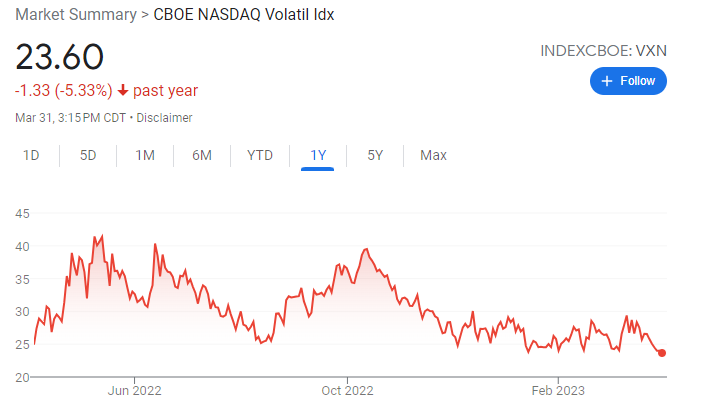
The VIX has dropped sharply recently as stocks have rallied in the past month. VIX closed just above the lowest levels of the year on Friday as the S&P 500 rallied, albeit well shy of yearly highs.

VXN, however, did close at a new yearly low on Friday as the NASDAQ 100 (QQQ) closed at a new yearly high. Also, VXN closed at the lowest level since January 2022.
A quick comparison of the last time QQQ was at comparable pricing will show how much the drop in VXN cheapens the price of puts. The comparative option montages are shown below.
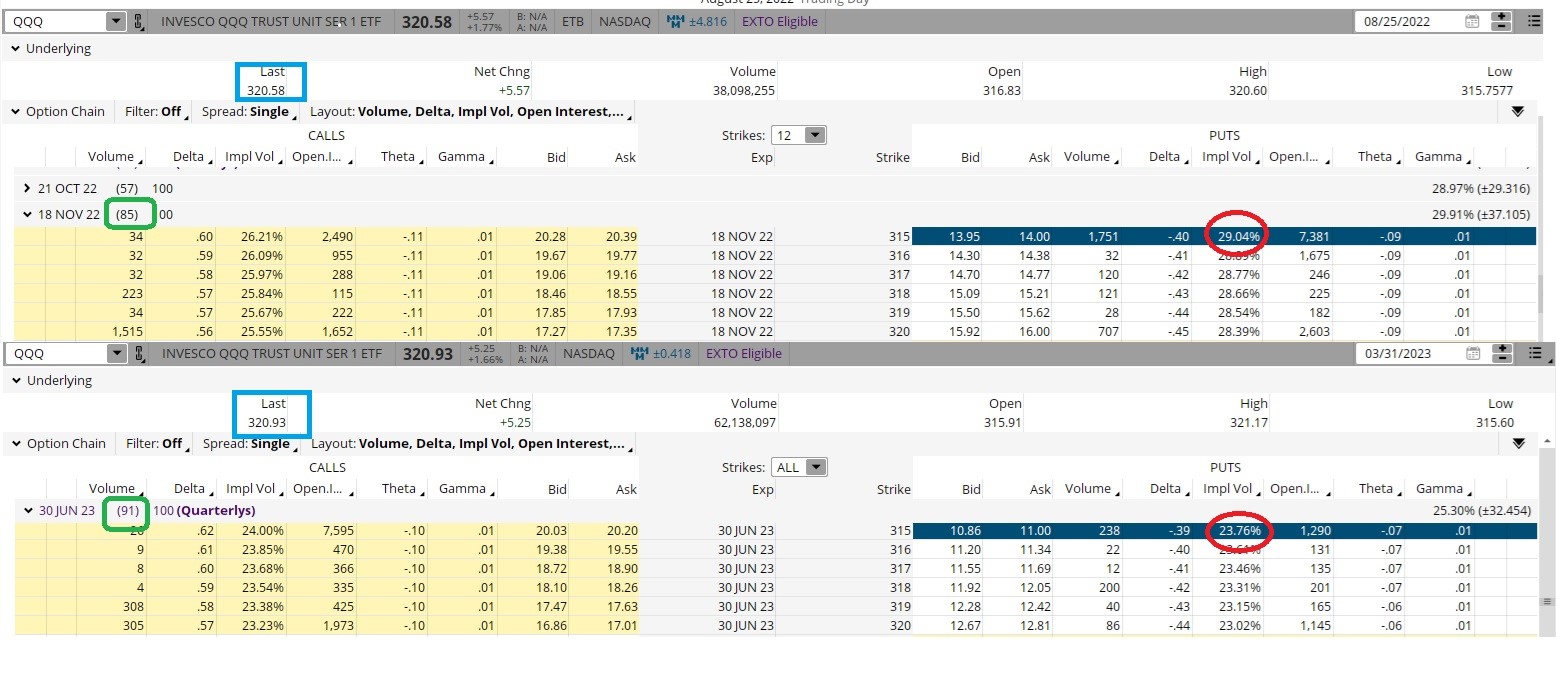
On August 25 of last year, QQQ closed at $320.58. The November 18th $315 puts had 85 days until expiration and were priced at $14.00. IV was just over 29.

Fast forward to Friday, and QQQ closed at $320.93, so only 38 cents higher than back in August. The June 30th expiration $315 puts had 91 days to expiration, so a few more days longer than the similar November 18th expiration puts from back in August. The June 30th puts were priced at $11.00. IV was just under 24.

Putting it all together, the slightly out of the money $315 puts from last August were trading $3.00 cheaper than the virtually similar puts are trading now.

Another way to look at it, the puts back in August cost 4.37% the price of QQQ compared to just 3.43% now. All because IV dropped from 29.04 to 23.76. To me, buying puts at a much cheaper price (and the cheapest price in quite a while) is never a bad thing.

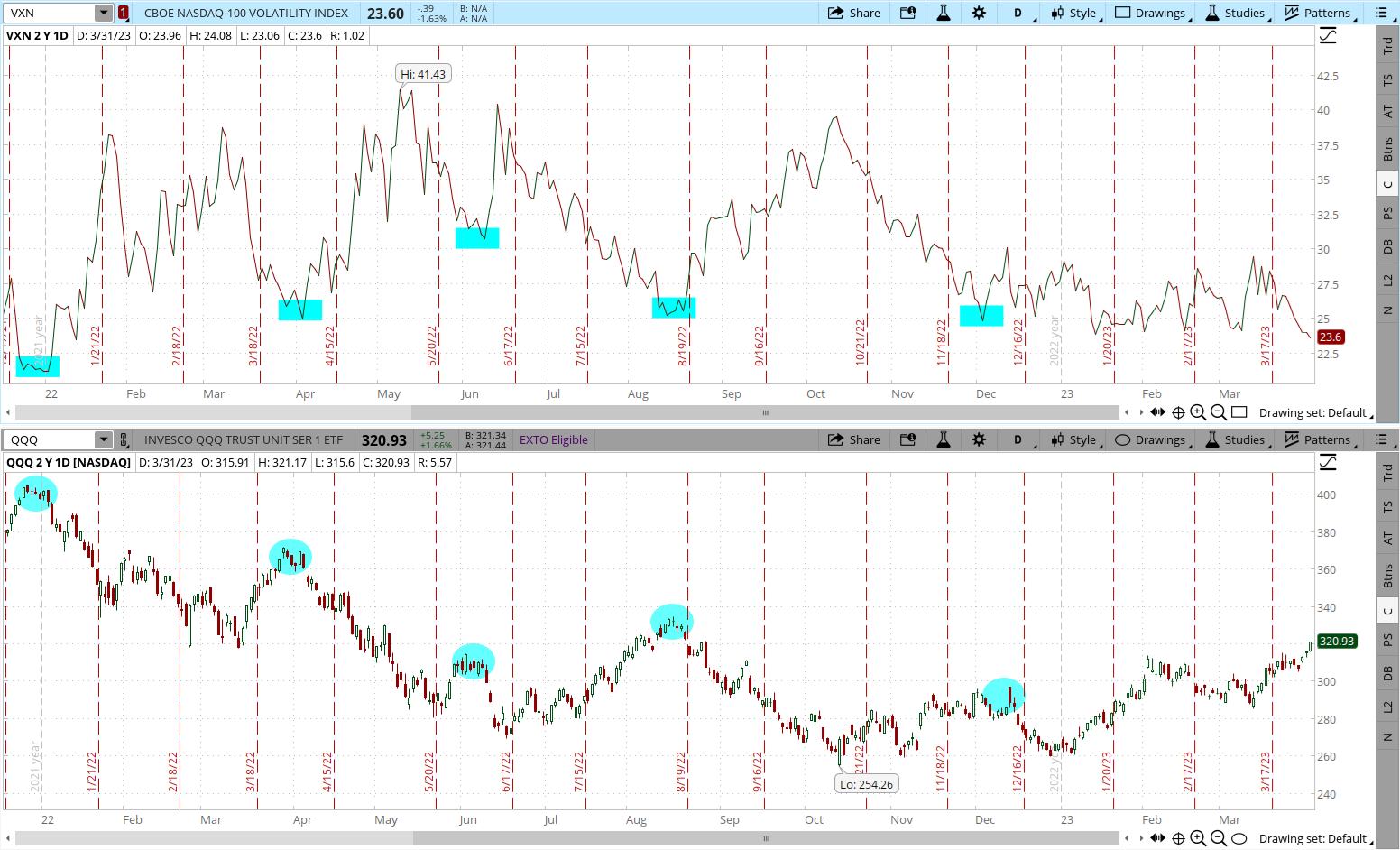
VXN is also a reliable market timing tool, very much like the VIX in that regard. Drops to comparatively low levels of VXN almost invariably coincide with short-term tops in QQQ, as the chart below shows. Is the QQQ near a top$ The VXN is implying so.
Technicals

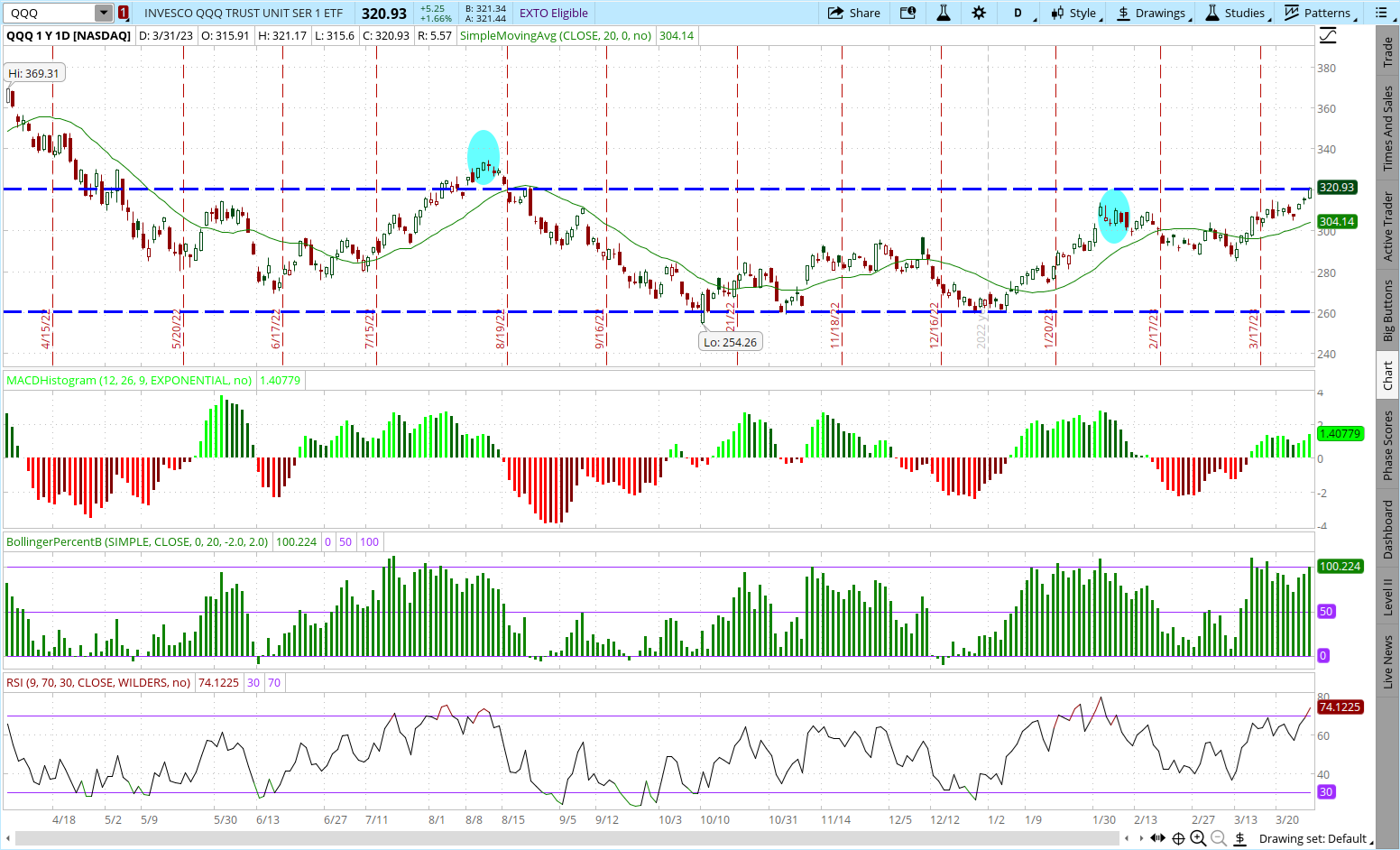
The NASDAQ 100 (QQQ) is getting overbought on a technical basis. 9-day RSI is now over 70. Bollinger Percent B just broke past 100. MACD hit an extreme. Shares are trading at a big premium to the 20-day moving average. Last times these indicators all aligned in a similar fashion marked a short-term top in QQQ.
NASDAQ 100 (QQQ) is getting a little out over the skis on a comparative basis when compared to the other three major indices. The Nazzy is showing a spectacular gain of over 20% so far in 2023. Compare that to the still very respectable gain of almost 7.5% for the S&P 500 (SPY) and it is easy to see just how much QQQ has rallied versus other stocks in Q1. If you compare the gains of QQQ to those of either IWM (Russell 2000) or DIA (Dow Jones Industrials) the out-performance is even more astounding.
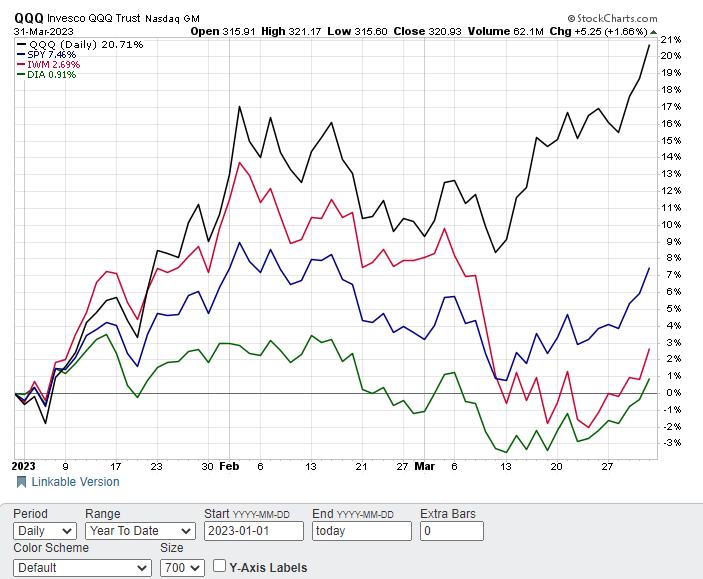
Certainly, some outperformance by the NASDAQ 100 is warranted given it was the worst performing index of the big four in 2022. That outperformance, however, is now getting to an extreme. Look for QQQ to be an underperformer over the coming months as the comparative spread converges back towards the more traditional relationship.

Fundamentals

Two stocks, Microsoft (MSFT) and Apple (AAPL), account for over 25% of the NASDAQ 100 Index weighting. They also comprise over 13% of the S&P 500-the first time two stocks were this powerful since IBM and AT&T in the late 1970s. Plus, they are the only stocks with a $2 trillion plus market cap.

To a large degree, as go these two stocks so goes the NASDAQ 100 and stocks generally. Looking at the valuations of these two mega cap names will provide a good insight into valuations generally for QQQ.

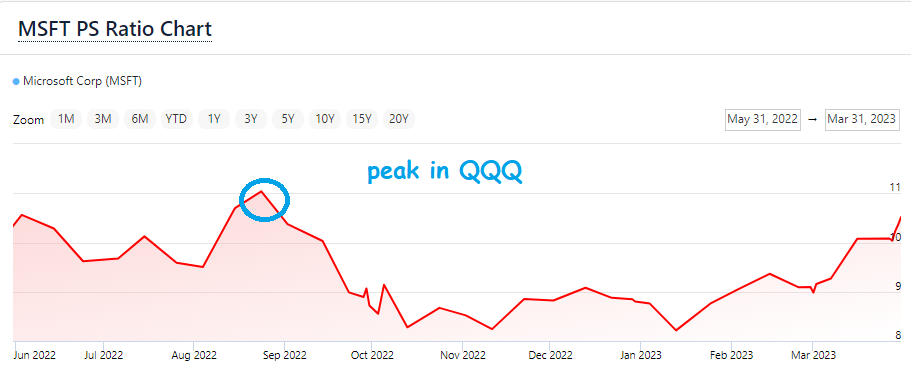
The Price/Sales ratio for top weighted Microsoft (MSFT) is now back well over 10 and at the highest multiple since August of 2022 when the QQQ peaked.
Number two Apple paints a similar picture.
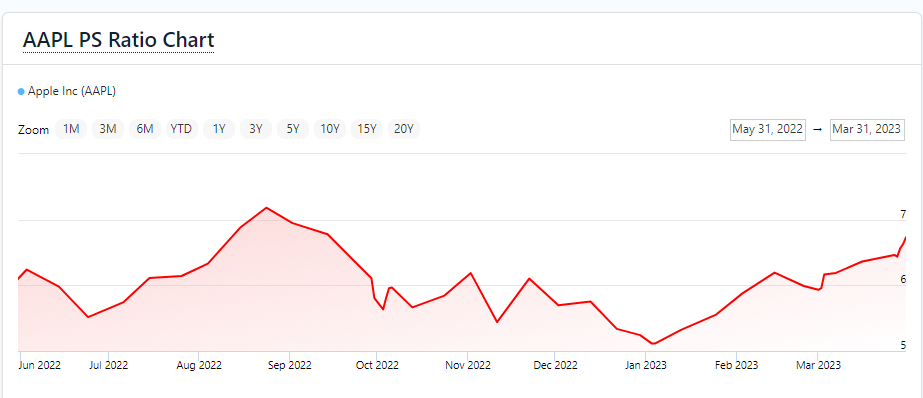
Price/Earnings ratio in MSFT is even more extreme, now at a higher level than back at the previous QQQ peak in price. All this even with interest rates increasing sharply in that time frame-which should cause multiples to contract.

Option prices are cheap. The NASDAQ 100 is overbought technically and overvalued fundamentally. Combining those two statements together means purchasing puts now on QQQ is much cheaper and much more sensible than anytime this year. All we need is the market to return to some semblance of sensibility to profit on a put play.

POWR Options

What To Do Next?

If you’re looking for the best options trades for today’s market, you should check out our latest presentation How to Trade Options with the POWR Ratings. Here we show you how to consistently find the top options trades, while minimizing risk.

If that appeals to you, and you want to learn more about this powerful new options strategy, then click below to get access to this timely investment presentation now:

How to Trade Options with the POWR Ratings

All the Best!

Tim Biggam

Editor, POWR Options Newsletter


QQQ shares closed at $320.93 on Friday, up $5.25 (+1.66%). Year-to-date, QQQ has gained 20.71%, versus a 7.46% rise in the benchmark S&P 500 index during the same period.


About the Author: Tim Biggam

Tim spent 13 years as Chief Options Strategist at Man Securities in Chicago, 4 years as Lead Options Strategist at ThinkorSwim and 3 years as a Market Maker for First Options in Chicago. He makes regular appearances on Bloomberg TV and is a weekly contributor to the TD Ameritrade Network “Morning Trade Live”. His overriding passion is to make the complex world of options more understandable and therefore more useful to the everyday trader. Tim is the editor of the POWR Options newsletter. Learn more about Tim’s background, along with links to his most recent articles.

More…

The post Three Valid Reasons To Say “Give Puts A Chance” appeared first on StockNews.com

https://www.entrepreneur.com/finance/three-valid-reasons-to-say-give-puts-a-chance/448876


When Will the Stock Market Balloon Pop Again?

There is a time honored theory that the stock market (SPY) is quite like a helium balloon. Discover what that means for what stocks are doing now and in the months ahead. Read on below for the full story….

By far the most popular article I have written in years was from last week because it crystalized what so many of us are feeling. Here it is again:

The WORST Stock Market Ever!

Unfortunately, everything said then is just as true now. That being that the only trend is NO trend. And that is true even after a few solid days in the plus column.

Gladly, we can add a few key updates to help us plot our trading plan for the days ahead. That is what is in store in this week’s commentary below…

Market Commentary

Let’s start with a helpful analogy that will frame our discussion today. And that is to appreciate that the stock market is quite similar to a helium balloon.

Meaning that its natural state is to float higher unless it is being held down by a stronger, negative force that pushes it lower.

Please read that again so it sinks in.

Now if we pull back to the big picture, we can easily appreciate that state of floating higher is true because 85-90% of investment history is framed by bullish conditions where going up is more likely than going down. However, we find this picture to also to be the case during bear markets when negative events are removed.

Consider the start of the year…how the market climbed day by day in January. Perhaps it was because there was really nothing negative to hold stocks down.

Next comes February with an increase in hawkish rhetoric from the Fed which starts to reign in some of the early enthusiasm. Next comes about concerns of a potential banking crisis and stocks get pushed down lower and lower on each wave of negative headlines.

This had stocks giving back all the 2023 gains by mid March with a closing low of 3,855 stocks. Amazingly from there we have gotten served up a +6.6% rally for the S&P 500 (SPY) to where we stand today.

Was it because of something positive?

No…just the lack of more negatives to hold down stocks. That’s all it took for them to float higher once again.

Now let’s start looking ahead. Because if we can clearly see if there are more negatives or positives ahead…then we can appreciate where the balloon (stock market) goes next.

I spent some time researching economic forecasts from a variety of sources. Sill 60% of them are calling for a recession forming in 2023 leading to a deeper bear market.

Most of the other 40% are not really calling for a gangbuster growing economy. They see it more in the stagnant growth category.

Stagnant is not exactly bullish my friends. Nor is it bearish. It would most likely equate to a continuation of the activity we have seen so far in 2023. That being range bound with unsettling volatility.

I wanted to share 2 of the forecasts I found most interesting starting with the Conference Board which provides a pretty typical recessionary call. They see the bad times starting in Q2 of this year with -0.9% GDP getting worse in Q3 at -1.8% followed by -0.6% in Q4 before things improve next year (See their full forecast here).

Yes, they see inflation coming down which is what the Fed was hoping to accomplish. Unfortunately employment also cracks and doesn’t get better til the middle of 2024.

How accurate do I believe this to be?

Close enough because economic forecasts are highly difficult to dial in perfectly. The point being this is likely a fairly mild recession that should still be plenty harsh enough to get stocks to head 15-20% lower from here. And yes, the more painful the future recession…the more stocks would go down.

Now I want to turn our attention to some of the extreme views out there like the famed Jeremy Grantham talking about the bursting of an “everything bubble” that could lead to a 50% peak to valley decline for the S&P 500 (SPY). (Read about that here).

However, lets remember that Jeremy Grantham is a perma-bear. And like a stopped watch he is only right twice a day…and amazingly wrong the rest of the time. So for as interesting as it may be to read outlooks like these, please do take them with a grain of salt.

In the short run, I expect stocks to remain in the same trading range we have seen all year long with a low of 3,855 and high of 4,200. Most every move in that range has proved to be meaningless noise not predictive of what comes next.

We will break above when more people are convinced that fears of recession are overblown. And we will break below if indeed the recession does come to town.

This is all to say that a focus on the fundamentals is still the key. Like paying attention to the slate of key economic reports next week like:

4/3 ISM Manufacturing

4/5 ISM Services

4/7 Government Employment (with focus on wage inflation)

And after that will be a focus on Q1 earnings season.

Will enough clues emerge in April to make us break one way or another?

Probably not UNLESS a new rash of banking failures emerge. That could create a Jenga moment for stocks to tumble lower as risk taking would go out the window.

At this moment I still believe odds of recession and deeper bear market are around 70%. This explains why I continue to manage my newsletter portfolios for that greater bearish possibility.

What To Do Next?

Watch my brand new presentation, REVISED: 2023 Stock Market Outlook

There I will cover vital issues such as…

  • 5 Warnings Signs the Bear Returns Starting Now!
  • Banking Crisis Concerns Another Nail in the Coffin
  • How Low Will Stocks Go?
  • 7 Timely Trades to Profit on the Way Down
  • Plan to Bottom Fish for Next Bull Market
  • 2 Trades with 100%+ Upside Potential as New Bull Emerges
  • And Much More!

If these ideas concern you, then please click below to access this vital presentation now:

REVISED: 2023 Stock Market Outlook >

Wishing you a world of investment success!


Steve Reitmeister…but everyone calls me Reity (pronounced “Righty”)
CEO, StockNews.com and Editor, Reitmeister Total Return


SPY shares . Year-to-date, SPY has gained 7.46%, versus a % rise in the benchmark S&P 500 index during the same period.


About the Author: Steve Reitmeister

Steve is better known to the StockNews audience as “Reity”. Not only is he the CEO of the firm, but he also shares his 40 years of investment experience in the Reitmeister Total Return portfolio. Learn more about Reity’s background, along with links to his most recent articles and stock picks.

More…

The post When Will the Stock Market Balloon Pop Again? appeared first on StockNews.com

https://www.entrepreneur.com/finance/when-will-the-stock-market-balloon-pop-again/448865


43 Years of Investing Wisdom in Just Minutes

Steve Reitmeister has been investing successfully for 43 years. He just released a brand new presentation to boil down his many years of stock picking experience into a simple to follow system that has beaten the S&P 500 (SPY) by more than 4 to 1 over the years. Keep reading below for the full story.

Yes, I have been investing for 43 years. And how I pick stocks today is shaped as much by the past mistakes as it is by the successes.

I really wanted to boil down all those years of wisdom into short form to share with investors which led to a brand new presentation that you can watch today:

Unlock the POWR in Your Portfolio  

I can say without hesitation that the ideas highlighted in this webinar are the very best I can share with other investors to improve your results in the months and years ahead.

That is because the key investing lesson learned is that the vast majority of things taught to us are DEAD WRONG!

This is not just a matter of opinion. Rather it is scientific fact.

Consider this… a few years ago I enlisted the help of one of the leading Data Scientists in the field to help create the POWR Ratings system. This journey started with a review of thousands of potential factors that would point to stocks likely to outperform.

95% of what we researched in fundamentals and price action failed the test.

This means that only 5% of the factors (118 in total) we reviewed actually helped select better stocks on a consistent basis.

Instead of just focusing on 1 or 2 of these elements we wanted to combine all 118 winning factors together to truly stack the odds in our favor.

This led to the creation of the POWR Ratings which has beaten the S&P 500 (SPY) by greater than 4 to 1 over the years.

The rest of the story awaits you in this brand new presentation. Including how incredibly well it has performed since the bear market came on the scene in early 2022.

Unlock the POWR in Your Portfolio  

Wishing you a world of investment success!


Steve Reitmeister…but everyone calls me Reity (pronounced “Righty”)
CEO, StockNews.com and Editor, Reitmeister Total Return


SPY shares were trading at $409.39 per share on Friday afternoon, up $5.69 (+1.41%). Year-to-date, SPY has gained 7.46%, versus a % rise in the benchmark S&P 500 index during the same period.


About the Author: Steve Reitmeister

Steve is better known to the StockNews audience as “Reity”. Not only is he the CEO of the firm, but he also shares his 40 years of investment experience in the Reitmeister Total Return portfolio. Learn more about Reity’s background, along with links to his most recent articles and stock picks.

More…

The post 43 Years of Investing Wisdom in Just Minutes appeared first on StockNews.com

https://www.entrepreneur.com/finance/43-years-of-investing-wisdom-in-just-minutes/448850


Why This Key Buy Signal Is Making Me Nervous About Current Market Conditions…

This week, we had the latest meeting by the Federal Reserve. The central bank raised interest rates by 25 basis points, and indicated that we’re likely close to a pause. You’d imagine the stock market (SPY) would cheer… But I’m seeing something else that’s making me nervous. Read on.

(Please enjoy this updated version of my weekly commentary originally published March 23rd, 2023 in the POWR Stocks Under $10 newsletter).

Market Commentary

 So, in addition to the POWR services I run, I also head up this options trading newsletter called Income Trader.

And our picks are based on this amazing, proprietary, Charles Dow award-winning algorithm. And this week, there was something bizarre about all of the “buy” signals it gave…

About half of the tickers on were short ETFs.

Now, for this algorithm, when a stock is on a “buy” signal, it’s usually an indication that its price has a higher likelihood of rising in the near future. It’s not a guarantee by any means, but it’s what the numbers have shown over the course of a decade.

And while we definitely have ETFs tracking various asset classes (bonds, gold, etc.) pop into our list from time to time… we don’t ever see short/inverse/leveraged tickers.

Even in previous downturns, like what we saw in 2022, I don’t think I’ve seen them pop up.

I’ll be honest; I’m not exactly sure what it means…

But this week, we had buys on inverse funds for a number of major groups — large-cap stocks, mid-cap stocks, the Russell, the S&P 500 (SPY), real estate, China, European stocks, consumer discretionary, emerging markets — and that doesn’t feel… good.

My take on this is that it is a weird time in the market. People are nervous and potentially bearish, and we’re seeing that reflected in that algorithm’s results.

And I’m not usually one to point fingers… but I think a lot of that nervousness is stemming directly from the Federal Reserve’s latest actions.

Back in 2022, it felt like the Fed had a straightforward goal and a straightforward plan: We’re going to curb inflation by raising interest rates.

At the time, our biggest fear was that we’d land in a recession… and there were many other voices and indicators confirming that potentiality.

But we’re now a year into that journey, and we’ve all the Fed has managed to do is make a small dent in inflation and break a few banks.

The labor market is still unexpectedly tight. And the central bank’s plan, which once felt very predictable, seems all over the place.

What will rates look like in three months? We can’t know for certain, because Powell’s plan is “it depends on what the latest economic numbers look like.” It’s a very reactionary plan.

At this latest meeting, Fed members ultimately agreed to raise interest rates by 25 basis points, although Powell indicated in the press conference that they had been considering a 50-bps hike until the bank crisis came into focus.

Speaking of, Powell shed a little light on that as well, saying there were only a few problem banks but that the rest of the financial system was “sound and resilient.”

A lot of financial new outlets are focusing on the idea that we only have one more rate hike in our future, as a key line about “ongoing increases” has been removed from its official statement.

The median for their plot forecast also indicates only one more hike this year.

Even so, stocks are back up again today and the S&P 500 (SPY) is trading back above its 200-day moving average, which we normally see when things are bullish.

But I’m feeling skeptical.

Maybe it’s because I’ve been trying to help our 20-year-old nanny sort through dozens of Taylor Swift ticket “sellers” that are actually just scam artists trying to steal her hard-earned money. (Seriously, what is wrong with people?)

Maybe it’s because I just had to file an FTC fraud report on a company purporting to sell refurbished Herman Miller chairs.

Maybe it’s because my trading algorithm is doing some truly bizarre things.

Maybe it’s because I can’t picture how one more 25-bps hike is going to suddenly slay the inflation beast (still at more than 6%) or how Powell can downplay the banking system’s problems even after the recent collapse of Credit Suisse, a global systemically important bank (G-SIB).

I’m not usually a pessimistic person, but I have a feeling we’re in for another pullback… here’s hoping I’m wrong.

Conclusion

At this moment, we have about 50% of our portfolio in cash, and 50% invested. Right now, that’s the best position we can be in during this moment.

I’ve heard some analysts say we’re not going to see a big capitulation moment because all of those potential “sellers” have been on the sidelines for months. Based on everyone I know… that sounds pretty on the nose.

We’ll continue keeping an eye on the market, but I believe there’s going to be a continued stutter step over the next handful of weeks until we figure out what’s actually next.

What To Do Next?

If you’d like to see more top stocks under $10, then you should check out our free special report:

3 Stocks to DOUBLE This Year

What gives these stocks the right stuff to become big winners, even in this brutal stock market?

First, because they are all low priced companies with the most upside potential in today’s volatile markets.

But even more important, is that they are all top Buy rated stocks according to our coveted POWR Ratings system and they excel in key areas of growth, sentiment and momentum.

Click below now to see these 3 exciting stocks which could double or more in the year ahead.

3 Stocks to DOUBLE This Year

All the Best!

Meredith Margrave
Chief Growth Strategist, StockNews
Editor, POWR Stocks Under $10 Newsletter


SPY shares closed at $395.75 on Friday, up $2.58 (+0.66%). Year-to-date, SPY has gained 3.88%, versus a % rise in the benchmark S&P 500 index during the same period.


About the Author: Meredith Margrave

Meredith Margrave has been a noted financial expert and market commentator for the past two decades. She is currently the Editor of the POWR Growth and POWR Stocks Under $10 newsletters. Learn more about Meredith’s background, along with links to her most recent articles.

More…

The post Why This Key Buy Signal Is Making Me Nervous About Current Market Conditions… appeared first on StockNews.com

https://www.entrepreneur.com/finance/why-this-key-buy-signal-is-making-me-nervous-about-current/448387


The WORST Stock Market Ever!

It’s been a while since I talked to anyone enjoying the recent stock market action. Too volatile. Too illogical. No real trend. All true. However, the more we understand why this is happening the easier to diagnose what will happen from here and how we can trade our way to profits. (Spoiler Alert) I am still bearish. Gladly I still see 7 timely trades to use to make money as the S&P 500 (SPY) heads lower from here. Read on below for the full story….

I woke up 2 days ago already knowing the theme for this article:

The WORST Stock Market Ever!

That’s because this ride is more Tilt-A-Whirl than Merry-Go-Round thanks to all the volatility. Pretty soon the corn dogs, cotton candy and elephant ears are coming up. (sorry for the visuals…but needed to drive home the point ;-)

Gladly if we pull back to the big picture, we can make sense of it all to chart our way to calmer shores. That is what is in store in today’s commentary.

Market Commentary

OK…I might be kidding about this being the worst stock market ever…but it’s certainly not fun. That’s because most people are rational and want things to move ahead in a more orderly fashion. This stock market of late has been anything but that.

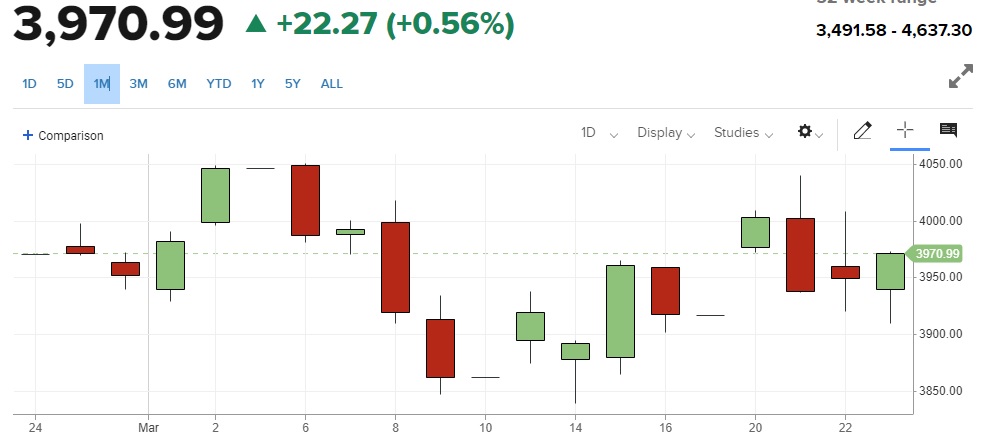
Up, down and all around. Not just across weeks and months…but INSIDE of a single session. This candlestick chart of the past month tells that story in spades:

So much to point out on this chart starting with us being absolutely flat month over month. This would seem to indicate that nothing of significance happened.

Now look deeper. Note how short lived all the rallies are…as well as the quick duration of the sell offs. And finally notice how big some of those candles are with tremendous intraday moves.

All that action over the past month…and nothing to show for it in the market average.

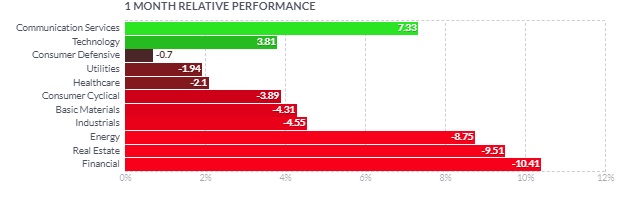
That’s where it makes sense to now look at things on a Sector level where we see a lot more diversity between winners and losers.

The obvious part is the weakness of the financials thanks to all the bad news in the banking sector. Real estate is so intra related with the banks that it’s pretty obvious why that group has taken it on the chin as well. The rest of the weaklings are a fairly Risk On groups which talks to growing fears of future economic health.

The counterpart to that is to discover that most of the Risk Off groups are near the top of the list: Consumer Defensive, Utilities, and Healthcare. The oddity is the strength of Communication Services and Tech. However, when you think of Tech as being dominated by FAANG…and they often act as a defensive group people often cling to…then you understand that the totality of this picture says it was a Risk Off month even if overall market breakeven.

Everything discussed so far explains WHAT is happening…now let’s shift to WHY.

The simple answer is to say the outlook for the economy (and thus the stock market) is unclear. Thus, each new day brings new headlines that tilt bearish today and bullish tomorrow.

Certainly, people see the threats that could lead to recession…but it keeps not happening. And that is what confuses the odds on what happens next and that lengthens this tug of war between the bulls and bears.

For example, a lot of economic data was weakening at the end of 2022. Like ISM Manufacturing under 50. And Retail Sales actually shrinking after removing inflation. This led to a large cut in corporate earnings expectations for Q1 of this year where Wall Street is currently looking for -9% earnings loss.

That steep loss doesn’t look as much in the cards when you appreciate that many thought Q1 GDP would also be in negative territory…perhaps marking the start of a new recession. And yet now as we look at the most revered GDP prediction model (GDP Now from the Atlanta Fed) that stands at +3.2% for the current quarter.

Reity, you are starting to contradict yourself. I thought you were bearish on the market?

Yes. That is true. I just wanted to make it clear WHY the market was so volatile. That being the mixed signals on the economy making bulls and bears tussle for control.

Now we have to turn our attention to the future and what is likely to happen. Here again, I want to share this simple, yet effective equation to quickly explain why I am still wearing the bear cloak. (It includes an important new addition in bold)

Higher Rates on the Way (5%+)

+ In Place AT LEAST til End of 2023

+ 6-12 Months of Lagged Economic Impact from Fed Policy

+ Banking Credit Crunch

= Fertile Soil to Create a Recession in the Future

Fed Chairman Powell talked about all of the first 4 factors at the recent rate hike announcement and press conference on 3/22. In fact, stocks were going up during the speech til he hit folks with a 1-2 hawkish punch staring with:

“It’s possible that this [banking crisis] will turn out to have very modest effects – these events will turn out to be very modest effects on the economy, in which case – and inflation will continue to be strong, in which case, you know, the path will look – might look different. It’s also possible that this potential tightening will contribute to significant tightening in credit conditions over time, and in principle, if that – that means that monetary policy may have less work to do. We simply don’t know.” 

This was followed by a statement that the credit crunch IS happening and is relatively equivalent to a 25-50 point basis cut on its own. This got stocks coming down from nearly +1% session to about breakeven. And then came punch #2.

That being when a reporter stated that current surveys show that the average investor expects just one more rate hike of 25 basis points and then rate CUTS every meeting thereafter. So, are investors wrong?

YES!

It wasn’t just the words he used. It was how Powell said it. Like a disappointed parent when his kid brings home an F on the report card. (what are you not understanding here!!!).

And then he reiterated quite emphatically that their forecast still calls for NO CUTS this year. From there the S&P 500 gave up the 1% gain and tumbled all the way to -1.65% into the close.

For me the aforementioned equation starting with a hawkish Fed ends with recession at some point in the future. Clearly not Q1…but Q2 and the rest of the year are still very much into play.

Unfortunately, until investors see more PROOF of a recession unfolding then the recent trading range and extreme volatility will continue. That is why I recommend investing based upon what you predict will happen beyond that range. Again, that leans decidedly bearish in my book.

What To Do Next?

Watch my brand new presentation, REVISED: 2023 Stock Market Outlook

There I will cover vital issues such as…

  • 5 Warnings Signs the Bear Returns Starting Now!
  • Banking Crisis Concerns Another Nail in the Coffin
  • How Low Will Stocks Go?
  • 7 Timely Trades to Profit on the Way Down
  • Plan to Bottom Fish for Next Bull Market
  • 2 Trades with 100%+ Upside Potential as New Bull Emerges
  • And Much More!

If these ideas concern you, then please click below to access this vital presentation now:

REVISED: 2023 Stock Market Outlook >

Wishing you a world of investment success!


Steve Reitmeister…but everyone calls me Reity (pronounced “Righty”)
CEO, StockNews.com and Editor, Reitmeister Total Return


SPY shares . Year-to-date, SPY has gained 3.88%, versus a % rise in the benchmark S&P 500 index during the same period.


About the Author: Steve Reitmeister

Steve is better known to the StockNews audience as “Reity”. Not only is he the CEO of the firm, but he also shares his 40 years of investment experience in the Reitmeister Total Return portfolio. Learn more about Reity’s background, along with links to his most recent articles and stock picks.

More…

The post The WORST Stock Market Ever! appeared first on StockNews.com

https://www.entrepreneur.com/finance/the-worst-stock-market-ever/448366


3 Stocks You’ll Never Regret Buying

The Federal Reserve this week increased interest rates for the ninth time since last year and shows no indication of rate cuts this year despite lingering recession fears. As the macroeconomic backdrop remains uncertain, investors could consider buying fundamentally strong, dividend-paying stocks Walmart (WMT), Elevance Health (ELV), and Canon (CAJ) for solid gains. Continue reading….

Despite the recent banking crisis, the Fed approved another interest rate hike to control elevated inflation. Amid the Fed’s persistent hawkish stance and bank stress, the odds of a recession are increasing. Despite uncertain macroeconomic conditions, it could be wise to invest in fundamentally sound, dividend-paying stocks Walmart Inc. (WMT), Elevance Health, Inc. (ELV), and Canon Inc. (CAJ) for steady returns.

In an effort to combat persistently high inflation, the Federal Reserve raised interest rates for the ninth consecutive time by a quarter point on Wednesday despite the recent turmoil in the financial sector. This takes the benchmark federal funds rates to a range of 4.75% to 5%, the highest level since September 2007.

Fed Chair Jerome Powell said, “rate cuts are not in our base case” for the remainder of 2023 despite several economists urging the Fed to pause rate hikes due to concerns of overcorrecting the economy into recession. The Fed’s prediction for the economy’s expansion this year has also fallen from 0.5% in December to 0.4%.

Chief economist at Goldman Sachs Group, Jan Hatzius, has raised the probability of a recession in the next 12 months from the previous estimate of 25% to 35%, citing heightened near-term uncertainty around the economic impacts of the banking crisis.

Furthermore, Stephanie Pomboy, who worked at ISI Group for over a decade and is one of several experts sounding the alarm on stocks and the economy, expects stocks to plunge 30% this year. Meanwhile, Jeremy Grantham, an esteemed market historian and veteran investor, anticipates a more dire scenario, forecasting a 50% decline in the S&P 500.

Investors seeking to navigate a volatile macroeconomic landscape might consider buying quality, dividend-paying stocks WMT, ELV, and CAJ for stable returns. Let’s evaluate what factors make these featured stocks worthy of investment.

Walmart Inc. (WMT)

WMT dispenses a diverse array of merchandise and amenities through the retail and e-commerce channels, catering to a wide range of customers with its cost-effective Everyday Low-Price scheme. It operates through three segments, Walmart U.S.; Walmart International; and Sam’s Club.

On March 2, WMT announced its plan to open 28 new Walmart Health centers by 2024, which is expected to expand its reach to two new states, Missouri and Arizona, while strengthening its presence in Texas. The move could significantly bolster the company’s operational capabilities, with more than 75 such centers by the end of 2024.

On February 28, WMT and Citigroup (C) announced their partnership to offer the Bridge built by Citi platform to WMT’s 10,000 Small and Medium-sized Businesses (SMBs) in the U.S.-based supplier network. The alliance should enable WMT’s suppliers to access the necessary capital to grow, thus driving the company’s expansion.

Also, on February 21, the company announced an annual dividend of $2.28 per share for fiscal 2024, a 2% increase over the previous fiscal year’s payout of $2.24 per share. WMT’s annual dividend of $2.28 yields 1.63% on the current price level. It has a long history of increasing dividends for 49 consecutive years.

For the fourth quarter that ended January 31, 2023, WMT’s total revenues increased 7.3% year-over-year to $164.05 billion. Its income before income taxes rose 86.2% from the year-ago value to $8.90 billion. In addition, the company’s consolidated net income grew 59.9% year-over-year to $5.81 billion, while its adjusted EPS came in at $1.71, up 11.8% year-over-year.

The consensus revenue estimate of $649.91 billion for the fiscal year ending January 2025 reflects a 3.5% year-over-year improvement. Likewise, the consensus EPS estimate of $6.79 for the next year indicates an 11.2% rise year-over-year. Moreover, the company surpassed its consensus EPS estimates in three of four trailing quarters.

The stock has gained 8.1% over the past six months to close the last trading session at $140.65.

WMT’s strong fundamentals are apparent in its POWR Ratings. The stock has an overall rating of A, equating to a Strong Buy in our proprietary rating system. The POWR Ratings are calculated by considering 118 different factors, each weighted to an optimal degree.

WMT has an A grade for Stability and a B for Sentiment and Quality. It ranks #2 in the A-rated 37-stock Grocery/Big Box Retailers industry.

In addition to the POWR Ratings I’ve just highlighted, you can see WMT’s ratings for Growth, Value, and Momentum here.

Elevance Health, Inc. (ELV)

ELV operates as a health benefits company that offers its customers an extensive range of medical, digital, pharmacy, behavioral, clinical, and care solutions. Its segments include Commercial & Specialty Business; Government Business; CarelonRx; and Other.

On February 15, ELV concluded its acquisition of BioPlus, a leading specialty pharmacy subsidiary of CarepathRx, a Nautic Partners portfolio company. The purchase should strengthen ELV’s capacity to offer end-to-end pharmacy services to its customers, resulting in increased affordability and an improved overall patient experience.

Furthermore, on January 23, ELV and Blue Cross and Blue Shield of Louisiana (BCBSLA) signed a definitive agreement that entails ELV’s acquisition of BCBSLA. The acquisition represents a significant strategic opportunity for ELV to expand its reach and capabilities within the healthcare industry, particularly in Louisiana.

For the fourth quarter that ended December 31, 2022, ELV’s total revenue increased 9.2% year-over-year to $39.93 billion, while its operating revenue grew 10.1% from the year-ago value to $39.67 billion. As of December 31, 2022, the company’s cash and cash equivalents stood at $7.39 billion, compared to $4.88 billion as of December 31, 2021.

ELV has raised its dividends for 11 consecutive years. It pays a $5.92 per share dividend annually, translating to a 1.27% yield on the current price level. Its dividend payouts have grown at a 16.7% CAGR over the past three years, and its four-year average dividend yield is 1.12%.

Analysts expect ELV’s EPS to increase 12.8% year-over-year to $32.79 for the fiscal year ending December 2023. The company’s revenue for the ongoing year is expected to grow 5.8% year-over-year to $164.71 billion. Furthermore, the company topped its consensus EPS and revenue estimates in all four trailing quarters, which is impressive.

The stock has plunged 1.7% over the past six months to close the last trading session at $446.30.

ELV’s solid fundamentals are apparent in its POWR Ratings. The stock has an overall rating of A, translating to a Strong Buy in our proprietary rating system.

ELV has a B grade for Quality, Value, and Stability. It is ranked #2 out of 10 stocks in the A-rated Medical – Health Insurance industry.

In addition to the POWR Ratings I’ve just highlighted, you can see ELV ratings for Growth, Sentiment, and Momentum here.

Canon Inc. (CAJ)

Headquartered in Tokyo, Japan, CAJ produces and distributes office multifunction devices and related products. It operates through four segments, Printing Business Unit; Imaging Business Unit; Medical Business Unit; and Industrial and Others Business Unit. It also provides maintenance services and replacement supplies.

On March 23, CAJ announced that it had agreed to acquire technology assets from Kyoto Seisakusho Co., Ltd, to enable the mass production of cells for clinical applications. The acquisition would allow the company to produce high-quality cells at a lower cost, providing the company with a strategic advantage in the emerging field of regenerative medicine.

On November 24, 2022, the company announced its plans to establish a new subsidiary named Canon Healthcare USA, Inc. Intending to bolster its presence in the influential American medical market, CAJ seeks to expedite the growth of its medical business.

For the fourth quarter that ended December 31, 2022, CAJ’s net sales grew 14.7% year-over-year to ¥4.03trillion ($30.31 billion), and its operating profit rose 25.4% from the prior year’s period to ¥353.39 billion ($2.65 billion). Also, the net income attributable to CAJ increased 13.6% year-over-year to ¥243.96 billion ($1.83 billion), and its EPS came in at ¥236.63, up 15.3% year-over-year.

The company pays a $0.90 per share dividend annually, translating to a 4.14% yield on the current price level. CAJ’s dividend payouts have grown at a 6.6% CAGR over the past three years, and its four-year average dividend yield is 3.85%.

The consensus revenue estimate of $31.31 billion for the fiscal year ending December 2023 reflects a 134.8% year-over-year improvement. Likewise, the consensus EPS estimate of $1.92 for the current year indicates a 3.4% rise from the previous year. The stock has gained 1.2% over the past five days to close the last trading session at $21.81.

CAJ’s POWR Ratings reflect its promising prospects. The stock has an overall rating of A, equating to a Strong Buy in our proprietary rating system.

The stock has a B grade for Quality, Stability, and Value. Within the Technology – Hardware industry, it ranks #4 of 42 stocks.

To see additional POWR Ratings for Sentiment, Growth, and Momentum for CAJ, click here

What To Do Next?

Get your hands on this special report:

7 SEVERELY Undervalued Stocks

The best part of the recent bear market is that there are thriving companies trading at tremendous discounts to fair value.

This combination of stellar earnings growth and low price provides a great catalyst for investor success.

And this report focuses on the 7 best of these stocks primed to soar in the weeks ahead. Click below to claim your copy now.

7 SEVERELY Undervalued Stocks


WMT shares were trading at $142.17 per share on Friday afternoon, up $1.52 (+1.08%). Year-to-date, WMT has gained 0.68%, versus a 3.20% rise in the benchmark S&P 500 index during the same period.


About the Author: Aanchal Sugandh

Aanchal’s passion for financial markets drives her work as an investment analyst and journalist. She earned her bachelor’s degree in finance and is pursuing the CFA program. She is proficient at assessing the long-term prospects of stocks with her fundamental analysis skills. Her goal is to help investors build portfolios with sustainable returns.

More…

The post 3 Stocks You’ll Never Regret Buying appeared first on StockNews.com

https://www.entrepreneur.com/finance/3-stocks-youll-never-regret-buying/448356


This Software Stock Signals a Buy

Shares of cloud software maker Salesforce (CRM) have gained more than 40% over the past three months. Outstanding financial performance and a bullish outlook, with growing AI integration, have recently driven investor sentiment around CRM. Hence, this software stock might be an ideal buy considering its promising growth prospects and high profitability. Keep reading….

Despite macroeconomic instability, the software industry has emerged as a colossal powerhouse in the global economy. The exponential surge in the quantity of enterprise data, coupled with the heightened automation of business operations across various end-use sectors, has spurred the demand for business software and services.

Furthermore, with the proliferation of Artificial Intelligence (AI) and machine learning technologies in software development, the software industry is poised to reap substantial benefits. Given the industry’s prospects, Salesforce, Inc. (CRM) could be a noteworthy software stock to add to one’s portfolio. Let us delve deeper into the reasons.

CRM is a customer relationship management platform. Its Customer 360 platform serves as a conduit that links customer data across various systems, applications, and devices. This integrated solution enables companies to sell, service, market, and conduct commerce virtually anywhere.

Amidst the pandemic, CRM underwent a rapid expansion, keeping pace with the skyrocketing adoption of cloud technology. The company’s strategic acquisitions of Slack and Tableau also contributed to its growth trajectory.

Cloud software maker CRM delivered impressive results for its fourth quarter and full fiscal year. “For the full year we delivered $31.4 billion in revenue, up 18% year-over-year, or 22% in constant currency, one of the best performances of any enterprise software company our size,” said Marc Benioff, CRM’s Chairman, and CEO.

“We closed FY23 with operating cash flow reaching $7.1 billion, up 19% year-over-year, the highest cash flow in our company’s history, and one of the highest cash flows of any enterprise software company our size,” he added.

CRM’s relentless focus on execution and proactive management of the current macro environment enabled the company to close out a strong year and position it for continued solid growth in fiscal 2024. 

CRM’s revenue is expected to be in the range of $8.16-$8.18 billion for the first quarter and $34.5-$34.7 billion for the fiscal year 2024. The company also expects non-GAAP earnings per share to be between $1.60 and $1.61 for the first quarter and $7.12 and $7.14 for the full year.

Shares of CRM have gained 16.7% over the past month and 44.8% over the past three months to close the last trading session at $188.68. Moreover, the stock is trading higher than its 50-day and 200-day moving averages of $167.61 and $161.45, respectively.

Let’s delve deeper into the factors that render CRM a compelling prospect for investment.

Positive Latest Developments

On March 7, 2023, CRM transformed the CRM technology landscape with Einstein GPT, the world’s first generative AI CRM technology. This innovation employs generative AI to revolutionize the customer experience by delivering AI-generated content at a hyper-scale throughout all sales, service, marketing, commerce, and IT interactions.

Additionally, the company announced the Generative AI Fund, a $250 million investment fund from Salesforce Ventures, its global investment arm. The fund aims to support the startup ecosystem, back high-potential businesses, and promote the development of trustworthy, generative AI. This move could prove beneficial for the company amid the burgeoning AI craze.

Also, on January 12, CRM unveiled a suite of new advancements designed to help retailers optimize and enhance their advertising sales, obtain a comprehensive view of transactions across both online and offline stores, and extract value from customer data. Implementing these innovations could empower retailers and drive the company’s performance forward.

Robust Financials

For the fiscal 2023 fourth quarter that ended January 31, CRM’s total revenues increased 14.4% year-over-year to $8.38 billion. Its gross profit grew 18.3% from the year-ago value to $6.28 billion. Also, the company’s non-GAAP income from operations rose 123.3% from the prior year’s period to $2.45 billion.

Moreover, CRM’s non-GAAP net income increased 96.4% year-over-year to $1.66 billion, while non-GAAP EPS rose 100% from the previous year’s quarter to $1.68. Furthermore, as of January 31, 2023, CRM’s cash and cash equivalents stood at $7.02 billion, compared to $5.46 billion as of January 31, 2022.

Favorable Analyst Estimates

Analysts expect CRM’s revenue to increase 10.4% year-over-year to $34.62 billion for the fiscal year ending January 2024. The company’s EPS for the current year is expected to rise 36% from the prior year’s period to $7.13. Also, CRM surpassed its consensus revenue and EPS estimates in all four trailing quarters, which is impressive.

Furthermore, the company’s revenue and EPS for the next fiscal year (ending January 2025) are expected to grow 11.2% and 22.4% year-over-year to $38.50 billion and $8.72, respectively.

High Profitability

CRM’s trailing-12-month gross profit margin of 73.34% is 46.2% higher than the 50.17% industry average. Its trailing-12-month EBITDA margin of 17.34% is 75.8% higher than the 9.9% industry average. Likewise, the stock’s trailing-12-month levered FCF margin of 32.60% is 436.4% higher than the industry average of 6.08%.

Furthermore, CRM’s trailing-12-month cash from operations of $7.11 billion is significantly higher than the $39.76 million industry average. And its trailing-12-month CAPEX/Sales of 2.55% compares to the industry average of 2.44%.

POWR Ratings Show Promise

CRM’s solid fundamentals are reflected in its POWR Ratings. The stock has an overall rating of B, which equates to Buy in our proprietary rating system. The POWR Ratings are calculated by taking into account 118 different factors, with each factor weighted to an optimal degree.

Our proprietary rating system also evaluates each stock based on eight distinct categories. CRM has an A grade for Growth and Sentiment, consistent with its robust financials and favorable analyst expectations.

In addition, the stock has a B grade for Quality, consistent with its higher-than-industry profitability. CRM is ranked #19 out of 134 stocks in the Software – Application industry. Click here to access CRM’s Value, Momentum, and Stability ratings.

View all the top stocks in the Software – Application industry here.

Bottom Line

CRM’s revenue has experienced a remarkable surge over the past three years, growing at a CAGR of 22.4%. Also, the company’s EBITDA and net income have increased at CAGRs of 27.9% and 18.2% over the same period, respectively.

The company’s commitment to implementing cutting-edge technological solutions for its clients has been instrumental in its remarkable success in recent years. Furthermore, it is positioned for significant growth and expansion in the fiscal year 2024, driven by increased AI adoption.

Given CRM’s robust financial performance, solid growth prospects, and high profitability, this software stock could be an ideal investment now.

How Does Salesforce, Inc. (CRM) Stack up Against Its Peers?

CRM has an overall rating of B, equating to a Buy. Check out these other stocks within the Software – Application industry with an A (Strong Buy) rating: Commvault Systems, Inc. (CVLT), Progress Software Corporation (PRGS), and IBEX Ltd (IBEX).

What To Do Next?

Get your hands on this special report:

3 Stocks to DOUBLE This Year

What gives these stocks the right stuff to become big winners, even in this brutal stock market?

First, because they are all low priced companies with the most upside potential in today’s volatile markets.

But even more important, is that they are all top Buy rated stocks according to our coveted POWR Ratings system and they excel in key areas of growth, sentiment and momentum.

Click below now to see these 3 exciting stocks which could double or more in the year ahead.

3 Stocks to DOUBLE This Year


CRM shares were trading at $188.76 per share on Wednesday afternoon, up $0.09 (+0.05%). Year-to-date, CRM has gained 42.36%, versus a 4.68% rise in the benchmark S&P 500 index during the same period.


About the Author: Aanchal Sugandh

Aanchal’s passion for financial markets drives her work as an investment analyst and journalist. She earned her bachelor’s degree in finance and is pursuing the CFA program. She is proficient at assessing the long-term prospects of stocks with her fundamental analysis skills. Her goal is to help investors build portfolios with sustainable returns.

More…

The post This Software Stock Signals a Buy appeared first on StockNews.com

https://www.entrepreneur.com/finance/this-software-stock-signals-a-buy/448172


Banking Turmoil Makes for Turbulent Markets

At the end of last week’s issue, I told everyone to buckle up for the boom. I wasn’t expecting one of the global systemically important banks (G-SIBs) to wind up on the chopping block. And Friday is a rare market event that is known for its wild price swings. So buckle up! Let’s get into what this means for the S&P 500 (SPY) in the coming days….

(Please enjoy this updated version of my weekly commentary originally published March 16th, 2023 in the POWR Stocks Under $10 newsletter).

Market Commentary

I’m not going to lie, I’m still a little on edge about everything going on in the stock market (SPY).

As I just mentioned, another major bank — Credit Suisse (CS), one of the 30 global systemically important banks (G-SIBs) — plunged more than 20% this week after it disclosed in a report that it had identified “material weaknesses” in controls over financial reporting and its biggest backer said it could not provide any more assistance.

Fortunately, the bank was able to shore up liquidity and restore confidence by borrowing $54 billion from Switzerland’s central bank.

San Francisco-lender First Republic Bank dropped 62% Monday, and is now the subject of a $30 billion, 11-bank rescue plan.

There’s been a lot of turmoil surrounding this new “banking crisis.” It has even affected the way I look at stocks. Before this week, I’ve never once looked into which banking institutions a company finances with… but it feels like an important part of the analysis now!

Unfortunately, I haven’t been able to easily identify where a certain company banks.

But, for example, it turned out Roku (ROKU) held roughly a quarter of its cash — nearly half-a-billion in uninsured deposits — at Silicon Valley Bank… and Roku is a widely traded company. We’re not just talking about small OTC companies.

And because everything involved with these bank crises is in flux right now, it’s still not clear what is going to be a big deal and what is not.

Then, there’s the question of how the Federal Reserve will balance the instability of the banking sector with its fight against inflation.

This week’s CPI numbers put inflation at 6%, which is still well above the Fed’s chosen 2% target level. For the past year-plus, the Fed has used interest rate hikes as its weapon of choice to curtail inflation.

But rising rates are the culprit behind SVB’s sudden collapse and the spotlight currently shining on the banking industry.

As of this weekend, fighting inflation is no longer the Fed’s sole focus… it also needs to consider overall financial stability and lending conditions.

A pause in rate hikes would be best for helping stabilize banks… but as February’s CPI and PPI reports reminded us this week, inflation is not dying out quickly, which means there’s a compelling case to continue raising rates.

What to do… what to do…

Personally, I’m glad not to be in his shoes.

The next Federal Reserve meeting is scheduled for March 21-22, and that will likely be another big market mover.

A pause would be good for banks but bad for the fight against inflation.

A 50-bps hike would be good for the fight against inflation but bad for banks.

I expect they’ll split the difference and we’ll end up with a 25-bps hike, which wouldn’t do much for inflation and would put banks in an even tighter spot. So, kind of the worst of both worlds.

Today is also a major day for the markets. It’s “quadruple witching,” which happens when equity futures and option contracts tied to individual stocks and indexes all expire on the same day.

Some of these contracts expire in the morning, while others expire in the afternoon. It usually happens about four times a year, and it can coincide with wild swings in the market today as traders scramble to cut losses or collect their profits early.

This quarter, there is about $2.8 trillion in contracts set to expire, so we could have a few very big moves.

Conclusion

The market took some bumps this week. Small-cap stocks, which account for many stocks under $10, got particularly roughed up.

And yet, our trade triggers are going to make sure we exit two of our positions with gains in our pockets. That’s not bad in a tough market condition.

Plus, keep your eye on your inbox a little bit later this morning for some fresh new names to replace the companies we’re cutting.

What To Do Next?

If you’d like to see more top stocks under $10, then you should check out our free special report:

3 Stocks to DOUBLE This Year

What gives these stocks the right stuff to become big winners, even in this brutal stock market?

First, because they are all low priced companies with the most upside potential in today’s volatile markets.

But even more important, is that they are all top Buy rated stocks according to our coveted POWR Ratings system and they excel in key areas of growth, sentiment and momentum.

Click below now to see these 3 exciting stocks which could double or more in the year ahead.

3 Stocks to DOUBLE This Year

All the Best!

Meredith Margrave
Chief Growth Strategist, StockNews
Editor, POWR Stocks Under $10 Newsletter


SPY shares were trading at $389.57 per share on Friday morning, down $6.54 (-1.65%). Year-to-date, SPY has gained 1.87%, versus a % rise in the benchmark S&P 500 index during the same period.


About the Author: Meredith Margrave

Meredith Margrave has been a noted financial expert and market commentator for the past two decades. She is currently the Editor of the POWR Growth and POWR Stocks Under $10 newsletters. Learn more about Meredith’s background, along with links to her most recent articles.

More…

The post Banking Turmoil Makes for Turbulent Markets appeared first on StockNews.com

https://www.entrepreneur.com/finance/banking-turmoil-makes-for-turbulent-markets/447902


Bank Problems = Bearish Thumb on Stock Market Scale

If you were not bearish already, then perhaps time to reconsider your stock market (SPY) outlook. As you will discover in today’s commentary, even the best case scenario for the recent banking concerns still likely tips the economy into recession which leads to deepening bear market. Read on below for the full story including a game plan to trade your way to profits on the way down.

There were plenty of reasons to already be bearish. Most of them were highlighted in my latest presentation, REVISED: 2023 Stock Market Outlook.

But now you layer on top deepening concerns about a potential banking crisis and it’s becoming a slam dunk for the bears. This explains why we are back below the 200 day moving average for the S&P 500 (SPY) once again poised to head even lower.

What happens next?

What is the right trading plan?

What are the best trades to make now?

That is what we will focus on in today’s conversation.

Market Commentary

I have already been on record as saying that this is clearly not the 2008 financial crisis revisited. Not even close.

Unfortunately enough damage has already been that even if another banking failure does not emerge that it already puts a thumb on the scale towards recession. Don’t just take my word for it…let’s get some insights from one of the economists over at JP Morgan who recently said:

“A very rough estimate is that slower loan growth by mid-size banks could subtract a half to a full percentage-point off the level of GDP over the next year or two. We believe this is broadly consistent with our view that tighter monetary policy will push the US into recession later this year.”

Goldman Sachs had similar sentiments in a note this week:

“We have seen a tightening of lending standards in the banking system, and my suspicion is that they will tighten further from here and potentially could tighten quite sharply, at least in the near term. On balance, my guess is that banks will take a view that this could result in either a near-term recession or a deeper recession than you would have had without this event.”

This is probably the best case scenario.

Now imagine the worst case. That being greater scrutiny by investors and bank regulators which uncovers another handful or more of large banks that need to be taken over or recapitalized. The headline risk on each round of breaking news would be bad devastating for the stock market.

Beyond that is the increase in fear by the average consumer and business owner that leads to greater caution…which is a fancy way of saying they will spend less. That is the road to recession. And that road was already getting paved by the Fed with a hawkish regime dead set on lowering demand to tame inflation this year.

I can not say for sure where on this spectrum of banking outcomes we will land. Unfortunately, even the best case for banks still points to likely recession and extension of bear market.

This explains why the last 9 sessions have been below 4,000. And 6 of the last 7 sessions below the 200 day moving average (red line below).

Some investors will want to wait for the next Fed announcement on 3/22 before making their next move…but why???

Remove the banking issues from the equation. They were incredibly clear that inflation is still too high and that they will keep pushing rates to 5%+ and have that in place through at least the end of the year.

That extended period of hawkishness, plus the lagged effects of Fed policy, is a pretty sure elixir for creating a recession. This explains why stocks were selling off into this announcement BEFORE the banking issues ever emerged.

Now let’s consider the borderline insane notion that the Fed could pause their rate hikes in March to lessen the pain over recent banking issues. Here is what I said about that in my Tuesday commentary:

“I actually suspect that investors would take that as a negative. That is because it would be a signal to investors that the Fed is SERIOUSLY worried about the stability of the banking system that they have to deviate so significantly from their hawkish plans.

Meaning that investors SHOULD NOT consider such a move as a dreamed of “dovish pivot”. Rather this would be the Fed hitting the panic button that the stability of financial system is now more important than fighting inflation (which they have dubbed as Public Enemy #1 for over a year).

For as funny as it sounds…let’s all pray that the Fed continues to hike rates aggressively at the 3/22 meeting as pressing pause could be much worse for stocks.”

Any way you slice it I would suggest being bearish into that 3/22 Fed announcement.

Now let’s move on to economic data which is only darkening in the manufacturing space which is often called the “canary in the coal mine” of the US economy. On Wednesday the NY Empire State Manufacturing Index dropped to -24.6 versus expectations of -7…way off the mark.

Things did not get better on Thursday as the Philly Fed Manufacturing Index came in at an equally ugly -23.2 about 2X worse than expected. There we find that the forward looking New Orders component is even worse at -28.2 (the lowest reading since the heart of Covid in May 2020).

For my money the outlook is looking rather bearish. That is sometimes hard to see clearly with all the recent volatility. Which leads one to pull back to take in the big picture.

That is why I say from a fundamental perspective things continue to tip towards recession which creates bearish environment. Further, the emergence of the banking concerns is only a cherry on top.

So, the word to the wise is to prepare for further downside action in the weeks ahead.

What To Do Next?

Watch my brand new presentation, REVISED: 2023 Stock Market Outlook

There I will cover vital issues such as…

  • 5 Warnings Signs the Bear Returns Starting Now!
  • Banking Crisis Concerns Another Nail in the Coffin
  • How Low Will Stocks Go?
  • 7 Timely Trades to Profit on the Way Down
  • Plan to Bottom Fish for Next Bull Market
  • 2 Trades with 100%+ Upside Potential as New Bull Emerges
  • And Much More!

If these ideas concern you, then please click below to access this vital presentation now:

REVISED: 2023 Stock Market Outlook >

Wishing you a world of investment success!


Steve Reitmeister…but everyone calls me Reity (pronounced “Righty”)
CEO, StockNews.com and Editor, Reitmeister Total Return


SPY shares rose $0.01 (0.00%) in after-hours trading Friday. Year-to-date, SPY has gained 1.98%, versus a % rise in the benchmark S&P 500 index during the same period.


About the Author: Steve Reitmeister

Steve is better known to the StockNews audience as “Reity”. Not only is he the CEO of the firm, but he also shares his 40 years of investment experience in the Reitmeister Total Return portfolio. Learn more about Reity’s background, along with links to his most recent articles and stock picks.

More…

The post Bank Problems = Bearish Thumb on Stock Market Scale appeared first on StockNews.com

https://www.entrepreneur.com/finance/bank-problems-bearish-thumb-on-stock-market-scale/447901


REVISED: 2023 Stock Market Outlook

40 year investment veteran Steve Reitmeister shares his most complete and up to the minute analysis of what lies ahead for investors the rest of 2023. First a return of the nasty bear market with the S&P 500 (SPY) making news lows. Yet just at the darkest hour the new bull market will emerge ushering in tremendous gains to investors who time it right. Steve shares his trading plan along with top 7 picks to profit on the way to bear market bottom. Next he shares a plan to buy the market bottom with 2 top picks set to rally 100%+. Get the full story below.

The original market outlook I created in December is now outdated. Just too much has changed these past few months.

Not just the shocking rally to start the new year…but now we have to entertain the notion of what a potential banking crisis means for stock prices.

This led to me record a brand new presentation this week that you should watch before placing your next trade:

REVISED: 2023 Stock Market Outlook >

Not convinced?

OK, let me pull back the curtain a little wider on the main contents:

  • 5 Warnings Signs the Bear Returns Starting Now!
  • Banking Crisis Concerns Another Nail in the Coffin
  • How Low Will Stocks Go?
  • 7 Timely Trades to Profit on the Way Down
  • Plan to Bottom Fish @ Market Bottom
  • 2 Trades with 100%+ Upside Potential as New Bull Emerges
  • And Much More!

If these ideas appeal to you, then please click below to access this vital presentation now:

REVISED: 2023 Stock Market Outlook >

Wishing you a world of investment success!


Steve Reitmeister…but everyone calls me Reity (pronounced “Righty”)
CEO, Stock News Network and Editor, Reitmeister Total Return


SPY shares . Year-to-date, SPY has gained 3.58%, versus a % rise in the benchmark S&P 500 index during the same period.


About the Author: Steve Reitmeister

Steve is better known to the StockNews audience as “Reity”. Not only is he the CEO of the firm, but he also shares his 40 years of investment experience in the Reitmeister Total Return portfolio. Learn more about Reity’s background, along with links to his most recent articles and stock picks.

More…

The post REVISED: 2023 Stock Market Outlook appeared first on StockNews.com

https://www.entrepreneur.com/finance/revised-2023-stock-market-outlook/447881