If You Own This Drug Manufacturer Stock, It’s Time to Sell

Canadian cannabis producer SNDL (SNDL) has made several acquisitions to support its growth. Although the company witnessed solid revenue growth in its last reported quarter, its bottom line was in the red. The company’s return to profitability remains uncertain. Moreover, given the regulatory challenges, I think this fundamentally weak stock is best avoided now. Read on….

Canada-based medical and adult-use cannabis producer SNDL Inc. (SNDL) has been struggling to grow and make profits. While SNDL has made several acquisitions to support its growth, in this piece, I will discuss why the stock is still not worth buying now.

The company’s acquisition of Alcanna Inc. (CLIQ) last year helped it become a major private-sector liquor retailer in Canada. In addition, the company began this year by acquiring a cannabis extraction company, The Valens Company Inc. (VLNS), which is expected to bolster its position in the Canadian cannabis market.

SNDL witnessed solid sales growth in its last reported quarter. “Our regulated products platform has shown resiliency in the face of stiff industry and macroeconomic headwinds, and our vertically integrated cannabis business is in the early stages of providing the scale and results that we believe are required for SNDL to be a strong member of a future oligopoly in Canada,” said Zach George, Chief Executive Officer of SNDL.

However, this growth failed to create value for its shareholders. Its bottom line declined into negative territory as the company could not initiate effective cost-cutting measures. A lack of profitability remains a big concern for investors, and SNDL might take a while before it returns to profitability again.

While the marijuana industry shows promise for the long term, it is expected to witness restricted growth in the near term due to limited legality and regulations. Although many states and territories have legalized marijuana for recreational and medical use, cannabis remains illegal on a federal level.

Moreover, rampant inflation in recent months and interest rate hikes are increasing costs and have made it more difficult for companies to secure capital. On the other hand, the possibility of a recession might dampen consumer expenditure on discretionary goods like cannabis products.

SNDL shares have declined 67.2% over the past year and 23.9% year-to-date to close the last trading session at $1.59. The stock is trading below its 50-day and 200-day moving averages of $2.06 and $2.56, respectively. Given the macroeconomic challenges, the stock might remain under pressure.

Here is what could shape SNDL’s performance in the near term:

Bottom Line in the Red

For the fiscal third quarter ended September 2022, net revenue increased substantially to C$230.50 million ($167.70 million). However, its loss from operations came in at C$88.54 million ($64.42 million), up 365% from the year-ago value.

Net loss came in at C$98.84 million ($71.91 million) compared to a net income of C$16.71 million ($12.16 million) in the year-ago period.

The net loss was largely due to higher general and administrative expenses, depreciation and amortization, asset impairment of intangibles and goodwill, finance costs, and a change in the fair value of derivative warrants. General and administrative expenses for the quarter were C$44.80 million ($32.59 million).

Also, its loss per share was C$0.41, compared to an EPS of C$0.08 in the previous year’s quarter. The company’s cash and cash equivalents decreased 53.7% year-over-year to C$291.43 million ($212.03 million).

Low Profitability

SNDL’s trailing-12-month gross profit margin of 19.07% is 65.7% lower than the industry average of 55.67%. Its trailing-12-month net income and levered FCF margins of negative 54.54% and 23.71% compare with the industry averages of negative 5.99% and 4.01%, respectively. Moreover, its trailing-12-month ROCE, ROTC, and ROTA stand negative at 19.18%, 2.07%, and 14.84%.

Unfavorable POWR Ratings

SNDL’s bleak fundamentals are reflected in its POWR Ratings. The stock has an overall D rating, equating to a Sell in our proprietary rating system. The POWR Ratings are calculated by considering 118 different factors, each weighted to an optimal degree.

Our proprietary rating system also evaluates each stock based on eight distinct categories. SNDL has a D grade for Quality, in sync with its negative profit margins.

It has an F grade for Stability, consistent with its beta of 3.79.

SNDL is ranked #130 out of 166 stocks in the D-rated Medical – Pharmaceuticals industry.

Click here to see the other ratings of SNDL for Growth, Value, Sentiment, and Momentum.

View all top stocks in the Medical – Pharmaceuticals industry here.

Bottom Line

The stock has plunged substantially in the past months, and SNDL might fall further as the company’s losses and weak profit margins weigh on investors’ sentiments. Although marijuana legalization has been rising, especially for medical purposes, full-scale federal legalization is nowhere near.

While the company’s acquisitions should help create some opportunities, its prospects for profitability remain uncertain. So, I believe this risky stock is better to steer clear of.

How Does SNDL Inc. (SNDL) Stack up Against Its Peers?

While SNDL has an overall POWR Rating of D, one might consider looking at its industry peers, Bristol-Myers Squibb Co. (BMY), Novartis AG (NVS), and Johnson & Johnson (JNJ), which have an overall A (Strong Buy) rating.

What To Do Next?

Get your hands on this special report:

3 Stocks To DOUBLE This Year

What gives these stocks the right stuff to become big winners, even in this brutal stock market?

First, because they are all low-priced companies with the most upside potential in today’s volatile markets.

But even more important is that they are all top Buy rated stocks according to our coveted POWR Ratings system, and they excel in key areas of growth, sentiment and momentum.

Click below now to see these 3 exciting stocks that could double or more in the year ahead.

3 Stocks To DOUBLE This Year


SNDL shares were trading at $1.54 per share on Friday morning, down $0.05 (-3.15%). Year-to-date, SNDL has declined -26.32%, versus a 2.90% rise in the benchmark S&P 500 index during the same period.


About the Author: Subhasree Kar

Subhasree’s keen interest in financial instruments led her to pursue a career as an investment analyst. After earning a Master’s degree in Economics, she gained knowledge of equity research and portfolio management at Finlatics.

More…

The post If You Own This Drug Manufacturer Stock, It’s Time to Sell appeared first on StockNews.com

https://www.entrepreneur.com/finance/if-you-own-this-drug-manufacturer-stock-its-time-to-sell/447841




1 Internet Stock to Buy This Week and 1 to Sell

Rapid digitalization and government initiatives are boosting the US internet industry. Hence, fundamentally strong internet stock Expedia Group (EXPE) might be an ideal buy this week. However, as supply chain issues and cyberattacks continue challenging the industry, fundamentally weak ContextLogic (WISH) might be best avoided. Read more.

The government’s plan to provide subsidized internet expansion and increase broadband connections in the US, made possible by regulatory changes, is a significant boost to the US internet industry and the economy as a whole. Moreover, amid the digitalization trends and increased use of smartphones, internet usage has increased considerably.

Therefore, quality internet stock Expedia Group, Inc. (EXPE) could be an ideal investment this month. However, amid supply chain issues and rising privacy threats, fundamentally weak internet stock ContextLogic Inc. (WISH) might be best avoided.

Government initiatives aimed at developing relevant infrastructure are driving the growth of the wireless internet services market. Technology providers and specialists are coming up with creative solutions to design and develop urban infrastructure in various regions.

The global wireless internet services market is projected to expand from $654.86 billion in 2022 to $704.47 billion by this year at a CAGR of 7.6%.

Moreover, the Internet of Things (IoT) market is expanding with the growing adoption of smart technologies. Its revenue is expected to grow at a CAGR of 8.8% to reach $7.37 billion by 2027.

The broadband market has seen significant growth due to an increase in wireless users, and it is crucial for digitalization, productivity, and economic growth. The fiber optic division has been the dominant player in the market, and the global broadband services market is expected to grow at a CAGR of 9.7% between 2023 and 2030.

However, supply chain bottlenecks induced delays and production disruptions continue to impact the internet industry. In addition, cyber threats are on the rise due to increased digitalization.

Stock to Buy:

Expedia Group, Inc. (EXPE)

EXPE operates as an online travel company in the United States and internationally. The company operates through Retail; B2B; and trivago segments. In addition, it offers a range of travel and non-travel verticals, including for corporate travel management, airlines, travel agents, online retailers, and financial institutions.

Its trailing-12-month EBITDA margin of 11.86% is 4.6% higher than the 11.34% industry average. Its trailing-12-month gross profit margin of 85.80% is 145.1% higher than the 35% industry average. Its trailing 12-month EBIT margin of 10.19% is 32.3% higher than the 7.70% industry average.

EXPE’s total revenue increased 14.9% year-over-year to $2.62 billion during the fourth quarter that ended December 31, 2022. Its gross bookings grew 17.5% from the year-ago value to $20.51 billion. Also, the company’s adjusted net income rose 17.4% from the prior year’s quarter to $196 million, while its adjusted EPS increased 18.9% year-over-year to $1.26.

Analysts expect EXPE’s revenue for the current fiscal quarter ending March 2023 to come in at $2.67 billion, indicating an 18.8% year-over-year growth. The company’s EPS is expected to be $0.14.

The stock gained 4.7% year-to-date to close the last trading session at $91.73.

EXPE’s POWR Ratings reflect its promising outlook. The stock has an overall rating of B, which translates to a Buy in our proprietary rating system. The POWR Ratings are calculated by considering 118 different factors, with each factor weighted to an optimal degree.

EXPE also has an A grade in Quality and a B in Value. It is ranked #3 out of 60 stocks in the Internet industry.

For additional ratings for EXPE’s Sentiment, Stability, Growth, and Momentum, click here.

Stock to Sell:

ContextLogic Inc. (WISH)

WISH operates as a mobile e-commerce company in Europe, North America, South America, and internationally. The company operates Wish, an e-commerce platform that connects users to merchants. It also provides marketplace and logistics services to merchants.

Its trailing-12-month asset turnover ratio of 0.55x is 46.3% lower than the 1.02x industry average. Its trailing-12-month gross profit margin of 29.07% is 17% lower than the 35% industry average. Its trailing-12-month CAPEX/Sales of 0.35% is 89.2% lower than the 3.23% industry average.

WISH’s revenue declined 57.4% year-over-year to $123 million during the fourth quarter that ended December 31, 2022. Adjusted EBITDA declined 313% year-over-year to negative $95 million. Gross profit declined 78.3% year-over-year to $26 million during the same quarter.

Also, its net loss increased 89.7% year-over-year to $110 million, while its net loss per share increased 77.8% year-over-year to $0.16.

Street expects WISH’s EPS to decline 86.3% year-over-year to negative $0.11 for the current quarter ending March 2023. Its revenue is expected to decline 36.6% year-over-year to $119.9 million for the same quarter. The stock has failed to surpass the revenue estimates in each of the trailing four quarters, which is disappointing.

The stock has declined 76.8% over the past nine months to close its last trading session at $0.40. It has declined 20.9% over the past month.

WISH’s POWR Ratings reflect this bleak outlook. The stock has an overall F rating, equating to a Strong Sell in our proprietary rating system.

WISH has an F grade in Stability and a D in Growth and Quality. It is ranked #59 in the same industry.

Beyond the POWR Rating grades we’ve stated above, WISH’s rating for Momentum, Sentiment, and Value can be seen here.

What To Do Next?

Get your hands on this special report:

7 SEVERELY Undervalued Stocks

The best part of the recent bear market is that there are thriving companies trading at tremendous discounts to fair value.

This combination of stellar earnings growth and low price provides a great catalyst for investor success.

And this report focuses on the 7 best of these stocks primed to soar in the weeks ahead. Click below to claim your copy now.

7 SEVERELY Undervalued Stocks


EXPE shares were trading at $90.90 per share on Thursday morning, down $0.83 (-0.90%). Year-to-date, EXPE has gained 3.77%, versus a 1.41% rise in the benchmark S&P 500 index during the same period.


About the Author: Kritika Sarmah

Her interest in risky instruments and passion for writing made Kritika an analyst and financial journalist. She earned her bachelor’s degree in commerce and is currently pursuing the CFA program. With her fundamental approach, she aims to help investors identify untapped investment opportunities.

More…

The post 1 Internet Stock to Buy This Week and 1 to Sell appeared first on StockNews.com

https://www.entrepreneur.com/finance/1-internet-stock-to-buy-this-week-and-1-to-sell/447745


4 Stocks That Could Help Grow Your Portfolio Over the Next Decade

Despite the Fed’s continued interest rate hikes, job growth remains robust. As market uncertainties and risks obscure hopes and optimism, it could be wise to invest in fundamentally sound stocks, Salesforce (CRM), Progress Software (PRGS), Photronics (PLAB), and Forrester Research (FORR), for the long term. Continue reading….

As the Fed indicated higher-than-expected rate hikes this year, a strong labor market and high inflation will likely keep the stock market under pressure for some time now. Amid this backdrop, we believe it could be wise to buy fundamentally strong stocks Salesforce, Inc. (CRM), Progress Software Corporation (PRGS), Photronics, Inc. (PLAB), and Forrester Research, Inc. (FORR).

Despite the Federal Reserve’s efforts to slow the economy and bring down inflation, the latest employment report came in stronger than expected. While job growth declined compared to January, nonfarm payrolls rose by 311,000 in February, higher than the estimate of 225,000, indicating a tight labor market. However, the unemployment rate rose to 3.6% last month, up from 3.4% in January.

Given the strong labor market, investors are bracing for a more aggressive 0.50% rate hike after Fed Chair Powell told lawmakers this week, “the ultimate level of interest rates is likely to be higher than previously anticipated.”

John Lynch, chief investment officer at Comerica Wealth Management, said, “Nonetheless, 50 basis points is still on the table for the March policy meeting, given recent economic strength and dependent on next week’s Consumer Price Index (CPI) report.”

Given the stalling disinflationary process, the headline CPI is expected to increase by 6% year-over-year in February, down from January’s 6.4%, while the core CPI is expected to rise by 5.5% year-over-year, compared to February’s 5.6%.

In the wake of the turmoil hitting the banking sector, the CBOE Volatility Index has increased 58.8% over the past five days. Given the near-term uncertainty, the economy seems to be straying away from a soft landing.

Amid this backdrop, it could be wise to buy fundamentally sound stocks CRM, PRGS, PLAB, and FORR. Given their solid growth over the past years and high profitability, these stocks could help grow your portfolio over the next decade.

Salesforce, Inc. (CRM)

CRM offers a customer relationship management platform that binds companies and customers globally. Its Customer 360 platform delivers a source, which connects customer data across systems, applications, and devices to help companies sell, service, market, and conduct commerce from anywhere.

On March 7, the company launched Einstein GPT, the world’s first generative AI CRM technology, which delivers AI-created content across every sales, service, marketing, commerce, and IT interaction at a hyper-scale. With this new introduction, the company aims to transform every customer experience with generative AI.

In addition, it also announced the launch of Salesforce Ventures’ $250 million Generative AI Fund, which is expected to bolster the startup ecosystem and development of responsible generative AI.

CRM’s revenue and EBIT grew at CAGRs of 22.4% and 58.9% over the past three years. Likewise, its net income grew at a CAGR of 18.2% during the same period.

In terms of the trailing-12-month gross profit margin, CRM’s 73.34% is 49.9% higher than the 48.94% industry average. Likewise, its 30.62% trailing-12-month levered FCF Margin is 378.5% higher than the industry average of 6.81%.

For the fiscal fourth quarter that ended on January 31, 2023, CRM’s total revenues increased 14.4% year-over-year to $8.38 billion. Its gross profit grew 18.3% from its year-ago value to $6.28 billion, while its non-GAAP income from operations improved 123.3% from its prior-year quarter to $2.45 billion.

In addition, its non-GAAP net income and adjusted net income per share came in at $1.66 billion and $1.68, up 96.4% and 100% year-over-year, respectively.

The consensus EPS estimate of $1.61 for the first quarter (ending April 2023) represents a 64.5% improvement year-over-year. The consensus revenue estimate of $8.17 billion for the current quarter indicates a 10.2% increase year-over-year. The company has an excellent earnings surprise history, surpassing the EPS and revenue estimates in each of the trailing four quarters.

The stock has gained 32.1% over the past three months and 30.6% year-to-date, to close the last trading session at $173.18.

CRM’s POWR Ratings reflect solid prospects. The stock has an overall rating of B, equating to Buy in our proprietary rating system. The POWR Ratings are calculated by considering 118 different factors, with each factor weighted to an optimal degree.

It has an A grade for Growth and Sentiment. Out of 134 stocks in the Software – Application industry, it is ranked #17. To see the other ratings of CRM for Value, Momentum, Stability, and Quality, click here.

Progress Software Corporation (PRGS)

PRGS offers software products to develop, deploy and manage high-impact business applications. Its offerings include OpenEdge, Developer Tools, Sitefinity, Corticon, DataDirect Connect, MOVEit, Chef, WhatsUp Gold, Kemp Loadmaster, and Kemp Flowmon Network Visibility, which aids businesses in innovating and fueling momentum.

On February 7, PRGS acquired MarkLogic, a leader in complex data and semantic metadata management, and a Vector Capital portfolio company. This acquisition expands the company’s industry-leading product portfolio and continues to contribute to its Total Growth Strategy.

PRGS’ total revenue increased 12.1% year-over-year to $157.13 million for the fourth quarter that ended November 30, 2022. Its adjusted income from operations grew 20.1% from the year-ago value to $61.98 million. In the same period, the company’s non-GAAP net income and non-GAAP EPS stood at $49.24 million and $1.12, up 19.2% and 21.7% year-over-year, respectively.

Analysts expect PRGS’ EPS and revenue for the first quarter (ended February 2023) to increase 8.3% and 7.6% year-over-year to $1.05 and $158.77 million, respectively. The company surpassed the consensus EPS estimates in each of the trailing four quarters.

PRGS’ net income and EBITDA have increased at CAGRs of 53.3% and 12.6%, respectively, over the past three years, while its EPS has grown at 54.8% CAGR.

The stock’s trailing-12-month levered FCF margin of 33.78% is 395.8% higher than the 6.81% industry average. Also, its trailing-12-month ROCE and ROTA of 23.45% and 6.74% compare with the industry averages of 4.85% and 1.56%, respectively.

Over the past year, the stock has gained 29.1% to close the last trading session at $56.20.

PRGS’ strong fundamentals are reflected in its POWR Ratings. The stock has an overall rating of A, translating to a Strong Buy in our proprietary rating system. It has an A grade for Quality and a B for Growth and Value. Within the same industry, it is ranked #3.

Beyond what is stated above, we’ve also rated PRGS for Momentum, Stability, and Sentiment. Get all the PRGS ratings here.

Photronics, Inc. (PLAB)

PLAB, along with its subsidiaries, manufactures and sells photomask products and services in the United States, Taiwan, China, Korea, Europe, and internationally.

In terms of trailing-12-month EBIT margin PLAB’s 27.15% is 361.7% higher than the 5.88% industry average, while its trailing-12-month net income margin of 12.97% is 344.6% higher than the industry average of 2.92%.

PLAB’s total revenue increased marginally year-over-year to $211.09 million in the fiscal first quarter that ended January 29, 2023. The company’s non-GAAP net income and non-GAAP EPS amounted to $24.36 million and $0.40, respectively, in the same period.

In addition, its total current assets came in at $700.82 million for the period that ended January 29, 2023, compared to $644.65 million for the period that ended October 31, 2022. Its long-term debt came in at $27.32 million, compared to $32.31 million for the same prior-period.

Street expects its revenue to increase by 3.2% year-over-year to $211 million in the second quarter ending April 30, 2023. Its EPS is expected to grow by 10% per annum over the next five years. It surpassed revenue estimates in all four trailing quarters.

Over the past three years, PLAB’s net income and EBIT have grown at 46.6% and 56.1% CAGRs, respectively. Moreover, its EPS has grown at 50.9% CAGR over the same period.

PLAB has gained 4.7% over the past six months to close the last trading day at $16.65.

PLAB’s POWR Ratings reflect this promising outlook. The stock has an overall rating of B, translating to Buy in our POWR Ratings system.

Also, it has a B grade in Value, Momentum, and Quality. It is ranked #14 of 91 stocks in the B-rated Semiconductor & Wireless Chip industry. Click here to see the other ratings of PLAB for Growth, Stability, and Sentiment.

Forrester Research, Inc. (FORR)

FORR is an independent research and advisory firm operating through the Research; Consulting; and Events segments. Its primary subscription research product offers clients access to its research designed to inform their strategic decision-making.

On January 23, 2023, FORR introduced the Partner Ecosystem Marketing service, the next generation of its Forrester Decisions for Channel Marketing service. The enhanced service is designed to help B2B organizations modernize, develop and optimize their existing partner programs.

Maria Chien, VP and research director at FORR, stated, “Currently, two-thirds of B2B channel and ecosystem leaders report that the orchestration of partner ecosystems is very important or essential to their organization. The Partner Ecosystem Marketing service within our Forrester Decisions portfolio will ensure that marketing leaders have access to the research and tools they need to fully capitalize on their partner ecosystems to drive business growth.”

In the fiscal fourth quarter that ended December 31, 2022, FORR’s net revenues increased 2.4% year-over-year to $136.89 million. During the same period, its adjusted net income and non-GAAP EPS came in at $8.51 million and $0.45, respectively. In addition, its debt outstanding as of December 31, 2022, stood at $50 million, down 33.3% year-over-year.

Analysts expect FORR’s EPS and revenue for the fiscal year 2024 to increase 14.1% and 5.4% year-over-year to $2.67 and $556.91 million, respectively. FORR’s revenue has grown at 5.2% and 9.8% CAGRs over the past three and five years, respectively. Also, its EBIT has grown at a 74.7% CAGR over the past three years.

The stock’s trailing-12-month gross profit margin of 58.39% is 101.1% higher than the 29.03% industry average. Likewise, its trailing-12-month levered FCF margin of 11.01% is 179.2% higher than the industry average of 3.94%.

Over the past month, the stock has gained marginally to close the last trading session at $31.84.

It is no surprise that FORR has an overall rating of A, equating to a Strong Buy in our proprietary rating system. It has an A grade for Quality and a B for Value and Sentiment. Out of 101 stocks in the Financial Services (Enterprise) industry, it is ranked first.

In addition to the POWR Ratings stated above, we have also given FORR grades for Growth, Momentum, and Stability. Get all FORR ratings here.

What To Do Next?

Get your hands on this special report:

7 SEVERELY Undervalued Stocks

The best part of the recent bear market is that there are thriving companies trading at tremendous discounts to fair value.

This combination of stellar earnings growth and low price provides a great catalyst for investor success.

And this report focuses on the 7 best of these stocks primed to soar in the weeks ahead. Click below to claim your copy now.

7 SEVERELY Undervalued Stocks


CRM shares were trading at $174.39 per share on Monday afternoon, up $1.21 (+0.70%). Year-to-date, CRM has gained 31.53%, versus a 1.08% rise in the benchmark S&P 500 index during the same period.


About the Author: Shweta Kumari

Shweta’s profound interest in financial research and quantitative analysis led her to pursue a career as an investment analyst. She uses her knowledge to help retail investors make educated investment decisions.

More…

The post 4 Stocks That Could Help Grow Your Portfolio Over the Next Decade appeared first on StockNews.com

https://www.entrepreneur.com/finance/4-stocks-that-could-help-grow-your-portfolio-over-the-next/447489


3 Tech Stocks to Watch Closely in 2023

Despite macroeconomic challenges, the tech industry is using digital advancements to support innovation and transformation across sectors, which is expected to boost its growth. Therefore, fundamentally strong tech stocks Salesforce (CRM), Juniper Networks (JNPR), and AudioCodes (AUDC) might be ideal additions to your watchlists. Read on.

The tech industry is in a favorable position to reap long-term benefits due to consistent advancements and the rising need for digital transformation across various industries. As the industry shows solid potential, fundamentally strong tech stocks Salesforce, Inc. (CRM), Juniper Networks, Inc. (JNPR), and AudioCodes Ltd. (AUDC) might be solid additions to your watchlist.

Almost every sector is ramping up their technology investments to enhance their capabilities. Gartner estimates that global IT spending will reach $4.60 trillion this year in 2023, a jump of 5.1% over 2022.

Also, while blockchain technology has revolutionized data storage and transactions, the availability of standard tools such as ChatGPT is making it easier for developers of all levels to work with this technology.

Moreover, the International Data Corporation’s (IDC) Worldwide Artificial Intelligence Spending Guide predicts that the expenditure on artificial intelligence (AI) worldwide, covering AI-focused software, hardware, and services, will increase at a CAGR of 27% from 2022 to 2026. The spending is projected to reach $300 billion in 2026.

Despite the widespread layoffs in the tech industry, the U.S. Bureau of Labor Statistics reported in 2022 that employment in the computer and IT sector is expected to grow 15% from 2021 to 2031.

Take a look at the stocks mentioned above:

Salesforce, Inc. (CRM)

CRM provides customer relationship management technology that brings companies and customers together worldwide.

The company’s service offerings include Sales to store data, monitor leads and progress, forecast opportunities, gain insights through analytics and relationship intelligence, and deliver quotes, contracts, and invoices; and Service that enables companies to deliver trusted and highly personalized customer service and support at scale.

On March 7, CRM launched Einstein GPT, the world’s first generative AI CRM technology, which delivers AI-created content across every sales, service, marketing, commerce, and IT interaction at a hyper-scale. With Einstein GPT, Salesforce will transform every customer experience with generative AI.

On January 12, CRM announced a series of new innovations to help retailers grow and optimize advertising sales, gain a single view of transactions across digital and physical stores, and unlock value from their customer data.

Its trailing-12-month EBITDA margin of 17.34% is 54.6% higher than the 11.22% industry average. Its trailing-12-month gross profit margin of 73.34% is 49.9% higher than the 48.94% industry average.

CRM’s total revenues increased 14.4% year-over-year to $8.38 billion in the fiscal fourth quarter, which ended January 31, 2023. Its gross profit increased 18.3% year-over-year to $6.28 billion. Also, income from operations came in at $357 million, compared to a loss from operations of $176 million in the previous-year quarter.

CRM’s revenue is expected to rise 10.2% year-over-year to $8.17 billion for the fiscal first quarter ending April 2023. The company’s EPS for the same quarter is expected to increase 64.5% year-over-year to $1.61. Additionally, the stock has topped consensus EPS and revenue estimates in each of the trailing four quarters, which is impressive.

The stock has gained 32.1% over the past three months to close the last trading session at $173.18.

CRM’s POWR Ratings reflect its promising outlook. The stock has an overall rating of B, which translates to a Buy in our proprietary rating system. The POWR Ratings are calculated by considering 118 different factors, with each factor weighted to an optimal degree.

CRM also has an A grade for Growth and Sentiment. It is ranked #17 out of 134 stocks in the Software – Application industry.   

To access additional ratings for CRM’s Value, Stability, Quality, and Momentum, click here.

Juniper Networks, Inc. (JNPR)

JNPR designs, develops, and sells network products and services worldwide. The company offers routing products, such as ACX series, MX series Ethernet routers, wide-area network SDN controllers, and session smart routers.

On March 8, JNPR announced a new cloud-hosted campus fabric workflow that facilitates the successful deployment of enterprise networks to expedite time-to-service and minimize troubleshooting costs.

In addition, the new JNPR EX4400-24X distribution switch delivers the power of Mist AI and the cloud to enterprise campus distribution deployments and low-density data center top-of-rack environments.

On the same day, JNPR announced that Shaare Zedek Medical Center, Jerusalem’s largest and fastest-growing multi-disciplinary medical center, has embarked on a total digital transformation of operations to provide superior experiences and exceptional care to its patients using JNPR’s data center solutions. This should boost the company’s revenue streams.

JNPR’s trailing-12-month EBITDA margin of 14.28% is 27.3% higher than the 11.22% industry average. Its trailing-12-month gross profit margin of 55.80% is 14% higher than the 48.94% industry average.

On January 31, JNPR announced a quarterly dividend of $0.22 per share, payable on March 22, 2023.

JNPR pays $0.88 annually as dividends which translates to a yield of 2.86% at the current price. Its 4-year average dividend yield is 2.99%. Its dividend payouts have grown at 3.6% and 12.1% CAGRs over the past three and five years, respectively.

During the fourth quarter of fiscal 2022, which ended December 31, 2022, JNPR’s total net revenue increased 11.5% year-over-year to $1.45 billion, while non-GAAP operating income increased 13.5% year-over-year to $276.5 million.

The company’s non-GAAP net income increased 12.1% year-over-year to $213.80 million, and non-GAAP net income per share increased 12.1% year-over-year to $0.65.

Street’s EPS estimate of $0.43 for the current quarter (ending March 2023) reflects a rise of 38.9% year-over-year. The company’s revenue estimate for the current quarter of $1.34 billion indicates a 14.6% improvement from the prior-year quarter. Additionally, JNPR has topped consensus revenue estimates in three of the trailing four quarters.

The stock has gained 6.9% over the past nine months, closing the last trading session at $30.80.

It is no surprise that JNPR has an overall rating of B, which equates to a Buy in our POWR Ratings system.

It has a grade B for Quality, Momentum, and Growth. JNPR is ranked #7 among 49 stocks in the B-rated Technology – Communication/Networking industry.   

In addition to the POWR Ratings above, we have also rated JNPR for Value, Stability, and Sentiment. Get all the JNPR ratings here.

AudioCodes Ltd. (AUDC)

AUDC vides advanced communications software, products, and productivity solutions for the digital workplace. The company offers solutions, products, and services for unified communications, contact centers, VoiceAI business line, and service provider businesses.

AUDC’s trailing-12-month EBITDA margin of 12.47% is 11.2% higher than the 11.22% industry average. Its trailing-12-month gross profit margin of 64.99% is 32.8% higher than the 48.94% industry average.

AUDC’s total revenues increased 6.9% year-over-year to $70.66 million in the fourth quarter that ended December 31, 2022. Its net income increased 4.1% year-over-year to $7.55 million. It reported non-GAAP net earnings per share of $0.36.

Analysts expect AUDC’s revenue to rise marginally year-over-year to $66.88 million for the fiscal first quarter ending March 2023. The company’s EPS for the same quarter is expected to be $0.27.

AUDC has declined 3.5% intraday to close its last trading session at $15.14.

AUDC’s POWR Ratings reflect its robust outlook. The stock has an overall rating of A, which translates to a Strong Buy in our proprietary rating system.

AUDC also has an A grade for Quality and a B for Momentum, Value, and Stability. It is ranked #4 in the Technology – Communication/Networking industry.   

For additional ratings for AUDC’s Growth and Sentiment, click here.

What To Do Next?

Get your hands on this special report:

7 SEVERELY Undervalued Stocks

The best part of the recent bear market is that there are thriving companies trading at tremendous discounts to fair value.

This combination of stellar earnings growth and low price provides a great catalyst for investor success.

And this report focuses on the 7 best of these stocks primed to soar in the weeks ahead. Click below to claim your copy now.

7 SEVERELY Undervalued Stocks


CRM shares were trading at $175.19 per share on Monday afternoon, up $2.01 (+1.16%). Year-to-date, CRM has gained 32.13%, versus a 1.59% rise in the benchmark S&P 500 index during the same period.


About the Author: Kritika Sarmah

Her interest in risky instruments and passion for writing made Kritika an analyst and financial journalist. She earned her bachelor’s degree in commerce and is currently pursuing the CFA program. With her fundamental approach, she aims to help investors identify untapped investment opportunities.

More…

The post 3 Tech Stocks to Watch Closely in 2023 appeared first on StockNews.com

https://www.entrepreneur.com/finance/3-tech-stocks-to-watch-closely-in-2023/447490


Making Sense of a Wild Week in the Markets

It’s been another doozy of a week for the S&P 500 (SPY). We had Fed Chair Jerome Powell giving his semiannual testimony before the Senate Banking Committee. We had the latest job openings summary from January. We had a surprise run on a bank in Silicon Valley push the entire financial indicator under the microscope. And we had the February employment report. That’s a lot to cover, so let’s get to it!.

(Please enjoy this updated version of my weekly commentary originally published March 10th, 2023 in the POWR Stocks Under $10 newsletter).

Market Commentary

 So much happened this week, that I’m taking it day by day. Feel free to imagine the ticking clock from “24” when you read the name of each day.

Monday

All quiet on the Western Front.

Tuesday

Things finally kick off with the first day of Powell’s testimony before the Senate Banking Committee. The biggest takeaway from the day?

“The latest economic data have come in stronger than expected, which suggests that the ultimate level of interest rates is likely to be higher than previously anticipated.”

Powell says that inflation remains high and the labor market is strong and that, even though inflation has been moderating in recent months, it still has a long way to go before it reaches 2%.

His comments trigger a 1.5% selloff across the market, with every sector finishing lower for the day.

Wednesday

On his second day at the podium, Powell repeats his message that the U.S. central bank is likely to take rates higher than previously anticipated, but following Tuesday’s selloff, he goes off-script to stress that policymakers had not yet made up their minds on the size of their interest-rate increase later this month.

“If — and I stress that no decision has been made on this — but if the totality of the data were to indicate that faster tightening is warranted, we’d be prepared to increase the pace of rate hikes.”

“The data” Powell is referring to the handful of important economic reports on deck, including the January reading on U.S. job openings, February’s employment report, and next week’s consumer price data.

On Wednesday, we also get the first of those reports — the latest Job Openings and Labor Turnover Summary (JOLTS) from January, which show the number of job openings fell to 10.82 million, down from the upwardly revised 11.2 million openings in the prior month.

The Bureau of Labor Statistics reports that construction, leisure, hospitality, and finance industries showed the major pullbacks in job openings.

Stocks fare slightly better, with the S&P 500 (SPY) and Nasdaq closing slightly up and the Dow closing only slightly lower.

Thursday

This was supposed to be a relatively quiet day in the market, with Powell’s testimony over and no major reports scheduled to be released.

But instead, we see Silicon Valley Bank (SIVB), the preferred bank of many startups, shoot itself in the foot after announcing it was liquidating its entire short-term securities book and raising $2.25 billion fresh capital.

That in itself wasn’t a problem; it was when the CEO tried to assure its investors that the bank had plenty of liquidity and stated to the group, “the last thing we need you to do is panic.”

No better way to start a run on a bank!

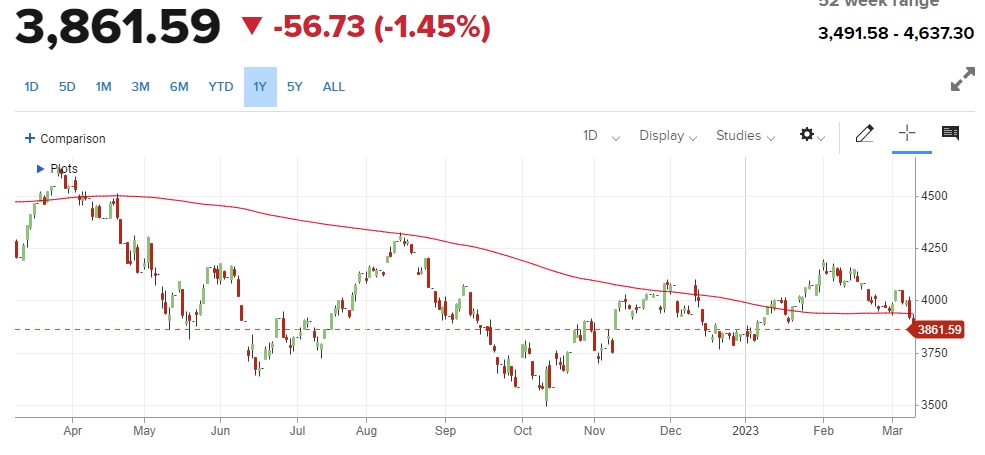
The entire banking sector gets shoved under the microscope, with many stocks dropping double digits. The S&P 500 closes below the important 200-day moving average.

Friday

Another jobs release, another hotter-than-expected report. The economy added 311,000 jobs in February (more than the 215,000 expected) and the unemployment rate rose to 3.6% as inflation forces more people to look for jobs.

The bright spot in the report was that wage growth came in at 4.6%, slightly lower than the anticipated 4.7%. However, that’s still significantly above the pre-pandemic level… and that’s going to be a concern for the Fed.

Oh, and that bank I mentioned earlier… the FDIC shut it down Friday morning. It’s the biggest bank to fall since Washington Mutual collapsed in 2008. Not great!

Whew! What a week. Here’s a chart to show you where things stand.

You know, through it all, I think my biggest takeaway from everything is still the potential that the Federal Reserve may go back up to a 50-bps hike after slowing to 25 basis points in the latest meeting.

Why did that catch my attention? Because the Fed hasn’t stutter-stepped at the end of a rate hiking cycle since 1990.

What would it mean for the economy if we got a 50-bps hike on March 22?

Would it be an automatic “everyone panic, the recession is coming” siren? Absolutely not.

Would it be an “Oh good, we’re definitely going to get a soft landing” all clear? Also definitely not.

In fact, we don’t know what it would mean because we haven’t seen it happen in recent history. And because we don’t know what it means, we have to tread cautiously.

We will still keep trading, and we will still keep using our edge to find stocks under $10 that are ready to explode to new heights.

Can all that happen in a market that feels like it’s on shaky ground? Absolutely.

Conclusion

If you thought this week was volatile, then buckle up for the boom!

We’ve got CPI and PPI scheduled for Tuesday and Wednesday, quadruple witching on Friday (an options event that usually comes with a wave of volatility), and then the next Federal Reserve meeting the week after.

With everyone on edge, another bank going under or a higher-than-expected inflation report could send stocks sinking. As I said, we’re going to be treading carefully and while still keeping an eye out for our next big winner.

What To Do Next?

If you’d like to see more top stocks under $10, then you should check out our free special report:

3 Stocks to DOUBLE This Year

What gives these stocks the right stuff to become big winners, even in this brutal stock market?

First, because they are all low priced companies with the most upside potential in today’s volatile markets.

But even more important, is that they are all top Buy rated stocks according to our coveted POWR Ratings system and they excel in key areas of growth, sentiment and momentum.

Click below now to see these 3 exciting stocks which could double or more in the year ahead.

3 Stocks to DOUBLE This Year

All the Best!

Meredith Margrave
Chief Growth Strategist, StockNews
Editor, POWR Stocks Under $10 Newsletter


SPY shares closed at $385.91 on Friday, down $-5.65 (-1.44%). Year-to-date, SPY has gained 0.91%, versus a % rise in the benchmark S&P 500 index during the same period.


About the Author: Meredith Margrave

Meredith Margrave has been a noted financial expert and market commentator for the past two decades. She is currently the Editor of the POWR Growth and POWR Stocks Under $10 newsletters. Learn more about Meredith’s background, along with links to her most recent articles.

More…

The post Making Sense of a Wild Week in the Markets appeared first on StockNews.com

https://www.entrepreneur.com/finance/making-sense-of-a-wild-week-in-the-markets/447434


Bears FIRMLY Back in Charge of Stocks Once Again!

Did you ever really buy the bullish argument touted by some to start the new year? Yes, it was an amusing fable that has now lost its luster as the bears are firmly back in charge as proven by the break below the 200 day moving average for the S&P 500 (SPY). What happens from here? Steve Reitmeister shares his views in the new commentary below.

It is not unusual for the new year to start bullish. Just a fresh dose of optimism comes with flipping the calendar.

Those good vibes are over!

Now more investors are coming back around to the bearish premise that never really went away. Add in a dose of concerns about the health of the financial industry and we finally broke below the 200 day moving average with odds of much more downside on the way.

I am here to make sense of it all in this week’s market commentary below…

Market Commentary

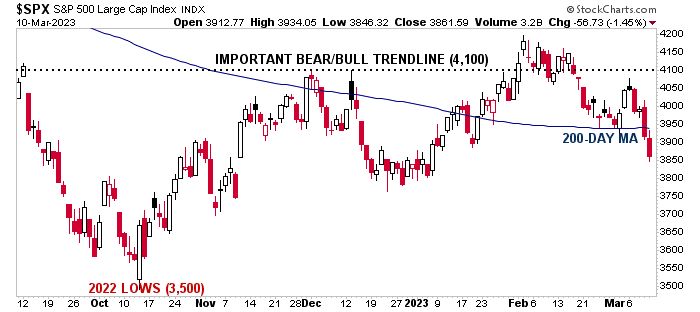
As they say a picture is worth a thousand words. So, let’s start with the picture of the S&P 500 (SPY) this past year including the long term trend line better known as the 200 day moving average (in red).

You can see how vital the 200 day moving average has been in framing the action this past year. First being the bearish break below in April 2022 with many subsequent suckers’ rallies that failed as they approached this key level.

However, the bulls really tried to make a convincing run of things by finally breaking above in January and staying above for nearly two months. That party ended yesterday with the first close below the 200 day (3,941). And today was a convincing follow through session to the downside.

Now the bears are firmly in charge once again. Let’s discuss why…

On Tuesday of this week Fed Chairman Powell reminded everybody why they should reconsider their bullish ways. In essence he stated that given the facts in hand that rates will likely need to go higher than previously stated…and stay in place for longer.

This led to a -1.5% sell off on Tuesday. Just for clarity, here is the key quote from Powell so you appreciate that there is little room for misinterpretation.

“The process of getting inflation back down to 2% has a long way to go and is likely to be bumpy. As I mentioned, the latest economic data have come in stronger than expected, which suggests that the ultimate level of interest rates is likely to be higher than previously anticipated. If the totality of the data were to indicate that faster tightening is warranted, we would be prepared to increase the pace of rate hikes.”

This reminds folks of the Feds intent to lower demand…which is a fancy way of saying likely to create a recession as a necessary evil to tamp down the flames of inflation. Hard to be bullish when the Sheriff of the economy is putting up a roadblock to economic advance.

When you have this clear message already in hand, then it becomes unnecessary to wait all the way for the Fed meeting on 3/22 to start selling. This notion was taken to the next level on Thursday with the first break below the 200 day moving average in quite some time.

Most of the investment media outlets stated that the reason for this downward pressure is that more people were getting spooked about the likelihood of employment report being too strong on Friday which would be a cherry on top for further Fed hawkishness.

That was a prescient move as indeed we found out Friday at that US economy added 311,000 jobs in February about 50% higher than expectations. Interestingly, the month over month wage increase was a notch lower than expected at +0.2%.

However, that is a very volatile indicator month over month. What really matters is that with the unemployment rate at record lows…and this many jobs still being added…and with more than 10 million job openings still being published…then it is a pretty good indicator of wage inflation likely being far too high in the future. This news had stocks bolting lower once again on Friday reconfirming the break below the 200 day moving average.

Note we have made it this far and I have not yet brought up the Silicon Valley Bank situation. No doubt about it…this event is also part of the recent sell off as investors are haunted by “Ghosts of Financial Crisis Past“.

My early take is that this is an isolated incident and not a statement of systemic financial crisis as we endured in 2008. However, there is likely more juice to squeeze from this story as investors will likely demand some kind of stress testing of banks to insure confidence. That is not a quick fix solution and will likely only add to downside pressure in coming weeks.

Looking ahead there are more fireworks set to go off in coming weeks such as:

3/14 Consumer Price Index (CPI). The key being the month over month pace to see if we are heating up like the February report…or cooling down like the previous few months.

3/15 Producer Price Index (PPI). Insiders know that this is more important than CPI because the prices paid by producers today ends up in the final product and services in the months ahead. (Current PPI leads to future CPI).

3/22 Fed Meeting with Interest Rate Decision & Economic Projections. Last month was only a 25 basis point hike. However, the odds makers are now leaning to 50 points this time around given Fed statements of needing to go even higher for longer.

I suspect these events will only reconfirm the logic behind the recent break back below the 200 day moving average.

The next battle ground is 3,855 which is the official border of bear market territory representing a 20% drop from the all time high (4,818). The Friday close of 3,861 means we are already knocking on the door.

Just for good measure lets talk about the possibility of what lies below.

3,491 is the low made in October and likely to be retested.

3,180 would mark a 34% decline from the all time high which is the average decline during a bear market.

3,000 is a point of serious, serious psychological resistance and hard to imagine going below unless some currently unforeseen crisis develops.

Putting it altogether, the bear market never left the scene. It just faded to the background for a while as bulls had some fun in January and early February.

That party is over!

The next thing to do is appreciate the sound logic behind the bearish argument and how much downside is likely still on the way. That should compel you to enact strategies that are suited for a bear market environment. The next section will help you with that…

What To Do Next?

Discover my brand new “Stock Trading Plan for 2023” covering:

  • Why 2023 is a “Jekyll & Hyde” year for stocks
  • How the Bear Market Comes Back with a Vengeance
  • 9 Trades to Profit Now as Bear Returns
  • 2 Trades with 100%+ Upside Potential When New Bull Emerges
  • And Much More!

Stock Trading Plan for 2023 >

Wishing you a world of investment success!


Steve Reitmeister…but everyone calls me Reity (pronounced “Righty”)
CEO, StockNews.com and Editor, Reitmeister Total Return


SPY shares . Year-to-date, SPY has gained 0.91%, versus a % rise in the benchmark S&P 500 index during the same period.


About the Author: Steve Reitmeister

Steve is better known to the StockNews audience as “Reity”. Not only is he the CEO of the firm, but he also shares his 40 years of investment experience in the Reitmeister Total Return portfolio. Learn more about Reity’s background, along with links to his most recent articles and stock picks.

More…

The post Bears FIRMLY Back in Charge of Stocks Once Again! appeared first on StockNews.com

https://www.entrepreneur.com/finance/bears-firmly-back-in-charge-of-stocks-once-again/447433


Learn to Day Trade and Invest with This Helpful Bundle, Now Less Than $40

Disclosure: Our goal is to feature products and services that we think you’ll find interesting and useful. If you purchase them, Entrepreneur may get a small share of the revenue from the sale from our commerce partners.

When you’re an entrepreneur, you don’t exactly have a ton of free time. You also may not have a lot of disposable income to play with, as most of your funds are likely going toward your enterprise. But if you’d like to figure out how to make some passive income, The Complete 2023 Stock Trading and Investing Bundle can help.

Making money in the stock market doesn’t have to be complicated. In fact, you can reap the benefits of investing with the help of the twelve informative courses in this bundle. And currently, you can score them all for just $39 — that’s less than $4 a course.

Learn the basics of stock trading and master day trading in a way that maximizes your profits and mitigates your risks with courses like Options Trading 101: A Beginner’s Guide to Trading Options. This course, like the others, is brought to you by Skill Success. This online learning hub allows you to learn directly from experts in different fields and has been featured on CNN, Mashable, CNET, TechRadar, and more.

This particular course is taught by Travis Rose, a full-time day trader and investor who provides step-by-step guidance to new traders. He shows the trading strategies that have made him money personally and teaches the difference between options and stocks.

Brett Romero, a software engineer and entrepreneur, teaches Fundamental Analysis Made Simple for Stock Investors, a must-have tool for those thinking about investing in stocks. This analysis helps you determine which companies to invest in, and he teaches it all in less than 45 minutes.

Ten other helpful courses round out The Complete 2023 Stock Trading and Investing Bundle, and you can score them all for just $39 right here.

Prices subject to change.

https://www.entrepreneur.com/starting-a-business/learn-to-day-trade-and-invest-with-this-helpful-bundle-now/447213


2 Beverage Stocks to Hold for the Next 20 Years

The beverage industry is growing amid changing preferences and the growing spending power of consumers. Moreover, as consumers are becoming health conscious and are rapidly shifting to non-alcoholic beverages, fundamentally sound Coca-Cola (KO) and Primo Water (PRMW) might be ideal buys for the long term. These stocks pay reliable dividends. Keep reading.

Changing preferences of the new-age consumers and the increasing spending power of the millennials are among the most significant factors driving the beverage industry’s growth. Moreover, the growing trend of drinking at social gatherings is boosting demand. The industry is expected to enjoy incremental gains in the coming years.

So, fundamentally strong beverage stocks, The Coca-Cola Company (KO) and Primo Water Corporation (PRMW), which pay regular dividends, could be worth adding to your long-term portfolios.

According to Statista, beverage revenue is expected to show an annual growth rate of 15.8%, resulting in a projected market volume of $163.90 billion by 2027. Revenue this year is projected to reach $91.03 billion.

Additionally, the rising population of health-conscious people and market players working to reduce the alcohol content in different beverages and the development and growth of food-based e-commerce platforms are contributing to the growth of the low-alcohol beverages market.

As per a report, 58% of customers worldwide are shifting towards non-alcoholic or low-alcoholic beverages and cocktails. Worldwide sales of beverages with low alcohol content are expected to grow at a CAGR of 4.5% through 2033.

Let’s discuss the stocks mentioned above in detail:

The Coca-Cola Company (KO)

KO manufactures, markets, and sells various non-alcoholic beverages worldwide. The company provides sparkling soft drinks, sparkling flavors; water, sports, coffee, and tea; juice, value-added dairy, and plant-based beverages; and other beverages.

Its trailing-12-month EBITDA margin of 31.42% is 169.9% higher than the 11.64% industry average. Its trailing-12-month gross profit margin of 58.14% is 82.3% higher than the 31.89% industry average. Its trailing-12-month net income margin of 22.19% is 540% higher than the 3.47% industry average.

On February 16, KO declared a quarterly dividend of $0.46 per share, payable on April 3, 2023.

Its annual dividend of $1.84 yields 3.06% on the current market prices, while its four-year average dividend yield is 3.05%. The company has raised its dividend at a CAGR of 3.2% over the past three years. Also, the company has paid dividends for 60 consecutive years.

KO’s non-GAAP net operating revenues increased 7.7% year-over-year to $10.20 billion in the fourth quarter, ended December 31, 2022. Its non-GAAP gross profit increased 6% from the year-ago value to $5.76 billion, while its non-GAAP EPS came in at $0.45.

For the fiscal first quarter ending March 2023, analysts expect KO’s  EPS to increase  1% year-over-year to $0.65. Its revenue is likely to increase 2.9% year-over-year to $10.81 billion. The company has an impressive earnings surprise history, as it surpassed the consensus EPS and revenue estimates in each of the trailing four quarters.

The stock has gained marginally over the past year to close the last trading session at $59.46.

KO’s POWR Ratings reflect this promising outlook. The stock has an overall rating of B, which translates to Buy in our proprietary rating system. The POWR Ratings assess stocks by 118 different factors, each with its own weighting.

It has a B grade for Quality, Stability, and Sentiment. Within the B-rated Beverages industry, it is ranked #17 out of 37 stocks.

Click here for additional POWR ratings for Value, Growth, and Momentum for KO.

Primo Water Corporation (PRMW)

PRMW provides pure-play water solutions for residential and commercial customers. It offers bottled water, water dispensers, purified bottled water, self-service refill drinking water, premium spring, mineral water, sparkling and flavored water, filtration equipment, and coffee.

On February 3, PRMW announced that it has acquired an additional spring water source adjacent to its current Mountain Valley spring in Garland County, Arkansas. Tom Harrington, CEO of PRMW, said, “This additional water source supports our continued growth and strengthens PRMW’s commitment to offer sustainable water solutions to customers across our footprint.”

Its trailing-12-month EBITDA margin of 17.35% is 49.1% higher than the 11.64% industry average. Its trailing-12-month gross profit margin of 58.39% is 83.1% higher than the 31.89% industry average.

On February 22, PRMW declared a quarterly dividend of $0.08 per share, payable on March 27, 2023.

Its annual dividend of $0.32 yields 2.13% on the current market prices, higher than its four-year average dividend yield of 1.73%. The company has raised its dividend at a CAGR of 6.5% and 3.9% over the past three and five years, respectively.

For the fiscal fourth quarter ended December 31, 2022, PRMW’s net revenue increased 2.9% year-over-year to $533 million, while its adjusted EBITDA grew 9% year-over-year to $107.30 million. The company’s adjusted net income increased 42.9% year-over-year to $25.30 million. Adjusted net income per share increased 45.5% year-over-year to $0.16.

Analysts expect PRMW’s revenue to increase 1.2% year-over-year to $532.59 million in the fiscal first quarter that ending March 2023. Also, its EPS is expected to come in at $0.21. The company has surpassed the consensus revenue estimates in three of the trailing four quarters.

PRMW’s shares have gained 5.2% over the past nine months to close the last trading session at $15.05.

It’s no surprise that PRMW has an overall A rating, which equates to a Strong Buy in our POWR Ratings system.

PRMW has a B grade for Growth, Stability, and Quality. The stock is ranked #6 in the same industry.

To access additional grades for Momentum, Value, and Sentiment, click here.

Consider This Before Placing Your Next Trade…

We are still in the midst of a bear market.
Yes, some special stocks may go up. But most will tumble as the bear market claws ever lower.

That is why you need to discover the brand new “Stock Trading Plan for 2023” created by 40-year investment veteran Steve Reitmeister. There he explains:

  • Why it’s still a bear market
  • How low stocks will go
  • 9 simple trades to profit on the way down
  • Bonus: 2 trades with 100%+ upside when the bull market returns

You owe it to yourself to watch this timely presentation before placing your next trade.

Stock Trading Plan for 2023 >


KO shares fell $0.06 (-0.10%) in premarket trading Friday. Year-to-date, KO has declined -6.52%, versus a 2.39% rise in the benchmark S&P 500 index during the same period.


About the Author: Kritika Sarmah

Her interest in risky instruments and passion for writing made Kritika an analyst and financial journalist. She earned her bachelor’s degree in commerce and is currently pursuing the CFA program. With her fundamental approach, she aims to help investors identify untapped investment opportunities.

More…

The post 2 Beverage Stocks to Hold for the Next 20 Years appeared first on StockNews.com

https://www.entrepreneur.com/finance/2-beverage-stocks-to-hold-for-the-next-20-years/447361


1 Blue-Chip Stock to Buy Now and Never Sell

Blue-chip stock, The Coca-Cola Company (KO), presents a strong long-term investment case, given its strong fundamentals, reliable dividends, favorable analyst estimates, high profitability, and strong past growth. Therefore, it could be wise to buy this stock and never sell it. Read more….

The stock market is expected to go through further volatility in the upcoming months as the Fed looks to keep raising interest rates beyond what was previously anticipated. However, the expected volatility should not deter investors from long-term investments. I think The Coca-Cola Company (KO), widely popular for its beverages, is the blue-chip stock to buy now for the long haul for reasons explained in this piece.

KO has been an investor favorite, creating incredible wealth over the past few decades. KO’s non-alcoholic beverages, snacks, and other edible items have reached the globe’s farthest corners. Famous investor Warren Buffett has owned the stock for over 30 years and said he would never sell it. With renewed recession fears following Federal Reserve Chairman Jerome Powell’s statement that interest rates will likely head higher than previously expected by policymakers, KO could be the stock to consider, given its defensive nature.

Despite the macroeconomic challenges, KO beat analysts’ fourth-quarter earnings and revenue estimates. Its earnings were 0.3% above the analyst estimates, while its revenue beat the consensus estimate by 2.8%.

For fiscal 2023, the company expects organic revenue to grow between 7% and 8%. It expects non-GAAP comparable currency-neutral EPS growth of 7% to 9% and non-GAAP comparable EPS growth of between 4% and 5%.

Also, KO expects to generate a non-GAAP free cash flow of approximately $9.50 billion through cash flow from operations of approximately $11.40 billion.

KO has been a dependable dividend payer over the past few decades. KO is expected to pay a dividend of 46 cents to shareholders on April 3, 2023. It has increased its dividend for 62 consecutive years. Its annual dividend of $1.84 yields 3.09% on the current share price. The company’s dividend payouts have increased at a 3.2% CAGR over the past three years and a 3.5% CAGR over the past five years.

The stock has declined 6.5% in price year-to-date and gained 0.9% over the past year to close the last trading session at $59.46.

Here’s what could influence KO’s performance in the upcoming months:

Robust Financials

KO’s non-GAAP net operating revenues increased 7.7% year-over-year to $10.20 billion for the fourth quarter ended December 31, 2022. Its non-GAAP gross profit increased 6% year-over-year to $5.76 billion. The company’s non-GAAP operating income increased 10.9% from the prior-year quarter to $2.32 billion. Its non-GAAP net income and non-GAAP EPS came in at $1.94 billion and $0.45, respectively.

For the fiscal year ended December 31, 2022, KO’s net operating revenues increased 11% year-over-year to $43 billion. Its non-GAAP gross profit increased 8.5% from the prior-year period to $25.23 billion. The company’s non-GAAP operating income rose 11.1% year-over-year to $12.35 billion. In addition, its non-GAAP net income increased 7.1% year-over-year to $10.80 billion. Also, its non-GAAP EPS came in at $2.48, representing an increase of 6.9% year-over-year.

Favorable Analyst Estimates

Analysts expect KO’s EPS for fiscal 2023 and 2024 to increase 4.7% and 7.6% year-over-year to $2.60 and $2.79, respectively. Its revenue for fiscal 2023 and 2024 is expected to increase 4.1% and 5.2% year-over-year to $44.80 billion and $47.15 billion, respectively.

Solid Historical Growth

KO’s revenue grew at a CAGR of 4.9% over the past three years. Its EBIT grew at a CAGR of 4.8% over the past three years. In addition, its net income grew at a CAGR of 2.3% in the same time frame.

High Profitability

In terms of the trailing-12-month gross profit margin, KO’s 58.14% is 82.3% higher than the 31.89% industry average. Likewise, its 31.42% trailing-12-month EBITDA margin is 169.9% higher than the industry average of 11.64%. Furthermore, the stock’s 28.49% trailing-12-month EBIT margin is 255.6% higher than the industry average of 8.01%.

POWR Ratings Show Promise

KO has an overall rating of B, equating to a Buy in our POWR Ratings system. The POWR Ratings are calculated by considering 118 different factors, each weighted to an optimal degree.

Our proprietary rating system also evaluates each stock based on eight distinct categories. KO has a B grade for Quality, consistent with its high profitability.

It has a B grade for Sentiment, in sync with favorable analyst estimates. Its 0.54 beta justifies its B grade for Stability.

KO is ranked #17 out of 37 stocks in the B-rated Beverages industry. Click here to access KO’s ratings for Growth, Value, and Momentum.

Bottom Line

KO’s impressive product portfolio and global brand recognition help it generate stable revenues, making it the stock to buy for all business cycles. Moreover, the blue-chip stock’s impressive dividend history substantiates its financial strength. Despite the macroeconomic uncertainties, KO has guided strong growth in revenue and earnings for fiscal 2023.

Given its robust financials, high profitability, solid historical growth, favorable analyst estimates, and reliable dividends, this blue-chip stock could be a solid long-term investment.

How Does The Coca-Cola Company (KO) Stack up Against Its Peers?

KO has an overall POWR Rating of B, equating to a Buy rating. You might want to consider investing in the following Beverages stocks with an A (Strong Buy) or B (Buy) rating: Embotelladora Andina S.A. (AKO.B), Kirin Holdings Company, Limited (KNBWY), and Carlsberg A/S (CABGY).

Consider This Before Placing Your Next Trade…

We are still in the midst of a bear market.

Yes, some special stocks may go up. But most will tumble as the bear market claws ever lower.

That is why you need to discover the brand new “Stock Trading Plan for 2023” created by 40-year investment veteran Steve Reitmeister. There he explains:

  • Why it’s still a bear market
  • How low stocks will go
  • 9 simple trades to profit on the way down
  • Bonus: 2 trades with 100%+ upside when the bull market returns

You owe it to yourself to watch this timely presentation before placing your next trade.

Stock Trading Plan for 2023 > 


KO shares fell $0.10 (-0.17%) in premarket trading Friday. Year-to-date, KO has declined -6.52%, versus a 2.39% rise in the benchmark S&P 500 index during the same period.


About the Author: Dipanjan Banchur

Since he was in grade school, Dipanjan was interested in the stock market. This led to him obtaining a master’s degree in Finance and Accounting. Currently, as an investment analyst and financial journalist, Dipanjan has a strong interest in reading and analyzing emerging trends in financial markets.

More…

The post 1 Blue-Chip Stock to Buy Now and Never Sell appeared first on StockNews.com

https://www.entrepreneur.com/finance/1-blue-chip-stock-to-buy-now-and-never-sell/447360


3 Powerhouse Stocks to Buy in 2023

As the Fed is expected to raise interest rates higher than expected, the revived recession fears will keep the stock market under pressure in the upcoming months. Thus, it could be wise to scoop up shares of high-quality businesses, such as Johnson & Johnson (JNJ), Humana Inc. (HUM), and AutoZone, Inc. (AZO), which look poised for long-term growth, even if they face some near-term hurdles. Continue reading….

In light of recent upbeat economic data, Fed chair Jerome Powell opened the door to larger interest rate hikes. With renewed recession fears due to expectations of a more aggressive tightening, the stock market is expected to remain volatile in the near term. Hence, investors could consider buying powerhouse stocks Johnson & Johnson (JNJ), Humana (HUM), and AutoZone (AZO), which have promising prospects.

Fed chairman Jerome Powell recently cautioned lawmakers that the central bank will likely raise interest rates higher than it previously expected in response to recent strong economic data and is prepared to return to a quicker pace of rate hikes if incoming data remains hot.

Following Powell’s hawkish testimony, Goldman Sachs (GS) economists increased their forecast for peak Fed rates to 5.5-5.75%. “We expect the data ahead of the March meeting to be mixed but firm on net, and we therefore see our standing forecast of a 25-basis-point hike in March as a close call, with some risk that the FOMC could hike by 50 basis points instead,” the economists led by Jan Hatzius wrote in a note to clients.

Moreover, Citigroup Inc. (C) economists expect the Fed to increase its benchmark rate by 50 basis points at the March meeting.

Furthermore, according to Rick Rieder, BlackRock’s Chief Investment Officer of Global Fixed Income, the Fed could increase rates to 6% and keep them higher for an extended period of time to fight stubborn inflation. Expectations of more aggressive action by the Fed revived recession fears, crushing the riskier corners of the stock market.

Amid an uncertain macroeconomic backdrop, investing in shares of high-quality businesses well-positioned for long-term growth could be wise. Let’s discuss what could help JNJ, HUM, and AZO survive the near-term headwinds and emerge as long-term winners.

Johnson & Johnson (JNJ)

JNJ researches, develops, produces, and markets a diverse range of healthcare products worldwide. The company operates through three segments, Consumer Health; Pharmaceutical; and MedTech. Its major emphasis is on human health and well-being products.

On December 22, 2022, JNJ completed the acquisition of Abiomed, Inc (ABMD). JNJ’s CEO, Joaquin Duato, said, “This acquisition marks another important step on Johnson & Johnson’s path to accelerating growth in our MedTech business and delivering innovative medical technologies to more people around the world.”

JNJ’s U.S. sales grew 2.9% year-over-year to $12.52 billion for the fiscal fourth quarter that ended December 31, 2022. Its adjusted earnings before the provision for taxes on income grew 17% from the year-ago value to $7.42 billion. Also, the company’s adjusted net earnings and EPS rose 9.5% and 10.3% year-over-year to $6.22 billion and $2.35, respectively.

JNJ has a record of increasing its dividends for 60 consecutive years. It pays a $4.52 per share dividend annually, translating to a 2.96% yield on the current price level. The company’s four-year average dividend yield is 2.60%, and its dividend payments have grown at 6.1% CAGR over the past five years.

Analysts expect JNJ’s revenue to increase 2.8% year-over-year to $97.62 billion for the fiscal year ending December 2023. The company’s EPS for the ongoing year is expected to rise 3.6% from the previous year to $10.51. Moreover, JNJ surpassed its consensus EPS estimates in all four trailing quarters, which is impressive.

Furthermore, JNJ’s revenue and EPS for fiscal 2024 are expected to grow 2.6% and 4.1% from the prior year to $100.20 billion and $10.94, respectively. The stock declined 8.1% to close the last trading session at $151.24.

JNJ’s strong fundamentals are apparent in its POWR Ratings. The stock has an overall rating of A, equating to a Strong Buy in our proprietary rating system. The POWR Ratings are calculated by considering 118 different factors, each weighted to an optimal degree.

JNJ has an A grade for Stability and a B for Sentiment, Value, and Quality. It is ranked #6 in the 169-stock Medical – Pharmaceuticals industry.

In addition to the POWR Ratings I’ve just highlighted, you can see JNJ’s ratings for Growth and Momentum here.

Humana Inc. (HUM)

HUM operates as a health and well-being company in the United States. It operates through two segments: Insurance and CenterWell. The company provides medical and supplemental benefit plans to individuals. Also, it offers pharmacy solutions, provider services, and home solutions services to its health plan members and third parties.

On March 2, 2023, HUM and Aledade, the nation’s largest network of independent primary care, announced a 10-year collaboration to provide value-based primary care for Humana’s Medicare Advantage members from in-network Aledade-enabled physicians.

George Renaudin, HUM’s President of Medicare and Medicaid, said, “Aledade was one of the largest value-based care providers for Humana in 2022, and our relationship will continue our goal to improve access to proactive screenings to identify and treat illnesses early. With an increased focus on value-based care, our entire health care system can see the results through higher-quality care and lower health care costs.”

On February 16, HUM announced that its Board of Directors declared a cash dividend to stockholders of $0.885 per share, payable on April 28, 2023. The dividend of $0.885 per share reflects an increase of 12.4% from the previous dividend of $0.7875 per share.

HUM’s current dividend translates to a 0.72% yield annually, while its four-year average dividend yield is 0.65%. Over the last five years, its dividend payouts have grown at a 14.5% CAGR. The company has raised its dividend for six consecutive years.

HUM’s adjusted revenues increased 6.6% year-over-year to $22.44 billion for the fourth quarter that ended December 31, 2022. Its adjusted pretax results were $263 million, up 58.4% year-over-year. The company adjusted EPS grew 30.7% year-over-year to $1.62. Also, its adjusted operating cash inflows were $651 million, compared to operating cash outflows of $96 million in the prior-year quarter.

Analysts expect HUM’s revenue and EPS for fiscal 2023 to increase 11.9% and 11.4% year-over-year to $103.91 billion and $28.12, respectively. The company’s revenue and EPS for fiscal 2024 are estimated to grow 8.7% and 13.6% year-over-year to $112.95 billion and $31.95, respectively. It topped the consensus EPS estimates in all four trailing quarters.

Shares of HUM have gained 13.3% over the past year to close the last trading session at $486.33.

HUM’s bright outlook is reflected in its POWR Ratings. The stock has an overall B rating, equating to a Buy in our proprietary rating system.

HUM has a B grade for Growth, Value, and Sentiment. It is ranked #4 of 10 stocks in the A-rated Medical – Health Insurance industry. Click here for the additional POWR Ratings for Stability, Momentum, and Quality for HUM.

AutoZone, Inc. (AZO)

AZO retails and distributes automotive replacement parts and accessories. The company’s products include A/C compressors, batteries and accessories, belts and hoses, bearings, calipers, clutches, engines, fuel pumps, ignition and lighting products, radiators, thermostats, and water pumps. It has stores in the United States, Mexico, and Brazil.

On February 28, 2023, Bill Rhode, AZO’s Chairman, President, and CEO, said, “For the remainder of fiscal 2023, we will be laser focused on relentless execution, and we will continue to focus our capital on projects that meet or exceed our return on capital targets. We will take nothing for granted as we will continue to focus on our long-term approach of increasing operating earnings and free cash flows while using our balance sheet effectively.”

For the fiscal second quarter that ended February 11, 2023, AZO’s net sales increased 9.5% year-over-year to $3.69 billion, while its gross profit grew 8.1% from the year-ago value to $1.93 billion. The company’s operating profit was $669.98 million, up 6.9% year-over-year. Its net income rose 1% year-over-year to $476.54 million, and its net income per share was $24.64, up 10.5% year-over-year.

AZO’s revenue and EPS for the current fiscal year (ending August 2023) are expected to grow 7.5% and 9.9% from the previous year to $17.48 billion and $128.79, respectively. Moreover, the company has surpassed the consensus revenue and EPS estimates in each of the trailing four quarters.

In addition, analysts expect the company’s revenue and EPS to increase 5.2% and 13.3% from the previous year to $18.38 billion and $145.95, respectively. The stock has gained 10.2% over the past six months and 28.5% over the past year to close the last trading session at $2,422.19.

AZO’s POWR Ratings reflect a promising outlook. The stock has an overall rating of B, translating to a Buy in our proprietary rating system.

AZO has an A grade for Quality and a B for Growth and Sentiment. Among 60 stocks in the A-rated Auto Parts industry, it is ranked #20. 

Click here to access additional ratings of AZO for Value, Momentum, and Stability.

Consider This Before Placing Your Next Trade…

We are still in the midst of a bear market.

Yes, some special stocks may go up. But most will tumble as the bear market claws ever lower.

That is why you need to discover the brand new “Stock Trading Plan for 2023” created by 40-year investment veteran Steve Reitmeister. There he explains:

  • Why it’s still a bear market
  • How low stocks will go
  • 9 simple trades to profit on the way down
  • Bonus: 2 trades with 100%+ upside when the bull market returns

You owe it to yourself to watch this timely presentation before placing your next trade.

Stock Trading Plan for 2023 > 


JNJ shares rose $0.06 (+0.04%) in premarket trading Friday. Year-to-date, JNJ has declined -13.77%, versus a 2.39% rise in the benchmark S&P 500 index during the same period.


About the Author: Mangeet Kaur Bouns

Mangeet’s keen interest in the stock market led her to become an investment researcher and financial journalist. Using her fundamental approach to analyzing stocks, Mangeet’s looks to help retail investors understand the underlying factors before making investment decisions.

More…

The post 3 Powerhouse Stocks to Buy in 2023 appeared first on StockNews.com

https://www.entrepreneur.com/finance/3-powerhouse-stocks-to-buy-in-2023/447358