3 Big Box Retailer Stocks to Buy Without Hesitation in 2023

Despite the economic turmoil, retail sales remained steady, indicating that consumer spending is not slowing down. While other sectors continue to feel the pinch of interest rate hikes, the grocery/big-box retail industry has been holding up well due to the inelastic demand for its products. Therefore, investors shouldn’t hesitate to buy shares of fundamentally strong big box retailers, Walmart (WMT), Sprouts Farmers Market (SFM), and Ingles Markets (IMKTA). Keep reading.

The big box retailer sector is well positioned to witness significant growth despite the macro issues, thanks to the inelastic demand for their products. Given the industry’s defensive nature, investors should check out fundamentally strong stocks, Walmart Inc. (WMT), Sprouts Farmers Market, Inc. (SFM), and Ingles Markets, Incorporated (IMKTA).

Despite the Fed’s persistent efforts to fight inflation, it has remained stubbornly high. A tight job market and inflation above the Fed’s 2% objective boost the argument for more rate hikes in the near term. Moreover, the latest Personal Consumption Expenditures (PCE) report shows inflation up more than expected in January, which suggests that the Fed is far from achieving its target.

Although high inflation is a major concern for the retail industry, rising prices usually do not deter consumers from spending on essentials. As a result, consumer spending, which accounts for more than two-thirds of U.S. economic activity, rose 1.8% in January, marking the largest increase since March 2021.

Over the past year, the big-box retail industry has encountered various hurdles, including supply chain constraints, high inflation, and rising interest rates. However, last month the Commerce Department reported that retail sales increased by 3% sequentially, while the grocery stores witnessed steady growth.

Furthermore, buoyed by the release of January’s blockbuster employment report, consumer spending will likely remain resilient. This bodes well for the grocery/big box retailers’ industry.

Quality big box retailer stocks WMT, SFM, and IMKTA should benefit from the industry tailwinds. Thus, investors shouldn’t hesitate to add these stocks to their portfolios this year.

Walmart Inc. (WMT)

WMT offers an assortment of merchandise and services at everyday low prices in both retail stores and through e-commerce websites. The company operates through three segments: Walmart U.S.; Walmart International; and Sam’s Club.

On February 21, the company increased its annual dividend by 2% to $2.28 per share, marking the 50th consecutive year of dividend increase. WMT’s four-year average dividend yield is 1.67%, and its annual dividend of $2.28 yields 1.62% at current prices. Its dividend has increased at a CAGR of 1.9% over the past three and five years.

On January 12, Walmart Commerce Technologies and Walmart GoLocal announced a collaboration with Salesforce.com Inc. (CRM) to provide retailers with tools and services that enable frictionless local pickup and delivery for customers worldwide. This collaboration will enable WMT to be more assessable to customers.

WMT’s total revenue increased 7.3% year-over-year to $164.05 billion in the fourth ended January 31, 2023. Its adjusted operating income grew 6.3% from the year-ago value to $6.37 billion, while its adjusted EPS came in at $1.71, representing an increase of 11.8% year-over-year. Also, the company’s attributable net income stood at $6.28 billion, up 76.2% year-over-year.

Analysts expect WMT’s revenue for the quarter ending April 2023 to be $147.26 billion, representing 5% year-over-year growth. Its EPS is expected to increase by 3.7% per annum over the next five years. The company surpassed the consensus revenue estimates in each of the trailing four quarters.

The stock has gained 12.9% over the past nine months to close the last trading session at $139.25.

WMT’s POWR Ratings reflect this promising outlook. The stock has an overall rating of A, which translates to a Strong Buy in our proprietary ratings system. The POWR Ratings assess stocks by 118 different factors, each with its own weighting.

WMT also has an A grade for Stability and a B for Growth, Value, Sentiment, and Quality. Among the 38 stocks in the A-rated Grocery/Big Box Retailers industry, it is ranked #3. Click here to see WMT’s rating for Momentum.

Sprouts Farmers Market, Inc. (SFM)

SFM is a specialty retailer of fresh, natural, and organic food products. It sells various products categorized under perishable and non-perishable categories, such as fresh produce, vitamins and supplements, grocery, meat and seafood, bakery, dairy, body care, and natural household items.

On November 2, 2022, SFM expanded its on-demand grocery delivery through a partnership agreement with DoorDash Inc. (DASH) in selected cities, commencing with Phoenix, Arizona. This strategic move extends the company’s footprint by enabling more people to access its fresh produce, thereby boosting the company’s overall revenue.

In the fourth quarter ended January 1, 2023, SFM’s net sales increased 5.6% year-over-year to $1.58 billion. Its gross profit came in at $ 572.81 million, up 7.4% year-over-year.

The company’s income from operations grew 20.4% from the year-ago value to $61.87 million, while its net income increased 24.5% year-over-year to $45.12 million. Also, its EPS stood at $ 0.42, representing an increase of 31.3% year-over-year.

The consensus EPS estimate of $0.85 for the first quarter (ending March 31, 2023) represents a 7.4% increase year-over-year. The consensus revenue estimate of $1.72 billion for the current quarter indicates a 4.7% increase from the same period last year. The company has an excellent earnings surprise history, as it surpassed the consensus EPS estimates in each of the trailing four quarters.

Shares of SFM have gained 22.7% over the past nine months to close the last trading session at $33.14.

SFM’s strong fundamentals are reflected in its POWR Ratings. The stock has an overall rating of B, which equates to Buy in our proprietary rating system. It has an A grade for Quality. In the same industry, it is ranked #20 of 38 stocks.

In addition to the POWR Ratings grades I’ve just highlighted, you can see the SFM ratings for Growth, Value, Momentum, Stability, and Sentiment here.

Ingles Markets, Incorporated (IMKTA)

IMKTA operates a chain of supermarkets that offers food products, including grocery, meat and dairy products, produce, frozen foods, and other perishables, and non-food products, which including fuel centers, pharmacies, and health and beauty care products, general merchandise, and private label items.

For the fiscal first quarter that ended on December 24, 2022, IMKTA’s net sales increased 7.3% year-over-year to $1.49 billion. Its gross profit rose 5.9% from the year-ago value to $371.16 million, while its net income increased 4.8% year-over-year to $69.37 million.

The company’s EPS for Class A and Class B common stock were $3.65 and $3.40 compared with the prior-year quarter values of $3.48 and $3.24, respectively.

Street expects IMKTA’s revenue for the fiscal year 2024 to increase by 3% year-over-year to $4.84 billion. Its EPS is estimated to increase by 14.5% per annum over the next five years. Over the past six months, the stock has gained marginally to close the last trading day at $91.82.

IMKTA’s solid prospects are reflected in its POWR Ratings. The stock has an overall A rating, which equates to a Strong Buy in our proprietary rating system.

It also has an A grade for Value and a B for Stability and Quality. Within the same A-rated industry, it is ranked #2 of 38 stocks.

Click here to see the additional ratings of IMKTA (Growth, Sentiment, and Momentum).

What To Do Next?

Get your hands on this special report:

7 SEVERELY Undervalued Stocks

The best part of the recent bear market is that there are thriving companies trading at tremendous discounts to fair value.

This combination of stellar earnings growth and low price provides a great catalyst for investor success.

And this report focuses on the 7 best of these stocks primed to soar in the weeks ahead. Click below to claim your copy now.

7 SEVERELY Undervalued Stocks


WMT shares . Year-to-date, WMT has declined -1.79%, versus a 4.14% rise in the benchmark S&P 500 index during the same period.


About the Author: Shweta Kumari

Shweta’s profound interest in financial research and quantitative analysis led her to pursue a career as an investment analyst. She uses her knowledge to help retail investors make educated investment decisions.

More…

The post 3 Big Box Retailer Stocks to Buy Without Hesitation in 2023 appeared first on StockNews.com

https://www.entrepreneur.com/finance/3-big-box-retailer-stocks-to-buy-without-hesitation-in-2023/447151


3 Stocks with Tremendous Growth Potential in 2023

Given the pace and intensity of the Fed’s monetary tightening, there’s a strong likelihood that the U.S. will enter a recession in 2023. However, amid a strong job market and resilient consumer spending, the possibility of a soft landing still stands. Given this backdrop, quality stocks Gilead Sciences (GILD), Coca-Cola Consolidated (COKE), and Ooma (OOMA), with immense growth potential, might be ideal investments this year. Let’s discuss.

As investors mull over the Fed’s next steps to steer the economy toward a “soft landing’ that quells inflation and avoids recession, some stocks have experienced significant gains since the start of the year.

To capitalize on this opportunity, let us explore the growth potential of fundamentally solid stocks Gilead Sciences, Inc. (GILD), Coca-Cola Consolidated, Inc. (COKE), and Ooma, Inc. (OOMA) that are poised to generate substantial returns in the future.

With persisting inflationary pressures, the Fed is expected to continue its rate hike regime. The US central bank is struggling to battle high inflation and might have to keep increasing interest rates before taking its pedal off the accelerator.

While Fed Chair Jerome Powell officially declared that the “disinflation process has begun‘ after February’s meeting, a recent report from the Commerce Department’s Bureau of Economic Analysis shows that Personal Consumption Expenditure (PCE) price index rose 5.4% in January, higher than expected.

With the market trying to figure out if future rate hikes are adequately priced, the next batch of economic indicators is likely to be crucial. Investors are awaiting February’s jobs report, which is slated for Friday after January’s blockbuster number showed a resilient labor market despite the Fed’s aggressive hiking.

On the bright side, the wide gap between job openings and available workers is one reason economists think the U.S. could avoid a recession this year. Furthermore, on the backs of strong consumer spending and retail report, Shark Tank investor Kevin O’Leary believes that stocks are turning in a return of about 8% this year, as the US economy is flushing with cash and will likely manage a soft landing.

Given the current muddled outlook of the economy, investors should emphasize on adding quality stocks with a focus on earnings consistency and high profitability. Fundamentally sound stocks GILD, COKE, and OOMA might be solid buys now to garner solid returns in the future. These companies are leaders in their respective industries and are poised for sustained growth.

Gilead Sciences, Inc. (GILD)

GILD is a biopharmaceutical company focusing on developing and commercializing medicine for treating life-threatening diseases, including HIV, viral hepatitis, and cancer.

Recently, Kite, a GILD company, acquired Tmunity Therapeutics, a clinical-stage biotech company focused on next-generation CAR T-therapies and technologies. This acquisition complements Kite’s existing in-house cell therapy research capabilities by adding additional pipeline assets, platform capabilities, and unique partnership with the University of Pennsylvania.

On February 3, GILD announced that the U.S. Food and Drug Administration (FDA) had approved Trodelvy to treat adult patients with pre-treated HR+/HER2- metastatic breast cancer who have received prior endocrine-based therapy and at least two chemotherapies.

Moreover, in January, the European Medicines Agency also validated a Type II Variation Marketing Authorization Application for the same. Given the limited treatment options, such approvals make Trodelvy accessible to more patients across the EU.

On January 30, Kite and Arcellx, Inc. (ACLX) announced a strategic collaboration to co-develop and co-commercialize ACLX’s lead late-stage clinical CART-ddBCMA for the treatment of patients with relapsed or refractory multiple myeloma.

In the same month, GILD and EVOQ Therapeutics, Inc. announced a collaboration and licensing agreement to advance EVOQ’s proprietary technology for treating rheumatoid arthritis (RA) and lupus. Under the agreement, GILD would receive the rights to exclusively license EVOQ’s NanoDisc technology to develop and commercialize immunotherapy products clinically.

On February 2, GILD increased its quarterly cash dividend by 2.7% to $0.75 per share of common stock, payable on March 30, 2023. The company’s annual dividend of $3 yields 3.70% at the current price level. Its dividend payouts have increased at a 5% CAGR over the past three years and a 7% CAGR over the past five years. GILD has a record of seven years of consecutive dividend growth.

GILD’s total revenues increased 2% year-over-year to $7.39 billion for the fiscal fourth quarter that ended December 31, 2022. Its adjusted operating income grew 79.1% from the year-ago value to $2.70 billion, while its non-GAAP attributable net income came in at $2.11 billion, representing a 143.2% improvement year-over-year.

Also, the company’s adjusted EPS increased by 142% from the prior-year value to $1.67.

For the fiscal second quarter ending on June 30, 2023, GILD’s EPS is expected to increase 8.8% year-over-year to $1.72. Its revenue for the same quarter is expected to increase by 3.6% year-over-year to 6.49 billion. The company surpassed the consensus EPS and revenue estimates in each of the trailing four quarters, which is promising.

GILD’s revenue and EBITDA have increased at CAGRs of 6.7% and 6.8%, respectively, over the past three years, while its levered free cash flow has grown at a 10.1% CAGR.

The stock’s trailing-12-month EBITDA margin of 47.93% is substantially higher than the 3.56% industry average. Its trailing-12-month net income margin of 16.83% compares with the negative 7.24% industry average.

Over the past year, the stock has gained 33.2% to close the last trading session at $80.28.

GILD’s solid prospects are reflected in its POWR Ratings. The stock has an overall rating of A, translating to a Strong Buy in our proprietary rating system. The POWR Ratings are calculated by considering 118 different factors, with each factor weighted to an optimal degree.

It also has an A grade for Growth and Value and a B for Quality. Out of the 399 stocks in the Biotech industry, it is ranked #2. To see the other ratings of GILD for Momentum, Stability, and Sentiment, click here.

Coca-Cola Consolidated, Inc. (COKE)

COKE and its subsidiaries manufacture, market, and distribute nonalcoholic beverages, primarily products of The Coca-Cola Company (KO) in the United States. It offers sparkling and still beverages, including energy products and noncarbonated beverages. Additionally, it distributes products for various other beverage brands, including Dr. Pepper and Monster Energy.

On February 10, 2022, COKE paid a quarterly dividend of $0.50 per share, up 100% from the previous quarter. Backed by its strong cash flows, it also paid a special cash dividend of $3 per share to its shareholders.

The company has a four-year average annual dividend yield of 0.32%, and its annual dividend of $2.00 yields 0.36% at the current price level. Its dividend payouts have increased at a 7.7% CAGR over the past three years.

COKE’s trailing-12-month ROCE of 47.08% is 377.9% higher than the 9.85% industry average. Likewise, its trailing-12-month ROTA of 22.55% is 263.9% higher than the industry average of 6.20%.

In the fiscal fourth quarter that ended December 31, 2022, COKE’s net sales increased 12.2% year-over-year to $1.57 billion. Its non-GAAP income from operations grew 90.8% from the year-ago value to $173.26 million, while its non-GAAP net income increased 100.6% year-over-year to $127.15 million.

The company’s net income per share came in at $12.61, representing a 512.1% year-over-year improvement. Also, its sparkling and still beverage sales increased 19% and 7.4% from the prior-year quarter to $948.50 million and $468.10 million, respectively.

Over the past three years, COKE’s EBITDA and EBIT have grown at 32.5% and 54.2% CAGRs, respectively. Moreover, its net income has grown at 235.7% CAGR over the same period.

Shares of COKE have gained 19.4% over the past six months to close the last trading day at $543.10.

COKE’s strong fundamentals are reflected in its POWR Ratings. It has an overall rating of A, which equates to a Strong Buy in our proprietary rating system.

It has an A grade for Growth and a B for Value, Stability, Sentiment, and Quality. Among 37 stocks in the A-rated Beverages industry, it is ranked #2. Click here to see COKE’s rating for Momentum.

Ooma, Inc. (OOMA)

OOMA provides communications services and related technologies to businesses and residential customers in the United States and Canada. Its products include Ooma Business, Ooma Office, Ooma Enterprise, and Ooma AirDial.

On November 29, 2022, the company announced that T-Mobile for Business had started offering Ooma AirDial, a solution for POTS replacement, as part of its Internet of Things portfolio. This reflects the growing demand for OOMA’s services and its vast market reach.

OOMA’s total revenue increased 11.9% year-over-year to $56.50 million for the fourth quarter that ended January 31, 2023. Its gross profit grew 16.7% from the year-ago value to $35.96 million, while its non-GAAP operating income rose 26.9% year-over-year to $4.02 million.

The company’s non-GAAP net income and non-GAAP net income per share increased 26.8% and 23.1% year-over-year to $4.10 million and $0.16, respectively. In addition, its adjusted EBITDA came in at $5.05 million, up 26.5% from the previous year’s quarter.

Analysts expect OOMA’s revenue to increase 12.3% year-over-year to $56.50 million in the first quarter (ending April 30, 2023). Its EPS is estimated to grow 13.3% year-over-year to $0.14 in the current quarter. Moreover, it surpassed EPS estimates in each of the trailing four quarters, which is excellent.

OOMA’s revenue has grown at 12.6% and 13.6% CAGRs over the past three and five years, respectively. Also, its tang book value has grown at a 36.4% CAGR over the past three years.

The stock’s trailing-12-month gross profit margin of 63.68% is 28.3% higher than the 49.63% industry average. Likewise, its trailing-12-month asset turnover ratio of 1.80x is 276.6% higher than the industry average of 0.48x.

Over the past six months, the stock has gained 3.6% to close the last trading session at $12.95.

It is no surprise that OOMA has an overall rating of A, equating to a Strong Buy in our proprietary rating system. It has an A grade for Growth and a B for Value, Stability, and Sentiment. Within the Telecom – Domestic industry, it is ranked #2 of 19 stocks.

In addition to the POWR Ratings stated above, we have also given OOMA grades for Momentum and Quality. Get all OOMA ratings here.

What To Do Next?

Get your hands on this special report:

7 SEVERELY Undervalued Stocks

The best part of the recent bear market is that there are thriving companies trading at tremendous discounts to fair value.

This combination of stellar earnings growth and low price provides a great catalyst for investor success.

And this report focuses on the 7 best of these stocks primed to soar in the weeks ahead. Click below to claim your copy now.

7 SEVERELY Undervalued Stocks


GILD shares . Year-to-date, GILD has declined -6.49%, versus a 4.14% rise in the benchmark S&P 500 index during the same period.


About the Author: Shweta Kumari

Shweta’s profound interest in financial research and quantitative analysis led her to pursue a career as an investment analyst. She uses her knowledge to help retail investors make educated investment decisions.

More…

The post 3 Stocks with Tremendous Growth Potential in 2023 appeared first on StockNews.com

https://www.entrepreneur.com/finance/3-stocks-with-tremendous-growth-potential-in-2023/447152


Is the Stock Market Finally Bouncing Back?

The S&P 500 (SPY) managed to break through the important 4,000 level, which is great news for stock traders. Looks like we might be able to climb that wall of worry after all! How did we manage to turn things around after “the worst week” so far in 2023? Read on to find out.

(Please enjoy this updated version of my weekly commentary originally published March 3rd, 2023 in the POWR Stocks Under $10 newsletter).

Market Commentary

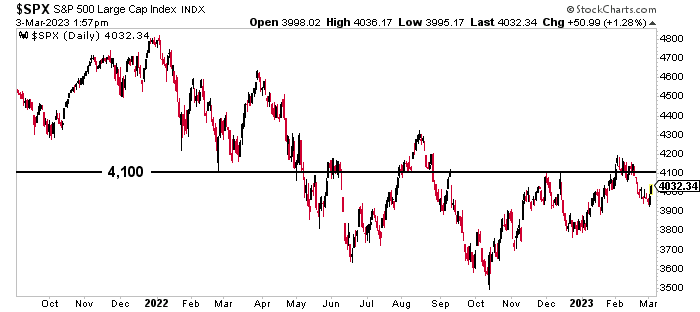
he past two days have seen a few positive catalysts that kicked things into a positive direction and pushed shares back above 4,000 (although we still have a ways to go before we retest the important 4,100 level).


First off, the 10-year Treasury yield also dropped below 4%, which was a positive sign for the market.

The PMI data for February also had traders’ attention. PMI improved to 50.6, beating analysts’ consensus of 50.5. ISM Non-Manufacturing PMI went down from 55.2 to 55.1, but still managed to exceed expectations.

According to Andrew Hunter, Deputy Chief U.S. Economist at Capital Economics, the figures suggest that the economy is growing, but not as fast as some people were thinking.

Most market segments, especially Consumer Cyclical and Real Estate stocks, had a good day, except for Consumer Defensive stocks, which didn’t see much upward movement.

This indicates traders are still in “risk on” mode, which means they’re willing to invest in more volatile assets right now. That’s great for our stocks under $10.

If the S&P 500 (SPY) stays where it is, we’ll have a positive week, which is a big win after last week, which was one of the worst so far this year.

The Federal Reserve also made headlines this week, as it released its semiannual Monetary Policy Report to Congress. The report lays out the Fed’s plan to continue increasing interest rates to get inflation back to 2%.

Atlanta Federal Reserve President Raphael Bostic wrote an essay calling for the central bank to raise its policy rate by 50 basis points to a range of 5%-5.25% and then keep it there until well into 2024.

He also said he’s keeping an eye on the data and will adjust his policy trajectory if necessary.

The Fed increased the benchmark rate by a quarter of a percentage point in February, and will release new projections after the March 21-22 meeting.

Just like we saw last year, the market will likely make some big moves based on what the Fed officials say between now and then.

Conclusion

While this week saw some wins for the bulls, a lot more will have to happen for the S&P 500 to overtake the important 4,100 level again.

But our portfolio performed well last year despite the volatility, and I expect we’ll see the same this year, especially considering we have some positive catalysts coming for a handful of our holdings.

What To Do Next?

If you’d like to see more top stocks under $10, then you should check out our free special report:

3 Stocks to DOUBLE This Year

What gives these stocks the right stuff to become big winners, even in this brutal stock market?

First, because they are all low priced companies with the most upside potential in today’s volatile markets.

But even more important, is that they are all top Buy rated stocks according to our coveted POWR Ratings system and they excel in key areas of growth, sentiment and momentum.

Click below now to see these 3 exciting stocks which could double or more in the year ahead.

3 Stocks to DOUBLE This Year

All the Best!

Meredith Margrave
Chief Growth Strategist, StockNews
Editor, POWR Stocks Under $10 Newsletter


SPY shares . Year-to-date, SPY has gained 5.69%, versus a % rise in the benchmark S&P 500 index during the same period.


About the Author: Meredith Margrave

Meredith Margrave has been a noted financial expert and market commentator for the past two decades. She is currently the Editor of the POWR Growth and POWR Stocks Under $10 newsletters. Learn more about Meredith’s background, along with links to her most recent articles.

More…

The post Is the Stock Market Finally Bouncing Back? appeared first on StockNews.com

https://www.entrepreneur.com/finance/is-the-stock-market-finally-bouncing-back/446968


Battle for the Soul of the Stock Market is at Hand

The battle for the soul of the stock market (SPY) is at stake in March. Why is that? What are the key events? And are bulls or bears more like to win? 40 year investment pro Steve Reitmeister answers all that along with his trading plan and top picks. Read on below for the full story.

Stocks found the bottom end of the current range at the 200 day moving average (3,940) with a few attempts to break of late. Most notably Thursday where a good deal of the session was spent below the line. But then came ample support followed by a big up day on Friday.

What does it all mean?

That bulls and bears are pretty evenly matched these days which keeps us stuck in a trading. The more meaningful question is WHEN do we break out of the range and WHAT will be the catalyst?

We will focus our time today on answering those questions and getting our portfolios ready to profitably trade the outcome.

Market Commentary

Let’s start off with a 1 year chart of the S&P 500 (SPY) to appreciate how significant the 200 day moving average has been in framing activity.

Yes, most of the time has been spent below this key long term trend line in bear market territory. However, you can also see that it’s been over 4 months since making lows and the last 2 months breaking back above this key level.

Those who believe more in the virtue of price action would say the bulls have the upper hand at this time.

However, it is easy to blast large holes in that theory by reviewing all the glorious bear market rallies that took place in the past before the market cratered once more. Most notable would be the greater than 20% rally that was officially called a new bull market in late 2008 before making much lower lows in the first quarter of 2009.

And just for good measure, please check out how the same thing happened in late 2002 before early 2003 brought a painful conclusion to that three year bear market.

The point is that the battle for the soul of the market is still before us. And quite possibly that battle is finalized in March as we hit these key dates with market moving events:

3/10 Government Employment Situation. Keep a close eye on the wage inflation data that was far too hot in the February report which started the recent downturn.

3/14 Consumer Price Index (CPI). The key being the month over month pace to see if we are heating up like the February report…or cooling down like the previous few months.

3/15 Producer Price Index (PPI). Insiders know that this is more important than CPI because the prices paid by producers today ends up in the final product and services in the months ahead. (Current PPI leads to future CPI).

3/22 Fed Meeting with Interest Rate Decision & Economic Projections. Most expect 25 basis point hike. The real issue is whether the Fed sounds more or less Hawkish than the early February meeting.

When I look at these events, along with recent data that foreshadows what they may tell us, plus recent statements by Fed officials…I cannot help but to continue to be bearish in my market outlook.

Why?

Because of the following equation I have shared before, but deserves repeating:

Higher Rates on the Way (5%+)

+

Higher Rates in Place til at Least End of 2023

+

6-12 months of lagged economic impact

+

Already weak economic readings

=

Fertile soil to create recession and thus extension of the bear market with lower lows on the way.

No doubt this same rational explains why famed hedge fund manager David Einhorn was recently on record for the following:

David Einhorn says investors should be ‘bearish on stocks and bullish on inflation’

Until the Government Employment Report on 3/10 I would pay ZERO attention to the price action inside the range. Just meaningless noise.

From that point forward these aforementioned catalysts will be live grenades thrown into the market fray. When the smoke clears I suspect we will break out of the range with either bulls or bears crowned victorious.

Again, given the facts in hand right now I would bet on the bears having the victory parade. However, it is good to keep an open mind to the new evidence as it rolls in. If truly bullish, then I would be more than happy to shed my bear coat and wave the bullish flag proudly.

Just one bit of warning…bulls may get irrationally exuberant reading too much into the first few events. This could come to a screeching halt when the Fed steps up to the mic on 3/22.

Anything resembling recent speeches clarifying rates will climb above 5% and stay in place through year end should cool down most investors from getting ahead of themselves.

Stay opened minded to the new facts as they avail themselves. Just realize the scales are still currently tipped in the bear’s favor.

What To Do Next?

Discover my brand new “Stock Trading Plan for 2023” covering:

  • Why 2023 is a “Jekyll & Hyde” year for stocks
  • How the Bear Market Comes Back with a Vengeance
  • 9 Trades to Profit Now as Bear Returns
  • 2 Trades with 100%+ Upside Potential When New Bull Emerges
  • And Much More!

Stock Trading Plan for 2023

Wishing you a world of investment success!

Reity
Steve Reitmeister…but everyone calls me Reity (pronounced “Righty”)
CEO, StockNews.com

Editor of Reitmeister Total Return  & POWR Value


SPY shares were unchanged in after-hours trading Friday. Year-to-date, SPY has gained 5.69%, versus a % rise in the benchmark S&P 500 index during the same period.


About the Author: Steve Reitmeister

Steve is better known to the StockNews audience as “Reity”. Not only is he the CEO of the firm, but he also shares his 40 years of investment experience in the Reitmeister Total Return portfolio. Learn more about Reity’s background, along with links to his most recent articles and stock picks.

More…

The post Battle for the Soul of the Stock Market is at Hand appeared first on StockNews.com

https://www.entrepreneur.com/finance/battle-for-the-soul-of-the-stock-market-is-at-hand/446967


#1 Rule for Successful Options Trading

After a brutal year in 2022, the S&P 500 (SPY) ripped higher to start the year-only to give much of the gains back. Using a steady hand to steer through the daily volatility is still a very viable strategy. 2023 is shaping up as a stock pickers market. A simple system of taking profitable bullish positions in good stocks AND at the same time taking bearish positions in bad stocks makes more sense than ever. This type of balanced approach will likely continue to outperform in what looks likely to be a difficult 2023. Read on below to find out more.

Options. Implied Volatility. Many traders’ eyes glaze over attempting to comprehend what is thought to be something way too difficult to ever understand.

In reality, though, the concepts that comprise option trading are easier to understand than you think.

A walk through of what I consider the most important concept, implied volatility (IV), will help prove this to you.

The most widely followed measure of implied volatility is the CBOE Volatility Index (VIX). It measures a 30-day implied volatility for the S&P 500 Index.

Many of you are likely familiar with the VIX from hearing it discussed on the major financial news networks. In fact, I talk about the VIX on a weekly basis on CBOE-TV “Vol 411”.

People look at the S&P 500 as a benchmark for how stock prices are generally doing. In a similar vein, option traders look at the VIX as a benchmark of how option prices are doing.

A higher VIX means more expensive options. A lower VIX means option prices are cheaper. So implied volatility is just a fancy way to say ”the price of the option”.

Implied volatility can be thought of the same way we think of insurance premiums:

  • Safe and steady drivers have lower car insurance premiums. Safe, steady, and lower volatility stocks have lower option premiums.
  • Crazy and reckless drivers have much higher premiums. Wilder, higher volatility stocks carry much higher option premiums.

So it’s no surprise that option prices are referred to as option premiums and that many portfolio managers will buy downside puts as insurance to protect their portfolios from lower prices.

There are six components that are used to price options:

  • Stock Price
  • Strike Price
  • Expiration date
  • Current Interest Rate
  • Dividends (if any)
  • Implied Volatility (IV) 

The first five are known. You can look at your trading screen and see the stock price, strike price, days to expiration.

Interest rates and dividends are easily found by doing a google search. The only unknown is implied volatility.

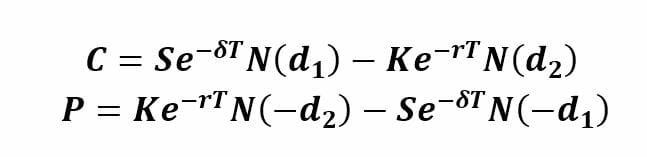
As said earlier, implied volatility is simply the price of an option. No need to do the fancy math or the calculations shown below to understand IV.

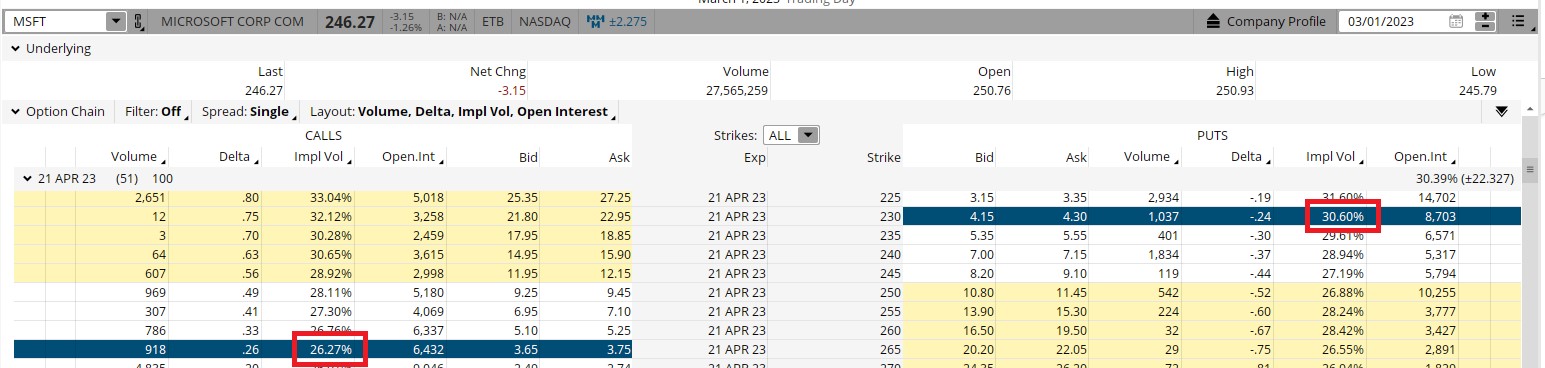
Implied volatility is called implied because it is the volatility input needed to match the price of the option to the price it is currently trading. A look at Microsoft (MSFT) options shows the implied volatility for the different strike prices.

Note how different strikes of the same expiration date – April 21 in this instance- have different implied volatilities. This is called the option skew.

An important takeaway is that out-of-the-money puts almost always trade at a higher level of implied volatility compared to similar out-of-the-money calls.

The MSFT $230 puts are priced at a 30.60 IV, while the $265 calls are priced much lower at a 26.27 IV as shown in red.

Both options closed about $17.50 points out-of-the money. Out-of-the money refers to the difference between where the stock is trading and the strike price.

Puts are out-of-the money if the strike price is below the current stock price. Calls are out-of-the money if the strike price is above the current stock price.

In this instance, the $230 puts were $17.27 points below the closing price of Microsoft ($246.27-$230)-or out-of-the money by that amount. The $265 calls were out-of-the money by $17.73 points.

The main reason for this difference in IV is the fact that stocks tend to drop more quickly than they rise. So downside puts are more valuable than upside calls.

Implied volatility tends to be much higher in front of earnings and other corporate events. This makes sense since a potentially big move in the stock price is looming.

Implied volatility usually falls following the earnings release or company announcement as the unknown becomes known.

Having a better understanding that high implied volatility means higher option prices can be vital when considering potential trades. Paying a higher option price means you need a bigger move in the stock to justify the trade.

In my POWR Options service I always do an in-depth implied volatility analysis, along with using the POWR Ratings and technical analysis as part of the idea generation process.

It is just as vital for individual traders to always consider levels of implied volatility when considering their trades as well.

Implied Volatility as a Market Timing Tool

Implied volatility can be used to identify potential turning points in the market. This is especially true when implied volatility spikes to extremes.

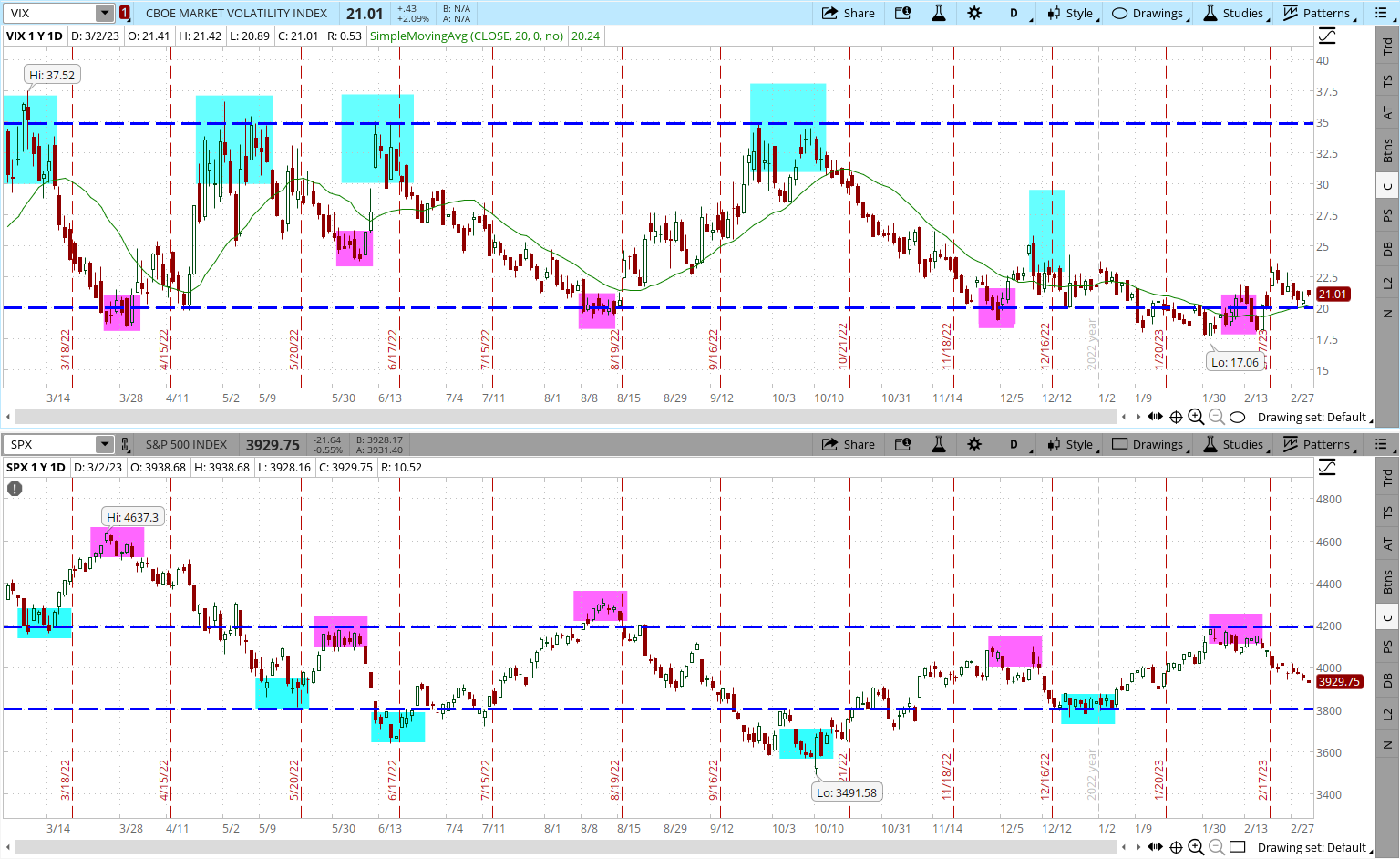
The charts below shows the VIX on the top and the S&P 500 (SPY) on the bottom. Note how the previous spikes in VIX (highlighted in blue) ultimately signaled significant short-term bottoms in the S&P 500.

Long periods of low levels in the VIX are a sign of complacency, which usually are a reliable indicator of short-term market tops, as seen in purple. The most recent sell signal was a sign of that.

The old Warren Buffett adage, to be “fearful when others are greedy and greedy when others are fearful,” applies perfectly to this VIX market timing methodology.

Trading, as we know, is all about probability, not certainty. Understanding and using implied volatility to put those probabilities in your favor can be a valuable addition to your trading toolbox. In POWR Options it is one of the most important tools we use.

What To Do Next?

If you’re looking for the best options trades for today’s market, you should definitely check out this key presentation How to Trade Options with the POWR Ratings. Here we show you how to consistently find the top options trades, while minimizing risk.

Using this simple but powerful strategy I have delivered a market beating +55.24% return, since November 2021, while most investors have been mired in heavy losses.

If that appeals to you, and you want to learn more about this powerful new options strategy, then click below to get access to this timely investment presentation now:

How to Trade Options with the POWR Ratings

Here’s to good trading!


Tim Biggam
Editor, POWR Options Newsletter


SPY shares rose $0.24 (+0.06%) in after-hours trading Friday. Year-to-date, SPY has gained 5.69%, versus a % rise in the benchmark S&P 500 index during the same period.


About the Author: Tim Biggam

Tim spent 13 years as Chief Options Strategist at Man Securities in Chicago, 4 years as Lead Options Strategist at ThinkorSwim and 3 years as a Market Maker for First Options in Chicago. He makes regular appearances on Bloomberg TV and is a weekly contributor to the TD Ameritrade Network “Morning Trade Live”. His overriding passion is to make the complex world of options more understandable and therefore more useful to the everyday trader. Tim is the editor of the POWR Options newsletter. Learn more about Tim’s background, along with links to his most recent articles.

More…

The post #1 Rule for Successful Options Trading appeared first on StockNews.com

https://www.entrepreneur.com/finance/1-rule-for-successful-options-trading/446945


How To Pare Down The Risk And Pump Up The Profits With A Pairs Trade Approach

How we profited from the power of the POWR ratings with a powerful pairs trade philosophy on VAL and HP.

Alfred Winslow Jones is widely credited with creating the first hedge fund, or more accurately  “hedged fund”, in the late 1940s.He supposedly got the idea while researching a markets article for Fortune magazine.

The idea was pretty basic-create a hedge, or pairs trade, by shorting stocks he thought would drop in value while buying stocks he thought would head higher. It is called a pairs trade since both the bullish and bearish trade are done simultaneously-or paired together.

For example, buying Ford (F) and shorting General Motors (GM) would be a classic pairs trade if you expected Ford to outperform GM.

This essentially dampens down overall market risk. Even better if the short and the long stock were in the same industry to greatly reduce sector risk.

This is a core strategy we have employed from inception in the POWR Options Portfolio, but with a few more advantageous features.

  • We use options, not stock, to take the offsetting short and long positions. Buying bearish puts on the “bad” stocks and bullish calls on the “good” stocks. This is a much less expensive way to create a hedged trade. It also has defined risk.
  • The portfolio relies on the POWR ratings to help identify the highest rated stocks to buy with bullish call purchases and the lowest rated stocks to short with bearish put purchases. Since inception, the Strong Buy (A Rated) and Buy Rated (B Rated) POWR Stocks have outperformed the S&P 500 by over 3x. The F Rated Strong Sell and D Rated Sell POWR Stock have fallen by nearly 4X the S&P 500.
  • Look to uncover situations where the lower rated stocks have temporarily outperformed the higher rated stocks to provide additional edge from the expected mean reversion.

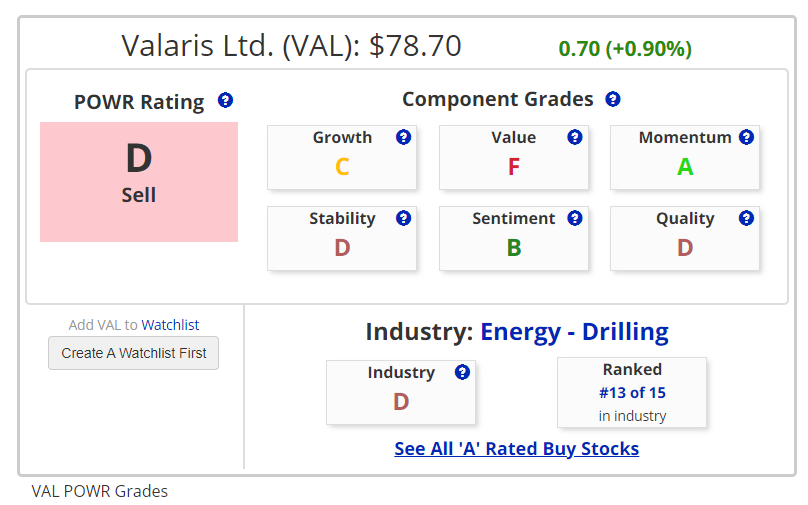
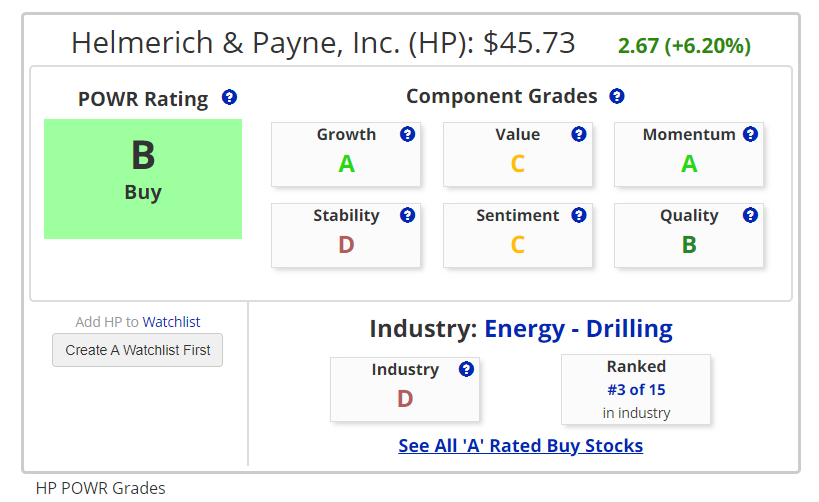
Let’s take a walk through a pairs trade recently done in the POWR Options Portfolio to help shed some light on the process. It was a combination of a put purchase on the lower D rated Valaris (VAL) and a call purchase on the higher B rated Helmerich & Payne (HP). Both stocks were in the Energy-Drilling Industry.

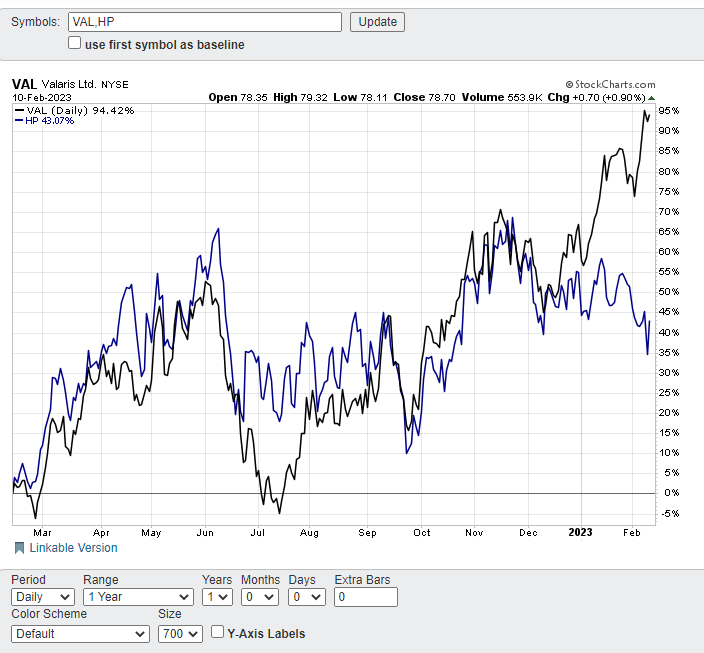
The comparative chart below from February 10 shows how lower rated Valaris (VAL) had dramatically outperformed higher rated Helmerich & Payne (HP) by over 50% in the past 12 months, with most of this outperformance beginning in early December. Before that time, you can see that the two stocks were more highly correlated-or moved more in tandem together.

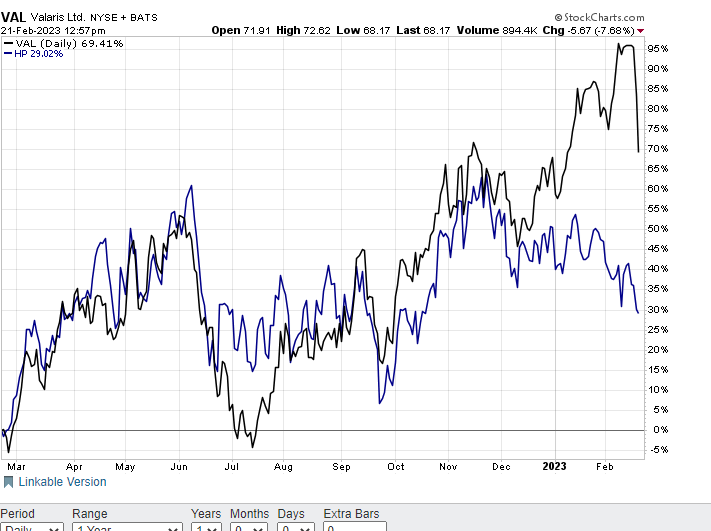
On February 21 the comparative performance differential converged by roughly 10%. Both stocks fell, but VAL dropped at a far faster pace than HP.

Originally, on 2/13, the POWR Options Portfolio bought the HP Calls at $5.50 and the VAL puts at $5.00 for a combined outlay of $1050.

One week later, the convergence generated a profit. POWR Options sold the HP calls at $3.50 and the VAL puts at $9.50 for a total combined credit of $1300, or a net gain of $250 .

Overall gain, as shown,  was $250 total net profit on $1050 invested. This equates to a net return of 23.8% in a week. Not a bad short-term return for a low risk trade.

All achieved by taking a defined risk bullish call position on the higher rated,but underperforming, Helmerich and a bearish put position on the lower rated, but outperforming,  Valaris.

The particulars are shown below:

2023 may be shaping up as a year where stocks go nowhere. This is especially true given the red-hot start to the year following such a dismal 2022.

Investors and traders alike may be well served putting the POWR Options pairs trade philosophy to work as part of their trading toolbox. Lower risk with still sizeable potential returns is a viable strategy in any market, especially the one we find ourselves in currently.

POWR Options

What To Do Next?

If you’re looking for the best options trades for today’s market, you should check out our latest presentation How to Trade Options with the POWR Ratings. Here we show you how to consistently find the top options trades, while minimizing risk.

If that appeals to you, and you want to learn more about this powerful new options strategy, then click below to get access to this timely investment presentation now:

How to Trade Options with the POWR Ratings

All the Best!

Tim Biggam

Editor, POWR Options Newsletter


VAL shares closed at $65.30 on Friday, up $0.36 (+0.55%). Year-to-date, VAL has declined -3.43%, versus a 3.65% rise in the benchmark S&P 500 index during the same period.


About the Author: Tim Biggam

Tim spent 13 years as Chief Options Strategist at Man Securities in Chicago, 4 years as Lead Options Strategist at ThinkorSwim and 3 years as a Market Maker for First Options in Chicago. He makes regular appearances on Bloomberg TV and is a weekly contributor to the TD Ameritrade Network “Morning Trade Live”. His overriding passion is to make the complex world of options more understandable and therefore more useful to the everyday trader. Tim is the editor of the POWR Options newsletter. Learn more about Tim’s background, along with links to his most recent articles.

More…

The post How To Pare Down The Risk And Pump Up The Profits With A Pairs Trade Approach appeared first on StockNews.com

https://www.entrepreneur.com/finance/how-to-pare-down-the-risk-and-pump-up-the-profits-with-a/446492


Hot Inflation Means a Rough Ride for Bulls Ahead…

It has certainly been a rough week for bulls in the S&P 500 (SPY). Over the past 10 days, we’ve now had three big reports all showing hotter-than-expected inflation. And while it looked like the bulls were going to be able to shake off the first two, the evidence is stacking up in favor of additional rate hikes, which might make a bull victory much more difficult now. Here’s what I mean.

(Please enjoy this updated version of my weekly commentary originally published February 24th, 2023 in the POWR Stocks Under $10 newsletter).

Market Commentary

At the end of last week, both CPI and PPI both reported rising month-over-month prices, as well as annual price increases that were larger than economists had expected.

Even so, bulls kept it fairly together, and the S&P 500 (SPY) ended the week just a few points below the important 4,100 line.

Despite the bears racking up some big wins last week, it still looked like this latest round of “tug-o-war” was anyone’s game…

And then the Fed minutes were released. And a third inflation indicator (and the Fed’s favorite) – the personal consumption expenditures (PCE) index – also came in hotter than anyone was expecting. And more Fed officials publicly voiced their concerns that inflation remains too high.

Look, I’ll be the first to say the bulls have put on a surprisingly strong show the first weeks of the year. But this is is going to be a big hurdle to clear for the rally to continue.

But I’m also not going to say it can’t be done. These bulls have always seemed a little bit delusional. There’s not a ton of “bullish” events that have happened… people were just ready to move into a more “risk on” environment.

We’ve also now seen bearish readings from all three signs I recently spotlighted — the 4,100 level (broken below), the January CPI report (hot), and the CME FedWatch Tool (number of people expecting a 50-bps hike in March has nearly tripled from 9.2% to 27%).

They say the market “climbs a wall of worry.” But how high is too high?

I’m not 100% certain. Honestly, anyone who tells you they are is selling you a load of, well, something.

Regardless, the bulls are going to have to put on quite a show with so much evidence pointing toward additional rate hikes and a higher terminal rate.

As such, I want us to take a little time to prepare our portfolio for the next leg lower. I’m not ready to sell anything today, but I spent some time this morning creating trade triggers for most of our holdings.

These will help us keep losses under control and protect the gains we worked hard for over the past months.

Conclusion

The best thing we can do for right now is be prepared. Stocks under $10 are such a strong group because they give us an important edge over major stocks that are priced down to the penny.

But they’re also susceptible to bigger price swings during selloffs. That’s why we’re keeping things locked down tight as we navigate what happens next.

What To Do Next?

If you’d like to see more top stocks under $10, then you should check out our free special report:

3 Stocks to DOUBLE This Year

What gives these stocks the right stuff to become big winners, even in this brutal stock market?

First, because they are all low priced companies with the most upside potential in today’s volatile markets.

But even more important, is that they are all top Buy rated stocks according to our coveted POWR Ratings system and they excel in key areas of growth, sentiment and momentum.

Click below now to see these 3 exciting stocks which could double or more in the year ahead.

3 Stocks to DOUBLE This Year

All the Best!

Meredith Margrave
Chief Growth Strategist, StockNews
Editor, POWR Stocks Under $10 Newsletter


SPY shares closed at $396.38 on Friday, down $-4.28 (-1.07%). Year-to-date, SPY has gained 3.65%, versus a % rise in the benchmark S&P 500 index during the same period.


About the Author: Meredith Margrave

Meredith Margrave has been a noted financial expert and market commentator for the past two decades. She is currently the Editor of the POWR Growth and POWR Stocks Under $10 newsletters. Learn more about Meredith’s background, along with links to her most recent articles.

More…

The post Hot Inflation Means a Rough Ride for Bulls Ahead… appeared first on StockNews.com

https://www.entrepreneur.com/finance/hot-inflation-means-a-rough-ride-for-bulls-ahead/446487


Brace for Bearish Breakout!

The battle lines are set between bulls and the bears over the 200 day moving average for the S&P 500 (SPY). A break below 3,940 will likely ignite a serious FOMO rally to the downside. Why is that likely going to happen? And how to best position your portfolio to profit? 40 year investment pro Steve Reitmeister explains all in the article that follows.

Stocks got darn close to a break out below the 200 day moving average (3,940) on Friday. From there the S&P 500 (SPY) bounced a little into the finish line at 3,970.

Bears cannot yet claim victory…nor can bulls.

This means the war for the soul of the stock market still lies in the days ahead. My money rides on a break to the downside…but crazier things have happened. So, let’s review where things stand now and thus how we should position our portfolios to profit.

Market Commentary

I love this CNBC headline from Friday:

Dow drops more than 400 points as a hot inflation report rattles Wall Street

Let me give you a more playful paraphrased version:

“Investors With Heads in the Sand Finally Discover that Inflation is Too Hot”

I have nearly gotten carpel tunnel syndrome writing commentary after commentary on all the obvious clues about high inflation and very hawkish Fed intentions. In fact, my article from Wednesday recounts 3 high and tight strikes knocking bulls off the plate.

Yet clearly some investors needed to see a 4th strike thrown today to get the message that the bullish start to this year was a mirage. That being the Fed’s favorite inflation measure, Personal Consumption Expenditures, coming in at +0.6% month over month.

That is well above expectations. And points to 7% annual inflation pace if it continued on this trajectory when the Fed is targeting 2%.

Now let’s marry this with other news from the week to point out why investors are right to run for the hills.

On Wednesday we got served up the Fed Meeting Minutes which got investors hitting the sell button once again. That is because those who didn’t vote for a 25 point hike actually wanted a much more hawkish 50 points.

No doubt the outspoken Fed President Bullard was one of those seeking higher rates given insights captured in this article. His view is to get rates much higher, much faster to more quickly stamp out inflation and then press pause for an extended period time.

There is no way to read these fresh Fed signals, along with recent signs of inflation still being too hot, and not appreciate the false start to the year by bulls. That upward move is premature when indeed inflation is not under wraps…leading the Fed to keep restrictive hawkish policies in place much longer than expected…which only increases the odds of recession and extension of bear market.

Before claiming victory for the bears, I need to be forthcoming on the following bullish indicators. That being some modest signs of economic improvement of late. Or at least, not as terrible as some recent readings.

Looking back to Tuesday we got a PMI Flash report back slightly in expansion territory at 50.2 from the previously anemic 46.8. This was mostly coming from improved results in the services space. However, manufacturing continues to look very week at 47.8 when 49 was the forecast.

Then on Thursday we got word that the Chicago Fed National Activity Index bounced nicely form -0.46 to +0.23%. That is the strongest reading for this broad based economic indicator since July.

Before you cheer too loud, please consider that the makers of this index warn against reading too much into any monthly report. Instead, they recommend reviewing the 3 month moving average which smooths out the results. There we find that the reading is still negative at -0.10.

So, what is more important…the slightly good news on the economic front…or the troubling signs of still sticky inflation that will keep the Fed on their hawkish path?

Both are of interest, but clearly the focus on inflation and the Fed is what is moving the market. That is because their goal is to “lower demand” to tamp down inflation back to 2% target. Lowering demand is just a fancy term for slowing down the economy which indeed carries the risk of recession.

This brings us back to an equation we discussed a few weeks back that I will slightly revise for today’s discussion:

Higher Rates on the Way (5%+)

+

Higher Rates in Place til at Least End of 2023

+

6-12 months of lagged economic impact

+

Already weak economic readings

=

Fertile soil to create recession and thus extension of the bear market with lower lows on the way.

Putting it altogether, bears have wrestled back control of the price action since the market made highs at the beginning of February. This 5% drop for the S&P 500 comes hand in hand with a clear rotation in favor of Risk Off groups like Consumer Defensive, Utilities and Healthcare.

Bulls can be as stubborn as bears. And no doubt they were having a grand ol time in January and may not want to so quickly throw in the towel on their upside aspirations.

However, a clear break below the quite important 200 day moving average for the S&P 500 (SPY) at 3,940 will usher in some serious FOMO to the downside as more investor hit the sell button in unison.

If you already have a portfolio built to survive a bear market…then you are all set.

If not, then I hope this commentary has you considering an approach that is well suited for increased likelihood of more downside ahead.

What To Do Next?

Discover my brand new “Stock Trading Plan for 2023” covering:

  • Why 2023 is a “Jekyll & Hyde” year for stocks
  • How the Bear Market Comes Back with a Vengeance
  • 9 Trades to Profit Now
  • 2 Trades with 100%+ Upside Potential When New Bull Emerges
  • And Much More!

Stock Trading Plan for 2023 >

Wishing you a world of investment success!


Steve Reitmeister…but everyone calls me Reity (pronounced “Righty”)
CEO, StockNews.com and Editor, Reitmeister Total Return


SPY shares were unchanged in after-hours trading Friday. Year-to-date, SPY has gained 3.65%, versus a % rise in the benchmark S&P 500 index during the same period.


About the Author: Steve Reitmeister

Steve is better known to the StockNews audience as “Reity”. Not only is he the CEO of the firm, but he also shares his 40 years of investment experience in the Reitmeister Total Return portfolio. Learn more about Reity’s background, along with links to his most recent articles and stock picks.

More…

The post Brace for Bearish Breakout! appeared first on StockNews.com

https://www.entrepreneur.com/finance/brace-for-bearish-breakout/446486


100 Best Stocks for March

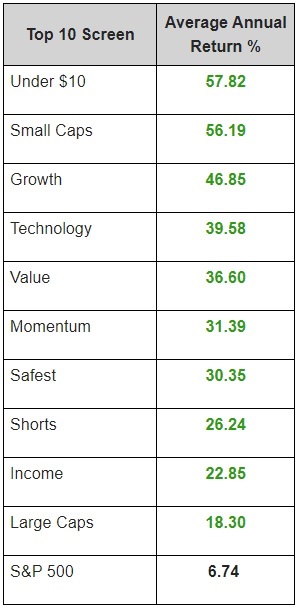
Our computer models are dialed into the 100 best stocks for March 2023. What makes them “the best stocks”? Years of hard work to find the precise factors that lead to market beating stocks (SPY). Like our coveted strategy with an average annual return of +57.82%. And yes, it even produced impressive profits during the 2022 bear market. Now is the time to discover the winning stocks it is picking for the weeks and months ahead. Get full details below.

We received a record response to my most recent presentation—where I shared our most profitable solution for investors—so I wanted to reach out once more to make sure you didn’t miss it:

100 Best Stocks for March >

This revolutionary trading system actually consists of 10 different “black box” trading strategies each with precisely 10 stocks each.

That includes our coveted “Top 10 Stocks Under $10” strategy sporting an average annual return of +57.82%.

And yes, it was profitable during the 2022 bear market.

And yes, it has come roaring out of the gate in the new year with a +22.07% gain (from 1/1/23 thru 2/14/23).

To create proven strategies like these, we turned to the same Data Scientist who created our coveted POWR Ratings. We had 3 key requests for this project:

  1. 10 unique stock picking strategies. Something for every investor
  2. 10 stocks per strategy updated daily
  3. MOST IMPORTANT: Provide stellar performance in ALL markets

And boy did he ever deliver!

Check out the market topping average annual returns for these strategies since 1999. That means they easily went over 4 bear market speed bumps and still provided consistent gains for investors.

Yes, your eyes do not deceive you.

Even the worst strategy was nearly 3X better than the S&P 500 (SPY). Whereas the best strategy at +57.82% per year consistently beat the overall market by over 8X.

146,497 Reasons to Pay Attention to What Comes Next…

We know that most of you will be impressed by the performance shared above. However, some of you are rightfully skeptical because you have seen great performance touted by others in the past…but reality came up far short.

That is why I decided to put my money where my mouth was by investing my entire Roth IRA account in 2 of these strategies starting back in February 2021 (Value and Small Caps).

Since then my account has significantly outpaced this bear market leading to a real life $146,497 gain. The full proof of that, including screenshots from my Schwab account, are in the presentation:

100 Best Stocks for March >

Truly this is a game changing investment tool that continued to outperform even during the 2022 bear market…and soaring ahead in early 2023.

You owe it to yourself to get on the right foot for the rest of the year by watching this valuable presentation now so you can use these winning strategies to outperform in the months ahead.

But Time is Running Out!

We are closing the door on this presentation and the 100 best stocks Monday, February 27th @ midnight or once 75 Spots have been filled….whichever comes first.

So don’t delay, click below to watch now:

100 Best Stocks for March >

Wishing you a world of investment success!


Steve Reitmeister
…but everyone calls me Reity (pronounced “Righty”)
CEO, StockNews.com & Editor, Reitmeister Total Return


SPY shares were trading at $394.77 per share on Friday morning, down $5.89 (-1.47%). Year-to-date, SPY has gained 3.23%, versus a % rise in the benchmark S&P 500 index during the same period.


About the Author: Steve Reitmeister

Steve is better known to the StockNews audience as “Reity”. Not only is he the CEO of the firm, but he also shares his 40 years of investment experience in the Reitmeister Total Return portfolio. Learn more about Reity’s background, along with links to his most recent articles and stock picks.

More…

The post 100 Best Stocks for March appeared first on StockNews.com

https://www.entrepreneur.com/finance/100-best-stocks-for-march/446468


Bulls Vs. Bears Tug of War

We’ve had two very big developments since last week — two hotter-than-expected inflation reports…and the S&P 500’s (SPY) reaction to them says a lot about where we are right now in terms of the ongoing bull/bear tug-o-war game. Keep reading to find out what it’s saying….

(Please enjoy this updated version of my weekly commentary originally published February 16th, 2023 in the POWR Stocks Under $10 newsletter).

Market Commentary

On Tuesday, we got the latest monthly Consumer Price Index (CPI) report from the Bureau of Labor Statistics.

The report showed prices rose 0.5% month to month and are up 6.4% in the past year. Both of those numbers were higher than most economists expected.

After investors spent 2022 buying and panic selling on inflation-related data, it seemed like a sure thing that we’d get massive selling… on both days, but Tuesday ended up flat (with the Nasdaq index actually up), and all three major indices have almost fully recovered their losses from this morning.

Then, this morning, we got the January Producer Price Index (PPI) report. Again, PPI showed prices increasing (at a rate of 0.7% month over month), which was faster than the 0.4% rate economists predicted.

It looked like we were going to get a repeat of Tuesday, with stocks falling on the news and then recovering their losses before the close.

And then, in the last hour of trading, the market tumbled again. In the end, the S&P 500 (SPY) closed down 1.4%. The Nasdaq closed down 1.8%.

So, what’s the deal?

It felt like Tuesday’s results were already somewhat baked into market prices. In fact, on Tuesday, I wrote…

We all know by this point that inflation is not going to simply drop in a straight line over the next few months, but inflation is still down significantly from its peak. Investors appear to have come around to the idea that the Fed probably won’t lower interest rates in 2023 — something Fed Chair Jerome Powell has been saying for months.

And even so, investors haven’t sold off all their holdings in a panic.

In other words, the bulls are winning this round of tug-o-war, and investors are “risk on,” buying up stocks that were previously deemed “too volatile” and “poor investments for a high-rate environment.”

But things were a bit different today… and that’s because we had the addition of two Fed officials saying they had considered the possibility of 50-bps hikes. That, plus a second hot inflation reading, seemed to put a chill on all the buying.

Now, even with the end-of-day selling, the S&P 500 is still sitting around 4,100, which is our important support/resistance level.

The index’s ability to stay above this land could potentially mean the bull rally is still on. If it falls below, then we could see a significant dip lower.

Because the market reversed so suddenly at the end of the day, it’s hard to know what the market sentiment will be going forward. I’m looking forward to see what tomorrow brings.

Conclusion

This could be a hard round for the bulls to win, but if they do, it could be the start of a strong leg higher.

And if the bears come out ahead, we’re still protecting ourselves with sell trade triggers and by taking our gains while they’re still quite profitable.

What To Do Next?

If you’d like to see more top stocks under $10, then you should check out our free special report:

3 Stocks to DOUBLE This Year

What gives these stocks the right stuff to become big winners, even in this brutal stock market?

First, because they are all low priced companies with the most upside potential in today’s volatile markets.

But even more important, is that they are all top Buy rated stocks according to our coveted POWR Ratings system and they excel in key areas of growth, sentiment and momentum.

Click below now to see these 3 exciting stocks which could double or more in the year ahead.

3 Stocks to DOUBLE This Year

All the Best!

Meredith Margrave
Chief Growth Strategist, StockNews
Editor, POWR Stocks Under $10 Newsletter


SPY shares closed at $407.26 on Friday, down $-1.02 (-0.25%). Year-to-date, SPY has gained 6.49%, versus a % rise in the benchmark S&P 500 index during the same period.


About the Author: Meredith Margrave

Meredith Margrave has been a noted financial expert and market commentator for the past two decades. She is currently the Editor of the POWR Growth and POWR Stocks Under $10 newsletters. Learn more about Meredith’s background, along with links to her most recent articles.

More…

The post Bulls Vs. Bears Tug of War appeared first on StockNews.com

https://www.entrepreneur.com/finance/bulls-vs-bears-tug-of-war/446027