Bears Back in Charge?

The S&P 500 (SPY) has been sloshing around in the trading range between 4,000 and 4,200 for the past month. However, bulls have gotten 3 straight strikes against them that may point to a looming breakout to the downside. Let’s review the growing evidence that bears are likely to come up to bat in the weeks ahead and what that means for our trading plans. Read on below for more.

Let’s properly set the scene.

Before the February 1st Fed announcement I shared 4 possible outcomes for the market thereafter. Unfortunately, we devolved into the least savory of these scenarios that I described as follows:

“Scenario 4: Dazed & Confused

This is where the Fed gives mixed signals. Still hawkish for a long time to save face given previous statements. And yet do tip their hat a little to moderating inflation.

This gray area leads to a trading range until investors have more facts in hand. I suspect that 4,000 is the low end with 4,200 at the high end. This comes hand in hand with a ton of volatility as each new headline has investors recalibrate the bull/bear odds.”

How accurate this has proved to be. Especially the part about each new headline having folks rethink how bullish or bearish they want to be.

There have been 3 straight strikes against the bulls pushing more investors into the bearish camp. Not just the decline of the market the past 2 sessions. But the clear Risk Off nature of their selections with money flowing back to the most defensive groups (Healthcare, Utilities and Consumer Staples).

Let’s review the box score to account for these 3 strikes and what it means for the evolving market outlook. (This next section was plucked from this recent commentary: Strike 3 for Investors THIS Thursday?)

“…strike 1 against the bulls. That being a MUCH stronger than expected Government Employment situation report showing robust job gains. That sounds great on the surface til you realize it came hand in hand with very persistent wage inflation.

This was precisely what Chairman Powell warned about that previous Wednesday and why the Fed will keep rates higher for longer than the market appreciates. Bulls scoffed at the notion the first time around. However, they did get taken aback when faced with that sticky inflation once more on Friday.

Powell then made it clear the following Tuesday 2/7 at the Economic Forum that this employment reports makes him believe that they may need to push rates higher…or keep them in place for longer to get inflation back to 2% target.

This extended hawkishness is a big STRIKE 1 against the bulls.

.. Strike 2 was pitched this Tuesday (2/14). I am referring to the higher than expected Consumer Price Index (CPI) report coming in at +6.4% vs. 6.2% expectations. This is obviously a far cry from the 2% target of the Fed.

What’s even worse is that month over month inflation was +0.5% which is 6% annualized… Sadly, this far too high month over month tally confirms the Feds notion that the long term battle with inflation is far from over.

The immediate reaction to this news was stocks falling nearly 1% early on the Tuesday session. Yet amazingly bulls fought back once again to a nearly breakeven finish.

These bulls continue to see positive things that I am not…perhaps they are smoking things I am not as well.”

All the above set the table for the Thursday 2/16 Producer Price Index (PPI) report. Indeed that did prove to be Strike 3 for bulls as it was far too hot leading to an immediate sell off Thursday and Friday.

Let me cement in your minds why this is so bearish.

The recent bull rally was premised on the idea that inflation was coming down faster than expected. This means the Fed was likely to end rate hikes sooner than stated increasing the odds of a soft landing that would usher in the next bull market.

These 3 recent events are a serious strike against that dovish notion. With inflation still this high, then it means the Fed will most likely follow through on its pledge to raise rates to 5% or above…and keep those restrictive policies in place through the end of the year.

When you appreciate how weak the economy is right now, coupled with another 10+ months of hawkish policies, plus 6-12 more months of lagged economic effects on that hawkish regime is a recipe that increases the odds of a recession forming.

Recession = lower corporate earnings = lower stock prices

All the above has me ratcheting up my recession and bear market expectation to about 70-75% (from previous 65%). The main thing holding me back from a higher probability is that employment remains incredibly resilient.

Most of us think about recession as a period of economic contraction. That is only half the story. The key ingredient is that the weakening of the economy brings about job loss and thus increase in the unemployment rate.

That hardship is what helps signify a recession and explains why the negative readings for GDP in the first half of 2022 was not labeled as such. Thus, with employment so strong at this stage of the rate hiking game…then it is still possible it never really worsens, which begets soft landing and end of the bear market.

Yet even as recently as February 1st, Chairman Powell was saying their baseline forecast still calls for unemployment to creep up above 4%. That is not so bad. However, history shows that once the demons of unemployment are unleashed it typically gets much worse than expected.

That’s because of this vicious cycle:

Job Loss > Lower Income > Lower Spending > Lower Corporate Earnings > Cost Cutting

And yes, job layoffs are a big part of that cost cutting regime which pushes the rinse and repeat cycle on the above with ever weaker economic readings…and ever greater job loss.

Let’s sum it up.

No one knows for sure what will happen in the end. We just need to keep reassessing the likely odds of recession and its follow on effects to stock prices.

The most recent announcements increase the odds of recession and thus bear market. This explains the 2 day sell off with major shift to Risk Off positions.

The information in hand may be enough for stocks to crack below 4,000 once again for the S&P 500 (SPY)…and perhaps back below the all important 200 day moving average at 3,943.

However, I suspect that investors will need more proof that won’t be in hand til early March with the next release of ISM Manufacturing, ISM Services and Government Employment Situation. Plus subsequent inflation readings.

I am not saying the bull argument that grew in popularity to start 2023 is dead. However, the logic of further extending the bear market is becoming all the more likely.

Please consider that in assessing the current structure of your portfolio and if it needs more defensive fine tuning.

What To Do Next?

Discover my brand new “Stock Trading Plan for 2023” covering:

  • Why 2023 is a “Jekyll & Hyde” year for stocks
  • How the Bear Market Should Come Back with a Vengeance
  • 9 Trades to Profit Now
  • 2 Trades with 100%+ Upside Potential as New Bull Emerges
  • And Much More!

Get It Now! Stock Trading Plan for 2023 >

Wishing you a world of investment success!


Steve Reitmeister…but everyone calls me Reity (pronounced “Righty”)
CEO, StockNews.com and Editor, Reitmeister Total Return


SPY shares were trading at $407.26 per share on Friday afternoon, down $1.02 (-0.25%). Year-to-date, SPY has gained 6.49%, versus a % rise in the benchmark S&P 500 index during the same period.


About the Author: Steve Reitmeister

Steve is better known to the StockNews audience as “Reity”. Not only is he the CEO of the firm, but he also shares his 40 years of investment experience in the Reitmeister Total Return portfolio. Learn more about Reity’s background, along with links to his most recent articles and stock picks.

More…

The post Bears Back in Charge? appeared first on StockNews.com

https://www.entrepreneur.com/finance/bears-back-in-charge/446026


ICL Group (ICL): Fertile Soil for Stock Market Profits

The best thing about bear markets is that they often crush even the healthiest growth stocks. This provides value seekers a tremendous opportunity to dig through the rubble to find quality stocks trading at ridiculous discounts. Such is the case with ICL Group (ICL). Read on below for the full story.

ICL Group (ICL) is an innovative Israeli company providing specialty chemicals…especially those focused on potash and phosphate which are most often used in the agricultural field. They have enjoyed tremendous growth over the past years with the share price rising 4X from the 2020 lows to 2022 highs.

However, since making those highs early in 2022 shares have endured an unnecessary beating thanks to the bear market environment throwing all babies out with the bathwater. This provides value seekers a great opportunity to get on board a thriving growth company with tremendous upside potential.

Let’s dig into the fundamental story.

Yes, commodity prices for potash and phosphate have peaked. Yet that doesn’t mean there is not tremendous demand…or tremendous opportunity to keep growing profits.

As we look out to next year, they are still expected to produce $1.04 in earnings per share. Amazingly at this moment shares are trading just a few ticks above $7. That means shares are being valued at only 7X forward earnings. Very cheap in any market environment.

This explains why ICL sports an A for Value in the POWR Ratings. In fact, it is in the top 1% of all stocks in our ratings universe. And this likely explains why analysts see shares having nearly 100% upside opportunity in the year ahead.

Bear markets provide a great opportunity to stock up on tremendous companies at discounted prices. That is exactly the special opportunity I see unfolding for ICL at this time.

Want to Discover More Value Stocks?

ICL is just 1 of 7 attractive value stocks found in a new special report we just put together. Click the link below to claim your free copy now:

7 SEVERELY Undervalued Stocks

What To Do Next?

Discover my brand new “Stock Trading Plan for 2023” covering:

  • Why 2023 is a “Jekyll & Hyde” year for stocks
  • How the Bear Market Should Come Back with a Vengeance
  • 9 Trades to Profit Now
  • 2 Trades with 100%+ Upside Potential as New Bull Emerges
  • And Much More!

Get It Now! Stock Trading Plan for 2023 >

Wishing you a world of investment success!


Steve Reitmeister…but everyone calls me Reity (pronounced “Righty”)
CEO, Stock News Network and Editor, Reitmeister Total Return


ICL shares were trading at $7.37 per share on Friday afternoon, down $0.01 (-0.14%). Year-to-date, ICL has gained 0.82%, versus a 6.51% rise in the benchmark S&P 500 index during the same period.


About the Author: Steve Reitmeister

Steve is better known to the StockNews audience as “Reity”. Not only is he the CEO of the firm, but he also shares his 40 years of investment experience in the Reitmeister Total Return portfolio. Learn more about Reity’s background, along with links to his most recent articles and stock picks.

More…

The post ICL Group (ICL): Fertile Soil for Stock Market Profits appeared first on StockNews.com

https://www.entrepreneur.com/finance/icl-group-icl-fertile-soil-for-stock-market-profits/446025


3 Reasons to LOVE Stocks Under $10

Investors love stocks under $10 because few things are more exciting in this world then backing up the truck with a ton of shares then watch the stock explode higher. But let’s be honest…it isn’t really that easy. So, let us show you a proven method for picking these low priced stocks that decreases risk…and absolutely crushes the S&P 500 (SPY) over time. Read on below to find out more….

The stock market can be a brutal place. Far too often, today’s winners will turn into tomorrow’s losers.

Just think of all the excitement generated by stocks like Peleton, Zoom, and Teladoc. These stocks soared higher in 2021 only to crumble in the subsequent bear market punishing those who were greedy and overstayed their welcome.

But, the opposite is also true.

Some of the best-performing stocks of tomorrow will be found by looking at the parts of the market that investors are avoiding due to years of underperformance.

Think about how energy stocks were universally hated with oil even falling to an unimaginable, negative price level for a brief moment in April 2020 as the pandemic led to a buildup of inventories and falling demand. Of course, this turned out to be a historic buying opportunity that led the way last year.

Because of the above, today we are going to discuss 3 reasons why investors should be looking at the universe of stocks under $10. This is the pathway to discovering hidden gems that will shine so brightly in the future.

Reason #1: Incredible Upside (if the Ingredients are Right)

The first reason is pretty intuitive.

These stocks have the most potential for gains. In fact, I can guarantee that the best-performing stocks in the future will be found within this group.

These stocks tend to be under-owned and under-followed leading to their cheap stock status. Thus, they are ready to explode higher on even the slightest positive catalyst like a strong earnings report, an acceleration in economic growth, or some improvement in sector conditions.

Of course, the challenge is to identify the high-quality ones while filtering out the “junk”. To this end, we have the POWR Ratings system which is our quantitative rating system that can help eliminate the stocks that you should avoid….and point to the ones with the most upside potential.

In fact, we have created a stellar strategy that focuses on the “Top 10 Stocks Under $10” which harnesses the best of the POWR Ratings. We share more info on that topic further below.

Reason #2: Inefficient Markets

Some of the greatest fortunes have been made in illiquid and inefficient markets.

It’s these exact conditions that create opportunities for investors. Compare this to more efficient and liquid markets, where it’s tough for individual investors to have any sort of advantage over institutional investors with more resources or high-frequency, trading algorithms.

It’s normal in a large and liquid stock to see any sort of news or developments immediately reflected in the stock price. With stocks under $10, the fundamentals matter just as much but prices don’t react as instantly or swiftly to these events.

This lag is your edge.

Another factor is that less liquidity means more volatility. This is another potential advantage for smart investors who can take advantage of this volatility to enter or exit positions at favorable prices.

Reason #3: Turnaround Opportunities

The final reason to love stocks under $10 is that this is where we can find “turnaround” opportunities in the market.

These are companies that are executing or experiencing a pivot in their business that will lead to an acceleration in earnings. Sometimes, it comes about due to a change in management, new regulations, or a change in monetary or economic conditions.

This is a powerful factor that can lead to many-fold returns for investors who are early and correct in identifying these opportunities.

Of course, investors have a better chance of identifying such situations with low-priced stocks, because they tend to be under owned and under covered by Wall Street and institutional investors. Once again, the POWR Ratings and our proprietary Stocks Under $10 strategy help pinpoint the best of these turnaround opportunities.

What To Do Next?

If you’d like to see more top stocks under $10, then you should check out our free special report:

3 Stocks to DOUBLE This Year

What gives these stocks the right stuff to become big winners, even in this brutal stock market?

First, because they are all low priced companies with the most upside potential in today’s volatile markets.

But even more important, is that they are all top Buy rated stocks according to our coveted POWR Ratings system and they excel in key areas of growth, sentiment and momentum.

Click below now to see these 3 exciting stocks which could double or more in the year ahead.

3 Stocks to DOUBLE This Year

All the Best!

Meredith Margrave
Chief Growth Strategist, StockNews
Editor, POWR Stocks Under $10 Newsletter


SPY shares fell $0.27 (-0.07%) in after-hours trading Friday. Year-to-date, SPY has gained 6.49%, versus a % rise in the benchmark S&P 500 index during the same period.


About the Author: Meredith Margrave

Meredith Margrave has been a noted financial expert and market commentator for the past two decades. She is currently the Editor of the POWR Growth and POWR Stocks Under $10 newsletters. Learn more about Meredith’s background, along with links to her most recent articles.

More…

The post 3 Reasons to LOVE Stocks Under $10 appeared first on StockNews.com

https://www.entrepreneur.com/finance/3-reasons-to-love-stocks-under-10/446008


The 3 Best Stocks to Buy Now for Long-Term Investors

As inflation is still at an alarmingly high level, the Fed is expected to continue with its rate hikes this year. However, experts see chances of the economy evading a recession. Therefore, it could be wise to buy quality stocks, Johnson & Johnson (JNJ), Pfizer (PFE), and Walmart (WMT) now and hold them for the long term. Keep reading.

Inflation for January 2023 increased 6.4% year-over-year, higher than the consensus estimate of 6.2%. Stubbornly high prices have increased the odds of continued rate hikes this year. Goldman Sachs expects the U.S. Federal Reserve to raise interest rates three more times in 2023 by 25 bps each.

However, the still-tight labor market is raising optimism. Kristalina Georgieva, managing director of the IMF, said, “The markets have good reason to be more upbeat because what they are finally seeing is the U.S. economy is likely to avoid recession.”

Moreover, President Biden believes that the nation will most likely avoid recession and that the risk for the same is pretty low. Furthermore, JPMorgan doubled its 2023 first-quarter GDP growth forecast to a 2% annualized rate.

Given the backdrop, investors could consider buying top-quality stocks Johnson & Johnson (JNJ), Pfizer Inc. (PFE), and Walmart Inc. (WMT) now and hold them for the long term.

Johnson & Johnson (JNJ)

JNJ and its subsidiaries research, develop, manufacture, and sell various products in the healthcare field worldwide. Its segments are Consumer Health and MedTech.

On December 22, 2022, JNJ completed its acquisition of Abiomed, Inc. (ABMD). The acquisition will help the company expand its capabilities in the MedTech sector in the coming years.

JNJ has paid dividends for 60 consecutive years. Its dividend payouts have increased at 6.1% CAGR for the past five years. Its current dividend yield is 2.84%, and its four-year average yield is 2.60%.

JNJ’s U.S. sales came in at $12.52 billion for the 2022 fourth quarter, up 2.9% year-over-year. Its adjusted net earnings increased 9.5% year-over-year to $6.22 billion, while its adjusted EPS came in at $2.35, representing a 10.3% year-over-year rise.

Analysts expect JNJ’s revenue to increase 3.1% year-over-year to $97.85 billion in the current fiscal year, 2023. Its EPS is expected to rise 3.5% year-over-year to $10.51 for the same period. It surpassed EPS estimates in all four trailing quarters. JNJ’s shares have lost marginally intraday to close the last trading session at $158.24.

JNJ’s POWR Ratings reflect this promising outlook. The stock has an overall A rating, which equates to a Strong Buy in our POWR Rating system. The POWR Ratings assess stocks by 118 different factors, each with its own weighting.

JNJ has an A grade for Stability and Quality and a B for Value. JNJ is ranked #7 out of 174 stocks in the Medical – Pharmaceuticals industry. Click here for additional JNJ ratings (Growth, Momentum, and Sentiment).

Pfizer Inc. (PFE)

PFE discovers, develops, manufactures, markets, distributes, and sells biopharmaceutical products worldwide. It offers medicines and vaccines in various therapeutic areas.

On January 31, 2023, Dr. Albert Bourla, Chairman and CEO, said, “As we turn to 2023, we expect to once again set records, with potentially the largest number of new product and indication launches that we’ve ever had in such a short period of time.”

PFE has paid dividends for 12 consecutive years. Its dividend payouts have increased at 5.5% CAGR over the past five years. Its current dividend yield is 3.79%, while its four-year average yield is 3.63%.

PFE’s revenues came in at $24.29 billion for the 2022 fourth quarter, up marginally year-over-year. Its non-GAAP net income increased 44.2% year-over-year to $6.55 billion, while its non-GAAP EPS came in at $1.14, up 44.3% year-over-year.

Street expects PFE’s revenue and EPS to come in at $69.29 billion and $3.47 for the current fiscal year, 2023. PFE’s shares have lost marginally intraday to close the last trading session at $42.95.

PFE’s overall B rating equates to a Buy in our proprietary rating system.

It has an A grade for Value and a B for Quality. PFE is ranked #26 in the same industry. Get all PFE ratings for Growth, Momentum, Stability, and Sentiment here.

Walmart Inc. (WMT)

WMT engages in the operation of retail, wholesale, and other units worldwide. The company operates through three segments: Walmart U.S.; Walmart International; and Sam’s Club.

On January 12, 2023, WMT Commerce Technologies and WMT GoLocal announced their partnership with Salesforce Inc. (CRM) to provide retailers access to new technologies and solutions, enabling frictionless local pickup and delivery for shoppers. This collaboration is expected to enhance the company’s customer service.

WMT has paid dividends for 49 consecutive years. Its dividend payouts have increased at a marginal CAGR over the past five years. Its current dividend yield is 1.53%, while its four-year average yield is 1.68%.

WMT’s net sales came in at $151.47 billion for the third quarter that ended October 31, 2022, up 8.8% year-over-year. Its membership and other income increased % year-over-year to $1.34 billion. Also, its total revenues came in at $152.81 billion, representing an 8.7% year-over-year rise.

WMT’s revenue is expected to increase 5.9% year-over-year to $606.66 billion in the current fiscal year, 2023. Its EPS is expected to increase by 3.7% per annum for the next five years. It surpassed EPS estimates in three of the four trailing quarters. Over the past year, the stock has gained 8% to close the last trading session at $144.27.

It’s no surprise that WMT has an overall A rating, equating to a Strong Buy in our proprietary rating system.

Also, the stock has a B grade for Stability and Sentiment. Within the A-rated Grocery/Big Box Retailers industry, WMT is ranked #10 out of 39 stocks. To see WMT’s additional POWR Ratings for Growth, Value, Momentum, and Quality, click here.

Consider This Before Placing Your Next Trade…

We are still in the midst of a bear market.

Yes, some special stocks may go up. But most will tumble as the bear market claws ever lower.

That is why you need to discover the brand new “Stock Trading Plan for 2023” created by 40-year investment veteran Steve Reitmeister. There he explains:

  • Why it’s still a bear market
  • How low stocks will go
  • 9 simple trades to profit on the way down
  • Bonus: 2 trades with 100%+ upside when the bull market returns

You owe yourself to watch this timely presentation before placing your next trade.

Stock Trading Plan for 2023 >


JNJ shares were unchanged in premarket trading Friday. Year-to-date, JNJ has declined -10.42%, versus a 6.76% rise in the benchmark S&P 500 index during the same period.


About the Author: Riddhima Chakraborty

Riddhima is a financial journalist with a passion for analyzing financial instruments. With a master’s degree in economics, she helps investors make informed investment decisions through her insightful commentaries.

More…

The post The 3 Best Stocks to Buy Now for Long-Term Investors appeared first on StockNews.com

https://www.entrepreneur.com/finance/the-3-best-stocks-to-buy-now-for-long-term-investors/445957


The 3 Best Industrial Stocks to Buy Now

Despite macroeconomic headwinds, total industrial production rose in January. Moreover, robust government investments and technological advancements are boosting the sector’s prospects. Hence, quality industrial stocks General Electric (GE), Watts Water Technologies (WTS), and Core Molding Technologies (CMT) might be ideal buys. Read more.

The total industrial production in January rose 0.8% from its year-earlier level. Also, manufacturing output increased by 1%, and mining output rose by 2% after two months of substantial decreases for each sector.

Increasing demand for operational excellence across the industrial sectors and the rising adoption of various technologies should help the global industrial services market thrive in the coming years. It is expected to reach an estimated value of $34 billion approximately by 2035, expanding at a CAGR of 9%.

While persistent price pressures, interest rate hikes, and supply chain issues weighed heavily on construction output in the U.S., causing delays and cost hikes last year, the industry is expected to rebound at an annual average growth rate of 3.2% from 2023 to 2026, supported by investment in the transport, electricity, housing, and manufacturing sectors.

Moreover, the industry is also being boosted by investment as part of the $1.2 trillion Infrastructure Investment and Jobs Act (IIJA). The Bipartisan Infrastructure Law has already provided more than $185 billion in funding for over 6,900 projects, including 2,800 bridge repair and replacement projects.

Given this backdrop, fundamentally strong industrial stocks General Electric Company (GE), Watts Water Technologies, Inc. (WTS), and Core Molding Technologies, Inc. (CMT) might be solid buys now.

General Electric Company (GE)

GE is a high-tech industrial company that operates in Europe, China, Asia, the Americas, the Middle East, and Africa. The company provides gas and steam turbines, a full balance of plant, upgrade, and service solutions, as well as data-leveraging software for power generation. It serves industrial, government, and other customers.

On February 14, GE announced that Air India, part of Tata Sons, had signed a firm order for 40 GEnx-1B and 20 GE9X engines, plus a multi-year TrueChoice engine services agreement. The deal was signed in coordination with the airline’s firm order for 20 Boeing 787 and 10 Boeing 777X aircraft.

Lawrence Culp, Jr., Chairman and CEO of GE, said, “We look forward to working together to introduce these engines into Air India’s fleet and are committed to ensuring they deliver exceptional performance.”

On February 7, 2023, GE Digital signed a multiyear strategic collaboration agreement with Amazon Web Services, Inc. (AWS) to help utilities accelerate grid modernization.

Both companies will work together to help electric utilities accelerate hybrid cloud adoption when and where needed, along with deploying solutions on the GridOS platform to solve mission-critical challenges at the speed of the energy transition. This should benefit GE’s revenue stream.

On February 10, GE declared a $0.08 per share dividend on the outstanding common stock payable on April 25, 2023.

While GE has a four-year average annual dividend yield of 0.51%, its annual dividend of $0.32 yields 0.38% at the current price level.

GE’s organic revenues increased 11.2% year-over-year to $21.71 billion during the fiscal fourth quarter that ended December 31, 2022. The company’s adjusted profit grew 37.3% year-over-year to $2.16 billion, while its adjusted EPS rose 51.2% from the prior year’s quarter to $1.24.

Analysts expect GE’s revenue for the fiscal year 2024 to come in at $66.81 billion, representing a 7.6% rise year-over-year. Its EPS is expected to rise 77.7% year-over-year to $3.42 in the same year. The company has an impressive earnings surprise history as it has surpassed the consensus revenue estimates in three of the trailing four quarters.

The stock has gained 12.6% over the past nine months to close the last trading session at $84.05.

GE’s POWR Ratings reflect its promising outlook. The stock has an overall rating of B, which translates to Buy in our proprietary rating system. The POWR Ratings are calculated by considering 118 different factors, with each factor weighted to an optimal degree.

GE has a B grade for Growth and Value. Within the A-rated Industrial-Manufacturing industry, it is ranked #12 out of 36 stocks.

In addition to the POWR Ratings highlighted above, one can access GE grades for Sentiment, Momentum, Stability, and Quality here.

Watts Water Technologies, Inc. (WTS)

WTS designs, manufactures, and sells products and solutions that manage and conserve the flow of fluids and energy into, through, and out of commercial and residential buildings. The company operates primarily in the Americas, Europe, the Asia-Pacific, the Middle East, and Africa.

On February 6, WTS declared a quarterly dividend of 30 cents per share on each outstanding share of the Company’s Class A common stock and Class B common stock, payable on March 15, 2023.

WTS’ annual dividend of $1.20 yields 0.67% at the current price level. Its dividend payouts have increased at an 8.8% CAGR over the past three years and a 9.1% CAGR over the past five years. WTS has raised its dividends for ten consecutive years. It has a four-year average annual dividend yield of 0.8%.

During the fiscal fourth quarter that ended December 31, 2022, WTS’ net sales increased 5.9% year-over-year to $501.90 million, and its gross profit grew 9.7% year-over-year to $218.60 million. The company’s operating income increased 7.4% year-over-year to $67.20 million.

Also, the company’s net income rose 71.1% year-over-year to $68.60 million, while its adjusted EPS increased 12.7% from the year-ago value to $1.60.

Street expects WTS’ revenue for the current quarter ending March 2023 to grow 2.3% year-over-year to $437.75 million. Its EPS is expected to be $1.63 in the same quarter. Moreover, WTS has surpassed the consensus EPS and revenue estimates in all four trailing quarters, which is impressive.

WTS has gained 34.9% over the past six months and 10.6% over the past month to close the last trading session at $175.10.

WTS’ strong fundamentals are reflected in its POWR Ratings. The stock has an overall rating of B, which translates to a Buy in our proprietary rating system.

WTS has an A grade for Quality and a B for Stability. Within the same industry, it is ranked #6.

Click here to access additional POWR Ratings for Growth, Value, Momentum, and Sentiment for WTS.

Core Molding Technologies, Inc. (CMT)

CMT and its subsidiaries operate as molders of thermoplastic and thermoset structural products. The company offers a range of manufacturing processes.

CMT’s total net sales rose 25.4% year-over-year to $101.61 million for the third quarter that ended September 30, 2022. Its net income came in at $1.32 million, compared to a loss of $3.31 million in the previous-year quarter. Moreover, its EPS came in at $0.16, compared to a loss per share of $0.41 in the same quarter the previous year.

Analysts expect CMT’s EPS for the to-be-reported fiscal year 2022 to be $1.03, indicating an 87.3% year-over-year growth. Its revenue is expected to be $368.53 million for the same year.

The stock has gained 85% over the past year and 17.1% over the past month, closing the last trading session at $16.06.

It is no surprise that CMT has an overall rating of A, which equates to a Strong Buy in our POWR Ratings system.

It has an A grade for Growth and Sentiment and a B for Value and Quality. CMT is ranked #2 in the same industry.

Beyond the POWR Ratings stated above, we have also rated CMT for Momentum and Stability. Get all CMT ratings here.

Consider This Before Placing Your Next Trade…

We are still in the midst of a bear market.

Yes, some special stocks may go up. But most will tumble as the bear market claws ever lower.

That is why you need to discover the brand new “Stock Trading Plan for 2023” created by 40-year investment veteran Steve Reitmeister. There he explains:

  • Why it’s still a bear market
  • How low stocks will go
  • 9 simple trades to profit on the way down
  • Bonus: 2 trades with 100%+ upside when the bull market returns

You owe it to yourself to watch this timely presentation before placing your next trade.

Stock Trading Plan for 2023 >


GE shares were unchanged in premarket trading Friday. Year-to-date, GE has gained 65.50%, versus a 6.76% rise in the benchmark S&P 500 index during the same period.


About the Author: Kritika Sarmah

Her interest in risky instruments and passion for writing made Kritika an analyst and financial journalist. She earned her bachelor’s degree in commerce and is currently pursuing the CFA program. With her fundamental approach, she aims to help investors identify untapped investment opportunities.

More…

The post The 3 Best Industrial Stocks to Buy Now appeared first on StockNews.com

https://www.entrepreneur.com/finance/the-3-best-industrial-stocks-to-buy-now/445956


5 Top Green Energy Stocks To Look Out for in 2023

If you’re ready to make new investments and tap into the world of green energy, some outstanding stock and ETF options might be the right fit for your portfolio.

Keep reading to learn about green energy, its growth in the last year and the top stocks to look out for in 2023.

The 5 top green energy stocks to look out for in 2023 are:

  1. Brookfield Renewable Partners (NYSE:BEP).
  2. NextEra Energy (NYSE:NEE).
  3. Algonquin Power & Utilities (NYSE:AQN).
  4. Enphase Energy (NYSE:ENPH).
  5. Bloom Energy (NYSE:BE).

Keep reading to learn more about green energy and why you might want to invest. We’ll also provide details on the top 5 choices for renewable energy stocks and the incentives for investing in them.

Related: 3 Clean Energy Stocks to Buy for a Green Future

What is green energy?

The country’s electricity supply comprises three types of power: conventional power, renewable energy and green power. While they all work to supply power, they do not function similarly.

Conventional power

Conventional power is that which provides energy through the use of fossil fuels, including oil, natural gas and coal. These resources can only be accessed through drilling, extraction or mining.

All these processes are harmful to the environment because they emit greenhouse gasses that contribute significantly to air pollution and climate change. That’s why a global energy transition seems to be taking place.

Related: Michael Bloomberg Wants to Wean the World from Coal by 2040

Renewable energy

Renewable energy uses fuel sources that do not diminish because they restore themselves. Renewable energy sources include:

  • Solar energy.
  • Wind power.
  • Marine energy.
  • Hydrogen.
  • Hydropower.
  • Eligible biomass (organic plant and waste material).
  • Geothermal sources (the earth’s heat).

Renewable energy sources are certainly more beneficial than fossil fuel sources; however, it is not yet a perfect science. The hydroelectric sources used to produce renewable energy often negatively affect some environments, like fisheries and specific land use.

Green power

Green power is a term that is a part of renewable energy but takes it one step further. Green energy uses the same energy sources as renewable energy to produce power. However, for a resource to qualify as green power, it must be power generated in a surplus.

This means that for something to be green power, it must exceed renewable energy’s mandates and requirements. Green power helps to reduce energy production’s carbon footprint and maintains a zero-emissions profile.

Related: There’s No Future in Technology or Sustainability Unless These 4 Things Change

Why consider investing in green energy

In 2015, the Paris Agreement was enacted by members of the United Nations. Although the United States dropped out of the agreement in 2020, the nation rejoined in 2022. The pact reflects countries’ promise to reduce greenhouse gas emissions to combat climate change.

Every five years, nations must review and report their progress and practices. Because this agreement is legally binding, countries must take actionable and measurable steps toward lowering carbon emissions.

With the Paris Agreement in play and 73% of global greenhouse gasses coming from transport, industry and buildings, more and more companies are changing their operations policies and putting the environment at the forefront of their mission.

Right now, roughly 5% of global energy is produced using clean energy, but that percentage must achieve 60% by 2050 to reach the net zero goal. That goal is going to require investment — $100 trillion, according to the International Renewable Energy Agency (IRENA).

Green energy has already become a more valuable investment, as it has grown from under $50 billion per year in 2004 to $300 billion per year in 2018. If there was a time to follow the money, this could very well be it.

Related: Are These Green Energy Companies Right For Your Portfolio?

5 top green energy stocks to look out for in 2023

1. Brookfield Renewable Partners (NYSE:BEP)

BEP is one of the world’s biggest publicly traded, pure-play renewable power platforms. They also are a publically traded company with potentially high-yield dividend stocks.

  • Focus: hydroelectric, wind, solar and storage facilities.
  • Locations: North America, South America, Europe, Asia.

While Brookfield Renewable Partners L.P. has been trending downward 40% since its peak in January 2021, the stock is still predicted to rise. This is due to its new partnership with Cameco and its operating margin of 27% (70% better than its peers).

2. NextEra Energy (NYSE:NEE)

NEE, based in Florida, is the world’s largest utility company, with a market value of $152.37 billion.

  • Focus: wind, solar power plants, storage, green hydrogeninitiatives.
  • Locations: United States.

While NextEra Energy’s stock has also experienced flat trading in the last two years, experts think it might be traders trying to establish a baseline before the predicted upswing in 2023.

The company is known to have a steady balance sheet, cash flow and disciplined managers, as well as a net margin of 19.3%, ranking it above 84% of its peers.

3. Algonquin Power & Utilities (NYSE:AQN)

AQN is a utility and renewable energy company with over $16 billion in assets.

  • Focus: renewable wind turbine power, hydro, thermal and solar power.
  • Locations: North American, international.

Wall Street has turned on AQN recently; however, it still has enormous growth potential. While the stock currently sits 58% under its peak metric and the 9.4% dividend yield might be at risk, the stock price target of $11.88 indicates a 55.5% upside potential.

4. Enphase Energy (NYSE:ENPH)

ENPH is an American technology company based in Fremont, California.

  • Focus: solar micro-inverters (for solar panels), battery energy storage and (primarily residential) electric vehicle charging.
  • Locations: United States.

While investors in Enphase Energy do ultimately benefit from rolling blackout situations, the dividends pay out. It outperforms 89% of its peers, having a 45% three-year revenue growth rate. In addition, the company has seen a return on equity of 60%.

5. Bloom Energy (NYSE:BE)

BE is a company headquartered in San Jose, California, that has transformed the electricity space with its solid oxide technology.

  • Focus: converting natural gas, biogas or hydrogen into electricity without combustion, resulting in zero to low CO2 emission.
  • Locations: United States.

Bloom Energy has given up 22% of its equity value and holds a market cap of $3.4 billion. With these numbers, BE offers many areas of investing potential. Some experts note the company as undervalued, meaning that it may provide great dividends for someone who gets in while shares are more affordable.

For example, Bloom Energy’s three-year cash flow growth rate is 79% higher than its peers at 37.7%.

Related: Is Renewable Energy Worth Your Investment?

How you can get started with green energy stocks

If you’re interested in investing with NASDAQ options in the energy sector, renewable energy provides many opportunities for the future.

A worldwide movement toward zero carbon emissions will take tremendous dedication from public and private companies to operate more intentionally and make changes that involve clean energy practices.

Although it holds much potential, the energy market, like anything else, can be unpredictable, so do thorough research and watch your clean energy stocks closely.

For more information on how to make headwinds with clean energy, critical elements of the stock market and more, visit Entrepreneur.com.

https://www.entrepreneur.com/starting-a-business/5-top-green-energy-stocks-to-look-out-for-in-2023/444790


Investor Alert: Earnings Recession Forming?

What does the most recent earnings season tell us what is in store for the stock market (SPY)? Steve Reitmeister, CEO of StockNews.com, dives into the latest earnings season results and points out the key points that some could find bullish…but most will find bearish. That is why he remains cautious on the future market outlook. Discover all that and more in this up to date stock market commentary below.

“At the end of the day, all price action comes down to earnings.”

The above is a quote from Ben Zacks…the famed money manager over at Zacks Investment Management that I worked for over twenty years ago.

Indeed that quote is 100% true. In particular as it refers to expectations for future earnings. That is why we are going to dive into the latest earnings season to see what it tells us about the future for stock prices.

Market Commentary

While the investment world was focused on inflation and the Fed a very interesting earnings season took place. The details of which tell us about recent price action and what may lay ahead.

In short, I would say it was a bad earnings season because earnings estimates continue to come lower for the year ahead. However, expectations were so low that it created an easy hurdle to climb over giving some logic behind the early 2023 rally.

There is no shortage of data one could analyze. However, I believe the following chart is the best way to assess how Wall Street feels about this earnings season.

Let me add some color commentary to make sense of these trends.

What you see here is the change of future earnings growth expectations for the S&P 500 in each quarter for 2023. Clearly things have been moving in the wrong direction for quite some time and only got worse as earnings reports rolled out over the last several weeks. Most notable is how the next 3 quarters are showing negative earnings growth when +10% earnings growth is the norm during bullish times.

The most optimistic view is to say that Q1 earnings estimates ONLY slipped from -6.29% to -8.62%. Because the average recession comes with 20% earnings declines then it could be said that the modest revisions keep the hopes alive for a soft landing. That would say the worst is behind us and new bull market emerging.

The more pessimistic view is to appreciate that Wall Street is usually behind the curve at the onset of a new recession. And thus estimates being cut by 20% or more may still be on the way. That negative outcome is most certainly not priced into stocks at this time and points to the potential for much more serious downside ahead.

Boiling it all down…the earnings outlook depends on the economic outlook…which depends a good deal on the Fed.

On that front Powell was decidedly more hawkish after last Friday’s strong employment report which showed far too much wage inflation. He was quite candid in his Economic Forum interview that this may lead the Fed to raising rates higher than previously expected…or for longer than expected.

This flies in the face of the bullishness experienced to start 2023. Which likely explains the haircut we have taken this past week.

Let’s dial into that price action for a moment.

The initial sell off from a recent high of 4,200 just seemed like your typical digestion after eating up a lot of gains. However, Friday we saw a very clear sector rotation away from Risk On assets and back towards Risk Off.

The poster child for Risk On is Cathie Wood’s ARK Innovation Fund (ARKK) which dropped a whopping -3.33% on the session even when the S&P closed in positive territory.

On the other end of the spectrum we saw defensive Risk Off groups like healthcare, utilities and consumer staples were STRONGLY in positive territory on the day.

If this defensive rotation continues, then it means that more investors appreciate the false start of the 2023 rally and why there are still many reasons to be bearish. That includes the declining earnings picture as shared today coupled with a increasingly hawkish Fed.

The key for price action in the near future is the possibility to break out of the current range of 4,000 to 4,200 for the S&P 500 (SPY). In particular, being mindful of a break below 4,000 and right after the very important 200 day moving average at 3,945.

A break below that would start a likely stampede back to the bearish side. Let’s remember that 3,491 was the previous low. And the average bear market decline of 34% would have us retreating to 3,180.

Here are some upcoming events that could serve as catalysts for future price action:

2/14 Consumer Price Index

2/15 Retail Sales

2/16 Producer Price Index

Indeed anything is possible when it comes to the economy and how investors react. But given the facts in hand, I still believe that extension of the bear market is 2X more likely than emerging into a new bull market at this time.

Trade accordingly.

What To Do Next?

Watch my brand new presentation: “Stock Trading Plan for 2023” that will help you assess the full bull vs. bear case to create the right trading strategy. It covers vital topics such as…

  • Why 2023 is a “Jekyll & Hyde” year for stocks
  • How the Bear Market Could Come Back with a Vengeance
  • 9 Trades to Profit Now
  • 2 Trades with 100%+ Upside Potential as New Bull Emerges
  • And Much More!

Watch “Stock Trading Plan for 2023” Now >

Wishing you a world of investment success!


Steve Reitmeister…but everyone calls me Reity (pronounced “Righty”)
CEO, StockNews.com and Editor, Reitmeister Total Return


SPY shares were trading at $408.01 per share on Friday afternoon, up $0.92 (+0.23%). Year-to-date, SPY has gained 6.69%, versus a % rise in the benchmark S&P 500 index during the same period.


About the Author: Steve Reitmeister

Steve is better known to the StockNews audience as “Reity”. Not only is he the CEO of the firm, but he also shares his 40 years of investment experience in the Reitmeister Total Return portfolio. Learn more about Reity’s background, along with links to his most recent articles and stock picks.

More…

The post Investor Alert: Earnings Recession Forming? appeared first on StockNews.com

https://www.entrepreneur.com/finance/investor-alert-earnings-recession-forming/444868


Is This the End of the 2023 Market Rally?

On Wednesday, the Federal Reserve announced a 25-basis point rate hike, a smaller increase than what we grew accustomed to in 2022. Inflation appeared to be moving back into a controlled place. The S&P 500 (SPY) cheered and continued to rally, leading to one of the strongest starts to the year that we’ve seen in… well, years. And then suddenly… a jobs report threw all of that into question. But does it mean the end of our 2023 rally? Read more to find out.

(Please enjoy this updated version of my weekly commentary originally published February 3rd, 2023 in the POWR Stocks Under $10 newsletter).

Market Commentary

On Wednesday, Fed Chair Jerome Powell announced that the central bank was hiking rates by 0.25%, or 25 basis points.

No real surprise there; literally everyone was expecting that. (And truly, I mean everyone. According to the CME FedWatch tool, more than 99% of traders were predicting a 25-basis point hike.)

In my message to subscribers to my POWR Growth service, I wrote that I was expecting one of two scenarios:

1) The Fed shows a few slightly dovish cards, giving investors the greenlight to buy.

2) The Fed doubles down on their previous messaging — “pain,” “more work to be done,” and “ongoing increases” — and the market tumbles.

At the start of Powell’s press conference, I thought we were heading for scenario No. 2.

Within the first few minutes, he had already trotted out the messages that there was “more work to be done,” there would be “ongoing increases,” and that the Fed expected they would have to “keep rates higher for longer.”

But then everything got a bit more moderate, and Powell seemed decidedly less hawkish. Especially during the question-and-answer session.

As the various journalists tried to get Powell to commit to more details of how the Fed is viewing the economy and what they may do if labor stays strong (or some other hypothetical scenario), he let a little more of his dovish side show, saying how the Fed was pleased with the slowdown they’re seeing in inflation and that they would at least consider any data that implied inflation had finally succumbed to their restrictive monetary policy.

In other words, he gave the bulls just enough wiggle room to interpret his message as an attempt to walk back his ultra hawkish statements from 2022.

At one point during the questions, I even said to StockNews CEO Steve Reitmeister, “I think the market closes up today.” And just as expected, it did. In fact, the stock market (SPY) climbed nearly 3% from the start of Powell’s Feb. 1 press conference to this morning’s job numbers…

Which brings me to today’s job numbers. Even though a number of metrics seemed to be showing classic signs that the economy had started to cool off, more than half a million jobs were added to the U.S. economy in January.

That’s significantly higher than the Wall Street estimate for 187,000 new jobs. It also pushed unemployment down to 3.4%, the lowest it’s been in more than 50 years.

Being a day behind schedule did give me the opportunity to digest this surprising report.

It’s especially important to consider because the Fed has made it clear that they’re worried about an overly tight labor market driving up wages and making it hard to cut down inflation. It seems that no matter what the central bank does, jobs remain resilient.

It’s too early to say exactly what this means. The market reacted by selling off 1%, although the week still closed up 1.6%. We won’t know exactly how much this will change the Fed’s current trajectory until they start addressing it at their local rotary club speeches.

Even so, things are certainly looking better than they were at the end of last year. The market has been rallying for multiple weeks now.

And we’ve definitely broken out above the 200-day moving average, which is an important technical indicator and a sign that the market is moving toward “risk on.”

But if inflation starts to rear its ugly head… or even if Powell and the rest of the Fed simply start to worry that their efforts aren’t having as much of an impact as they’d expect… we could be in for another serious round of rate hikes.

Powell is a big fan of the late Fed Chair Paul Volcker, who is best known for ruthlessly driving the sky-high inflation of the 1980s into the ground… and causing a recession.

And while Powell is obviously striving to do a better job of threading the needle and giving us the soft landing everyone is hoping for, he’s going to do what has to be done to keep inflation trending lower.

So, what do we do now?

Whether or not this is actually a bull or bear rally, the bulls are clearly running the show right now. Even after today’s shockingly strong jobs report, traders are still pricing in rate cuts before the end of the year. (They just moved the cut forecast back a few months… from September to November.)

And remember, Powell has still not actually said that the central bank is planning to start cutting rates at any point in 2023, just that “if we do see inflation coming down more quickly then that will play into our views.”

But the market feels very confident we’ll see at least one and maybe even TWO cuts by the end of this year.

In my heart of hearts, I truly believe we have one more leg lower in store before we enter the next true bull market. I know we can’t take the Fed’s language at face value… but, right now, it feels like investors are outright ignoring it.

You know, maybe we should wait for a few more signs that inflation is on the ropes before buying up crypto and tech stocks and other riskier assets. Maybe we’re all getting a little too ahead of ourselves… and maybe the rally is, too.

Even so, there’s no point in sitting on the sidelines forever while we wait for a reality check that may never come. That’s a great way not to make money. Especially when there are amazing stocks under $10 that are delivering massive gains in just weeks.

Therefore, we’re going to continue moving into the bullish camp, just gradually. We don’t want to get caught off guard if there’s a sudden pullback. Unless we see a pullback or pause, I’ll look to start adding one new stock to our portfolio.

I also plan to start trimming stocks that are losing steam. This is exactly what we did earlier this week with Target Hospitality (TH), our 400% winner that I just sold out of the portfolio after it triggered our trade trigger.

Setting trade triggers like that is a smart way to make sure we don’t let our gains evaporate. Better to lock those gains in by selling after we see signs of weakness.

This will ensure we have a portfolio built on strength and not just stocks that were strong at one point but have since run out of gas.

Conclusion

I’m still a little skeptical about this rally, but I’m not going to fight the trend. However, we’re not just doing a cannonball into the deep end of the pool – we have a prudent and effective plan in place to carefully move into the market while the rally can help us.

What To Do Next?

If you’d like to see more top stocks under $10, then you should check out our free special report:

3 Stocks to DOUBLE This Year

What gives these stocks the right stuff to become big winners, even in this brutal stock market?

First, because they are all low priced companies with the most upside potential in today’s volatile markets.

But even more important, is that they are all top Buy rated stocks according to our coveted POWR Ratings system and they excel in key areas of growth, sentiment and momentum.

Click below now to see these 3 exciting stocks which could double or more in the year ahead.

3 Stocks to DOUBLE This Year

All the Best!

Meredith Margrave
Chief Growth Strategist, StockNews
Editor, POWR Stocks Under $10 Newsletter


SPY shares closed at $412.35 on Friday, down $-4.43 (-1.06%). Year-to-date, SPY has gained 7.82%, versus a % rise in the benchmark S&P 500 index during the same period.


About the Author: Meredith Margrave

Meredith Margrave has been a noted financial expert and market commentator for the past two decades. She is currently the Editor of the POWR Growth and POWR Stocks Under $10 newsletters. Learn more about Meredith’s background, along with links to her most recent articles.

More…

The post Is This the End of the 2023 Market Rally? appeared first on StockNews.com

https://www.entrepreneur.com/finance/is-this-the-end-of-the-2023-market-rally/444342


Bullish or Bearish or BOTH???

The stock market (SPY) is becoming more complicated by the day. Bulls make a good case given the recent rally. But so do the bears given the clear weakness in the economy pointing to recession. Who is right? And how best to trade the market in the weeks and months ahead? 40 year investment veteran Steve Reitmeister shares his balanced views in this fresh commentary below….

Why are so many investment experts still calling for a bear market?

And just as interesting…why are so many equally talented investors saying the new bull market is already here?

Because investing is an inexact science leading some to rely on economic data…while others prefer to read the charts…or the expression on Powell’s face… or astrology signs or….(fill in the blank with the nuttiest thing you can think of).

So what is an investor to do when there are so many well-reasoned opinions that are giving such contradictory conclusions?

That will be the focus of this week’s commentary.

Market Commentary

I believe the best way to tell this story is from a very personal place. That being where I have an Economics degree and most certainly diagnose the market from a fundamental point of view.

Early on in my career I used to make fun of chartist for playing the market like a video game instead of taking it more seriously with fundamentals. Yet that was quite foolish on my part as I have come to greatly respect many of the leading chartist like Kevin Matras of Zacks and JC Parets of AllStarCharts.com. There is simply no denying their keen insights on market direction.

Now let’s move the conversation forward to Wednesday’s Fed meeting. I was already bearish beforehand…as are the majority of market commentators at this time. And I became even more bearish after the announcement. Amazingly, others saw it differently as stocks 3% from the time of the speech into Thursday’s close.

I went to bad Wednesday night angry, confused, dejected, perplexed, and downright flummoxed.

But then something dawned on me in the early hours and could not get back to sleep. This led to the following trade alert that I sent out to Reitmeister Total Return members on Thursday morning.

I have edited it for the purposes of our conversation today and will follow it up with some additional notes.

[Trade Alert] Less Stubborn Steve

As you likely understood from last night’s commentary, there is no way for me to watch Chairman Powell’s speech yesterday and not be firmly bearish. Keeping hawkish policies in place through the end of the year + 12 months of lagged effects + very weak economic data at the moment = ample window to create recession w/ job loss and lower stock prices in the months ahead.

On the other hand, I want to share with you this conversation from a month ago that haunted me all night leading to this morning’s email. I was asked to provide an answer to the following question:

What’s one lesson you learned in 2022 that you’ll take with you into 2023?

To which I answered: “I finally got bearish in May with the market closer to 4,100. Earlier than most…but later than it needed to be if I focused on the clear break below the 200 day moving average in April around 4,500. Acknowledging that proven signal would have improved my results and will be mindful to heed that warning in the future.”

The only way to rectify these 2 opposing positions is to strike a middle ground. To become less bearish in our portfolio to enjoy more upside if the bulls are correct with their recent rally above the all important 200 day moving average.

Just as important is not becoming so bullish as to have the rug pulled from us on a future date when the economy could tip over into recession with stocks descending once again. The solution is to make the following trades that move us to 36% long the stock market from the previously 0% long bearish hedge.

(trade tickers reserved for Reitmeister Total Return members)

…I could have accomplished the task with many different combinations of trades. So don’t spend too much time thinking about that. If you see another path to get to the same destination then take it. The key is that we are no longer totally bearish. We are now a shade bullish.

If the wisdom of the bull rally grows larger, we will keep ratcheting up our bullishness in the portfolio. Mostly with stocks with top POWR Ratings. Whereas, if we break back below the 200 day moving average, then we will get back in our defensive bearish hedge once again by selling (Risk On assets) and adding back appropriate inverse ETFs.

I absolutely can be a stubborn person with strong convictions. And it would be easy for me to remain bearish given the economic facts as I perceive them.

However, I am also open minded enough to realize when I am being a hypocrite and going against sound logic. (like ignoring the time tested benefits of 200 day moving average breakouts). That is why this is the prudent move that gives us plenty of flexibility to change in the future.

Heck, if the bear market started back in earnest this afternoon…then at only 36% long we would lose a lot less money than most. And as we crossed back over the 200 day moving average reverting back to our bearish hedge would have us producing profits as the market descended lower. That is not so bad for a “worst case” scenario.

However, if the wisdom of the crowd creating this rally is indeed correct, then we will be glad that we started to participate in the upside at this stage instead of much later.

In closing, I want to share this valuable lesson.

The investing world is rarely straight forward. That is why there are so many incredibly intelligent players who have well reasoned views that are 180 degrees opposite of each other. Thus, at its most confusing moments it is often wise to strike a balance as we are doing today.

It is better to be partially right than 100% wrong!

As time rolls on, and greater clarity emerges, it becomes easier to shift to the wisest course of action. For now, we will straddle the bullish and bearish camps by making the 3 trades above. No doubt there will be more trades to come.

Let’s stay nimble with our thoughts and swift with our actions.”

(End of 2/2/23 Reitmeister Total Return trade alert)

Taking back to the top…there are many sound opinions from a myriad of seasoned investors. In the end some will be right and others will be wrong.

Your challenge is to determine what to do now.

If you are like me…and realize there is competing sound logic, then you do not have to make a binary, yes/no decision. You can find a nuanced approach that provides appropriate balance.

Just remember you are not married to whatever approach you chose. That’s because your investment strategy should be ever evolving.

Not just about being bullish vs. bearish. But also considering if it is time for…

growth vs. value

large caps vs. small caps

what sectors are hot vs. which are not

I have looked in the mirror and made an appropriate change in my strategy. Time for you to do the same.

What To Do Next?

Watch my brand new presentation: “Stock Trading Plan for 2023” that will help you assess the full bull vs. bear case to create the right trading strategy. It covers vital topics such as…

  • Why 2023 is a “Jekyll & Hyde” year for stocks
  • How the Bear Market Could Come Back with a Vengeance
  • 9 Trades to Profit Now
  • 2 Trades with 100%+ Upside Potential as New Bull Emerges
  • And Much More!

Watch “Stock Trading Plan for 2023” Now >

Wishing you a world of investment success!


Steve Reitmeister…but everyone calls me Reity (pronounced “Righty”)
CEO, StockNews.com and Editor, Reitmeister Total Return


SPY shares closed at $412.35 on Friday, down $-4.43 (-1.06%). Year-to-date, SPY has gained 7.82%, versus a % rise in the benchmark S&P 500 index during the same period.


About the Author: Steve Reitmeister

Steve is better known to the StockNews audience as “Reity”. Not only is he the CEO of the firm, but he also shares his 40 years of investment experience in the Reitmeister Total Return portfolio. Learn more about Reity’s background, along with links to his most recent articles and stock picks.

More…

The post Bullish or Bearish or BOTH??? appeared first on StockNews.com

https://www.entrepreneur.com/finance/bullish-or-bearish-or-both/444341


3 Fatal Flaws of Investing Revealed

The virtues of value investing were re-established in 2022 as growth stocks were mauled by the bear market taking on much more pain than the average S&P 500 (SPY) stock. Unfortunately, that shift in strategy exposes 3 fatal flaws that can also hamper investment results. This article will share a proven strategy that solves these 3 issues leading to vastly superior performance. Read on below for more….

Some people were starting to believe that value investing was dead.

Yes, that sounds extreme. However, for the bulk of the last several years the path to stock market success was paved with buying growth companies no matter how much momentum…no matter how high their nose bleed PE.

I am referring to every hot trend from Electric Vehicles to Cannabis to 3D Printers to Metaverse to (fill in the blank).

This growth only investment blueprint appeared to negate the virtue of classic value principles pioneered by Benjamin Graham (and his most famous pupil Warren Buffett) as these “in favor” investments have gravity defying multiples.

Then came along the bear market of 2022 where growth stocks were mauled to death (that is a fair description when you see the greater than 60% losses levied on the growth stock poster child Cathie Wood’s ARK Innovation ETF).

At the same time value stock strategies showed their virtue. Including our proprietary strategy that actually gained 9% on the year. More on that later.

The rise of value strategies in 2022 led many investors to flock back to this fundamentally sound investing approach.

Unfortunately, newcomers are more likely to fall victim to 3 fatal flaws:

  1. Value Traps (where stocks head lower and lower)
  2. Classic Value Metrics Don’t Work Anymore
  3. Lack of Timeliness Deadens ROI

So, what’s the solution?

Please give me just a few minutes of your time so I can spell it out for you. This will put you in the best possible position to outperform in 2023.

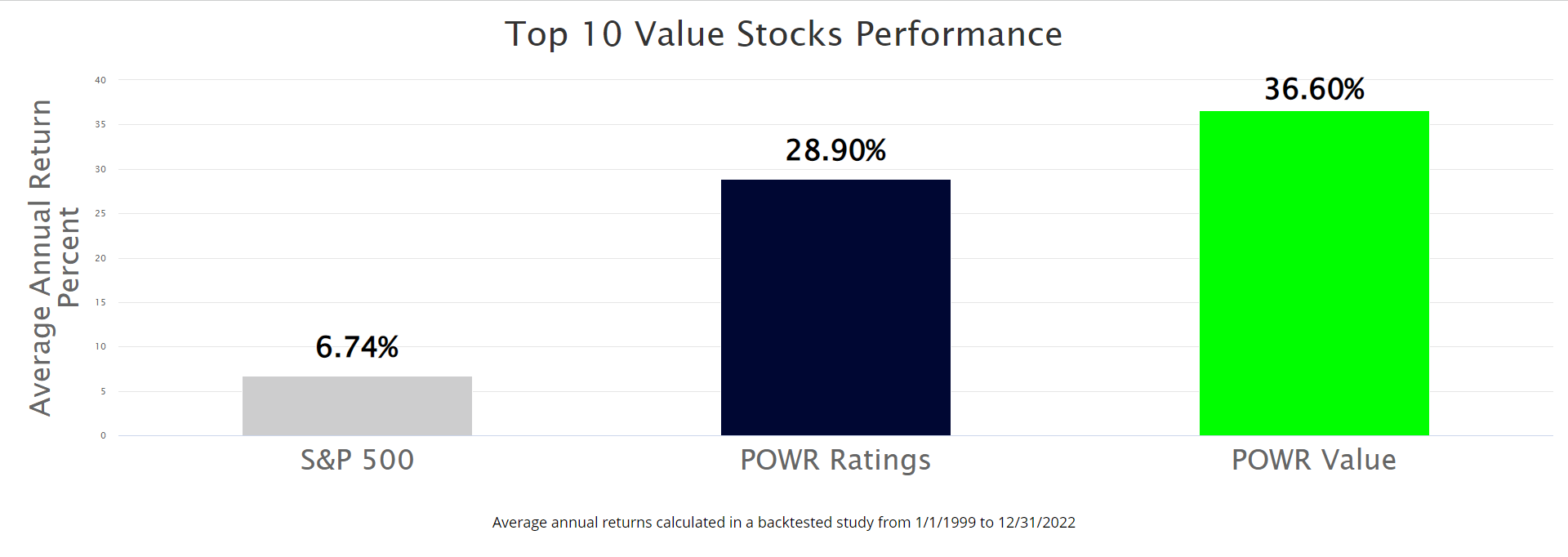
This includes sharing details on our coveted Top 10 Value Stocks strategy that has scored an average +36.60% gain since 1999 (5.4x better than the S&P 500 over that stretch).

Let me first tell you more about this computer generated model. Then we will discuss how it solves all 3 of the fatal flaws of value investing.

That journey starts with a brief discussion of our quant ranking system; the POWR Ratings.

If you have spent any time on StockNews.com you have certainly seen information on our exclusive POWR Ratings system. Indeed, these ratings really do help investors gain a decided advantage over the market, as can clearly be seen in the performance chart below.

Where Does the Outperformance Come From?

The POWR Ratings model is the most complete review of a stock available to individual investors today. All in all, we look at 118 different factors of a stock before assigning an A to F rating.

Which 118 factors?

The simple answer is ONLY the ones that lead to more profitable stock selection. Truly this is like a DNA check of each stock getting down to the molecular level to appreciate the stocks built to outperform.

Once that analysis of the overall POWR Rating is done, we then break down those 118 factors into 6 additional grades to appreciate the virtue of a stock on the following dimensions:

  • Value
  • Growth
  • Momentum
  • Stability
  • Quality
  • Sentiment

For those quick on the draw, you probably just figured out that if you combine a strong overall POWR Rating with a healthy Value score, that you are well on your way to picking the best value stocks.

Gladly that process will get you going in the right direction.

Sadly you will still end up with a list of over 700 stocks to research.

That is not so bad if picking stocks is your full-time job. However, for most of you that is far too time consuming.

This led to an “Aha!” moment.

What if we could develop a strategy to unearth the 10 top value stocks at any time producing consistent outperformance?

So, we went back to the same Data Scientist who created the POWR Ratings and asked the seemingly impossible—could he turn up the volume on the value metrics and somehow exceed their already market beating returns?

After months of research and rigorous testing the Top 10 Value Stocks strategy was born.

Not only did we narrow to just 10 value stocks. But we also greatly increased performance to +36.60% per year since 1999.

The hallmark of this screen is a zealous focus on the 31 individual value factors that help to consistently discover the market’s best value stocks (and just as importantly, ignoring the 100’s of factors that actually don’t work at all!).

Combining those 31 unique value factors together in optimal fashion leads to uncovering this incredibly consistent winning strategy.

The Key Word is “Consistency”

That’s because the POWR Ratings also focuses on the consistency of growth. Not just earnings growth, but also improvements in revenue, profit margins and cash flow.

Then our rating model goes further into the Quality of a stock by drilling down on the main metrics that show the health of operations over time.

The steps noted above solve the #1 fatal flaw of value investing. That being how to avoid the value traps that are really just poorly run companies that go from bad to worse. The focus on Growth and Quality aspects are the best possible health checks to alleviate these problems.

Meaning that we look beyond the overly simplistic value measurements used in the past, allowing us to deliver to you the healthiest growing companies, that just so happen to be trading at attractive discount prices.

Next up we need to tackle the 2nd fatal flaw. Which is that most classic value metrics don’t work like they used to.

Consider this.

Computer driven trading now dominates the investment landscape. No longer is it seasoned investment managers making the decisions. Instead the vast majority of trades are run by these quant models.

This has been true for more than 10 years. And truly billions of dollars have been thrown at these quant models to squeeze out every last drop of profit hidden in shares.

So long ago these models tapped into the benefit of the typical value approaches like PE, Book Value, PEG, Price to Sales etc.

Now after years of high volume trading of these models it could be said that the value well has run dry.

More precisely, the best value metrics have very little benefit on their own. So the key to success is to stack as many of these metrics in your favor as possible. Like the 31 value metrics inside the POWR Ratings model.

That’s 31 advantages working in your favor to generate outperformance. Each one increasing the odds of success. And that’s how the Top 10 Value Stocks strategy is able to produce a +36.60% annual return.

Finally we address the 3rd fatal flaw which is that value stocks are generally not timely which damages your ROI.

Value is considered a contrarian investing style. That’s because you are betting on companies that are currently out of favor hoping that the share price turns around.

Unfortunately the longer it takes…the more it harms your Return On Investment.

Gladly the POWR Ratings focuses on 25 different factors that greatly increase the timeliness and ROI of the stocks.

13 Sentiment Factors

12 Momentum Factors

Sentiment factors track what the smart money is doing with the stock such as institutional ownership, Wall Street analyst estimates and insider buying. These are time-tested ways of finding timely, in-favor stocks.

Next up is narrowing in on 12 different Momentum factors that targets stocks ready to rise. Indeed Momentum is just like physics where “a body in motion… stays in motion”.

All in all the POWR Ratings applies 118 factors to find the best stocks. The combination of which truly helps overcome the 3 fatal flaws of value investing.

Then we dial up value attributes to create the Top 10 Value Stocks strategy that increases performance to a stellar +36.60% a year.

This is how you solve the 3 fatal flaws of value investing.

And this is the consistent path to finding the best stocks in the future…

One last improvement

For as great as the Top 10 Value Stocks strategy truly is, there is still one glaring flaw that exists in all quantitative systems. And that is understanding the all-important WHY behind which stocks to buy, and when to sell to maximize gains.

That is why I go one step further, using my 40 years of investing experience to dive deeper into each stock, pulling the curtain back on the all-important qualitative metrics that no computer ratings system can uncover.

The final result is the very best value stocks, that I hand select for subscribers to our popular POWR Value Newsletter.

This is truly a best of both world’s solution:

+36.60% annual return from Top 10 Value strategy

+

Steve Reitmeister with 40+ years of investing experience with a keen eye for uncovering hidden value stocks

=

POWR Value newsletter to help you discover the best value stocks for today’s market.

What To Do Next?

If you’d like to see more top value stocks, then you should check out our free special report:

7 SEVERELY Undervalued Stocks

What makes these stocks great additions to any portfolio?

First, because they are all undervalued companies with exciting upside potential.

But even more important, is that they are all top Buy rated stocks according to our coveted POWR Ratings system.

Click below now to see these 7 stellar value stocks with the right stuff to outperform in the coming months.

7 SEVERELY Undervalued Stocks

Wishing you a world of investment success!

Steve Reitmeister…but everyone calls me Reity (pronounced “Righty”)
CEO, StockNews.com
Editor of Reitmeister Total Return & POWR Value


SPY shares fell $0.15 (-0.04%) in after-hours trading Friday. Year-to-date, SPY has gained 7.82%, versus a % rise in the benchmark S&P 500 index during the same period.


About the Author: Steve Reitmeister

Steve is better known to the StockNews audience as “Reity”. Not only is he the CEO of the firm, but he also shares his 40 years of investment experience in the Reitmeister Total Return portfolio. Learn more about Reity’s background, along with links to his most recent articles and stock picks.

More…

The post 3 Fatal Flaws of Investing Revealed appeared first on StockNews.com

https://www.entrepreneur.com/finance/3-fatal-flaws-of-investing-revealed/444322