NVIDIA vs. Taiwan Semi: Which Chip Stock Is the Better Buy in 2023

Chip demand has been under pressure lately. However, industry executives have a positive outlook for 2023. Also, the industry is expected to witness steady growth in the long term. So, popular chip stocks NVIDIA (NVDA) and Taiwan Semiconductor Manufacturing Company (TSM) are expected to be solid beneficiaries of the industry tailwinds. But which is the better buy in 2023? Let’s find out….

shutterstock.com – StockNews

Chip demand has declined in recent months. However, the long-term prospects of the industry look stable. The global semiconductor chip handler market is estimated to grow at a CAGR of 4.2% until 2026.

KPMG LLP and the Global Semiconductor Alliance’s (GSA) global semiconductor industry survey in the fourth quarter of 2022 reveals 81% project their company’s revenue will grow over 2023. Moreover, 65% of the executives surveyed think the semiconductor supply shortage will ease this year. The Semiconductor Industry Confidence Index score came in at 56 for 2023, indicating a positive outlook.

Moreover, investors’ interest in chip stocks is evident from the iShares Semiconductor ETF’s (SOXX) 24.2% gains over the past three months. Therefore, chip stocks NVIDIA Corporation (NVDA) and Taiwan Semiconductor Manufacturing Company Limited (TSM) are expected to benefit.

NVDA has lost 5.9% over the past month, while TSM has gained marginally. However, NVDA has gained 38.1% over the past three months, while TSM has gained 28.9%. But which of these stocks is the better pick now? Let’s find out.

Latest Developments

On January 3, 2023, NVDA and Hon Hai Technology Group (Foxconn), the world’s largest technology manufacturer, announced a strategic partnership to develop automated and autonomous vehicle platforms. This agreement is aimed at meeting growing industry demand.

On the other hand, on October 26, 2022, TSM announced the Open Innovation Platform® (OIP) 3DFabric Alliance at the 2022 Open Innovation Platform Ecosystem Forum.

Dr. L.C. Lu, TSM’s fellow and vice president of design and technology platform, said, “Through the collective leadership of TSMC and our ecosystem partners, our 3DFabric Alliance offers customers an easy and flexible way to unlocking the power of 3D IC in their designs, and we can’t wait to see the innovations they can create with our 3DFabric technologies.”

Moreover, TSM registered record financials in its latest reported quarter.

Recent Financial Results

NVDA’s revenue came in at $5.93 billion for the third quarter that ended October 30, 2022, down 16.5% year-over-year. Its gross profit came in at $3.18 billion, down 31.4% year-over-year. Also, its net income came in at $680 million, down 72.4% year-over-year, while its EPS came in at $0.27, down 72.2% year-over-year.

TSM’s net sales came in at NT$625.53 billion ($20.56 billion) for the fiscal 2022 fourth quarter ended December 2022, up 42.8% year-over-year. Its gross profit came in at NT$389.19 billion ($12.79 billion), up 68.7% year-over-year. Also, its net income came in at NT$295.90 billion ($9.73 billion), up 78% year-over-year, while its EPS came in at NT$11.41, up 78% year-over-year.

Past and Expected Financial Performance

NVDA’s revenue is expected to increase marginally year-over-year to $26.97 billion in 2023.

However, its revenue is expected to decrease 21.4% year-over-year to $6.01 billion for the quarter ending January 2023 and 22.5% year-over-year to $6.42 billion for the quarter ending April 2023. Its EPS is expected to fall 26.4% year-over-year to $3.27 in 2023.

On the other hand, TSM’s revenue is expected to increase 2.2% year-over-year to $76.24 billion in 2023. Moreover, its EPS is expected to rise 21.5% per annum for the next five years. It surpassed EPS estimates in all four trailing quarters.

Profitability

NVDA’s gross profit margin of 57.84% is higher than TSM’s 57.30%. However, TSM’s EBITDA and net income margins of 68.04% and 42.51% are higher than NVDA’s 30.52% and 20.85%.

In addition, TSM’s ROE, ROA, and ROTC of 36.57%, 19.92%, and 19.33% are higher than NVDA’s 26.39%, 16.88%, and 13.23%, respectively.

Thus, TSM is more profitable.

Valuation

In terms of forward EV/Sales, TSM’s 5.26x is 63.9% lower than NVDA’s 14.57x. Its forward EV/EBITDA of 7.64x is significantly lower than NVDA’s 63.05x. Moreover, its forward P/E of 12.78x compares with NVDA’s 96.08x.

Thus, TSM is relatively more affordable.

POWR Ratings

TSM has an overall rating of B, equating to Buy in our proprietary POWR Ratings system. On the other hand, NVDA has an overall rating of D, which translates to Sell. The POWR Ratings are calculated considering 118 different factors, with each factor weighted to an optimal degree.

TSM has a B grade for Growth, consistent with its steady financials in the latest reported quarter. Comparatively, NVDA has a D grade for Growth, consistent with its bleak financials.

In addition, TSM has a C grade for Stability, in sync with its 24-month beta of 1.04. In contrast, NVDA has a D grade for Stability, in sync with its 24-month beta of 2.03.

Furthermore, TSM has a B grade for Sentiment, consistent with its favorable analyst expectations, while NVDA has a C for Sentiment, consistent with its mixed analyst expectations.

Of the 93-stock Semiconductor & Wireless Chip industry, TSM is ranked #12, and NVDA is ranked #81.

Beyond what we’ve stated above, we have also rated the stocks for Value, Momentum, Sentiment, and Quality. Click here to view TSM ratings. Get all NVDA ratings here.

The Winner

While the semiconductor industry is witnessing macro headwinds, its long-term prospects look bright. Therefore, popular chip stocks TSM and NVDA should benefit. However, TSM’s robust financials, attractive valuations, and profitability make it a better Buy.

Our research shows that the odds of success increase when one invests in stocks with an Overall Rating of Strong Buy or Buy. View all the top-rated stocks in the Semiconductor & Wireless Chip industry here.


TSM shares rose $3.47 (+4.24%) in premarket trading Thursday. Year-to-date, TSM has gained 14.24%, versus a 3.55% rise in the benchmark S&P 500 index during the same period.


About the Author: Riddhima Chakraborty

Riddhima is a financial journalist with a passion for analyzing financial instruments. With a master’s degree in economics, she helps investors make informed investment decisions through her insightful commentaries.

More…

The post NVIDIA vs. Taiwan Semi: Which Chip Stock Is the Better Buy in 2023 appeared first on StockNews.com

https://www.entrepreneur.com/article/442820



2 Energy Stocks to Buy This Week for a Brighter 2023

With the Chinese economy reopening and demand bouncing back, the energy sector is anticipated to witness recovery and growth in the foreseeable future. Given this backdrop, quality energy stocks Unit Corporation (UNTC) and Adams Resources & Energy (AE) might be solid buys this week for a brighter 2023. Read on….

shutterstock.com – StockNews

Despite geopolitical turmoil and volatile market conditions, the energy sector posted an impressive performance last year. The Energy Select Sector SPDR Fund (XLE) has gained 43.7% over the past year, compared to the SPDR S&P 500 ETF Trust’s (SPY) 16.1% decline over the same period.

Meanwhile, the reopening of China’s borders after strict COVID-19 restrictions spurred optimism in the energy market and raised oil prices. Moreover, OPEC+ seems intent on keeping the oil market tight to prevent prices from dropping if a recession materializes.

According to Goldman Sachs, global oil demand is expected to increase by 2.7 million barrels per day (BPD) in 2023. The investment bank expects this to drive oil prices above $100 this year, and Brent Crude could trade at $105 per barrel by the fourth quarter.

Furthermore, John LaForge, head of the global real asset strategy at Wells Fargo Investment Institute, stated, “Within commodity sectors we like energy the best and suspect that oil prices are on track for another positive year, driven by production challenges and strategic opportunities in large oil-producing countries.”

Against this backdrop, it might be wise to add fundamentally strong energy stocks Unit Corporation (UNTC) and Adams Resources & Energy, Inc. (AE) to your portfolio this week for a brighter 2023.

Unit Corporation (UNTC)

UNTC explores, acquires, develops, and operates oil and natural gas properties in the United States. The company operates through its three broad segments: Oil and Natural Gas; Contract Drilling; and Mid-Stream.

On January 5, UNTC announced a special cash dividend of $10 per share and approved a quarterly cash dividend policy beginning in its second quarter. The special dividend is payable to shareholders on January 31, 2023. This reflects the company’s ability to pay back its shareholders.

The stock’s trailing-12-month gross profit margin of 48.23% is 18.5% higher than the industry average of 40.70%. Its trailing-12-month EBIT margin of 28.86% is 49.6% higher than the industry average of 19.29%. Also, its trailing-12-month net income margin of 23.85% is 109.6% higher than the industry average of 11.38%.

For the fiscal quarter that ended September 30, 2022, UNTC’s income from operations rose 39% from the prior-year quarter to $66.26 million. Net income attributable to UNTC and its per common share value came in at $55.82 million and $5.60 per share, which increased 786.7% and 918.2% year-over-year, respectively.

Shares of UNTC have gained 24.6% over the past six months to close the last trading session at $62.94. Moreover, it has gained 10.4% over the past month.

UNTC’s strong fundamentals are reflected in its POWR Ratings. The stock has an overall rating of B, which equates to Buy in our proprietary rating system. The POWR Ratings assess stocks by 118 different factors, each with its own weighting.

UNTC also has an A grade for Momentum and Quality and a B for Value. The stock is ranked #5 out of the 92-stock B-rated Energy – Oil & Gas industry. Click here for additional ratings on Growth, Stability, and Sentiment for UNTC.

Adams Resources & Energy, Inc. (AE)

AE markets, transports, and stores various U.S. crude oil and natural gas basins. The company has three operational segments: Crude Oil Marketing, Transportation and Storage; Tank truck Transportation of Liquid Chemicals, Pressurized Gases, Asphalt, and Dry Bulk; and Pipeline Transportation, Terminalling and Storage of Crude Oil.

On November 10, 2022, AE declared a quarterly cash dividend for the third quarter of 2022 of $0.24 per common share, which was payable on December 16. The company has consistently paid a dividend since 1994. This reflects the shareholder return ability of the company.

In the same month, AE announced the repurchase of all of the shares of Adams common stock owned by KSA Industries, Inc. The total purchase price was approximately $70 million or $36 per share and would be funded by a combination of existing cash on hand and a new term loan.

Along with the company’s recent acquisitions, repurchasing of shares is expected to enhance the value for all remaining shareholders. Kevin Roycraft, Chief Executive Officer of the company, said, “The company will also see an immediate annual savings of roughly $1.9 million in dividend payments at the current dividend rate.”

For the fiscal third quarter that ended September 30, AE’s total revenues increased 50.1% year-over-year to $852.90 million. Its operating earnings grew 30.1% from the prior-year quarter to $2.99 million, while its net earnings grew 41.7% from its year-ago value to $2.19 million. The company’s net earnings per common share improved 38.9% from its year-ago value of $0.50.

The consensus EPS estimate of $4.01 for the fiscal year ending December 2023 represents a 19% improvement year-over-year. The company’s revenue is expected to come in at $3.10 billion.

The stock has gained 26.6% over the past six months and 33.7% over the past three months to close the last trading session at $40.45.

AE’s POWR Ratings reflect its promising prospects. The stock has an overall rating of A, which translates to a Strong Buy in our proprietary rating system.

The stock also has an A grade for Momentum and Sentiment and a B for Value and Quality. Within the same industry, it is ranked #3. Click here to see the additional POWR Ratings for AE (Stability and Growth).


UNTC shares were unchanged in premarket trading Wednesday. Year-to-date, UNTC has gained 8.78%, versus a 2.13% rise in the benchmark S&P 500 index during the same period.


About the Author: Sristi Suman Jayaswal

The stock market dynamics sparked Sristi’s interest during her school days, which led her to become a financial journalist. Investing in undervalued stocks with solid long-term growth prospects is her preferred strategy.Having earned a master’s degree in Accounting and Finance, Sristi hopes to deepen her investment research experience and better guide investors.

More…

The post 2 Energy Stocks to Buy This Week for a Brighter 2023 appeared first on StockNews.com

https://www.entrepreneur.com/article/442715


The 4 Most Attractive Long-Term Stock Picks

With the Fed expected to keep rates higher throughout this year, the odds of the economy tipping into a recession are rising. Amid ongoing macroeconomic uncertainties, investors may consider buying companies with reliable performance over the years for solid long-term returns. To that end, Pfizer (PFE), Johnson & Johnson (JNJ), Sysco (SYY), and Overseas Shipholding (OSG) could be ideal investments now. Read on….

shutterstock.com – StockNews

The stock market witnessed heightened volatility last year due to lingering macroeconomic and geopolitical headwinds. While inflation cooled for two consecutive months, minutes from the Federal Reserve’s December meeting show that policymakers expect to continue increasing rates in 2023 and keep them higher for “some time’ until the 2% inflation target is met.

Bloomberg’s monthly survey shows that economists placed a 70% probability for the US economy to tip into a recession this year, citing slashing demand forecasts and cutting inflation projections in the wake of the Fed’s aggressive rate hikes. Also, the head of the International Monetary Fund (IMF), Kristalina Georgieva, warned that 2023 would be a tough year, expecting one-third of the global economy to be in recession.

With the potential recessionary pressures, the labor market is expected to slow down over the coming months. December showed some signs of cooling labor demand, with an addition of 223,000 jobs, down from an addition of 256,000 jobs in November. Also, by the end of 2023, the unemployment rate is expected to rise to 4.5% with the slowing economy.

Given an uncertain macroeconomic backdrop, investing in fundamentally sound and stable stocks Pfizer Inc. (PFE), Johnson & Johnson (JNJ), Sysco Corporation (SYY), and Overseas Shipholding Group, Inc. (OSG) could be wise for solid long-term returns.

Pfizer Inc. (PFE)

PFE discovers, develops, manufactures, markets, distributes, and sells biopharmaceutical products worldwide. The company serves wholesalers, retailers, hospitals, clinics, government agencies, pharmacies, individual provider offices, and disease control and prevention centers.

On December 19, 2022, PFE and LianBio (LIAN), a biotechnology company dedicated to providing innovative medicines to patients in China and other Asian markets, announced that PFE opted into the right to develop and commercialize sisunatovir, a respiratory syncytial virus (RSV) therapeutic candidate, in Mainland China, Hong Kong, Macau, and Singapore.

This ongoing collaboration of PFE with LianBio has the potential to reach more patients and boost the company’s revenue streams.

On November 3, PFE’s investigational cancer immunotherapy, elranatamab, received Breakthrough Therapy Designation from the U.S. Food and Drug Administration (FDA) for treating people with relapsed or refractory multiple myeloma. This is yet another significant achievement for PFE in the field of oncology.

For the third quarter ended October 2, 2022, PFE’s United States segment revenues came in at $13.85 billion, up 97.3% year-over-year. Its income from continuing operations grew 5.8% from the year-ago value to $8.65 billion.

The company’s non-GAAP net income came in at $10.17 billion, up 39.7% year-over-year. Also, its non-GAAP EPS came in at $1.78, up 40.2% year-over-year.

PFE has raised dividends for 12 consecutive years. Its dividend payouts have increased at a 5.7% CAGR over the past five years. Its current dividend yield is 3.39%, and its four-year average yield is 3.63%.

Analysts expect PFE’s revenue for the fiscal year (ended December 2022) to increase 23.5% year-over-year to $100.39 billion. The company’s EPS for the same period is estimated to grow 46.5% year-over-year to $6.47. Moreover, the company has surpassed the consensus EPS estimates in each of the trailing four quarters.

Over the past month, the stock has declined 8.6% to close the last trading session at $47.62.

PFE’s POWR Ratings reflect this promising outlook. The stock has an overall rating of A, equating to a Strong Buy in our proprietary rating system. The POWR Ratings assess stocks by 118 different factors, each with its own weighting.

PFE has an A grade for Value and a B for Growth and Quality. Within the Medical – Pharmaceuticals industry, it is ranked #6 out of 164 stocks. Click here for the additional POWR Ratings for Momentum, Stability, and Sentiment for PFE.

Johnson & Johnson (JNJ)

JNJ researches, develops, manufactures, and sells various products in the healthcare field worldwide. The company operates through three segments: Consumer Health; Pharmaceutical; and Medical Devices.

In December 2022, JNJ acquired Abiomed Inc. (ABMD), a world leader in breakthrough heart, lung, and kidney support technologies. Joaquin Duato, CEO of JNJ, said, “This acquisition marks another important step on Johnson & Johnson’s path to accelerating growth in our MedTech business and delivering innovative medical technologies to more people around the world.”

In the third quarter of fiscal 2022, JNJ reported sales of $23.79 billion, a 1.9% increase year-over-year, while sales from the Pharmaceutical segment increased 2.6% from the year-ago value to $13.21 billion. The company’s net earnings rose 21.6% year-over-year to $4.46 billion. Also, its EPS grew 22.6% year-over-year to $1.68.

JNJ has a record of increasing dividends for 60 consecutive years. It pays a $4.52 per share dividend annually, which translates to a 2.57% yield on the current price. Its four-year average dividend yield is 2.60%. Its dividend payouts have grown at a 5.9% CAGR over the past three years and a 6% CAGR over the past five years.

Analysts expect JNJ’s revenue to increase 1.4% year-over-year to $95.05 billion in the fiscal year ended December 2022. The company’s EPS for the same year is expected to grow 2.5% year-over-year to $10.05. Also, it surpassed the consensus EPS estimates in all four trailing quarters.

Furthermore, the company’s revenue and EPS for the next fiscal year 2023 are expected to grow 2.7% and 3.3% year-over-year to $97.63 billion and $10.38, respectively. Over the past year, the stock has gained 1.2% to close the last trading session at $175.16.

JNJ’s strong fundamentals are reflected in its POWR Ratings. The stock’s overall A rating indicates a Strong Buy in our proprietary rating system.

JNJ has an A grade for Stability and a B for Quality, Sentiment, and Value. In the Medical – Pharmaceuticals industry, it is ranked #3 out of 164 stocks.

Click here to access additional POWR Ratings for Growth and Momentum for JNJ.

Sysco Corporation (SYY)

SYY engages in the marketing and distribution of various food and related products, primarily to the food service or food-away-from-home industry worldwide. It operates through segments, including U.S. Foodservice Operations; International Foodservice Operations; SYGMA; and Other.

On November 11, SYY received its first series-produced battery electric Freightliner eCascadia, which is a zero-emission Class 8 truck. SYY’s senior vice president of corporate affairs and chief communications officer, Neil Russell, stated that the addition is a significant milestone in the company’s climate journey as it works toward electrifying 35% of its U.S. fleet by 2030.

SYY’s non-GAAP gross profit increased 17.3% year-over-year to $3.48 billion for the fiscal 2023 first quarter ended October 1, 2022. Its adjusted EBITDA increased 7.5% year-over-year to $916.86 million.

The company’s non-GAAP net earnings increased 14.6% year-over-year to $492.60 million. Also, its non-GAAP EPS increased 16.9% from the prior-year period to $0.97.

The company has raised its dividend for seven consecutive years. Over the last five years, SYY’s dividend payouts have grown at a 7.5% CAGR. Its four-year average dividend yield is 2.41%, and its annual dividend of $1.96 per share translates to a 2.47% yield. It is expected to pay a quarterly dividend of $0.49 per share on January 27, 2023.

Analysts expect SYY’s EPS and revenue for the quarter ending December 31, 2022, to increase 47.9% and 13.9% year-over-year to $0.84 and $18.58 billion, respectively. Shares of SYY have gained 4.7% over the past five days to close the last trading session at $79.96.

SYY’s financial strength and solid growth outlook are reflected in its POWR Ratings. The stock has an overall rating of A, which translates to a Strong Buy in our proprietary rating system.

The stock has an A grade for Growth and a B for Value and Stability. SYY is ranked #5 out of 83 stocks within the B-rated Food Makers industry.

We have also given SYY grades for Momentum, Sentiment, and Quality. Get all SYY ratings here.

Overseas Shipholding Group, Inc. (OSG)

OSG is the owner and operator of a fleet of oceangoing vessels engaged in transporting crude oil and petroleum products in the U.S. flag trade. The company serves independent oil traders, refinery operators, and government entities.

On December 8, OSG announced that it had exercised options to extend its six bareboat charter agreements with American Shipping Company ASA for an additional three-year term commencing in December 2023. With these extensions, seven vessels will continue to lease from AMSC, six with maturity dates aligned to end in December 2026 and one with a maturity of 2025.

On November 15, SYY’s Board of Directors announced the purchase of $5 million shares of the company’s common stock from Cyrus Capital at $2.86 per share for a total of $14,300,000. The price paid in this share purchase equates to an enterprise value of roughly 4.5 times the expected adjusted EBITDA for 2022, an implied valuation considered quite attractive for OSG.

OSG’s shipping revenues increased 30.9% year-over-year to $123.60 million for the third quarter that ended September 30, 2022. Its adjusted EBITDA was $42.30 million, an increase of $30.10 compared with the third quarter of 2021. The company’s net income came in at $13.25 million, compared to a net loss of $16.01 million in the year-ago period.

In addition, the company’s EPS came in at $0.15, compared to a loss per share of $0.18 in the prior-year period.

Shares of OSG have gained 56.9% over the past six months and 73.3% over the past six months, closing the last trading session at $2.21.

OSG’s POWR Ratings reflect its solid growth prospects. The stock has an overall rating of A, which equates to a Strong Buy in our proprietary rating system.

OSG has an A grade for Quality and Momentum. It has a B grade for Growth and Value. In the 46-stock A-rated Shipping industry, it is ranked first. Click here to see OSG’s rating for Stability and Sentiment.


PFE shares rose $0.12 (+0.25%) in premarket trading Wednesday. Year-to-date, PFE has declined -7.06%, versus a 2.13% rise in the benchmark S&P 500 index during the same period.


About the Author: Mangeet Kaur Bouns

Mangeet’s keen interest in the stock market led her to become an investment researcher and financial journalist. Using her fundamental approach to analyzing stocks, Mangeet’s looks to help retail investors understand the underlying factors before making investment decisions.

More…

The post The 4 Most Attractive Long-Term Stock Picks appeared first on StockNews.com

https://www.entrepreneur.com/article/442709


Are Stocks Stuck in a Trading Range til February?

The S&P 500 (SPY) seems to be rising once again. However, there are several reasons to consider before joining the bull party. In fact, Steve Reitmeister, CEO of StockNews.com, provides many reasons to consider doubling down on bearish bets with more downside soon on the way. Read on below for the full story.

shutterstock.com – StockNews

Stocks are likely going to be stuck in a trading range until the next Fed announcement on Wednesday February 1st.

Why?

Because investors have been burned many times before getting bullish in hopes of a Fed pivot that did not arrive.

So even with signs of moderating inflation providing a modest lift to stocks of late…there is a limit to the upside until investors hear from the Fed again. There is also limit to the downside. And this begets a trading range.

Let’s discuss the shape of the trading range and possible outcomes after the Fed announcement. All that and more is on tap for this week’s Reitmeister Total Return commentary.

Market Commentary

In many ways the trading range has already been in place for the past month flitting between 3,800 and 4,000 for the S&P 500 (SPY).

And this is likely to stay in place as investors are fearful of reading the Fed tea leaves wrong as they have so many times this year. So even though there were welcome signs of moderating wage inflation (public enemy #1 to the Fed) there are enough whispers from the Fed that their job is far from done.

One such whisper from the Fed recently came from Atlanta Fed President, Ralph Bostic. During his speech he shared that interest rates will get above 5% and hold there for a while. He was then asked for how long would they remain elevated above 5% for which he stated emphatically. “three words: a long time“.

This harkens back to December 14th when the market was on the verge of a breakout above the 200 day moving average before Powell slammed the door on that notion. He too repeated the 3 word mantra (a long time) over and over again when discussing their plans for higher rates.

Plain and simple, Powell said that they fear damage from long term inflation much more than the downsides that come with a recession. And thus will remain aggressively hawkish until inflation is back down to the 2% target for good.

Investors got the memo loud and clear in mid December leading to a -6% bearish run for stocks. However, bit by bit investors are forgetting the Feds message as stocks float back higher in the range.

The main thing creating a lid on stock prices at the moment is a combination of the 200 day moving average at 3,990 followed by the psychologically important 4,000 level. You could call that a double reinforced resistance level that will be hard to crack without clear and decisively bullish news from the Fed.

Right now, from a Fed policy perspective I see little reason for investors to get seriously more bullish at this time. That’s because of the consistency of the higher rates for “a long time” mantra.

Also consider that from an economic perspective there are more and more signs of a recession forming early in 2023. Let’s refer to 3 key pieces of data from the past week that speak loudly to worsening economic conditions:

First, was ISM Manufacturing declining to 48.4 last week as New Orders lower at 45.2 means that the worst is yet to come. (Remember under 50 = contraction).

Second, we find that things are not much better on the services side of the ledger as ISM Services dropped abruptly from 56.5 to 49.6. And here again, the forward looking New Orders component was markedly worse at 45.2.

Let’s remember that the above services report was during December…the holiday shopping season when consumers normally put aside any concerns to spend lavishly on their families. However, there was much less “ho, ho, ho” in these results and much more “humbug“.

Lastly, on the economic front, the NFIB Small Business Optimism index was, well, NOT optimistic. That comes through loud and clear as it came in at a six month low of 89.8 when under 100 = contraction.

Here too we see these business owners not feeling good about what lies ahead as the 6 month business conditions outlook worsened with 51% predicting lower results ahead. The only positive to be found in this report is still ample job openings which likely keeps pressure on higher wages…which will keep the Fed on the offensive against inflation a good while longer.

To sum it up, I expect stocks to remain in this 3,800 to 4,000 trading range until we hear from the Fed. Or more specifically I think it will be very hard to break above that range.

On the downside, stocks could tumble lower before the Fed chimes in if the upcoming inflation reports are hotter than expected. That’s because investors would wisely read that information to mean that the Fed would stay aggressively hawkish a good while longer…thus increasing odds of recession and stock market downside.

This means we should put the following dates on our calendar:

1/12/23 = Consumer Price Index

1/18/23 = Producer Price Index

2/1/23 = Fed Rate Hike Decision and Powell Speech

Don’t give much credence to moves higher in the range for now as it likely will be all for not when the Fed takes the mic on February 1st. However, it is also possible that stocks crack lower before that if CPI or PPI shows inflation being too sticky which provides a forgone conclusion of what the Fed will on 2/1.

Long story short, the smart money still rides on recession forming with deeper bear market in coming months. Please trade accordingly.

What To Do Next?

Watch my brand new presentation: “2023 Stock Market Outlook” covering:

  • Why 2023 is a “Jekyll & Hyde” year for stocks
  • 5 Warnings Signs the Bear Returns in Early 2023
  • 8 Trades to Profit on the Way Down
  • Plan to Bottom Fish @ Market Bottom
  • 2 Trades with 100%+ Upside Potential as New Bull Emerges
  • And Much More!

Watch Now: “2023 Stock Market Outlook” >

Wishing you a world of investment success!

Steve Reitmeister…but everyone calls me Reity (pronounced “Righty”)
CEO, Stock News Network and Editor, Reitmeister Total Return


SPY shares were trading at $389.56 per share on Tuesday afternoon, up $1.70 (+0.44%). Year-to-date, SPY has gained 1.86%, versus a % rise in the benchmark S&P 500 index during the same period.


About the Author: Steve Reitmeister

Steve is better known to the StockNews audience as “Reity”. Not only is he the CEO of the firm, but he also shares his 40 years of investment experience in the Reitmeister Total Return portfolio. Learn more about Reity’s background, along with links to his most recent articles and stock picks.

More…

The post Are Stocks Stuck in a Trading Range til February? appeared first on StockNews.com

https://www.entrepreneur.com/article/442675


How To Be Like Buffett And Buy A Berkshire Stock At A Discount

How to use a covered call strategey to buy the dip and sell the rip on the latest Warren Buffett buy in Taiwan Semiconductor (TSM).

shutterstock.com – StockNews

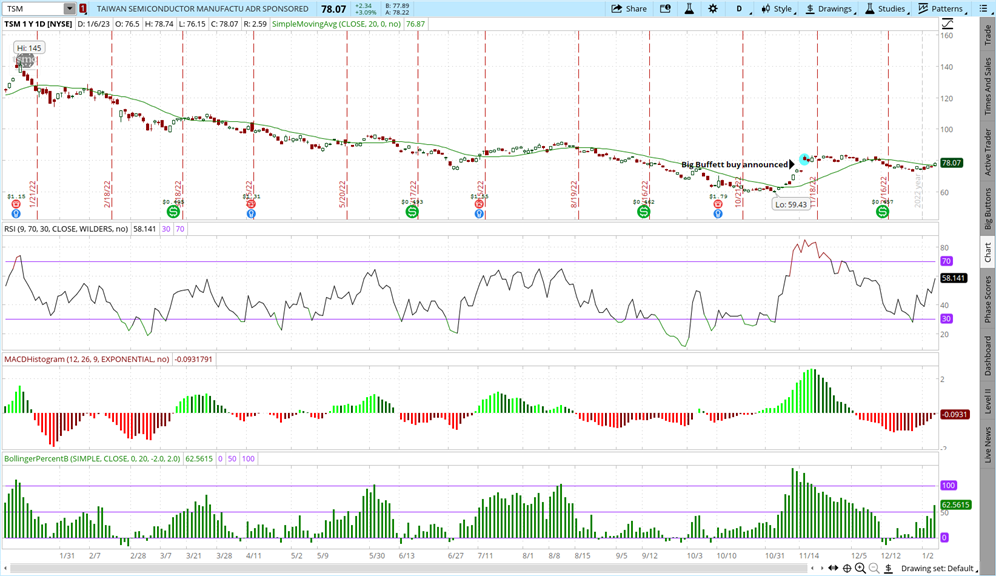
Berkshire Hathaway (BRK.B) disclosed last quarter that it bought a sizable stake in Taiwan Semiconductor (TSM) stock. How sizeable? How about just over 60 million shares at just under $69 per share. This equates to roughly a $4.1 billion dollar outlay for Berkshire and famed chairman and CEO Warren Buffett.

The news of the acquisition on November 15 sent TSM stock soaring over 10% on the day. Shares moved from under $73 pre-announcement to close above $80 post-announcement. Taiwan Semiconductor has since pulled back somewhat to the $78 area.

Buying Taiwan Semi stock at current levels means paying close to the highest price TSM has been in several months. It also is well above the price Mr. Buffett paid for his large stake in the company.

Luckily, a covered call options strategy provides a way to get into TSM stock at a discount close to the Buffett Buy price while pre-positioning to be a seller of the shares on a big move higher.

A covered call trade involves buying 100 shares of the underlying stock and simultaneously selling 1 call option against those shares. It is sometimes referred to as a buy-write since it entails buying the stock and writing the call options.

Effectively, you receive the premium of the call option sold to help reduce the net cost of the trade and provide a downside cushion. That’s the good part.

For having a much lower initial cost on the trade, however, your upside is capped off at the strike price of the call sold.

An example of a covered call strategy in TSM stock would be to buy shares at current prices ($78.10) and sell the January $85 calls at $8.80 to reduce the cost of the stock purchase by the amount of the call sale.

The table below shows that selling the TSM Jan $85 call reduces the net purchase price by the premium received for the call sale of $8.80. This puts the net cost for the trade at $69.30 ($78.10 minus $8.80), providing an 11.27% downside cushion until break-even on the stock.

Of course, there is no free lunch in trading. The upside is limited to the strike price of the covered call sold of $85. That, however, still leaves potential upside gain of $15.70 points ($85 short strike price less $69.30 initial cost). This amounts to a 22.66% potential gain on the trade if the stock closes higher than $85 on January 19, 2024 expiration.

This trade certainly fits into the Warren Buffett philosophy of being fearful when others are greedy and greedy when others are fearful. You are willing to be a buyer of TSM stock on a 11.27% drop when others would likely be getting fearful. You are also willing to sell TSM on a 22.66% rally when others would probably be getting greedy.

Plus, TSM sports a solid dividend yield of 1.83% and a low payout ratio of about 25% which would further boost the overall return or lower the risk for the covered call trade.

Investors could use different call strikes or expiration months to sell to fit their risk/return profile. Selling lower strike calls would bring in more premium to lower the risk on the trade but it also lowers the return as well.

2022 was a tough year for stocks. The S&P 500 was down 19% while the NASDAQ 100 did even worse. Luckily, my POWR Options program returned well over 50%.

Many experts expect a difficult market environment in 2023. Investors and traders looking to hedge the downside while still allowing for realistic upside would be wise to consider an option-based covered call strategy.

POWR Options

What To Do Next?

If you’re looking for the best options trades for today’s market, you should check out our latest presentation How to Trade Options with the POWR Ratings. Here we show you how to consistently find the top options trades, while minimizing risk.

If that appeals to you, and you want to learn more about this powerful new options strategy, then click below to get access to this timely investment presentation now:

How to Trade Options with the POWR Ratings

All the Best!

Tim Biggam

Editor, POWR Options Newsletter


TSM shares closed at $78.07 on Friday, up $2.34 (+3.09%). Year-to-date, TSM has gained 4.81%, versus a 1.48% rise in the benchmark S&P 500 index during the same period.


About the Author: Tim Biggam

Tim spent 13 years as Chief Options Strategist at Man Securities in Chicago, 4 years as Lead Options Strategist at ThinkorSwim and 3 years as a Market Maker for First Options in Chicago. He makes regular appearances on Bloomberg TV and is a weekly contributor to the TD Ameritrade Network “Morning Trade Live”. His overriding passion is to make the complex world of options more understandable and therefore more useful to the everyday trader. Tim is the editor of the POWR Options newsletter. Learn more about Tim’s background, along with links to his most recent articles.

More…

The post How To Be Like Buffett And Buy A Berkshire Stock At A Discount appeared first on StockNews.com

https://www.entrepreneur.com/article/442474


AutoNation (AN) is a Top Value Stock for 2023

Now is the time for value stocks and thus now is the time to discover the attractiveness of AutoNation (AN) shares. Read on below for the full story.

shutterstock.com – StockNews

Many investors have the wrong idea about a bear market. That’s because they see that the average stock is down 20% or more…even worse, high profile growth stocks like Tesla or Roku are down 60-80%. This makes them think there is no way to generate gains in the negative environment.

The real lesson is to seek value. That is the path that leads to outperformance even in the face of a bear market. And that is why I want you to train your attention on AutoNation (AN).

AutoNation is the largest automotive dealer in the United States, has benefited greatly from the increase in used car sales and their rising value. The company also launched its AutoNation USA used vehicle store concept, which is expected to drive massive profits in the years to come. This gives investors a nice combination of steady organic growth along with an exciting new growth driver.

Even as interest rates have risen, US consumers continue to show their clear love and devotion to cars as buying demand remains high. This shows up loud and clear with the Auto Dealers Group still being in the top 1/3rd of our Industry Rank proudly sporting a healthy B rating.

On the value front it is quite shocking to notice that the current PE stands just a notch below 5. Even in the midst of the 2022 sell off that is an eye-popping cheap level for any stock let alone an industry leader like AutoNation.

The value story continues with an overall A rating. Meaning that across the 31 different factors in the POWR Ratings model, AN stands in the top 5% in value. This likely explains why the analyst at Bank of America still has a $238 price target on shares which is more than 100% above current level. That alone could make AN the poster child for this report of severely undervalued stocks.

Want to Discover More Value Stocks?

AutoNation is just 1 of 7 attractive value stocks found in a new special report we just put together. Click the link below to claim your free copy now:

7 SEVERELY Undervalued Stocks

What To Do Next?

Watch my brand new presentation: “2023 Stock Market Outlook” covering:

  • Why 2023 is a “Jekyll & Hyde” year for stocks
  • 5 Warnings Signs the Bear Returns in Early 2023
  • 8 Trades to Profit on the Way Down
  • Plan to Bottom Fish @ Market Bottom
  • 2 Trades with 100%+ Upside Potential as New Bull Emerges
  • And Much More!

Watch Now: “2023 Stock Market Outlook” > 

Wishing you a world of investment success!

Steve Reitmeister…but everyone calls me Reity (pronounced “Righty”)
CEO, Stock News Network and Editor, Reitmeister Total Return


AN shares closed at $111.00 on Friday, up $1.89 (+1.73%). Year-to-date, AN has gained 3.45%, versus a 1.48% rise in the benchmark S&P 500 index during the same period.


About the Author: Steve Reitmeister

Steve is better known to the StockNews audience as “Reity”. Not only is he the CEO of the firm, but he also shares his 40 years of investment experience in the Reitmeister Total Return portfolio. Learn more about Reity’s background, along with links to his most recent articles and stock picks.

More…

The post AutoNation (AN) is a Top Value Stock for 2023 appeared first on StockNews.com

https://www.entrepreneur.com/article/442472


Feels a lot like Deja Vu 2022…

It’s finally 2023! Hello new year and good riddance to the year that was. Last year was a rough one for the S&P 500 (SPY) by anyone’s measurement… So let’s put that behind us and move on with 2023 to see what that has in store for us. There’s a lot coming up in the next few weeks, so let’s jump right in. Read on below.

shutterstock.com – StockNews

(Please enjoy this updated version of my weekly commentary originally published January 5th, 2023 in the POWR Stocks Under $10 newsletter).

Market Commentary

You know what I’m most excited about? Not having to talk about the Federal Reserve every single week over and over again and…

…Wait, what’s that?

The minutes from the Fed’s December meeting were released Wednesday?

And the market sank Thursday on strong labor numbers because of the Fed’s likely reaction (more rate hikes)?

Oh, and two Fed members gave remarks at different events today?

Welcome to the new year…same as the old year.

For better or for worse, the Federal Reserve is still a big market  driver. And we’re still going to be talking about it in this newsletter. A lot.

But to Chair Jerome Powell’s credit, the minutes from December’s meeting make their 2023 outlook extremely clear.

“Read my lips: NO NEW RATE CUTS.”

Okay, that’s not a direct quote from anyone, but it might as well be.

Even though many many many investors have already been talking about a potential 2023 policy pivot, the minutes showed not a single Fed official expects a rate cut at any point during the year.

They even included a line warning investors to keep the market rallies to a minimum.

“Participants noted that, because monetary policy worked importantly through financial markets, an unwarranted easing in financial conditions, especially if driven by a misperception by the public of the Committee’s reaction function, would complicate the Committee’s effort to restore price stability.”

…..?

“Said differently, if equities continue to rally on bad economic news, the Fed will need to push forward to an even higher terminal rate and unofficially add ‘weaker stocks’ to the mandate,” wrote BMO Capital Markets strategists Ian Lyngen and Benjamin in a note Wednesday.

Ah.

Now, I know that may seem extremely dour — it kind of reads as if the Fed has its foot on the neck of the entire stock market (SPY).

And yet, St. Louis Federal Reserve Bank President James Bullard gave a speech earlier today saying the prospects of a soft landing are rising due to the continued strength in the labor market.

So, a little bad and a little good.

We’ll know more by mid-month. There are a number of important economic reports scheduled to be released in the next two weeks. Then, we have the next FOMC meeting, scheduled for the last day of January and the first day of February.

Each of these events will give us one more piece of information we can use to form our 2023 market outlook. Right now, mine is cautious…

I’ll be watching the data and the markets. As much as I wish otherwise, I am concerned that we’re in for another year like the one we just bid “good riddance” to.

But as you can see from a few of the positions in the current portfolio, we can still rake in solid profits even if the Fed keeps the broader market under their thumb.

What To Do Next?

If you’d like to see more top stocks under $10, then you should check out our free special report:

3 Stocks to DOUBLE This Year

What gives these stocks the right stuff to become big winners, even in this brutal stock market?

First, because they are all low priced companies with the most upside potential in today’s volatile markets.

But even more important, is that they are all top Buy rated stocks according to our coveted POWR Ratings system and they excel in key areas of growth, sentiment and momentum.

Click below now to see these 3 exciting stocks which could double or more in the year ahead.

3 Stocks to DOUBLE This Year

All the Best!

Meredith Margrave
Chief Growth Strategist, StockNews
Editor, POWR Stocks Under $10 Newsletter


SPY shares closed at $388.08 on Friday, up $8.70 (+2.29%). Year-to-date, SPY has gained 1.48%, versus a % rise in the benchmark S&P 500 index during the same period.


About the Author: Meredith Margrave

Meredith Margrave has been a noted financial expert and market commentator for the past two decades. She is currently the Editor of the POWR Growth and POWR Stocks Under $10 newsletters. Learn more about Meredith’s background, along with links to her most recent articles.

More…

The post Feels a lot like Deja Vu 2022… appeared first on StockNews.com

https://www.entrepreneur.com/article/442461


10 Minutes a Month to Beat the Stock Market

The #1 problem for investors is underperforming the stock market (SPY). The #2 problem is how much time they spend (aka waste) to achieve these poor outcomes. The above problems explain why 40 year investment veteran Steve Reitmeister is now sharing insights on a proven method to beat the market in as little as 10 minutes a month. Note Steve has employed this method himself to enjoy a real world $104,390 gain since February 2021. Read on below for full details.

shutterstock.com – StockNews

This was the right way to start off the new year for investors.

That’s because I just shared with a live audience how to stop wasting time with their stock selection process. And how they could handily beat the market with the minimum of effort.

The title of the webinar kind of says it all. And gladly you can watch the replay now:

10 Minutes a Month to Beat the Stock Market >>

No doubt a lot of the attendees were skeptical at first. Kind of sounded like “8 Minute Abs” for stock investing.

However, over the course of the webinar I clearly laid out the sound fundamental logic behind the process.

And how it consistently helps find the best stocks.

And how it only takes 10 minutes a month to enjoy market topping results.

Better yet…I showed how I have been using this very same process in my Roth IRA account since February 2021 leading to a real life $104,390 gain far surpassing the meager S&P 500 (SPY) return.

Watch the Webinar Replay Now >>

Gladly we have many strategies to choose from so you can dial into the perfect stocks for who you are as an investor.

That’s because every investor is different. Some more aggressive…some more conservative.

Then you have growth, value, income and momentum factors to weigh for each stock.

And then you have current market conditions to consider which is why we have built separate strategies for bullish times as well as bearish.

So whatever type of strategy you are looking for it will be easy to find it…and apply it successfully in just 10 minutes a month.

And yes, these strategies have performed incredibly well even during the rough and tumble 2022 bear market. The full proof of this is shared in this timely webinar below.

10 Minutes a Month to Beat the Stock Market >>

Wishing you a world of investment success!

Steve Reitmeister…but everyone calls me Reity (pronounced “Righty”)
CEO, StockNews.com


SPY shares closed at $388.08 on Friday, up $8.70 (+2.29%). Year-to-date, SPY has gained 1.48%, versus a % rise in the benchmark S&P 500 index during the same period.


About the Author: Steve Reitmeister

Steve is better known to the StockNews audience as “Reity”. Not only is he the CEO of the firm, but he also shares his 40 years of investment experience in the Reitmeister Total Return portfolio. Learn more about Reity’s background, along with links to his most recent articles and stock picks.

More…

The post 10 Minutes a Month to Beat the Stock Market appeared first on StockNews.com

https://www.entrepreneur.com/article/442460


Are Bulls or Bears Winning in 2023?

The new year has begun with a roller coaster ride for investors. Some excited…some losing their lunch. That is the past. The key is what it all means for the future especially as we close in on the all important 200 day moving average for the S&P 500 (SPY). Check out what 40 year investment veteran Steve Reitmeister has to say about it all in his new commentary including a trading plan to stay one step ahead of the market.

shutterstock.com – StockNews

The first trading week of the new year ended on a strong note. However, it wasn’t all “lollipops and ice cream” as stocks sank one day then surged the next…then sank…then surged again.

The reason for this extreme volatility is some mixed signals on the economic front. Some quite bullish. Some quite bearish. All quite confusing.

So I will do my level best to make sense of it all in this week’s commentary.

Market Commentary

The best place to start this conversation is by sharing with you the contents of a trade alert this morning to take profits on a 3X inverse ETFs in my Reitmeister Total Return service:

“Today we got a goldilocks set of reports for bulls. Employment strong + wage inflation moderating + weak ISM report = odds of less hawkish Fed are higher and thus bulls will have some fun for a little while…and thus best to sell HIBS.

Reity, are you becoming bullish?

No. I am becoming slightly less bearish with today’s information. And thus taking our most aggressive bearish bet off the table.

Right now investors are most focused on inflation and that is moderating nicely while employment remains strong. This improves the soft landing narrative.

Unfortunately, they are taking their eye off the collapsing economy such as ISM Services dropping from 56.5 last month to a contractionary 49.6 this month. And yes, the forward looking New Orders component is even worse at 45.2.

I think the S&P 500 (SPY) may try and make a move back towards 200 day moving average (3,999) and then reassess if inflation is the only story worth noting…or should the deteriorating economy weigh into decision making???

If truly break above 200 day moving average in meaningful way…then yes, we will get less and less bearish…and more and more bullish.”

(end of Friday morning note)

There really is a “Catch 22” scenario in rooting for lower inflation. That’s because the #1 way to reduce inflation is by lowering demand. Yes, that is the explicitly stated goal of the Fed with their rate hiking regime.

But let me do a little language translation for you:

“Lower Demand” is Fed speak for “Let’s Create a Recession”

So yes, we are taming inflation by greatly harming the economy. This shows up loud and clear in the key economic reports this week starting with ISM Manufacturing on Wednesday ebbing ever lower to 48.4. This goes hand in hand with the 45.2 showing for New Orders pointing to even lower readings ahead.

And as already shared ISM Services, the larger part of the economy, is also in a state of decline. Let me correct that…in a state of falling of a cliff.

Yes, this is disinflationary. Hooray!

But it is also opening up the Pandoras Box known as recession. Boo, Hiss!

And if that really does pick up speed then employment will finally falter with lower spending as a result which only exacerbates the recessionary pressures.

So…is it time to get bullish because lower inflation may have the Fed less hawkish down the road. Or time to get more bearish because there are greater signs of a recession forming now???

That indeed is the key question for investors. But with the Fed likely mum until their next decision date on February 1st, then I could see the bulls having a little more fun up to the serious resistance at 4,000.

That area is now doubly reinforced. Not only is it a psychologically important hurdle…but it also is connected to the 200 day average which now stands close by at 3,999.

We have seen quite a few momentary breakouts above the 200 day moving average since the bear market began. And then quickly the coffin was shut with more downside on the way.

To sum it up, I am still bearish as I think the catalyst of recession is more important than ebbing inflation. However, other investors may not agree. Thus, if we see a meaningful break above the 200 day moving average I would be compelled to get a bit more bullish too.

If investing were easy…then everyone would do it with a high degree of success.

Clearly not the case. Which is why we weigh all the key factors to create a market outlook along with a portfolio constructed to outperform in that environment. Then we go into each new day with an open mind to objectively review each next bit of information. This gives us the best chance to adjust our strategies to stay on the right side of the action.

I will continue to do my level best to share you timely updates as things evolve with appropriate trade recommendations.

What To Do Next?

Watch my brand new presentation: “2023 Stock Market Outlook” covering:

  • Why 2023 is a “Jekyll & Hyde” year for stocks
  • 5 Warnings Signs the Bear Returns in Early 2023
  • 8 Trades to Profit on the Way Down
  • Plan to Bottom Fish @ Market Bottom
  • 2 Trades with 100%+ Upside Potential as New Bull Emerges
  • And Much More!

Watch Now: “2023 Stock Market Outlook” >

Wishing you a world of investment success!

Steve Reitmeister…but everyone calls me Reity (pronounced “Righty”)
CEO, Stock News Network and Editor, Reitmeister Total Return


SPY shares fell $0.20 (-0.05%) in after-hours trading Friday. Year-to-date, SPY has gained 1.48%, versus a % rise in the benchmark S&P 500 index during the same period.


About the Author: Steve Reitmeister

Steve is better known to the StockNews audience as “Reity”. Not only is he the CEO of the firm, but he also shares his 40 years of investment experience in the Reitmeister Total Return portfolio. Learn more about Reity’s background, along with links to his most recent articles and stock picks.

More…

The post Are Bulls or Bears Winning in 2023? appeared first on StockNews.com

https://www.entrepreneur.com/article/442437


Salesforce Announces Layoffs, Gets Mocked by Burry — But Still Looks Better Than its Rivals

CRM is laying off people and closing its offices, but it’s still far ahead of its competitors in many ways.

shutterstock.com – StockNews

Recently, CRM addressed the issue of excessive expenses, announcing job reductions and office closures in order to trim costs. It is clear that the company is prioritising its long-term health and outlook as it moves further into the future. In response, famed trader Michael Burry boldly stated, “CRM should have been down 25% on those job cuts. Job cuts are so not the reason to own that.”.

If Burry is right in that Salesforce is overvalued, the picture may look much bleaker for its competitors — the majority of whom have less revenue, less profit, and less market share. In this article, we’ll take a look at CRM and some of its underlying fundamentals, as well as how it compares against one of its main rivals in the customer relationship management space — Hubspot.

CRM vs. Hubspot: Business Differences

Salesforce is a cloud-based customer relationship management (CRM) platform. It helps businesses manage and track customer interactions, automate customer service tasks, and analyze customer data to create better customer experiences. It also enables businesses to improve marketing and sales capabilities, as well as facilitate communication and collaboration between teams. Hubspot, one of its main rivals, is also in the customer relationship management space — but while Salesforce’s primary focus is on customer data, Hubspot’s main focus is on digital marketing, reporting, and analysis.

Income Differences in CRM and Hubspot

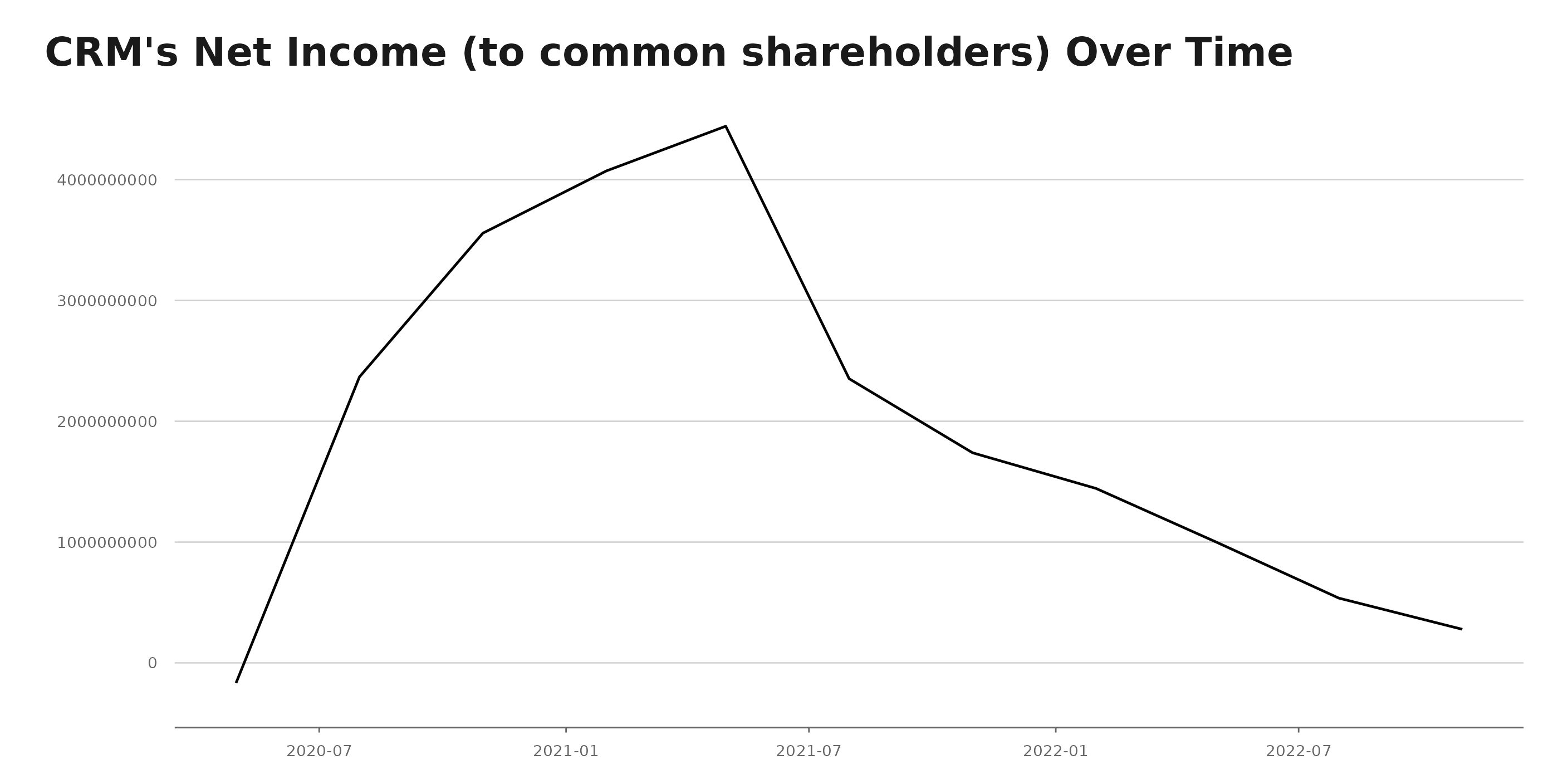
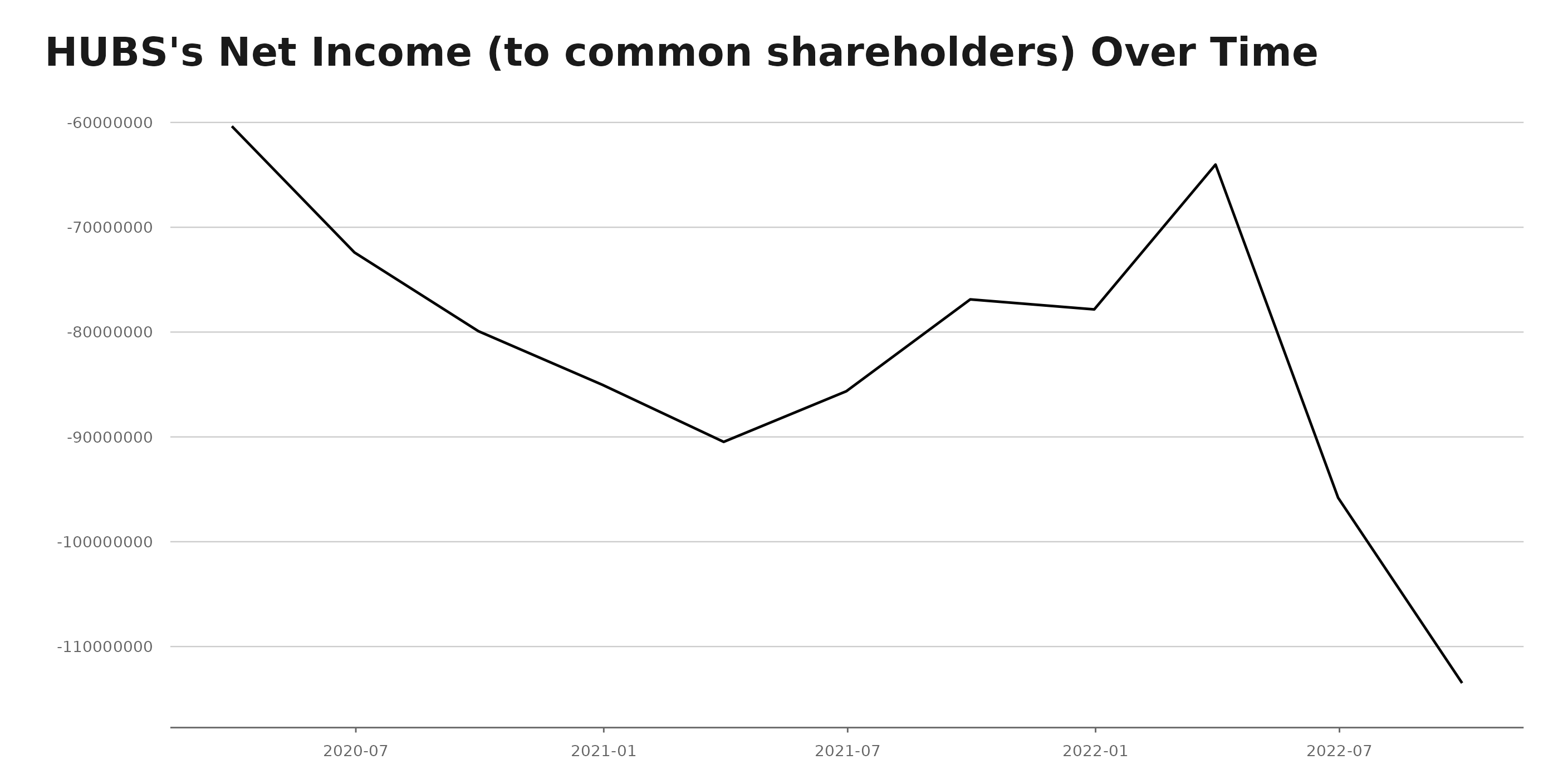
The distribution and growth rate of net income (to common shareholders) for CRM and HUBS varies significantly. CRM’s trailing twelve month net income (to common shareholders) spiked sharply to over 4 billion in the middle of 2021, but has fallen since; it now stands at approximately $278 million. On the other hand, HUBS’ trailing twelve month net income was -$110 million in the most recent quarter, compared to -$64 million in March of 2021 — essentially a doubling of losses. If Salesforce, a profitable company, is shedding employees and office space in the face of a recession in an environment where fundraising is harder, the outlook for a unprofitable competitors with smaller market share might be worse.

The chart below shows the income over time for CRM.

And here is the Net Income to common shareholders for Hubspot:

Net margin tells a similar story. For CRM, the Net Margin has declined since the summer of 2021, going from near 20% to its current level of near 1%. Hubspot, meanwhile, has seen its net margin go from -4% to -7% in this year. In sum, CRM may be in trouble — but it seems to be faring better than many of its competitors.


shares . Year-to-date, has declined -0.80%, versus a % rise in the benchmark S&P 500 index during the same period.


About the Author: Simit Patel

Simit Patel has 2 decades of investing experience applying a top-down approach starting with macroeconomics followed by price action technical analysis to find more winning trades.

More…

The post Salesforce Announces Layoffs, Gets Mocked by Burry — But Still Looks Better Than its Rivals appeared first on StockNews.com

https://www.entrepreneur.com/article/442351