3 Stocks Delivering Strong Results in 2022 to Buy Now

The central bank might deliver another big rate hike next month to tame the persistently high inflation. However, the corporate earnings season has been gearing up investors’ sentiments. We believe fundamentally sound stocks Bristol-Myers Squibb (BMY), Energy Transfer (ET), and Kroger (KR), which have consistently reported strong financials this year, might be solid buys ahead of their earnings release. Keep reading.

shutterstock.com – StockNews

The central bank is widely expected to deliver a fourth straight 75-basis point rate hike next month as it fights sky-high inflation. Neel Kashkari, Minneapolis Federal Reserve President, said that the Federal Reserve might need to push its benchmark policy rate above 4.75% if underlying inflation does not stop rising.

Like the second quarter, investors had been anticipating an earnings apocalypse, but of the thirty-five companies that have reported third-quarter earnings as of October 17, 68.5% have beaten estimates, higher than the historical average of 66.2%, according to Refinitiv. Investors seem to be hopeful about the rest of the companies that are yet to report their quarterly earnings.

On the other hand, Goldman Sachs CEO David Solomon said that the United States might tip into a recession next year. Still, it is possible that inflation can be tamed without causing too much economic pain. Solomon said, “I could still see a scenario with a soft landing.”

Given this backdrop, fundamentally strong stocks Bristol-Myers Squibb Company (BMY), Energy Transfer LP (ET), and The Kroger Co. (KR), which have consistently reported strong financials this year, could be ideal buys ahead of their earnings release. Moreover, these are excellent dividend-paying companies.

Bristol-Myers Squibb Company (BMY)

BMY engages in the discovery, development, licensing, manufacture, and sale of biopharmaceutical products globally. The company’s offerings include products for hematology, oncology, cardiovascular, immunology, fibrotic, neuroscience, and COVID-19 diseases.

On October 4, BMY and Autolus Therapeutics plc (AUTL), a biopharmaceutical company developing next-generation programmed T cell therapies, entered into an agreement that grants BMY access to incorporate Autolus’ proprietary RQR8 safety switch into an initial set of selected cell therapy programs on a target-by-target basis for the treatment of cancer. This should help in BMY’s further developments in this space.

On September 16, BMY received approval from the European Commission for the LAG-3-blocking antibody combination, Opdualag, to treat unresectable or metastatic melanoma with tumor cell PD-L1 Expression < 1%.

This approval would enable the treatment of all adults and adolescents above 12 years of age in all European Union member states, as well as Iceland, Liechtenstein, and Norway, which might boost the revenue stream of the company.

On September 14, BMY declared a quarterly dividend of $0.54 per share and a quarterly dividend of $0.50 per share on the company’s $2.00 convertible preferred stock, payable on November 1, 2022, and December 1, 2022, respectively. It pays a $2.16 per share dividend annually, which translates to a 3.03 % yield on the current price. The company’s dividends have grown at a CAGR of 9.6% over the past three years.

During the second quarter ended June 30, BMY’s total revenues increased 1.6% year-over-year to $11.89 billion. The company’s non-GAAP net earnings attributable to BMY amounted to $4.15 billion, up 13.2% year-over-year, while the non-GAAP EPS improved 18.4% from the prior-year quarter to $1.93.

Analysts expect BMY’s EPS for the fiscal year ending December 2023 to be $7.98, indicating a 6.2% year-over-year growth. The company’s revenue is expected to increase by 3.2% from the prior year to $47.55 billion next year. The company has an impressive earnings surprise history, as it surpassed the consensus EPS estimates in each of the trailing four quarters.

Over the past year, BMY has gained 26% to close its last trading session at $71.74. It has gained 15.1% year-to-date.

BMY’s POWR Ratings reflect this promising outlook. The company has an overall rating of A, which translates to Strong Buy in our proprietary rating system. The POWR Ratings assess stocks by 118 different factors, each with its own weighting.

BMY has an A grade for Value and a B for Growth and Quality. It is ranked #5 out of 161 stocks in the Medical – Pharmaceuticals industry. 

Beyond what we’ve stated above, we have also given BMY grades for Momentum, Stability, and Sentiment. Get all BMY ratings here.

Energy Transfer LP (ET)

ET owns and operates a portfolio of energy assets in the United States. The company sells natural gas to independent power plants, electric utilities, local distribution, and industrial end-users.

On August 24, ET announced that its subsidiary Energy Transfer LNG Export, LLC, had entered into an LNG Sale and Purchase Agreement with Shell NA LNG LLC about its Lake Charles LNG Project. This agreement should help the company meet the increasing demand for LNG and boost its revenues.

Earlier in August, ET announced that it had completed the sale of its 51% interest in Energy Transfer Canada ULC to a joint venture that includes Pembina Pipeline Corporation and global infrastructure funds managed by KKR. The asset sale is expected to enable the company to redeploy capital within its U.S. footprint.

On July 26, ET declared a quarterly dividend of $0.23 per share, paid out on August 19. Its annual dividend of $0.92 yields 7.86% on current prices. Moreover, the company’s 4-year average yield stands at 10.45%.

During the fiscal second quarter ended June 30, ET’s revenue increased 71.8% year-over-year to $25.95 billion. The company’s operating income grew 32.3% year-over-year to $2.11 billion. The company’s net income attributable to partners increased 111.8% from the prior-year period to $1.33 billion, while its net income per common unit for the same quarter rose 95% year-to-year to $0.39.

ET’s revenue is expected to increase 44.3% year-over-year to $24.04 billion in the third fiscal quarter ended September 2022. Its EPS is likely to rise 82.9% year-over-year to $0.37 for the same quarter. Additionally, the company has surpassed EPS estimates in three of four trailing quarters, which is impressive.

ET’s shares have gained 43.3% year-to-date to close its last trading session at $11.79. The stock has gained 16.8% over the last three months.

ET’s strong fundamentals are reflected in its POWR Ratings. The company has an overall rating of B, which translates to Buy in our proprietary rating system. It also has an A grade for Momentum and a B grade for Value. Among the 94 stocks in the B-rated Energy – Oil & Gas industry, it is ranked #31.

To see additional ratings for ET for Growth, Quality, Sentiment, and Stability, click here.

The Kroger Co. (KR)

KR operates as a retailer in the United States. The company operates combination food and drug stores, multi-department stores, marketplace stores, and price-impact warehouses.

On October 18, KR announced the official opening of its newest Customer Fulfillment Center in Romulus, Michigan, which will leverage advanced robotics technology and creative solutions to redefine the customer experience for customers in the greater Detroit area. The expansion should help drive up the revenue of the company over time.

On October 14, KR and Albertsons Companies (ACI) announced that they have entered into a definitive agreement under which the companies will merge, aiming to expand the customer reach and improve proximity to deliver fresh and affordable food to approximately 85 million households with a premier omnichannel experience. The company expects this collaboration to drive profitable growth and sustainable value for all.

On September 15, KR declared a quarterly dividend of 26 cents per share to be paid to shareholders on December 1, 2022. Its annual dividend of $1.04 yields 2.41% on prevailing prices. The company’s dividend payouts have increased at a 15.3% CAGR over the past three years and a 12.9% CAGR over the past five years. The company has a record of 15 years of consecutive dividend growth.

KR’s sales increased 9.3% year-over-year to $34.64 billion in the fiscal second quarter ending August 13. Its operating profit increased 13.7% year-over-year to $954 million. The company’s adjusted EBITDA grew 10.9% from the year-ago value to $7.63 billion, while its adjusted EPS improved 12.5% year-over-year to $0.90.

Street expects KR’s revenue for the fiscal year ending January 2023 to come in at $148.32 billion, indicating an increase of 7.6% year-over-year. The company’s EPS is expected to grow 10.9% year-over-year to $4.08 in the same year. Additionally, as the company surpassed the consensus EPS estimates in each of the trailing four quarters, it has an impressive earnings surprise history.

KR has gained 10.1% over the past year to close the last trading session at $43.16. The stock gained 2.5% intraday yesterday.

It is no surprise that KR has an overall rating of A, translating to Strong Buy in our POWR Ratings system. The stock has a B grade in Quality, Value, and Growth. It is ranked #9 of 38 stocks in the A-rated Grocery/Big Box Retailers industry.

Click here to access additional POWR Ratings for KR for Momentum, Stability, and Sentiment.


BMY shares rose $0.01 (+0.01%) in premarket trading Wednesday. Year-to-date, BMY has gained 18.65%, versus a -21.43% rise in the benchmark S&P 500 index during the same period.


About the Author: Kritika Sarmah

Her interest in risky instruments and passion for writing made Kritika an analyst and financial journalist. She earned her bachelor’s degree in commerce and is currently pursuing the CFA program. With her fundamental approach, she aims to help investors identify untapped investment opportunities.

More…

The post 3 Stocks Delivering Strong Results in 2022 to Buy Now appeared first on StockNews.com

https://www.entrepreneur.com/article/437509


Get in on These 3 Stocks Before They Explode

With the stock market’s recent slump against the backdrop of aggressive rate hikes, there are some lucrative opportunities for investors to grab. We believe fundamentally strong stocks Valero Energy (VLO), Tripadvisor (TRIP), and Rambus (RMBS) are solid buys at their current price levels to benefit from their rebound. Read on….

shutterstock.com – StockNews

The Fed’s hawkish stance to deal with the stubborn inflation has led to massive sell-offs in the stock market. The S&P 500 index is down more than 22% this year. The central bank expects to maintain its approach until it hits a terminal rate of 4.6%, which could hurt the stock market further.

However, the market sell-offs have created some lucrative investment opportunities. Since stark rallies typically follow market bottoms, this might be the opportune time to pick quality stocks with solid rebound potential.

According to a recent Wells Fargo Investment Institute study, “over the past 30 years, missing the best 20 days (based on S&P 500 Index returns from September 1, 1992 through August 31, 2022) took the annual average return from 7.8% per year down to 3.2%, which was less than the 3.3% average inflation rate over that same period.”

Hence, we believe quality stocks Valero Energy Corporation (VLO), Tripadvisor, Inc. (TRIP), and Rambus Inc. (RMBS) are solid buys at their current price levels. These stocks might witness big rebounds, given their solid fundamentals and growth prospects.

Valero Energy Corporation (VLO)

VLO manufactures, markets, and sells transportation fuels and petrochemical products. The company operates through its three broad segments – Refining; Renewable Diesel; and Ethanol.

In September, VLO announced that it had reduced its debt by approximately $1.25 billion through its previously announced tender offers for various series of senior notes. The company also declared a collective debt reduction of about $3.60 billion through transactions in the second half of 2021 and the first half of 2022.

In July, VLO declared a quarterly dividend of $0.98 per share on its common stock. This was payable to shareholders on September 1, reflecting the company’s ability to pay back its shareholders.

For the fiscal second quarter that ended June 30, VLO’s revenues increased 86.1% year-over-year to $51.64 billion. The adjusted net income attributable to VLO stockholders rose significantly from the prior-year quarter to $4.61 billion. Adjusted earnings per common share improved significantly from the prior-year period to $11.36.

VLO’s net income and EPS have grown at 40.3% and 41.8% CAGRs over the past three years. The consensus EPS estimate of $6.99 for the fiscal third quarter that ended September 2022 indicates a 472.8% year-over-year improvement.

The consensus revenue estimate for the same period of $43.62 billion indicates a 47.8% year-over-year growth. In addition, VLO has an impressive surprise earnings history, as it has topped consensus EPS estimates in each of the trailing four quarters.

The stock has gained 46.8% over the past year and 53.8% year-to-date to close its last trading session at $115.50.

VLO’s strong fundamentals are reflected in its POWR Ratings. The stock has an overall rating of A, equating to a Strong Buy in our proprietary rating system. The POWR Ratings are calculated by considering 118 different factors, with each factor weighted to an optimal degree.

VLO has a Growth and Momentum grade of A and a Value and Quality grade of B. In the 94-stock Energy – Oil & Gas industry, it is ranked #8. The industry is rated B.

Click here to see the additional POWR Ratings for VLO (Stability and Sentiment).

Tripadvisor, Inc. (TRIP)

Online travel company TRIP operates through its two broad segments – Hotels, Media & Platform and Experiences & Dining. The company operates its branded websites and manages other travel media brands.

In September, TRIP announced the launch of its in-house creative and content studio Wanderlab. This is expected to connect the right advertisers with the right consumers, which should benefit the company.

In August, it was reported that the Weather Channel digital properties had teamed with TRIP and USA TODAY to offer consumers premium subscription bundles. Brad Soroca, VP of Business Development at TRIP, said, “With the continued evolution of travel subscription services, it was the perfect opportunity for two leading brands in adjacent spaces to join together to bring incredible service and value to travelers.”

TRIP’s revenue increased 77% year-over-year to $417 million in the fiscal second quarter that ended June 30. Non-GAAP net income and non-GAAP EPS came in at $54 million and $0.37, up substantially from their negative year-ago values. Free cash flow rose 152% from the prior-year period to $282 million.

Analysts expect TRIP’s EPS to improve 138.9% year-over-year to $0.38 in the fiscal third quarter (ended September 2022). Likewise, Street expects the company’s revenue for the same quarter to increase 46.6% year-over-year to $444.04 million.

Over the past three months, the stock has gained 34.4%. It has gained 5.2% over the past five days to close its last trading session at $23.30.

It’s no surprise that TRIP has an overall B rating, which translates to Buy in our POWR Ratings system. It also has an A grade for Growth and Quality. It is ranked #5 in the 63-stock Internet industry.

To see the additional POWR Ratings for Value, Momentum, Stability, and Sentiment for TRIP, click here.

Rambus Inc. (RMBS)

RMBS offers semiconductor products internationally. The company provides DDR memory interface chips to module manufacturers and OEMs, silicon IP that moves data in advanced applications, and physical interface and digital controller IP to offer industry-leading, integrated memory and interconnect subsystems.

Last month, RMBS declared that it had initiated an accelerated share repurchase program with Wells Fargo Bank, National Association, to repurchase an aggregate of approximately $100 million of its common stock. This underscores the company’s faith in its prospects and ability for long-term shareholder returns.

In July, the company announced an expansion of its DDR5 memory interface chip portfolio with the introduction of the Rambus SPD (Serial Presence Detect) Hub and Temperature Sensor. The portfolio enhancements should drive the company’s revenue.

For the fiscal second quarter that ended June 30, RMBS’ total revenue increased 42.7% year-over-year to $121.13 million. Net income and net income per share came in at $35.02 million and $0.31, up 213.6% and 210% from the prior-year quarter, respectively.

RMBS’ revenue has grown at an 18.7% CAGR over the past three years. Street EPS and revenue estimates of $0.13 and $140.90 million for the fiscal third quarter (ended September 2022) indicate 322.2% and 23.3% year-over-year rises, respectively.

RMBS’ shares have gained 19.1% over the past year and 19.9% over the past three months to close its last trading session at $26.45.

This promising prospect is reflected in RMBS’ POWR Ratings. The stock has an overall B rating, equating to Buy in our proprietary rating system.

RMBS has a Growth grade of A and a Sentiment and Quality grade of B. In the 93-stock Semiconductor & Wireless Chip industry, it is ranked #15. The industry is rated B.

In addition to the POWR Rating grades we’ve stated above, one can see RMBS ratings for Value, Momentum, and Stability here.


VLO shares fell $115.50 (-100.00%) in premarket trading Tuesday. Year-to-date, VLO has gained 58.18%, versus a -21.87% rise in the benchmark S&P 500 index during the same period.


About the Author: Anushka Dutta

Anushka is an analyst whose interest in understanding the impact of broader economic changes on financial markets motivated her to pursue a career in investment research.

More…

The post Get in on These 3 Stocks Before They Explode appeared first on StockNews.com

https://www.entrepreneur.com/article/437405


3 Big Reasons Why You Need To Consider Covered Call Trades

The combination of cheaper stock prices and more expensive option prices sets up ideally for a covered call trade in stocks like Apple.

shutterstock.com – StockNews

Stocks have fallen back to the lowest levels in the past year. Investors are torn as to whether this is once again the lows or if stocks may indeed head lower before rebounding. The VIX is nearing recent highs reflecting this uncertainty.

But rather than wait and see whether this is a buying opportunity, astute investors may want to consider taking advantage of the current conditions of cheaper stock prices and higher VIX to put on a lower risk covered call trade. Remember that VIX is simply a way to say the price of options.

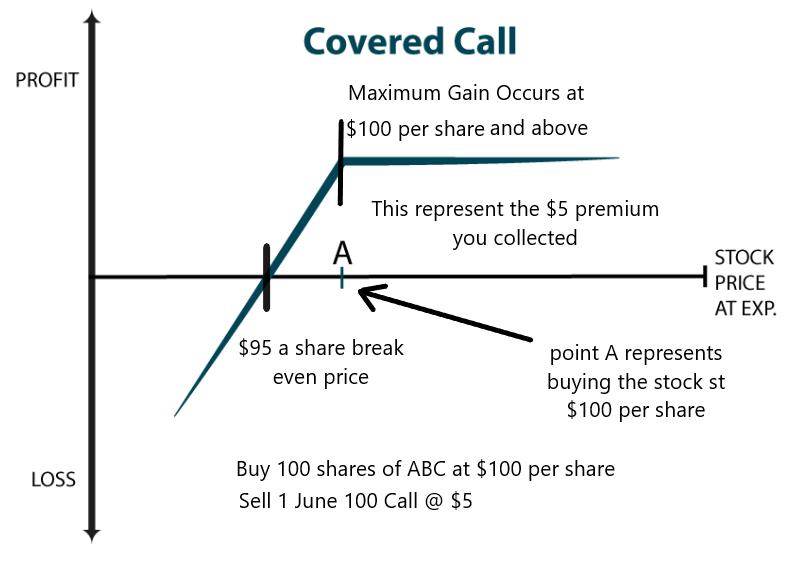
A covered call trade involves buying 100 shares of stock and simultaneously selling a call option against the stock to reduce the overall cost of the trade. This provides downside protection by the amount of the call premium received  but does cap the upside at the strike price of the call option sold.

It is an ideal trade for those who are neutral to slightly bullish on stocks. Here are three big reasons why this strategy may be a good way to take advantage of more subdued stock returns in 2023.

Stocks Lower/ Calls Higher

Stocks are no doubt lower than they were a year ago. The S&P 500 has fallen over 20% in that time frame while the NASDAQ 100 and Russell 2000 have fallen even further. Implied volatility (IV), which measures the price of options, is significantly higher than it was 12 months back. The VIX is a well-known and general gauge of option prices on the S&P 500. It has virtually doubled from 16 to 32 over the past 365 days. This means options prices, both calls and puts, are much more expensive now than back then.

Doing a covered call trade of buying stock and selling calls benefits from both the lower stock prices and higher call prices.

Upside Likely Limited

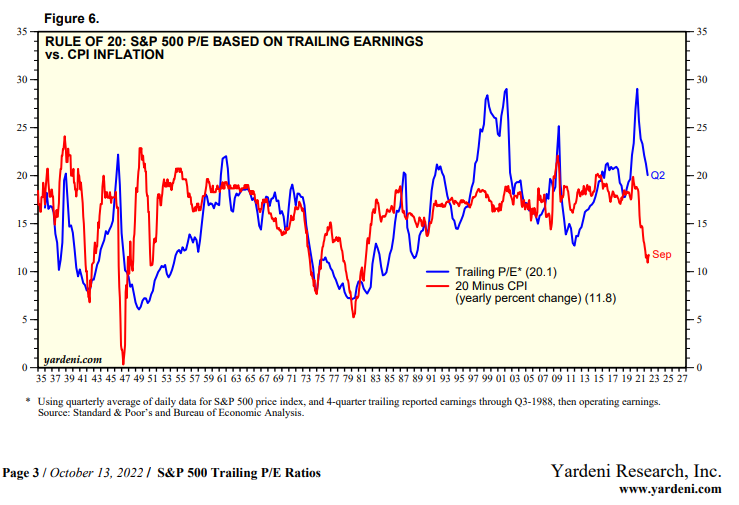
Given the recent red-hot rise in interest rates, valuation multiples will likely be capped for the foreseeable future. The 10-year Treasury yield just closed above 4% compared to well under 2% just last year. The Consumer Price Index, or CPI, is at 40-year highs of over 8%. The chart below shows how much inflation has risen recently using the Rule of 20 (20 minus CPI rate of currently 8.2%). This rise in inflation and interest rates has brought the trailing P/E down from almost 30 to nearly 20.

With the Fed likely to raise rates again and inflation unlikely to slow substantially, P/E multiples should continue to be somewhat subdued for the next several quarters.  This will serve to provide a serious headwind for stock prices in the coming months, making call sales even more beneficial as a hedging mechanism.

Money For Nothing

Covered call trades have the combination of long stock and short calls to produce potential profits. If the stock rises, the long stock position will make good money while the short call position loses less. Most investors get that idea.

But if the stock position goes nowhere, the covered call position will still do quite well since the short call option will do good as time premium erodes while the go-nowhere stock remains near break-even.

The chart above shows how the covered call trade is profitable if the stock remains around the $100 per share initial purchase price because of the $5 initial premium collected as part of the covered call trade.

Let’s take a walk through a real-time covered call trade in Apple (NASDAQ:AAPL) to see just how much the recent drop in stock prices and increase in covered call prices can provide a potent one-two punch to the covered call strategy. The same sort of rationale can be applied in a similar manner to different stocks or ETFs.

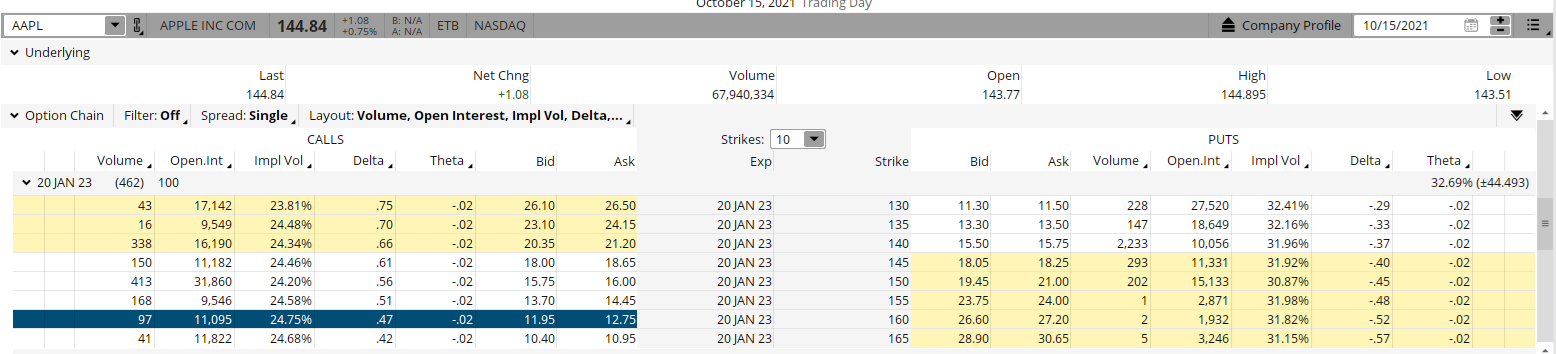
Looking back at Apple stock a year ago, we can see shares closed at $144.84. The January $160 calls (462 days to expiration) were at $12.35 as seen in the option montage below. Doing a covered call trade of buying AAPL stock and selling a Jan $160 call would cost $132.49 ($144.84 – $12.35).

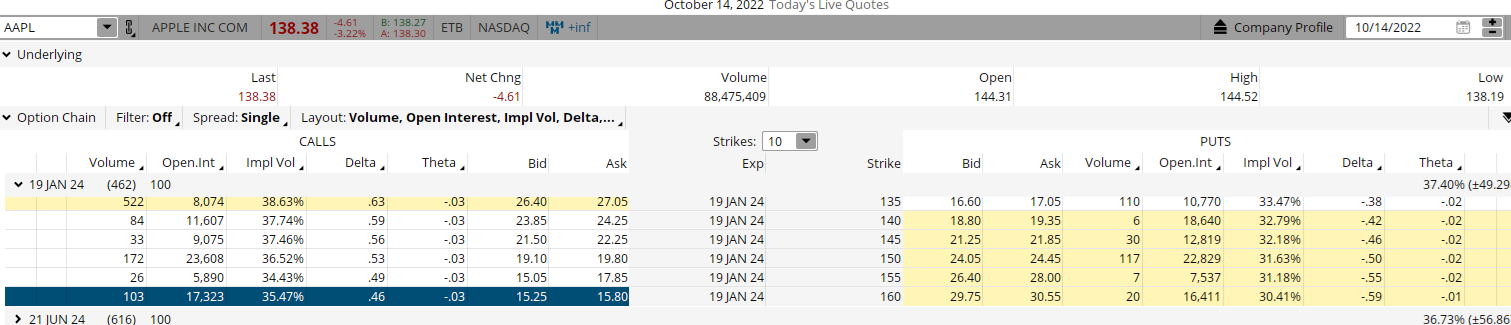
Looking at the close on Friday, AAPL stock closed at $138.38. The January $160 calls (462 days to expiration) were at $15.50 as seen in the montage below. Doing a covered call trade now would cost $122.88 ($138.38 – $15.50).

Comparing the two is shown in the table below

then now change
stock 144.84 138.38 -6.46
call 12.35 15.5 3.15
0
buy write 132.49 122.88 -9.61

Even though the price of the stock dropped by nearly 6 1/2 points, the price of the $160 calls actually increased by over 3 points. Putting those two notions together, the cost of the covered call trade fell by $9.61 (buying cheaper stock and selling more expensive calls).

I put together the table below to highlight some of the pertinent points.

iv 24.75 35.47
call delta 47 46
dte 462 462
dp 8.53% 11.20%
ur 20.76% 30.21%

Implied volatility (IV) shot higher by nearly 11 vol points from 24.75 to 35.47. This is the reason why the call price rose by over 3 points even with AAPL down significantly. The delta of the calls remained pretty much unchanged due to the rise in IV as well. Buying the stock (100 delta) and selling the 46 delta calls reduces the overall delta to 54, or roughly half of just owning AAPL stock outright.

Days to expiration (DTE) was the same in both examples at 462. Downside protection (dp) of 11.20% -or how far the stock can fall until breakeven- was significantly better now by 2.67% compared to a year ago. Upside return (ur) of 30.21%-or how much we would make if AAPL is above $160 next January-also rose by almost 9.5% if AAPL stock closes above the short $160 strike.

Investors who are more risk adverse can sell a lower strike call to bring in more call premium and reduce the overall risk even further. More bullish traders may want to sell higher strike calls at a lower premium that allows more potential upside.

The combination of a lower stock price and a higher call price means implementing a covered call trade of buying the stock cheaper and selling the call option more expensive can lower your downside risk and also increase your upside return. Traders and investors alike who are looking to take a lower risk guardedly bullish position with still solid upside return should seriously consider a covered call strategy. This is especially true given that stocks are currently at the lows and call prices are near the highs.

POWR Options

What To Do Next?

If you’re looking for the best options trades for today’s market, you should check out our latest presentation How to Trade Options with the POWR Ratings. Here we show you how to consistently find the top options trades, while minimizing risk.

If that appeals to you, and you want to learn more about this powerful new options strategy, then click below to get access to this timely investment presentation now:

How to Trade Options with the POWR Ratings

All the Best!

Tim Biggam

Editor, POWR Options Newsletter


AAPL shares closed at $138.38 on Friday, down $-4.61 (-3.22%). Year-to-date, AAPL has declined -21.75%, versus a -23.83% rise in the benchmark S&P 500 index during the same period.


About the Author: Tim Biggam

Tim spent 13 years as Chief Options Strategist at Man Securities in Chicago, 4 years as Lead Options Strategist at ThinkorSwim and 3 years as a Market Maker for First Options in Chicago. He makes regular appearances on Bloomberg TV and is a weekly contributor to the TD Ameritrade Network “Morning Trade Live”. His overriding passion is to make the complex world of options more understandable and therefore more useful to the everyday trader. Tim is the editor of the POWR Options newsletter. Learn more about Tim’s background, along with links to his most recent articles.

More…

The post 3 Big Reasons Why You Need To Consider Covered Call Trades appeared first on StockNews.com

https://www.entrepreneur.com/article/437299


Investor Alert: We Have NOT Hit Bottom!

Bears have been in charge for 2 months and likely going to take a rest for a while. So even though we have seen some mighty bounces this week…and could see more in coming days…do not be fooled. We still have a long way to go til bottom is found. Why is that the case? How much lower will the S&P 500 (SPY) go? How to profit in the weeks ahead? Read on below for the answers.

shutterstock.com – StockNews

This was a very interesting week for stocks. Several times the premarket activity pointed one way…and then the script got flipped.

All in all, we have yet another week making new lows as inflation is not fading away, which means more vigilant Fed, which means greater likelihood of recession down the road, which means more downside for stocks.

Let’s recap the week that was followed by what is likely in store for investors in the weeks ahead. This comes hand in hand with updates to our trading plan to stay on the right side of the action.

Market Commentary

Stocks tested the lows again on Tuesday. This got bulls anxious to enjoy a healthy pre-market bounce on Wednesday as it seemed like a good buying opportunity.

NOT SO FAST!

Next comes the Producer Price Index (PPI) report showing inflation way to hot. In fact, it was the month over month increase that was 2X expectations that alarmed investors since it was the first monthly increase in three months.

The report showed that inflation is showing up ALL OVER THE PLACE. It is no longer just a matter of high energy prices. Inflation has become sticky in just about every category you could imagine.

Remember that PPI is the leading indicator of where the more widely followed CPI will be in the future. Meaning that inflation is “not going quietly into that good night” any time soon. And why that healthy premarket bounce immediately evaporated with yet another test of the S&P 500 (SPY) lows in store Wednesday.

A near repeat of the Wednesday action took place on Thursday. Stocks were ready for a big bounce in the premarket only for another too hot inflation report (CPI) to rain on everyone’s parade. This sparked another big sell off to new lows a tick under 3,500.

From there a big rally ensued to close the day at 3,669.91. Nothing about that bounce felt like it was built from sound logic and rationality. Everything about it felt like computers looking at 3,500 as a point of support and a place to have some fun for a few hours.

Also the groups that outperformed were some of the most defensive groups. The ones you cling to during a bear market and shed at the beginning of the next bull market.

Not surprisingly investors were splashed with cold water on Friday when they tried to rally once again only to discover a very weak Retail Sales report. Yes, it increased…but less than the rate of inflation meaning that consumer spending is slowing down.

All the above points to the fact that…THIS IS NOT BOTTOM

Let’s remember that the average bear market sees a 34% decline. That would equate to 3,180 this time around.

Now let’s remember that the overall market valuations before this bear market began were a historic high. Yes, the overall PE for the S&P 500 (SPY) was actually a notch higher at the start of 2022 then it was at the peak of the 1999 tech bubble.

Now let’s remember that one of the things to help find bottom is an accommodative Fed that is aggressively LOWERING rates to help restart the economy and restart investment. Yet right now the exact opposite is happening as the Fed has an aggressive rate hiking regime to tamp down the raging flames of inflation. (Read more about that in my recent article: Hidden Reason for Bloodier Bear Market).

Long story short, NOTHING about the Thursday bounce says the true and lasting bottom has been found. But yes, bear markets have some rip-roaring rallies along the way.

Some short…some long…but all NOT built to last.

When investors can finally appreciate the true virulence of the coming recession and approximate the full damage to the earnings outlook, then and only then can we start talking about a bottom forming.

Thus, at this stage we are still in wait and see mode to appreciate the outcome of high inflation + Hawkish Fed. That likely happens in the first half of 2023 because so far their rate hikes have not tamed inflation one damn bit. So they gotta keep pushing harder on higher rates to finally make the economy crack…thus reigning in inflation.

The outlook over the next 3-6 months is still quite bearish. However, in the short run it would not be surprising that 3,500 proves to be a point of support leading to a healthy bear market rally to unfold.

No…not the same kind of +18% “crazy train” rally we saw from mid June to mid August.

Perhaps more of a typical 5-10% rally could be in the offing as bears are getting a bit too comfortable having the upper hand for so long. Please consider using any of these ill-fated rallies to reinstate your bearish strategies.

Kind of like during a bull market we chant “buy the dip”. Well during a bear market it’s the opposite where we chant “fade the rally”.

That will prove to be valuable advice as this bear market likely bottoms somewhere between 2,800 and 3,200. Trade accordingly.

What To Do Next?

Discover my special portfolio with 9 simple trades to help you generate gains as the market descends further into bear market territory.

This plan has been working wonders since it went into place mid August generating a +5.69% gain as the S&P 500 (SPY) tanked -16.62%.

If you have been successfully navigating the investment waters in 2022, then please feel free to ignore.

However, if the bearish argument shared above does make you curious as to what happens next…then do consider getting my updated “Bear Market Game Plan” that includes specifics on the 9 unique positions in my timely and profitable portfolio.

Click Here to Learn More >

Wishing you a world of investment success!


Steve Reitmeister…but everyone calls me Reity (pronounced “Righty”)
CEO, Stock News Network and Editor, Reitmeister Total Return


SPY shares fell $0.21 (-0.06%) in after-hours trading Friday. Year-to-date, SPY has declined -23.83%, versus a % rise in the benchmark S&P 500 index during the same period.


About the Author: Steve Reitmeister

Steve is better known to the StockNews audience as “Reity”. Not only is he the CEO of the firm, but he also shares his 40 years of investment experience in the Reitmeister Total Return portfolio. Learn more about Reity’s background, along with links to his most recent articles and stock picks.

More…

The post Investor Alert: We Have NOT Hit Bottom! appeared first on StockNews.com

https://www.entrepreneur.com/article/437285


3 Stocks That Could Help You Retire Even in a Bear Market

September inflation report came in hotter than expected, increasing the chances of aggressive interest rate hikes later this year. Since analysts expect the economy to tip into a recession next year, dividend-paying stocks Walmart (WMT), Coca-Cola (KO), and Greif (GEF), which are backed by solid fundamentals, could help you plan your retirement even in a bear market. Read more….

shutterstock.com – StockNews

The Federal Reserve has undertaken a series of interest rate hikes in an effort to control the surging inflation. Despite rate hikes, inflation came in hotter than expected in September, rising 0.4% sequentially and 8.2% from a year ago. The report initially rattled financial markets, with stock market futures plunging and Treasury yields increasing.

The latest GDP estimate showed that the U.S. economy contracted in the first half of this year. JPMorgan Chase & Co. (JPM) Chief Executive Officer Jamie Dimon cautioned about the possibility of a recession, as persistent and elevated inflation could cause interest rates to rise higher than 4.5%.

The S&P 500 has slid more than 20% this year, signaling a bear market. However, there might still be opportunities left for long-term investors, as bear markets usually don’t continue for long.

Given this backdrop, fundamentally strong dividend stocks Walmart Inc. (WMT), The Coca-Cola Company (KO), and Greif, Inc. (GEF) could be solid investments to ensure a stable income stream. 

Walmart Inc. (WMT) 

WMT engages in the operation of retail, wholesale, and other units worldwide. The company operates through three segments: Walmart U.S.; Walmart International; and Sam’s Club. 

On October 3, WMT’s division Sam’s Club launched its expanded Photo and Customization Services, where its members are granted access to professional photographers, enhanced photo printing services, as well as made-to-order apparel and home goods, making Sam’s Club the first to do so in the warehouse space.

On September 28, WMT celebrated the grand opening of Walmart’s first of four Next Generation Fulfillment Centers in Joliet, Illinois. The new FC should improve the company’s operative capacity and might drive up its revenues.  

In February, WMT declared an annual dividend of $2.24 per share to be paid in four quarterly installments of $0.56 per share. Its annual dividend yields 1.69% on prevailing prices. The company’s dividend payouts have increased at a 1.9% CAGR over the past three and five years. The company has a record of 48 years of consecutive dividend growth. 

WMT’s total revenues came in at $152.86 billion for the second quarter that ended July 31, 2022, up 8.4% year-over-year. Its consolidated net income came in at $5.15 billion, up 17.9% year-over-year, while its EPS stood at $1.88, up 23.7% year-over-year. 

The consensus EPS estimate of $1.48 for the fiscal fourth quarter ending April 2023 represents a 14.1% improvement year-over-year. The consensus revenue estimate of $144.64 billion for the same quarter indicates a 3.1% increase from the prior-year period. The company has an impressive earnings surprise history, surpassing the consensus EPS estimates in three of the trailing four quarters. 

Over the past three months, the stock has gained 5.5% to close the last trading session at $132.28. 

WMT’s POWR Ratings reflect this promising outlook. The company’s overall A rating translates to Strong Buy in our proprietary rating system. The POWR Ratings assess stocks by 118 different factors, each with its own weighting. 

It has an A grade for Sentiment and a B for Growth, Stability, and Quality. It is ranked #6 out of 38 stocks in the A-rated Grocery/Big Box Retailers industry.  

To see the additional POWR Ratings for WMT for Value and Momentum, click here.  

The Coca-Cola Company (KO)  

Beverage company KO manufactures, markets, and sells various non-alcoholic beverages worldwide. The company provides sparkling soft drinks, flavored and enhanced water, sports drinks, juice, dairy and plant-based beverages, tea and coffee, and energy drinks. 

On September 29, KO and Molson Coors Beverage Company (TAP) announced that they had entered into an exclusive agreement to develop and commercialize Topo Chico Spirited, a line of spirit-based, ready-to-drink cocktails. The new product launch might bolster the company’s revenue stream. 

On July 21, KO declared a quarterly dividend of 44 cents per common share, which was payable to shareholders on October 3. Its annual dividend of $1.76 yields 3.15% on prevailing prices. The company’s dividend payouts have increased at a 3.1% CAGR over the past three years and a 3.6% CAGR over the past five years.  The company has a record of 59 years of consecutive dividend growth.

KO’s net operating revenue increased 11.8% year-over-year to $11.33 billion in the second quarter that ended July 1. Its non-GAAP gross profit grew 7.2% from the year-ago value to $6.67 billion, while its non-GAAP net income improved 4.4% year-over-year to $3.06 billion. The company’s non-GAAP net earnings per common share increased 2.9% from its year-ago value to $0.70. 

Street expects KO’s revenue to increase 8.9% year-over-year to $42.09 billion in the fiscal year 2022. Its EPS is estimated to grow 5.9% year-over-year to $2.46 in the same year. It has surpassed EPS estimates in all four trailing quarters, which is impressive.  
KO’s shares have gained 2.5% over the past five days to close the last trading session at $55.87. 

KO’s overall B rating equates to a Buy in our proprietary rating system. The stock has a B grade for Stability, Sentiment, and Quality. It’s ranked #17 out of 35 stocks in the A-rated Beverages industry.  

Click here to get the KO ratings for Growth, Value, and Momentum. 

Greif, Inc. (GEF) 

GEF is a global producer of industrial packaging products and services. The company operates through three segments: Global Industrial Packaging; Paper Packaging & Services; and Land Management.  

On August 30, GEF declared quarterly cash dividends of $0.50 per share on its Class A common stock and $0.75 per share on its Class B common stock, which was payable on October 1, 2022. Its annual dividend of $2.00 yields 3.37% on prevailing prices. The company’s dividend payouts have increased at a 2.2% CAGR over the past three years and a 2.3% CAGR over the past five years. 

For the fiscal third quarter that ended July 31, 2022, GEF’s net sales increased 8.8% year-over-year to $1.62 billion. The company’s operating profit increased 18.8% year-over-year to $205.70 million. Also, its net income rose 23.4% year-over-year to $146.10 million, while its class A common stock EPS grew 24.9% from its prior-year quarter to $2.36.  

For the fiscal year ending October 2022, GEF’s EPS and revenue are expected to increase 43.2% and 16% year-over-year to $8.02 and $6.45 billion, respectively. It has surpassed the consensus EPS estimates in each of the trailing four quarters. 

The stock has declined 1.4% over the past five days to close the last trading session at $59.34.

GEF’s POWR Ratings reflect this promising outlook. The stock has an overall rating of A, translating to a Strong Buy in our proprietary rating system. It also has a B grade for Value and Quality. Within the A-rated Industrial – Packaging industry, it is ranked #3 out of 22 stocks.  

Beyond what we’ve stated above, we have also given GEF grades for Growth, Momentum, Stability, and Sentiment. Get all GEF ratings here.


WMT shares were trading at $130.77 per share on Friday afternoon, down $1.51 (-1.14%). Year-to-date, WMT has declined -8.54%, versus a -23.65% rise in the benchmark S&P 500 index during the same period.


About the Author: Kritika Sarmah

Her interest in risky instruments and passion for writing made Kritika an analyst and financial journalist. She earned her bachelor’s degree in commerce and is currently pursuing the CFA program. With her fundamental approach, she aims to help investors identify untapped investment opportunities.

More…

The post 3 Stocks That Could Help You Retire Even in a Bear Market appeared first on StockNews.com

https://www.entrepreneur.com/article/437280


2 Tech Stocks to Consider Buying Over NVIDIA

Semiconductor companies, such as NVIDIA Corporation (NVDA), are struggling amid the market downturn, export restrictions, and slowing demand. However, the broader technology market is expected to endure short-term uncertainties and keep growing due to continued digitization. Hence, we think quality technology stocks Cisco (CSCO) and Hackett Group (HCKT) are better investments than NVDA. Keep reading….

shutterstock.com – StockNews

NVIDIA Corporation (NVDA) provides graphics, computation, and networking solutions globally. On October 7, new restrictions were imposed on chipmakers, including NVDA, to prevent technology from advancing China’s military power. The companies must now obtain a license from the Commerce Department to export advanced chips and chip-making equipment.

The above restrictions have closely followed last month’s announcement in which the White House blocked NVDA from exporting high-end graphics chips to China due to similar concerns. The company said the ban impacted $400 million in potential sales to China.

For the fiscal 2022 second quarter, NVDA’s non-GAAP net income and EPS declined 50.7% and 51% year-over-year to $1.29 billion and $0.51, respectively. Also, analysts expect its EPS and revenue for the fiscal 2023 third quarter (ending October 2022) to come in at $0.71 and $5.85 billion, indicating a 39.3% and 17.6% year-over-year decline, respectively. The stock has plummeted 59.9% year-to-date.

The recently released jobs data for September seems to have paved the way for another significant interest rate increase by the Federal Reserve during its meeting next month. This indicates another headwind for tech companies.

Despite the current headwinds, demand for ubiquitous tech goods and services is expected to keep growing amid the increasing adoption of cloud computing, artificial intelligence (AI), virtual reality (VR), the internet of things (IoT), and increasing automation of business processes.

The global technology market is expected to grow at a CAGR of 25.7% over the next five years to reach $3.17 billion by 2027, with the United States expected to strengthen its leadership in this space.

Hence, we suggest investing in fundamentally strong technology stocks Cisco Systems, Inc. (CSCO) and Hackett Group Inc. (HCKT) instead of NVDA for better risk-adjusted returns.

Cisco Systems, Inc. (CSCO)

CSCO designs, manufactures, and sells internet protocol-based networking and other products across networking, security, collaboration, applications, and the cloud. The company operates through three geographic segments: the Americas; Europe, the Middle East, and Africa (EMEA); and Asia Pacific, Japan, and China (APJC).

On October 5, CSCO announced an expansion of its existing SD-WAN partnership with Microsoft (MSFT) to allow customers to sidestep the public internet and MPLS to send their Cisco SD-WAN traffic over the latter’s Azure cloud backbone. This is expected to add value by providing speed and cost benefits.

For the fiscal year 2022 ended July 31, CSCO’s revenue increased 3.6% year-over-year to $51.6 billion, while its operating income increased 8.9% year-over-year to $13.97 billion. The company’s non-GAAP net income increased 3.7% year-over-year to $14.10 billion, which translates to an EPS of $3.36, up 4.3% year-over-year.

Analysts expect CSCO’s revenue and EPS for the fiscal year 2023 to increase 5% and 5.1% year-over-year to $54.11 billion and $3.53, respectively. The company has an impressive earnings surprise history, surpassing the consensus EPS estimates in each of the trailing four quarters.

Over the past month, CSCO’s stock slumped 9.6% to close the last trading session at $40.27.

CSCO’s overall B rating equates to a Buy in our POWR Ratings system. The POWR Ratings assess stocks by 118 different factors, each with its own weighting.

It has an A grade for Quality. Within the Technology – Communication/Networking industry, it is ranked #5 out of 49 stocks.

Click here to see the additional POWR Ratings for Growth, Momentum, Stability, Sentiment, and Value for CSCO.

Hackett Group Inc. (HCKT)

HCKT operates as a business and technology consulting firm. The company offers benchmarking, executive advisory, business transformation, and cloud enterprise application implementation.

On September 22, HCKT announced the launch of a new Market Intelligence Service for software and service providers and users. The service will measure software and service providers’ ability to deliver business value and their unique capabilities to help companies achieve Digital World Class performance.

HCKT believes the new service will be a powerful and attractive value proposition for all C-level executives and their respective teams.

HCKT’s total revenue increased 3.7% year-over-year to $75.93 million for the second quarter of 2022. The company’s total assets stood at $217.89 million as of July 1, 2022, compared to $207.54 million as of December 31, 2021.

Analysts expect HCKT’s revenue and EPS for the fiscal year 2022 to increase 6.6% and 10.4% year-over-year to $297.20 million and $1.45, respectively. Also, the company has surpassed the consensus EPS estimates in each of the trailing four quarters.

HCKT’s stock has slumped 2.4% over the past month to close the last trading session at $19.05.

HCKT’s promising outlook is reflected in its overall POWR Rating of A, which translates to a Strong Buy in our proprietary rating system. It also has a grade of A for Sentiment and Quality and a B for Value and Stability.

HCKT tops the list of 10 stocks in the A-rated Outsourcing – Tech Services industry.

Click here for an additional rating of HCKT (Growth and Momentum).


NVDA shares were trading at $116.70 per share on Monday afternoon, down $4.06 (-3.36%). Year-to-date, NVDA has declined -60.29%, versus a -23.32% rise in the benchmark S&P 500 index during the same period.


About the Author: Santanu Roy

Having been fascinated by the traditional and evolving factors that affect investment decisions, Santanu decided to pursue a career as an investment analyst. Prior to his switch to investment research, he was a process associate at Cognizant.With a master’s degree in business administration and a fundamental approach to analyzing businesses, he aims to help retail investors identify the best long-term investment opportunities.

More…

The post 2 Tech Stocks to Consider Buying Over NVIDIA appeared first on StockNews.com

https://www.entrepreneur.com/article/436960


Don’t Get Rid of These 2 Cable Provider Stocks Just yet

Demand for digital entertainment has increased substantially over the past two years. As cable remains the dominant method for internet connection, cable providers should benefit. Although cable provider stocks Comcast Corporation (CMCSA) and Charter Communications (CHTR) witnessed price declines amid the broader market sell-off this year, we think these stocks are still worth owning. Keep reading….

shutterstock.com – StockNews

The entertainment industry saw a huge shift towards in-home entertainment during the COVID-19 pandemic. Over-the-top (OTT) streaming services, along with traditional TV and video games, saw huge demand. The total global entertainment and media revenue rose 10.4% in 2021 after a 2.3% dip in 2020. This industry is expected to grow at a 4.6% CAGR between 2022-2026.

In addition to the pandemic-led preferential changes, increased penetration of the internet, rapid technological progress, and massive use of social media as an aggregator platform are expected to bolster this industry’s growth prospects. And as cable remains the dominant method for connecting homes to the internet, cable providers should benefit amid the growing streaming services demand.

Although cable provider stocks Comcast Corporation (CMCSA) and Charter Communications, Inc. (CHTR) suffered significant declines in price amid the broader market sell-off this year, we think investors should not get rid of these stocks just yet.

Comcast Corporation (CMCSA)

CMCSA operates as a media and technology company worldwide through its Cable Communications; Media; Studios; Theme Parks; and Sky segments.

In October, CMCSA opened a new Xfinity store in Burlington to meet the needs of its local customers. The new store provides a complete line of Xfinity products and services ranging from smart home security solutions to Xfinity Mobile and Supersonic WiFi. This should help the company expand its revenue stream.

CMCSA’s revenue increased 5.1% year-over-year to $30.02 billion for the second quarter that ended June 30, 2022. Its operating income came in at $6.37 billion, up 15.6% year-over-year. Also, its adjusted net income came in at $4.51 billion, up 14.3% year-over-year, while its adjusted EPS stood at $1.01, up 20.2% year-over-year.

Street expects CMCSA’s revenue to increase 4.5% year-over-year to $121.66 billion in fiscal 2022, while its EPS is expected to grow 11.4% year-over-year to $3.60 in the same period. It also surpassed EPS estimates in all four trailing quarters.

The stock has slumped 2.6% intraday and 41.8% year-to-date to close the last trading session at $29.27.

CMCSA’s POWR Ratings reflect its promising outlook. The stock has an overall grade of B, equating to a Buy in our proprietary rating system. The POWR Ratings are calculated considering 118 different factors, with each factor weighted to an optimal degree.

It also has a B grade for Value and Quality. Within the Entertainment – TV & Internet Providers industry, it is ranked first among nine stocks.

Click here for the additional POWR Ratings for Growth, Momentum, Stability, and Sentiment for CMCSA.

Charter Communications, Inc. (CHTR)

CHTR operates as a broadband connectivity and cable operator company serving residential and commercial customers in the United States. It offers subscription-based video services, voice communications services, mobile services, and internet services.

During the second quarter ended June 30, 2022, CHTR’s total revenues increased 6.2% year-over-year to $13.60 billion. Net income attributable to CHTR increased 44.2% year-over-year to $1.47 billion, while its adjusted EBITDA came in at $5.51 billion, up 9.7% year-over-year.

Analysts expect CHTR’s EPS to increase 29.7% year-over-year to $8.43 in the quarter ended September 2022. Also, the consensus revenue estimate of $13.68 billion indicates a 4.3% year-over-year growth in the same period.

The stock has gained marginally intraday to close the last trading session at $314.97. It slumped 52.1% year-to-date.

It is no surprise that CHTR has an overall B rating, which equates to a Buy in our proprietary rating system. It also has a B grade for Growth. The stock is ranked second in the same industry.

To access CHTR’s additional ratings for Value, Momentum, Sentiment, Stability, and Quality, click here.


CMCSA shares were trading at $29.33 per share on Monday afternoon, up $0.06 (+0.20%). Year-to-date, CMCSA has declined -40.18%, versus a -23.12% rise in the benchmark S&P 500 index during the same period.


About the Author: Komal Bhattar

Komal’s passion for the stock market and financial analysis led her to pursue investment research as a career. Her fundamental approach to analyzing stocks helps investors identify the best investment opportunities.

More…

The post Don’t Get Rid of These 2 Cable Provider Stocks Just yet appeared first on StockNews.com

https://www.entrepreneur.com/article/436955


So Many Charts Are At Key Junctures That Patience Pays

Interest rates are nearing new highs which has pushed stocks to new lows. Now oil is looking higher as well. Time to take a technical take on the markets.

shutterstock.com – StockNews

So many markets are at critical areas on the charts. A quick walk through of each of these should help shed some insight into what price points to watch for bearish break-downs or bullish break-outs over the coming weeks. Interest rates will likely hold the key until after the next Fed meeting in early November.

The 10-year Treasury yield is fast approaching recent highs once again near the 4% level. An upside break-out would likely send stocks to new lows while a re-test of the 3.5% area would be bullish for equities.

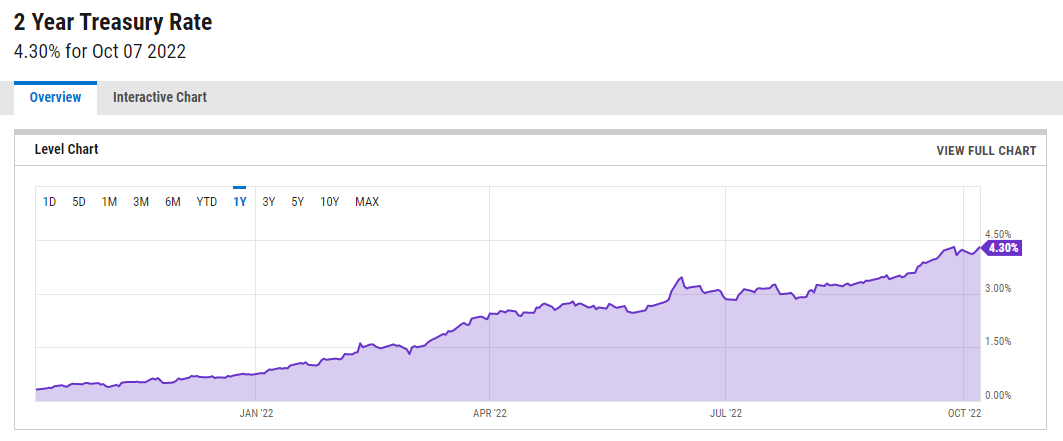
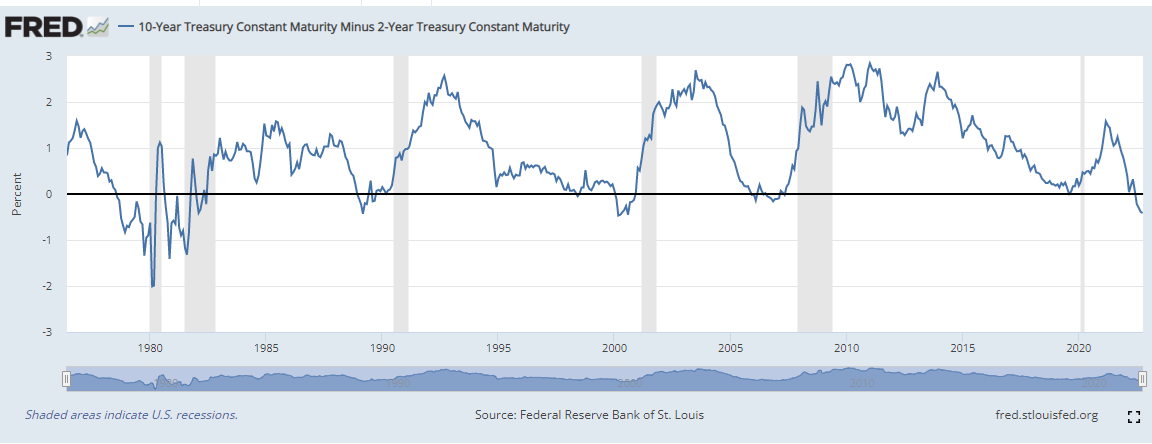
The 2-year Treasury yield is at a similar inflection point, albeit with a higher yield. A move past 4.5% would not be a welcome sight for stock traders. Note that the 2-10 is still deeply inverted, which is normally a recessionary sign.

The NASDAQ 100 (QQQ) is hovering right at major support near $270. Not yet oversold yet but definitely getting closer.

S&P 500 and Russell 2000 displaying identical patterns. Whether stocks hang on and bounce or breakdown and fall further remains to be seen.

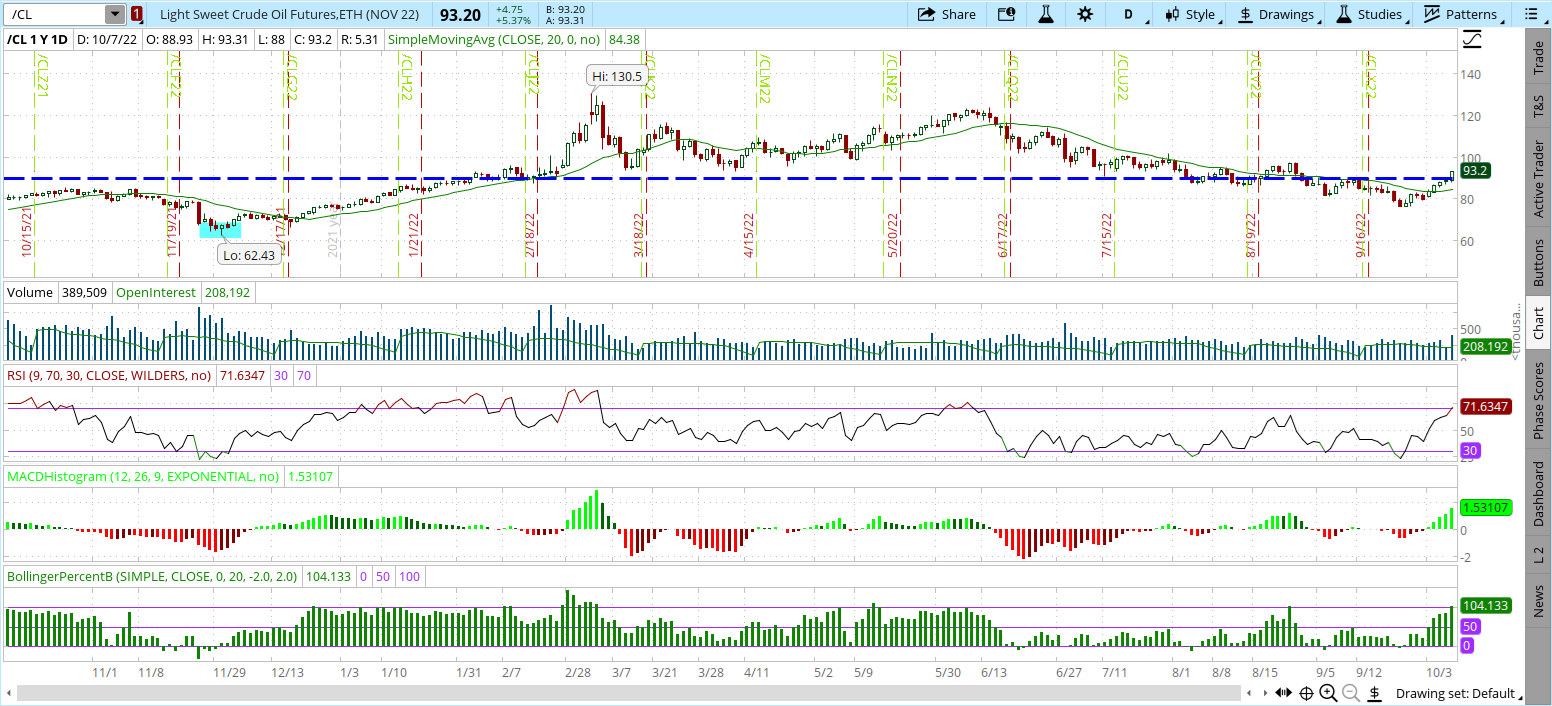
Gold and oil are also at major inflection points on the charts, although oil getting a little overbought short-term.

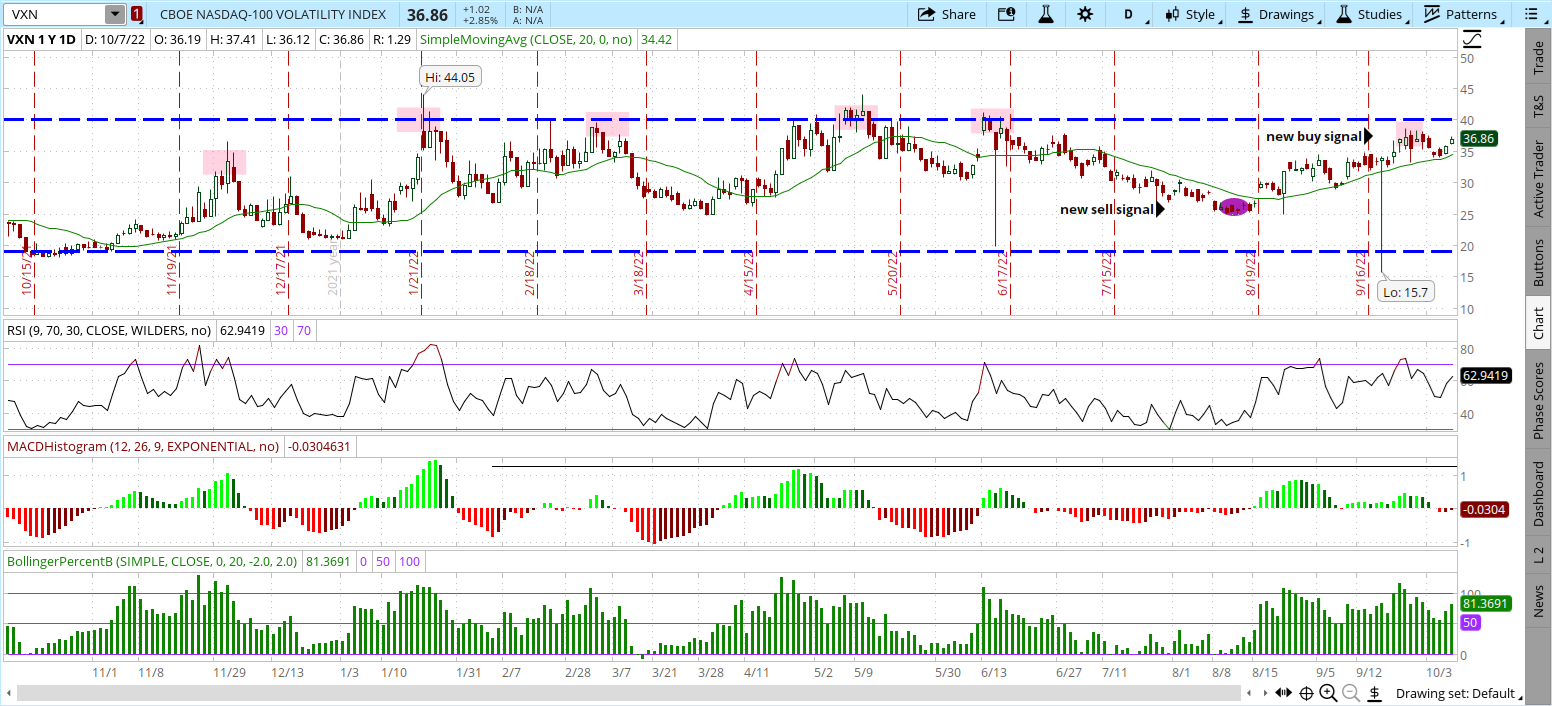
Implied volatility in stocks (VXN and VIX) is nearing the recent highs once again, although not quite there yet. Nervousness abounds as stocks fall towards recent lows.

How this ultimately plays out is anyone’s guess. I prefer to stay hedged and nimble, which is the approach that has been working well recently in the POWR Options portfolio. The recent semiconductor pairs trade -bearish lower rated WOLF and bullish higher rated AVGO- was closed in one day for a 19% profit.

POWR Options

What To Do Next?

If you’re looking for the best options trades for today’s market, you should check out our latest presentation How to Trade Options with the POWR Ratings. Here we show you how to consistently find the top options trades, while minimizing risk.

If that appeals to you, and you want to learn more about this powerful new options strategy, then click below to get access to this timely investment presentation now:

How to Trade Options with the POWR Ratings

All the Best!


Tim Biggam

Editor, POWR Options Newsletter


SPY shares closed at $362.79 on Friday, down $-10.41 (-2.79%). Year-to-date, SPY has declined -22.73%, versus a % rise in the benchmark S&P 500 index during the same period.


About the Author: Tim Biggam

Tim spent 13 years as Chief Options Strategist at Man Securities in Chicago, 4 years as Lead Options Strategist at ThinkorSwim and 3 years as a Market Maker for First Options in Chicago. He makes regular appearances on Bloomberg TV and is a weekly contributor to the TD Ameritrade Network “Morning Trade Live”. His overriding passion is to make the complex world of options more understandable and therefore more useful to the everyday trader. Tim is the editor of the POWR Options newsletter. Learn more about Tim’s background, along with links to his most recent articles.

More…

The post So Many Charts Are At Key Junctures That Patience Pays appeared first on StockNews.com

https://www.entrepreneur.com/article/436883


Why Q3 Earnings Season Will Majorly Impact Where the Market Heads Next…

In last week’s commentary, we discussed the importance of the mid-June lows for the S&P 500 (SPY) and the possibility of an undercut and then a rebound. In many ways, this is exactly what markets do -> frustrate the maximum amount of bulls and bears. Certainly, the bears were ebullient about this breakdown with many adding to shorts and puts, while many bulls probably capitulated. Now, we are more than 5% above these lows. Next on the docket is the September jobs report tomorrow and a CPI report next week. These will play a large role in determining the path and nature of this bear market rally. In today’s commentary, I want to discuss some lessons from the past 2 bear market rallies and how we are going to apply them to our portfolio. Read on below to find out more….

shutterstock.com – StockNews

(Please enjoy this updated version of my weekly commentary originally published October 6th, 2022 in the POWR Stocks Under $10 newsletter).

Over the last week, the S&P 500 (SPY) is up by 4.4%, although it was up more than 6% at some point, before some profit-taking into the September jobs report.

It’s been a broad-based rally with strength across the board. Not surprisingly, we are seeing the biggest moves in the most oversold sectors like metals, energy, and tech.

Why is the Market Rallying?

From a technical perspective, we have a double bottom, especially with the drop below support and quick recovery. As long as this double bottom is intact, we have to respect the bull case.

To be clear, this is a bounce. But given the strong technical setup and bearish sentiment, my gut tells me this is likely to turn into a bear market rally that lasts for weeks and tests important resistance levels on the upside.

And if the fundamentals evolve in a supportive manner, then the bear market rally can even turn into something more meaningful. Every bull market started as a bear market rally, but not every (or most) bear market rally turn into bull markets.

Again, I think we are at the same precipice. If this is a normal, cyclical recession, then buying at these levels is likely to be rewarded in six to twelve months’ time.

If this is more in the vein of 2002 or 2008, then stocks are probably in the middle innings of their descent. In that case, the S&P 500 is likely to break 3,000 and we could see the retracement of the entire rally that began in March 2020.

Earnings and Rates

So far, all of the market weakness can be attributed to inflation and higher rates pushing down multiples for the S&P 500 (SPY).That’s because earnings growth has managed to remain positive despite the numerous headwinds faced by the economy and increasing concerns of an imminent recession.

So, the Q3 earnings season is just beginning and will play a major role in determining whether the bounce can turn into a rally, or whether it will quickly roll over. Just to set the stage, analysts are forecasting 2.9% earnings growth for Q3.

This is a drastic cut from expectations of nearly 10% earnings growth in Q3 a couple of months ago. It’s largely a result of companies’ warnings and guidance lower given the numerous headwinds.

Objectively, it’s not bad. But, it’s an indication that markets are expecting some pain which creates the potential for an upside surprise. And, this is exactly what happened in Q2 and was one of the factors behind the 18% rally for the S&P 500 between mid-June and early August.

On the rate front, there are some subtle developments that are conflicting with the last CPI report which sent short-term and long-term rates, shooting up to new highs.

In essence, we are seeing real estate prices decline, used car prices decline, and freight prices drop, in addition to the relief from lower energy prices.

Just like the cyclical vs secular recession debate has major implications, the inflation debate is equally compelling and interesting. There is one camp that sees inflation as an onion.

Just because the outside is fine, doesn’t mean that the core isn’t rotten. Essentially that core inflation is its own beast with only a mild connection to more volatile, cyclical factors.

The other camp sees core inflation as simply lagging behind more real-time indicators like those mentioned above. This camp believes that inflation has already peaked and that core CPI is simply a lagging indicator.

Last 2 Bear Market Rallies

Going back and studying the last 2 bear market rallies in 2022 is quite instructive.

Both saw double-digit gains in a short period of time and massive gains in the most oversold stocks and sectors. Certain sectors and stocks even were able to make new highs.

Basically, we have to take advantage of these rallies while being mindful of the endgame, especially if the fundamentals are deteriorating.

These bear market rallies can help us identify which stocks and sectors are benefitting from secular trends vs cyclical trends. And that can really help fuel outperformance during the next bull market.

For instance, I’m noticing incredible strength and accumulation in energy, lithium, and alternative energy stocks. On the other hand, oversold stocks can be bought for trade and just trade as these are liable to roll over and make new lows.

What To Do Next?

If you’d like to see more top stocks under $10, then you should check out our free special report:

3 Stocks to DOUBLE This Year

What gives these stocks the right stuff to become big winners, even in the brutal 2022 stock market?

First, because they are all low priced companies with the most upside potential in today’s volatile markets.

But even more important, is that they are all top Buy rated stocks according to our coveted POWR Ratings system and they excel in key areas of growth, sentiment and momentum.

Click below now to see these 3 exciting stocks which could double or more in the year ahead.

3 Stocks to DOUBLE This Year

All the Best!

Jaimini Desai
Chief Growth Strategist, StockNews
Editor, POWR Stocks Under $10 Newsletter


SPY shares closed at $362.79 on Friday, down $-10.41 (-2.79%). Year-to-date, SPY has declined -22.73%, versus a % rise in the benchmark S&P 500 index during the same period.


About the Author: Jaimini Desai

Jaimini Desai has been a financial writer and reporter for nearly a decade. His goal is to help readers identify risks and opportunities in the markets. He is the Chief Growth Strategist for StockNews.com and the editor of the POWR Growth and POWR Stocks Under $10 newsletters. Learn more about Jaimini’s background, along with links to his most recent articles.

More…

The post Why Q3 Earnings Season Will Majorly Impact Where the Market Heads Next… appeared first on StockNews.com

https://www.entrepreneur.com/article/436877


Where is the Bottom for this Bear Market?

Bounces will pop up here and there as they did this past week…but don’t think for a second that this bear market is over because the Fed is not yet done with their mission to tamp down the flames of recession. When all is said and done we will have a recession and the S&P 500 (SPY) will be much lower. This leads to the key question: Where is bottom? Investing veteran Steve Reitmeister shares his views in his updated market outlook below.

shutterstock.com – StockNews

September was downright brutal ending with a crescendo of selling that sent stocks to the lowest levels of this bear market. Not surprisingly this created ripe conditions for a 6% relief rally for the S&P 500 (SPY) to kick off October…how quickly that party ended.

Thursday investors took a modest step back. But then after hours we received word of a terrible earnings report from Advanced Micro Devices (AMD).

These are not just AMD problems. Unfortunately it speaks to a wide spread slow down in computer products along with supply chain issues that will no doubt harm many in the sector.

Couple the above with a Friday jobs report that was just a tad too good which investors know will embolden the Fed to keep raising rates aggressively. This increases the odds of a hard landing for the economy down the road pushing more investors to hit the sell button.

Long story short…welcome back to the bear market. Get the rest of the investment story and trading plan in the fresh commentary below…

Market Commentary

Right now investors are in a can’t win situation as good news sparks stock sell off as readily as bad news. Yes, that is quite odd but it aligns with the general premise of…

Don’t Fight the Fed!

When the Fed was lowering rates, as they did for nearly 12 years straight, we all used this saying as a battle cry to stay bullish. That is because lower rates are a catalyst for economic growth, which is great fuel for stock prices.

Now we have the opposite.

A Fed that is dead set on extinguishing the flames of inflation with the most aggressive rate hiking policy in history. Meaning the pace at which they are raising rates is unprecedented.

The reason for this fast pace is not just the high rate of inflation. Sadly, the Fed was asleep at the wheel calling early inflation “transitory” and thus not something to be burdened with.

When the Fed finally woke up to the stickiness of this inflation, then their only recourse was to aggressively raise rates. The goal is to slow down the economy, which by extension will tame inflation.

Or let me put it another way. Recession by its very nature leads to less demand. Everyone who ever took Econ 101 knows this will lower prices thus reigning in inflation.

Putting these pieces together means the Fed is actively trying to create a recession. And yes, recessions and bear markets go together like peanut butter and jelly.

This explains why “Don’t Fight the Fed!” now translates as “watch out below!” for stock prices.

And this also explains why even good news on the economic front is greeted with selling. The most recent instance of that was the October Employment Report on Friday showing robust job gains that only gives the Fed a green light to continue to aggressively raise rates.

The only real questions are how deep of a recession will we have and thus how far down stock prices should go?

Those betting on a soft landing would be right to think the recent lows at 3,585 for the S&P 500 (SPY) would seem like a fair bottom for stocks as it represents a nearly 26% decline from the all time highs.

Unfortunately I have yet to talk to anyone calling for a soft bottom. That’s because with the Fed slow to react to inflation, that they have to be more aggressive in the steps taken. Not just the pace they are raising rates, but also the unwinding of Quantitative Easing. (aka Quantitative Tightening).

Most investors forgot about this one.

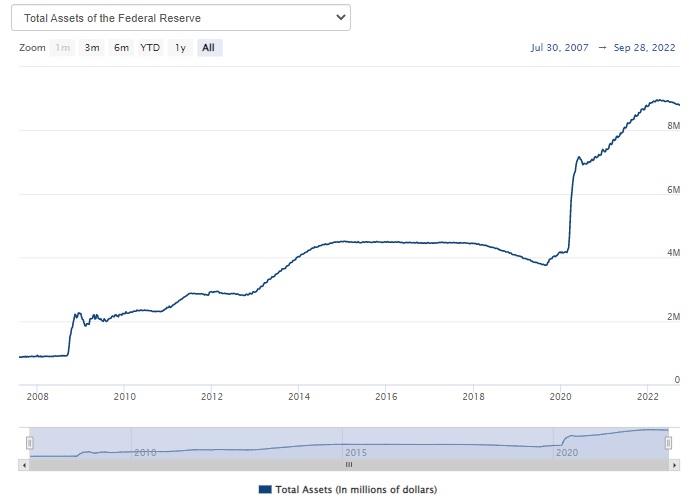
Now they are unwinding that massive balance sheet $90 billion dollars a month. Here again, lets go back to our Econ 101.

If the Fed sells these bonds, then it increases the supply of bonds. If demand is the same as the past, then it will naturally lead to higher rates to attractive investors to buy the bonds. This is yet another form of putting the brakes on the economy.

Back to the point…where is all of this heading?

Unfortunately the smart money is on much higher rates and a much weaker economy and thus much lower stock prices.

Let’s not forget that the average bear market endures a 34% decline in stock prices. That would equate to 3,180 this time around.

But also the average bear market comes hand in hand with a Fed that was LOWERING rates to help the economy recover. Now you have the exact opposite. So it likely points to a weaker economy and lower lows.

Second, when you have low rates on bonds, it makes the stock market look like a more attractive investment by comparison. That is NOT true when rates are going higher.

Imagine Treasury yields of 5-7%. That will be the safe money investment choice. Likely corporate bonds paying 2-3% above that.

It will be very tempting to take that safer route to investment returns. Especially if you believe that rates will come down in the future only padding the return on these bond investments.

This is another way of saying that demand for stocks will not be as strong at the bottom of this cycle as the typical recession and bear market. And thus it is not crazy to contemplate that stocks will need to fall further to get more investors off the sidelines.

That is why you need to contemplate that 40% drop is not out of the question. That translates to 2,891 for the S&P 500 (SPY).

No one rings a bell at the top or the bottom. So timing this perfectly is not in the cards.

However, it does say that right now the wise choice is to bet on stocks going lower…much lower.

What To Do Next?

Discover my special portfolio with 9 simple trades to help you generate gains as the market descends further into bear market territory.

This plan has been working wonders since it went into place mid August generating a +4.65% gain as the S&P 500 (SPY) tanked over 15%.

If you have been successfully navigating the investment waters in 2022, then please feel free to ignore.

However, if the bearish argument shared above does make you curious as to what happens next…then do consider getting my updated “Bear Market Game Plan” that includes specifics on the 9 unique positions in my timely and profitable portfolio.

Click Here to Learn More >

Wishing you a world of investment success!


Steve Reitmeister…but everyone calls me Reity (pronounced “Righty”)
CEO, Stock News Network and Editor, Reitmeister Total Return


SPY shares fell $0.17 (-0.05%) in after-hours trading Friday. Year-to-date, SPY has declined -22.73%, versus a % rise in the benchmark S&P 500 index during the same period.


About the Author: Steve Reitmeister

Steve is better known to the StockNews audience as “Reity”. Not only is he the CEO of the firm, but he also shares his 40 years of investment experience in the Reitmeister Total Return portfolio. Learn more about Reity’s background, along with links to his most recent articles and stock picks.

More…

The post Where is the Bottom for this Bear Market? appeared first on StockNews.com

https://www.entrepreneur.com/article/436862