Quality Stocks In…Garbage Stocks Out!

Stocks keep flirting with the all time highs for the S&P 500 (SPY) and keep falling short. Meaning this is proving to be a stubborn level of resistance at 4,800. Why is that happening? And when will stocks finally break above? 43 year investment veteran Steve Reitmeister shares his view including a preview of his favorite stock picks now. Read on below for the answers.

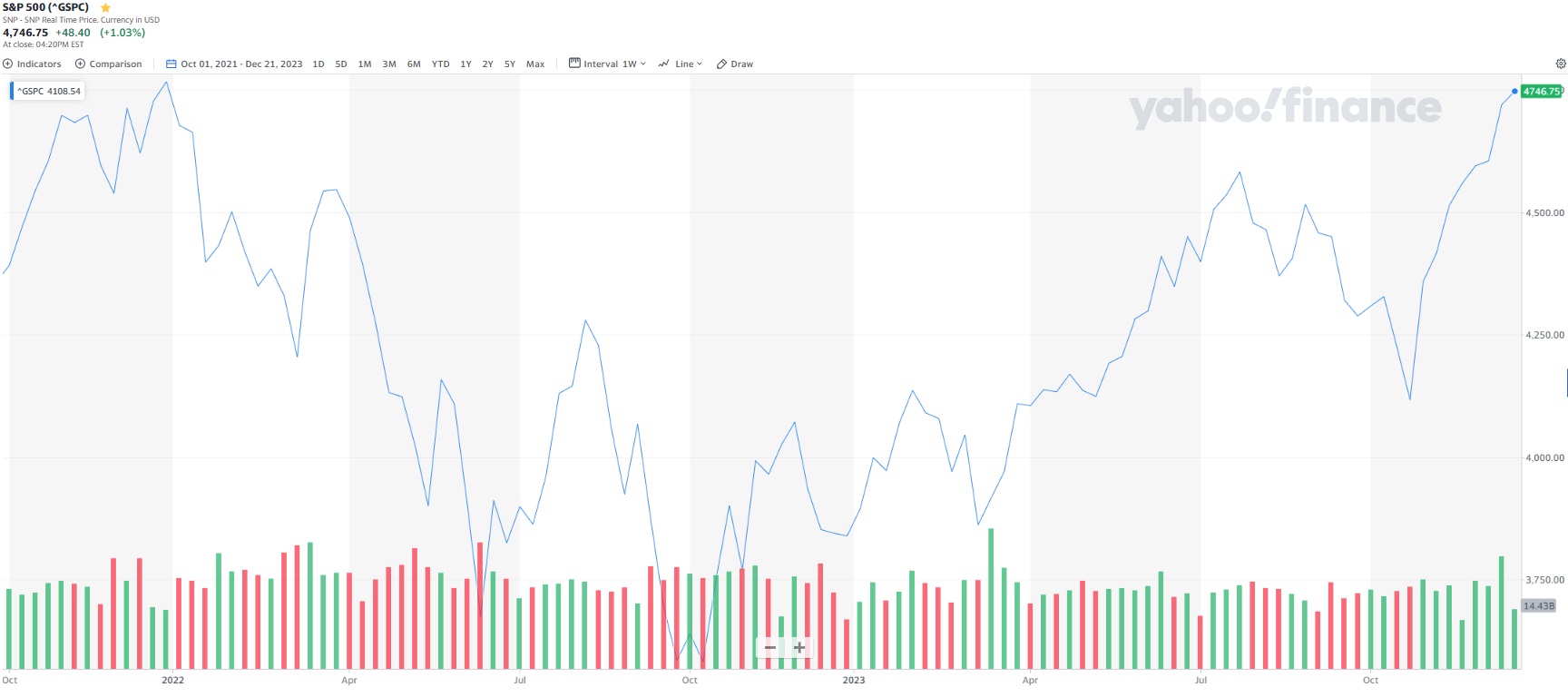
As suspected, the market is not ready to make new highs above 4,796 for the S&P 500 (SPY).

That was quite evident Thursday as stocks jumped out of bed in the morning to touch those previous highs only to find stubborn resistance with the broad market heading lower from there.

Why are stocks struggling at this level?

And what is an investor to do about it?

The answers to those vital questions will be at the heart of today’s commentary.

Market Commentary

Some investment writers will have a fairly short hand, and highly inaccurate, way to describe what happened on Thursday.

They will tell you that the CPI inflation reading was hotter than expected on Thursday morning. And that caused the stock market sell off that followed.

That is simply not true.

Here is what really happened. The CPI report came out an hour before the market open. And yet still the market leapt higher out of the gate. But once it touched the hem of the previous highs (4,796) a more than 1% intraday sell off that ensued.

That pain is not so evident in the late session bounce and modest loss for S&P 500. Yet is a lot more apparent in the -0.7% showing for the small caps in the Russell 2000 on the session.

Thus, the problem for lack of further stock advance is not about CPI report. Just a statement that investors are not prepared to breakthrough resistance to make new highs.

So, what is holding stocks back?

I discussed that in greater detail in my last commentary: When Will the Bull Market Run Again?

The essence of the story is that investors have less clarity on the next moves for the Fed than they had after the November and December meetings that sparked a tremendous end of year rally. Unfortunately, there has been a mixed bag of inflation and economic data that calls into question when rate cuts will begin.

At the earliest those cuts could come at the March 20th meeting. But I sense that the more readings we get like Thursday’s CPI report, or last Fridays stronger than expected employment report…the more likely those first cuts get pushed off to either the May 1st or June 12th Fed meetings.

Digging into the CPI reading we find that inflation was expected to come in at 3.1% yet spiked to 3.4% on this reading. Core CPI was even worse at 3.9% year over year. Just still too far away from the Fed’s target of 2%.

For the “wonks” out there you should dig into the Sticky Price resources created by the Atlanta Fed. To put it plainly, sticky inflation remains too sticky. The main elements are housing and wages that are not coming down as quickly as expected.

When you appreciate the conservative nature of the Fed…and that they state over and over again that they are “data dependent”, then its hard to look at the recent data and assume they are ready to lower rates any time soon.

Long story short, I don’t think that investors are ready for the next bull run to make new highs until they are more certain WHEN the Fed will finally start cutting rates. That delays the next upside move to March 20th at the earliest with May or June becoming all the more likely.

Hard to complain about settling into a trading range for a while given the tremendous pace of gains to end 2023. So this seems like a reasonable time for stocks to rest before making the next big move.

The upside of the current range connects with the aforementioned all time high of 4,796…but really easier to think of the lid as 4,800.

On the downside, that is a bit harder to infer. Typically trading ranges are 3-5% from top to bottom. So, for quick math let’s say around 4,600 on the bottom. This also represents the previous resistance point that took a long time to finally break above in early December.

The good news is that I expect quality stocks to prevail even in a range bound market. Meaning that last year pretty much any piece of beaten down junk was bid higher. That party is OVER!

Instead, when you have a pretty fully valued market as we have now, then there will be a greater eye towards quality of fundamentals and value proposition. I spelled that out pretty completely in last week’s article: Is 2024 Prime Time for Value Stocks?

The answer to the question posed in the headline is…YES. Meaning that 2024 is lining up nicely for value stocks.

Case in point being the early results this year with our Top 10 Value strategy up +3.70% through Wednesday’s close vs. breakeven for S&P 500 and -2.80% for the small caps in the Russell 2000.

I strongly believe that edge for value will continue as the year rolls on. And the best way to take advantage of that is spelled out in the next section…

What To Do Next?

Discover my current portfolio of value stocks packed to the brim with the outperforming benefits found in our exclusive POWR Ratings model.

This includes direct access to our Top 10 Value Stocks strategy that is hot out of the gates in 2024 with plenty more room to run.

If you are curious to learn more, and want to lean into my 43 years of investment experience, then please click the link below to get started now.

Steve Reitmeister’s Trading Plan & Top Picks >

Wishing you a world of investment success!


Steve Reitmeister…but everyone calls me Reity (pronounced “Righty”)
CEO, StockNews.com and Editor, Reitmeister Total Return


SPY shares were trading at $475.88 per share on Friday afternoon, down $0.47 (-0.10%). Year-to-date, SPY has gained 0.12%, versus a % rise in the benchmark S&P 500 index during the same period.


About the Author: Steve Reitmeister

Steve is better known to the StockNews audience as “Reity”. Not only is he the CEO of the firm, but he also shares his 40 years of investment experience in the Reitmeister Total Return portfolio. Learn more about Reity’s background, along with links to his most recent articles and stock picks.

More…

The post Quality Stocks In…Garbage Stocks Out! appeared first on StockNews.com

https://www.entrepreneur.com/finance/quality-stocks-ingarbage-stocks-out/468307


2 ETFs Poised to Ride Emerging Market Waves in 2024

Amid uncertainty surrounding the domestic economy and potential market volatility, investors seeking stability and growth may consider emerging market ETFs like Emerging Markets Internet and Ecommerce ETF (EMQQ) and Vanguard FTSE Emerging Markets ETF (VWO). Read more….

In light of potential stock market volatility due to uncertainties souring the domestic economy, a prudent strategy could be to invest in emerging market ETFs for better growth and stability.

To that end, Emerging Markets Internet and Ecommerce ETF (The) (EMQQ) and Vanguard FTSE Emerging Markets ETF (VWO) could be great choices.

Before diving deeper into the stats of these ETFs, let’s discuss what makes the investment case strong for emerging markets ETFs.

Fed foresees three interest rate cuts in 2024, signaling the first reversal since rates began rising post-COVID-19. However, the uncertainty surrounding the timing of these rate cuts raises concerns about businesses enduring prolonged challenges due to elevated borrowing costs.

Meanwhile, geopolitical risks remain a top concern, influencing market dynamics. Therefore, investors might strategically position their portfolios to capitalize on better stability and growth prospects of emerging markets by investing in quality emerging market ETFs.

Let’s evaluate the two Emerging Markets Equities ETFs picks, starting with number two.

ETF #2: Emerging Markets Internet and Ecommerce ETF (The) (EMQQ)

EMQQ is an exchange-traded fund launched and managed by Exchange Traded Concepts, LLC. It invests in growth and value stocks of companies across diversified market capitalization. It seeks to track the performance of the EMQQ The Emerging Markets Internet & Ecommerce Index, by using a full replication technique.

With $385.49 million in assets under management (AUM), EMQQ’s top holding is Reliance Industries Limited, with an 8.91% weighting, followed by Alibaba Group Holding Limited (BABA), with an 8.37% weighting and PDD Holdings Inc. Sponsored ADR Class A (PDD), with 8.27%. It has a total of 118 holdings.

EMQQ has an expense ratio of 0.86%, higher than the category average of 0.51%. It currently has a NAV of $302.52.

The ETF pays an annual dividend of $0.24, which yields 0.81% on the current price. It has a four-year average dividend yield of 0.31%.

EMQQ has gained 5.3% over the past three months and 1.5% over the past six months to close the last trading session at $30.16.

EMQQ’s POWR Ratings reflect this promising outlook. The ETF’s overall A rating equates to a Strong Buy in our proprietary rating system. The POWR Ratings are calculated by considering 118 different factors, each weighted to an optimal degree.

EMQQ has a B grade for Trade. Of the 101 ETFs in the A-rated Emerging Markets Equities ETFs group, it is ranked #65. Click here to access all of EMQQ’s POWR Ratings.

ETF #1: Vanguard FTSE Emerging Markets ETF (VWO)

VWO is an exchange-traded fund launched and managed by The Vanguard Group, Inc. It invests in public equity markets of emerging global regions. The fund seeks to track the performance of the FTSE Emerging Markets All Cap China A Inclusion Index by using a representative sampling technique.

With $101.37 billion in AUM, the fund has a total of 5000 holdings. VWO’s top holding is Taiwan Semiconductor Manufacturing Co., Ltd. (TSM), with a 5.27% weighting, followed by Tencent Holdings Ltd. (TCEHY), with a 3.64% weighting, and BABA, with 2.45%. It has a total of 101 holdings.

VWO has an expense ratio of 0.08%, lower than the category average of 0.51%. It currently has a NAV of $40.52. Its fund inflows came in at $802.19 million over the past six months.

The fund’s annual dividend of $1.45 yields 3.57% on the current share price. Its four-year average yield is 3.04%. Its dividend payouts have increased at a CAGR of 14.9% over the past three years and 5.7% over the past five years.

VWO has gained 5% over the past three months and 0.6% over the past nine months to close the last trading session at $40.49.

VWO’s strong outlook is reflected in its POWR Ratings. The ETF has an overall rating of A, translating to a Strong Buy in our proprietary rating system.

It has an A grade for Buy & Hold and Trade. It is ranked #2 in the same ETF group. To access all the POWR Ratings for VWO, click here.

What To Do Next?

43 year investment veteran, Steve Reitmeister, has just released his 2024 market outlook along with trading plan and top 11 picks for the year ahead.

2024 Stock Market Outlook >


VWO shares fell $0.22 (-0.54%) in premarket trading Monday. Year-to-date, VWO has declined -2.02%, versus a -1.51% rise in the benchmark S&P 500 index during the same period.


About the Author: Abhishek Bhuyan

Abhishek embarked on his professional journey as a financial journalist due to his keen interest in discerning the fundamental factors that influence the future performance of financial instruments.

More…

The post 2 ETFs Poised to Ride Emerging Market Waves in 2024 appeared first on StockNews.com

https://www.entrepreneur.com/finance/2-etfs-poised-to-ride-emerging-market-waves-in-2024/468019


3 Private Equity Stocks to Watch

The private equity industry is well-positioned for substantial growth in the future, largely attributable to a growing High-Net-Worth Individuals (HNWI) base, an uptick in global deals, and the sector’s enhanced ability to navigate market turbulence. Given this backdrop, private equity stocks Golub Capital BDC (GBDC), WhiteHorse Finance (WHF), and Goldman Sachs BDC (GSBD) could be watched now. Read on….

As we usher in a new year, the private equity industry scenario might continue to be molded by trends reminiscent of those that characterized 2023 – modest fundraising, rising interest rates, and a complex macroeconomic backdrop tainted by geopolitical turmoil. However, a glimmer of optimism illuminates the industry’s horizon, courtesy of an expanding pool of high-net-worth individuals (HNWI), a surge in transactional actions, and escalating fundraising initiatives emanating from secondary funds.

Considering this scenario, it would be astute for investors to watch private equity stocks Golub Capital BDC, Inc. (GBDC), WhiteHorse Finance, Inc. (WHF), and Goldman Sachs BDC, Inc. (GSBD) for better entry opportunities.

In 2023, the private equity (PE) landscape navigated through unique circumstances driven by a spike in interest rates, a banking catastrophe, and widespread geopolitical uncertainty. Not surprisingly, these tumultuous conditions led to a slump in PE activity throughout the year. Concurrently, an abundance of uncertainty, an antagonist to successful dealmaking, pervaded the global markets. However, through astute risk mitigation, managers ensured that PE-backed deals proceeded unhindered.

The U.S. currently spearheads the global PE industry with assets trumping $6 trillion. The consistency of the industry was underlined as PE firms pronounced deals worth $101 billion in the third quarter of 2023. Moreover, the rising number of deals reinforced this stability, where sponsors signed 93 deals of $100 million in the third quarter, marking a 63% surge from the first quarter of 2023.

Due to their record dry powder valued at $2.59 trillion and diversified portfolios incorporating fresh asset classes, PE firms are more than well-equipped to withstand market volatility. This diversification has fortified the resilience and agility of PE firms in managing unfavorable alterations in marketplace dynamics.

Furthermore, 2024 appears poised for a substantial uptick in secondary transactions. Secondaries funds exhibited an accelerated fundraising rhythm last year, with a total of $68.1 billion raised as of September 2023. The level of secondaries dry powder reached $202.7 billion.

In recent times, the strategy of PE firms targeting High Net Worth Individuals (HNWI) to amplify fundraising has garnered considerable attention. It will be compelling to observe if this approach makes significant strides in 2024. Considering traditional exit routes have become impassable, PE firms have found an alternative in net asset value financing to generate capital, thereby enabling distributions to Limited Partners.

Consequently, the global PE market is projected to reach $1.10 trillion by 2032, growing at a CAGR of 9.7%.

With these trends in mind, let’s delve into the fundamentals of the three Private Equity stock picks, beginning with the third choice.

Stock #3: Golub Capital BDC, Inc. (GBDC)

GBDC is a business development company and operates as an externally managed closed-end non-diversified management investment company. It invests in debt and minority equity investments in middle-market companies that are, in most cases, sponsored by private equity investors.

On December 29, 2023, GBDC paid stockholders a quarterly dividend of $0.37 per share. Its annualized dividend rate of $1.48 per share translates to a dividend yield of 9.68% on the current share price. Its four-year average yield is 9.18%. GBDC’s dividend payments have grown at CAGRs of 5.3% and 1.8% over the past three and five years, respectively.

During the three months ended September 30, 2023, GBDC repurchased approximately $0.10 million, or 5,250 shares, of its common stock pursuant to the company’s previously disclosed share repurchase program.

During the year that ended September 30, 2023, GBDC repurchased approximately $16.90 million, or 1.30 million shares, of its common stock pursuant to the company’s previously disclosed share repurchase program.

On November 30, 2023, GBDC announced that it had priced an underwritten public offering of $450 million in aggregate principal amount of 7.05% notes due 2028. The notes will mature on December 5, 2028, and may be redeemed in whole or in part at the company’s option at any time prior to November 5, 2028, at par plus a “make-whole” premium, and thereafter at par.

GBDC’s trailing-12-month cash from operations of $195.37 million is 39% higher than the industry average of $140.56 million. Its trailing-12-month gross profit and net income margins of 100% and 42.88% are 65.6% and 69.4% higher than the industry averages of 60.37% and 25.31%, respectively.

For the fiscal fourth quarter that ended September 30, 2023, GBDC’s total investment income and net investment income after tax increased 6.3% and 13.1% quarter-over-quarter to $164.54 million and $83.44 million, respectively.

For the same quarter, its net gain on investments came at $18.39 million, compared to a net loss on investments of $873 thousand in the prior quarter. Also, its basic and adjusted earnings per common share stood at $0.60, up 39.5% from the previous quarter.

Street expects GBDC’s revenue and EPS in the fiscal second quarter ending March 2024 to increase 10.6% and 11.6% year-over-year to $162.48 million and $0.48, respectively. The company surpassed consensus EPS estimates in each of the trailing four quarters and consensus revenue estimates in three of the trailing four quarters, which is impressive.

The stock has gained 16.8% over the past year to close the last trading session at $15.29. Over the past nine months, it has gained 15.9%.

GBDC’s fundamentals are reflected in its POWR Ratings. The stock has an overall C rating, equating to Neutral in our proprietary rating system. The POWR Ratings are calculated by considering 118 distinct factors, with each factor weighted to an optimal degree.

GBDC has a B grade for Momentum. Within the Private Equity industry, it is ranked #3 out of 34 stocks.

Beyond what we’ve stated above, we have also rated the stock for Growth, Value, Stability, Sentiment, and Quality. Get all ratings of GBDC here.

Stock #2: WhiteHorse Finance, Inc. (WHF)

WHF is a business development company, a non-diversified, closed-end management company specializing in originating senior secured loans, lower middle market, and growth capital industries. It typically invests between $5 million and $25 million in companies having enterprise value of between $50 million and $350 million.

On January 3, WHF distributed $0.39 per share to stockholders with respect to the quarter that ended December 31, 2023. Its annualized dividend rate of $1.54 per share translates to a dividend yield of 12.08% on the current share price. Its four-year average yield is 12.38%. WHF’s dividend payments have grown at a 1.4% CAGR over the past three years.

WHF’s trailing-12-month ROTA of 2.11% is 82.2% higher than the industry average of 1.16%. Its trailing-12-month gross profit and EBIT margins of 100% and 70.77% are 65.6% and 226.8% higher than the industry averages of 60.37% and 21.65%, respectively.

For the fiscal third quarter that ended September 30, 2023, WHF’s total investment income and core net investment income increased 20% and 25.2% year-over-year to $25.87 million and $10.81 million, respectively.

For the same quarter, its core net investment income per share stood at $0.47, up 25% from the year-ago quarter. As of September 30, 2023, WHF’s cash and cash equivalents stood at $10.63 million, compared to $9.51 million as of December 31, 2022.

Street expects WHF’s revenue and EPS for the fiscal year of 2023 (ended December 2023) to increase 17.3% and 15.3% year-over-year to $102.65 million and $1.85, respectively. The company surpassed consensus revenue estimates in each of the trailing four quarters and consensus EPS estimates in three of the trailing four quarters.

The stock has gained 2.8% over the past month to close its last trading session at $12.75. Over the past three months, it has gained 1.8%.

WHF’s solid fundamentals are reflected in its POWR Ratings. The stock has an overall rating of B, translating to Buy in our proprietary rating system.

WHF has a B grade for Momentum. Within the same industry, it is ranked #2.

Beyond what we’ve stated above, we have also rated the stock for Growth, Value, Stability, Sentiment, and Quality. Get all ratings of WHF here.

Stock #1: Goldman Sachs BDC, Inc. (GSBD)

GSBD is a business development company specializing in middle market and mezzanine investment in private companies. It seeks to invest between $10 million and $75 million in companies with EBITDA between $5 million and $75 million annually.

GSBD’s Board of Directors declared a regular fourth quarter dividend of $0.45 per share payable to the shareholders on January 26, 2024. Its annualized dividend rate of $1.80 per share translates to a dividend yield of 12.15% on the current share price. Its four-year average yield is 11.13%.

GSBD’s trailing-12-month cash from operations of $355.05 million is 152.6% higher than the industry average of $140.56 million. Its trailing-12-month EBIT and levered FCF margins of 82.29% and 43.34% are 280% and 150.7% higher than the industry averages of 21.65% and 17.29%, respectively.

For the fiscal third quarter that ended September 30, 2023, GSBD’s total investment income and net investment income after taxes increased 26.1% and 19.2% year-over-year to $120.06 million and $72.95 million, respectively.

For the same quarter, its basic and adjusted earnings per share came at $0.47, compared to a basic and adjusted loss per share of $0.07 in the prior-year quarter. As of September 30, 2023, GSBD’s cash stood at $76.60 million, compared to $39.60 million as of December 31, 2022.

Street expects GSBD’s revenue and EPS in the fiscal first quarter ending March 2024 to increase 6.7% and 17.2% year-over-year to $114.57 million and $0.54, respectively. The company surpassed consensus revenue estimates in each of the trailing four quarters and consensus EPS estimates in three of the trailing four quarters.

The stock has gained 10% over the past nine months to close its last trading session at $14.81. Over the past six months, it has gained 7.6%.

GSBD’s robust prospects are reflected in its POWR Ratings. The stock has an overall B rating, equating to Buy in our proprietary rating system.

GSBD has a B grade for Growth and Momentum. It is ranked first within the same industry.

Click here for the additional POWR Ratings for GSBD (Value, Stability, Sentiment, and Quality).

What To Do Next?

43 year investment veteran, Steve Reitmeister, has just released his 2024 market outlook along with trading plan and top 11 picks for the year ahead.

2024 Stock Market Outlook >


GBDC shares rose $0.06 (+0.39%) in premarket trading Monday. Year-to-date, GBDC has gained 1.26%, versus a -1.55% rise in the benchmark S&P 500 index during the same period.


About the Author: Sristi Suman Jayaswal

The stock market dynamics sparked Sristi’s interest during her school days, which led her to become a financial journalist. Investing in undervalued stocks with solid long-term growth prospects is her preferred strategy. Having earned a master’s degree in Accounting and Finance, Sristi hopes to deepen her investment research experience and better guide investors.

More…

The post 3 Private Equity Stocks to Watch appeared first on StockNews.com

https://www.entrepreneur.com/finance/3-private-equity-stocks-to-watch/468009


Is 2024 Prime Time for Value Stocks?

The tremendous returns for the S&P 500 (SPY) enjoyed in 2023 are likely a thing of the past as we turn the calendar over to 2024. Instead the average investor should expect very modest returns. Yet those with a nose for picking value stocks are lined up for vastly superior results. Why is that? And what are the best value stocks to discover now? Read on below for the answers.

There is good reason to believe that value stocks will be in season this year. This is great news to all those who use our POWR Ratings system given its value bias.

That’s because 31 of the 118 factors analyzed for each stock is a value criterion. Meaning that we go far beyond just PE, book value and Price to Sales to determine the full value proposition for each stock.

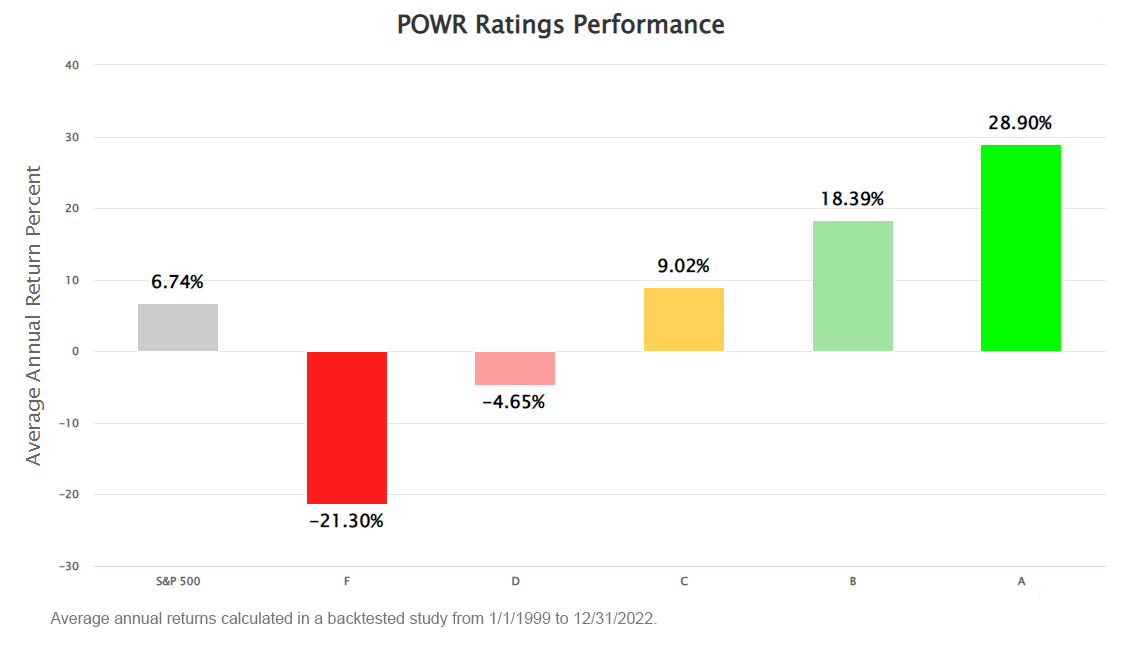
The sum total of this POWR Ratings analysis has led to a 4X return over the S&P 500 (SPY) going back to 1999. And yes, signs point to pressing our advantage once again in the year ahead.

Why precisely does the forecast look so favorable for value stocks?

The answer will be at the heart of today’s commentary below…

Market Commentary

For some of us, it is always a good time to be a value investor. That is because it simply does not make sense to overpay for a stock.

Because why would you overpay for anything???

Would you buy a new TV for $1,200 if you knew you could get the exact same one from Amazon for only $799? Of course not!

In fact, it is the very act of determining that the stock is undervalued at the outset that lines up the investor for the outperformance that unfolds as other investors awaken to the stock’s attractiveness. This was the point made by many classic investors including the father of value investing Benjamin Graham and his most famous disciple, Warren Buffett.

Unfortunately, the market tides do not always agree with this concept that value is always in fashion. That was certainly true in 2023 when growth stocks took the lead. That makes perfect sense when you understand the general rhythms of the market.

Best Time for Growth Stocks

The classic idea is that a bull market is the time to buy growth stocks. That is especially true in the early days of a new bull as these growth stocks are punished with the most severe price drops during the bear market phase.

It helps to appreciate the fear and greed cycle at work. As the pendulum swings to fear, the growth stocks are beaten down to extreme levels.

Once the foot of the bear market is removed from the necks of investors, then these same growth stocks race higher with the idea of forthcoming economic expansion that fuels earnings growth and share price advances.

Case in point is noting the +67.64% gain for the ARK Innovation ETF (ARKK) in 2023. That was a full 2.5X better than the S&P 500 on the year.

Best Time for Value Stocks

The flip side of the above coin is to say that value strategies work best during bear markets. When investors are more discriminating about the stocks they own.

This proves out well when I share with you that our Top 10 Value Stock strategy (the cornerstone of our POWR Value newsletter) enjoyed a +9.18% return in 2022 in the midst of the bear market declines.

Not surprisingly the aforementioned ARK Innovation ETF chock fill with everyone’s favorite growth companies cratered -66.97% that year as investors ran from growth stocks like the plague.

Yet bear markets are not the only time that value strategies are in fashion. This also takes place during the latter stages of bull rallies when valuations are near maximum levels.

Those times are marked by modest to negligible returns for the overall market pushing investors to dig a bit deeper to find worthy selections. A good example of that was 2018 a full nine years into the long bull run that started back in 2009.

There we find a -4.57% showing for the S&P 500 on the year. Yet our Top 10 Value Stock strategy enjoyed a robust +16.20% return.

The point is that I think that 2024 is lining up to be one of those years of modest returns for the overall market pushing people to value approaches to enjoy better returns.

That may seem like an odd statement as most would say that the new bull market just began in 2023. Thus, there should still be plenty of time and upside to follow.

Then again, lets appreciate the unique nature of the 2022 bear market. Yes, it technically qualifies as a bear because the stock market declined more than 20% from the all time highs.

However, it was a very shallow bear market because the forewarned recession never came to fruition. With that, stocks bounced back with gusto late 2022 and continuing into 2023.

That stage was prime time for beaten down growth stocks to be bid back up. Now with the overall market pressing against the all time highs…and really no serious increase in the earnings outlook in the coming year, then stocks are once again pretty fully valued.

To be more specific, FactSet is pointing to a 19.3 forward PE for the S&P 500. That is well above the 10 year average of 17.6. This points to the overall market being pretty fully valued.

It is typically at this stage, when most of the usual suspect stocks are back to full valuations that the overall market index starts to show tepid results. Meaning that after the 26% gain for the S&P 500 in 2023 that the index is likely set for very modest returns.

In my last commentary, I even predicted that 5,200 was likely the upside target for 2024 which only equates to around an 8% return. Even lower would not surprise me…but that is for the average stock.

So yes, I like the odds for value to be back in play in the weeks and months ahead. The results for just the first three days of 2024 seems to prove this out:

-1.70% S&P 500 (large caps)

-3.42% Russell 2000 (small caps)

+1.91% Top 10 Value Stocks

No doubt your next question is “Where can I see the best value stocks now?”

More about that in the next section…

What To Do Next?

Discover my current portfolio of value stocks packed to the brim with the outperforming benefits found in our exclusive POWR Ratings model.

This includes direct access to our Top 10 Value Stocks strategy that is hot out of the gates in 2024 with plenty more room to run.

If you are curious to learn more, and want to lean into my 43 years of investment experience, then please click the link below to get started now.

Steve Reitmeister’s Trading Plan & Top Picks >

Wishing you a world of investment success!


Steve Reitmeister…but everyone calls me Reity (pronounced “Righty”)
CEO, StockNews.com and Editor, Reitmeister Total Return


SPY shares were trading at $469.87 per share on Friday morning, up $2.59 (+0.55%). Year-to-date, SPY has declined -1.14%, versus a % rise in the benchmark S&P 500 index during the same period.


About the Author: Steve Reitmeister

Steve is better known to the StockNews audience as “Reity”. Not only is he the CEO of the firm, but he also shares his 40 years of investment experience in the Reitmeister Total Return portfolio. Learn more about Reity’s background, along with links to his most recent articles and stock picks.

More…

The post Is 2024 Prime Time for Value Stocks? appeared first on StockNews.com

https://www.entrepreneur.com/finance/is-2024-prime-time-for-value-stocks/467978


2 Crypto Stocks to Watch Ahead of Spot ETF Approval

Cryptocurrency prices have been on the rise after the so-called “crypto winter” deepened by the collapse of the FTX exchange in 2022. Bitcoin is up more than 150% year-to-date, mainly strengthened by optimism for a spot bitcoin ETF. As this year’s crypto recovery paves the way for a promising 2024, crypto-centric stocks NVIDIA (NVDA) and Block (SQ) could be ideal watchlist additions. Read on….

The crypto market has witnessed a roller coaster ride this year but has generated profitable returns. In early December, the digital currency topped around $44,000 for the first time since April last year and gained above 150% year-to-date, primarily fueled by optimism for a spot bitcoin ETF.

Amid this backdrop, it could be wise to add quality crypto-centric stocks NVIDIA Corporation (NVDA) and Block, Inc. (SQ) to your watchlist.

Cryptocurrency prices are rebounding after a so-called “crypto winter” that was aggravated by the collapse of the FTX exchange in 2022. Last year was highlighted by hedge fund collapses, crypto lender failures, and worsening losses at miners, which was punctuated in November 2022 when the FTX spiraled into bankruptcy.

While the Bitcoin price surged more than 150% from the same time last year, shares of Coinbase (COIN), MicroStrategy (MSTR), and the Grayscale Bitcoin Trust (GBTC), all closely tied to the digital currency, rose more than 300% in value. Ethereum, another major coin, is up approximately 85% from this time in 2022.

Yesterday, the Bitcoin price jumped to nearly $43,446.82, a significant win for investors who got in at the start of the year when the price was around $16,500.

One of the primary drivers for the Bitcoin surge this year was an easing of the Fed’s interest rate increases, which created an attractive case for riskier assets. Crypto prices were further strengthened by the upcoming bitcoin halving, which occurs every four years and is scheduled for May 2024. During the halving process, the reward for mining is slashed in half, capping the supply of bitcoin.

Additional buying was fueled by the potential for a flurry of bitcoin ETFs emerging in the new year.

This year, various leading financial firms, including BlackRock, WisdomTree, Fidelity, and others, asked the Securities and Exchange Commission (SEC) to approve a spot bitcoin ETF. This approval of the first U.S. spot bitcoin ETF awaited in January 2024, would be a milestone for cryptocurrency investors.

“For ETF investors, this would be the best product on the market,” said Bryan Armour, director of passive strategies research for North America at Morningstar. “All the other options right now have flaws to varying degrees.”

At present, U.S. investors can buy bitcoin futures ETFs, which own bitcoin futures contracts or agreements to buy or sell the asset later for an agreed-upon price. This long-awaited bitcoin spot ETF can invest in the digital asset directly.

Given an enhanced optimism surrounding the crypto space, crypto-centric stocks NVDA and SQ could be solid watchlist additions now.

Let’s take a closer look at the fundamentals of these stocks:

NVIDIA Corporation (NVDA)

NVDA offers graphics, and compute and networking solutions globally. It provides GeForce GPUs for gaming and PCs, Quadro/NVIDIA RTX GPUs for enterprise workstation graphics, Data Center platforms and systems for AI, HPC, and accelerated computing, cryptocurrency mining processors, and more. The company serves the gaming, data center, and automotive markets.

Cryptocurrency mining requires specialized computer hardware, including GPUs. NVDA saw an immense opportunity in this market and boosted the production of specialized GPUs for cryptocurrency mining. For instance, the NVIDIA GeForce GTX 1070 became highly popular among miners due to its high hash rate and power efficiency.

On November 13, NVDA announced that it had supercharged the world’s leading AI computing platform with the introduction of the NVIDIA HGX™ H200. Based on NVIDIA Hopper™ architecture, the platform features the NVIDIA H200 Tensor Core GPU with advanced memory to handle enormous amounts of data for generative AI and high-performance computing workloads.

The NVIDIA H200 is the first GPU to offer HBM3e — faster, larger memory to boost the acceleration of generative AI and large language models while advancing scientific computing for HPC workloads. This new processor optimized for AI applications is expected to extend the company’s market reach and drive its growth.

NVDA’s trailing-12-month gross profit margin and EBITDA margin of 69.85% and 49.39% are favorably higher than the industry averages of 49.14% and 9.25%, respectively. Likewise, the stock’s trailing-12-month net income margin of 42.10% is 1,694.7% higher than the industry average of 2.35%.

In terms of forward non-GAAP P/E, NVDA is trading at 40.18x, 59.7% higher than the industry average of 25.16x. Moreover, the stock’s forward EV/Sales and Price/Sales multiples of 20.59 and 20.77 are significantly higher than the industry averages of 3.03 and 3.08, respectively.

For the fiscal 2024 third quarter that ended October 29, 2023, NVDA’s revenue increased 205.5% year-over-year to $18.12 billion. Its gross profit grew 321.8% year-over-year to $13.40 billion. The company’s non-GAAP operating income rose 652.4% from the year-ago value to $11.56 billion.

In addition, the company’s non-GAAP net income and EPS came in at $10.02 billion and $4.02, up 588.2% and 593.1% year-over-year, respectively. But as of October 29, 2023, NVDA’s current liabilities increased to $9.10 billion, compared to $6.56 billion as of January 29, 2023.

Analysts expect NVDA’s revenue and EPS for the fourth quarter (ending January 2024) to increase 231.1% and 411.1% year-over-year to $20.03 billion and $4.50, respectively. Also, the company has topped the consensus revenue and EPS estimates in each of the trailing four quarters, which is impressive.

NVDA’s stock has gained 10.4% over the past six months and 252.8% over the past year to close the last trading session at $495.22.

NVDA’s mixed fundamentals are reflected in its POWR Ratings. The stock has an overall rating of C, which translates to a Neutral in our proprietary rating system. The POWR Ratings are calculated by considering 118 different factors, each weighted to an optimal degree.

NVDA has an A grade for Growth and a B for Quality and Sentiment. However, it has a D grade for Value. It has ranked #28 out of 91 stocks in the Semiconductor & Wireless Chip industry.

To see the other ratings of NVDA for Momentum and Stability, click here.

Block, Inc. (SQ)

SQ operates as a technology company with a primary focus on financial services. The company’s products include Square, which makes commerce and financial services easy and accessible for sellers with its integrated ecosystem of technology solutions; Cash App to send, spend, or invest money in stocks or bitcoin; Afterpay for connecting consumers and businesses; and more.

On December 7, Bitkey, the self-custody Bitcoin wallet built by SQ, launched in more than 95 countries across six continents, widening access to self-custody and empowering people worldwide to own and manage their Bitcoin easily and safely.

Bitkey includes a mobile app to make transactions easily on the phone, a hardware device to protect savings securely offline, and a set of recovery tools in case customers lose their phone, hardware, or both. This global launch of a self-custody Bitcoin wallet might bode well for SQ.

On November 16, SQ’s Afterpay, one of the global leaders in “Buy Now, Pay Later” payment and Rokt, the leading e-commerce tech company, announced a partnership enabling Afterpay to offer its e-commerce shoppers highly relevant offers at checkout, which creates a more relevant and engaging shopping experience while driving new revenue and deepening customer lifetime value.

SQ’s trailing-12-month gross profit margin of 34.69% is 42.6% lower than the 60.37% industry average. In addition, its trailing-12-month EBIT margin and net income margin of negative 1.64% and negative 1.36% compared to the industry averages of 20.95% and 25.21%, respectively.

In terms of forward EV/Sales, SQ is trading at 2.22x, 29.9% lower than the industry average of 3.16x. However, the stock’s forward non-GAAP P/E multiple of 41.50 is 284.6% higher than the industry average of 10.79. Also, its forward EV/EBITDA of 28.97x is 141.6% higher than the industry average of 11.99x.

In the third quarter that ended September 30, 2023, SQ’s Bitcoin revenue increased 37.5% year-over-year to $2.42 billion, and its total net revenue came in at $5.62 billion, up 24.4% year-over-year. Also, the company’s gross profit rose 21.1% from the year-ago value to $1.90 billion.

However, the company’s operating loss and net loss came in at $9.91 million and $33.76 million, respectively.

Street expects SQ’s revenue for the fourth quarter (ending December 2023) to increase 21.6% year-over-year to $5.65 billion. The company’s EPS for the ongoing quarter is estimated to grow 160.5% year-over-year to $0.57. Also, SQ surpassed the consensus revenue estimates in all trailing four quarters.

SQ’s stock has gained 22.8% over the past six months and 34.6% over the past year to close the last trading session at $79.51.

SQ’s POWR Ratings reflect this mixed outlook. The stock has an overall rating of C, which translates to a Neutral in our proprietary rating system.

The stock has a C grade for Value and Sentiment. SQ is ranked #64 out of 102 stocks in the Financial Services (Enterprise) industry.

In addition to the POWR Ratings I’ve just highlighted, you can see SQ’s ratings for Quality, Momentum, Growth, and Stability here.

What To Do Next?

Discover 10 widely held stocks that our proprietary model shows have tremendous downside potential. Please make sure none of these “death trap” stocks are lurking in your portfolio:

10 Stocks to SELL NOW! >


NVDA shares were unchanged in premarket trading Friday. Year-to-date, NVDA has gained 239.02%, versus a 26.54% rise in the benchmark S&P 500 index during the same period.


About the Author: Mangeet Kaur Bouns

Mangeet’s keen interest in the stock market led her to become an investment researcher and financial journalist. Using her fundamental approach to analyzing stocks, Mangeet’s looks to help retail investors understand the underlying factors before making investment decisions.

More…

The post 2023 Crypto Rebound Paves the Way for a Promising 2024: 2 Crypto-Centric Stocks to Watch appeared first on StockNews.com

https://www.entrepreneur.com/finance/2023-crypto-rebound-paves-the-way-for-a-promising-2024-2/467710


Get Year-End Triumph With 3 Energy Stocks

The energy sector is expected to witness considerable long-term growth and expansion, thanks to robust demand for oil and gas globally and the rapid adoption of digital technology. Given this backdrop, fundamentally sound energy stocks Liberty Energy (LBRT), Delek (DK), and Dorchester Minerals (DMLP) could be solid buys now. Read on….

Surging oil and gas demand worldwide and constrained supply are likely to push prices higher, positioning the energy sector for robust profitability and growth. Also, oil and gas companies are increasingly adopting digital technology, driving the industry’s prospects.

Given the industry’s tailwinds, it could be wise to invest in quality energy stocks Liberty Energy Inc. (LBRT), Delek US Holdings, Inc. (DK), and Dorchester Minerals, L.P. (DMLP) for solid returns.

Despite lingering macroeconomic headwinds, the Organization of the Petroleum Exporting Countries (OPEC) predicts higher oil demand for longer. OPEC expects world oil demand to grow by 2.46 million barrels per day (bpd) in 2023. Next year, global oil demand will increase by 2.25 million bpd.

Solid economic growth and continued improvements in China will be the primary drivers of elevated oil demand.

Further, in its 2023 World Oil Outlook (WOO), OPEC projects world demand to reach 116 million bpd by 2045, an increase from 99.6 million bpd in 2022. For its long-term oil demand forecast to be met, the group said that oil sector investments of about $14 trillion, or $610 billion on average per year, would be needed.

Through 2023, OPEC members have slashed their crude oil production in an effort to boost prices. Recently, various OPEC+ oil producers agreed to voluntary output cuts totaling around 2.2 million bpd in the first quarter of 2024. Saudi Arabia, the world’s biggest crude exporter, will lead the effort by extending a voluntary output cut of 1 million bpd, previously intended till the year-end.

Along with Saudi, the following voluntary barrel-per-day production cuts were announced: Russia by 500,000; Iraq by 223,000; the United Emirates by 163,000; Kuwait by 135,000; Kazakhstan by 82,000; Algeria by 51,000; and Oman by 42,000. Also, OPEC+ announced after the meeting that Brazil, another major producer, will join at the start of next year.

U.S. oil and gas production is set to break records this year. The latest federal government forecast reflected a record extraction of 12.9 million barrels of crude oil per day, which amounts to more than double that from a decade ago.

The gas production also increased with a glut of new export terminals on the Gulf of Mexico coast, embarking a boom that will witness U.S. LNG exports double in the following four years.

Further, the U.S. Energy Information Administration (EIA) expects global liquid fuel consumption to increase by 1.8 million b/d this year and by 1.3 million b/d in 2024. Most of the growth in liquid fuel demand is from non-OECD Asia, predominantly driven by China and India.

Digital transformation has significantly contributed to the rapid development of the energy sector. Oil and gas exploration, production, and mining companies are increasingly leveraging AI, machine learning, IoT, big data analysis, and blockchain technologies.

The global smart energy market size is expected to reach around $394.99 billion by 2032, growing a CAGR of 10.5% during the forecast period from 2023 to 2032. The market utilizes smart grids, IoT devices, and data analytics to offer efficient management of energy resources.

Given the industry’s robust outlook, investing in fundamentally strong energy stocks LBRT, DK, and DMLP could be wise now.

Let’s discuss the fundamentals of these stocks in detail:

Liberty Energy Inc. (LBRT)

LBRT offers hydraulic services and related technologies to onshore oil and natural gas exploration and production companies. It provides hydraulic fracturing services, including complementary services, like wireline services, proppant delivery solutions, data analytics, related goods and technologies, and other services comprising design and pump diagnostic fracture injection tests.

On October 17, LBRT announced a dividend of $0.07 per share of Class A common stock, paid on December 20, 2023, to holders of record as of December 6, 2023. This dividend represents a 40% increase from the prior quarter.

“Our investment in differential technologies and innovative businesses build on our competitive advantage and expand our market opportunities. We are increasing our quarterly cash dividend by 40% in response to the significant growth in our per share earnings and cash generating abilities from our business transformation over the last three years,” said Chris Wright, LBRT’s CEO.

LBRT pays an annual dividend of $0.22, which translates to a yield of 1.19% at the current share price. Its four-year average dividend yield is 0.95%. Moreover, the company’s dividend payouts have increased at a CAGR of 63.9% over the past three years.

In terms of forward non-GAAP P/E, LBR is trading at 5.69x, 43.8% lower than the industry average of 10.13x. Likewise, the stock’s forward EV/EBITDA multiple of 2.92 is 46.1% lower than the industry average of 5.42. Also, its forward Price/Sales of 0.66x is 54.4% lower than the industry average of 1.44x.

LBRT’s revenue and EBITDA have grown at respective CAGRs of 18.1% and 22.3% over the past five years. The company’s EBIT has increased 20.3% over the same timeframe, while its net income and EPS have improved at CAGRs of 28.8% and 6.9%, respectively.

For the third quarter that ended September 30, 2023, LBRT’s total revenue grew 2.3% year-over-year to $1.21 billion. The company’s operating income rose 12.2% year-over-year to $205.23 million. Its adjusted net income was $148.61 million or $0.85 per share, indicating increases of 1% and 9% from the year-ago value, respectively.

In addition, LBRT’s adjusted EBITDA increased 15.3% year-over-year to $319.21 million. The company’s total assets came in at $3.09 billion as of September 30, 2023, compared to $2.57 billion as of December 31, 2022.

Street expects LBRT’s revenue for the fiscal year (ending December 2023) to increase 14.7% year-over-year to $4.76 billion. The company’s EPS for the current year is expected to grow 24.5% year-over-year to $3.25. Moreover, the company topped the consensus revenue and EPS estimates in three of the trailing four quarters, which is impressive.

Shares of LBRT have gained 45.2% over the past six months and 26.8% year-to-date to close the last trading session at $18.51.

LBRT’s solid fundamentals are reflected in its POWR Ratings. The stock has an overall rating of B, which translates to a Buy in our proprietary rating system. The POWR Ratings are calculated by considering 118 different factors, each weighted to an optimal degree.

LBRT has a B grade for Value and Momentum. It is ranked #14 out of 49 stocks in the Energy – Services industry.

In addition to the POWR Ratings we’ve stated above, we also have LBRT ratings for Stability, Quality, Sentiment, and Growth. Get all LBRT ratings here.

Delek US Holdings, Inc. (DK)

DK is an integrated downstream energy business company. It operates through three segments: Refining; Logistics; and Retail. The Refining segment processes crude oil and other feedstock for manufacturing; the Logistics segment gathers, transports, and stores crude oil, intermediate, and refined products; and the Retail segment owns convenience store sites.

On November 1, DK announced a regular quarterly dividend of $0.24 per share paid on November 20, 2023, to shareholders of record on November 13th, 2023. This dividend payment reflects an increase of $0.05 from the previous quarterly dividend. The dividend increase highlights the company’s commitment to return value to its shareholders.

In terms of forward Price/Sales, DK is currently trading at 0.10x, 92.8% lower than the industry average of 1.44x. Likewise, the stock’s forward EV/EBIT multiple of 8.61 is 7.15% lower than the industry average of 9.27. Also, its forward Price/Cash Flow of 2.42x is 47.9% lower than the industry average of 4.64x.

During the third quarter that ended on September 30, 2023, DK reported net revenues of $4.75 billion. The company’s operating income rose 324% from the year-ago value to $224.70 million. Its net income amounted to $136.10 million, or $1.97 per share, compared to $16.80 million, or $0.10 per share, in the previous year’s period, respectively.

In addition, the company’s cash and cash equivalents came in at $901.70 million as of September 30, 2023, compared to $841.30 million as of December 31, 2022.

Over the past six months, the stock has gained 14.8% and 3% year-to-date to close the last trading session at $26.56.

DK’s promising outlook is reflected in its POWR Ratings. The stock has an overall rating of B, which translates to a Buy in our proprietary rating system.

The stock has a B grade for Growth and Value. Within the Energy – Oil & Gas industry, DK is ranked #14 of 84 stocks.

Click here to access additional ratings of DK for Momentum, Sentiment, Quality, and Stability.

Dorchester Minerals, L.P. (DMLP)

DMLP engages in the acquisition, ownership, and administration of producing and non-producing natural gas and crude oil royalty, net profit, and leasehold interests. The company’s royalty properties consist of producing and non-producing mineral, royalty, and overriding royalty, net profits, and leasehold interests in 592 counties and parishes in 28 states.

On November 7, DMLP announced the consummation of a notable lease transaction in the Midland Basin. Further, it leased 243 net acres in two tracts of land in Reagan County, Texas, for an amount of $30,000 per acre, and it includes a 25% royalty. These leases will substantially increase the partnership’s fourth-quarter distribution among the unitholders.

DMLP’s revenue and EBITDA have grown at respective CAGRs of 41.5% and 47.6% over the past three years. The company’s EBIT has increased 56.5% over the same timeframe, while its net income and EPS have improved at CAGRs of 55.9% and 50.6%, respectively.

DMLP’s trailing-12-month gross profit and EBIT margins of 96.41% and 73.44% are 103.7% and 237.9% higher than the respective industry averages of 47.32% and 21.73%. Further, the stock’s trailing-12-month net income margin of 70.35% is 405.1% higher than the industry average of 13.93%.

In the third quarter that ended September 30, 2023, DMLP reported total operating revenues of $42.59 million. Operating revenues from Royalties grew 6.7% year-over-year to $35.79 million. Its cash and cash equivalents were $43.49 million as of September 30, 2023, compared to $40.75 million as of December 31, 2022.

Also, the company’s total assets came in at $192.29 million versus $176.24 million as of December 31, 2022.

DMLP’s stock has surged 11.8% over the past month and 9.6% over the past year to close the last trading session at $31.45.

DMLP’s POWR Ratings reflect robust prospects. The stock has an overall rating of B, equating to a Buy in our proprietary rating system.

The stock has an A grade for Quality. DMLP is ranked #15 out of 26 stocks in the A-rated MLPs – Oil & Gas industry.

Click here to access additional ratings of DMLP for Value, Growth, Momentum, Stability, and Sentiment.

What To Do Next?

Discover 10 widely held stocks that our proprietary model shows have tremendous downside potential. Please make sure none of these “death trap” stocks are lurking in your portfolio:

10 Stocks to SELL NOW! >


LBRT shares were unchanged in premarket trading Tuesday. Year-to-date, LBRT has gained 17.18%, versus a 25.73% rise in the benchmark S&P 500 index during the same period.


About the Author: Mangeet Kaur Bouns

Mangeet’s keen interest in the stock market led her to become an investment researcher and financial journalist. Using her fundamental approach to analyzing stocks, Mangeet’s looks to help retail investors understand the underlying factors before making investment decisions.

More…

The post Get Year-End Triumph With 3 Energy Stocks appeared first on StockNews.com

https://www.entrepreneur.com/finance/get-year-end-triumph-with-3-energy-stocks/467577


When Will Stocks Break to New Highs?

The post 11/1 Fed meeting bull rally has been very impressive. The S&P 500 (SPY) is knocking on the door of the all time highs. However, small caps are still a long way away from their past peak. Discover why investment veteran Steve Reitmeister is pounding the table on small caps in the weeks and months ahead. Plus he shares his hand picked selections. Read on below for more.

We all know why the market is rallying. Dovish tilt by the Fed solidifies the likelihood for a soft landing before they lower rates and economy picks up steam. That is about as bullish of a recipe as you can have.

With that stocks are sprinting towards their all time highs to close out 2023. Thus, I thought it might be interesting to review the 3 key stock indices to see how far away from their all time highs…and what that might tell us about price action going into 2024.

Let’s start with the S&P 500 (SPY) focused on large cap stocks:

Here the index peaked on January 3, 2022 with a closing high of 4,796. Stocks were flirted with that level on Wednesday before dramatic intraday sell off ensued. Yet on Thursday once again investors bought that dip leading to closing the Thursday session at 4,746.

The point is that this is the healthiest looking index rising +23.63% this year and only about 1% away from the all time highs. No doubt we will eclipse that mark fairly soon. Just a question of whether that happens by the end of 2023 or early in the New Year.

Next let’s downshift to a view of the midcap stocks as represented by S&P 500 Midcap ETF (MDY).

Here we have a closing high made about 2 months before the large caps on November 16, 2021 at 515.53. MDY was well below that mark most of the year, but has played a lot of catch up since the November 1st Fed meeting that sparked this end of the year rally that broadened out beyond the large caps.

This index is just less than 2% below its all time highs. Good odds to eclipse in the days remaining in 2023. But if not then easy hurdle to make early in 2024.

Lastly, we will take a gander at the small cap stocks best represented by the Russell 2000 index:

This index topped out at 2,442 all the way back on November 8, 2021. Even with the rotation to small caps of late, the index only closed at 2,017 on Thursday. That means we are still 17% below the all time highs.

This underperformance by small caps is not a recent phenomenon. Rather you could really go back 4 years with fairly consistent outperformance of large cap stocks.

Yet the further we go back in time…the more we understand that small caps typically outperform large caps by a nice margin. Especially true during bull markets as investors focus on growth and upside potential.

The point being that this recent rotation to small stocks has legs and not too late to join the party. The key is WHICH small caps have the best opportunity to outperform?

That is a tremendous advantage we have with the POWR Ratings system that analyzes 118 factors for every stock. Meaning it does as deep of a dive on a mega cap like Apple as it does on a hidden gem under $1 billion market cap.

Having these 118 factors of the company in our favor is what leads to tremendous outperformance. Like 4X better than the S&P 500 for our A rated POWR Stocks going all the way back to 1999.

Long story short, you will want to lever up on small caps with the best POWR Ratings. And that is precisely what you will find in the next section…

What To Do Next?

Discover my current portfolio of 11 stocks packed to the brim with the outperforming benefits found in our exclusive POWR Ratings model.

This includes 4 small caps recently added with tremendous upside potential.

Plus I have added 2 special ETFs that are all in sectors well positioned to outpace the market in the weeks and months ahead.

This is all based on my 43 years of investing experience seeing bull markets…bear markets…and everything between.

If you are curious to learn more, and want to see these 13 hand selected trades, then please click the link below to get started now.

Steve Reitmeister’s Trading Plan & Top Picks >

Wishing you a world of investment success!


Steve Reitmeister…but everyone calls me Reity (pronounced “Righty”)
CEO, StockNews.com and Editor, Reitmeister Total Return


SPY shares rose $0.15 (+0.03%) in after-hours trading Thursday. Year-to-date, SPY has gained 25.48%, versus a % rise in the benchmark S&P 500 index during the same period.


About the Author: Steve Reitmeister

Steve is better known to the StockNews audience as “Reity”. Not only is he the CEO of the firm, but he also shares his 40 years of investment experience in the Reitmeister Total Return portfolio. Learn more about Reity’s background, along with links to his most recent articles and stock picks.

More…

The post When Will Stocks Break to New Highs? appeared first on StockNews.com

https://www.entrepreneur.com/finance/when-will-stocks-break-to-new-highs/467498


2024 Software Outlook: Buying Potential for 3 Stocks

The software industry, witnessing significant expansion, is driven by technological advancements, digital transformations across diverse sectors, and the mounting focus on data-oriented solutions. Given this backdrop, quality software stocks Semrush Holdings (SEMR), Dynatrace (DT), and Progress Software (PRGS) could be solid buys now. Read on….

Investments in digitalization are significantly increasing the demand for software applications. Furthermore, the incorporation of generative artificial intelligence within these applications is predicted to fuel the sector’s expansion further.

Therefore, it could be wise to buy software application stocks Semrush Holdings, Inc. (SEMR), Dynatrace, Inc. (DT), and Progress Software Corporation (PRGS), which possess solid upside potential.

The exponential impact of the software industry on global entities, whether individuals or institutions, is a testament to its influential dynamism. Predictions suggest that the industry’s contributions could significantly propel the U.S. economy. The global enterprise software market is poised to expand at a CAGR of 11.5%, reaching $517.26 billion by 2030.

A shift toward the improvement of essential applications is gaining momentum across organizations, potentially leading to a substantial increase in software expenses. According to Gartner, Inc. (IT), global IT spending is anticipated to reach $5.10 trillion in 2024, suggesting an 8% year-over-year rise.

The ushering in of avant-garde technologies like generative AI is posited to be a fundamental component in bolstering software application demand. Software application firms operating on subscription-based models are set to reap significant benefits due to the incorporation of generative AI into their suites. Goldman Sachs forecasts the total accessible market for generative AI software at an impressive $150 billion.

The market for application development software is expected to generate $167 billion in revenue in 2023. By 2028, this growth is anticipated to result in a market volume of $234.70 billion, expanding at a 7% CAGR.

In light of these encouraging trends, let’s look at the fundamentals of the three Software – Application stocks, beginning with number 3.

Stock #3: Semrush Holdings, Inc. (SEMR)

SEMR develops an online visibility management software-as-a-service platform in the U.S., the U.K., and internationally. The company enables companies to identify and reach the right audience for their content through the right channels. It serves small and midsize businesses, enterprises, and marketing agencies, encompassing consumer internet, education, financial services, healthcare, retail, software, and others.

On December 12, SEMR and UserWay, a full-service provider of digital accessibility technologies, announced their collaboration. UserWay’s web accessibility compliance technology is now available on the SEMR’s App Center, including the UserWay Accessibility Scanner and the UserWay Accessibility Widget.

The collaboration reflects a shared dedication to making the digital world more inclusive and accessible. Through this collaboration, UserWay’s AI-powered web accessibility technologies will enable SEMR’s users to create sites that are optimized for search engines and ADA compliance, facilitating a more accessible digital experience for people with disabilities.

SEMR’s trailing-12-month gross profit margin of 82.73% is 69.3% higher than the 48.88% industry average. Its asset turnover ratio of 0.98x is 59.2% higher than the industry average of 0.62x.

SEMR’s total revenues for the fiscal third quarter that ended September 30, 2023, increased 19.6% year-over-year to $78.72 million. Its non-GAAP income from operations stood at $6.95 million, compared to a non-GAAP loss from operations of $8.27 million in the year-ago quarter.

The company’s non-GAAP net income came at $8.42 million, compared to a non-GAAP net loss of $7.11 million in the year-ago quarter. In addition, its net income per share attributable to common stockholders amounted to $0.03, compared to a net loss per share attributable to common stockholders of $0.06 in the prior-year quarter.

Street expects SEMR’s revenue for the fiscal fourth quarter ending December 2023 to increase 20.9% year-over-year to $83.14 million. Its EPS for the same quarter is expected to be $0.03. It surpassed the consensus revenue and EPS estimates in three of the trailing four quarters, which is impressive.

Over the past year, the stock has gained 67.4% to close the last trading session at $13.39. It gained 59.8% over the past three months.

SEMR’s robust outlook is reflected in its POWR Ratings. The stock has an overall rating of B, translating to Buy in our proprietary rating system. The POWR Ratings are calculated by considering 118 distinct factors, with each factor weighted to an optimal degree.

SEMR has a B grade for Growth and Sentiment. Within the 131-stock Software – Application industry, it is ranked #34.

Beyond what we’ve stated above, we have also rated the stock for Value, Momentum, Stability, and Quality. Get all ratings of SEMR here.

Stock #2: Dynatrace, Inc. (DT)

DT provides a security platform for multicloud environments. It operates a security platform which provides application and microservices monitoring, runtime application security, infrastructure monitoring, log management and analytics, digital experience monitoring, digital business analytics, and cloud automation.

In November, DT achieved the Amazon Web Services (AWS) Security Competency. By earning this competency, DT has demonstrated expertise in helping its customers proactively remediate vulnerabilities and defend against threats across their AWS environments.

This recognition reinforces DT’s position as a trusted AWS partner and is a testament to its AI-powered approach to identifying, blocking, and investigating vulnerabilities in hybrid and multicloud environments. It further motivates the company to continue helping customers accelerate cloud migration and transformation with confidence.

DT’s trailing-12-month net income margin of 13.06% is 456.8% higher than the 2.35% industry average. Its trailing-12-month ROTA of 6.09% is significantly higher than the industry average of 0.15%.

DT’s total revenue for the fiscal second quarter that ended September 30, 2023, increased 25.9% year-over-year to $351.70 million. Its non-GAAP income for operations rose 46% year-over-year to $106.44 million. Its free cash flow for the quarter stood at $34.13 million, up 36.1% year-over-year.

The company’s non-GAAP net income increased 45% year-over-year to $93.49 million. In addition, its non-GAAP net income per share rose 40.9% year-over-year to $0.31.

Street expects DT’s revenue and EPS for the fiscal third quarter ending December 2023 to increase 20.3% and 11.8% year-over-year to $357.73 million and $0.28, respectively. It surpassed the consensus revenue and EPS estimates in each of the trailing four quarters.

Over the past year, the stock has gained 46.1% to close the last trading session at $55.23. Over the past nine months, it gained 43.9%.

DT’s strong prospects are reflected in its POWR Ratings. It has an overall rating of B, equating to a Buy in our proprietary rating system.

It has a B grade for Growth, Sentiment, and Quality. It is ranked #32 within the same industry.

Click here to see DT’s Value, Momentum, and Stability ratings.

Stock #1: Progress Software Corporation (PRGS)

PRGS develops, deploys, and manages business applications. OpenEdge, Sitefinity, Kemp LoadMaster, Developer Tools, and DataDirect Connect are some of the company’s applications. It sells its products to end users, independent software vendors, original equipment manufacturers, and system integrators.

On November 2, 2023, PRGS announced the release of Progress Sitefinity 15. PRGS introduces additional generative AI (GenAI) functionality across the platform with this version, allowing marketers to produce tailored content at scale. Also, Sitefinity Integration Hub’s innovative no-code data connectivity instantly integrates with top MarTech platforms, allowing for unified customer profiles.

The new GenAI support in Progress Sitefinity 15 empowers marketers to create personalized content at scale and optimize it based on real-time insights. This should bode well for the company.

Its annualized dividend rate of $0.70 per share translates to a dividend yield of 1.28% on the current share price. Its four-year average yield is 1.49%. PRGS’ dividend payments have grown at CAGRs of 1.5% and 4% over the past three and five years, respectively.

PRGS’ trailing-12-month net income margin of 11.65% is 396.5% higher than the 2.35% industry average. Its trailing-12-month ROCE and ROTA of 19.35% and 4.92% are significantly higher than the industry averages of 1.11% and 0.15%, respectively.

PRGS’ non-GAAP revenue for the third quarter ended August 31, 2023, increased 14.8% year-over-year to $175.78 million. Its non-GAAP income from operations increased 13.8% year-over-year to $68.39 million. Its non-GAAP net income rose 10.6% year-over-year to $48.75 million. Also, its non-GAAP earnings per share came in at $1.08, representing an 8% year-over-year increase.

The consensus revenue estimate of $178.86 million for the fiscal first quarter ending February 2024 represents an 8% year-over-year increase. Analysts expect its EPS to be $1.16 for the same quarter. It surpassed EPS estimates in each of the trailing four quarters and revenue in three of the trailing four quarters.

The stock has gained 11.5% over the past year to close the last trading session at $54.98. Over the past month, it gained 2.5%.

PRGS’s POWR Ratings reflect its promising outlook. The stock has an overall rating of B, which translates to a Buy in our proprietary rating system.

PRGS has a B grade for Value and Quality. It is ranked #22 within the same industry. 

To access additional ratings for PRGS’s Growth, Momentum, Stability, and Sentiment, click here.

What To Do Next?

43 year investment veteran, Steve Reitmeister, has just released his 2024 market outlook along with trading plan and top 11 picks for the year ahead.

2024 Stock Market Outlook >


DT shares . Year-to-date, DT has gained 44.20%, versus a 25.48% rise in the benchmark S&P 500 index during the same period.


About the Author: Sristi Suman Jayaswal

The stock market dynamics sparked Sristi’s interest during her school days, which led her to become a financial journalist. Investing in undervalued stocks with solid long-term growth prospects is her preferred strategy. Having earned a master’s degree in Accounting and Finance, Sristi hopes to deepen her investment research experience and better guide investors.

More…

The post 2024 Software Outlook: Buying Potential for 3 Stocks appeared first on StockNews.com

https://www.entrepreneur.com/finance/2024-software-outlook-buying-potential-for-3-stocks/467426


Stock Trading Plan AFTER the Fed Meeting

If you were to ask Chairman Powell if there is a “dovish tilt” by the Fed who would say emphatically no. That is because they are open to raising rates again if needed. However there is ample reason for investors to call his bluff given numerous facts in hand that say inflation coming down…rate hikes over…and time to plan for rate cuts in the year ahead. As such the S&P 500 (SPY) sprinted to new highs above 4,700. What happens next? And how can stock investors outperform? That is what investment pro Steve Reitmeister covers in his latest market commentary that includes a preview of his top 13 picks for today’s market. Read on below for more.

Investors enjoyed one of the best possible outcomes from the 12/13 Fed meeting. That being a clear dovish tilt in their language pushing the S&P 500 (SPY) to new highs on the year.

As per usual, Chairman Powell played up the flexibility the Fed needs and they “could” raise rates again. But that was fairly hollow when the updated dot plot from Fed officials showed no more rate hikes on the way and 3 rate cuts in the year ahead. With that stocks pressed on the gas pedal to further accentuate the bull run that started after the 11/1 Fed meeting.

Let’s review the key details from the Fed announcement and what that means for our investment plans in the weeks and months ahead.

Market Commentary

Even before the Fed took center stage on Wednesday we already got good news from the PPI report that morning further pointing out the improvements in the fight against inflation. Core PPI is now down to the Fed target at 2% while the full PPI reading is even more tame at only +0.9%.

Remember that PPI is the leading indicator of what shows up in the readings more vital to the Fed like CPI and PCE. So, this bodes well for lower readings in the future…and the Fed feeling confident to in following through on their dovish language tilt with the actual lowering of rates.

The above did not factor into the Fed announcement that afternoon at 2pm ET…but did prove that the Fed does see many of these positive developments in place. Holding rates steady was a given. But what got stocks off to the races, and bond yields moving even lower, was Fed expectations for 3 rate cuts in 2024 and another 4 in 2025.

Most know that the Fed typically understates these plans to give themselves some wiggle room to change course if needed. The simple fact that there is less talk of hikes…and more talks of cuts, tells you that the Fed has very likely managed a soft landing for the economy this cycle.

It is interesting to see how investors changed their outlook from the FedWatch tool from the CME. This is where they measure how investors are weighing the odds of rates in the future.

The next Fed meeting is set for January 31, 2024. Only a month ago odds of a rate cut were nearly non-existent at 2% probability. That has spiked to 21% as of today with this fresh information in hand.

Even more revealing is the 82% odds of a rate cut for the March 20, 2024 meeting. Some even thinking it could be a half point cut.

When you appreciate the above information…and how that would be a catalyst for the economy and earnings growth…then you understand why stocks have rallied so hard on this dovish tilt from the Fed.

HOWEVER, I do think that expectations do need to be tempered for the future. That’s because much of that positive chain reaction for stocks is already showing up in current share prices. This fits under the well understood concept that investors make their selections today based upon what they expect 4-6 months down the road.

This also matches with what I shared in my 2024 Stock Market Outlook presentation where I discuss the likely continuation of the bull market in the year ahead. Yet where the path to stock market gains will be very different than 2023.

Meaning that blindly putting money in just mega cap tech stocks is overplayed and that group will underperform in the year ahead. Instead, the 4 year advantage for large caps over small caps should end with the latter finally taking the lead.

This overdue and healthy rotation has already been present since this recent bull run began in early November. And was further accentuated on the Wednesday rally when the Russell 2000 rose +3.52% versus +1.37% for the S&P 500.

Thursday was more of the same with the small caps in the Russell 2000 adding on another +2.72% once again far outpacing the large cap centric S&P 500 at only +0.26% on the day.

I expect this small stock advantage to continue to play out in 2024. Perhaps not as pronounced as what you see above…but they should outperform by a good stretch in the year ahead.

That is why our portfolio is gladly tilted in that small cap direction…and enjoying very strong recent performance. More about that in the section below…

What To Do Next?

Discover my current portfolio of 11 stocks packed to the brim with the outperforming benefits found in our exclusive POWR Ratings model.

This includes 4 small caps recently added with tremendous upside potential.

Plus I have added 2 special ETFs that are all in sectors well positioned to outpace the market in the weeks and months ahead.

This is all based on my 43 years of investing experience seeing bull markets…bear markets…and everything between.

If you are curious to learn more, and want to see these 13 hand selected trades, then please click the link below to get started now.

Steve Reitmeister’s Trading Plan & Top Picks >

Wishing you a world of investment success!


Steve Reitmeister…but everyone calls me Reity (pronounced “Righty”)
CEO, StockNews.com and Editor, Reitmeister Total Return


SPY shares were trading at $469.98 per share on Friday afternoon, down $2.03 (-0.43%). Year-to-date, SPY has gained 24.26%, versus a % rise in the benchmark S&P 500 index during the same period.


About the Author: Steve Reitmeister

Steve is better known to the StockNews audience as “Reity”. Not only is he the CEO of the firm, but he also shares his 40 years of investment experience in the Reitmeister Total Return portfolio. Learn more about Reity’s background, along with links to his most recent articles and stock picks.

More…

The post Stock Trading Plan AFTER the Fed Meeting appeared first on StockNews.com

https://www.entrepreneur.com/finance/stock-trading-plan-after-the-fed-meeting/467071


Unlocking Year-End Gains with Energy Stocks

Amid heightened demand for oil and gas, the energy sector is on the brink of substantial expansion. Moreover, Wall Street analysts expressed optimistic views triggered by constrained supply. Given this backdrop, quality energy stocks Marathon Petroleum Corporation (MPC), ChampionX Corporation (CHX), and Liberty Energy (LBRT) could be solid buys for year-end gains. Read on….

The global oil industry stands on the precipice of a significant transformation as OPEC+ nations limit their oil production. Additionally, amid the vigorous demand for oil and gas, Wall Street analysts project an upward trajectory in market performance, bolstering investor interest in this sector. Expectations of considerable profit gains especially favor companies already situated to capitalize on this industry-wide growth.

Given this backdrop, it could be wise to add fundamentally robust energy stocks Marathon Petroleum Corporation (MPC), ChampionX Corporation (CHX), and Liberty Energy Inc. (LBRT) to your portfolio now.

Before exploring the fundamentals of these stocks, let’s scrutinize the industry’s evolving dynamics.

In a drive for sustainable energy, over 140 nations worldwide have established net-zero emission objectives, thus hastening the transition toward renewable resources. Despite the increased adoption of clean energy solutions, the global oil and gas demand is anticipated to remain robust. In 2023, the International Energy Agency (IEA) expects global oil demand to increase by 2.4 million barrels per day (bpd) and 930,000 bpd by 2024.

This winter, meteorologists anticipate milder temperatures up until December 23, yet traditional cooling trends could augment U.S. gas demand in the Lower 48 states, including exports. LSEG predicts a rise from 121.3 billion cubic feet per day (bcfd) this week to 124.8 bcfd the following week and 127.3 bcfd in two weeks.

The United States stands on the edge of leapfrogging Australia and Qatar to emerge as the world’s top supplier of Liquefied Natural Gas by 2023. Soaring oil prices, supply disruptions, and sanctions associated with the ongoing conflict in Ukraine have amplified international demand for U.S. exports.

Amid geopolitical unrest and voluntary production cuts by Saudi Arabia and Russia, oil prices could surge further. Analysts at UBS Group AG (UBS) and The Goldman Sachs Group, Inc. (GS) foresee a probable increase in oil prices because of the implementation of these voluntary cutbacks. Forecasted Brent oil prices for 2024 are expected to hover between $80 and $100.

In light of these encouraging trends, let’s look at the fundamentals of the three energy stocks.

Marathon Petroleum Corporation (MPC)

MPC operates as an integrated downstream energy company primarily in the United States. It operates in two segments: Refining & Marketing and Midstream.

On October 25, MPC’s board of directors approved an increase to the quarterly dividend to $0.825 per share, payable to the shareholders on December 11, 2023. Its annualized dividend rate of $3.30 per share translates to a dividend yield of 2.31% on the current share price. Its four-year average yield is 3.85%.

MPC’s dividend payments have grown at CAGRs of 9.9% and 10.8% over the past three and five years, respectively. The company has a record of paying dividends for 12 consecutive years.

The Board of Directors approved an incremental $5 billion share repurchase authorization. With the addition of this new authorization, the company has a total of $8.3 billion available under its share repurchase authorizations as of October 27.

MPC’s trailing-12-month cash from operations of $17.38 billion is significantly higher than the industry average of $669.40 million. Its trailing-12-month ROCE, ROTC, and ROTA of 43.98%, 16.33%, and 12.84% are 120%, 75.6%, and 71.4% higher than the industry averages of 19.99%, 9.30%, and 7.49%, respectively.

In the fiscal third quarter, the company returned approximately $3.1 billion of capital to shareholders through $2.8 billion in share repurchases and $297 million of dividends.

In the fiscal third quarter that ended September 30, 2023, MPC’s total revenues and other income and income from operations stood at $41.58 billion and $4.75 billion, respectively. Its adjusted income per share increased 4.2% from the year-ago quarter to $8.14.

For the same quarter, adjusted net income attributable to MPC and adjusted EBITDA stood at $3.22 billion and $5.71 billion, respectively. As of September 30, 2023, its total current assets came at $36.28 billion, compared to $35.24 billion as of December 31, 2022.

Street expects MPC’s revenue and EPS for the fiscal fourth quarter ending December 2023 to be $35.40 billion and $2.80, respectively. The company surpassed consensus EPS estimates in each of the trailing four quarters and consensus revenue estimates in three of the trailing four quarters, which is impressive.

The stock has gained 34.7% over the past year to close the last trading session at $143.85. Over the past six months, it gained 27.3%.

MPC’s POWR Ratings reflect its positive prospects. The stock has an overall B rating, equating to Buy in our proprietary rating system. The POWR Ratings are calculated by considering 118 distinct factors, with each factor weighted to an optimal degree.

The stock has an A grade for Quality and a B for Momentum. Within the Energy – Oil & Gas industry, it is ranked #9 out of 85 stocks.

To see MPC’s additional POWR Ratings for Growth, Value, Stability, and Sentiment, click here.

ChampionX Corporation (CHX)

CHX provides chemistry solutions and engineered equipment and technologies to oil and gas companies worldwide. The company operates through four segments: Production Chemical Technologies; Production & Automation Technologies; Drilling Technologies; and Reservoir Chemical Technologies.

The company demonstrated its commitment to return excess cash to its shareholders. Through $68 million share repurchases and regular cash dividends of $17 million, it returned 52% of cash from operating activities and 74% of its free cash flow to its shareholders in the third quarter.

On October 27, CHX paid its shareholders a regular quarterly dividend of $0.085 per share on the company’s common stock, par value of $0.01 per share. Its annual dividend of $0.34 translates to a 1.18% yield on the current price. Its four-year average dividend yield is 0.36%.

CHX’s trailing-12-month asset turnover ratio of 1.13x is 106.7% higher than the 0.55x industry average. Likewise, its trailing-12-month levered FCF margin of 13.05% is 122.6% higher than the industry average of 5.86%.

For the fiscal third quarter that ended September 30, 2023, CHX’s revenues stood at $939.78 million, while gross profit increased 48.5% year-over-year to $291.86 million. Its adjusted EBITDA stood at $189.54 million, up 14.1% from the year-ago quarter.

Adjusted net income attributable to CHX and adjusted earnings per share increased 19.3% and 24.2% year-over-year to $80.95 million and $0.41, respectively. For the nine months that ended September 30, 2023, cash and cash equivalents stood at $285.01 million, up 49.2% year-over-year.

Street expects CHX’s revenue for the fiscal fourth quarter ending December 2023 to be $954.98 million, while EPS is expected to be $0.45, representing a 4% year-over-year increase. It surpassed EPS estimates in three of the trailing four quarters.

The stock has gained 6.6% over the past year to close its last trading session at $28.87. Moreover, over the past six months, it has gained 3.8%.

CHX’s POWR Ratings reflect a robust outlook. It has an overall rating of B, which equates to Buy in our proprietary rating system.

It also has a B grade for Momentum and Quality. Within the 49-stock Energy-Services industry, it is ranked #8.

Beyond what we’ve stated above, we have also rated the stock for Growth, Value, Stability, and Sentiment. Get all ratings of CHX here.

Liberty Energy Inc. (LBRT)

LBRT offers hydraulic services and related technologies to onshore oil and natural gas exploration and production companies in North America. The company provides hydraulic fracturing and complementary services like wireline services, proppant delivery solutions, data analytics, related goods, and technologies.

On October 17, LBRT’s board of directors declared a quarterly dividend of $0.07 per share of class A common stock, a 40% increase from the prior quarter’s dividend. It is payable to the shareholders on December 20, 2023.

Its annualized dividend rate of $0.28 per share translates to a dividend yield of 1.57% on the current share price. Its four-year average yield is 0.95%. LBRT’s dividend payments have grown at CAGRs of 63.9% and 17.1% over the past three and five years, respectively.

The company returned $38 million to shareholders through share repurchases and a quarterly cash dividend. During the quarter that ended September 30, 2023, LBRT repurchased and retired 1,784,899 shares of Class A common stock at an average of $16.38 per share, representing 1% of shares outstanding, for approximately $29 million.

The company has cumulatively repurchased and retired 10.6% of shares outstanding at program commencement on July 25, 2022. The total remaining authorization for future common share repurchases is approximately $211 million.

LBRT’s trailing-12-month asset turnover ratio of 1.75x is 218.5% higher than the industry average of 0.55x. Its trailing-12-month ROCE, ROTC, and ROTA of 38.63%, 25.76%, and 19.97% are 93.2%, 177%, and 166.6% higher than the industry averages of 19.99%, 9.30%, and 7.49%, respectively.

For the fiscal third quarter that ended September 30, 2023, LBRT’s revenue increased 2.3% year-over-year to $1.22 billion. Its operating income grew 12.2% from the year-ago quarter to $205.23 million. Also, the company’s adjusted EBITDA stood at $319.21 million, up 15.3% year-over-year.

Furthermore, net income attributable to LBRT stockholders was $148.61 million and $0.85 per share, representing increases of 1.1% and 9% from the prior year quarter, respectively.

Street expects LBRT’s revenue and EPS for the fiscal year ending December 2023 to increase 14.7% and 24.7% year-over-year to $4.76 billion and $3.26, respectively. The company surpassed consensus revenue and EPS estimates in three of the trailing four quarters.

The stock has gained 25.4% over the past year to close the last trading session at $17.81. Over the past six months, it has gained 30.4%.

LBRT’s solid fundamentals are reflected in its POWR Ratings. The stock has an overall B rating, equating to Buy in our proprietary rating system.

The stock has a B grade for Value and Momentum. Within the Energy-Services industry, it is ranked #7.

Click here for LBRT’s additional POWR Ratings for Growth, Stability, Sentiment, and Quality.

What To Do Next?

Discover 10 widely held stocks that our proprietary model shows have tremendous downside potential. Please make sure none of these “death trap” stocks are lurking in your portfolio:

10 Stocks to SELL NOW! >


MPC shares were unchanged in premarket trading Tuesday. Year-to-date, MPC has gained 26.49%, versus a 22.14% rise in the benchmark S&P 500 index during the same period.


About the Author: Sristi Suman Jayaswal

The stock market dynamics sparked Sristi’s interest during her school days, which led her to become a financial journalist. Investing in undervalued stocks with solid long-term growth prospects is her preferred strategy.Having earned a master’s degree in Accounting and Finance, Sristi hopes to deepen her investment research experience and better guide investors.

More…

The post Unlocking Year-End Gains with Energy Stocks appeared first on StockNews.com

https://www.entrepreneur.com/finance/unlocking-year-end-gains-with-energy-stocks/466811