Boot Barn (BOOT) came out with quarterly earnings of $2.23 per share, missing the Zacks Consensus Estimate of $2.26 per share. This compares to earnings of $1 per share a year ago. These figures are adjusted for non-recurring items.
– Zacks
This quarterly report represents an earnings surprise of -1.33%. A quarter ago, it was expected that this Western apparel and footwear retailer would post earnings of $0.94 per share when it actually produced earnings of $1.22, delivering a surprise of 29.79%.
Over the last four quarters, the company has surpassed consensus EPS estimates three times.
Boot Barn, which belongs to the Zacks Retail – Apparel and Shoes industry, posted revenues of $485.9 million for the quarter ended December 2021, surpassing the Zacks Consensus Estimate by 0.01%. This compares to year-ago revenues of $302.34 million. The company has topped consensus revenue estimates four times over the last four quarters.
The sustainability of the stock’s immediate price movement based on the recently-released numbers and future earnings expectations will mostly depend on management’s commentary on the earnings call.
Boot Barn shares have lost about 22% since the beginning of the year versus the S&P 500’s decline of -8.7%.
What’s Next for Boot Barn?
While Boot Barn has underperformed the market so far this year, the question that comes to investors’ minds is: what’s next for the stock?
There are no easy answers to this key question, but one reliable measure that can help investors address this is the company’s earnings outlook. Not only does this include current consensus earnings expectations for the coming quarter(s), but also how these expectations have changed lately.
Empirical research shows a strong correlation between near-term stock movements and trends in earnings estimate revisions. Investors can track such revisions by themselves or rely on a tried-and-tested rating tool like the Zacks Rank, which has an impressive track record of harnessing the power of earnings estimate revisions.
Ahead of this earnings release, the estimate revisions trend for Boot Barn: mixed. While the magnitude and direction of estimate revisions could change following the company’s just-released earnings report, the current status translates into a Zacks Rank #3 (Hold) for the stock. So, the shares are expected to perform in line with the market in the near future. You can see the complete list of today’s Zacks #1 Rank (Strong Buy) stocks here.
It will be interesting to see how estimates for the coming quarters and current fiscal year change in the days ahead. The current consensus EPS estimate is $1.16 on $331.04 million in revenues for the coming quarter and $6.03 on $1.44 billion in revenues for the current fiscal year.
Investors should be mindful of the fact that the outlook for the industry can have a material impact on the performance of the stock as well. In terms of the Zacks Industry Rank, Retail – Apparel and Shoes is currently in the top 31% of the 250 plus Zacks industries. Our research shows that the top 50% of the Zacks-ranked industries outperform the bottom 50% by a factor of more than 2 to 1.
Farfetch Limited (FTCH), another stock in the same industry, has yet to report results for the quarter ended December 2021.
This company is expected to post quarterly loss of $0.32 per share in its upcoming report, which represents a year-over-year change of +95.1%. The consensus EPS estimate for the quarter has been revised 9.3% higher over the last 30 days to the current level.
Farfetch Limited’s revenues are expected to be $676.36 million, up 25.2% from the year-ago quarter.
Want the latest recommendations from Zacks Investment Research? Today, you can download 7 Best Stocks for the Next 30 Days. Click to get this free report
The stock market’s loss of altitude in recent days has pushed most major indexes into ‘correction’ territory, raising hopes among many that the worst may be behind us. But there are others that cite various reasons to stay bearish, keeping alive questions about the market’s next move. I am adding to that debate in this piece by pointing out a source of support for the market that will help not only stabilize, but actually rebound in the days ahead. Stocks need power to push higher, just as humans and machines do. For stocks, this ‘power’ comes from a variety of sources, but interest rates and corporate profits are the biggest drivers. Interest rates have been market-friendly for the last many years, with forceful Fed action during the pandemic cementing that role. But we have reached an inflection point with the Fed’s interest rate policy, as worries about runaway inflation have prompted the central bank to start normalizing monetary policy by removing the accommodative measures it put in place during the pandemic. The current market pullback is a reflection of market participants’ uncertainty about the speed and magnitude with which the Fed will change interest rate policy in the days ahead. A big part of the ongoing inflationary pressures in the economy is because of the pandemic’s impact on global and local supply chains. The other part is a result of the stronger-than-expected post-pandemic demand that likely got exacerbated by stimulative fiscal measures. The Fed fully understands that no policy change on its part will have a bearing on stretched global supply chains. Its goal instead will be to take the edge off excess demand by removing the extraordinary stimulus measures like ending the QE program and instituting some interest rate hikes. What this means is a modest rise in interest rates in an otherwise stable interest rate and economic backdrop. I am not making light of this Fed policy change. This is a big deal, particularly for parts of the market that require a high degree of risk tolerance. Such investments, like SPACs and stocks of small, high-growth companies with minimal current profitability, have been hit hard in the recent downturn. But the stock market is much more than just speculative operators or hyper-growth small companies whose profits lie out in future years. This brings us to the second force we mentioned earlier that powers stocks higher-corporate earnings. The earnings picture took a severe beating as a result of the pandemic, but it enjoyed an impressive rebound, with aggregate totals in each of the first three quarters of 2021 successively reaching new all-time records. This was despite continued pandemic-related issues in the broader leisure, hospitality and travel spaces. Early indicators suggest that this performance momentum will remain in place in the ongoing 2021 Q4 earnings season, with the reporting cycle ramping up significantly in the coming days. We strongly believe that investors will find it difficult to justify continued market weakness in the face of very strong earnings releases in the days ahead. The market set up for this earnings season couldn’t have been better. Earnings growth remains very strong, with the ongoing 2021 Q4 earnings season on track to show growth in excess +22%, with the positive growth trend continuing in the current and coming quarters, albeit at a lower rate. This growth pace represents a deceleration from the first half’s breakneck speed, but it is still very strong by historical standards. This would come after the COVID-19-driven declines of 2020 when earnings dropped by -13%. Continued . . . —————————————————————————————————— Notification of Release: 5 Stocks Set to Double Five Zacks’ experts have each revealed their single favorite stock with the best chance to gain +100% and more in the months ahead. Previous editions of this Special Report have racked up gains of +143.0%, +175.9%, +498.3%, and even +673%.¹ Today, you are invited to download the just-released report that names new stocks and spotlights why their gain potential is so exceptional. See Stocks Now >> —————————————————————————————————– Many skeptics have been discounting this favorable turn in the earnings growth picture, citing the expected deceleration in earnings growth in 2022 after 2021’s breakneck pace. This narrative argues that given the already stretched level of aggregate valuation metrics, we would need the incremental developments on the earnings front to remain positive to help support the market. These are reasonable points. But what we need to keep in mind with respect to the market is that we don’t need continuation of the outsized growth for the first half of 2021 to push stocks higher. What we do need, however, is an environment of improving earnings outlook, with estimates steadily going up. And that’s exactly what we have at present. We make the following two points in support of this view: First: The revisions trend remained positive through the first three quarters of 2021, but modestly turned negative in the last three months of the year. What this means is that estimates for 2021 Q4 went down modestly after the period got underway at the start of October. But this has started to change already, with estimates for 2022 Q1 going up in recent days. Earnings for S&P 500 companies are currently expected to increase by +4.6% in 2022 Q1, which is up from +3.7% growth expected at the start of January 2022. We are seeing a similar favorable revisions trend for estimates for 2022 Q2 as well. Second: The favorable revisions trend is broad-based and not concentrated in one area, though the Energy sector has been a big beneficiary of the recent momentum in oil prices. Looking at full-year 2022 earnings estimates, estimates have gone up by more than +15% in the past 12 months and by more than +5% in the last 6 months. In fact, full-year 2022 estimates have gone up by +1.7% since the start of October 2021, with the net revisions trend staying positive even on an ex-Energy basis. The next point will make the case for the revisions trend to accelerate meaningfully in the coming months as the Omicron-driven infection surge recedes, helping revive activity levels that had been dampened by the highly infectious variant. The fact is that there is no fundamental reason for stocks to lose ground as long as interest rates remain stable and earnings estimates maintain their current uptrend. The bottom line is that there is significant upside to current consensus earnings estimates. And an environment of rising earnings estimates and stable interest rates should keep stocks on an upward trajectory. Putting It All Together In the ongoing Q4 earnings season, companies are not only coming out with impressive results, but also providing positive guidance for the current period and beyond even as they explain the cost pressures and supply-chain challenges. Current estimates for this year and next represent strong earnings growth, but we remain very confident that the growth pace should continue to go up as a result of favorable estimate revisions. In fact, there is a strong likelihood that the outlook for economic and earnings growth will turn out to be a lot stronger than currently reflected in consensus estimates. The stock market’s positive momentum is grounded in the fundamental reality of an improving earnings outlook and a very favorable interest rate environment. We see no reasons for this trend to stall or reverse as long as these fundamental drivers remain in place. How to Take Advantage Today is an ideal time to get aboard this market trend which is why I’m inviting you to look into our unique arrangement called Zacks Investor Collection. It gives you access to the picks and commentary from all our long-term portfolios in real time for the next 30 days. Plus, it includes Zacks Premium research so you can find winning stocks, ETFs and mutual funds on your own. In 2021, these portfolios closed 68 double- and triple-digit gains. The gains reached as high as +147.7%, +150.9% and even +995.2%.¹ To put the odds of success even more in your favor, you are also invited to download our just-released Special Report, 5 Stocks Set to Double. Each stock was handpicked by a Zacks expert as their personal favorite to have the best chance of gaining +100% and more in the months ahead. Previous editions of this report have racked up some huge gains. Examples include Boston Beer Co. which soared +143.0%, Nvidia blasted +175.9%, Weight Watchers climbed +498.3% and Tesla surged +673%.¹ Now this exclusive report reveals new stocks with sky-high long-term potential: Stock #1: Social Media Platform Revs Up for Next Big Burst Stock #2: Surging Chemical Company Still “Off the Radar” Stock #3: Small-Cap with Huge Advantage for Chipmaking Stock #4: Few Would Guess This Stock Will Double Stock #5: Over 19,000 Patents and $30 Billion in Revenue The earlier you get into these stocks the higher their profit potential. Also, the opportunity to download this just-released Special Report, 5 Stocks Set to Double, ends midnight Sunday, January 30. Get started now with Zacks Investor Collection and 5 Stocks Set to Double >> Thanks and good trading, Sheraz Mian Sheraz Mian serves as the Director of Research and manages the entire research department. He also manages the Zacks Focus List and Zacks Top 10 Stocks portfolios. He invites you to access Zacks Investor Collection. ¹ The results listed above are not (or may not be) representative of the performance of all selections made by Zacks Investment Research’s newsletter editors and may represent the partial close of a position.
– Zacks
Want the latest recommendations from Zacks Investment Research? Today, you can download 7 Best Stocks for the Next 30 Days. Click to get this free report
Wall Street has been witnessing dullness on the bourses, largely due to the rising 10-year Treasury yields. However, there are certain sectors like banking and energy that have remained strong on easing Omicron variant concerns, rising yields and steadily recovering U.S. economy from the pandemic-led slowdown.
– Zacks
The Federal Reserve Open Market Committee’s two-day meeting begun on Jan 25. Post the meeting, the central bank is expected to give some hint on its decision on taking a more aggressive approach to policy tightening in 2022, considering the consistently hot inflation levels.
The coronavirus vaccine rollout is gradually helping control the spread of the outbreak across the globe. The optimism surrounding the gradual reopening of global economies and increasing demand is painting a rosy picture for cyclical sectors. The progress in coronavirus vaccine rollout presents a strong case, favoring a faster return to normalcy and economic recovery. As the economy starts operating in full swing, banks and energy sectors will generate more business.
Let’s study the two sectors in more detail:
Banking ETFs in Focus
Several factors are working in favor of the space. The Federal Reserve has already started tapering the bond purchases, which it expects to complete by March this year. The Fed is expected to begin raising its benchmark interest rate in March. The shift toward a tighter monetary policy will push yields higher, thereby helping the financial sector. This is because rising rates will help in boosting profits for banks, insurance companies, discount brokerage firms and asset managers. The steepening of the yield curve (the difference between short and long-term interest rates) is likely to support banks’ net interest margins. As a result, net interest income, which constitutes a chunk of banks’ revenues, is likely to receive support from the steepening of the yield curve and a modest rise in loan demand.
The Federal Reserve may take a more aggressive approach in raising interest rates.
Against this backdrop, let’s take a look at some banking ETFs that can gain from the current environment:
SPDR S&P Regional Banking ETF seeks to provide investment results that before fees and expenses generally correspond to the total return performance of the S&P Regional Banks Select Industry Index. It has AUM of $5.46 billion and charges 0.35% in expense ratio (read: 5 ETF Plays to Make the Most of Red-Hot Inflation).
SPDR S&P Bank ETF seeks to provide investment results that before fees and expenses generally correspond to the total return performance of the S&P Banks Select Industry Index. It has AUM of $3.61 billion and charges 0.35% in expense ratio (read: Rotate to Cyclical Sectors With These Top-Ranked ETFs).
Invesco KBW Bank ETF is based on the KBW Nasdaq Bank Index. The index is a modified-market capitalization-weighted index of companies primarily engaged in U.S. banking activities. It has AUM of $3.11 billion and charges 0.35% in expense ratio (read: Banking Earnings Mixed-Bag: What’s in Store for ETFs?).
Energy ETFs to Watch For
Investors are closely tracking the energy sector, which is showing strength as global demand and economic growth levels are on the path of recovery from the pandemic lows. Oil prices have been rising since the beginning of 2022. The upside in crude oil prices has been triggered by various factors like easing Omicron variant concerns, protests in Kazakhstan and outages in Libya causing supply shortages and less OPEC+ output.
Against the bullish energy sector backdrop, let’s take a look at some energy ETFs that are worth adding to your portfolio for boosting returns:
Invesco Dynamic Energy Exploration & Production ETF PXE
The fund seeks to track the performance of the Dynamic Energy Exploration & Production Intellidex Index. With AUM of $165.2 million, the fund has an expense ratio of 63 basis points (bps) (read: Energy ETFs Hitting New 52-Week High).
The fund seeks to track the performance of the MSCI US Investable Market Energy 25/50 Index. With AUM of $6.83 billion, the fund charges 10 bps in fees.
The fund seeks to provide investment results, before expenses, that generally correspond to the price and yield performance of the Energy Select Sector Index. With AUM of $31.33 billion, the fund has an expense ratio of 0.12%.
Infrastructure Stock Boom to Sweep America
A massive push to rebuild the crumbling U.S. infrastructure will soon be underway. It’s bipartisan, urgent, and inevitable. Trillions will be spent. Fortunes will be made.
The only question is “Will you get into the right stocks early when their growth potential is greatest?”
Zacks has released a Special Report to help you do just that, and today it’s free. Discover 7 special companies that look to gain the most from construction and repair to roads, bridges, and buildings, plus cargo hauling and energy transformation on an almost unimaginable scale.
Want the latest recommendations from Zacks Investment Research? Today, you can download 7 Best Stocks for the Next 30 Days. Click to get this free report
In this pre-Fed episode of Cook’s Kitchen, I look at interesting charts from NVIDIANVDA and ShopifySHOP as well as my favorite market breadth indicators that might signal a “wash-out” capitulation in stocks. By the time you are reading and watching, the FOMC will have already delivered its economic projections, rate hike forecasts, and the all-important presser with the Jay-Hawk. But as I explain, I was already a buyer into Monday’s capitulation lows with the ProSharesUltraPro QQQ 3X Bull ETFTQQQ and I will buy more today if the Fed is showing too many hawk feathers and it slips back below $50. As for NVIDIA and Shopify, I think they are trading near very attractive levels and I offer my views thus: NVIDIA is reacting to the increasing probability that they won’t be able to buy Arm Holdings and Shopify is reacting to an analyst back-pedal on earnings growth. Regarding my market breadth charts, I show 3 that are very useful, including my favorite which has helped me spot correction bottoms for over 5 years. Speaking of corrections, in the video I also show a great table from Bespoke Investment Group on Nasdaq kerplunks since 2009. What stands out to me is that the current 17% wipe-out is still junior to the 2018 “valuation adjustment.” This is important because we are in a similar policy environment where the Fed is getting more hawkish and the market is throwing a tantrum. If investors don’t like what they hear today about rates and inflation projections, then we could easily be headed for the 20-handle in this correction. But the pain should be over fairly quick as the smart money knows rates will only be rising slowly and still make stocks the only game in town. And seriously, since the market tantrums worked the last two outa two, it will probably work again. Finally today, I looked at BlockSQ and The Trade DeskTTD as buying candidates in this uncertainty. Besides the fact that I think Jack Dorsey is a blockhead for changing the name to Block, the stock is ridiculously cheap under 4X sales for the premier small business ecosystem. Maybe investors hate his obsession with crypto, Bitcoin, and the now eponymous Blockchain. I’m still scratching my blockhead about it. As for the “CME of Advertising” — my nickname for The Trade Desk because of their lightning-fast exchange model for data-driven ad deployment — I was a buyer on Monday near $60 and I would buy more given the chance. So, Jay Powell & Co. if you guys and gals are listening, don’t worry about those folks throwing a tantrum and go ahead and strut your inner hawks today. It will give us one more bear-trap market flush and a bunch of great opportunities to buy stocks on sale for a Feb-March rally. As promised in the video, I leave you with the link to Tracey Ryniec’s 300th episode of the MarketEdge podcast, where we go over our bull market mistakes, and how to avoid them going forward… Lessons from 7 Years of Stock Investing Disclosure: I own NVDA, TTD, and TQQQ for the Zacks TAZR Trader.
– Zacks
Zacks Names “Single Best Pick to Double”
From thousands of stocks, 5 Zacks experts each have chosen their favorite to skyrocket +100% or more in months to come. From those 5, Director of Research Sheraz Mian hand-picks one to have the most explosive upside of all.
As one investor put it, “curing and preventing hundreds of diseases…what should that market be worth?” This company could rival or surpass other recent Zacks’ Stocks Set to Double like Boston Beer Company which shot up +143.0% in little more than 9 months and NVIDIA which boomed +175.9% in one year.
Want the latest recommendations from Zacks Investment Research? Today, you can download 7 Best Stocks for the Next 30 Days. Click to get this free report
Capital One vs. Ally: Which Credit Services Stock is a Better Buy?
The credit services industry has been making an impressive comeback on rising credit transactions and consumers’ increased discretionary spending. So, Capital One Financial (COF) and Ally (ALLY) should benefit from the industry tailwinds. But which of these two stocks is a better buy now? Read more to learn our view.
shutterstock.com – StockNews
Capital One Financial Corporation (COF) in McLean, Va., is a diversified financial service holding company that offers a range of financial products and services to consumers, small businesses, and commercial clients through branches, the internet, and other distribution channels. It operates through three segments: Credit Card, Consumer Banking, and Commercial Banking. In comparison, Ally Financial Inc. (ALLY) in Detroit, Mich., is a bank holding company that provides various digital financial products and services to consumer, commercial, and corporate customers. It operates through Automotive Finance Operations, Insurance Operations, Mortgage Finance Operations, and Corporate Finance Operations segments.
The credit services industry has suffered in the near-zero interest rate environment and lower consumer spending amid the CVID-19 pandemic. However, the sector has witnessed a solid recovery on the back of increased credit transactions over the past year. Also, the Federal Reserve has announced that it will be reducing its bond purchases and increasing interest rates three times this year to control inflation. These hawkish monetary moves should help credit services companies generate bigger revenues. Therefore, both COF and ALLY should benefit.
COF’s shares have gained 2.2% in price over the past month, while ALLY has lost 1.9%. COF’s 9.7% gains over the past nine months compare with ALLY’s negative returns. Furthermore, COF is the clear winner with 41.3% price gains versus ALLY’s 14.9% returns in terms of the past year’s performance.
But which of these two stocks is a better buy now? Let’s find out.
Latest Developments
On Oct. 26, 2021, Richard D. Fairbank, COF’s Founder, Chairman, and CEO, said, “Our modern technology stack is powering our performance and our opportunity, it’s setting us up to capitalize on the accelerating digital revolution in banking, and it’s the engine that drives enduring value creation over the long-term.”
On Dec.1, 2021, ALLY announced that it had acquired Fair Square Financial, a digital-first credit card company. ALLY’s CEO Jeffrey J. Brown said, “The addition of Fair Square and its credit card offerings will enhance our suite of consumer products and align with our long-term strategy to be the leading full-service digital bank.”
Recent Financial Results
COF’s total net revenue increased 6% year-over-year to $7.80 billion for its fiscal third quarter, ended Sept.30, 2021. The company’s net income grew 29% year-over-year to $2.99 billion. Also, its EPS came in at $6.78, up 34% year-over-year.
ALLY’s adjusted total net revenue increased 17% year-over-year to $2.20 billion for its fiscal fourth quarter, ended Dec.31, 2021. The company’s consumer auto originations grew 20% year-over-year to $10.90 billion. Also, its adjusted EPS came in at $2.02, up 26% year-over-year.
Past and Expected Financial Performance
COF’s revenue and EPS have grown at CAGRs of 13.1% and 53.5%, respectively, over the past three years. Analysts expect COF’s revenue to increase 11.4% for the quarter ending March 31, 2022, and 6.4% in fiscal 2022. However, its EPS is expected to decline 22.2% for the quarter ending March 31, 2022, and 25.9% in fiscal 2022. Its EPS is expected to grow at 45.9% per annum over the next five years.
In comparison, ALLY’s revenue and EPS have grown at CAGRs of 13.6% and 40.8%, respectively, over the past three years. The company’s revenue is expected to increase 7.5% for the quarter ending March 31, 2022, and 5.9% in fiscal 2022. However, its EPS is expected to decline 12.9% for the quarter ending March 31, 2022, and 14.4% in fiscal 2022. And ALLY’s EPS is expected to grow at a 38.2% rate per annum over the next five years.
Profitability
COF’s trailing-12-month revenue is 3.66 times what ALLY generates. COF is also more profitable, with a 39.51% net income margin, versus ALLY’s 35.29%.
Furthermore, COF’s ROE and ROA of 20.56% and 2.96%, respectively, are higher than ALLY’s 19.31% and 1.68%.
Valuation
In terms of forward non-GAAP P/E, ALLY is currently trading at 6.27x, which is 15% higher than COF’s 5.45x. Furthermore, ALLY’s 0.16x forward non-GAAP PEG ratio is 60% higher than COF’s 0.10x.
So, COF is relatively affordable here.
POWR Ratings
COF has an overall B rating, which equates to Buy in our proprietaryPOWR Ratings system. In contrast, ALLY has an overall C rating, which translates to Neutral. The POWR Ratings are calculated by considering 118 distinct factors, with each factor weighted to an optimal degree.
COF has a B grade for Sentiment, while ALLY has a C grade for Sentiment.
Among 53 stocks in the Consumer Financial Services industry, COF is ranked #9. In comparison, ALLY is ranked #11.
Beyond what I have stated above, we have also rated the stocks for Value, Momentum, Growth, Stability, and Quality. Click here to view all the COF ratings. Also, get all the ALLY ratings here.
The Winner
The continuing economic recovery is driving the growth of the credit services industry. Also, the industry is well-positioned to benefit from forthcoming interest rate hikes. So, COF and ALLY should benefit. However, we think it is better to bet on COF now because of its higher profitability and lower valuation.
Our research shows that odds of success increase when one invests in stocks with an Overall Rating of Strong Buy or Buy. View all the other top-rated stocks in the Consumer Financial Services industry here.
COF shares were trading at $153.25 per share on Tuesday afternoon, up $4.95 (+3.34%). Year-to-date, COF has gained 5.62%, versus a -8.20% rise in the benchmark S&P 500 index during the same period.
About the Author: Nimesh Jaiswal
Nimesh Jaiswal’s fervent interest in analyzing and interpreting financial data led him to a career as a financial analyst and journalist. The importance of financial statements in driving a stock’s price is the key approach that he follows while advising investors in his articles.
Today we look at a handful of penny stocks gaining a lot of attention on social media. One of the most significant driving forces since the start of the 2020 pandemic has been droves of new retail traders pumping liquidity into the market. There are a few different schools of thought about the lasting impact it could have on the market. However, the last two years have been nothing quite like we’ve ever seen.
PennyStocks.com – PennyStocks
These underlying trends have stemmed from the active retail trading community, whether it’s short squeezes, speculative breakouts, fear-driven buying, or somewhat of a mix. Thanks to the explosive rallies in meme stocks like AMC Entertainment (NYSE:AMC) and GameStop (NYSE:GME), these millions of new traders are finding a home on social media sites like Reddit.
Reddit Penny Stocks To Buy [or avoid]
It has become the new “investor round table” for traders to share ideas. Outlets like Reddit have also become heavily scrutinized for the unregulated and, at times, completely false claims made by individual online profiles. Social sentiment is a prevailing catalyst daily. You can either fight the trend or figure out a way to make money from it. According to some of the traders on Reddit this week, here are a few penny stocks to buy.
SmileDirectClub Inc. (NASDAQ:SDC)
As one of the household name penny stocks, you might assume that SmileDirectClub has good standings in the stock market today. The company is well-known for its at-home dental solutions, including invisible braces and teeth whitening. There’s also a good chance that you’ve seen at least one advertisement on TV or social media in the last few days. Regardless, SDC stock has been hard-hit over the previous year, with the final quarter of 2021 being one of the worst. Shares ripped lower following worse than expected earnings results with a mixed response from the company:
“We are disappointed with our third-quarter results driven by the macroeconomic headwinds that are influencing the spending of our core demographic…While we could not have anticipated the rapidly evolving nature of this impact on our consumer, we have responded quickly to focus our marketing on helping support them during this time, while we also move upstream with higher income demographics through the Challenger Campaign and investments in our Dental Partner Network.”
The company has taken up strategic actions to right the ship in response. This week, a wild twist of events highlights the latest move to curb expenses. SmileDirectClub suspended operations in 8 markets while also cutting back staff.
Areas impacted included Mexico, Spain, Germany, the Netherlands, Austria, Singapore, Hong Kong, and New Zealand. The main focus appears to be on the U.S., Canada, the U.K, Ireland, France, and Australia right now. Ultimately this could save $120 million in 2022, according to the company.
Kosmos Energy Ltd. (NYSE:KOS)
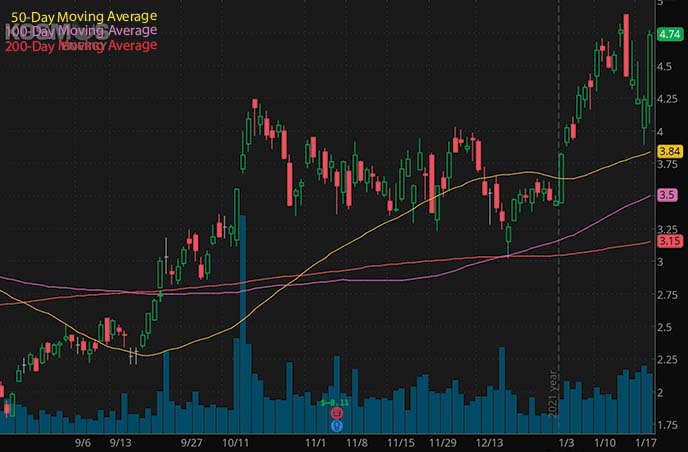
Even with the stock market sell-off this week, some sectors have gained bullish momentum. One of these is energy, and companies like Kosmos have climbed higher as a result. In fact, following a few days of selling this month, KOS stock has bounced back in a big way this week. Shares jumped over 15% from Monday’s low of $3.89 to Tuesday’s morning high of $4.54.
Aside from the sector trends, news from Kosmos this month put it back in a brighter spotlight. The company announced that it completed drilling of its Winterfell-2 appraisal well in the Green Canyon area of the U.S Gulf. This helped the company define further the resource potential of the site, with current gross estimates sitting around 100 million barrels. With encouraging results, Kosmos Energy’s CEO Andrew Inglis expects to advance a development scheme for bringing things online in “around” two years.
In-kind with this bullish outlook, analysts at Goldman Sachs raised their $5 price target to $7.50 while maintaining their Buy on the penny stock.
Transocean Limited (NYSE:RIG)
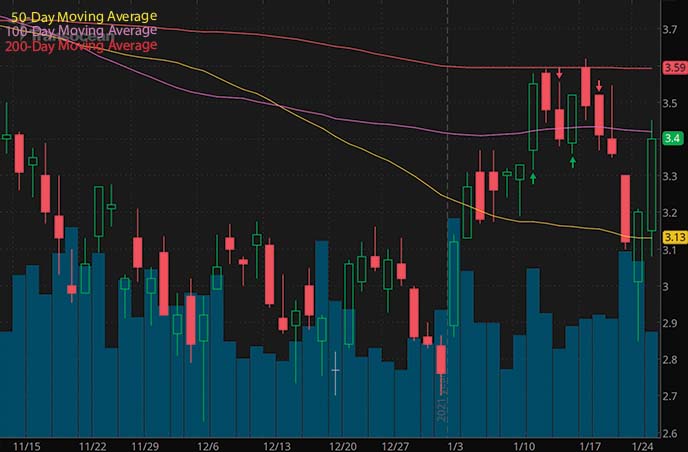
Similarly, shares of Transocean ticked higher on Tuesday, supported by strength in energy stocks. The contract drilling services provider pulled an about-face at the top of the week. A 2-day bounce in RIG stock propelled shares from lows of $2.85 to highs of over $3.30.
Much of the excitement also comes shortly after the company’s Transocean Enabler will drill a carbon injection well and sidetrack for another well drilled early in 2020 to support Equinor’s Norther Lights Carbon Capture Storage Project. This is a JV created by Equinor, Shell, and TotalEnergies.
“Beyond our core business of drilling ultra-deepwater and harsh environment wells, this is an excellent example of how we can further leverage our rigs and core competencies in support of renewable and alternative energy projects in offshore markets across the globe.”
Janelle Daniel, Transocean’s Vice President of Human Resources, Sustainability and Communications.
Sustainable investing is a big focus for the market right now. The ESG movement continues growing strong, which could further the company’s stake in this budding niche.
Progenity Inc. (NASDAQ:PROG)
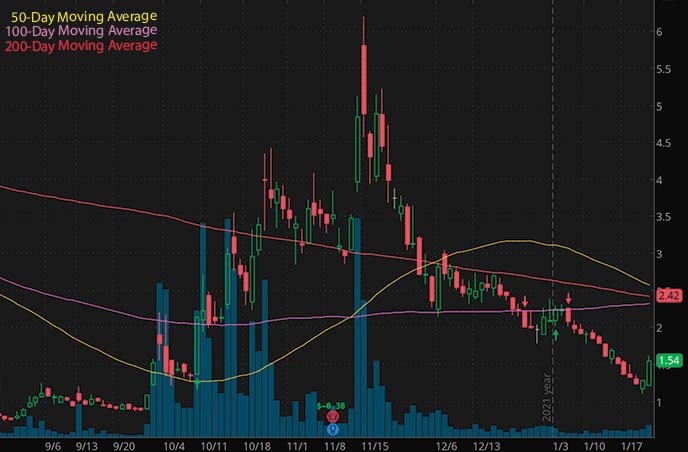
A darling of Q4 2021 was Progenity Inc. Shares of the biotech company exploded from under $1 to highs of over $6 within a few short months. Company milestones and stock market technicals came together, helping to add to the excitement.
Progenity is advancing its pipeline designed for women’s health, gastrointestinal health, and oral biotherapeutics. In particular, the company offers a range of ingestible devices that provide diagnostic sampling and drug delivery solutions. Its current plans are being pushed ahead for commercially launching its Preecludia test designed to rule out preeclampsia in pregnant patients. According to the company, this space has an addressable market of up to $3 billion.
In addition, February could be set for some excitement as Progenity will make presentations at multiple industry events. These include the Belgian Week of Gastroenterology on February 9th and the European Crohn’s and Colitis Organisation on February 18th.
If this weren’t enough, PROG stock has joined the list of potential “short squeeze penny stocks” to watch right now. According to data from Fintel.IO, the current short float percentage on PROG sits around 11.5%. It was a hot topic of discussion late last year and seems to be back in the mentions among traders on social media right now.
Reliance Global Group (NASDAQ:RELI)
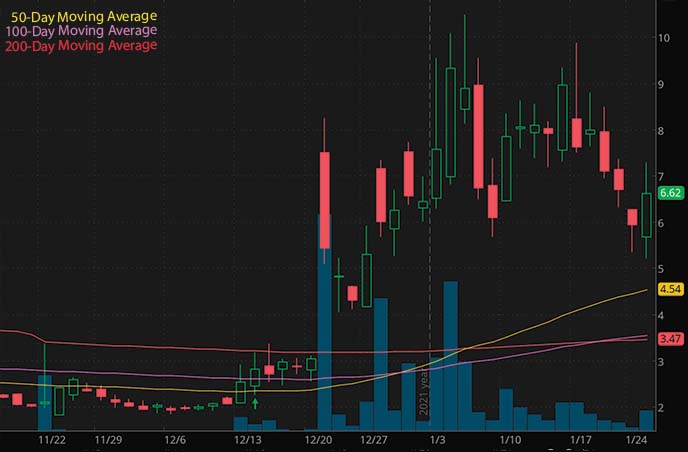
It’s been a while since Reliance Global traded near the penny stock range. If you’re an active reader of PennyStocks.com, you may recall it as a hot stock late last year. The insurance stock skyrocketed from under $2 to highs of more than $10 following a flurry of attention on social media.
The first time we discussed the company in December, Reliance had just come off of a big launch of its 5MinuteInsure platform in new territories. However, the bigger story was similar to PROG stock as a potential short-squeeze candidate. At the time, the short float percentage on RELI sat above 30%. With a lower float, it wasn’t surprising to see additional volatility.
Fast-forward to this week, and RELI is still on that “short squeeze” radar right now. According to Fintel data, the current short float percentage is around 25.5% as of this article. Meanwhile, Reliance announced the completion of its latest acquisition of Medigap Health Insurance Company. Medigap specializes in Medicare supplement insurance and recorded roughly $7 million in revenue for the 12 months ending September 30, 2021.
“Medigap is one of the nation’s fastest-growing providers of Medicare supplemental insurance coverage with licenses and doing business in 47 states. Our goal is to aggressively expand their operations, as well as capitalize on cross-selling opportunities across our existing portfolio companies,” explained Ezra Beyman, CEO of Reliance Global Group.
Tuesday afternoon, RELI stock firmly stepped back out of the penny stock range after reaching highs of over $7.
Penny Stocks To Watch Right Now
According to social media users on Reddit, these are just a handful of penny stocks to buy. If any of the companies are on your list right now, the next step is doing a deeper dive. Social media is an interesting place, but you are the only person responsible for making the final investment decision. You can check out more details on penny stocks by using our stock profile tool, which gives access to news, filings, and more for free.
If you enjoyed this article and you’re interested in learning how to trade so you can have the best chance to profit consistently then you need to checkout this YouTube channel. CLICK HERE RIGHT NOW!
https://www.entrepreneur.com/article/415090
5 Mega-Cap Stocks with More Than 40% Upside, According to Wall Street
Amid the current, dizzying market volatility, investing in fundamentally sound mega-cap stocks could offer some stability to one’s portfolio returns. Analysts believe the shares of Amazon.com (AMZN), NVIDIA (NVDA), Walt Disney (DIS), salesforce.com (CRM), and PayPal Holdings (PYPL) could rally by more than 40% in price in the near term. So, we think it could be worth adding these stocks to one’s watchlist. Read on.
In this environment, investing in fundamentally sound mega-cap stocks is considered a safe strategy because these stocks usually withstand market fluctuations better than shares of smaller companies. Furthermore, these companies’ dominant market positions accord their financials some resilience even in adverse economic conditions.
Despite the possibility of a continuing market weakness, Wall Street analysts expect mega-cap stocks Amazon.com, Inc. (AMZN), NVIDIA Corporation (NVDA), The Walt Disney Company (DIS), salesforce.com, inc. (CRM), and PayPal Holdings, Inc. (PYPL) to deliver a than 40% gain in the coming months. Therefore, we think it could be worth adding these stocks to one’s watchlist.
With a market capitalization of $1.47 trillion, AMZN in North Seattle, Wash., is a multinational technology company that is an online retailer of consumer products and subscriptions, operator of Amazon Web Services (AWS), one of the biggest cloud platforms in the digital computing space, and offers compute, storage, database, analytics, machine learning, fulfillment, advertising, publishing, and digital content subscriptions. It also offers personalized shopping services, web-based credit card payment, and direct shipping to customers.
On Jan. 10, 2022, AMZN’s Amazon Web Services, Inc. (AWS) announced the general availability of Amazon Elastic Compute Cloud (Amazon EC2) Hpc6a instances, a new instance type that is purpose-built for tightly coupled high-performance computing (HPC) workloads. Powered by Advanced Micro Devices, Inc.’s (AMD) 3rd Gen AMD EPYC processors, these Hpc6a instances deliver up to 65% better price-performance than similar compute-optimized Amazon EC2 instances. AMZN expects to witness high demand for these Hpc6a instances from organizations that rely on HPC.
AMZN’s total net sales for its fiscal 2021 third quarter, ended Sept.30, 2021, increased 15.3% year-over-year to $110.81 billion. As of Sept. 30, 2021, the company had $29.94 billion in cash and cash equivalents.
Analysts expect the company’s revenue to increase 21.8% year-over-year to $470.32 billion in its fiscal 2021, ended Dec. 31, 2021. It surpassed the consensus EPS estimates in three of the trailing four quarters. AMZN’s EPS is expected to grow at a 36% rate per annum over the next five years.
The stock has declined 16.3% in price over the past month and closed yesterday’s trading session at $2,809.88. All 30 Wall Street analysts rating the stock have rated it a Buy. The stock’s $4,150.83 average price target indicates43.6% upside potential.
NVDA designs and manufactures computer graphics processors, chipsets, and related multimedia software used in the gaming, professional visualization, data center, and automotive markets. The Santa Clara, Calif–based company’s products are sold to OEMs, ODMs, system builders, add-in board manufacturers, retailers/distributors, Internet and cloud service providers, mapping companies, and other ecosystem participants. It has a market capitalization of $582.43 billion.
On Jan. 24, 2022, NVDA announced that technology conglomerate Meta Platforms, Inc. (FB) selected NVDA’s NVIDIA DGX A100 systems to be installed in FB’s AI supercomputer–The AI Research SuperCluster (RSC)–to build better AI models and progress toward developing metaverse. The new AI supercomputer uses 760 NVIDIA DGX A100 systems as its compute nodes, and 6,080 NVIDIA A100 GPUs are linked on an NVIDIA Quantum 200Gb/s InfiniBand network to deliver 1,895 petaflops of TF32 performance. FB plans to expand to 16,000 GPUs to deliver a whopping five exaflops of mixed precision AI performance. NVDA is looking forward to a long-term partnership with FB.
NVDA’s total revenue for its fiscal 2022 third quarter, ended Oct. 31, 2021, increased 50.3% year-over-year to $7.10 billion. The company’s non-GAAP gross profit came in at $4.76 billion, representing a 53.8% year-over-year improvement. Its non-GAAP income from operations came in at $3.39 billion for the quarter, indicating a 69.9% rise from the prior-year period. NVDA’s non-GAAP net income was $2.97 billion, up 62.1% from the year-ago period. And its non-GAAP EPS increased 12.5% year-over-year to $1.17. The company had $1.29 billion in cash and cash equivalents as of Oct. 31, 2021.
The $4.34 consensus EPS estimate for its fiscal year 2022 ending Jan. 31, 2022, represents a 73.6% rise from the prior-year period. It surpassed the consensus EPS estimates in each of the trailing four quarters. Analysts expect NVDA’s revenue to rise 60% year-over-year to $26.68 billion. And its EPS is expected to grow at a 39.4% per annum rate over the next five years.
NVDA’s shares have declined 21.2% in price over the past month and ended yesterday’s trading session at $233.72. Of 25 Wall Street analysts that have rated the stock, 23 have rated it a Buy, while two rated it Hold. Analysts expect the stock’s price to hit $359.17 in the near term, representing 53.7% upside potential.
As one of the top entertainment companies worldwide, DIS in Burbank, Calif., operates through two business segments—Disney Media and Entertainment Distribution; and Disney Parks, Experiences, and Products. The company engages in film and episodic production and distribution activities, and operates television broadcast networks, studios that produce motion pictures, and direct-to-consumer streaming services. It sells branded merchandise through retail, online, and wholesale businesses and develops and publishes books, comics, and magazines. It has a market capitalization of $250.24 billion.
On Oct. 28, 2021, ViacomCBS Inc.’s (VIAC) ViacomCBS Networks International (VCNI) business division entered agreed to acquire a majority stake in Fox TeleColombia & Estudios TeleMexico, the acclaimed Spanish language content producer, from DIS and its founding family. Through this transaction, VCNI will gain access to Fox TeleColombia & Estudios TeleMexico’s studio operations in Colombia and Mexico and many hours of library content. The transaction is expected to help the companies gain more market reach in the coming months.
DIS’ revenues for its fiscal 2021 fourth quarter, ended Oct. 2, 2021, increased 26% year-over-year to $18.53 billion. The company’s pre-tax income from continuing operations came in at $290 million, versus a $580 million loss in the prior-year period. Its net income was $159 million for the quarter, versus a $710 million net loss in the prior-year period. DIS’ EPS was $0.09, compared to a $0.39 loss per share in the year-ago period. The company had $15.96 billion in cash and cash equivalents as of Oct. 2, 2021.
The $3.81 consensus EPS estimate for its fiscal year 2022, ending Sept. 30, 2022, indicates an 88.6% rise from the prior-year period. Analysts expect the company’s revenue to be $73.58 billion for the same fiscal year, representing a 24% rise from the prior year. DIS’ EPS is expected to grow at a 37.7% rate per annum over the next five years.
DIS stock has declined 10.5% in price over the past month to close yesterday’s trading session at $137.46. Of 22 Wall Street analysts rating the stock, 15 have rated it a Buy, and seven rated it Hold. DIS’ average price target of $195.35 represents42.1% upside potential.
With a $219.69 billion market capitalization, San Francisco’s CRM provides enterprise cloud computing solutions that focus on customer relationship management to businesses and industries worldwide. Its solutions include sales force automation, customer service and support, marketing automation, digital commerce, community management, analytics, and a cloud platform for building custom applications.
On Jan.13, 2022, CRM announced new partnerships to power the future of commerce. The addition of PayPal Holdings, Inc.’s (PYPL) PayPal should enable sellers to use Salesforce Payments to reduce checkout friction and drive sales. Built on Commerce Cloud by ISV partner XCentium, CRM’s Salesforce B2B Commerce for wholesale apparel and fashion companies supports preseason ordering and automated interactions across self-service and sales teams. Hosted by Alibaba Group Holding Limited’s (BABA) Alibaba Cloud, Salesforce Social Commerce provides tools needed by retailers to evolve with China’s ever-growing commerce ecosystem and easily integrate with digital commerce systems. CRM looks forward to helping retailers create fast, connected, and highly-personalized shopping experiences.
CRM’s total revenues for its fiscal 2022 third quarter, ended Oct. 31, 2021, increased 26.7% year-over-year to $6.86 billion. The company’s gross profit came in at $5.02 billion, representing a 24.7% rise from the year-ago period. Its non-GAAP income from operations came in at $1.36 billion for the quarter, up 26.6% from the prior-year period. It had $4.75 billion in cash and cash equivalents as of October 31, 2021.
Analysts expect the company’s revenue to increase 24.2% year-over-year to $26.40 billion for its fiscal 2022, ending Jan.31, 2022. It surpassed the consensus EPS estimates in each of the trailing four quarters. CRM’s EPS is expected to grow at a 10% rate per annum over the next five years.
Over the past month, CRM’s shares have declined 11.9% in price to close yesterday’s trading session at $223.03. Twenty three of 26 Wall Street analysts rating the stock have rated it a Buy, and three rated it Hold. The $337.87 average price target represents 51.5% upside potential.
With a $190.54 market capitalization, San Jose, Calif-based PYPL operates as a technology platform and digital payments company that enables customers and merchants to execute digital and mobile payments worldwide. The payments platform allows consumers to transfer and withdraw funds from their bank accounts and hold balances in their PayPal accounts in various currencies. It also offers gateway services that enable merchants to accept payments online with credit or debit cards and digital wallets.
On Jan.13, 2022, PYPL and CRMpartnered to provide global enterprise merchants access to PYPL’s checkout solutions through the PayPal Commerce Platform when integrating through Salesforce Payments. By offering a variety of payment methods, PYPL is looking forward to gaining reach to a broader customer base and helping increase conversion rates.
For its fiscal third quarter, ended Sept. 30, 2021, PYPL’s net revenues increased 13.2% year-over-year to $6.18 billion. The company’s non-GAAP net income came in at $1.32 billion for the quarter, marking a 3.5% year-over-year improvement. Its non-GAAP EPS improved 3.7% year-over-year to $1.11. The company had cash and cash equivalents of $7.78 billion as of Sept.30, 2021.
The $4.62 consensus EPS estimate for its fiscal year 2021 ending Dec. 31, 2021, represents a 19.1% rise from the prior-year period. It surpassed the consensus EPS estimates in each of the trailing four quarters. Analysts expect PYPL’s revenue to rise 18.2% year-over-year to $26.68 billion in the same fiscal year. And PYPL’s EPS is expected to grow at a 20.5% rate per annum over the next five years.
PYPL has declined 15.5% in price over the past month and ended yesterday’s trading session at $162.17. Of 33 Wall Street analysts that have rated the stock, 26 have rated it a Buy, while six rated it Hold. Analysts expect the stock’s price to hit $254.58 in the near term, representing 57% upside potential.
AMZN shares were trading at $2,815.12 per share on Tuesday afternoon, down $75.76 (-2.62%). Year-to-date, AMZN has declined -15.57%, versus a -7.90% rise in the benchmark S&P 500 index during the same period.
About the Author: Sweta Vijayan
Sweta is an investment analyst and journalist with a special interest in finding market inefficiencies. She’s passionate about educating investors, so that they may find success in the stock market.
S&P 500 Corrects Ahead Of Fed Meeting: Let’s Check The Technicals
[embedded content]
It’s been a crazy start to what is expected to be the most pivotal week of market action in the first quarter. The outlook divergence among investors has never been wider as bulls and bears duked it out in the highest volume sessions for US public equities since the pandemic capitulation (March 2020).
– Zacks
Money managers are de-risking their portfolios ahead of the Fed’s first policy meeting of 2022 and taking profits in big tech before their quarterly results are unveiled this week. Fear of a monetary shock coupled with margin pinching inflation fears (specifically regarding wages) is compelling shareholders to reduce exposure to rate-sensitive mega-cap tech names following an incredible nearly 2-year market-buoying rally.
Nevertheless, S&P 500’s break below the critical -10% correction marker (at excessively oversold RSI levels) has cash-heavy market participants putting money back to work. Fundamentals are taking back the stock market after months of euphoria-driven neglect, and this week’s big-tech results could provide an excellent value-powered springboard for recently compressed growth equities.
The Fed’s policy decision and subsequent Powell press conference Wednesday afternoon (1/26) will be the most important event of the week as it will tighten up interest rate expectations, which underpin the valuations of the entire public equity market. As long as nothing shocking transpires, I expect to see a relief rally with Jerome’s market soothing words of a gradual monetary shift.
The Daily Action
High-beta technology stocks were naturally at the forefront of this week’s daily price action, following last week’s consequential selling pressure spilling over. The tech-heavy Nasdaq 100 retreated as much as -18% from its November highs in Monday’s session, less than 2% away from bear market territory (-20% or more decline from recent highs). Still, the selling is beginning to look overdone, and this growth-focused index is poised to bounce out of the excessively oversold RSI levels it’s trading at.
The US 10-Year Treasury yield dipped marginally after touching 1.9% last week, in the all too familiar flight-to-safety rotation, with surging demand for the safety of bonds marginally pressuring yields since last week (out of risk-on stocks and into riskless bonds).
WTI crude oil futures took off to the consensus analyst price target of $85/barrel in the first couple weeks of 2022 trading, which is the price WTI crude will conceivable oscillate around until the next catalyst (likely OPEC’s February meeting next Wednesday).
The VIX, aka the market’s fear gauge, has been on a tear since the year began, opening 2022 around 16 but spiked to nearly 40 in less than 3 weeks as market anxieties took flight in this week’s action (remaining in the 30s).
A New Market
The democratization of individual investing (commission-free trading accessible to anyone with a smartphone) coupled with pandemic boredom has driven millions of eager freshmen traders & investors into the stock market.
Soaring market engagement from capital-infused institutional money managers and amateur traders has completely changed the market dynamics, with hyper-fast high volume momentum trading, highly technically driven daily action, and self-fulfilling prophecies (particularly with technical levels) becoming an industry standard.
For example, investors have been preparing for the S&P 500 to correct for months now (-10% or more pullback from recent high), and most analysts had projected this to occur in earlier 2022, which is precisely what transpired. After the predicted “Santa Rally” concluded on the third trading day of the year, the market began looking for reasons to correct, which isn’t challenging when the pace of inflation is at a 40-year high.
Nevertheless, a self-fulfilling prophecy came to fruition in Monday afternoon’s buying spree once the S&P 500 entered correction territory, which was the buy trigger many market participants had patiently prepped for.
Whether the 4222 low that the S&P 500 hit Monday marks the bottom for public equities will be dictated by the Fed’s policy decisions coupled with mega-cap tech’s Q4 margin results (inflation implications) and forward-looking guidance.
The Week Ahead
We’ve got a formative week of market-moving fundamentals ahead, and with the recent volatility, public equities are more susceptible than ever to any catalyzer (or fear of one).
We are coming to the crescendo of Q4 earnings season as big tech prepares its annual reports while the Federal Reserve determines how to approach these uncharted economic waters as material inflation persists.
The Fed Meeting
This will be new Vice-Chair Leal Brainard’s first time taking her seat beside Fed Chair Jerome Powell. Following her declaration of her dedication to control recently outsized pricing pressures, the markets are looking for a more hawkish tone in this Wednesday’s (1/26) post-FOMC meeting policy statement and subsequent press conference with Jerome.
Fed Chair Jerome and his band of market accommodating central bankers are expected to unveil their 2022 monetary strategy. Market participants are anticipating the Fed will announce a March liftoff, which would kick off a long-awaited period of monetary tightening, following a 40-year high in the pace of inflation.
With the latest Omicron-variant causing prolonged pricing pressures that are officially not “transitory” (Jerome publicly retired the term in the context of inflation), the Federal Reserve is now under the gun to make more aggressive monetary strides towards controlling consumer prices before it gets out of hand.
The credit markets have been franticly raising their 2022 rate hike projections as primarily COVID-related supply chain bottlenecks push back economic recoveries and pressure prices as the Omicron-variant spreads like wildfire. The market is currently pricing for a 60% probability of 4 or more rate hikes by the end of 2022 (each incremental increase represents 25 basis-points).
I believe that these expectations are on the aggressive side, considering how outstandingly market accommodating Powell has been. Powell has done nothing but ensure investors that he intends to ease the US economy into a normalized interest rate environment. I wouldn’t be surprised if the Fed were to reduce the number of rate hikes over the next 12 months but accelerate its asset sheet roll-off for a smoother market transition towards the target sustainable monetary approach (as little interference as possible).
However, incoming Vice-Chair Brainard’s hawkish comments about controlling inflation being her #1 priority in a Congressional hearing earlier this month has traders pricing for the possibility of a monetary shock (unexpected policy changes at the world’s most influential central bank). A monetary shock is one of the few things that would almost certainly impede our currently flourishing economic revival.
The booming US economy has managed to shrug off most of the recent inflation, with customers’ willingness to pay at an all-time high. Still, the potentially severe adverse impacts of rapidly rising prices only show up when this willingness abates.
If the Fed raises rates too quickly, it risks halting demand and catalyzing an economic contraction, but letting prices run too hot for too long could cause much deeper and systemic economic harm.
Fed Chair Powell has done a tremendous job navigating the unchartered monetary waters that the pandemic’s medically-induced economic coma forced upon the world. Jerome’s progressive policy approach has been receiving a growing level of criticism from those worried that this slow and steady monetary tightening strategy will catalyze a period of irrevocable stagflation like that of the 1970s (high inflation, low economic growth).
Chair Powell remains the smartest man in the room. He remains steadfast on his outlook for the natural deceleration of inflation, which I presume will occur once the latest Omicron-driven supply chain tie-ups subside and demands can once again be met.
Mega-Cap Tech Reports
Big tech is finally up to bat as we enter the heart of Q4 earnings season, and these quarterly fundamentals can’t seem to come soon enough, with sellers driving this cohort’s year-to-date returns towards bear market territory (-20% or more off recent highs).
With their recent valuation slips, Netflix’s NFLX stock capitulating report last week, and margin compressed results from Wall Street’s leading financiers, investors are looking for these market-buoying beacons of boundless growth to drive fresh fundamental optimism back into this exhausted bull market.
Microsoft MSFT, which is trading nearly -20% off its November highs (toeing bear market territory), will be the first of the trillion-dollar club to reveal its year-ending results after the closing bell Tuesday afternoon (1/25). The market is looking for record results, and I see no reason they won’t get them. MSFT has surpassed analysts’ top and bottom line estimates every quarter for more than 5 years as its best-in-class cloud & AI services fuel this innovation-fueled legacy tech giant’s continuous valuation advancement.
Tesla’s TSLA incredible market-disrupting growth narrative has catalyzed a tidal wave of investor demand for this EV giant’s shares. Nevertheless, the stock has sizable pulled back from the trillion-dollar valuation milestone it reached in October. TSLA is now trading over 30% below its recent highs but may be in for a bounce when it reports Wednesday after the closing bell (1/26) if Musk can deliver the growth figures he promised in the face of this global chip shortage.
Thursday afternoon (1/27), Apple’s AAPL Q4 results will be the single most important December quarter release. The world’s most valuable enterprise (making up 6.8% of the S&P 500 & over 12% of the Nasdaq 100) will give investors integral color on how systemic and material the recent Omicron-fueled inflation rally was/is.
The components of Apple’s market-leading smartphone (and its most significant profit drive), the iPhone, are sourced worldwide, making it an excellent gauge for the real impact that rising prices have on corporate margins. There have been rumors that Apple’s suppliers have had trouble fulfilling order obligations, but we will get the full story before the week concludes.
Abbott ABT, Intel INTC, AT&T T, and Boeing BA release their Q4 results on Wednesday (1/26). Visa V, Mastercard MA, Comcast CMCSA, and McDonald’s MCD on Thursday (1/27). To conclude this pivotal earnings week, watch out for some of the largest US exporters, Chevron CVX and Caterpillar CAT.
There is nothing systematically disturbing about the recent market pullback, and I see this healthy correction as an opportunity.
If you still have cash on the sideline, I urge you to begin putting some of that money to work here. Don’t try to call a bottom with any “all-in” trades but rather scale into your favorite stocks by dollar-cost averaging lower if the market continues to slip.
Good luck out there!
Dan
Infrastructure Stock Boom to Sweep America
A massive push to rebuild the crumbling U.S. infrastructure will soon be underway. It’s bipartisan, urgent, and inevitable. Trillions will be spent. Fortunes will be made.
The only question is “Will you get into the right stocks early when their growth potential is greatest?”
Zacks has released a Special Report to help you do just that, and today it’s free. Discover 5 special companies that look to gain the most from construction and repair to roads, bridges, and buildings, plus cargo hauling and energy transformation on an almost unimaginable scale.
Want the latest recommendations from Zacks Investment Research? Today, you can download 7 Best Stocks for the Next 30 Days. Click to get this free report
Mastercard IncorporatedMA recently introduced an innovative virtual card solution Mastercard Track Instant Pay to ensure accelerated and seamless business payments, thereby benefiting buyers and suppliers. Powered by MA’s open-loop business-to-business (B2B) network (Mastercard Track Business Payment Service), the recently launched solution can be availed across the United States and has plans for further international expansion.
– Zacks
Shares of Mastercard have lost 4% in the last couple of days, replicating declines in broader markets.
Coming back to the latest move, Mastercard Track Instant Pay is the latest addition to MA’s extensive portfolio of B2B products and services. The recently introduced solution is devised through integrating Previse’s (one of the leading artificial intelligence and data science companies) machine learning capabilities with the core commercial solutions and globally stretched payment network of Mastercard.
Consequently, the solution utilizes advanced machine learning and straight-through processing to automate business processes. Automating the otherwise time-consuming manual processes can be of great help to buyers, as it reduces costs, saves time and results in better management of working capital. Mastercard Track Instant Pay does not deprive suppliers of the benefits as well. The machine learning technology can evaluate invoices and detect those that are not likely to get approved. As a result, the remaining invoices can be processed for accelerated payments to suppliers. Meanwhile, straight-through processing ensures digital payments reach a supplier’s bank account directly and safely through a Mastercard virtual card and devoid of any manual intervention.
Initiatives similar to the latest one highlight MA’s sincere efforts to bolster its B2B products and services portfolio. Concurrently, it intends to address and modernize the evolving landscape of the global B2B payments market. In view of a rapidly growing digital economy, integration of automation across the business payment ecosystem has gained immense importance. Mastercard remains focused on capitalizing on the prevailing scenario. Its cutting-edge Mastercard Track solution launched back in 2018 is likely to complement the endeavor amid the dire demand for a solution that strives to offer increased choice and efficiencies to buyers and suppliers.
Such moves undertaken on the part of MA seem time opportune as delayed and inefficient payment processes continue to trouble businesses in the form of cash flow issues along with consumption of more time and costs. Consequently, businesses remain inclined toward availing of solutions that can automate supplier payments via virtual cards. Research conducted by Mercator Advisory Group (published on MA’s website) found that 90% of virtual card transactions continue to be manually processed, which indicates existing solutions failing to address the dire business needs.
Mastercard has been partnering with several organizations and rolling out cost-effective solutions for benefiting the worldwide B2B payments space. The technology company in the global payments industry has been investing heavily in the B2B payments space and real-time payments functionality. At the beginning of 2022, MA joined forces with BMO and Moneris in a bid to launch Mastercard’s innovative payment service across Canada and thus modernize the country’s B2B payments landscape.
Similar to Mastercard, other companies such as The Western Union CompanyWU, Visa Inc. V and American Express CompanyAXP have resorted to either launching B2B platforms or collaborating with renowned financial service providers for easing payments.
Western Union boasts of a robust B2B payments platform. WU keeps on pursuing collaborations with several global financial service providers with an aim to boost its platform and offer enhanced management of international payments on the back of its expansive worldwide network spanning across more than 200 countries and territories. In September 2021, Western Union collaborated with Japan’s KYODAI Remittance in a bid to offer enhanced B2B cross-border payments to corporate clients.
Visa has been making every effort to expand its reach across the vast B2B payment market. To complement its endeavor, V has either resorted to launching innovative digital solutions for replacing age-old processes or pursuing collaborations with several financial institutions. Visa B2B Connect delivers innovative B2B cross-border payments and keeps on adding partners to its network.
American Express joined forces with Goldman Sachs in October 2021 for offering a cloud-based payments solution to large corporate clients, who will be empowered to manage multiple payment platforms and thus result in seamless B2B payments. AXP continues to pursue a host of measures focused on technology upgradations, the introduction of secured digital solutions and assisting businesses in regulating payments.
American Express stock has gained 46.4% in a year. Shares of Visa and Western Union have lost 1.8% and 22.6%, respectively, in the same time frame.
Infrastructure Stock Boom to Sweep America
A massive push to rebuild the crumbling U.S. infrastructure will soon be underway. It’s bipartisan, urgent, and inevitable. Trillions will be spent. Fortunes will be made.
The only question is “Will you get into the right stocks early when their growth potential is greatest?”
Zacks has released a Special Report to help you do just that, and today it’s free. Discover 5 special companies that look to gain the most from construction and repair to roads, bridges, and buildings, plus cargo hauling and energy transformation on an almost unimaginable scale.
Want the latest recommendations from Zacks Investment Research? Today, you can download 7 Best Stocks for the Next 30 Days. Click to get this free report
ServiceNowNOW is scheduled to release fourth-quarter 2021 results on Jan 26. The Zacks Consensus Estimate for fourth-quarter revenues is currently pegged at $1.60 billion, suggesting growth of 28.1% from the year-ago quarter. The consensus mark for fourth-quarter earnings has remained unchanged at $1.43 per share over the past 30 days, which indicates an improvement of 22.22% from the year-ago quarter.
– Zacks
Factors to Note
ServiceNow’s fourth-quarter performance is likely to have benefited from the strong adoption of its workflow solutions by enterprises amid the pandemic-induced accelerated digital transformation trend. The company’s robust product portfolio and the Now Platform are likely to have aided the to-be-reported quarter’s performance. ServiceNow expects fourth-quarter non-GAAP adjusted subscription billings between $2.305 billion and $2.310 billion (adjusted for constant currency), which indicates growth of 26% year over year. The Zacks Consensus Estimate for subscription billings is currently pegged at $2.307 billion, suggesting an improvement of 26% from the figure reported in the year-ago quarter. ServiceNow’s expanding global presence, solid partner base and strategic buyouts might get reflected in the fourth-quarter results. The company has been strengthening its portfolio offerings in the cloud-computing market through its expanded partnership with SentinelOneS. ServiceNow unites with SentinelOne security and IT teams to provide a more efficient, coordinated and comprehensive incident response across endpoint and cloud environments. The latest move will aid SentinelOne in gaining strong momentum among customers, globally, due to the rising number of cyber-attacks, which warrant increased security infrastructures.
What Our Model Says
According to the Zacks model, the combination of a positive Earnings ESP and Zacks Rank #1 (Strong Buy), 2 (Buy) or 3 (Hold) increases the odds of an earnings beat. But that’s not the case here. ServiceNow has an Earnings ESP of -2.39% and a Zacks Rank #4 (Sell). You can uncover the best stocks to buy or sell before they’re reported with our Earnings ESP Filter.
Stocks to Consider
Here are a few other companies you may want to consider, as our model shows that these too have the right combination of elements to post an earnings beat in their upcoming releases: AlphabetGOOGL has an Earnings ESP of +7.71% and a Zacks Rank #2. You can see the complete list of today’s Zacks #1 Rank stocks here. The Zacks Consensus Estimate for 2022 earnings has increased 0.33% in the past 60 days to $108.27 per share. AppleAAPL has an Earnings ESP of +2.89% and a Zacks Rank of 3, at present. The Zacks Consensus Estimate for 2022 earnings has increased 0.68% in the past 60 days to $5.81 per share.
Zacks’ Top Picks to Cash in on Artificial Intelligence
This world-changing technology is projected to generate $100s of billions by 2025. From self-driving cars to consumer data analysis, people are relying on machines more than we ever have before. Now is the time to capitalize on the 4th Industrial Revolution. Zacks’ urgent special report reveals 6 AI picks investors need to know about today.
Want the latest recommendations from Zacks Investment Research? Today, you can download 7 Best Stocks for the Next 30 Days. Click to get this free report
 – Zacks
  – Zacks
  – Zacks
  – Zacks
  shutterstock.com – StockNews
 PennyStocks.com – PennyStocks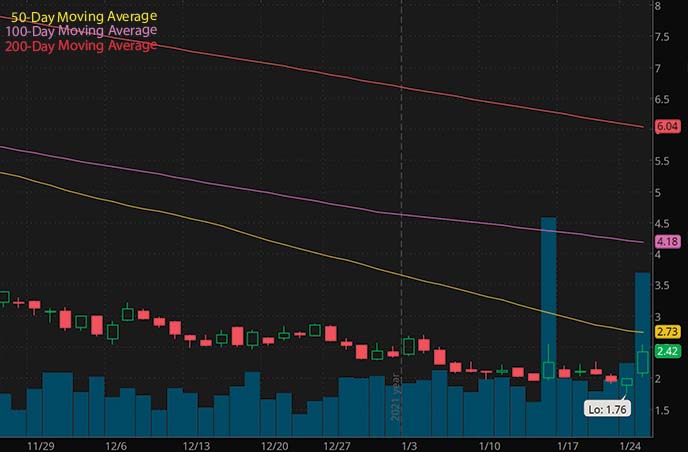
 shutterstock.com – StockNews
 – Zacks
  – Zacks
 – Zacks