Mastercard (MA) vs. Equifax (EFX): Buy, Hold or Sell These Financial Stocks?

The financial services industry is well-positioned for robust profitability and expansion thanks to sustained demand and widespread adoption of digital technologies. Moreover, financial institutions generally benefit from higher interest rates. So, let’s determine if you should buy, hold, or sell financial stocks Mastercard (MA) and Equifax (EFX). Read on to know more….

With solid demand driven by robust consumer spending and business investment activity, alongside rapid digital transformation, the financial services sector is well-poised for significant growth and expansion in the foreseeable years. Further, the profit margins of financial companies expand in a high-interest-rate environment.

Given the industry’s tailwinds, it could be wise to invest in fundamentally sound financial stock Mastercard Incorporated (MA). However, investors could hold Equifax Inc. (EFX) and wait for a better entry point in this stock.

Before delving deeper into their fundamentals, let’s discuss why the financial services industry has been thriving.

Financial services are products and services provided by financial institutions that facilitate financial transactions and other financial activities such as credit cards, loans, insurance, tax accounting, wealth management, and investment opportunities. Financial services are in high demand among individuals, corporations, governments, and investment institutions.

The global financial services market is expected to reach $37.48 trillion by 2027, growing at a CAGR of 7.5%.

The financial services sector is increasingly accelerating its adoption of digital technology. Artificial Intelligence (AI) and Machine Learning (ML) are transforming every aspect of the financial industry landscape, and their widely adopted applications include task automation, predictive analytics, fraud detection, credit risk management, customer support, and algorithmic trading.

With the COVID-19 pandemic, consumers have rapidly shifted to cloud and mobile solutions for their everyday financial needs. Also, the industry leverages blockchain for secure payments, identity management, and smart contracts. This technology enables real-time transaction processing, improved customer experience, faster settlement times, and increased data accuracy.

Furthermore, financial institutions have adopted Robotic Process Automation (RPA) to improve the accuracy of financial analysis and forecasts and maximize efficiency and productivity by reducing costs with the services-through-software model. According to Gartner, approximately 80% of finance leaders have already implemented or plan to implement RPA.

The consumer finance market size is projected to reach $1.96 trillion by 2029, growing at an impressive CAGR of 7.1%. The quick clearance of loan requests from financial organizations and the easy accessibility of loans, including house loans, vehicle loans, and personal loans, are key factors for global consumer finance business’ growth.

In addition, growing access to loans and credit via digital payment systems provides the consumer finance market with numerous development prospects.

Moreover, financial companies usually benefit from rising interest rates as their profit margins expand as rates climb. The Federal Reserve approved a 25 basis points (bps) hike in July, raising the benchmark fed funds rate target range to 5.25%-5.5%, the highest level in nearly 22 years.

While the Fed held interest rates steady at its meeting in September, it signaled expecting one more rate hike before the end of the year as the inflation rate is still above its target of 2%.

Considering these conducive trends, let’s take a look at the fundamentals of the three Consumer Financial Services stocks, starting with number 2.

Stock to Hold:

Stock #2: Equifax Inc. (EFX)

EFX is a data, analytics, and technology company. It operates through three segments: Workforce Solutions; U.S. Information Solutions (USIS); and International. The company offers consumer and commercial information services like credit scoring, credit modeling and portfolio analytics, and other consulting services; mortgage services; and credit monitoring products.

On September 20, EFX announced a new integration between The Work Number® service and Payroll Relief software from the IRIS Software Group (IRIS).

Automated employment and income verifications from The Work Number can now be available to up to a million additional employees of U.S. small- and medium-sized businesses (SMBs) using IRIS Payroll Relief software. The new integration with IRIS Software Group should benefit EFX significantly.

On August 2, EFX acquired Boa Vista Serviços, the second-largest credit bureau in Brazil. This strategic and financially attractive acquisition would expand Equifax’s international footprint in the large and fast-growing $2 billion Brazilian total addressable market. It also offers Boa Vista Serviços customers access to expansive Equifax capabilities and cloud-native solutions.

EFX’s trailing-12-month gross profit margin and EBITDA margin of 55.55% and 29.36% compare to the respective industry averages of 83.32% and 117.15%. However, the stock’s trailing-12-month ROCE and ROTC of 13.12% and 5.77% are lower than the industry averages of 13.60% and 6.79%, respectively.

For the second quarter that ended June 30, 2023, EFX reported operating revenue of $1.32 billion. Its revenue from the U.S. Information Solutions segment grew 5.6% from the year-ago value to $445 million. However, the company’s operating income was $236.90 million, down 22.2% year-over-year.

In addition, net income attributable to Equifax was $138.30 million and $1.12 per share, representing declines of 31.1% and 31.3% year-over-year, respectively.

Analysts expect EFX’s revenue for the fiscal year (ending December 2023) to increase 3.6% year-over-year to $5.31 billion. However, the company’s EPS for the current year is expected to decline 8.2% from the prior year to $6.94. But it has surpassed the consensus EPS estimates in each of the trailing four quarters.

Shares of EFX have gained 6.2% over the past year to close the last trading session at $184.11. But the stock has plunged 7% over the past month and 6.8% over the past six months.

EFX’s POWR Ratings reflect its mixed outlook. The stock has an overall C rating, equating to a Neutral in our proprietary rating system. The POWR Ratings are calculated by considering 118 different factors, with each factor weighted to an optimal degree.

EFX has a C grade for Growth, Momentum, Stability, and Quality. It is ranked #40 of 50 stocks in the Consumer Financial Services industry.

Click here for the additional POWR Ratings for EFX (Sentiment and Value).

Stock to Buy:

Stock #1: Mastercard Incorporated (MA)

MA offers transaction processing and other payment-related products and services internationally. The company facilitates the processing of payment transactions, including authorization, clearing, settlement, and other payment-related services. It serves account holders, merchants, financial institutions, businesses, governments, and other organizations.

On July 24, MA introduced Mastercard Receivables Manager, a fast, safe, and cost-effective automated solution designed to streamline the processing of virtual card payments for businesses. This innovation complements MA’s virtual card platform, providing diverse payment options and advancing the digitization of B2B transactions across buyers and suppliers.

On May 26, MA announced expanding its global payment partnership with the pan-European Commercial Bank, UniCredit. The strategic collaboration leverages UniCredit’s extensive network of 13 banks to extend the reach of MA’s card payment expertise, potentially driving increased transaction volumes and revenue for the company.

MA’s trailing-12-month gross profit margin of 100% is 67.9% higher than the industry average of 59.55%. Also, the stock’s trailing-12-month EBITDA and net income margins of 60.33% and 43.37% compare favorably to the industry averages of 20.13% and 25.78%, respectively.

During the second quarter that ended June 30, 2023, MA’s net revenue increased 14.2% year-over-year to $6.27 billion. Its operating income rose 23.3% from the prior year’s quarter to $3.70 billion. Additionally, the company’s adjusted net income and adjusted EPS grew 9.8% and 12.9% year-over-year to $2.74 billion and $2.89, respectively.

Street expects MA’s revenue and EPS for the fiscal year (ending December 2023) to increase 13.4% and 14.2% from the prior year to $25.21 billion and $12.16, respectively. Also, the company topped the consensus revenue and EPS estimates in all four trailing quarters, which is remarkable.

MA’s stock has gained 13.5% over the past six months and 38.7% over the past year to close the last trading session at $402.49.

MA’s solid fundamentals are reflected in its POWR Ratings. The stock has an overall rating of B, which translates to Buy in our pro­­­­­­­­­prietary rating system.

MA has a B grade for Stability and Quality. It is ranked #6 out of 50 stocks within the same industry.

Beyond what we stated above, we also have MA’s ratings for Value, Growth, Sentiment, and Momentum. Get all MA ratings here.

43 Year Investment Pro Shares Top Picks

Steve Reitmeister is best known for his timely market outlooks & unique trading plans to stay on the right side of the market action. Click below to get his latest insights…

Steve Reitmeister’s Trading Plan & Top Picks >


MA shares were unchanged in premarket trading Tuesday. Year-to-date, MA has gained 16.29%, versus a 14.28% rise in the benchmark S&P 500 index during the same period.


About the Author: Mangeet Kaur Bouns

Mangeet’s keen interest in the stock market led her to become an investment researcher and financial journalist. Using her fundamental approach to analyzing stocks, Mangeet’s looks to help retail investors understand the underlying factors before making investment decisions.

More…

The post Mastercard (MA) vs. Equifax (EFX): Buy, Hold or Sell These Financial Stocks? appeared first on StockNews.com

https://www.entrepreneur.com/finance/mastercard-ma-vs-equifax-efx-buy-hold-or-sell-these/459707




3 Biotech Stocks Offering Potential for Gains

Solid foothold of personalized medicine, increasing prevalence of chronic diseases, favorable government initiatives, and rapid digital transformation are opening new avenues for biotech companies. Thus, it could be wise to invest in fundamentally sound biotech stocks BioMarin Pharmaceutical (BMRN), Shionogi (SGIOY), and Exelixis (EXEL)for potential gains. Read on….

Despite a challenging macro environment, the biotech industry’s long-term outlook looks promising, thanks to numerous advancements in genetic engineering, growing research and development (R&D) in personalized medicine, and the rising prevalence of chronic diseases. Further, supportive government policies and the rapid adoption of emerging technologies fuel the sector’s growth.

Given the industry’s bright growth prospects, quality biotech stocks BioMarin Pharmaceutical Inc. (BMRN), Shionogi & Co., Ltd. (SGIOY), and Exelixis, Inc. (EXEL) could be ideal buys for solid returns.

Before delving deeper into the fundamentals of these stocks, let’s discuss what’s shaping the biotech sector’s outlook.

The COVID-19 pandemic has positively impacted the biotechnology industry by creating several growth opportunities and propelling advancements in drug development and manufacturing for vaccines for the disease.

Despite elevated inflation, rising interest rates, and slowing economic growth, the biotech sector is well-placed for robust growth and profitability in the long term, driven by rapid advancements in genetic engineering, primarily exemplified by the revolutionary CRISPR-Cas9 technology and increasing R&D in personalized medicine and novel advanced therapies.

White House Office of Science and Technology Policy Report identified precision medicine as an R&D priority for the U.S. over the next 20 years. The report highlighted goals to advance precision medicine, such as significant improvements in health monitoring, multi-omics, cell-based therapies, AI-driven drug development, gene editing, and microbial genome sequencing.

According to the IMARC Group, the global biotechnology market is expected to reach $1.03 trillion by 2028, growing at a CAGR of 7.4% during 2023-2028.

Moreover, the rising prevalence of infectious and chronic diseases such as cancer, diabetes, different forms of arthritis, and age-related macular degeneration is expected to boost the industry’s growth. High demand for biotechnology tools for agricultural applications like molecular breeding, micro-propagation, and conventional plant breeding should also bode well for the industry.

Furthermore, the sector is driven by favorable government support through initiatives aimed at streaming the medication regulatory pathway, improving approval processes and reimbursement policies, and standardizing clinical studies.

Biotech companies are increasingly incorporating digital technologies like AI, cloud, and the Internet of Things (IoT), revolutionizing the research, development, and commercialization of drugs and therapies. The global AI in drug discovery market is projected to reach $11.73 billion by 2031, growing at a 27.4% CAGR.

With these favorable trends in mind, let’s delve into the fundamentals of the three Biotech stock picks, beginning with the third choice.

Stock #3: BioMarin Pharmaceutical Inc. (BMRN)

BMRN develops and commercializes therapies for people with severe and life-threatening rare diseases and medical conditions. The company’s commercial products include Vimizim, Naglazyme, Kuvan, Palynziq, Brineura, Roctavian and Voxzogo.

On September 15, BMRN announced that the European Medicines Agency’s (EMA) Committee for Medicinal Products for Human Use (CHMP) adopted a positive opinion recommending marketing authorization to expand the indication for VOXZOGO® (vosoritide) for injection to treat children aged four months and older with achondroplasia.

EMA’s final approval decision is expected by the fourth quarter of 2023.  VOXZOGO is currently approved in Europe for children with achondroplasia who are two years of age and older with open growth plates.

On June 29, the U.S. Food and Drug Administration (FDA) approved BMRN’s ROCTAVIAN™ (valoctocogene roxaparvovec-rvox) gene therapy for treating adults with severe hemophilia A to control bleeds. ROCTAVIAN’s approval was based on durability, efficacy, and safety results from the largest and longest Phase 3 study for a gene therapy for hemophilia.

This FDA approval of ROCTAVIAN builds on BMRN’s proven track record of advancing treatments targeting the underlying cause of life-threatening genetic conditions, and it is expected to drive the company’s growth and profitability.

For the second quarter that ended June 30, 2023, BMRN’s revenues increased 11.5% year-over-year to $595.27 million. Its income from operations grew 50.4% from the year-ago value to $58.87 million. The company’s non-GAAP net income rose 37% from the prior year’s quarter to $105.20 million, and its non-GAAP EPS was $0.54, up 31.7% year-over-year.

Analysts expect BMRN’s EPS for the fiscal year (ending December 2023) to increase 14.3% year-over-year to $2.21. The consensus revenue estimate of $2.46 billion for the current year indicates a 17.2% rise year-over-year. Moreover, the company has surpassed the consensus EPS estimates in three of the trailing four quarters.

Shares of BMRN have gained 1.9% over the past year to close the last trading session at $86.51.

BMRN’s POWR Ratings reflect this robust outlook. The stock has an overall B rating, translating to Buy in our proprietary rating system. The POWR Ratings assess stocks by 118 distinct factors, each with its own weighting.

BMRN has an A grade for Growth and a B for Value and Sentiment. Within the Biotech industry, it is ranked #17 of 359 stocks.

To access additional ratings of BMRN for Momentum, Quality, and Stability, click here.

Stock #2: Shionogi & Co., Ltd. (SGIOY)

Headquartered in Osaka, Japan, SGIOY engages in the research, development, manufacture, and distribution of pharmaceuticals, diagnostic reagents, and medical devices. The company’s offerings include Fetroja, a multidrug-resistant for bacterial infection treatment; Xofluza, an influenza virus drug; and Tivicay, an anti-HIV drug.

On August 29, SGIOY announced that Flomox® Fine Granules for children launched in China through its partner, Beijing Huawei Pharmaceutical Co. LTD. This drug was listed on the National Reimbursement Drug List (NRDL) in January this year.

In China, there are limited options for pediatric infectious disease treatment drugs, and this drug would contribute as a new treatment option for pediatric infectious diseases. This move reflects the company’s commitment to the principle “Protecting people worldwide from the threat of infectious diseases” and is expected to expand its reach and drive its revenue stream.

On June 26, SGIOY’s New Jersey-based subsidiary, Shionogi Inc., announced the acquisition of Qpex Biopharma, Inc., a privately held clinical-stage pharmaceutical company with expertise in antimicrobial research and development.

“We are pleased to welcome Qpex into the Shionogi family. Bacterial resistance to antibiotics remains one of the biggest threats to global health, and Qpex’s pipeline, including xeruborbactam, and its capabilities will accelerate our efforts to develop new antibiotic treatments to address antimicrobial resistance,” said Isao Teshirogi, CEO of Shionogi.

SGIOY’s revenue grew 52.2% year-over-year to ¥109.31 billion ($736.63 million) for the first quarter that ended June 30, 2023. The company’s operating profit and profit before tax came in at ¥46.59 billion ($313.97 million) and ¥55.70 billion ($375.36 million), increases of 274.9% and 38.2% year-over-year, respectively.

In addition, profit attributable to owners of the parent rose 22.6% from the prior year’s quarter to ¥42.56 billion ($286.61 million). Also, the company’s earnings per share amounted to ¥144.57 billion, up 25.6% year-over-year.

Analysts expect SGIOY’s revenue for the fourth quarter (ending March 2024) to increase 36.4% year-over-year to $896.80 million. Likewise, the company’s revenue for the fiscal year 2024 is expected to grow 6.6% from the prior year to $2.93 billion. Also, it has topped the consensus revenue estimates in each of the trailing four quarters, which is impressive.

SGIOY’s stock has gained 2.8% over the past month to close the last trading session at $11.13.

SGIOY’s solid fundamentals are reflected in its POWR Ratings. The stock has an overall grade of B, equating to a Buy in our proprietary rating system.

SGIOY has a B for Growth, Value, and Quality. It is ranked #13 out of 359 stocks in the same industry.

In addition to the POWR Ratings I’ve just highlighted, you can see SGIOY’s ratings for Stability, Momentum, and Sentiment here.

Stock #1: Exelixis, Inc. (EXEL)

EXEL is an oncology-focused biotechnology company that focuses on discovering, developing, and commercializing new medicines to treat cancers. The company offers CABOMETYX tablets to treat patients with advanced renal cell carcinoma and COMETRIQ capsules for metastatic medullary thyroid cancer. It also offers COTELLIC and MINNEBRO.

On September 13, EXEL and Insilico Medicine entered into an exclusive license agreement granting Exelixis worldwide rights to develop and commercialize ISM3091, a potentially best-in-class small molecule inhibitor of USP1, which emerged as a synthetic lethal target in the context of BRCA-mutated tumors. This deal should bode well for the company.

In the second quarter that ended June 30, 2023, EXEL’s total revenues increased 12% year-over-year to $469.85 million, and its net product revenues were $409.60 million, up 18% year-over-year. The company’s non-GAAP net income came in at $100.29 million, or $0.25 per share, compared to non-GAAP net income of $89.70 million, or $0.28 per share for the comparable period in 2022.

Street expects EXEL’s revenue and EPS for the fiscal year (ending December 2023) to increase 14.1% and 28.1% year-over-year to $1.84 billion and $0.72, respectively. Additionally, the company has surpassed the consensus revenue and EPS estimates in each of the trailing four quarters.

For the fiscal year 2024, EXEL’s revenue and EPS are expected to grow 13% and 33.1% from the previous year to $2.08 billion and $0.96, respectively.

Over the past six months, the stock has gained 17.3% and 29.6% over the past year to close the last trading session at $21.48.

EXEL’s POWR Ratings reflect its promising prospects. The stock has an overall rating of B, which translates to Buy in our proprietary rating system.

It has an A grade for Value and Quality and a B for Sentiment. EXEL is ranked #9 of 359 stocks in the Biotech industry.

Click here to see the other ratings of EXEL for Growth, Momentum, and Stability.

What To Do Next?

Get your hands on this special report with 3 low priced companies with tremendous upside potential even in today’s volatile markets:

3 Stocks to DOUBLE This Year >


BMRN shares were unchanged in premarket trading Monday. Year-to-date, BMRN has declined -16.41%, versus a 13.80% rise in the benchmark S&P 500 index during the same period.


About the Author: Mangeet Kaur Bouns

Mangeet’s keen interest in the stock market led her to become an investment researcher and financial journalist. Using her fundamental approach to analyzing stocks, Mangeet’s looks to help retail investors understand the underlying factors before making investment decisions.

More…

The post 3 Biotech Stocks Offering Potential for Gains appeared first on StockNews.com

https://www.entrepreneur.com/finance/3-biotech-stocks-offering-potential-for-gains/459619


Why Does Jay Soloff Love This Income Stock?

This company is in the sweet spot when it comes to higher mortgage rates. Its required insurance product is in increasing demand as home prices outstrip the ability of most buyers to pay 20% down. Enact (ACT) should be on your radar as a housing market play that can win in a variety of scenarios.

The Housing Market Index, which measures homebuilder confidence fell five points recently from 50, to 45, an indicator homebuilders are a little less bullish than they have been for most of 2023. One big reason, continued high interest and mortgage rates.

But if you’re a homebuyer in this environment, unless you’re one of the lucky few to be paying cash, you’re going to be required to pay Private Mortgage Insurance (PMI) in your monthly mortgage payment. And that’s where Enact (ACT) makes its living.

What exactly is PMI? Private mortgage insurance is required by mortgage lenders when a buyer puts down less than 20% of the purchase price of a home. The insurance premiums are paid by the homeowner, but the insurance is there to protect the mortgage lender in the event the homeowner defaults on their loan.

And rising mortgage rates, which bump up the price of that loan substantially, and therefore the monthly payments, are making it harder and harder for buyers to surpass that 20% threshold on their down payments. Which, as you’ve probably surmised by now, means more business for ACT.

The rising cost of homes, combined with a continued shortage of houses, really makes it difficult for Enact NOT to do well. As CEO Rohit Gupta said in their latest earnings release, “[S]trong new business production supported by elevated persistence drove record insurance in force while favorable credit performance and expense efficiency drove solid earnings and returns.”

In other words, Enact is seeing record demand for its product, and they just need to ensure they execute that business efficiently.

And, from their recent numbers, they are executing quite well. The company is over 80% owned by insiders, a huge vote of confidence, and has operating margins of over 85%. (For reference, American International Group (AIG), a large general insurer, has operating margins of 29%.)

The company trades at 6.7x current earnings, and only 7.7x projected earnings. It also comes in at only 8.1x free cash flow, which is a huge plus in the current interest rate environment. Its current dividend is 2.29%.

ACT has an overall A rating in our POWR Rating system, and should continue to perform well given current housing demand. The stock has moved from the low $20s to close to $30 this year, and is now pulling back slightly offering a potential buy opportunity.

What To Do Next?

Above I featured just 1 of my favorite income stocks. My guess is that you’d like to discover even more attractive income stocks.

All you need to do is check out my POWR Income Insider portfolio.

This is backed by a proven quant strategy that has produced an average annual return of +24.3%. It even generated surprising gains in 2022 when the bear market came to town.

If you would like to learn about this consistently successful income stock approach…then just click the link below:

Discover POWR Income Insider now >


ACT shares closed at $27.62 on Friday, down $-0.10 (-0.36%). Year-to-date, ACT has gained 16.57%, versus a 13.80% rise in the benchmark S&P 500 index during the same period.


About the Author: Jay Soloff

Jay is a former professional market maker who cut his teeth trading on the floor of the CBOE. With more than 20 years of experience trading and investing, his focus is on making professional strategies accessible to everyone, which is exactly what does in his highly profitable POWR Income and POWR Stocks Under $10 investment advisory services.

More…

The post Why Does Jay Soloff Love This Income Stock? appeared first on StockNews.com

https://www.entrepreneur.com/finance/why-does-jay-soloff-love-this-income-stock/459595


My Favorite Energy Stock Under $10

Oil is back in the headlines as it has rocketed higher on a combination of factors over the past two months. This means oil stocks should definitely be back on your radar. And this under $10 oil stock has popped up on the POWR Ratings radar, Battalion Oil (BATL).

Spoiler alert, if you haven’t been to the gas station in the past week, you may be in for a shock. The price of gas has risen about 28% since early July, spiking higher the past few weeks. 

While I’m not personally pleased by this, it does open up more investing opportunities in stocks like Battalion Oil (BATL). This under $10 stock is set to outperform with West Texas Intermediate (WTI) right at $90 a barrel. 

Battalion should not only benefit from rising oil prices, but the company has been on a focused mission this year to reduce cost. Earlier this year, BATL CEO Matt Steele said the company had reduced its corporate office workforce by 44%. Steele expects a combination of staff reductions and other cost saving measures to reduce total general and administrative costs by 40% in 2023.

The company currently trades at an astoundingly low 0.9x earnings, and 3.7x projected earnings. BATL currently trades at .45x its price to sales, and has a low price to book ratio of less than 2x.

BATL has been spending recently on several “acid gas injection” projects, which are coming online now. Those facilities are expected to save the company an additional $2.5 million per month in costs associated with outside processing facilities. 

With operating margins recently coming in at 42%, and a return on equity (ROE) of 25%, rising oil prices should only bolster these outstanding numbers. 

Out POWR Ratings have BATL ranked above 90% of companies in our database on the component of Value.  

From my view there is no relief on the horizon for gas prices. In fact, if anything there are catalysts out there, such as the refilling of the strategic oil reserves that must take place sooner rather than later, that point to at minimum a stable price and more likely a higher oil price. 

These factors should continue to support BATL, which has fallen from its highs of around $20 in 2022 to its current price just under $6.

What To Do Next?

If you like the stock shared above…then you will love this new special report sharing 3 low priced companies with tremendous upside potential.

3 Stocks to DOUBLE This Year >


BATL shares closed at $5.92 on Friday, up $0.03 (+0.51%). Year-to-date, BATL has declined -39.03%, versus a 13.80% rise in the benchmark S&P 500 index during the same period.


About the Author: Jay Soloff

Jay is a former professional market maker who cut his teeth trading on the floor of the CBOE. With more than 20 years of experience trading and investing, his focus is on making professional strategies accessible to everyone, which is exactly what does in his highly profitable POWR Income and POWR Stocks Under $10 investment advisory services.

More…

The post My Favorite Energy Stock Under $10 appeared first on StockNews.com

https://www.entrepreneur.com/finance/my-favorite-energy-stock-under-10/459581


3 AI Stocks to Buy Now

AI regulation is a foregone conclusion, it’s just left to be determined who in government will formulate the rules and enforce them. Elon Musk thinks a whole new agency will be needed to enforce the massive amount of regulation coming down the road. These three companies, Red Violet (RDVT), Akamai (AKAM) and Cisco (CSCO), are at the forefront of companies implementing those regulations, and should see a pretty penny in profits for their work.

A large group of tech titans descended on Capitol Hill recently asking the U.S. government for, wait for it…more regulation! They were meeting with Congressional leaders, looking for regulation of what many fear is a too rapidly advancing AI technology. Elon Musk is at the forefront of this push, warning of the dangers of AI. 

One of the fears surrounding the new technology is that it can impersonate a human, causing havoc for companies that more and more deal with their customers online, or through some electronic medium. A company you’ve probably never heard of is looking to be on the front line of this impersonation battle, Red Violet (RDVT).

Red Violet uses AI and machine learning (AI/ML) in its products, which are able to provide identity intelligence and fraud prevention for businesses in a digitally foggy world. 

Have you gotten multiple choice identity questions recently when signing into a sensitive website, maybe a financial site? 

Did you wonder how they knew what street you lived on when you were 15, along with some person you know (that maybe you forgot you knew), and what county you went to college in?

This is the type of record compilation that Red Violet performs, cross checking who an individual claims to be with vast databases that paint a picture of who that person actually is. This identity picture becomes critical in a world where hackers steal singular identifying bits of information, like a social security number, on a daily basis. 

Red Violet has an overall B POWR Rating, and ranks 15th in our software/business category. It has a strong Growth ranking, outpacing 89% of the stocks in our database. 

Red Violet is still a young company, but very importantly in the current environment, the company has recently become profitable. In 2Q revenue increased 17% YoY, while gross profit increased 18%. The company has consistent gross margins of 64%. 

In the recent earnings release, Derek Dubner, CEO, said, “We are seeing continued strength in new customer onboarding, pipeline expansion from higher-tier prospects, and robust customer conversion at all levels.” The technology Red Violet provides is scalable, cloud based, and has taken hold in the realty market where the company recently reported deals with realtors in several states. 

As AI ramps up, and personal identity comes under increasing attack from ne’er-do-wells, Red Violet stands only to increase its profitability, ensuring safe, protected, customer transactions.

Speaking of protection, there is one company that is synonymous with protection on the web, that should benefit from any AI regulation around increased AI security precautions, and that is Akamai (AKAM)

Akamai provides cybersecurity services, optimization of web property services, and brand protection to many of the largest companies in the world. There is no debate, that with AI, web, DDoS and all other forms of hacking attacks, will become more sophisticated and more frequent. AKAM uses AI and years of experience to, as their motto goes, “Power and Protect Life Online”.

Akamai is an entrenched player in the delivery of web services, and runs the largest network edge platform in the world. This allows the company to identify early security threats, and put in place mediation efforts much sooner than other security providers. 

In its latest quarter, revenue in its security and compute business (59% of current business) grew 14% YoY. In that earnings announcement CEO Dr. Tom Leighton said the company was “[I]ncreasing our guidance for revenue and earnings for the remainder of the year, while continuing to invest in key growth areas of security and cloud computing.”

Akamai has an overall POWR Rating of B, outpacing over 90% of the stocks in our POWR Rating database. It stands out in the Quality category, where it is in the top 80% of the stocks we track. 

Finally Cisco’s (CSCO) recent announcement that it is purchasing Splunk (SPLK) in an all cash tender offer underscores the strength and demand in the AI/cybersecurity market. Cisco announced its offer with the underlying premise that AI and cybersecurity are key elements moving forward, and they expect the acquisition of the AI and cybersecurity assets of Splunk to be accretive to earnings in year two.

For you old timers, you’ll remember Cisco under John Chambers was a bellwether stock in the mid-90’s and into the dotcom boom/bust. It hasn’t recovered that luster, but with this acquisition is upping its game in the AI/cybersecurity sector. 

This may make them a longer term player in this early market, as they bring in Splunk customers, and add Splunk functionality to their offerings. At a minimum it shows the company is pushing forward in AI/cybersecurity and not willing to stand on the sidelines.

In its latest quarter CSCO increased revenue 16% YoY, while increasing operating cash flow to $6 billion, or up 62% YoY. The company has an overall B rating in our POWR Ratings, ahead of over 91% of the companies in our database. It has a stellar Quality rating putting it in the 99th percentile of U.S. companies.

There are going to be big winners in the market who implement AI in their products. But, as the recent meeting in DC among top AI executives and the government should clearly show, there are going to be mandated big winners in the protection/regulation scheme in the new AI world we are embracing. 

Red Violet (RDVT), Akamai (AKAM) and Cisco (CSCO) should be among those security providers that profit from this emerging regulatory framework.

What To Do Next?

Get your hands on this special report with 3 low priced companies with tremendous upside potential even in today’s volatile markets:

3 Stocks to DOUBLE This Year >


RDVT shares closed at $19.95 on Friday, up $0.47 (+2.41%). Year-to-date, RDVT has declined -13.34%, versus a 13.80% rise in the benchmark S&P 500 index during the same period.


About the Author: Steven Adams

After earning a law degree cum laude with a focus on securities law, Steven worked as a Nasdaq market maker for a large broker dealer, and then as a trader for an arbitrage focused proprietary hedge fund. He subsequently worked as a consultant for a Fortune 500 consulting firm serving both government and commercial clients, including the NYSE, Prudential, FDIC, and NASA.

More…

The post 3 AI Stocks to Buy Now appeared first on StockNews.com

https://www.entrepreneur.com/finance/3-ai-stocks-to-buy-now/459580


100 Best Stocks for October

Our computer models are dialed into the 100 best stocks for October 2023. What makes them “the best stocks”? Years of hard work to find the precise factors that lead to market beating stocks (SPY). Like our coveted strategy with an average annual return of +57.15%. And yes, it even produced impressive profits during the 2022 bear market. Now is the time to discover the winning stocks it is picking for the weeks and months ahead. Get full details below.

We received a record response to my most recent presentation—where I shared our most profitable solution for investors—so I wanted to reach out once more to make sure you didn’t miss it:

100 Best Stocks for October >

This revolutionary trading system actually consists of 10 different “black box” trading strategies each with precisely 10 stocks each.

I am referring to our coveted “low priced” stock strategy sporting an average annual return of +57.15%.

And yes, it was profitable during the 2022 bear market putting the S&P 500 (SPY) to shame.

And yes, it has come roaring out of the gate once again in 2023!

To create proven strategies like these, we turned to the same Data Scientist who created our coveted POWR Ratings. We had 3 key requests for this project:

  1. 10 unique stock picking strategies. Something for every investor
  2. 10 stocks per strategy updated daily
  3. MOST IMPORTANT: Provide stellar performance in ALL markets

And boy did he ever deliver!

In the webinar we go over full details on each of the 10 strategies and their market beating results.

No doubt you have heard many other investment experts talk about great results in theory, but come up short in reality.

That is why I came up with…

136,835 Reasons to Pay Attention to What Comes Next

Back in February 2021 I decided to put my money where my mouth was by investing my entire Roth IRA account in 2 of these “black box” stock picking strategies.

Since then, my account has significantly outpaced the market leading to a real life gain of $136,835.

The full proof of that, including screenshots from my Schwab account, are in the presentation.

Even better, I show you the precise methods I used…and how you can easily do the same to enjoy market topping results.

It’s all there in the presentation…so start watching now:

100 Best Stocks for October >

You owe it to yourself to get on the right foot for the rest of the year by watching this valuable presentation now so you can use these winning strategies to outperform in the months ahead.

But Time is Running Out!

So don’t delay, click below to watch now:

100 Best Stocks for October >

Wishing you a world of investment success!


Steve Reitmeister
…but everyone calls me Reity (pronounced “Righty”)
CEO, StockNews.com & Editor, Reitmeister Total Return


SPY shares were trading at $433.56 per share on Thursday afternoon, down $5.08 (-1.16%). Year-to-date, SPY has gained 14.63%, versus a % rise in the benchmark S&P 500 index during the same period.


About the Author: Steve Reitmeister

Steve is better known to the StockNews audience as “Reity”. Not only is he the CEO of the firm, but he also shares his 40 years of investment experience in the Reitmeister Total Return portfolio. Learn more about Reity’s background, along with links to his most recent articles and stock picks.

More…

The post 100 Best Stocks for October appeared first on StockNews.com

https://www.entrepreneur.com/finance/100-best-stocks-for-october/459566


Stock Alert: Just Another BUY THE DIP Opportunity

Traders threw a tantrum after the Fed shared details on their rate hike plans. This has the S&P 500 (SPY) hitting the lowest level in quite a while. Gladly, things are not as dire as they seem. That is why Steve Reitmeister shares his latest insights to explain why a bull market is still in place…and how to target the best stocks and ETFs for the days ahead. Read on for the full story below.

The Fed was not kidding when they said “higher rates for longer”. That was reiterated with extra vigor on Wednesday….and investors were not pleased.

Does this change the bullish thesis? Or is this just a little detour south before the next leg north?

We will break it all down in today’s commentary.

Market Commentary

Here is the nutshell of the Wednesday Fed announcement.

The economy is doing better than we expected…so it’s going to take a bit longer to bring down inflation to target level…the good news is that we really believe we can do it without creating a recession.

So why did stocks go down on this seemingly positive outlook?

Because the dot plot of rate expectations by Fed officials now has the end of 2024 rate still way up at 5.1%. That was revised higher from the previous estimate of 4.6%.

Yes, this most certainly fits in with the Fed narrative of “higher rates for longer”, but much longer and higher than investors previously anticipated.

This notion of longer Fed involvement increases odds of overstaying their welcome creating a recession. Also it delays when rates are lowered which would be a catalyst for higher economic growth which begets higher earnings growth and higher stock prices.

Granted this update is not overly positive. But it’s not really negative either.

That’s because when you pull back and assess the big picture it still says that the odds of recession (and return to bear market) are very low. This is reinforced by Fed officials who now predict +1.5% GDP growth in 2024 up from previous projection of +1.1%.

To boil this all down…things are still bullish because odds of recession are so low. But the idea of when the Fed starts lowering rates to boost the economy and stock prices is also postponed.

Instead, I see slower earnings growth begetting more modest stock price increases for the overall market. For example, the S&P 500 (SPY) may only go up 5-10% next year. Not terrible…not exciting either.

But that 5-10% is the return for the average stock. Our goal is to invest in BETTER THAN AVERAGE stocks. Or to be totally honest, we want GREAT stocks.

Gladly that is easy to do thanks to our reliance on the consistent outperformance of the POWR Ratings. Focusing on the fundamentally most sound and reasonably priced stocks has always been a path to better returns.

In fact, historically many of my years of superior outperformance over the market is precisely this situation. Where superior stock selection handily beats mundane results for overall market.

So I welcome this chapter where every dip is just another opportunity to snap up the best stocks at even better prices.

How low could this recent dip go?

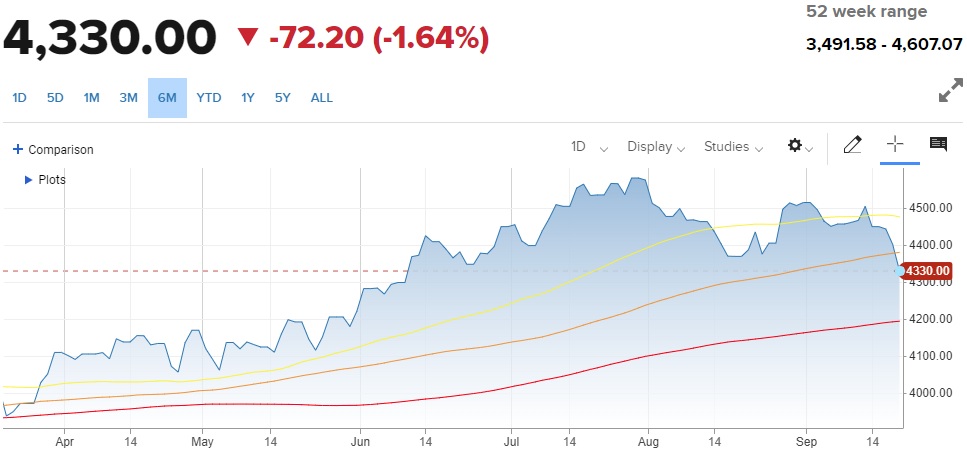
Moving Averages: 50 Day (yellow), 100 Day (orange), 200 Day (red)

We are enduring our first real test of the 100 day moving average (4,375) in quite some time as we broke below on Thursday. Maybe bounce back Friday…maybe take a real shot at scaring investors with a test down to the 200 day moving average at 4,189.

That would represent a stiff 10% correction for the overall market that could levy 50-100% more pain on riskier positions.

Honestly, I would welcome that move in the short run…because I know it would not be long lived. Also as a value investor I think that it would be fun to see all the overpriced glory stocks, that led the way the first half of the year, get their proper comeuppance now.

As shared earlier, I still see us in the midst of a long term bull market. However, investors were a bit too overzealous about when the Fed was going to lower rates…and thus a necessary pullback/correction is unfolding.

Maybe bottom is now at the 100 day moving average…but likely no worse than down at the 200 day moving average. Yet all that will truly do is get rid of recent excesses making it all the easier for the overall market to move higher by end of the year and into 2024.

Again, the key to outperformance is going to be superior stock selection. The next section will share with you some important insights on that front…

What To Do Next?

Discover my current portfolio of 7 stocks packed to the brim with the outperforming benefits found in our POWR Ratings model.

Plus I have added 4 ETFs that are all in sectors well positioned to outpace the market in the weeks and months ahead.

This is all based on my 43 years of investing experience seeing bull markets…bear markets…and everything between.

If you are curious to learn more, and want to see these 11 hand selected trades, then please click the link below to get started now.

Steve Reitmeister’s Trading Plan & Top Picks >

Wishing you a world of investment success!


Steve Reitmeister…but everyone calls me Reity (pronounced “Righty”)
CEO, StockNews.com and Editor, Reitmeister Total Return


SPY shares rose $0.10 (+0.02%) in after-hours trading Thursday. Year-to-date, SPY has gained 14.05%, versus a % rise in the benchmark S&P 500 index during the same period.


About the Author: Steve Reitmeister

Steve is better known to the StockNews audience as “Reity”. Not only is he the CEO of the firm, but he also shares his 40 years of investment experience in the Reitmeister Total Return portfolio. Learn more about Reity’s background, along with links to his most recent articles and stock picks.

More…

The post Stock Alert: Just Another BUY THE DIP Opportunity appeared first on StockNews.com

https://www.entrepreneur.com/finance/stock-alert-just-another-buy-the-dip-opportunity/459565


1 Income Stock to BANK ON Now

One of the best ways to address risk is through diversity. With a strong balance sheet and solid earnings KB Financial (KB) provides a diverse option in the banking sector, with international exposure to mitigate some of the risk we’ve seen in U.S. banking this year.

Regional and small banks have been under a microscope recently after the March failures of Silicon Valley and Signature bank. But wreckless management, and lax oversight, at a few banks should not turn inventors off on solid income producers like KB Financial Group (KB).

Though KB trades on the New York Stock Exchange it is actually based in South Korea. The company operates in a number of segments, including retail and corporate banking, and is also active in the credit card and insurance business.

One of the things I like about KB is that it provides some exposure in South Korea, away from the banking issues that have plagued U.S. regional banks. While it is subject to U.S. regulations, it operates much of its business in a differentiated interest rate regime.

While KB is rated a B overall in our POWR Ratings, importantly for an income producing stock its best ranking is in the Stability component. The last thing I want in an income stock is risk to the dividend.

KB has a mix of mortgage, general obligation and small home and office loans (SOHO), but mortgages account for only about 27% of its overall portfolio. And, over the past four years the bank has essentially doubled assets under management.

From a valuation perspective, the stock trades at just 4.8x current earnings, and 3.8x projected earnings. As of 2Q 2023, KB’s net interest increased 5.4% YoY, with net operating profit increasing 40.4% YoY.

In its earnings release, CFO Scott YH Seo, said profit was pretty evenly spread over “growth of interest and commissions income and supported by cost control efforts”. I like to see a good balance in financial institution earnings, which helps alleviate a lumpy earnings picture over time.

The current dividend yield is 4.42% on most recently reported earnings of $8.60 per share.

This year the stock has traded in a range from just over $35 to just over $48. It currently sits at $40, and could be added to if it drifts back toward $35 as we head into fall.

What To Do Next?

Above I featured just 1 of my favorite income stocks. My guess is that you’d like to discover even more attractive income stocks.

All you need to do is check out my POWR Income Insider portfolio.

This is backed by a proven quant strategy that has produced an average annual return of +24.3%. It even generated surprising gains in 2022 when the bear market came to town.

If you would like to learn about this consistently successful income stock approach…then just click the link below:

Discover POWR Income Insider now >


KB shares were unchanged in after-hours trading Friday. Year-to-date, KB has gained 11.99%, versus a 16.81% rise in the benchmark S&P 500 index during the same period.


About the Author: Jay Soloff

Jay is the lead Options Portfolio Manager at Investors Alley. He is the editor of Options Floor Trader PRO, an investment advisory bringing you professional options trading strategies. Jay was formerly a professional options market maker on the floor of the CBOE and has been trading options for over two decades.

More…

The post Income Stock of the Week: KB Financial Group (KB) appeared first on StockNews.com

https://www.entrepreneur.com/finance/income-stock-of-the-week-kb-financial-group-kb/459151


What is Jay Soloff’s Stock of the Week ???

Applying AI to their business products is where companies can gain an edge in the AI race. eGain (EGAN) is doing just that, and revitalizing its customer knowledge business in the process. Let’s take a look at this stock that just released its latest earnings.

Releasing earnings on Thursday, eGain (EGAN) appears to be in turnaround mode. According to CEO Ashu Roy, the company was seeing stalled deals in the first half of the year, but “we are now seeing many of those deals re-engaging and new RFPs launching with urgency and intent.”

EGAN provides a customer engagement platform that provides client agents with information at their fingertips when their customers contact them with issues. The company counts among its many customers, L.L. Bean, Lands’ End, and even the IRS.

eGain recently started deploying AI into its knowledge management systems, and now has a whole suite of “Knowledge + AI” products that can either be used by a customer agent, or provide self service options to customer clients who want to bypass the human interaction.

These AI enhanced tools are particularly critical at this time, as call center workers currently are experiencing both large turnover, estimated in the overall industry at over 30%, and more complex customer inquiries. An eGain sponsored survey of call center agents found that 63% of 456 surveyed said the questions they now receive are more complicated than in the past.

EGAN ranks very highly on the Quality metric of our POWR Ratings outpacing over 93.5% of all stocks in the database. The company has a stellar A rating overall, ranking in the top 15 stocks of all the stocks we track.

EGAN is trading at just 2.5x cash, and has gross margins of that top 70%. Its enterprise value (EV) to sales is just 1.29, and the company has almost no debt, very unusual for a tech company at this stage. In fact, in the latest quarter the company actually repurchased almost $5 million of its common stock, and has over $73 million in cash or cash equivalents on hand.

CEO Roy is excited about the interest being raised by generative AI, and said it is “rejuvenating interest in knowledge platforms, and this will drive demand for our products in fiscal 2024” (the company’s fiscal year ended with the recent quarter).

With all the hype around AI, this is exactly the kind of stock that draws my interest. One that is actually using AI to enhance its product offerings, and drive new contract interest.

What To Do Next?

If you like the stock shared above…then you will love this new special report sharing 3 low priced companies with tremendous upside potential.

3 Stocks to DOUBLE This Year >


EGAN shares were unchanged in after-hours trading Friday. Year-to-date, EGAN has declined -35.77%, versus a 16.81% rise in the benchmark S&P 500 index during the same period.


About the Author: Jay Soloff

Jay is the lead Options Portfolio Manager at Investors Alley. He is the editor of Options Floor Trader PRO, an investment advisory bringing you professional options trading strategies. Jay was formerly a professional options market maker on the floor of the CBOE and has been trading options for over two decades.

More…

The post Stock Under $10 of the Week: eGain (EGAN) appeared first on StockNews.com

https://www.entrepreneur.com/finance/stock-under-10-of-the-week-egain-egan/459132


The ODD Story Behind Thursday’s BIG Stock Rally

We have all been worried about what high inflation will do to the economy and stock market. And yet on Thursday inflation spiked again, yet amazingly the S&P 500 (SPY) had a great session. Investment veteran Steve Reitmeister shares the reasons why in his new market outlook with trading plan and top picks. Read on below for more.

Going back to early 2022 we understood a very important investment reflex. To sell stocks when headlines pointed to higher inflation…and to buy stocks when the news spoke of lower inflation.

So why on earth did stocks have a gangbuster rally Thursday as the month over month PPI reading nearly doubled?

We will dive below the surface to show the wisdom of that move. Plus, more details as to why the bull market story is well intact.

Market Commentary

Let’s take a step back to remember that we have been operating in a volatile trading range since the end of July. The 5 month rally towards 4,600 on the S&P 500 (SPY) was overheated and overdue for a round of profit taking.

From there we took saw a very typical 5% pullback for the overall market. However, many of the stocks that led the rally saw even stiffer losses.

This trading range scenario has us very vulnerable to every headline, which explains the helter-skelter day by day results. Yet overall, the general bullish thesis for stocks is not lost…just faded to the background for the time being.

With that understanding in place you can appreciate why most investors were very keen on what the monthly CPI and PPI inflation reports predicted about future Fed actions. First came CPI on Wednesday where the yearly Core Inflation rate continues to come down (4.3% vs. 4.7%).

However, some did flinch on the tripling of the monthly non-core rate from 0.2% to 0.6%. So even though the S&P 500 ended in the plus column, most appreciate it was a Risk Off session with small caps taking a bit of a beating.

Flash forward to Thursday where the PPI report showed an even more explosive 0.7% month over month increase (greater than 8% annualized pace). One might suspect that stocks would implode on that news because of this frequently appreciated chain reaction:

Higher inflation > Fed raises rates more > Increases odds of recession > Stocks go DOWN!

Gladly investors could see that the only reason for the rise in PPI was a 1 month spike in oil prices. Tose moves are often very transient. That is why the Fed likes to focus on core inflation figures which removes the volatility in food & energy.

There we see a much more subdued +2.2% year over year inflation pace which is getting us ever closer to that 2% Fed target. This led to a reduction in the likelihood of another Fed Rate hike this year.

Right now, investors place 97% odds of the Fed standing pat at their upcoming meeting on Wednesday September 20th. However, it was always the November meeting that was the bigger question mark.

Going back a week ago investors placed 47% odds of a rate hike taking place in November. Thanks to the CPI and PPI reports this week, that is now down to only 36% odds.

Now let’s flip the above chain reaction around to appreciate the bullish version:

Lower inflation > Fed stops raising rates > And soon lower rates > Decreases odds of recession > Stocks go UP!

And as shared in my last commentary, Goldman Sachs has decreased the odds of recession to only 15%. Note that the starting assumption by economists and market strategist is that 10% odds is true even during the best of times.

Thus, it means they see very few things right now that lead to a recession…and thus recommending that investors prepare for more stock market upside ahead. I feel the same way.

Outlook and Trading Plan

The fundamentally bullish story was shared above. The technical version is that we can barely remember the last time that stocks flirted with the long term trend line of the 200 day moving average (now at 4,179).

Add that all up and it says it’s wise to be bullish and use the dips in this trading range to add more quality stocks.

Like which ones?

Read on below for some of my top ideas.

What To Do Next?

Discover my current portfolio of 7 stocks packed to the brim with the outperforming benefits found in our POWR Ratings model.

Plus, I have added 4 ETFs that are all in sectors well positioned to outpace the market in the weeks and months ahead.

This is all based on my 43 years of investing experience seeing bull markets…bear markets…and everything between.

If you are curious to learn more, and want to see these 11 hand selected trades, then please click the link below to get started now.

Steve Reitmeister’s Trading Plan & Top Picks >

Wishing you a world of investment success!


Steve Reitmeister…but everyone calls me Reity (pronounced “Righty”)
CEO, StockNews.com and Editor, Reitmeister Total Return


SPY shares rose $0.13 (+0.03%) in after-hours trading Friday. Year-to-date, SPY has gained 16.81%, versus a % rise in the benchmark S&P 500 index during the same period.


About the Author: Steve Reitmeister

Steve is better known to the StockNews audience as “Reity”. Not only is he the CEO of the firm, but he also shares his 40 years of investment experience in the Reitmeister Total Return portfolio. Learn more about Reity’s background, along with links to his most recent articles and stock picks.

More…

The post The ODD Story Behind Thursday’s BIG Stock Rally appeared first on StockNews.com

https://www.entrepreneur.com/finance/the-odd-story-behind-thursdays-big-stock-rally/459131