Rubik’s WOWCube adds complexity, possibility by reinventing the puzzle cube

For people who are awful at the original Rubik’s Cube, like this author, a more accessible version of the puzzle is welcome. Solving the new Rubik’s Cube feels more attainable and less frustrating.

The WOWCube is made up of eight modules. Each module has its own PCB, processor, gyroscope, and accelerometer. That may explain why Cubios went with this smaller design. The predicament also begs the question of whether electronics really improve the Rubik’s Cube.

Games and other apps

Once I played some of the WOWCube’s other games, I saw the advantage of the smaller grid. The 2×2 layout is more appropriate for games like White Rabbit, which is like Pac-Man but relies on tilting and twisting the cube, or Ladybug, where you twist the cube to create a path for a perpetually crawling ladybug. A central module might add unneeded complexity and space to these games and other WOWCube apps, like Pixel World, which is like a Rubik’s Cube puzzle but with images depicting global landmarks, or the WOWCube implementation of Gabriele Cirulli’s puzzle game, 2048.
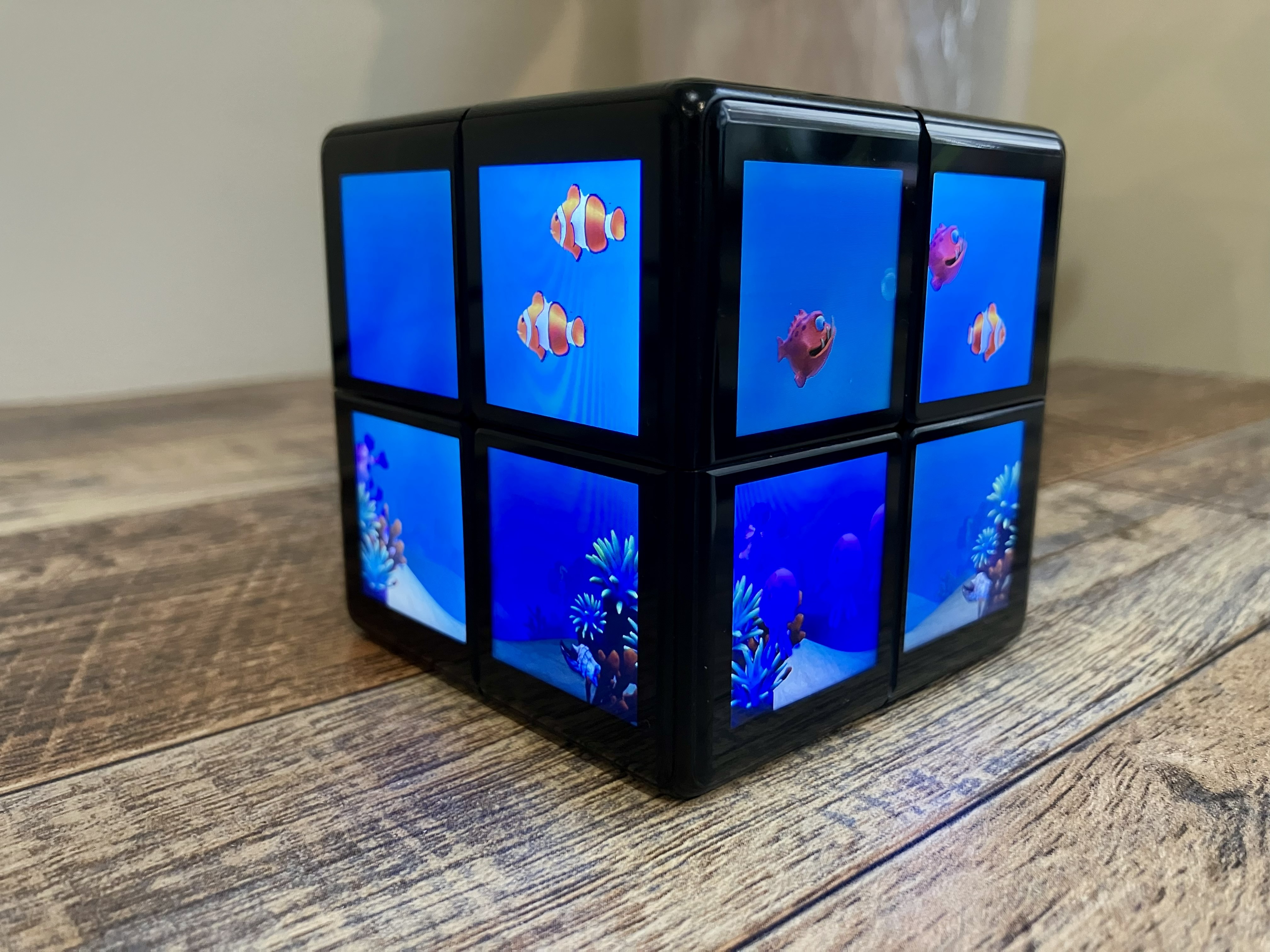
Rubik's WOWCube displaying its Aquarium app.

One of the “games” makes the WOWCube look like a virtual aquarium.

Scharon Harding
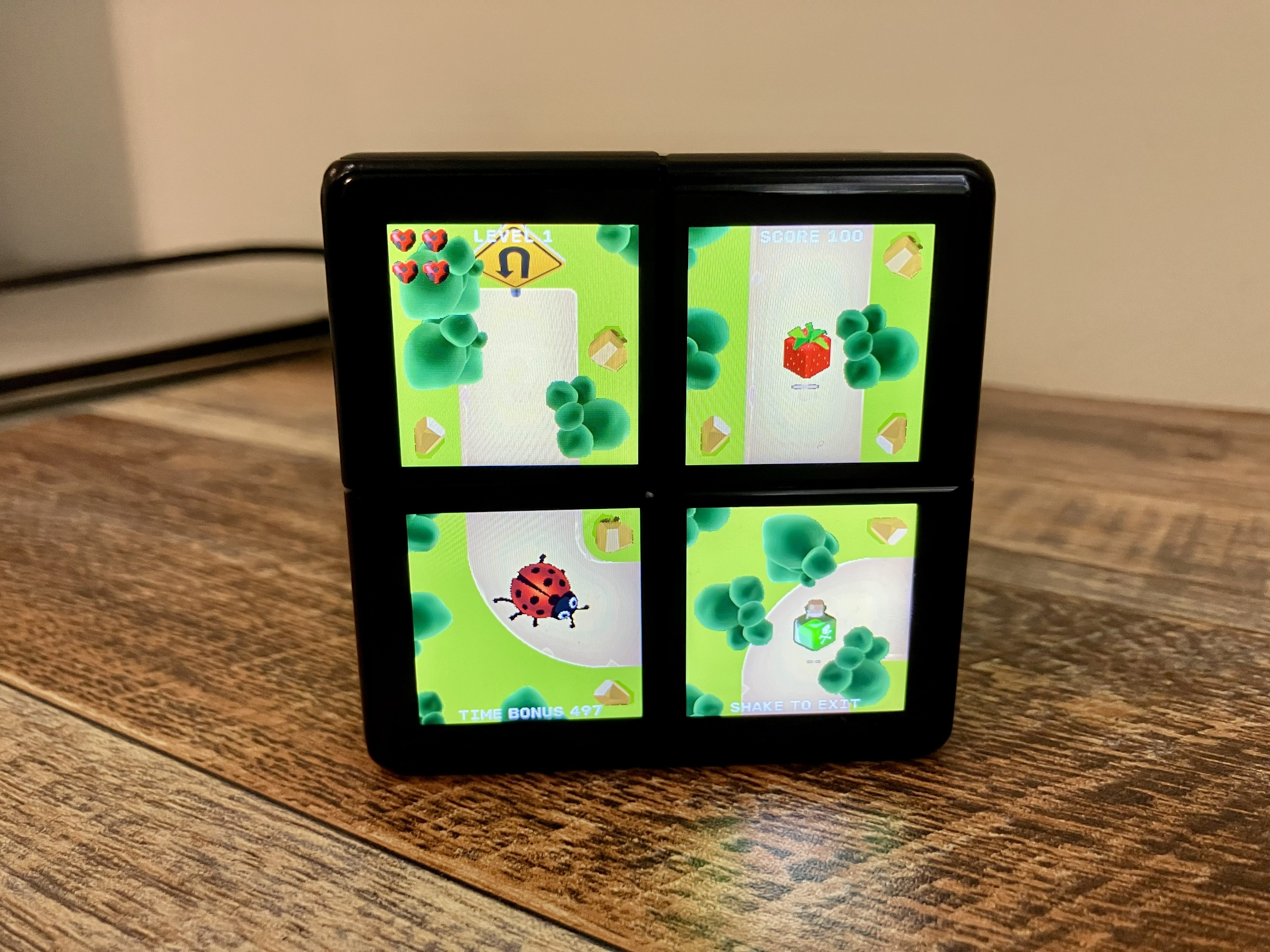
Rubik's WOWCube playing the Ladybug game

The Ladybug game.

Scharon Harding

At the time of writing, the WOWCube has 15 “games,” including the Rubik’s Cube puzzle. Most of the games are free, but some, such as Space Invaders Cubed ($30) and Sunny Side Up ($5), cost money.

Unlike the original Rubik’s Cube, which is content to live on your shelf until you need a brain exercise or go on a road trip, the WOWCube craves attention with dozens of colorful screens, sound effects, and efforts to be more than a toy.

With its Widgets app open, the cube can display information, like the time, temperature, and alerts, from a limited selection of messaging apps. More advanced actions, like checking the temperature for tomorrow or opening a WhatsApp message, are unavailable. There’s room for improvement, but further development, perhaps around features like an alarm clock or reminders, could turn the WOWCube into a helpful desk companion.

https://arstechnica.com/gadgets/2026/02/rubiks-wowcube-adds-complexity-possibility-by-reinventing-the-puzzle-cube/


5 changes to know about in Apple’s latest iOS, macOS, and iPadOS betas

The 26.4 update is the first to begin testing encryption for RCS messages. But as with the initial RCS rollout, Apple is moving slowly and deliberately: for now, encrypted RCS messaging only works when texting between Apple devices, and not between Apple devices and Android phones. The feature also won’t be included in the final 26.4 release—it’s only included in the betas for testing purposes, and it “will be available to customers in a future software update for iOS, iPadOS, macOS, and watchOS.”

Encrypted iMessage and RCS chats will be labeled with a lock icon, much like how most web browsers label HTTPS sites.

To support encrypted messaging, Apple will jump from version 2.4 of the RCS Universal Profile to version 3.0. This should also enable support for several improvements in versions 2.5, 2.6, and 2.7 of the RCS standard, including previously iMessage-exclusive things like editing and recalling messages and replying to specific messages inline.

The return of the “Compact” Safari tab bar

The Compact tab view returns to Safari 26.4 and iPadOS 26.4.

Credit: Andrew Cunningham

The Compact tab view returns to Safari 26.4 and iPadOS 26.4. Credit: Andrew Cunningham

As part of the macOS 12 Monterey/iPadOS 15 beta cycle in 2021, Apple attempted a pretty radical redesign of the Safari browser that combined your tabs and the address bar into one, with the goal of increasing the amount of viewable space on the pages you were viewing. By the time both operating systems were released to the public, Safari’s default design had more or less reverted to its previous state, but the “compact” tab view lived on as an optional view in the settings for those who liked it.

Tahoe, the Safari 26 update, and iPadOS 26 all removed that Compact view entirely, though a version of the Compact view became the default for the iPhone version of Safari. The macOS 26.4, Safari 26.4, and iPadOS 26.4 updates restore the Compact tab option to the other versions of Safari.

On-by-default Stolen Device Protection

Originally introduced in the iOS 17.3 update, Apple’s “Stolen Device Protection” toggle for iPhones added an extra layer of security for users whose phones were stolen by people who had learned their passcodes. With Stolen Device Protection enabled, an iPhone that had been removed from “familiar locations, such as home or work” would require biometric Face ID or Touch ID authentication before accessing stored passwords and credit cards, erasing your phone, or changing Apple Account passwords. Normally, users can enter their passcodes as a fallback; Stolen Device Protection removes that fallback.

https://arstechnica.com/gadgets/2026/02/5-changes-to-know-about-in-apples-latest-ios-macos-and-ipados-betas/


Google’s Pixel 10a arrives on March 5 for $499 with specs and design of yesteryear

It’s that time of year—a new budget Pixel phone is about to hit virtual shelves. The Pixel 10a will be available on March 5, and pre-orders go live today. The 9a will still be on sale for a while, but the 10a will be headlining Google’s store. However, you might not notice unless you keep up with the Pixel numbering scheme. This year’s A-series Pixel is virtually identical to last year’s, both inside and out.

Last year’s Pixel 9a was a notable departure from the older design language, but Google made few changes for 2026. We liked that the Pixel 9a emphasized battery capacity and moved to a flat camera bump, and this time, it’s really flat. Google says the camera now sits totally flush with the back panel. This is probably the only change you’ll be able to identify visually.

Specs at a glance: Google Pixel 9a vs. Pixel 10a
Phone Pixel 9a Pixel 10a
SoC Google Tensor G4 Google Tensor G4
Memory 8GB 8GB
Storage 128GB, 256GB 128GB, 256GB
Display 1080×2424 6.3″ pOLED, 60–120 Hz, Gorilla Glass 3, 2700 nits (peak) 1080×2424 6.3″ pOLED, 60–120 Hz, Gorilla Glass 7i, 3000 nits (peak)
Cameras 48 MP primary, f/1.7, OIS; 13 MP ultrawide, f/2.2; 13 MP selfie, f/2.2 48 MP primary, f/1.7, OIS; 13 MP ultrawide, f/2.2; 13 MP selfie, f/2.2
Software Android 15 (at launch), 7 years of OS updates Android 16, 7 years of OS updates
Battery 5,100 mAh, 23 W wired charging, 7.5 W wireless charging 5,100 mAh, 30 W wired charging, 10 W wireless charging
Connectivity Wi-Fi 6e, NFC, Bluetooth 5.3, sub-6 GHz 5G, USB-C 3.2 Wi-Fi 6e, NFC, Bluetooth 6.0, sub-6 GHz 5G, USB-C 3.2
Measurements 154.7×73.3×8.9 mm; 185 g 153.9×73×9 mm; 183 g

Google also says the new Pixel will have a slightly upgraded screen. The resolution, size, and refresh rate are unchanged, but peak brightness has been bumped from 2,700 nits to 3,000 nits (the same as the base model Pixel 10). Plus, the cover glass has finally moved beyond Gorilla Glass 3 to Gorilla Glass 7i, which supposedly has improved scratch and drop protection.

Pixel 10a in Berry

Credit: Google

Credit: Google

Google notes that more of the phone is constructed from recycled material, 100 percent for the aluminum frame and 81 percent for the plastic back. There’s also recycled gold, tungsten, cobalt, and copper inside, amounting to about 36 percent of the phone’s weight. The phone also continues to have a physical SIM slot, which was removed from the Pixel 10 series last year. The device’s USB-C 3.2 port can also charge slightly faster than the 9a (30 W versus 23 W), and wireless charging has gone from 7.5 W to 10 W. There are no Qi2 magnets inside, though.

Internally, the Pixel 10a is even more like its predecessor. Unlike past A-series phones, this one doesn’t have the latest Tensor chip—it’s sticking with the same Tensor G4 from the 9a. That’s a bummer, as the G5 was a bigger leap than most of Google’s chip upgrades. The company says it stuck with the G4 to “balance affordability and performance.”

https://arstechnica.com/gadgets/2026/02/googles-pixel-10a-arrives-on-march-5-for-499-with-specs-and-design-of-yesteryear/


RAM shortage hits Valve’s four-year-old Steam Deck, now available “intermittently”

Earlier this month, Valve announced it was delaying the release of its new Steam Machine desktop and Steam Frame VR headset due to memory and storage shortages that have been cascading across the PC industry since late 2025. But those shortages are also coming for products that have already launched.

Valve had added a note to its Steam Deck page noting that the device would be “out-of-stock intermittently in some regions due to memory and storage shortages.” None of Valve’s three listed Steam Deck configurations are currently available to buy, nor are any of the certified refurbished Steam Deck configurations that Valve sometimes offers.

Valve hasn’t announced any price increases for the Deck, at least not yet—the 512GB OLED model is still listed at $549 and the 1TB version at $649. But the basic 256GB LCD model has been formally discontinued now that it has sold out, increasing the Deck’s de facto starting price from $399 to $549. Valve announced in December that it was ending production on the LCD version of the Deck and that it wouldn’t be restocked once it sold out.

The Steam Deck’s hardware is four years old this month, and faster hardware with better chips and higher-resolution screens have been released in the years since. But those Ryzen Z1 and Z2 chips aren’t always dramatically faster than the Deck’s semi-custom AMD chip; many of those handhelds are also considerably more expensive than the OLED Deck’s $549 starting price. When it’s in stock, the Deck still offers compelling performance and specs for the price.

https://arstechnica.com/gadgets/2026/02/valves-steam-deck-intermittently-out-of-stock-as-ram-shortage-drags-on/


The first Android 17 beta is now available on Pixel devices

In short, the first Android 17 beta is chock full of things that may interest developers and modders, but there’s little in the way of user-facing changes right now.

Android 17 release schedule

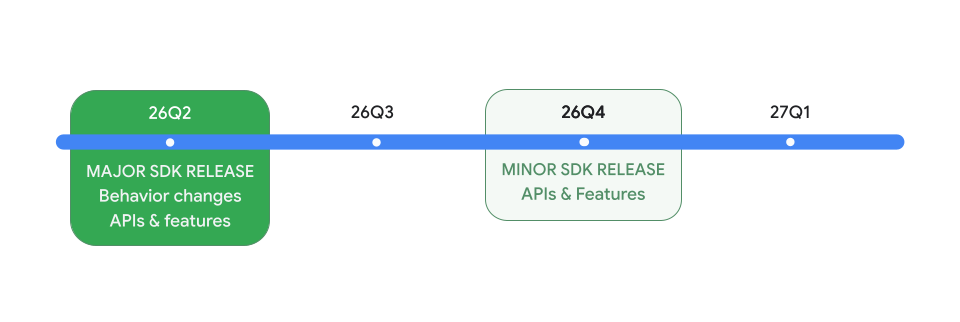
Google has made some notable changes to how it releases Android updates, and Android 17 continues the trend. Like last year, there will be two Android 17 releases in 2026. The first one, coming in Q2, will be the more significant of the two. It will include a raft of new APIs, behavioral changes, and feature updates. This split release setup was implemented to better align with when major OEMs release new devices, but Android 17 availability still focuses mainly on Pixels. Google’s phones receive immediate updates, but everyone else has to wait for OEMs to roll out updates over the following weeks or months.

At the end of the year, another version (you can think of it as Android 17.1 even though Google doesn’t give it a name) will become available on supported devices. This “minor SDK release” will include some API and feature changes, but Google doesn’t have any details at this time.

Android release schedule

Credit: Google

Credit: Google

Before we get to that, Google plans to launch a second beta release in March. The company says Beta 2 will include final APIs, allowing developers to complete testing and roll out updates. Developers will have “several months” to get that work done before the final version hits Pixels.

In 2025, Google also changed the way it updates the open source parts of Android. Rather than regular code dumps, Google now only updates the Android Open Source Project (AOSP) twice yearly, in the second and fourth quarters, when new versions are released. That makes it harder to know what to expect from upcoming versions of Android, but Google insists this is more efficient.

If you want to check out Android 17 today, you’ll need a Pixel device. It supports the Pixel 6, Pixel 7, Pixel 8, Pixel 9, and Pixel 10 generations. The Pixel tablet and original Pixel Fold are also included. Other phone makers may release beta builds in the weeks ahead, but it’s a Google-only event for now. You can opt in to get an OTA to Android 17 on the beta program website.

https://arstechnica.com/gadgets/2026/02/the-first-android-17-beta-is-now-available-on-pixel-devices/


DIY PC maker Framework has needed monthly price hikes to navigate the RAM shortage

AI-driven memory and storage price hikes have been the defining feature of the PC industry in 2026, and hobbyists have been hit the hardest—companies like Apple with lots of buying power have been able to limit the price increases for their PCs, phones, and other gadgets so far, but smaller outfits like Valve and Raspberry Pi haven’t been so lucky.

Framework, the company behind repairable and upgradeable computer designs like the Laptop 13, Laptop 16, and Laptop 12, is also taking a hard hit by price increases. The company stopped selling standalone RAM sticks in November 2025 and has increased prices on one or more of its systems every month since then; this week’s increases are hitting the Framework Desktop and the DIY Editions of its various laptops particularly hard.

The price increases are affecting both standalone SODIMM memory modules and the soldered-down LPDDR5X memory used in the Framework Desktop. Patel says that standalone RAM sticks are being priced “as close as we can to the weighted average cost of our purchases from suppliers.” In September, buying an 8GB stick of RAM with a Framework Laptop 13 cost $40; it currently costs $130. A 96GB DDR5 kit of two 48GB sticks costs $1,340, up from $480 in September.

Framework Desktop systems and boards with built-in RAM are seeing price increases between 6 and 16 percent—in general, the more RAM you’re buying, the higher the increase. The base Framework Desktop system with 32GB of LPDDR5X now starts at $1,209, a $110 increase since launch. The maxed-out 128GB desktop starts at $2,599, a whopping $600 more than the system cost at launch.

https://arstechnica.com/gadgets/2026/02/frameworks-ram-prices-climbing-on-a-monthly-cadence-with-more-hikes-to-come/


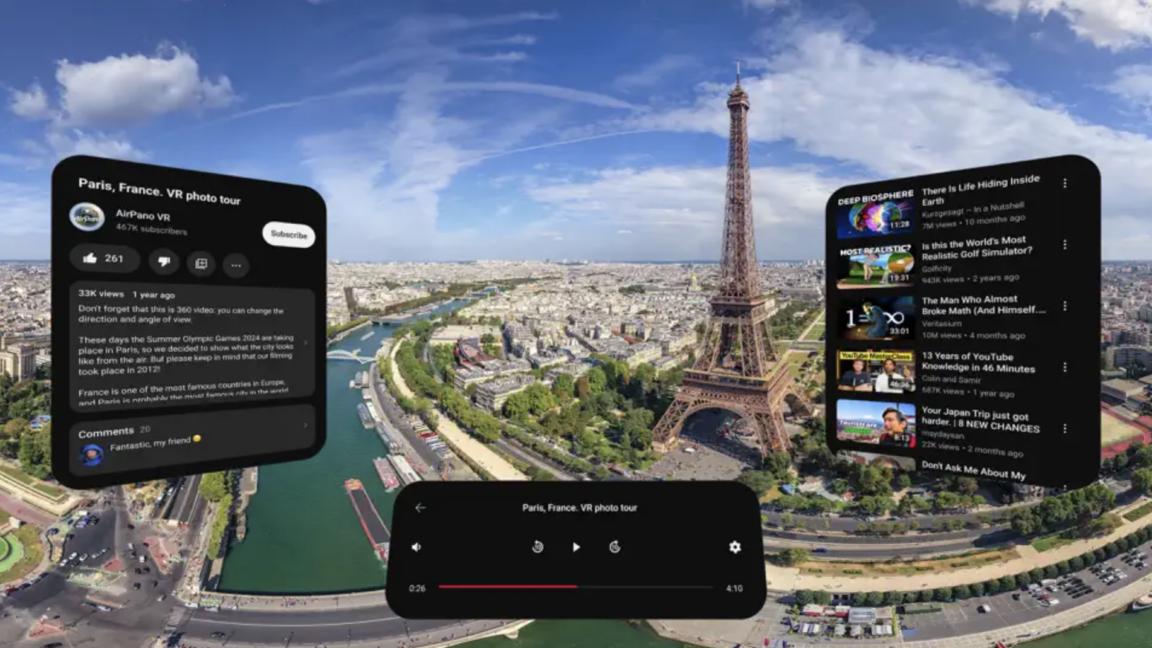
It took two years, but Google released a YouTube app on Vision Pro

When Apple’s Vision Pro mixed reality headset launched in February 2024, users were frustrated at the lack of a proper YouTube app—a significant disappointment given the device’s focus on video content consumption, and YouTube’s strong library of immersive VR and 360 videos. That complaint continued through the release of the second-generation Vision Pro last year, including in our review.

Now, two years later, an official YouTube app from Google has launched on the Vision Pro’s app store. It’s not just a port of the iPad app, either—it has panels arranged spatially in front of the user as you’d expect, and it supports 3D videos, as well as 360- and 180-degree ones.

YouTube’s App Store listing says users can watch “every video on YouTube” (there’s a screenshot of a special interface for Shorts vertical videos, for example) and that they get “the full signed-in experience” with watch history and so on.

Shortly after the Vision Pro launched, many users complained to YouTube about the lack of an app. They were referred to the web interface—which worked OK for most 2D videos, but it obviously wasn’t an ideal experience—and were told that a Vision Pro app was on the roadmap.

Two years of silence followed. Third-party apps popped up, like the relatively popular Juno app, but it was pulled from the App Store on Google’s claim that it violated API policies. (Some others remained or became available later.)

Google is building out its own XR ambitions, so it’s possible the Vision Pro app benefited from some of that work, but it’s unclear how this all came to be. But it’s here now. Next up: Netflix, right? Sadly, that’s unlikely; unlike Google, Netflix has not announced any intention here.

https://arstechnica.com/gadgets/2026/02/it-took-two-years-but-google-released-a-youtube-app-on-vision-pro/


Byte magazine artist Robert Tinney, who illustrated the birth of PCs, dies at 78

On February 1, Robert Tinney, the illustrator whose airbrushed cover paintings defined the look and feel of pioneering computer magazine Byte for over a decade, died at age 78 in Baker, Louisiana, according to a memorial posted on his official website.

As the primary cover artist for Byte from 1975 to the late 1980s, Tinney became one of the first illustrators to give the abstract world of personal computing a coherent visual language, translating topics like artificial intelligence, networking, and programming into vivid, surrealist-influenced paintings that a generation of computer enthusiasts grew up with.

Tinney went on to paint more than 80 covers for Byte, working almost entirely in airbrushed Designers Gouache, a medium he chose for its opaque, intense colors and smooth finish. He said the process of creating each cover typically took about a week of painting once a design was approved, following phone conversations with editors about each issue’s theme. He cited René Magritte and M.C. Escher as two of his favorite artists, and fans often noticed their influence in his work.

A phone call that changed his life

A recent photo portrait of Robert Tinney provided by the family.

A recent photo portrait of Robert Tinney provided by the family.

A recent photo portrait of Robert Tinney provided by the family. Credit: Family of Robert Tinney

Born on November 22, 1947, in Penn Yan, New York, Tinney moved with his family to Baton Rouge, Louisiana, as a child. He studied illustration and graphic design at Louisiana Tech University, and after a tour of service during the Vietnam War, he began his career as a commercial artist in Houston.

His connection to Byte came through a chance meeting with Carl Helmers, who would later found the magazine. In a 2006 interview I conducted with Tinney for my blog, Vintage Computing and Gaming, he recalled how the relationship began: “One day the phone rang in my Houston apartment and it was Carl wanting to know if I would be interested in painting covers for Byte.” His first cover appeared on the December 1975 issue, just three months after the magazine launched.

Over time, his covers became so popular that he created limited-edition signed prints that he sold on his website for decades. “A friend suggested once that I should select the best covers and reproduce them as signed prints,” he said in 2006. “Byte was gracious enough to let me advertise the prints when they could fit in an ad (it did get bumped occasionally), and the prints were very popular in the Byte booth at the big computer shows, two or three of which my wife, Susan, and I attended per year. When an edition sold out, I then put the design on a T-shirt.”

https://arstechnica.com/gadgets/2026/02/byte-magazine-artist-robert-tinney-who-illustrated-the-birth-of-pcs-dies-at-78/


“Windows 11 26H1” is a special version of Windows exclusively for new Arm PCs

But for app developers, IT shops, and anyone else who needs to test things against multiple Windows versions at once, it does create an odd period of overlap where they’ll need to account for one version of Windows that runs just on these brand-new PCs, and one version of Windows that covers everybody else.

Special treatment for Arm PCs

Releasing a new version of Windows that just covers new Arm PCs is another signal of Microsoft’s commitment to Arm processors and the Arm version of Windows, after decades of near-exclusive focus on the x86 version of the OS that ran on Intel and AMD’s chips.

Microsoft offered multiple versions of both Windows 10 and Windows 11 in both x86 and Arm editions, but the 24H2 update was a major milestone for Arm PCs. It came with big under-the-hood changes to Windows’ compiler, kernel, and scheduler, and an optimized x86-to-Arm translation layer called Prism that enhanced the compatibility and performance of apps that hadn’t been built to run on Arm processors.

The 24H2 update also coincided with the release of the first-generation Qualcomm Snapdragon X-series processors, high-performance Arm chips developed by some of the same people behind Apple’s M-series chips for Macs. Many third-party developers have also finally released Arm-native versions of their Windows apps, which are faster and more responsive than translated x86 apps.

Microsoft’s confidence in the Arm version of Windows was so great that the new Surface PCs released in mid-2024 used Qualcomm’s processors exclusively, relegating Intel chips to offshoot versions for businesses with strict compatibility requirements. For years previously, Microsoft had treated the Intel- and AMD-based Surfaces as the “main” ones and the Arm-based Surface Pro X as the offshoot.

Since the 24H2 update, development on the Arm and the traditional x86 versions of Windows has happened at slightly different rates. Some features, particularly things like Recall and Click To Do that were only rolling out to Copilot+ PCs with fast built-in neural processing units (NPUs), have been available for the Arm versions of Windows for a few weeks or months before they hit the x86 versions. Windows 11 24H2 itself was also shipping on Arm PCs in stores several months before Microsoft began rolling the update out to the wider PC ecosystem.

We’ve asked Microsoft to elaborate on what the Windows 11 26H1 update includes and whether it contains any changes that will benefit the wider PC ecosystem somewhere down the line. We’ll update the article if we receive a response.

https://arstechnica.com/gadgets/2026/02/windows-11-26h1-is-a-special-version-of-windows-exclusively-for-new-arm-pcs/


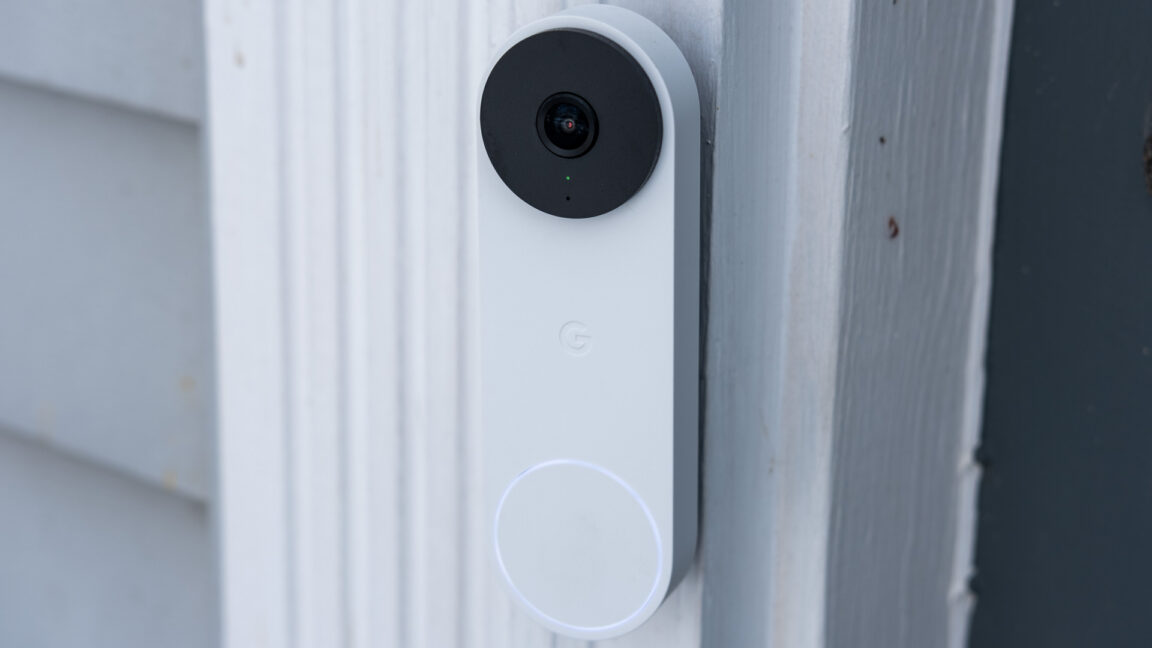
Google recovers “deleted” Nest video in high-profile abduction case

[embedded content]

Suspect attempts to cover the camera with a plant.

In statements made by investigators, the video was apparently “recovered from residual data located in backend systems.” It’s unclear how long such data is retained or how easy it is for Google to access it. Some reports claim that it took several days for Google to recover the data.

In large-scale enterprise storage solutions, “deleted” for the user doesn’t always mean that the data is gone. Data that is no longer needed is often compressed and overwritten only as needed. In the meantime, it may be possible to recover the data. That’s something a company like Google could decide to do on its own, or it could be compelled to perform the recovery by a court order. In the Guthrie case, it sounds like Google was voluntarily cooperating with the investigation, which makes sense. Publishing video of the alleged perpetrator could be a major breakthrough as investigators seek help from the public.

It’s not your cloud

There is a temptation to ascribe some malicious intent to Google’s video storage setup. After all, this video expired after three hours, but here it is nine days later. That feels a bit suspicious on the surface, particularly for a company that is so focused on training AI models that feed on video.

We have previously asked Google to explain how it uses Nest to train AI models, and the company claims it does not incorporate user videos into training data, but the way you interact with the service and with your videos is fair game. “We may use your inputs, including prompts and feedback, usage, and outputs from interactions with AI features to further research, tune, and train Google’s generative models, machine learning technologies, and related products and services,” Google said.

https://arstechnica.com/google/2026/02/google-recovers-deleted-nest-video-in-high-profile-abduction-case/