Samsung’s Ballie home robot, once promised for summer 2025, gets grim update
[embedded content]

CES 2025: Samsung’s new AI robot assistant, Ballie.

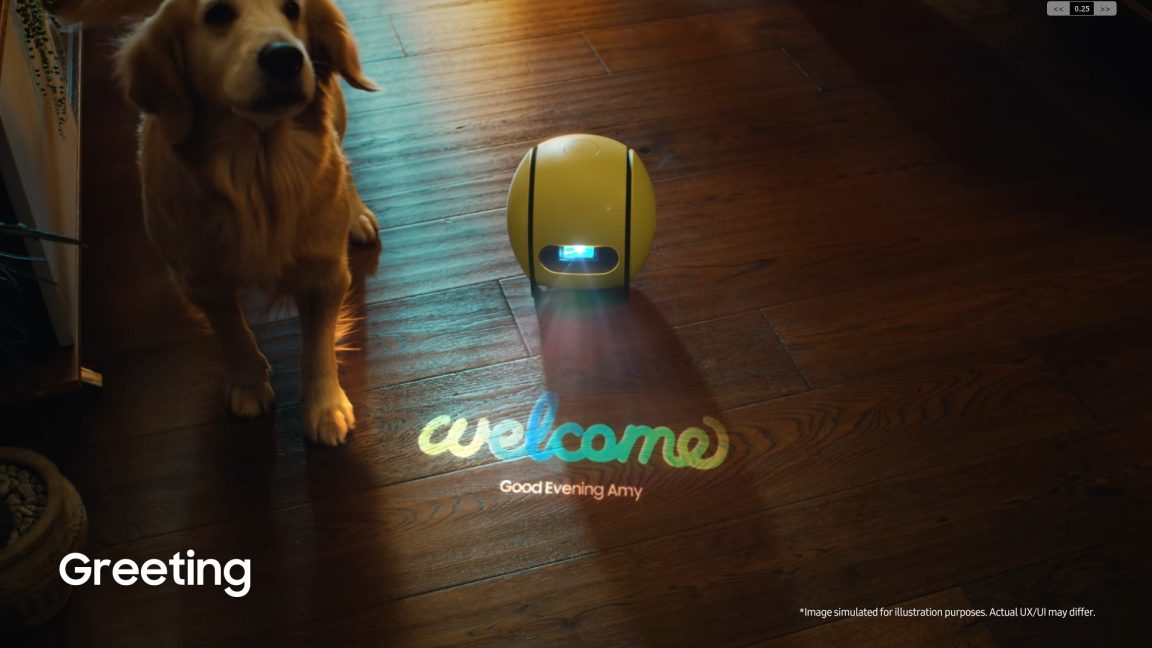
“Available to consumers this summer, Ballie will be able to engage in natural, conversational interactions to help users manage home environments, including adjusting lighting, greeting people at the door, personalizing schedules, setting reminders, and more,” the press release said, pointing to the robot’s implementation of Google Gemini.

It’s now 2026, and Ballie still hasn’t come out. Bloomberg reported today that the device has been “indefinitely shelved.” The publication noted that a company spokesperson called Ballie an “active innovation platform” for internal use, which is noticeably different from referring to it as a gadget that people will eventually be able to buy.

“After multiple years of real-world testing, it continues to inform how Samsung designs spatially aware, context-driven experiences, particularly in areas like smart home intelligence, ambient AI and privacy-by-design,” a Samsung spokesperson said in a statement to Bloomberg.

The website for registering to “get the chance to be the first to meet Ballie” is still up, and it’s possible that Samsung could still release Ballie.

But for now, Samsung may not be confident that Ballie will consistently deliver its advertised features over a long period and/or drum up enough interest from people who can pay the likely high price for a home robot. With many technology companies rethinking their approaches to chatbots, AI in smart speakers, and home robots, Samsung may have decided it was more prudent to extract features from Ballie for use in other products. Ballie likely requires deeper exploration around how it can be more useful and reliable before Samsung sends it to market—if it ever does.

https://arstechnica.com/gadgets/2026/01/samsung-squashes-hopes-that-it-will-release-its-ballie-home-robot/



Motorola reveals the Razr Fold, a book-style foldable launching this summer

The Razr Fold will have a triple 50MP camera system. Some foldable devices like the Galaxy Z Fold 7 have flagship-level main sensors, but the others are a big step down due to space constraints. Motorola will use a 50MP Sony Lytia sensor for the primary, along with a 50MP ultrawide (with macro) and a 50MP 3x telephoto. The camera module adds a fair bit of chunk to the back panel—it looks to almost double the thickness of the phone in that area, but Moto has not released official measurements to confirm that.

AI-infused software, because of course

Motorola is offering a few hints about how the software on this phone will work, but unsurprisingly, there’s a lot we don’t know. For instance, it’s launching in the summer, so does that mean it will run Android 17? Google changed the release schedule in 2025 to account for the glut of new Android devices that launch each summer.

Credit: Motorola

We are also told the Razr Fold’s software will take advantage of the form factor with “flexible layouts, “adaptive interfaces,” and “multitasking enhancements.” The company declined to elaborate on how any of those will work. Motorola will continue offering AI features like Catch Me Up and Pay Attention, but they’re joined by a new AI experience called Qira, which the company says will be accessible across both Motorola and Lenovo devices.

The idea is that Qira remembers your context from other devices, allowing you to take action across apps, create documents, and get supposedly useful reminders. Qira will launch on Lenovo laptops soon, with Motorola phones in the Edge and Razr family soon after. The new AI platform, which relies on technology from the likes of Microsoft and Perplexity, will be available on the Razr Fold at launch.

We also have no idea what Motorola will charge for this phone. Most book-style foldables retail for around $2,000, and the components that go into these phones are not getting cheaper. In fact, many of them could be getting much more expensive in 2026. When pressed, Motorola refuses to even offer a ballpark estimate of MSRP. We should get more details on the Razr Fold specs and pricing as the summer launch window approaches.

https://arstechnica.com/gadgets/2026/01/motorola-reveals-the-razr-fold-a-book-style-foldable-launching-this-summer/


HP’s EliteBoard G1a is a Ryzen-powered Windows 11 PC in a membrane keyboard

Alternatively, HP’s EliteBoard will bring Windows and a more powerful x86 architecture to the keyboard-PC form factor. HP says the EliteBoard will support Windows 11 Pro for Business and an AMD Ryzen AI 300-series processor with an up to 50 TOPs NPU. The device will be sold with a 32 W internal battery and is part of Microsoft’s Copilot+ PC program. 

HP's EliteBoard G1a in a carrying case.

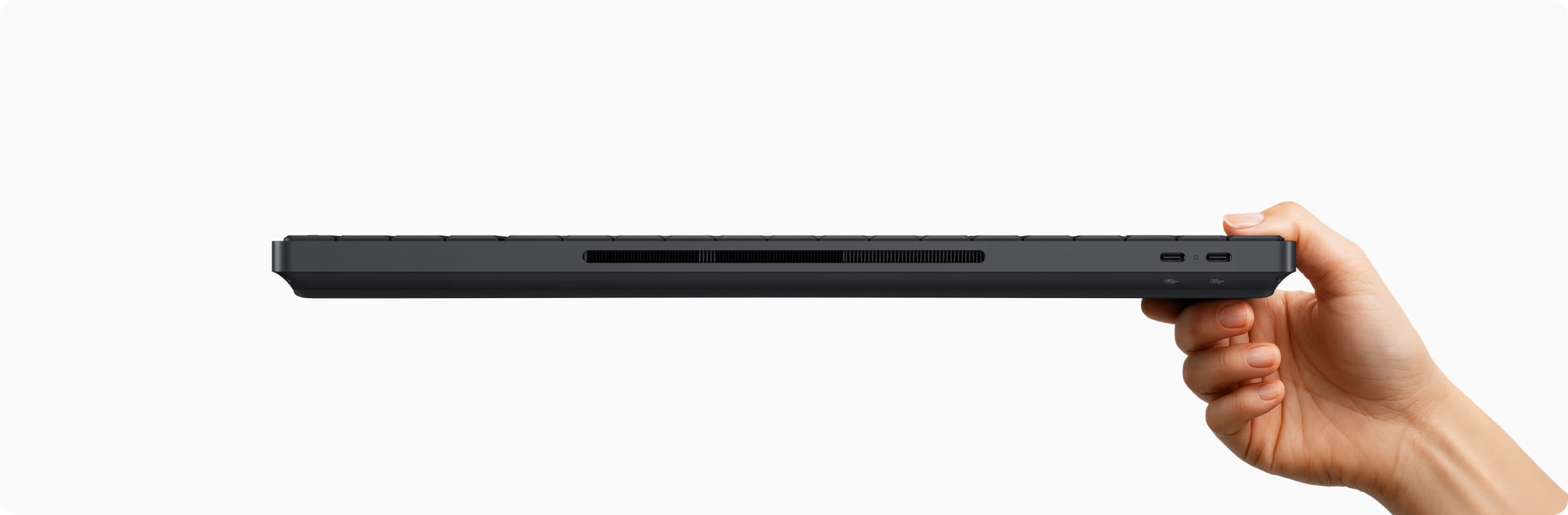
The keyboard-PC has a 0.47-inch-thick profile.

Credit: HP

The keyboard-PC has a 0.47-inch-thick profile. Credit: HP

The EliteBoard is aimed at workplaces that would benefit from ultraportable computers that can be quickly set up, such as corporate offices where employees don’t have assigned seats (also known as hot desking). In its announcement, HP said that the EliteBoard, which weighs 1.65 pounds, was built to “move, connect, and adapt to any workspace with ease.”

HP's EliteBoard G1a profile view.

Marketing images released by HP show the keyboard-PC with two USB-C ports.

Credit: HP

Marketing images released by HP show the keyboard-PC with two USB-C ports. Credit: HP

HP hasn’t released further specs, but based on what we do know, the EliteBoard will have limited computing power, especially compared to other Windows 11 business PCs. Still, the unique system is set to bring new capabilities and a familiar interface to keyboard-PCs. It could garner deeper interest for the category from IT departments seeking easy hybrid workplace solutions, makers, and minimalists interested in experimenting,

HP is demoing the keyboard-PC at CES 2026 in Las Vegas this week and plans to release it in March. It hasn’t set a price yet.

https://arstechnica.com/gadgets/2026/01/hps-eliteboard-g1a-is-a-ryzen-powered-windows-11-pc-in-a-membrane-keyboard/


With GeForce Super GPUs missing in action, Nvidia focuses on software upgrades

For the first time in years, Nvidia declined to introduce new GeForce graphics card models at CES. CEO Jensen Huang’s characteristically sprawling and under-rehearsed 90-minute keynote focused almost entirely on the company’s dominant AI business, relegating the company’s gaming-related announcements to a separate video posted later in the evening.

Instead, the company focused on software improvements for its existing hardware. The biggest announcement in this vein is DLSS 4.5, which adds a handful of new features to Nvidia’s basket of upscaling and frame-generation technologies.

DLSS upscaling is being improved by a new “second-generation transformer model” that Nvidia says has been “trained on an expanded data set” to improve its predictions when generating new pixels. According to Nvidia’s Bryan Catanzaro, this is particularly beneficial for image quality in the Performance and Ultra Performance modes, where the upscaler has to do more guessing because it’s working from a lower-resolution source image.

DLSS Multi-Frame Generation is also improving, increasing the number of AI-generated frames per rendered frame from three to five. This new 6x mode for DLSS MFG is being paired with something called Dynamic Multi-Frame Generation, where the number of AI-generated frames can dynamically change, increasing generated frames during “demanding scenes,” and decreasing the number of generated frames during simpler scenes “so it only computes what’s needed.”

The standard caveats for Multi-Frame Generation still apply: It needs an RTX 50-series GPU (the 40-series can still only generate one frame for every rendered frame, and older cards can’t generate extra frames at all), and the game needs to be running at a reasonably high base frame rate to minimize lag and weird rendering artifacts. It remains a useful tool for making fast-running games run faster, but it won’t help make an unplayable frame rate into a playable one.

https://arstechnica.com/gadgets/2026/01/nvidia-leans-on-dlss-improvements-to-make-up-for-a-lack-of-gpus-at-ces/


Intel launches Core Ultra Series 3 CPUs, made using its long-awaited 18A process

Intel will formally launch its first Core Ultra Series 3 laptop processors later this month, the company announced at its CES keynote today. Codenamed Panther Lake and targeted, at least for now, at high-end ultraportable PCs, the Core Ultra 3 chips will also be the first to use Intel’s 18A manufacturing process, the company’s effort to catch up with the chip manufacturing technology of Taiwan Semiconductor (TSMC).

The launch will start with 14 chips across five product families, which Intel says will be used in “over 200” PC designs. The first of these will be available on January 27, with others following “throughout the first half of this year.”

  • The Core Ultra X9 and Core Ultra X7 processors include all of Intel’s latest CPU and GPU architectures, plus a fully enabled 12-core Intel Arc B390 integrated GPU and support for slightly faster LPDDR5x-9600.
  • The Core Ultra 9 and 7 processors will use all of the same technologies, but with just four GPU cores and support for either LPDDR5x-8533 or DDR5-7200 DIMMs. But they will offer 20 PCI Express lanes, up from 12 for the X9 and X7, meaning they’ll pair better with dedicated GPUs.
  • The Core Ultra 5 chips are mostly lower-end models with fewer CPU cores, and either 4- or 2-core GPUs. But Intel being Intel, there is one oddball that muddies the waters: the Core Ultra 5 338H, which has 12 CPU cores and a 10-core Intel Arc B370 GPU.

A Panther Lake refresher

The higher-end Core Ultra Series 3 CPUs. Credit: Intel

The Core Ultra 5 family encompasses a wide range of possible performance levels. Credit: Intel

We wrote about the basic building blocks of Panther Lake when Intel released details late last year. In many ways the chip is a retreat from the Lunar Lake design, sold as Core Ultra 200V, which used chiplets manufactured mostly outside the company and on-package RAM rather than memory in a DIMM slot or soldered to the mainboard. At the time, Intel said these moves were made in the interest of saving power and extending battery life, as were decisions like removing Hyperthreading support from the P-cores.

Read full article

Comments

https://arstechnica.com/gadgets/2026/01/intel-launches-core-ultra-series-3-cpus-made-using-its-long-awaited-18a-process/


AMD reheats last year’s Ryzen AI and X3D CPUs for 2026’s laptops and desktops

Intel, AMD, Nvidia, and other chip companies usually have some kind of news to announce at CES to kick off the year, but some of those announcements are more interesting than others. Sometimes you see new chips with significant speed boosts and other new technologies, and sometimes you get rebranded versions of old silicon meant to fill out a lineup or make an existing architecture seem newer and more exciting than it is.

AMD’s Ryzen CPU announcements this year fall firmly into the latter camp—these are all gently tweaked variants of chips that launched in 2024 and 2025.

“New,” for certain values of “new”

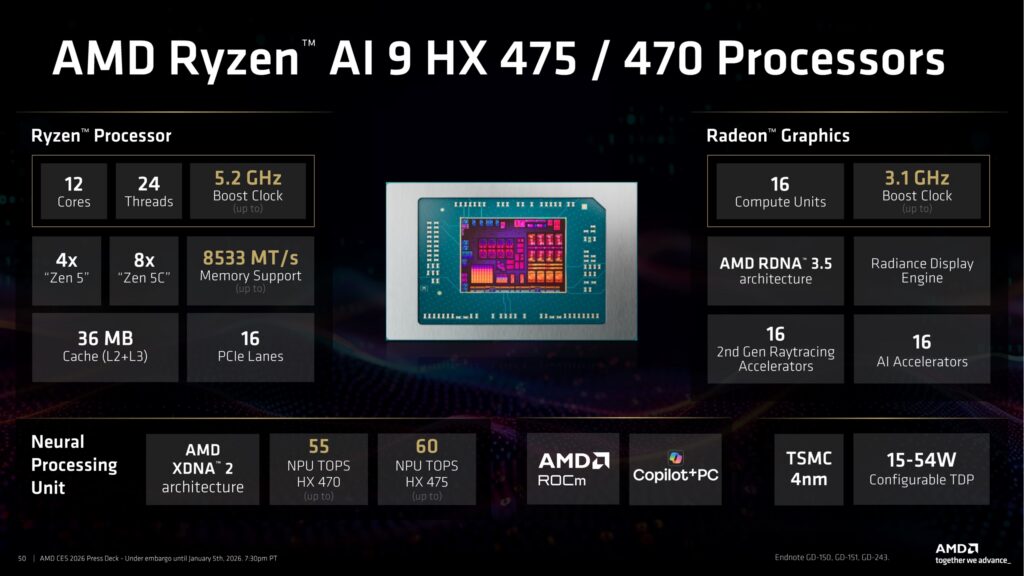
These Ryzen AI 400-series chips are slightly faster than, but otherwise functionally identical to, the Ryzen AI 300 series. Credit: AMD

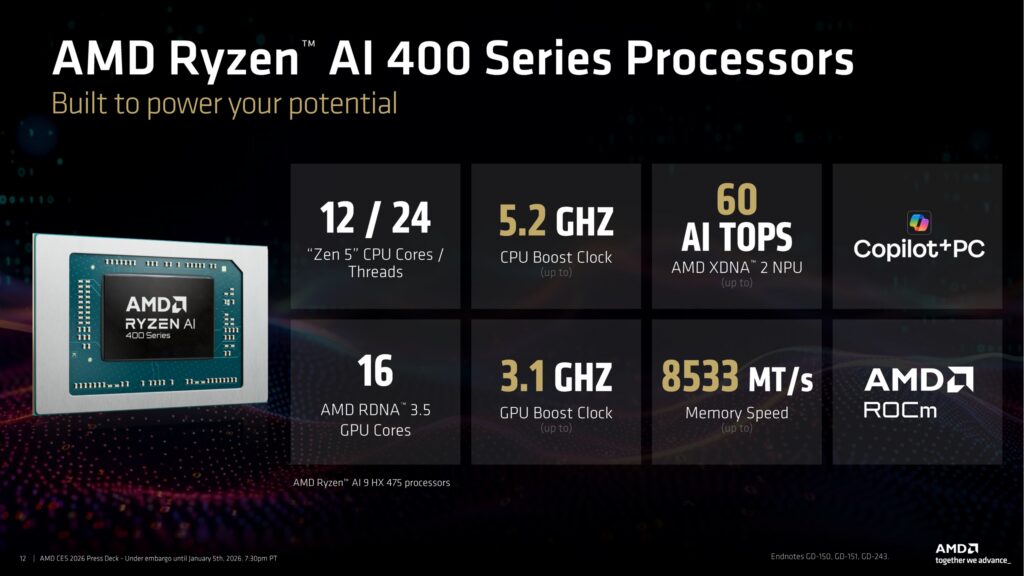
Slightly higher CPU clock speeds, NPU speeds, and supported RAM speeds will separate Ryzen AI 400 from Ryzen AI 300. Credit: AMD

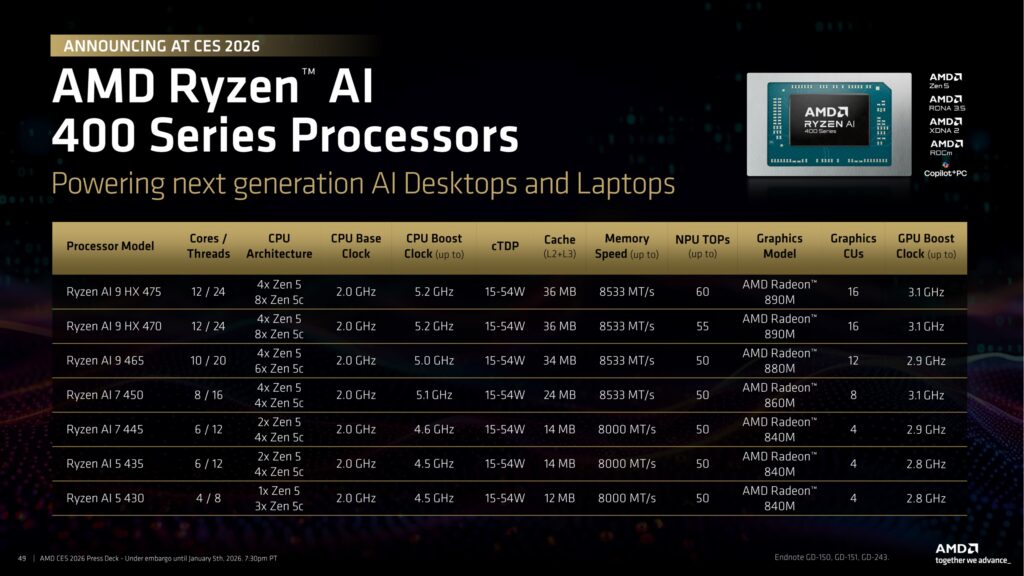
Core specs for the new-ish chips. Credit: AMD

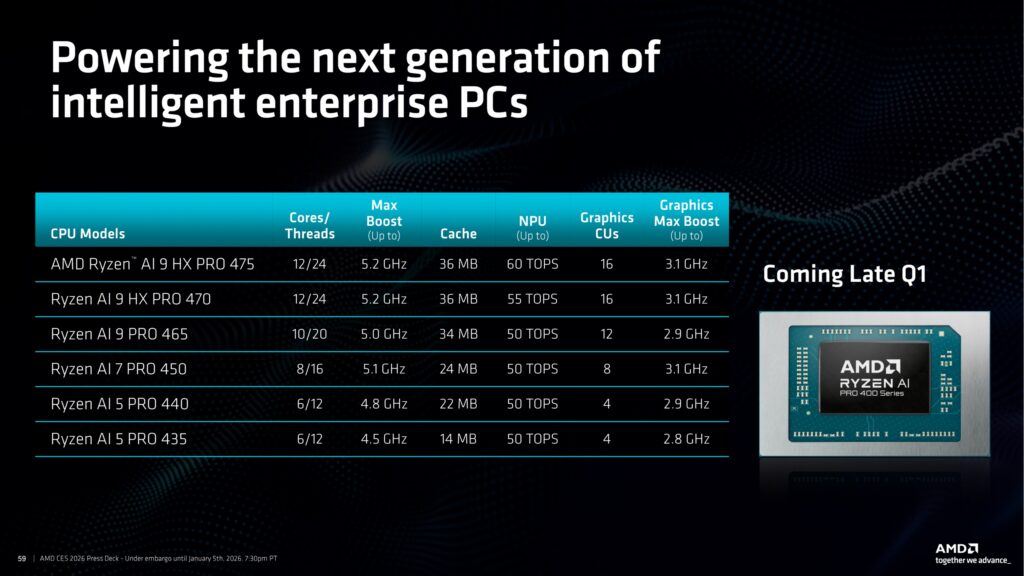
The corresponding Ryzen Pro chips for business PCs. Credit: AMD

Let’s start with the Ryzen AI 400 series. Officially the follow-up to the Ryzen AI 300 chips announced in June 2024, these processors offer some modest clock speed improvements and faster memory support. The new Ryzen AI 9 HX 470 has a peak boost clock speed of 5.2 GHz and support for LPDDR5x-8533, for example, up from 5.1 GHz and LPDDR5x-8000 for the Ryzen AI 9 HX 370, and its built-in neural processing unit (NPU) is capable of 60 trillion operations per second (TOPS) rather than 50 TOPS.

Read full article

Comments

https://arstechnica.com/gadgets/2026/01/amd-reheats-last-years-ryzen-ai-and-x3d-cpus-for-2026s-laptops-and-desktops/


“Streaming stops feeling infinite”: What subscribers can expect in 2026

“Big combined libraries push companies to double down on proven IP because it travels, merchandises, and reduces marketing risk,” said Robert Rosenberg, a partner at the New York law firm Moses Singer focusing on intellectual property, entertainment, technology, and data law.

Rosenberg also expects to see a “tilt toward” live events, sports, and unscripted content “for retention” if HBO Max sells.

In the shorter term, Rory Gooderick, research manager at analyst firm Ampere Analysis, predicted that WBD will be “cautious when greenlighting new large-scale projects until” the acquisition is finalized.

Beyond the potential HBO Max sale, more merger activity could lead to streaming services straying from their original selling point of offering bolder, quirkier content.

As the industry consolidates, “sticky content,” like procedurals, reality shows, and “comfort TV that drives long viewing sessions,” will take priority among mainstream, subscription-based streaming services, especially as they put more emphasis on ad-tier subscriptions, Goodman predicted.

A more stable future?

The new year will be formative for streaming and yield lasting impacts for subscribers. We’ve discussed numerous negative implications, but there could be a silver lining. While we may see more turbulence, hopefully, we’ll also start to see a road toward more stable streaming options.

Streaming subscribers can’t directly stop mergers or price hikes or control streaming libraries. But with services like Netflix and Disney+ focusing on becoming one-stop shops with massive libraries, there’s an opportunity for other services to hone their specialties and stand out by providing offbeat, unexpected, and rare content at more affordable prices.

As the landscape settles, streamers should be mindful of the importance of variety to subscribers. According to Bill Michels, chief product officer at Gracenote, Nielsen’s content data business unit:

There will be some consolidation. But the [connected TV] landscape, inclusive of FAST and [direct-to-consumer] channels, provides more than ample video variety for viewers, so the biggest challenge will be connecting content with the right audience. Audience engagement depends on good content. Audience retention depends on making sure audiences are never without something to watch.

https://arstechnica.com/gadgets/2026/01/streaming-stops-feeling-infinite-what-subscribers-can-expect-in-2026/


Remembering what Windows 10 did right—and how it made modern Windows more annoying

Even the mandatory Microsoft Account sign-in, one of the most frequently complained-about aspects of Windows 11, was a Windows 10 innovation—it was easier to circumvent than it is now, and it was just for the Home edition of the software, but in retrospect, it was clearly a step down the road that Windows 11 is currently traveling.

Windows 11 did make things worse, though

A desktop with an extra informational wallpaper icon, a Start menu full of apps you may or may not use, and a busy taskbar will greet you the first time you log into Windows 11.

A desktop with an extra informational wallpaper icon, a Start menu full of apps you may or may not use, and a busy taskbar will greet you the first time you log in to Windows 11.

Andrew Cunningham

A clean Windows 11 desktop and Start menu.

A cleaner desktop, taskbar, and Start menu, with many extraneous elements removed. With the exception of Edge, most Windows apps can be retained or removed as you prefer.

Andrew Cunningham

But many of Windows 11’s annoyances are new ones. And the big problem is that these annoyances have been stacked on top of the annoying things that Windows 10 was already doing, gradually accumulating to make the new PC setup process go from “lightly” to “supremely” irritating.

The Microsoft Account sign-in requirement is ground zero for a lot of this since signing in with an account unlocks a litany of extra ads for Microsoft 365, Game Pass, and other services you may or may not need or want. Connecting to the Internet and signing in became a requirement for new installations of both the Home and the Pro versions of Windows 11 starting with version 22H2, and while workarounds existed then and continue to exist now, you have to know about them beforehand or look them up yourself—the OS doesn’t offer you an option to skip. Microsoft will also apparently be closing some of these loopholes in future updates, making circumvention even more difficult.

And if getting through those screens when setting up a new PC wasn’t annoying enough, Windows 11 will regularly remind you about other Microsoft services again through its Second Chance Out-Of-Box Experience screen, or SCOOBE. This on-by-default “feature” has offered to help me “finish setting up” Windows 11 installations that are years old and quite thoroughly set up. It can be turned off via a buried checkbox in the Notifications settings, but removing it or making it simpler to permanently dismiss from the SCOOBE screen itself would be the more user-friendly change, especially since Microsoft already bombards users with “helpful reminders” about many of these same services via system notifications.

https://arstechnica.com/gadgets/2025/12/remembering-the-best-and-worst-about-windows-10-on-the-year-it-technically-died/


I switched to eSIM in 2025, and I am full of regret

Maybe this isn’t a good idea

Many people have had the same phone number for years—even decades at this point. These numbers aren’t just a way for people to get in touch because, stupidly, we have also settled on phone numbers as a means of authentication. Banks, messaging apps, crypto exchanges, this very website’s publishing platform, and even the carriers managing your number rely on SMS multifactor codes. And those codes aren’t even very secure.

So losing access to your phone number doesn’t just lock you out of your phone. Key parts of your digital life can also become inaccessible, and that could happen more often now due to the fungible nature of eSIMs.

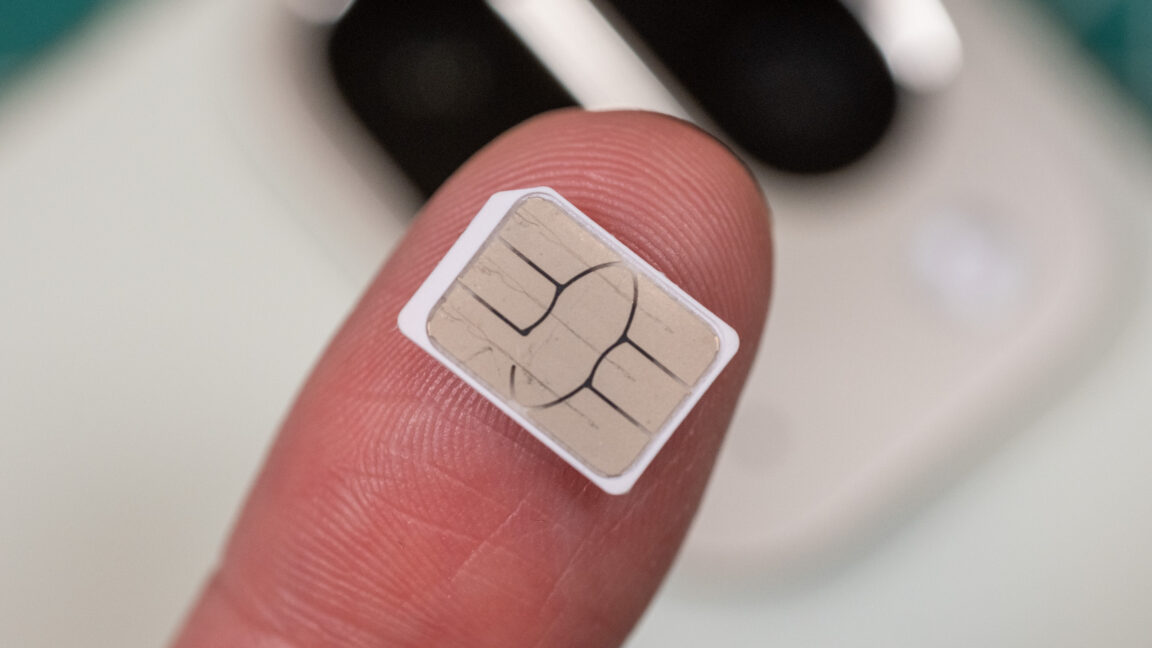
Most people won’t need to move their phone number very often, but the risk that your eSIM goes up in smoke when you do is very real. Compare that to a physical SIM card, which will virtually never fail unless you damage the card. Swapping that tiny bit of plastic takes a few seconds, and it never requires you to sit on hold with your carrier’s support agents or drive to a store. In short, a physical SIM is essentially foolproof, and eSIM is not.

Obviously, the solution is not to remove multifactor authentication—your phone number is, unfortunately, too important to be unguarded. However, carriers’ use of SMS to control account access is self-defeating and virtually guarantees people are going to have bad experiences in the era of eSIM. Enshittification has truly come for SIM cards.

If this future is inevitable, there ought to be a better way to confirm account ownership when your eSIM glitches. It doesn’t matter what that is as long as SMS isn’t the default. Google actually gets this right with Fi. You can download an eSIM at any time via the Fi app, and it’s secured with the same settings as your Google account. That’s really as good as it gets for consumer security. Between Google Authenticator, passkeys, and push notifications, it’s pretty hard to get locked out of Google, even if you take advantage of advanced security features.

We gave up the headphone jack. We gave up the microSD card. Is all this worthwhile to boost battery capacity by 8 percent? That’s a tough sell.

https://arstechnica.com/gadgets/2025/12/i-switched-to-esim-in-2025-and-i-am-full-of-regret/


FCC’s import ban on the best new drones starts today

DJI sent numerous requests to the US government to audit its devices in hopes of avoiding a ban, but the federal ban was ultimately enacted based on previously acquired information, The New York Times reported this week.

The news means that Americans will miss out on new drone models from DJI, which owns 70 percent of the global drone market in 2023, per Drone Industry Insights, and is widely regarded as the premium drone maker. People can still buy drones from US companies, but American drones have a lackluster reputation compared to drones from DJI and other Chinese companies, such as Autel. US-made drones also have a reputation for being expensive, usually costing significantly more than their Chinese counterparts. DaCoda Bartels, COO of FlyGuys, which helps commercial drone pilots find work, told the Times that US drones are also “half as good.”

There’s also concern among hobbyists that the ban will hinder their ability to procure drone parts, potentially affecting the repairability of approved drones and DIY projects.

US-based drone companies, meanwhile, are optimistic about gaining business in an industry where it has historically been hard to compete against Chinese brands. It’s also possible that the ban will just result in a decline in US drone purchases.

In a statement, Michael Robbins, president and CEO of the Association for Uncrewed Vehicle Systems International (AUVSI), which includes US drone companies like Skydio as members, said the ban “will truly unleash American drone dominance” and that the US cannot “risk… dependence” on China for drones.

“By prioritizing trusted technology and resilient supply chains, the FCC’s action will accelerate innovation, enhance system security, and ensure the US drone industry expands rather than remaining under foreign control,” Robbins said.

Understandably, DJI is “disappointed” by the FCC’s decision, it said in a statement issued on Monday, adding:

While DJI was not singled out, no information has been released regarding what information was used by the Executive Branch in reaching its determination. Concerns about DJI’s data security have not been grounded in evidence and instead reflect protectionism, contrary to the principles of an open market.

https://arstechnica.com/gadgets/2025/12/djis-new-drones-will-not-be-available-in-the-us-as-fcc-ban-takes-effect/