The Splay is a subpar monitor but an exciting portable projector 
Since I’m fascinated by new display technologies and by improving image quality, I’ve never been a fan of home projectors. Projectors lack the image quality compared to good TVs and monitors, and they’re pretty needy. Without getting into the specific requirements of different models, you generally want a darker room with a large, blank wall for a projector to look its best. That can be a lot to ask for, especially in small, densely decorated homes like mine.

That said, a projector can be a space-efficient alternative to a big-screen TV or help you watch TV or movies outside. A projector can be versatile when paired with the right space, especially if that projector makes sure the “right space” is included in the device.

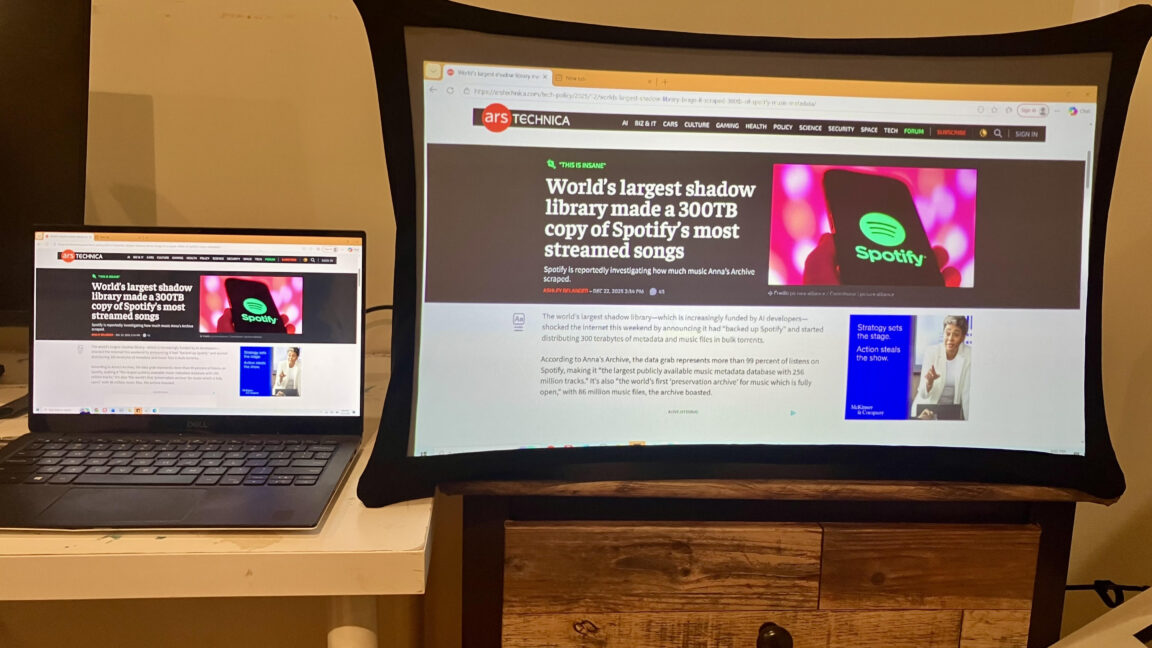
The Splay was crowdfunded in 2021, and its maker, Arovia, describes it as the “first fully collapsible monitor and projector.” In short, it’s a portable projector with an integrated fabric shroud that can serve as a big-screen (24.5 or 34.5 inches diagonally, depending on the model) portable monitor. Or, you can take off the fabric shroud and use the Splay as an ultra-short-throw projector and cast a display that measures up to 80 inches diagonally onto a wall.

At its core, the Splay is a projector, meaning it can’t compete with high-end LCD-LED or OLED monitors. It costs $1,300; the device is currently sold out, but an Arovia representative told me that it will be restocked this month.

Here’s how the device works, per one of Arovia’s patents

The … collapsible, portable display device, has a housing member having a sliding member aligned on the exterior of the housing member, and sliding along the exterior of said housing member between two operating positions, a collapsible screen containing one or more sheets of flexible, wrinkle resistant silicone or rubber materials containing optical enhancing components and capable of displaying an image when in an expanded operating position, and multiple collapsible members connected to said screen …

Arovia’s representative pointed to the Splay being used for mobile workspaces, gaming, and enterprise use cases, like trade shows.

https://arstechnica.com/gadgets/2025/12/the-splay-is-a-subpar-monitor-but-an-exciting-portable-projector/




LG TVs’ unremovable Copilot shortcut is the least of smart TVs’ AI problems

But Copilot will still be integrated into Tizen OS, and Samsung appears eager to push chatbots into TVs, including by launching Perplexity’s first TV app. Amazon, which released Fire TVs with Alexa+ this year, is also exploring putting chatbots into TVs.

After the backlash LG faced this week, companies may reconsider installing AI apps on people’s smart TVs. A better use of large language models in TVs may be as behind-the-scenes tools to improve TV watching. People generally don’t buy smart TVs to make it easier to access chatbots.

But this development is still troubling for anyone who doesn’t want an AI chatbot in their TV at all.

Some people don’t want chatbots in their TVs

Subtle integrations of generative AI that make it easier for people to do things like figure out the name of “that movie” may have practical use, but there are reasons to be wary of chatbot-wielding TVs.

Chatbots add another layer of complexity to understanding how a TV tracks user activity. With a chatbot involved, smart TV owners will be subject to complicated smart TV privacy policies and terms of service, as well as the similarly verbose rules of third-party AI companies. This will make it harder for people to understand what data they’re sharing with companies, and there’s already serious concern about the boundaries smart TVs are pushing to track users, including without consent.

Chatbots can also contribute to smart TV bloatware. Unwanted fluff, like games, shopping shortcuts, and flashy ads, already disrupts people who just want to watch TV.

LG’s Copilot web app is worthy of some grousing, but not necessarily because of the icon that users will eventually be able to delete. The more pressing issue is the TV industry’s shift toward monetizing software with user tracking and ads.

If you haven’t already, now is a good time to check out our guide to breaking free from smart TV ads and tracking.

https://arstechnica.com/gadgets/2025/12/lg-tvs-unremovable-copilot-shortcut-is-the-least-of-smart-tvs-ai-problems/


Riot Games is making an anti-cheat change that could be rough on older PCs

But Riot says it’s considering rolling the BIOS requirement out to all players in Valorant‘s highest competitive ranking tiers (Ascendant, Immortal, and Radiant), where there’s more to be gained from working around the anti-cheat software. And Riot anti-cheat analyst Mohamed Al-Sharifi says the same restrictions could be turned on for League of Legends, though they aren’t currently. If users are blocked from playing by Vanguard, they’ll need to download and install the latest BIOS update for their motherboard before they’ll be allowed to launch the game.

Newer PCs are getting patched; older PCs might not be

An AMD Ryzen 7 5800X3D in a motherboard with a 500-series chipset. It’s unclear whether these somewhat older systems need a patch or will get one. Credit: Andrew Cunningham

The vulnerability is known to affect four of the largest PC motherboard makers: ASRock, Asus, Gigabyte, and MSI. All four have released updates for at least some of their newer motherboards, while other boards have updates coming later. According to the vulnerability note, it’s unclear whether systems from OEMs like Dell, Lenovo, Acer, or HP are affected.

ASRock’s security bulletin about the issue says it affects Intel boards based on the 500-, 600-, 700-, and 800-series chipsets; MSI only lists the 600- and 700-series chipsets. Asus is also missing the 800-series, but says the vulnerability affects boards based on even older 400-series Intel chipsets; Gigabyte, meanwhile, covers 600-through-800-series Intel chipsets, but is also the only vendor to mention patches for AMD’s 600- and 800-series chipsets (any motherboard with an AM5 socket, in short).

Collectively, all of these chipsets cover Intel’s 10th-generation Core processors and newer, and AMD Ryzen 7000 series and newer.

What’s unclear is whether the boards and chipsets that go unmentioned by each vendor aren’t getting a patch because they don’t need a patch, if they will be patched but they just aren’t being mentioned, or if they aren’t getting a patch at all. The bulletins at least suggest that 400- and 500-series Intel chipsets and 600- and 800-series AMD chipsets could be affected, but not all vendors have promised patches for them.

https://arstechnica.com/gadgets/2025/12/some-valorant-players-need-to-update-their-pc-bios-to-keep-anti-cheat-software-happy/


YouTube bans two popular channels that created fake AI movie trailers

Deadline reports that the behavior of these creators ran afoul of YouTube’s spam and misleading-metadata policies. At the same time, Google loves generative AI—YouTube has added more ways for creators to use generative AI, and the company says more gen AI tools are coming in the future. It’s quite a tightrope for Google to walk.

AI movie trailers

A selection of videos from the now-defunct Screen Culture channel.

Credit: Ryan Whitwam

A selection of videos from the now-defunct Screen Culture channel. Credit: Ryan Whitwam

While passing off AI videos as authentic movie trailers is definitely spammy conduct, the recent changes to the legal landscape could be a factor, too. Disney recently entered into a partnership with OpenAI, bringing its massive library of characters to the company’s Sora AI video app. At the same time, Disney sent a cease-and-desist letter to Google demanding the removal of Disney content from Google AI. The letter specifically cited AI content on YouTube as a concern.

Both the banned trailer channels made heavy use of Disney properties, sometimes even incorporating snippets of real trailers. For example, Screen Culture created 23 AI trailers for The Fantastic Four: First Steps, some of which outranked the official trailer in searches. It’s unclear if either account used Google’s Veo models to create the trailers, but Google’s AI will recreate Disney characters without issue.

While Screen Culture and KH Studio were the largest purveyors of AI movie trailers, they are far from alone. There are others with five and six-digit subscriber counts, some of which include disclosures about fan-made content. Is that enough to save them from the ban hammer? Many YouTube viewers probably hope not.

https://arstechnica.com/google/2025/12/youtube-bans-two-popular-channels-that-created-fake-ai-movie-trailers/


Peacock showing ads upon launch opens the door for more disruptive streaming ads

Peacock subscribers will see ads immediately upon opening the streaming app or website next year. It’s a bold new strategy for attracting advertisers—something that’s been increasingly important to subscription-based streaming services—but it also risks alienating viewers

As reported by Variety, the new type of ads will display on the profile selection page that shows when a subscriber launches Peacock. Starting next year, instead of the profile page just showing your different Peacock profiles, most of the page will be dominated by an advertorial image. The circles of NBCUniversal-owned characters selected for user profiles will be relegated to a vertical column on the screen’s left side, as you can see here.

To avoid seeing what NBCUniversal is calling “Arrival Ads” every time you open Peacock, you need to subscribe to Peacock’s most expensive plan, which is ad-free and starts at $17 per month (Peacock’s ad-based plans start at $8/month.)

NBCUniversal’s announcement claims that Peacock will be the first streaming service to implement this type of ad. But that may not be the brag the entertainment giant thinks it is, as subscribers may quickly find the startup ads disruptive.

Peacock isn’t making money

Over the past couple of years, it’s become increasingly important for streaming services to generate revenue beyond subscription fees. Peacock and many other streaming services have struggled with profitability after spending years focusing on pricey content production and licensing to attract subscribers.

For its part, Peacock has 41 million subscribers and isn’t profitable. In its most recent quarterly earnings report, shared in October, NBCUniversal parent company Comcast reported that the service lost $217 million in earnings before interest, taxes, depreciation, and amortization, compared to losing $436 million in the same quarter in 2024. At the same time, Peacock has struggled to grow viewership and has had the same number of subscribers since Q1 2025. In Q1 2024, Peacock had 31 million subscribers.

https://arstechnica.com/gadgets/2025/12/peacock-showing-ads-upon-launch-opens-the-door-for-more-disruptive-streaming-ads/


RAM and SSD prices are still climbing—here’s our best advice for PC builders

If you’ve already got a decent gaming PC, you’re feeling pretty good about all of this—as long as the games you want to play don’t have Mario or Pikachu in them, your PC is all you really need. It’s also not a completely awful time to be upgrading a build you already have, as long as you already have at least 16GB of RAM—if you’re thinking about a GPU upgrade, doing it now before the RAM price spikes can start impacting graphics card pricing is probably a smart move.

If you don’t already have a decent gaming PC and you can buy a whole PlayStation 5 for the cost of some 32GB DDR5 RAM kits, well, it’s hard to look past the downsides no matter how good the upsides are. But it doesn’t mean we can’t try.

What if you want to buy something anyway?

As (relatively) old as they are, midrange Core i5 chips from Intel’s 12th-, 13th-, and 14th-generation Core CPU lineups are still solid choices for budget-to-midrange PC builds. And they work with DDR4, which isn’t quite as pricey as DDR5 right now. Credit: Andrew Cunningham

Say those upsides are still appealing to you, and you want to build something today. How should you approach this terrible, volatile RAM market?

I won’t do a full update to August’s system guide right now, both because it feels futile to try and recommend individual RAM kits or SSD with prices and stock levels being as volatile as they are, and because aside from RAM and storage I actually wouldn’t change any of these recommendations all that much (with the caveat that Intel’s Core i5-13400F seems to be getting harder to find; consider an i5-12400F or i5-12600KF instead). So, starting from those builds, here’s the advice I would try to give to PC-curious friends:

DDR4 is faring better than DDR5. Prices for all kinds of RAM have gone up recently, but DDR4 pricing hasn’t gotten quite as bad as DDR5 pricing. That’s of no help to you if you’re trying to build something around a newer Ryzen chip and a socket AM5 motherboard, since those parts require DDR5. But if you’re trying to build a more budget-focused system around one of Intel’s 12th-, 13th-, or 14th-generation CPUs, a decent name brand 32GB DDR4-3200 kit comes in around half the price of a similar 32GB DDR5-6000 kit. Pricing isn’t great, but it’s still possible to build something respectable for under $1,000.

https://arstechnica.com/gadgets/2025/12/for-just-a-couple-of-months-in-the-middle-of-2025-it-was-an-ok-time-to-build-a-pc/


Software leaks point to the first Apple Silicon “iMac Pro,” among other devices

Apple doesn’t like to talk about its upcoming products before it’s ready, but sometimes the company’s software does the talking for it. So far this week we’ve had a couple of software-related leaks that have outed products Apple is currently testing—one a pre-release build of iOS 26, and the other some leaked files from a kernel debug kit (both via MacRumors).

Most of the new devices referenced in these leaks are straightforward updates to products that already exist: a new Apple TV, a HomePod mini 2, new AirTags and AirPods, an M4 iPad Air, a 12th-generation iPad to replace the current A16 version, next-generation iPhones (including the 17e, 18, and the rumored foldable model), a new Studio Display model, some new smart home products we’ve already heard about elsewhere, and M5 updates for the MacBook Air, Mac mini, Mac Studio, and the other MacBook Pros. There’s also yet another reference to the lower-cost MacBook that Apple is apparently planning to replace the M1 MacBook Air it still sells via Walmart for $599.

For power users, though, the most interesting revelation might be that Apple is working on a higher-end Apple Silicon iMac powered by an M5 Max chip. The kernel debug kit references an iMac with the internal identifier J833c, based on a platform identified as H17C—and H17C is apparently based on the M5 Max, rather than a lower-end M5 chip. (For those who don’t have Apple’s branding memorized, “Max” is associated with Apple’s second-fastest chips; the M5 Max would be faster than the M5 or M5 Pro, but slower than the rumored M5 Ultra.)

This device could be the long-awaited, occasionally-rumored-but-never-launched replacement to Apple’s 27-inch iMac, which was discontinued in 2022 with no direct replacement. An M5 Max chip would also make this machine the closest thing we’ve seen to a direct replacement for the iMac Pro, a 27-inch iMac variant that was launched in late 2017 but likewise discontinued without an update or replacement.

The current M4 Max chip includes 14 or 16 CPU cores, 32 or 40 GPU cores, and between 36GB and 128GB of unified memory, specs we’d expect an M5 Max to match or beat. And because the Max chips already fit into the 14- and 16-inch MacBook Pros, it should be no problem to fit one into an all-in-one desktop PC.

https://arstechnica.com/gadgets/2025/12/leaked-debug-kit-suggests-apple-is-testing-a-new-imac-pro-among-many-other-macs/


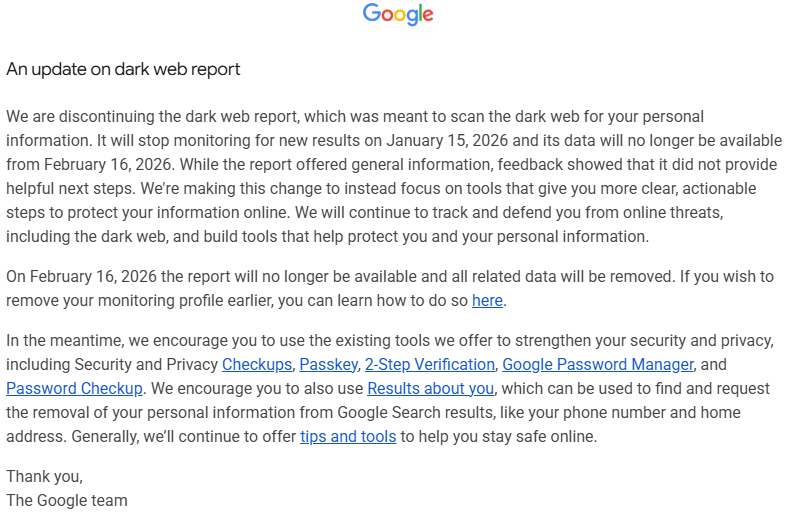
Google will end dark web reports that alerted users to leaked data

As Google admits in the email alert, its dark web scans didn’t offer much help. “Feedback showed that it did not provide helpful next steps,” Google said of the service. Here’s the full text of the email.

Google dark web email

Credit: Google

With other types of personal data alerts provided by the company, it has the power to do something. For example, you can have Google remove pages from search that list your personal data. Google doesn’t run anything on the dark web, though, so all it can do is remind you that your data is being passed around in one of the shadier corners of the Internet.

The shutdown begins on January 15, when Google will stop conducting new scans for user data on the dark web. Past data will no longer be available as of February 16, 2026. Google says it will delete all past reports at that time. However, users can remove their monitoring profile earlier in the account settings. This change does not impact any of Google’s other privacy reports.

The good news is that the best ways to protect your personal data from being shuffled around the dark web are the same ones that keep you safe on the open web. Google suggests always using two-step verification, and tools like Passkeys and Google’s password checkup can ensure you don’t accidentally reuse a compromised password. Stay safe out there.

https://arstechnica.com/gadgets/2025/12/google-is-shutting-down-dark-web-reports-in-january-because-they-werent-helpful/


How to break free from smart TV ads and tracking

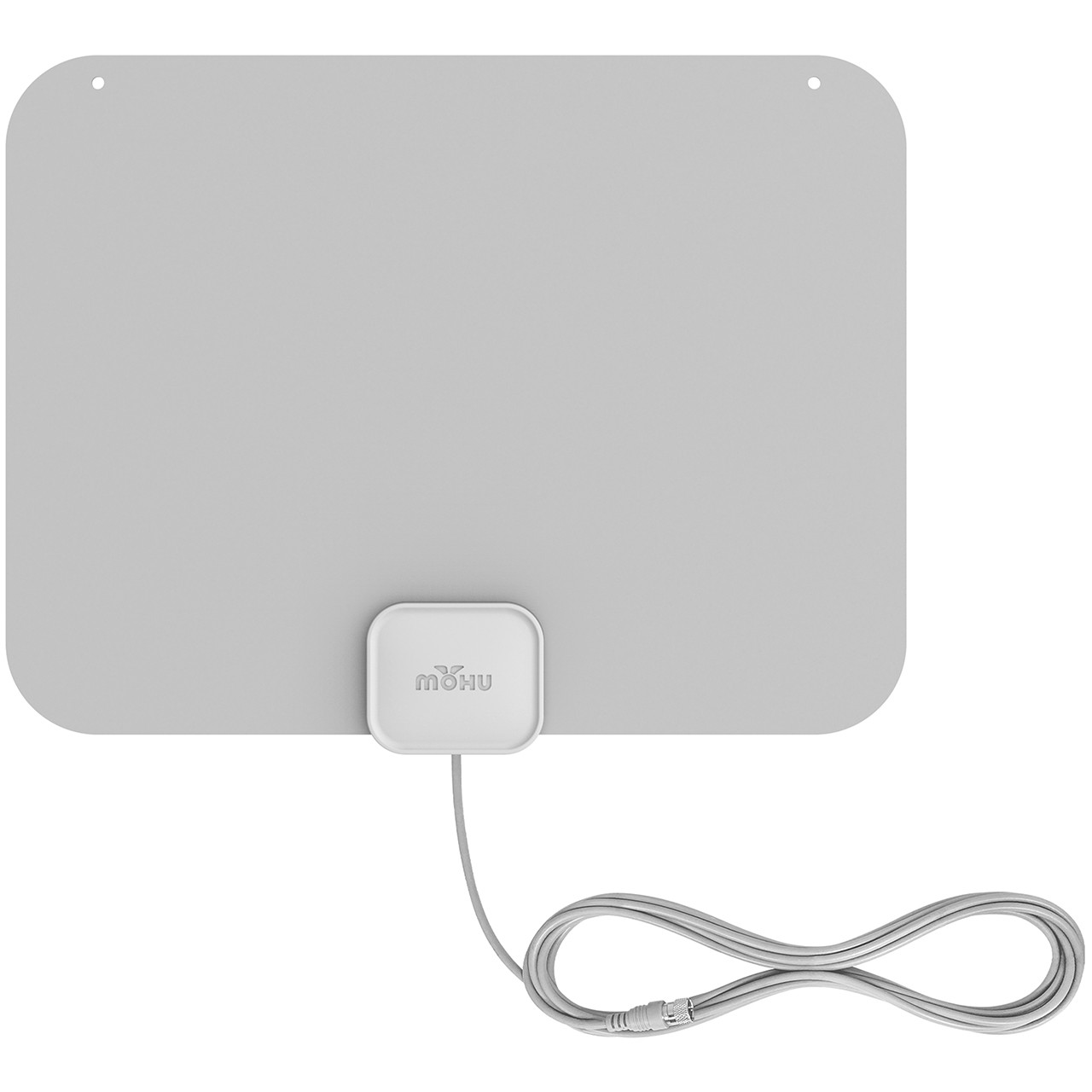
Mohu's Leaf antenna.

Mohu’s Leaf antenna. Bye, bye, bunny ears.

Mohu’s Leaf antenna. Bye, bye, bunny ears. Credit: Mohu

The best part is that companies can’t track what you watch with an antenna. As Nielsen said in a January 2024 blog post:

Big data sources alone can’t provide insight into the viewing behaviors of the millions of viewers who watch TV using a digital antenna.

Antennas have also gotten more versatile. For example, in addition to local stations, an antenna can provide access to dozens of digital subchannels. They’re similar to the free ad-supported television channels gaining popularity with smart TVs users today, in that they often show niche programming or a steady stream of old shows and movies with commercial breaks. You can find a list of channels you’re likely to get with an antenna via this website from the Federal Communications Commission.

TV and movies watched through an antenna are likely to be less compressed than what you get with cable, which means you can get excellent image quality with the right setup.

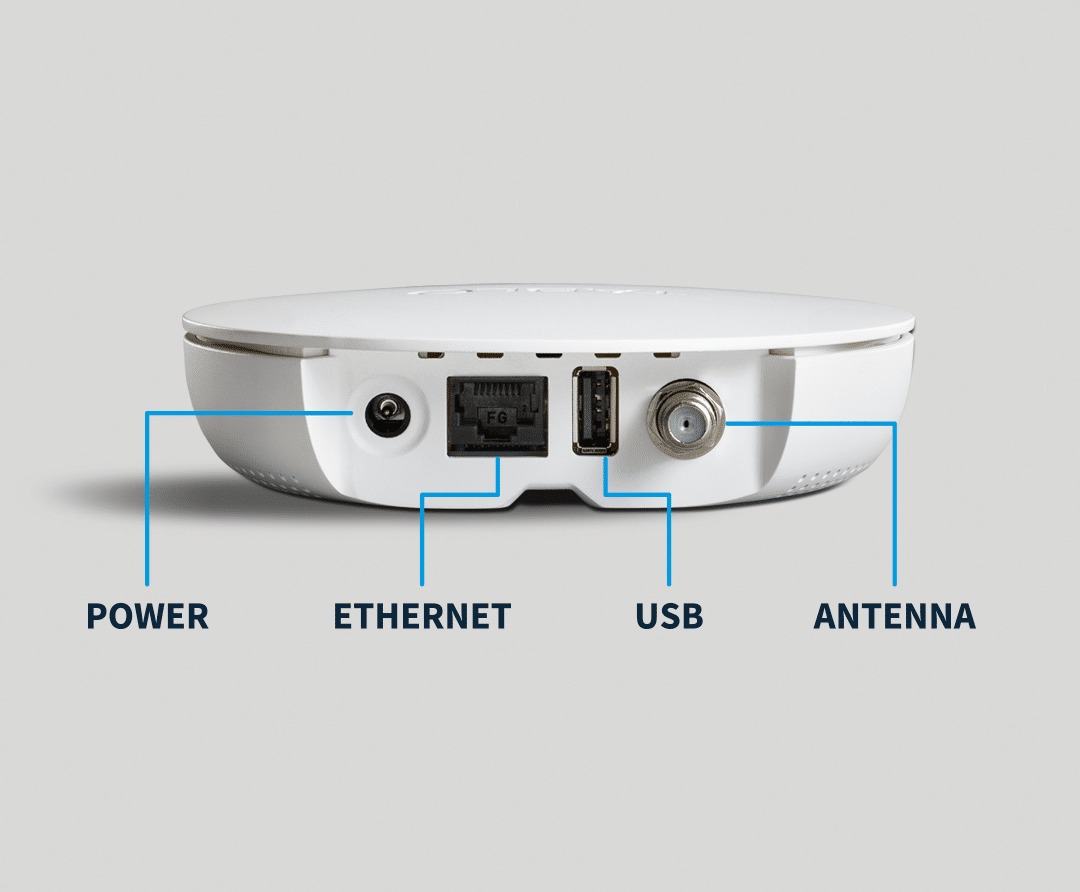
You can also add DVR capabilities, like record and pause, to live broadcasts through hardware, such as a Tablo OTA DVR device or Plex DVR, a subscription service that lets antenna users add broadcast TV recordings to their Plex media servers.

A diagram of the 4th Gen Tablo's ports.

A diagram of the 4th Gen Tablo’s ports.

A diagram of the 4th Gen Tablo’s ports. Credit: Tablo

Things to keep in mind

You’re unlikely to get 4K or HDR broadcasts with an antenna. ATSC 3.0, also known as Next Gen TV, enables stations to broadcast in 4K HDR but has been rolling out slowly. Legislation recently proposed by the FCC could further slow things.

In order to watch a 4K or HDR broadcast, you’ll also need an ATSC 3.0 tuner or an ATSC 3.0-equipped TV. The latter is rare. LG, for example, dropped support in 2023 over a patent dispute. You can find a list of ATSC 3.0-certified TVs and converters here.

Realistically, an antenna doesn’t have enough channels to provide sufficient entertainment for many modern households. Sixty percent of antenna owners also subscribe to some sort of streaming service, according to Nielsen.

Further, obstructions like tall buildings and power lines could hurt an antenna’s performance. Another challenge is getting support for multiple TVs in your home. If you want OTA TV in multiple rooms, you either need to buy multiple antennas or set up a way to split the signal (such as by using an old coaxial cable and splitter, running a new coaxial cable, or using an OTA DVR, such as a Tablo or SiliconDust’s HDHomeRun).

https://arstechnica.com/gadgets/2025/12/the-ars-technica-guide-to-dumb-tvs/


Chatbot-powered toys rebuked for discussing sexual, dangerous topics with kids

OpenAI says it doesn’t allow its LLMs to be used this way

When reached for comment about the sexual conversations detailed in the report, an OpenAI spokesperson said:

Minors deserve strong protections, and we have strict policies that developers are required to uphold. We take enforcement action against developers when we determine that they have violated our policies, which prohibit any use of our services to exploit, endanger, or sexualize anyone under 18 years old. These rules apply to every developer using our API, and we run classifiers to help ensure our services are not used to harm minors.

Interestingly, OpenAI’s representative told us that OpenAI doesn’t have any direct relationship with Alilo and that it hasn’t seen API activity from Alilo’s domain. OpenAI is investigating the toy company and whether it is running traffic over OpenAI’s API, the rep said.

Alilo didn’t respond to Ars’ request for comment ahead of publication.

Companies that launch products that use OpenAI technology and target children must adhere to the Children’s Online Privacy Protection Act (COPPA) when relevant, as well as any other relevant child protection, safety, and privacy laws and obtain parental consent, OpenAI’s rep said.

We’ve already seen how OpenAI handles toy companies that break its rules.

Last month, the PIRG released its Trouble in Toyland 2025 report (PDF), which detailed sex-related conversations that its testers were able to have with the Kumma teddy bear. A day later, OpenAI suspended FoloToy for violating its policies (terms of the suspension were not disclosed), and FoloToy temporarily stopped selling Kumma.

The toy is for sale again, and PIRG reported today that Kumma no longer teaches kids how to light matches or about kinks.

FoloToys' Kumma smart teddy bear

A marketing image for FoloToy’s Kumma smart teddy bear. It has a $100 MSRP.

A marketing image for FoloToy’s Kumma smart teddy bear. It has a $100 MSRP. Credit: FoloToys

But even toy companies that try to follow chatbot rules could put kids at risk.

https://arstechnica.com/gadgets/2025/12/chatbot-powered-toys-rebuked-for-discussing-sexual-dangerous-topics-with-kids/