Google Gemini will now learn from your chats—unless you tell it not to

As Gemini is increasingly woven into the fabric of Google, the way the chatbot accesses and interacts with your data is in a constant state of flux. Today, Google is announcing several big changes to how its AI adapts to you, giving it the ability to remember more details about your chats for improved answers. If that’s a concern, Google also has a new temporary chat option that won’t affect the way Gemini thinks about you.

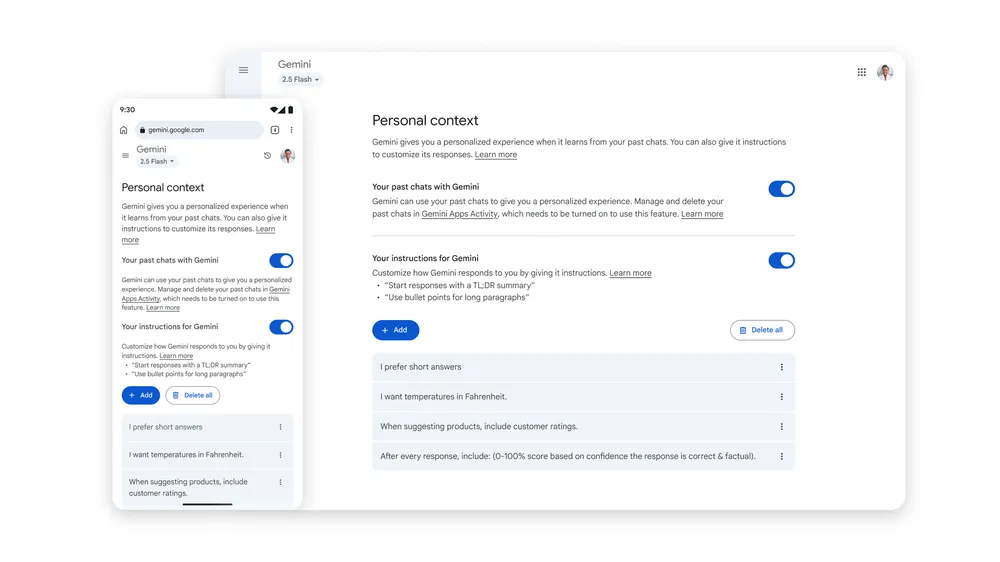
You might recall several months back when Google added a “personalization” option to the Gemini model selector. This mode leaned on your Google search history to customize responses, a feature that did not seem to appeal to many Gemini users. Google later dropped that mode, but a new attempt at customization is now rolling out. Gemini is getting an option called Personal Context. When enabled, the chatbot will remember details about your past conversations, adapting its replies without being specifically prompted.

Google claims Personal Context will produce more relevant responses, particularly when you ask the chatbot to make recommendations. This is separate from the saved instructions feature, which allows you to provide explicit instructions for Gemini to be used in crafting outputs. This does have the potential to make Gemini feel more engaging, but that’s not always a good thing. AI chatbots that get too friendly with the user can reinforce misconceptions and lead to delusional thinking, something we’ve seen distressingly often with AI models.
Credit: Google

To start, this feature will be available with the Gemini 2.5 Pro model, but you won’t get customization in the Eurpean Union,the  UK, or Switzerland. It’s also limited to users over the age of 18. Google says it will eventually release this feature in additional regions and with support for the more efficient Gemini 2.5 Flash model. You can turn Personal Context on and off at will from the main settings page.

https://arstechnica.com/ai/2025/08/google-gemini-will-now-learn-from-your-chats-unless-you-tell-it-not-to/


Perplexity offers more than twice its total valuation to buy Chrome from Google

Google has strenuously objected to the government’s proposed Chrome divestment, which it calls “a radical interventionist agenda.” Chrome isn’t just a browser—it’s an open source project known as Chromium, which powers numerous non-Google browsers, including Microsoft’s Edge. Perplexity’s offer includes $3 billion to run Chromium over two years, and it allegedly vows to keep the project fully open source. Perplexity promises it also won’t enforce changes to the browser’s default search engine.

An unsolicited offer

We’re currently waiting on United States District Court Judge Amit Mehta to rule on remedies in the case. That could happen as soon as this month. Perplexity’s offer, therefore, is somewhat timely, but there could still be a long road ahead.

This is an unsolicited offer, and there’s no indication that Google will jump at the chance to sell Chrome as soon as the ruling drops. Even if the court decides that Google should sell, it can probably get much, much more than Perplexity is offering. During the trial, DuckDuckGo’s CEO suggested a price of around $50 billion, but other estimates have ranged into the hundreds of billions. However, the data that flows to Chrome’s owner could be vital in building new AI technologies—any sale price is likely to be a net loss for Google.

If Mehta decides to force a sale, there will undoubtedly be legal challenges that could take months or years to resolve. Should these maneuvers fail, there’s likely to be opposition to any potential buyer. There will be many users who don’t like the idea of an AI startup or an unholy alliance of venture capital firms owning Chrome. Google has been hoovering up user data with Chrome for years—but that’s the devil we know.

https://arstechnica.com/gadgets/2025/08/perplexity-offers-more-than-twice-its-total-valuation-to-buy-chrome-from-google/


AOL announces September shutdown for dial-up Internet access

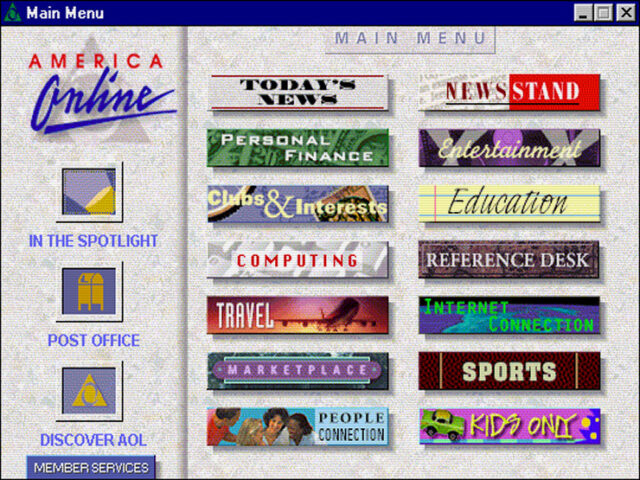
A screenshot of America Online's version 2.5 client in 1995.

A screenshot of America Online’s version 2.5 client in 1995.

The company’s cultural impact extended far beyond mere connectivity. AOL Instant Messenger introduced many users to real-time digital communication. Chat rooms created some of the Internet’s first social networks. The famous “You’ve Got Mail” notification became so iconic that it was a title for a 1998 romantic comedy. For better or worse, AOL keywords trained a generation to navigate the web through corporate-curated portals rather than open searching.

Over the years, Ars Technica documented numerous dial-up developments and disasters that plagued AOL users. In 2015, 83-year-old Ron Dorff received phone bills totaling $24,298.93 after his AOL modem started dialing a long-distance number instead of a local access point—a problem that had plagued users since at least 2002, when New York’s attorney general received more than 50 complaints about similar billing disasters.

The financial risks weren’t limited to technical mishaps: AOL itself contributed to user frustration by repeatedly adjusting its pricing strategy. In 2006, the company raised dial-up rates to $25.90 per month—the same price as broadband—in an attempt to push users toward faster connections. This followed years of subscriber losses that saw AOL’s user base fall over time as the company struggled with conflicting strategies that included launching a $9.95 Netscape-branded service in 2003 while maintaining premium pricing for its main offering.

The infrastructure that remains

AOL’s shutdown doesn’t mean dial-up is completely dead. Several niche providers like NetZero, Juno, and Dialup 4 Less continue to offer dial-up services, particularly in areas where it remains the only option. In the past, some maintained dial-up connections as a backup connection for emergencies, though many still use it for specific tasks that don’t require high bandwidth, like processing credit card payments.

The Public Switched Telephone Network that carries dial-up signals still exists, though telephone companies increasingly route calls through modern packet-switched networks rather than traditional circuit-switched systems. As long as traditional phone service exists, dial-up remains technically possible—just increasingly impractical as the web grows more demanding.

For AOL, maintaining dial-up service likely became more about serving a dwindling but dependent user base than generating meaningful revenue. The infrastructure requirements, customer support needs, and technical maintenance for such a legacy system eventually outweigh the benefits.

The September 30 shutdown date gives remaining dial-up users just over one month now to find alternative Internet access—a challenge for those in areas where alternatives don’t exist. Some may switch to satellite or cellular services despite higher costs. Others may lose Internet access entirely, further widening the digital divide that dial-up, for all its limitations, helped bridge for three decades.

This article was updated on August 12, 2025 at 10:45 AM Eastern to add details about when AOL began offering true Internet access.

https://arstechnica.com/gadgets/2025/08/aol-will-finally-end-1991-dial-up-internet-service-thats-older-than-smartphones/


GitHub will be folded into Microsoft proper as CEO steps down

Putting GitHub more directly under its AI umbrella makes some degree of sense for Microsoft, given how hard it has pushed tools like GitHub Copilot, an AI-assisted coding tool. Microsoft has continually iterated on GitHub Copilot since introducing it in late 2021, adding support for multiple language models and “agents” that attempt to accomplish plain-language requests in the background as you work on other things.

However, there have been problems, too. Copilot inadvertently exposed the private code repositories of a few major companies earlier this year. And a recent Stack Overflow survey showed that trust in AI-assisted coding tools’ accuracy may be declining even as usage has increased, citing the extra troubleshooting and debugging work caused by “solutions that are almost right, but not quite.”

It’s unclear whether Dohmke’s departure and the elimination of the CEO position will change much in terms of the way GitHub operates or the products it creates and maintains. As GitHub’s CEO, Dohmke was already reporting to Julia Liuson, president of the company’s developer division, and Liuson reported to Core AI group leader Jay Parikh. The CoreAI group itself is only a few months old—it was announced by Microsoft CEO Satya Nadella in January, and “build[ing] out GitHub Copilot” was already one of the group’s responsibilities.

“Ultimately, we must remember that our internal organizational boundaries are meaningless to both our customers and to our competitors,” wrote Nadella when he announced the formation of the CoreAI group.

https://arstechnica.com/gadgets/2025/08/github-will-be-folded-into-microsoft-proper-as-ceo-steps-down/


Sonos says it’s forced to raise prices while trying to win back customers

During that call, Sonos CFO Saori Casey said that the company expects “tariff expenses will be approximately $5 million in Q4.” In Sonos’ fiscal Q3, it paid $3.5 million in tariffs, Casey said.

Sonos is still recovering from app problems

Since July 2024, when Sonos’ then-CEO Patrick Spence admitted that a software update inadvertently broke many Sonos devices, the company has been trying to prove to customers and investors that its pricey audio devices are still worth buying.

During the earnings call, Conrad said he believes the value of Sonos gadgets “compounds over time, thanks to the kinds of software updates that deliver new experiences.” But a widely reviled app update last year damaged Sonos’ reputation in this area. The update stripped the app of some basic features, such as the ability to edit playlists and song queues, and many Sonos devices, especially older ones, stopped functioning properly.

Meanwhile, Sonos hasn’t released a new product since the Arc Ultra soundbar and Sub 4 subwoofer in October 2024. In March, reports surfaced that Sonos axed its streaming video player. Conrad told investors yesterday that Sonos has a release roadmap going beyond its 2026 fiscal year. Any devices in that roadmap, however, will be challenged to sell customers on their software, long-term reliability, and price.

Customers may cut Sonos some slack, considering the widespread impact that tariffs are expected to have on electronics pricing. In May, the Trump administration axed the de minimis exemption that enabled duty-free imports of goods worth $800 or less, impacting electronics such as PC peripherals and DIY parts. Currently, the US and China have paused tariffs as the countries look to reach an agreement by August 12. At that time, goods imported from China could face tariffs as high as 145 percent, which would significantly impact the prices of most electronics sold in the US.

But Sonos is already struggling to release and sell new products at high prices, so raising them even higher could further harm the company.

“We lost the momentum in 2024. We’re starting to get it back, and we’re going to accelerate our pace from here,” Conrad said.

https://arstechnica.com/gadgets/2025/08/sonos-says-it-is-forced-to-raise-prices-while-trying-to-win-back-customers/


RIP to the Macintosh HD hard drive icon, 2000–2025

That version of the icon persisted through the Apple Silicon-era Big Sur redesign and was still with us in the first public beta build for macOS 26 Tahoe that Apple released last week. The new beta also updates the icons for external drives (orange, with a USB-C connector on top), network shares (blue, with a globe on top), and removable disk images (white, with an arrow on top).

All of the system’s disk icons get an update in the latest macOS 26 Tahoe developer beta. Credit: Apple/Andrew Cunningham

Other icons that reused or riffed on the old hard drive icon have also been changed. Disk Utility now looks like a wrench tightening an Apple-branded white bolt, for some reason, and drive icons within Disk Utility also have the new SSD-esque icon. Installer apps use the new icon instead of the old one. Navigate to the /System/Library/CoreServices folder where many of the built-in operating system icons live, and you can see a bunch of others that exchange the old HDD icon for the new SSD.

Apple first offered a Mac with an SSD in 2008, when the original MacBook Air came out. By the time “Retina” Macs began arriving in the early 2010s, SSDs had become the primary boot disk for most of them; laptops tended to be all-SSD, while desktops could be configured with an SSD or a hybrid Fusion Drive that used an SSD as boot media and an HDD for mass storage. Apple stopped shipping spinning hard drives entirely when the last of the Intel iMacs went away.

This doesn’t actually matter much. The old icon didn’t look much like the SSD in your Mac, and the new one doesn’t really look like the SSD in your Mac either. But we didn’t want to let the old icon’s passing go unremarked. So, thanks for the memories, Macintosh HD hard drive icon! Keep on spinning, wherever you are.

https://arstechnica.com/gadgets/2025/08/rip-to-the-macintosh-hd-hard-drive-icon-2000-2025/


Murena’s Pixel Tablet is helping to wean me off Google

There were times when a side-by-side comparison found Google’s results to be more aligned with what I had in mind. However, I quickly appreciated Qwant’s lack of AI-generated responses, Google Maps listings, rows of advertisements, and other distractions ahead of actual results. For example, the top results for a search for “Brooklyn rooftop bars” with the Qwant-based engine were roundups from different blogs and publications. Google’s top results were a map, a few bars’ individual websites, posts from Reddit and Instagram, and only two curated lists (one from a news publication and another from Yelp).

The tablet is weaning me off of Google Search, but I’ll likely download Google Maps soon. Murena’s tablet comes with Magic Earth, the only non-open source app preloaded onto the device. However, without Street Views, speedier response, more detailed public transit information (like the names of stops you have to pass), and easier ways to find points of interest, like restaurants, Magic Earth is not sufficient for replacing Google’s alternative—despite Maps’ low privacy rating.

More privacy, please

Despite the inconveniences of a truly Google-free tablet, using Murena’s Pixel Tablet encouraged me to push for more online privacy. It’s proof that privacy-centric tablets and other gadgets are not only possible, but also worthwhile. With Big Tech often failing to protect users, gadgets that don’t spy on you deserve a bigger spotlight.

One of /e/OS’s best features is its privacy reports, which provide an overview of the apps tracking you.

An example of a privacy report.

Credit: Scharon Harding/Murena

An example of a privacy report. Credit: Scharon Harding/Murena

The tablet’s privacy menu also has a toggle for hiding your IP address, although Murena notes that you may want to think twice before sending emails, as “your address may end [up getting a] permanent ban from your provider.” Both features give users more control without introducing complexity and place a much greater emphasis on understanding online privacy than what you find among other tablets.

Murena’s Pixel Tablet, while not perfect, proves that a privacy-forward tablet doesn’t have to come with trade-offs. Devices like this make privacy a competitive advantage that other companies should emulate.

https://arstechnica.com/gadgets/2025/08/murenas-pixel-tablet-is-helping-to-wean-me-off-google/


Roku gets frugal with the content and price of its new streaming service

At a time when subscription video-on-demand (SVOD) streaming services keep getting more expensive and their ads more extensive, Roku’s new streaming service, Howdy, is worth a closer look.

Howdy launched today in the US for $3 per month. It is currently only accessible via a web browser or the Howdy app on Roku OS. Roku said in its announcement today that Howdy will roll out to “mobile and additional platforms in the near future.”

Howdy has, per Roku, “nearly 10,000 hours” of content from Warner Bros. Discovery, Lionsgate, and Filmrise. That’s a much smaller number of content distribution partners than what you’ll find on Roku’s flagship streaming service, The Roku Channel, which has shows and movies from companies like AMC Networks, MGM, NBCUniversal, and Paramount. (Roku also makes the Roku OS operating systems for smart TVs and streaming devices and Roku-brand TVs, and runs the Frndly TV streaming service.)

In its announcement, Roku touted the movies Mad Max: Fury Road (2015) and The Blind Side (2009) and the shows Kids in the Hall from Canada (1984–present) and Showtime’s Weeds (2005–2012), as well as “iconic rom-coms, medical dramas, ’90s comedy, [and] feel-good classics” as spotlights of Howdy’s library.

Perusing the service, you’ll find that featured movies include American Psycho (2000), Divergent (2014), Lucy (2014), Reservoir Dogs (1992), Saw (2004), and The Butterfly Effect (2004). Among featured TV shows are Ambitions (2019), Party Down (2009–2010), and Southland (2009–2013). Other titles include the movie Crank (2006), The Fate of the Furious (2017), The Iron Giant (1999), and the show Cheaters (2000–2021).

Cheap for ad-free streaming

As you can tell from above, Howdy’s library isn’t very modern or competitive with the likes of Netflix or other, more expensive streaming services. But at $3 per month, Howdy is notable as one of the cheapest ways to get mainstream—albeit largely dated—content without ads. For comparison, ad-free access to the much larger libraries of Netflix ($18 per month), Hulu ($19 per month), and Amazon Prime Video (starting at $12 per month without a Prime subscription) costs more.

https://arstechnica.com/gadgets/2025/08/roku-gets-frugal-with-the-content-and-price-of-its-new-streaming-service/


Ukraine rescues soldier via drone delivery of complete e-bike

Details from a frontline war zone are almost impossible to verify, but the brigade has shared plenty of footage, including shots of the drone lifting the bike and a soldier riding it back to safety along a treeline. (Both sides are now making widespread use of e-bikes and motorcycles for quick infantry assaults after three years of drone warfare have wiped out many of the traditional armored vehicles.)

Photo of drone command center.

The drone command center that ran the operation.

In their telling, a soldier with the callsign “Tankist” was holding a frontline position that came under attack, and a number of his comrades were killed. Tankist found himself cut off from safety and had to hold the position alone for several days.

To retrieve him, brigade staff devised a plan to deliver an e-bike via heavy bomber drone. The first drone was shot down, while the second failed under the weight. But the third attempt was successful, and Tankist was finally able to zip back toward Ukrainian lines. (He apparently hit a landmine on the way and survived that, too, finishing the trip on a second delivered e-bike.)

Amazon, of course, has had “drone delivery” in view for years and is currently testing delivery drones at locations around the US, including Pontiac, Michigan; Phoenix, Arizona; and Waco, Texas.

But these drones will only deliver packages weighing under 5 lbs—an e-bike weighs considerably more.

https://arstechnica.com/gadgets/2025/08/ukraine-rescues-soldier-via-drone-delivery-of-complete-e-bike/


Amazon is considering shoving ads into Alexa+ conversations

Since 2023, Amazon has been framing Alexa+ as a monumental evolution of Amazon’s voice assistant that will make it more conversational, capable, and, for Amazon, lucrative. Amazon said in a press release on Thursday that it has given early access of the generative AI voice assistant to “millions” of people. The product isn’t publicly available yet, and some advertised features are still unavailable, but Amazon’s CEO is already considering loading the chatbot up with ads.

During an investors call yesterday, as reported by TechCrunch, Andy Jassy noted that Alexa+ started rolling out as early access to some customers in the US and that a broader rollout, including internationally, should happen later this year. An analyst on the call asked Amazon executives about Alexa+’s potential for “increasing engagement” long term.

Per a transcript of the call, Jassy responded by saying, in part, “I think over time, there will be opportunities, you know, as people are engaging in more multi-turn conversations to have advertising play a role to help people find discovery and also as a lever to drive revenue.”

Like other voice assistants, Alexa has yet to monetize users. Amazon is hoping to finally make money off the service through Alexa+, which is eventually slated to play a bigger role in e-commerce, including by booking restaurant reservations, keeping track of and ordering groceries, and recommending streaming content based on stated interests. But with Alexa reportedly costing Amazon $25 billion across four years, Amazon is eyeing additional routes to profitability.

Echo Show devices already show ads, and Echo speaker users may hear ads when listening to music. Advertisers have shown interest in advertising with Alexa+, but the inclusion of ads in a new offering like Alexa+ could drive people away.

https://arstechnica.com/gadgets/2025/08/amazon-is-considering-shoving-ads-into-alexa-conversations/