Ukraine rescues soldier via drone delivery of complete e-bike

Details from a frontline war zone are almost impossible to verify, but the brigade has shared plenty of footage, including shots of the drone lifting the bike and a soldier riding it back to safety along a treeline. (Both sides are now making widespread use of e-bikes and motorcycles for quick infantry assaults after three years of drone warfare have wiped out many of the traditional armored vehicles.)

Photo of drone command center.

The drone command center that ran the operation.

In their telling, a soldier with the callsign “Tankist” was holding a frontline position that came under attack, and a number of his comrades were killed. Tankist found himself cut off from safety and had to hold the position alone for several days.

To retrieve him, brigade staff devised a plan to deliver an e-bike via heavy bomber drone. The first drone was shot down, while the second failed under the weight. But the third attempt was successful, and Tankist was finally able to zip back toward Ukrainian lines. (He apparently hit a landmine on the way and survived that, too, finishing the trip on a second delivered e-bike.)

Amazon, of course, has had “drone delivery” in view for years and is currently testing delivery drones at locations around the US, including Pontiac, Michigan; Phoenix, Arizona; and Waco, Texas.

But these drones will only deliver packages weighing under 5 lbs—an e-bike weighs considerably more.

https://arstechnica.com/gadgets/2025/08/ukraine-rescues-soldier-via-drone-delivery-of-complete-e-bike/


Amazon is considering shoving ads into Alexa+ conversations

Since 2023, Amazon has been framing Alexa+ as a monumental evolution of Amazon’s voice assistant that will make it more conversational, capable, and, for Amazon, lucrative. Amazon said in a press release on Thursday that it has given early access of the generative AI voice assistant to “millions” of people. The product isn’t publicly available yet, and some advertised features are still unavailable, but Amazon’s CEO is already considering loading the chatbot up with ads.

During an investors call yesterday, as reported by TechCrunch, Andy Jassy noted that Alexa+ started rolling out as early access to some customers in the US and that a broader rollout, including internationally, should happen later this year. An analyst on the call asked Amazon executives about Alexa+’s potential for “increasing engagement” long term.

Per a transcript of the call, Jassy responded by saying, in part, “I think over time, there will be opportunities, you know, as people are engaging in more multi-turn conversations to have advertising play a role to help people find discovery and also as a lever to drive revenue.”

Like other voice assistants, Alexa has yet to monetize users. Amazon is hoping to finally make money off the service through Alexa+, which is eventually slated to play a bigger role in e-commerce, including by booking restaurant reservations, keeping track of and ordering groceries, and recommending streaming content based on stated interests. But with Alexa reportedly costing Amazon $25 billion across four years, Amazon is eyeing additional routes to profitability.

Echo Show devices already show ads, and Echo speaker users may hear ads when listening to music. Advertisers have shown interest in advertising with Alexa+, but the inclusion of ads in a new offering like Alexa+ could drive people away.

https://arstechnica.com/gadgets/2025/08/amazon-is-considering-shoving-ads-into-alexa-conversations/


Citing “market conditions,” Nintendo hikes prices of original Switch consoles

Slowed tech progress, inflation, and global trade wars are doing a number on game console pricing this year, and the bad news keeps coming. Nintendo delayed preorders of the Switch 2 in the US and increased accessory prices, and Microsoft gave its Series S and X consoles across-the-board price hikesin May.

Today, Nintendo is back for more, increasing prices on the original Switch hardware, as well as some Amiibo, the Alarmo clock, and some Switch and Switch 2 accessories. The price increases will formally take effect on August 3.

The company says that there are currently no price increases coming for the Switch 2 console, Nintendo Online memberships, and physical and digital Switch 2 games. But it didn’t take future price increases off the table, noting that “price adjustments may be necessary in the future.”

Nintendo didn’t announce how large the price increases would be, but some retailers were already listing higher prices as of Friday. Target now lists the Switch Lite for $229.99, up from $199.99; the original Switch for $339.99, up from $299.99; and the OLED model of the Switch for a whopping $399.99, up from $349.99 and just $50 less than the price of the much more powerful Switch 2 console.

https://arstechnica.com/gadgets/2025/08/citing-market-conditions-nintendo-hikes-prices-for-original-switch-consoles/


Google releases Gemini 2.5 Deep Think for AI Ultra subscribers

Google is unleashing its most powerful Gemini model today, but you probably won’t be able to try it. After revealing Gemini 2.5 Deep Think at the I/O conference back in May, Google is making this AI available in the Gemini app. Deep Think is designed for the most complex queries, which means it uses more compute resources than other models. So it should come as no surprise that only those subscribing to Google’s $250 AI Ultra plan will be able to access it.

Deep Think is based on the same foundation as Gemini 2.5 Pro, but it increases the “thinking time” with greater parallel analysis. According to Google, Deep Think explores multiple approaches to a problem, even revisiting and remixing the various hypotheses it generates. This process helps it create a higher-quality output.

Deep Think benchmarks

Credit: Google

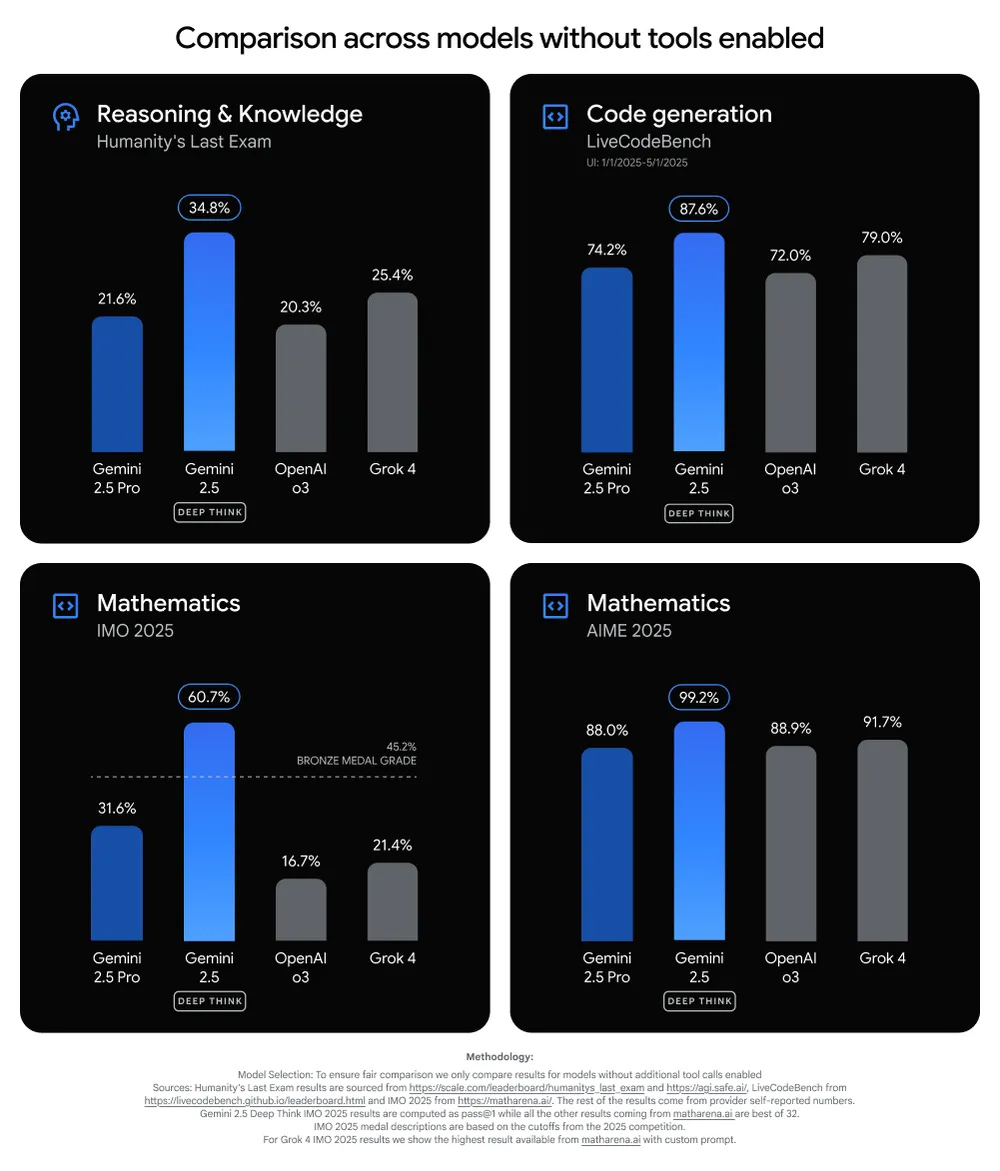
Like some other heavyweight Gemini tools, Deep Think takes several minutes to come up with an answer. This apparently makes the AI more adept at design aesthetics, scientific reasoning, and coding. Google has exposed Deep Think to the usual battery of benchmarks, showing that it surpasses the standard Gemini 2.5 Pro and competing models like OpenAI o3 and Grok 4. Deep Think shows a particularly large gain in Humanity’s Last Exam, a collection of 2,500 complex, multi-modal questions that cover more than 100 subjects. Other models top out at 20 or 25 percent, but Gemini 2.5 Deep Think managed a score of 34.8 percent.

https://arstechnica.com/ai/2025/08/google-releases-gemini-2-5-deep-think-for-ai-ultra-subscribers/


Developer survey shows trust in AI coding tools is falling as usage rises

AI tools are widely used by software developers, but those devs and their managers are still grappling with figuring out how exactly to best put the tools to use, with growing pains emerging along the way.

That’s the takeaway from the latest survey of 49,000 professional developers by community and information hub Stack Overflow, which itself has been heavily impacted by the addition of large language models (LLMs) to developer workflows.

The survey found that four in five developers use AI tools in their workflow in 2025—a portion that has been rapidly growing in recent years. That said, “trust in the accuracy of AI has fallen from 40 percent in previous years to just 29 percent this year.”

The disparity between those two metrics illustrates the evolving and complex impact of AI tools like GitHub Copilot or Cursor on the profession. There’s relatively little debate among developers that the tools are or ought to be useful, but people are still figuring out what the best applications (and limits) are.

When asked what their top frustration with AI tools was, 45 percent of respondents said they struggled with “AI solutions that are almost right, but not quite”—the single largest reported problem. That’s because unlike outputs that are clearly wrong, these can introduce insidious bugs or other problems that are difficult to immediately identify and relatively time-consuming to troubleshoot, especially for junior developers who approached the work with a false sense of confidence thanks to their reliance on AI.

As a result, more than a third of the developers in the survey “report that some of their visits to Stack Overflow are a result of AI-related issues.” That is to say, code suggestions they accepted from an LLM-based tool introduced problems they then had to turn to other people to solve.

Even as major improvements have recently come via reasoning-optimized models, that close-but-not-quite unreliability is unlikely to ever vanish completely; it’s endemic to the very nature of how the predictive technology works.

https://arstechnica.com/ai/2025/07/developer-survey-shows-trust-in-ai-coding-tools-is-falling-as-usage-rises/


Apple releases iOS 18.6, macOS 15.6, and other updates as current gen winds down

Apple’s next-generation software updates are just a couple of months away, but Apple isn’t done with last year’s releases just yet. Apple has released iOS 18.6, iPadOS 18.6, macOS Sequoia 15.6, watchOS 11.6, tvOS 18.6, and visionOS 2.6 to the public today, fixing an issue with sharing movies from the Photos app but mostly patching a long list of security vulnerabilities.

For iOS, iPadOS, and macOS, the list of resolved CVEs covers everything from the Metal graphics API to WebKit to networking to filesystem permissions issues. All told, each of these updates patches over two dozen vulnerabilities, and the other OS updates cover many of the same flaws. According to Apple’s release notes, at least, none of these vulnerabilities are being actively exploited in the wild—you should patch as soon as you can, but there appear to be no known zero-day vulnerabilities.

For iOS and iPadOS users in the EU, the updates also include a mechanism for installing alternate app stores and for installing apps directly from websites, in accordance with the EU’s Digital Markets Act.

Many of the security fixes are also available for older operating systems that Apple is still maintaining, mostly for people who can’t update their devices to the latest versions. The iPadOS 17.7.9 update covers several tablets that were dropped by iPadOS 18, and macOS Ventura 13.7.7 and macOS Sonoma 14.7.7 will cover fading Intel Macs that were dropped by newer releases.

All of these operating systems will be superseded in the fall by new releases, unified under version number 26. The first public betas of iOS 26, iPadOS 26, macOS 26, and other updates were released last week.

https://arstechnica.com/gadgets/2025/07/apple-releases-ios-18-6-macos-15-6-and-other-updates-as-current-gen-winds-down/


Acquisition sends thousands of Whistle pet trackers to IoT graveyard

Whistle pet trackers are headed to the Internet of Things (IoT) graveyard. After releasing its first product in 2013, the Seattle-based Whistle has just been acquired by a competitor that has decided to brick all of Whistle’s smart GPS and activity monitors.

Tractive, an Austrian company that has also been selling Internet-connected GPS trackers for pets since 2013, on Monday announced its acquisition of Whistle from Mars Petcare, as spotted by The Verge. Mars Petcare is the pet food subsidiary of Mars Inc (which also makes candies like M&M’s), and it acquired Whistle in 2016 for $117 million.

Tractive bought Whistle to expand its business in the US. Until September 30, Whistle owners can get Tractive devices to replace the Whistle trackers that Tractive is bricking. People currently paying for a Whistle subscription will see their subscriptions transferred to their new Tractive device. People with a Whistle device but no subscription must “pay for a Tractive subscription” in order to get a replacement device, Tractive’s website says. Tractive subscriptions start at $108 per year.

Despite buying Whistle’s technology, Tractive says it would be too difficult to run both its own and Whistle’s platforms. Its website reads:

… maintaining and developing two separate ecosystems—devices, apps, and software—doubles the complexity and could limit the quality of service and innovation.

By unifying efforts under a single, powerful technology platform, Tractive can deliver new features and improvements faster, more reliably, and with greater impact for all users—including former Whistle customers.

Tractive devices have some features that Whistle products lack, such as resting heart rate and respiratory rate monitoring. Some Whistle users still aren’t sold on the switch, though, because Tractive devices don’t have all the features that Whistle’s product line has, including the Health 2.0 Smart Device’s efforts to track pets’ licking, scratching, eating, drinking, and sleeping.

https://arstechnica.com/gadgets/2025/07/acquisition-sends-thousands-of-whistle-pet-trackers-to-iot-graveyard/


Bankrupt Futurehome suddenly makes its smart home hub a subscription service

Smart home device maker Futurehome is forcing its customers’ hands by suddenly requiring a subscription for basic functionality of its products.

Launched in 2016, Futurehome’s Smarthub is marketed as a central hub for controlling Internet-connected devices in smart homes. For years, the Norwegian company sold its products, which also include smart thermostats, smart lighting, and smart fire and carbon monoxide alarms, for a one-time fee that included access to its companion app and cloud platform for control and automation. As of June 26, though, those core features require a 1,188 NOK (about $116.56) annual subscription fee, turning the smart home devices into dumb ones if users don’t pay up.

“You lose access to controlling devices, configuring; automations, modes, shortcuts, and energy services,” a company FAQ page says.

You also can’t get support from Futurehome without a subscription. “Most” paid features are inaccessible without a subscription, too, the FAQ from Futurehome, which claims to be in 38,000 households, says.

After June 26, customers had four weeks to continue using their devices as normal without a subscription. That grace period recently ended, and users now need a subscription for their smart devices to work properly.

Some users are understandably disheartened about suddenly having to pay a monthly fee to use devices they already purchased. More advanced users have also expressed frustration with Futurehome potentially killing its devices’ ability to work by connecting to a local device instead of the cloud. In its FAQ, Futurehome says it “cannot guarantee that there will not be changes in the future” around local API access.

In response, a Reddit user, according to a Reddit-provided translation of the Norwegian post, said:

I can understand to some extent that they have to do it for services that have ongoing expenses, like servers (even though I actually think it’s their problem, not mine, that they didn’t realize this was a bad idea when they sold me the solution), but a local function that only works internally in the equipment I’ve already paid for shouldn’t be blocked behind a paywall.

According to Futurehome, subscription-less customers can still create, delete, and switch between households, edit household users and owners, and update and factory reset their Futurehome Smarthubs.

https://arstechnica.com/gadgets/2025/07/bankrupt-futurehome-suddenly-makes-its-smart-home-hub-a-subscription-service/


Blender developers begin work on full-fledged mobile version

To that end, some features developed for the mobile version of Blender will cross-pollinate to desktop, like icon support for sidebar tabs and a helper overlay with curated shortcuts, among other things.

You can see some mockups over at the Blender blog. Development has begun in earnest on a new, separate branch for this tablet application. It will be developed first to target the iPad Pro and Apple Pencil, with other platforms and tablets to get tailored support later.

It sounds like the team already has some knowledgable designers and developers on this branch, but the blog post is also an invitation for new contributors. Specifically, it calls for “developers with extensive experience in this area” to contribute to building the application, touch events and gestures support, “File System / iCloud / AirDrop support,” and OpenSubdiv.

It sounds like things are already moving relatively quickly, as a tech demo is planned for SIGGRAPH 2025 in Vancouver next month.

https://arstechnica.com/gadgets/2025/07/popular-3d-application-blender-will-get-a-tablet-version/


Echelon kills smart home gym equipment offline capabilities with update

Some might never have purchased Echelon equipment if they knew the machines might one day fail to work without a web connection or Echelon account.

Third-party app connections severed

For some owners of Echelon equipment, QZ, which is currently rated as the No. 9 sports app on Apple’s App Store, has been central to their workouts. QZ connects the equipment to platforms like Zwift, which shows people virtual, scenic worlds while they’re exercising. It has also enabled new features for some machines, like automatic resistance adjustments. Because of this, Viola argued in his blog that QZ has “helped companies grow.”

“A large reason I got the [E]chelon was because of your app and I have put thousands of miles on the bike since 2021,” a Reddit user told the developer on the social media platform on Wednesday.

However, Echelon’s firmware update likely seeks to regain some of the revenue opportunities that overlap with the capabilities that apps like QZ enable. Echelon’s subscription-based app, which starts at $40 per month, also offers “guided scenic rides,” for example. QZ can allow people to watch Peloton classes from their Echelon device, but Echelon sells its own fitness classes. The Tennessee-headquartered company has been investing in ways to get customers more engaged with its personalized workout platform, too, which requires the machines to be online.

There’s also value in customer data. Getting more customers to exercise with its app means Echelon may gather more data for things like feature development and marketing.

Echelon is a private company, and we don’t know how much money it is making, but it’s likely that its financial goals hinge on subscription sales, which can generate more revenue than expensive equipment purchases. Meanwhile, Echelon is competing with other tech-centric companies offering gym equipment and classes, like the Peloton.

Viola runs QZ, which costs $7 to $8 to download, alone, offering users a lot of support via online communities. He told Ars that revenue from app purchases covers his costs “more or less.”

“It was never my intention to damage anyone’s business. This is just competition. The best product should prevail,” Viola said. “I never created QZ to get rich; I just wanted users to have a great hour of fitness when they choose, without connection issues, subscriptions, or [other limitations].”

In terms of QZ, the user community is “working on a fully open-source Echelon controller to unlock bikes that have already received this update,” per Viola. It’s in the very early stages, he said.

https://arstechnica.com/gadgets/2025/07/firmware-update-hinders-echelon-smart-home-gym-equipments-ability-to-work-offline/